


Abstract
The increasing penetration of distributed renewable energy resources and the emergence of prosumers are reshaping the operational landscape of distribution grids. This work proposes a comprehensive prosumer-centric control and coordination framework integrated into the IEEE 33-bus radial distribution feeder. Selected buses are modeled as aggregated prosumer nodes equipped with photovoltaic (PV) generation, wind turbines, oncentrated solar power (CSP), a hybrid energy storage system (HESS) including redox flow batteries (RFBs), superconducting magnetic energy storage (SMES), and fuel cells (FCs), as well as electric vehicle (EV) fleets. A hierarchical power management strategy is developed, combining a decentralized fuzzy logic controller for real-time dispatch with a Particle Swarm Optimization (PSO) layer that tunes membership functions and rule weights to enhance system stability and renewable utilization. Time-series simulations are conducted to evaluate the impact of prosumer integration on network performance. The results show a significant improvement in the voltage profile across all buses, particularly at downstream nodes, highlighting the effectiveness of distributed renewable injections and coordinated storage management. The proposed framework illustrates the potential of clustered prosumers to support voltage stability, improve grid operation and enable high-renewable penetration in distribution networks.
1. Introduction
The electric power system is undergoing a structural transformation driven by the rapid deployment of distributed renewable energy sources (RESs) and increasing electrification of transport and heat. Decentralized generation is progressively shifting energy production away from centralized plants toward low-voltage distribution networks, producing new operational patterns with higher variability and bidirectional power flows that conventional distribution practices were not designed to handle [1,2].
Concurrently, the notion of the prosumer, which represents an end-user that both consumes and produces energy, has matured from a conceptual proposal into a practical paradigm enabled by smart meters, local storage, and electric vehicles (EVs). Prosumers are increasingly able to actively manage generation and demand, participate in local energy markets and provide ancillary services to the distribution grid. While this participation creates opportunities for cost reduction, demand shaping and resilience, it also introduces additional operational complexity for distribution system operators (DSOs) [2,3].
The combination of high RES penetration and prosumer activity raises three interdependent categories of challenges in distribution networks. The first involves technical challenges manifesting in high local power injection during high-generation periods, which causes voltage rise, reverse power flow and potential thermal overloads in radial feeders. Moreover, the intermittency of RESs increases real-time balancing requirements and system uncertainty. Addressing these issues requires active, fast-responding local resources and coordinated dispatch. The second involves operational challenges in the form of prosumers controlling heterogeneous devices—including photovoltaic (PV) systems, small wind turbines, batteries, EVs, and potentially fuel-based units—with different time constants and degradation characteristics. Coordinating these devices to achieve multi-objective goals requires advanced control strategies beyond fixed heuristic rules. The third involves economic and market challenges, as prosumers interact with time-varying electricity tariffs, feed-in tariffs and emerging peer-to-peer schemes. Scheduling decisions must therefore jointly optimize energy costs, potential export revenues and device lifecycle costs [4,5].
Hybrid energy storage systems (HESSs), which combine technologies with complementary strengths—such as fast-response, high-power but low-energy devices, including superconducting magnetic energy storage (SMES), electrochemical systems optimized for energy capacity and cycle life such as redox flow batteries (RFBs), and fuel cell (FC) based generation for long-duration support—represent a promising solution for meeting the diverse temporal requirements of prosumer operation. HESS architectures permit separation of duties, SMES for transient smoothing, RFB for daily arbitrage and medium-duration buffering, and FC for sustained backup, which improves overall system efficiency and reduces degradation of individual components. Recent studies and reviews report increasing interest in HESS architectures for microgrid and prosumer applications, highlighting advantages of combining multiple storage technologies [5,6].
From a control perspective, rule-based or deterministic scheduling approaches struggle to capture the nonlinear and multi-objective nature of prosumer management. Fuzzy logic controllers provide an interpretable framework for encoding heuristic expert knowledge and producing smooth control actions under uncertainty. Several recent studies have demonstrated the effectiveness of fuzzy energy management systems (EMS) in microgrids with hybrid storage. Metaheuristic optimization methods are widely used to tune control parameters and storage sizing in energy systems, as they efficiently explore nonconvex and multimodal search spaces while handling mixed continuous and discrete design variables. In particular, Particle Swarm Optimization (PSO) has been shown to be effective for energy management and storage sizing problems [7,8].
Electric vehicles (EVs) add both flexibility and complexity: they represent mobile storage resources that can provide vehicle-to-grid (V2G) services, but their availability is constrained by user behavior and travel schedules. System-level strategies that jointly consider EV charging and potentially V2G operation within prosumer dispatch can significantly reshape load profiles and reduce peak power imports, provided adequate incentives and scheduling are in place. Comprehensive reviews underline V2G’s potential and list implementation challenges including communication requirements, battery degradation and user acceptance [9,10].
Recent research has increasingly focused on integrated prosumer architectures that jointly combine distributed renewable generation, hybrid energy storage systems, electric vehicles, and advanced control strategies within distribution networks. Studies have shown that coordinated operation of PV, wind generation, and multi-technology storage significantly improves voltage regulation, power smoothing, and system resilience compared to single-technology solutions. In parallel, intelligent energy management systems based on fuzzy logic, neural networks, and rule-based controllers have been widely adopted to handle the nonlinear and uncertain nature of prosumer operation, often enhanced through metaheuristic optimization techniques such as PSO for parameter tuning and performance improvement. At the same time, several works have explored the role of EVs as flexible assets capable of supporting grid services when properly integrated into local control schemes. However, much of the existing literature addresses these components in isolation or within simplified microgrid models, with limited validation on realistic radial distribution feeders and incomplete consideration of heterogeneous storage stacks and coordinated multi-layer control [11,12].
Very recent studies published in 2024 and 2025 indicate a clear shift in prosumer research toward more adaptive, decentralized, and intelligence-driven energy management frameworks. Advanced real-time and predictive control approaches, such as model predictive control and robust decentralized schemes, have been proposed to better accommodate uncertainty in renewable generation, load variability, and user behavior in prosumer-based microgrids. At the same time, increased attention has been given to coordinated operation of heterogeneous resources, including hybrid energy storage systems and flexible demand assets, with an emphasis on scalability and resilience in realistic distribution-level environments. Emerging works also highlight the growing importance of distributed decision-making and interaction mechanisms among multiple prosumers, moving beyond isolated microgrid studies toward community-level and feeder-level coordination. These recent contributions reflect an ongoing transition from static or centralized control paradigms toward flexible, data-driven, and multi-layer control strategies capable of supporting high prosumer penetration in active distribution networks [13,14,15,16].
Recent advances in data-driven control have introduced reinforcement learning (RL) as a powerful alternative for energy management in prosumer-based systems. In particular, deep reinforcement learning algorithms such as Deep Deterministic Policy Gradient (DDPG) and its improved variants, including Twin Delayed Deep Deterministic Policy Gradient (TD3), have demonstrated strong performance in managing hybrid energy systems under uncertainty by learning optimal control policies directly from interaction with the environment. Recent studies have applied TD3 to energy management and demand response problems, reporting improved convergence stability and control performance compared to conventional actor–critic methods, especially in continuous action spaces typical of power systems. While these approaches offer high adaptability and model-free learning capabilities, they generally require extensive training data, careful reward shaping, and significant computational effort, which may limit their practical deployment in distribution-level applications. In contrast, the PSO-optimized fuzzy logic framework adopted in this work emphasizes interpretability, reduced training requirements, and ease of implementation, providing a complementary and practically oriented alternative within the broader landscape of modern intelligent control strategies [17].
For distribution-level studies, the IEEE 33-bus radial test feeder [18] is a well-established benchmark for evaluating voltage profiles, power losses, and reconfiguration or control strategies in radial distribution networks. It is widely used to assess the impact of distributed generation and microgrid-based control concepts. The standard DistFlow/LinDistFlow formulations remain practical tools for coupling nodal power injections with voltage and loss computations in radial feeders [18].
Despite a growing body of work on prosumer energy management, several gaps remain. Few studies combine: (1) a prosumer-cluster mapping inside a realistic radial distribution benchmark (IEEE 33-bus); (2) a heterogeneous hybrid storage stack (RFB + SMES + FC) at each prosumer node; (3) an interpretable decentralized fuzzy-logic-based PMS for local real-time decisions; and (4) a PSO-based global tuning procedure that explicitly minimizes an operational cost function, including market interactions. Addressing this combination is essential to obtain results that are both practically implementable and academically rigorous for distribution system operators and prosumer aggregators [5,19].
The primary objective of designing an optimal prosumer-centric energy management and control strategy is to enable the coordinated operation of heterogeneous distributed resources within active distribution networks. Such a strategy must simultaneously address the technical challenges associated with voltage regulation and frequency stability under high renewable penetration while ensuring effective coordination among renewable generators and hybrid energy storage systems. Beyond maintaining system stability, the control framework should be capable of adapting to uncertainty and spatial dispersion of resources, thereby maximizing renewable energy utilization and improving overall operational robustness. Achieving these objectives requires an integrated control and optimization approach that combines real-time intelligent decision-making with systematic parameter tuning, ensuring both fast dynamic response and consistent steady-state performance in realistic distribution network environments [20].
This paper addresses these gaps by proposing a detailed architecture and integrated control and optimization framework for prosumer-centric operation on the IEEE 33-bus distribution feeder. The main contributions are: (i) the mapping of selected bus groups (buses 21–22, 32–33, 17–18, and 23–24–25) into aggregated prosumer nodes equipped with PV generation, wind turbines, HESS (RFB + SMES + FC), and EV fleets; (ii) the design of a decentralized fuzzy logic power management system (PMS) at each prosumer node that issues local charging/discharging, curtailment, and dispatch commands; (iii) the development of a PSO-based tuning layer that optimizes fuzzy scaling factors and selected rule weights to minimize a cost function; and (iv) a comprehensive time-series simulation study using the IEEE 33-bus benchmark to quantify the resulting economic impacts. The proposed framework is designed for practical implementation in MATLAB/Simulink (Version R2024b).
The remainder of the paper is organized as follows. Section 2 presents the prosumer-augmented IEEE 33-bus architecture and device sizing assumptions. Section 3 details the component models. Section 4 describes the fuzzy PMS design and the PSO-based optimization problem. Section 5 introduces the simulation scenarios and performance metrics, and Section 6 concludes the paper and outlines future work.
2. System Architecture and Prosumer Integration
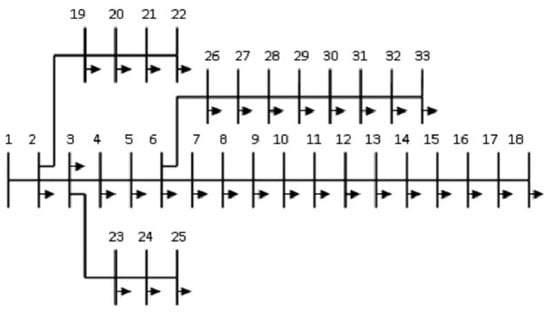
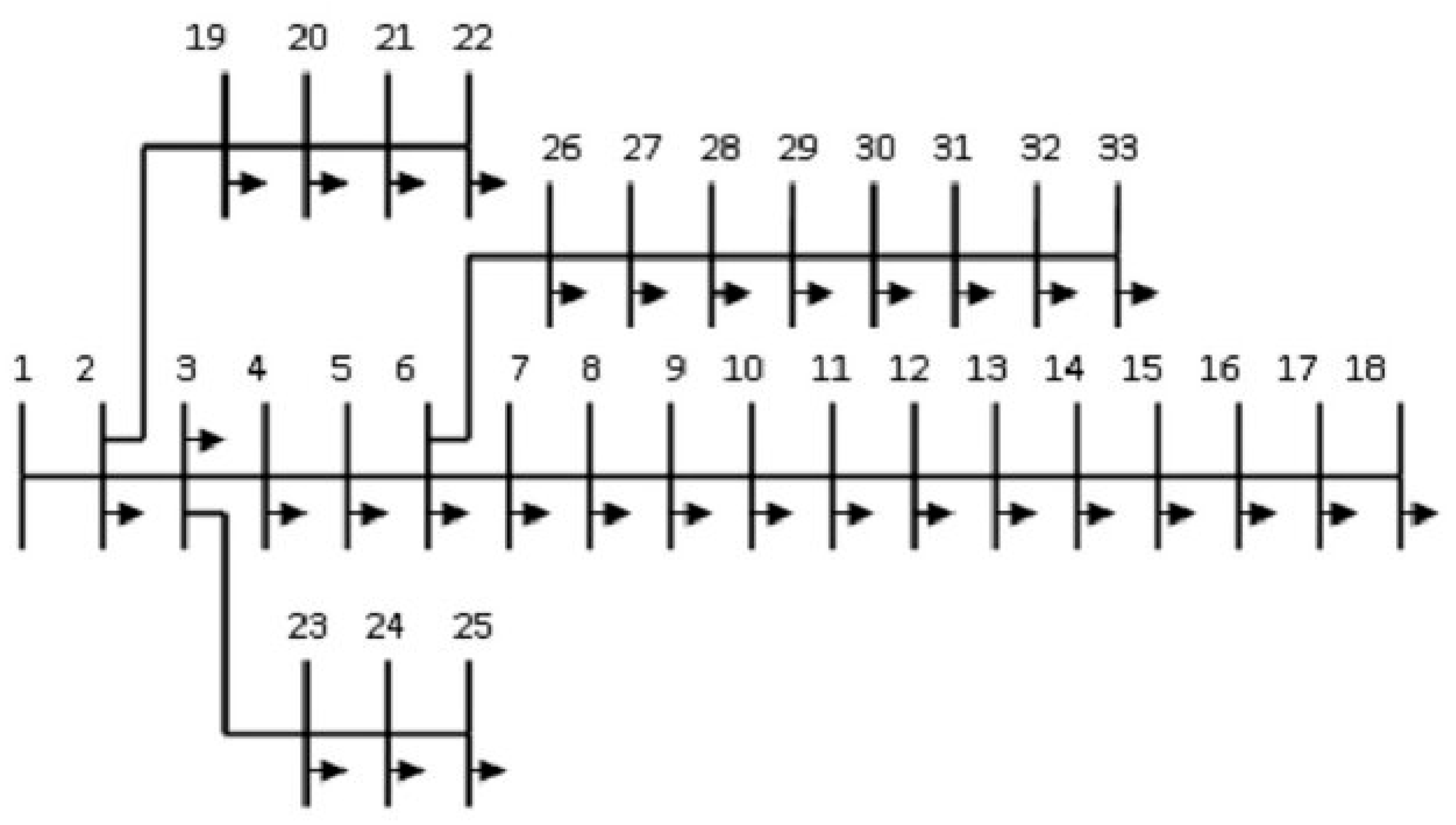
This study adopts the IEEE 33-bus radial distribution feeder [18] as the reference network for assessing prosumer-centric operation under high penetration of distributed renewable resources. The IEEE 33-bus system represents a typical medium-voltage distribution grid with a nominal voltage of 12.66 kV and a total feeder length of approximately 17 km. Its radial topology and well-documented electrical parameters make it a widely used benchmark for evaluating voltage regulation strategies, distributed generation integration, demand-side flexibility, and energy management concepts under realistic distribution-level constraints. Figure 1 illustrates the single-line diagram of the IEEE 33-bus system.
Figure 1.
IEEE 33-bus distribution system line diagram.
2.1. Prosumer Mapping in the IEEE 33-Bus Network
To embed prosumer behavior into a realistic distribution setting, selected buses of the IEEE 33-bus feeder are replaced by aggregated prosumer nodes, each representing a residential cluster equipped with local renewable generation, hybrid energy storage, electric vehicle fleets, and flexible loads.
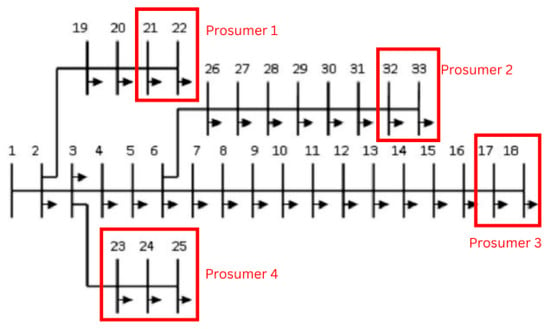
Four prosumer clusters are defined as follows:
- Prosumer A: Buses 21–22;
- Prosumer B: Buses 32–33;
- Prosumer C: Buses 17–18;
- Prosumer D: Buses 23–24–25.
Each cluster is treated as a single controllable prosumer node. The electrical demand at each constituent bus is aggregated, and local DER components are connected to the representative bus of the cluster (21, 32, 17, and 23, respectively). The remaining buses in the feeder retain their original passive load functionality.
This mapping allows for the analysis of geographically distributed prosumers interacting through a constrained radial network subject to voltage, thermal, and operational limits.
2.2. Distributed Energy Resources at Prosumer Nodes
Each prosumer node is equipped with the following technologies:
- Photovoltaic (PV) System
A rooftop-scale PV plant sized between 80–150 kW, depending on cluster demand, is installed at each prosumer node. The PV generation profile is obtained from standardized irradiance data and converted into electrical power through a single-diode PV model.
- Wind Turbine (WT)
A small-scale wind turbine (20–60 kW) is integrated to provide complementary renewable generation. Wind speed data are converted into electrical output using the manufacturer’s power curve.
- Concentrated Solar Power (CSP)
A compact concentrated solar power (CSP) unit is incorporated to provide dispatchable renewable generation with integrated thermal storage. By converting concentrated solar heat into storable thermal energy and later into electricity, the CSP unit offers multi-hour firm output that complements the variability in PV and wind generation, thereby enhancing reliability at the prosumer node.
- Hybrid Energy Storage System (HESS)
To address multi-scale temporal variability, the prosumer incorporates a heterogeneous HESS composed of:
- Redox Flow Battery (RFB): Medium-energy storage (e.g., 200–400 kWh, 50–100 kW) used for daily energy shifting and energy arbitrage.
- Superconducting Magnetic Energy Storage (SMES): A high-power (20–40 kW), low-energy storage device for transient smoothing, fast frequency response, and short-term load-following.
- Fuel Cell (FC) Unit: Dispatchable long-duration support (30–60 kW), assumed to operate with sufficient hydrogen supply for the expected simulation horizon.
- Electric Vehicles (EVs)
Each prosumer includes an EV parking hub containing 8 to 15 EVs, each equipped with a battery capacity ranging from 40 to 60 kWh. EV availability is modeled through time-of-day schedules derived from residential mobility patterns, enabling both charging and vehicle-to-grid (V2G) services when connected.
2.3. Load and Renewable Profiles
The base load data of the IEEE 33-bus system are scaled to reflect residential prosumer consumption patterns. A normalized residential profile is assigned to each prosumer cluster, while the original IEEE benchmark loads are retained for non-prosumer buses.
PV irradiance and wind speed profiles are obtained from publicly available meteorological datasets (e.g., NREL or European TSO databases). These profiles are interpolated to match the simulation time step and converted into electrical power using standard PV and wind turbine models.
2.4. Simulation Time Resolution and Horizon
The simulation covers a complete 10-min horizon with a time step of 1 min, which provides sufficient granularity for capturing:
- Fast SMES dynamics;
- Fuzzy-logic-based local control actions;
- Short-term load/RES variability.
3. Component and Network Modeling
This section describes the mathematical models adopted for the distributed energy resources, hybrid storage technologies, electric vehicles, and the radial distribution network. All component models are formulated to support time-series simulation with the 1 min resolution defined in Section 2. Unless otherwise stated, all models operate in discrete time and are expressed in per-unit quantities based on the standard IEEE 33-bus base values.
3.1. Photovoltaic (PV) Generation Model
PV power generation at each prosumer node is computed from the irradiance profile and the characteristics of the PV modules. The PV model accounts for cell temperature effects, irradiance variability, and inverter power limits. A single-diode model or simplified empirical formulation is used to convert irradiance and cell temperature into DC electrical output. The inverter stage is represented by an efficiency factor and an active-power limit reflecting the maximum installed PV capacity.
The PV model provides the available renewable power PPV, which is then supplied to the PMS for curtailment or direct consumption decisions.
The mathematical transfer-function mode of the PV system is defined as follows:
where PPV is the PV system’s power output, KPV is the system’s gain and TPV is its time constant.
3.2. Wind Turbine (WT) Model
Wind generation is modeled using measured or synthetic wind speed profiles and the turbine manufacturer’s power curve. The aerodynamic-to-electrical energy conversion includes cut-in, rated, and cut-out speeds, and captures the nonlinear shape of the power curve. The resulting electrical output corresponds to the available active power PWT. For simplicity, reactive power capability is not explicitly considered, and the wind turbine is assumed to operate at unity power factor.
The mathematical transfer-function model of the wind turbine is defined as follows:
where PWT is the wind turbine’s power output, KWT is the system’s gain and TWT is its time constant.
3.3. Concentrated Solar Power (CSP) Model
The CSP subsystem provides dispatchable renewable generation by converting concentrated solar irradiance into stored thermal energy and subsequently into electricity through a thermal power block. The CSP output is modeled as a function of direct normal irradiance (DNI), collector aperture area, optical efficiency, and the thermal-to-electric conversion efficiency of the power block. Thermal energy is stored in a two-tank molten-salt storage system, enabling multi-hour firm power delivery and allowing the CSP unit to decouple electricity production from instantaneous solar input. The storage state is updated using the thermal charging and discharging rate as well as heat losses, while turbine output is bounded by minimum and maximum power limits. At the electrical interface, the CSP unit delivers the dispatchable power PCSP, which is used to complement intermittent PV and wind generation.
The mathematical transfer-function model of the CSP unit is defined as follows:
where PCSP is the unit’s power output, KCSP is the unit’s gain and TCSP is its time constant.
3.4. Hybrid Energy Storage System (HESS)
Each prosumer incorporates a hybrid energy storage system consisting of a redox flow battery (RFB), superconducting magnetic energy storage (SMES), and a fuel cell (FC). The three subsystems operate in parallel and are coordinated by the fuzzy PMS.
3.4.1. Redox Flow Battery (RFB)
The RFB is modeled using a state-of-charge (SOC) variable, which is updated based on the charge and discharge power and the system’s round-trip efficiency. The power rating, energy capacity, and minimum/maximum SOC limits are enforced. To reflect degradation and chemical losses, optional constraints such as maximum depth-of-discharge or ramp-rate limits may be included. The RFB provides dispatchable power PRFB, which is positive during discharge and negative during charging.
The mathematical transfer-function model of the RFB system is defined as follows:
where PRFB is the battery’s power output, KRFB is the battery’s gain and TRFB is its time constant.
3.4.2. Superconducting Magnetic Energy Storage (SMES)
SMES units are represented as fast-acting high-power devices with limited usable energy capacity. The SMES is modeled with an SOC-like energy state and a bidirectional power converter, subject to maximum power and energy constraints. Due to its ability to respond within the same time step, the SMES is primarily used for smoothing short-term power fluctuations and providing rapid charge/discharge bursts PSMES.
The mathematical transfer-function model of the SMES system is defined as follows:
where PSMES is the system’s power output, KSMES is the system’s gain and TSMES is its time constant.
3.4.3. Fuel Cell (FC)
The fuel cell (FC) provides long-duration dispatchable support. The FC model describes the steady-state power output as a controllable variable bounded by minimum and maximum power limits. Fuel consumption may be represented as an efficiency or fuel-to-power conversion factor. The fuel cell generates only positive power PFC. Dynamic transients can be neglected due to the 1 min simulation time step.
The mathematical transfer-function model of the fuel cell system is defined as follows:
where PFC is the fuel cell’s power output, KFC is the cell’s gain and TFC is its time constant.
3.5. Electric Vehicle (EV) Model
Electric vehicles (EVs) are modeled either individually or in aggregate for each prosumer. Each EV is characterized by a state-of-charge (SOC) variable, rated battery capacity, charging and discharging power limits and a connection schedule indicating when the EV is plugged into the grid. When available, EVs can either charge, remain idle or inject power back into the grid (V2G), according to the local PMS decision. The SOC evolution follows the charging/discharging efficiency and respects minimum SOC requirements to meet mobility needs.
An aggregated EV fleet for each prosumer node produces a total power contribution PEV, computed as the sum of the charging and discharging decisions of all connected EVs.
The mathematical transfer-function model of the EV is defined as follows:
where PEV is the EV’s power output, KEV is the EV’s gain and TEV is its time constant.
3.6. Prosumer Net Injection
For each prosumer node, the total net power injection into the distribution grid is expressed as:
This injected power is subject to inverter limits, internal prioritization rules, and power balance constraints imposed by the PMS. Positive values indicate export to the grid, and negative values indicate import.
4. Proposed Method
This section presents the overall control, coordination, and optimization strategy designed for the prosumer-centric operation of the IEEE 33-bus distribution system. The proposed method integrates a hierarchical power-management structure, a multi-level decision logic based on fuzzy inference, and a metaheuristic optimization layer using Particle Swarm Optimization (PSO). The objective is to guarantee coordinated dispatch of distributed renewable generation and hybrid energy storage units located at selected buses while ensuring voltage stability, power balance satisfaction, and smooth operational behavior of the microgrid.
4.1. Architectural Overview
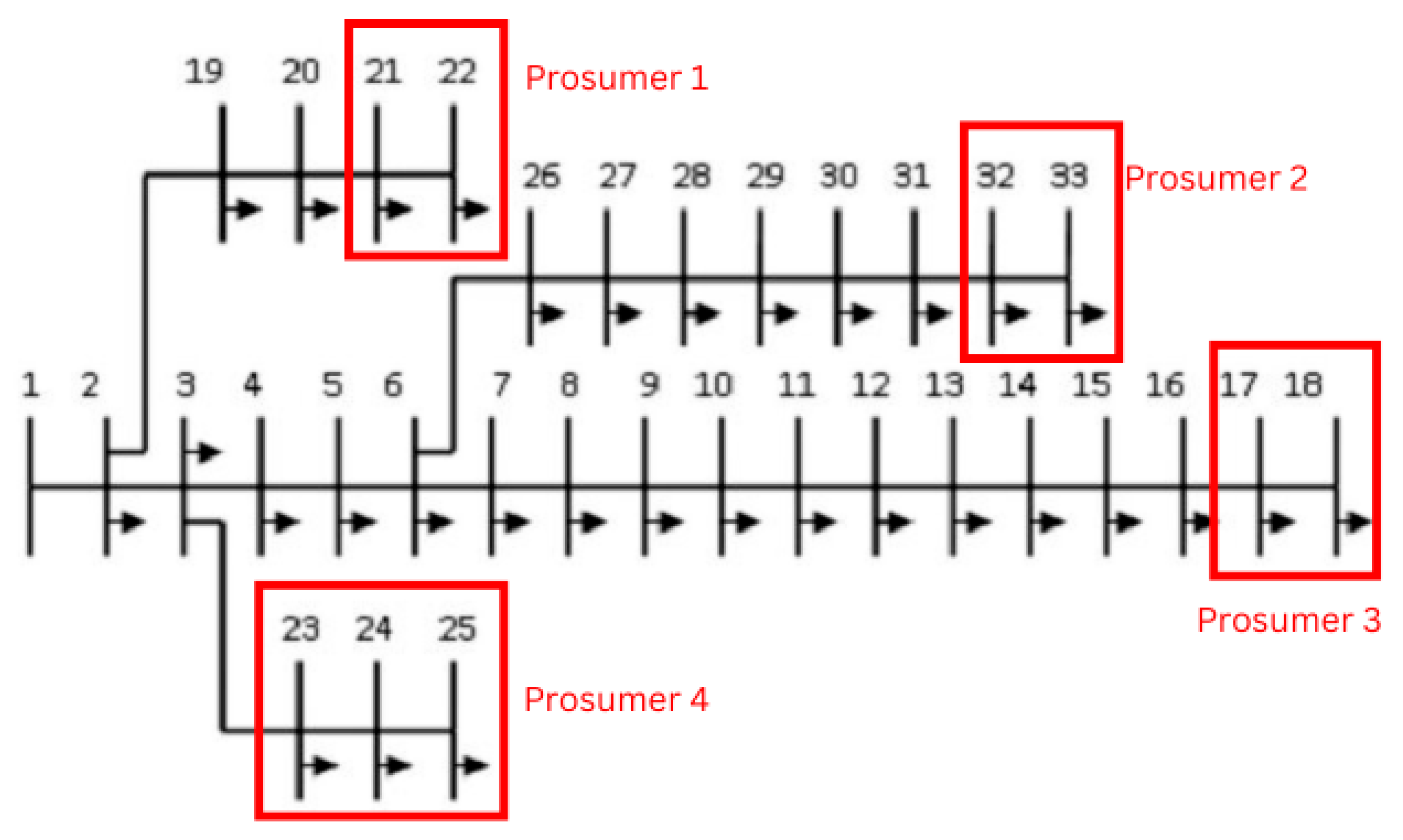
The full system operates as a radial distribution grid where buses 17–18, 21–22, 23–24–25, and 32–33 are transformed into prosumer nodes, as shown in Figure 2.
Figure 2.
IEEE 33-bus distribution system line diagram with the introduction of the prosumers.
Each prosumer consists of a photovoltaic generation unit, a wind turbine, a hybrid energy storage system, an electric vehicle (when present and connected) and a local residential electrical load.
All prosumers operate under a distributed architecture; however, a microgrid coordinator (MGC) supervises global decisions such as power exchange with the upstream grid and allocation of setpoints across prosumer units.
The proposed control method ensures coordinated dispatch among all renewable sources, stabilizes local bus voltages and system frequency, schedules charging and discharging actions within the hybrid energy storage system, and prioritizes fast-response devices such as SMES for transient support. Real-time decisions are driven by the fuzzy logic PMS, while the PSO layer refines controller performance by optimizing membership functions and rule weights.
4.2. Conventional Regulation
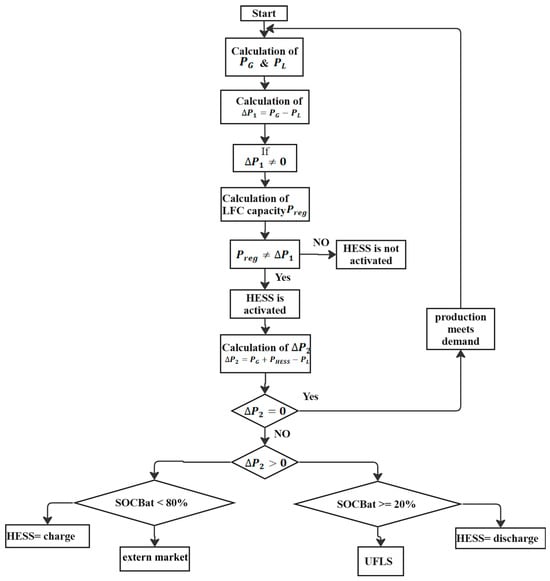
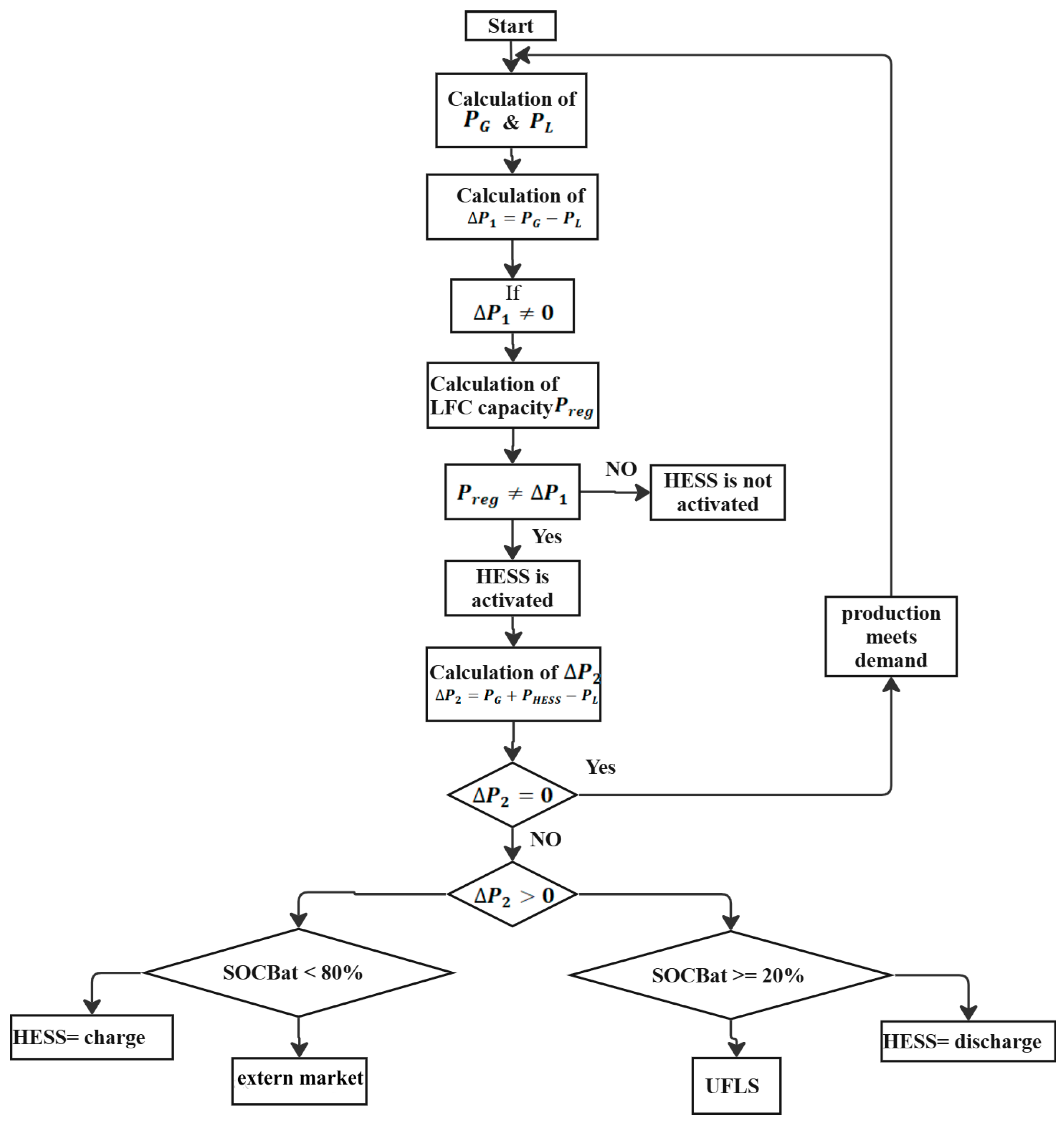
Figure 3 illustrates the operational flowchart of the conventional power balance and regulation mechanism used as a baseline control strategy. At each control interval, the total generated power PG and load demand PL are evaluated to compute the initial power mismatch ΔP1. When a mismatch exists, the available Load Frequency Control (LFC) capacity is assessed. If the LFC capability is insufficient to fully compensate for the imbalance, the hybrid energy storage system (HESS) is activated to support system regulation. A second power mismatch ΔP2, accounting for HESS contribution, is then calculated to verify whether generation meets demand. Depending on the sign and magnitude of ΔP2, charging or discharging actions are issued based on the battery state-of-charge constraints. Surplus energy is either stored in the HESS or exported to the external market, while power deficits may trigger storage discharge or under-frequency load shedding (UFLS) if operational limits are reached. This logic ensures basic system stability and power balance while respecting storage constraints and serves as a benchmark against which the proposed fuzzy-logic-based power management strategy is evaluated.
Figure 3.
Flowchart of the conventional power balance and regulation strategy based on load–generation mismatch, LFC capacity, and HESS activation logic.
4.3. Optimization Process
In order to optimally tune the proposed control strategy, an Integral of Time multiplied by Absolute Error (ITAE) objective function is adopted, defined with respect to the system power imbalance ΔP, and the function is expressed as follows:
The ITAE criterion penalizes both the magnitude and persistence of power deviations, thereby promoting fast dynamic response and improved steady-state regulation. This objective function is minimized using the Particle Swarm Optimization (PSO) algorithm. For benchmarking purposes, the Load Frequency Control (LFC) loop is implemented using a conventional PID controller, which regulates frequency deviations by acting on the power imbalance signal; the corresponding proportional, integral, and derivative gains, which were calculated by MATLAB’s built-in tuner, are explicitly reported in Table 1.
Table 1.
PID parameters.
Within the proposed framework, PSO is employed to optimize selected fuzzy logic membership function parameters, scaling factors, and rule weighting coefficients while respecting operational constraints. The PSO population size, inertia weight, cognitive and social coefficients, and stopping criteria are summarized in Table 2.
Table 2.
PSO parameters.
The fuzzy logic controller is implemented using a Sugeno-type inference system with two inputs and three outputs. The inputs are the normalized power imbalance variable P and its rate of change ΔP, each defined over the range [0, 1] and described by four triangular membership functions representing different operating conditions. The controller generates three control outputs corresponding to renewable energy source (RES) dispatch, dispatchable generation control (DG), and hybrid energy storage system command (HESS). Each output is modeled using constant membership functions, enabling fast and computationally efficient decision-making. The inference process employs product-based AND logic, probabilistic OR aggregation, and weighted average defuzzification. A total of 16 fuzzy rules govern the interaction between the inputs and outputs, ensuring coordinated activation or deactivation of generation and storage resources in response to system power imbalance dynamics. The complete fuzzy logic rule base governing real-time power management decisions is provided in Appendix A.
4.4. Supervisory Control Structure
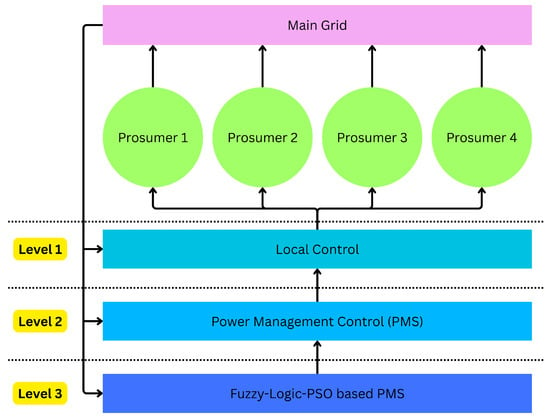
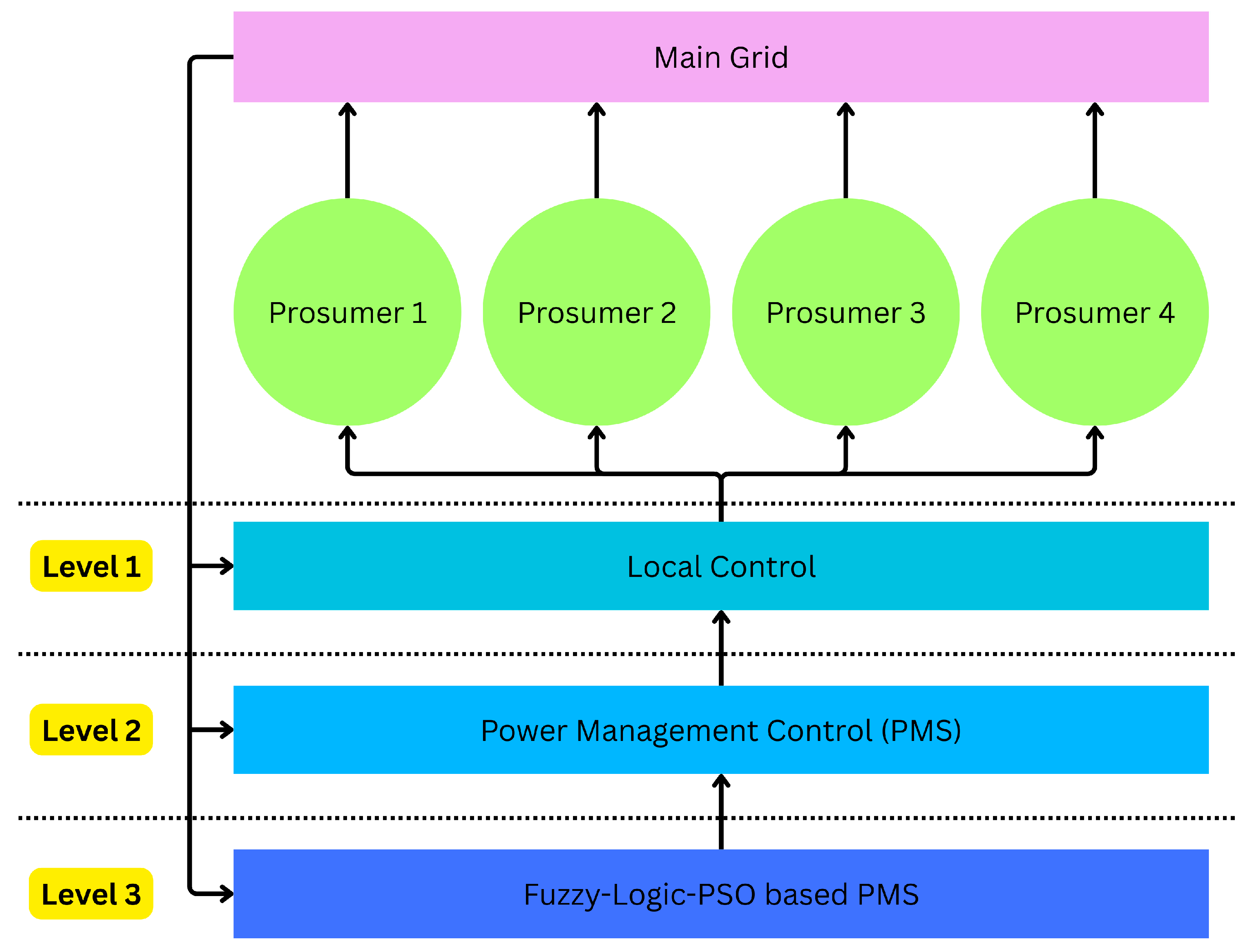
The control strategy is structured into three levels, each with a specific role, as illustrated in Figure 4.
Figure 4.
Overview of the proposed method architecture.
- Level 1—Local Prosumer Control Layer
Each prosumer node continuously monitors the availability of PV and wind generation, local load demand, the state of charge of both the RFB and EV batteries, the magnetic energy level stored in the SMES unit, the operational readiness of the fuel cell system, local voltage magnitude and its deviation, and short-term forecasts of renewable power. Based on these measurements, the local controllers execute immediate actions such as maintaining primary DC-bus balance, smoothing rapid fluctuations in renewable output, deploying SMES for fast compensation during sudden disturbances, and enforcing protective and operational constraints. This local autonomy enables each prosumer to react rapidly to disturbances without relying on system-wide coordination.
- Level 2—Fuzzy Logic Power Management System (PMS)
The fuzzy logic PMS handles the real-time dispatch decisions for each prosumer. Its inputs include the net prosumer power:
It also includes the state of charge of the RFB and EV batteries, the magnetic energy fraction stored in the SMES, the rate of change in net power, the local voltage deviation, short-term wind and solar forecasts, and, optionally, the microgrid frequency deviation. Based on these inputs, the controller generates outputs such as charging or discharging commands for both the RFB and EV batteries, the SMES activation level, fuel-cell activation (binary or continuous), and the requested power exchange with the MGC. The fuzzy system operates using linguistic variables (e.g., Low, Medium, High SOC; Surplus or Deficit), a rule base encoding operational priorities and constraints, an inference mechanism formulated as either Mamdani or Takagi–Sugeno, and a defuzzification step to produce crisp control set points. The rules enforce critical behaviors: renewable surpluses trigger RFB charging first and EV charging second; deficits trigger RFB discharge and, in prolonged shortages, FC activation; SMES is reserved exclusively for transient or rapid-response events; EV discharging is permitted only above a defined minimum SOC; and voltage deviations initiate corrective charging or discharging within allowable bounds. Through these mechanisms, the fuzzy PMS governs the dynamic operational behavior of each prosumer.
- Level 3—PSO-Based Optimization Layer
The PSO optimizer enhances the fuzzy PMS by tuning the shapes and parameters of the membership functions, adjusting rule-importance weights, refining scaling factors for both inputs and outputs, setting relative scheduling priorities among the RFB, FC, and SMES units, and calibrating prosumer-level power-exchange parameters. Unlike economic optimization, the objective of this PSO layer is to minimize power imbalances across the microgrid, reduce voltage variations throughout the IEEE 33-bus system, ensure smooth and stable power exchange with the grid, reduce the switching frequency of HESS components, improve transient response and limit frequency deviations, and maximize the utilization of available renewable energy. The optimizer may operate either offline or online: in offline mode, historical renewable and load profiles are used to determine static optimal fuzzy parameters, whereas in online mode, the PSO periodically updates controller parameters in real time as operating conditions change.
5. Simulation and Results
The simulation section evaluates the performance of the proposed prosumer-centric control framework when embedded in the IEEE 33-bus radial distribution feeder. The objective is to assess the dynamic behavior, voltage stability, renewable energy utilization, and storage coordination achieved by the combined fuzzy logic PMS and PSO-based tuning strategy under realistic operating conditions. Time-series simulations are conducted using representative solar and wind profiles, residential demand patterns, and EV availability schedules. The selected prosumer nodes (21–22, 32–33, 17–18, and 23–24–25) are modeled as aggregated multi-energy units equipped with PV, wind, HESS, and EV resources. The simulation environment incorporates detailed component-level models, the DistFlow formulation for radial power flow, and discrete-time control evaluation to capture interactions between local prosumer behavior and network-wide electrical performance. This setup enables a systematic evaluation of the method’s ability to handle renewable variability, manage storage, regulate voltage, and support grid stability across a range of scenarios.
5.1. Voltage Profile Improvement Following Prosumer Integration
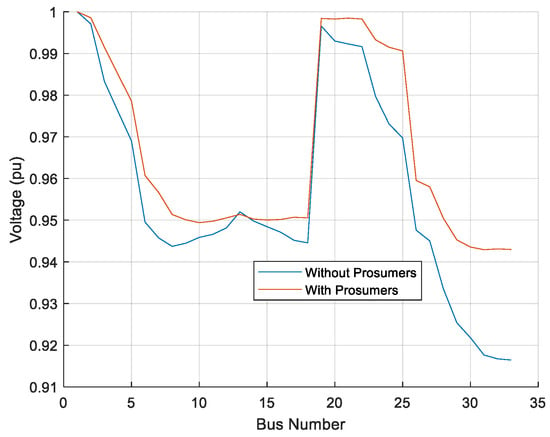
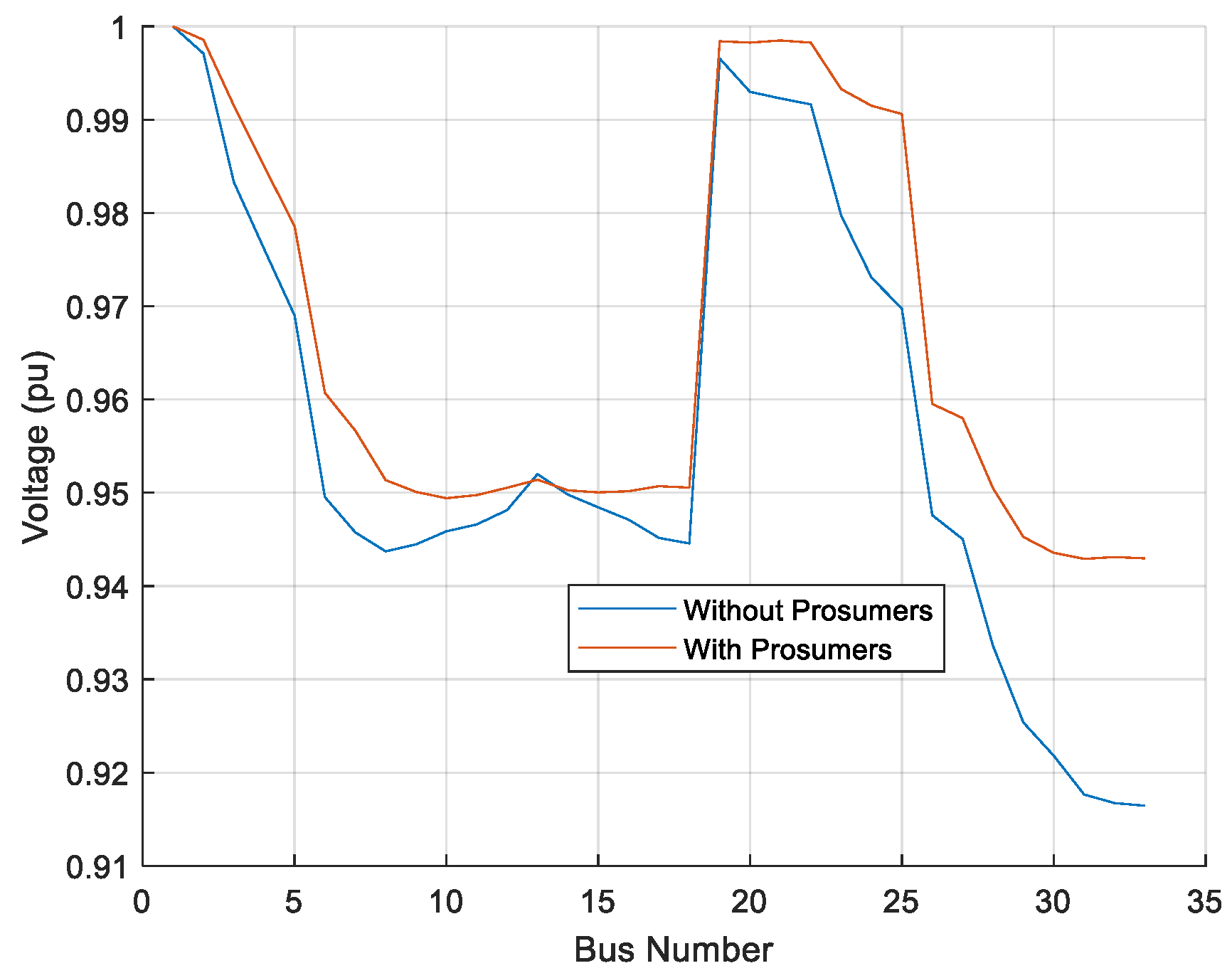
A preliminary simulation was conducted to quantify the impact of introducing prosumer nodes on the steady-state voltage profile of the IEEE 33-bus feeder. The study compares the per-unit voltage magnitude at every bus under two conditions: (i) the original network operating solely with passive loads and no distributed resources, and (ii) the augmented network in which the designated buses host prosumers equipped with renewable generation and hybrid storage. Power flow computations were carried out using the same loading conditions in both cases to ensure a consistent baseline. The results in Figure 5 show a systematic increase in bus voltages across the entire feeder once prosumers are added, with the most notable improvements observed at downstream buses where voltage drops are typically more pronounced. This demonstrates that the distributed injections provided by prosumers effectively support feeder voltage by reducing stress on the upstream substation and alleviating the inherent voltage decline characteristic of radial distribution networks.
Figure 5.
Steady-state voltage values for each bus before and after the introduction of prosumers.
5.2. Comparison of Droop Control and Load Frequency Control in a Non-Renewable Prosumer System
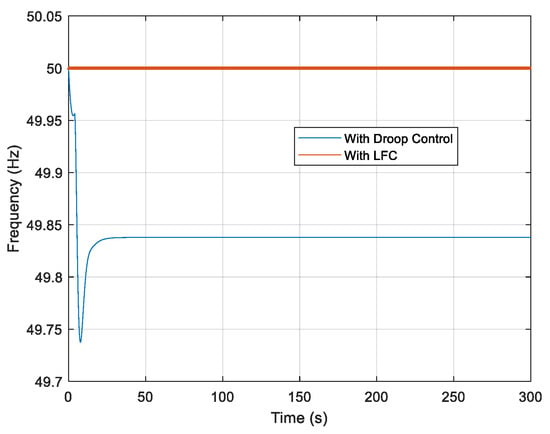
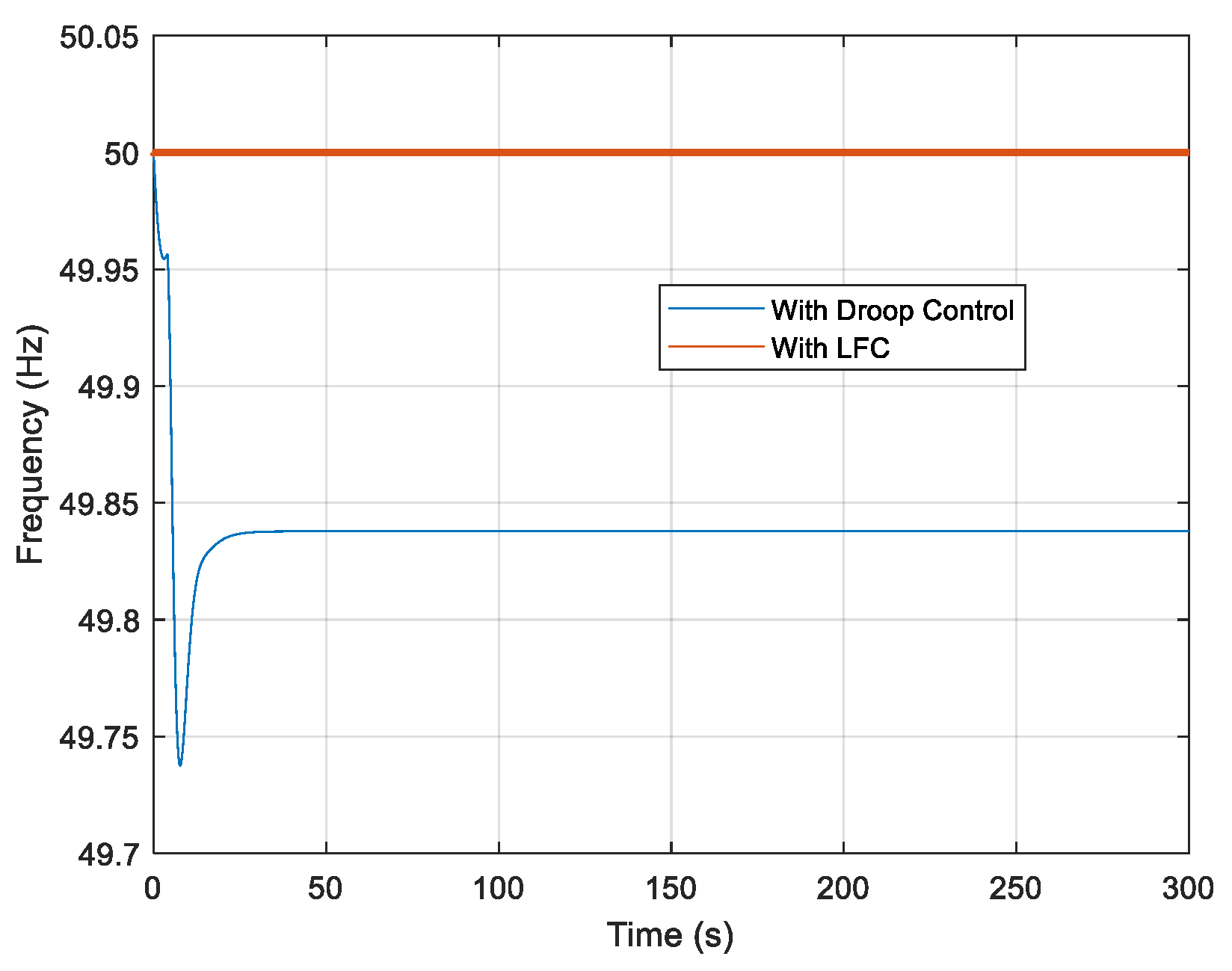
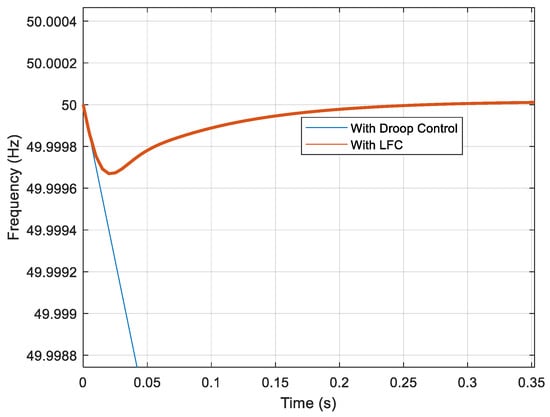
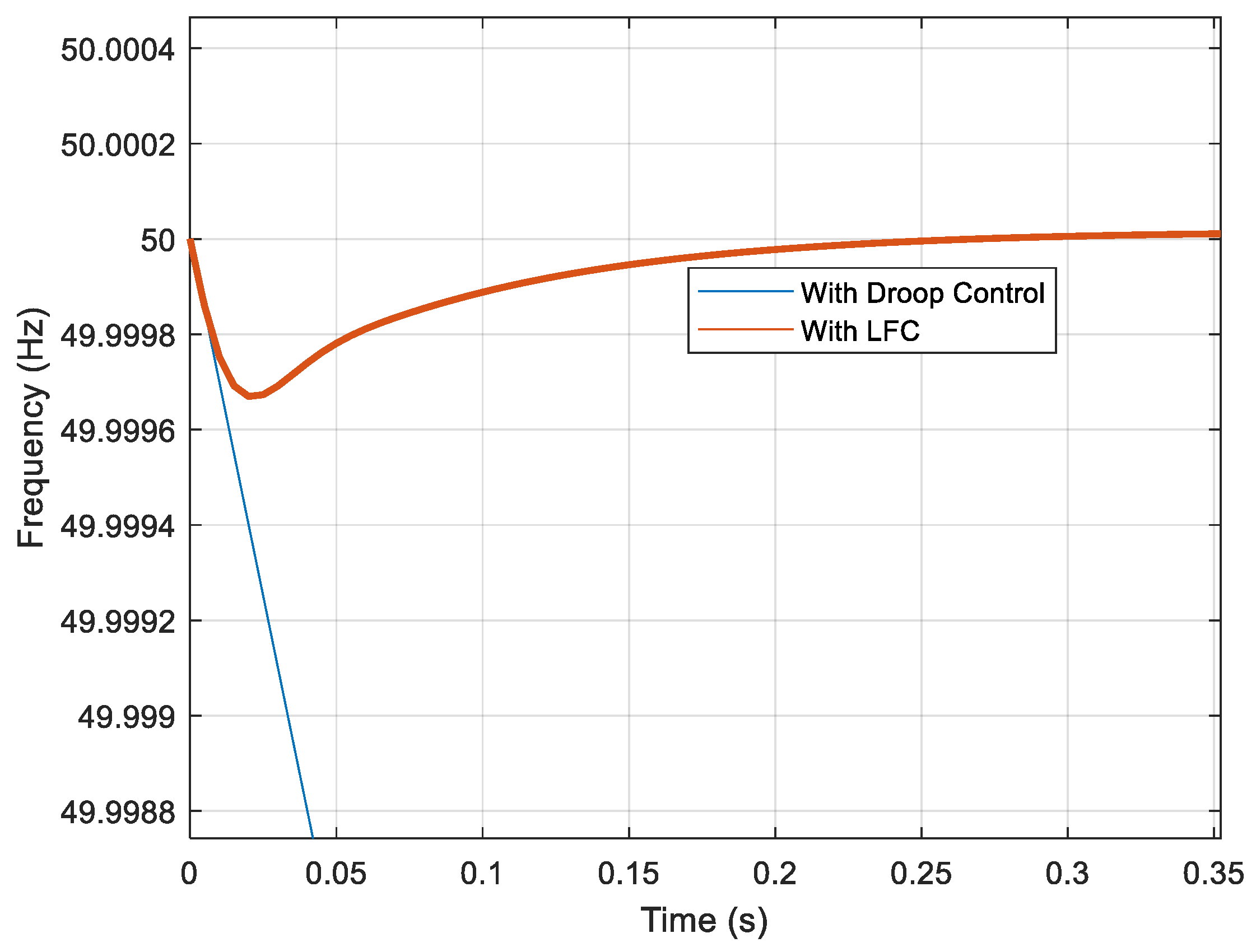
This simulation evaluates the dynamic behavior of a prosumer system operating without renewable energy sources, where local generation is provided by a diesel generator in combination with a hybrid energy storage system and electric vehicles. Two control strategies are compared: conventional droop control and centralized Load Frequency Control (LFC). Both approaches are tested under identical load variations and operating conditions to ensure a fair comparison. The objective of this analysis is to examine the effectiveness of each control scheme in maintaining frequency stability by regulating power sharing between the diesel generator, storage units, and EVs while responding to load disturbances. The results in Figure 6 highlight the differences in transient response, frequency deviation, and recovery time, demonstrating that for prosumer systems lacking direct renewable generation, LFC control is a more suitable option. Figure 7 shows a close-up view of the LFC response, showing a fast recovery time.
Figure 6.
Frequency comparison of droop control and LFC in a prosumer system without renewable resources.
Figure 7.
Close-up view of Figure 6.
5.3. Comparison of Droop Control and Load Frequency Control in a Renewable-Assisted Prosumer System
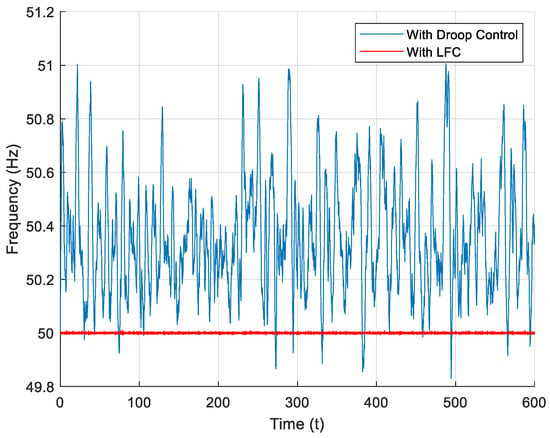
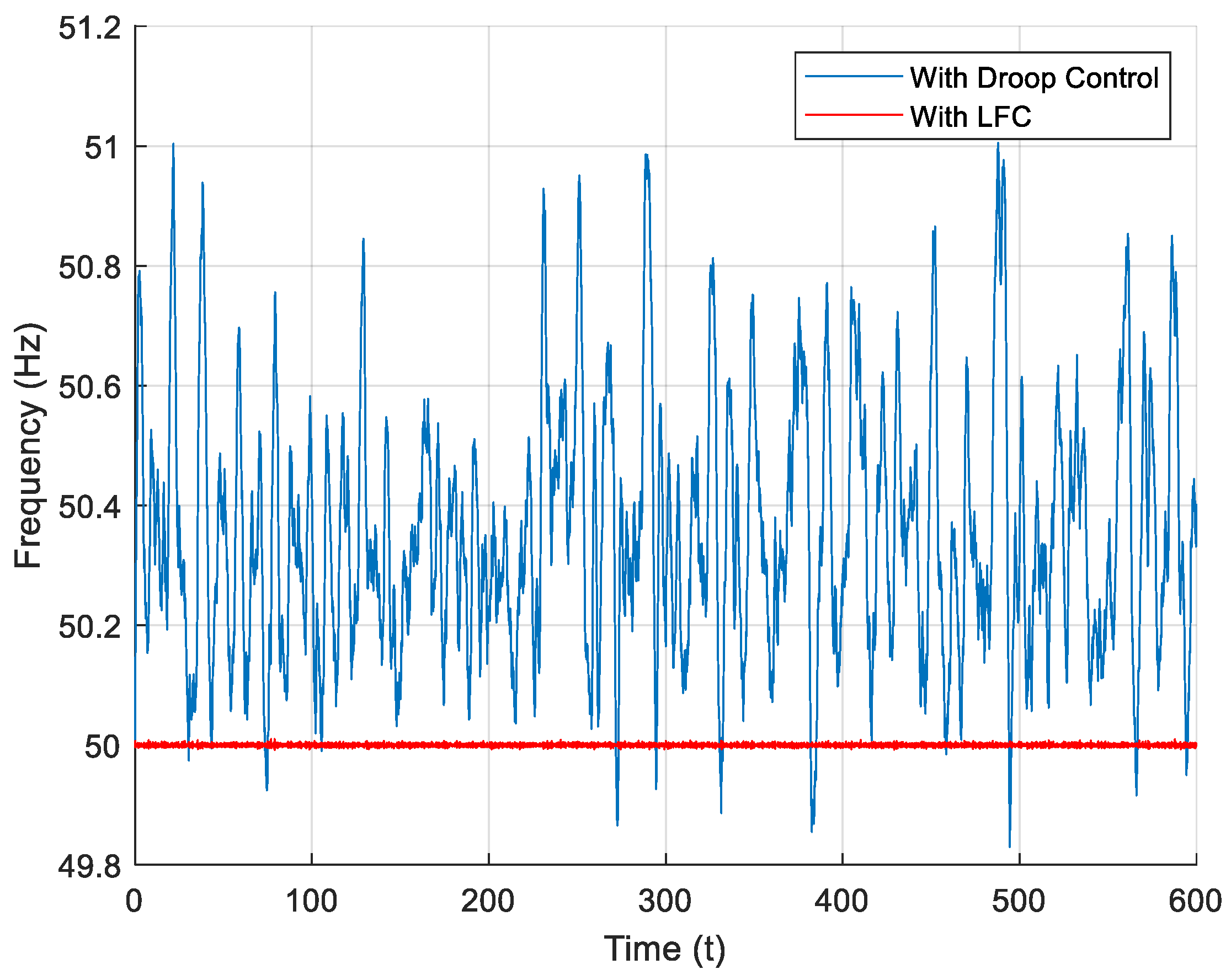
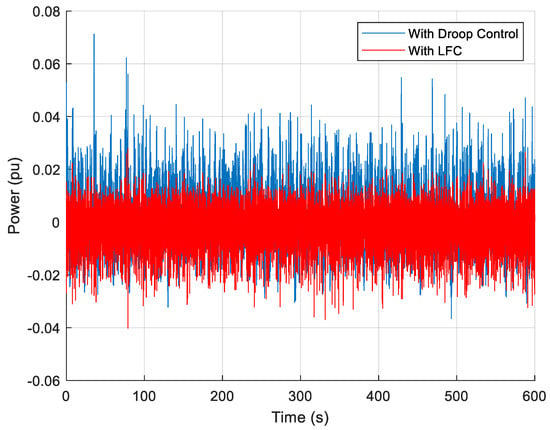
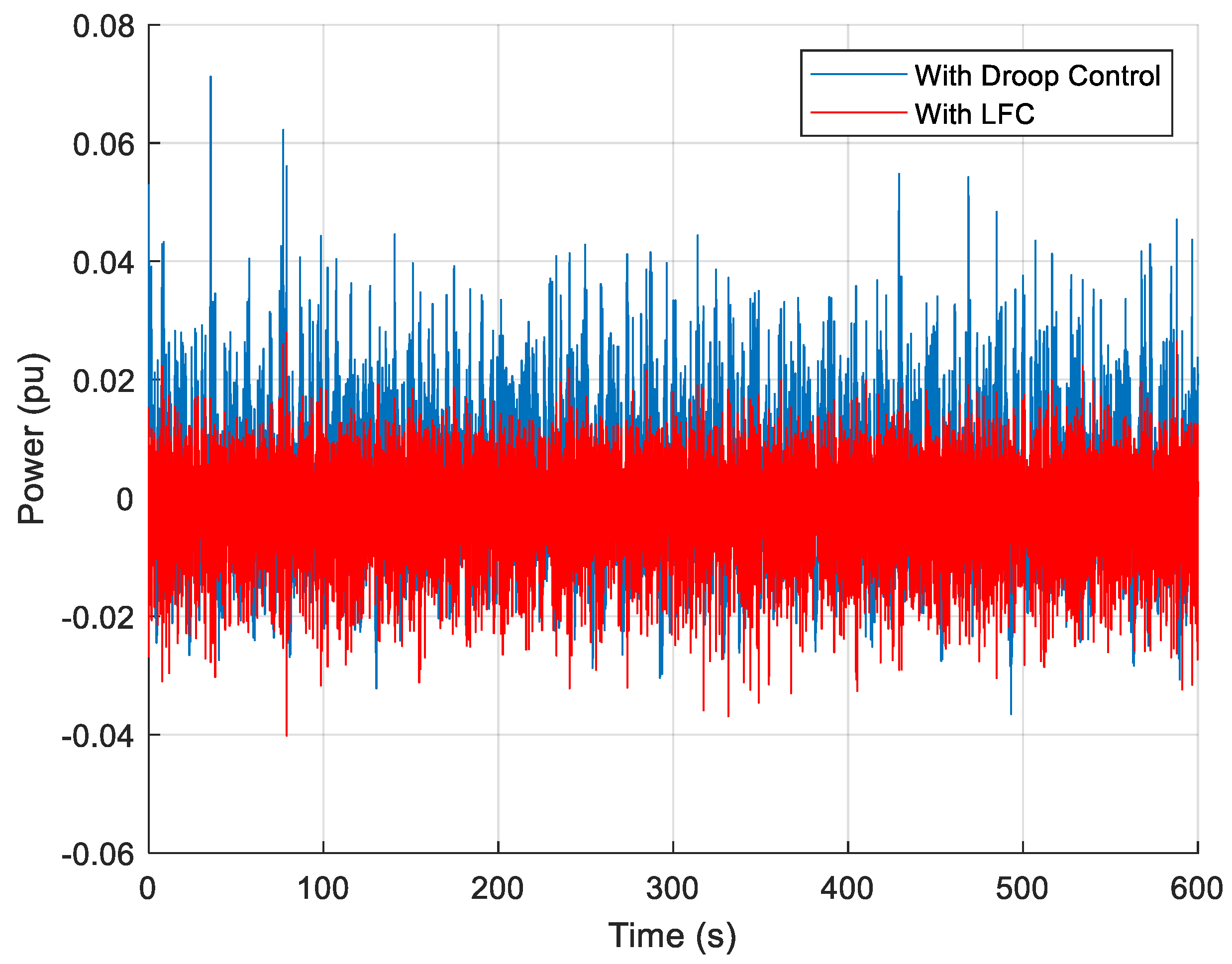
A further simulation compares droop control and LFC in a prosumer system that includes renewable energy resources while retaining the diesel generator as a dispatchable backup unit. In this configuration, photovoltaic, wind, and CSP generation operate alongside the diesel generator, hybrid energy storage system, and electric vehicles. Both control strategies are assessed under identical load disturbances and renewable generation profiles to ensure a consistent basis for comparison. The objective is to evaluate how droop-based and LFC-based schemes regulate frequency by coordinating power sharing among diesel generation, renewables, storage, and EVs, while maintaining system stability in the presence of renewable intermittency. The results in Figure 8 show the intermittency of RESs during the droop control test, while LFC maintains the frequency at its scheduled value. Figure 9 shows the power difference between production and consumption in the prosumer system, indicating that fluctuations are significantly reduced in the LFC case compared to the droop control case. These results further demonstrate that LFC control is more suitable for these types of systems.
Figure 8.
Frequency comparison of droop control and LFC in a prosumer system with renewable resources.
Figure 9.
Power flow comparison between droop control and LFC in a prosumer system with renewable resources.
5.4. Comparison of Load Frequency Control and Fuzzy-Logic-Based Power Management in a Renewable-Assisted Prosumer System
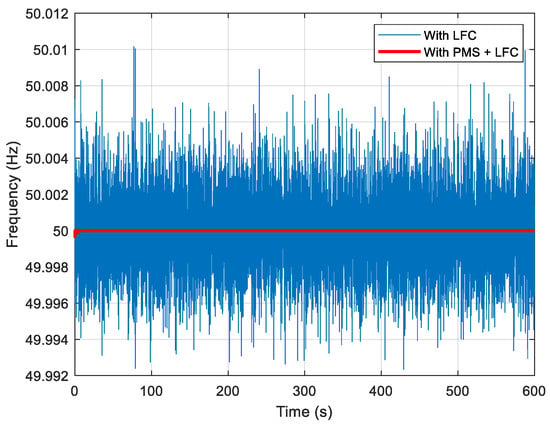
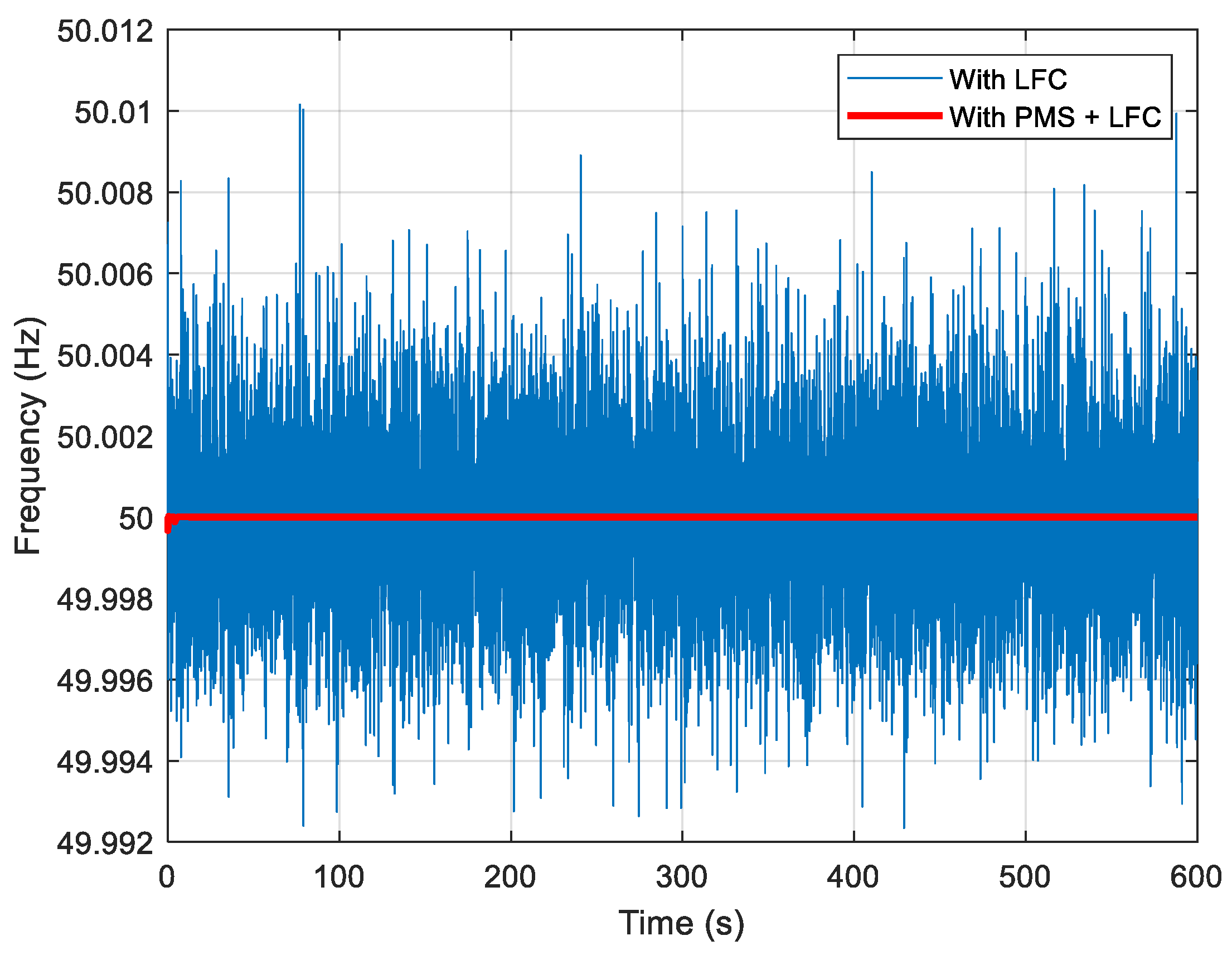
This simulation extends the previous analysis by comparing the performance of conventional Load Frequency Control (LFC) with the proposed fuzzy-logic-based power management system (PMS) in a renewable-assisted prosumer configuration. The system includes photovoltaic, wind, and CSP generation in conjunction with a diesel generator, hybrid energy storage system, and electric vehicles. Both control strategies are evaluated under identical operating conditions, load variations, and renewable generation profiles. The objective of this comparison is to assess the ability of the fuzzy PMS to coordinate heterogeneous resources, mitigate frequency deviations, and improve dynamic response relative to LFC.
Figure 10 compares the frequency response of the renewable-assisted prosumer system under conventional Load Frequency Control (LFC) and the combined fuzzy-logic-based power management system with LFC. When LFC is applied alone, the system frequency remains centered around the nominal 50 Hz but exhibits persistent low-amplitude oscillations caused by load variations and renewable intermittency, indicating limited damping capability. When the fuzzy PMS is integrated, these oscillations are significantly reduced, and the frequency is maintained almost constant around its nominal value throughout the simulation. This improvement is attributed to the ability of the fuzzy PMS to coordinate diesel generation, renewable sources and hybrid storage in a more responsive and adaptive manner. The results show that while LFC ensures basic frequency regulation, the fuzzy logic PMS enhances stability and disturbance rejection, leading to a more robust prosumer operation under mixed conventional and renewable generation.
Figure 10.
Coordinated strategy of LFC and PMS in a prosumer with renewable resources.
5.5. Steady-State Voltage Profile Analysis Under Different Control Strategies
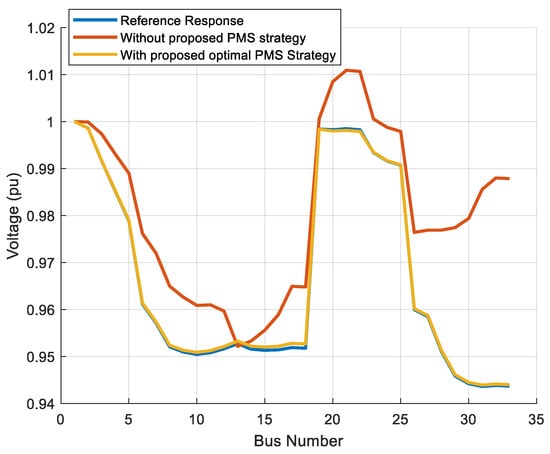
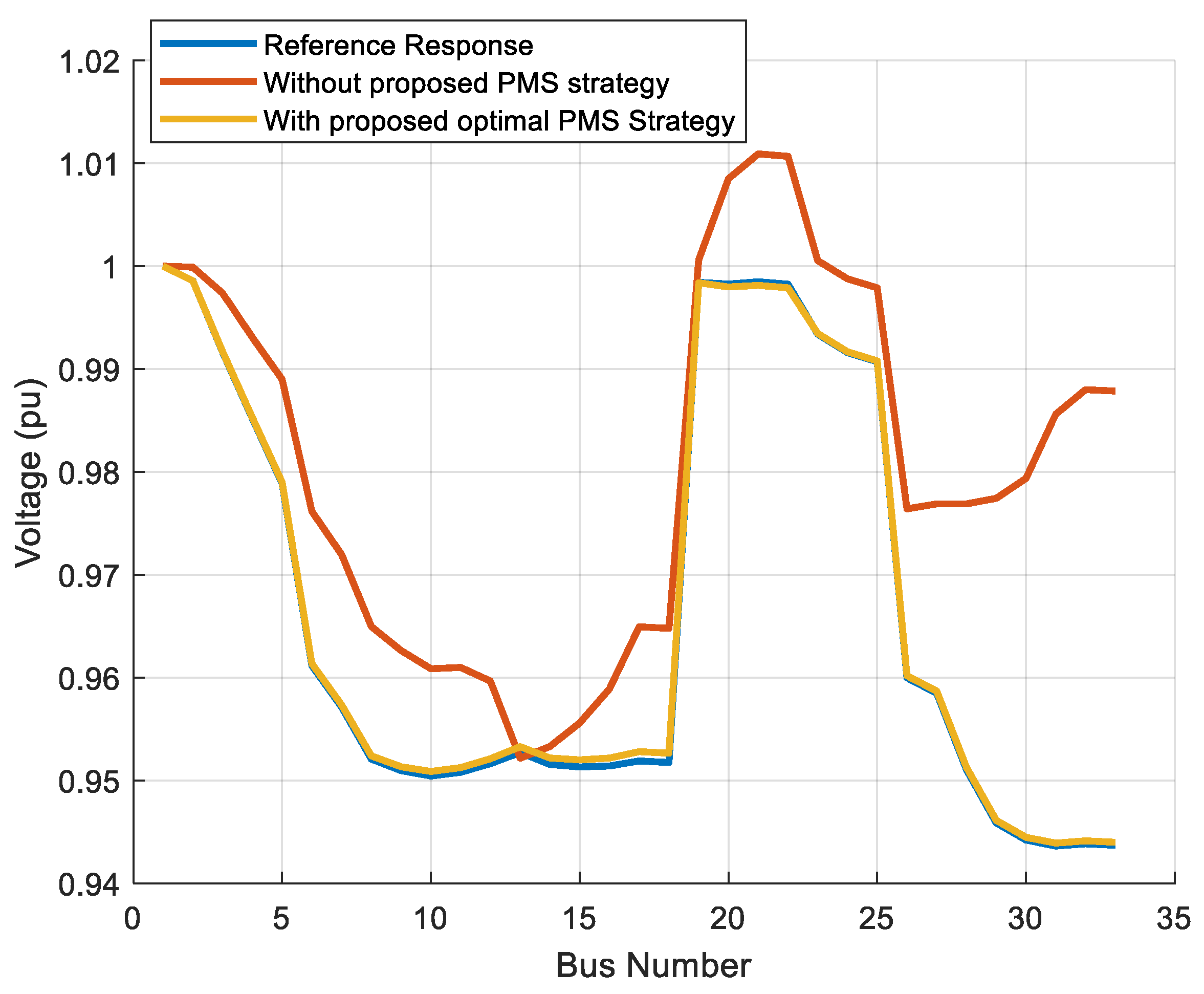
This simulation evaluates the steady-state voltage distribution across all buses of the IEEE 33-bus radial feeder under three distinct operating conditions. First, a baseline reference case is considered, in which the net power balance at each node is maintained such that the difference between local production and consumption is zero, resulting in an ideal reference voltage profile. Second, an unregulated case is simulated where prosumer injections are present but no voltage regulation or coordinated control strategy is applied, leading to deviations in bus voltage magnitudes. Third, the proposed fuzzy-logic-based power management system and LFC optimized via PSO are activated to regulate prosumer behavior and coordinate distributed resources. The comparison aims to quantify the effectiveness of the proposed control strategy in restoring voltage levels toward their nominal reference values.
As illustrated in Figure 11, the baseline reference case exhibits a smooth voltage profile along the feeder, representing ideal operating conditions where local generation perfectly matches consumption. In contrast, the unregulated case shows a noticeable increase in voltage magnitudes at several buses, particularly in downstream sections, indicating overvoltage conditions caused by uncontrolled prosumer power injections. When the proposed fuzzy-PSO-based PMS is applied, the voltage profile closely follows the reference response across all buses, significantly reducing deviations and preventing excessive voltage rise. This demonstrates the ability of the proposed control strategy to effectively regulate distributed injections and coordinate hybrid storage and generation while also maintaining voltage levels within acceptable limits throughout the distribution network. Table 3 shows the exact percentage improvement in voltage profiles at critical downstream buses, supporting the data in Figure 11.
Figure 11.
Steady-state voltage profile of the IEEE 33-bus feeder under reference operation, unregulated prosumer integration, and the proposed fuzzy-PSO-based PMS.
Table 3.
Percentage of improvement in voltage values at critical downstream buses.
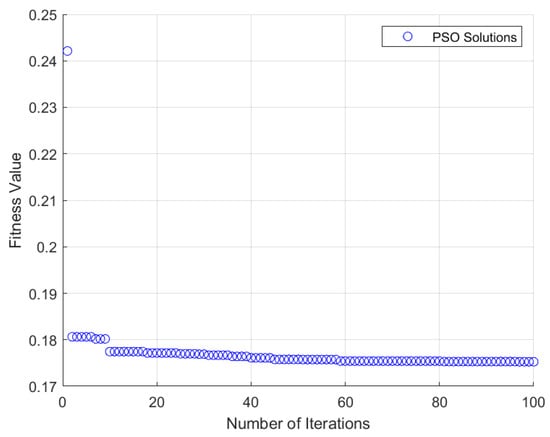
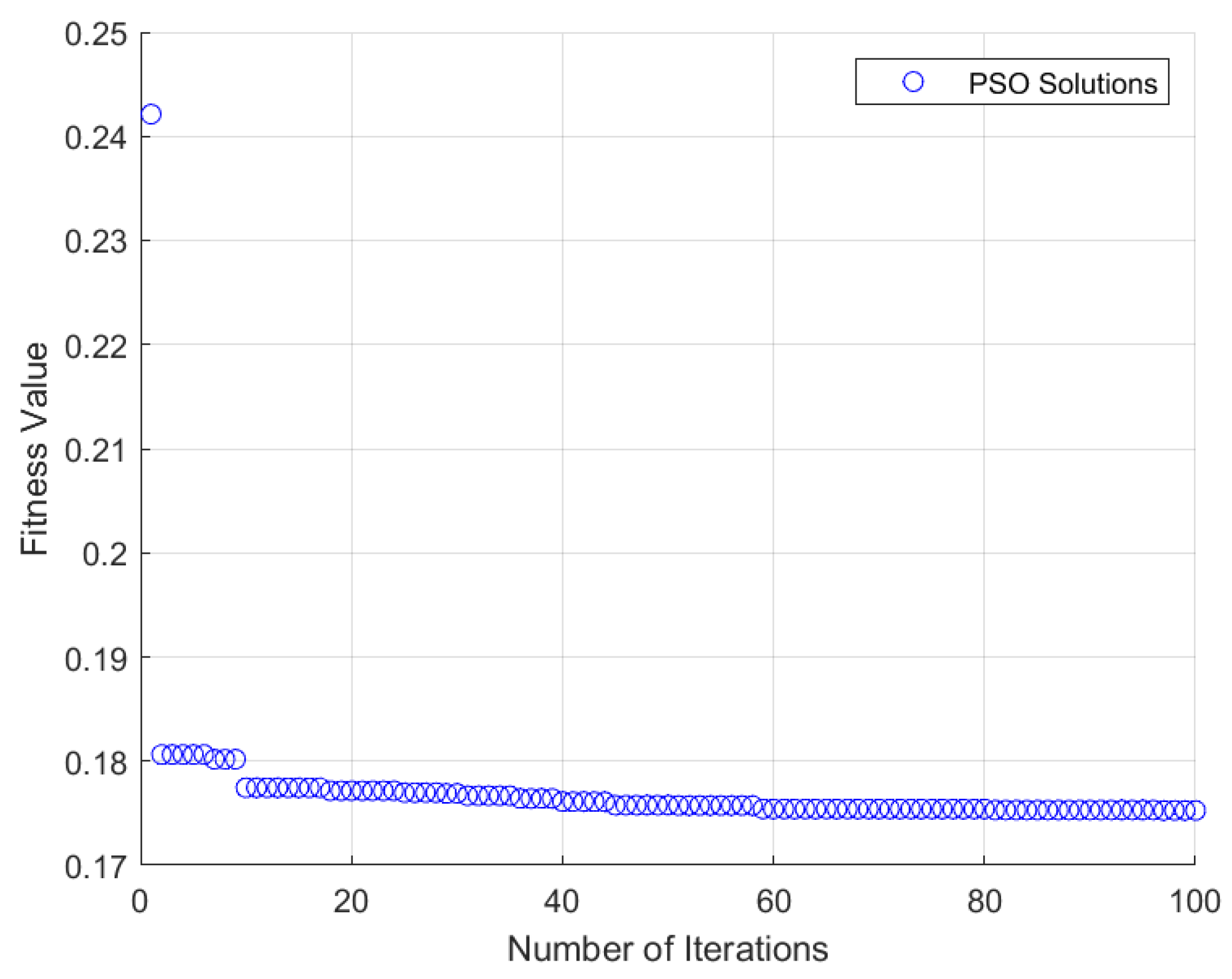
The convergence characteristics of the PSO algorithm used to optimize the fuzzy-based PMS are illustrated in Figure 12. The plot tracks the fitness value—representing the minimization of voltage deviations and frequency errors—over 100 iterations. Initially, the algorithm starts with a high fitness value near 0.24, but it demonstrates rapid convergence within the first 10 iterations, dropping sharply to approximately 0.18. As the search progresses, the PSO successfully refines the control parameters, reaching a stable, steady-state minimum of roughly 0.175 after 60 iterations. This consistent plateau indicates that the algorithm has effectively identified the optimal set points required to maintain the bus voltages at their nominal reference values.
Figure 12.
The PSO convergence curve.
5.6. Steady-State Voltage Profile Analysis Under Different Levels of RES Integration
To further investigate the impact of renewable energy sources (RESs) on distribution-level voltage behavior, this section analyzes the steady-state voltage profile of the IEEE 33-bus feeder under varying RES integration scenarios using the proposed fuzzy-PSO-based control strategy. The objective is to assess how both the magnitude and the deployment pattern across prosumer clusters influence voltage regulation across the network. Two complementary analyses are conducted: the first examines the effect of increasing RES penetration levels within the same prosumer bus cluster, while the second evaluates uniform RES penetration applied simultaneously across all prosumer clusters. This approach enables a comprehensive assessment of the robustness and adaptability of the proposed control method under different RES deployment configurations.
5.6.1. Different Levels of RES Integration Within the Same Bus Cluster
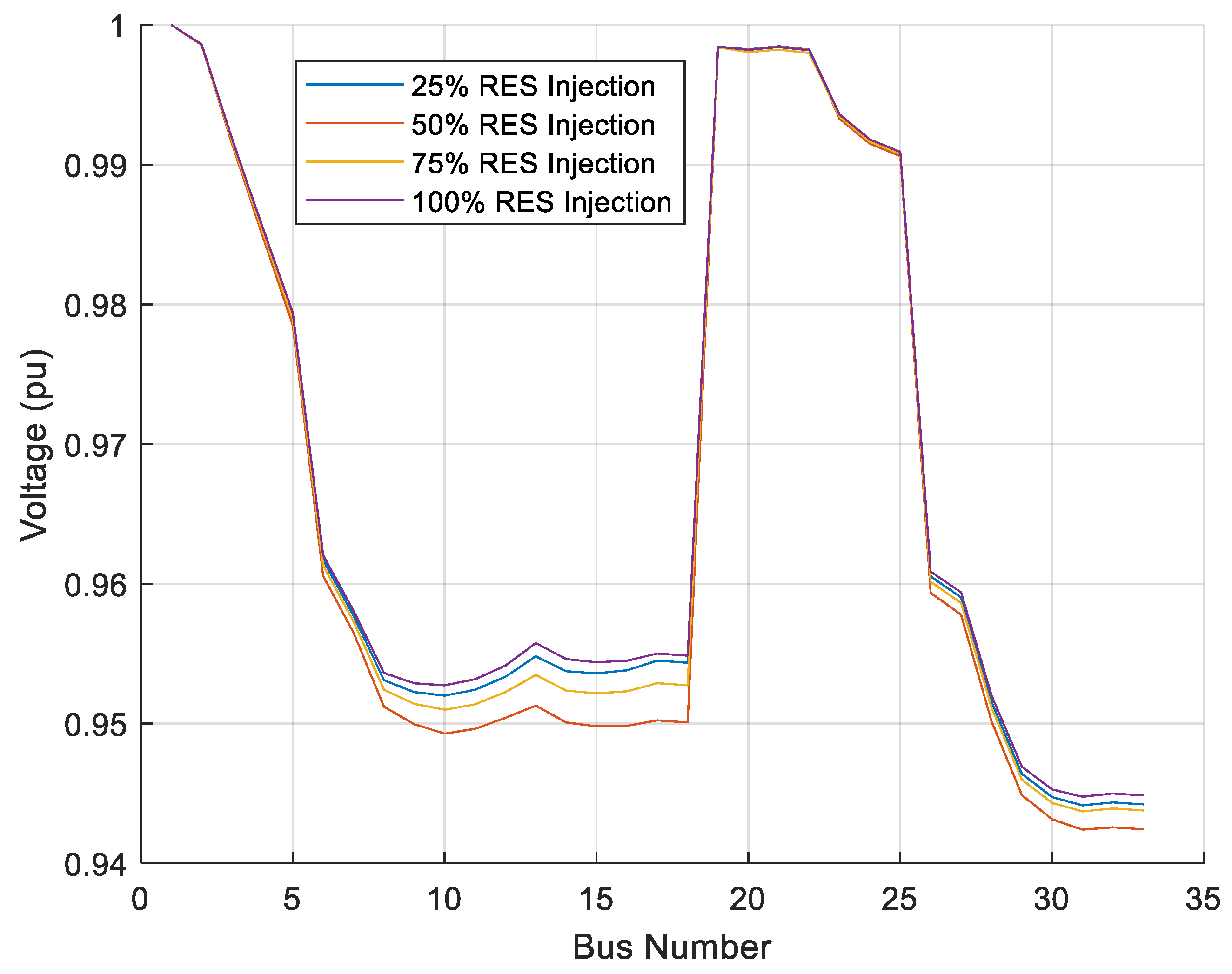
In this simulation, the impact of progressively increasing renewable energy penetration within a single prosumer bus cluster is evaluated under the proposed control strategy. Four RES integration levels (25%, 50%, 75% and 100%) are applied to the same cluster while maintaining identical network loading and operating conditions. This analysis aims to quantify how rising local renewable injections affect steady-state voltage magnitudes and to verify the ability of the proposed fuzzy-logic-based PMS to maintain voltage levels within acceptable limits as RES penetration increases. The resulting voltage profile is presented in Figure 13.
Figure 13.
Steady-state voltage profile of the IEEE 33-bus feeder under different levels of renewable integration onto the same bus cluster.
The voltage profile demonstrates that increasing renewable energy source injection from 25% to 100% provides significant voltage support across the IEEE 33-bus feeder. Notably, the fuzzy-PSO-based control strategy ensures that even at maximum penetration, the voltages remain within a stable and narrow operating band. This confirms that the proposed power management system successfully translates increased local generation into improved grid stability without causing over-voltage violations, highlighting its robustness in handling high-density prosumer clusters.
5.6.2. Uniform RES Integration Across All Prosumer Bus Clusters
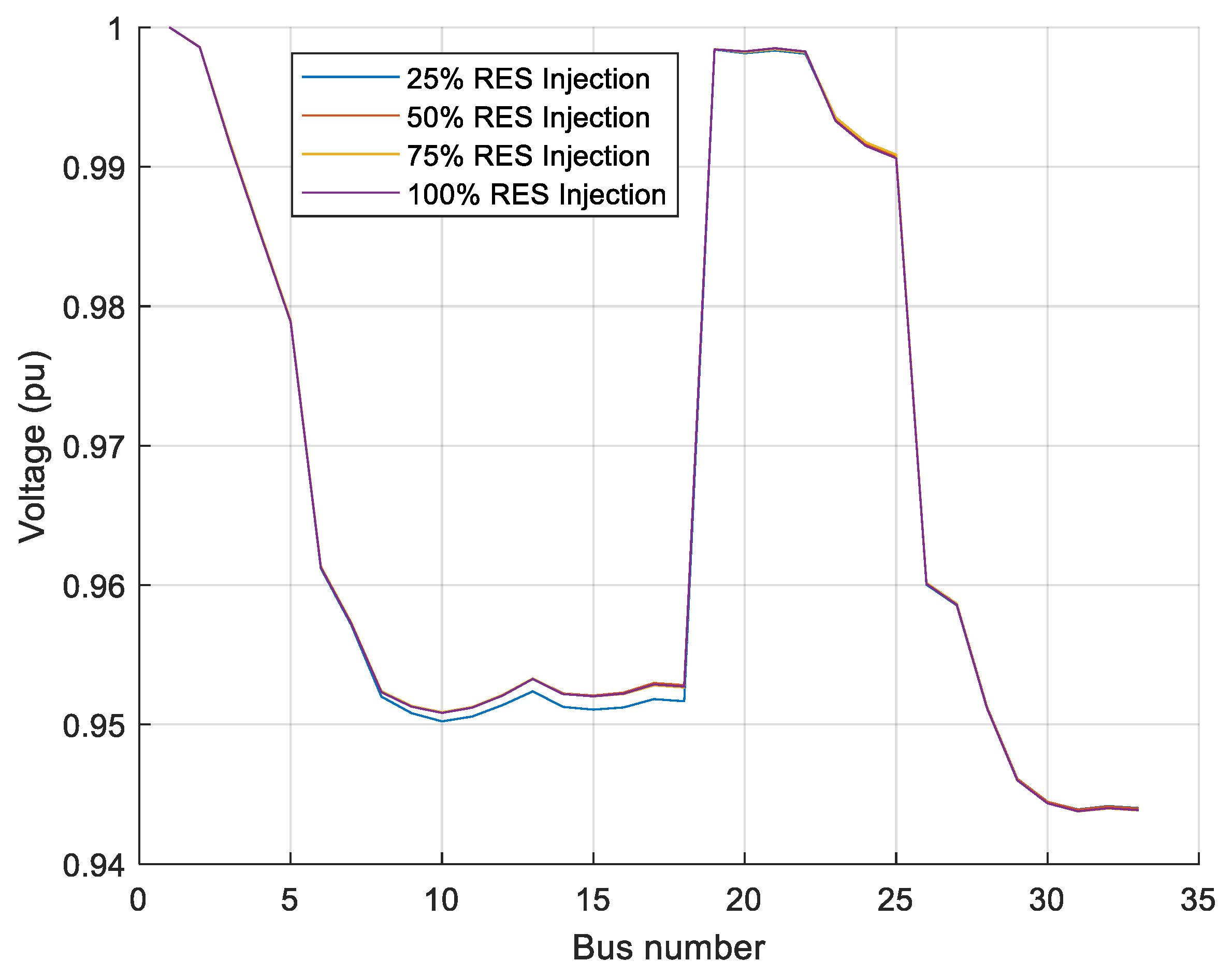
In the second case study, the same RES penetration levels (25%, 50%, 75% and 100%) are applied uniformly and simultaneously across all four prosumer bus clusters. Unlike the previous case, this configuration distributes renewable generation spatially along the feeder while maintaining equal penetration at each cluster. The objective of this analysis is to evaluate the cumulative and coordinated impact of distributed RES integration on the network voltage profile and to assess whether the proposed fuzzy-PSO-based PMS can consistently maintain voltage regulation under increasing system-wide renewable penetration. The corresponding results are illustrated in Figure 14.
Figure 14.
Steady-state voltage profile of the IEEE 33-bus feeder under the same level of renewable integration onto different bus clusters.
The voltage profile in Figure 14 illustrates the impact of distributed renewable energy source integration applied simultaneously across all four prosumer bus clusters. Under this uniform deployment pattern, the magnitude of the voltage profile across the IEEE 33-bus system remains remarkably consistent, even as penetration levels increase from 25% to 100%. While the previous case study showed distinct “lifting” of the voltage as penetration grew, this uniform distribution results in overlapping or very closely aligned voltage lines across most of the feeder. This indicates that the proposed fuzzy-PSO-based control strategy successfully manages the cumulative impact of system-wide renewable generation, providing coordinated voltage regulation that prevents significant fluctuations. The steady-state magnitudes are maintained within a stable range, demonstrating the robustness of the power management system (PMS) in maintaining acceptable voltage levels under spatially distributed RES injections.
5.7. Comparative Study Between PSO and GA
This section presents a comparative analysis between the proposed PSO-based fuzzy Power Management System (PMS) and an alternative configuration in which the fuzzy controller parameters are optimized using a Genetic Algorithm (GA). Both optimization techniques are applied to the same fuzzy logic structure, operating under identical system conditions, renewable profiles, and load variations, in order to ensure a fair and consistent comparison. The objective of this study is to assess the influence of the optimization method on control performance, convergence behavior, and dynamic response rather than to modify the underlying control architecture. By evaluating PSO and GA within the same prosumer-centric framework, this comparison provides insight into the robustness and efficiency of the optimization methods in complex distribution-level systems. Table 4 summarizes the main parameters used in the Genetic Algorithm.
Table 4.
GA parameters.
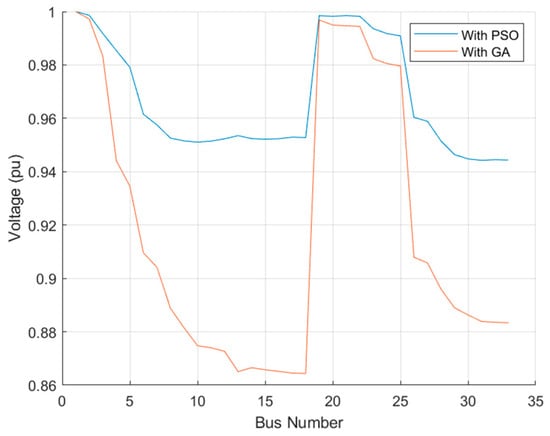
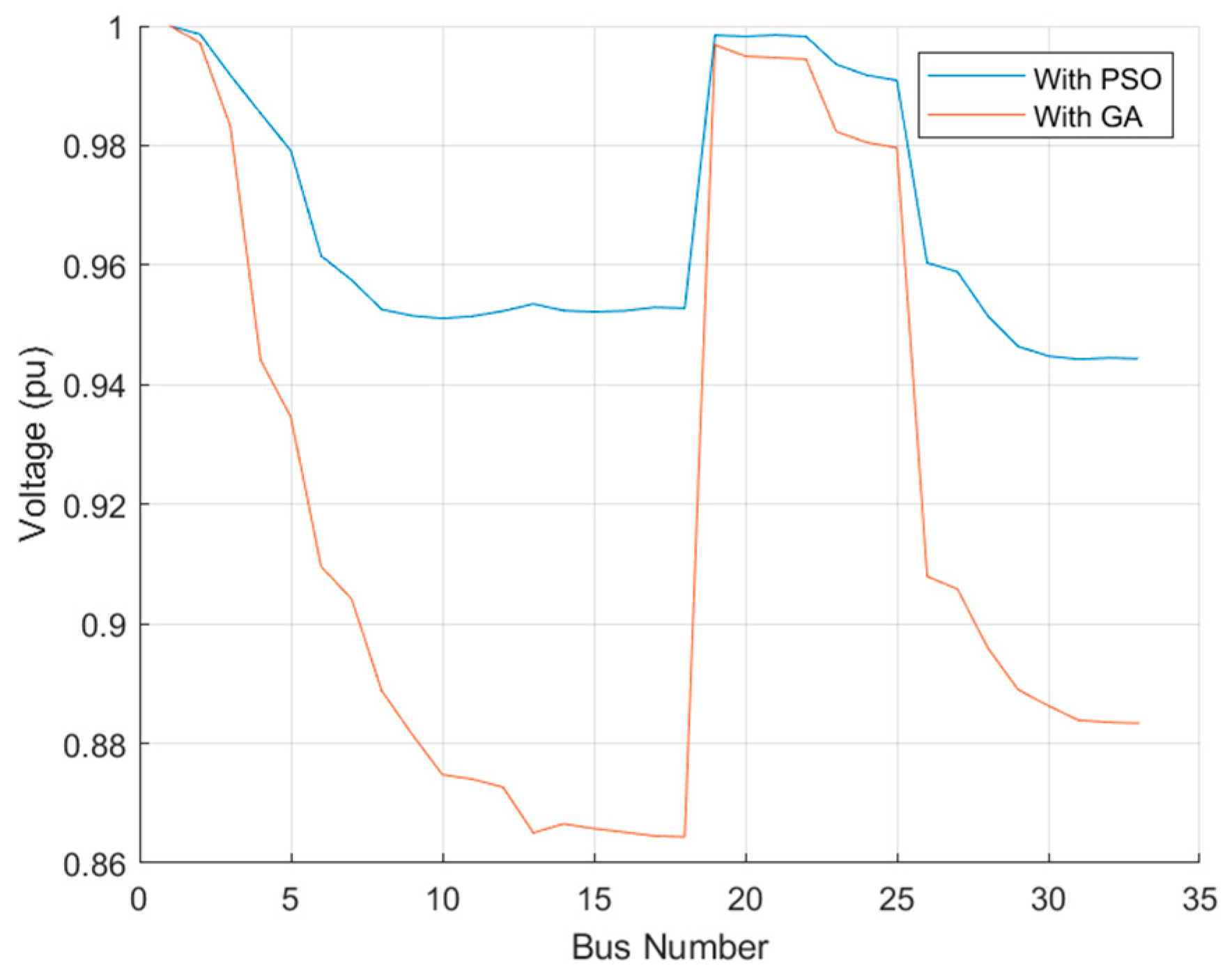
Figure 15 shows the steady-state voltage profile of the IEEE 33-bus feeder optimized via the PSO and GA algorithms.
Figure 15.
Steady-state voltage profile of the IEEE 33-bus feeder optimized via PSO and GA.
The results reveal that while PSO maintains a stable profile near the nominal 1 pu value, the GA results show significant degradation, with voltages dropping as low as 0.86 pu at the feeder ends. This discrepancy indicates that the GA likely converged to a local optimum or suffered from a fitness function that prioritized real power loss reduction without adequate constraints on voltage regulation.
6. Conclusions
This paper presents a comprehensive prosumer-centric framework for optimizing the operation of distribution systems with high penetration of renewable energy resources, hybrid energy storage, and electric vehicles. By embedding aggregated prosumer clusters into the IEEE 33-bus radial distribution feeder, the study demonstrates how distributed renewable generation combined with coordinated storage and intelligent control can enhance voltage stability and system performance at the distribution level. The proposed architecture integrates photovoltaic, wind, and concentrated solar power generation with a heterogeneous hybrid energy storage system composed of redox flow batteries, superconducting magnetic energy storage, and fuel cells, enabling multi-timescale flexibility and improved resilience.
A hierarchical control strategy was developed, combining local autonomous control, a fuzzy-logic-based power management system, and a PSO-based optimization layer. Simulation results show that prosumer integration leads to a systematic improvement in voltage profiles across all buses, particularly at downstream locations. Comparative analyses further demonstrates that Load Frequency Control outperforms conventional droop control in both non-renewable and renewable-assisted prosumer systems. Moreover, the integration of the fuzzy logic PMS with LFC significantly reduces frequency oscillations and improves disturbance rejection, highlighting the advantages of intelligent, rule-based coordination in complex prosumer environments with mixed conventional and renewable resources.
Despite these promising results, the present study adopts simplified market interaction assumptions and does not explicitly model dynamic pricing, peer-to-peer trading, or multi-market participation mechanisms. As a result, economic dispatch decisions are evaluated primarily from a technical and operational perspective rather than through a fully integrated market framework. Future work will therefore focus on extending the proposed control architecture to include detailed economic dispatch and market participation models, such as coupling day-ahead, intra-day, and ancillary service markets, incorporating dynamic and uncertain pricing signals, and analyzing their impact on prosumer behavior and system-level performance. Additionally, integrating advanced learning-based decision layers for market-oriented scheduling while preserving the interpretability and stability of the proposed framework represents a promising research direction.
Author Contributions
Conceptualization, D.S., N.E.Y.K. and A.N.-S.; methodology, D.S. and N.E.Y.K.; software, D.S.; validation, D.S. and N.E.Y.K.; formal analysis, D.S. and A.N.-S.; investigation, D.S.; resources, N.E.Y.K.; data curation, D.S.; writing—original draft preparation, D.S.; writing—review and editing, N.E.Y.K. and A.N.-S.; visualization, D.S., N.E.Y.K. and A.N.-S.; supervision, N.E.Y.K. and A.N.-S.; project administration, N.E.Y.K. and A.N.-S. All authors have read and agreed to the published version of the manuscript.
Funding
This research received no external funding.
Institutional Review Board Statement
Not applicable.
Informed Consent Statement
Not applicable.
Data Availability Statement
The original contributions presented in this study are included in the article. Further inquiries can be directed to the corresponding author.
Conflicts of Interest
The authors declare no conflicts of interest.
Appendix A
Table A1.
Fuzzy logic rule table.
References
- Sami, M.S.; Abrar, M.; Akram, R.; Hussain, M.M.; Nazir, M.H.; Khan, M.S.; Raza, S. Energy Management of Microgrids for Smart Cities: A Review. Energies 2021, 14, 5976. [Google Scholar] [CrossRef] [Scilit]
- Parra-Domínguez, J.; Sánchez, E.; Ordóñez, Á. The Prosumer: A Systematic Review of the New Paradigm in Energy and Sustainable Development. Sustainability 2023, 15, 10552. [Google Scholar] [CrossRef] [Scilit]
- Kotilainen, K. Energy Prosumers’ Role in the Sustainable Energy System. In Affordable and Clean Energy; Springer International Publishing: Cham, Switzerland, 2020. [Google Scholar] [CrossRef] [Scilit]
- Elalfy, D.A.; Gouda, E.; Kotb, M.F.; Bureš, V.; Sedhom, B.E. Comprehensive review of energy storage systems technologies, objectives, challenges, and future trends. Energy Strategy Rev. 2024, 54, 101482. [Google Scholar] [CrossRef] [Scilit]
- El Zerk, A.; Ouassaid, M. Real-Time Fuzzy Logic Based Energy Management System for Microgrid Using Hardware in the Loop. Energies 2023, 16, 2244. [Google Scholar] [CrossRef] [Scilit]
- Sharmoukh, W. Redox flow batteries as energy storage systems: Materials, viability, and industrial applications. RSC Adv. 2025, 15, 10106–10143. [Google Scholar] [CrossRef] [Scilit] [PubMed]
- Vivas, F.J.; Segura, F.; Andújar, J.M. Fuzzy logic-based energy management system for grid-connected residential DC microgrids with multi-stack fuel cell systems: A multi-objective approach. Sustain. Energy Grids Netw. 2022, 32, 100909. [Google Scholar] [CrossRef] [Scilit]
- Paul, K.; Jyothi, B.; Kumar, R.S.; Singh, A.R.; Bajaj, M.; Kumar, B.H.; Zaitsev, I. Optimizing sustainable energy management in grid connected microgrids using quantum particle swarm optimization for cost and emission reduction. Sci. Rep. 2025, 15, 5843. [Google Scholar] [CrossRef] [Scilit] [PubMed]
- Kumar, P.; Channi, H.K.; Kumar, R.; Rajiv, A.; Kumari, B.; Singh, G.; Singh, S.; Dyab, I.F.; Lozanović, J. A comprehensive review of vehicle-to-grid integration in electric vehicles: Powering the future. Energy Convers. Manag. X 2025, 25, 100864. [Google Scholar] [CrossRef] [Scilit]
- Mojumder, M.R.H.; Ahmed Antara, F.; Hasanuzzaman, M.; Alamri, B.; Alsharef, M. Electric Vehicle-to-Grid (V2G) Technologies: Impact on the Power Grid and Battery. Sustainability 2022, 14, 13856. [Google Scholar] [CrossRef] [Scilit]
- Zahraoui, Y.; Alhamrouni, I.; Mekhilef, S.; Khan, M.R.B.; Seyedmahmoudian, M.; Stojcevski, A.; Horan, B. Energy Management System in Microgrids: A Comprehensive Review. Sustainability 2021, 13, 10492. [Google Scholar] [CrossRef] [Scilit]
- Habib, S.; Kamran, M.; Rashid, U. Impact analysis of vehicle-to-grid technology and charging strategies of electric vehicles on distribution networks—A review. J. Power Sources 2015, 277, 205–214. [Google Scholar] [CrossRef] [Scilit]
- Xie, P.; Wang, H.; Jia, Y. Decentralized energy management regime for prosumer community Microgrids using flexible tube model predictive control. Electr. Power Syst. Res. 2024, 236, 110553. [Google Scholar] [CrossRef] [Scilit]
- Awaji, H.H.H.; Alhussainy, A.A.; Alobaidi, A.H.; Alghamdi, S.; Alghamdi, S.; Alruwaili, M. Real-time energy management simulation for enhanced integration of renewable energy resources in DC microgrids. Front. Energy Res. 2024, 12, 1458115. [Google Scholar] [CrossRef] [Scilit]
- Nassereddine, K.; Turzynski, M.; Bielokha, H.; Strzelecki, R. Simulation of energy management system using model predictive control in AC/DC microgrid. Sci. Rep. 2025, 15, 5388. [Google Scholar] [CrossRef] [Scilit] [PubMed]
- Lou, W.; Zhu, S.; Zhuo, X.; Qin, S.; Li, B.; Zhou, Y.; Chen, J.; Gao, Q. Energy interaction strategy for multi-prosumer distribution systems based on game theory. Front. Energy Res. 2025, 13, 1537562. [Google Scholar] [CrossRef] [Scilit]
- Jia, C.; Liu, W.; Chau, K.T.; He, H.; Zhou, J.; Niu, S. Passenger-aware reinforcement learning for efficient and robust energy management of fuel cell buses. eTransportation 2026, 27, 100537. [Google Scholar] [CrossRef] [Scilit]
- Baran, M.E.; Wu, F.F. Optimal capacitor placement on radial distribution systems. IEEE Trans. Power Deliv. 1989, 4, 725–734. [Google Scholar] [CrossRef] [Scilit]
- Dolatabadi, S.; Ghorbanian, M.; Siano, P.; Hatziargyriou, N.D. An Enhanced IEEE 33 Bus Benchmark Test System for Distribution System Studies. IEEE Trans. Power Syst. 2020, 36, 2565–2572. [Google Scholar] [CrossRef] [Scilit]
- Olivares, D.; Mehrizi-Sani, A.; Etemadi, A.H.; Canizares, C.A.; Iravani, R.; Kazerani, M.; Hajimiragha, A.H.; Gomis-Bellmunt, O.; Saeedifard, M.; Palma-Behnke, R.; et al. Trends in Microgrid Control. IEEE Trans. Smart Grid 2014, 5, 1905–1919. [Google Scholar] [CrossRef] [Scilit]

Disclaimer/Publisher’s Note: The statements, opinions and data contained in all publications are solely those of the individual author(s) and contributor(s) and not of MDPI and/or the editor(s). MDPI and/or the editor(s) disclaim responsibility for any injury to people or property resulting from any ideas, methods, instructions or products referred to in the content. |
© 2026 by the authors. Licensee MDPI, Basel, Switzerland. This article is an open access article distributed under the terms and conditions of the Creative Commons Attribution (CC BY) license (https://creativecommons.org/licenses/by/4.0/).