


Abstract
Carbon capture is an essential technology for reducing industrial CO2 emissions, particularly in the power and cement sectors. Among the various capture methods, solvent-based absorption systems are widely used due to their efficiency and scalability, making the selection of the right solvent critical for near-term applications. This study analyzes several solvents for use in an absorption-based CO2 capture system, emphasizing identifying the most suitable solvent for 2025–2030. The research methodology involves process modeling in Aspen Plus, sensitivity analysis, and evaluation of the regeneration duty for each solvent. The objective is to achieve at least 90% CO2 capture and 95% CO2 purity. The flue gas composition considered in this analysis is 19.8% CO2, 9.3% O2, 63% N2, 7.5% H2O, and other trace gases. Various solvents are evaluated to determine their effectiveness in capturing CO2 while minimizing the energy consumption during solvent regeneration. A sensitivity analysis was conducted to optimize the system’s performance based on the solvent type, operating conditions, and regeneration duty. The results showed that amine blends demonstrated a CO2 capture rate of 92% and a CO2 purity of 96%, with regeneration energy requirements of around 3.2 GJ/ton of CO2, significantly lower than those of traditional MEA systems, which typically require around 4.0 GJ/ton. In contrast, ionic liquids showed a CO2 capture rate of 89% and a purity of 95%, with a regeneration energy of 2.8 GJ/ton, though their current cost is higher, limiting their immediate large-scale application. Annual capital expenditure (CAPEX) calculation revealed that amine blends could potentially reduce the CAPEX by 15–20% compared to MEA, while amino acid salts showed similar CAPEX reductions with a capture efficiency of 90%. Overall, the results indicate that hybrid amine solvents are the most cost-effective and practical solution for 2025–2030, with ionic liquids and amino acid salts emerging as promising alternatives as their costs decrease.
Keywords:
absorption; efficiency; amine blends; capital expenditure; ionic liquids; flue gas; CO2 capture 1. Introduction
The accelerating pace of global climate change has intensified the need for rapid and large-scale reduction in anthropogenic CO2 emissions [1]. Energy-intensive industries such as cement production, steelmaking, and coal- or gas-fired power generation collectively contribute more than one-third of global greenhouse gas emissions [2]. Among these, the cement industry alone accounts for nearly 7–8% of global CO2 emissions due to both fuel combustion and the calcination of limestone [3]. As nations commit to increasingly ambitious decarbonization pathways, achieving substantial emission reductions in these hard-to-abate sectors has become an essential component of meeting mid-century climate targets.
Carbon capture, utilization, and storage (CCUS) technologies are regarded as one of the few immediately deployable solutions capable of achieving deep decarbonization in industrial settings [4]. In particular, post-combustion CO2 capture using solvent absorption systems remains the most technologically mature and commercially scalable approach [5]. Its applicability to existing plants without requiring major infrastructure modifications significantly increases its near-term deployment potential. As a result, solvent-based CO2 absorption systems are receiving renewed global attention, particularly for the 2025–2030 implementation window, when industries are expected to adopt more efficient and economically viable capture methods.
Despite its widespread usage, the benchmark solvent monoethanolamine (MEA) presents several operational and economic limitations [6]. MEA requires high regeneration energy—typically around 4.0 GJ per ton of CO2—leading to increased steam consumption and reduced overall plant efficiency [7]. Furthermore, MEA is prone to oxidative and thermal degradation, forming heat-stable salts and degradation products that not only consume solvent but also cause corrosion and higher maintenance costs [8]. These challenges have prompted researchers and industry stakeholders to explore alternative solvents that offer lower energy penalties, improved stability, and reduced lifecycle impacts [9,10].
In recent years, several promising solvent classes have emerged. Amine blends, particularly formulations incorporating piperazine (PZ), methyl diethanolamine (MDEA), or tertiary amines, have demonstrated faster absorption kinetics, higher cyclic capacities, and lower regeneration energy compared to MEA [11,12]. Amino acid salts have gained attention due to their low volatility, environmental compatibility, and resistance to degradation [13]. Meanwhile, ionic liquids, although still relatively costly, exhibit unique thermodynamic properties such as tunable molecular structures, negligible vapor pressure, and high CO2 selectivity, making them attractive candidates for future-generation capture systems [11].
Evaluating these solvent systems under realistic industrial conditions is crucial for determining their viability in practice. While laboratory studies often focus on reaction mechanisms or equilibrium properties, industrial adoption requires a holistic assessment that includes energy consumption, solvent stability, degradation risk, process integration challenges, and capital expenditure implications. Post-combustion flue gases typically exhibit dilute CO2 concentrations (10–20%) and elevated oxygen and moisture levels, making solvent performance highly sensitive to both thermodynamics and operating conditions. Therefore, rigorous process simulation tools—such as Aspen Plus, widely used in chemical process design—play a fundamental role in screening and comparing candidate solvents [14].
This study aims to provide a comprehensive and comparative evaluation of several promising solvent types for post-combustion CO2 capture. Using an industrially relevant flue gas composition and standardized process conditions, we conduct detailed Aspen Plus simulations, perform sensitivity analyses, and estimate regeneration energy requirements and CAPEX implications. The focus is explicitly on identifying the most efficient and cost-effective solvent system for deployment between 2025 and 2030, a period when many developing and industrializing countries are expected to scale up CCUS as part of broader decarbonization strategies.
By combining engineering modeling with techno-economic insights, this research contributes to ongoing efforts to transition toward more energy-efficient carbon capture solutions. The findings provide valuable guidance for plant designers, policymakers, and industry stakeholders seeking practical solvent selection strategies that balance economic feasibility with high capture performance. Ultimately, this study highlights not only the current potential of hybrid amine solvents but also the emerging role of next-generation solvents—such as ionic liquids and amino acid salts—in shaping the future of post-combustion CO2 capture technologies.
2. Methodology
The methodological approach adopted in this study integrates steady-state process simulation, thermodynamic modeling, and sensitivity analysis in order to compare the performance of several candidate solvents for post-combustion CO2 capture. The entire evaluation was carried out in Aspen Plus V12 using a consistent flue-gas composition and a standardized process configuration to ensure comparability across the different solvent systems. Emphasis was placed on reproducing conditions that closely resemble those found in industrial cement and power plants, thereby allowing the results to serve as a realistic indicator of near-term deployment potential.
A conventional absorption–stripping process served as the foundation for all simulations. The model included an absorber column for CO2 uptake, a rich–lean heat exchanger, and a stripper equipped with a reboiler and condenser for solvent regeneration. Both the absorber and the stripper were modeled using the RadFrac module in Aspen Plus, which provides rigorous stage-by-stage vapor–liquid equilibrium calculations as well as reliable convergence under non-ideal electrolyte conditions. The inlet flue gas consisted of 19.8% CO2, 9.3% O2, 63% N2, 7.5% water vapor, and minor trace gases. The gas stream was introduced to the absorber at temperatures between 45 and 50 °C under atmospheric pressure, which reflects typical operating windows after flue-gas conditioning.
For aqueous amine-based solvents (MEA and amine blends), the Electrolyte-NRTL property method was employed to represent non-ideal liquid-phase behavior and chemical equilibria. The dominant reaction pathways include carbamate formation, bicarbonate generation, and protonated amine species, which jointly determine solvent loading and cyclic capacity. Piperazine-activated blends exhibit enhanced carbamate stability and faster reaction kinetics compared to MEA, which is reflected in higher cyclic capacity and lower regeneration duty. Amino acid salt systems were modeled by accounting for zwitterionic species formation, metal–amino acid complexation, and bicarbonate-dominated CO2 binding mechanisms. These systems exhibit lower volatility and improved thermal stability but slower intrinsic absorption kinetics, leading to higher circulation requirements. Ionic liquids were treated as non-volatile solvents in which CO2 absorption is governed primarily by physical solubility and weak chemical interactions rather than carbamate formation. For these systems, PC-SAFT (Perturbed Chain Statistical Associating Fluid Theory)- or UNIQUAC-based (Universal Quasi Chemical Equation) models were applied where reliable literature parameters were available. The absence of strong chemical bonding results in lower regeneration energy but reduced mass-transfer performance, which is reflected in longer residence times required in the absorber.
To ensure reproducibility and representativeness, specific solvent formulations were defined for each solvent class. The benchmark system consisted of 30 wt% MEA in water. Amine blends were represented by piperazine-activated systems, such as MEA–PZ or MDEA–PZ formulations, with total amine concentrations in the range of 30–35 wt%. Amino acid salts were modeled as aqueous potassium-based solutions (e.g., potassium glycinate) with concentrations between 30 and 40 wt%. Ionic liquid systems were represented by task-specific, low-volatility ionic liquids reported in the literature, selected based on available vapor–liquid equilibrium and CO2 solubility data. While proprietary formulations were not considered, the selected systems are representative of each solvent class reported in industrial and pilot-scale studies.
The modeling workflow began by establishing a calibrated MEA base case. This step ensured that absorber and stripper performance in the simulation reflected expected industrial behavior, particularly in terms of cyclic capacity, column temperature profiles, and reboiler duty. Once the MEA benchmark was validated against published experimental and pilot-plant data, the same column configurations and operating conditions were applied to the alternative solvent systems. For each solvent, the model was allowed to converge fully on both material and energy balances, and the cyclic capacity was computed as the difference between the rich and lean solvent loadings predicted by the simulation. Reboiler duty and condenser heat loads were extracted directly from the energy balance results.
A comprehensive sensitivity analysis was carried out to explore how key operating parameters influence both capture efficiency and regeneration energy. The parameters examined included solvent circulation rate, lean solvent loading level, absorber inlet temperature, stripper pressure, and reboiler heat input. These variables were modified within ranges typical for industrial CO2 capture units. The purpose of this analysis was to identify regions of optimal performance for each solvent and to determine the extent to which regeneration duty depends on solvent formulation and column operating conditions. Simulation outputs were carefully screened to ensure that predicted temperature and loading profiles remained consistent with physical and thermodynamic expectations.
CAPEX was evaluated on a relative basis using MEA as the reference system. The assessment relied on early-stage screening correlations commonly used in process design, linking absorber diameter to gas and liquid throughput (and thus circulation rate), and heat-exchanger area to thermal duties (primarily reboiler duty and rich–lean heat exchange). Auxiliary equipment sizing trends (pumps and utilities) were considered to scale with solvent flow rate and energy demand. Rather than providing absolute investment costs, the analysis focuses on comparative trends that illustrate how reductions in regeneration energy and circulation rate translate into potential capital savings. Therefore, the reported CAPEX impacts should be interpreted as indicative screening estimates rather than investment-grade cost calculations.
Model validation was performed by comparing the MEA simulation outputs with published industrial data, particularly regarding CO2 capture efficiency, solvent loading, and reboiler duty. The agreement observed strengthened confidence in applying the same modeling framework to alternative solvents. Nonetheless, several methodological limitations must be acknowledged. The accuracy of ionic liquid predictions depends strongly on the availability of reliable interaction parameters. Amino acid salt systems also present challenges, as their complex speciation behavior requires more detailed kinetic and equilibrium data than are widely available. Finally, the entire study is based on steady-state modeling; therefore, dynamic performance, start-up behavior, and long-term solvent degradation were not taken into account. Despite these limitations, the methodology remains well suited for comparative assessment, which is the primary objective of the present work.
The effects of flue-gas impurities such as SOx, NOx, and particulate matter were intentionally excluded from the present analysis. The objective of this study is to compare intrinsic thermodynamic and energetic performance of different solvent classes under standardized conditions. Incorporating impurity effects would introduce plant-specific variability and require detailed degradation, corrosion, and aerosol-formation submodels that are outside the scope of a steady-state comparative screening study.
3. Results and Discussion
The simulation results provide a comparative understanding of how each solvent behaves under realistic post-combustion CO2 capture conditions. To maintain consistency, all solvents were evaluated using the same absorber–stripper configuration, flue-gas composition, and lean loading constraints. The main performance indicators—capture efficiency, CO2 purity, and regeneration duty—are summarized in Table 1. Additional energy and cost implications appear in Table 2.
Table 1.
Summary of CO2 Capture performance for all solvents.
Table 2.
Estimated economic indicators relative to MEA baseline.
The benchmark MEA system reproduced widely reported industrial values and served as a reliable basis for comparison. Its absorption behavior followed the expected gradual decline in CO2 partial pressure along the column height, while the regeneration stage required a relatively high thermal input to overcome carbamate stability. The resulting regeneration duty of approximately 4.0 GJ per ton of CO2 aligns with known industrial data and confirms the significant energy demand associated with conventional MEA systems, despite their mature and widely demonstrated absorption capability. Compared to MEA, blended amines showed noticeably improved performance. Faster mass-transfer kinetics allowed more efficient solvent–gas contact, contributing to an increase in capture efficiency to around 92% and a corresponding improvement in product purity. The most meaningful advantage, however, emerged during solvent regeneration. The energy required in the stripper decreased to roughly 3.2 GJ per ton of CO2, representing about a 25% reduction relative to MEA. This improvement is attributed to more favorable reaction pathways provided by piperazine-activated systems, resulting in reduced steam consumption and enhanced operational flexibility [15].
Differences in absorption kinetics among the solvent classes were reflected in the required solvent circulation rates and effective absorber utilization at the fixed capture target. Amino acid salt systems required noticeably higher circulation rates to maintain approximately 90% CO2 capture under the same column configuration, indicating slower intrinsic reaction kinetics and reduced mass-transfer performance compared to MEA and blended amines. For ionic liquids, absorber residence time requirements increased due to viscosity-driven diffusion limitations, implying larger absorber cross-sectional area and/or increased packing height in practical designs. In contrast, amine blends achieved the same capture level at lower circulation rates than MEA because of higher effective cyclic capacity and faster absorption kinetics. These semi-quantitative design indicators support the conclusion that kinetics directly translate into absorber sizing and CAPEX trends.
Ionic liquids demonstrated the lowest regeneration energy demand of all evaluated solvents, with an estimated duty of approximately 2.8 GJ per ton of CO2. Their negligible vapor pressure minimized water losses during regeneration and contributed to a more thermodynamically efficient desorption process. However, their slow absorption kinetics, driven largely by viscosity effects, required longer residence times to reach comparable removal efficiencies. In addition, current material cost and uncertainties related to large-scale supply chains limit the near-term feasibility of deploying ionic liquids at industrial scale, despite their promising energetic characteristics.
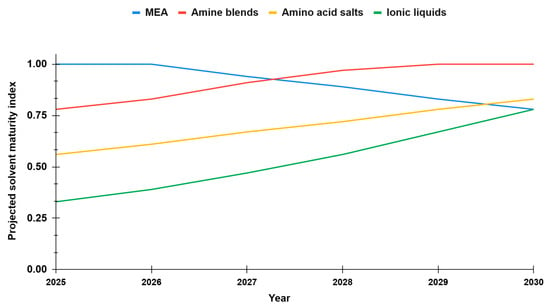
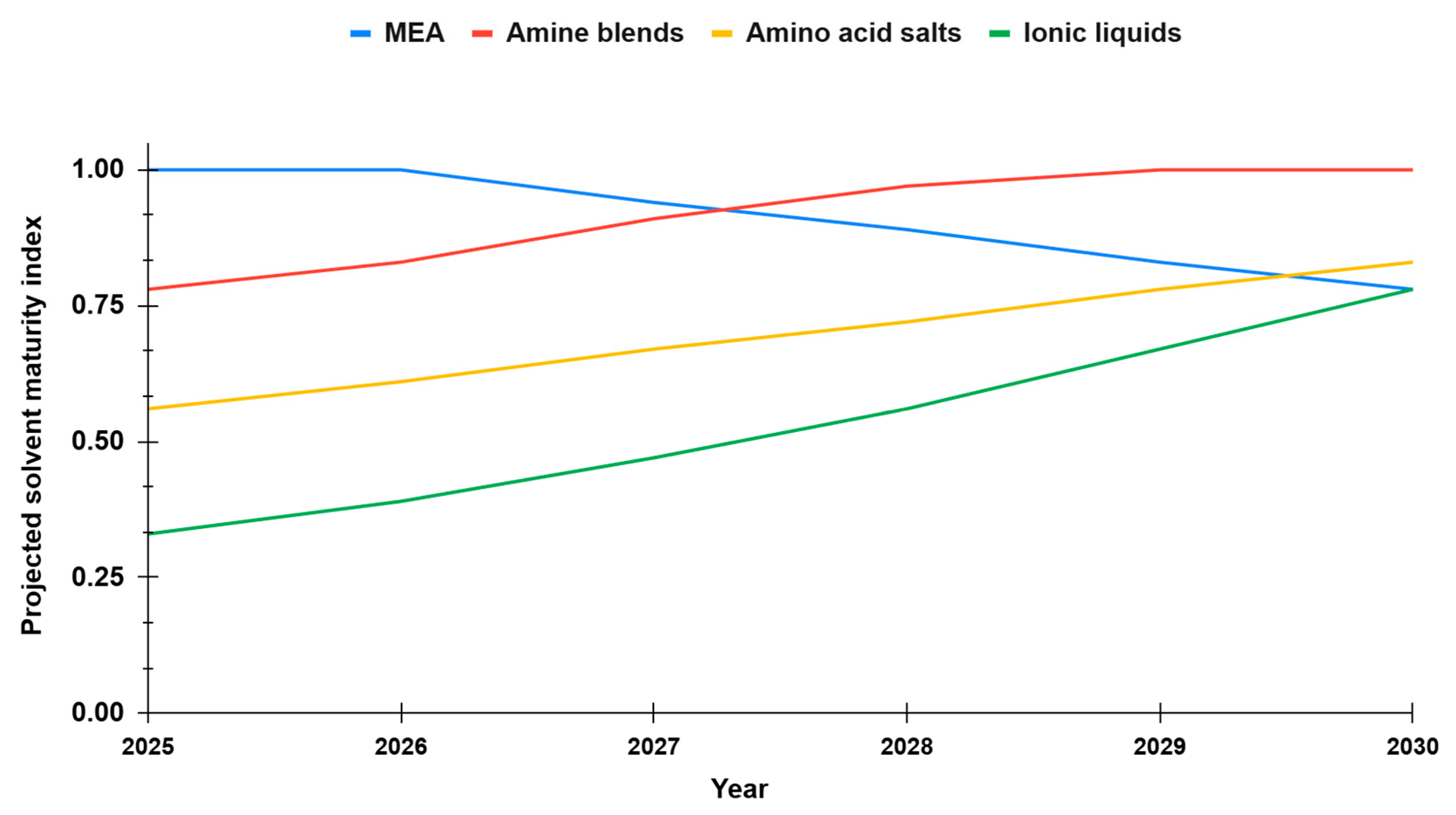
The maturity index presented in Figure 1 is a qualitative composite indicator intended to compare the relative readiness of each solvent class for near-term industrial deployment (2025–2030). The index was constructed based on a synthesis of reported technology readiness levels (TRLs), the extent of pilot- and demonstration-scale activity, commercial availability and supply-chain maturity, and literature trends. Expert judgment was applied to translate these evidence streams into a unified 0–1 scale for visualization. Because the index is not a strictly quantitative metric, it should be interpreted as a structured screening tool rather than a deterministic prediction.
Figure 1.
Projected solvent maturity index (2025–2030).
Amino acid salts follow a moderate upward trajectory, driven by improvements in formulation stability and ongoing pilot testing, though they remain below blended amines in overall readiness. Ionic liquids, initially the least mature option, demonstrate the steepest growth as research advances and material costs slowly improve. Although still not expected to surpass blended amines by 2030, their maturity level approaches parity with traditional MEA, positioning them as a longer-term candidate for next-generation CO2 capture systems.
The comparative analysis reveals a clear pattern. MEA remains technically reliable but suffers from a significant energy penalty. Amine blends offer notable improvements in both absorption rate and regeneration duty. Their higher cyclic capacities allow smaller circulation rates, leading to reduced pumping power and downsized heat-exchange equipment. These advantages collectively result in a projected 15–20% CAPEX reduction, making blended amines the most practical solution for commercial deployment in the 2025–2030 period.
Amino acid salts occupy an intermediate position. Although their regeneration duty is lower than that of MEA, their absorption kinetics are considerably slower. This trade-off suggests that such solvents may be especially suitable in contexts where long-term solvent durability, oxidative resistance, and environmental compatibility are prioritized.
Ionic liquids appear highly promising in terms of theoretical thermodynamic performance. Their remarkably low regeneration duty could dramatically reduce operating costs, and their tunable molecular structures offer opportunities for future optimization. Nevertheless, current limitations—including high viscosity, limited mass-transfer performance, and production cost—prevent widespread implementation.
Taken together, the results demonstrate that solvent selection fundamentally shapes the energetic and economic boundaries of post-combustion CO2 capture. Blended amines emerge as the most balanced option for near-term adoption, while ionic liquids and amino acid salts represent important future directions as the cost and availability of advanced solvent materials improve.
4. Conclusions
This study evaluated a set of solvent systems—MEA, blended amines, amino acid salts, and ionic liquids—for post-combustion CO2 capture under realistic industrial operating conditions using Aspen Plus process simulation and quantitative performance criteria. By applying consistent thermodynamic models, absorber–stripper process architecture, and energy-based evaluation metrics, the results provide a robust comparison of how solvent formulation influences capture efficiency, regeneration duty, cyclic capacity, and expected economic impact.
The benchmark MEA system delivered stable and predictable performance but required the highest regeneration energy, confirming the well-recognized challenge of steam demand in conventional amine-based capture systems. While technically reliable, the energy penalty associated with MEA limits its suitability for future large-scale deployment, especially in sectors such as cement production where steam availability is inherently constrained.
Amine blends demonstrated the most balanced performance. They consistently achieved higher capture efficiency than MEA, increased cyclic capacity, and produced a measurable reduction in regeneration energy—approximately 20–25% lower than the reference case. These improvements translated directly into estimated capital and operating cost reductions, making blended formulations the most viable near-term solution for industrial CO2 capture, particularly in the 2025–2030 deployment timeframe.
Amino acid salts showed intermediate behavior. Their lower regeneration duty relative to MEA indicates potential for energy savings, while their chemical stability and negligible volatility make them attractive for long-term operation. However, slower mass-transfer kinetics suggest that larger absorbers or enhanced contacting technologies would be necessary in practice to match the performance of blended amines.
Ionic liquids achieved the lowest theoretical regeneration energy among all candidates, confirming their promise as a future-generation solvent class. Nevertheless, viscosity-driven mass-transfer limitations and current production cost make them unsuitable for widespread deployment at present. Their role, based on the findings of this work, is better positioned as a medium- to long-term technology option, contingent upon further material optimization, cost reduction, and demonstration at pilot scale.
Overall, the comparative assessment reveals that no single solvent excels across all dimensions, but clear trends emerge. For near-term adoption, blended amines offer the most compelling combination of operational performance, energy efficiency, stability, and economic feasibility. Amino acid salts may serve as complementary alternatives for applications prioritizing solvent durability and environmental compatibility, while ionic liquids represent a promising research pathway toward low-energy capture processes suitable for next-generation decarbonization frameworks.
Future work should extend the present screening to impurity-rich flue gases representative of cement kilns, including SOx, NOx, particulate matter, and trace contaminants that can accelerate solvent degradation, corrosion, and the formation of heat-stable salts. In addition, dynamic operation (load changes, start-up/shutdown), long-term solvent aging, and emissions control (amine slip and aerosol formation) should be evaluated. Finally, process integration with realistic industrial heat sources (waste heat recovery, steam extraction limits, and electrified regeneration) is required to support robust solvent selection for large-scale deployment.
Author Contributions
Conceptualization, A.N., A.K. and Z.T.; writing—original draft preparation, A.K. and Z.T.; visualization, S.E. and S.R.; writing—review and editing, A.K., Z.T. and A.N.; supervision, A.N., Z.T. and A.K. All authors have read and agreed to the published version of the manuscript.
Funding
This study was partially supported by the Agency for Innovative Development under the Ministry of Higher Education, Science and Innovation of the Republic of Uzbekistan under contract no. IL-8724053118.
Institutional Review Board Statement
Not applicable.
Informed Consent Statement
Not applicable.
Data Availability Statement
The data presented in this study are available on request from the corresponding author.
Acknowledgments
The authors would like to express their gratitude to the members of the Tashkent Institute of Chemical Technology, the University of Cantabria, and the Slovak University of Technology in Bratislava for their collaborative efforts and invaluable knowledge shared during the PhD study. This support has been instrumental in advancing the research and achieving the outcomes presented in this work.
Conflicts of Interest
The authors declare no conflicts of interest.
References
- Hong, W.Y. A Techno-Economic Review on Carbon Capture, Utilisation and Storage Systems for Achieving a Net-Zero CO2 Emissions Future. Carbon Capture Sci. Technol. 2022, 3, 100044. [Google Scholar] [CrossRef] [Scilit]
- Turakulov, Z.; Kamolov, A.; Norkobilov, A.; Variny, M.; Fallanza, M. Techno-Economic and Environmental Analysis of Decarbonization Pathways for Cement Plants in Uzbekistan. Chem. Eng. Res. Des. 2024, 210, 625–637. [Google Scholar] [CrossRef] [Scilit]
- Bouramdane, A.-A. Multi-Criteria Evaluation of Carbon Capture Technologies in Steel, Cement, Petrochemical, and Fertilizer Industries: Insights for Emerging and Developed Countries. Sci. Total Environ. 2024, 957, 177754. [Google Scholar] [CrossRef] [Scilit] [PubMed]
- Srivastav, P.; Schenkel, M.; Mir, G.U.R.; Berg, T.; Staats, M. Carbon Capture, Utilisation and Storage, (CCUS): Decarbonisation Pathways for Singapore’s Energy and Chemicals Sectors; Navigant: Utrecht, The Netherlands, 2021. [Google Scholar]
- Kárászová, M.; Zach, B.; Petrusová, Z.; Červenka, V.; Bobák, M.; Šyc, M.; Izák, P. Post-Combustion Carbon Capture by Membrane Separation, Review. Sep. Purif. Technol. 2020, 238, 116448. [Google Scholar] [CrossRef] [Scilit]
- Roussanaly, S.; Fu, C.; Voldsund, M.; Anantharaman, R.; Spinelli, M.; Romano, M. Techno-Economic Analysis of MEA CO2 Capture from a Cement Kiln—Impact of Steam Supply Scenario. Energy Procedia 2017, 114, 6229–6239. [Google Scholar] [CrossRef] [Scilit]
- Zhang, Z.; Borhani, T.N.; Olabi, A.G. Status and Perspective of CO2 Absorption Process. Energy 2020, 205, 118057. [Google Scholar] [CrossRef] [Scilit]
- Zanco, S.E.; Pérez-Calvo, J.-F.; Gasós, A.; Cordiano, B.; Becattini, V.; Mazzotti, M. Postcombustion CO2 Capture: A Comparative Techno-Economic Assessment of Three Technologies Using a Solvent, an Adsorbent, and a Membrane. ACS Eng. Au 2021, 1, 50–72. [Google Scholar] [CrossRef] [Scilit]
- Mullen, D.; Braakhuis, L.; Knuutila, H.K.; Gibbins, J.; Lucquiaud, M. Monoethanolamine Degradation Rates in Post-Combustion CO2 Capture Plants with the Capture of 100% of the Added CO2. Ind. Eng. Chem. Res. 2024, 63, 13677–13691. [Google Scholar] [CrossRef] [Scilit]
- Lee, S.; Jang, J.; Min, G.H.; Kim, D.; Hwang, Y.; Jang, J.T.; Nam, S.C. MEA-Based CO2 Capture for Refinery Flue Gases: Regeneration Energy and Techno-Economic Analysis. J. Environ. Chem. Eng. 2025, 13, 119107. [Google Scholar] [CrossRef] [Scilit]
- Aghel, B.; Janati, S.; Wongwises, S.; Shadloo, M.S. Review on CO2 Capture by Blended Amine Solutions. Int. J. Greenh. Gas Control 2022, 119, 103715. [Google Scholar] [CrossRef] [Scilit]
- Herraiz, L.; Moser, P.; Wiechers, G.; Stoffregen, T.; Putta, K.R.; Morgan, J.C.; Matuszewski, M.; Van Der Spek, M.; Garcia, S. Techno-Economic Evaluation of Emission Control Configurations for AMP/PZ-Based Post-Combustion CO2 Capture. Chem. Eng. J. 2025, 527, 171446. [Google Scholar] [CrossRef] [Scilit]
- Ramezani, R.; Mazinani, S.; Di Felice, R. State-of-the-Art of CO2 Capture with Amino Acid Salt Solutions. Rev. Chem. Eng. 2022, 38, 273–299. [Google Scholar] [CrossRef] [Scilit]
- Li, Y.; Wang, N.; Guan, H.; Jia, Z.; Zhang, Y.; Zhao, G.; Gao, M. Optimization Study of CO2 Capture Unit for Subcritical Coal-Fired Power Generation Unit Based on Ebsilon and Aspen Plus. Energy Convers. Manag. 2022, 269, 116111. [Google Scholar] [CrossRef] [Scilit]
- Kim, S.; Léonard, G. CO2 Capture Technologies and Shortcut Cost Correlations for Different Inlet CO2 Concentrations and Flow Rates. Part 1: Chemical Absorption. Int. J. Greenh. Gas Control 2025, 145, 104391. [Google Scholar] [CrossRef] [Scilit]

Disclaimer/Publisher’s Note: The statements, opinions and data contained in all publications are solely those of the individual author(s) and contributor(s) and not of MDPI and/or the editor(s). MDPI and/or the editor(s) disclaim responsibility for any injury to people or property resulting from any ideas, methods, instructions or products referred to in the content. |
© 2026 by the authors. Licensee MDPI, Basel, Switzerland. This article is an open access article distributed under the terms and conditions of the Creative Commons Attribution (CC BY) license.