


Abstract
This bibliometric analysis aims to map the evolution, disciplinary structure, and collaboration dynamics of green hydrogen (GH) research in North Africa from 2019 to 2025. Drawing on a corpus of ~39,000 global publications, indexed in Scopus and analysed through SciVal, we isolate and examine the contributions of Egypt, Morocco, Algeria, Tunisia, and Libya. Egypt leads the region with 842 publications and a field-weighted citation impact of 2.42, followed by Morocco (232 Pubs., FWCI 2.30) and Algeria (184 Pubs., FWCI 1.65). Notably, Tunisia exhibits the highest growth factor (41 times since 2019), while Libya remains marginal with only 18 publications in the GH field. The region is well represented in Energy and Environmental fields but is underrepresented in trendy areas such as Materials and Chemical Engineering, highlighting critical gaps in consistency, sophistication, and technical infrastructure. While international collaboration exceeds 69% for most countries, it rarely translates into a high impact compared to the global average. Conversely, the limited industrial collaboration shows the highest citation impact (e.g., Tunisia: 68 citations/publications). A thematic analysis reveals shared strengths in electrolytic hydrogen production and renewable energy integration, with Egypt showing diversification into microalgae and nanocomposites and Morocco excelling in techno-economic assessments and ammonia-based systems. By revealing patterns in research quality, collaboration, and thematic positioning, this study offers evidence-based insights to inform national science strategies, enhance regional cooperation, and position North Africa more strategically in the emerging global green hydrogen economy.
1. Introduction
Green hydrogen (GH) produced using renewable energy or by reforming biogas like methane remains a critical lever in the global energy transition, targeting emission reductions in sectors that are hard to decarbonise, such as steelmaking, heavy-duty transport, and chemicals, while enabling the large-scale storage of variable renewables [1,2]. According to the IEA’s Global Hydrogen Review 2024, the global hydrogen demand reached 97 Mt in 2023, a 2.5% increase from 2022, but low-emission hydrogen still represents less than 1 Mt (under 1% of total production). The report highlights that almost 520 GW of electrolyser capacity has been announced, with final investment decisions (FIDs) doubling year over year and reaching a 3.4 Mt H2/year capacity. Nevertheless, challenges persist around cost, regulatory clarity, infrastructure, and demand creation.
These headlines reflect a sector at a turning point: persistent implementation barriers (R&D and economics) [3] moderate the major signals toward growth (expanded electrolyser capacity and more FIDs). This reinforces that scientific and technological innovation remains essential to drive down costs, improve efficiency, and de-risk investments.
Beyond global trends, green hydrogen presents a strategic opportunity for countries in the Global South, especially those with abundant renewable resources, to reposition themselves within the expanding hydrogen economy [4,5]. North African countries (Morocco, Algeria, Tunisia, Libya, and Egypt) share valuable and complementary assets: vast solar, wind, and marine energy potential; proximity to European and African markets; existing energy corridors; and increasing political commitment to GH exports [6,7,8]. Morocco and Egypt are leading with national strategies and pilot partnerships [9,10,11,12], but scientific and technological capacities across the region remain poorly mapped.
The current bibliometric literature on hydrogen research in Africa or MENA is limited and often misses indications to support informed science policy [13,14,15,16]. Global-level bibliometric reviews, like those by [17,18,19], rarely provide regional breakdowns or comparative insight into North Africa’s research contributions. This is problematic because evidence-based data on research output, thematic focus, and collaboration are essential to inform targeted R&D investment and support national ambitions aligned with economic, environmental, and export goals. Bibliometric methods, as demonstrated in previous studies [20,21], also offer a powerful lens to reveal opportunities for regional scientific cooperation in North Africa [22], a region with shared languages, cultures, economies, and ecosystems. Enhanced collaboration could yield a regional scientific and innovation platform, boosting visibility in international research networks and facilitating access to large funding programmes such as Horizon Europe [23,24] and the EU–Africa Global Gateway [25]. Leveraging these programmes requires robust scientific strategies, coherent specialisation choices, and the clear alignment of academic output with strategic goals.
This bibliometric study, hence, seeks to address these knowledge gaps by mapping green hydrogen research in North Africa within the global context. It will analyse thematic and disciplinary priorities, document key collaboration patterns (both intra-regional and international), and assess North Africa’s position in the global GH research ecosystem. Our goal is to produce actionable, evidence-based insights that can guide science policymakers, identify strategic research niches, and foster genuine regional cooperation, ultimately supporting North Africa’s emergence as a scientifically credible actor in the global green hydrogen economy.
2. Methodological Approach
This work proposes an exploratory study based on a flowchart to analyse the scientific capacities of the North African countries (Morocco, Algeria, Tunisia, Libya, and Egypt) in a highly strategic field: green hydrogen (GH research). It adopts a heuristic approach as described in previous exercises [26,27,28].
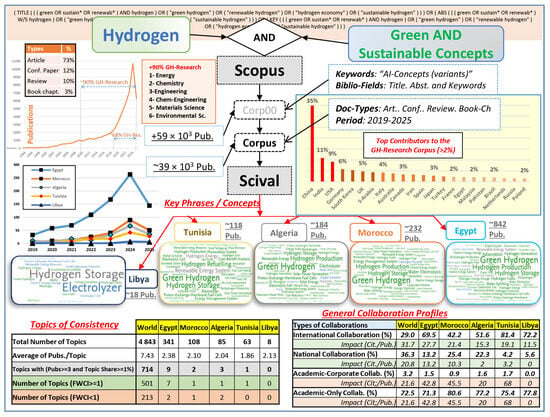
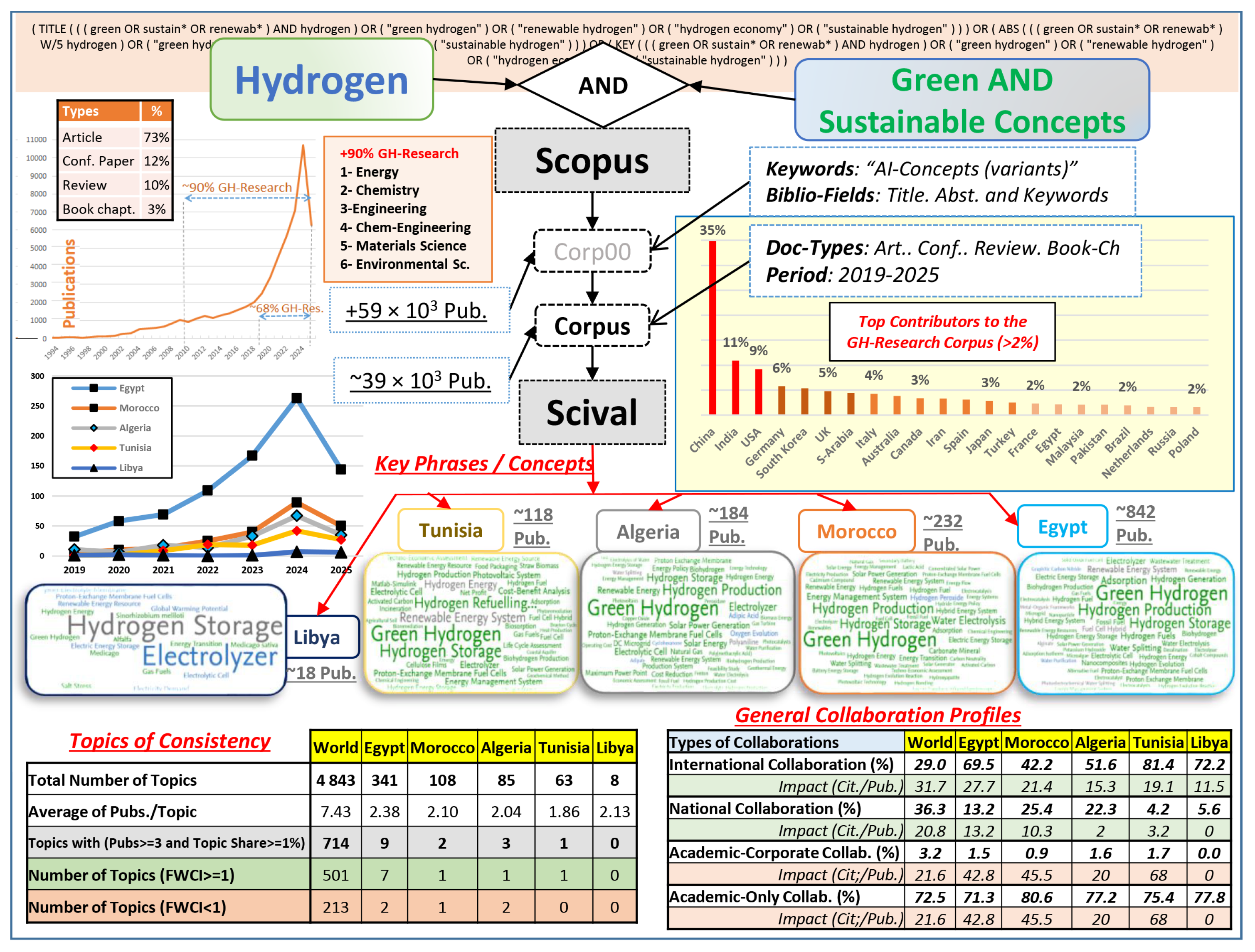
This study uses a bibliometric analysis of a representative corpus of GH research. It begins with an overview of the global GH research field. Then, the incremental approach suggests a different analysis, based on successive results (Figure 1). This approach is based on the fundamental laws of bibliometrics [29,30,31,32], which allows for exploring large volumes of data by reducing the size of the corpora and entities to be analysed. This helps to detect major trends and to mitigate marginal phenomena that are not the target of this type of exploratory study.
Figure 1.
Methodological approach.
We suggest building this bibliometric analysis on a corpus extracted from the bibliographic database Scopus. Indeed, Scopus allows for better coverage of regional publications (North Africa) and is well-suited to this type of exploratory study [33,34,35]. This corpus covers the 2019–2025 period and concerns the main publication types: “Article”, “Review”, “Conference Paper”, and “Book Chapter”.
The Scopus query was performed in early June 2025 using the following syntax: (TITLE (((green OR sustain* OR renewab*) AND hydrogen) OR (“green hydrogen”) OR (“renewable hydrogen”) OR (“hydrogen economy”) OR (“sustainable hydrogen”))) OR (ABS (((green OR sustain* OR renewab*) W/5 hydrogen) OR (“green hydrogen”) OR (“renewable hydrogen”) OR (“sustainable hydrogen”))) OR (KEY (((green OR sustain* OR renewab*) AND hydrogen) OR (“green hydrogen”) OR (“renewable hydrogen”) OR (“hydrogen economy”) OR (“sustainable hydrogen”))).
After a preliminary analysis, the corpus extracted from Scopus was then processed using Scival (SciVal is a bibliometric analysis platform of the publisher Elsevier (https://www.elsevier.com/products/scival, accessed on 20 June 2025)), an analytical tool provided by the well-known scientific editor “Elsevier” [36,37,38]. Figure 1 summarises the methodological approach and presents the different stages of this study. The corpus contains around 59,000 publications (Pubs.), of which 73% are Articles and 12% are Conference Papers.
The GH research field shows a relatively recent dynamism. Almost 68% of the corpus was published between 2019 and May 2025, and around 90% was published after 2010.
The exploration of this corpus begins by revealing the bibliometric distribution, structured by the major entities in the corpus (e.g., countries and topics). This core field represents the main field’s activity and its structuring trends. It thus constitutes a model of progress for North African countries and for designing a successful and efficient development strategy in this field.
This study thus attempts to situate North African countries within the overall structure of this field. The volume and evolution curves of these countries already allow for the detection of their strategic orientation. Exploring collaborative profiles and thematic specialisations provides a more precise idea of the coherence and relevance of these profiles, which ultimately reflect the orientation and ambition of these countries in terms of scientific policy, in this undeniably strategic field for North Africa.
3. The Global GH Field on Scopus
To explore the current state of the GH research field, the bibliometric analysis is limited to the 2019–2025 period and the four main publication types: Article, Conference Paper, Review, and Book Chapter. The resulting corpus consists of ~39,000 publications.
3.1. Main Subject Areas of the GH Research Field
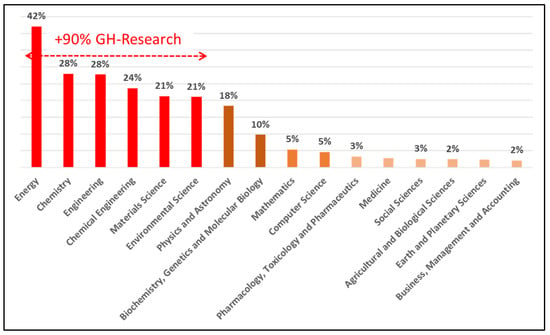
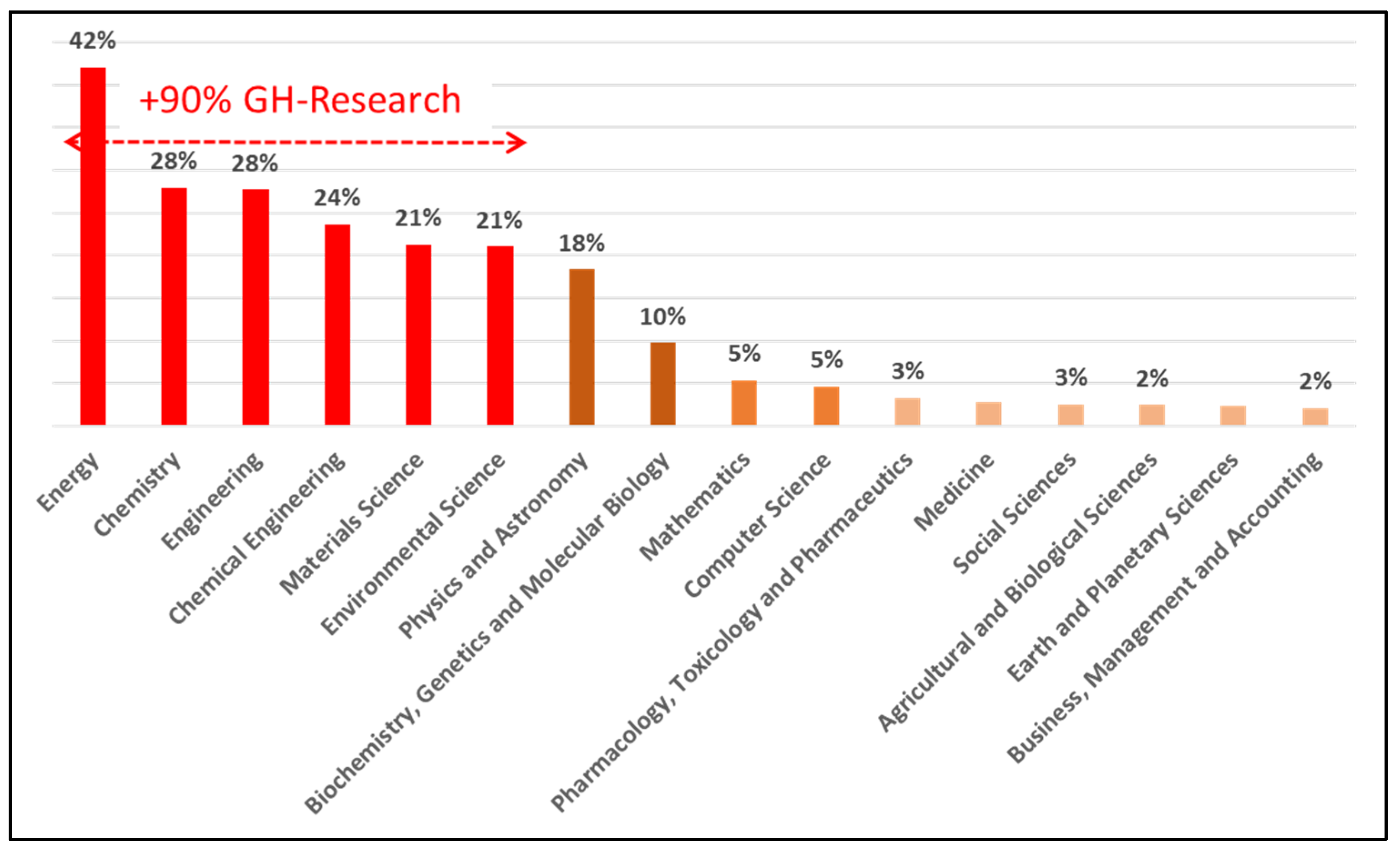
The GH research corpus covers all the 27 Subject Areas of Scopus [39,40], but only 16 contribute more than 2% to the GH corpus (Figure 2). In addition, only six Subject Areas contribute more than 20% (Energy, Chemistry, Engineering, Chemical Engineering, Materials Science, and Environmental Science). They are present in more than 90% of the GH corpus.
Figure 2.
Disciplinary breakdown of the GH corpus (+2%).
This finding reveals a strong trend: GH research is currently focusing on the development and optimisation of processes, particularly chemical ones, for the production of neutral or low-carbon hydrogen. This may involve the exploitation of alternative resources (methane, biomass, etc.) and the use of renewable energies (wind, solar, etc.). The optimisation of chemical processes (electrolysis, reforming, etc.) involves the study and development of high-performing materials (e.g., catalysts). The purpose of this research is completely in line with SDG 7 [41], aiming to improve the carbon footprint, reduce dependence on fossil resources, and reduce the access costs to greener energy. This trend is also corroborated by the remaining sixteen Subject Areas, which support the first six.
3.2. Green Hydrogen Research World Leaders
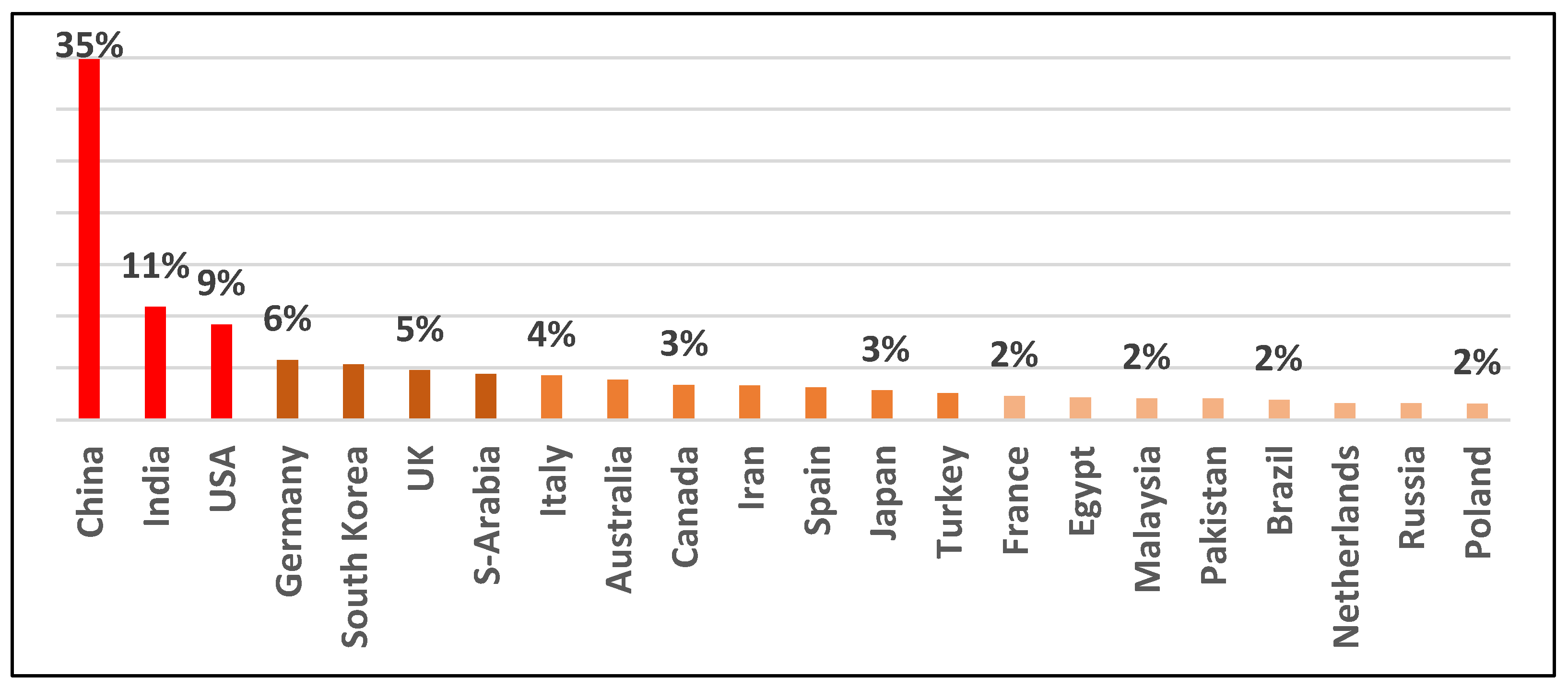
As shown in Figure 3, only 22 countries contribute more than 2% to the GH corpus. They also comprise more than 89% of the total. China is the absolute leader in terms of publications (+35% of the GH research field). In addition, only three countries exceed the ~9–10% threshold (China, India, and the USA) and comprise nearly 53% of the global corpus. Similarly, the top seven countries (>=5%) account for 65% of the global corpus. We also note the rise of certain players such as Saudia Arabia, Iran, and the Netherlands.
Figure 3.
The top 22 countries contributing +2% to the GH corpus.
Egypt is also among these top 22 countries, at the 16th position with 842 publications (Pubs). The other North African countries are ranked as follows: Morocco—42nd (232 Pubs.), Algeria—48th (184 Pubs.), Tunisia—57th (118 Pubs.), and Libya—89th (18 Pubs.).
4. North African Contribution to the GH Research
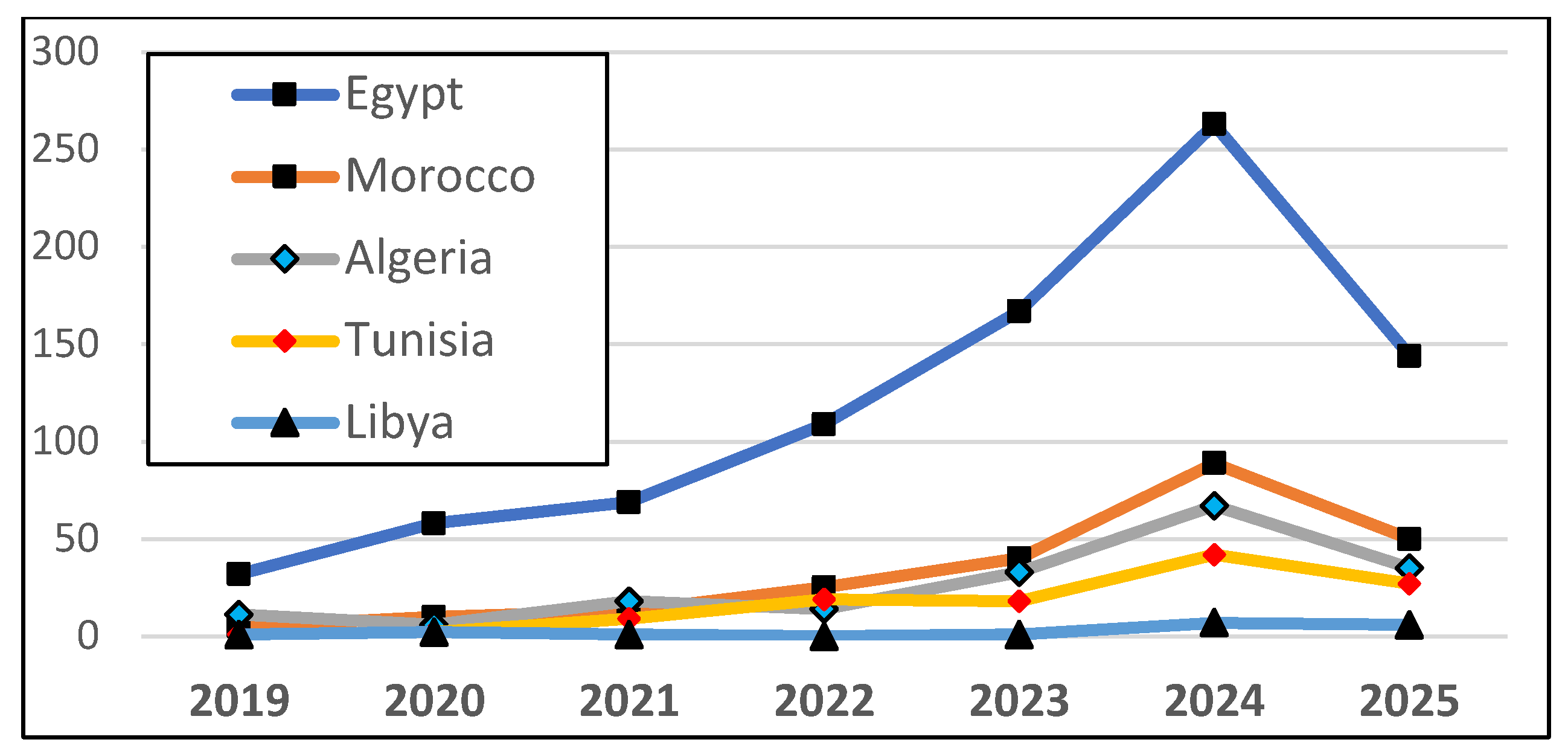
The North African corpora were transferred to Scival. The analysis reveals significant differences (Figure 4). Egypt (16th), clearly ahead, contributes 2% to the GH corpus, but with a relatively weak growth factor of 7.22 (from 2019 to 2024). Then, Morocco (42nd) and Algeria (48th), with 231 and 181 Pubs., achieve two different growth factors, respectively, of 16.8 and 5.09 (2019–2024). Tunisia (57th) contributes with 118 Pubs. and achieves the highest growth factor in the region (41). Finally, Libya shows a growth factor of six, but with a very weak level of publications (18).
Figure 4.
Evolution of GH publications from North African countries.
4.1. The Citational Performance of the North African Corpora
Table 1 shows the citation performance of the five North African countries in the GH-related research outputs.
Table 1.
Citational performance of North African corpora.
Egypt stands out in GH research, with 842 Pubs and the highest field-weighted citation impact (FWCI: Number of citations received by an entity relative to the global average performance. This indicator is normalised relative to the field, nature, and age of the publication. The global average of the FWCI is 1.) in the region (2.42). Egypt also excels in quality metrics, with 45.3% of its publications in the top 10% journals in terms of Citescore (Citescore is a journal’s metric. It reflects the average citations per publication a journal receives over the four last years’ window.) and 47.5% ranked among the top 10% most cited overall. Its citation per publication rate (24.5) further solidifies its leading position.
Morocco follows with 232 Pubs, with a high impact reflected by its FWCI (2.3) and its growth factor (16.80). Morocco also achieves 44.5% of its outputs in top journals (10%), with 40.5% among the top 10% most cited globally and an average number of citations per publication of “14.6”.
Algeria, with 184 Pubs, has relatively moderate productivity and impact, shown by its growth factor (5.09) and its relatively low FWCI (1.65). Nevertheless, Algeria’s strength lies in its 34.2% of outputs in top journals and its 31% of publications ranked in the top 10% most cited papers. Its citations per publication rate (11.1) is also weak compared to the global average.
Tunisia, with 118 Pubs, shows the highest growth factor (41) and the second highest FWCI in the region (2.36). It surpasses Egypt in top journal publications (53.5%) and Morocco in both: 1- Publications ranked in the top cited 10% (40.7%) and 2- Citations per Publication rate (16.3).
With the smallest output (18) and a rate of citations per Pub. of 9, Libya is clearly outside the GH research game. Despite its high rate of Pubs. in the top 10% most cited works (55.6%), its growth factor (6) and FWCI (1.91) confirm Libya’s great delay in the GH field.
4.2. Nuanced Alignment with Global Priorities
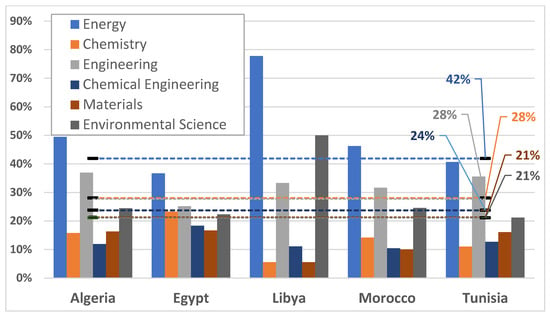
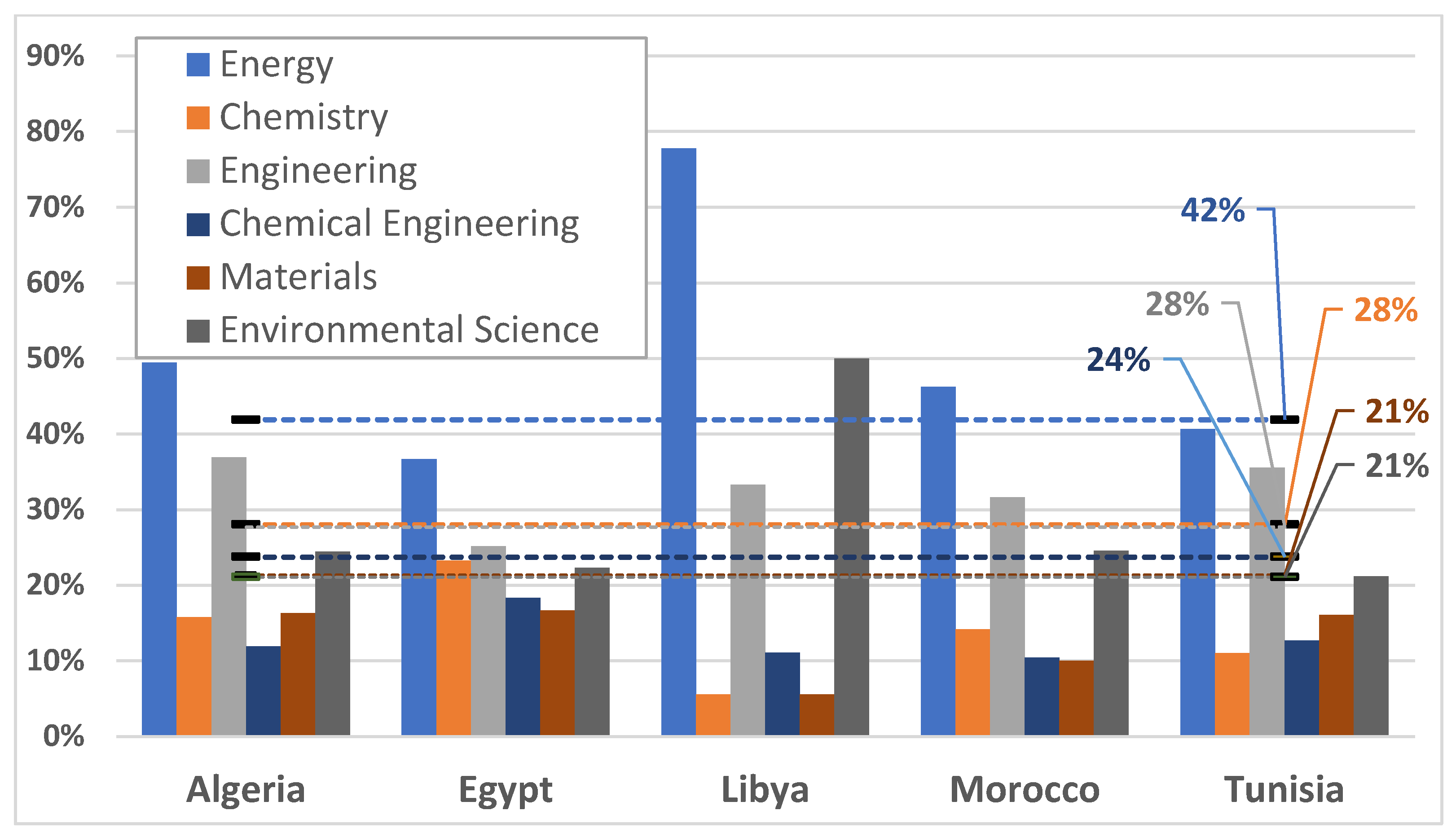
The North African GH corpora are, generally, dominated by the six main Subject Areas, accounting for +90% of the global corpus. Indeed, these six main domains are present in +82% of the Egyptian corpus, nearly 90% of the Moroccan corpus, 92% of the Algerian corpus, 87% of the Tunisian corpus, and ~89% of the Libyan corpus. In terms of proportions, Figure 5 shows that North African countries appear to be in line with the global GH trend in the Subject Areas of “Energy” and “Environmental Science”. However, they are of lesser interest in “Chemical Engineering” and “Materials”.
Figure 5.
Proportions of North African countries in the six main Subject Areas of the GH corpus.
Overall, except for Libya, the participation of North African countries in the GH corpus is differentiated, being relatively modest but very promising. It is partially consistent with the disciplinary orientations of the global corpus, with a greater concentration in the two disciplines of “Energy” and “Environmental Science”.
Apart from the Egyptian effort, in volume and proportion, to contribute to the “Chemical Engineering” and “Materials” disciplines, it seems that the participation of North Africans in these fields is not in line with the general trend. Indeed, these disciplines, demanding in terms of means and the accumulation of know-how, could precisely explain a certain prematurity of North African countries (a little less for Egypt). This “prematurity” could explain the gap that separates them from truly adhering to innovation trends, which currently concern the most advanced countries in this field.
4.3. Disciplinary Specificities of North African Countries
Beyond the six common dominant fields, Table 2 highlights certain disciplinary specificities of North African countries. They show a higher orientation towards “Engineering”, “Environmental Science”, and “Physics and Astronomy”. This could explain the strong interest in environmental issues (climate change, water, desert, etc.).
Table 2.
Disciplinary specificities of North African countries in the GH field.
In addition, Egypt demonstrates a specific interest in “Biochemistry, Genetics, and Molecular Biology” and “Pharmacology, Toxicology, and Pharmaceutics”. This probably explains an interest in the valorisation of biological resources and processes related to hydrogen.
On the other hand, the four other North African countries show a specific interest in “Mathematics” and “Computer Science”. One reason could be that the new possibilities of digital tools and artificial intelligence would encourage researchers in these countries to try to overcome the lack of advanced technical platforms to ameliorate their scientific mastery in the GH field.
5. Collaborative Profiles of North African Countries in the GH Field
5.1. Different Forms of Collaboration
Table 3 shows the different types of collaboration and their impact across the five North African countries, displaying notable variations in focus and outcomes.
Table 3.
Collaborative profiles and impacts (citations/publication).
North African countries exhibit greater openness to international collaboration than the global average in the field of GH (29%). However, these countries fail to achieve the average impact of 31.7 (citations per publication), with a maximum of 27.7 for Egypt and a minimum of 11.5 for Libya. Morocco is the least open in the region (42.2%), followed by Algeria (51.6%). Contrary to global trends, national collaboration in North African countries is weaker than their international collaborations, with a clearly lower performance (impacts). On the other hand, industrial collaborations, although still weak, show the best performance, with exceptional values for Tunisia (68 cit/pub.), Morocco (45.5), and Egypt (42.8). This analysis demonstrates Egypt’s progress in transforming its international and industrial collaboration efforts. The volume effect is also noticeable in its favour. Second, Morocco seems to be taking better advantage of its various forms of collaboration, while Algeria is not sufficiently transforming its collaborative efforts into a virtuous impact. Tunisia is structurally open to international collaboration and is making significant strides in its industrial collaboration. Libya seems to be penalised by its low publication volume, and international collaboration, even at 72.2%, is a sporadic phenomenon that does not follow any policy.
5.2. Main Collaborators of the North African Countries
For each North African country, Table 4 illustrates the following: the top three collaborators in terms of publications and the top three collaborators with the highest FWCIs, with a threshold of eight plus publications (except for Libya with a threshold of three publications).
Table 4.
Top 3 collaborators by publications and FWCI.
The analysis shows the important role of certain countries in the international collaboration of North African countries. Indeed. Saudia Arabia largely dominates this ranking by the volume of publications shared. especially with Egypt. and its presence in the ranking of the top four North African countries (4/5). France. India. and Turkey are present in the top lists of three countries. and simultaneously for Morocco’s and Tunisia’s lists. Saudi Arabia and China are simultaneously present in the top lists of Egypt and Morocco. where France is present in the top lists of Morocco. Algeria. and Tunisia.
6. Major Specialisation Topics
In the Scopus database. each publication is algorithmically assigned to a “topic” using a direct citation analysis. A topic represents a coherent cluster of publications that collectively address a specific research question or area of inquiry. SciVal then uses this structure. comprising approximately 94.000 unique topics. to analyse the activity and specialisation of bibliographic entities such as countries. institutions. or authors [42,43,44,45]. A country’s contribution to a given topic is quantified by the Topic Share (%). which reflects both the degree of its specialisation in that research question and the relative weight of its contribution compared to the global output.
6.1. Breadth of Specialisation Topics
Overall. concerning the GH corpus. North African countries have different profiles in terms of topics. From the 4.843 topics of the global GH corpus. Egypt participates in 341 topics. Morocco in 108. Algeria in 85. Tunisia in 63. and Libya in 8. These figures. compared to the volume of publications. indicate the potential consistency of each country concerning its scope. Table 5 shows. for example. that Egypt displays an average of 2.38 publications per topic (Pubs./Topic). whereas Morocco. Algeria. Tunisia. and Libya. achieve. respectively. 2.10. 2.04. 1.86. and 2.13.
Table 5.
Scope of participation topics for North African countries.
To describe their contributions. we identify the topics where these North African countries contribute +1% internationally (Topic Share >= 1%). with a minimum of three publications. We also distinguish two groups: the first where the topics’ FWCI is “>=1” and the second where the FWCI < 1. Table 5 summarises these elements.
Thus. with a volume almost four times larger than that of Morocco. Egypt demonstrates a stronger consistency (2.38 Pubs./Topic) covering the 341 topics in which it participates. It is also significantly present (Pubs >= 3 and Topic Share >= 1%) in nine topics. including those with an FWCI >= 1. The other North African countries. with volumes and topic consistencies that are significantly more modest. confirm the supremacy of Egypt in this region. This raises an obvious question about the possibilities of cooperation and complementarity within this region.
6.2. Specialisation Topics and Consistency
For each North African country. Table 6 shows the top three topics where they contributes the most to the global effort (Pubs >= 3). It thus describes two top lists: the first top three (in terms of Share). where the FWCI is >=1. and the second top three. where the FWCI is <1 (Tunisia and Libya do not meet the requirements to have six topics in Table 6). This dual lens helps to distinguish between areas of both relative scientific impact and activity.
Table 6.
Top 3 topics in North Africa by share and FWC (‘>=1’ OR ‘<1’).
The final column highlights globally significant topics (in green). i.e., those among the 31 most prominent GH topics (with more than 100 global publications) where the GH corpus Topic Share exceeds 10%. The number in the green cell indicates the rank in the GH list (/31). given that the ranking is based on the Topics Share%.
In sum. “Hydrogen Production through Advanced Electrolytic Systems” is a shared topic of strength across four countries (Morocco. Algeria. Tunisia. and Libya). ranked second globally. and often coupled with high FWCIs. Egypt shows broad contributions. with high-share and impactful topics like microalgae-based hydrogen and integrated energy systems. both globally ranked (4th and 13th). Morocco excels in high-impact niches such as renewable ammonia production (FWCI 14.8. globally ranked fifth). Tunisia and Libya present focused and globally aligned research efforts. with no topics underperforming in citation impact. Finally. Algeria combines impactful niche research (e.g., hydrogel systems) with activity in globally relevant but less cited topics. These patterns reflect both thematic specialisation and varying levels of research quality. indicating promising areas for strategic positioning and regional synergy in GH research.
7. Themes and Concepts of Interest in North African Countries in the GH Research
To study the themes of interest in North African countries. we explore the main concepts. or key phrases (Key phrases are concepts extracted from publications using Elsevier’s Fingerprint engine. which applies NLP processing to titles. abstracts. and keywords. A thesaurus (OmniScience) helps normalise and produce a distinctive distribution of the studied corpus. Each concept is thus given a score that defines its relative relevance for the studied corpus.) of their GH corpora.
7.1. Egypt
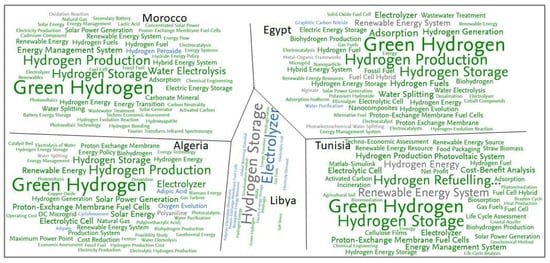
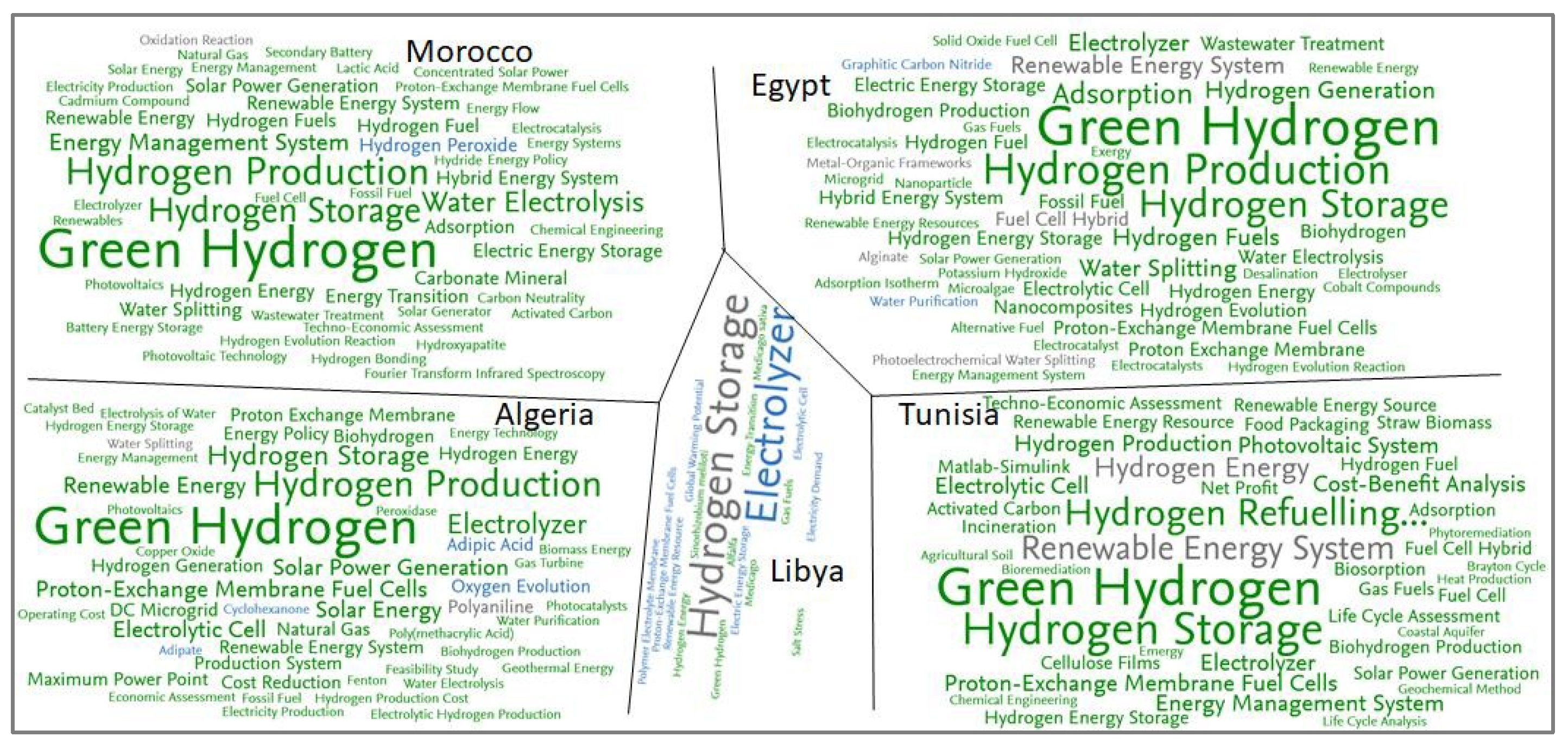
The word cloud (Figure 6) of the 50 most relevant key phrases in the Egyptian corpus (842 Pubs.) shows a broad and mature research ecosystem. Indeed. Egypt leads the North African region in green hydrogen research. with the largest and most diversified publication output.
Figure 6.
North African countries’ most relevant concepts in the GH field.
Its thematic coverage spans the entire hydrogen value chain—from hydrogen production. storage. and electrolysis to more advanced areas like nanocomposites. biohydrogen. and integrated energy systems. Key growing topics include electrolytic technologies. microalgae-based production. and drug delivery systems. reflecting a strong orientation toward both technological innovation and applied scientific impact. Egypt’s portfolio shows a clear alignment with global trends and positions it as a potential regional leader in green hydrogen R&D.
7.2. Morocco
The word cloud of the 50 most relevant key phrases in the Moroccan corpus (232 Pubs.) shows a specific profile. Indeed. Morocco’s green hydrogen research is focused and strategically positioned. particularly around renewable energy integration. solar power generation. and hydrogen storage. Emerging themes such as hydrogen peroxide. energy management systems. and techno-economic assessments highlight a systemic approach that links hydrogen production with grid optimisation and sustainability planning. Morocco stands out for its emphasis on energy system modelling and policy-relevant research. making it a strong candidate for leading transition-oriented and infrastructure-integrated hydrogen studies in the region.
7.3. Algeria
The figure of the 50 most relevant key phrases represents the relevant key concepts of the Algerian corpus. It shows that Algeria’s research is technically oriented. with a clear emphasis on cost-effective hydrogen technologies. solar-assisted electrolysis. and fuel cell development. Prominent themes include proton exchange membrane fuel cells. DC microgrids. cost reduction strategies. and adipic acid synthesis. The country is contributing to both fundamental electrochemical processes and renewable system integration. suggesting a dual focus on technological development and applied energy solutions. Algeria’s specificity lies in its approach to developing affordable and scalable hydrogen systems.
7.4. Tunisia
The word cloud of the 50 most relevant key phrases represents the most relevant key concepts of the Tunisian corpus. It shows that Tunisia’s hydrogen research is relatively selective but marked by high-impact and advanced topics. The main focus areas include electrolysers. proton exchange membranes. and solar-integrated hydrogen production. The country also shows an emerging specialisation in converter technologies and system efficiency optimisation. Despite a lower output volume (118 Pubs.). Tunisia demonstrates scientific quality and relevance. particularly in fuel cell systems and renewable integration. making it a promising hub for technical excellence in electrochemical hydrogen conversion.
7.5. Libya
The word cloud of the 50 most relevant key phrases represents the most relevant key concepts of the Libyan corpus. Libya’s contribution to green hydrogen research remains modest. with a declining but notable focus on electrolysers. proton exchange membrane fuel cells. and hydrogen storage. A few interdisciplinary themes. such as Medicago sativa and salt stress. hint at links to bioenergy or agro-environmental research. While most topics show a stagnant or declining output. Libya’s early engagement with core hydrogen technologies suggests potential for growth if supported by capacity-building and international collaboration initiatives.
At different levels of maturity. the five countries share several thematic interests: green hydrogen production. electrolyser technologies. hydrogen storage. and renewable energy integration (solar). The widespread presence of concepts like proton exchange membrane fuel cells (PEMFCs) across all countries also reflects a shared commitment to hydrogen’s role in future clean energy systems. While biohydrogen. techno-economic assessment. and advanced materials are not universally present. they highlight emerging areas of specialisation. Overall. North African countries are thematically converging around the most globally relevant hydrogen technologies. signalling a growing regional awareness of hydrogen’s strategic potential.
8. Discussion and Conclusions
The bibliometric evidence presented reveals a region in transition. where the research potential of green hydrogen is increasingly recognised yet still constrained by structural and institutional asymmetries.
8.1. Scientific Maturity and Regional Divergence
The data confirms Egypt’s scientific leadership in GH research in North Africa. supported by its volume. international visibility. and diversified topic engagement. Morocco and Tunisia. while producing fewer publications. demonstrate a promising specialisation in energy system integration and electrochemical innovation. respectively. Algeria and Libya show more fragmented and discipline-limited profiles. highlighting a need for capacity-building. infrastructure support. and policy alignment.
8.2. Thematic Alignment and Missed Opportunities
While North African countries follow global GH research directions. particularly in Energy and Environmental Sciences. their relative underrepresentation in frontier domains like Materials and Chemical Engineering suggests structural limitations in terms of laboratories. funding. or technical know-how. These gaps hinder their full engagement with high-value innovation chains such as electrolyser optimisation. catalytic materials. and hydrogen storage technologies. However. emerging strengths in areas such as biohydrogen. microalgae systems. and techno-economic assessments present opportunities for niche strategies.
8.3. Collaboration Profiles: A Double-Edged Sword
This study reveals a strong openness to international collaboration across the region. which enhances visibility and impact but also indicates a dependency on external expertise and funding. Industrial collaboration. while remaining weak. is the most efficient in terms of citations. particularly in Tunisia and Morocco. Yet national collaboration remains strikingly low. limiting the development of a local research identity in GH and. therefore. any strong synergies for North Africa. This finding calls for a reinvention of regional scientific cooperation frameworks. potentially under shared programmes or thematic clusters focused on hydrogen value chains.
8.4. Strategic Prospects and Policy Insights
This study underlines the strategic value of bibliometric analysis as a tool for guiding S&T policy in emerging technological fields. By identifying high-performing topics. productive partnerships. and thematic gaps. such an approach supports evidence-based decision-making at both national and regional levels. For North Africa. bibliometrics can serve as an early warning system to detect missed opportunities. assess research’s relevance to industrial policies. and build R&D portfolios aligned with international funding calls. such as Horizon Europe or the EU–Africa Global Gateway.
8.5. Toward a Regional Hydrogen Research Platform
The patterns revealed suggest that North African countries are not merely peripheral players but have the potential to co-construct a regional innovation platform around GH. Egypt’s leadership. Morocco’s system-oriented vision. Tunisia’s technical focus. Algeria’s applied potential. and Libya’s emerging interest can together shape a diversified and complementary ecosystem. To realise this. policymakers must foster regional coordination mechanisms. incentivise intra-Maghreb collaboration. and link academic research to public–private investment strategies in hydrogen infrastructure.
In conclusion. green hydrogen represents not only a technical challenge but a strategic opportunity for North Africa. This study provides one of the rare regionally focused bibliometric maps of GH research. demonstrating the potential of data-driven foresight to support science policy and regional innovation strategies. To transition from fragmented efforts to collective scientific leadership. North African countries must integrate bibliometric intelligence into national planning and regional cooperation. Doing so will enable them to position themselves strategically within the global hydrogen economy. not just as resource providers. but as credible knowledge producers and innovation actors.
Author Contributions
Conceptualization. H.B. and A.M.; methodology. H.B. and A.M.; software. H.B. and M.Y.; validation. H.B., R.E.A. and A.M.; formal analysis. H.B. and R.E.A.; data curation. H.B. and M.Y.; writing—original draft preparation. H.B.; writing—review and editing. H.B. and R.E.A.; visualization. H.B. and M.Y.; supervision. A.M. All authors have read and agreed to the published version of the manuscript.
Funding
This research received no external funding.
Institutional Review Board Statement
Not applicable.
Informed Consent Statement
Not applicable.
Data Availability Statement
No new data were created or analyzed in this study. Data sharing is not applicable to this article.
Conflicts of Interest
The authors declare no conflict of interest.
References
- IEA Global Hydrogen Review 2024. Available online: https://www.iea.org/reports/global-hydrogen-review-2024#overview (accessed on 19 June 2025).
- IRENA Geopolitics of the Energy Transformation: The Hydrogen Factor. Available online: https://www.irena.org/publications/2022/Jan/Geopolitics-of-the-Energy-Transformation-Hydrogen (accessed on 19 June 2025).
- Segovia-Hernández, J.G.; Hernández, S.; Cossío-Vargas, E.; Juarez-García, M.; Sánchez-Ramírez, E. Green hydrogen production for sustainable development: A critical examination of barriers and strategic opportunities. RSC Sustain. 2024, 3, 134–157. [Google Scholar] [CrossRef] [Scilit]
- Hydrogen Council. McKinsey & Company. Hydrogen Insights 2024. Available online: https://hydrogencouncil.com/en/hydrogen-insights-2024/ (accessed on 19 June 2025).
- Baumgarten, J.; Schneider, C.P.; Möst, D. Hydrogen Economy Index—A comparative assessment of the political and economic perspective in the MENA region for a clean hydrogen economy. Int. J. Hydrogen Energy 2025, 101, 1503–1517. [Google Scholar] [CrossRef] [Scilit]
- Khan, M.I.; Al-Ghamdi, S.G. Hydrogen economy for sustainable development in GCC countries: A SWOT analysis considering current situation. challenges. and prospects. Int. J. Hydrogen Energy 2022, 48, 10315–10344. [Google Scholar] [CrossRef] [Scilit]
- Mostafa, B.; Houssain, M.; Taleb, J. Technological and Economic Challenges of Green Hydrogen Production in Morocco for the European Market. Int. J. Recent Technol. Appl. Sci. 2025, 7, 44–54. [Google Scholar] [CrossRef] [Scilit]
- Razi, F.; Dincer, I. Renewable energy development and hydrogen economy in MENA region: A review. Renew. Sustain. Energy Rev. 2022, 168, 112763. [Google Scholar] [CrossRef] [Scilit]
- Caillard, A.; Yeganyan, R.; Cannone, C.; Plazas-Niño, F.; Howells, M. A Critical Analysis of Morocco’s Green Hydrogen Roadmap: A Modelling Approach to Assess Country Readiness from the Energy Trilemma Perspective. Climate 2024, 12, 61. [Google Scholar] [CrossRef] [Scilit]
- Bayssi, O.; Nabil, N.; Azaroual, M.; Bousselamti, L.; Boutammachte, N.; Rachidi, S.; Barberis, S. Green hydrogen landscape in North African countries: Strengths. challenges. and future prospects. Int. J. Hydrogen Energy 2024, 84, 822–839. [Google Scholar] [CrossRef] [Scilit]
- Hassan, M.A.; El-Amary, N.H. Economic and technical analysis of hydrogen production and transport: A case study of Egypt. Sci. Rep. 2025, 15, 9002. [Google Scholar] [CrossRef] [Scilit]
- Nasser, M.; Hassan, H. Egyptian green hydrogen Atlas based on available wind/solar energies: Power. hydrogen production. cost. and CO2 mitigation maps. Int. J. Hydrogen Energy 2023, 50, 487–501. [Google Scholar] [CrossRef] [Scilit]
- Agyekum, E.B. Is Africa ready for green hydrogen energy takeoff?–A multi-criteria analysis approach to the opportunities and barriers of hydrogen production on the continent. Int. J. Hydrogen Energy 2023, 49, 219–233. [Google Scholar] [CrossRef] [Scilit]
- Jaradat, M.; Almashaileh, S.; Bendea, C.; Juaidi, A.; Bendea, G.; Bungau, T. Green Hydrogen in Focus: A Review of Production Technologies. Policy Impact. and Market Developments. Energies 2024, 17, 3992. [Google Scholar] [CrossRef] [Scilit]
- Dagnachew, A.G.; Yalew, S.G.; Tesfamichael, M.; Okereke, C.; Abraham, E. A green hydrogen revolution in Africa remains elusive under current geopolitical realities. Clim. Policy 2024, 25, 291–302. [Google Scholar] [CrossRef] [Scilit]
- Uliasz-Misiak, B.; Misiak, J.; Tarkowski, R. Research Trends in Underground Hydrogen Storage: A Bibliometric Approach. Energies 2025, 18, 1845. [Google Scholar] [CrossRef] [Scilit]
- Raman, R.; Nair, V.K.; Prakash, V.; Patwardhan, A.; Nedungadi, P. Green-hydrogen research: What have we achieved. and where are we going? Bibliometrics analysis. Energy Rep. 2022, 8, 9242–9260. [Google Scholar] [CrossRef] [Scilit]
- Qahtan, T.F.; Alade, I.O.; Rahaman, S.; Saleh, T.A. Mapping the research landscape of hydrogen production through electrocatalysis: A decade of progress and key trends. Renew. Sustain. Energy Rev. 2023, 184, 113490. [Google Scholar] [CrossRef] [Scilit]
- Kar, S.K.; Harichandan, S.; Roy, B. Bibliometric analysis of the research on hydrogen economy: An analysis of current findings and roadmap ahead. Int. J. Hydrogen Energy 2022, 47, 10803–10824. [Google Scholar] [CrossRef] [Scilit]
- Boutracheh, H.; El Bouhaddioui, M.; Moumen, A.; El Mansouri, B.; Mejjad, N. Current research priorities on fog harvesting as a clean water resource: A bibliometric approach. E3S Web Conf. 2024, 489, 05002. [Google Scholar] [CrossRef] [Scilit]
- Azirar, A.; Boutracheh, H. La Recherche Scientifique et L’innovation Dans le Monde Arabe. 2019. IRES Reports. Available online: https://ires.ma/fr/publications/rapports-thematiques/la-recherche-scientifique-et-linnovation-dans-le-monde-arabe (accessed on 19 June 2025).
- Boutracheh, H.; Mouhssine, Y.; Moumen, A. Mapping AI Research in North Africa: A Bibliometric Analysis for Trends and Opportunities. In Proceedings of the 2025 5th International Conference on Innovative Research in Applied Science. Engineering and Technology (IRASET), Fez, Morocco, 15–16 May 2025; pp. 1–10. [Google Scholar]
- EC. LIFE Climate Change Mitigation and Adaptation. 2025. Available online: https://climate.ec.europa.eu/eu-action/eu-funding-climate-action/life-climate-change-mitigation-and-adaptation_en (accessed on 20 June 2025).
- EC. Horizon Europe. 2025. Available online: https://research-and-innovation.ec.europa.eu/funding/funding-opportunities/funding-programmes-and-open-calls/horizon-europe_en (accessed on 20 June 2025).
- EC. EU-Africa: Global Gateway Investment Package. 2025. Available online: https://international-partnerships.ec.europa.eu/policies/global-gateway/initiatives-sub-saharan-africa/eu-africa-global-gateway-investment-package_en (accessed on 20 June 2025).
- Boutracheh, H.; Mejjad, N.; El Bouhadioui, M.; Moumen, A. Water Research in the Age of AI: A Bibliometric Heuristic Analysis for Trends and Opportunities. In Lecture Notes in Geoinformation and Cartography; Springer: Cham, Switzerland, 2024; pp. 3–45. [Google Scholar] [CrossRef] [Scilit]
- Boutracheh, H.; Moumen, A. Scientific peripheralism in Green Hydrogen: Morocco’s collaboration patterns and strategic misalignment. Int. J. Hydrogen Energy 2025, 177, 151526. [Google Scholar] [CrossRef] [Scilit]
- Boutracheh, H.; El Ansari, R.; Mejjad, N.; Moumen, A. Application of bibliometrics as a data mining technique for research prioritization. In Proceedings of the NISS 2023: The 6th International Conference on Networking. Intelligent Systems & Security, Larache, Morocco, 24–26 May 2023; pp. 1–9. [Google Scholar]
- Ball, R.; By, E. Handbook Bibliometrics; Walter de Gruyter GmbH: Berlin, Germany, 2021. [Google Scholar]
- Abramo, G.; D’aNgelo, C.A. Evaluating research: From informed peer review to bibliometrics. Scientometrics 2011, 87, 499–514. [Google Scholar] [CrossRef] [Scilit]
- Bar-Ilan, J. Informetrics at the beginning of the 21st century—A review. J. Inf. 2008, 2, 1–52. [Google Scholar] [CrossRef] [Scilit]
- Narin, F.; Hamilton, K.S. Bibliometric performance measures. Scientometrics 1996, 36, 293–310. [Google Scholar] [CrossRef] [Scilit]
- Singh, V.K.; Singh, P.; Karmakar, M.; Leta, J.; Mayr, P. The journal coverage of Web of Science. Scopus and Dimensions: A comparative analysis. Scientometrics 2021, 126, 5113–5142. [Google Scholar] [CrossRef] [Scilit]
- Singh, P.; Singh, V.K.; Kanaujia, A. Exploring the Publication Metadata Fields in Web of Science. Scopus and Dimensions: Possibilities and Ease of doing Scientometric Analysis. J. Sci. Res. 2024, 13, 715–731. [Google Scholar] [CrossRef] [Scilit]
- Magadán-Díaz, M.; Rivas-García, J.I. Publishing Industry: A Bibliometric Analysis of the Scientific Production Indexed in Scopus. Publ. Res. Q. 2022, 38, 665–683. [Google Scholar] [CrossRef] [Scilit]
- Turunen, P.; Sandgren, T. Comparing the SDG-classification systems of Dimensions. InCites and SciVal for the University of Helsinki. Inf. Res. 2025, 30, 1–20. [Google Scholar] [CrossRef] [Scilit]
- Mousavizadeh, M.; Chakoli, A.N.; Pournaghi, R. Qualitative Analysis of Architectural Dimensions and Framework of SciVal in Terms of Analyzing. Processing and Information Management of Research. Iran. J. Inf. Process. Manag. 2020, 35, 755–784. [Google Scholar]
- Elsevier. SciVal|Research Performance Assessment Solution|Elsevier. 2025. Available online: https://www.elsevier.com/products/scival (accessed on 20 June 2025).
- Elsevier. What Is the Complete List of ASJC Subject Areas in Scopus? 2025. Available online: https://service.elsevier.com/app/answers/detail/a_id/15181/supporthub/scopus/ (accessed on 21 June 2025).
- Kim, E.; Jeong, D.Y. Dominant Characteristics of Subject Categories in a Multiple-Category Hierarchical Scheme: A Case Study of Scopus. Publications 2023, 11, 51. [Google Scholar] [CrossRef] [Scilit]
- UN. Ensure Access to Affordable, Reliable, Sustainable and Modern Energy for All. 2025. Available online: https://sdgs.un.org/goals/goal7 (accessed on 21 June 2025).
- Klavans, R.; Boyack, K.W. Which Type of Citation Analysis Generates the Most Accurate Taxonomy of Scientific and Technical Knowledge? J. Assoc. Inf. Sci. Technol. 2017, 68, 984–998. [Google Scholar] [CrossRef] [Scilit]
- Waltman, L.; Van Eck, N.J. A new methodology for constructing a publication-level classification system of science. J. Am. Soc. Inf. Sci. Technol. 2012, 63, 2378–2392. [Google Scholar] [CrossRef] [Scilit]
- Klavans, R.; Boyack, K.W. Research portfolio analysis and topic prominence. J. Informetr. 2017, 11, 1158–1174. [Google Scholar] [CrossRef] [Scilit]
- Small, H.; Boyack, K.W.; Klavans, R. Identifying emerging topics in science and technology. Res. Policy 2014, 43, 1450–1467. [Google Scholar] [CrossRef] [Scilit]

Disclaimer/Publisher’s Note: The statements, opinions and data contained in all publications are solely those of the individual author(s) and contributor(s) and not of MDPI and/or the editor(s). MDPI and/or the editor(s) disclaim responsibility for any injury to people or property resulting from any ideas, methods, instructions or products referred to in the content. |
© 2025 by the authors. Licensee MDPI, Basel, Switzerland. This article is an open access article distributed under the terms and conditions of the Creative Commons Attribution (CC BY) license (https://creativecommons.org/licenses/by/4.0/).