


Abstract
The aim of the research is the development of a one-pot method for the synthesis of lignans, natural compounds that show a wide spectrum of biological activities. For this purpose, the ansa-zirconocenes of various structures were tested as catalysts of allylbenzene cyclometalation with ethylaluminum dichloride (EtAlCl2) and Mg. The effects of the organophosphorus compounds, hexamethylphosphoramide (HMPA) and triphenylphosphine (PPh3), on the chemo- and regioselectivity of the reaction were studied. The use of η5-indenyl or fluorenyl ansa-complexes with ethanediyl or dimethylsilylene bridges, as well as a biscyclopentadienyl complex with Si-bound ligands as catalysts in the presence of HMPA, yields the formation of cyclometalation products in a total yield of 70%. Cyclometalation product composition is represented by two regioisomers, 3,4-dibenzyl- and 2,4-dibenzyl-substituted alumolanes, with a ratio of (1-2):1, in which hydrolysis provides corresponding dibenzylbutane lignan and 9,8′-neo-lignan.
1. Introduction
Since 1989, the catalytic cycloalumination of alkenes and acetylenes (Dzhemilev reaction) has been developing as a direction of organoaluminum compound (OAC) chemistry. The reaction provides an effective and stereoselective route for the synthesis of various classes of organic compounds [1,2].
Among the developed methods, the reaction of terminal alkenes or alkynes with OAC and Mg, catalyzed by Cp2ZrCl2, which goes through the formation of metallocycles, affords 2,3-disubstituted butanes or 1,4-butanediols with a high diastereoselectivity (Scheme 1) [1,2,3,4,5]. Using this approach, the one-pot diastereoselective method for the synthesis of dibenzylbutane lignans, a group of natural compounds showing a wide range of biological activities [6,7,8,9,10,11,12], was developed [13,14].
Scheme 1.
The reaction of terminal alkenes with OAC and Mg, catalyzed by Cp2ZrCl2.
The structure of the catalyst and the composition of the catalytic system significantly influence the reaction rate and the chemo- and stereoselectivity. The ansa-effect is well known for zirconocenes [15]. As a rule, it causes an increase in catalyst activity. Moreover, nucleophilic agents can affect the stability of organometallic species. For example, hexamethylphosphoramide (HMPA) possess high solvating ability towards the inorganic ions and organometallic reagents [16,17,18,19]. Phosphine ligands can stabilize intermediates, in particular zirconacycles [20,21], which are formed in the course of cyclometalation reactions, and therefore reduce the probability of side processes.
In continuation of our studies [13,14], the ansa-zirconocenes of various structures were tested as the catalysts of the allylbenzene cyclometalation with ethylaluminum dichloride (EtAlCl2) and Mg. The effect of the organophosphorus compounds HMPA and triphenylphosphine (PPh3) on the chemo- and regioselectivity of the reaction was studied as well.
2. Results and Discussion
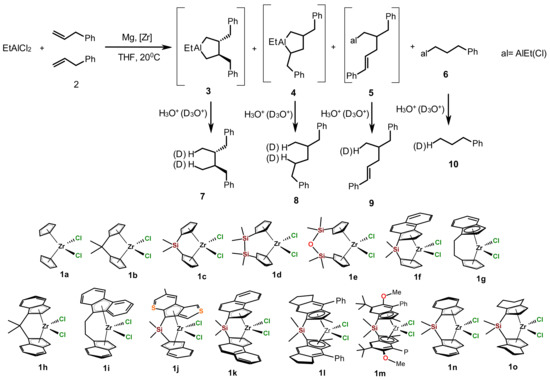
The catalytic action of zirconocenes of various structures (1a–o) in the reaction of allylbenzene with ethylaluminum dichloride (EtAlCl2) and metallic Mg in tetrahydrofuran (THF) was studied (Scheme 2 and Table 1). HMPA or PPh3 were used as nucleophilic agents.
Scheme 2.
The reaction of allylbenzene with EtAlCl2 and Mg, catalyzed with zirconocenes 1a–o in the presence of HMPA or PPh3.
Table 1.
Reaction of allylbenzene with EtAlCl2 and Mg, catalyzed by Zr complexes 1a–o (22 °C, 72 h, HMPA or PPh3, THF, mole ratio [Zr]:[Mg]:[EtAlCl2]:[allylbenzene]:[HMPA or PPh3] = 1:20:25:20:20).
It was found that the reaction of allylbenzene with EtAlCl2 and Mg, catalyzed with zirconocenes in the presence of HMPA or PPh3 affords alumolane regioisomers 3 and 4 (Scheme 2). The acyclic OAC with double bond 5 and hydroalumination product 6 were identified in the product mixture as well. Hydrolysis or deuterolysis of cyclometalation products 3 and 4 provide dibenzylbutane lignan 7 and 9,8′-neo-lignan 8.
The addition of HMPA to the reaction mixture with catalyst 1a significantly shortens the reaction time (Table 1, entries 2–4). As a result, the reaction proceeds in 48 h with an allylbenzene conversion of 97–99%. The addition of PPh3 led to a decrease in the substrate conversion to 61–63% (entries 5,6). The alkene conversion reached 70–98% in the reactions catalyzed by ansa-zirconocenes. However, among them biscyclopentadienyl and bisindenyl complexes with isopropylidene bridges 1b and 1h showed minimal activity (entries 7, 13). The presence of HMPA increased the chemoselectivity of the reaction towards the formation of cyclic OACs (up to 81%). Nevertheless, the regioselectivity of the process decreased.
The most active catalysts in the reaction of allylbenzene with Et2AlCl and Mg was found to be ansa-complexes with ethanediyl (1g,i) (entries 12,14) or dimethylsilylene (1i–m) bridges (entries 15–20), containing η5-indenyl or fluorenyl fragments, as well as a biscyclopentadienyl complex with Si-bound ligands (1c) (entry 8). In the presence of these complexes, the conversion of allylbenzene was 70–98% and the reaction proceeded with the predominant formation of cyclometallation products 3,4 with a total yield of up to 70% and a regioisomer ratio 3:4 = (1–3.6):1. However, despite the increase in the activity and chemoselectivity of catalytic systems based on Zr ansa-complexes due to the introduction of HMPA, the regioselectivity of the reaction decreased (see, for example, complex 1m,n, entries 19, 20). The use of a Si-bound bistetrahydroindenyl (1o) instead of a bisindenyl ligand (1m) in the catalyst structure leads to an almost complete loss of activity.
3. Materials and Methods
General Procedures
All operations for organometallic compounds were performed under argon according to Schlenk technique. THF and diethyl ether were dried and distilled from sdium/benzophenone before use. Commercially available allylbenzene (98%, Acros) and EtAlCl2 (97%, Merck). CAUTION: the pyrophoric nature of aluminum alkyl compounds requires special safety precautions in their handling. Zirconocenes 1a–1o were synthesized according to known procedures: 1a [22], 1b [23], 1c [24], 1d [25], 1e [26], 1f, 1g, 1i [27,28], 1h [29], 1j [30,31], 1k [32,33], 1l [34], 1m [35], 1n [36], 1o [37] from ZrCl4 (98%, Acros).
1H and 13C NMR spectra were recorded on a Bruker AVANCE-400 spectrometer (400.13 MHz (1H), 100.62 MHz (13C)) (Bruker, Rheinstetten, Germany). As solvents and the internal standards, CD2Cl2 and CDCl3 were employed. The 1D and 2D NMR spectra (COSY HH, HSQC, HMBC, NOESY) were recorded using standard Bruker pulse sequences. The yields of OAC products were determined by analyzing the mixture of deuterolysis or hydrolysis products 7–10 using a gas chromatograph-mass spectrometer GCMS-QP2010 Ultra (Shimadzu, Tokyo, Japan) equipped with the GC-2010 Plus chromatograph (Shimadzu, Tokyo, Japan), TD-20 thermal desorber (Shimadzu, Tokyo, Japan), and an ultrafast quadrupole mass-selective detector (Shimadzu, Tokyo, Japan).
The obtained NMR and the mass spectral characteristics of compounds 7–10 correspond to the literature data [13,14].
4. Conclusions
It was shown that the structure of the η5-ligand at the Zr atom significantly affects the activity of the system, and the presence of HMPA increases the yield of cyclometalation products up to 77%. The reaction proceeds with the formation of regioisomers of 3,4-dibenzyl- and 2,4-dibenzyl-substituted alumolanes with a ratio (1-2):1, which hydrolysis provides corresponding dibenzylbutane and 9,8′-neo-lignans.
Author Contributions
Conceptualization, L.V.P.; methodology, P.V.K. and L.V.P.; validation, L.V.P. and P.V.K.; formal analysis, P.V.K., P.V.I. and I.E.N.; investigation, P.V.K.; resources, P.V.K. and L.V.P.; data curation, P.V.K. and L.V.P.; writing—original draft preparation, P.V.K. and L.V.P.; writing—review and editing, L.V.P.; visualization, P.V.K. and L.V.P.; supervision, L.V.P.; project administration, P.V.K.; funding acquisition, L.V.P. All authors have read and agreed to the published version of the manuscript.
Funding
The studies were carried out in accordance with the Federal Program No. AAAA-A19-119022290004-8. The work was also supported by the TIPS RAS State Plan (in part of the synthesis of zirconocene dichloride complexes).
Institutional Review Board Statement
Not applicable.
Informed Consent Statement
Not applicable.
Data Availability Statement
Data is contained within the article.
Acknowledgments
The authors acknowledge the use of equipment in the Agidel Collective Use Centre at the Institute of Petrochemistry and Catalysis of RAS.
Conflicts of Interest
The authors declare no conflict of interest.
Sample Availability
Samples of the compounds are not available from the authors.
References
- Dzhemilev, U.M.; Ibragimov, A.G. Metal complex catalysis in the synthesis of organoaluminium compounds. Russ. Chem. Rev. 2000, 69, 121–135. [Google Scholar] [CrossRef] [Scilit]
- D’yakonov, V.A. Dzhemilev Reaction in Organic and Organometallic Synthesis (Chemistry Research and Applications); Nova Science Publishers: New York, NY, USA, 2010; p. 96. [Google Scholar]
- Dzhemilev, U.M.; Ibragimov, A.G.; Morozov, A.B.; Khalilov, L.M.; Muslukhov, R.R.; Tolstikov, G.A. Synthesis and reactions of metallocycles. 6. Stereoselective synthesis of 3,4-dialkyl-substituted aluminocyclopentanes by cyclometallation of α-olefins using trialkylalanes in the presence of Cp2ZrCl2. Russ. Chem. Bull. 1991, 40, 1022–1025. [Google Scholar] [CrossRef] [Scilit]
- Dzhemilev, U.M.; Ibragimov, A.G.; Morozov, A.B. Regio- and Stereo-selective Synthesis of trans-3,4-Dialkyl-substituted Aluminacyclopentanes in the Presence of (η5-C5H5)2ZrCl2. Mendeleev Commun. 1992, 1, 26–28. [Google Scholar] [CrossRef] [Scilit]
- Ibragimov, A.G.; Khafizova, L.O.; Yakovleva, L.G.; Nikitina, E.V.; Satenov, K.G.; Khalilov, L.M.; Dzhemilev, U.M. Synthesis and transformations of metallocycles 19. Synthesis of 3-alkylalumacyclopentanes and 2-alkyl-1,4-dialuminiobutanes on Zr-containing complex catalysts. Russ. Chem. Bull. 1999, 48, 774–780. [Google Scholar] [CrossRef] [Scilit]
- Ayres, D.C.; Loike, J.D. Lignans: Chemical, Biological and Clinical Properties; Cambridge University Press: Cambridge, UK, 1990; p. 426. [Google Scholar]
- Ward, R.S. Lignans, neolignans and related compounds. Nat. Prod. Rep. 1997, 14, 43–74. [Google Scholar] [CrossRef] [Scilit]
- Saleem, M.; Kim, H.J.; Ali, M.S.; Lee, Y.S. An update on bioactive plant lignans. Nat. Prod. Rep. 2005, 22, 696–716. [Google Scholar] [CrossRef] [Scilit]
- Teponno, R.B.; Kusari, S.; Spiteller, M. Recent advances in research on lignans and neolignans. Nat. Prod. Rep. 2016, 33, 1044–1092. [Google Scholar] [CrossRef] [Scilit]
- Pan, J.-Y.; Chen, S.-L.; Yang, M.-H.; Wu, J.; Sinkkonen, J.; Zou, K. An update on lignans: Natural products and synthesis. Nat. Prod. Rep. 2009, 26, 1251–1292. [Google Scholar] [CrossRef] [Scilit]
- Yamauchi, S.; Masuda, T.; Sugahara, T.; Kawaguchi, Y.; Ohuchi, M.; Someya, T.; Akiyama, J.; Tominaga, S.; Yamawaki, M.; Kishida, T.; et al. Antioxidant Activity of Butane Type Lignans, Secoisolariciresinol, Dihydroguaiaretic Acid, and 7,7′-Oxodihydroguaiaretic Acid. Biosci. Biotechnol. Biochem. 2008, 72, 2981–2986. [Google Scholar] [CrossRef] [Scilit]
- Kawaguchi, Y.; Yamauchi, S.; Masuda, K.; Nishiwaki, H.; Akiyama, K.; Maruyama, M.; Sugahara, T.; Kishida, T.; Koba, Y. Antimicrobial Activity of Stereoisomers of Butane-Type Lignans. Biosci. Biotechnol. Biochem. 2009, 73, 1806–1810. [Google Scholar] [CrossRef] [Scilit]
- Parfenova, L.V.; Berestova, T.V.; Kovyazin, P.V.; Yakupov, A.R.; Mesheryakova, E.S.; Khalilov, L.M.; Dzhemilev, U.M. Catalytic cyclometallation of allylbenzenes by EtAlCl2 and Mg as new route to synthesis of dibenzyl butane lignans. J. Organomet. Chem. 2014, 772–773, 292–298. [Google Scholar] [CrossRef] [Scilit]
- Parfenova, L.V.; Kovyazin, P.V.; Tyumkina, T.V.; Khalilov, L.M.; Dzhemilev, U.M. Cycloalumination of allylbenzenes with triethylaluminum in the presence of Cp2ZrCl2. One-pot synthesis of 2-benzylbutane-1,4-diols as precursors of dibenzylbutane lignans. Russ. J. Org. Chem. 2016, 52, 1750–1755. [Google Scholar] [CrossRef] [Scilit]
- Wang, B. Ansa-metallocene polymerization catalysts: Effects of the bridges on the catalytic activities. Coord. Chem. Rev. 2006, 250, 242–258. [Google Scholar] [CrossRef] [Scilit]
- Edwards, P.P.; Guy, S.C.; Holton, D.M.; McFarlan, W. Nmr spectrum of Na− in sodium–hexamethylphosphoric triamide solutions. J. Chem. Soc. Chem. Commun. 1981, 22, 1185–1186. [Google Scholar] [CrossRef] [Scilit]
- Jackman, L.M.; Chen, X. Solvation of aggregates of lithium phenolates by hexamethylphosphoric triamide. HMPA causes both aggregation and deaggregation. J. Am. Chem. Soc. 1992, 114, 403–411. [Google Scholar] [CrossRef] [Scilit]
- Clegg, W.; O’Neil, P.A.; Henderson, K.W.; Mulvey, R.E. Structure of Monomeric [TiCl4(hexamethylphosphoric triamide)2]. Acta Crystallogr. Sect. C Cryst. Struct. Commun. 1993, 49, 2108–2109. [Google Scholar] [CrossRef] [Scilit]
- Reich, H.J.; Borst, J.P. Direct NMR spectroscopic determination of organolithium ion pair structures in THF/HMPA solution. J. Am. Chem. Soc. 1991, 113, 1835–1837. [Google Scholar] [CrossRef] [Scilit]
- Takahashi, T.; Swanson, D.R.; Negishi, E. Zirconacyclopropanes and Zirconacyclopropenes. Their Synthesis, Characterization, and Reactions. Chem. Lett. 1987, 16, 623–626. [Google Scholar] [CrossRef] [Scilit]
- Takahashi, T.; Murakami, M.; Kunishige, M.; Saburi, M.; Uchida, Y.; Kozawa, K.; Uchida, T.; Swanson, D.R.; Negishi, E.I. Zirconocene-Alkene Complexes. An X-ray Structure and a Novel Preparative Method. Chem. Lett. 1989, 18, 761–764. [Google Scholar] [CrossRef] [Scilit]
- Freidlina, R.K.; Brainina, E.M.; Nesmeyanov, A.N. The Synthesis of Mixed Pincerlike Cyclopentadienyl Compounds of Zirconium. Dokl. Acad. Nauk SSSR 1961, 138, 1369–1372. Available online: http://mi.mathnet.ru/dan25187 (accessed on 10 May 2022).
- Koch, T.; Blaurock, S.; Somoza, F.B.; Voigt, A.; Kirmse, R.; Hey-Hawkins, E. Unexpected P−Si or P−C Bond Cleavage in the Reaction of Li2[(C5Me4)SiMe2PR] (R = Cyclohexyl, 2,4,6-Me3C6H2) and Li[(C5H4)CMe2PHR] (R = Ph, tBu) with ZrCl4 or [TiCl3(thf)3]: Formation and Molecular Structure of the ansa-Metallocenes [{(η-C5Me4)2SiMe2}ZrCl2] and [{(η-C5H4)2CMe2}MCl2] (M = Ti, Zr). Organometallics 2000, 19, 2556–2563. [Google Scholar] [CrossRef] [Scilit]
- Bajgur, C.S.; Tikkanen, W.; Petersen, J.L. Synthesis, structural characterization, and electrochemistry of [1]metallocenophane complexes, [Si(alkyl)2(C5H4)2]MCl2, M = Ti, Zr. Inorg. Chem. 1985, 24, 2539–2546. [Google Scholar] [CrossRef] [Scilit]
- Thiele, K.H.; Schliessburg, C.; Baumeister, K.; Hassler, K. Tetramethyldisilan-1,2-diyl-verbrückte Dicyclopentadienyl-und Diindenylmetalldichloride der 4. Gruppe—Kristallstruktur von C5H4-Si(CH3)2-Si(CH3)2-C5H4ZrCl2. Z. Anorg. Allg. Chem. 1996, 622, 1806–1810. [Google Scholar] [CrossRef] [Scilit]
- Nifant’ev, I.E.; Vinogradov, A.A.; Vinogradov, A.A.; Churakov, A.V.; Ivchenko, P.V. Synthesis of zirconium(III) complex by reduction of O[SiMe2(η5-C5H4)]2ZrCl2 and its selectivity in catalytic dimerization of hex-1-ene. Mendeleev Commun. 2018, 28, 467–469. [Google Scholar] [CrossRef] [Scilit]
- Nifant’ev, I.; Ivchenko, P. Fair Look at Coordination Oligomerization of Higher α-Olefins. Polymers 2020, 12, 1082. [Google Scholar] [CrossRef] [Scilit]
- Resconi, L.; P’emontezi, F.; Nifant’ev, I.E.; Ivchenko, P.V. Metallocenes, Method of Their Preparation, Polymerization Catalyst, Method of Polymerization of Olefins, Homopolymers and Propylene Copolymer. RU Patent 2177948 C2, 10 January 2002. [Google Scholar]
- Nifant’ev, I.E.; Ivchenko, P.V. Synthesis of Zirconium and Hafnium ansa-Metallocenes via Transmetalation of Dielement-Substituted Bis(cyclopentadienyl) and Bis(indenyl) Ligands. Organometallics 1997, 16, 713–715. [Google Scholar] [CrossRef] [Scilit]
- Nifant’ev, I.E.; Laishevtsev, I.; Ivchenko, P.V.; Kashulin, I.A.; Guidotti, S.; Piemontesi, F.; Camurati, I.; Resconi, L.; Klusener, P.A.A.; Rijsemus, J.J.H.; et al. C1-Symmetric Heterocyclic Zirconocenes as Catalysts for Propylene Polymerization, 1. Macromol. Chem. Phys. 2004, 205, 2275–2291. [Google Scholar] [CrossRef] [Scilit]
- Resconi, L.; Guidotti, S.; Camurati, I.; Frabetti, R.; Focante, F.; Nifant’ev, I.E.; Laishevtsev, I.P. C1-Symmetric Heterocyclic Zirconocenes as Catalysts for Propylene Polymerization, 2. Macromol. Chem. Phys. 2005, 206, 1405–1438. [Google Scholar] [CrossRef] [Scilit]
- Spaleck, W.; Kuber, F.; Winter, A.; Rohrmann, J.; Bachmann, B.; Antberg, M.; Dolle, V.; Paulus, E.F. The Influence of Aromatic Substituents on the Polymerization Behavior of Bridged Zirconocene Catalysts. Organometallics 1994, 13, 954–963. [Google Scholar] [CrossRef] [Scilit]
- Stehling, U.; Diebold, J.; Kirsten, R.; Roll, W.; Brintzinger, H.-H. ansa-Zirconocene Polymerization Catalysts with Anelated Ring Ligands—Effects on Catalytic Activity and Polymer Chain Length. Organometallics 1994, 13, 964–970. [Google Scholar] [CrossRef] [Scilit]
- Nifant’ev, I.E.; Ivchenko, P.V.; Bagrov, V.V.; Churakov, A.V.; Chevalier, R. Novel Effective Racemoselective Method for the Synthesis of ansa-Zirconocenes and Its Use for the Preparation of C2-Symmetric Complexes Based on 2-Methyl-4-aryltetrahydro(s)indacene as Catalysts for Isotactic Propylene Polymerization and Ethylene-Propylene Copolymerization. Organometallics 2012, 31, 4340–4348. [Google Scholar] [CrossRef] [Scilit]
- Nifant’ev, I.E.; Ivchenko, P.V.; Bagrov, V.V.; Churakov, A.V.; Mercandelli, P. 5-Methoxy-Substituted Zirconium Bis-indenyl ansa-Complexes: Synthesis, Structure, and Catalytic Activity in the Polymerization and Copolymerization of Alkenes. Organometallics 2012, 31, 4962–4970. [Google Scholar] [CrossRef] [Scilit]
- Herrmann, W.A.; Rohrmann, J.; Herdtweck, E.; Spaleck, W.; Winter, A. The First Example of an Ethylene-Selective Soluble Ziegler Catalyst of the Zirconocene Class. Angew. Chem. Int. Ed. Engl. 1989, 28, 1511–1512. [Google Scholar] [CrossRef] [Scilit]
- Luttikhedde, H.J.G.; Leino, R.P.; Nasman, J.H.; Ahlgren, M.; Pakkanen, T. Racemic Dichloro{(R,R)-3,3′-(dimethylsilanediyl)bis[(1,2,3,3a,7a-η)-4,5,6,7-tetrahydro-1-indenyl]}zirconium. Acta Crystallogr. Sect. C Cryst. Struct. Commun. 1995, 51, 1488–1490. [Google Scholar] [CrossRef] [Scilit]



Publisher’s Note: MDPI stays neutral with regard to jurisdictional claims in published maps and institutional affiliations. |
© 2022 by the authors. Licensee MDPI, Basel, Switzerland. This article is an open access article distributed under the terms and conditions of the Creative Commons Attribution (CC BY) license (https://creativecommons.org/licenses/by/4.0/).