


Abstract
Phytophthora spp. is recognized as one of the most widespread and destructive fungal pathogens of agricultural crops. Consequently, the discovery, development and rational application of chemical crop protection agents against this pathogen represent a matter of considerable urgency. In this context, hydrazones and their metal complexes, particularly those of copper(II), rank among the most promising candidates for antifungal screening. Owing to their straightforward synthesis, a wide range of substrates, and the ability to tailor structures with predefined physicochemical properties to diverse biological activities, copper(II) complexes of hydrazones are actively explored as antifungal agents. The biochemical mechanisms underlying the prominent antifungal properties of these compounds involve the overproduction of reactive oxygen species (ROS) and the induction of mitochondrial depolarization. A series of hydrazones derived from 4,6-di-tert-butyl-2,3-dihydroxybenzaldehyde (2-(4,6-di-tert-butyl-2,3-dihydroxybenzylidene)hydrazine-1-carboxamide and 4,6-di-tert-butyl-2,3-dihydroxybenzylidene-4-hydroxybenzohydrazide), along with their corresponding copper(II) complexes, have been synthesized and fully characterized by the methods of NMR, ESR, FT-IR and UV–visible absorption spectroscopy, complemented by elemental analysis, powder X-ray diffraction and electrochemical studies. The resulting binuclear copper(II) complexes were found to adopt a [Cu2L2] coordination motif (where L denotes the ligand). The synthesized compounds have demonstrated reducing properties, with the copper(II) complexes undergoing electrochemical oxidation more readily than the parent ligands, which could be the prerequisite for cellular redox cycling leading to ROS overproduction. Antifungal activity assays against Phytophthora infestans revealed that complexation with copper(II) affects the bioactivity of the hydrazone ligands differently depending on their structure: Cu(II) complexation reduced the activity of HLI, whereas HLII and its corresponding Cu(II) complex displayed comparable inhibitory activity.
1. Introduction
Global consumption of chemical crop protection agents against diseases and pests in agriculture exceeds 3.5 million tons annually, driven by the need to ensure stable crop yields. The main negative consequences of this process include the dissemination of toxicants from various chemical classes across ecosystems, along with their cumulative and chronic effects on the environment and human health [1,2]. It is also crucial to note the growing resistance among phytopathogens and pests to currently applied agents, which diminishes their efficacy and necessitates increasingly higher dosages to achieve the desired effect [3]. Among the most widespread and devastating fungal-like (oomycete) pathogens affecting agricultural crops (such as cereals and vegetables) are representatives of Phytophthora spp.; crop losses due to the development of late blight can reach up to 100% [4]. Phytopathogenic fungi exert harmful effects not only on agricultural plants but also on humans and animals with compromised immune systems [5]. Given the rapid spread of mold-induced diseases and the low efficacy of polyene- and azole-based antifungal drugs against them, there is a pressing need to develop novel substances that exhibit high targeted activity against mold fungi [6,7]. We have previously demonstrated that complexes of bioactive transition metals with phenolic derivatives represent highly promising compounds for developing a new class of safe fungicides against phytopathogens, as they uniquely combine a broad spectrum of antimicrobial activity, antioxidant properties, and low toxicity [8,9,10]. Within these redox-active complexes, metal ions and organic ligands are coordinately bound and can be released in a free state upon dissociation, potentially enabling these compounds to employ multiple mechanisms of biocidal action involving diverse biological targets. This capacity not only endows the metal complexes with a broad spectrum of biocidal activity but also allows them to overcome the resistance of pathogenic microorganisms to traditional antimicrobial agents. The realization of these effects is made possible because complexation intentionally alters the solubility, lipophilicity, charge distribution, and stereochemistry of the initial ligand compound, thereby influencing the mechanism of action of the bioactive substances bound within the metal complexes. Furthermore, sterically hindered phenolic derivatives can be characterized as polydentate ligands capable of forming various coordination polyhedra that include chelate rings. Such rings increase the thermodynamic stability of the complexes, play a significant role in their bioactivity, and frequently account for the reduced toxicity of the original ligands within the complexes [10]. The effect of copper on Phytophthora infestans (the causative agent of late blight in potatoes and tomatoes) is unique in that this bioelement plays a dual role in the life cycle of the pathogens. On one hand, copper is essential as a cofactor for key enzymes involved in vital processes and virulence, particularly respiratory chain enzymes (cytochrome c oxidase, etc.), polyphenol oxidases (laccases), lytic polysaccharide monooxygenases (AA17/LPMO), and enzymes responsible for spore germination [11,12]. On the other hand, at high concentrations (e.g., during a host immune system attack or fungicide exposure), copper acts as a non-specific multi-target poison, disrupting key enzymes of Phytophthora infestans through several pathways: (i) blocking the sulfhydryl groups of glycolysis and respiration enzymes (pyruvate dehydrogenase and Krebs cycle enzymes); (ii) inactivating antioxidant defense enzymes via the Fenton reaction, which generates toxic hydroxyl radicals that damage lipids, proteins, DNA, and other biomolecules; and (iii) coagulating structural proteins and membrane ATPases, leading to osmotic balance disruption [13,14,15]. These processes result in growth arrest and the death of Phytophthora spores, concurrently blocking the enzymatic systems responsible for the spores’ ability to germinate and penetrate plant tissues. Beyond the direct destruction of pathogen enzymes, copper can influence the plant’s own enzymatic systems by suppressing the biosynthesis of abscisic acid (a stress hormone) in potatoes, stimulating ethylene synthesis enzymes, and triggering the cascade of phytoalexin production—the plant’s endogenous antibiotics that inhibit the development of Phytophthora infestans [16]. Due to this multi-vector impact (protein destruction, zoospore suppression, and host immunity stimulation), this phytopathogen has ultimately failed to develop resistance to copper, in stark contrast to modern systemic fungicides [3]. It should be noted that copper-containing fungicides commonly used in agrotechnology (sulfate, oxychloride, hydroxide) act primarily as contact agents and are most effective preventatively, prior to the onset of disease signs or at the first symptoms, as they create a protective barrier that halts the enzymatic processes of the pathogen. This article discusses the synthesis, physicochemical, and antimicrobial properties of a new type of fungicides against Phytophthora infestans phytopathogens—a series of hydrazones derived from 4,6-di-tert-butyl-2,3-dihydroxybenzaldehyde (2-(4,6-di-tert-butyl-2,3-dihydroxybenzylidene)hydrazine-1-carboxamide and 4,6-di-tert-butyl-2,3-dihydroxybenzylidene-4-hydroxybenzohydrazide), along with their corresponding copper(II) complexes—which significantly differ in structure from known crop protection agents and possess a distinct mechanism of action, making them crucial for addressing the problem of resistance development in phytopathogenic fungi. The proposed approach will provide fundamentally new data establishing the dependence of both the antifungal activity level and the redox properties of the synthesized metal complexes on the nature of the complexing metal ions and the phenolic derivative ligands. The resulting compounds may be of significant interest as crop protection agents against late blight.
2. Materials and Methods
Determination of copper was performed with an atomic emission spectrometer with an inductively coupled plasma excitation source (Spectroflame Modula, Kleve, Germany). ESI-MS spectra were recorded with a Shimadzu LC-MS 2020 spectrometer (Shimadzu Corporation, Kyoto, Japan) using direct injection of the specimens into the ion source. UV-Vis absorption spectra of the compounds were recorded in acetonitrile (HPLC grade) using a Solar PB 2201 spectrophotometer (JSC “Spectroscopy, Optics and Lasers—Advanced Developments”, Minsk, Belarus) and a quartz cuvette with an optical path of 1 cm. FT-IR spectra were registered in the range of 400–4000 cm−1 using an AVATAR FT-IR-330 (Nicolet Instrument Corporation, Madison, WI, USA) spectrometer with a Smart Diffuse Reflectance accessory. Molar conductance of the copper(II) complex solutions in acetonitrile was measured at the concentration of 10−3 M at room temperature using a TESLA BMS91 conductometer (Metrohm, Herisau, Switzerland, cell constant 1.0). X-Ray diffractograms were registered at room temperature using the range of 2θ = 7–90° of CuKα monochromated radiation with a DRON-2.0 diffractometer (Bourevestnik, Saint Petersburg, Russia). ESR spectra of the copper(II) complexes were recorded using an ERS-220 spectrophotometer, X-band (Thermo Fisher Scientific, Waltham, MA, USA, 9.45 GHz).
Electrochemical measurements were performed under dry nitrogen in a three-electrode two-compartment electrochemical cell using a glassy-carbon (GC) working electrode, Pt auxiliary electrode and Ag|AgCl|0.1 mol·L−1 (C2H5)4NCl reference electrode. The supporting electrolyte was 0.1 mol·L−1 (C2H5)4NClO4. The Ag|AgCl|0.1 mol·L−1 (C2H5)4NCl reference electrode was calibrated with the ferrocenium | ferrocene redox couple located at E1/2 = +0.54 V. Anhydrous acetonitrile was used as a solvent. (C2H5)4NClO4 and (C2H5)4NCl used to prepare solutions were dried respectively at 80 and 100 °C under vacuum for 3 h. Preparation of solutions and filling of the electrochemical cell with them was carried out in a glove box in dry nitrogen.
For the determination of antifungal activity, the mycelium of Phytophthora infestans was inoculated as agar blocks onto Petri dishes containing Rye A medium and then cultured for 2–3 weeks at 18 °C. 10 mg/mL solutions of the copper(II) complexes in DMSO were added to the Petri dishes to achieve the desired final complex concentrations of 50 µg/mL and 100 µg/mL and the final DMSO concentration of 1%. After 10 mL of Rye A medium had been added to each Petri dish, the dishes were dried and the P. infestans mycelium was inoculated as blocks of equal diameter (1 cm × 1 cm) onto the Petri dishes. To the control dishes, DMSO was added to the control dishes to achieve the final concentration of 1%. For 2 weeks, the dishes were incubated at the temperature of 18 °C. The diameter of the grown mycelium zone was measured, and the mycelium growth area was calculated based on the measured diameter.
3. Results
A methanolic solution of copper(II) acetate was added dropwise to a methanolic solution of the ligand at a metal-to-ligand molar ratio of 1:1. The reaction mixture was stirred with a magnetic stirrer for 30 min. The resulting precipitate was collected by filtration, washed with methanol, and dried at room temperature.
Complex Cu2LI2: Dark-green solid, yield 79%. Anal. calcd for C32H46Cu2N6O6: C, 52.09; H, 6.28; Cu, 17.22; N, 11.39; found: C, 51.88; H, 6.31; Cu, 17.15; N, 11.44. Molar conductivity Ωm: 2.8 Ohm−1∙cm2∙mol−1. FT-IR (ν, cm−1): 3576 m, 3450 m; 3321 m, 3230 m; 1647 s; 1599 s; 1288 s, 1227 s; 548 w, 486 w; 418 w. UV-Vis: λ, nm: 218, 235, 331, 391 sh, 522 sh. ESR data: g∥ = 2.34; g⊥ = 2.12. ESI-MS(+) calcd for [C16H23CuN3O3]+ 368.10, found 368.95.
Complex Cu2LII2: Dark-brown solid, yield 68%. Anal. calcd for C44H52Cu2N4O8: C, 59.25; H, 5.88; Cu, 14.25; N, 6.28; found: C, 59.61; H, 6.32; Cu, 13.99; N, 6.17. Molar conductivity Ωm: 6.7 Ohm−1∙cm2∙mol−1. FT-IR (ν, cm−1): 3600 m; 1647 s; 1229 s, 1181 s; 544 m, 509 m; 485 w, 464 w. UV-Vis: 218, 230, 350, 401 sh, 550 sh. ESR data: g∥ = 2.25; g⊥ = 2.09.
Results of the antifungal assays for the ligands HLI, HLII and their copper(II) complexes Cu2LI2, Cu2LII2 are presented in Table 1.
Table 1.
Antifungal activity at the concentration of 100 μg/mL against Phytophtora infestans.
4. Discussion
The formation of copper(II) complexes with hydrazones was confirmed by elemental analysis, molar-conductivity measurements, FT-IR, UV–Vis, ESR spectroscopy, and ESI-MS. Complex Cu2LI2 was isolated as an amorphous dark-green solid in 79% yield, whereas complex Cu2LII2 was obtained as a dark-brown solid in 68% yield. The low molar-conductivity values, <6.7 Ohm−1∙cm2∙mol−1 indicate that the complexes behave as non-electrolytes in solution.
In the FT-IR spectra of the copper(II) complexes, a shift is observed in the bands corresponding to valent vibrations of azomethine and hydroxyl groups of the parent ligands due to their participation in copper(II) coordination upon complex formation. FT-IR spectra of the copper(II) complexes also exhibit a shift in the absorption bands of C–O bonds to the lower frequency region compared to the ligands. Importantly, since the absorption bands corresponding to valent vibrations of the ligand C=O and N-H groups disappear in the spectra of their complexes, the ligands are coordinated to the copper(II) ion in the enol form rather than in the form of a keto tautomer. Furthermore, the bands observed at 548 cm−1 for Cu2LI2 and 544 and 509 cm−1 for Cu2LII2 can be assigned to ν(Cu–O), while the bands at 486 and 418 cm−1 for Cu2LI2 and 485 and 464 cm−1 for Cu2LII2 are assigned to ν(Cu–N). The electronic absorption spectra of the complexes show high-energy bands at 218 and 235 nm for Cu2LI2 and at 218 and 230 nm for Cu2LII2, which are assigned to intra-ligand π–π* transitions. Bands at 331–350 nm are attributed to n–π* transitions of C=N group. The broad visible-region at 522–550 nm is consistent with d-d transitions of Cu(II) [17,18].
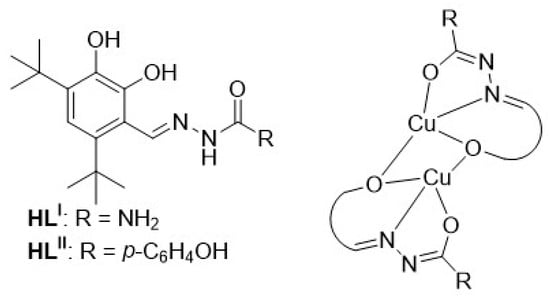
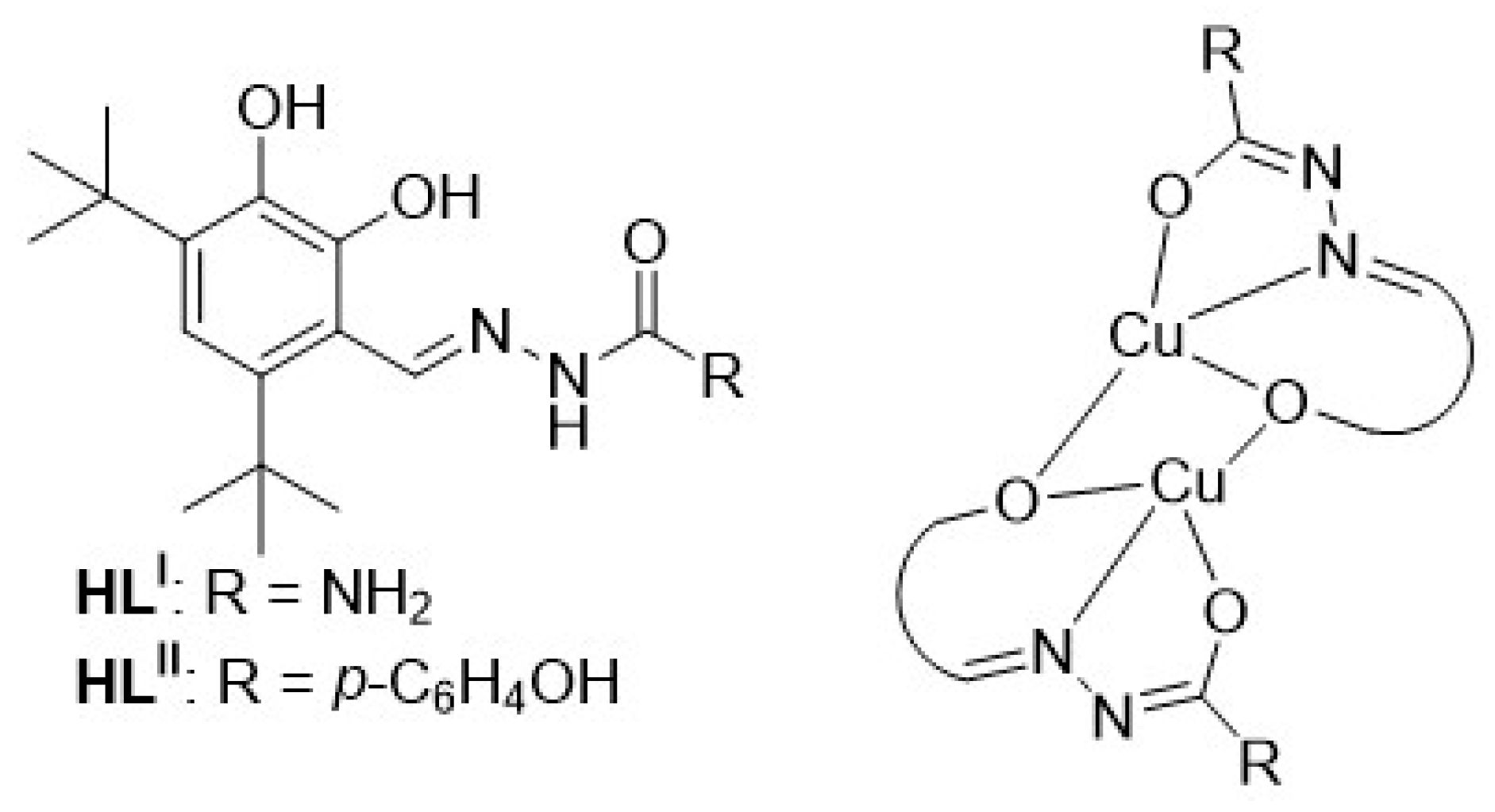
The solid-state ESR spectra of the complexes recorded at 77 K are very similar and exhibit axially symmetric g-tensors with g∥ > g⊥ > 2.0023 [19]. The exchange interaction parameter G = (g∥ − 2.0023)/(g⊥ − 2.0023), which measures the exchange interaction between copper centers in the solid state, is less than 4 (calculated as 2.8 for these complexes); consequently, the exchange interaction is considerable [20]. This strong exchange coupling suggests a binuclear [Cu2L2] structure bridged by N,O-donor ligands (Figure 1), which is further supported by elemental analysis. The bulky substituents on the ligand benzene rings induce steric strain, causing a significant distortion of the square-planar coordination cores. This structural distortion is reflected in the ESR spectra by the relatively high g-values [17].
Figure 1.
Structural formulae of the ligands HLI, HLII and coordination polyhedra of the binuclear copper(II) complexes Cu2LI2, Cu2LII2.
Thus, the observed g∥ > g⊥ > ge trend and the G-values (<4) indicate a dx2–y2 ground state, confirming that the Cu(II) ions reside in a distorted square-planar environment coordinated by N,O-donor ligands [21]. These findings are in good agreement with the results of other physicochemical methods (Figure 1).
The studied ligands are o-diphenol derivatives and readily undergo electrochemical oxidation. The peak potential of the first oxidation wave (E1pa) was used as a criterion for their reducing ability. The ligands, which differ only in the substituent at the 3-position, exhibit similar electrochemical properties. Two main peaks in electrochemical oxidation are observed for compounds HLI (1.03 V and 1.65 V) and HLII (1.06 V and 1.89 V) under anodic polarization (Table 2). The anodic peaks at 1.03 V and 1.06 V are accompanied by corresponding cathodic peaks in the reduction in oxidation products at 0.63 V (for HLI) and 0.82 V (for HLII) on the reverse scan. This indicates that the oxidation of the ligands, corresponding to the first anodic process, proceeds quasi-reversibly. Comparing these data with the electrochemical behavior of 3,5-di-tert-butylcatechol, it can be concluded that this anodic process involves the phenolic hydroxyl groups [22]. The second anodic process, corresponding to the peak at 1.65 V (for HLI) and 1.89 V (for HLII), proceeds irreversibly (no corresponding cathodic peaks are observed on the reverse scan) and may be associated with a redox process involving the –CH=N–NH– group (Table 2).
Table 2.
Cyclic voltammetry data for the ligands HLI, HLII and their Cu(II) complexes.
Compounds HLI and HLII undergo reduction under cathodic polarization, which is consistent with known data on the electrochemistry of hydrazone derivatives [23]: two main cathodic waves with peaks at −1.75 V and −2.21 V (for HLI) and −2.0 V and −2.27 V (for HLII) are registered on the voltammograms; moreover, for HLII, a small third peak at −1.71 V is also observed (Table 2).
Under anodic polarization, the voltammograms of the complexes exhibit oxidation peaks at 1.21 V and 1.56 V (for Cu2LI2) and 0.81 V, 1.06 V, 1.34 V, and 1.77 V (for Cu2LII2). It should be noted that the anodic peak potentials in the regions of 1.06–1.21 V and 1.56–1.77 V are close to those of the free ligands (Table 2). Due to the low solubility of Cu2LI2 in acetonitrile (saturated solution concentration of 0.05–0.1 mM), the peak currents are small and their potentials are determined with limited accuracy.
Under cathodic polarization, the voltammograms of Cu2LI2 and Cu2LII2 show the onset of a reduction process starting at approximately −0.5 V (Table 2). Due to the low concentration of Cu2LI2, only the occurrence of the cathodic process can be stated (individual peaks cannot be resolved). Cu2LII2 displays three peaks: two of these (at −0.80 V and −1.12 V) can be assigned to copper reduction (an oxidation peak of the reduced copper is observed on the reverse scan), while the peak at −1.89 V is ligand-centered (Table 2).
Based on their redox features, the Cu2LI2 complex exhibits lower reducing activity than its free ligand, whereas the Cu2LII2 complex acts as a stronger reductant (Table 2). Thus, the electrochemical study corroborates the spectroscopic results, confirming that the coordination cores of the complexes consist of Cu(II) ions and the ligands in their monoanionic form.
Antifungal activity of the synthesized and characterized compounds at the concentrations of 100 μg/mL is presented in Table 1. The inhibitory activity of the parent ligands (HLI and HLII) and their corresponding copper(II) complexes Cu2LI2 and Cu2LII2) was evaluated against Phytophthora infestans. It has been found that the free ligand HLI exhibited the highest inhibitory activity, whereas its copper(II) complex, Cu2LI2 proved largely ineffective across the tested concentrations. This indicates that coordination to the copper(II) ion diminishes the anti-oomycete properties of the HLI ligand. In contrast, the free ligand HLII and its complex Cu2LII2 displayed comparable levels of biological activity, with both demonstrating a pronounced dose-dependent inhibitory effect. When HLII was introduced into Rye A medium at a concentration of 100 µg/mL, the mycelial growth of P. infestans was suppressed to 76% of the untreated control. Similarly, treatment with the Cu2LII2 complex at 100 µg/mL restricted mycelial growth to 71% of the control. Overall, while complexation with copper(II) reduces the efficacy of the HLI ligand, the Cu2LII2 complex retains strong anti-oomycete activity comparable to that of its free ligand HLII.
5. Conclusions
Two novel copper(II) complexes with hydrazones derived from 4,6-di-tert-butyl-2,3-dihydroxybenzaldehyde were synthesized and comprehensively characterized. Antifungal assays against P. infestans demonstrated that the ligand HLI exhibited the highest inhibitory activity, while its copper(II) complex Cu2LI2 proved largely ineffective. In contrast, HLII and its complex Cu2LII2 displayed comparable anti-oomycete activity, indicating that the nature of the substituent at the 3-position of the ligand plays a decisive role in determining the biological efficacy of both the ligand and its metal complex. The obtained results provide a foundation for the rational design of novel copper-based fungicides with multi-target mechanisms of action.
Author Contributions
Conceptualization, I.T. and N.L.; methodology, M.G.; software, M.G.; validation, M.G., A.K. and N.L.; formal analysis, N.O. and G.K.; investigation, I.T., M.G., A.K., A.S. and G.K.; resources, N.O. and T.K.-R.; data curation, I.T., M.G. and A.S.; writing—original draft preparation, I.T.; writing—review and editing, I.T., M.G., A.K., A.S., I.A., D.K. and N.L.; visualization, I.T.; supervision, M.G., A.K., G.K. and N.L.; project administration, N.O., G.K., T.K.-R. and N.L.; funding acquisition, I.T., A.K. and N.L. All authors have read and agreed to the published version of the manuscript.
Funding
This research received no external funding.
Institutional Review Board Statement
Not applicable.
Informed Consent Statement
Not applicable.
Data Availability Statement
The raw data supporting the conclusions of this article will be made available by the authors on request.
Acknowledgments
The work was conducted within the framework of the research program “Chemical processes and technologies”, subprogram “Biologically active substances and materials”.
Conflicts of Interest
The authors declare no conflicts of interest.
Abbreviations
The following abbreviations are used in this manuscript:
| ATP | Adenosine triphosphate |
| DMSO | Dimethyl sulfoxide |
| DNA | Deoxyribonucleic acid |
| ESR | Electron spin resonance |
| FT-IR | Fourier-transform infrared |
| NMR | Nuclear magnetic resonance |
| ROS | Reactive oxygen species |
References
- Carvalho, F.P. Pesticides, environment, and food safety. Food Energy Secur. 2017, 6, 48–60. [Google Scholar] [CrossRef] [Scilit]
- Brhich, A.; Ait Sidi Brahim, M.; Merzouki, H.; Chatoui, R.; Merzouki, M. Fate and impact of pesticides: Environmental and human health issues. In Nutrition and Human Health; Chatoui, H., Merzouki, M., Moummou, H., Tilaoui, M., Saadaoui, N., Brhich, A., Eds.; Springer International Publishing: Cham, Switzerland, 2022; pp. 41–53. [Google Scholar]
- Lucas, J.A.; Hawkins, N.J.; Fraaije, B.A. The evolution of fungicide resistance. In Advances in Applied Microbiology; Gadd, G.M., Sariaslani, S., Eds.; Academic Press: Cambridge, MA, USA, 2015; Volume 90, pp. 29–92. [Google Scholar]
- Nazarov, P.A.; Baleev, D.N.; Ivanova, M.I.; Sokolova, L.M.; Karakozova, M.V. Infectious plant diseases: Etiology, current status, problems and prospects in plant protection. Acta Nat. 2020, 12, 46–59. [Google Scholar] [CrossRef] [Scilit] [PubMed]
- Kim, J.S.; Yoon, S.J.; Park, Y.J.; Kim, S.Y.; Ryu, C.M. Crossing the kingdom border: Human diseases caused by plant pathogens. Environ. Microbiol. 2020, 22, 2485–2495. [Google Scholar] [CrossRef] [Scilit] [PubMed]
- Thind, T.S. Changing trends in discovery of new fungicides: A perspective. Indian Phytopathol. 2021, 74, 875–883. [Google Scholar] [CrossRef] [Scilit]
- Li, N.; Sun, C.; Jiang, J.; Wang, A.; Wang, C.; Shen, Y.; Huang, B.; An, C.; Cui, B.; Zhao, X.; et al. Advances in controlled-release pesticide formulations with improved efficacy and targetability. J. Agric. Food Chem. 2021, 69, 12579–12597. [Google Scholar] [CrossRef] [Scilit] [PubMed]
- Loginova, N.V.; Koval’chuk-Rabchinskaya, T.V.; Ksendzova, G.A.; Osipovich, N.P.; Faletrov, Y.V.; Nabebina, K.A.; Gvozdev, M.Y.; Polozov, G.I. Redox-active metal complexes with hydrazone and thiosemicarbazone derivatives of 4,6-di-tert-butyl-2,3-dihydroxybenzaldehyde as novel antimicrobials for medicinal uses. In Hydrazones: Uses and Reactions; Østergaard, I.P., Ed.; Nova Science Publishers: Hauppauge, NY, USA, 2020; pp. 57–114. [Google Scholar]
- Turomsha, I.; Gvozdev, M.; Khodosovskaya, A.; Sokolova, A.; Osipovich, N.; Ksendzova, G.; Koval’chuk-Rabchinskaya, T.; Loginova, N. Copper(II) complexes of hydrazone and thiosemicarbazone ligands: Synthesis, characterization, antibacterial and antifungal activity. Chem. Proc. 2025, 18, 11. [Google Scholar] [CrossRef] [Scilit]
- Loginova, N.V.; Koval’chuk, T.V.; Gres, A.T.; Osipovich, N.P.; Polozov, G.I.; Halauko, Y.S.; Faletrov, Y.V.; Harbatsevich, H.I.; Hlushko, A.V.; Azarko, I.I.; et al. Redox-active metal complexes of sterically hindered phenolic ligands: Antibacterial activity and reduction of cytochrome c. Part IV. Silver(I) complexes with hydrazone and thiosemicarbazone derivatives of 4,6-di-tert-butyl-2,3-dihydroxybenzaldehyde. Polyhedron 2015, 88, 125–137. [Google Scholar] [CrossRef] [Scilit]
- Ivanov, A.A.; Ukladov, E.O.; Golubeva, T.S. Phytophthora infestans: An overview of methods and attempts to combat late blight. J. Fungi 2021, 7, 1071. [Google Scholar] [CrossRef] [Scilit] [PubMed]
- Welsh, L.R.J.; Avrova, A.O.; Besser, K.; Kirkbride, T.; Machado, C.B.; Hatton, N.E.; Gomez, L.D.; Fascione, M.A.; Cartwright, J.; Boevink, P.C.; et al. Oomycetes manipulate plant innate immunity through galacturonide oxidases. Nat. Commun. 2025, 16, 9093. [Google Scholar] [CrossRef] [Scilit] [PubMed]
- García-Santamarina, S.; Thiele, D.J. Copper at the fungal pathogen-host axis. J. Biol. Chem. 2015, 290, 18945–18953. [Google Scholar] [CrossRef] [Scilit] [PubMed]
- Samanovic, M.I.; Ding, C.; Thiele, D.J.; Darwin, K.H. Copper in microbial pathogenesis: Meddling with the metal. Cell Host Microbe 2012, 11, 106–115. [Google Scholar] [CrossRef] [Scilit] [PubMed]
- Magnani, D.; Solioz, M. How bacteria handle copper. In Molecular Microbiology of Heavy Metals; Nies, D.H., Silver, S., Eds.; Springer: Berlin/Heidelberg, Germany, 2007; Volume 6, pp. 259–285. [Google Scholar]
- Liu, H.F.; Xue, X.J.; Yu, Y.; Xu, M.M.; Lu, C.C.; Meng, X.L.; Zhang, B.G.; Ding, X.H.; Chu, Z.H. Copper ions suppress abscisic acid biosynthesis to enhance defence against Phytophthora infestans in potato. Mol. Plant Pathol. 2020, 21, 636–651. [Google Scholar] [CrossRef] [Scilit] [PubMed]
- Biradar, N.S.; Havinale, B.R. Dimeric square planar complexes of Cu(II) with aroyl hydrazones. Inorg. Chim. Acta 1976, 17, 157–160. [Google Scholar] [CrossRef] [Scilit]
- Cozar, O.; David, L.; Chiş, V.; Damian, G.; Todică, M.; Agut, C. IR and ESR studies on some dimeric copper(II) complexes. J. Mol. Struct. 2001, 563–564, 371–375. [Google Scholar] [CrossRef] [Scilit]
- Hathaway, B.J.; Billing, D.E. The electronic properties and stereochemistry of mono-nuclear complexes of the copper(II) ion. Coord. Chem. Rev. 1970, 5, 143–207. [Google Scholar] [CrossRef] [Scilit]
- Ruf, M.; Noll, B.C.; Groner, M.D.; Yee, G.T.; Pierpont, C.G. Pocket semiquinonate complexes of cobalt(II), copper(II), and zinc(II) prepared with the hydrotris(cumenylmethylpyrazolyl)borate ligand. Inorg. Chem. 1997, 36, 4860–4865. [Google Scholar] [CrossRef] [Scilit] [PubMed]
- Chandra, S.; Gupta, L.K. EPR and electronic spectral studies on Co(II), Ni(II) and Cu(II) complexes with a new tetradentate [N4] macrocyclic ligand and their biological activity. Spectrochim. Acta A 2004, 60, 1563–1571. [Google Scholar] [CrossRef] [PubMed]
- Lund, H.; Hammerich, O. (Eds.) Organic Electrochemistry, 4th ed.; Marcel Dekker: New York, NY, USA, 2001. [Google Scholar]
- Pessôa, M.M.B.; Andrade, G.F.S.; dos Santos, M.R.; Temperini, M.L.A. The electrochemical reduction of 2-formylpyridine thiosemicarbazone monitored by SERS and UV–vis spectroscopies. J. Electroanal. Chem. 2003, 545, 117–122. [Google Scholar] [CrossRef] [Scilit]

Disclaimer/Publisher’s Note: The statements, opinions and data contained in all publications are solely those of the individual author(s) and contributor(s) and not of MDPI and/or the editor(s). MDPI and/or the editor(s) disclaim responsibility for any injury to people or property resulting from any ideas, methods, instructions or products referred to in the content. |
© 2026 by the authors. Licensee MDPI, Basel, Switzerland. This article is an open access article distributed under the terms and conditions of the Creative Commons Attribution (CC BY) license.