


Abstract
Natural products remain an important source of structurally diverse molecules for the discovery of anti-inflammatory agents. Phyla lanceolata is used in traditional medicine, although experimental evidence supporting its anti-inflammatory properties is scarce. This study evaluated the topical anti-inflammatory activity of sequential organic extracts from P. lanceolata leaves. Plant material collected in Cunduacan, Tabasco, Mexico, was successively macerated with n-hexane, ethyl acetate, and methanol. Extraction yields were determined gravimetrically, and anti-inflammatory activity was assessed in the 12-O-tetradecanoylphorbol-13-acetate (TPA)-induced mouse ear edema model using indomethacin as the reference drug. Methanol afforded the highest extraction yield (7.93%), followed by ethyl acetate (1.51%) and n-hexane (0.56%). The ethyl acetate extract produced the greatest inhibition of edema (55.43%), whereas indomethacin produced 62.67% inhibition. These preliminary findings identify the ethyl acetate extract of P. lanceolata as the most active extract under the conditions tested and support its further phytochemical characterization and bioactivity-guided fractionation.
1. Introduction
Inflammation is a protective physiological response to tissue injury and infection, but excessive or persistent activation can contribute to tissue damage and disease progression. Natural products continue to provide chemically diverse scaffolds for pharmacological research, and medicinal plants are an important source of metabolites capable of modulating inflammatory pathways [1,2].
Phyla lanceolata (Michx.) Greene (Verbenaceae) is a perennial herb with a prostrate or creeping habit that is commonly associated with moist habitats and low-lying areas. Its distribution includes regions of North America and Mexico [3]. Despite its use in traditional medicine, the pharmacological properties of this species remain poorly characterized.
Evidence from related species supports further investigation of the genus Phyla. In Phyla nodiflora, flavonoids such as eupafolin, hispidulin, and cirsiliol have been reported [4]. Several of these metabolites have been associated with anti-inflammatory effects involving mediators such as cyclooxygenase-2 (COX-2), inducible nitric oxide synthase (iNOS), prostaglandin E2 (PGE2), and nitric oxide (NO) [2,5]. These observations cannot be extrapolated directly to P. lanceolata, however, because the presence and abundance of such metabolites in this species require specific phytochemical characterization.
Anti-inflammatory activity has also been reported for other members of Verbenaceae. Ethanolic extracts of Lippia dulcis and the essential oil of Lippia sidoides reduced inflammation in the TPA-induced mouse ear edema model [6,7]. In contrast, experimental information on P. lanceolata remains limited, providing a rationale for evaluating its organic extracts in the same pharmacological model.
Additionally, the anti-inflammatory activity of natural products has been investigated through the evaluation of essential oils and fractions enriched in specific groups of metabolites [8]. Fellahi et al. investigated the essential oil of Daucus crinitus and a phenylpropanoid-enriched fraction, reporting anti-inflammatory activity in an in vitro model. Although this study involved a species from the Apiaceae family and employed an experimental model different from TPA-induced mouse ear edema, its findings provide relevant evidence regarding the importance of chemical composition and fraction enrichment in the investigation of natural products with anti-inflammatory potential.
Accordingly, this study aimed to evaluate the anti-inflammatory activity of sequential n-hexane, ethyl acetate, and methanol extracts obtained from P. lanceolata leaves using the TPA-induced mouse ear edema model. The study was designed as an initial pharmacological screening to identify the extract most suitable for subsequent phytochemical characterization and bioactivity-guided fractionation.
2. Materials and Methods
2.1. Plant Material
Plant material of Phyla lanceolata was collected in January 2026 in Huimango 2nd Section, Cunduacan Municipality, Tabasco, Mexico (18°07′07.0″ N, 93°10′02.0″ W).
A voucher specimen was deposited in the Herbarium of the Academic Division of Biological Sciences, Universidad Juárez Autónoma de Tabasco, where the material was taxonomically identified by Dr. Nelly C. Jiménez Pérez. The voucher specimen was registered under number 037601.
2.2. Preparation of Extracts
Leaves of Phyla lanceolata were dried in a Riossa H-102 oven (REPRESA, Tequisquiapan, Querétaro, Mexico) at 40–50 °C for 1–2 h and then ground. The dried material was subjected to sequential maceration with solvents of increasing polarity: n-hexane, ethyl acetate, and methanol (Merck, Darmstadt, Germany, the solvents used were of analytical grade and were used without further purification). Four liters of each solvent were used, with a maceration period of 24 h for each extraction step. After each maceration, the liquid phase was separated from the plant material and concentrated under reduced pressure using a rotary evaporator. Extraction yield was calculated gravimetrically as the mass of dried extract relative to the mass of dried plant material and expressed as a percentage.
2.3. TPA-Induced Mouse Ear Edema
The anti-inflammatory activity of Phyla lanceolata extracts was evaluated using the TPA-induced mouse ear edema model following the procedure described by González-Cortazar et al. [9], with modifications. Male Balb-C mice (20 g) were obtained from Centro Medico Nacional SXXI-IMSS (Cuauhtémoc, Mexico). They were organized in groups of 4 animals under controlled conditions with a 12 h light–dark cycle at a temperature of 20 ± 1 °C and free access to food (Labdiet 5008, Brentwood, MI, USA) and water. Mice were handled according to the Mexican Official Standard on the Care and Management of Animals (NOM-062-ZOO-1999) and international regulations.
Animals were randomly allocated to groups of four (n = 4): a TPA-treated control group, an indomethacin reference group, and groups treated with the n-hexane (PeHex), ethyl acetate (PeEtOAc), or methanol (PeMeOH) extract. Edema was induced by topical application of TPA dissolved in acetone to the right ear. Immediately thereafter, each extract or indomethacin was applied topically at 1.0 mg/ear. Six hours after TPA administration, 6-mm tissue disks were collected from both ears with a biopsy punch. Ear edema was determined as the difference in weight between disks obtained from the treated and untreated ears. The percentage inhibition of edema was calculated relative to the TPA-treated control group using the following formula:
2.4. Statistical Analysis
The data obtained from the TPA-induced mouse ear edema model were analyzed using one-way analysis of variance (ANOVA), followed by Dunnett’s post hoc test for multiple comparisons between the experimental groups and the reference control group. Statistical significance was set at p ≤ 0.05.
3. Results
Anti-Inflammatory Activity
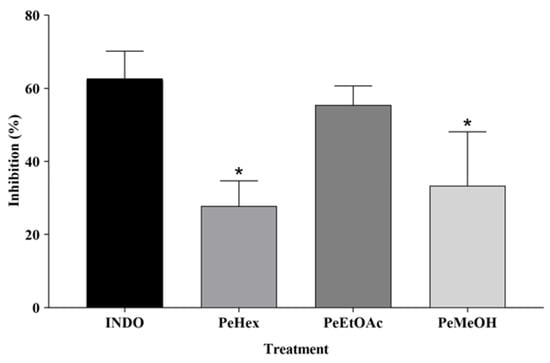
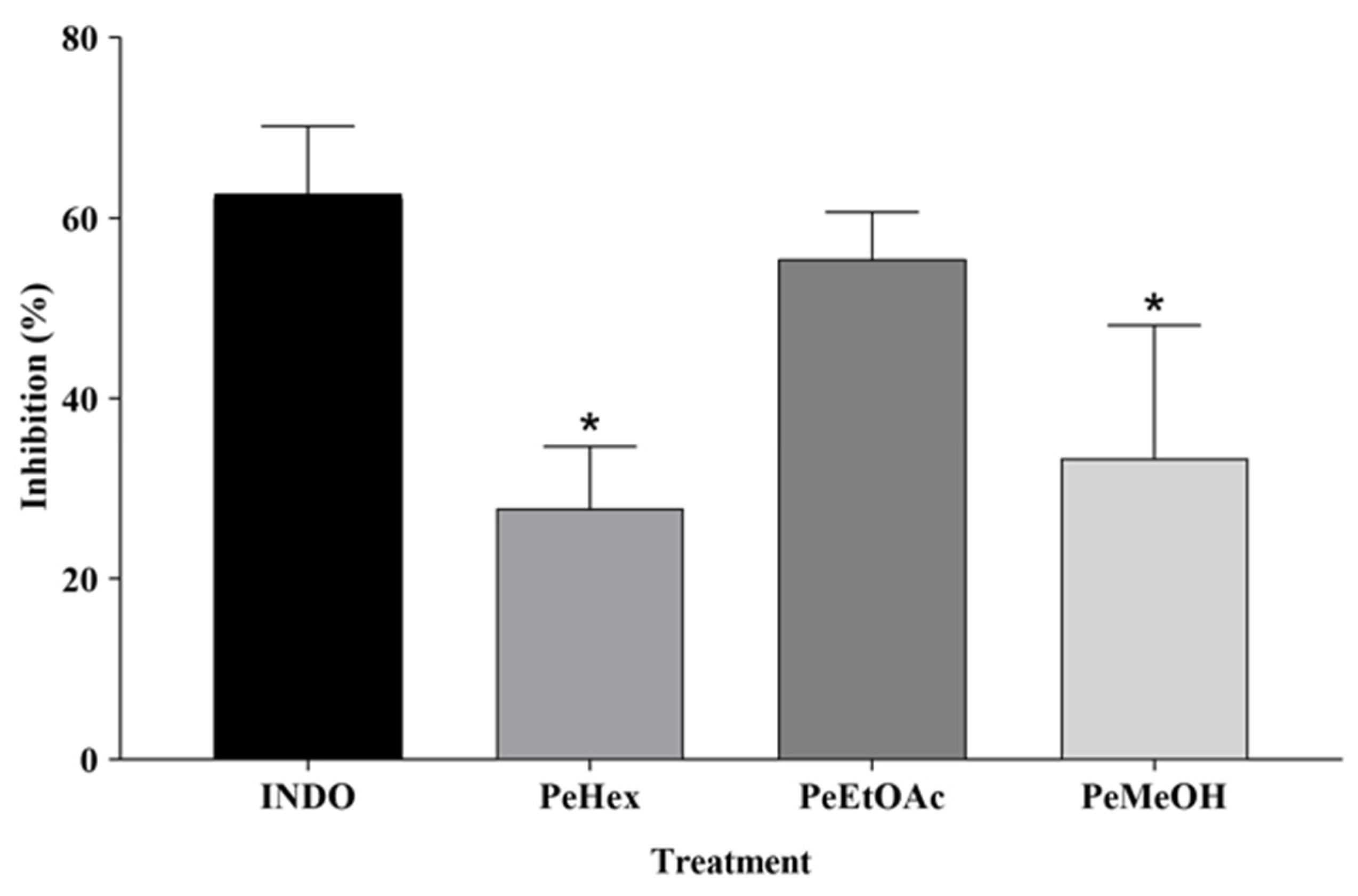
Sequential extraction yielded 0.56% n-hexane extract, 1.51% ethyl acetate extract, and 7.93% methanol extract. In the TPA-induced mouse ear edema model, the mean edema value in the TPA-treated group was 13.125 mg. Indomethacin reduced the mean edema to 4.900 mg, corresponding to 62.67% inhibition. Among the plant extracts, PeEtOAc produced the greatest numerical inhibition, with a mean edema value of 5.850 mg and 55.43% inhibition, followed by PeMeOH (8.750 mg; 33.33%) and PeHex (9.475 mg; 27.81%). Thus, the ethyl acetate extract was the most active of the three extracts under the conditions tested (Table 1, Figure 1). One-way analysis of variance (ANOVA), followed by Dunnett’s post hoc test, revealed statistically significant differences between the PeHex and PeMeOH extract-treated groups and the reference group (indomethacin) (p < 0.05). In contrast, the ethyl acetate extract (PeEtOAc) showed no statistically significant difference compared with indomethacin.
Table 1.
Anti-inflammatory activity of Phyla lanceolata extracts in the TPA-induced mouse ear edema model.
Figure 1.
Anti-inflammatory activity of Phyla lanceolata extracts in the TPA-induced mouse ear edema model. Indomethacin (INDO) was used as the reference drug. PeHex, n-hexane extract; PeEtOAc, ethyl acetate extract; PeMeOH, methanol extract. Analysis of variance [ANOVA]) with the post hoc Dunnett test (n = 4; mean ± Standard Deviation [SD]). * p < 0.05 in comparison with the reference group (INDO).
4. Discussion
The present study provides preliminary evidence that organic extracts of Phyla lanceolata can reduce TPA-induced ear edema. Among the three sequential extracts, the ethyl acetate extract showed the highest inhibition of edema (55.43%), followed by the methanol (33.33%) and n-hexane (27.81%) extracts, whereas indomethacin produced 62.67% inhibition. Analysis by ANOVA followed by Dunnett’s post hoc test revealed statistically significant differences between the PeHex and PeMeOH groups and the indomethacin reference group (p < 0.05); in contrast, PeEtOAc did not differ significantly from the reference drug.
The extraction yield did not parallel the pharmacological response. Methanol afforded the highest yield (7.93%), whereas the ethyl acetate extract represented only 1.51% of the dried plant material but produced the greatest inhibition of edema. This difference suggests that extraction yield alone is not a reliable predictor of anti-inflammatory activity and that compounds enriched in an intermediate-polarity fraction may contribute disproportionately to the observed effect.
These results are consistent with studies conducted in other plant species. In Prosopis laevigata, González-Cortazar et al. [10] reported inhibition rates of 60.81%, 75.96%, and 60.29% for n-hexane, dichloromethane, and methanol extracts, respectively, using the TPA-induced ear edema model. Likewise, anti-inflammatory activity has been reported for extracts and metabolites of different polarities from Penstemon gentianoides and P. campanulatus, including flavonoids, iridoids, and phenylpropanoids [11]. Collectively, these findings support the notion that anti-inflammatory activity may be concentrated in specific fractions and associated with particular metabolites.
Phyla nodiflora, a related species, contains flavonoids such as eupafolin, hispidulin, and cirsiliol [4]. Eupafolin has been reported to modulate inflammatory mediators including COX-2, PGE2, iNOS, and NO [2,5]. These reports provide a plausible phytochemical context for the activity observed here, but they do not demonstrate that the same compounds occur in P. lanceolata. Chemical profiling of the active ethyl acetate extract is therefore necessary before any specific metabolite or mechanism can be proposed.
The magnitude of inhibition observed with PeEtOAc is also consistent with the anti-inflammatory activity reported for other Verbenaceae species in the TPA model. Ethanolic extracts of Lippia dulcis produced 49.13% inhibition, whereas the essential oil of Lippia sidoides produced 45.93% inhibition [6,7]. Differences among species, extract types, and experimental conditions preclude direct potency comparisons; nevertheless, these reports support continued investigation of Verbenaceae as a source of anti-inflammatory metabolites. The present findings should be interpreted as a screening result, particularly because measures of variability and inferential statistical comparisons were not available for the dataset used in this manuscript.
5. Conclusions
Sequential organic extracts of Phyla lanceolata exhibited anti-inflammatory activity in the TPA-induced mouse ear edema model. The ethyl acetate extract showed the highest inhibition of edema (55.43%), approaching that observed with indomethacin (62.67%), with no statistically significant difference between the two treatments. In contrast, the n-hexane and methanol extracts differed significantly from indomethacin (p < 0.05). These findings identify the ethyl acetate extract as the most promising candidate for further chemical characterization and bioactivity-guided fractionation to identify metabolites that may contribute to its anti-inflammatory effects.
Author Contributions
Conceptualization, methodology, E.A.B.-G., M.G.-C., A.Z. and M.H.R.; methodology, M.G.-C., A.Z. and M.H.R.; investigation, A.K.A.-C.; data curation, A.K.A.-C. and E.A.B.-G.; writing—original draft preparation, A.K.A.-C.; writing—review and editing, E.A.B.-G., M.G.-C., A.Z. and M.H.R.; supervision, E.A.B.-G., M.G.-C., A.Z. and M.H.R. All authors have read and agreed to the published version of the manuscript.
Funding
This research received no external funding.
Institutional Review Board Statement
The Research Committee of IMSS approved the experimental designs used in the present study F-2021-1702-022.
Informed Consent Statement
Not applicable.
Data Availability Statement
The data supporting the findings of this study are included in the article. Individual-animal data should be retained by the authors and made available upon reasonable request where permitted by the approved protocol.
Conflicts of Interest
The authors declare no conflicts of interest.
References
- Pascual, M.E.; Slowing, K.; Carretero, E.; Sánchez Mata, D.; Villar, A. Lippia: Traditional Uses, Chemistry and Pharmacology: A Review. J. Ethnopharmacol. 2001, 76, 201–214. [Google Scholar] [CrossRef] [Scilit] [PubMed]
- Chen, C.-C.; Lin, M.-W.; Liang, C.-J.; Wang, S.-H. The Anti-Inflammatory Effects and Mechanisms of Eupafolin in Lipopolysaccharide-Induced Inflammatory Responses in RAW264.7 Macrophages. PLoS ONE 2016, 11, e0158662. [Google Scholar] [CrossRef] [Scilit] [PubMed]
- O’Leary, N.; Múlgura, M.E. A Taxonomic Revision of the Genus Phyla (Verbenaceae). Ann. Mo. Bot. Gard. 2012, 98, 578–596. [Google Scholar] [CrossRef] [Scilit]
- Lin, F.-J.; Yen, F.-L.; Chen, P.-C.; Wang, M.-C.; Lin, C.-N.; Lee, C.-W.; Ko, H.-H. HPLC-Fingerprints and Antioxidant Constituents of Phyla nodiflora. Sci. World J. 2014, 2014, 528653. [Google Scholar] [CrossRef] [Scilit] [PubMed]
- Tsai, M.-H.; Lin, Z.-C.; Liang, C.-J.; Yen, F.-L.; Chiang, Y.-C.; Lee, C.-W. Eupafolin Inhibits PGE2 Production and COX2 Expression in LPS-Stimulated Human Dermal Fibroblasts by Blocking JNK/AP-1 and Nox2/P47phox Pathway. Toxicol. Appl. Pharmacol. 2014, 279, 240–251. [Google Scholar] [CrossRef] [Scilit] [PubMed]
- Pérez, S.; Meckes, M.; Pérez, C.; Susunaga, A.; Zavala, M.A. Anti-Inflammatory Activity of Lippia Dulcis. J. Ethnopharmacol. 2005, 102, 1–4. [Google Scholar] [CrossRef] [Scilit] [PubMed]
- Monteiro, M.V.B.; De Melo Leite, A.K.R.; Bertini, L.M.; De Morais, S.M.; Nunes-Pinheiro, D.C.S. Topical Anti-Inflammatory, Gastroprotective and Antioxidant Effects of the Essential Oil of Lippia Sidoides Cham. Leaves. J. Ethnopharmacol. 2007, 111, 378–382. [Google Scholar] [CrossRef] [Scilit] [PubMed]
- Fellahi, M.; Keniche, A.; Dib, M.E.A.; Bensaid, O.; Datoussaid, Y.; Muselli, A. In-Vitro Evaluation of the Anti-Inflammatory, Antidiabetic and Hemolytic Activities of Daucus crinitus Desf. Essential Oil and Its Phenylpropanoid- Enriched Fraction. Curr. Chem. Biol. 2026, 20, 442–450. [Google Scholar] [CrossRef] [Scilit]
- González-Cortazar, M.; Salinas-Sánchez, D.O.; Herrera-Ruiz, M.; Román-Ramos, D.C.; Zamilpa, A.; Jiménez-Ferrer, E.; Ble-González, E.A.; Álvarez-Fitz, P.; Castrejón-Salgado, R.; Pérez-García, M.D. Eupatorin and Salviandulin-A, with Antimicrobial and Anti-Inflammatory Effects from Salvia Lavanduloides Kunth Leaves. Plants 2022, 11, 1739. [Google Scholar] [CrossRef] [Scilit] [PubMed]
- González-Cortazar, M.; Salinas-Sánchez, D.O.; Herrera-Ruiz, M.; Hernández-Hernández, P.; Zamilpa, A.; Jiménez-Ferrer, E.; Utrera-Hernández, B.E.; Pérez-García, M.D.; Gutiérrez-Roman, A.S.; Ble-González, E.A. Chemical Profile Analysis of Prosopis Laevigata Extracts and Their Topical Anti-Inflammatory and Antibacterial Activities. Plants 2025, 14, 1118. [Google Scholar] [CrossRef] [Scilit] [PubMed]
- Domínguez, M.; Avila, J.G.; Nieto, A.; Céspedes, C.L. Anti-Inflammatory Activity of Penstemon Gentianoides and Penstemon Campanulatus. Pharm. Biol. 2011, 49, 118–124. [Google Scholar] [CrossRef] [Scilit] [PubMed][Green Version]

Disclaimer/Publisher’s Note: The statements, opinions and data contained in all publications are solely those of the individual author(s) and contributor(s) and not of MDPI and/or the editor(s). MDPI and/or the editor(s) disclaim responsibility for any injury to people or property resulting from any ideas, methods, instructions or products referred to in the content. |
© 2026 by the authors. Licensee MDPI, Basel, Switzerland. This article is an open access article distributed under the terms and conditions of the Creative Commons Attribution (CC BY) license.