


Abstract
The rise of antimicrobial resistance has intensified the search for novel bioactive natural compounds. Flavonoids and isoflavonoids, which exhibit a broad range of pharmacological activity and generally low toxicity, represent promising scaffolds for drug discovery. Although these compounds have traditionally been regarded as plant-specific metabolites, growing evidence indicates that microorganisms can also synthesize or biotransform them. The identification of microbial isoflavonoid producers and elucidation of their biosynthetic pathways may therefore provide new opportunities for obtaining pharmacologically relevant compounds. In the present study, the halotolerant strain Streptomyces albidoflavus INA 01478 was found to produce a bioactive metabolite identified as genistein. The compound was isolated and structurally characterized using mass spectrometry and NMR spectroscopy, and its antimicrobial activity was evaluated.
1. Introduction
Flavonoids and isoflavonoids are polyphenolic natural products that are widely distributed in plants, where they contribute to the regulation of growth, attraction of pollinators, and defence against biotic and abiotic stresses [1,2,3]. Their characteristic C6–C3–C6 scaffold consists of two aromatic rings linked through a heterocyclic ring, and variations in ring connectivity, oxidation state, and substitution pattern give rise to several major subclasses. Isoflavonoids are distinguished from other flavonoids by attachment of the B ring at C-3 rather than C-2 [4,5]. The considerable structural diversity of these compounds is associated with a broad spectrum of biological activities, including antioxidant, antibacterial, antifungal, antitumour, and anti-inflammatory effects [1,2,3,4,5,6]. Genistein and daidzein, together with their glycosylated and malonylated derivatives and other isoflavonoids such as glycitin, are particularly abundant in soybean, although they are also found in beans, peanuts, chickpeas, and other plant sources [1,2,6]. Natural isoflavonoids were initially considered to occur predominantly in members of the Leguminosae, but subsequent studies demonstrated a broader taxonomic distribution. Importantly, microorganisms have also emerged as producers or biotransformation hosts for isoflavonoids. Fungi and actinomycetes have been reported to produce both well-known compounds, including genistein, daidzein, prunetin, kakkatin, and formononetin, and previously undescribed polyphenolic metabolites [2,7,8].
The ability of microorganisms to produce isoflavonoids is of particular interest because these compounds combine diverse biological activities with potential pharmaceutical and nutraceutical applications. Microbial biosynthesis and biotransformation may also provide alternative routes to structurally diverse or relatively rare isoflavonoids that are difficult to obtain efficiently by conventional extraction from plant material. In this context, identification of new microbial producers and characterization of their metabolites are important both for natural-product discovery and for understanding the biosynthetic pathways involved. The present study therefore aimed to isolate and identify an antifungally active metabolite produced by the halotolerant actinomycete Streptomyces albidoflavus INA 01478 and to characterize its structure using mass spectrometry and multidimensional NMR spectroscopy.
2. Results and Discussion
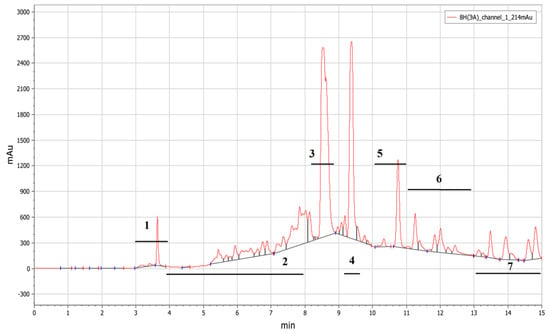
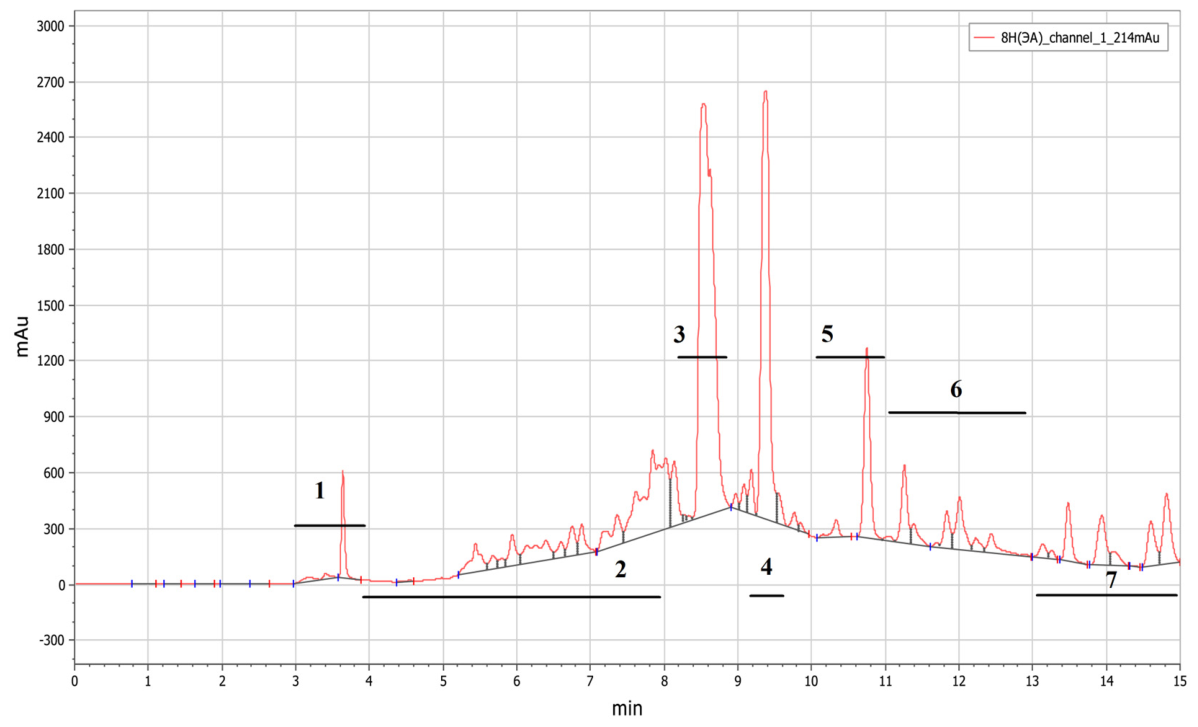
The halotolerant strain Streptomyces albidoflavus INA 01478 (GenBank accession: JBUBNM010000001) was isolated from bottom sediments of Trondheim Fjord (Norwegian Sea) and has been deposited in the Gause Collection of Antibiotic Producers (Gause Institute of New Antibiotics, Russia). In our previous work, the antimicrobial activity of this actinomycete was evaluated against a panel of bacterial and fungal test strains [9]. Additional antifungal activity against Aspergillus fumigatus KPB F-37 and Fusarium solani VKPM F-890 was also established; the inhibition zone diameters were 14–15 mm and 28–32 mm, respectively. The findings from the conducted studies confirmed that the strain displays strong antifungal activity. The crude extracts obtained by ethyl acetate extraction also exhibited inhibitory activity against fungi. The inhibition zones were 18 mm against Candida albicans ATCC 2091, 20 mm against Fusarium oxysporum VKPM F-148, 22 mm against F. solani VKPM F-890, 13 mm against Aspergillus niger ATCC 16404, and 11 mm against A. fumigatus KPB F-37. The metabolites of the ethyl acetate fraction were analysed by reversed-phase HPLC. The chromatographic profile showed multiple peaks eluting between 3 and 15 min (Figure 1).
Figure 1.
Analytical reversed-phase HPLC profile of the ethyl acetate extract of Streptomyces albidoflavus INA 01478. Horizontal bars indicate the seven collected fractions.
The antifungal activity the seven collected fractions was determined (Table 1).
Table 1.
Antifungal activity of different fractions from ethyl acetate extract (n/a—no activity).
The largest inhibition zones against C. albicans, F. oxysporum, F. solani and A. niger were detected for compounds in fractions 3 and 4. Only these two compounds had activity against A. niger ATCC 16404. The compound eluting in peak 3 was previously characterised as daidzein on the basis of NMR and mass spectrometric analyses and its biosynthetic pathway was elucidated by whole-genome sequencing [9]. In the present study, the structure of the second isolated compound (the compound eluting in peak 4) was determined through detailed analysis of nuclear magnetic resonance (NMR) and mass spectrometry (MS) data (Figure 2). The molecular mass of this compound was found to be 16 Da higher than that of daidzein, suggesting the presence of an additional oxygen atom.
Figure 2.
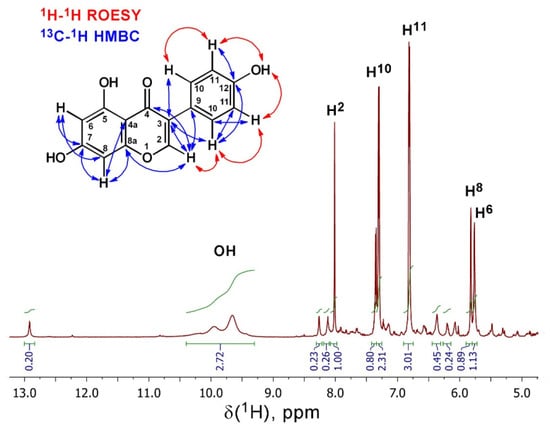
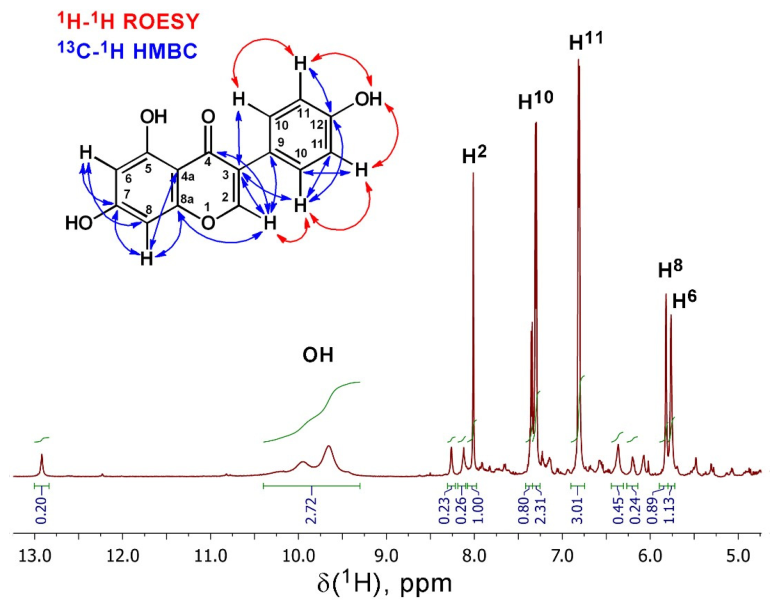
Fragment of the 1H NMR spectrum of genistein recorded in DMSO-d6 at 600 MHz and 298 K, with signal assignments. Diagnostic 1H-1H ROESY correlations are shown in red and 13C-1H HMBC correlations are shown in blue.
Structural elucidation and signal assignment were based on heteronuclear correlations observed in the HSQC and HMBC spectra, as well as spatial proximities between protons detected in the ROESY spectrum.
Table 2 presents the 13C and 1H NMR chemical shifts of the compound under study and compares them with literature values reported for genistein. Overall, the experimental and literature values agree well. Minor discrepancies can be attributed to differences in sample concentration, the presence of impurities that may interact with genistein, and variations in spectral acquisition conditions.
Table 2.
Comparison of experimentally measured 13C and 1H chemical shifts with published values for genistein (Mazurek et al. [10]).
Purified genistein was tested against Fusarium spp., as the fraction showed large inhibition zones against these pathogens. These results confirm that the antifungal activity of the fraction is largely due to genistein.
Genistein is a bioactive isoflavone with a broad spectrum of pharmacological effects. In addition to its oestrogen-like activity, it exhibits antioxidant, anti-inflammatory, antimicrobial, anti-angiogenic, and metabolic effects. Its anticancer properties are the most extensively studied. In cancer cells, genistein inhibits tumour growth by activating p53, caspase-3, and caspase-10, suppressing TGF-β/Smad (Transforming Growth Factor) signalling, and downregulating tumour-promoting factors. The clinical evidence is strongest for breast and prostate cancers [6]. Genistein is therefore a compound of considerable pharmaceutical value. Nevertheless, its conventional recovery from soybeans is environmentally problematic, involving extensive use of organic solvents, substantial waste production, and reliance on agricultural yields. Microbial synthesis or biotransformation of this compound offers a promising alternative in modern biotechnology. Recent findings have demonstrated that Paenibacillus jilinensis possesses a native capacity to synthesise genistein via seven endogenous bacterial enzymes, which share approximately 30% sequence homology with their plant counterparts. Life-cycle assessment indicated that the bacterial platform generates 92% less waste than conventional soybean extraction [11]. In our earlier study, we showed that the genome of Streptomyces albidoflavus INA 01478 harbours a complete set of genes for daidzein biosynthesis. The subsequent phase of our research will focus on identifying the genes responsible for genistein production.
3. Conclusions
In this study, genistein was isolated from an antifungally active fraction produced by the halotolerant actinomycete Streptomyces albidoflavus INA 01478 and identified by mass spectrometry and multidimensional NMR spectroscopy. To the best of our knowledge, this is the first report of genistein production by this strain. These findings expand the known diversity of microbial isoflavonoid producers and further demonstrate the potential of actinomycetes as sources of pharmacologically relevant natural products. Microbial production may also provide an alternative to conventional plant extraction, although its practical and environmental advantages require further evaluation. Future studies should focus on identifying the biosynthetic genes and regulatory mechanisms responsible for genistein formation in S. albidoflavus and on establishing the contribution of genistein to the antifungal activity of the strain.
4. Materials and Methods
4.1. Antimicrobial Activity Test
The antibiotic activity against the test organisms was determined by cultivating the strain Streptomyces albidoflavus INA 01478 on liquid growth media developed for actinomycetes (A4 medium), which comprised (in g/L): soybean meal 10.0, glucose 10.0, NaCl 5.0, and CaCO3 2.5. The actinomycete strain was cultured in 750 mL Erlenmeyer flasks with 150 mL of liquid medium at 28 °C with shaking at 200 rpm for 5 days. Culture liquids were separated from biomass by centrifugation at 4800 rpm for 20 min. Antifungal activity against Candida albicans ATCC 2091, Aspergillus niger ATCC 16404, Aspergillus fumigatus KPB F-37, Fusarium solani VKPM F-890 and Fusarium oxysporum VKPM F-148 was assessed by the standard agar well diffusion and disc-diffusion methods. Prior to inoculation, microbial suspensions were adjusted to a 0.5 McFarland standard using a DEN-1 densitometer (Bio-San, Riga, Latvia) and evenly spread onto the surface of the agar medium in Petri dishes. Fungal suspensions were inoculated onto Mueller–Hinton agar supplemented with 2% glucose (HiMedia Laboratories, Mumbai, India).
4.2. Extraction, HPLC and Mass Spectrum Analysis
The culture (2000 mL) broth was centrifuged to remove the biomass, and the resulting supernatant was extracted with ethyl acetate (EtOAc) at a supernatant-to-EtOAc ratio of 7:1 (vol/vol). The combined crude extracts were dried over anhydrous Na2SO4 and evaporated at 45 °C. The residues were dissolved in ethanol (EtOH), filtered and evaporated. The active substances were isolated using reverse-phase high-performance liquid chromatography on a Shine device (Qingdao Shenghan Chromatograph Technology Co., Qingdao, China) with a UV detector and ShineSil C18 column (4.6 × 250 mm). The chromatographic procedure was performed with a gradually increasing acetonitrile gradient from 5 to 95% for 15 min with UV detection at 214 and 260 nm. Preparative purification of the target compound from the EtOAc extract was performed using a PuriFlash 4250 chromatograph (Advion Interchim Scientific, Montluçon, France) with the Zorbax SB-C18 column (21.2 × 250 mm, with a particle size of 7 μm) under the same conditions, with the exception of the flow rate parameter (10 mL/min). Electron ionization mass spectra were acquired using a Finnigan MAT INCOS 50 spectrometer (Thermo Fisher Scientific, Waltham, MA, USA) with direct sample injection into the ion source. The ionization energy was set to 70 eV, and the controlling voltage was 1.75 kV. LC/MS analysis was conducted using an Agilent 1100 LC/MSD system (Agilent Technologies, Santa Clara, CA, USA).
4.3. NMR Spectroscopy
NMR spectra were recorded on a Bruker AVANCE 600 spectrometer (Bruker, Karlsruhe, Germany) operating at a proton frequency of 600 MHz at 298 K in DMSO-d6. The assignment of 1H and 13C signals was achieved through the analysis of the following 2D NMR experiments: DQF-COSY, ROESY, 13C-1H HSQC and 13C-1H HMBC. The mixing time for the ROESY experiment was set to 320 ms. 1H chemical shifts were referenced to tetramethylsilane (TMS) as an internal standard, while 13C chemical shifts were indirectly referenced using the γ-ratio method [12]. 2D NMR spectra were processed using NMRPipe [13] following a standard protocol that included a Lorentz-to-Gauss window function, forward-backward linear prediction, and polynomial baseline correction. Spectral analysis was performed with NMRFAM-Sparky [14]. 1D NMR spectra were processed and analyzed using Mnova software v. 14.1.2 (Mestrelab Research, Santiago de Compostela, Spain).
Author Contributions
Conceptualization, I.L. and V.S.; Methodology, O.S., I.L. and V.P.; Validation, V.P.; Investigation, A.S., O.S. and V.P.; Writing—Original Draft, O.S.; Writing—Review and Editing, V.S. All authors have read and agreed to the published version of the manuscript.
Funding
The work of Sineva O., Sadykova V., Simonov A., and Levshin I. was carried out within the framework of the state assignment of the Gause Institute of New Antibiotics (institutional funding). NMR studies (Polshakov V.) were supported by the Russian Science Foundation (grant 24-14-00081).
Institutional Review Board Statement
Not applicable.
Informed Consent Statement
Not applicable.
Data Availability Statement
The original contributions presented in this study are included in the article. The whole-genome sequence data are openly available in GenBank under accession number JBUBNM010000001. The remaining chemical and spectral data are available from the corresponding author upon reasonable request.
Conflicts of Interest
The authors declare no conflicts of interest.
References
- Dias, M.C.; Pinto, D.C.G.A.; Silva, A.M.S. Plant Flavonoids: Chemical Characteristics and Biological Activity. Molecules 2021, 26, 5377. [Google Scholar] [CrossRef] [Scilit] [PubMed]
- Wang, J.F.; Liu, S.S.; Song, Z.Q.; Xu, T.C.; Liu, C.S.; Hou, Y.G.; Huang, R.; Wu, S.H. Naturally Occurring Flavonoids and Isoflavonoids and Their Microbial Transformation: A Review. Molecules 2020, 25, 5112. [Google Scholar] [CrossRef] [Scilit] [PubMed]
- Magadan-Corpas, P.; Ye, S.; Braune, A.; Villar, C.J.; Lombo, F. Optimization of Flavanonols Heterologous Biosynthesis in Streptomyces albidoflavus, and Generation of Auronols. Front. Microbiol. 2024, 15, 1378235. [Google Scholar] [CrossRef] [Scilit] [PubMed]
- Maleki, S.J.; Crespo, J.F.; Cabanillas, B. Anti-Inflammatory Effects of Flavonoids. Food Chem. 2019, 299, 125124. [Google Scholar] [CrossRef] [Scilit] [PubMed]
- Kopustinskiene, D.M.; Jakstas, V.; Savickas, A.; Bernatoniene, J. Flavonoids as Anticancer Agents. Nutrients 2020, 12, 457. [Google Scholar] [CrossRef] [Scilit] [PubMed]
- Sharifi-Rad, J.; Quispe, C.; Imran, M.; Rauf, A.; Nadeem, M.; Gondal, T.A. Genistein: An Integrative Overview of Its Mode of Action, Pharmacological Properties, and Health Benefits. Oxid. Med. Cell. Longev. 2021, 2021, 3268136. [Google Scholar] [CrossRef] [Scilit] [PubMed]
- Wang, R.-J.; Zhang, S.-Y.; Ye, Y.-H.; Yu, Z.; Qi, H.; Zhang, H.; Xue, Z.-L.; Wang, J.-D.; Wu, M. Three New Isoflavonoid Glycosides from the Mangrove-Derived Actinomycete Micromonospora aurantiaca 110B. Mar. Drugs 2019, 17, 294. [Google Scholar] [CrossRef] [Scilit] [PubMed]
- Zheng, K.X.; Jiang, Y.; Jiang, J.X.; Huang, R.; He, J.; Wu, S.H. A New Phthalazinone Derivative and a New Isoflavonoid Glycoside from Lichen-Associated Amycolatopsis sp. Fitoterapia 2019, 135, 85–89. [Google Scholar] [CrossRef] [Scilit] [PubMed]
- Sineva, O.N.; Markelova, N.N.; Malysheva, K.V.; Kolpakova, O.A.; Kudryakova, G.K.; Prokhorenko, I.A.; Kisil, O.V.; Simonov, A.Y.; Polshakov, V.I.; Levshin, I.B.; et al. Halotolerant Streptomyces albidoflavus INA 01478 as a Producer of Daidzein: Genome Annotation, Purification and Antifungal Activity. Appl. Biochem. Microbiol. 2025, 61, 872–881. [Google Scholar] [CrossRef] [Scilit]
- Mazurek, A.P.; Kozerski, L.; Sadlej, J.; Kawecki, R.; Bednarek, E.; Sitkowski, J.; Dobrowolski, J.C.; Maurin, J.K.; Biniecki, K.; Witowska, J.; et al. Genistein Complexes with Amines: Structure and Properties. J. Chem. Soc. Perkin Trans. 1998, 2, 1223–1230. [Google Scholar] [CrossRef] [Scilit]
- Zhang, J.B.; Chen, W.; Yang, Y.J.; Liu, Z.Z. Discovery and Green Metabolic Engineering of a Self-Sufficient Genistein Pathway in Paenibacillus jilinensis. Green Chem. 2025, 27, 7575–7585. [Google Scholar] [CrossRef] [Scilit]
- Wishart, D.S.; Bigam, C.G.; Yao, J.; Abildgaard, F.; Dyson, H.J.; Oldfield, E.; Markley, J.L.; Sykes, B.D. 1H, 13C and 15N Chemical Shift Referencing in Biomolecular NMR. J. Biomol. NMR 1995, 6, 135–140. [Google Scholar] [CrossRef] [Scilit] [PubMed]
- Delaglio, F.; Grzesiek, S.; Vuister, G.W.; Zhu, G.; Pfeifer, J.; Bax, A. NMRPipe: A Multidimensional Spectral Processing System Based on UNIX Pipes. J. Biomol. NMR 1995, 6, 277–293. [Google Scholar] [CrossRef] [Scilit] [PubMed]
- Lee, W.; Tonelli, M.; Markley, J.L. NMRFAM-SPARKY: Enhanced Software for Biomolecular NMR Spectroscopy. Bioinformatics 2015, 31, 1325–1327. [Google Scholar] [CrossRef] [Scilit] [PubMed]

Disclaimer/Publisher’s Note: The statements, opinions and data contained in all publications are solely those of the individual author(s) and contributor(s) and not of MDPI and/or the editor(s). MDPI and/or the editor(s) disclaim responsibility for any injury to people or property resulting from any ideas, methods, instructions or products referred to in the content. |
© 2026 by the authors. Licensee MDPI, Basel, Switzerland. This article is an open access article distributed under the terms and conditions of the Creative Commons Attribution (CC BY) license.