


Abstract
Over the last decade, plant-derived diterpenes have attracted considerable attention as a rich source of structurally diverse bioactive compounds with significant potential for drug discovery. Among them, abietane-type diterpenes represent one of the most extensively investigated families due to their broad spectrum of biological activities, including antioxidant, antimicrobial, anti-inflammatory, neuroprotective, and antitumor effects. The availability of the chiral natural (+)-carnosic acid at reasonable price from some providers encouraged us to use it as starting material. In this communication, we report the synthesis of methyl 11,12-dimethoxy-14-acetyl carnosate, a novel derivative of the natural product carnosic acid. The target compound was prepared from methyl 11,12-dimethoxycarnosate through a key Friedel–Crafts acylation. The structural characterization was unambiguously established by extensive 1H, 13C, and 2D-NMR analysis. It is interesting to note that the proximity of the acetyl group at the C14 position to the characteristic isopropyl moiety at C13 of the abietane skeleton induced an atypical pattern of spectral signals in 1H and 13C NMR spectra. Preliminary biological evaluation in a panel of tumor cell lines revealed promising antiproliferative activity for this derivative, highlighting its potential as a scaffold for further medicinal chemistry optimization.
1. Introduction
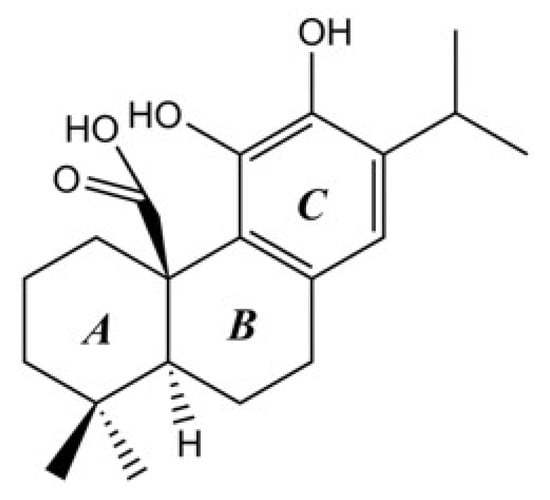
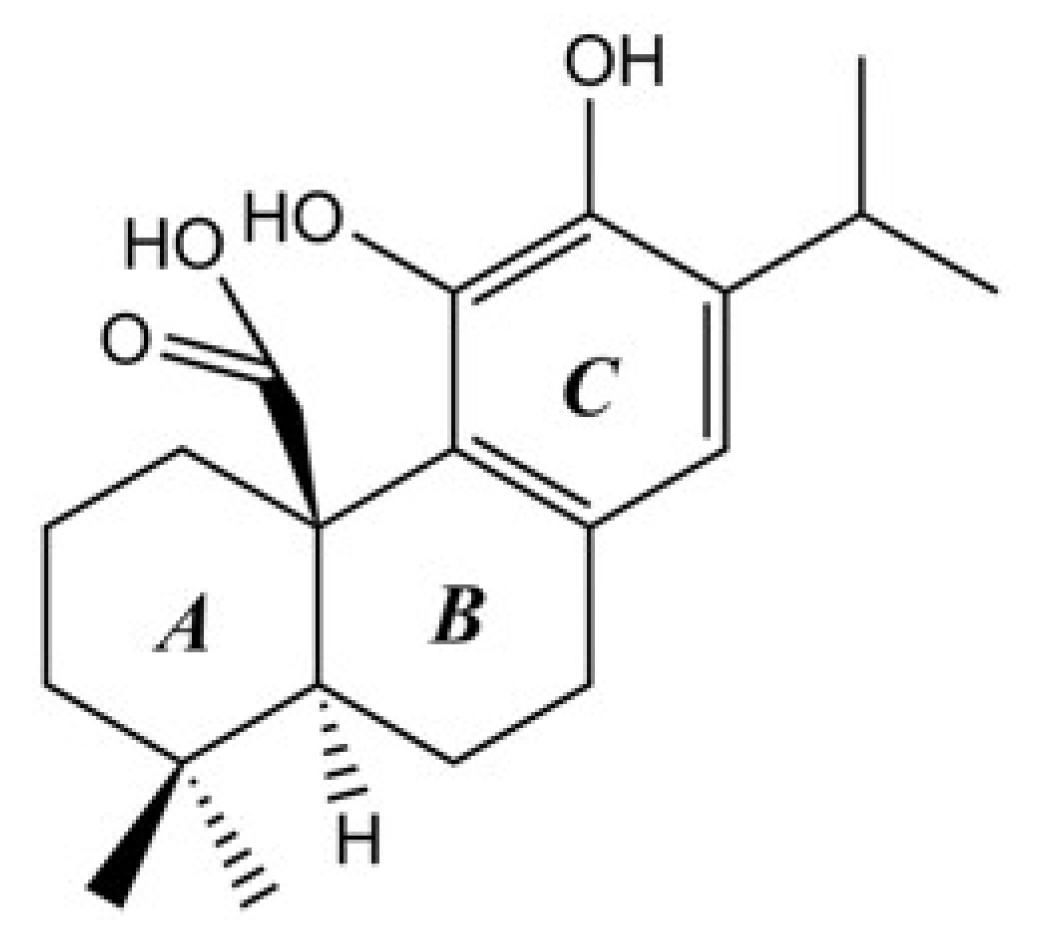
Abietane diterpenoids constitute a major class of naturally occurring terpenes characterized by a tricyclic carbon skeleton. Among them, the group of aromatic abietanes represent a diverse family of plant secondary metabolites, with more than 200 compounds identified to date possessing an aromatic C-ring [1]. These metabolites are widely distributed in plants, particularly within the Lamiaceae, Cupressaceae, and Pinaceae families, where they exhibit remarkable structural diversity resulting from variations in oxidation patterns and functional group substitution. This diversity is closely associated with a broad range of biological activities and ecological functions. Among aromatic abietanes, carnosic acid (CA) (Figure 1) is one of the most abundant and biologically significant members. It is a major natural constituent of rosemary (Rosmarinus Officinalis) and serves as a key biosynthetic precursor of several oxidized diterpenoids, including carnosol, rosmanol, and related derivatives.
Figure 1.
Carnosic acid (CA).
The biological relevance of CA is closely related to its unique molecular architecture. The combination of a highly lipophilic abietane skeleton and a redox-active catechol moiety confers a broad spectrum of pharmacological activities, including antioxidant, anti-inflammatory, antimicrobial, antiviral, antiparasitic, neuroprotective, and antiproliferative effects [2]. Owing to its potent antioxidant properties, CA has also been widely exploited in the food, nutraceutical, and cosmetic industries, where it is used as a natural preservative and functional ingredient. The increasing interest in carnosic acid has also been driven by its potential as a versatile scaffold for medicinal chemistry. Accordingly, numerous semisynthetic derivatives have been synthesized to enhance potency, improve selectivity, and optimize pharmacokinetic behavior while providing valuable insights into structure–activity relationships. In particular, modifications involving the C12 hydroxyl group, the C20 carboxylic acid, and other reactive positions have generated promising analogues with improved biological profiles, highlighting carnosic acid as an excellent precursor for the design of new bioactive molecules with potential therapeutic applications.
2. Results and Discussion
2.1. Synthesis
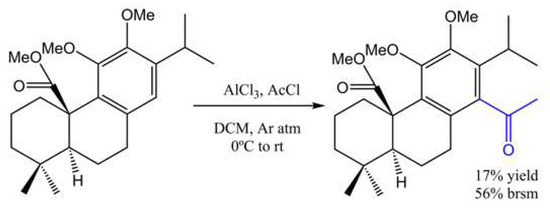
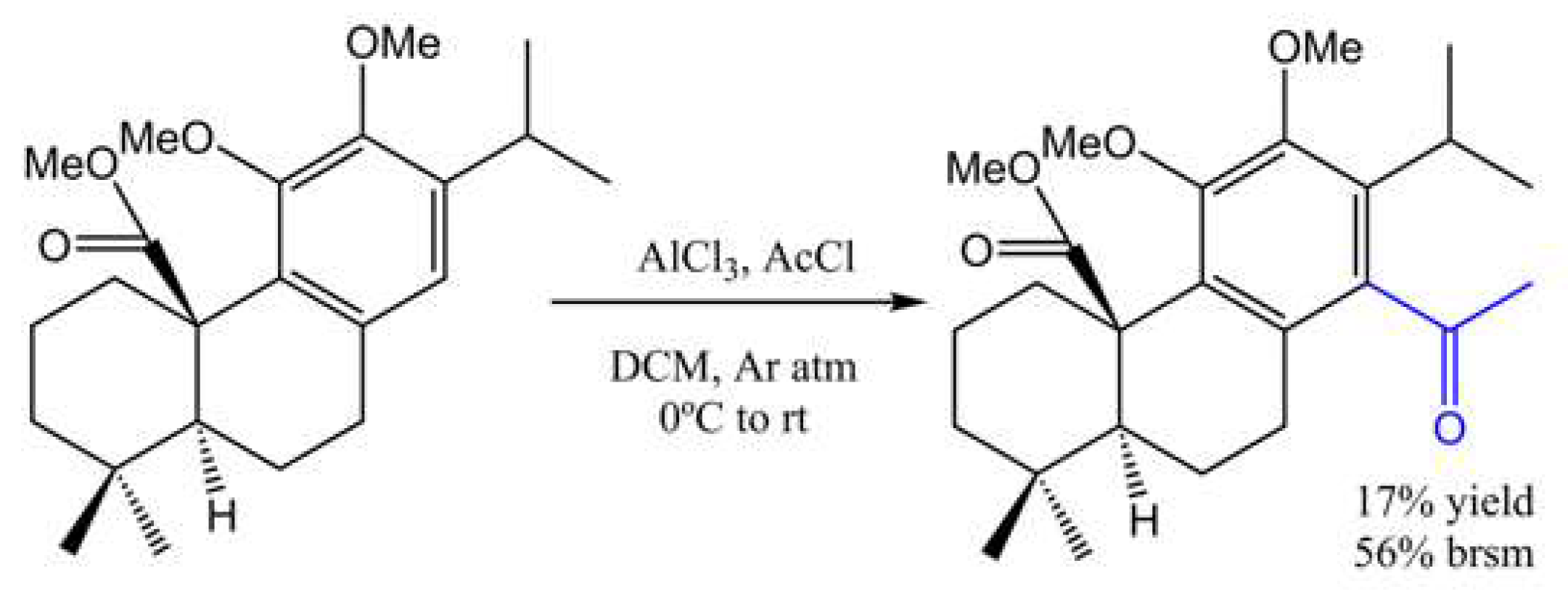
Compound 1 was synthesized from carnosic acid by adapting the literature procedure described by Zhou et al., [3] employing 3.3 equivalents of dimethyl sulfate (Me2SO4) and 3.5 equivalents of potassium carbonate (K2CO3). Compound 1a was obtained according to the synthetic route shown in Scheme 1, which was adapted from a reported ipso Friedel–Crafts protocol [4]. Although the reaction was initially designed to achieve the targeted ipso Friedel–Crafts substitution on C-13, the desired product was not isolated. Instead, compound 1a was formed under the reaction conditions and was isolated as the main product. Owing to its novel structure, this compound was fully characterized and subsequently evaluated for its antiproliferative activity.
Scheme 1.
Synthesis of methyl 11,12-dimethoxy-14-acetyl carnosate (1a) with AlCl3 and AcCl at 0 °C to room temperature (rt) in DCM.
2.2. Structural Elucidation
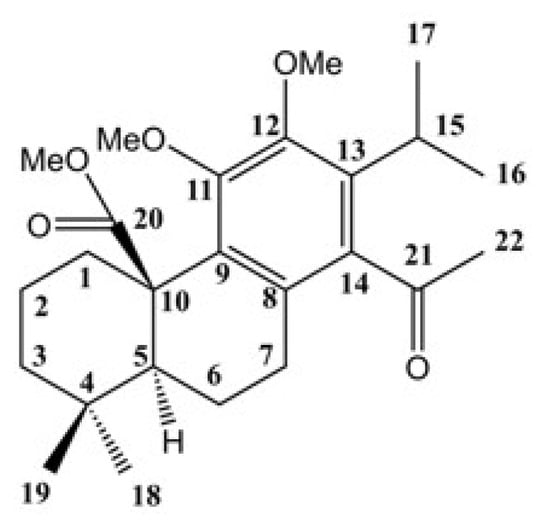
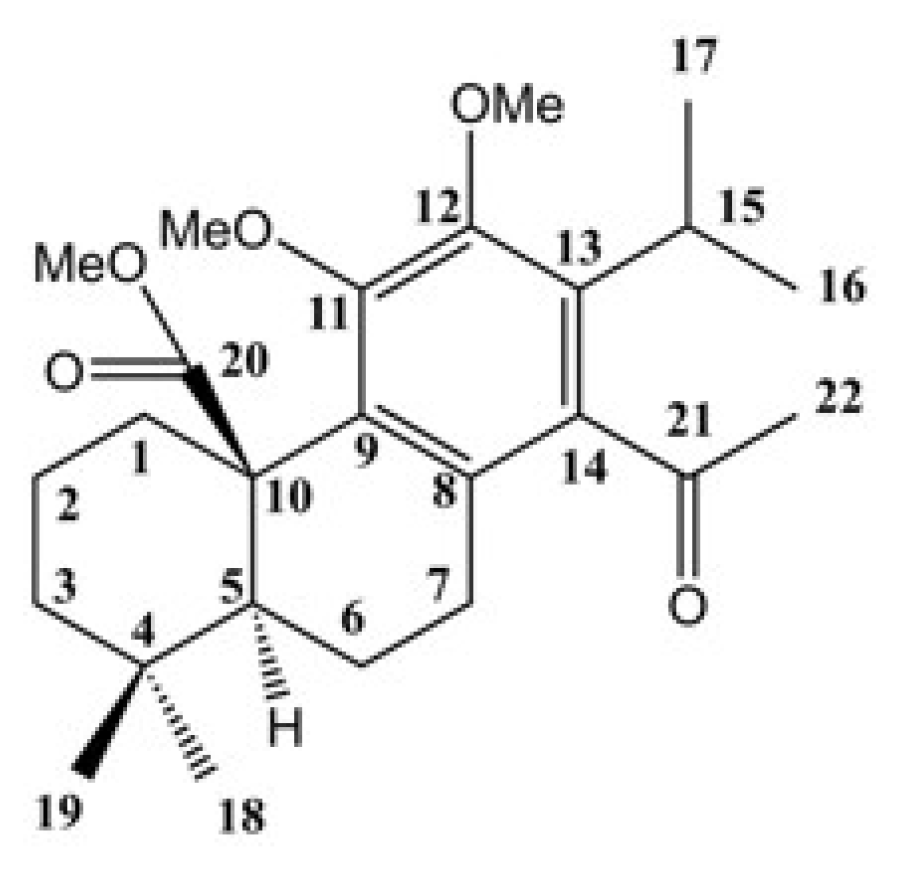
Methyl 11,12-dimethoxy-14-acetyl carnosate (1a) was analyzed by 1H, 13C, DEPT135, DEPT90, and 2D-NMR to elucidate its structure (Figure 2, Table 1).
Figure 2.
Structural elucidation of compound 1a.
Table 1.
Carbon and proton numbering scheme for compound 1a.
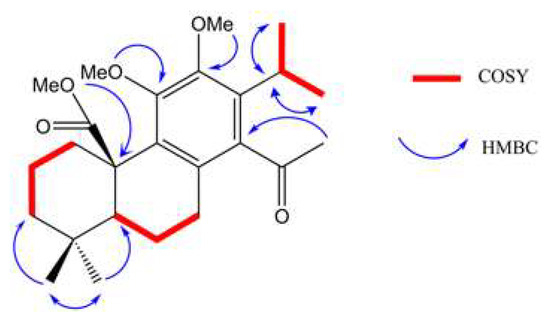
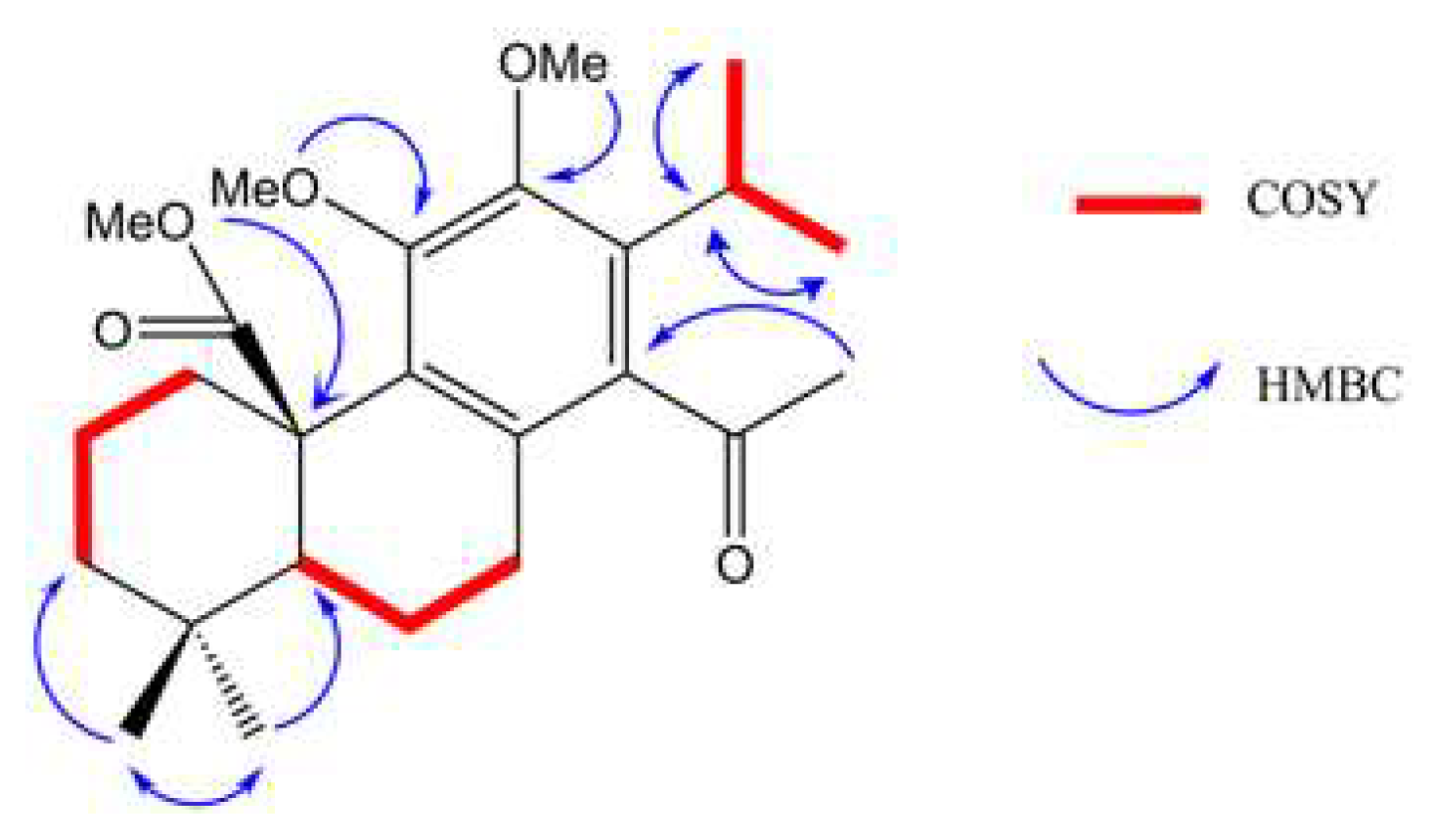
HMBC analysis: The assignments of the aromatic carbon signals of ring C in the 13C NMR spectrum were established based on the observed correlations between H-6α and C8, as well as between H-16/H-17 and C13. The positions of the C11-OMe and C12-OMe substituents were further confirmed by their corresponding 1H NMR signals and the correlations with the adjacent aromatic carbons. Additional correlations not discussed above are shown in Figure 3.
Figure 3.
COSY and HMBC key interactions of compound 1a.
COSY analysis. The 1H–1H COSY spectrum established the expected scalar coupling network within ring A. H-1β showed correlations with H-1α, H-2α, and H-2β, while H-2β correlated with H-1α, H-2α, H-3β, and H-1β, confirming the connectivity among H-1, H-2, and H-3. Additional mutual correlations were observed between H-5, H-6, and H-7, supporting the proton connectivity within ring B. The isopropyl methine proton (H-15) displayed strong correlations with both methyl groups (H-16 and H-17), consistent with the expected spin system of the isopropyl substituent.
NOESY analysis. The NOESY spectrum provided key through-space correlations supporting the relative stereochemistry of compound 1a. H-1β showed cross-peaks with H-1α, H-2α, and H-2β, whereas H-1α correlated with H-2α. H-2β exhibited NOE interactions with H-2α and H-1α/H-1β, while H-3α correlated with H-3β. In ring B, H-5 showed correlations with H-18, H-6α, H-6β, and H-7, and H-6β displayed additional NOESY with H-6α and H-7. H-7 was also spatially correlated with H-5 and H-6α. The methyl ketone group (H-22) exhibited NOESY with H-7, H-15, H-16, and H-17 while H-15 shows correlation with both methyl groups (H-16 and H-17). In turn, H-16 and H-17 each showed correlations with MeO-12 and H-15. Finally, H-18 displayed NOESY with H-3α, H-5, H-6α, and H-19, while H-19 correlated with H-2β, H-3β, H-6β, H-18, and H-21. Collectively, COSY, NOESY, and HMBC data are consistent with the proposed structure and absolute stereochemistry of compound 1a.
The 13C NMR signals assigned to C1 and C7 in Table 1 exhibited low intensity and broad line shapes. Additionally, the 1H NMR signals of the isopropyl group exhibited reduced resolution and lower intensity after the introduction of the C14 methyl ketone moiety. These observations could be related to the influence of neighboring functional groups. The signal of C1 may be affected by the adjacent ester moiety, while the broadening observed for C7 could be from the presence of the neighboring methyl ketone group on C14. Additionally, the proximity of the methyl ketone and isopropyl substituents on C13 may generate steric hindrance, limiting rotational freedom around the adjacent C–C bond and thereby contributing to the reduced signal intensity and broadened resonance.
2.3. Antiproliferative Assay
The biological activity of compound 1a was evaluated against six different human cancer cell lines (Table 2). GI50 (Growth Inhibition 50) is the concentration of a compound required to inhibit 50% of net cell growth compared with untreated control cells. Among them, the SW1573 lung cancer cell line exhibited the highest sensitivity. Compared with carnosic acid (GI50 ≈ 20 μM) and standard chemotherapeutics such as etoposide (GI50 ≈ 15 µM) and cisplatin (GI50 ≈ 2.7 µM), compound 1a displayed markedly enhanced antiproliferative activity.
Table 2.
GI50 on different cell lines for compound 1a.
3. Materials and Methods
3.1. Materials and Equipment
Carnosic acid (98%) was purchased from BLDPharm (Shanghai, China). Acetyl chloride (98%) and AlCl3 were obtained from Merck Life Science S.L.U. (St. Louis, MO, USA). TLC was performed on silica gel 60 F254 plates (Merck Life Science S.L.U., St. Louis, MO, USA) and detected with UV light at 254 nm, visualized by immersion in a 10% sulfuric acid solution and heating with a heat gun. Column chromatography was carried out on silica gel 60 (0.040–0.063 mm, Scharlab, S.L., Barcelona, Spain).
Analytical data were obtained using the following instruments: NMR spectra were recorded on a Bruker Ascend 400 (9.4T) NMR spectrometer (Bruker, Billerica, MA, USA). All spectra were recorded in CDCl3 as solvents. Cole-Parmer MP-800D melting point apparatus (Cole-Parmer, Vernon Hills, IL, USA), AB Sciex QTOF 6600+ mass spectrometer (SCIEX, Framingham, MA, USA) and JASCO P2000 polarimeter (JASCO Inc, Easton, MD, USA).
The antiproliferative activity was assessed against a panel of human cancer cell lines using the standard National Cancer Institute (NCI) sulforhodamine B (SRB) assay [5]. The cell lines used in this study were A549 (lung carcinoma), HeLa (cervical adenocarcinoma), MIA PaCa-2 (pancreatic adenocarcinoma), SW1573 (lung carcinoma), T-47D (breast carcinoma), and WiDr (colorectal adenocarcinoma).
3.2. Synthesis of Methyl 11,12-Dimethoxy-14-Acetyl Carnosate (1a)
To a solution of methyl 11–12 dimethoxycarnosate (1) (954 mg, 2.55 mmol) in anhydrous DCM (10.0 mL) at 0 °C, acetyl chloride (98%, 1.63 mL, 22.92 mmol, 9.0 Eq.) was added dropwise. With vigorous stirring, anhydrous AlCl3 (2.04 g, 15.28 mmol, 6.0 Eq.) was added in small portions during 5 min. Then, the reaction mixture was gradually allowed to warm to rt and left to react for 3 h. The reaction was quenched with 10% aqueous HCl (12.0 mL) at 0 °C. The reaction mixture was transferred to a separatory funnel and the layers were separated. The aqueous layer was extracted with Et2O (3 × 20.0 mL), and the combined organic layers were washed with saturated aqueous NaHCO3 (12.0 mL) and brine (10.0 mL), then dried over Na2SO4. The solvent was removed under reduced pressure to afford an orange oil. The crude product was subsequently purified by column chromatography on silica gel (n-hexane/EtOAc, 9:1) to give methyl 11,12-dimethoxy-14-acetyl carnosate (1a) as a yellowish solid (179.3 mg, yield = 17%, 56% based on recovered starting material), along with the recovery of 666.8 mg of unreacted starting material (1). [α]25D = +108.2° (c 0.37, DCM). 1H NMR (400 MHz) and 13C NMR (100 MHz) (see Table 1). Melting point (m. p.): 150–152 °C, HRMS (ESI) m/z 417.2636 [M + H]+, calcd for C25H37O5: 417.2620; Anal. calcd. for C25H36O5: C, 71.8; H, 8.7; Found: C, 72.1; H, 8.7.
4. Conclusions
Although the synthetic yield of compound 1a was relatively low, its biological evaluation revealed a marked improvement in antiproliferative activity compared with the starting material, carnosic acid. In particular, 1a exhibited enhanced potency across the tested cancer cell lines, with the strongest activity observed against the SW1573 lung cancer cell line (GI50 ≈ 1.2 μM). These findings suggest that the structural modification successfully increased the biological efficacy of the parent scaffold, highlighting compound 1a as a promising lead for further optimization. Furthermore, the unusual NMR behavior is noteworthy and requires further investigation to fully elucidate the structural and dynamic factors involved.
Author Contributions
Conceptualization, M.A.G.-C.; methodology, M.A.G.-C., W.E.M.-H. and J.M.P.; validation, M.A.G.-C. and J.M.P.; formal analysis, M.A.G.-C., N.L.-C., W.E.M.-H., A.G.-B. and J.M.P.; investigation, M.A.G.-C., N.L.-C., W.E.M.-H., A.G.-B. and J.M.P.; resources, M.A.G.-C. and J.M.P.; writing—original draft preparation, N.L.-C. and M.A.G.-C.; writing—review and editing, M.A.G.-C. and J.M.P.; funding acquisition, M.A.G.-C. and J.M.P. All authors have read and agreed to the published version of the manuscript.
Funding
The authors thank the Spanish Government (Projects PID2023-146114NB-C21, PID2021-123059OB-I00 and CEX2021-001230-S funded by MCIN/AEI/10.13039/501100011033/FEDER, UE) for financial support. This research was also supported by the regional government “Generalitat Valenciana”, grant number CIAICO/2022/220 to M.A.G.-C. A.G.-B. thanks the Asociación Española Contra el Cáncer (AECC) de Santa Cruz de Tenerife for predoctoral grant PRDTF233958GONZ. W.E.M.-H. also thanks the regional government “Generalitat Valenciana” for a PhD contract (grant number CIACIF/2024/510).
Institutional Review Board Statement
Not applicable.
Informed Consent Statement
Not applicable.
Data Availability Statement
The data are available in the manuscript and further details upon request.
Acknowledgments
We acknowledge the support given by the characterization department of the “Instituto de Tecnologia Quimica, ITQ” for providing the NMR, elemental composition and high-resolution mass spectra (through Universitat de Valencia) of the samples.
Conflicts of Interest
The authors declare no conflicts of interest.
References
- González, M.A. Aromatic Abietane Diterpenoids: Their Biological Activity and Synthesis. Nat. Prod. Rep. 2015, 32, 684–704. [Google Scholar] [CrossRef] [Scilit] [PubMed]
- Birtić, S.; Dussort, P.; Pierre, F.-X.; Bily, A.C.; Roller, M. Carnosic Acid. Phytochemistry 2015, 115, 9–19. [Google Scholar] [CrossRef] [Scilit] [PubMed]
- Zhou, B.; Li, X.; Feng, H.; Li, Y. Efficient Syntheis of the Key Intermediate Triptophenolide Methyl Ether for the Synthesis of(-)-Triptolide. Tetrahedron 2010, 66, 5396–5401. [Google Scholar] [CrossRef] [Scilit]
- Antoniou, A.; Chatzopoulou, M.; Bantzi, M.; Athanassopoulos, C.M.; Giannis, A.; Pitsinos, E.N. Identification of Gli-Mediated Transcription Inhibitors through Synthesis and Evaluation of Taepeenin D Analogues. Medchemcomm 2016, 7, 2328–2331. [Google Scholar] [CrossRef] [Scilit]
- Monks, A.; Scudiero, D.; Skehan, P.; Shoemaker, R.; Paull, K.; Vistica, D.; Hose, C.; Langley, J.; Cronise, P.; Vaigro-Wolff, A.; et al. Feasibility of a High-Flux Anticancer Drug Screen Using a Diverse Panel of Cultured Human Tumor Cell Lines. J. Natl. Cancer Inst. 1991, 83, 757–766. [Google Scholar] [CrossRef] [Scilit] [PubMed]

Disclaimer/Publisher’s Note: The statements, opinions and data contained in all publications are solely those of the individual author(s) and contributor(s) and not of MDPI and/or the editor(s). MDPI and/or the editor(s) disclaim responsibility for any injury to people or property resulting from any ideas, methods, instructions or products referred to in the content. |
© 2026 by the authors. Licensee MDPI, Basel, Switzerland. This article is an open access article distributed under the terms and conditions of the Creative Commons Attribution (CC BY) license.