


Abstract
Covalent triazine frameworks (CTFs) are nitrogen-rich porous polymers with potential applications in adsorption, separation, and catalysis. In this work, melamine-derived (Mel-CTF) and p-phenylenediamine-derived (PDA-CTF) frameworks were synthesized by nucleophilic substitution of cyanuric chloride with multifunctional amines. Particular attention was paid to the influence of the HCl scavenger and heating method on framework formation and porosity. KOH, K2CO3, and DIPEA were evaluated under conventional and microwave conditions. The obtained materials were characterized by FT-IR, XRD, nitrogen sorption, and TGA. The results show that HCl-scavenger selection strongly affects accessible porosity, whereas microwave heating mainly accelerates framework formation and improves conversion.
1. Introduction
Covalent triazine frameworks (CTFs) are nitrogen-rich porous polymers constructed from 1,3,5-triazine units covalently connected by organic linkers. Owing to their rigid backbone, CTFs commonly exhibit high thermal and chemical stability, significant surface areas and a high concentration of electron-rich nitrogen sites, which make them attractive for adsorption, separation, heterogeneous catalysis and related applications [1,2]. CTFs were first prepared by ionothermal trimerization of aromatic nitriles in molten ZnCl2 at high temperature [3]. To overcome the harsh conditions and possible carbonization associated with this route, several milder synthetic strategies have subsequently been developed [1,2,4,5,6,7,8,9].
A versatile approach utilizes cyanuric chloride (CC, 2,4,6-trichloro-1,3,5-triazine) as a pre-formed triazine unit that undergoes nucleophilic substitution with polyfunctional amines to yield –NH-linked networks under moderate conditions [4,10,11]. This strategy allows a wide range of amines to be used for framework formation and makes it possible to tune the chemical composition and pore architecture through the choice of monomer and reaction conditions. Melamine is an attractive triamino-triazine building block for highly nitrogen-rich frameworks, whereas p-phenylenediamine (PDA) provides a rigid aromatic diamine linker and has previously been used for triazine-containing polymer networks [5,11,12,13].
A key challenge of nucleophilic substitution on CC is the completion of successive chlorine substitution reactions and the simultaneous neutralization of the HCl formed during network growth. The choice of HCl scavenger can therefore influence not only conversion but also precipitation, cross-linking and development of accessible pore volume. In addition, conventional heating may require several days to reach high conversion. Microwave irradiation provides rapid volumetric heating and is an efficient method for accelerating triazine-network formation [7,8]. However, rapid formation of a solid network does not necessarily result in the highest porosity.
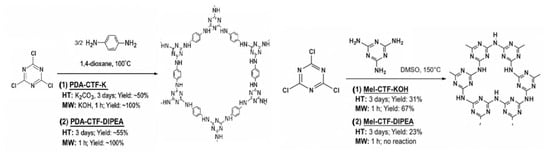
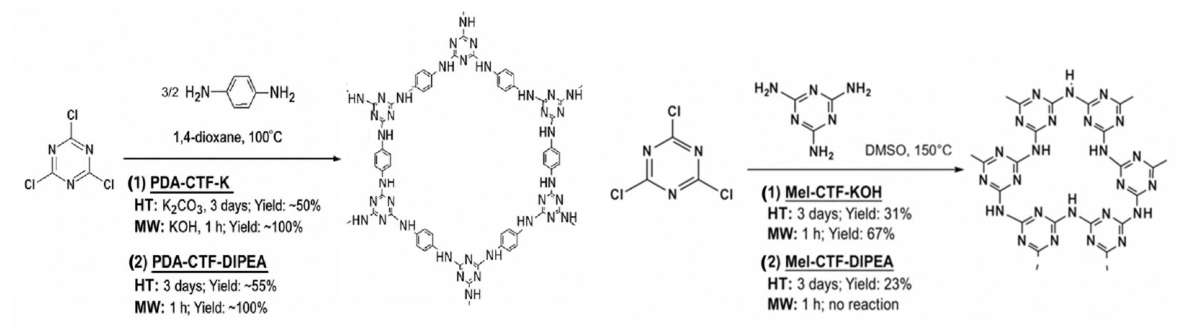
In this work we compare conventional and microwave-assisted synthesis of –NH-linked CTFs obtained from cyanuric chloride and melamine (Mel-CTFs) and from p-phenylenediamine (PDA-CTFs, see Figure 1). The principal variable is the HCl scavenger: KOH, K2CO3 and DIPEA were used in the combinations permitted by the two synthetic systems. The second variable is the type of heating, classical heating in a flask (HT) or microwave heating in a MARS-6 reactor (MW). We provide a comparative analysis of (i) framework formation and isolated yield, (ii) local structure from FT-IR and powder X-ray diffraction (XRD), (iii) porosity from N2 sorption, BET and pore-size analysis and (iv) thermal stability from thermogravimetric analysis (TGA).
Figure 1.
Synthetic conditions and sample nomenclature for PDA-CTFs and Mel-CTFs. HT denotes conventional heating in a flask and MW denotes microwave heating in a MARS-6 reactor.
2. Materials and Methods
2.1. Safety Notes on Syntheses
Cyanuric chloride (CC) is a moisture-sensitive reactant that must be stored in a cool, dry place. Additionally, CC is a strong electrophile that activates DMSO [14]. This interaction is highly exothermic and can become hazardous if solid CC is dissolved in DMSO without adequate cooling, dilution, agitation, or rate control [15]. Therefore, CC was gradually dissolved in DMSO in a separate flask under an inert atmosphere, with vigorous stirring and cooling to approximately −10 °C to −15 °C using an ice-salt bath. A solution of the amine and a HCl scavenger was then added dropwise to this mixture. For syntheses utilizing conventional heating, the reaction mixtures were allowed to warm to room temperature naturally before being heated in a sand bath. For microwave-assisted syntheses, the resulting cooled mixtures were transferred to a Teflon-lined autoclave under an argon purge.
To ensure operational safety, reaction mixtures with small reactant quantities should be loaded into high-pressure Teflon-lined vessels compatible with the designated microwave reactor. The system must be equipped with integrated temperature and pressure sensors, capable of withstanding high pressures and fitted with a reliable pressure relief valve. Heating must be applied gradually and the microwave reactor must have an automated safety cut-off mechanism activated by sudden temperature or pressure spikes. Prior to microwave irradiation, the reaction mixture should be purged with nitrogen (or argon) at room temperature for at least 10 min to displace oxygen and ensure thorough mixing.
2.2. Synthesis of Mel-CTFs
Melamine-based CTFs were synthesized by nucleophilic substitution between cyanuric chloride and melamine in DMSO. For the conventionally heated samples, melamine and CC were used in a 1:1 molar ratio; one equivalent corresponded to 10 mmol and KOH or DIPEA was added in 3 equivalents. The reaction mixture in 150 mL DMSO was heated at 150 °C for 72 h. The reaction mixture was filtered, washed with i-PrOH, Me2CO and dried in a lyophilic dryer at 10−5 bar, at room temperature, overnight. The procedure of CTF isolation was repeated in other syntheses described in this work. The yield of Mel-CTF-DIPEA-HT was 23%, Mel-CTF-KOH-HT—31%.
In the current work MARS-6 microwave “EasyPrep” 100 mL Teflon-lined reactors were utilized. In the syntheses of Mel-CTFs the ratio of reactants (CC:Melamine:DIPEA or KOH) was 1:1:3; where 1 equivalent corresponded to 1 mmol. The pre-made cooled mixture in 30 mL of DMSO was purged with Ar in the vessel at room temperature then capped, closed and transferred to MARS-6 microwave oven, the vessel was heated to 150 °C during 15 min, then the temperature was maintained for 1 h with cyclic microwave input of approximately 50–200 W. The yield of isolated Mel-CTF-KOH-MW was 67%, Mel-CTF-DIPEA-MW did not give an isolable solid product under these conditions.
2.3. Synthesis of PDA-CTFs
PDA-CTFs were synthesized from p-phenylenediamine and cyanuric chloride in a 3:2 molar ratio. Solution-phase preparation of PDA/CC triazine networks under conventional heating is an established approach; closely related syntheses using DIPEA or K2CO3 as HCl scavengers were recently reported by Rusanova et al. [16], and the formation of CTFs from cyanuric chloride and 1,4-phenylenediamine has also been disclosed in related patent literature [17]. For conventional heating in the present comparison, one equivalent corresponded to 5 mmol; PDA (15 mmol), CC (10 mmol) and 6 equivalents of K2CO3 or DIPEA were refluxed in 150 mL of 1,4-dioxane at 100 °C for 72 h. The yield of isolated PDA-CTFs were ~80%.
For microwave synthesis, one equivalent corresponded to 0.5 mmol. The mixture of PDA (1.5 mmol), CC (1 mmol) and 3 mmol of KOH or DIPEA in 30 mL of 1,4-dioxane was purged with Ar in “EasyPrep” vessel at room temperature for 10 min. Then capped, closed and transferred to MARS-6, where the vessel was gradually (for 15 min) heated to 100 °C. Microwave input varied approximately from 50 to 200 W to maintain the target temperature for 1 h in the reactor. The yields of isolated PDA-CTFs were near quantitative—97%.
2.4. Powder X-Ray Diffraction of CTFs
Powder XRD patterns of the isolated Mel-CTFs and PDA-CTFs were collected on a Thermo Fisher Scientific (Madison, WI, USA)/INEL Equinox-1000 diffractometer (Artenay, France) using Cu Kα radiation (λ = 1.5406 Å). Samples were measured as air-dried powders, and the diffraction profiles were used for qualitative comparison of peak positions, broad diffuse maxima and the degree of long-range ordering.
2.5. FT-IR Spectroscopy of CTF Powders
FT-IR spectra of the CTF powders were recorded using an attenuated total reflection (ATR) accessory in transmission mode on Thermo Scientific FTIR spectrometer (Madison, WI, USA) in the range of 4000–525 cm−1. The spectra were represented as normalized absorbance curves and compared using the principal N–H, triazine C=N/C–N and low-frequency ring-vibration regions.
2.6. N2 Sorption, BET and Pore-Size Analysis
Nitrogen adsorption–desorption isotherms at 77 K were obtained on a BELSORP Mini-X instrument (Osaka, Japan). Before analysis, the samples were activated under dynamic vacuum at 120–150 °C for 6 h. BET surface areas were determined from the adsorption branch, and total pore volumes were estimated from the amount adsorbed near p/p0 ≈ 0.99. Mesopore-size distributions were evaluated by the BJH method and micropore contributions by the MP method. The supplied BELSORP results were checked against the numerical adsorption data. For the two PDA-CTF-DIPEA materials the nitrogen uptake is extremely low; their calculated BET values are therefore reported as apparent surface areas and are used only to demonstrate the practically non-porous character of these samples.
2.7. Thermogravimetric Analysis
Thermogravimetric analysis (TGA) was performed on a TGA 5500 instrument (TA Instruments, New Castle, DE, USA) using TRIOS software (version 5.2.2.47561, TA Instruments, New Castle, DE, USA) under a continuous nitrogen purge (25 mL/min) at a heating rate of 10 °C/min. The TGA curves were used exclusively for comparison of thermal stability. To reduce the contribution of low-temperature volatile loss, T5,150 was defined as the temperature at which the mass decreased by 5% relative to the mass at 150 °C. The principal mass-loss intervals above 150 °C and the residue masses at 600 °C were also compared.
3. Results and Discussion
3.1. Framework Formation and Isolated Yield
Under conventional heating, the melamine/CC system with KOH forms Mel-CTF-KOH-HT in a moderate isolated yield of about 31%. Replacement of KOH by DIPEA under the same temperature and reaction time still affords an isolable Mel-CTF-DIPEA-HT product but in lower yield of 23%. In contrast, microwave heating of the KOH system at 150 °C for only 1 h increases the isolated yield to 67%, whereas the corresponding DIPEA experiment does not afford a solid Mel-CTF.
For the PDA-bridged networks, both conventionally heated reactions give approximately 80% isolated yield, while both microwave reactions approach near-complete conversion after 1 h. These observations confirm the strong accelerating effect of microwave heating but also show that the ability to isolate a network depends on the HCl scavenger and linker system. The synthetic conditions and isolated outcomes for Mel-CTFs and PDA-CTFs are given in Supplementary Materials (Table S1).
3.2. Investigation of CTF Structures from FT-IR Spectroscopy
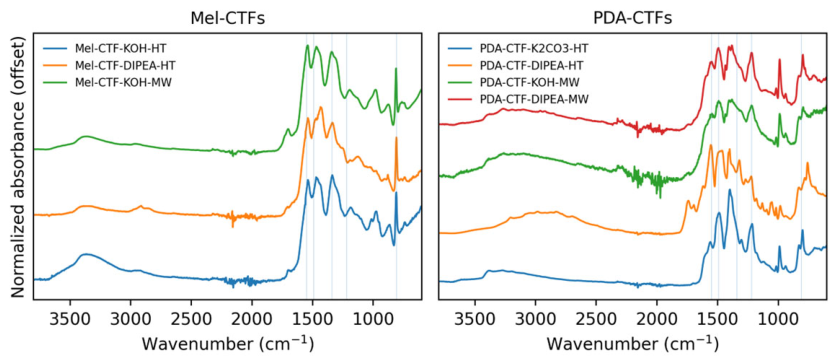
The FT-IR spectra of the isolated Mel-CTFs and PDA-CTFs display the characteristic bands expected for cyanuric-chloride-derived amine-linked triazine polymers (see Figure 2). The main absorption bands are observed in the regions of approximately 1500–1560 cm−1 and 1340–1490 cm−1, assigned to overlapping triazine C=N/C–N and aromatic vibrations, with additional C–N-related bands in the 1220–1320 cm−1 region and a characteristic low-frequency band near 790–810 cm−1 [4,11,12,13]. Both Mel-CTFs and PDA-CTFs spectra also show a broad N–H stretching region near 3300–3400 cm−1.
Figure 2.
IR spectra of isolated Mel-CTFs and PDA-CTFs. The spectra were normalized and vertically shifted for comparison.
It is important that the PDA-CTF-DIPEA-HT and PDA-CTF-DIPEA-MW samples retain the principal triazine/C–N spectral features although their nitrogen uptake is very low. Thus, FT-IR confirms formation of triazine-rich solids, while the strong difference in BET surface area should be attributed to differences in accessible pore structure rather than simply to absence of substitution reaction.
3.3. Powder XRD: Amorphous and Short-Range Ordered CTF Networks
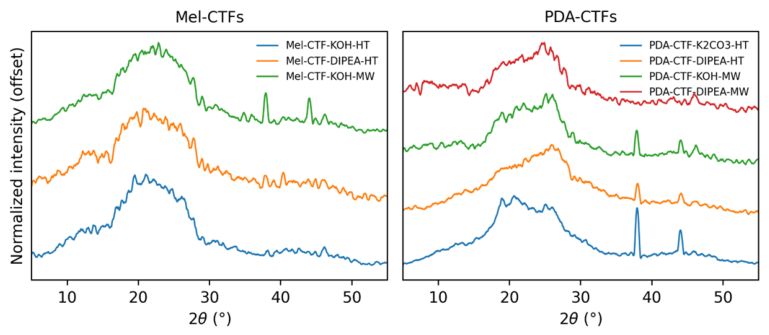
The powder XRD patterns of the Mel-CTFs and PDA-CTFs are typical of predominantly amorphous or short-range ordered cyanuric-chloride-derived networks (See Figure 3). All samples show broad diffuse maxima approximately in the 20–26° 2θ region rather than a series of sharp framework reflections. Mel-CTF-KOH-HT and Mel-CTF-DIPEA-HT have broad maxima near 21°, while the maximum of Mel-CTF-KOH-MW is shifted toward ~23°. The PDA samples show the same general amorphous behavior, with broad maxima extending from ~21° for PDA-CTF-K2CO3-HT to ~26° for PDA-CTF-KOH-MW. Such broad XRD features are common for solution-prepared CC/amine triazine polymers, where rapid precipitation and irregular local connectivity limit long-range periodicity [4,11,13].
Figure 3.
XRD patterns of isolated Mel-CTFs and PDA-CTFs. The profiles were normalized and vertically shifted to facilitate comparison.
3.4. Textural Properties from N2 Sorption and BET Analysis
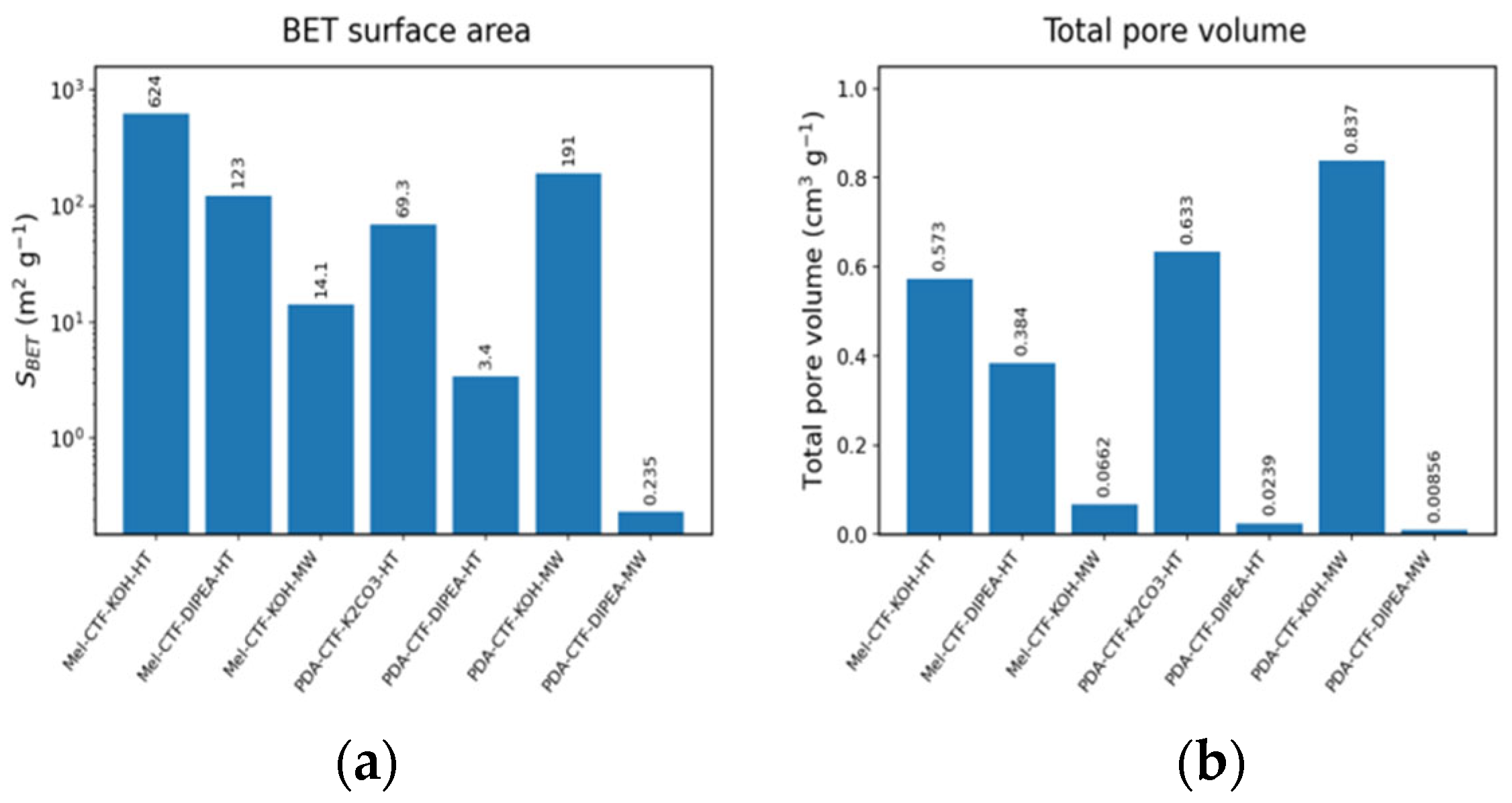
Nitrogen sorption (see Figure S1) results show a strong dependence of accessible porosity on the HCl scavenger (see Figure 4 and Tables S2 and S3). For the conventionally heated melamine system, Mel-CTF-KOH-HT has a BET surface area of approximately 624.2 m2/g and a total pore volume of 0.5732 cm3/g. Mel-CTF-DIPEA-HT, obtained in almost the same isolated yield, has a considerably smaller surface area of 122.6 m2/g and a pore volume of 0.3836 cm3/g. Thus, replacement of KOH by DIPEA decreases the accessible BET area by about five times without a significant change in isolated yield.
Figure 4.
Textural characteristics of the isolated CTFs: (a) BET surface area and (b) total pore volume. The BET values for the two PDA-CTF-DIPEA samples are considered apparent values because of their very low N2 uptake.
The influence of scavenger is even more pronounced for PDA-CTFs. Under microwave conditions, both KOH and DIPEA provide near-complete conversion; however, PDA-CTF-KOH-MW possesses a BET surface area of 191.4 m2/g and total pore volume of 0.8370 cm3/g, whereas PDA-CTF-DIPEA-MW is practically non-porous with an apparent BET area of only 0.235 m2/g and total pore volume of 0.00856 cm3/g. Under conventional heating, PDA-CTF-K2CO3-HT has a BET area of 69.3 m2/g, while PDA-CTF-DIPEA-HT has only about 3.40 m2/g. Consequently, high conversion does not necessarily result in formation of an open porous network.
The comparison of characteristics of Mel-CTF-KOH-HT and Mel-CTF-KOH-MW additionally demonstrates that microwave irradiation primarily affects reaction kinetics. The reaction time decreases from 72 h to 1 h and the yield increases from 31 to 67%, but the BET surface area decreases from about 624 to 14.1 m2/g. Therefore, accelerated substitution and precipitation can improve isolated conversion without improving accessible porosity (see Figure S2). The present data establish this phenomenological relationship, although additional elemental, spectroscopic and microscopic studies would be required to determine whether the effect originates from salt formation, solvation, phase-separation kinetics, network topology or pore collapse during isolation.
3.5. Thermal Stability from TGA
Thermogravimetric analysis under N2 confirms that all isolated networks retain substantial thermal stability, up to 200 °C. However, several % of CTF powder’s mass losses were observed below 200 °C due to substitution of residual volatile compounds with nitrogen flow. The shape and temperature of the main mass-loss region depend on synthetic conditions. To exclude the initial loss of volatile components from the stability comparison, T5,150 was calculated relative to the mass at 150 °C. The values range from approximately 229 to 297 °C. PDA-CTF-DIPEA-MW and PDA-CTF-KOH-MW show the highest T5,150 values, about 297 and 293 °C, respectively, followed by Mel-CTF-DIPEA-HT (about 286 °C) and Mel-CTF-KOH-HT (about 274 °C). Comparative TGA curves, the temperature ranges of the strongest mass loss above 150 °C and the residue masses at 600 °C are given in the Supplementary Materials (see Figure S3).
3.6. Influence of HCl Scavenger and Heating Mode on Network Formation
Taken together, the FT-IR, XRD and N2-sorption results show that the HCl scavenger strongly affects the structure–property relationship of the resulting CTFs. The DIPEA-derived PDA materials retain the main spectral signatures of a triazine-rich network but possess almost no accessible nitrogen porosity. In contrast, inorganic KOH or K2CO3 gives substantially higher surface areas. The comparison of Mel-CTF-KOH-HT and Mel-CTF-DIPEA-HT is particularly informative because the isolated yields are almost identical, whereas the BET areas differ by about a factor of five. These results demonstrate that the HCl scavenger acts as an important synthetic/process parameter during network growth and not only as a reagent for stoichiometric neutralization of HCl.
Microwave irradiation, in turn, strongly decreases the time required for framework formation and can increase isolated yield. However, its influence on porosity is not unidirectional: the microwave PDA/KOH system gives the highest surface area within the PDA-bridged frameworks, whereas the microwave Mel/KOH product has a much lower surface area than its conventionally heated analog. Thus, optimization of these CC-derived CTFs requires simultaneous control of the linker, HCl scavenger, solvent and heating profile [4,10,11,12,13].
4. Conclusions
We have compared conventional and microwave-assisted synthesis of –NH-linked covalent triazine frameworks derived from melamine and p-phenylenediamine in the presence of different HCl scavengers. The results demonstrate that selection of the HCl scavenger is the principal factor controlling development of accessible porosity. Under conventional melamine conditions, KOH and DIPEA give low yields of about 31 and 23%, respectively, but the BET surface area decreases from approximately 624 to 123 m2/g when KOH is replaced by DIPEA. In the microwave-assisted syntheses of PDA-CTFs, KOH and DIPEA both provide near-complete conversion, whereas the resulting BET surface areas differ substantially—191 and 0.235 m2/g.
Microwave irradiation strongly accelerates framework formation: for Mel-CTF-KOH the reaction time decreases from 72 h to 1 h and the yield increases from 31 to 67%. At the same time, the surface area decreases to about 14.1 m2/g, showing that high conversion and high porosity are not directly related. FT-IR spectroscopy confirms formation of triazine-rich –NH-containing networks, while XRD shows that the isolated materials are predominantly amorphous or short-range ordered.
Overall, the study identifies the HCl scavenger as a critical parameter in CC/amine CTF synthesis and shows that heating mode should be optimized together with base selection to control both synthesis efficiency and pore structure.
5. Patents
The synthesis of PDA-bridged CTFs by conventional heating was described in the WIPO Patent WO2025221764A1 [17]. However, the influence of the heating mode and the choice of the HCl scavenger were not reported.
Supplementary Materials
The following supporting information can be downloaded at https://www.mdpi.com/article/10.3390/chemproc2026022036/s1. Figure S1. N2 adsorption–desorption isotherms at 77 K for Mel-CTFs (a) and PDA-CTFs (b); Figure S2. BJH pore-size distributions calculated from the desorption branch for Mel-CTFs and PDA-CTFs. PDA-CTF-DIPEA-HT and PDA-CTF-DIPEA-MW are not plotted because their N2 uptake is too low to provide a robust BJH distribution; Figure S3. TGA curves of isolated Mel-CTFs and PDA-CTFs under N2; Table S1. Synthetic conditions and isolated outcomes for Mel-CTFs and PDA-CTFs; Table S2. BET surface areas and total pore volumes derived from the supplied N2-sorption measurements; Table S3. Selected pore-size metrics from vendor BELSORP analyses for samples with interpretable BJH/MP outputs.
Author Contributions
Conceptualization, V.S., H.A.; methodology, D.G., E.R., V.S.; validation, V.S., E.R., D.G.; formal analysis, H.A., K.A.; investigation, D.G., E.R.; resources, V.S., H.A., K.A., M.S.; data curation, D.G., V.S.; writing—original draft preparation, D.G., V.S.; writing—review and editing, D.G., E.R., V.S.; visualization, D.G.; supervision, V.S., H.A., K.A.; project administration, V.S., H.A., K.A., M.S.; funding acquisition, V.S. All authors have read and agreed to the published version of the manuscript.
Funding
This research received no external funding.
Institutional Review Board Statement
Not applicable.
Informed Consent Statement
Not applicable.
Data Availability Statement
The original contributions presented in this study are included in the article/Supplementary Materials. Further inquiries can be directed to the corresponding author.
Conflicts of Interest
The authors Dmitrii Gribanev, Elena Rusanova and Vera Solovyeva were employed with the company Aramco Innovations LLC. The remaining authors declare that the research was conducted in the absence of any commercial or financial relationships that could be construed as a potential conflict of interest.
Abbreviations
All samples are designated according to the linker, HCl scavenger and heating mode: linker-CTF-scavenger-HT/MW. Thus, Mel-CTF-KOH-MW denotes a melamine-derived framework obtained with KOH under microwave heating, while PDA-CTF-K2CO3-HT denotes a PDA-derived framework obtained with K2CO3 under conventional heating. K2CO3 was used only in the conventionally heated PDA synthesis. In the other inorganic-base experiments KOH was used, while DIPEA was selected as the organic HCl scavenger. The following abbreviations are used in this manuscript:
| CC | Cyanuric Chloride (1,3,5-trichlorotriazine) |
| MW | Microwave irradiation |
| FT-IR | Fourier-transformed Infrared spectrum |
| TGA | Thermogravimetric analysis |
| XRD | X-Ray Diffraction measurement |
| CTF | Covalent triazine framework |
| BET | Brunauer–Emmett–Teller method |
| MP | Multi-Point method of calculation of BET surface area |
| BJH | Barrett–Joyner–Halenda method |
References
- Liao, L.; Li, M.; Yin, Y.; Chen, J.; Zhong, Q.; Du, R.; Liu, S.; He, Y.; Fu, W.; Zeng, F. Advances in the Synthesis of Covalent Triazine Frameworks. ACS Omega 2023, 8, 4527–4542. [Google Scholar] [CrossRef] [Scilit] [PubMed]
- Liu, M.; Guo, L.; Jin, S.; Tan, B. Covalent Triazine Frameworks: Synthesis and Applications. J. Mater. Chem. A 2019, 7, 5153–5172. [Google Scholar] [CrossRef] [Scilit]
- Kuhn, P.; Antonietti, M.; Thomas, A. Porous, Covalent Triazine-Based Frameworks Prepared by Ionothermal Synthesis. Angew. Chem. Int. Ed. 2008, 47, 3450–3453. [Google Scholar] [CrossRef] [Scilit] [PubMed]
- Peter, S.E.; Thomas, P.; Vairavel, P.; Anil Kumar, N.V. Cyanuric Chloride as a Linker towards the Synthesis of Covalent Triazine Polymers: A Review. Mater. Adv. 2024, 5, 9175–9209. [Google Scholar] [CrossRef] [Scilit]
- Alkayal, N.S. Investigation into the Synthetic Strategies of Melamine-Based Porous Polymeric Materials: A Bibliometric Analysis. Polymers 2025, 17, 868. [Google Scholar] [CrossRef] [Scilit] [PubMed]
- Puthiaraj, P.; Kim, S.-S.; Ahn, W.-S. Covalent Triazine Polymers Using a Cyanuric Chloride Precursor via Friedel–Crafts Reaction for CO2 Adsorption/Separation. Chem. Eng. J. 2016, 283, 184–192. [Google Scholar] [CrossRef] [Scilit]
- Ren, S.; Bojdys, M.J.; Dawson, R.; Laybourn, A.; Khimyak, Y.Z.; Adams, D.J.; Cooper, A.I. Porous, Fluorescent, Covalent Triazine-Based Frameworks via Room-Temperature and Microwave-Assisted Synthesis. Adv. Mater. 2012, 24, 2357–2361. [Google Scholar] [CrossRef] [Scilit] [PubMed]
- Chaudhary, M.; Mohanty, P. Nitrogen Enriched Polytriazine as a Metal-Free Heterogeneous Catalyst for the Knoevenagel Reaction under Mild Conditions. New J. Chem. 2018, 42, 12924–12928. [Google Scholar] [CrossRef] [Scilit]
- Qian, Z.; Wang, Z.J.; Zhang, K.A.I. Covalent Triazine Frameworks as Emerging Heterogeneous Photocatalysts. Chem. Mater. 2021, 33, 1909–1926. [Google Scholar] [CrossRef] [Scilit]
- Mukhtar, A.; Mellon, N.B.; Bustam, M.A.; Saqib, S.; Lee, S.-P.; Kareem, F.A.; Ullah, S. Impact of Amine Functionality on the Selective CO2/CH4 Adsorption Behavior of Porous Covalent Triazine Adsorbent. J. Nat. Gas Sci. Eng. 2020, 83, 103582. [Google Scholar] [CrossRef] [Scilit]
- Gopi, S.; Kathiresan, M. 1,4-Phenylenediamine Based Covalent Triazine Framework as an Electro Catalyst. Polymer 2017, 109, 315–320. [Google Scholar] [CrossRef] [Scilit]
- Li, M.; Zhao, H.; Lu, Z.-Y. Highly Efficient, Reversible Iodine Capture and Exceptional Uptake of Amines in Viologen-Based Porous Organic Polymers. RSC Adv. 2020, 10, 20460–20466. [Google Scholar] [CrossRef] [Scilit] [PubMed]
- Wang, K.; Yang, L.-M.; Wang, X.; Guo, L.; Cheng, G.; Zhang, C.; Jin, S.; Tan, B.; Cooper, A.I. Covalent Triazine Frameworks via a Low-Temperature Polycondensation Approach. Angew. Chem. Int. Ed. 2017, 56, 14149–14153. [Google Scholar] [CrossRef] [Scilit] [PubMed]
- De Luca, L.; Giacomelli, G.; Porcheddu, A. A Mild and Efficient Alternative to the Classical Swern Oxidation. J. Org. Chem. 2001, 66, 7907–7909. [Google Scholar] [CrossRef] [Scilit] [PubMed]
- Yang, Q.; Sheng, M.; Li, X.; Tucker, C.; Vásquez Céspedes, S.; Webb, N.J.; Whiteker, G.T.; Yu, J. Potential Explosion Hazards Associated with the Autocatalytic Thermal Decomposition of Dimethyl Sulfoxide and Its Mixtures. Org. Process Res. Dev. 2020, 24, 916–939. [Google Scholar] [CrossRef] [Scilit]
- Rusanova, E.; Gribanev, D.; Alqahtani, H.; Alruwaili, K.; Solovyeva, V. Carbon-Nanotubes- and Porous Organic Polymers-Based Porous Fluids for CO2 Capture. Mater. Proc. 2025, 26, 22. [Google Scholar] [CrossRef] [Scilit]
- Solovyeva, V.; Pankratova, E.; Alqahtani, H.S.; Alruwaili, K. Mixed Matrix Membranes Containing Covalent Triazine Frameworks. WIPO Patent WO2025221764A1, 23 October 2025. [Google Scholar] [CrossRef] [Scilit]
Disclaimer/Publisher’s Note: The statements, opinions and data contained in all publications are solely those of the individual author(s) and contributor(s) and not of MDPI and/or the editor(s). MDPI and/or the editor(s) disclaim responsibility for any injury to people or property resulting from any ideas, methods, instructions or products referred to in the content. |
© 2026 by the authors. Licensee MDPI, Basel, Switzerland. This article is an open access article distributed under the terms and conditions of the Creative Commons Attribution (CC BY) license.