


Abstract
The Geranium L. plants are widely utilized in traditional Balkan medicine due to desirable biological activities. This study evaluated 23 phytochemicals from eight Geranium species collected from the Vlasina Plateau, Serbia, using SwissTargetPrediction and molecular docking. An unexpected target identified for only four compounds—hyperoside, isoquercetin, astragalin, and astragalin-2-O-gallate—was the Neuromedin U receptor 2 (NMU2), a key regulator of energy metabolism. These molecules demonstrated favorable NMU2 binding scores predicted using AutoDock Vina. These in silico findings suggest that Geranium constituents may represent promising preliminary computational candidates for NMU2-targeted obesity management, warranting further experimental validation. Experimental receptor-binding, functional, cellular, and in vivo studies are required to validate these predictions and determine their biological relevance.
1. Introduction
1.1. Geranium Genus
The genus Geranium L. comprises approximately 250 species, of which 39 are represented in the European flora, including 23 species occurring in Serbia. Species belonging to this genus have a long history of use in traditional Balkan medicine, where they are valued for their diverse therapeutic properties, which are attributed to their phytochemical composition. Geranium species are rich in polyphenols—tannins (geraniin, ellagitannin, tellimagradin I, and tellimagradin II), flavonoids (quercetin, kaempferol, and myricetin), and phenolic acids (ellagic, caffeic, ferulic, gallic, and syringic acids). These bioactive compounds have been associated with a range of biological activities, including antimicrobial, antidiarrheal, anti-inflammatory, antioxidant, and anticancer effects. Beyond their therapeutic potential, these compounds may also have practical applications in food preservation, cosmetics, agriculture, and other related fields [1,2,3].
1.2. Obesity
The World Health Organization (WHO) reports that, since 1990, the global prevalence of obesity has more than doubled among adults and increased fourfold among adolescents. Obesity is associated with a wide range of chronic diseases and comorbidities, contributing to reduced life expectancy, which emphasizes the need for effective prevention and treatment strategies [4,5,6].
Lifestyle modification, including dietary changes and increased physical activity, constitutes the cornerstone of obesity management. However, pharmacological therapy, including orlistat, phentermine/topiramate, naltrexone/bupropion, tirzepatide, liraglutide, and semaglutide, may also be incorporated when lifestyle interventions alone are insufficient to achieve and maintain weight loss. Despite the effectiveness of pharmacological therapy for obesity, there are several limitations, such as weight regain after discontinuation of therapy, as well as gastrointestinal disturbances, pancreatitis, gallbladder disorders, renal dysfunction, alterations in bone metabolism, visual disturbances, and sexual dysfunction [7,8,9,10,11].
Given the increasing global prevalence of obesity and the limitations and adverse effects associated with the currently available pharmacological therapies, there is a continuing need for the development of novel therapeutic agents that can achieve more effective and sustained weight reduction while providing improved safety and tolerability. One promising target for the treatment of obesity is the Neuromedin U receptor 2 (NMU2) [12,13].
Neuromedin U (NMU) is a neuropeptide involved in a broad range of physiological processes, among which the regulation of energy metabolism and its anorexigenic effects are particularly relevant to the present study. Two specific NMU receptors have been identified and characterized: neuromedin U receptor 1 (NMU1) and neuromedin U receptor 2 (NMU2). In this study, NMU2 receptors are of particular interest because they are expressed in the brain regions (especially in the hypothalamus) that are involved in the regulation of food reward, highlighting their role in the control of food intake and, consequently, body weight. Therefore, NMU2 represents a promising therapeutic target for the development of novel pharmacological approaches to the treatment of obesity [13,14].
The aim of this study is to evaluate potential drug targets of phytochemical constituents identified in eight Geranium species (G. macrorrhizum, G. robertianum, G. phaeum, G. palustre, G. sanguineum, G. columbinum, G. pyrenaicum, and G. lucidum) collected from the Vlasina Plateau in Serbia, with a particular focus on predicting binding affinities of selected compounds to the NMU2 receptor.
2. Materials and Methods
Twenty-three compounds—namely astragalin, astragalin-2-O-gallate, brevifolincarboxylic acid, chebulagic acid, chlorogenic acid, corilagin, digalloylglucose, ellagic acid, gallic acid, galloylglucose, galloylquinic acid, geraniin, 3-galloylshikimic acid, 4-O-galloylshikimic acid, 5-galloylshikimic acid, hyperoside, isoquercetin, kaempferol, pentagalloylglucose, quercetin, tellimagradin I, tellimagradin II, and trigalloylglucose—were identified across extracts obtained from the underground and aerial parts of eight Geranium species: G. macrorrhizum, G. robertianum, G. phaeum, G. palustre, G. sanguineum, G. columbinum, G. pyrenaicum, and G. lucidum. The investigated plant material was collected from the Vlasina Plateau in Serbia. Detailed information regarding the extraction procedures and chemical characterization of the obtained extracts has been reported previously [15,16].
All 23 compounds were evaluated using the SwissTargetPrediction (Lausanne, Switzerland) platform to assess their potential drug targets. The search was focused on human targets by selecting the ‘Homo sapiens’ option. Only targets with a probability greater than 0 were recorded and further analyzed.
Compounds predicted to have potential to interact with NMU2 were subjected to molecular docking using the AutoDock Vina v1.2 software (La Jolla, CA, United States) with VEGA ZZ v3.2.4.29 software (Milano, Italy) as a graphical user interface to assess their potential binding affinity to the selected receptor. The protein three-dimensional (3D) structure of the neuromedin U-bound neuromedin U receptor in a 2-Gq protein complex was downloaded from a Protein Data Bank (PDB ID: 7W55) (Piscataway, NJ, USA) [17] and prepared for docking by adding hydrogens at the correct protonation states of ionizable groups for pH 7.4 and selecting only the NMU2 receptor (chain F) for further work. The center of mass of neuromedin U was used as the center of a cube for docking with a side of 24 Å. The search exhaustiveness was set at 50, and 10 poses were generated for each ligand. The results of the docking were characterized by visualizing predicted ligand–receptor interactions using Biovia Discovery Studio Visualizer v. 22.2.0.20298 (Vélizy-Villacoublay, France).
The physicochemical, pharmacokinetic, and drug-like properties of four compounds were evaluated using the SwissADME computational tool (Lausanne, Switzerland) [18].
3. Results and Discussion
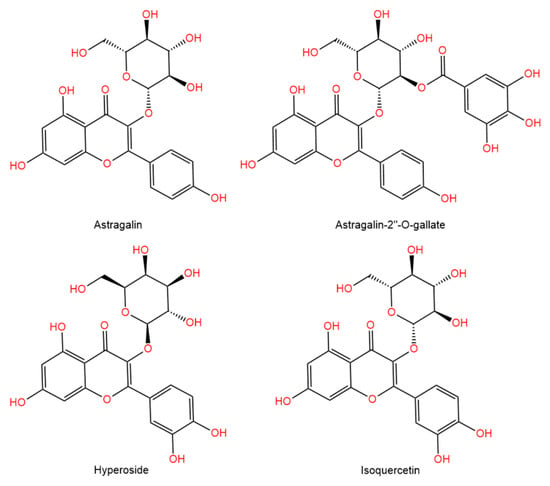
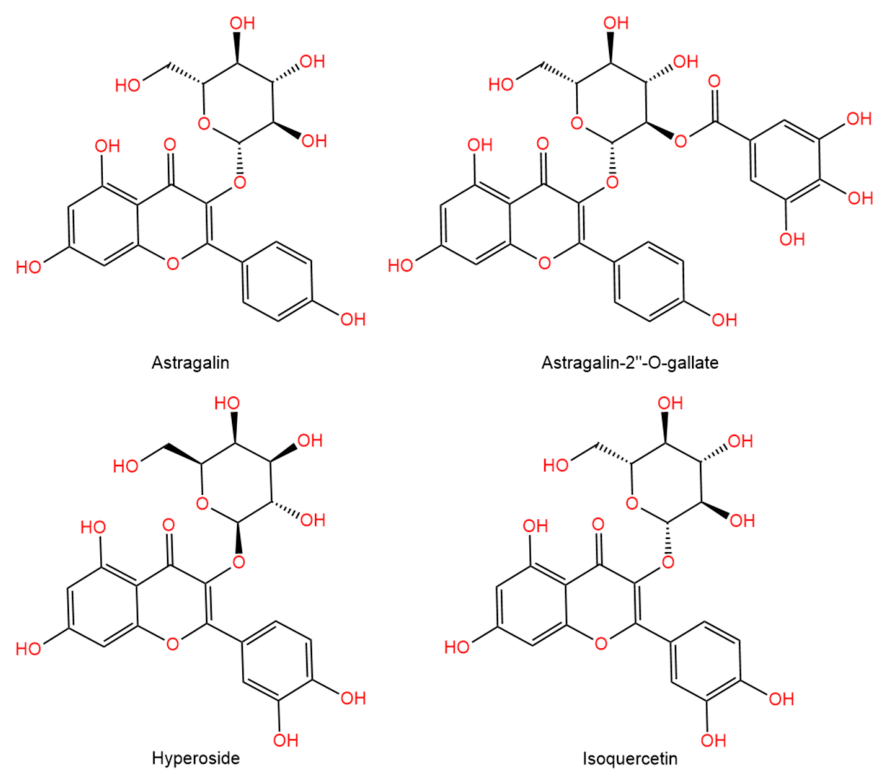
Target prediction for the 23 compounds identified several proteins that align with their known biological activities [19,20,21]. Moreover, it was observed that several molecules had the potential for binding to the NMU2 receptor. Namely, hyperoside and isoquercetin, identified in both G. pyrenaicum and G. macrorrhizum, exhibited the highest predicted probabilities of binding to the NMU2 receptor. Astragalin and astragalin-2-O-gallate, identified in both G. palustre and G. pyrenaicum, also demonstrated potential for NMU2 receptor binding (Table 1 and Figure 1).
Table 1.
Results for NMU2 binding potential obtained via SwissTargetPrediction and Vega ZZ.
Figure 1.
2D structures of selected compounds with the highest probability to target NMU2 receptor.
Based on their predicted NMU2 receptor-binding potential, hyperoside, isoquercetin, astragalin, and astragalin-2-O-gallate were selected for further in silico analysis using VEGA ZZ to investigate their potential interactions with the NMU2 receptor.
It has been found that these four compounds have potential for favorable interaction with the NMU2 receptor (Table 1), with astragalin-2-O-gallate having the highest predicted binding affinity (−9.6 kcal/mol).
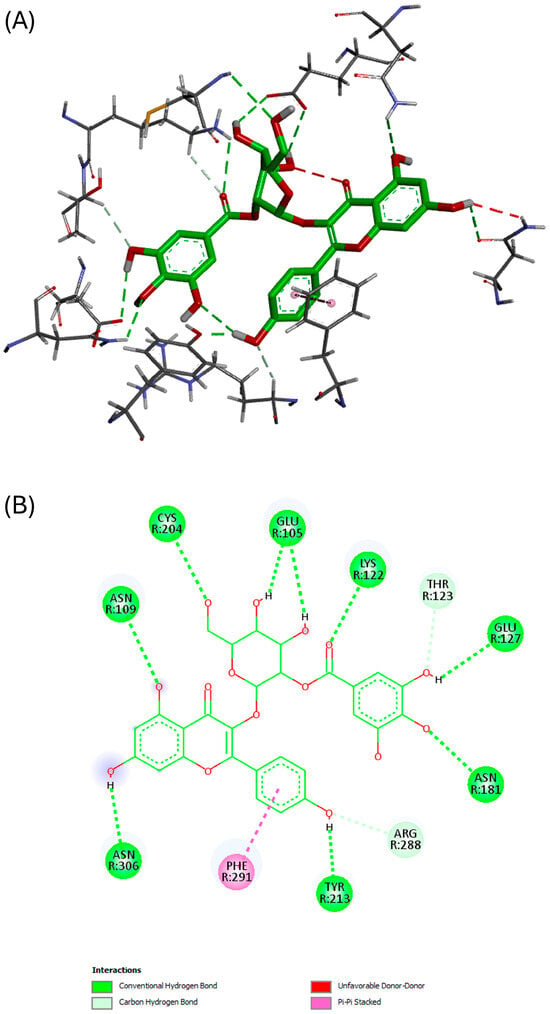
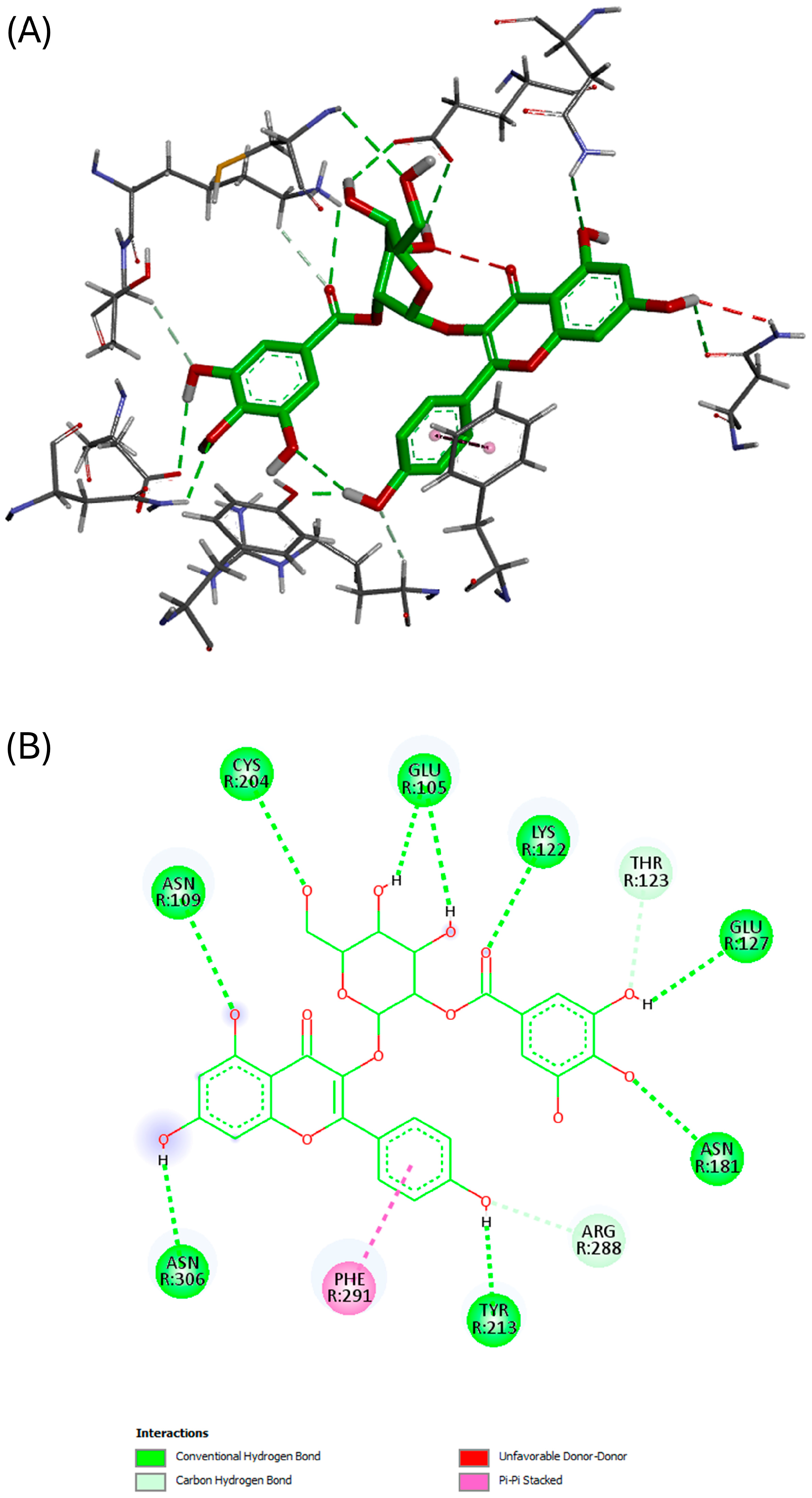
The key intermolecular interactions between residues of the binding site and the predicted binder astragalin-2-O-gallate include nine hydrogen bonds and one pi–pi interaction (Figure 2A). These include interactions with reported residues that are involved in interactions with ligands from the experimental structure, NMU, namely GLU127, ASN181, and TYR213, with a proximity to residue ARG288 (Figure 2B). Although this comprehensive hydrogen bond network does not fully coincide with the interactions that NMU forms with the receptor, this molecule could bind into a binding site and modulate protein function. Although showing the lowest probability to act as a binder for the NMU2 receptor, the additional ring contributes to receptor binding with two hydrogen bonds to the galloyl ring, which leads to the highest predicted binding affinity for this set of molecules.
Figure 2.
Most favorable binding pose of astragalin-2-O-gallate in the neuromedin U receptor 2 (NMU2) binding site, as predicted using AutoDock Vina v1.2 software and visualized with Biovia Discovery Studio Visualizer v. 22.2.0.20298. (A) Three-dimensional representation of the ligand (shown as sticks; carbon atoms colored green) within the NMU2 receptor active site; key binding-site residues are depicted as stick representations to highlight intermolecular interactions. (B) Two-dimensional protein–ligand interaction plot illustrating hydrogen bonds and other non-covalent contacts between astragalin-2-O-gallate and receptor residues in the binding pocket.
The SwissADME predictions classify these molecules as having limited blood–brain barrier (BBB) permeability when evaluated by consensus LogP, a conservative rule-of-thumb derived from ensemble fragment models. However, this assessment may underestimate the CNS accessibility of polyphenols. Recent experimental evidence demonstrates that vegetable-derived phenolic compounds, including quercetin, rutin, kaempferol, and epigallocatechin gallate (EGCG), can cross the BBB intact or after biotransformation, reaching brain tissue at measurable concentrations [22,23]. This permeation does not rely solely on passive diffusion governed by consensus LogP; rather, it appears to be mediated by specific transporters that facilitate uptake of polar hydrogen-bond-rich molecules such as flavonoid glycosides. Importantly, our computational screening also identified hyperoside and isoquercetin as non-substrates of P-glycoprotein (P-gp), an efflux transporter known to limit CNS exposure of many xenobiotics. Thus, while consensus LogP predicts suboptimal BBB passage, the combined evidence, iLogP values within favorable ranges, P-gp-independent uptake mechanisms, and documented brain accumulation of structurally analogous phenolics in vitro and in vivo, supports a biologically plausible pathway for these Geranium constituents to engage NMU2 receptors expressed in the hypothalamus [22,23].
The currently utilized pharmacological treatments for obesity that exert their effects through the CNS encompass a wide range of chemical compounds. For example, phentermine is an amphetamine derivative, liraglutide is a peptide, topiramate is a fructopyranose derivative, naltrexone possesses a morphinan structure, and bupropion is structurally related to the cathinone class. Interestingly, 3’-methoxyflavonol has been identified as a potent highly selective small-molecule agonist of the human NMU2 receptor, whereas (R)-5′-(phenylaminocarbonylamino)spiro[1-azabicyclo[2.2.2]octane-3,2′(3′H)-furo[2,3-b]pyridine] (R-PSOP) was found to be a highly potent and selective antagonist. The compounds identified in this study are predominantly of flavonoid origin and may similarly modulate the NMU2 receptor function; however, whether they act as agonists or antagonists remains to be experimentally established [13,24].
4. Conclusions
Among the 23 compounds identified across eight Geranium species, only four natural products—hyperoside, isoquercetin, astragalin, and astragalin-2-O-gallate—were predicted to have the potential to interact with the NMU2 receptor. Hyperoside, identified in both G. pyrenaicum and G. macrorrhizum, exhibited the highest predicted binding affinity, whereas astragalin-2-O-gallate, identified in both G. palustre and G. pyrenaicum, showed the most favorable binding energy for this protein target, with an important role in obesity. Although Geranium constituents may represent promising preliminary computational candidates for further investigation in the development of novel therapeutic strategies for obesity, experimental receptor-binding, functional, cellular, and in vivo studies are required to validate these predictions and establish their biological relevance. Notably, G. pyrenaicum may be of particular interest as its extract contains all four compounds predicted to have the potential to interact with the NMU2 receptor.
Author Contributions
Conceptualization, M.I.; methodology, S.S., M.D., and M.Z.; software, M.Z. and A.Đ.; validation, S.S., M.D., M.Z. and I.R.; investigation, A.Đ. and I.R.; resources, M.I.; data curation, M.I. and A.Đ.; writing—original draft preparation, I.R. and A.Đ.; writing—review and editing, M.Z. and M.I.; visualization, M.Z.; supervision, M.I.; project administration, M.I.; funding acquisition, M.I. and M.Z. All authors have read and agreed to the published version of the manuscript.
Funding
This work was in part funded by the Provincial Secretariat for Higher Education and Scientific Research of the Autonomous Province of Vojvodina, Republic of Serbia, under project number: 003873635 2025 09418 003 000 000 001 04 004.
Institutional Review Board Statement
Not applicable.
Informed Consent Statement
Not applicable.
Data Availability Statement
Data supporting the findings of this study are available from the corresponding author on reasonable request.
Acknowledgments
During the preparation of this manuscript/study, the authors used Chat GPT (open free) for basic language editing and readability improvements. The authors have reviewed and edited the output and take full responsibility for the content of this publication.
Conflicts of Interest
The authors declare no conflicts of interest.
Abbreviations
The following abbreviations are used in this manuscript:
| WHO | World Health Organization |
| IARC | International Agency for Research on Cancer |
| GLP-1 | Glucagon-like peptide-1 |
| GIP | Glucose-dependent insulinotropic polypeptide |
| NMU1 | Neuromedin U receptor 1 |
| NMU2 | Neuromedin U receptor 2 |
| NMU | Neuromedin U |
| CNS | Central nervous system |
| BBB | Blood–brain barrier |
| EGCG | Epiallocatechin gallate |
| P-gp | P-glycoprotein |
References
- Ilić, M.D.; Marčetić, M.D.; Zlatković, B.K.; Lakušić, B.S.; Kovačević, N.N.; Drobac, M.M. Chemical Composition of Volatiles of Eight Geranium L. Species from Vlasina Plateau (South Eastern Serbia). Chem. Biodivers. 2020, 17, e1900544. [Google Scholar] [CrossRef] [Scilit] [PubMed]
- Alshehri, B. The geranium genus: A comprehensive study on ethnomedicinal uses, phytochemical compounds, and pharmacological importance. Saudi J. Biol. Sci. 2024, 31, 103940. [Google Scholar] [CrossRef] [Scilit] [PubMed]
- Srivastava, K.; Azad, I.; Khan, M.A.; Chaubey, S.; Verma, M.; Srivastava, M.; Niranjan, A.; Pal, M.; Khan, A.R. Phytochemical Diversity, Pharmacological Relevance, and Emerging Applications of Geranium Species: A Review. Curr. Pharm. Des. 2026; in press. [CrossRef] [Scilit]
- World Health Organization. Obesity and Overweight. Available online: https://www.who.int/news-room/fact-sheets/detail/obesity-and-overweight (accessed on 9 September 2026).
- Blüher, M. An overview of obesity-related complications: The epidemiological evidence linking body weight and other markers of obesity to adverse health outcomes. Diabetes Obes. Metab. 2025, 27, 3–19. [Google Scholar] [CrossRef] [Scilit] [PubMed]
- Gunter, M.J.; Berrington de Gonzalez, A. Is obesity a cause of all cancer types? Lancet Reg. Health Eur. 2024, 46, 101110. [Google Scholar] [CrossRef] [Scilit] [PubMed]
- Ritter, J.M.; Flower, R.J.; Henderson, G.; Loke, Y.K.; MacEwan, D.; Rang, H.P. Rang & Dale’s Pharmacology, 9th ed.; Elsevier: Amsterdam, The Netherlands, 2020; pp. 428–430. [Google Scholar]
- Chao, A.M.; Paul, A.; Hodgkins, J.V.; Wadden, T.A. A guideline-directed approach to obesity treatment. Diabetes Spectr. 2024, 37, 281–295. [Google Scholar] [CrossRef] [Scilit] [PubMed]
- Hamza, M.; Papamargaritis, D.; Davies, M.J. Tirzepatide for overweight and obesity management. Expert Opin. Pharmacother. 2025, 26, 31–49. [Google Scholar] [CrossRef] [Scilit] [PubMed]
- Kolli, R.T.; Aoutla, S.; Jyothi, N.; Kalifa, M.R.H.M.; Raju, A.; Muralidharan, K.C. Rebound or retention: A meta-analysis of weight regain after the discontinuation of glucagon-like peptide-1 (GLP-1) receptor agonists and other anti-obesity drugs. Cureus 2025, 17, e94926. [Google Scholar] [CrossRef] [Scilit] [PubMed]
- Fahim, S.A.; Attia, Y.M.; Messiha, A.; Nabawy, A.Y.; Refaat, F.; El-Maadawy, W.H. Comparative safety and side effects of semaglutide and tirzepatide: Implications for clinical decision-making in obesity management. Biomed. Pharmacother. 2025, 193, 118731. [Google Scholar] [CrossRef] [Scilit] [PubMed]
- Peier, A.; Kosinski, J.; Cox-York, K.; Qian, Y.; Desai, K.; Feng, Y.; Trivedi, P.; Hastings, N.; Marsh, D.J. The Antiobesity Effects of Centrally Administered Neuromedin U and Neuromedin S Are Mediated Predominantly by the Neuromedin U Receptor 2 (NMUR2). Endocrinology 2009, 150, 3101–3109. [Google Scholar] [CrossRef] [Scilit] [PubMed]
- Sampson, C.M.; Kasper, J.M.; Felsing, D.E.; Raval, S.R.; Ye, N.; Wang, P.; Patrikeev, I.; Rytting, E.; Zhou, J.; Allen, J.A.; et al. Small-Molecule Neuromedin U Receptor 2 Agonists Suppress Food Intake and Decrease Visceral Fat in Animal Models. Pharmacol. Res. Perspect. 2018, 6, e00425. [Google Scholar] [CrossRef] [Scilit] [PubMed]
- Malendowicz, L.K.; Ruciński, M. Neuromedins NMU and NMS: An updated overview of their functions. Front. Endocrinol. 2021, 12, 713961. [Google Scholar] [CrossRef] [Scilit] [PubMed]
- Ilić, M.; Samardžić, S.; Kotur-Stevuljevic, J.; Usjak, D.; Milenkovic, M.; Kovacevic, N.; Drobac, M. Polyphenol rich extracts of Geranium L. species as potential natural antioxidant and antimicrobial agents. Eur. Rev. Med. Pharmacol. Sci. 2021, 25, 6283–6294. [Google Scholar] [CrossRef] [Scilit] [PubMed]
- Ilić, M.; Samardžić, S.; Kojić, V.; Jakimov, D.; Marčetić, M.; Drobac, M. Phenolic Profiles and Cytotoxic Activities of Methanolic Extracts From Eight Geranium L. Species. Chem. Biodivers. 2026, 23, e03814. [Google Scholar] [CrossRef] [Scilit] [PubMed]
- You, C.; Zhang, Y.; Xu, P.; Huang, S.; Yin, W.; Xu, H.E.; Jiang, Y. Structural insights into the peptide selectivity and activation of human neuromedin U receptors. Nat. Commun. 2022, 13, 2045. [Google Scholar] [CrossRef] [Scilit] [PubMed]
- Mukadam, M.M.; Jagdale, D.M. In Silico ADME/T Prediction of Steroidal Chalcone Derivatives Using SwissADME and OSIRIS Explorer. Res. J. Pharm. Technol. 2024, 17, 843–848. [Google Scholar] [CrossRef] [Scilit]
- Zhang, Y.-M.; Zhang, Z.-Y.; Wang, R.-X. Protective Mechanisms of Quercetin Against Myocardial Ischemia Reperfusion Injury. Front. Physiol. 2020, 11, 956. [Google Scholar] [CrossRef] [Scilit] [PubMed]
- Wang, N.; Singh, D.; Wu, Q. Astragalin attenuates diabetic cataracts via inhibiting aldose reductase activity in rats. Int. J. Ophthalmol. 2023, 16, 1186–1195. [Google Scholar] [CrossRef] [Scilit] [PubMed]
- Fan, S.; Pan, H.; Huang, J.; Lei, Z.; Liu, J. Hyperoside exerts osteoprotective effect on dexamethasone-induced osteoblasts by targeting NADPH Oxidase 4 (NOX4) to inhibit the reactive oxygen species (ROS) accumulation and activate c-Jun N-terminal kinase (JNK) pathway. Bioengineered 2022, 13, 8657–8666. [Google Scholar] [CrossRef] [Scilit] [PubMed]
- Velásquez-Jiménez, D.; Corella-Salazar, D.A.; Zuñiga-Martínez, B.S.; Domínguez-Avila, J.A.; Montiel-Herrera, M.; Salazar-López, N.J.; Rodrigo-Garcia, J.; Villegas-Ochoa, M.A.; González-Aguilar, G.A. Phenolic compounds that cross the blood–brain barrier exert positive health effects as central nervous system antioxidants. Food Funct. 2021, 12, 10356–10369. [Google Scholar] [CrossRef] [Scilit] [PubMed]
- Pervin, M.; Unno, K.; Takagaki, A.; Isemura, M.; Nakamura, Y. Function of Green Tea Catechins in the Brain: Epigallocatechin Gallate and Its Metabolites. Int. J. Mol. Sci. 2019, 20, 3630. [Google Scholar] [CrossRef] [Scilit] [PubMed]
- Liu, J.J.; Payza, K.; Huang, J.; Liu, R.; Chen, T.; Coupal, M.; Laird, J.M.A.; Cao, C.-Q.; Butterworth, J.; Lapointe, S.; et al. Discovery and pharmacological characterization of a small-molecule antagonist at neuromedin U receptor NMUR2. J. Pharmacol. Exp. Ther. 2009, 330, 268–275. [Google Scholar] [CrossRef] [Scilit] [PubMed]

Disclaimer/Publisher’s Note: The statements, opinions and data contained in all publications are solely those of the individual author(s) and contributor(s) and not of MDPI and/or the editor(s). MDPI and/or the editor(s) disclaim responsibility for any injury to people or property resulting from any ideas, methods, instructions or products referred to in the content. |
© 2026 by the authors. Licensee MDPI, Basel, Switzerland. This article is an open access article distributed under the terms and conditions of the Creative Commons Attribution (CC BY) license.