


Abstract
We considered reactions of the hydrogen atom transfer between arsines and triplet nitro compounds 1XAsH2 + 3YNO2 → 3[XAsH…H…ONOY] → 2XAsH. + 2HONOY. In our case X = H, CH3, Ph, and Y = H, CH3, Ph. In the cases of all arsine and nitro compounds we obtained similar characteristics, for example, arsine—bond (As-H) = 1.574 Å, bond (O-H) = 1.573 Å, angle (As-H-O) = 162.555-degree, atomic spin density (As) = 0.2931, atomic spin density (H) = −0.0425, atomic spin density (O) = −0.6895, and activation energy = 4.79 kCal/mol. Methyl arsine and phenyl arsine have a shorter bond between arsenic and hydrogen and a longer bond between oxygen and hydrogen than in the arsine case. We did not find any difference between HNO2 and CH3NO2 geometries of the transitional states. Nitro phenyl has a shorter bond between arsenic and hydrogen and a longer bond between oxygen and hydrogen than in the case of arsine. Spin density donor substituents at the arsenic atom make bond As-H longer, but donor substituents at the nitrogen atom make bond O-H shorter. If X or Y was Ph, then atomic spin density on the hydrogen atom would be raised, but still remain negative. X and Y had the same influence on atomic spin density (H). Results were obtained by method ZOOM-NEB-TS wB97XD/def2-TZVP of the ORCA program.
1. Introduction
The most important reactions in catalysis are reactions of the hydrogen atom transfer. Reactions of this type usually need a transition metal catalyst.
In our case, the catalyst is the quantum of light. The scheme of such a reaction involves the following processes:
1YNO2 + hν → 3YNO2
1XAsH2 + 3YNO2 → 3[XAsH…H…ONOY] → 2XAsH. + 2HONOY
In our case X = H, CH3, Ph, and Y = H, CH3, Ph.
In reference [1] the interaction between nitrobenzene and isopropyl alcohol was described. The combination of less intersystem crossing and a large deactivation rate constant for the triplet nitrobenzene accounts for the low quantum yield of isopropyl alcohol, relative to values reported for benzophenone. This information shows that nitro compounds play a main role in the reactions.
Reference [2] reports photochemical hydrogen atom abstraction from vinylidenearsane leading to radical formation.
It was shown [3] that reaction of the hydrogen atom transfers from arsine to the hydroxyl was radical. The study predicts the hydrogen abstraction pathway leading to AsH2 and H2O as products and the H-elimination pathways via the formation of arsinous acid (AsH2OH) and arsine oxide (AsH3O). The transition state can decompose to form AsH2 and water via a 1,2-hydrogen shift mechanism with the corresponding transition state of 6.8 kcal/mol above the reactant energy.
The purpose of this work is to study the geometry of transition state and propose the reaction mechanism.
2. Methods
Results were obtained by method ZOOM-NEB-TS [4] wB97XD [5]/def2-TZVP of the ORCA [6] program.
3. Results and Discussion
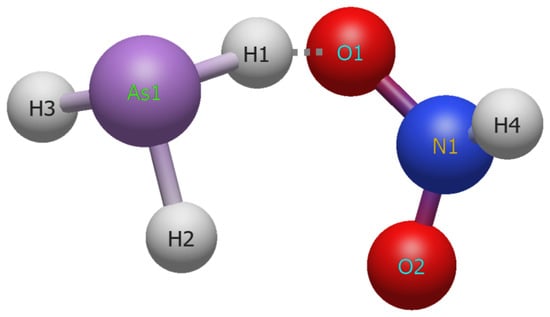
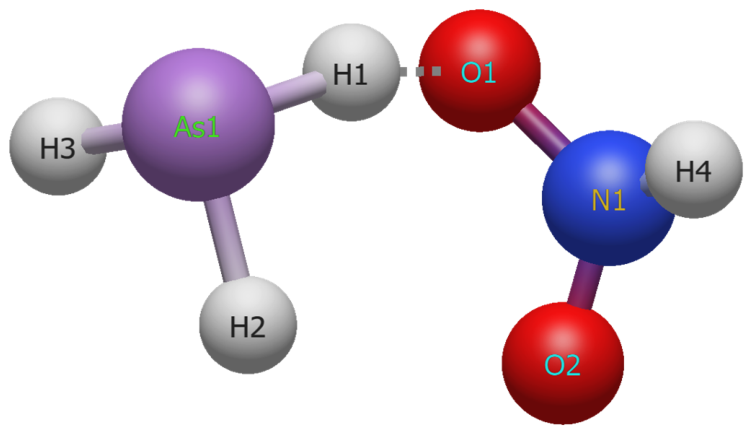
Geometry of the transition state is shown in Figure 1.
Figure 1.
Geometry of the transition state for X-H, Y-H.
Table 1 lists the main geometric characteristics of the transition state, including the As1–H1 and H1-O1 bond lengths and As1-H1-O1 angle. We observed similar As1-H1 bond length and a small difference in H1-O1 bond length. Methyl arsine and phenyl arsine have a shorter bond between arsenic and hydrogen and a longer bond between oxygen and hydrogen than arsine. Angle As1-H1-O1 is close to 160° in all cases.
Table 1.
The general geometric characteristics of the transition state.
Table 2 lists atomic spin density on the As1, H1, and O1 atoms. When X or Y is CH3 or Ph, then the atomic spin density on As1 changes accordingly. Substituents do not affect atomic spin density of H1. The highest atomic spin density on O1 is observed when X or Y = CH3; phenyl substituents are also slightly increased compared to the atomic spin density on O1.
Table 2.
The atomic spin density of As1, H1, O1.
Table 3 lists the atomic charges on As1, H1, and O1. When X = H, then the atomic charge on As1 is negative. Methyl and phenyl substituents increase the atomic charge on As1 to positive values. The substituents reduce the atomic charges on H1 and O1.
Table 3.
The atomic charge of As1, H1, O1.
The atomic charge and spin density in reactant, transition state and product for X-H and Y-H are presented in Table 4. We observe a consistent decrease in atomic charge on As1 and substantial increase in charge on H1. The H2 and H3 atomic charges are slightly increased in the transition state and product. The atomic charges on O1 and O2 show a consistent reduction.
Table 4.
Atomic charge and spin density in reactant, transition state, and product for X-H, Y-H.
We observe spin density in the product, indicating that a radical center is localized on the As atom of arsine, but in nitrous acid spin density is distributed between N1 and O2. The spin density on O1 shows a substantial decrease, which is attributed to the formation of a bond between O1 and H1. All this information can produce a conclusion about the ionic reaction mechanism.
Table 5 lists activation energy for the reactions of the hydrogen atom transfer. Substituents do not affect activation energy.
Table 5.
Activation energy reactions of the hydrogen atom transfer.
4. Conclusions
For the first time, we obtained the geometry of the transition states for the photochemical reactions of the hydrogen atom transfer between arsines and the triplet nitro compounds. Geometry characteristics have similar values for all reactions. Substituents produce a shorter bond between arsenic and hydrogen and a longer bond between oxygen and hydrogen. A radical center is localized on the As1 atom. In nitro compounds radical is mainly localized between 5N and 6O. We propose that an atomic ionic reaction mechanism is involved. Substituents do not affect activation energy.
Author Contributions
Conceptualization, D.B. and S.Z.; methodology, D.B.; software, D.B.; validation, D.B. and S.Z.; formal analysis, D.B.; investigation, D.B.; resources S.Z.; data curation, D.B.; writing—original draft preparation, D.B.; writing—review and editing—S.Z., visualization, D.B.; supervision, S.Z.; project administration, S.Z. All authors have read and agreed to the published version of the manuscript.
Funding
This research received no external funding.
Institutional Review Board Statement
Not applicable.
Informed Consent Statement
Not applicable.
Data Availability Statement
The original contributions presented in this study are included in the article. Further inquiries can be directed to the corresponding author.
Conflicts of Interest
The authors declare no conflict of interest.
References
- Hurley, R.; Testa, A.C. Photochemical n → π* Excitation of Nitrobenzene. J. Am. Chem. Soc. 1966, 88, 4330–4332. [Google Scholar] [CrossRef] [Scilit]
- Qian, W.; Schreiner, P.R.; Mardyukov, A. Preparation and Photochemistry of Parent Triplet Vinylarsinidene. J. Am. Chem. Soc. 2024, 146, 930–935. [Google Scholar] [CrossRef] [Scilit] [PubMed]
- Viana, R.B. Exploring the Reaction Channels between Arsine and the Hydroxyl Radical. Mol. Phys. 2017, 115, 2431–2441. [Google Scholar] [CrossRef] [Scilit]
- Ásgeirsson, V.; Birgirsson, B.O.; Bjornsson, R.; Becker, U.; Riplinger, C.; Neese, F.; Jónssson, H. Nudged Elastic Band Method for Molecular Reactions Using Energy-Weighted Springs Combined with Eigenvector Following. J. Chem. Theory Comput. 2021, 17, 4929–4945. [Google Scholar] [CrossRef] [Scilit] [PubMed]
- Lin, Y.S.; Li, G.D.; Mao, S.P.; Chai, J.D. Long-Range Corrected Hybrid Density Functionals with Im proved Dispersion Corrections. J. Chem. Theory Comput. 2013, 9, 263–272. [Google Scholar] [CrossRef] [Scilit] [PubMed]
- Neese, F. Software update: The ORCA program system. version 6.0 WIXES Comput. Molec. Sci. 2025, 15, e70019. [Google Scholar] [CrossRef] [Scilit]

Disclaimer/Publisher’s Note: The statements, opinions and data contained in all publications are solely those of the individual author(s) and contributor(s) and not of MDPI and/or the editor(s). MDPI and/or the editor(s) disclaim responsibility for any injury to people or property resulting from any ideas, methods, instructions or products referred to in the content. |
© 2026 by the authors. Licensee MDPI, Basel, Switzerland. This article is an open access article distributed under the terms and conditions of the Creative Commons Attribution (CC BY) license.