


Abstract
Coumarins and 1,2,3-triazoles have long attracted medicinal chemists because of their diverse structures and broad biological activities. In this study, we report the synthesis of 1-(2-oxo-2H-1-benzopyran-4-yl)-1H-1,2,3-triazole-4-carbaldehyde, a molecular hybrid that combines the coumarin and 1,2,3-triazole frameworks and incorporates the essential features of both pharmacophores. The synthesis begins by preparing 4-azidocoumarin from 4-hydroxycoumarin. Next, a Cu(I)-catalyzed azide-alkyne cycloaddition with propargyl alcohol forms the 1,2,3-triazole core. Finally, oxidation of the alcohol yields the desired molecular hybrid, with an overall isolated product yield of 35.4%. The structure of the hybrid was confirmed by 1H and 13C NMR spectroscopy and infrared spectroscopy. Finally, we evaluated the antibacterial activity of all synthesized compounds against a panel of bacteria, including multidrug-resistant strains, to assess potential antimicrobial properties. Although the compounds did not show antibacterial activity against the strains evaluated, this does not rule out other biological activities that have yet to be explored. Thus, it is essential to investigate alternative targets and different pharmacological profiles.
1. Introduction
The search for new chemical structures with potential biological applications remains a major focus in medicinal chemistry. Among these, heterocyclic compounds such as coumarins have received significant attention because of their structural versatility. This scaffold serves as the foundation for a variety of compounds with antibacterial [1], antifungal [2], anticancer [3], and antioxidant activities [4]. Additionally, 1,2,3-triazoles are another important class of heterocycles. They are valued not only for their biological properties—including antimicrobial [5], antiviral [6], anticancer, and antitubercular activities [7]—but also for their exceptional stability in hydrolytic, oxidative, and reductive conditions, as well as against enzymatic degradation. Furthermore, their ability to form hydrogen bonds and dipolar interactions enhance their capacity to interact with various molecular targets, thereby improving compound solubility [6].
On the other hand, molecular hybridization combines two or more pharmacophoric units into a single molecular entity. This approach has been explored in various studies, integrating coumarin and 1,2,3-triazole scaffolds into a single molecule. Many of these studies have reported derivatives with promising antimicrobial properties [8] and other biological activities [9], highlighting the potential to expand this hybrid class of compounds. Growing global concern about antimicrobial resistance, particularly the rise in multidrug-resistant (MDR) bacterial strains [10], underscores the need for unique molecular structures that can overcome established resistance mechanisms. In this context, we present the synthesis of a new molecular hybrid derived from these scaffolds, aiming to develop a compound with significant biological potential.
2. Materials and Methods
2.1. General
All solvents and reagents were purchased from Aldrich (St. Louis, MO, USA) and used without further purification. All melting points are uncorrected and were determined using an INFITEK MTP420 melting point apparatus (Infitek Co., Ltd., Shanghai, China). FTIR spectra were recorded on a Varian 660-IR/FT-IR (Agilent Technologies, Santa Clara, CA, USA) spectrometer over the range 4000–400 cm−1. The 1H and 13C NMR spectra were recorded at 298 K on a Bruker Avance 500 MHz spectrometer (Bruker BioSpin GmbH, Ettlingen, Germany) equipped with a z-gradient, triple-resonance (1H, 13C, 15N) cryoprobe using DMSO-d6 or CDCl3 as solvents. Chemical shifts are expressed in ppm with TMS as an internal reference (TMS, δ = 0 ppm) for protons. Reactions were monitored by TLC on silica gel using ethyl acetate/hexane mixtures as a solvent and compounds visualized by UV lamp. The incubation for the antibacterial activity assay was carried out in a Bio Tek Cytation 5 cell imaging multimode reader (Agilent Technologies, Winooski, VT, USA).
2.2. Synthesis
2.2.1. 4-Chloro-2H-1-benzopyran-2-one (2)
4-Hydroxycoumarin (1) (3.0 g, 1 eq) was treated with POCl3 (6 mL) and heated to 90 °C for 2 h with stirring. The progress of the reaction was monitored by thin-layer chromatography with EtOAc/hexane, (1:1) as eluent. Once the reaction mixture cooled to room temperature, it was added dropwise to a mixture of ice and water while stirring and then left at 4 °C overnight. The resulting solid was filtered and washed with ice-cold water, followed by purification through Soxhlet extraction using hexane. The solvent was then removed under reduced pressure, yielding 4-chloro-2H-1-benzopyran-2-one (2) as orange, needle-like crystals. Yield: 61.1%; m.p. 93.3–94.2 °C (lit. 86–88 °C [11]); 1H-NMR (500 MHz, CDCl3) δ 7.85 (dd, J = 7.9, 1.4 Hz, 1H), 7.62–7.57 (m, 1H), 7.37–7.33 (m, 2H), 6.58 (s, 1H); IR (cm−1): 1748, 1711, 1599, 1440, 1266, 1175.
2.2.2. 4-Azido-2H-1-benzopyran-2-one (3)
4-Chloro-2H-1-benzopyran-2-one (2) (1.33 g, 1 eq) was dissolved in anhydrous DMF (8.5 mL), and NaN3 (2 eq) was added. The mixture was stirred at room temperature for 17 h. Progress was monitored by TLC using EtOAc/hexane, (1:2) as eluent. Once the reaction was complete, the mixture was slowly added to an ice–water mixture and stored at 4 °C overnight. The resulting solid was filtered, washed with cold water, and dried under vacuum to yield 4-azido-2H-1-benzopyran-2-one (3) as a pale pink powder. Yield: 98.6%; m.p. 159.9–161.1 °C (lit. 161–162 °C [11]); 1H-NMR (500 MHz, CDCl3) δ 7.68 (dd, J = 7.9, 1.4 Hz, 1H), 7.59–7.54 (m, 1H) 7.31 (d, J = 8.3 Hz, 1H), 7.27 (t, J = 7.6 Hz, 1H), 6.10 (s, 1H); 13C-NMR (126 MHz, CDCl3) δ 160.6, 153.7, 153.5, 133.3, 124.4, 123.5, 117.0, 115.0, 100.3; IR (cm−1): 2129, 1724.
2.2.3. 4-[4-(Hydroxymethyl)-1H-1,2,3-triazol-1-yl]-2H-1-benzopyran-2-one (4)
A mixture of 4-azido-2H-1-benzopyran-2-one (3) (1.28 g, 1 eq) and propargyl alcohol (2 eq) in acetone (136 mL) was sequentially treated with 13.5 mL of aqueous solutions of CuSO4·5H2O (1 eq) and sodium ascorbate (1 eq), while stirring. The mixture was heated to reflux for 42 h and monitored by TLC using EtOAc/hexane (1:1) as eluent. Upon completion, and with constant stirring, the reaction mixture was carefully poured into an ice–water (273 mL). The resulting precipitate was filtered, washed with water, and then dried under vacuum to yield 4 as a yellow powder. Yield: 99.5%; m.p. 169.5–174.8 °C; 1H-NMR (500 MHz, DMSO-d6) δ 8.66 (s, 1H), 7.96 –7.82 (m, 1H), 7.77 (s, 1H), 7.64–7.51 (m, 1H), 7.45 (s, 1H), 6.90 (s, 1H), 5.47 (s, 1H), 4.67 (s, 2H); IR (cm−1): 3284, 1718, 1614, 1229, 1051.
2.2.4. 1-(2-Oxo-2H-1-benzopyran-4-yl)-1H-1,2,3-triazole-4-carbaldehyde (5)
Compound 4 (50 mg, 1 eq) was dissolved in CH2Cl2 (1 mL) at room temperature under stirring, and pyridinium chlorochromate (PCC, 3 eq) was added, followed by additional CH2Cl2 (2 mL). The mixture was stirred for 5 h and monitored by TLC (EtOAc/hexane, 1:1). Upon completion, the reaction mixture was purified by flash column chromatography (silica gel; EtOAc/hexane, 1:1). Product 5 was concentrated under reduced pressure as a pure white solid. Yield: 59.1%; m.p. 177.4–181.1 °C; 1H-NMR (500 MHz, CDCl3) δ 10.28 (s, 1H), 8.57 (s, 1H), 7.75–7.69 (m, 1H), 7.67 (d, J = 8.1 Hz, 1H), 7.51 (d, J = 8.3 Hz, 1H), 7.39 (t, J = 7.7 Hz, 1H), 6.65 (s, 1H); 13C-NMR (126 MHz, CDCl3) δ 184.3, 159.0, 154.3, 147.9, 146.2, 134.1, 126.3, 125.4, 124.7, 117.9, 114.0, 111.5; IR (cm−1): 1732, 1693, 1601, 1530, 1357, 1185.
2.3. Biological Evaluation
The antibacterial activity of the synthesized compounds was evaluated against a panel of bacteria, including Gram-positive strains such as Staphylococcus aureus ATCC 25923, Enterococcus faecalis ATCC 29212, and Listeria monocytogenes ATCC 13932. The study also included Gram-negative bacteria, specifically Escherichia coli ATCC 25922, Salmonella enterica serovar Typhi ATCC 14028, Pseudomonas aeruginosa ATCC 27853, and Burkholderia cepacia ATCC 25416. Additionally, multidrug-resistant clinical isolates of Klebsiella pneumoniae, Escherichia coli, Enterococcus faecalis, Staphylococcus epidermidis, Enterococcus faecium, Salmonella enterica serovar Kentucky, and Pseudomonas aeruginosa were tested by broth microdilution [12]. These seven clinical multidrug-resistant isolates were supplied by the National Institute of Health of Ecuador (INSPI).
Bacterial inocula were prepared in Brain Heart Infusion (BHI) broth to achieve a final cell density of 5 × 10⁵ CFU/mL. Stock solutions of compounds 2, 3, and 5 were prepared in DMSO at 20 mM, while compound 4 was prepared at 8.43 mM due to its limited solubility. Dilutions were prepared from these stock solutions, maintaining the final DMSO concentration in each well at 2.5% v/v—a concentration previously shown to have no impact on bacterial growth [13]. A control group of bacterial cells was cultured in 2.5% DMSO alone to rule out any solvent-related inhibitory effects. Additionally, several antibiotics were included as controls (Table 1). BHI broth alone and BHI supplemented with each compound at the tested concentrations served as blanks.
Table 1.
Reference antibiotics used as growth-inhibition controls in the antibacterial activity assays.
The antibacterial susceptibility was assessed using the broth microdilution method, in accordance with the guidelines established by the Clinical and Laboratory Standards Institute (CLSI) [14], with some modifications. Specifically, 5 µL of each stock solution was added to 195 µL of a bacterial suspension (5 × 10⁵ CFU/mL), resulting in a final volume of 200 µL. The plates were incubated at 37 °C for 20 h with continuous shaking. The optical density at 600 nm (OD600) was measured at the beginning (t = 0) and the end (t = 20 h) of the incubation period. All assays were conducted in triplicate.
3. Results and Discussion
3.1. Synthesis
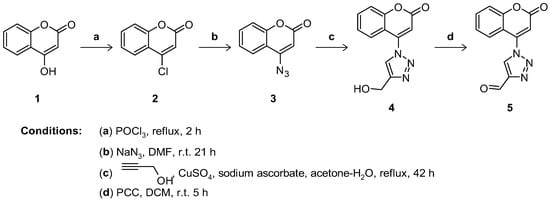
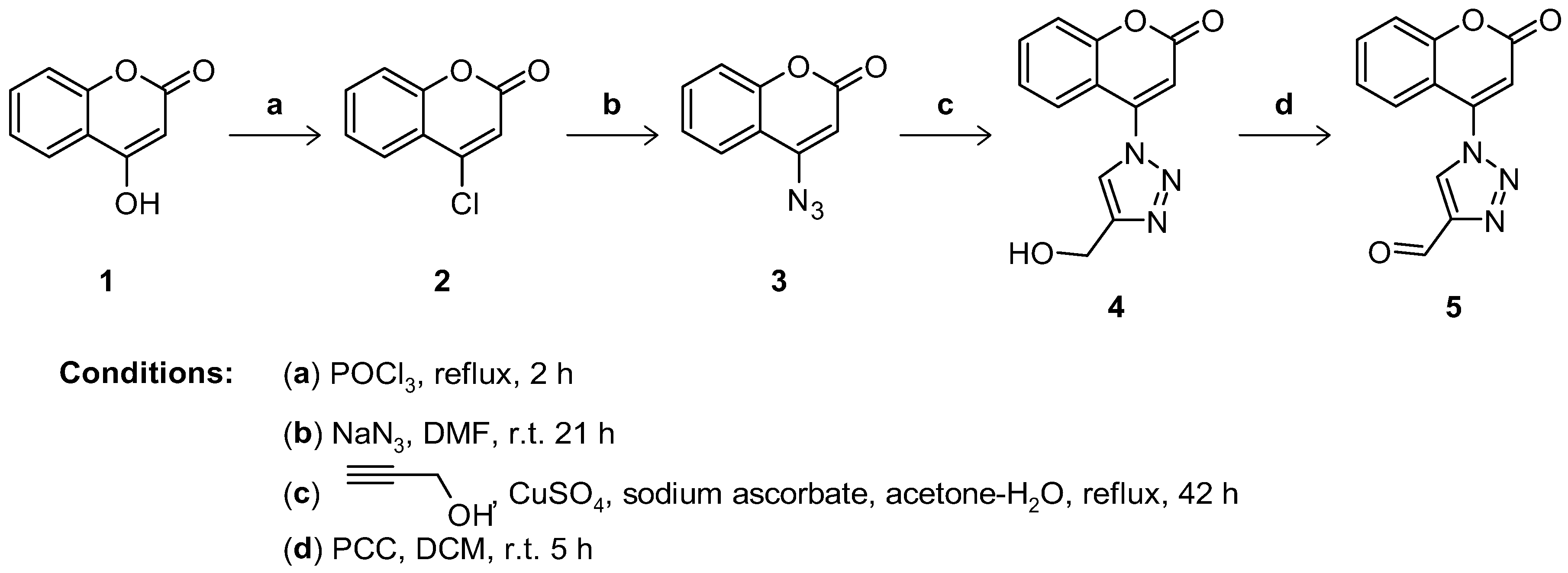
The target compound 5 was synthesized via a four-step sequence (Scheme 1), starting with 4-hydroxycoumarin (1), an easily obtainable starting material.
Scheme 1.
Synthesis of 1-(2-oxo-2H-1-benzopyran-4-yl)-1H-1,2,3-triazole-4-carbaldehyde (5).
The first step involved chlorinating 1 using POCl3 to produce 4-chloro-2H-1-benzopyran-2-one (2), as previously reported [11]. Soxhlet extraction of compound 2 with hexane significantly increased the yield to 61%. Azidation of 2 then afforded 4-azido-2H-1-benzopyran-2-one (3) [11] in 99% yield. Finally, a CuAAC click reaction between 3 and propargyl alcohol formed the triazole ring, affording 4-[4-(hydroxymethyl)-1H-1,2,3-triazol-1-yl]-2H-1-benzopyran-2-one (4) in quantitative yield after 42 h.
An initial attempt to oxidize the hydroxymethyl group in compound 4 with Jones reagent did not afford the expected aldehyde 5. Although this reagent is primarily known for oxidizing primary alcohols into acids [15], it has also been used to oxidize 1-substituted-1,2,3-triazol-4-yl-methanols to aldehydes [16]. However, in our specific case, it did not yield aldehydes.
Using pyridinium chlorochromate (PCC) in dichloromethane instead, the oxidation was complete within five hours. However, the isolated yield of 5 was notably scale-dependent. In small-scale reactions (≤50 mg of 4), we obtained a 61% yield. In contrast, when we scaled up to 100 mg of the starting material, we observed significant formation of a black, viscous residue due to chromium by-products. This buildup hindered the isolation of the desired product, resulting in a marked drop in yield to 13%. To address this problem, we explored a solvent-free protocol using PCC supported on alumina, combined with small amounts of tert-butanol in a porcelain mortar [17]. Although we observed the formation of aldehyde 5 under these conditions, we could isolate it in only 20% yield. The structures of all synthesized compounds were confirmed by 1H NMR and IR spectroscopy.
3.2. Antibacterial Activity
All synthesized compounds were tested at 500 µM; however, none showed detectable inhibitory activity against any of the fourteen bacterial strains used in the assay. The consistent lack of activity across all 14 strains (Gram-positive, Gram-negative, and susceptible or multidrug-resistant isolates) suggests these molecules likely lack a pharmacophore capable of interacting with a relevant bacterial target. This suggests that the lack of activity is not due to permeability barriers, since a similar lack of activity was observed even against Gram-positive bacteria with a more permissive cell envelope [18,19]. This negative finding, particularly at such a high concentration (500 µM), offers valuable insights into structure–inactivity relationships and complements classical structure–activity relationship data, guiding the rational design of new analogs within this series.
4. Conclusions
The hybrid compound 1-(2-oxo-2H-1-benzopyran-4-yl)-1H-1,2,3-triazole-4-carbaldehyde (5) was synthesized in four steps with an overall yield of 35.4%. Spectroscopic characterization confirmed the successful formation of the synthesized compounds. In biological assays, none of the compounds showed antibacterial activity against a range of bacteria, including multidrug-resistant strains. However, these findings underscore the need further to investigate this hybrid scaffold against other biological targets and to explore structural modifications that could enhance its biological profile.
Author Contributions
Conceptualization, J.H.-M.; investigation, G.M.-F., J.Z.-M., J.C.R.-B. and J.H.-M.; writing—original draft preparation, G.M.-F., J.Z.-M. and J.H.-M.; writing—review and editing, G.M.-F. and J.H.-M.; supervision, J.H.-M.; project administration, J.H.-M. All authors have read and agreed to the published version of the manuscript.
Funding
This research received no external funding.
Institutional Review Board Statement
Not applicable.
Informed Consent Statement
Not applicable.
Data Availability Statement
All data generated or analyzed during this study are included in this published article.
Conflicts of Interest
The authors declare no conflicts of interest.
References
- Yang, X.-C.; Zeng, C.-M.; Avula, S.R.; Peng, X.-M.; Geng, R.-X.; Zhou, C.-H. Novel coumarin aminophosphonates as potential multitargeting antibacterial agents against Staphylococcus aureus. Eur. J. Med. Chem. 2023, 245, 114891. [Google Scholar] [CrossRef] [Scilit] [PubMed]
- Benanane, S.; Cheikh, N.; Bendhina, N.E.-H.; Villemin, D.; Boumendjel, A. New coumarin derivatives accessible in short and eco-friendly conditions with antifungal activity. Future Med. Chem. 2023, 15, 745–756. [Google Scholar] [CrossRef] [Scilit] [PubMed]
- Kubrak, T.P.; Makuch-Kocka, A.; Aebisher, D. Coumarins in anticancer therapy: Mechanisms of action, potential applications and research perspectives. Pharmaceutics 2025, 17, 595. [Google Scholar] [CrossRef] [Scilit] [PubMed]
- Todorov, L.; Saso, L.; Kostova, I. Antioxidant activity of coumarins and their metal complexes. Pharmaceuticals 2023, 16, 651. [Google Scholar] [CrossRef] [Scilit] [PubMed]
- Todorov, L.; Kostova, I. 1,2,3-Triazoles and their metal chelates with antimicrobial activity. Front. Chem. 2023, 11, 1247805. [Google Scholar] [CrossRef] [Scilit] [PubMed]
- Agouram, N. 1,2,3-Triazole derivatives as antiviral agents. Med. Chem. Res. 2023, 32, 2458–2472. [Google Scholar] [CrossRef] [Scilit]
- Tian, G.; Song, Q.; Liu, Z.; Guo, J.; Cao, S.; Long, S. Recent advances in 1,2,3- and 1,2,4-triazole hybrids as antimicrobials and their SAR: A critical review. Eur. J. Med. Chem. 2023, 259, 115603. [Google Scholar] [CrossRef] [Scilit] [PubMed]
- Satheeshkumar, C.; Ravivarma, M.; Arjun, P.; Silambarasan, V.; Raaman, N.; Velmurugan, D.; Song, C.; Rajakumar, P. Synthesis, anti-microbial activity and molecular docking studies on triazolylcoumarin derivatives. J. Chem. Sci. 2015, 127, 565–574. [Google Scholar] [CrossRef] [Scilit]
- Mishra, K.N.; Upadhyay, H.C. Coumarin-1,2,3-triazole hybrids as leading-edge anticancer agents. Front. Drug Discov. 2022, 2, 1072448. [Google Scholar] [CrossRef] [Scilit]
- Marino, A.; Maniaci, A.; Lentini, M.; Ronsivalle, S.; Nunnari, G.; Cocuzza, S.; Parisi, F.M.; Cacopardo, B.; Lavalle, S.; La Via, L. The global burden of multidrug-resistant bacteria. Epidemiologia 2025, 6, 21. [Google Scholar] [CrossRef] [Scilit] [PubMed]
- Joshi, S.; Kumari, S.; Bhattacharjee, R.; Sakhuja, R.; Pant, D.D. Estimation of ground and excited state dipole moments of synthesized coumarin derivative [N-(2-oxo-2H-chromen-4-yl)imino]triphenyl-phosphorane. J. Mol. Liq. 2014, 200, 115–119. [Google Scholar] [CrossRef] [Scilit]
- Zúñiga-Miranda, J.; González-Pastor, R.; Carrera-Pacheco, S.E.; Rodríguez-Pólit, C.; Barba-Ostria, C.; Machado, A.; Guamán, L.P.; Alcivar-León, C.D.; Heredia-Moya, J. Experimental and Computational Studies of Schiff Bases Derived from 4-Aminoantipyrine as Potential Antibacterial and Anticancer Agents. Discov. Appl. Sci. 2025, 7, 115. [Google Scholar] [CrossRef] [Scilit]
- Teran, R.; Guevara, R.; Mora, J.; Dobronski, L.; Barreiro-Costa, O.; Beske, T.; Pérez-Barrera, J.; Araya-Maturana, R.; Rojas-Silva, P.; Poveda, A.; et al. Characterization of antimicrobial, antioxidant, and leishmanicidal activities of Schiff base derivatives of 4-aminoantipyrine. Molecules 2019, 24, 2696. [Google Scholar] [CrossRef] [Scilit] [PubMed]
- Clinical and Laboratory Standards Institute. Methods for Dilution Antimicrobial Susceptibility Tests for Bacteria That Grow Aerobically, 11th ed.; Clinical and Laboratory Standards Institute: Wayne, PA, USA, 2018. [Google Scholar]
- Wang, Z. Jones oxidation. In Comprehensive Organic Name Reactions and Reagents; Wiley: Hoboken, NJ, USA, 2010; pp. 1564–1568. [Google Scholar] [CrossRef] [Scilit]
- Sambasiva Rao, P.; Kurumurthy, C.; Veeraswamy, B.; Santhosh Kumar, G.; Poornachandra, Y.; Ganesh Kumar, C.; Vasamsetti, S.B.; Kotamraju, S.; Narsaiah, B. Synthesis of novel 1,2,3-triazole substituted-N-alkyl/aryl nitrone derivatives, their anti-inflammatory and anticancer activity. Eur. J. Med. Chem. 2014, 80, 184–191. [Google Scholar] [CrossRef] [Scilit] [PubMed]
- Niknam, K. Pyridinium chlorochromate supported on alumina as an efficient oxidizing agent for oxidation of alcohols under solvent-free conditions. Asian J. Chem. 2005, 17, 2513–2516. [Google Scholar]
- Maher, C.; Hassan, K.A. The Gram-Negative Permeability Barrier: Tipping the Balance of the in and the Out. mBio 2023, 14, e01205-23. [Google Scholar] [CrossRef] [Scilit] [PubMed]
- Silhavy, T.J.; Kahne, D.; Walker, S. The Bacterial Cell Envelope. Cold Spring Harb. Perspect. Biol. 2010, 2, a000414. [Google Scholar] [CrossRef] [Scilit] [PubMed]

Disclaimer/Publisher’s Note: The statements, opinions and data contained in all publications are solely those of the individual author(s) and contributor(s) and not of MDPI and/or the editor(s). MDPI and/or the editor(s) disclaim responsibility for any injury to people or property resulting from any ideas, methods, instructions or products referred to in the content. |
© 2026 by the authors. Licensee MDPI, Basel, Switzerland. This article is an open access article distributed under the terms and conditions of the Creative Commons Attribution (CC BY) license.