


Abstract
This study describes a novel, solvent- and catalyst-free, ultrasound-assisted methodology for the green synthesis of 1H-benzo[d]imidazole derivatives. Driven by acoustic cavitation, this one-pot protocol operates efficiently without hazardous reaction media or auxiliary reagents. Optimization using o-phenylenediamine and benzaldehyde yielded up to 97% of the 1,2-disubstituted adduct under mild conditions (2.0 equiv. aldehyde, 2 h). Product selectivity (N-benzylated versus non-N-benzylated) and overall yields were strongly dictated by the steric effect and the electronic nature of aldehyde substituents. This approach provides a clean, rapid access to privileged nitrogen heterocycles of biological and agricultural significance.
1. Introduction
Over the next decades, rising global populations (projected to grow to 10.3 billion by the 2080s [1]) will create increased food demands and human pressures on ecosystems, thus stimulating phytopathogenic pest proliferation. As such, benzimidazoles form a critical chemical core in crop protection due to their exceptional fungicidal properties. These planar nitrogenous heterocycles, in their parent form, consist of a molecular formula, C7H6N2, and the fused rings of benzene and imidazole allow for chemical flexibility via 1,3-nitrogen positions, while the aromatic nature of the system and the dual nitrogen functionality in the imidazole core give the scaffold an amphoteric character and hydrogen-bonding capacity [2,3]. Recognized as privileged scaffolds [4], benzimidazoles are vital pharmacophores in clinical drugs and commercial fungicides [3,5]. However, the conventional synthetic routes to their structures are fraught with significant sustainability drawbacks, using not only hazardous solvents but also prolonged heating cycles.
An approach to overcome such operational limitations lies in the green chemistry paradigm, which is a well-established concept for systematically reducing or eliminating the use of hazardous substances at the source [6]. Rooted in the twelve principles formalization by Anastas and Warner, this discipline is consistently applied to maximize atom economy, enhance energy efficiency, and replace noxious reaction media [7,8]. In modern synthetic methodologies, the use of solvent-free transformations is a very efficient way to minimize waste since carrying out reactions under neat or solid-state conditions increases the effective concentrations of the reactants, thus dramatically accelerating the reaction kinetics [9,10,11]. Moreover, the addition of one-pot approaches allows sequential transformations to be performed seamlessly within a single vessel without the isolation of intermediates, simplifying the experimental workflows and saving on the overall use of auxiliary purification reagents [12], as demonstrated by Thakuria and Das in the solvent-free synthesis of non-N-benzylated 1H-benzo[d]imidazoles in 65–92% yields under thermal heating at 140 °C [13].
As a powerful enabling technology for promoting solvent-free transformations, sonochemistry is a highly efficient non-classical energy input through ultrasound irradiation, usually at a 20–100 kHz frequency range [14,15]. The synthetic benefits of ultrasound do not come from a direct quantum interaction with molecular bonds but from acoustic cavitation, a physical process involving the nucleation and collapse of microbubbles in the medium [16]. This cavitation collapse then releases tremendous local energy within microsecond time scales, creating extreme microenvironments (“hot spots”), which have temperatures exceeding 5000 K and pressures above 1000 atm [16]. Such locally extreme mechanical phenomena induce such mechanical effects as microjets, intense turbulence, and enhanced mass transport but also chemical effects driven by reactive radical species, thus shortening reaction times, increasing product yields, and facilitating cleaner heterocycle construction [15].
In recent years, the development of sono-synthetic and environmentally benign methodologies for benzimidazole assembly has drawn great scientific interest. Notable contributions include neat, air-assisted, catalyst-free ultrasound protocols for the synthesis of benzimidazole-fused pyrimidine analogs in 85–95% yield [17]; ultrasound-assisted oxidative cyclization via a mild NaOH/I2 system in ethanol achieving 91–99% yields of non-N-benzylated 1H-benzo[d]imidazoles [18]; solvent-free mechanochemical ball-milling transformations providing 64–97% yields [19,20]; and molecular iodine-promoted processes acting as mild Lewis acids or oxidants with 65–92% yields [21,22]. Nevertheless, there are still significant methodological gaps: several protocols designated as “green” still rely on volatile organic solvents or strong chemical oxidants, while mechanistic discussions regarding the involvement of imine intermediate and internal redox side-product formation are often omitted [3].
To overcome these limitations, the present study demonstrates a robust, solvent-free, one-pot sono-synthetic methodology for the efficient preparation of 1H-benzo[d]imidazole derivatives. This operational protocol adheres to the principles of green chemistry by eliminating reaction solvents, minimizing isolation steps, and using ultrasonic cavitational activation as a clean source of energy [6,11].
2. Methods
2.1. Chemistry
All chemicals were purchased from Sigma Aldrich (St. Louis, MO, USA). Melting points were measured in open capillaries on a Stuart SMP10 melting point apparatus (Cole-Parmer, Staffordshire, UK). 1H NMR and 13C NMR spectra were recorded at 298 K on a Bruker AscendTM 500 MHz (Bruker Corporation, Billerica, MA, USA) (1H NMR spectra at 500 MHz and 13C NMR spectra at 125 MHz). Chemical shifts (δ) are reported in parts per million (ppm) relative to tetramethylsilane, TMS, as an internal standard; spectra were recorded in DMSO-d6 (δ 2.5) or CDCl3 (δ 7.27). Chromatography (TLC) was performed using pre-coated silica gel 60 F254 preparative plates from Merck (Darmstadt, Germany). The detection of compounds was monitored at the fluorescence analysis cabinet MODEL CM-10 (Spectronics Corporation, Melville, NY, USA) longwave ultraviolet 365 nm. Column chromatography was performed using a solvent system of 230–400 mesh silica with hexane:ethyl acetate (80:20). All reactions were carried out on test tubes under ambient atmosphere inside an ultrasonic bath operating (Cole Parmer, model 8891-21, series QBC031070097E) at 100 W and an output frequency of 42 kHz for 2 h.
2.2. Synthesis of Benzimidazoles
In a test tube o-phenylenediamine (1 mmol) was mixed with the corresponding aldehyde (2 mmol) of interest. Before introducing the reaction, a Cole Parmer ultrasonic bath (100 W, 42 kHz) filled with water up to the manufacturer’s indicator line was turned on and allowed to reach a steady-state water temperature of 60 °C (requiring approximately 5 min). The test tube was then vertically immersed so that the external water level aligned with the meniscus of the reaction mixture. After the reaction time has elapsed (2 h); the crude reaction mixture is washed with methanol and adsorbed on silica gel. The desired product within the crude mixture is isolated using column chromatography through a silica gel column eluted by hexane and ethyl acetate.
- 1-benzyl-2-phenyl-1H-benzo[d]imidazole [23] (3a)
This compound was purified by column chromatography (hexane-ethyl acetate 80:20) to afford a white solid, 97%, m.p. 78–82 °C; 1H NMR (CDCl3) δ 7.87 (d, 1H, J = 7.9 Hz), 7.69 (d, 2H, J = 7.65 Hz), 7.51–7.41 (m, 3H), 7.37–7.28 (m, 4H) 7.25–7.18 (m, 2H), 7.11 (d, 2H, J = 8.6 Hz), 5.46 (s, 2H).; 13C NMR (CDCl3) δ 154.34, 143.35, 136.57, 136.23, 130.25, 130.06, 129.43 (s, 2C), 129.21 (s, 2C), 128.90 (s, 2C), 127.93, 126.13 (s, 2C), 123.19, 122.83, 120.16, 110.68, 48.55.
- 1-(4-fluorobenzyl)-2-(4-fluorophenyl)-1H-benzo[d]imidazole [24] (3b)
This compound was purified by column chromatography (hexane-ethyl acetate 80:20) to afford a soft yellow solid, 20%, m.p. 74–76 °C; 1H NMR (DMSO-d6) δ 7.68 (dd, 2H, J = 8.40, 5.95 Hz), 7.65–7.61 (m, 1H), 7.43–7.39 (m, 1H), 7.29 (t, 2H, J = 8.92 Hz), 7.20–7.14 (m, 2H), 7.02 (t, 2H, J = 8.85 Hz), 6.94 (dd, 2H, J = 8.62, 5.57 Hz), 5.48 (s, 2H); 13C NMR (DMSO-d6) δ 163.21 (d, 1C, J ipso = 246 Hz), 161.25 (d, 1C, J ipso = 242 Hz), 152.20, 142.45, 135.67, 133.08 (d, 1C, J para = 3), 131.5 (d, 2C, J meta = 8.6 Hz), 128.3 (d, 2C, J meta = 8.13 Hz),126.7 (d, 1C, J para = 3.2 Hz), 122.91, 122.42, 119.36, 116 (d, 2C, J ortho = 21.7 Hz), 115.7 (d, 2C, J ortho = 21.2 Hz), 111.16, 46.82.
- 1-(3-fluorobenzyl)-2-(3-fluorophenyl)-1H-benzo[d]imidazole (3c)
This compound was purified by column chromatography (hexane-ethyl acetate 80:20) to afford a white solid, 49.37%, mp. 140 °C; 1H NMR (DMSO-d6) δ 7.7–7.64 (m, 1H), 7.54–7.41 (m, 4H), 7.33–7.27 (m, 1H), 7.26–7.16 (m, 3H), 6.99 (td, 1H, J = 8.55, 2.75 Hz), 6.78 (d, 1H, J = 9.9 Hz), 6.68 (d, 1H, J = 7.75 Hz), 5.55 (s, 2H); 13C NMR (DMSO-d6) δ 162.33 (d, 1C, J ipso = 242. 85 Hz) 162. 05 (d, 1C, J ipso = 243.3 Hz), 151.89, 142.55, 139.81 (d 1C, J metha = 7.22 Hz), 135.96, 132.22 (d, 1C, J metha = 8.59 Hz), 131.10 (d, 1C, J meta = 8.58 Hz), 131.01 (d, 1C, J metha = 8.13 Hz), 125.25 (d, 1C, J para = 2.7 Hz), 123.23, 122.62, 122.12 (d, 1C, J para = 3.16 Hz), 119.56, 116.93 (d, 1C, J ortho = 20.76 Hz), 116.01 (d, 1C, J ortho = 23.03 Hz), 114.5 (d, 1C, J ortho = 20.76 Hz), 113.25 (d, 1C, J ortho = 22.11 Hz), 111.20, 46.99.
- 1-(3-methoxybenzyl)-2-(3-methoxyphenyl)-1H-benzo[d]imidazole [25] (3d)
This compound was purified by column chromatography (hexane-ethyl acetate 70:30) to afford a yellowish-white solid, 17.29%, m.p. 165 °C; 1H NMR (DMSO-d6) δ 7.69–7.65 (m, 2H), 7.42–7.36 (m, 2H), 7.19–7.11 (m, 4H), 7.01 (dd, 1H, J = 8.3, 2.9 Hz), 6.74 (dd, 1H, J = 8.2, 2.9 Hz), 6.59 (s, 1H), 6.47 (d, 1H, J = 7.6 Hz), 5.5 (s, 2H), 3.73 (s, 3H), 3.65 (s, 3H); 13C NMR (DMSO-d6) δ 159.55, 159.33, 153.06, 151.13, 142.57, 138.65, 135.98, 131.48, 131.37, 130.06, 122.35, 121.26, 119.33, 118.11, 115.84, 114.26, 112.70, 112.10, 111.44, 55.19, 55.02, 47.44.
- 5-chloro-1-(3-methoxybenzyl)-2-(3-methoxyphenyl)-1H-benzo[d]imidazole (3e)
This compound was purified by column chromatography (hexane-ethyl acetate 80:20) to afford a red solid, 24.22%, m.p. 185 °C; 1H NMR (DMSO-d6) δ 7.72 (d, 1H, J = 2.15 Hz), 7.45 (d, 1H, J = 8.7 Hz), 7.39–7.36 (m, 1H), 7.23–7.19 (m, 2H), 7.16 (s, 1H), 7.12 (t, 1H, J = 8.0 Hz), 7.04 (dd, 1H, J = 8.3, 2.4 Hz), 6.74 (dd, 1H, J = 8.2, 2.1 Hz), 6.52 (s, 1H), 6.45 (d, 1H, J = 7.7 Hz), 5.49 (s, 2H), 3.66 (s, 3H), 3.58 (s, 3H); 13C NMR (DMSO-d6) δ 159.56, 159.35, 154.54, 143.42, 138.29, 134.83, 130.83, 130.14, 130.11, 126.83, 122.97, 121.29, 118.76, 118.06, 116.15, 114.22, 112.84, 112.58, 112.08, 55.21, 55.02, 47.63.
- 5-chloro-1-(4-methoxybenzyl)-2-(4-methoxyphenyl)-1H-benzo[d]imidazole (3f)
This compound was purified by column chromatography (hexane-ethyl acetate 80:20) to afford a orangish-red solid, 24.89%, m.p 152 °C; 1H NMR (DMSO-d6) δ 7.66 (d, 1H, J = 2.15 Hz), 7.61 (d, 2H, J = 8.7 Hz), 7.40 (d, 1H, J = 8.7 Hz), 7.17 (dd, 1H, J = 8.7, 2.15 Hz), 7.02 (d, 2H, J = 8.7 Hz), 6.85 (d, 2H, J = 8.7 Hz), 6.77 (d, 2H, J = 8.7 Hz), 5.43 (s, 2H), 3.75 (s, 3H), 3.60 (s, 3H); 13C NMR (DMSO-d6) δ 160.96, 160.63, 158.66, 154.39, 141.52, 136.72, 130.64, 128.51, 128.28, 127.49, 126.87, 122.52, 122.21, 121.94, 120.36, 114.52, 114.38, 114.29, 111.02, 55.43, 55.39, 55.09.
- 2-(2-methoxyphenyl)-1H-benzo[d]imidazole [26] (4a)
This compound was purified by column chromatography (hexane-ethyl acetate 69:31) to afford a white solid, 83%, m.p 160–166 °C; 1H NMR (DMSO-d6) δ 10.68 (s, 1H), 8.59 (d, 1H, J = 7.8 Hz), 7.82 (d, 1H, J = 7.95 Hz), 7.49 (d, 1H, J = 7.15 Hz), 7.42 (t, 1H, J = 7.85 Hz), 7.30–7.22 (m, 2H), 7.14 (t, 1H, J = 7.57 Hz), 7.06 (d, 1H, J = 8.4 Hz), 4.07 (s, 3H); 13C NMR (CDCl3) δ 156.65, 149.76, 142.82, 133.47, 131.07, 130.03, 122.60, 122.17, 121.59, 119.16, 117.74, 111.33, 110.67, 56.1.
- 2-(3-fluorophenyl)-1H-benzo[d]imidazole-5-carbonitrile (4b)
This compound was purified by column chromatography (hexane-ethyl acetate 75:25) to afford an orange-pink solid, 78%, m.p. 172 °C; 1H NMR (DMSO-d6) δ 7.86 (s, 1H), 7.76 (d, 1H, J = 7.95 Hz), 7.69 (d, 1H, J = 9.95 Hz), 7.47 (d, 1H, J = 8.4 Hz), 7.37–7.31 (m, 2H), 7.11 (td, 1H, J = 8.55, 2.75 Hz); 13C NMR (DMSO-d6) δ 162.49 (d, 1C, J ipso = 242.85 Hz), 153.11, 131.49 (d, 1C, J meta = 8.58 Hz), 131.38 (d, 2C, J meta = 8.58 Hz), 125.99, 123.08 (d, 2C, J para = 3.16 Hz), 120.03, 117.61 (d, 2C, J ortho = 21.21 Hz), 113.56 (d, 2C, J ortho = 23.48 Hz), 104.38.
- 2-(4-fluorophenyl)-5-nitro-1H-benzo[d]imidazole [27] (4c)
This compound was purified by column chromatography (hexane-ethyl acetate 85:15) to afford a yellow solid, 29.80%, m.p. 265 °C; 1H NMR (DMSO-d6) δ 8.34 (s, 1H), 8.19–8.12 (m, 2H), 8.02 (dd, 1H, J = 8.85, 2.3 Hz), 7.65 (d, 1H, J = 8.85 Hz), 7.36 (t, 2H, J = 8.7 Hz); 13C NMR (DMSO-d6) δ 163.71 (d, 1C, J ipso = 247.36 Hz), 154.86, 142.65, 129.40 (d, 4C, J meta = 8.58 Hz), 125.65 (d, 1C, J para = 2.7 Hz), 117.95, 116.21 (d, 4C, J ortho = 22.11 Hz).
- 2-(2-fluorophenyl)-1H-benzo[d]imidazole [28] (4d)
This compound was purified by column chromatography (hexane-ethyl acetate 88:12) to afford a white solid, 24%, m.p. 217–225 °C; 1H NMR (DMSO-d6) δ 8.15 (td, 1H, J = 7.77, 2.01 Hz), 7.59–7.52 (m, 2H), 7.50–7.45 (m, 1H), 7.35 (dd, 1H, J = 11.6, 7.8 Hz), 7.30 (t, 1H, J = 7.5 Hz), 7.14 (dd, 2H, J = 6.1, 3.2 Hz); 13C NMR (DMSO-d6) δ 159.52 (d, 1C, J ipso = 248.26 Hz), 146.30, 131.96 (d, 2C, J meta = 8.58 Hz), 130.28 (d, 2C, J meta = 2.71 Hz), 125.19 (d, 2C, J para = 3.15 Hz), 122.43, 118.12 (d, 1C, J ortho = 11.28 Hz), 116.60 (d, 2C, J ortho = 21.68 Hz).
3. Results and Discussion
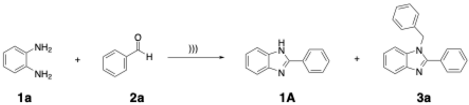
The methodology was initially optimized using o-phenylenediamine 1a and benzaldehyde 2a as starting materials. Preliminary screening using 1 mmol of compound 1a and 1.2 equivalents of aldehyde 2a proceeded under solvent- and catalyst-free conditions, showing two distinct products. These two distinct products were isolated using the same methodology described in the previous section, while the 1H NMR and 13C NMR spectroscopy analysis structurally confirmed them as the non-N-benzylated, 2-phenyl-1H-benzo[d]imidazole 1A and the N-benzylated, 1-benzyl-2-phenyl-1H-benzo[d]imidazole 3a (Table 1, entry 1). Unfortunately, the reaction did not finish, and starting materials were recovered.
Table 1.
Optimization of standard conditions.
To favor the end of the reaction, the effect of aldehyde stoichiometry and the reaction time were investigated. Thus, increasing the amount of aldehyde 2a to 1.5 equiv. showed similar results (Table 1, entry 2), with an incomplete reaction. The increase in the reaction time to 4 h using 1.2 equiv. of aldehyde 2a (Table 1, entry 3) and 1.5 equiv. of aldehyde 2a (Table 1, entry 4) resulted in incomplete reaction progress. Fortunately, the complete consumption of starting materials required 2.0 equiv. of aldehyde 2a in a reaction time of 2 h. Under these optimized conditions, disubstituted compound 3a was isolated in 97% yield.
Reaction parameters such as solvent choice, inorganic bases, catalysts, temperature, and stoichiometry are known to dictate selectivity between 1A and 3a [25]. In our protocol, employing an excess of aldehyde (2.0 equiv.) enables both amine centers of 1a to react. Furthermore, the absence of a solvent and catalyst appears to reduce chemo-selective control, potentially favoring the formation of the N-benzylated derivative 3a as the major product in the mixture of both the N-benzylated 3a and non-N-benzylated 1A products.
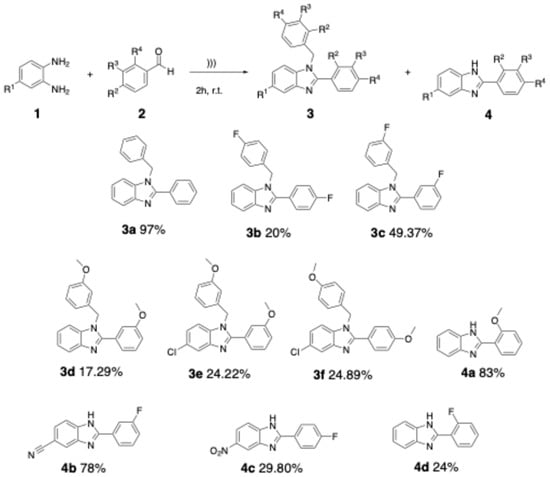
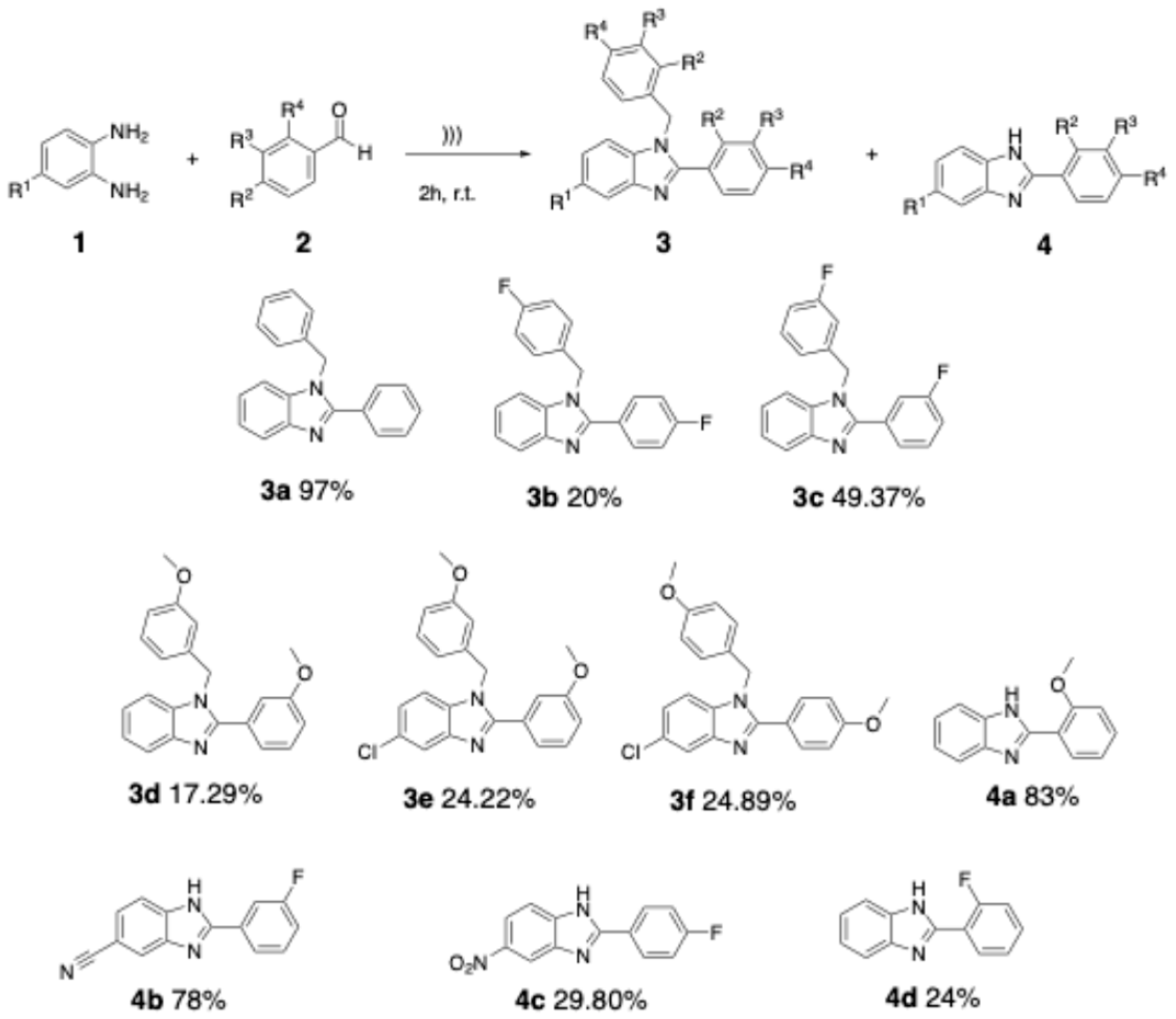
Applying these optimized conditions, nine additional derivatives, 3a–3f and 4a–4d were synthesized; unfortunately, the N-benzylated derivatives were not the only products, as originally anticipated (Scheme 1). Instead, it was found that the yields and product distribution (N-benzylated vs. non-N-benzylated) strongly depend on both the steric hindrance and electronic properties of substituents on aromatic rings of the different benzaldehydes and o-phenylenediamines that were used. It is important to clarify that a mixture of mono- and disubstituted products was consistently yielded, as monitored by TLC under UV light. However, only the major product (the most prominent fluorescent or colored spot in the TLC plate under UV light) was successfully isolated by column chromatography and fully characterized. Consequently, isolated yields are reported exclusively for this target product in Scheme 1, while the formation of the secondary product was qualitatively observed but not isolated.
Scheme 1.
Synthesized benzimidazoles 3a–3f and 4a–4d.
Product yields were affected by benzaldehyde decomposition in the reaction mixture. Benzyl alcohols from the aldehydes were detected as side products and likely act as internal oxidizing agents during benzimidazole formation (see Mechanism section). Additionally, operating in an open system leads to aerobic oxidation of benzaldehydes into benzoic acid derivatives. These acidic side products were observed in 1H NMR spectra as impurities, presumably present as organic salts of the benzimidazole core.
Electron-withdrawing groups (EWGs), such as para-fluoro, reduce the overall electron density of the aromatic system, thereby increasing the electrophilicity of the aldehyde carbonyl. Although this might accelerate the initial nucleophilic attack during the formation of the carbinolamine adduct, it may also promote faster decomposition of the aldehyde in the presence of atmospheric oxygen. In contrast, electron-donating groups (EDGs), such as methoxy, degrade at a slower rate than EWGs. However, EDGs exert a dual effect: they might decrease the electrophilicity of the carbonyl group while enhancing thermodynamic stability via a resonance effect with the benzimidazole core, ultimately leading to higher yields compared to EWGs. When comparing compound 3c with 3d, both the fluorine and methoxy groups at the meta-position act as deactivating agents that direct to the ortho- and para-positions. Nevertheless, due to the high electronegativity of the fluorine atom, compound 3c gave a higher yield by facilitating the nucleophilic attack on the imine intermediate. Furthermore, comparing compound 3b with 3c suggests that the para-position of the fluorine atom in 3b increases carbonyl electrophilicity, accelerating aldehyde oxidation compared to the meta-substituted counterpart 3c, which accounts for the lower yield observed for 3b.
On the other hand, ortho-substituted benzaldehydes selectively yield monosubstituted products [29], driven predominantly by steric hindrance. Low yields persist with ortho-EWGs, whereas ortho-EDGs markedly improve reaction outcomes (see compound 4a versus 4e), likely due to the reduced aldehyde decomposition noted above. Notably, the electronic and steric nature of the diamine substituents critically influences the reaction outcome: EDGs (as in compounds 3e and 3f) tend to favor N-benzylated products, whereas EWGs (as in 4b and 4c) promote non-N-benzylated counterparts, which can be attributed to their direct influence on the electrophilicity of the imine intermediate.
Proposed Reaction Mechanism
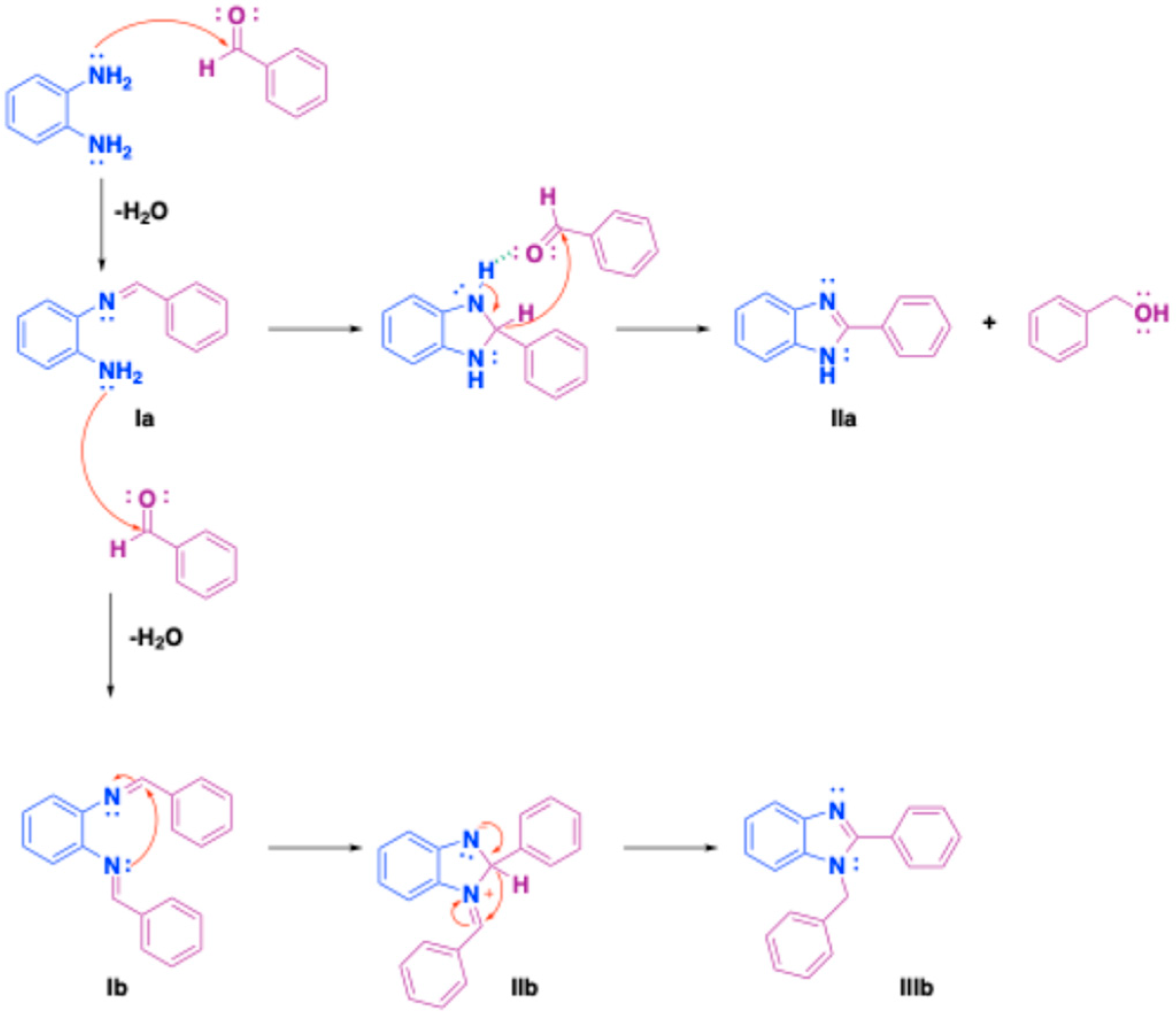
In accordance with previous reports [20], the synthesis is proposed to proceed through stages involving imine intermediates, intramolecular cyclization, and hydrogen transfer (Scheme 2).
- Imine Formation: The mechanism initiates with a nucleophilic attack by one amino group of the o-phenylenediamine on the benzaldehyde. This forms a transient hemiaminal, followed by dehydration to yield the imine intermediate (Ia).
- Selectivity: The imine (Ia) can either react with a second aldehyde molecule (leading to disubstitution) or undergo an intramolecular nucleophilic attack by the second amino group (leading to monosubstitution).
- Monosubstituted Product (IIa): The intramolecular cyclization 5-exo-trig leads to the dihydrobenzimidazole. This dihydro intermediate is then oxidized to the final monosubstituted benzimidazole (IIa) by a molecule of the aldehyde, which is concurrently reduced to the benzyl alcohol.
- Disubstituted Product (IIIb): The imine (Ia) can react with a second aldehyde molecule to form the diimine intermediate (Ib). Subsequent intramolecular cyclization 5-exo-trig between the ortho-imines yields the final disubstituted benzimidazole (IIIb), after a transposition reaction promoted by the nitrogen lone pair, causing a hydrogen transfer to the vicinal π-bond of the imine. Steric bulk in the aldehyde (ortho-positions) might inhibit this diimine formation, thus favoring the monosubstituted pathway.
Scheme 2.
Proposed reaction mechanism.
4. Conclusions
This work demonstrates an efficient, simple, and sustainable sono-synthetic protocol for the synthesis of benzimidazole derivatives, offering a viable alternative to traditional methodologies that rely on toxic solvents and harsh catalysts. Driven by acoustic cavitation, this solvent-free, one-pot transformation operates under mild conditions while maintaining high atom economy and energy efficiency, directly aligning with the core principles of green chemistry.
Optimization studies demonstrated that stoichiometric control (2.0 equiv. of benzaldehyde 2) governs, in some cases, the chemoselective access to N-benzylated adducts, achieving yields as high as 97%. Furthermore, the reaction scope revealed that the product distribution (N-benzylated versus non-N-benzylated) is critically controlled by an interplay between steric hindrance and electronic effects of the aldehyde substituents. Specifically, electron-withdrawing groups (EWGs) increase the electrophilicity of the aldehyde carbonyl, which might promote the decomposition of the aldehyde in the presence of atmospheric oxygen; on the other hand, electron-donating groups (EDGs) exert a dual effect: they decrease the electrophilicity of the carbonyl group while enhancing thermodynamic stability via a resonance effect with the benzimidazole core, ultimately leading to higher yields compared to EWGs, whereas substituents at ortho- positions promote non-N-benzylated benzimidazoles via steric constraint.
Mechanistic insights also highlighted the role of aldehyde species as internal hydrogen acceptors, alongside competitive aerobic oxidation pathways. Given the urgent need for sustainable agrochemicals to combat climate and population-driven phytopathogenic threats, this catalyst- and solvent-free approach represents a powerful, environmentally sustainable strategy for constructing privileged nitrogen heterocycles of biological and agricultural significance.
Author Contributions
Conceptualization, R.G.E., J.K.Z.R., N.R.C., O.I.H.A., M.V.X. and C.A.S.; methodology, R.G.E. and J.K.Z.R.; software, R.G.E.; validation, N.R.C., O.I.H.A., M.V.X. and C.A.S.; formal analysis R.G.E., J.K.Z.R. and C.A.S.; investigation, R.G.E. and J.K.Z.R.; resources, N.R.C., O.I.H.A., M.V.X. and C.A.S.; data curation, R.G.E., J.K.Z.R. and C.A.S.; writing—original draft preparation, R.G.E.; writing—review and editing, R.G.E. and C.A.S.; visualization, R.G.E.; supervision, N.R.C., O.I.H.A., M.V.X. and C.A.S.; project administration, N.R.C., O.I.H.A., M.V.X. and C.A.S.; funding acquisition, R.G.E. and C.A.S. All authors have read and agreed to the published version of the manuscript.
Funding
The authors gratefully acknowledge the financial support of this work by Secretaría de Ciencias, Humanidades, Tecnología e Innovación (SECIHTI CF-2023-I-1700). R.G.E. thanks SECIHTI (México) for scholarship number 1322077.
Institutional Review Board Statement
Not applicable.
Informed Consent Statement
Not applicable.
Data Availability Statement
The data presented in this study are available on request from the corresponding author due to legal reasons.
Acknowledgments
R.G.E and C.A.S gratefully acknowledge the Organic Chemistry Laboratory at the Benemérita Universidad Autónoma de Puebla for performing the nuclear magnetic resonance (NMR) measurements.
Conflicts of Interest
The authors declare no conflict of interest.
Abbreviations
The following abbreviations are used in this manuscript:
| equiv. | Equivalents |
| N.D. | Not Determined |
References
- United Nations. World Population Prospects 2024: Summary of Results; United Nations: New York, NJ, USA, 2024; p. 80. Available online: https://desapublications.un.org/publications/world-population-prospects-2024-summary-results (accessed on 10 August 2026).
- Bansal, Y.; Silakari, O. The Therapeutic Journey of Benzimidazoles: A Review. Bioorganic Med. Chem. 2012, 20, 6208–6236. [Google Scholar] [CrossRef] [Scilit] [PubMed]
- Keri, R.S.; Hiremathad, A.; Budagumpi, S.; Nagaraja, B.M. Comprehensive Review in Current Developments of Benzimidazole-Based Medicinal Chemistry. Chem. Biol. Drug Des. 2015, 86, 19–65. [Google Scholar] [CrossRef] [Scilit] [PubMed]
- Welsch, M.E.; Snyder, S.A.; Stockwell, B.R. Privileged Scaffolds for Library Design and Drug Discovery. Curr. Opin. Chem. Biol. 2010, 14, 347–361. [Google Scholar] [CrossRef] [Scilit] [PubMed]
- Gaba, M.; Singh, S.; Mohan, C. Benzimidazole: An Emerging Scaffold for Analgesic and Anti-Inflammatory Agents. Eur. J. Med. Chem. 2014, 76, 494–505. [Google Scholar] [CrossRef] [Scilit] [PubMed]
- Anastas, P.; Eghbali, N. Green Chemistry: Principles and Practice. Chem. Soc. Rev. 2010, 39, 301–312. [Google Scholar] [CrossRef] [Scilit] [PubMed]
- Anastas, P.T.; Kirchhoff, M.M. Origins, Current Status, and Future Challenges of Green Chemistry. Acc. Chem. Res. 2002, 35, 686–694. [Google Scholar] [CrossRef] [Scilit] [PubMed]
- Li, C.-J.; Trost, B.M. Green Chemistry for Chemical Synthesis. Proc. Natl. Acad. Sci. USA 2008, 105, 13197–13202. [Google Scholar] [CrossRef] [Scilit] [PubMed]
- Tanaka, K.; Toda, F. Solvent-Free Organic Synthesis. Chem. Rev. 2000, 100, 1025–1074. [Google Scholar] [CrossRef] [Scilit] [PubMed]
- Sheldon, R.A. The E Factor 25 Years on: The Rise of Green Chemistry and Sustainability. Green Chem. 2017, 19, 18–43. [Google Scholar] [CrossRef] [Scilit]
- Avila-Ortiz, C.G.; Juaristi, E. Novel Methodologies for Chemical Activation in Organic Synthesis under Solvent-Free Reaction Conditions. Molecules 2020, 25, 3579. [Google Scholar] [CrossRef] [Scilit] [PubMed]
- Cioc, R.C.; Ruijter, E.; Orru, R.V.A. Multicomponent Reactions: Advanced Tools for Sustainable Organic Synthesis. Green Chem. 2014, 16, 2958–2975. [Google Scholar] [CrossRef] [Scilit]
- Thakuria, H.; Das, G. An Expeditious One-Pot Solvent Free Synthesis of Benzimidazole Derivatives. Arkivoc 2008, 2008, 321–328. [Google Scholar] [CrossRef] [Scilit]
- Applied Sonochemistry: Uses of Power Ultrasound in Chemistry and Processing, 1st ed.; Mason, T.J., Lorimer, J.P., Eds.; Wiley-VCH: Weinheim, Germany, 2003. [Google Scholar] [CrossRef] [Scilit]
- Cravotto, G.; Cintas, P. Power Ultrasound in Organic Synthesis: Moving Cavitational Chemistry from Academia to Innovative and Large-Scale Applications. Chem. Soc. Rev. 2006, 35, 180–196. [Google Scholar] [CrossRef] [Scilit] [PubMed]
- Suslick, K.S. Sonochemistry. Science 1990, 247, 1439–1445. [Google Scholar] [CrossRef] [Scilit] [PubMed]
- Martis, G.J.; Gaonkar, S.L. Benzimidazole Motifs in Drug Discovery: Sustainable Synthetic Strategies and Emerging Biological Applications. RSC Adv. 2026, 16, 19470–19498. [Google Scholar] [CrossRef] [Scilit] [PubMed]
- Alishahi, N. Ultrasound-Assisted One-Pot Cyclization for the Synthesis of 2-Substituted Benzimidazole Derivatives: A Rapid Access via NaOH/I2 as an Efficient Oxidant System. J. Energy Sustain. 2025, 1, 025280012. [Google Scholar]
- EL-Sayed, T.; Aboelnaga, A.; Hagar, M. Ball Milling Assisted Solvent and Catalyst Free Synthesis of Benzimidazoles and Their Derivatives. Molecules 2016, 21, 1111. [Google Scholar] [CrossRef] [Scilit] [PubMed]
- Chung, N.T.; Dung, V.C.; Duc, D.X. Recent Achievements in the Synthesis of Benzimidazole Derivatives. RSC Adv. 2023, 13, 32734–32771. [Google Scholar] [CrossRef] [Scilit] [PubMed]
- Gogoi, P.; Konwar, D. An Efficient and One-Pot Synthesis of Imidazolines and Benzimidazoles via Anaerobic Oxidation of Carbon–Nitrogen Bonds in Water. Tetrahedron Lett. 2006, 47, 79–82. [Google Scholar] [CrossRef] [Scilit]
- Naeimi, H.; Alishahi, N. Efficient, Rapid and One Pot Synthesis of 2-Substituted Benzimidazoles Using the NaOH/I2 System as an Oxidant Under Mild Conditions. J. Chem. Res. 2013, 37, 208–209. [Google Scholar] [CrossRef] [Scilit]
- Saha, P.; Brishty, S.R.; Rahman, S.M.A. Synthesis and Evaluation of Disubstituted Benzimidazole Derivatives as Potential Analgesic and Antidiarrheal Agents. Pharm.-Sci. 2020, 82, 222–229. [Google Scholar] [CrossRef] [Scilit]
- Avila-Sorrosa, A.; Gil-Ruiz, L.A.; Vargas-Diaz, M.E.; Torres-Nogueda, B.; Morales-Morales, D. Green Synthesis and in Vitro Anticancer Evaluation of 1,2-Disubstituted Benzimidazole Derivatives. Results Chem. 2025, 14, 102134. [Google Scholar] [CrossRef] [Scilit]
- Das, K.; Mondal, A.; Srimani, D. Selective Synthesis of 2-Substituted and 1,2-Disubstituted Benzimidazoles Directly from Aromatic Diamines and Alcohols Catalyzed by Molecularly Defined Nonphosphine Manganese(I) Complex. J. Org. Chem. 2018, 83, 9553–9560. [Google Scholar] [CrossRef] [Scilit] [PubMed]
- Dong, C.; Higashiura, Y.; Marui, K.; Kumazawa, S.; Nomoto, A.; Ueshima, M.; Ogawa, A. Metal-Free Oxidative Coupling of Benzylamines to Iminesunder an Oxygen Atmosphere Promoted Using Salicylic Acid Derivativesas Organocatalysts. ACS Omega 2016, 1, 799–807. [Google Scholar] [CrossRef] [Scilit] [PubMed]
- Rakib, E.M.; Boga, C.; Calvaresi, M.; Chigr, M.; Franchi, P.; Gualandi, I.; Ihammi, A.; Lucarini, M.; Micheletti, G.; Spinelli, D.; et al. A Multidisciplinary Study of Chemico-Physical Properties of Different Classes of 2-Aryl-5(or 6)-Nitrobenzimidazoles: NMR, Electrochemical Behavior, ESR, and DFT Calculations. Arab. J. Chem. 2021, 14, 103179. [Google Scholar] [CrossRef] [Scilit]
- Ersan, R.H.; Jasim, K.; Sadeeq, R.; Salim, S.; Fadhil, Z.; Mahmood, S. Fluorinated Benzimidazole Derivatives: In Vitro Antimicrobial Activity. Bioorg. Med. Chem. Rep. 2023, 6, 1–8. [Google Scholar] [CrossRef] [Scilit]
- Fu, J.; Yue, Y.; Liu, K.; Wang, S.; Zhang, Y.; Su, Q.; Gu, Q.; Lin, F.; Zhang, Y. PTSA-Catalyzed Selective Synthesis and Antibacterial Evaluation of 1,2-Disubstituted Benzimidazoles. Mol. Divers. 2023, 27, 873–887. [Google Scholar] [CrossRef] [Scilit] [PubMed]

Disclaimer/Publisher’s Note: The statements, opinions and data contained in all publications are solely those of the individual author(s) and contributor(s) and not of MDPI and/or the editor(s). MDPI and/or the editor(s) disclaim responsibility for any injury to people or property resulting from any ideas, methods, instructions or products referred to in the content. |
© 2026 by the authors. Licensee MDPI, Basel, Switzerland. This article is an open access article distributed under the terms and conditions of the Creative Commons Attribution (CC BY) license.