


Abstract
This study aims to develop a simplified approach to modelling cyclodextrin (CD) clathrate complexes with non-steroidal anti-inflammatory drugs (NSAIDs) molecules. Such an approach will minimise the time and computational resources required for the preliminary prediction of the possibility of spontaneous formation of these complexes. Three-dimensional models of γ-cyclodextrin(γ-CD), nimesulide and meloxicam were prepared using the Avogadro2 software environment. Potential energy minimisation was carried out in the LAMMPS software package using the conjugate gradient method. Non-covalent interactions were described using the Lennard–Jones potential. Analysis of the spatial structure of the optimised complexes was carried out using the Visual Molecular Dynamics (VMD) programme. To assess the stability of the complexes, the potential energy of the system and the binding energy were calculated.
1. Introduction
Non-steroidal anti-inflammatory drugs (NSAIDs) have a broad spectrum of pharmacological effects (analgesic, anti-inflammatory, antipyretic) and are used to treat various medical conditions accompanied by pain and inflammation. However, the clinical use of NSAIDs is limited by a number of factors, such as low solubility, irritation of the gastrointestinal tract and a short half-life. The encapsulation of the hydrophobic molecules of these drugs within the non-polar inner cavity of cyclodextrin (CD) molecules is aimed at modifying their physicochemical properties, which is a key challenge in pharmaceutical chemistry and the chemistry of inclusion complexes [1]. To investigate the complex formation process and subsequently characterise the resulting compounds using physicochemical methods, γ-cyclodextrin (γ-CD) was selected, as it possesses the largest cavity size among natural cyclodextrins. This has the potential to enable the formation of more stable complexes with bulky drug molecules [2]. The following model NSAIDs were used: nimesulide—a representative of the sulphonanilide group, and meloxicam—a representative of the oxicam group (enolic acid derivatives). The mechanism of action of both compounds is based on the selective inhibition of cyclooxygenase-2 (COX-2)—an enzyme that catalyses the synthesis of prostaglandins, key mediators of inflammation, pain and fever. Nimesulide is characterised by low solubility in an aqueous phase (<0.02 mg/mL), which significantly limits its bioavailability. Meloxicam, despite its longer half-life and favourable pharmacokinetic characteristics, also has limited solubility in an aqueous medium. Taking into account the limited solubility and bioavailability of nimesulide and meloxicam, as well as the known side effects of these drugs—such as the effect on the gastrointestinal tract for nimesulide and the effect on the cardiovascular system for meloxicam— it can be assumed that the formation of inclusion complexes with γ-cyclodextrin will increase the solubility and bioavailability of these compounds, improve their compatibility with other medicinal products, reduce therapeutic doses and thereby decrease the frequency and severity of side effects. At the same time, a longer release period of the active substance from the complex is also expected, which will ensure a prolonged effect on the body. Studies were conducted for each substance under comparable conditions.
2. Materials and Methods
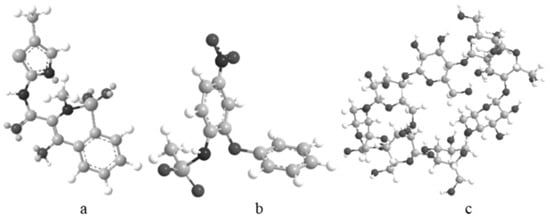
Substances used: The following were used in this study: γ-cyclodextrin, CAS No. 17465-86-0; meloxicam (4-hydroxy-2-methyl-N-(5-methyl-1,3-thiazol-2-yl)-1,1-dioxo-2H-1λ6,2-benzothiazine-3-carboxamide), CAS No. 71125-38-7; nimesulide (N-(4-nitro-2-phenoxyphenyl)methanesulphonamide), CAS No. 51803-78-2 (Figure 1).
Figure 1.
3D models of the molecules (a) meloxicam, (b) nimesulide, and (c) γ-CD, constructed and optimised using ChemOffice 16.0.
Molecular modelling of γ-cyclodextrin inclusion complexes with nimesulide and meloxicam was carried out using molecular mechanics methods [3]. The initial three-dimensional structures of the γ-cyclodextrin, nimesulide and meloxicam molecules were generated using the Avogadro 2 (Open Chemistry Project, USA) software. To investigate the effect of the relative arrangement of the components on the stability of the complex, several initial configurations were created (Table 1), differing in the orientation and position of the NSAID molecule relative to the cavity of the γ-cyclodextrin.
Table 1.
Description of the configurations selected for analysis.
The LAMMPS software package (version 22 July 2025, Update 4) was used for molecular mechanics simulations and geometric optimisation of the complexes. Geometric optimisation was carried out by minimising the potential energy of the system. The calculations employed real units and a simplified force model comprising the Lennard–Jones potential for non-covalent interactions and a harmonic potential for covalent bonds with a cut-off radius of 10 Å:
pair_style lj/cut 10.0
bond_style harmonic
The potential energy of the complexes under investigation was minimised using the Conjugate Gradient (CG) method with the LAMMPS (Sandia National Laboratories, Albuquerque, NM, USA) software package. The convergence criteria were set at 1·10−4 for energy and 1·10−6 for force; the maximum number of iterations was 1000, and the maximum number of force calculations was 10,000. An independent calculation was performed for each initial configuration, after which the initial and final values of the system’s potential energy were analysed.
Visualisation and subsequent analysis of the resulting molecular structures were carried out in VMD (Visual Molecular Dynamics) (University of Illinois Urbana-Champaign, Urbana-Champaign, IL, USA) using the TopoTools extension (VMD plugin, open-source project). Using VMD, we determined the geometric characteristics of the complexes, the positions of the molecules relative to one another, and the RMSD of the guest molecule, as well as analysing interatomic distances and possible hydrogen bonds.
To assess the energetic stability of the complexes, the binding energy was calculated as follows:
where
Ebind = Ecomplex − (Ehost + Eguest),
Ecomplex is the energy of the resulting complex;
Ehost is the energy of the host molecule (in our case, γ-cyclodextrin);
Eguest is the energy of the guest molecule (nimesulide/meloxicam).
The values of Ebind are calculated as the energy difference between the minimised structures, without taking into account the entropic contribution or the deformation of the molecules during complex formation.
3. Results and Discussion
The formation of inclusion complexes between the molecules of these drugs and the CD molecule is aimed at modifying their physicochemical properties and represents a current area of research in supramolecular chemistry. The aim of this work was to construct models and evaluate the stability of clathrate complexes of γ-CD with nimesulide and meloxicam. The simulation yielded stable, optimised structures for the γ-cyclodextrin complexes with nimesulide and meloxicam.
Table 2.
Calculated properties for the nimesulide–cyclodextrin complex.
Table 3.
Calculated properties for the meloxicam-cyclodextrin complex.
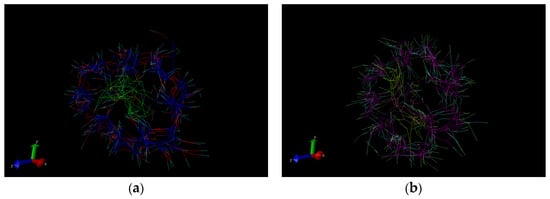
To assess the influence of the spatial orientation of the NSAID molecule within the γ-cyclodextrin cavity, five initial configurations were examined for each of nimesulide and meloxicam (Figure 2). The configurations differed in the orientation and position of the guest molecule relative to the cyclodextrin cavity. The following parameters were determined for each system: binding energy, the Root-Mean-Square Deviation (RMSD) of the guest molecule, distances characterising intermolecular contacts, and the distance between the geometric centres of the molecular structures.
Figure 2.
Superimposition of the spatial configurations of the molecules (a) γ-CD—nimesulide, (b) γ-CD—meloxicam.
For both complexes—γ-cyclodextrin with nimesulide and γ-cyclodextrin with meloxicam—the initial energy varied over a wide range due to differences in the initial atomic overlaps; following minimisation, all systems attained negative binding energies, calculated as the difference in energies between the minimised structures, excluding the entropic contribution. In the case of nimesulide, the structure in which the guest is initially displaced by 2 Å along the Z-axis within the host cavity relative to the initial position (N4) has the most negative binding energy; within the framework of the molecular-mechanical model used, this configuration is characterised by the most energetically favourable interaction between nimesulide and γ-cyclodextrin. For meloxicam, the most energetically favourable configuration was the structure in which the guest is initially rotated by 180 degrees about the Z-axis within the host cavity relative to the initial position, M2. A comparison with data from the literature shows that the binding energy values we obtained for complexes with γ-CD (−52.04–−64.43 kcal/mol for nimesulide) are higher than the energies calculated using the semi-empirical PM3 method for the nimesulide–β-CD complex (−10.21 kcal/mol) [4,5]. This difference is likely due to the use of different calculation methods (molecular mechanics/quantum chemistry), as well as the larger size of the γ-CD cavity, which allows the NSAID molecule to adopt a more favourable conformation. For meloxicam, our binding energy values (−49.80 to −63.67 kcal/mol) are qualitatively consistent with the data from a study in which the binding energy of the meloxicam–β-CD (1:2) complex was −34.08 kcal/mol [4,6]. However, a direct quantitative comparison is difficult due to differences in force fields and calculation conditions. The RMSD values for meloxicam ranged from 1.29 to 1.66 Å. The highest value was obtained for M5—1.66 Å—and the lowest for M3—1.29 Å. For M1, M2 and M4, the RMSD was 1.50, 1.38 and 1.55 Å, respectively. Overall, the RMSD values for meloxicam are slightly higher than those for nimesulide, which may indicate a slightly greater rearrangement of the spatial configuration of the molecule during minimisation. In the γ-cyclodextrin–nimesulide system, the smallest structural change was observed for N2 (1.18 Å), and the largest for N3 (1.46 Å). For the guest molecule meloxicam, the largest value was obtained for M4—1.66 Å, and the smallest for M2—1.38 Å. These values suggest that both guest molecules undergo a moderate rearrangement of their spatial configuration relative to the initial state in all selected configurations. When analysing the nearest H···A molecular contacts between the guest molecules and γ-cyclodextrin, it can be noted that the corresponding contacts cannot be classified as classical hydrogen bonds; it is likely that van der Waals interactions are observed here.
4. Conclusions
The results obtained demonstrate the potential of molecular modelling methods for the preliminary assessment of the stability of cyclodextrin inclusion complexes with drug substances. The proposed approach can be used in the rational design of supramolecular systems and in planning their subsequent experimental investigation.
Author Contributions
Conceptualization, E.G. and V.P.; methodology, E.G.; software, V.P.; validation, E.G. and V.P.; formal analysis, V.P.; investigation, V.P.; resources, V.P.; data curation, V.P.; writing—original draft preparation, V.P.; writing—review and editing, E.G.; visualization, V.P.; supervision, E.G.; project administration, E.G.; funding acquisition, E.G. All authors have read and agreed to the published version of the manuscript.
Funding
This research received no external funding.
Institutional Review Board Statement
Not applicable.
Informed Consent Statement
Not applicable.
Data Availability Statement
The original contributions presented in this study are included in the article. Further inquiries can be directed to the corresponding author.
Acknowledgments
The author expresses gratitude to the academic supervisor, Elena Vladimirovna Grekhneva, for setting the task and discussing the results, as well as to the staff of the Department of Chemistry at Kursk State University for creating a favorable working atmosphere. During the preparation of this study, the author’s used ChatGPT (GPT-6, OpenAI) for the purposes of language refinement, interpretation of molecular modelling results. The authors have reviewed and edited the output and take full responsibility for the content of this publication.
Conflicts of Interest
The authors declare no conflict of interest.
Abbreviations
The following abbreviations are used in this manuscript:
| NSAIDs | Non-steroidal anti-inflammatory drugs |
| CD | Cyclodextrin |
| RMSD | Root-Mean-Square Deviation |
| CG | Conjugate Gradient |
| VMD | Visual Molecular Dynamics |
References
- Suldin, A.S.; Puchnina, S.V.; Suldin, A.V. Optimisation of the composition of the anti-inflammatory medicinal product Piron. Pharmacy 2020, 69, 34–39. [Google Scholar] [CrossRef] [Scilit]
- Bykov, E.S. Adsorption of Volatile Organic Compounds on a Carbon Adsorbent Modified with Bilayers of “Liquid Crystal—β-Cyclodextrin: Specialisation 1.4.4 ‘Physical Chemistry’. Ph.D. Thesis, Samara National Research University Named After Academician S. P. Korolev, Samara, Russia, 2021. [Google Scholar]
- Grekhneva, E.V.; Barteneva, E.S.; Efanov, K.S. Peculiarities of Obtaining and Modelling the Structure of Nimesulide Clathrate Complexes with β- and γ-Cyclodextrins. Chem. Proc. 2022, 12, 53. [Google Scholar] [CrossRef] [Scilit]
- Rymar, M.V.; Vetiutneva, N.A. Comparative Study of the Mechanisms of Interaction of Nimesulide, Meloxicam and Ibuprofen with β-Cyclodextrin: Semi-Empirical Method of Quantum Chemistry. In Actual Questions of Development of New Drugs, Proceedings of theAbstracts of XX International Scientific and Practical Conference of Young Scientists and Students, Kharkiv, Ukraine, 22–23 April 2014; National University of Pharmacy: Kharkiv, Ukraine, 2014; p. 75. [Google Scholar]
- Ravelet, C.; Geze, A.; Villet, A.; Grosset, C.; Ravel, A.; Wouessidjewe, D.; Peyrin, E. Chromatographic determination of the association constants between nimesulide and native and modified beta-cyclodextrins. J. Pharm. Biomed. Anal. 2002, 29, 425–430. [Google Scholar] [CrossRef] [Scilit] [PubMed]
- Banerjee, R.; Chakraborty, H.; Sarkar, M. Host-guest complexation of oxicam NSAIDs with beta-cyclodextrin. Biopolymers 2004, 75, 355–365. [Google Scholar] [CrossRef] [Scilit] [PubMed]

Disclaimer/Publisher’s Note: The statements, opinions and data contained in all publications are solely those of the individual author(s) and contributor(s) and not of MDPI and/or the editor(s). MDPI and/or the editor(s) disclaim responsibility for any injury to people or property resulting from any ideas, methods, instructions or products referred to in the content. |
© 2026 by the authors. Licensee MDPI, Basel, Switzerland. This article is an open access article distributed under the terms and conditions of the Creative Commons Attribution (CC BY) license.