


Abstract
Breast cancer continues to rank among the major causes of cancer-related deaths globally, highlighting the need for the development of new, safe, and multitargeted therapeutic agents. In the current research, the anticancer potential of Holoptelea integrifolia (Roxb.) Planch against breast cancer was investigated using molecular docking and ADMET analysis. An integrated approach was applied for the discovery of phytochemicals with anticancer activity, identification of their potential target molecules and assessment of favorable pharmacokinetic and drug-like properties. Phytochemicals from Holoptelea integrifolia (Roxb.) were initially subjected to drug-likeness and ADMET (Absorption, Distribution, Metabolism, Excretion, Toxicity) profiling using SwissADME. Subsequently, phytochemicals exhibited favorable predicted drug-likeness, and pharmacokinetic properties were selected for molecular docking using Maestro v 13.7 (Schrodinger Ltd., Wilmington, DE, USA) software to explore their possible binding properties with the EGFR (Epidermal growth factor receptor) (PDB ID: 4HJO), obtained from the RCSB Protein Data Bank. Among the twelve screened compounds, four exhibited profiles within the predefined acceptable criteria. Further, molecular docking of the selected four compounds revealed that stigmasterol presents the most favorable binding interactions against the EGFR, with a docking score of −4.355 Kcal/mol. Overall, these findings provide a computational framework for exploring the molecular interaction between the phytochemicals from Holoptelea integrifolia and the EGFR, thereby supporting their consideration as preliminary computational candidates for further experimental investigations against breast cancer.
1. Introduction
Breast cancer continues to be a major and multifactorial health problem affecting millions of people around the world [1]. According to the most recent statistics provided by the World Health Organization, approximately 2.3 million new cases of breast cancer were identified in 2022. Despite considerable advances in early diagnostic and treatment options, breast cancer is still a major challenge characterized by high recurrence rates and treatment resistance. The limitations of existing treatments emphasize the need for an innovative strategy for the prevention and treatment of this disease [2].
Over the years, advances in molecular oncology have led to the development of several therapeutic approaches that specifically target molecules involved in tumor development and survival. One of the first identified targets of these novel anticancer drugs is the epidermal growth factor receptor (EGFR). EGFR overexpression has been reported in approximately 50 percent of TNBC and IBC cases. Consequently, numerous studies have investigated the potential use of EGFR inhibitors for the treatment of breast cancer [3].
Products derived from diverse natural sources may modulate multiple physiological pathways and could therefore be useful in the treatment of complex diseases such as cancer [4]. For many years, cancer has remained a challenging disease to treat, highlighting the need for diverse and innovative approaches to combat the cancer. In an effort to address this challenge, plant-derived compounds have attracted considerable attention as a potential source of anticancer agents. Numerous studies have investigated the development of cancer therapies from natural compounds [5,6].
Lakshmi et al. reported the effect of Holoptelea integrifolia on Dalton’s ascitic lymphoma in Swiss albino mice. The ethanolic extract of the leaves of H. integrifolia was evaluated for its antineoplastic activity at doses of 250 and 500 mg/kg body weight. The study was conducted to evaluate the effects of ethanolic extract of Holoptelea integrifolia on the tumor volume, tumor cells, viable tumor cells, mean survival time, and life span increment. The findings demonstrated the anti-neoplastic potential of the crude extract of the test plant [7]. In the present study, we investigated the anticancer effects of Holoptelea integrifolia (Roxb). against breast cancer via the inhibition of EGFR tyrosine kinase.
2. Materials and Methods
- In silico ADMET analysis of the selected compounds
The phytocompounds selected from Holoptelea integrifoila (ROXB) were screened for drug-likeness and ADMET properties using SWISS ADME (http://www.swissadme.ch, accessed on 1 September 2026). Based on the screening results, the compounds were evaluated for human intestinal absorption, blood–brain barrier permeation, CYP1A2 inhibition, CYP2C19 inhibition, CYP3A4 inhibition, CYP2D6 inhibition and LD50 values [8].
2.1. Molecular Docking
Based on the ADMET profiling, the compounds that met the predefined criteria for ADMET and drug-likeness properties were subjected to molecular docking to assess their predicted binding affinity of the ligands with the selected protein target. The protein target was obtained from the Protein Data Bank (https://www.rcsb.org/). Molecular docking was performed using Maestro v 13.7 (Schrodinger Ltd., Wilmington, DE, USA), and the visualization was done using Discovery studio visualizer 2021 [9]. The protein structures were prepared by removing the water molecules, heteroatoms, and co-crystallized ligands to avoid potential interferences during the molecular docking process. The polar hydrogen atoms were subsequently added to facilitate precise modeling of the interactions between the molecules. Atomic charges and atom types were assigned accordingly. The LigPrep module was employed to prepare the ligands by minimizing and optimizing the molecules using the OPLS4 force field. Molecular docking was performed using the Ligand Docking module, in which docking of the ligands was done against the target proteins using the Extra Precision (XP) mode. The docking search space was defined by generating a grid box around the co-crystallized ligand-binding site of the receptor. The grid dimensions and coordinates were determined using Discovery studio visualizer 2021 to ensure maximum coverage of the active binding site. The grid box was centered at center x = 24.13, center y = 8.64, center z = 10.21. Grid box dimension size x = 20, y = 20, z = 20 [10].
2.2. Analysis of Boiled Egg Model
To predict the gastrointestinal (GI) absorption and blood–brain barrier (BBB) permeability, the pharmacokinetic properties of stigmasterol were analyzed using Boiled egg (Brain Or Intestinal Estimate of Drug-likeness) model. The SMILES notation for the stigmasterol molecule was acquired from the chemical database and submitted to the SwissADME (https://www.swissadme.ch/ accessed on 1 September 2026). The Boiled egg model was generated based on the lipophilicity and topological polar surface area (TPSA) of the compound. The position of stigmasterol within the Boiled egg diagram was used to predict its GI absorption and potential for penetration across BBB [11].
3. Results and Discussions
3.1. In Silico ADMET Analysis
In silico ADMET profiling of the 11 selected phytoconstituents and one standard drug revealed considerable variations in the drug-likeness, GI absorption, BBB (Blood Brain Barrier) permeability, CYP enzyme interaction prediction, and predicted acute toxicity (LD50DM). Based on Lipinski’s rule of five, the majority of the investigated compounds, such as oleanolic acid, β-sitosterol, friedelin, stigmasterol, quercetin, maritimetin, gnididilatin, betulin, β-amyrin, and the standard drug Erlotinib, were classified as “Accepted”, implying that these compounds are likely to meet the physicochemical properties required for oral drug-likeness. Daucosterol and rutin, however, were categorized as “Rejected” compounds based on Lipinski’s rule of five, suggesting that these compounds do not satisfy certain Lipinski criteria and hence are likely to have limited oral bioavailability. The predicted human intestinal absorption (HIA) profile showed that maritimetin was the only compound predicted to have positive HIA (+), while oleanolic acid, β-sitosterol, daucosterol, friedelin, stigmasterol, quercetin, rutin, gnididilatin, betulin, β-amyrin, and Erlotinib were predicted to have negative HIA (−). Therefore, maritimetin is the only compound among the investigated drugs that has the most favorable HIA predictions. Regarding BBB permeation, oleanolic acid, friedelin, gnididilatin, and β-amyrin were predicted to be positive (+), suggesting that these compounds may possess compatible physicochemical properties. CYP450 inhibition profiles also revealed differences in the potential interaction of the identified compounds with CYP enzymes. Oleanolic acid, β-sitosterol, daucosterol, stigmasterol, betulin, β-amyrin, and Erlotinib were not predicted to inhibit CYP1A2, CYP2C19, CYP3A4, or CYP2D6 enzymes, signifying a lower predicted potential for drug–drug interactions for CYP-mediated enzymes. Quercetin and maritimetin were both predicted to inhibit CYP1A2 and CYP3A4 enzymes. Friedelin was predicted to inhibit the CYP2C19 enzyme, whereas gnididilatin was predicted to inhibit CYP2C19 and CYP2D6. The predicted LD50DM values ranged from 4.4 to 6.4, suggesting variability in the acute toxicity potential of the compounds. Among the compounds, quercetin had the smallest predicted LD50DM value (4.4), followed by rutin (4.6), maritimetin (4.9), and paclitaxel (5.0), while gnididilatin had the largest (6.4). For oleanolic acid (5.5), β-sitosterol (5.1), daucosterol (5.1), friedelin (5.3), stigmasterol (5.2), betulin (5.2), and β-amyrin (5.4), the predicted values were intermediate. The standard drug Erlotinib was Lipinski-accepted but showed negative HIA and BBB predictions and no predicted inhibition of the four CYP enzymes evaluated (Table 1).
Table 1.
In silico ADMET screening of the selected phytoconstituents.
3.2. Molecular Docking Analysis
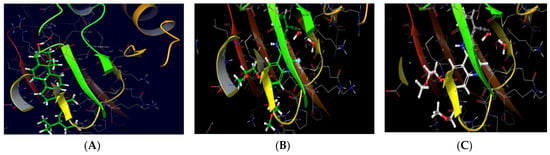
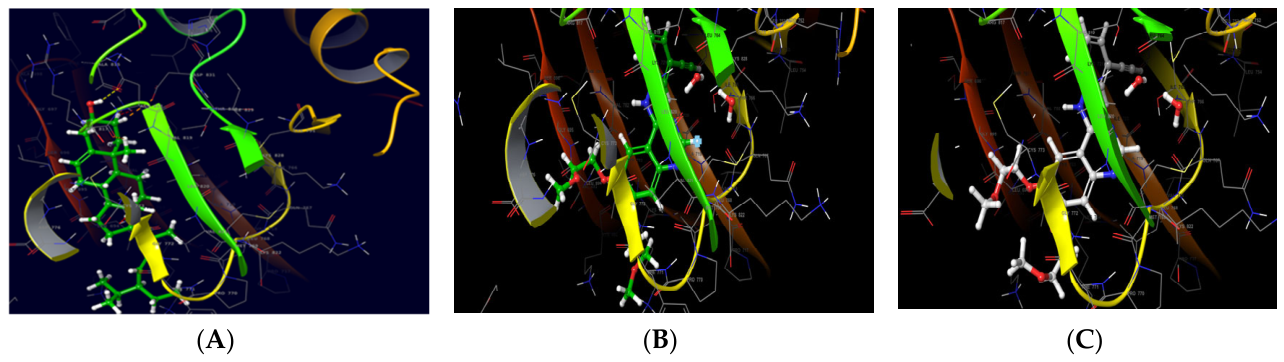
The final selected compounds identified through the ADMET screening, along with the standard drug, was docked against the target protein 4HJO. The docking scores varied considerably among the molecules evaluated in this study. Stigmasterol showed the most favorable docking score of −4.477 kcal/mol, followed by betulin (−3.750 kcal/mol), β-sitosterol (−3.482 kcal/mol), and Erlotinib (−9.524 kcal/mol). The MM/GBSA binding free energy calculations provided additional insights into the predicted energetic stability of the docked complexes. Among the phytoconstituents analyzed in this study, stigmasterol showed a ΔG_bind value of −16.82 kcal/mol, while those of β-sitosterol, betulin, and Erlotinib were found to be −28.07, −10.43, and −76.10 kcal/mol, respectively. All the compounds exhibited a negative MM/GBSA binding free energy value, suggesting favorable ligand-protein complex formation within the computational model (Table 2). Figure 1 represents the three-dimensional interaction of the best-docked compound stigmasterol (A) and the standard drug Erlotinib (B) against the 4HJO target. Prior to docking assessment of the selected phytoconstituents, the docking procedure was validated by self-docking the native ligand co-crystallized with the target. When the re-docked ligand (AQ4) was docked to the EGFR crystal structure (4HJO), the docking score obtained was −7.539 kcal/mol. In addition, when a 3-D interaction study was performed, it was revealed that the re-docked ligand was able to reproduce the binding interactions seen in the experimental crystal structure. The satisfactory reproduction of the binding interaction of the native ligand confirms the adequacy of the docking parameters used (Figure 1C).
Table 2.
Docking score and binding free energy of the docked compounds.
Figure 1.
Three-dimensional interaction of best-docked compound stigmasterol (A), standard drug Erlotinob (B) against 4HJO target, and interaction diagrams of re-docking of native co-crystallized ligands of AQ4 with 4JHO (C).
3.3. Boiled Egg Model Analysis
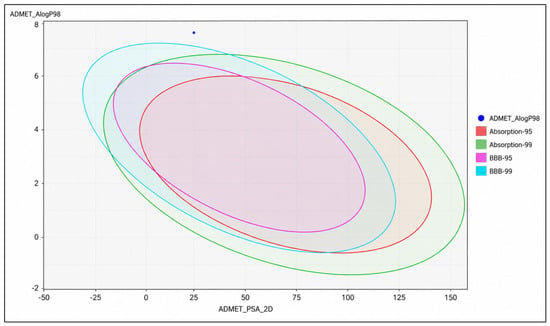
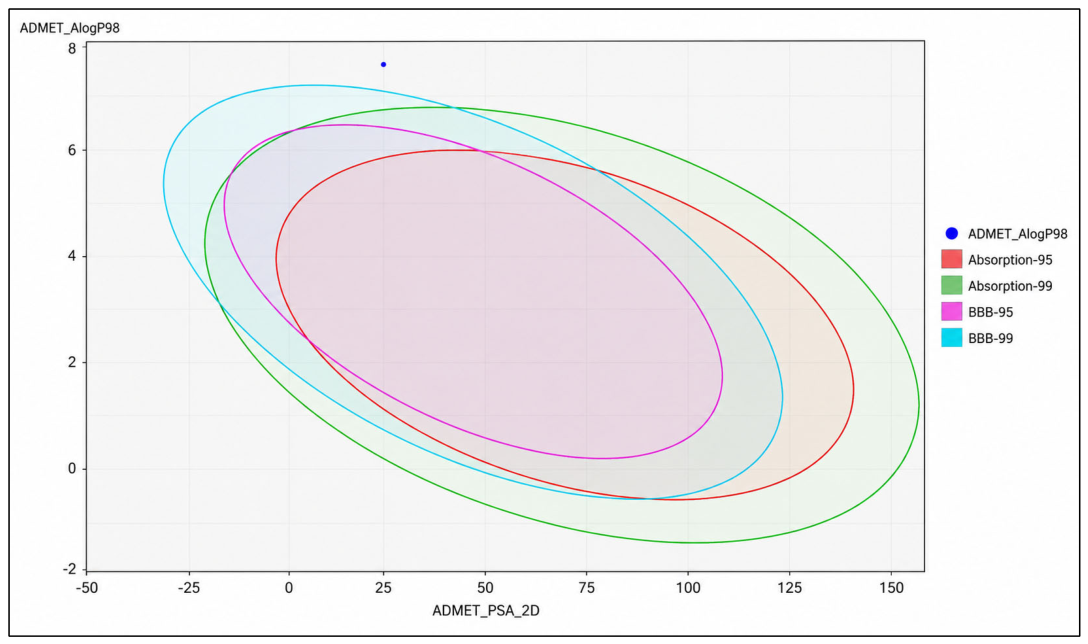
Based on the Boiled egg analysis plot, stigmasterol exists within a chemical space characterized by a low polar surface area (about 20–25 Å2) in two-dimensional space and a high AlogP (around 7.5) value. Stigmasterol was positioned outside the 95% and 99% confidence intervals for both intestinal absorption and blood–brain barrier permeability, associated with a poor prediction of the compound’s ADMET profile for intestinal and CNS permeation. The high lipophilicity of stigmasterol may enhance its membrane binding affinity but can also reduce its solubility in water, potentially resulting in inefficient oral absorption (Figure 2).
Figure 2.
Boiled egg analysis plot for the phytocompounds—stigmasterol.
4. Limitations
The present study has several limitations that should be considered when interpreting the results obtained. Firstly, the study was primarily computational; therefore, predicted interactions and binding energies cannot be considered as direct biochemical evidence of EGFR inhibition or antitumor activity. The molecular docking and MM/GBSA approach also have inherent methodological limitations, and differences were observed in the ranking of compounds based on the computational parameters evaluated. None of the phytochemicals consistently demonstrated better results across all criteria examined. Therefore, these compounds should be regarded as computationally selected compounds rather than experimentally validated EGFR inhibitors. Secondly, biochemical assays are required to assess the actual inhibitory activity of the selected compounds against EGFR; subsequently, cellular studies should be conducted to evaluate their effects on the viability of the breast cancer cells and EGFR-mediated signaling.
5. Conclusions
In the current study, an in silico evaluation of phytochemicals derived from Holoptelea integrifolia was conducted to assess their predicted interactions with the EGFR (PDB ID: 4HJO) as an important therapeutic target in breast cancer. ADMET screening identified four suitable phytochemical candidates with suitable drug-like characteristics; among these phytochemicals, stigmasterol showed the most favorable docking score (−4.477 kcal/mol). However, the MM/GBSA binding free energy of stigmasterol −16.82 kcal/mol was less favorable. Furthermore, Boiled egg analysis predicted poor gastrointestinal absorption and limited BBB (blood–brain barrier) penetration for stigmasterol.
Author Contributions
Conceptualization, A.A.; methodology, A.A. and K.M.; writing—original draft preparation, A.A.; writing—review and editing, A.A. and K.M. All authors have read and agreed to the published version of the manuscript.
Funding
This research received no external funding.
Institutional Review Board Statement
Not applicable.
Informed Consent Statement
Not applicable.
Data Availability Statement
The original contributions presented in this study are included in the article.
Acknowledgments
The authors express heartfelt gratitude to the leadership and management of JSS College of Pharmacy, JSS Academy of Higher Education & Research, Mysuru, Karnataka, India. During the preparation of the manuscript, the authors used grammarly tool for language pol-ishing, grammar correction, and improvement of textual clarity in line with the journal’s re-quirements. The authors have reviewed and edited the output revised and take full responsibil-ity for the content of this publication.
Conflicts of Interest
The authors declare no conflicts of interest.
References
- Obeagu, E.I.; Obeagu, G.U. Breast cancer: A review of risk factors and diagnosis. Medicine 2024, 103, e36905. [Google Scholar] [CrossRef] [Scilit]
- Anand, A.; SNanjundiah, M.; Mruthunjaya, K. Network pharmacology, molecular docking, DFT analysis and in-vitro assessment of Syzygium cumini L. as an inhibitor of STAT-3 and JUN against breast cancer. Results Chem. 2026, 28, 103430. [Google Scholar] [CrossRef] [Scilit]
- Masuda, H.; Zhang, D.; Bartholomeusz, C.; Doihara, H.; Hortobagyi, G.N.; Ueno, N.T. Role of epidermal growth factor receptor in breast cancer. Breast Cancer Res. Treat. 2012, 136, 331–345. [Google Scholar] [CrossRef] [Scilit]
- Cragg, G.M.; Newman, D.J. Plants as a source of anti-cancer agents. J. Ethnopharmacol. 2005, 100, 72–79. [Google Scholar] [CrossRef] [Scilit]
- Burns, J.; Yokota, T.; Ashihara, H.; Lean, M.E.J.; Crozier, A. Plant Foods and Herbal Sources of Resveratrol. J. Agric. Food Chem. 2002, 50, 3337–3340. [Google Scholar] [CrossRef] [Scilit]
- Mans, D.R.A.; Rocha, A.B.; Schwartsmann, G. Anti-Cancer Drug Discovery and Development in Brazil: Targeted Plant Collection as a Rational Strategy to Acquire Candidate Anti-Cancer Compounds. Oncologist 2000, 5, 185–198. [Google Scholar] [CrossRef] [Scilit]
- Kumar, V.; Singh, S.; Bhadouria, R.; Singh, R.; Prakash, O. Phytochemical, Analytical and Medicinal Studies of Holoptelea integrifolia Roxb. Planch—A Review. Curr. Tradit. Med. 2019, 5, 270–277. [Google Scholar] [CrossRef] [Scilit]
- Saritha, K.; Alivelu, M.; Mohammad, M. Drug-likeness analysis, in silico ADMET profiling of compounds in Kedrostis foetidissima (Jacq.) Cogn, and antibacterial activity of the plant extract. In Silico Pharmacol. 2024, 12, 67. [Google Scholar] [CrossRef] [Scilit]
- Borah, S.; Rajkumari, J.D.; Mahanta, S.; Goswami, N. Computational Identification of Paederia foetida Linn. Phytochemicals as Potential Inhibitors of Staphylococcus aureus Peptide Deformylase. Cell Biochem Biophys. 2026, 84, 3845–3872. [Google Scholar] [CrossRef] [Scilit]
- Awadelkareem, A.M.; Al-Shammari, E.; Elkhalifa, A.E.O.; Adnan, M.; Siddiqui, A.J.; Snoussi, M.; Khan, M.I.; Azad, Z.R.A.A.; Patel, M.; Ashraf, S.A. Phytochemical and In Silico ADME/Tox Analysis of Eruca sativa Extract with Antioxidant, Antibacterial and Anticancer Potential against Caco-2 and HCT-116 Colorectal Carcinoma Cell Lines. Molecules 2022, 27, 1409. [Google Scholar] [CrossRef] [Scilit]
- Ahmad, I.; Khan, H.; Serdaroğlu, G. Physicochemical properties, drug likeness, ADMET, DFT studies, and in vitro antioxidant activity of oxindole derivatives. Comput. Biol. Chem. 2023, 104, 107861. [Google Scholar] [CrossRef] [Scilit]

Disclaimer/Publisher’s Note: The statements, opinions and data contained in all publications are solely those of the individual author(s) and contributor(s) and not of MDPI and/or the editor(s). MDPI and/or the editor(s) disclaim responsibility for any injury to people or property resulting from any ideas, methods, instructions or products referred to in the content. |
© 2026 by the authors. Licensee MDPI, Basel, Switzerland. This article is an open access article distributed under the terms and conditions of the Creative Commons Attribution (CC BY) license.