


Abstract
A series of acridine derivatives was synthesized through the microwave-assisted condensation of β-enaminones with benzaldehyde using a rapid and simple protocol. The antibacterial properties of the synthesized compounds were investigated in silico by molecular docking against Bacillus anthracis dihydropteroate synthase (BaDHPS, PDB ID: 3TYE), an essential enzyme involved in bacterial folate biosynthesis. The synthesized derivatives exhibited docking scores ranging from −4.80 to −6.14 kcal/mol, compared with −8.65 kcal/mol for the reference ligand. A4 showed the most favorable score (−6.14 kcal/mol). These findings identify A4 as the most promising members of the series and support their further investigation as potential antibacterial candidates.
1. Introduction
Acridine and its derivatives represent an important class of nitrogen-containing heterocyclic compounds that has attracted considerable interest in medicinal and pharmaceutical chemistry. The characteristic planar tricyclic framework of acridine provides favorable structural features for interactions with a variety of biological targets and allows extensive chemical modification at different positions of the heterocyclic core [1]. Consequently, acridine-based compounds have been associated with a broad spectrum of pharmacological properties and have been investigated as potential therapeutic agents for several diseases, including cancer [2], malaria, and neurodegenerative disorders [3]. In addition, numerous acridine derivatives have displayed antibacterial, antioxidant, anticonvulsant, analgesic, and carbonic anhydrase inhibitory activities, highlighting the versatility of this privileged heterocyclic scaffold in drug discovery [4].
Among these biological properties, antibacterial activity is of particular interest because the emergence and dissemination of antimicrobial resistance continue to reduce the effectiveness of existing antibacterial agents. The development of structurally diverse molecules capable of interacting with essential bacterial targets therefore remains an important area of medicinal chemistry research. Acridine derivatives are attractive candidates in this context because structural modification of the acridine nucleus can considerably influence their physicochemical properties and interactions with biological macromolecules [5].
At the same time, the development of more sustainable synthetic methodologies has become an important objective in modern organic chemistry. Microwave-assisted organic synthesis has emerged as an efficient alternative to conventional heating, frequently enabling significant reductions in reaction time while providing efficient and reproducible access to heterocyclic compounds [6]. Moreover, combining microwave irradiation with catalyst-free reaction conditions can improve the sustainability and operational simplicity of synthetic procedures by reducing the use of additional reagents and minimizing chemical waste.
In the present work, a series of acridine derivatives was synthesized through the microwave-assisted condensation of various β-enaminones with aromatic aldehydes under catalyst-free conditions. To complement the synthetic study and explore the potential antibacterial properties of the obtained compounds at the molecular level, an in silico molecular docking investigation was performed against Bacillus anthracis dihydropteroate synthase (BaDHPS), an enzyme involved in bacterial folate biosynthesis. This computational approach provides a basis for identifying promising acridine derivatives for further investigation as potential antibacterial agents.
2. Materials and Methods
2.1. Chemistry
The synthesis of acridines was done according to the method described by Bouone et al. [7].
2.2. Molecular Docking
The X-ray crystal structure of Bacillus anthracis dihydropteroate synthase (BaDHPS) in complex with DHP-STZ (PDB ID: 3TYE) [8] was retrieved from the RCSB Protein Data Bank. The protein structure was prepared using the Protein Preparation Wizard implemented in the Schrödinger Suite 2021-3. Protein preparation included the assignment of bond orders, addition of hydrogen atoms, optimization of the hydrogen-bonding network, determination of appropriate protonation states, removal of crystallographic artifacts, and energy minimization.
The three-dimensional structures of ligands A1–A4 and the reference ligand were generated using Maestro and subsequently prepared and energy-minimized with LigPrep using the OPLS4 force field [9]. Following protein and ligand preparation, molecular docking simulations were performed using Glide in extra precision (XP) mode [10]. The ligands were docked into the active site of BaDHPS to predict their preferred binding orientations and characterize the key protein–ligand interactions. The resulting docked complexes and their intermolecular interactions were subsequently analyzed and visualized using BIOVIA Discovery Studio Visualizer version v21.1.0.20298 [11]. Receptor grids were generated using the Receptor Grid Generation module of Glide. For the target protein, the grid center was set at X = −90.571, Y = 76.515, and Z = 82.844 Å, with an outer grid box of 30 × 30 × 30 Å and a ligand docking box of 10 × 10 × 10 Å.
3. Results and Discussion
3.1. Chemistry
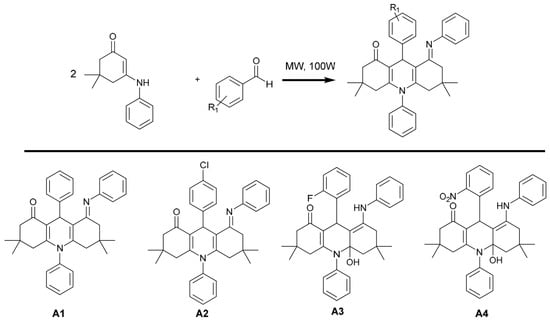
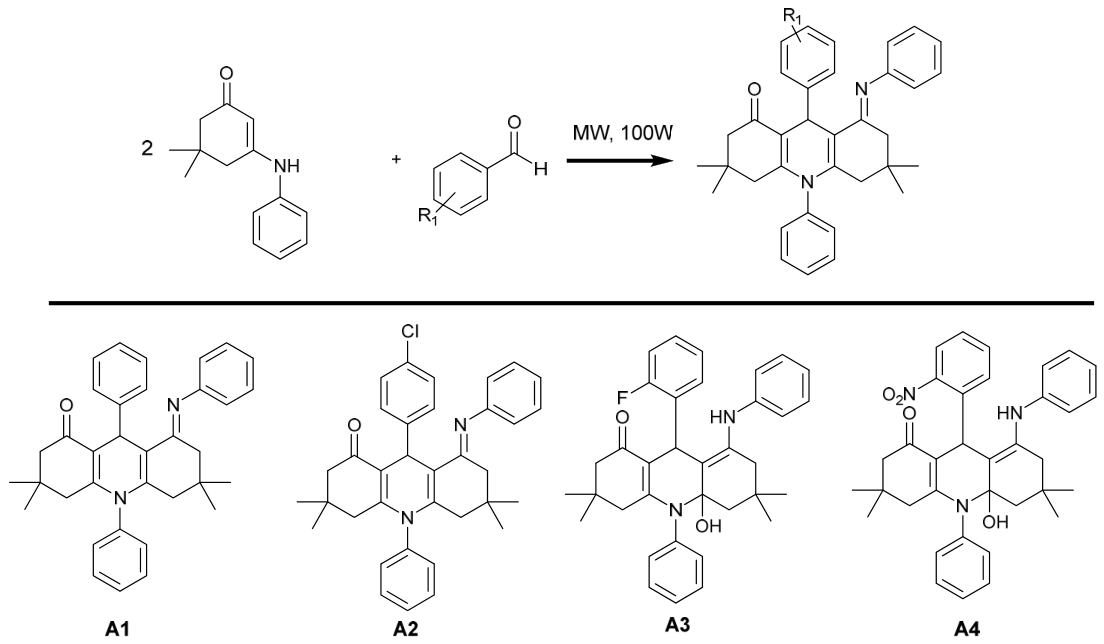
Acridine derivatives A1–A4 were synthesized by microwave-assisted condensation of β-enaminones (1 mmol, 2 equiv.) with the corresponding aromatic aldehydes (0.5 mmol, 1 equiv.) in a minimum amount of ethanol (0.5 mL). The reaction mixtures were irradiated under microwave conditions for 3–12 min and monitored by TLC. After completion, methanol (3 mL) was added, and the products were crystallized at 6 °C overnight, followed by filtration and drying to afford the desired acridine derivatives in good yields (Figure 1).
Figure 1.
Synthesized acridine derivatives A1–A4.
3.2. Molecular Docking
Molecular docking was performed to investigate the potential binding modes of the synthesized acridine derivatives A1–A4 within the active site of Bacillus anthracis dihydropteroate synthase (BaDHPS). The crystallographic ligand DHP-STZ was used to assess the reliability of the docking protocol. The DHP-STZ was redocked into the BaDHPS active site using the same docking procedure applied to the synthesized compounds, and the calculated root mean square deviation (RMSD) between the experimentally determined and predicted binding poses was 1.60 Å. This RMSD value indicates a satisfactory reproduction of the crystallographic binding orientation and supports the reliability of the applied docking protocol.
The docking scores obtained for the synthesized compounds are summarized in Table 1. The calculated scores ranged from 4.80 to −6.14 kcal/mol, whereas the reference ligand displayed a more favorable docking score of −8.65 kcal/mol. Among the synthesized acridine derivatives, A4 exhibited the most favorable docking score (−6.14 kcal/mol), followed by A3 (−5.98 kcal/mol), A2 (−5.20 kcal/mol), and A1 (−4.80 kcal/mol). The more negative docking scores observed for A4 and A3 indicate more favorable predicted ligand–protein interactions compared with A2 and A1 under the applied docking conditions.
Table 1.
Docking score of synthesized compounds (A1–A4) and reference ligand.
The relatively favorable docking score obtained for A4 suggests that this derivative can adopt a suitable orientation within the BaDHPS binding cavity and establish a favorable network of non-covalent interactions with the surrounding amino acid residues. A3 also showed a relatively strong predicted binding score of −5.98 kcal/mol, indicating that its molecular structure permits favorable accommodation within the active site.
The differences in docking scores among the derivatives indicate that structural modifications within this series can influence their predicted interaction with BaDHPS. The planar aromatic acridine framework may contribute to the accommodation of these compounds within the enzyme binding cavity, while the nature and position of substituents may affect their orientation and the extent of favorable interactions with the surrounding residues. Thus, the docking results suggest that A4 and A3 are the most promising members of the investigated series based on their predicted binding scores.
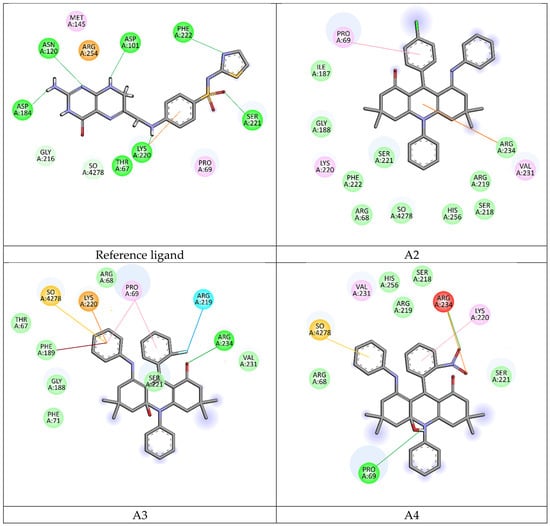
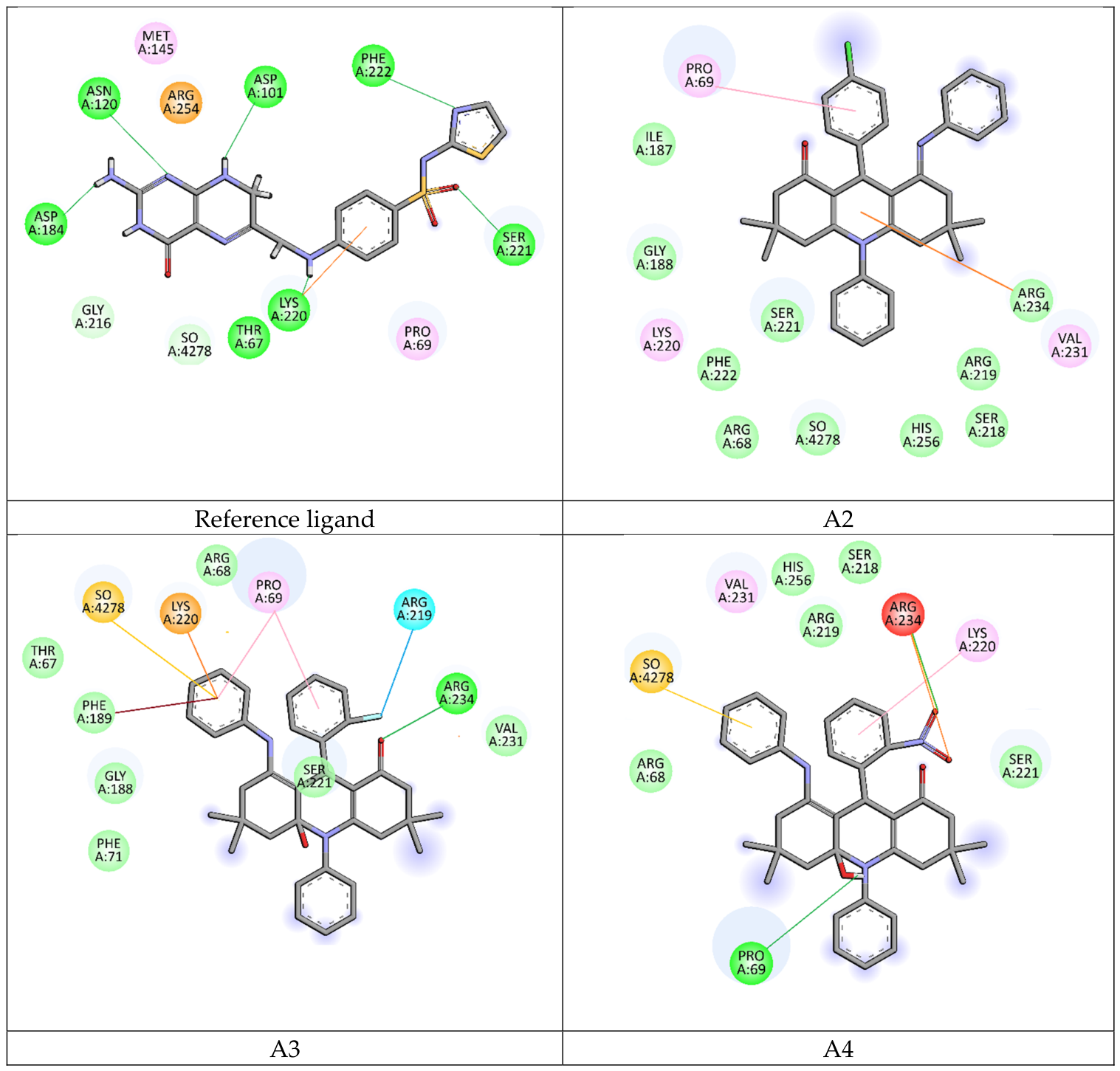
The predicted binding modes of the synthesized acridine derivatives within the BaDHPS active site were analyzed using BIOVIA Discovery Studio Visualizer. The reference ligand established an extensive interaction network with the enzyme, including six hydrogen bonds involving Phe222, Ser221, Lys220, Asp101, Asn120, and Asp184, together with a π-cation interaction with Lys220. These multiple interactions are consistent with the more favorable docking score obtained for the reference ligand and indicate strong predicted stabilization of the ligand within the BaDHPS binding site.
In comparison, A2 did not form any hydrogen bonds with the active site residues but established a π-cation interaction with Arg234 and a π-alkyl interaction with Pro69. Nevertheless, the presence of aromatic and hydrophobic interactions indicates that A2 can be accommodated within the BaDHPS binding pocket through non-covalent interactions.
Among the synthesized derivatives, A3 displayed a particularly rich interaction pattern. It formed a hydrogen bond with Arg234 and a π–π stacked interaction with Phe189. In addition, A3 established a halogen interaction with Arg219, a π-cation interaction with Lys220, a π-sulfur interaction with SO4278, and a π-alkyl interaction with Pro69. Several additional hydrophobic contacts were observed with Arg68, Phe71, Ser221, Thr67, and Val231. The combination of hydrogen bonding, aromatic stacking, electrostatic, sulfur-associated, and hydrophobic contacts provides a favorable interaction network that may contribute to the relatively strong predicted binding of A3 within the BaDHPS active site.
A4 also exhibited a favorable and diverse interaction pattern within the BaDHPS binding cavity. The ligand formed two hydrogen bonds involving Pro69 and Arg234, together with a π-cation interaction with Arg234. Additional interactions included a π-sulfur interaction with SO4278 and a π-alkyl interaction with Lys220. A4 also established hydrophobic contacts with Ser218, His256, Arg68, and Ser221. The simultaneous presence of hydrogen-bonding, sulfur-associated, and hydrophobic interactions suggests that A4 is able to establish multiple stabilizing contacts within the binding pocket (Figure 2).
Figure 2.
Binding interactions of the studied compounds within the active site of BaDHPS.
Overall, the interaction analysis provides structural support for the docking score ranking of the synthesized compounds. A4, which exhibited the most favorable docking score among A1–A4, established two hydrogen bonds and several additional electrostatic and hydrophobic interactions, suggesting favorable accommodation within the BaDHPS active site.
4. Conclusions
In conclusion, a series of acridine derivatives A1–A4 was successfully prepared using a rapid microwave-assisted synthetic approach. Molecular docking against BaDHPS revealed differences in predicted binding affinity depending on the structural features of the derivatives. The docking protocol was successfully validated by redocking DHP-STZ, giving an RMSD of 1.60 Å. Among the synthesized compounds, A4 exhibited the most favorable docking score (−6.14 kcal/mol), followed by A3 (−5.98 kcal/mol), compared with −8.65 kcal/mol for the reference ligand. Interaction analysis showed that A4 formed two hydrogen bonds with Pro69 and Arg234, together with π-cation, π-sulfur, π-alkyl, and hydrophobic interactions, while A3 displayed a diverse network of hydrogen-bonding, π–π stacking, halogen, electrostatic, and hydrophobic contacts.
Author Contributions
Conceptualization, A.B. and R.M.; methodology, A.B.; software, A.B.; validation, I.Z.; formal analysis, R.M.; investigation, A.B.; writing—original draft preparation, A.B.; writing—review and editing, A.B. All authors have read and agreed to the published version of the manuscript.
Funding
This work was supported financially by the General Directorate for Scientific Research and Technological Development (DG-RSDT) and Algerian Ministry of Scientific Research, Applied Organic Chemistry Laboratory (FNR 2000).
Institutional Review Board Statement
Not applicable.
Informed Consent Statement
Not applicable.
Data Availability Statement
Data are available in this manuscript.
Acknowledgments
During the preparation of this manuscript, the authors used Chatgpt (OpenAI, GPT-6) for the purposes of correcting grammatical and spelling errors, improving sentence structure, and enhancing the clarity and readability of the manuscript. The authors have reviewed and edited the output and take full responsibility for the content of this publication.
Conflicts of Interest
The authors declare no conflicts of interest.
References
- Denny, W.A. Chemotherapeutic effects of acridine derivatives. Med. Chem. Rev. 2004, 1, 257–266. [Google Scholar] [CrossRef] [Scilit]
- Kaya, M.; Basar, E.; Çakir, E.; Tunca, E.; Bülbül, M. Synthesis and characterization of novel dioxoacridine sulfonamide derivatives as new carbonic anhydrase inhibitors. J. Enzyme Inhib. Med. Chem. 2012, 27, 509–514. [Google Scholar] [CrossRef] [Scilit] [PubMed]
- Fonte, M.; Tassi, N.; Gomes, P.; Teixeira, C. Acridine-Based Antimalarials—From the Very First Synthetic Antimalarial to Recent Developments. Molecules 2021, 26, 600–618. [Google Scholar] [CrossRef] [Scilit] [PubMed]
- Sondhi, S.M.; Bhattacharjee, G.; Jameel, R.K.; Shukla, R.; Raghubir, R.; Lozach, O.; Meijer, L. Antiinflammatory, analgesic and kinase inhibition activities of some acridine derivatives. Central Eur. J. Chem. 2004, 2, 1–15. [Google Scholar] [CrossRef] [Scilit]
- Alinezhad, H.; Tajbakhsh, M.; Norouzi, M.; Baghery, S.; Rakhtshah, J. Green and expeditious synthesis of 1, 8-dioxodecahydroacridine derivatives catalysed by protic pyridinium ionic liquid. J. Chem. Sci. 2013, 125, 1517–1522. [Google Scholar] [CrossRef] [Scilit]
- Bouzina, A.; Berredjem, M.; Marminon, C. Microwave-accelerated multicomponent synthesis and X-ray characterization of novel benzothiadiazinone dioxide derivatives, analogues of Monastrol. Res. Chem. Intermed. 2021, 47, 1359–1376. [Google Scholar] [CrossRef] [Scilit]
- Bouone, Y.O.; Bouzina, A.; Djemel, A.; Benaceur, F.; Bensouici, C.; Ibrahim-Ouali, M.; Aouf, N.E. Microwave synthesis, X-ray analysis, in vitro and in silico evaluation of the antioxidant and anti-urease activities of novel acridines derived from β-enaminones. J. Mol. Struct. 2025, 1331, 141609. [Google Scholar] [CrossRef] [Scilit]
- Yun, M.K.; Wu, Y.; Li, Z.; Zhao, Y.; Waddell, M.B.; Ferreira, A.M.; Lee, R.E.; Bashford, D.; White, S.W. Catalysis and sulfa drug resistance in dihydropteroate synthase. Science 2012, 335, 1110–1114. [Google Scholar] [CrossRef] [Scilit] [PubMed]
- Schrödinger Release 2023-4: Protein Preparation Wizard; Schrödinger, LLC.: New York, NY, USA, 2023.
- Friesner, R.A.; Banks, J.L.; Murphy, R.B.; Halgren, T.A.; Klicic, J.J.; Mainz, D.T.; Repasky, M.P.; Knoll, E.H.; Shelley, M.; Perry, J.K.; et al. Glide: A new approach for rapid, accurate docking and scoring. 1. Method and assessment of docking accuracy. J. Med. Chem. 2004, 47, 1739–1749. [Google Scholar] [CrossRef] [Scilit] [PubMed]
- BIOVIA. Dassault Systèmes. Discovery Studio Visualizer, version 2021; Dassault Systèmes: San Diego, CA, USA, 2021. [Google Scholar]

Disclaimer/Publisher’s Note: The statements, opinions and data contained in all publications are solely those of the individual author(s) and contributor(s) and not of MDPI and/or the editor(s). MDPI and/or the editor(s) disclaim responsibility for any injury to people or property resulting from any ideas, methods, instructions or products referred to in the content. |
© 2026 by the authors. Licensee MDPI, Basel, Switzerland. This article is an open access article distributed under the terms and conditions of the Creative Commons Attribution (CC BY) license.