


Abstract
Background/Objectives: Telerehabilitation for physiotherapy programs (TelePhysio) has been shown to improve knee extension force (KEF) in older patients with type 2 diabetes mellitus (T2DM), but factors associated with responsiveness remain unclear. This exploratory secondary analysis investigated whether baseline eating behaviors modified the effectiveness of TelePhysio in KEF. Methods: This secondary analysis included 74 older patients with T2DM enrolled in a randomized controlled trial. The participants were assigned to the TelePhysio (n = 39) or non-intervention group (n = 35). Baseline eating behaviors were assessed using an Eating Behavior Questionnaire. Multiple regression analysis was performed using 6-month KEF as the dependent variable, adjusting for baseline KEF, age, sex, body mass index, diabetic polyneuropathy, intervention group, baseline eating behavior score, and their interactions. The original trial was prospectively registered with the University Hospital Medical Information Network Clinical Trials Registry (UMIN-CTR; UMIN000024416; registered on 15 October 2016). Results: A significant interaction was found between the intervention group and baseline eating behavior score (B = −0.0064, p = 0.0352). Estimated TelePhysio effects on eating behavior scores corresponding to mean − 1 standard deviation (SD), mean, and mean + 1 SD were +0.36, +0.12, and −0.12 Nm/kg, respectively. None of the seven domain-specific group-by-domain interactions reached statistical significance. Sensitivity analyses using KEF changes showed a similar directional trend but were not statistically significant (p = 0.2913). Conclusions: Baseline eating behaviors may be associated with differential responsiveness to TelePhysio in older adults with T2DM. The estimated effect of TelePhysio on KEF was smaller at higher baseline Eating Behavior Questionnaire scores. These findings should be cautiously interpreted because the interaction was not confirmed using sensitivity analysis regarding changes in the KEF.
1. Introduction
Type 2 diabetes mellitus (T2DM) is associated with accelerated decline in skeletal muscle mass and strength, particularly in older adults [1]. Reduced lower-extremity muscle strength in patients with T2DM is associated with impaired physical function, frailty, disability, and decreased quality of life [2]. In previous studies, aging, physical inactivity, and diabetic complications such as diabetic polyneuropathy (DPN) were reported to contribute to a decline in lower-limb muscle strength in patients with T2DM [3].
Exercise therapy is a key strategy for preserving muscle function in older patients with T2DM [4]. In this population, resistance training has been reported to improve muscle strength and glycemic control [5]. Telerehabilitation approaches have garnered increasing attention as accessible and sustainable methods for long-term exercise support [6]. In our previous randomized controlled trial (TelePhysioT2D trial), teleguidance for physiotherapy (TelePhysio) was shown to improve knee extension force (KEF) and prevent a decline in muscle strength in older patients with T2DM [7]. However, not all patients respond equally to exercise-based interventions in clinical practice.
Eating behavior might partly explain this heterogeneity in treatment response. In patients with T2DM, eating behaviors might reflect broader behavioral and lifestyle-related factors that could influence responsiveness to exercise-based interventions. Nutritional and behavioral factors might be associated with skeletal muscle health and sarcopenia in older adults with T2DM [8]. Therefore, baseline eating behaviors might influence responsiveness to exercise-based interventions, including TelePhysio. However, only a few studies have investigated whether eating behaviors modify the effect of TelePhysio on muscle strength in older patients with T2DM. If responsiveness to TelePhysio differs according to eating behaviors, it may be possible to identify patients who will benefit sufficiently from exercise support alone and those who may require additional nutritional or behavioral interventions.
To investigate this, we performed an exploratory secondary analysis of a randomized controlled trial to investigate whether baseline eating behaviors modify the effect of TelePhysio on the KEF in older patients with T2DM.
2. Materials and Methods
2.1. Study Design
This was a post hoc exploratory secondary analysis of a previously reported randomized controlled trial (TelePhysioT2D trial) [7]. The details of the original study design and intervention protocols are described in our previous publication [7]. The original trial was a multicenter, prospective, parallel-group, single-blind, randomized controlled trial that investigated the effectiveness of TelePhysio in older patients with T2DM. This study was approved by the Research Ethics Committee of the KKR Takamatsu Hospital (Approval No. E106), and written informed consent was obtained from all participants. The original study protocol was registered with the University Hospital Medical Information Network (Registration No. UMIN000024416; registered on 15 October 2016). In addition to the primary randomized controlled trial, a previous secondary analysis examined health-related quality of life and physical function in participants with DPN [9]. The present study addresses a distinct research question by evaluating baseline eating behavior score as a potential modifier of the effect of TelePhysio on 6-month KEF in the full randomized cohort.
2.2. Study Participants
The TelePhysioT2D trial enrolled 74 older patients with T2DM. The participants were recruited from seven medical institutions in Japan. The inclusion and exclusion criteria were identical to those in the original trial [7]; patients with severe musculoskeletal or cerebrovascular diseases, marked limitations in activities of daily living, acute metabolic disorders, severe diabetic complications, or other conditions judged inappropriate for participation in exercise therapy by the attending physician or principal investigator were excluded.
2.3. Intervention Program
The participants were randomly assigned to either the TelePhysio group or the non-intervention group. Both groups performed aerobic and resistance exercise programs for 6 months. In the TelePhysio group, physical therapists with experience in diabetes care provided weekly telephone-based support, including confirmation of exercise adherence, discussion about barriers to exercise continuation, behavioral modification support, and exercise-related counseling. The non-intervention group received only a single physiotherapy session at the 3-month follow-up visit [7].
2.4. Clinical Parameter
Age, sex, body mass index (BMI), hemoglobin A1C (HbA1c) level, duration of diabetes, DPN, diabetic retinopathy, diabetic nephropathy, KEF, and eating behavior scores were assessed at baseline. BMI was calculated as body weight divided by height squared (kg/m2). The HbA1c levels were measured using standard methods. DPN was defined as present if the patient had at least two of the following: (1) symptoms such as dysesthesia, pain, and/or loss of sensation; (2) decreased or absent Achilles tendon reflex; and (3) decreased vibratory sensation (≤10 s) [7]. Diabetic retinopathy and diabetic nephropathy were diagnosed according to the Japan Diabetes Society guidelines, and habitual physical activity was assessed using the short version of the International Physical Activity Questionnaire (IPAQ) and expressed as energy expenditure (kcal/day), as described in the original trial [7].
2.5. Eating Behavior Assessment
Eating behavior was assessed using an Eating Behavior Questionnaire. This questionnaire was originally developed based on the guidelines of the Japan Society for the Study of Obesity, and has been used in Japanese clinical settings to evaluate eating behavior patterns in patients with obesity [10]. The questionnaire consisted of 55 items classified into seven domains: recognition of weight and constitution, external eating behavior, emotional eating behavior, sense of hunger, eating style, food preference, and regularity of eating habits [11]. Each item was scored on a 4-point Likert scale; the total score ranged between 55 and 220 points, with higher scores indicating more similarity to the eating behaviors endorsed by the Japan Society for the Study of Obesity. Previous studies have supported the clinical utility of this questionnaire in Japanese clinical settings, including patients with obesity and T2DM [10,11]. Recent studies have administered the Eating Behavior Questionnaire to patients with diabetes mellitus [11].
In the present study, the baseline total eating behavior score was used as the primary explanatory variable to comprehensively reflect overall eating behaviors rather than focusing on individual domains. However, as eating behavior scores should be comprehensively interpreted based on the balance among the seven domains, additional exploratory analysis was performed separately for each domain. Associations between baseline eating behavior scores and changes in KEF were assessed separately in the TelePhysio and non-intervention groups as supplementary analyses.
2.6. Outcome
The primary outcome of this secondary analysis was the 6-month KEF adjusted for the baseline KEF, which was measured using a belt-stabilized handheld dynamometer (μTas F-1, Anima Inc., Tokyo, Japan) according to the protocol described in the original trial [7]. Measurements were taken twice on each side; the highest values from the right and left sides were averaged for the analysis. Force values were converted from kgf to Newtons (N), and torque (Nm) was calculated by multiplying the force by the moment arm length from the knee joint center to the sensor attachment point. The KEF (Nm/kg) was calculated and used for the statistical analyses.
2.7. Statistical Analysis
Continuous variables are presented as means ± standard deviations (SD), while categorical variables are presented as numbers and percentages. To investigate whether baseline eating behavior modified the effect of TelePhysio on muscle strength, multiple regression analysis was performed using the 6-month KEF as the dependent variable, with baseline KEF included as a covariate. The independent variables included group allocation, baseline eating behavior score, interaction term between group allocation and baseline eating behavior score, age, sex, BMI, and DPN. The baseline eating behavior score was mean-centered before constructing the interaction term, and group allocation was entered using effect coding. Covariates were selected a priori based on previous literature and their clinical relevance as potential confounders associated with muscle strength in older patients with T2DM.
To facilitate clinical interpretation of the interaction effect, model-predicted 6-month KEF values were estimated at representative baseline eating behavior scores corresponding to the mean and one standard deviation above and below the mean. Eating behavior score was treated as a continuous variable.
As a sensitivity analysis, an additional multiple regression model was performed using the change in KEF from baseline to 6 months (ΔKEF) as the dependent variable. The model included group allocation, baseline eating behavior score, the group-by-eating-behavior interaction term, age, sex, BMI, and DPN as independent variables. Furthermore, simple linear regression analyses were separately performed in the TelePhysio and non-intervention groups to assess the relationship between baseline eating behavior scores and ΔKEF. These analyses were considered supplementary to the primary interaction analyses.
Additional exploratory analyses were performed separately for each of the seven Eating Behavior Questionnaire domains. For each domain, a multiple regression model was constructed using 6-month KEF as the dependent variable and including group allocation, the baseline domain score, the group-by-domain interaction term, baseline KEF, age, sex, BMI, and DPN as independent variables. The baseline domain scores were entered as continuous variables without mean-centering. These domain-specific analyses were considered exploratory.
All statistical analyses were performed using the JMP version 19.1.0 software (SAS Institute, Cary, NC, USA). A two-sided p-value < 0.05 was considered statistically significant.
3. Results
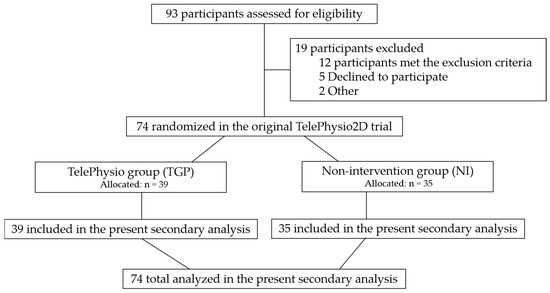
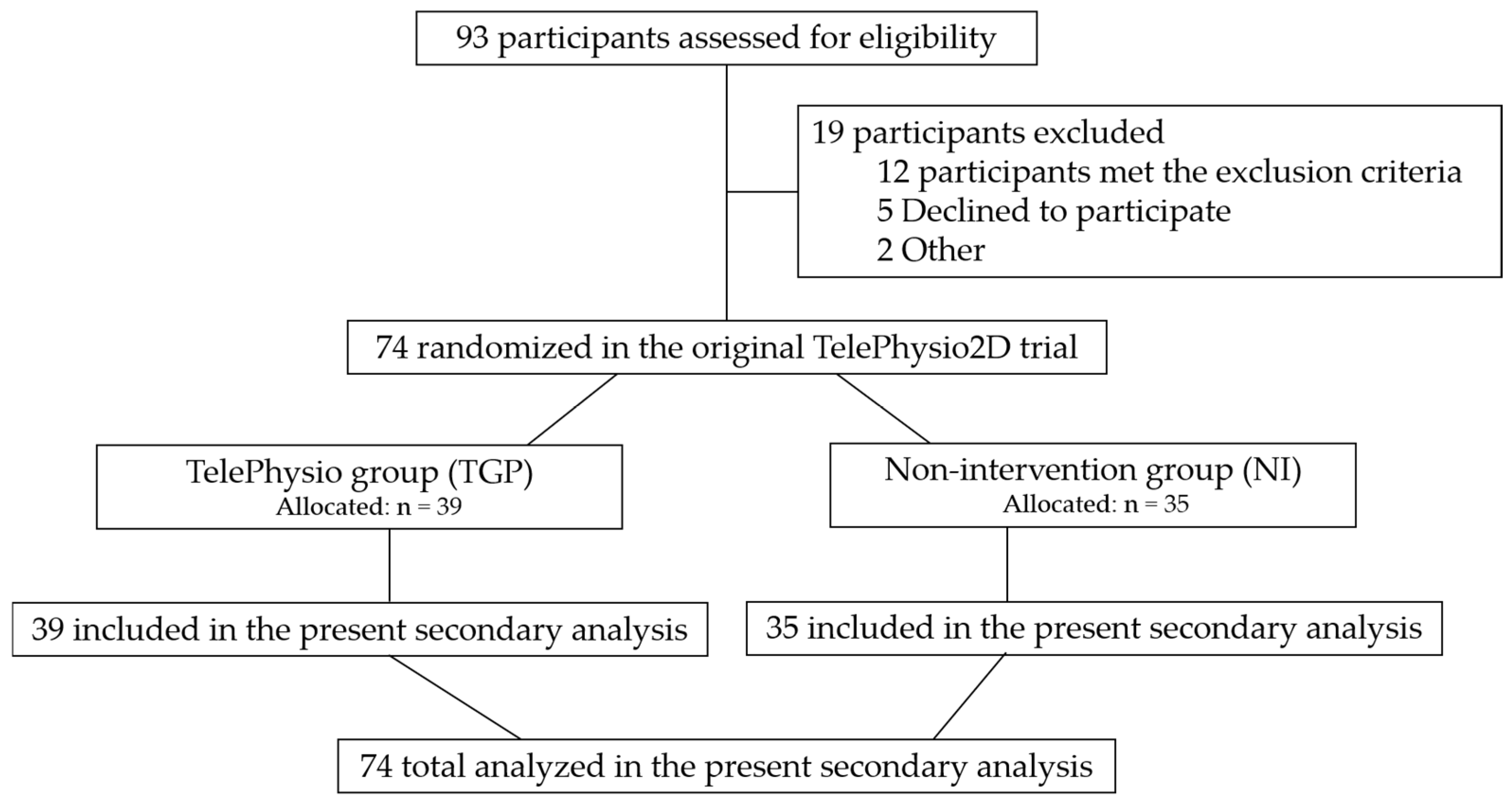
The participant flow from the original TelePhysioT2D trial to the present secondary analysis is shown in Figure 1. Of the 93 participants assessed for eligibility in the original trial, 19 were excluded, and 74 were randomized to the TelePhysio (n = 39) or non-intervention group (n = 35). All 74 randomized participants were included in the present secondary analysis and completed the analyses without any missing data. The baseline clinical characteristics of the study participants are presented in Table 1. No statistically significant differences in baseline clinical characteristics were observed between the two groups. The mean age and HbA1c levels were 73.9 ± 6.1 years and 9.5 ± 2.6% in the TelePhysio group and 72.8 ± 5.9 years and 10.2 ± 2.5% in the non-intervention group.
Figure 1.
Participant flow from the original TelePhysioT2D trial to the present secondary analysis.
Table 1.
Clinical characteristics of the TelePhysio and non-intervention groups.
The results of the multiple regression analysis are presented in Table 2. After adjusting for age, sex, BMI, DPN, and baseline KEF, a significant interaction was found between TelePhysio group allocation and baseline eating behavior score (B = −0.0064, p = 0.0352). In contrast, the baseline eating behavior score alone was not statistically significantly associated with the 6-month KEF (p = 0.8980). Female sex was independently associated with lower 6-month KEF after adjustment for baseline KEF and other covariates (B = −0.2201, p < 0.0001), whereas age, BMI, baseline KEF, and DPN were not statistically significantly associated with the outcome.
Table 2.
Multiple regression analysis for factors associated with 6-month KEF.
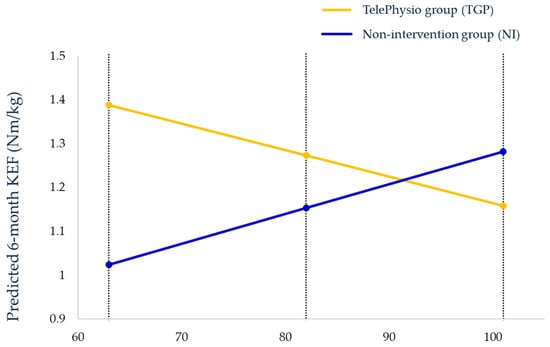
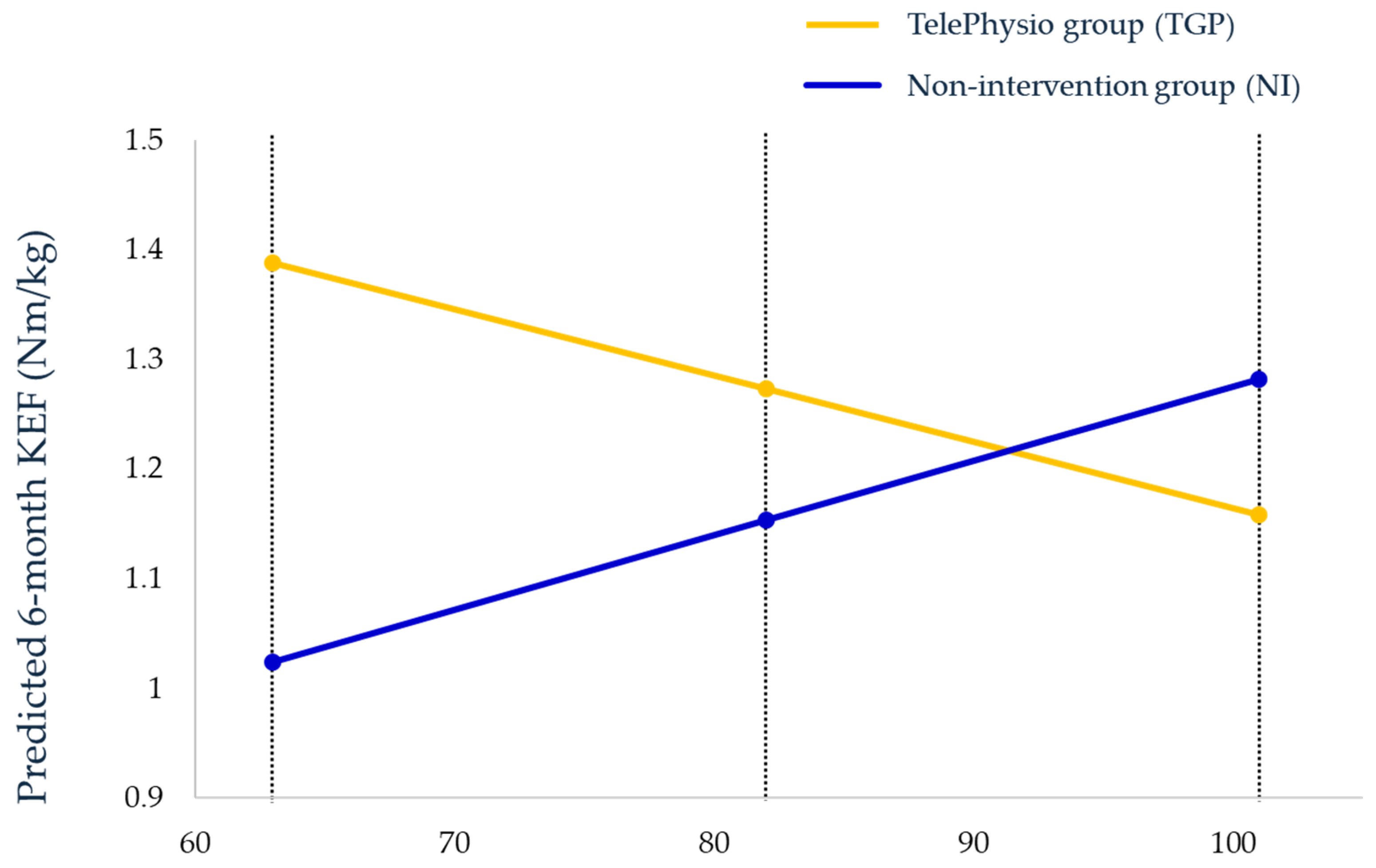
Figure 2 shows the model-predicted 6-month KEF according to the baseline eating behavior scores of the two study groups. Estimated effects were calculated at baseline eating behavior scores corresponding to mean − 1 SD (63 points), mean (82 points), and mean + 1 SD (101 points). The estimated effect of TelePhysio on 6-month KEF was larger at lower baseline eating behavior scores and smaller at higher scores. The estimated differences in 6-month KEF between the TelePhysio and non-intervention groups were approximately +0.36 Nm/kg, +0.12 Nm/kg, and −0.12 Nm/kg at representative baseline eating behavior scores corresponding to mean − 1 SD (63 points), mean (82 points), and mean + 1 SD (101 points), respectively.
Figure 2.
Predicted 6-month knee extension force (KEF) according to baseline eating behavior score in the TelePhysio and non-intervention groups. Model-predicted values were estimated from the adjusted multiple regression model including group allocation, baseline eating behavior score, the interaction term between group allocation and baseline eating behavior score, baseline KEF, age, sex, BMI, and DPN. Representative baseline eating behavior scores corresponding to mean − 1 SD (63), mean (82), and mean + 1 SD (101) were used to illustrate the interaction effect. The figure illustrates model-based predicted values and is intended to facilitate interpretation of the interaction.
In exploratory domain-specific analyses, none of the seven group-by-domain interaction terms reached statistical significance (unadjusted p-value range, 0.146–0.962; Supplementary Table S1). Thus, no specific domain was identified as a statistically significant modifier of the effect of TelePhysio on 6-month KEF.
Additional sensitivity analysis models using ΔKEF as the dependent variable were performed. Although the direction of the interaction was consistent with that of the primary analysis, the interaction term did not reach statistical significance (p = 0.2913).
Despite being not statistically significant, additional simple linear regression analyses showed a negative association between baseline eating behavior score and ⊿KEF in the TelePhysio group (r = −0.237, p = 0.146), whereas no apparent association was observed in the non-intervention group (r = 0.043, p = 0.805).
4. Discussion
This exploratory secondary analysis investigated whether baseline eating behaviors modified the effects of TelePhysio on KEF in older patients with T2DM. The main finding was that a significant interaction was observed between group allocation and baseline eating behavior scores using the multiple regression analysis adjusted for baseline KEF. Specifically, the estimated effect of TelePhysio on the 6-month KEF was larger at lower baseline Eating Behavior Questionnaire scores and smaller at higher scores. These findings suggest that responsiveness to TelePhysio may differ according to baseline eating behaviors.
Exploratory domain-specific analyses did not identify any individual domain as a statistically significant modifier of the effect of TelePhysio on 6-month KEF. Thus, the interaction observed for the total Eating Behavior Questionnaire score could not be localized to a specific domain in this sample. This pattern may reflect information aggregated across multiple domains or greater measurement precision of the total score; however, limited statistical power may also account for the nonsignificant domain-specific findings. These analyses should not be interpreted as evidence that all domains jointly determine responsiveness to TelePhysio.
Telerehabilitation has also garnered increasing attention as an accessible and sustainable approach for long-term disease management [6,12]. TelePhysio is reported to improve KEF and prevent the decline in muscle strength in older patients with T2DM [7]. Exercise-based interventions are important for preserving skeletal muscle function in older adults with T2DM [1,5]. In previous longitudinal studies, accelerated decline in muscle strength and physical function is seen in older adults with T2DM [13]. The present findings suggest that baseline eating behaviors may partly explain the variability in responsiveness to TelePhysio and suggest that it may contribute to the emerging concept of individualized rehabilitation for managing older patients with T2DM.
Baseline eating behavior score was not independently associated with the 6-month KEF scores. Instead, the interaction between group allocation and eating behavior scores was significant, suggesting that eating behaviors might function as an effect modifier rather than a direct determinant of muscle strength. The findings do not indicate that higher Eating Behavior Questionnaire scores are a direct determinant of lower muscle strength but suggest that such characteristics may influence how effectively patients respond to exercise-focused teleguidance interventions. Several biological and behavioral mechanisms may explain the observed interaction, although these mechanisms were not directly examined in the present study. Eating behaviors may serve as a surrogate marker of broader behavioral and lifestyle-related factors, including irregular meal patterns, inadequate protein or energy intake, physical inactivity, and frailty-related tendencies [8,14,15,16]. Furthermore, eating behaviors assessed by the questionnaire may reflect not only dietary tendencies but also broader self-management abilities, adherence-related behaviors, and behaviors associated with responsiveness to lifestyle interventions. Such factors may limit skeletal muscle adaptation, even when exercise support is provided. Previous studies have reported that nutritional status, dietary patterns, and physical activity are closely associated with skeletal muscle health and sarcopenia in older adults [17,18,19]. T2DM and sarcopenia reportedly share common pathophysiological mechanisms, including insulin resistance, chronic inflammation, and mitochondrial dysfunction [20]. Therefore, patients with higher baseline Eating Behavior Questionnaire scores may potentially benefit from additional nutritional or behavioral support alongside exercise support.
The interaction effect remained significant after adjusting for age, sex, BMI, DPN, and baseline KEF, suggesting that eating behaviors may partly explain the heterogeneity in responsiveness to TelePhysio independent of conventional clinical factors. Because eating behavior assessment is relatively simple and feasible in routine clinical practice, it may represent a practical candidate marker for individualized rehabilitation. This study did not directly assess the nutritional intake, dietary composition, protein intake, energy balance, detailed physical activity patterns beyond the IPAQ-derived estimate of habitual physical activity, or frailty. Supplementary analyses showed no statistically significant correlation between the baseline eating behavior score and changes in KEF in either the TelePhysio or non-intervention groups. Accordingly, the present findings should not be interpreted as evidence that TelePhysio improved muscle strength through the modification of eating behavior itself. Rather, baseline eating behaviors might represent broader patient profiles associated with differential responsiveness to exercise-based teleguidance.
The sensitivity analysis using ΔKEF as the dependent variable showed a similar directional trend; however, the interaction term did not reach statistical significance. Therefore, the present findings should be interpreted as exploratory and hypothesis-generating rather than definitive evidence of differential responsiveness to TelePhysio. Replication in larger prospective studies is necessary before definitive conclusions can be drawn. In addition, this study was a post hoc secondary analysis with a relatively small sample size, and multiple statistical testing may have increased the risk of type I error. Moreover, because the original trial was not specifically designed to evaluate effect modification by baseline eating behaviors, the observed interaction should be interpreted cautiously. Detailed information on cardiovascular disease, which may affect muscle strength and responsiveness to exercise, was not systematically collected in the original trial. In addition, participants in the present study showed relatively poor glycemic control; therefore, the generalizability of these findings to patients with well-controlled T2DM may be limited.
These findings have important clinical implications. Telerehabilitation is expected to play an important role in the long-term management of older patients with T2DM because of its accessibility and sustainability [6,12,21]. However, exercise-focused teleguidance alone might not be sufficient for managing all patients. The present results suggest that baseline eating behavior assessment may help identify patients who derive less benefit from TelePhysio alone. These patients may benefit from integrated interventions that combine exercise therapy with nutritional or behavioral support. Individualized telerehabilitation strategies based on patient characteristics may contribute to a more effective management of muscle dysfunction in older adults with T2DM.
5. Conclusions
Baseline eating behaviors may be associated with differential responsiveness to TelePhysio on the KEF in older adults with T2DM. Patients with higher Eating Behavior Questionnaire scores may benefit less from exercise-focused teleguidance alone, suggesting the potential need for integrated support that addresses both exercise and dietary behaviors. These findings should be interpreted as exploratory and require confirmation through larger prospective studies.
Supplementary Materials
The following supporting information can be downloaded at: https://www.mdpi.com/article/10.3390/diabetology7090170/s1, Table S1: Exploratory domain-specific analyses of the Eating Behavior Questionnaire for 6-month KEF.
Author Contributions
Conceptualization, H.K., T.N. and Y.I.; methodology, H.K., T.N., H.O. and Y.I.; formal analysis, H.K., T.N. and H.O.; investigation, H.K.; data curation, H.K.; visualization, H.K.; writing—original draft preparation, H.K.; writing—review and editing, H.K., T.N., H.O. and Y.I.; supervision, T.N. and Y.I.; project administration, H.K.; funding acquisition, T.N. All authors have read and agreed to the published version of the manuscript.
Funding
This work was supported by the Japan Society for the Promotion of Science (JSPS) KAKENHI, grant numbers 15K01440 and 23K24692. The JSPS had no role in the study design, data collection and analysis, decision to publish, or preparation of the manuscript.
Institutional Review Board Statement
This study was conducted in accordance with the Declaration of Helsinki. The original randomized controlled trial was approved by the Ethics Committee of KKR Takamatsu Hospital (approval number: E106) on 17 June 2016. The trial was registered with the University Hospital Medical Information Network Clinical Trials Registry (UMIN000024416) on 15 October 2016. The present study was conducted as a secondary analysis of the approved trial.
Informed Consent Statement
Written informed consent was obtained from all participants.
Data Availability Statement
The datasets analyzed during the current study are not publicly available because they contain information that could compromise the privacy of research participants, but they are available from the corresponding author on reasonable request, subject to approval by the study investigators and the relevant ethics committee.
Acknowledgments
We extend our sincere gratitude to all patients with type 2 diabetes who participated in our study and to the physical therapists who collected data for the study.
Conflicts of Interest
The authors declare no conflicts of interest.
Abbreviations
The following abbreviations are used in this manuscript:
| BMI | Body mass index |
| DPN | Diabetic polyneuropathy |
| KEF | Knee extension force |
| T2DM | Type 2 diabetes mellitus |
| TelePhysio | Teleguidance for physiotherapy program |
References
- Leenders, M.; Verdijk, L.B.; van der Hoeven, L.; Adam, J.J.; van Kranenburg, J.; Nilwik, R.; van Loon, L.J.C. Patients with type 2 diabetes show a greater decline in muscle mass, muscle strength, and functional capacity with aging. J. Am. Med. Dir. Assoc. 2013, 14, 585–592. [Google Scholar] [CrossRef] [Scilit] [PubMed]
- Volpato, S.; Bianchi, L.; Lauretani, F.; Bandinelli, S.; Guralnik, J.M.; Zuliani, G.; Ferrucci, L. Role of muscle mass and muscle quality in the association between diabetes and gait speed. Diabetes Care 2012, 35, 1672–1679. [Google Scholar] [CrossRef] [Scilit] [PubMed]
- Andersen, H. Motor dysfunction in diabetes. Diabetes Metab. Res. Rev. 2012, 28, 89–92. [Google Scholar] [CrossRef] [Scilit] [PubMed]
- Colberg, S.R.; Sigal, R.J.; Yardley, J.E.; Riddell, M.C.; Dunstan, D.W.; Dempsey, P.C.; Horton, E.S.; Castorino, K.; Tate, D.F. Physical activity/exercise and diabetes: A position statement of the American Diabetes Association. Diabetes Care 2016, 39, 2065–2079. [Google Scholar] [CrossRef] [Scilit] [PubMed]
- Umpierre, D.; Ribeiro, P.A.B.; Kramer, C.K.; Leitão, C.B.; Zucatti, A.T.N.; Azevedo, M.J.; Gross, J.L.; Ribeiro, J.P.; Schaan, B.D. Physical activity advice only or structured exercise training and association with HbA1c levels in type 2 diabetes: A systematic review and meta-analysis. JAMA 2011, 305, 1790–1799. [Google Scholar] [CrossRef] [Scilit] [PubMed]
- Cottrell, M.A.; Galea, O.A.; O’Leary, S.P.; Hill, A.J.; Russell, T.G. Real-time telerehabilitation for the treatment of musculoskeletal conditions is effective and comparable to standard practice: A systematic review and meta-analysis. Clin. Rehabil. 2017, 31, 625–638. [Google Scholar] [CrossRef] [Scilit] [PubMed]
- Kataoka, H.; Nomura, T.; Oka, H.; Ikeda, Y. Effectiveness of tele-guidance for physiotherapy in older patients with type 2 diabetes: A randomized controlled trial. J. Diabetes Investig. 2025, 16, 1284–1291. [Google Scholar] [CrossRef] [Scilit] [PubMed]
- Mesinovic, J.; Zengin, A.; De Courten, B.; Ebeling, P.R.; Scott, D. Sarcopenia and type 2 diabetes mellitus: A bidirectional relationship. Diabetes Metab. Syndr. Obes. 2019, 12, 1057–1072. [Google Scholar] [CrossRef] [Scilit] [PubMed]
- Nomura, T.; Kataoka, H.; Oka, H.; Ikeda, Y. Teleguidance by Physiotherapists Maintains the Quality of Life in Older Patients with Diabetic Polyneuropathy: Sub-analysis of the TelePhysioT2D Trial. Diabetol. Int. 2026, 17, 33. [Google Scholar] [CrossRef] [Scilit] [PubMed]
- Ogawa, W.; Hirota, Y.; Miyazaki, S.; Nakamura, T.; Ogawa, Y.; Shimomura, I.; Yamauchi, T.; Yokote, K.; Creation Committee for Guidelines for the Management of Obesity Disease 2022 by Japan Society for the Study of Obesity (JASSO). Definition, criteria, and core concepts of guidelines for the management of obesity disease in Japan. Endocr. J. 2024, 71, 223–231. [Google Scholar] [CrossRef] [Scilit] [PubMed]
- Suzuki, T.; Sato, T.; Tanaka, M.; Endo, K.; Nakata, K.; Ogawa, T.; Hosaka, I.; Akiyama, Y.; Umetsu, A.; Furuhashi, M. Tirzepatide ameliorates eating behaviors regardless of prior exposure to glucagon-like peptide receptor agonists in Japanese patients with type 2 diabetes mellitus. J. Diabetes Complicat. 2024, 38, 108779. [Google Scholar] [CrossRef] [Scilit] [PubMed]
- Kairy, D.; Lehoux, P.; Vincent, C.; Visintin, M. A systematic review of clinical outcomes, clinical process, healthcare utilization and costs associated with telerehabilitation. Disabil. Rehabil. 2009, 31, 427–447. [Google Scholar] [CrossRef] [Scilit] [PubMed]
- Park, S.W.; Goodpaster, B.H.; Strotmeyer, E.S.; Kuller, L.H.; Broudeau, R.; Kammerer, C.; de Rekeneire, N.; Harris, T.B.; Schwartz, A.V.; Tylavsky, F.A.; et al. Accelerated loss of skeletal muscle strength in older adults with type 2 diabetes: The Health, Aging, and Body Composition Study. Diabetes Care 2007, 30, 1507–1512. [Google Scholar] [CrossRef] [Scilit] [PubMed]
- Morley, J.E.; Anker, S.D.; von Haehling, S. Prevalence, incidence, and clinical impact of sarcopenia: Facts, numbers, and epidemiology—Update 2014. J. Cachexia Sarcopenia Muscle 2014, 5, 253–259. [Google Scholar] [CrossRef] [Scilit] [PubMed]
- Chen, L.K.; Woo, J.; Assantachai, P.; Auyeung, T.W.; Chou, M.Y.; Iijima, K.; Jang, H.C.; Kang, L.; Kim, M.; Kim, S.; et al. Asian Working Group for Sarcopenia: 2019 Consensus Update on Sarcopenia Diagnosis and Treatment. J. Am. Med. Dir. Assoc. 2020, 21, 300–307.e2. [Google Scholar] [CrossRef] [Scilit] [PubMed]
- Sinclair, A.J.; Abdelhafiz, A.H.; Rodríguez-Mañas, L. Frailty and sarcopenia—Newly emerging and high impact complications of diabetes. J. Diabetes Complicat. 2017, 31, 1465–1473. [Google Scholar] [CrossRef] [Scilit] [PubMed]
- Houston, D.K.; Nicklas, B.J.; Ding, J.; Harris, T.B.; Tylavsky, F.A.; Newman, A.B.; Lee, J.S.; Sahyoun, N.R.; Visser, M.; Kritchevsky, S.B.; et al. Dietary protein intake is associated with lean mass change in older, community-dwelling adults: The Health, Aging, and Body Composition (Health ABC) Study. Am. J. Clin. Nutr. 2008, 87, 150–155. [Google Scholar] [CrossRef] [Scilit] [PubMed]
- Cruz-Jentoft, A.J.; Bahat, G.; Bauer, J.; Boirie, Y.; Bruyère, O.; Cederholm, T.; Cooper, C.; Landi, F.; Rolland, Y.; Sayer, A.A.; et al. Sarcopenia: Revised European consensus on definition and diagnosis. Age Ageing 2019, 48, 16–31. [Google Scholar] [CrossRef] [Scilit] [PubMed]
- Beaudart, C.; Dawson, A.; Shaw, S.C.; Harvey, N.C.; Kanis, J.A.; Binkley, N.; Reginster, J.Y.; Chapurlat, R.; Chan, D.C.; Bruyère, O.; et al. Nutrition and physical activity in the prevention and treatment of sarcopenia: Systematic review. Osteoporos. Int. 2017, 28, 1817–1833. [Google Scholar] [CrossRef] [Scilit] [PubMed]
- Cleasby, M.E.; Jamieson, P.M.; Atherton, P.J. Insulin resistance and sarcopenia: Mechanistic links between common co-morbidities. J. Endocrinol. 2016, 229, R67–R81. [Google Scholar] [CrossRef] [Scilit] [PubMed]
- Tchero, H.; Kangambega, P.; Briatte, C.; Brunet-Houdard, S.; Retali, G.R.; Rusch, E. Clinical effectiveness of telemedicine in diabetes mellitus: A meta-analysis of 42 randomized controlled trials. Telemed. J. e-Health 2019, 25, 569–583. [Google Scholar] [CrossRef] [Scilit] [PubMed]

Disclaimer/Publisher’s Note: The statements, opinions and data contained in all publications are solely those of the individual author(s) and contributor(s) and not of MDPI and/or the editor(s). MDPI and/or the editor(s) disclaim responsibility for any injury to people or property resulting from any ideas, methods, instructions or products referred to in the content. |
© 2026 by the authors. Licensee MDPI, Basel, Switzerland. This article is an open access article distributed under the terms and conditions of the Creative Commons Attribution (CC BY) license.