


Abstract
Background: Individuals with diabetes have an increased risk of infection-related hospitalization; however, whether type 1 diabetes (T1D) and type 2 diabetes (T2D) differentially influence outcomes following hospitalization remains unclear. We compared mortality, metabolic complications, and hospital outcomes among adults with T1D, T2D, or no documented diabetes admitted with urinary tract infection (UTI) or pneumonia. Methods: We performed a retrospective cohort study using electronic health records from a tertiary 1500-bed medical center (2018–2026). Eligible adult hospital admissions for UTI or pneumonia were classified according to documented T1D, T2D, or no diabetes. The study included 22,475 UTI admissions (211 with T1D, 9230 with T2D, and 13,034 without diabetes) and 32,703 pneumonia admissions (208 with T1D, 15,112 with T2D, and 17,383 without diabetes). Multivariable logistic regression was used to evaluate the association between diabetes status and 30-day mortality, with adjustment for age, sex, BMI, CCI, and MEWS. Because individuals could contribute multiple eligible admissions, the primary mortality models used patient-level cluster-robust standard errors to account for within-patient correlation. Results: T1D admissions involved substantially younger individuals than T2D or non-diabetes admissions but were associated with the greatest metabolic instability during hospitalization. Hypoglycemia occurred in 41.2% of T1D admissions for UTI and 19.7% for pneumonia, compared with 19.6% and 4.1% in T2D, respectively (both p < 0.001). Hyperglycemia was also markedly more frequent in T1D, affecting 88.6% of UTI and 72.6% of pneumonia admissions. ICU transfer was nearly threefold higher in T1D than T2D during UTI hospitalization (10.0% vs. 3.5%, p < 0.001). After adjustment, T1D was not independently associated with 30-day mortality, whereas T2D was associated with modestly lower adjusted odds of 30-day mortality compared with patients without documented diabetes. No significant mortality differences were observed between T1D and T2D. Conclusions: Diabetes type was not independently associated with higher short-term mortality following hospitalization for UTI or pneumonia after adjustment for measured confounders. However, T1D was associated with substantially greater glycemic instability and increased intensive care utilization, suggesting that diabetes type may influence the metabolic complexity and intensity of inpatient management more than short-term survival.
1. Introduction
Diabetes mellitus is associated with an increased susceptibility to infections, greater disease severity, and higher rates of infection-related hospitalization than the general population [1,2,3]. Infections are increasingly recognized as a major complication of diabetes and have recently emerged as the third leading cause of death among individuals with type 2 diabetes (T2D), after cardiovascular disease and cancer [4]. As the prevalence of diabetes continues to rise, understanding the clinical course and outcomes of infection-related hospitalizations has become an important public health priority.
Although both type 1 diabetes (T1D) and T2D predispose individuals to infection, the underlying mechanisms differ. T1D is characterized by autoimmune destruction of pancreatic β-cells and absolute insulin deficiency, resulting in marked metabolic instability and impaired immune responses [5,6,7]. In contrast, T2D is characterized by insulin resistance, chronic low grade inflammation, and dysfunction of innate immune cells, including neutrophils and macrophages [6,8]. In both conditions, hyperglycemia further impairs host defenses through reduced phagocytosis, diminished complement activity, and impaired T-cell function, thereby increasing susceptibility to bacterial infections and potentially worsening clinical outcomes [7,9].
Although prior studies have demonstrated increased infection-related hospitalization and mortality in both T1D and T2D compared with individuals without diabetes [1,2,3,4], important gaps remain. First, most existing studies have focused on comparisons between diabetic and non-diabetic populations, with relatively limited data directly comparing outcomes between T1D and T2D in the setting of acute infection. Second, it remains unclear whether diabetes type is independently associated with short-term outcomes after accounting for differences in age, comorbidity burden, and acute illness severity. Third, the clinical course of infection-related hospitalization, including metabolic complications such as hypoglycemia and hyperglycemia, as well as the need for intensive care support, has not been well characterized across diabetes types.
Therefore, we aimed to compare clinical characteristics, in-hospital complications, and short-term mortality among patients with T1D, T2D, and no diabetes hospitalized with common bacterial infections, including urinary tract infection and pneumonia. We further examined whether diabetes type is independently associated with 30-day mortality after adjustment for demographic factors, comorbidity burden, and markers of acute illness severity.
2. Methods
2.1. Study Design and Data Source
This retrospective cohort study utilized the MDclone healthcare analytics platform to extract deidentified electronic health record (EHR) data from a tertiary 1500 bed medical center in Israel between 1 January 2018 and 31 May 2026. MDclone enables secure, population-level analysis of structured clinical data while preserving patient privacy [10]. Available data included demographics, diagnoses, laboratory values, procedures, medications, and hospitalization outcomes.
2.2. Study Population
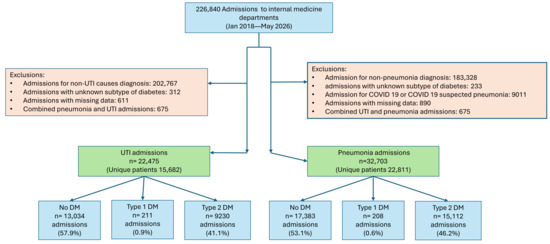
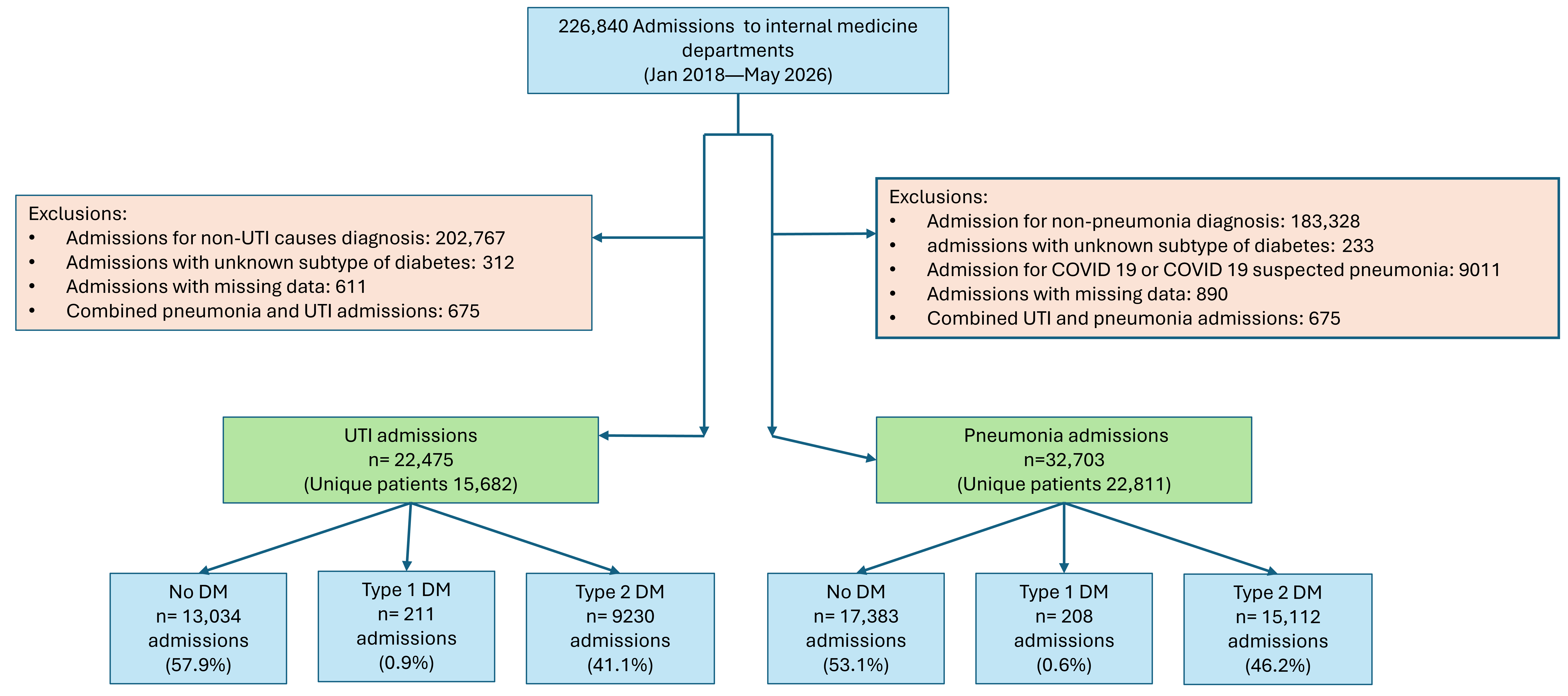
Adults (≥18 years) admitted to an internal medicine department with UTI or pneumonia and with documented T1D or T2D or without documented diabetes were eligible for inclusion. The hospital admission was the unit of analysis. Individuals could contribute more than one eligible admission during the study period, with each eligible hospitalization treated as a separate admission-level observation. An individual could also contribute admissions to both infection-specific cohorts if separate eligible hospitalizations for UTI and pneumonia occurred during the study period. In the UTI cohort, 15,682 unique patients contributed 22,475 eligible admissions, with 11,107 admissions from patients contributing one admission, 6194 from patients contributing two admissions, 2754 from patients contributing three admissions, 1552 from patients contributing four admissions, and 868 from patients contributing five or more admissions. In the pneumonia cohort, 22,811 unique patients contributed 32,703 eligible admissions, with 15,919 admissions from patients contributing one admission, 9780 from patients contributing two admissions, 3750 from patients contributing three admissions, 2072 from patients contributing four admissions, and 1182 from patients contributing five or more admissions (Table S1). A total of 22,475 UTI admissions (T1D: n = 211; T2D: n = 9230; no diabetes: n = 13,034) and 32,703 pneumonia admissions (T1D: n = 208; T2D: n = 15,112; no diabetes: n = 17,383) met eligibility criteria (Figure 1). Exclusion criteria included age < 18 years, gestational diabetes, secondary or drug induced diabetes, and ambiguous diabetes classification, defined as admissions carrying conflicting diagnostic codes for both T1D and T2D without additional clinical data to resolve the classification, admissions with combined infections of UTI and pneumonia, and incomplete or missing information. Because T1D represents a relatively rare exposure in hospitalized adult populations, all eligible T1D admissions during the study period were included, and no sampling or matching was applied. This design reflects a population-based observational cohort capturing the full available T1D inpatient experience, while T2D and non-diabetic groups represent the corresponding background hospitalized population for comparison.
Figure 1.
Cohort selection. The source population consisted of eligible hospital admissions captured in the institutional electronic health record during the study period; admissions were not restricted to patients requiring ICU-level care. Direct ICU admissions were excluded according to the cohort-selection criteria shown. A total of 675 admissions with combined UTI and pneumonia infections were excluded, corresponding to 618 unique patients. UTI—urinary tract infection; COVID—coronavirus disease; DM—diabetes mellitus.
2.3. Variables and Outcomes
Baseline variables included age, sex, body mass index (BMI), HbA1c, diabetes duration (available for T1D and T2D groups only), Charlson Comorbidity Index (CCI) [11], chronic kidney disease, cardiovascular disease, diabetes medications, and infection type. Outcomes included 30-day mortality, length of stay (LOS), intensive care unit (ICU) transfer, shock, hypoglycemia (blood glucose < 70 mg/dL), hyperglycemia (blood glucose > 180 mg/dL), and hyperosmolar hyperglycemia. Resistant organism infections, including extended-spectrum β-lactamase (ESBL)-producing organisms and methicillin-resistant Staphylococcus aureus (MRSA), were also assessed.
2.4. Severity Assessment and Clinical Definitions
Acute illness severity at hospital admission was assessed using the Modified Early Warning Score (MEWS), a validated clinical risk stratification tool based on routinely collected physiological measurements, including systolic blood pressure, heart rate, respiratory rate, body temperature, and level of consciousness [12,13]. MEWS was used to quantify the degree of physiological derangement on presentation, with higher scores indicating greater risk of clinical deterioration and the need for escalated medical care.
Shock was identified using ICD diagnosis codes and/or vasopressor administration.
2.5. Statistical Analysis
Continuous variables were summarized using medians with interquartile ranges, and categorical variables were reported as frequencies and percentages. Between-group comparisons were performed using the Kruskal–Wallis test for continuous variables and the χ2 test or Fisher’s exact test for categorical variables, as appropriate.
All analyses were performed separately for the UTI and pneumonia cohorts. Given the marked imbalance in group sizes, all primary comparisons were conducted using regression-based models rather than relying solely on unadjusted group comparisons, to reduce bias from unequal sample sizes and confounding.
The association between diabetes status and 30-day mortality was estimated using multivariable logistic regression, adjusting for age, sex, BMI, CCI, and MEWS. Because individuals could contribute more than one eligible admission, the primary mortality models were fit using patient-level cluster-robust (sandwich) standard errors, specifying the patient as the clustering unit to account for within-patient correlation among repeated admissions. Because the number of clusters (unique patients) was large, the conventional sandwich variance estimator was used. Diabetes status (T1D, T2D, or no diabetes) was included as a categorical exposure, with no diabetes as the reference group. For secondary analyses, T1D was directly compared with T2D; these models additionally adjusted for HbA1c and diabetes duration. Models were intentionally limited to clinically important covariates to avoid unnecessary overadjustment.
Three prespecified sensitivity analyses were performed to assess the robustness of the primary findings: (1) exclusion of admissions with borderline diabetes classification (age of onset 30–50 years); (2) exclusion of admissions during the initial COVID-19 pandemic period (2020–2021); and (3) refitting of the mortality models under an independence (naïve) specification that did not account for within-patient correlation, to assess the influence of the clustering adjustment on the primary estimates.
Secondary clinical and metabolic outcomes were considered exploratory and were primarily used to characterize differences in the clinical course of hospitalization rather than to establish independent causal associations. No formal multiplicity adjustment was applied to these exploratory comparisons.
Statistical analyses were performed using SPSS (version 30.0; IBM Corp, Armonk, NY). All tests were two-sided, and a p-value <0.05 was considered statistically significant.
2.6. Ethics
This study was approved by the institutional review board of Tel Aviv Sourasky Medical Center (Approval No. TLV-0432-26). The requirement for informed consent was waived given the retrospective, deidentified nature of the data.
3. Results
3.1. Cohort Characteristics
A total of 22,475 UTI admissions and 32,703 pneumonia admissions were included in the analysis.
Among UTI admissions, 13,034 (58.0%) were admissions without documented diabetes, 211 (0.9%) involved T1D, and 9230 (41.1%) involved T2D. T1D admissions involved substantially younger individuals than admissions without diabetes or with T2D (median age of 66.5 vs. 81.5 and 78.0 years, respectively; p < 0.001). The proportion of males was highest in the T1D group (66.4%) compared with the T2D (58.4%) and non-diabetic groups (50.0%; p < 0.001). Patients with T2D had the greatest burden of comorbidity, with a median Charlson Comorbidity Index (CCI) of 6 compared with 5 in both the T1D and non-diabetic groups (p < 0.001). As expected, chronic anti-diabetic medication use differed markedly between diabetes groups. Among T2D admissions, metformin was the most frequently prescribed medication (3932, 42.6%), followed by insulin (3373, 36.5%), DPP-4 inhibitors (1638, 17.7%), SGLT2 inhibitors (1401, 15.2%), GLP-1 receptor agonists (525, 5.7%), and sulfonylureas (364, 3.9%). Among T1D admissions, insulin therapy predominated (144, 68.2%), while metformin (25, 11.8%), SGLT2 inhibitors (12, 5.7%), DPP-4 inhibitors (9, 4.3%), and GLP-1 receptor agonists (1, 0.5%) were used less frequently; no patients with T1D received sulfonylureas.
Among pneumonia admissions, 17,383 (53.2%) were for patients with no diabetes, 208 (0.6%) had T1D, and 15,112 (46.2%) had T2D. Similar age differences were observed, with patients with T1D being considerably younger than those without diabetes (61.2 vs. 83.5 years) and those with T2D (78.5 years; p < 0.001). Patients with T2D again demonstrated the highest comorbidity burden (median CCI 6). Chronic anti-diabetic medication use showed a similar pattern to that observed in the UTI cohort. In patients with T2D, metformin was the most commonly used medication (7265, 48.1%), followed by insulin (3705, 24.5%), DPP-4 inhibitors (2734, 18.1%), SGLT2 inhibitors (2138, 14.1%), GLP-1 receptor agonists (939, 6.2%), and sulfonylureas (574, 3.8%). Among patients with T1D, insulin remained the predominant therapy (109, 52.4%), with smaller proportions receiving metformin (32, 15.4%), SGLT2 inhibitors (13, 6.3%), DPP-4 inhibitors (10, 4.8%), and GLP-1 receptor agonists (4, 1.9%).
3.2. Urinary Tract Infection
T1D admissions had the greatest metabolic instability during hospitalization. Hypoglycemia occurred in 41.2% of T1D admissions compared with 19.6% in T2D and 11.3% in patients without diabetes (p < 0.001). Similarly, hyperglycemia was most common among patients with T1D, occurring in 88.6% of admissions compared with 78.4% in T2D and 29.9% in patients without diabetes (p < 0.001). Hyperosmolar hyperglycemia also occurred more frequently among patients with diabetes than among patients without diabetes (Table 1).
Table 1.
Baseline characteristics and clinical outcomes among patients hospitalized with urinary tract infection.
This greater metabolic complexity was accompanied by increased utilization of intensive care. ICU transfer occurred in 10.0% of T1D admissions compared with 3.5% of T2D admissions and 4.2% of admissions without documented diabetes (p < 0.001) (Table 1). In contrast, T2D admissions had the highest rate of shock during hospitalization (6.8%), compared with 1.9% in T1D and 5.2% among patients without diabetes (p < 0.001) (Table 1).
Despite these differences in clinical course, crude mortality was lowest among T1D admissions. Thirty-day mortality occurred in 17.1% of T1D admissions, compared with 27.0% of T2D admissions and 33.2% of admissions without documented diabetes (p < 0.001). Seven-day mortality demonstrated a similar pattern (10.0%, 14.7%, and 19.0%, respectively).
Hospital length of stay differed modestly across groups, with patients with T2D having the longest hospitalization (median 5.7 days), whereas patients with T1D had the shortest median stay (4.0 days; p < 0.001).
Resistant organisms were uncommon, and no significant differences were observed in rates of ESBL-producing organisms or MRSA infection.
3.3. Pneumonia
A similar pattern was observed in the pneumonia cohort, with T1D admissions demonstrating the greatest degree of metabolic instability despite the lowest crude mortality. Hypoglycemia occurred in 19.7% of T1D admissions compared with 4.1% of T2D admissions and 3.6% of admissions among patients without diabetes (p < 0.001). Hyperglycemia affected 72.6% of patients with T1D, 63.5% of those with T2D, and 21.0% of patients without diabetes (p < 0.001) (Table 2).
Table 2.
Baseline characteristics and clinical outcomes among patients hospitalized with pneumonia.
Despite the increased burden of metabolic complications, crude mortality remained lowest among patients with T1D. Seven-day mortality occurred in 3.4% T1D admissions, compared with 4.5% in T2D admissions and 7.9% in patients without diabetes admissions (p < 0.001). Thirty-day mortality occurred in 5.3%, 8.9%, and 15.4% of T1D, T2D, and no-diabetes admissions, respectively (p < 0.001).
Hospital length of stay was similar across all groups (median 3.7 days; p = 0.205). ICU transfer was uncommon in the pneumonia cohort and did not differ significantly between diabetes groups. Because ICU transfer was recorded infrequently in this cohort, it should not be interpreted as a comprehensive measure of illness severity.
Resistant organisms remained uncommon in all three groups.
3.4. Association Between Diabetes Type and Thirty-Day Mortality
Because T1D admissions involved substantially younger patients than T2D and non-diabetes admissions, multivariable analyses were performed to evaluate the association between diabetes status and short-term mortality after adjustment for measured demographic, comorbidity, and acute illness-severity factors. Although crude mortality was lower among both diabetes groups across both infection cohorts, these crude differences should be interpreted in the context of the substantial age and comorbidity differences between groups.
Following multivariable adjustment for potential confounders, the association between T1D and mortality was not significant for either UTI (adjusted OR 0.81, 95% CI 0.55–1.23; p = 0.330) nor pneumonia (adjusted OR 0.76, 95% CI 0.34–1.45; p = 0.340). In contrast, T2D remained independently associated with modestly lower odds of 30-day mortality following hospitalization for UTI (adjusted OR 0.84, 95% CI 0.79–0.91; p < 0.001) and pneumonia (adjusted OR 0.67, 95% CI 0.59–0.72; p < 0.001), Table 3.
Table 3.
Multivariable association between diabetes status and 30-day mortality.
Direct comparison between T2D and T1D demonstrated no significant difference in adjusted mortality for either UTI (adjusted OR 0.97, 95% CI 0.65–1.45; p = 0.880) nor pneumonia (adjusted OR 1.09, 95% CI 0.52–2.28; p = 0.810), Table 3.
3.5. Sensitivity Analyses
Three sensitivity analyses were performed to assess the robustness of the primary findings. First, exclusion of admissions with borderline diabetes classification (defined as age of diabetes onset between 30 and 50 years) did not materially alter the results. Following this exclusion, the UTI cohort included 13,034 admissions without diabetes, 148 admissions with T1D, and 7954 admissions with T2D. In the pneumonia cohort, 17,383 admissions without diabetes, 156 admissions with T1D, and 12,869 admissions with T2D remained available for analysis. In the UTI cohort, the adjusted OR for 30-day mortality comparing T1D with no diabetes remained non-significant (adjusted OR 0.81, 95% CI 0.55–1.19; p = 0.29), whereas T2D remained associated with lower adjusted odds of mortality (adjusted OR 0.84, 95% CI 0.79–0.89; p < 0.001). In the pneumonia cohort, results were similarly unchanged (T1D vs. no diabetes: adjusted OR 0.73, 95% CI 0.35–1.50; p = 0.39; T2D vs. no diabetes: adjusted OR 0.65, 95% CI 0.61–0.70; p < 0.001). Direct comparisons between T1D and T2D remained non-significant in both cohorts.
Second, exclusion of admissions occurring during the initial COVID-19 pandemic period (2020–2021) yielded comparable findings. After this exclusion, the UTI cohort consisted of 9588 admissions without diabetes, 155 admissions with T1D, and 6791 admissions with T2D (total n = 16,534). The corresponding pneumonia cohort included 11,268 admissions without diabetes, 135 admissions with T1D, and 9806 admissions with T2D (total n = 21,209). In the UTI cohort, the adjusted OR for T1D versus no diabetes was 0.86 (95% CI 0.59–1.24; p = 0.42), whereas the adjusted OR for T2D versus no diabetes was 0.86 (95% CI 0.81–0.91; p < 0.001). In the pneumonia cohort, the adjusted OR for T1D versus no diabetes was 0.68 (95% CI 0.33–1.40; p = 0.30), and the adjusted OR for T2D versus no diabetes was 0.63 (95% CI 0.59–0.68; p < 0.001). The consistency of the findings after exclusion of admissions during 2020–2021 suggests that the principal mortality associations were not substantially driven by the initial COVID-19 pandemic period.
Third, the mortality models were refit under an independence (naïve) specification that did not account for within-patient correlation, in order to assess the influence of the clustering adjustment on the primary cluster-robust estimates. Point estimates were essentially unchanged in magnitude and direction, and confidence intervals were modestly narrower than those of the primary cluster-robust models, consistent with the expected effect of ignoring repeated admissions within patients. In the UTI cohort, the naïve model yielded an adjusted OR of 0.84 (95% CI 0.60–1.16; p = 0.285) for T1D versus no diabetes and 0.85 (95% CI 0.81–0.90; p < 0.001) for T2D versus no diabetes. In the pneumonia cohort, the corresponding estimates were 0.70 (95% CI 0.37–1.36; p = 0.294) for T1D versus no diabetes and 0.64 (95% CI 0.60–0.69; p < 0.001) for T2D versus no diabetes. Direct comparisons between T1D and T2D remained non-significant in both cohorts (UTI: adjusted OR 0.96, 95% CI 0.69–1.34; p = 0.816; pneumonia: adjusted OR 0.74, 95% CI 0.38–1.43; p = 0.738). The similarity between the naïve and primary cluster-robust models indicates that the direction and statistical interpretation of the primary associations were not materially affected by accounting for within-patient correlation (Table S4).
4. Discussion
In this large retrospective cohort of more than 55,000 admissions for urinary tract infection and pneumonia, the principal finding was that T1D was associated with markedly greater metabolic instability during acute infection, including substantially higher rates of hypoglycemia and hyperglycemia and, during UTI hospitalization, greater ICU utilization. After adjustment for measured demographic characteristics, comorbidity burden, and acute illness severity, T1D was not independently associated with 30-day mortality. T2D was associated with modestly lower adjusted odds of 30-day mortality compared with the substantially older hospitalized population without documented diabetes. Overall, diabetes status appeared to be more strongly associated with metabolic complexity and intensity of inpatient management than with short-term mortality.
4.1. Diabetes and the “Infection–Mortality Paradox”
One of the principal findings of this study is that diabetes was not associated with worse short-term mortality once patients were hospitalized. This observation is consistent with prior reports describing a so-called “diabetes paradox,” whereby patients with diabetes experience similar or occasionally lower, short-term mortality than patients without diabetes following acute infectious illness [14,15,16]. For example, a meta-analysis of sepsis outcomes found no increase in short-term mortality among patients with diabetes [15], while population based analyses have demonstrated that although diabetes increases the risk of infection-related hospitalization, it does not consistently translate into higher short-term mortality once hospitalization occurs [14,16].
Importantly, these findings contrast with epidemiologic studies showing that diabetes increases infection-related mortality at the population level [2,3,4]. This apparent discrepancy likely reflects an important distinction between the risk of developing severe infection and outcomes after hospitalization. Diabetes clearly increases susceptibility to infection and infection related hospitalization, but once hospitalized, age, comorbidity burden, and acute illness severity appear to be stronger determinants of short-term survival than diabetes type itself.
Several mechanisms may contribute to the observed findings. First, residual confounding by age and frailty is likely important. Patients with T1D were markedly younger than those without diabetes, and although adjustment was performed, functional status and frailty are not fully captured by the Charlson Comorbidity Index and may continue to influence outcomes [17,18]. Second, patients with diabetes may be admitted earlier in the course of infection because of closer clinical monitoring and lower thresholds for hospitalization, potentially resulting in lower observed inpatient mortality [1,3]. Third, stress hyperglycemia in patients without diabetes is a well-established marker of severe acute illness and is independently associated with mortality, whereas chronic diabetes may attenuate this relationship through physiological adaptation to sustained hyperglycemia [19,20].
An important consideration is the marked age difference between the diabetes groups and the non-diabetic comparator group. In both infection cohorts, patients without diabetes were substantially older than patients with T1D, while patients with T2D were intermediate in age. Therefore, the observed adjusted associations should not be interpreted as indicating that a younger patient with T1D has the same absolute mortality risk as a substantially older patient without diabetes. Rather, the regression estimates describe the association between diabetes status and 30-day mortality after statistical adjustment for measured covariates within this hospitalized population. Residual differences in frailty, functional status, admission thresholds, and other unmeasured characteristics may remain.
Nevertheless, these explanations remain hypothesis generating. Recent ICU-based studies suggest that diabetes may still confer increased mortality among critically ill patients with sepsis [21], indicating that the apparent diabetes paradox may not extend to patients with the most severe infections.
4.2. Metabolic Instability in Type 1 Diabetes
The most distinctive finding of our study was the marked metabolic instability observed among patients with T1D. Despite no significant difference in adjusted mortality compared with the reference groups, T1D was consistently associated with the highest rates of both hypoglycemia and hyperglycemia across both infection cohorts. More than 40% of patients with T1D admitted with UTI developed hypoglycemia, nearly 90% experienced hyperglycemia, and approximately one in five patients hospitalized with pneumonia developed hypoglycemia. These rates substantially exceeded those observed in both T2D and patients without diabetes.
In-hospital hypoglycemia is a well-established risk factor for adverse outcomes, including increased mortality, longer hospitalization, and cardiovascular complications [22,23,24]. A systematic review demonstrated that inpatient hypoglycemia is associated with a twofold increase in mortality risk [14], while studies in T1D populations have shown a dose dependent relationship between severe hypoglycemia and subsequent mortality [25].
The high prevalence of hypoglycemia in T1D likely reflects the inherent metabolic fragility of absolute insulin deficiency during acute illness, including reduced oral intake, altered insulin sensitivity, and lack of endogenous insulin buffering capacity [26]. These findings highlight that while T1D was not independently associated with increased mortality, it was strongly associated with clinically important metabolic complications that may require intensive inpatient management.
Hyperglycemia was also highly prevalent across both diabetes types, particularly in T1D, where nearly 90% of UTI admissions experienced marked hyperglycemia. The American Diabetes Association recommends maintaining inpatient glucose levels between 100–180 mg/dL to minimize both hypo- and hyperglycemic complications [27]. Our findings underscore the importance of structured inpatient glycemic management strategies, particularly for hospitalized patients with T1D.
4.3. Intensive Care Utilization and Severity Markers
Despite lower crude mortality, T1D admissions had higher rates of ICU transfer during UTI hospitalization compared with both T2D and non-diabetic admissions. This may reflect increased clinical concern for metabolic decompensation, including diabetic ketoacidosis and severe hypoglycemia, rather than infection severity alone. An additional, non-severity explanation is related to workflow; the intensive monitoring demands of T1D management (frequent glucose checks, insulin titration, vigilance for ketoacidosis and hypoglycemia) impose a higher nursing burden on general wards, which may lead clinicians to favor transfer to the ICU, where the lower nurse-to-patient ratio better accommodates this care. In contrast, T2D admissions demonstrated higher rates of shock, consistent with their greater comorbidity burden. ICU transfer was uncommon in the pneumonia cohort, however, and therefore provides limited discrimination of illness severity in that cohort.
These findings suggest that diabetes type may influence the clinical trajectory of hospitalization more than it influences short-term mortality risk.
4.4. Comparison with Prior Literature
Our findings are consistent with prior studies demonstrating that diabetes, particularly T1D, is associated with increased infection-related hospitalization [2,3]. However, the primary focus of the present study was not infection susceptibility but outcomes following hospitalization for UTI or pneumonia. Our findings suggest that, among patients who are already hospitalized with these infections, diabetes type was not independently associated with higher short-term mortality after adjustment for measured demographic, comorbidity, and illness-severity factors.
The inverse association observed for T2D should be interpreted cautiously and should not be considered evidence of a protective effect. Differences in age, frailty, hospitalization thresholds, unmeasured clinical characteristics, and stress hyperglycemia among patients without documented diabetes may contribute to this observation.
4.5. Strengths and Limitations
This study has several strengths, including a large, unselected cohort of hospitalized admissions; inclusion of both T1D and T2D with a non-diabetic comparator group; and adjustment for demographic characteristics, comorbidity burden, and acute illness severity using regression-based modeling. The use of a comprehensive electronic health record database enabled detailed characterization of metabolic complications and clinical outcomes.
Several limitations should be acknowledged. First, the retrospective observational design limits causal inference and leaves the possibility of residual confounding, particularly by frailty, functional status, hospitalization thresholds, and aspects of acute illness severity not captured by the available variables. Second, because the analysis was admission-based and individuals could contribute multiple hospitalizations, within-patient correlation may be present; this was addressed through a patient-level cluster-robust sensitivity analysis. Third, misclassification between diabetes types is possible in electronic health records. Fourth, the relatively small number of T1D admissions limits statistical power to detect modest mortality differences; therefore, the absence of statistical significance should not be interpreted as evidence of equivalence. Fifth, the non-diabetic comparator group was substantially older than the T1D group, and residual age-related confounding may remain despite adjustment. The observed associations therefore should not be interpreted as indicating equivalent absolute mortality risk across age-disparate groups. Sixth, BMI was based on available electronic health record measurements and may not represent the BMI distribution of the broader population with T2D; missing measurements may also introduce selection bias. Seventh, previous infection history and the extent of endocrinology or diabetes-specialist involvement were not available as prespecified variables and could not be evaluated. Eighth, the non-diabetic comparator group may include patients with undiagnosed diabetes or prediabetes, as suggested by the substantial rates of hyperglycemia observed in this group. Finally, the inverse association between T2D and 30-day mortality should be interpreted cautiously and should not be considered evidence of a protective effect. Because direct ICU admissions were excluded by the cohort-selection criteria, the study may underrepresent patients with the most severe acute illness who required immediate ICU-level care. This exclusion may also limit the generalizability of the findings to critically ill populations and to patients admitted directly to intensive care. The study was conducted within a single healthcare system with universal healthcare coverage, which may limit generalizability but also reduces bias related to disparities in healthcare access [28,29,30].
5. Conclusions
In this large cohort of admissions for urinary tract infection or pneumonia, T2D was associated with modestly lower adjusted odds of 30-day mortality compared with admissions without documented diabetes, whereas T1D was not independently associated with mortality after adjustment for measured confounders. No significant difference in adjusted mortality was observed between T1D and T2D. However, T1D was associated with substantially greater metabolic instability and, during UTI hospitalization, greater ICU utilization. Overall, diabetes status appeared to be more strongly associated with metabolic complexity and intensity of inpatient management than with short-term mortality.
Supplementary Materials
The following supporting information can be downloaded at: https://www.mdpi.com/article/10.3390/diabetology7090171/s1, Table S1: Distribution of eligible admissions; Table S2: UTI admissions BMI-stratified mortality analyses; Table S3: Pneumonia admissions BMI-stratified mortality analyses; Table S4: Sensitivity analyses of the association between diabetes status and 30-day mortality.
Author Contributions
Conceptualization, H.Z. and E.F.; methodology, H.Z. and E.F.; investigation, H.Z. and E.F.; resources, H.Z. and E.F.; writing—original draft preparation, H.Z.; writing—review and editing, E.F.; visualization, H.Z. and E.F.; supervision, H.Z. and E.F.; project administration, H.Z. and E.F. All authors have read and agreed to the published version of the manuscript.
Funding
This research received no external funding.
Institutional Review Board Statement
The study was approved by the Institutional Review Board of Tel Aviv Sourasky Medical Center (Approval No. TLV-0432-26) on 12 February 2026.
Informed Consent Statement
The requirement for informed consent was waived because of the retrospective observational design.
Data Availability Statement
The datasets during and/or analyzed during the current study are available from the corresponding author upon reasonable request.
Conflicts of Interest
All authors declare no conflicts of interest.
References
- Fang, M.; Ishigami, J.; Echouffo-Tcheugui, J.B.; Lutsey, P.L.; Pankow, J.S.; Selvin, E. Diabetes and the Risk of Hospitalisation for Infection: The Atherosclerosis Risk in Communities (ARIC) Study. Diabetologia 2021, 64, 2458–2465. [Google Scholar] [CrossRef] [Scilit] [PubMed]
- Magliano, D.J.; Harding, J.L.; Cohen, K.; Huxley, R.R.; Davis, W.A.; Shaw, J.E. Excess Risk of Dying From Infectious Causes in Those With Type 1 and Type 2 Diabetes. Diabetes Care 2015, 38, 1274–1280. [Google Scholar] [CrossRef] [Scilit] [PubMed]
- Carey, I.M.; Critchley, J.A.; Dewilde, S.; Harris, T.; Hosking, F.J.; Cook, D.G. Risk of Infection in Type 1 and Type 2 Diabetes Compared With the General Population: A Matched Cohort Study. Diabetes Care 2018, 41, 513–521. [Google Scholar] [CrossRef] [Scilit] [PubMed]
- Critchley, J.A.; Carey, I.M.; Chaudhry, U.A.R.R.; Bowen, L.; Cook, D.G.; Harris, T. Increased Risk of Infections in People Living With Diabetes. Diabetes 2026, 75, 1381–1389. [Google Scholar] [CrossRef] [Scilit] [PubMed]
- Janssen, A.W.M.; Stienstra, R.; Jaeger, M.; van Gool, A.J.; Joosten, L.A.B.; Netea, M.G.; Riksen, N.P.; Tack, C.J. Understanding the Increased Risk of Infections in Diabetes: Innate and Adaptive Immune Responses in Type 1 Diabetes. Metabolism 2021, 121, 154795. [Google Scholar] [CrossRef] [Scilit] [PubMed]
- Zhou, Z.; Wang, H.; Tan, S.; Zhang, H.; Zhu, Y. The Alterations of Innate Immunity and Enhanced Severity of Infections in Diabetes Mellitus. Immunology 2024, 171, 313–323. [Google Scholar] [CrossRef] [Scilit] [PubMed]
- Pearson-Stuttard, J.; Blundell, S.; Harris, T.; Cook, D.G.; Critchley, J. Diabetes and Infection: Assessing the Association with Glycaemic Control in Population-Based Studies. Lancet Diabetes Endocrinol. 2016, 4, 148–158. [Google Scholar] [CrossRef] [Scilit] [PubMed]
- Perakakis, N.; Harb, H.; Hale, B.G.; Varga, Z.; Steenblock, C.; Kanczkowski, W.; Alexaki, V.I.; Ludwig, B.; Mirtschink, P.; Solimena, M.; et al. Mechanisms and Clinical Relevance of the Bidirectional Relationship of Viral Infections with Metabolic Diseases. Lancet Diabetes Endocrinol. 2023, 11, 675–693. [Google Scholar] [CrossRef] [Scilit] [PubMed]
- van Crevel, R.; van de Vijver, S.; Moore, D.A.J. The Global Diabetes Epidemic: What Does It Mean for Infectious Diseases in Tropical Countries? Lancet Diabetes Endocrinol. 2017, 5, 457–468. [Google Scholar] [CrossRef] [Scilit] [PubMed]
- Foraker, R.E.; Yu, S.C.; Gupta, A.; Michelson, A.P.; Pineda Soto, J.A.; Colvin, R.; Loh, F.; Kollef, M.H.; Maddox, T.; Evanoff, B.; et al. Spot the Difference: Comparing Results of Analyses from Real Patient Data and Synthetic Derivatives. JAMIA Open 2020, 3, 557–566. [Google Scholar] [CrossRef] [Scilit] [PubMed]
- Quan, H.; Li, B.; Couris, C.M.; Fushimi, K.; Graham, P.; Hider, P.; Januel, J.M.; Sundararajan, V. Updating and Validating the Charlson Comorbidity Index and Score for Risk Adjustment in Hospital Discharge Abstracts Using Data From 6 Countries. Am. J. Epidemiol. 2011, 173, 676–682. [Google Scholar] [CrossRef] [Scilit] [PubMed]
- Gardner-Thorpe, J.; Love, N.; Wrightson, J.; Walsh, S.; Keeling, N. The Value of Modified Early Warning Score (MEWS) in Surgical in-Patients: A Prospective Observational Study. Ann. R. Coll. Surg. Engl. 2006, 88, 571–575. [Google Scholar] [CrossRef] [Scilit] [PubMed]
- Subbe, C.P.; Kruger, M.; Rutherford, P.; Gemmel, L. Validation of a Modified Early Warning Score in Medical Admissions. QJM 2001, 94, 521–526. [Google Scholar] [CrossRef] [Scilit] [PubMed]
- Zohar, Y.; Zilberman Itskovich, S.; Koren, S.; Zaidenstein, R.; Marchaim, D.; Koren, R. The Association of Diabetes and Hyperglycemia with Sepsis Outcomes: A Population-Based Cohort Analysis. Intern. Emerg. Med. 2021, 16, 719–728. [Google Scholar] [CrossRef] [Scilit] [PubMed]
- Wang, Z.; Ren, J.; Wang, G.; Liu, Q.; Guo, K.; Li, J. Association Between Diabetes Mellitus and Outcomes of Patients with Sepsis: A Meta-Analysis. Med. Sci. Monit. 2017, 23, 3546–3555. [Google Scholar] [CrossRef] [Scilit] [PubMed]
- Donnelly, J.P.; Nair, S.; Griffin, R.; Baddley, J.W.; Safford, M.M.; Wang, H.E.; Shapiro, N.I. Association of Diabetes and Insulin Therapy With Risk of Hospitalization for Infection and 28-Day Mortality Risk. Clin. Infect. Dis. 2017, 64, 435–442. [Google Scholar] [CrossRef] [Scilit] [PubMed]
- Smerdely, P. Mortality Is Not Increased with Diabetes in Hospitalised Very Old Adults: A Multi-Site Review. BMC Geriatr. 2020, 20, 522. [Google Scholar] [CrossRef] [Scilit] [PubMed]
- Carey, I.M.; Critchley, J.A.; Chaudhry, U.A.R.; DeWilde, S.; Limb, E.S.; Bowen, L.; Audi, S.; Cook, D.G.; Whincup, P.H.; Sattar, N.; et al. Contribution of Infection to Mortality in People with Type 2 Diabetes: A Population-Based Cohort Study Using Electronic Records. Lancet Reg. Health–Eur. 2025, 48, 101147. [Google Scholar] [CrossRef] [Scilit] [PubMed]
- Rayyan-Assi, H.; Feldman, B.; Leventer-Roberts, M.; Akriv, A.; Raz, I. The Relationship between Inpatient Hyperglycaemia and Mortality Is Modified by Baseline Glycaemic Status. Diabetes Metab. Res. Rev. 2021, 37, e3420. [Google Scholar] [CrossRef] [Scilit] [PubMed]
- Akirov, A.; Diker-Cohen, T.; Masri-Iraqi, H.; Duskin-Bitan, H.; Shimon, I.; Gorshtein, A. Outcomes of Hyperglycemia in Patients with and without Diabetes Hospitalized for Infectious Diseases. Diabetes Metab. Res. Rev. 2018, 34, e3027. [Google Scholar] [CrossRef]
- Zheng, H.; Yu, F.; Bei, C.; Zhou, Y.; Mo, Z.; Wei, B. Diabetes Mellitus and Mortality in Patients Admitted to ICU with Sepsis: A Meta-Analysis. Front. Med. 2026, 13, 1743706. [Google Scholar] [CrossRef] [Scilit] [PubMed]
- Lake, A.; Arthur, A.; Byrne, C.; Davenport, K.; Yamamoto, J.M.; Murphy, H.R. The Effect of Hypoglycaemia during Hospital Admission on Health-Related Outcomes for People with Diabetes: A Systematic Review and Meta-Analysis. Diabet. Med. 2019, 36, 1349–1359. [Google Scholar] [CrossRef] [Scilit] [PubMed]
- Blonde, L.; Umpierrez, G.E.; Reddy, S.S.; McGill, J.B.; Berga, S.L.; Bush, M.; Chandrasekaran, S.; DeFronzo, R.A.; Einhorn, D.; Galindo, R.J.; et al. American Association of Clinical Endocrinology Clinical Practice Guideline: Developing a Diabetes Mellitus Comprehensive Care Pland—2022 Update. Endocr. Pract. 2022, 28, 923. [Google Scholar] [CrossRef] [Scilit] [PubMed]
- Zaitoon, H.; Matsri, S.; Nagler, S.; Lalovich, M.M.; DeFronzo, R.A.; Feigin, E. Under- and Overdosing Insulin in the Hospital: A Retrospective Cohort Study of Dose Deviation and Patient Outcomes. Diabet. Med. 2026. [Google Scholar] [CrossRef] [Scilit] [PubMed]
- Moser, O.; Rafferty, J.; Eckstein, M.L.; Aziz, F.; Bain, S.C.; Bergenstal, R.; Sourij, H.; Thomas, R.L. Impact of Severe Hypoglycaemia Requiring Hospitalization on Mortality in People with Type 1 Diabetes: A National Retrospective Observational Cohort Study. Diabetes Obes. Metab. 2023, 25, 2243–2254. [Google Scholar] [CrossRef]
- American Diabetes Association Professional Practice Committee for Diabetes. 6. Glycemic Goals, Hypoglycemia, and Hyperglycemic Crises: Standards of Care in Diabetes—2026. Diabetes Care 2025, 49, S132. [Google Scholar] [CrossRef] [Scilit] [PubMed]
- American Diabetes Association Professional Practice Committee for Diabetes. 16. Diabetes Care in the Hospital: Standards of Care in Diabetes—2026. Diabetes Care 2025, 49, S339. [Google Scholar] [CrossRef] [Scilit] [PubMed]
- Patsoukaki, V.; Lind, L.; Lampa, E.; Radhi, S.; Eeg-Olofsson, K.; Eliasson, B.; Eriksson, J.W. Risk Differences and Underlying Factors of Cardiovascular Events and Mortality in Patients with Type 2 Diabetes versus Type 1 Diabetes: A Longitudinal Cohort Study of Swedish Nationwide Register Data. Lancet Diabetes Endocrinol. 2025, 13, 848–862. [Google Scholar] [CrossRef] [Scilit] [PubMed]
- Zhang, J.; Ma, Y.; To, W.L.; Chow, S.; To Tang, H.; Wong, H.K.; Luo, J.; Hoi Cheung, C.; Bian, Z. Impact of COVID-19 Infection on Mortality, Diabetic Complications and Haematological Parameters in Patients with Diabetes Mellitus: A Systematic Review and Meta-Analysis. BMJ Open 2025, 15, e090986. [Google Scholar] [CrossRef] [Scilit] [PubMed]
- Gregg, E.W.; Sophiea, M.K.; Weldegiorgis, M. Diabetes and COVID-19: Population Impact 18 Months Into the Pandemic. Diabetes Care 2021, 44, 1916–1923. [Google Scholar] [CrossRef] [Scilit] [PubMed]

Disclaimer/Publisher’s Note: The statements, opinions and data contained in all publications are solely those of the individual author(s) and contributor(s) and not of MDPI and/or the editor(s). MDPI and/or the editor(s) disclaim responsibility for any injury to people or property resulting from any ideas, methods, instructions or products referred to in the content. |
© 2026 by the authors. Licensee MDPI, Basel, Switzerland. This article is an open access article distributed under the terms and conditions of the Creative Commons Attribution (CC BY) license.