


Abstract
Background: Diabetic foot ulcer (DFU) recurrence remains a primary challenge in diabetes care. Although wound closure is the conventional therapeutic endpoint, it does not equate to risk resolution. Despite the implementation of evidence-based preventive strategies, a significant proportion of patients experience recurrent ulceration, highlighting an efficacy gap in current management. Objectives: This narrative review aims to quantify the residual recurrence risk and to provide a clinical framework for risk stratification in patients in remission. Methods: A structured narrative review of PubMed and Google Scholar (up to May 2026) was conducted to evaluate the residual burden associated with standard preventive interventions. Only English-language publications were considered. Results: Our analysis reveals that even with optimal adherence to established preventive protocols, a substantial residual risk persists, ranging from 16.7% to 41.4%. Clinical data indicate that the frequency of podiatric follow-up is a critical determinant of outcomes, with a 4-week screening interval limiting residual risk to 18.4%, significantly outperforming less frequent assessments. Conclusions: The persistence of residual risk mandates a paradigm shift in diabetic foot management: from a “healing-centered” approach to a “remission-focused” model. We propose an integrated, multidisciplinary strategy—anchored by 4-week podiatric surveillance—to mitigate the multifactorial drivers of recurrence and narrow the efficacy gap in clinical practice.
1. Introduction
Diabetic Foot Syndrome (DFS) remains the leading cause of non-traumatic lower-extremity amputation and continues to be a major driver of hospitalizations, disability, and reduced quality of life [1]. Every year, approximately 18.6 million individuals develop a diabetic foot ulcer (DFU) [2].
Although the immediate clinical objective is ulcer closure, long-term outcomes remain concerning. Several studies show that, within five years of healing, ulcer recurrence occurs in 40% to 65% of patients [3]. Yet, despite this substantial risk, secondary prevention measures are still insufficiently implemented [4].
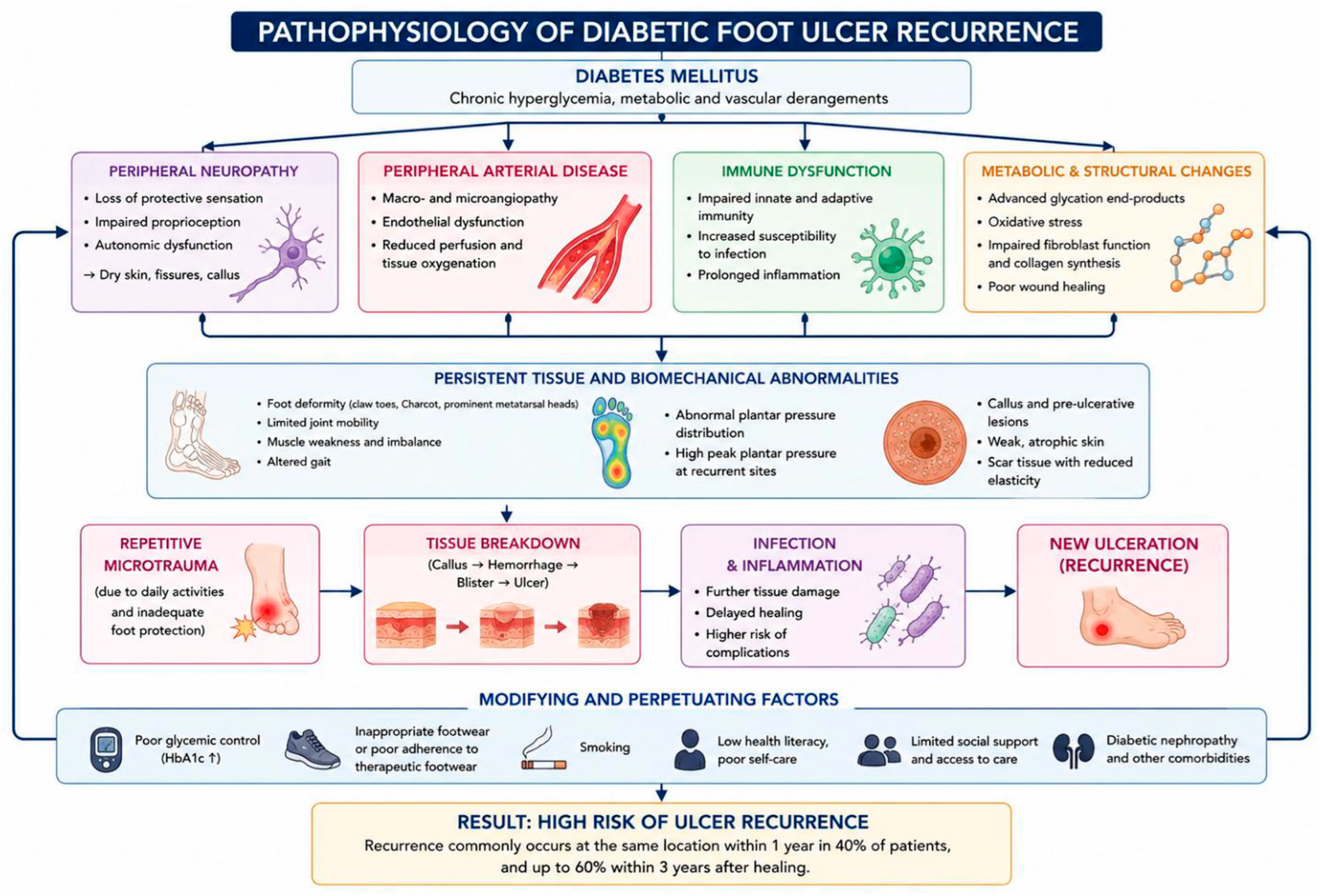
This apparent paradox underscores that wound closure does not mean risk resolution. The persistence of risk after ulcer closure is multifactorial [3]. Peripheral sensory neuropathy impairs protective sensation and delays recognition of repetitive trauma. Motor neuropathy contributes to intrinsic muscle wasting, deformities, and altered plantar pressure distribution. Autonomic dysfunction promotes skin dryness and fissuring. Furthermore, previous ulceration itself may induce scar tissue characterized by lower mechanical resistance and altered elasticity. In many patients, peripheral artery disease and microvascular dysfunction impair tissue perfusion and regenerative capacity. Hyperglycemia and chronic low-grade inflammation may further compromise skin integrity. Therefore, a healed ulcer often represents a biologically fragile site exposed to recurrent mechanical stress [5] (Figure 1).
Figure 1.
Pathophysiology of diabetic foot ulcer recurrence.
For this reason, a change in terminology has been proposed from “healing” to “remission” [6].
The comparison with oncology is intentional: like cancer, DFS is characterized by high mortality [2], major healthcare costs [7], and a lifelong tendency toward recurrence [3]. Another important limitation is the marked methodological and terminological inconsistency across the scientific literature [8], which often does not clearly distinguish between a true “recurrence”, namely, an ulcer re-emerging at the same anatomical location as the prior lesion and a “new ulcer,” occurring at a different site or resulting from a different underlying cause [9].
This distinction is vital for understanding the “residual recurrence risk”. The central paradox of DFS management is that the clinical disappearance of a lesion does not equate to the resolution of underlying risk; rather, it marks the entry into a period of high-risk clinical remission.
Several studies have analyzed the risk factors associated with diabetic foot ulcer recurrence. According to Armstrong et al. [3], independent predictors of recurrence include the presence of a pre-ulcerative lesion, a score of ≥10 on the Geriatric Depression Scale, a diagnosis of osteomyelitis, elevated serum levels of C-reactive protein as well as glycated hemoglobin (HbA1c > 7.5%). Furthermore, a recent meta-analysis [10] has confirmed the role of additional determinants, including: male sex, smoking history, living alone, plantar ulcer location, diabetic retinopathy, diabetic nephropathy, peripheral neuropathy, foot deformity, and peripheral arterial disease.
Additional factors that increase the risk of ulcer recurrence relate to the practical and psychological difficulty of sustaining long-term self-care, including the underestimation of warning symptoms (such as pain or bleeding) and incomplete uptake of preventive measures, such as the use of prescribed therapeutic footwear, the avoidance of walking barefoot, and consistent podiatric follow-up care [11].
Predictive factors for DFU recurrence are classified as potentially modifiable or non-modifiable. Systematic identification of these determinants allows for the stratification of patient risk and the prioritization of clinical resources (Table 1).
Table 1.
Predictive Factors of DFU Recurrence.
Some risk factors, such as gender, history of smoking, and already developed diabetes complications, are not modifiable. However, it is important to focus our attention on modifiable risk factors, such as the treatment of pre-ulcerative lesions, glycemic control, osteomyelitis, deformities, social isolation, and depression. Moreover, identifying the most effective interventions to reduce ulcer recurrence is essential, as the risk of recurrence remains even after preventive strategies have been implemented.
This narrative review will explore the residual risk after diabetic foot ulcer healing. A narrative approach was chosen to allow for a broad synthesis of heterogeneous evidence spanning glycemic control, structured education, foot management, footwear, and screening.
2. Methods
To investigate the residual risk following the healing of diabetic foot ulcers, this study adopts a narrative literature review design.
A structured narrative review was conducted through searches of PubMed and Google Scholar for studies published up to May 2026. Only English-language manuscripts were considered. The search strategy included combinations of the terms ‘diabetic foot’, ‘ulcer recurrence’, ‘reulceration’, ‘remission’, and ‘prevention’. Clinical trials, observational studies, systematic reviews, and meta-analyses were considered eligible. Case reports and small case series were excluded. Studies were selected according to their relevance to the topic and methodological quality.
This narrative review aims to quantify the “residual recurrence risk”—defined as the probability of ulcer recurring despite active, evidence-based preventive intervention—and to provide a clinical framework for risk stratification in patients in remission. The term residual recurrence risk was used as a pragmatic clinical indicator and does not represent a validated epidemiological metric.
The residual recurrence risk was defined as the probability of a patient developing a new diabetic foot ulcer (DFU) despite receiving the active preventive intervention. This parameter represents the clinical burden that persists even when the treatment protocol is followed. The residual risk for the intervention group was calculated as the ratio between the number of recurrences and the total number of participants in that group, expressed as a percentage:
For interventions involving multiple clinical trials, a pooled residual risk was calculated by aggregating the total number of events across all relevant studies to provide a robust weighted average.
3. Impact of Preventive Strategies on Residual Recurrence Risk
The following data summarizes the residual burden persisting across various preventive strategies.
3.1. Screening of Diabetic Foot
To prevent recurrence, the 2023 IWGDF guidelines recommend that individuals with successfully healed foot ulcers receive professional clinical assessment every 1–3 months, on the basis of expert opinion [12]. Recently, an RCT [13] evaluated the clinical efficacy of 1-, 2-, and 3-month screening intervals for the prevention of plantar diabetic foot ulcers (DFUs) in patients in remission for the first time. All study participants received outdoor and indoor therapeutic footwear equipped with a rigid rocker sole, custom-made insoles designed to reduce the risk of ulcer recurrence, and the same podiatric care (removal of hyperkeratosis and proper nail care). The only difference was the frequency of callus removal, which varied according to group allocation: participants in the 4-week group underwent 12 sessions of callus removal (once a month), those in the 8-week group underwent 6 sessions (once every two months), and those in the 12-week group underwent 3 sessions (once every three months). The study found that participants in the 12-week group experienced DFU recurrence significantly more frequently (n = 27, 46%) than the 4-week (n = 18, 18.4%) and 8-week (n = 14, 28.6%) groups (p < 0.001). The residual risk of recurrence was 18.4% in the 4-week group.
3.2. Glycemic Control
None of the RCTs [14,15,16,17] that evaluated the impact of glycemic control on macro- and microvascular outcomes report data on ulcer recurrence.
The meta-analysis by Guo [18], including six observational studies showed that poor blood glucose control is associated with an increased incidence of DFU recurrence but with high heterogeneity among the included six studies (OR = 2.49, 95% CI, 1.05–5.90, p < 0.00001).
The 16.7% residual risk associated with HbA1c < 7.5% derives from a single observational sub-analysis [19] and should be interpreted with caution compared to RCT-based estimates.
3.3. Treatment of Pre-Ulcerative Lesions
Pre-ulcerative lesions such as thick calluses, blisters, or bleeding, are some of the strongest indicators of ulcer recurrence [3]. If these pre-ulcer conditions are recognized early, treating them can help prevent many future ulcers.
In the meta-analysis by Da Ros [11], three trials [20,21,22] examining ulcer recurrence rates showed no significant difference between the intervention groups and the standard of care (any strategies vs. standard of care (SoC): MH-OR: 0.84 [0.24, 2.98], p = 0.26, I2 = 58%), leaving a residual risk of 41.4% in intervention groups.
3.4. Structured Education
In a meta-analysis by Da Ros [11], the impact of structured education on DFU recurrence was evaluated across three studies [23,24,25]. Although the intervention demonstrated a trend toward reducing risk, the results were not statistically significant (MH-OR: 0.13 [0.01, 1.64], p = 0.10), and heterogeneity was high (I2 = 88%). Notably, a substantial residual recurrence risk of 33.6% persisted within the intervention groups.
3.5. At-Home Foot Temperature Monitoring
A meta-analysis [26] evaluating seven randomized controlled trials (RCTs) assessed the impact of at-home foot temperature monitoring on diabetic foot ulcer (DFU) recurrence. The intervention demonstrated a statistically significant benefit, nearly halving the risk of recurrence. Despite this efficacy, a notable residual recurrence risk of 22.7% persisted within the intervention group.
3.6. Footwear
A randomized controlled trial [27] demonstrated that rigid-soled footwear significantly reduces the recurrence risk of plantar neuropathic ulcers compared to semi-rigid-soled footwear (MH-OR: 0.17 [0.05, 0.57], p = 0.004). Despite this substantial reduction, a residual recurrence risk of 23% remained within the intervention group.
3.7. Surgical Interventions
Ulcer recurrence is strongly associated with underlying foot deformities. In such cases, surgical debridement of the affected bone is typically required to promote long-term ulcer remission. The most prevalent deformities include hammertoes, localized nerve entrapment, and Achilles tendon tightness.
One RCT [28] investigated the efficacy of tenotomy in preventing ulcers associated with diabetic hammertoe. While the trial found no statistically significant difference in ulcer recurrence rates between groups, a secondary analysis demonstrated that tenotomy was associated with a significant reduction in peak plantar pressure on the operated toes [29]. Due to the absence of RCT data reporting recurrence rates in the intervention groups of surgical studies, a residual recurrence risk value could not be calculated for this category and was therefore excluded from Table 2.
Table 2.
Preventive strategy and residual recurrence risk.
4. Discussion
Quantifying the residual recurrence risk is essential for clinical practice, as it exposes the ‘efficacy gap’ inherent in current preventive protocols. Our analysis reveals that even when evidence-based interventions are rigorously implemented, a significant burden of disease persists.
The lowest observed recurrence rate was reported among patients with HbA1c < 7.5%, although this finding derives from observational evidence and should not be interpreted as proof of efficacy.
In contrast, interventions targeting localized pathology, such as specialized footwear, maintain a residual risk of approximately 23%, suggesting that mechanical offloading alone—while essential—is insufficient to negate the underlying biological fragility of the healed site.
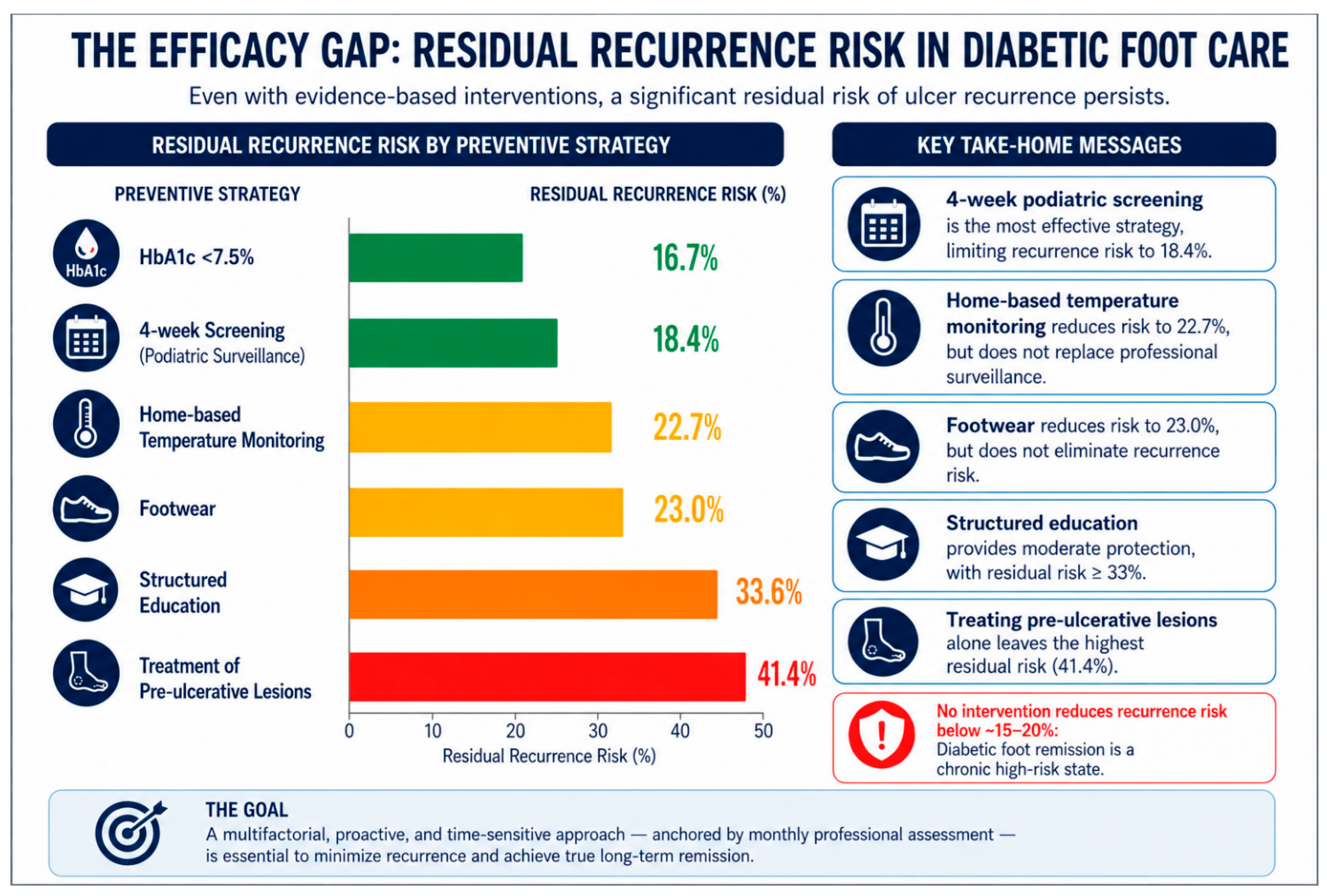
A central finding of this review is the paramount importance of the frequency of clinical follow-up. The data derived from recent RCTs explicitly demonstrate that the interval between screenings is a primary determinant of recurrence. Specifically, the 4-week podiatric screening interval emerges as a critical intervention, limiting the residual recurrence risk to 18.4%. This significantly outperforms the 8-week (28.6%) and 12-week (46%) intervals. The superiority of the 4-week protocol is clinically intuitive: it allows for the timely identification and management of pre-ulcerative lesions, such as hyperkeratosis and calluses, before they progress to full-thickness ulceration.
The 22.7% residual risk observed in the at-home thermometry group—while statistically effective (RR 0.51)—nonetheless highlights that monitoring alone cannot replace professional clinical surveillance. The data suggest that structured education, with its associated 33.6% residual risk, often fails to bridge the gap between patient knowledge and consistent long-term adherence (Figure 2).
Figure 2.
The Efficacy Gap: Residual Recurrence Risk in Diabetic Foot Care.
No currently available intervention reduces recurrence risk below approximately 15–20%, suggesting that diabetic foot remission should be considered a chronic high-risk state rather than a therapeutic success.
Consequently, we posit that the “efficacy gap” cannot be closed by any single intervention in isolation. Instead, the 4-week screening schedule should serve as the non-negotiable cornerstone of a multidisciplinary “remission-focused” strategy. By anchoring patients’ care pathways to a monthly professional assessment, clinicians create a stable platform upon which glycemic optimization, thermometry, and offloading footwear can exert their synergistic effects. This transition from a reactive to a proactive, time-sensitive surveillance model is essential to move clinical practice beyond the “healing” endpoint and toward durable remission [30].
A critical, yet often underappreciated, determinant of residual recurrence risk is patient adherence to prescribed preventive interventions.
The analogy with cardiovascular medicine is particularly instructive: in secondary prevention after myocardial infarction, poor adherence to guideline-recommended pharmacotherapy—including statins and antiplatelet agents—is associated with a significantly increased risk of recurrent cardiovascular events and all-cause mortality, with each 20% improvement in adherence translating into an 8% reduction in cardiovascular events and a 12% reduction in mortality [31]. Non-adherence to statin therapy, in particular, has been identified as a primary real-world driver of insufficient LDL-C reduction, directly widening the residual cardiovascular risk gap despite robust trial efficacy [32].
A parallel dynamic operates in Diabetic Foot Syndrome. In an RCT by Bus et al., offloading-improved custom-made footwear failed to significantly reduce plantar ulcer recurrence on an intention-to-treat basis; however, in the subgroup of highly adherent patients (≥80% of steps in prescribed footwear), recurrence was significantly lower in the improved footwear group compared with usual care [33]. This finding illustrates that the residual risk quantified in intervention groups is, at least in part, attributable to the real-world difficulty of sustaining the intervention as prescribed, rather than to a limitation of the intervention itself.
Consistent with this interpretation, a dedicated observational study showed that mean adherence to prescription custom-made footwear was only 71 ± 25%, dropping to 61% at home—precisely the setting with the highest walking activity [34].
Therefore, a non-negligible fraction of the efficacy gap documented in this review reflects the discrepancy between the efficacy achievable under controlled trial conditions and the effectiveness observed in real-world practice—a discrepancy driven largely by adherence. Closing this gap requires patient-centered strategies, including structured education, motivational counseling, and shared decision-making, analogous to the models advocated in cardiovascular secondary prevention.
The adherence gap described above cannot be fully understood in purely behavioral terms. DFS imposes a substantial and sustained psychosocial burden—including anxiety, depressive symptomatology, fear of amputation, and the demands of lifelong self-surveillance—that plausibly explains much of the discrepancy between prescribed and actual preventive behavior. Notably, a Geriatric Depression Scale score ≥ 10 is itself an independent predictor of recurrence (Table 1), underscoring that psychological distress is not merely a correlate of poor adherence but a driver of clinical risk in its own right. Future preventive strategies should therefore integrate psychosocial support alongside education and biomechanical intervention.
5. Limitations
This review has several limitations. First, the literature search was restricted to English-language publications indexed in PubMed, potentially excluding relevant data from other databases or languages. Second, most available evidence derives from heterogeneous observational studies and relatively small randomized trials. Third, the observation period varies significantly among the included studies, making direct comparison of recurrence rates difficult. Fourth, definitions of recurrence vary substantially across studies, limiting direct comparisons. Fifth, pooled residual risk estimates should be interpreted cautiously because preventive interventions and patient populations differed markedly among studies. Sixth, this review focused on interventions with predominantly physical or behavioral outcome data; structured psychosocial interventions (e.g., dedicated psychological support, peer-support programs) were not systematically captured, reflecting a broader gap in the recurrence literature rather than a deliberate exclusion, and are highlighted as a priority for future research below.
6. Conclusions and Future Directions
The management of Diabetic Foot Syndrome (DFS) must permanently evolve beyond the traditional endpoint of wound healing. As demonstrated above, a healed ulcer should not be classified as restored tissue; rather, it represents a biologically compromised site characterized by altered structural resilience and permanent susceptibility to mechanical failure. Preventing ulcer recurrence is a crucial pillar in DFS management [30]. The identified residual risk—ranging from 16.7% to 41.4%—serves as a quantitative mandate for a more comprehensive clinical approach. Our review suggests that long-term DFS outcomes can only be improved by adopting a multifactorial model that integrates:
- Rigorous podiatric surveillance: Standardized 4-week screening intervals;
- Glycemic optimization: Tight glycemic control targets (HbA1c < 7.5%);
- Advanced patient-centered monitoring: Implementation of at-home thermometry to provide early warnings of inflammation;
- Proactive biomechanical intervention: Rigid-soled footwear and surgical correction of structural deformities to minimize repetitive micro-trauma.
Even within this comprehensive model, residual risk is unlikely to be fully eliminated. We propose that a degree of recurrence risk should be regarded as an inherent feature of DFS remission—comparable to residual risk in other chronic, relapsing conditions—rather than as evidence of patient or clinician failure. Recalibrating expectations accordingly, for both clinicians and patients, is itself a component of the remission-focused paradigm we advocate. Future research should prioritize structured psychosocial support and its integration into multidisciplinary DFS care pathways, given emerging evidence that psychological distress (e.g., Geriatric Depression Scale ≥ 10) is an independent predictor of recurrence rather than merely a correlate of non-adherence.
These findings underscore the need to reconsider our current healthcare delivery models for high-risk diabetic patients. In summary, achieving true, long-term remission in DFS requires a transition from reactive care to a proactive, surveillance-based paradigm. Future clinical trials should adopt standardized definitions of “recurrence” and “remission” to better quantify the true impact of preventive interventions and ultimately narrow the efficacy gap that continues to compromise patient outcomes.
Author Contributions
Conceptualization, C.M. and R.D.R.; investigation, C.M. and R.D.R.; writing—original draft preparation, C.M.; writing—review and editing, C.M., R.D.R. and V.V.; visualization, C.M., R.D.R. and V.V.; supervision, R.D.R.; project administration, C.M. All authors have read and agreed to the published version of the manuscript.
Funding
This research received no external funding.
Institutional Review Board Statement
Not applicable.
Informed Consent Statement
Not applicable.
Data Availability Statement
No new data were created or analyzed in this study.
Conflicts of Interest
The authors declare no conflicts of interest.
Abbreviations
The following abbreviations are used in this manuscript:
| DFU | Diabetic foot ulcer |
| DFS | Diabetic foot syndrome |
| GDS | Geriatric Depression Scale |
| IWGDF | International Working Group on the Diabetic Foot |
| MH-OR | Mantel-Haenszel Odds Ratio |
| OR | Odds Ratio |
| RCTs | Randomized controlled trials |
| RR | Relative Risk |
| PAD | Peripheral Artery Disease |
References
- Lazzarini, P.A.; Cramb, S.M.; Golledge, J.; Morton, J.I.; Magliano, D.J.; Van Netten, J.J. Global trends in the incidence of hospital admissions for diabetes-related foot disease and amputations: A review of national rates in the 21st century. Diabetologia 2023, 66, 267–287. [Google Scholar] [CrossRef] [Scilit] [PubMed]
- Armstrong, D.G.; Tan, T.W.; Boulton, A.J.M.; Bus, S.A. Diabetic Foot Ulcers: A Review. JAMA 2023, 330, 62–75. [Google Scholar] [CrossRef] [Scilit] [PubMed]
- Armstrong, D.G.; Boulton, A.J.M.; Bus, S.A. Diabetic Foot Ulcers and Their Recurrence. N. Engl. J. Med. 2017, 376, 2367–2375. [Google Scholar] [CrossRef] [Scilit] [PubMed]
- Miranda, C.; Da Ros, R. Prevention of Diabetic Foot Ulcer: A Neglected Opportunity. Transl. Med. UniSa 2020, 22, 50–51. [Google Scholar] [PubMed]
- Chao, C.Y.; Zheng, Y.P.; Cheing, G.L. Epidermal thickness and biomechanical properties of plantar tissues in diabetic foot. Ultrasound Med. Biol. 2011, 37, 1029–1038. [Google Scholar] [CrossRef] [Scilit] [PubMed]
- Armstrong, D.G.; Mills, J.L. Toward a change in syntax in diabetic foot care: Prevention equals remission. J. Am. Podiatr. Med. Assoc. 2013, 103, 161–162. [Google Scholar] [PubMed]
- Da Ros, R.; Assaloni, R.; Michelli, A.; Brunato, B.; Barro, E.; Meloni, M.; Miranda, C. Burden of Infected Diabetic Foot Ulcers on Hospital Admissions and Costs in a Third-Level Center. Diabetology 2024, 5, 141–150. [Google Scholar] [CrossRef] [Scilit]
- Miranda, C. Prevention of diabetic foot ulcer recurrence: A call for high-quality randomized trials. Gazz. Med. Ital.-Arch. Sci. Med. 2026, 185, 631–632. [Google Scholar] [CrossRef] [Scilit]
- Örneholm, H.; Apelqvist, J.; Larsson, J.; Eneroth, M. Recurrent and other new foot ulcers after healed plantar forefoot diabetic ulcer. Wound Repair Regen. 2017, 25, 309–315. [Google Scholar] [CrossRef] [Scilit] [PubMed]
- Lin, C.; Tian, J.; Zhang, Z.; Zheng, C.; Liu, J. Risk factors associated with the recurrence of diabetic foot ulcers: A meta-analysis. PLoS ONE 2025, 20, e0318216. [Google Scholar] [CrossRef] [Scilit] [PubMed]
- Da Ros, R.; Volpe, A.; Bordieri, C.; Tramonta, R.; Bernetti, A.; Scatena, A.; Monge, L.; Ragghianti, B.; Silverii, A.; Uccioli, L.; et al. Panel of the Italian Guidelines for the Treatment of Diabetic Foot Syndrome and on behalf of SID and AMD. Prevention of foot ulcers recurrence in patients with diabetes: A systematic review and meta-analysis of randomized controlled trials for the development of the italian guidelines for the treatment of diabetic foot syndrome. Acta Diabetol. 2024, 61, 1363–1373. [Google Scholar] [CrossRef] [Scilit] [PubMed]
- Bus, S.A.; Sacco, I.C.N.; Monteiro-Soares, M.; Raspovic, A.; Paton, J.; Rasmussen, A.; Lavery, L.A.; van Netten, J.J. Guidelines on the prevention of foot ulcers in persons with diabetes (IWGDF 2023 update). Diabetes Metab. Res. Rev. 2024, 40, e3651. [Google Scholar] [CrossRef] [Scilit] [PubMed]
- López-Moral, M.; García-Madrid, M.; García-Morales, E.; García-Álvarez, Y.; Álvaro-Afonso, F.J.; Lázaro-Martínez, J.L. Comparison of 4, 8, and 12 week screening and foot care frequencies in persons in remission: The DIATIME comparative efficacy study—A randomized clinical trial. Diabetes Res. Clin. Pract. 2025, 230, 112962. [Google Scholar] [CrossRef] [Scilit] [PubMed]
- Gerstein, H.C.; Miller, M.E.; Byington, R.P.; Goff, D.C., Jr.; Bigger, J.T.; Buse, J.B.; Cushman, W.C.; Genuth, S.; Ismail-Beigi, F.; Grimm, R.H., Jr.; et al. Action to Control Cardiovascular Risk in Diabetes Study Group. Effects of intensive glucose lowering in type 2 diabetes. N. Engl. J. Med. 2008, 358, 2545–2559. [Google Scholar] [PubMed]
- Patel, A.; MacMahon, S.; Chalmers, J.; Neal, B.; Billot, L.; Woodward, M.; Marre, M.; Cooper, M.; Glasziou, P.; Grobbee, D.; et al. ADVANCE Collaborative Group. Intensive blood glucose control and vascular outcomes in patients with type 2 diabetes. N. Engl. J. Med. 2008, 358, 2560–2572. [Google Scholar] [PubMed]
- Duckworth, W.; Abraira, C.; Moritz, T.; Reda, D.; Emanuele, N.; Reaven, P.D.; Zieve, F.J.; Marks, J.; Davis, S.N.; Hayward, R.; et al. VADT Investigators. Glucose control and vascular complications in veterans with type 2 diabetes. N. Engl. J. Med. 2009, 360, 129–139. [Google Scholar] [CrossRef] [Scilit] [PubMed]
- UK Prospective Diabetes Study (UKPDS) Group. Intensive blood-glucose control with sulphonylureas or insulin compared with conventional treatment and risk of complications in patients with type 2 diabetes (UKPDS 33). Lancet 1998, 352, 837–853. [Google Scholar] [CrossRef] [Scilit]
- Guo, Q.; Ying, G.; Jing, O.; Zhang, Y.; Liu, Y.; Deng, M.; Long, S. Influencing factors for the recurrence of diabetic foot ulcers: A meta-analysis. Int. Wound J. 2023, 20, 1762–1775. [Google Scholar] [CrossRef] [Scilit] [PubMed]
- Dubský, M.; Jirkovská, A.; Bem, R.; Fejfarová, V.; Skibová, J.; Schaper, N.C.; Lipsky, B.A. Risk factors for recurrence of diabetic foot ulcers: Prospective follow-up analysis in the Eurodiale subgroup. Int. Wound J. 2013, 10, 555–561. [Google Scholar] [CrossRef] [Scilit] [PubMed]
- Plank, J.; Haas, W.; Rakovac, I.; Gorzer, E.; Sommer, R.; Siebenhofer, A.; Pieber, T.R. Evaluation of the impact of chiropodist care in the secondary prevention of foot ulcerations. Diabetes Care 2003, 26, 1691–1695. [Google Scholar] [CrossRef] [Scilit] [PubMed]
- van Schie, C.H.; Whalley, A.; Armstrong, D.G.; Vileikyte, L.; Boulton, A.J. The effect of silicone injections in the diabetic foot on peak plantar pressure and plantar tissue thickness: A 2-year follow-up. Arch. Phys. Med. Rehabil. 2002, 83, 919–923. [Google Scholar] [CrossRef] [Scilit] [PubMed]
- Westphal, C.; Neame, I.M.; Harrison, J.C.; Bower, V.M.; Gurr, J.M. A diabetic foot ulcer pilot study: Does silicone gel sheeting reduce the incidence of reulceration? J. Am. Podiatr. Med. Assoc. 2011, 101, 116–123. [Google Scholar] [PubMed]
- Monami, M.; Zannoni, S.; Gaias, M.; Nreu, B.; Marchionni, N.; Mannucci, E. Effects of a Short Educational Program for the Prevention of Foot Ulcers in High-Risk Patients: A Randomized Controlled Trial. Int. J. Endocrinol. 2015, 2015, 615680. [Google Scholar] [CrossRef] [Scilit] [PubMed]
- Suryani, M.; Samekto, W.; Heri-Nugroho; Susanto, H.; Dwiantoro, L. Effect of foot-ankle flexibility and resistance exercise in the secondary prevention of plantar foot diabetic ulcer. J. Diabetes Complicat. 2021, 35, 107968. [Google Scholar] [CrossRef] [Scilit] [PubMed]
- Lincoln, N.B.; Radford, K.A.; Game, F.L.; Jeffcoate, W.J. Education for secondary prevention of foot ulcers in people with diabetes: A randomised controlled trial. Diabetologia 2008, 51, 1954–1961. [Google Scholar] [CrossRef] [Scilit] [PubMed]
- Novais, S.A.L.; Carvalhais, M.D.; Ribeiro, D.F.C.; Correia, Í.N.D.; Sandutã, V.; Goutan-Roura, E.; Marques, P.A.O. Foot Temperature Monitoring in People With Diabetes Mellitus: A Systematic Review of Incidence and Risk With Meta-Analysis. Nurs. Health Sci. 2025, 27, e70206. [Google Scholar] [CrossRef] [Scilit] [PubMed]
- López-Moral, M.; Lázaro-Martínez, J.L.; García-Morales, E.; García-Álvarez, Y.; Álvaro-Afonso, F.J.; Molines-Barroso, R.J. Clinical efficacy of therapeutic footwear with a rigid rocker sole in the prevention of recurrence in patients with diabetes mellitus and diabetic polineuropathy: A randomized clinical trial. PLoS ONE 2019, 14, e0219537. [Google Scholar] [CrossRef] [Scilit] [PubMed]
- Askø Andersen, J.; Rasmussen, A.; Engberg, S.; Bencke, J.; Frimodt-Møller, M.; Kirketerp-Møller, K.; Rossing, P. Flexor Tendon Tenotomy Treatment of the Diabetic Foot: A Multicenter Randomized Controlled Trial. Diabetes Care 2022, 45, 2492–2500. [Google Scholar] [CrossRef] [Scilit] [PubMed]
- Askø Andersen, J.; Rasmussen, A.; Engberg, S.; Bencke, J.; Frimodt-Møller, M.; Kirketerp-Møller, K.; Rossing, P. Effect of flexor tendon tenotomy of the diabetic hammertoe on plantar pressure: A randomized controlled trial. BMJ Open Diabetes Res. Care 2024, 12, e004398. [Google Scholar] [CrossRef] [Scilit] [PubMed]
- Miranda, C.; DA Ros, R. The internal medicine management of diabetic foot syndrome. Minerva Med. 2026, 117, 36–52. [Google Scholar] [CrossRef] [Scilit] [PubMed]
- Chen, C.; Li, X.; Su, Y.; You, Z.; Wan, R.; Hong, K. Adherence with cardiovascular medications and the outcomes in patients with coronary arterial disease: “Real-world” evidence. Clin. Cardiol. 2022, 45, 1220–1228. [Google Scholar] [CrossRef] [Scilit] [PubMed]
- Banach, M.; Stulc, T.; Dent, R.; Toth, P.P. Statin non-adherence and residual cardiovascular risk: There is need for substantial improvement. Int. J. Cardiol. 2016, 225, 184–196. [Google Scholar] [CrossRef] [Scilit] [PubMed]
- Bus, S.A.; Waaijman, R.; Arts, M.; de Haart, M.; Busch-Westbroek, T.; van Baal, J.; Nollet, F. Effect of custom-made footwear on foot ulcer recurrence in diabetes: A multicenter randomized controlled trial. Diabetes Care 2013, 36, 4109–4116. [Google Scholar] [PubMed]
- Waaijman, R.; Keukenkamp, R.; de Haart, M.; Polomski, W.P.; Nollet, F.; Bus, S.A. Adherence to wearing prescription custom-made footwear in patients with diabetes at high risk for plantar foot ulceration. Diabetes Care 2013, 36, 1613–1618. [Google Scholar] [CrossRef] [Scilit] [PubMed]

Disclaimer/Publisher’s Note: The statements, opinions and data contained in all publications are solely those of the individual author(s) and contributor(s) and not of MDPI and/or the editor(s). MDPI and/or the editor(s) disclaim responsibility for any injury to people or property resulting from any ideas, methods, instructions or products referred to in the content. |
© 2026 by the authors. Licensee MDPI, Basel, Switzerland. This article is an open access article distributed under the terms and conditions of the Creative Commons Attribution (CC BY) license.