Article

Validation of Prostate Cancer Diagnosis and Cause of Death in a National Cohort of Male Veterans with Type 2 Diabetes


by
Kinfe G. Bishu
1,2,*,
Andrew D. Schreiner
3,
David J. Taber
1,4,
Matvey Tsivian
5 and
Mulugeta Gebregziabher
1,2,*
1
Ralph H. Johnson VA Medical Center, Charleston, SC 29401, USA
2
Department of Public Health Sciences, Medical University of South Carolina, Charleston, SC 29425, USA
3
Department of Internal Medicine, Medical University of South Carolina, Charleston, SC 29425, USA
4
Department of Surgery, Medical University of South Carolina, Charleston, SC 29425, USA
5
Department of Urology, Medical University of South Carolina, Charleston, SC 29425, USA
*
Authors to whom correspondence should be addressed.
Diabetology 2026, 7(8), 158; https://doi.org/10.3390/diabetology7080158
Submission received: 17 June 2026 / Revised: 5 August 2026 / Accepted: 11 August 2026 / Published: 17 August 2026

Abstract

Background: Accurate diagnosis and cause of death ascertainment are essential for effective disease surveillance and epidemiological research. This study aimed to validate prostate cancer diagnostic accuracy (PCa) and the accuracy of cause of death information among veterans with type 2 diabetes mellitus (T2DM). Methods: We conducted a retrospective cohort study of veterans with T2DM diagnosed during the baseline period (2008–2009) and followed from 2010 to 2019 using data from the Veterans Health Administration (VHA) Corporate Data Warehouse (CDW). Diagnostic codes and cause of death data were obtained from the Prostate Cancer Data Core (PCDC) and the National Death Index (NDI), which served as the gold standards for validating PCa diagnosis and mortality information in the CDW. Concordance between data sources was assessed using Cohen’s Kappa statistic. Results: Among 763,424 veterans with T2DM, 37,048 (4.9%) were diagnosed with PCa in the CDW and 36,861 (4.8%) in the PCDC, with a concordance rate of 36,361 (98.6% of patients diagnosed in the PCDC). Mortality data from the NDI identified 2723 deaths with PCa listed as the underlying cause of death, of whom 75.4% had a corresponding PCa diagnosis recorded in the CDW. For all-cause mortality, 328,165 veterans were identified as deceased in the CDW Vital Status File (VSF), compared with 326,707 deaths recorded in the NDI. Of these, 324,567 deaths were concordant between the two sources, representing 99.3% of NDI-recorded deaths. Compared with the PCDC, the CDW demonstrated high accuracy for identifying incident PCa diagnosis, with a sensitivity of 98.6% and a specificity of 99.9%. Conclusions: The findings demonstrated a high level of concordance in key outcomes, including PCa diagnosis between the CDW and PCDC, and all-cause mortality between the CDW VSF and NDI.

1. Introduction

1.1. PCa Incidence and Mortality Among Diabetic Patients

In 2020, there were 375,304 deaths related to prostate cancer (PCa) globally [1]. In the United States, PCa is the fifth leading cause of cancer death, with the prevalence estimated at 3,399,229 cases in 2021 [2]. Between January 2000 and October 2020, a total of 1,144,610 veterans were diagnosed with PCa, using the International Classification of Diseases, Ninth Revision, Clinical Modification (ICD-9-CM) and Tenth Revision, Clinical Modification (ICD-10-CM), the VA Central Cancer Registry (VACCR), the Current Procedural Terminology (CPT) codes, and Natural Language Processing (NLP) [3]. Regarding the relationship between diabetes and PCa, data from the Radiation Therapy Oncology Group Protocol 92-01 indicated that prevalent diabetes was associated with a lower risk of PCa incidence and mortality, yet a higher risk of all-cause mortality [4]. Meta-analyses have generally reported an inverse relationship between diabetes and PCa risk [5,6].

1.2. Prostate Cancer (PCa) Diagnosis

Traditionally, PCa diagnosis has relied on digital rectal examination (DRE), prostate-specific antigen (PSA) blood tests, and transrectal ultrasound (TRUS) prostate biopsy, which remains the gold standard for confirmation [7]. Recent advances in machine learning algorithms have significantly enhanced the detection and diagnosis of PCa using magnetic resonance imaging (MRI) [8]. Data suggest that integrating a risk assessment model that includes PSA density with MRI findings can improve the assessment of clinically significant prostate cancer (CSCAP) [9]. Among patients with MRI-visible prostate lesions, adding MRI-targeted biopsy to systematic biopsy has been shown to increase the detection of clinically significant cancers (grade group ≥ 3) while decreasing the detection of clinically insignificant cancers [10].

1.3. Ascertainment of Cause of Death for PCa

Understanding cause-specific mortality is essential for identifying the reasons behind mortality risks across different populations or subgroups [11,12]. However, assigning a CoD can be challenging, especially when deaths occur outside health facilities or due to inaccuracies in death certificates and transcription errors [11,12]. The accuracy of CoD data is crucial for mortality studies, and it is customary to establish an independent CoD review committee to validate official death certificate data [13,14]. The National Death Index (NDI), managed by the National Center for Health Statistics (Hyattsville, Maryland, USA) and the Center for Disease Control and Prevention (CDC; Atlanta, Georgia, USA), contains death certificate records from 1971 to the present. It connects public health and medical researchers with U.S. death records to ascertain vital statistics [15]. A retrospective study cross-referenced the Shared Equal Access Regional Cancer Hospital (SEARCH) database (coded between 1989–2011) with the NDI for vital status, CoD, and date of death [11]. The 9-digit Social Security Number (SSN) was used to verify matches between our databases and NDI datasets [15]. Another recent study compared data from the Kaiser Permanente Mid-Atlantic States’ Virtual Data Warehouse (KPMAS-VDW) with the NDI for vital status and death dates, and reported that NDI data significantly improved overall death capture [15].

1.4. National Cohort Validation in the Veterans Health Administration (VHA)

Mortality and diagnostic accuracy are critical in clinical research for understanding disease impact and demographic behavior [15,16]. A longitudinal study employing a 13-year national cohort within the Veterans Affairs system demonstrated the validity of using ICD codes in conjunction with estimated glomerular filtration rate (eGFR) to accurately identify patients with chronic kidney disease [17]. Accurate mortality data is essential for calculating health outcomes, including overall survival [18]. Studies reported that misclassification of race and ethnicity on mortality adversely affects an opportunity to achieve optimal health [15,19]. In the VHA CDW, mortality can be ascertained using tables such as SPatient.SPatient, Vthe A’s Master Veteran Index (MVI), and the VHA Vital Status File (VSF) [20,21]. SPatient.SPatient does not record CoD. The mortality data from the VA’s Master Veteran Index (MVI) database was based on the enhanced Master Patient Index (MPI), which uses data from the NCA, SSDMF, and VA’s Veterans Health Information Systems and Technology Architecture [20]. The VHA VSF, which identifies deaths from multiple VHA and non-VHA sources [21], included two tables—Vital Status Master and Vital Status Mini. Both tables included scrambled SSN, sex, death, and birth dates, but it has no information on the CoD. According to Jobson and Gentry [22], the VHA Vital Status Master File is the most complete source of veterans’ information for vital status and date of death. The master file combines death information from the Veterans Benefit Administration (VBA) Beneficiary Identification Records Locator Subsystem (BIRLS) database, Medical SAS Inpatient Datasets (MSID)—formerly referred to as the Patient Treatment File (PTF)—the SSDMF, the Fee Basis, and the Medicare Vital Status File [21,22]. Previous studies have evaluated the validity of diagnosing cancer [9,10] and CoD ascertainment [11,13,18]. However, no study has simultaneously examined diagnostic accuracy and PCa cause-specific mortality, stratified by race and ethnicity, among individuals with type-2 diabetes mellitus (T2DM) using contemporary national cohort databases.
The primary objectives of the study are to compare (i) the incidence and date of prostate cancer diagnosis between the VHA CDW and the Prostate Cancer Data Core (PCDC); (ii) vital status, CoD, and date of death between the VHA CDW and the NDI using a large patient cohort from 1 January 2010 to 31 December 2019. The secondary objective is to compare the dates of all-cause mortality between the VHA CDW and NDI.

2. Methods and Data

2.1. Study Population

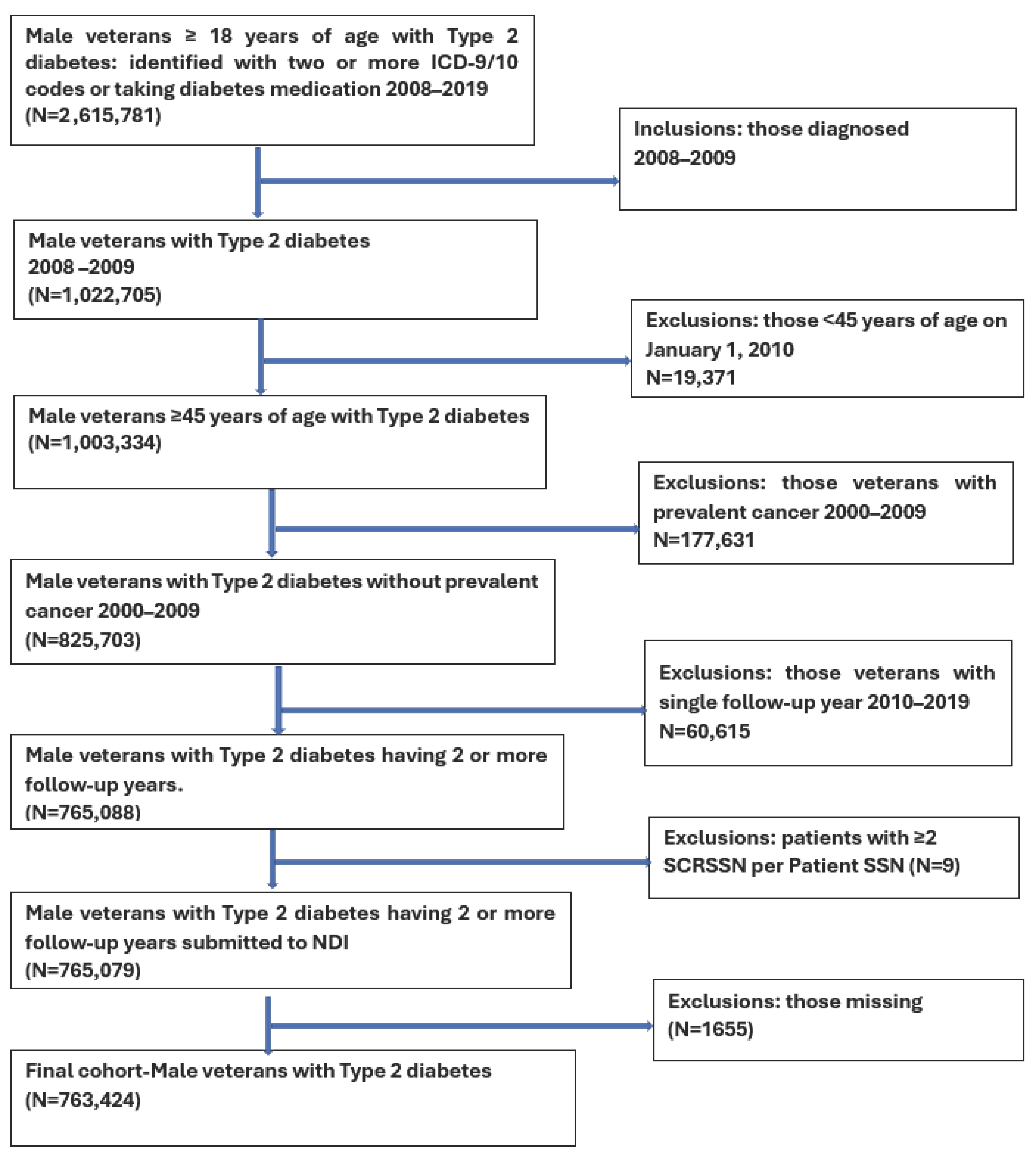
We used a previously validated algorithm to identify male veterans with diabetes, defined by the presence of two or more ICD-9 diabetes diagnosis codes (250, 357.2, 362.0, and 366.41) from inpatient stays/outpatient encounters or a diabetes medication prescription within a 24-month period (2008 and 2009) [23,24]. Prostate cancer and other cancers were identified using ICD-9 codes (185.x, V10.46, 233.4) or ICD-10 codes (C61.x, Z85.46, D07.5) recorded in the 2000-2019 VA CDW production domain between 2000 and 2019 (Supplemental Table S1), as well as and cancer registries data from the VA CDW–Oncology Raw Domain. Men with a cancer diagnosis other than non-melanoma skin cancer prior to 2010 or their 45th birthday were excluded. We allowed men to enter the cohort after 1 January 2010 if they met all inclusion criteria and had at least ≥2 years of follow-up data. This retrospective study evaluated the accuracy of incident PCa diagnosis and mortality using national clinical and administrative data from adult male veterans with T2DM. Our final sample included 763,424 veterans (see Figure 1).

2.2. Data Sources for Prostate Cancer Diagnosis

VHA databases: We validated prostate cancer diagnosis and diagnosis dates from the VA CDW Production Domain and CDW–Oncology Raw Domain databases coded between 1 January 2010 to 31 December 2019 against the PCDC. The VHA CDW stores data generated from over 20 years of EHR use and facilitates the discovery and application of knowledge. The CDW Production Domain is modeled and updated nightly. The CDW–Oncology Raw Domain originates with information from site-based cancer registries, and is extracted directly from the data source (e.g., VistA) and updated on a variety of schedules. The Oncology Raw Domain captures cancer registry data entered by the registrars, including cancer site, diagnosis, treatment, and other related fields. It is part of the data warehouse that allows for relatively easy linkage between the CDW–Oncology Raw Domain tables and other CDW data tables. CDW Raw Domain data has not been verified, standardized, or indexed, but it contains national information on incident cancers which may be useful for case ascertainment [25]. The VHA CDW databases include inpatient, outpatient, clinical, laboratory, pathology, pharmacy, radiology, prescription benefits, and vital signs data for patients who received healthcare services from the organization (see Supplemental Table S2, 2.1 & 2.2). The VHA via Data Access Request Tracker (DART) Dashboard databases included the National Precision Oncology Program (NPOP) Database, Assistant Deputy Under Secretary for Health (ADUSH) Enrollment Files, Health Economics Resource Center (HERC) Cost Data, Managerial Cost Accounting (MCA), Medical SAS Files, Observational Medical Outcomes Partnership (OMOP) Common Data Model, and Vital Status File (see Supplemental Table S2, 2.3). In 2016, VA Research partnered with the Prostate Cancer Foundation to establish the National Precision Oncology Program (NPOP), which offers system-wide deoxyribonucleic acid (DNA) sequencing for veterans with cancer [26].
PCDC: The VA Informatics and Computing Infrastructure (VINCI) team identified patients who were diagnosed with prostate cancer (patients were either identified as an analytic case in the cancer registry or those who had at least one prostate cancer diagnosis code in their Electronic Health Record (EHR) and the VA CDW. The data source for the diagnosis included inpatient, outpatient, and fee-based tables, which were scrutinized for clinical procedures, laboratory tests, treatments, and medications relevant to prostate cancer diagnosis and treatment [27]. One of the unique capabilities of VHA data is the opportunity for NLP, used in research to alleviate the need for chart abstraction in large data samples [28]. The VINCI team developed the NLP algorithm to identify metastatic PCa from PCa-related clinical notes, achieving a sensitivity of 0.919 and a specificity of 0.979 [3]. The PCDC combined patients identified via structured data and NLP and includes relevant patient demographic data, clinical features, vital status, and sites of care. The PCDC included information on each veteran’s unique Integration Control Number (Patient ICN), age at first diagnosis, indicators for one versus two or more ICD diagnosis codes, the earliest prostate cancer diagnosis date, PSA values, metastatic Pca, and Gleason score data derived from NLP, and the prostate cancer diagnosis source.
Prostate cancer was operationally defined as a binary variable (Yes/No) in each database. In the VHA CDW and Oncology Raw Domain databases, prostate cancer status was derived and coded as a binary indicator based on ICD diagnosis codes and cancer registry primary site codes. In the prostate PCDC database, an existing prostate cancer indicator variable derived from ICD diagnosis codes was used. Individuals with evidence of prostate cancer were coded as Yes and those without evidence were coded as No.
PCa diagnoses were identified using structured data from the CDW, including CDWork and the CDW Raw Domain VACCR Oncology cancer registry site codes. These structured data sources overlap with those used by the PCDC. However, the PCDC further supplements the structured data with information extracted from clinical notes using NLP, resulting in a more comprehensive and potentially more accurate dataset.

2.3. Data Sources for Mortality

CDW VHA VSF: We cross-checked data from CDW VSF databases coded between 1 January 2010 and 31 December 2019 with the National Death Index (NDI), vital status, date of death, and CoD. The information in the VHA VSF originates from many sources, including the VBA’s Beneficiary Identification Records Locator Subsystem (BIRLS) Death File, the VA Medicare VSF, which includes data from the Centers for Medicare and Medicaid Services (CMS) VSF, and the SSDMF [21]. The CDW VSF is updated quarterly by the VHA National Data Systems (NDS); there may be a lag of three or more months between a death occurring and its inclusion in the VSF [29]. The CDW VHA VSF applies algorithms to determine best death and birth dates but is does not contain CoD.
NDI: In our application to request NDI data from the VA Mortality Data Repository (MDR), we submitted an MDR Memorandum, MDR Application, MDR Confidentiality Agreement, Institutional Review Board (IRB) Approval Protocol, and IRB and Research and Development (R&D) Approval letter. Following approval, we followed the instructions on how to prepare and submit a search file. To be eligible for the NDI search, 765,079 patient records containing complete information on names, date of birth, ScrSSN, and a valid 9-digit SSN were submitted in a comma-separated values file to be linked with the NDI. The NDI is data from outside of VA containing patient SSN, the matching record identified in the MDR, date of birth, sex, state of death record, underlying CoD, the date of death, and ICD-10 codes to match the CoD. Supplemental Table S3 summarizes selected US mortality comparison studies. The sensitivity ranges from 74.2% to 98.3% and the specificity ranges from 92.8% to 99.7%, with the NDI as a gold standard. The sensitivity ranges from 53.9% to 73.4% and the specificity ranges from 66.7% to 90.3%, with the expert review as a gold standard.
All-cause mortality was operationally defined as a binary variable indicating whether a patient died from any cause during the study period. In the CDW, mortality status was derived from the recorded data of death. Patients with a documented death date were coded as Yes (death) and those without a recorded death date were coded as No (alive). For the NDI, prostate cancer-specific mortality was defined as a binary variable using the date of death and the underlying cause of death. Individuals with a recorded date of death and an underlying cause of death coded as a prostate cancer (ICD-10 code C61) were classified as having prostate cancer-specific mortality (Yes); otherwise, they classified as No. For the CDW VSF, prostate cancer-specific mortality was defined as a binary outcome. Patients with a recorded date of death and a prostate cancer diagnosis identified through ICD-9 and ICD-10 codes were classified as having prostate cancer-specific mortality (Yes). Although patients had a recorded death, individuals without a prostate cancer diagnosis identified through ICD-9 or ICD-10 codes were classified as not having prostate cancer-specific mortality (No).

2.4. Data Management

Data were housed in VA in Microsoft Structured Query Language (SQL) Server Management Studio 19 (SSMS 19) tables, including the CDW Production Domains, CDW Raw Domains, Decision Support System (DSS) National Data Extracts (NDEs), Text Integration Utility (TIU) text notes, and the VSF. To link CDW tables, we used the SQL command ‘JOIN’ to keep those matched records in both tables using identifiers. VINCI is a free workspace for projects that include applications: SSMS, SAS, SAS Grid Tools, Stata, Stat/Transfer, R, RStudio, SPSS, MATLAB, and others while ensuring security and veterans’ privacy. We exported data from SSMS to Stata 18 for analytical purposes on VINCI via an Open Database Connectivity (ODBC) exec () command.

2.5. Statistical Analysis

Descriptive statistics for measured variables were computed to present the cohort characteristics. Comparative analyses were conducted using chi-square tests for categorical variables and one-way analysis of variance (ANOVA) for continuous variables. Cohen’s kappa (k statistic) was used to assess agreement between data sources using the Stata command “diagt” (diagnostic test), which allowed us to calculate sensitivity, specificity, positive predictive value (PPV), and negative predictive value (NPV). We used the receiver operating characteristic (ROC) curve to evaluate the performance of the CDW and PCDC in PCa diagnosis. We then calculated the difference in the dates of PCa diagnosis (in days) between the CDW and PCDC data and stratified the findings by race and ethnicity. We repeated this analysis for the PCa vital status, and all CoDs from the CDW [15,18]. The PCDC was used as the gold standard for incidence of PCa, and the NDI was considered the gold standard for mortality. All analyses were performed using Stata version 18 software (StataCorp, College Station, TX, USA). The Ralph H. Johnson VA Research and Development Committee and the Medical University of South Carolina institutional review board approved the study (Pro 00120634) on the 25 July 2022.

3. Results

A total of 763,424 veterans with T2DM were included in the study and followed for a mean 5.1 years. During follow-up, 42.8% of the cohort died (Table 1). The mean age at baseline was 65.6 years. Most participants were Non-Hispanic White (74.6%) and the baseline service-connected disability rating was 13.9%. The mean baseline Elixhauser comorbidity was 3.0 and veterans averaged 4.3 primary care visit per year. During the baseline period, 78.8% used statin, 33.4% used insulin, and 83.8% were prescribed at least one oral antidiabetic medication.
During follow-up, a total of 37,048 (4.9% of the total) and 36,861 (4.8% of the total) veterans were diagnosed with prostate cancer in the CDW and PCDC, respectively. CDW and PCDC diagnoses were in concordance in 36,361 (98.6%) veterans, while 500 veterans were diagnosed in the CDW only and 687 were diagnosed in the PCDC only. Of the 36,361 veterans diagnosed with prostate cancer in both datasets, 91.5% had an exact match in the diagnosis date, while the remaining cases differed by one or more days (Table 2 & Supplemental Table S4). There were minimal discrepancies in the exact diagnosis date across racial and ethnic groups. When comparing matched records across all patients, we observed an agreement rate of 99.8% and a Kappa statistic of 0.98 (95% confidence interval: 0.98, 0.98, p < 0.001).
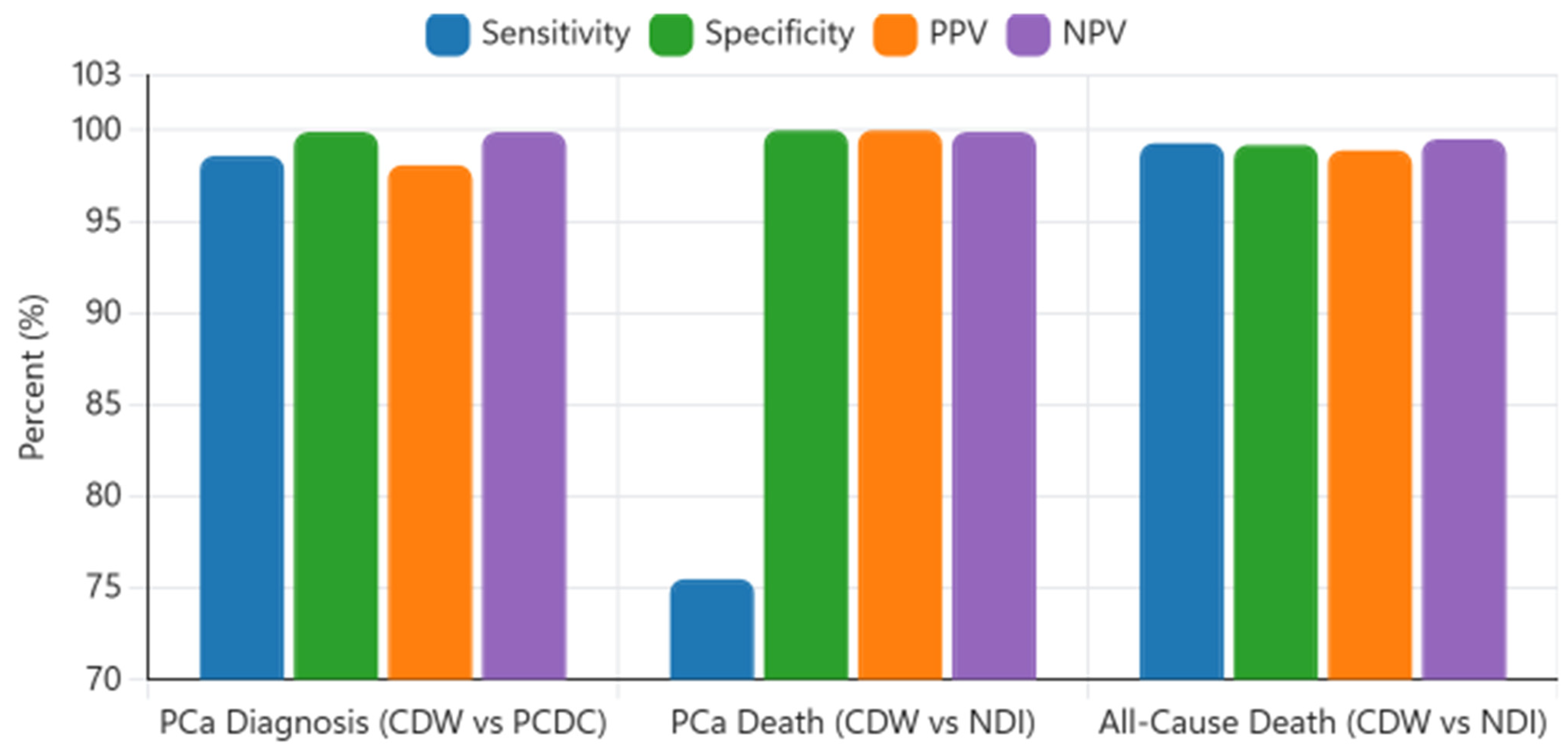
When compared with the reference dataset, incident PCa diagnoses identified in the CDW demonstrated high sensitivity (98.6%; 95% CI: 98.5%, 98.8%) and specificity (99.9%, 95% CI: 99.9%, 99.9%). Overall, the CDW correctly classified 99.8% of cases, with an ROC area of 0.99 (95% CI: 0.99, 0.99.), a PPV 98.1% (95% CI: 98.0%, 98.3%), and a NPV 99.9% (95% CI: 99.9%, 99.9%) (Table 3 and Figure 2).
We compared and evaluated PCa-specific mortality between the CDW and NDI datasets, using the NDI as the gold standard. A total of 2723 patients were recorded as deceased with PCa ICD-10 code of ‘C61’ listed as a CoD in the NDI. Of these, 2055 (75.4%) had concordant prostate cancer-specific mortality records in both datasets, with death dates matching exactly or differing by one or more days (see Table 4). Out of the total, 668 patients were classified as false negatives, having a record of PCa as the cause of death in the NDI but no corresponding PCa mortality record in the CDW. Concordance based on the exact date of death showed minimal disparities across racial and ethnic groups. Overall, the agreement rate was 99.91%, with a Kappa statistic of 0.86 (95% CI: 0.85, 0.87, p < 0.001). Using the NDI as the gold standard, the CDW demonstrated a sensitivity rate of 75.5% (95% CI: 73.8%, 77.1%), and specificity was 100.0% (95% CI: 100.0%, 100.0%) for identifying PCa-specific mortality. Overall, the CDW correctly classified 99.91% of cases, with an ROC area of 0.88 (95% CI: 0.87, 0.89), a PPV of 100.0% (95% CI; 99.8%, 100.0%), and a NPV of 99.9% (95% CI: 99.9%, 99.9%) (Table 4 and Figure 2).
For all-cause mortality, we compared deaths recorded in the CDW VSF with those in the NDI, using the NDI as the gold standard. A total of 328,165 and 326,707 veterans were identified as deceased in the CDW VSF and NDI, respectively. The two data sources were concordant for 324,567 deaths (99.3%), while 3598 deaths were identified only in the CDW VSF and 2140 only in the NDI. Among the 324,567 concordant deaths, 96.7% had an exact match on the date of death, whereas the remaining 3.3% differed by one or more days in the recorded date of deaths (see Table 5). Agreement on the exact date of death was consistent across racial and ethnic groups, with only minimal discrepancies observed. Among matched records, the overall agreement rate was 99.25%, with a Kappa statistic of 0.99 (95% [CI] 0.98, 0.99, p < 0.001) (Table 5). Using the NDI as a gold standard, the CDW demonstrated high sensitivity (99.3%; 95% CI: 99.3%, 99.4%) and specificity (99.2%, 95% CI: 99.1%, 99.2%) for identifying all-cause mortality. Overall, the CDW correctly classified 99.3% of cases and achieved an ROC area of 0.99 (95% CI: 0.99, 0.99) (Table 5 and Figure 2).

4. Discussion

This study evaluated the diagnostic accuracy of incident PCa identification and the ascertainment of PCa-specific and all-cause mortality among patients with type 2 diabetes mellitus using data from a large national cohort. The findings provide important evidence regarding the validity of these outcomes across multiple data sources. We observed a high level of agreement between the CDW and PCDC for incident PCa diagnoses and between the CDW VSF and NDI for all-cause mortality. In contrast, agreement between the CDW and NDI for PCa-specific mortality was substantially lower, indicating greater challenges in accurately ascertaining cause-specific mortality from administrative data source.
The CDW demonstrated high sensitivity and specificity for identifying incident PCa compared to the PCDC, indicating excellent concordance between the two data sources. However, constructing an incident PCa cohort from the CDW is a complex and time-intensive process. To minimize misclassification, we first identified and excluded all prevalent cancer cases diagnosed between 2000 and 2009. Then we ascertained incident PCa cases using ICD-coded data from 21 CDW sources, including inpatient, outpatient, surgery, radiology, and fee basis, as well as data from the Oncology Raw Domain. This comprehensive approach enabled the accurate identification of newly diagnosed PCa cases across multiple structured clinical and administrative data sources.
The VHA CDW is a national-level database representing the U.S. veteran population. It can be used to identify a wide range of diagnoses, including both cancer and non-cancer conditions, making it broadly applicable across diverse study populations. Although incident disease identification often requires substantial programming and data management, the CDW remains a comprehensive resource with extensive research utility and broad applicability across clinical research areas.
On the other hand, the PCa incidence cohort in the PCDC is cleaned and readily available for use; it is created from structured data (ICD-codes), the VACCR, and clinical notes using NLP. Findings support the use of the PCDC for research purposes due to its high-level completeness, accuracy, and ease of data retrieval. In addition to the PCDC, the VA Precision Oncology Program (POP) has established precision oncology programs including lung cancer, breast cancer, and rare cancers [27]. Precision oncology aids researchers in allowing for the leverage of high-quality data to enhance research prediction and data-driven insights [30,31]. One challenge in administrative databases is accurately identifying incident disease cases. Our findings suggest that excluding prevalent cases occurring at least 10 years before cohort entry is essential for improving case ascertainment. In addition, integrating multiple sources of diagnostic information—including ICD codes, prescription data, and clinical notes—from diverse settings such as inpatient, outpatient, radiology, and surgery records can substantially enhance diagnostic accuracy. The PCDC is a nationally curated prostate cancer dataset developed for both operational and research purposes. It contains patient-level demographic and clinical characteristics, procedures, laboratory results, and medication information. Because the data are standardized, cleaned, and integrated at the patient level, the PCDC is an efficient and valuable resource for prostate cancer research. However, its applicability is limited to individuals with prostate cancer, making it less suitable for studies involving broader disease populations.
The study findings showed that concordance in PCa-specific mortality based on the exact date of death was relatively lower among Hispanic veterans. These discrepancies may be attributable to the smaller sample size of this subgroup or potential biases in cause-of-death ascertainment. For instance, a recent study suggested that implicit bias and other systematic factors may contribute to inaccuracies in cause of death among racial and ethnic minority populations [32]. The CDW demonstrated relatively low sensitivity for identifying PCa-specific CoD, likely due to misclassification of mortality record. This finding is consistent with previous research comparing national mortality ascertainment databases in the United States, including the NDI, the SSA, and the Department of Veterans Affairs, which has reported variability in the accuracy of cause-specific mortality classification [33].
These findings are consistent with previous research showing that the NDI has the highest sensitivity for mortality ascertainment. As a national mortality database, the NDI is an essential source for research because it includes cause-of-death information, enabling accurate identification and evaluation of cause-specific mortality outcomes [33]. Although direct comparisons of death and CoD ascertainment across studies may be limited by differences in study in population, methodologies, demographics, and other patient characteristics [18,34], our findings of CoD misclassification in administrative databases sources relative to the NDI are consistent with those of other studies [18,33,35]. Differences in mortality data source and deficiencies in the CoD certification in real-world settings may bias inferences and conclusions drawn from health research [14,18,36]. Inaccurate CoDs recorded on death certificates have been documented in many studies. Educational interventions are a fundamental step toward improving the accuracy of death certification, thereby enhancing the quality of mortality statistics used for epidemiological research, public health policy, and healthcare planning [14,36]. Given the small cohort size, previous studies have used expert review as a gold standard for mortality ascertainment to improve the accuracy of CoD classification, which relies on death certificate data [14,37,38]. The NDI is a national-level morality repository that contains dates and causes of death derived from death certificates. Because it provides cause-specific mortality information, the NDI is widely regarded as the reference standard for mortality ascertainment research and is particularly valuable for studies of cause-specific death.
With respect to all-cause mortality, 328,156 deaths were identified in the CDW VSF and 326,707 deaths in the NDI, with 99.3% concordance between the two data sources. Among concordant deaths, 96.67% had an exact match in the date of death. Concordance based on the exact data of death was similar across racial and ethnic groups. All-cause mortality recorded in the CDW VSF closely aligned with the NDI with respect to both vital status and date of death. Based on our comparison with the NDI, the CDW VSF demonstrated excellent performance in ascertaining vital status and date of death, supporting its use as a reliable source of all-cause mortality data for research. For mortality studies, the CDW VSF is a reliable source for all-cause mortality ascertainment. The CDW VSF is derived from multiple sources, including the VBA BIRLS Death File, the VA Medicare Vital Status File, and the SSDMF. The integration of these sources provides a comprehensive and accurate source for determining veterans’ vital statuses and dates of death [22,35]. A previous study supports our findings, demonstrating that mortality data derived from multiple sources—including the Death Master File, online obituary data, hospital discharge status on medical claims, health plan reasons for disenrollment data, and the center for Medicare and Medicaid Services—achieve greater accuracy and more reliable performance in multiyear studies than reliance on any single source alone [39]. Hence, the findings demonstrate that the CDW VSF is an efficient alternative to the NDI for determining vital status and date of deaths in large VHA epidemiological cohort studies.

5. Strengths and Limitations

The major strength of this study is its innovative use of large datasets to validate incident PCa diagnosis and cause-specific mortality data for PCa among a diverse population of veterans with type 2 diabetes. Another key strength is the use of comprehensive national data encompassing a large veteran cohort with up to 10-year follow-up, providing valuable insights into the quality and consistency of these data over time. Furthermore, linkage of the CDW with the PCDC and the NDI enhances the validity of diagnostic and mortality ascertainment. The inclusion of NDI data, which are based on death certificate records, further strengthened the reliability of the cause-specific mortality analysis. The PCDC is considered a robust reference source because it integrates structured data from the VHA CDW and VACCR, supplemented by NLP extraction from unstructured clinical notes. Furthermore, data accuracy was validated through chart abstraction, supporting the reliability of prostate cancer diagnosis and outcomes captured in the database. The NDI is widely regarded as the national benchmark for mortality ascertainment in epidemiological research, providing standardized underlying causes of death based on death certificates. However, there are some limitations to consider when interpreting the findings. First, the use of the NDI in practice is somewhat limited due to its 2-year data update lag and the time and cost involved in the data retrieval process. Second, NDI CoD classification depends on the accuracy of death certificate reporting and coding, which may result in misclassification of the CoD. Third, our study cohort is based on the VA population, which restricts the generalizability of the results to a broader population. Fourth, in the comparison of prostate cancer-specific mortality with the NDI, we used the vital status and date of death from the CDW Vital Status File (VSF) and combined these with prostate cancer diagnoses identified from CDW ICD-9/10 codes to determine cause of death. This approach may introduce bias, particularly due to potential misclassification arising from inconsistencies in mapping ICD-9 codes from the CDW to the ICD-10 coding system used by the NDI. Further research should validate our findings and investigate discrepancies in cause-specific death classification using large, nationwide datasets. Additionally, studies exploring racial and ethnic disparities in cause-specific mortality can provide valuable insights into health outcome variations. Furthermore, future studies are needed to validate both prostate cancer diagnosis and cancer stage classifications.

6. Conclusions

This study provides novel and valuable evidence on the the accuracy of PCa diagnosis and cause-specific mortality in veterans with diabetes, supporting the efficient conduct of epidemiological research in this population. The findings demonstrated a high-level of agreement between the CDW and PCDC for PCa diagnosis ascertainment, as well as between the CDW VSF and NDI for all-cause mortality, indicating that these data sources are reliable for research applications. Given the time-intensive and complex process of retrieving and cleaning CDW data, the use of the PCDC for PCa diagnosis ascertainment and the CDW VSF for all-cause mortality represents a valid, efficient, and practical approach for epidemiological research. However, the low sensitivity observed for PCa-specific mortality highlights limitations in the CDW for identifying cause-specific deaths and underscores the importance of using the NDI when accurate cause-of-death information is required. To our knowledge, this is the first study to simultaneously evaluate the diagnostic accuracy of PCa ascertainment and PCa-specific mortality among individuals with type 2 diabetes mellitus using a large national cohort of veterans.

Supplementary Materials

The following supporting information can be downloaded at: https://www.mdpi.com/article/10.3390/diabetology7080158/s1, Supplemental Table S1: Site-specific cancer diagnosis codes, Supplemental Table S2: VHA Data Source, Supplemental Table S3: Selected literature comparing mortality databases with the NDI for ascertainment of US mortality, Supplemental Table S4: Cross tabulation of prostate cancer diagnosis in CDW vs. PCDC.

Author Contributions

K.G.B. and M.G. conceptualized the project and led the data curation, formal analysis, methodology, and drafting the manuscript. M.G. was responsible for funding acquisition, project administration, and study supervision. All authors participated in the drafting and critical edition of the manuscript. All authors have read and agreed to the published version of the manuscript.

Funding

This research was funded by a VHA Health Equity and Rural Outreach Center (HEROIC) SWIFT Rapid Pilot Proposal at Ralph H. Johnson VA, Charleston (PI: Gebregziabher, grant number: 00120634).

Institutional Review Board Statement

Although the study utilized data containing protected health information (PHI), the IRB approved the protocol with appropriate safeguards to ensure confidentiality and compliance with HIPPA regulations. The Ralph H. Johnson VA Research and Development Committee and the Medical University of South Carolina institutional review board approved this study (Project no: 00120634, approval date: 25 July 2022).

Informed Consent Statement

This is retrospective study that used national databases with no patient contact. IRB approved the study and granted a waiver of informed consent.

Data Availability Statement

The data is not publicly accessible due to confidentiality requirements. More information is available on: https://vincicentral.vinci.med.va.gov/SitePages/VINCI_University-VINCI_Data-Data_Sources.aspx (accessed on 17 June 2026).

Acknowledgments

This work was supported by a VHA HEROIC at Ralph H. Johnson VA, Charleston. The funders had no role in study design, data collection, or analysis.

Conflicts of Interest

The authors declare no conflict of interest.

Abbreviations

VAVeterans Affairs
PCaProstate Cancer
T2DMType 2 Diabetes Mellitus
VHAVeterans Health Administration
CDWCorporate Data Warehouse
PCDCProstate Cancer Data Core
NDINational Death Index
KappaCohen’s Kappa
VSFVital Status File
SEERSurveillance, Epidemiology, and End Results
ICD-9-CMInternational Classification of Diseases, Ninth Revision, Clinical Modification
ICD-10-CMInternational Classification of Diseases, Tenth Revision, Clinical Modification
VACCRVA Central Cancer Registry
CPTCurrent Procedural Terminology
DREDigital Rectal Examination
PSAProstate Specific Antigen
TRUSTransrectal Ultrasound
MRIMagnetic Resonance
CSCAPClinically Significant Prostate Cancer
CoDCause of Death
CDCCenter for Disease Control
SEARCHShared Equal Access Regional Cancer Hospital
SSNSocial Security Number
KPMAS-VDWKaiser Permanente Mid-Atlantic States’ Virtual Data Warehouse
MVIMaster Veteran Index
NCANational Cemetery Administration
MCMedical Center
SSDMFSocial Security Administration’s Death Master File
SSASocial Security Administration
EVVEElectronic Verification of Vital Events
VBAVeterans Benefit Administration
BIRLSBeneficiary Identification Records Locator Subsystem
MSIDMedical SAS Inpatient Datasets
PTFPatient Treatment File
DARTData Access Request Tracker
NPOPNational Precision Oncology Program
ADUSHAssistant Deputy Under Secretary for Health
HERCHealth Economics Resource Center
MCAManagerial Cost Accounting
OMOPObservational Medical Outcomes Partnership
VINCIVA Informatics and Computing Infrastructure
HERElectronic Health Record
NLPNatural Language Processing
ICNIntegration Control Number
CMSCenters for Medicare and Medicaid Services
NDSNational Data Systems
DAFDeath Ascertainment File
MDRMortality Data Repository
IRBInstitutional Review Board
PTRPreparatory to Research
R&DResearch and Development
HIPPAHealth Insurance Portability and Accountability Act
RoBRules of Behavior
WOCWithout Compensation
SSMSMicrosoft SQL Server Management Studio
DSSDecision Support System
TIUText Integration Utility
SPSSStatistical Package for Social Sciences
MATLABMatrix Laboratory
ODBCOpen Database Connectivity
ANOVAAnalysis of Variance
PPVPositive Predictive Value
NPVNegative Predictive Value
ROCReceiver Operating Characteristic
CIConfidence Interval
PCSMProstate Cancer-Specific Mortality
nmCRPCaNon-metastatic Castrate-Resistant Prostate Cancer
POPPrecision Oncology Program

References and Note

  1. Wang, L.; Lu, B.; He, M.; Wang, Y.; Wang, Z.; Du, L. Prostate Cancer Incidence and Mortality: Global Status and Temporal Trends in 89 Countries from 2000 to 2019. Front. Public Health 2022, 10, 811044. [Google Scholar] [CrossRef] [Scilit] [PubMed] [PubMed Central]
  2. Surveillance, Epidemiology, and End Results (SEER). Cancer Stat Facts: Prostate Cancer; National Cancer Institute: Bethesda, MD, USA, 2024. Available online: https://seer.cancer.gov/statfacts/html/prost.html (accessed on 27 January 2024).
  3. Alba, P.R.; Gao, A.; Lee, K.M.; Anglin-Foote, T.; Robison, B.; Katsoulakis, E.; Rose, B.S.; Efimova, O.; Ferraro, J.P.; Patterson, O.V.; et al. Ascertainment of Veterans with Metastatic Prostate Cancer in Electronic Health Records: Demonstrating the Case for Natural Language Processing. JCO Clin. Cancer Inform. 2021, 5, 1005–1014. [Google Scholar] [CrossRef] [Scilit] [PubMed]
  4. Smith, M.R.; Bae, K.; Efstathiou, J.A.; Hanks, G.E.; Pilepich, M.V.; Sandler, H.M.; Shipley, W.U. Diabetes and mortality in men with locally advanced prostate cancer: RTOG 92-02. J. Clin. Oncol. 2008, 26, 4333–4339. [Google Scholar] [CrossRef] [Scilit] [PubMed] [PubMed Central]
  5. Kasper, J.S.; Giovannucci, E. A meta-analysis of diabetes mellitus and the risk of prostate cancer. Cancer Epidemiol. Biomark. Prev. 2006, 15, 2056–2062. [Google Scholar] [CrossRef] [Scilit] [PubMed]
  6. Xu, H.; Jiang, H.W.; Ding, G.X.; Zhang, H.; Zhang, L.M.; Mao, S.H.; Ding, Q. Diabetes mellitus and prostate cancer risk of different grade or stage: A systematic review and meta-analysis. Diabetes Res. Clin. Pract. 2013, 99, 241–249. [Google Scholar] [CrossRef] [Scilit] [PubMed]
  7. Descotes, J.L. Diagnosis of prostate cancer. Asian J. Urol. 2019, 6, 129–136. [Google Scholar] [CrossRef] [Scilit] [PubMed] [PubMed Central]
  8. Islam, R.; Imran, A.; Rabbi, M.F. Prostate Cancer Detection from MRI Using Efficient Feature Extraction with Transfer Learning. Prostate Cancer 2024, 2024, 1588891. [Google Scholar] [CrossRef] [Scilit] [PubMed] [PubMed Central]
  9. Elkhoury, F.F.; Felker, E.R.; Kwan, L.; Sisk, A.E.; Delfin, M.; Natarajan, S.; Marks, L.S. Comparison of Targeted vs Systematic Prostate Biopsy in Men Who Are Biopsy Naive: The Prospective Assessment of Image Registration in the Diagnosis of Prostate Cancer (PAIREDCAP) Study. JAMA Surg. 2019, 154, 811–818. [Google Scholar] [CrossRef] [Scilit] [PubMed] [PubMed Central]
  10. Ahdoot, M.; Wilbur, A.R.; Reese, S.E.; Lebastchi, A.H.; Mehralivand, S.; Gomella, P.T.; Bloom, J.; Gurram, S.; Siddiqui, M.; Pinsky, P.; et al. MRI-Targeted, Systematic, and Combined Biopsy for Prostate Cancer Diagnosis. N. Engl. J. Med. 2020, 382, 917–928. [Google Scholar] [CrossRef] [Scilit] [PubMed] [PubMed Central]
  11. Moghanaki, D.; Howard, L.E.; De Hoedt, A.; Aronson, W.J.; Kane, C.J.; Amling, C.L.; Cooperberg, M.R.; Terris, M.K.; Freedland, S.J. Validity of the National Death Index to ascertain the date and cause of death in men having undergone prostatectomy for prostate cancer. Prostate Cancer Prostatic Dis. 2019, 22, 633–635. [Google Scholar] [CrossRef] [Scilit] [PubMed] [PubMed Central]
  12. Zhang, Y.S.; Hu, P.; Strauss, J.A.; Zhao, Y.; Wang, Y.; Crimmins, E.M. Ascertaining cause of mortality among middle-aged and older persons using computer-coded and expert review verbal autopsies in the China Health and Retirement Longitudinal Study. Glob. Health Action 2020, 13, 1768502. [Google Scholar] [CrossRef] [Scilit] [PubMed] [PubMed Central]
  13. Kilpeläinen, T.P.; Mäkinen, T.; Karhunen, P.J.; Aro, J.; Lahtela, J.; Taari, K.; Talala, K.; Tammela, T.L.; Auvinen, A. Estimating bias in causes of death ascertainment in the Finnish Randomized Study of Screening for Prostate Cancer. Cancer Epidemiol. 2016, 45, 1–5. [Google Scholar] [CrossRef] [Scilit] [PubMed]
  14. McGivern, L.; Shulman, L.; Carney, J.K.; Shapiro, S.; Bundock, E. Death Certification Errors and the Effect on Mortality Statistics. Public Health Rep. 2017, 132, 669–675. [Google Scholar] [CrossRef] [Scilit] [PubMed] [PubMed Central]
  15. Ter-Minassian, M.; Basra, S.S.; Watson, E.S.; Derus, A.J.; Horberg, M.A. Validation of US CDC National Death Index mortality data, focusing on differences in race and ethnicity. BMJ Health Care Inform. 2023, 30, e100737. [Google Scholar] [CrossRef] [Scilit] [PubMed] [PubMed Central]
  16. Navar, A.M.; Peterson, E.D.; Steen, D.L.; Wojdyla, D.M.; Sanchez, R.J.; Khan, I.; Song, X.; Gold, M.E.; Pencina, M.J. Evaluation of Mortality Data From the Social Security Administration Death Master File for Clinical Research. JAMA Cardiol. 2019, 4, 375–379. [Google Scholar] [CrossRef] [Scilit] [PubMed] [PubMed Central]
  17. Ozieh, M.N.; Gebregziabher, M.; Ward, R.C.; Taber, D.J.; Egede, L.E. Creating a 13-year National Longitudinal Cohort of veterans with chronic kidney disease. BMC Nephrol. 2019, 20, 241. [Google Scholar] [CrossRef] [Scilit] [PubMed] [PubMed Central]
  18. Lerman, M.H.; Holmes, B.; St Hilaire, D.; Tran, M.; Rioth, M.; Subramanian, V.; Winzeler, A.M.; Brown, T. Validation of a Mortality Composite Score in the Real-World Setting: Overcoming Source-Specific Disparities and Biases. JCO Clin. Cancer Inform. 2021, 5, 401–413. [Google Scholar] [CrossRef] [Scilit] [PubMed] [PubMed Central]
  19. Arias, E.; Heron, M.; National Center for Health Statistics; Hakes, J.; US Census Bureau. The Validity of Race and Hispanic-origin Reporting on Death Certificates in the United States: An Update. Vital Health Stat. 2 2016, 1–21. [Google Scholar] [PubMed]
  20. Ruderman, M.A.; Byers, A.L.; Bauer, M.S.; Stolzmann, K.; Miller, C.J.; Connolly, S.L.; Kim, B. One-Year All-Cause Mortality and Delivery of the Collaborative Chronic Care Model in General Mental Health Clinics. Psychiatr. Serv. 2023, 74, 1077–1080. [Google Scholar] [CrossRef] [Scilit] [PubMed] [PubMed Central]
  21. Cheng, E.M.; Myers, L.J.; Vassar, S.; Bravata, D.M. Impact of Hospital Admission for Patients with Transient Ischemic Attack. J. Stroke Cerebrovasc. Dis. 2017, 26, 1831–1840. [Google Scholar] [CrossRef] [Scilit] [PubMed] [PubMed Central]
  22. Jobson, J.D.; Gentry, C. The Mortality Rate of 100% Service-Connected U.S. Veterans. SOCRA Source 2021, 108, 31–39. [Google Scholar] [PubMed] [PubMed Central]
  23. Egede, L.E.; Gebregziabher, M.; Hunt, K.J.; Axon, R.N.; Echols, C.; Gilbert, G.E.; Mauldin, P.D. Regional, Geographic, and Ethnic Differences in Medication Adherence Among Adults with Type 2 Diabetes. Ann. Pharmacother. 2011, 45, 169–178. [Google Scholar] [CrossRef] [Scilit] [PubMed]
  24. Ioannidou, A.; Watts, E.L.; Perez-Cornago, A.; Platz, E.A.; Mills, I.G.; Key, T.J.; Travis, R.C.; The PRACTICAL consortium, CRUK, BPC3, CAPS, PEGASUS; Tsilidis, K.K.; Zuber, V. The relationship between lipoprotein A and other lipids with prostate cancer risk: A multivariable Mendelian randomisation study. PLoS Med. 2022, 19, e1003859. [Google Scholar] [CrossRef] [Scilit] [PubMed] [PubMed Central]
  25. Zullig, L.L.; Jazowski, S.A.; Chawla, N.; Williams, C.D.; Winski, D.; Slatore, C.G.; Clary, A.; Rasmussen, K.M.; Ticknor, L.M.; Kelley, M.J. Summary of Veterans Health Administration Cancer Data Sources. J. Regist. Manag. 2024, 51, 21–28. [Google Scholar] [PubMed] [PubMed Central]
  26. Montgomery, B.; Rettig, M.; Kasten, J.; Muralidhar, S.; Myrie, K.; Ramoni, R. The Precision Oncology Program for Cancer of the Prostate (POPCaP) Network: A Veterans Affairs/Prostate Cancer Foundation Collaboration. Fed. Pract. 2020, 37, S48–S53. [Google Scholar] [CrossRef] [Scilit] [PubMed] [PubMed Central]
  27. VA Prostate Data Core. This work was supported using resources and facilities of the Department of Veterans Affairs (VA) Informatics and Computing Infrastructure (VINCI), VA HSR RES 13-457.
  28. Graham, L.A. Databases for surgical health services research: Veterans Health Administration data. Surgery 2019, 165, 876–878. [Google Scholar] [CrossRef] [Scilit] [PubMed]
  29. Arnold, N. VIReC Data Snapshot: Recent Death Dates in the VSF and MPI; U.S. Dept. of Veterans Affairs, Health Services Research and Development Service, VA Information Resource Center: Hines, IL, USA, 2021.
  30. Schwartzberg, L.; Kim, E.S.; Liu, D.; Schrag, D. Precision Oncology: Who, How, What, When, and When Not? Am. Soc. Clin. Oncol. Educ. Book 2017, 37, 160–169. [Google Scholar] [CrossRef] [PubMed]
  31. Kelley, M.J. VA National Precision Oncology Program. Fed. Pract. 2020, 37, S22–S27. [Google Scholar] [CrossRef] [Scilit] [PubMed] [PubMed Central]
  32. Appel, N.S.; Edgar, H.J.H.; Berry, S.D.; Hunley, K. Error and bias in race and ethnicity descriptions in medical examiner records in New Mexico: Consequences for understanding mortality among Hispanic/Latinos. Forensic Sci. Int. Synerg. 2023, 7, 100338. [Google Scholar] [CrossRef] [Scilit] [PubMed] [PubMed Central]
  33. Cowper, D.C.; Kubal, J.D.; Maynard, C.; Hynes, D.M. A primer and comparative review of major US mortality databases. Ann. Epidemiol. 2002, 12, 462–468. [Google Scholar] [CrossRef] [Scilit] [PubMed]
  34. Skopp, N.A.; Smolenski, D.J.; Schwesinger, D.A.; Johnson, C.J.; Metzger-Abamukong, M.J.; Reger, M.A. Evaluation of a methodology to validate National Death Index retrieval results among a cohort of U.S. service members. Ann. Epidemiol. 2017, 27, 397–400. [Google Scholar] [CrossRef] [Scilit] [PubMed]
  35. Sohn, M.W.; Arnold, N.; Maynard, C.; Hynes, D.M. Accuracy and completeness of mortality data in the Department of Veterans Affairs. Popul. Health Metr. 2006, 4, 2. [Google Scholar] [CrossRef] [Scilit] [PubMed] [PubMed Central]
  36. Aung, E.; Rao, C.; Walker, S. Teaching cause-of-death certification: Lessons from international experience. Postgrad. Med. J. 2010, 86, 143–152. [Google Scholar] [CrossRef] [Scilit] [PubMed]
  37. Schwarcz, S.; Hessol, N.A.; Spinelli, M.A.; Hsu, L.C.; Wlodarczyk, D.; Tulsky, J.; Newman, M.D.; Buchbinder, S.P. Sensitivity and Specificity of the National Death Index for Multiple Causes of Death in People with HIV. Public Health Rep. 2021, 136, 595–602. [Google Scholar] [CrossRef] [Scilit] [PubMed] [PubMed Central]
  38. Olubowale, O.T.; Safford, M.M.; Brown, T.M.; Durant, R.W.; Howard, V.J.; Gamboa, C.; Glasser, S.P.; Rhodes, J.D.; Levitan, E.B. Comparison of Expert Adjudicated Coronary Heart Disease and Cardiovascular Disease Mortality with the National Death Index: Results from the REasons for Geographic and Racial Differences in Stroke (REGARDS) Study. J. Am. Heart Assoc. 2017, 6, e004966. [Google Scholar] [CrossRef] [Scilit] [PubMed] [PubMed Central]
  39. Sponholtz, T.; Jamal-Allial, A.; Vojjala, S.K.; Papazian, A.; Eshete, B.; Paullin, M.; Mahmoudpour, S.H.; Verpillat, P.; Beachler, D.C. Trends in the Completeness and Validity of Sources of Death Data Against the National Death Index from 2010 to 2018. Pharmacoepidemiol. Drug Saf. 2024, 33, e5870. [Google Scholar] [CrossRef] [Scilit] [PubMed]
Figure 1. Chart flow for veterans with Type 2 diabetes.
Diabetology 07 00158 g001
Figure 2. Validation performance by outcome and data sources, 2010–2019.
Diabetology 07 00158 g002
Table 1. Baseline demographic and clinical characteristics among male veterans with T2DM by NDI mortality status.
Total DeceasedNot Deceased
N (%)763,424 (100)326,711 (42.8)436,713 (57.2)
Mean age (std. dev.) *65.6 (9.9)62.3 (8.2)70.2 (10.1)
Race and ethnicity
Non-Hispanic White74.679.870.8
Non-Hispanic Black15.912.618.3
Hispanic6.45.07.4
Other2.72.23.1
Missing0.40.40.4
Marital status
Non-Married40.242.638.4
Married59.757.361.5
Missing0.080.090.08
Location of residence
Urban61.661.661.5
Rural38.238.338.1
Missing0.20.080.4
Mean annual primary care visit (std. dev.) *4.3 (4.2)4.6 (4.7)4.1 (3.8)
Service-connected disability (≥50%)
No86.185.286.8
Yes13.914.813.2
Mean elixhauser comorbidities (std. dev.) *3.0 (1.9)3.4 (2.2)2.7 (1.6)
Statin use
No21.221.720.9
Yes78.878.379.2
Insulin use
No66.660.371.3
Yes33.439.728.8
Oral diabetes medication use
No16.221.712.1
Yes83.878.387.9
* ANOVA test. Chi-square test. Note: Annual primary care visit, service-connected disability, Elixhauser scores, statin use, insulin use, and oral medication use are for the baseline 2008–2009.
Table 2. Prostate cancer date of diagnosis differences between the CDW and PDC by race/ethnicity.
Diagnosis Differences Matched on Days
All PatientNHWNHBHispanicOther
Diagnosis Date DifferenceNumber of Subjects%Number of Subjects%Number of Subjects%Number of Subjects%Number of Subjects%
033,27791.5221,38492.18901190.68205889.5275588.62
11030.28610.26340.3470.3010.12
21170.32610.26500.5060.2600
3810.22460.20280.2830.1330.35
4780.21390.17300.3070.3020.23
5990.27430.19440.4470.3050.59
6920.25470.20370.5770.3010.12
71130.31560.24500.5050.2220.23
≥824016.6014626.306536.571998.66839.74
Total36,36110023,19910099371002299100852100
Diagnosis Differences Matched on Date Intervals
Diagnosis Date DifferenceNumber of Subjects%Number of Subjects%Number of Subjects%Number of Subjects%Number of Subjects%
033,27791.5221,38492.18901190.68205889.5275588.62
1–3016144.449013.885705.741124.87283.29
31–605341.473361.451361.37371.61242.82
61–902860.791840.79600.60291.26131.53
91–1201630.45980.42390.39160.7091.06
121–150650.18420.18120.1250.2260.70
151–180660.18330.14180.18110.4840.47
≥1813560.982210.95910.92311.35131.53
Total36,36110023,19910099371002299100852852
Whether Diagnosis Matched on the Same Date or Not
Exact
Diagnosis Date
Number of Subjects%Number of Subjects%Number of Subjects%Number of Subjects%Number of Subjects%
Yes33,27791.521,38492.2901190.7205889.575588.6
No30848.518157.89269.324110.59711.4
Total36,36110023,19910099371002299100852100
Note: Counts across race/ethnicity categories for prostate cancer diagnosis may not sum to the total number of subjects because of missing race/ethnicity data (74 subjects).
Table 3. Validity of prostate cancer diagnosis and mortality ascertainment by data source, 2010–2019.
Statistics (95% CI)PCa Diagnosis
(CDW vs. PCDC)
PCa Death
(CDW vs. NDI)
All-cause Death
(CDW vs. NDI)
Sensitivity98.6% (98.5%, 98.8%)75.5% (73.8%, 77.1%)99.3% (99.3%, 99.4%)
Specificity99.9% (99.9%, 99.9%)100% (100.0%,100.0%)99.2% (99.1%, 99.2%)
ROC area0.99 (0.99, 0.99)0.88 (0.87, 0.89)0.99 (0.99, 0.99)
PPV98.1% (98.0%, 98.3%)100% (99.8%,100.0%)98.9% (98.9%, 98.9%)
NPV99.9% (99.9%, 99.9%)99.9% (99.9%, 99.9%)99.5 (99.5%, 99.5%)
Correctly classified99.8%99.9%99.3%
List of abbreviations: PCa—prostate cancer; ROC—receiver operating characteristic; PPV—positive predictive value; NPV—negative predictive value; 95% CI—95% confidence interval; CDW—corporate data warehouse; NDI—national death index.
Table 4. Prostate cancer date of deaths differences between the CDW and NDI by race/ethnicity.
Death Differences Matched on Days
All PatientNHWNHBHispanicOther
Death Date DifferenceNumber of Subjects%Number of Subjects%Number of Subjects%Number of Subjects%Number of Subjects%
0198096.35140396.5641495.6111294.9245100.00
1351.70221.51112.5421.6900
260.2950.3410.230000
350.2430.2110.2310.8500
40000000000
520.100020.460000
60000000000
710.0510.07000000
≥8110.5480.5520.4610.8500
Missing150.73110.7620.4621.6900
Total2055100145310043310011810045100
Death Differences Matched on Date Intervals
Death Date DifferenceNumber of Subjects%Number of Subjects%Number of Subjects%Number of Subjects%Number of Subjects%
0198096.35140396.5641495.6111294.9245100
1–30552.68362.48163.7032.5400
31–6010.0510.07000000
61–9010.0510.07000000
91–1200000000000
121–1500000000000
151–1800000000000
≥18130.1510.0710.2310.8500
Missing150.73110.7620.4621.6900
Total2055100145310043310011810045100
Whether Death Matched on The same Date or Not
Exact Death DateNumber of Subjects%Number of Subjects%Number of Subjects%Number of Subjects%Number of Subjects%
Yes198096.35140396.5641495.611294.945100
No602.9392.68173.943.400
Missing150.73110.7620.521.700
Total2055100145310043310011810054100
Note: Counts across race/ethnicity categories for prostate cancer-specific death may not sum to the total number of subjects because of missing race/ethnicity data (6 subjects).
Table 5. All-cause date of mortality differences between the CDW and NDI by race/ethnicity.
Death Differences Matched on Days
All PatientNHWNHBHispanicOther
Death Date DifferenceNumber of Subjects%Number of Subjects%Number of Subjects%Number of Subjects%Number of Subjects%
0313,70796.67250,90596.7639,02095.8215,43897.07697496.97
154561.6841291.599272.282411.521211.68
211210.348780.341690.42450.28210.29
36250.194790.18970.24310.19130.18
43820.123050.12500.12160.1080.11
53000.092290.09500.12180.1110.01
62390.071820.07380.09110.0760.08
72870.092220.09480.1260.0460.08
≥824500.7519750.763230.79980.62420.58
Total324,567100259,30410040,72210015,9041007192100
Death Differences Matched on Date Intervals
Death Date DifferenceNumber of Subjects%Number of Subjects%Number of Subjects%Number of Subjects%Number of Subjects%
0313,70796.65250,90596.7639,02095.8215,43897.08697496.97
1–3098773.0475952.9315863.894232.662022.81
31–602960.092340.09420.1090.0670.10
61–901350.041090.04160.0490.0610.01
91–120510.02460.022020.0110.01
121–150560.02440.0280.0240.0300
151–180420.01320.0160.0130.0210.01
≥1814040.123390.13420.10160.1060.08
Total324,567100259,30410040,72210015,9041007192100
Whether Death Matched on the Same Date or Not
Extract Death DateNumber of Subjects%Number of Subjects%Number of Subjects%Number of Subjects%Number of Subjects%
Yes313,70796.6250,90596.839,02095.815,43897.1697497.0
No10,8603.483993.217024.24662.92183.0
Total324,567100259,30410040,72210015,9041007192100
Note: Counts across race/ethnicity categories for all-cause death may not sum to the total number of subjects because of missing race/ethnicity data (1445 subjects).
Disclaimer/Publisher’s Note: The statements, opinions and data contained in all publications are solely those of the individual author(s) and contributor(s) and not of MDPI and/or the editor(s). MDPI and/or the editor(s) disclaim responsibility for any injury to people or property resulting from any ideas, methods, instructions or products referred to in the content.