


Abstract
Background: Diabetes is the eighth-leading cause of death in the U.S. and poor blood glucose (BG) management is associated with serious long-term complications. While educational interventions have been shown to improve health outcomes among individuals with diabetes, evidence regarding the effectiveness of gamification remains inconsistent. The purpose of this study is to evaluate existing systematic reviews on the effectiveness of gamification interventions for blood glucose management among individuals with diabetes. Method: A systematic literature search was conducted using electronic databases including Medline, Embase, Cochrane library, APA PsycInfo, Web of Science, and Campbell systematic reviews. Studies published in English with gamification as the primary intervention and BG or HbA1c as primary outcomes were included in the review. Studies were excluded if they involved gestational diabetes, used gamification alongside other interventions, or were classified as gray literature. The quality of each review was assessed using a modified AMSTAR 2 tool. Results: Of 382 articles screened, eight systematic reviews were included in the final review. In the quality assessment, four reviews fulfilled 11 out of 13 (84.6%) of the critical appraisal items. All (100%) of the reviews demonstrated reduction in HbA1c; however, the reduction was statistically significant in only one review. Conclusions: Gamification shows potential in assisting with glycemic control, with reviews finding a decrease in HbA1c among patients with diabetes. More rigorous, large-scale studies need to be done to understand gamification as a method of diabetes management and long-term outcomes.
1. Introduction
In the United States, diabetes is one of the most prevalent chronic health conditions, affecting an estimated 11.6% (38.4 million) of the population, and is currently the seventh-leading cause of death [1,2]. Diabetes represents a major public health challenge because of its long-term consequences on an individual’s well-being and the impact it has on healthcare systems. Poor diabetes management can lead to a variety of serious and often irreversible complications, such as cardiovascular disease, retinopathy, neuropathy, and nephropathy [3]. These diabetes-related complications not only decrease patients’ quality of life but can also result in a heavy financial and emotional burden for individuals, families, and the communities affected by them [4].
Managing diabetes involves routine blood glucose monitoring, medication adherence, maintaining a healthy diet, and engaging in regular physical activity. While these behaviors are essential, sustaining them over time can be difficult, particularly when motivation or support is lacking [5]. To address these challenges, diabetes self-management education (DSME) programs have become an integral component of diabetes care. These programs aim to help patients understand their condition, build self-efficacy, and develop sustainable management habits [6]. Research has shown that DSME programs can improve patient knowledge and lead to better clinical outcomes [7]. However, keeping patients engaged in these programs long term remains one of the biggest barriers to success. In recent years, researchers and clinicians have increasingly explored innovative approaches to enhance patient engagement and motivation. One of the most promising emerging strategies is gamification, which involves the use of game-like elements, such as points, badges, levels, leaderboards, and rewards in non-game settings including healthcare [8]. When applied to healthcare, gamification aims to make behavior more enjoyable, interactive, and sustainable. In diabetes care, gamified interventions have been used to encourage consistent blood glucose monitoring, medication adherence, and healthy lifestyle choices [9]. Early evidence suggests that these interventions can increase engagement and, in some cases, improve self-management outcomes [10].
However, the overall evidence regarding the effectiveness of gamification remains mixed. While some studies have reported meaningful improvements in blood glucose management and self-management behaviors [11], others have found only insignificant or short-term effects [12]. Several systematic reviews have tried to summarize findings from individual studies, but their conclusions often vary due to the differences in scope, study quality, and methodology [13]. So far, no comprehensive synthesis has combined these systematic reviews to create a broader understanding of gamification’s overall impact on diabetes management.
Thus, this systematic review of systematic reviews aims to evaluate the existing evidence on gamification-based interventions for diabetes self-management. Specifically, it seeks to determine how gamification affects blood glucose management and patient engagement in self-care behaviors. By integrating findings across multiple reviews, this study will provide a clearer, evidence-based understanding of whether gamification enhances diabetes outcomes, as well as highlight directions for future intervention design and evaluation.
2. Methods
2.1. Study Selection
The criteria for inclusions were as follows: (1) were original research studies (systematic review with or without meta-analysis), (2) studied people with type 1 or type 2 diabetes, (3) used a method of gamification as the primary intervention and (4) used blood glucose or HbA1c as the major clinical outcome of the study. Similarly, research studies were excluded if (1) they were not reported in English, (2) they did not include gamification as an intervention or were mixed with other types of intervention, (3) they included participants with gestational diabetes, or (4) they belonged to gray literature. The reporting of this systematic review was guided by the standards of the Preferred Reporting Items for Systematic Review and Meta-Analysis (PRISMA) statement 2020 [14]. A protocol for this review was registered on the Open Science Framework (OSF) on 23 July 2025 (https://doi.org/10.17605/OSF.IO/K9XUS).
2.2. Database Search
A comprehensive search strategy was developed by a medical sciences librarian who is experienced in systematic review searching. The search was piloted against seed articles that were selected by the review team, and a consensus was made regarding search terms and inclusion criteria for the final search. This search consisted of two concepts (diabetes and gamification), and a third concept to narrow down to review and meta-analysis papers was added. There were no date restrictions placed on the search, and only sources of evidence that were fully available in the English language were considered for inclusion. If full texts were not available, authors were contacted, and articles were excluded if authors did not respond or were unwilling to provide the full manuscript.
On 17 June 2025, electronic databases Medline (OVID), Embase (OVID), Cochrane Library, APA PsycInfo (EBSCO), and Web of Science were searched. Additionally, a manual search of the journal Campbell Collaboration Systematic Reviews was conducted the same day. Upon completion of the full text screening phase, both forward and backward citation searching was conducted on 28 July 2025 by the medical sciences librarian using citation chaser [15]. Detailed description of searching is described in Supplementary Materials File S1.
2.3. Screening and Data Extraction
Results from the database searches and journal search were uploaded into Covidence, a web-based collaboration platform that streamlines the production of systematic and other literature reviews for screening [16]. Citations were deduplicated automatically as they were imported into Covidence, and any remaining duplicates were removed manually. Three independent reviewers screened the titles and abstracts of all identified records for eligibility. Full texts of potentially relevant sources were then retrieved and assessed against the inclusion criteria independently by at least two reviewers. Articles excluded at this stage were documented along with the reasons for exclusion. Any disagreements between reviewers were resolved through discussion. Data extraction of the final articles was done independently by the two reviewers. Findings were summarized using both narrative synthesis and structured tables. Table 1 presents the characteristics of the included reviews, Table 2 summarizes the risk of bias assessments and Table 3 provides an overview of the reported outcomes.
Table 1.
Descriptive characteristics of included studies.
Table 2.
Critical appraisal of included studies using AMSTAR2.
Table 3.
Detailed description of outcomes in each study.
2.4. Quality Assessment
The quality assessment of each systematic review was done by utilizing the AMSTAR2 protocol. AMSTAR 2 is a critical appraisal tool designed to evaluate the methodological quality of systematic reviews that include randomized or non-randomized studies. It consists of 16 items, of which 7 are considered critical domains (items 2, 4, 7, 9, 11, 13, and 15) that have a substantial impact on the overall confidence rating of a review [26]. As our study focused on a systematic review of systematic reviews, items #11, 12, and 15 in the AMSTAR2 were deemed not applicable as they focused on meta-analysis. Therefore, we had a total of 13 items, out of which items # 2, 4, 7, 9, and 13 served as critical items. Items # 2, 4, 7, 9, and 13 were related to “registration of protocol”, “comprehensive literature search”, “list of excluded studies and justification for the exclusion”, “use of satisfactory techniques to assess the risk of bias of individual systematic review”, and “accounting for risk of bias in primary studies when interpreting or discussing the results”, respectively. Because we modified the AMSTAR 2 assessment approach, instead of categorizing the quality of each review as high, moderate, low, or critically low as described by Shea et al., we calculated the number of evaluation items met among the 13 assessed items and presented this as a percentage, with higher percentages indicating higher methodological quality of the systematic review [26]. Quality assessment was done independently by two reviewers, and any disagreement was resolved through discussion.
2.5. Corrected Covered Area (CCA) Calculation
In the systematic review of systematic reviews with or without meta-analysis, it might be challenging to examine all available evidence from the primary studies, as many of the primary studies are usually included in more than one systematic review. The pooled result would then give disproportionate statistical power to multiple primary studies [27]. An analysis obtained by summing up the results of the reviews could introduce major overlap and might result in many primary studies being included more than once, resulting in biased results [28]. To address this issue, Pieper et al. [29] introduced the concept of corrected covered area (CCA). In this study, CCA was calculated by utilizing the statistical tool developed by Pieper et al. [29]. Detailed description of CCA calculation is provided in Supplementary Materials File S2.
3. Result
3.1. Result of Study Search
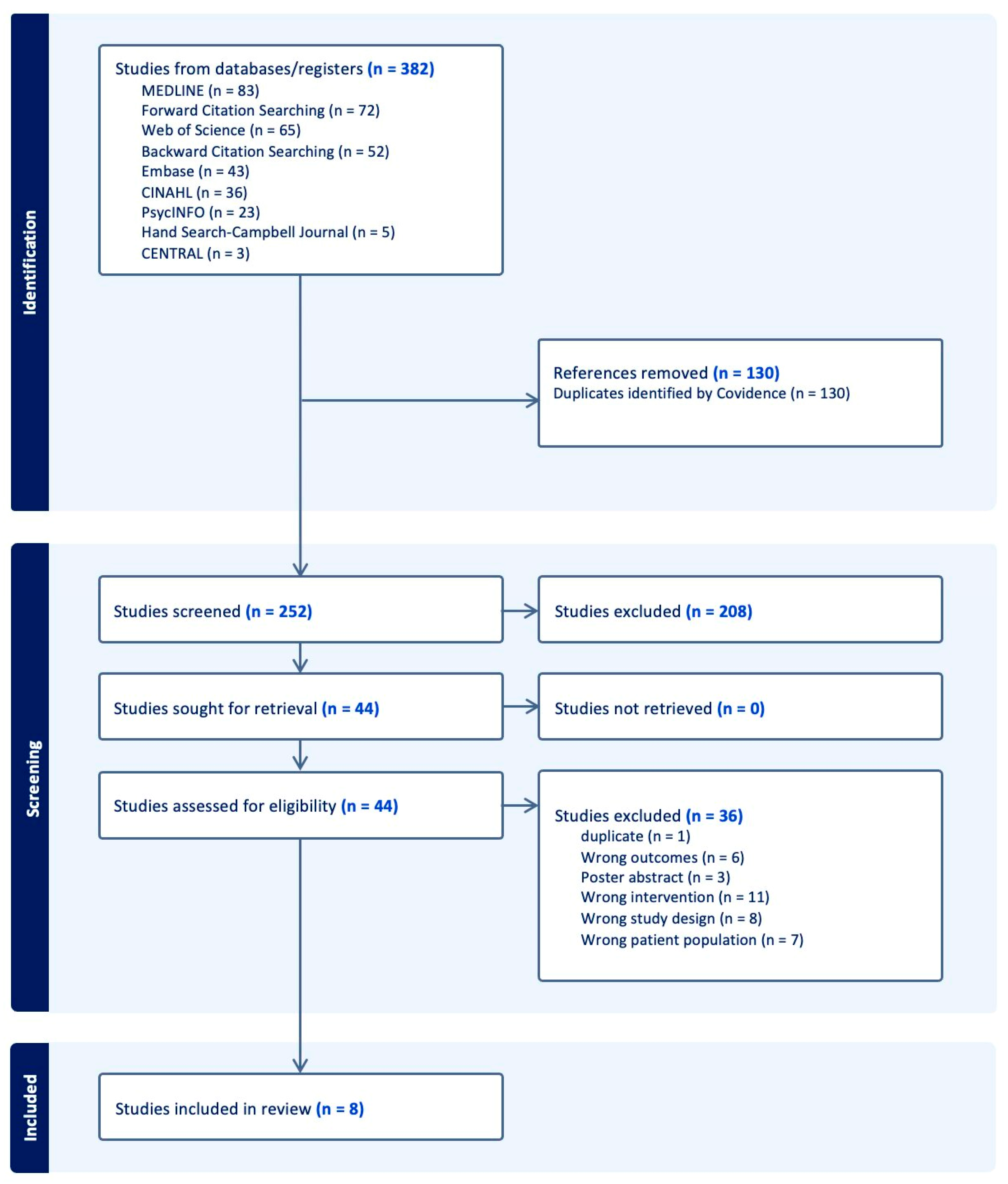
The electronic databases, manual journal search, and forward and backward citation search yielded a total of 382 studies imported for screening. After duplicates were removed (n = 130), titles and abstracts were assessed for eligibility (n = 252). Irrelevant citations were removed (n = 208). Full texts were evaluated against the eligibility criteria (n = 44), and 36 studies were excluded with reasons. The final review consisted of eight studies (Figure 1).
Figure 1.
PRISMA flowsheet for the systematic review of systematic reviews.
3.2. Descriptive Statistics of Included Review
All of the eight included systematic reviews were published between 2015 and 2024. The total number of individual studies within these systematic reviews was 69, and they were predominantly (87%) randomized controlled trials (RCTs). The remainder of the studies (13%) were quasi-experimental and observational studies. In terms of location, one study was conducted across both the United States and Qatar. Out of the remaining 68 studies, 31 (45.58%) were conducted in North America, 24 (35.29%) in Europe, 11 (16.17%) in Asia, and 2 (2.94%) in Australia. The modalities of gamification intervention in these studies ranged from video games, smartphone games, digital handheld games, gamified behavior or education systems, exergames, and serious educational games. A detailed description of individual interventions in each systematic review is provided in Table 1.
3.3. Result of Quality Assessment
The revised AMSTAR2 was utilized to assess the quality of each systematic review. Regarding the critical domain items, four (50%) systematic reviews failed to meet item #2, which was related to protocol registration, and two (25%) systematic reviews did not address item #13, which was related to consideration of risk of bias when interpreting or discussing the results. Among non-critical domains, all eight (100%) reviews failed to report the sources of funding for the individual studies included in each systematic review. Overall, out of eight reviews, one (12.5%) review fulfilled 8 of 13 (61.5%) appraisal items, two studies fulfilled 10 of 13 (76.9%) items, four studies fulfilled 11 of 13 (84.6%) items, and one study fulfilled 12 of 13 (92.3%) items. A detailed description of the quality assessment of all eight systematic reviews is included in Table 2.
3.4. Result of CCA Calculation
Detailed description on calculation of CCA is provided in Supplementary Materials File S2. The calculated CCA in this study was 16.23%, implying a very high overlap of primary studies.
3.5. Effect of Gamification on Blood Glucose and HbA1c Level
The effectiveness of gamification in blood glucose and HbA1c level management is summarized in Table 3. In a meta-analysis by Yao et al., gamification interventions were associated with a modest reduction in HbA1c levels (mean difference [MD] = −0.09%, 95% CI: −0.29, 0.10, p = 0.36); however, this improvement was not statistically significant [17]. Six among 10 studies in Ossenbrink et al. analyzed HbA1c levels, among which two studies revealed significant reduction [18]. Kerfoot et al. and Kempf and Martin showed significant reduction in HbA1c levels between intervention and control group at 48 weeks (p = 0.048) and 12 weeks (p < 0.001) post intervention, respectively [24,25]. Around 67% (six out of nine) of studies in Brady et al. analyzed HbA1c as the outcome measure [19]. Five of these studies had a reduction in HbA1c levels; however, only two studies, Kerfoot et al. and Kempf and Martin, had a significant reduction [24,25].
In another meta-analysis with a total of 1045 sample size, Lim et al. reported a minimal effect size of game-based exercise intervention (d = −0.16, 95% CI = −0.45, 0.14, p = 0.29), although this effect was not statistically significant [20]. Similar findings of minimal but non-significant reductions in HbA1c levels among intervention groups were reported in reviews by Shiau et al. (Hedges’s g = −0.06, p = 0.54), Cabrera et al. (MD = −0.12, 95% CI = −0.57, 0.33), and Christensen (2016) (MD = −0.10, 95% CI = −0.33, 0.14) [11,22,23]. In contrast, Kaihara et al. observed a significant decrease in HbA1c following gamification interventions (MD = −0.21, 95% CI = −0.37, −0.05) [21].
3.6. Effect of Gamification on Change in Confidence and Knowledge Regarding Diabetes Management
Studies assessing change in confidence and knowledge level following gamification intervention were limited. A meta-analysis to assess diabetes self-efficacy (Hedges’s g = 0.22, p = 0.32) and diabetes knowledge (mean difference = 0.17, p = 0.46) following gamification intervention found no significant difference between the intervention and control group [11]. (Table 3).
4. Discussion
Six of the reviewed studies conducted a meta-analysis, all of which demonstrated minor to moderate reduction in HbA1c levels [11,17,20,21,22,23]. Except for the meta-analysis by Kaihara et al., these reductions were not statistically significant [21]. The two systematic reviews without meta-analysis by Ossenbrink et al. and Brady et al. also reported a decrease in HbA1c; however, these findings were not statistically significant in the majority of included studies [18,19]. A notable issue demonstrated in this review is the substantial overlap of primary studies across included systematic reviews as demonstrated by the calculated CCA of 16.23 percentage. Several primary studies, particularly those conducted by Kerfoot et al. [24] and Kempf and Martin [25], were repeatedly included across multiple reviews, suggesting that the evidence base is derived from a relatively small and recurring set of primary studies. This overlap suggests that the apparent consistency in HbA1c outcomes might be due to repeated synthesis of the same underlying studies. This is particularly relevant to the meta-analysis by Kaihara et al. which was the only review demonstrating a statistically significant reduction in HbA1c [21]. This finding appears to be largely driven by the same recurring studies of Kerfoot et al. and Kempf and Martin [24,25]. Therefore, the observed significance in this study may reflect the influence of a small number of positive studies rather than a broadly supported effect across diverse interventions and population. In contrast other studies like Yao et al. included a broader and more heterogenous set of studies, many of which reported minimal or non-significant effects, which likely attenuated the overall pooled effect [17]. This implies that difference in study selection and relative influence of a small number of positive trials might partly explain the divergent conclusions across meta-analysis. A commonly identified limitation across reviews was the lack of homogeneity in gamification modalities, which ranged from video games and gamified education system to exergames and serious games [11,17,18,19,20,23]. Small sample sizes in the included studies were another frequently cited concern [11,17,20]. Cabrera et al. and Brady et al. additionally noted limited diversity among study populations, with most research conducted in North America and Europe [19,22]. The absence of information on potential confounders like body weight, diabetic medication, and disease duration may also have contributed to variability in study outcomes [19,21].
The concept of gamification is relatively new and started appearing in mainstream vocabulary around 2010. Gamification has been applied in various domains including education, marketing, human resources, training, and healthcare [30]. Commonly employed elements of gamification include marketplace and economics, digital rewards, real world prizes, avatars, agents, competition, teams, feedback, 3-D environment, ranks and levels, and time pressure [31,32]. The use and effectiveness of gamification in healthcare is relatively new and continuously emerging. In a systematic review performed by Johnson et al., gamification in health and wellness demonstrated positive effects in 59% of the studies, whereas in 41% of studies, a mixed effect was noted [8]. The evidence was strongest for behavioral outcomes, particularly physical activity. With respect to diabetes care, the utilization of gamification is relatively new and is continuously emerging as evidenced by a study by Priesterroth et al., where only 1.4 out of 17 gamification techniques were implemented in freely available diabetes self-management applications in the Google Play store [33]. Current evidence on the effect of gamification on blood glucose management is heterogenous with some studies demonstrating benefit while others show no significant benefit [12,24,25]. Although the direction of benefit of gamification in our review is consistent, the certainty is low due to lack of statistical significance. Also, it is important to note that all the reviews in our study have used different gamification approaches, and therefore it is difficult to compare the effect of similar gamification methods.
Quality assessment revealed that among the eight systematic reviews included in this review, only four of them (50%) met at least 80% of the quality assessment criteria. One of the striking revelations was that half of the reviews failed to fulfil the critical domain related to protocol registration. Protocol registration prior to commencement of the review serves important benefits. It helps in reducing the review authors’ biases, promotes transparency of methods and minimizes duplication. Similarly, it also provides an opportunity for the team to plan the logistics and resources to conduct the review [34]. A positive association of protocol registration with review quality is also well documented. In a study by Sideri et al., an average increase of 6.6% in quality assessment was found when a comparison was made between registered and unregistered systematic reviews [35]. Despite these benefits, the protocol registration in published systematic reviews or meta-analyses is substantially low as evidenced by a cross-sectional analysis done by Tawfik et al. [36]. This study showed that 44.2% of the authors failed to register the protocol prior to the submission of their systematic review or meta-analysis during the period 2010 to 2016. Most common (45%) cited reasons by the authors were lack of protocol registration as a mandatory prerequisite for the publication and lack of awareness on the importance of protocol registration [36].
Among non-critical domains, all the reviews failed to provide information on the source of funding for primary studies included in the review. The evidence of industry sponsored trials favoring a better outcome is well documented. In a systematic review performed by Lundh et al., compared to non-industry sponsored studies, those with industry sponsored studies had favorable efficacy results (RR = 1.27, 95% CI = 1.17, 1.37) and more favorable conclusions (RR = 1.34, 95% CI = 1.19, 1.51) [37]. Despite this evidence, the proportion of systematic reviews mentioning funding sources of the primary studies is minimal, as evidenced by a review performed by Faggion Jr et al., where only 45 (31%) out of 146 systematic reviews reported the funding sources of primary studies [38]. In recent years, recognition of sponsorship bias has raised concerns about the reliability of evidence underlying many commonly used therapeutics and preventive interventions. Sponsorship bias is the process of favoring the sponsor’s aim through distortion of design and reporting of studies [39]. In meta-research assessing industry sponsorship bias in 28 randomized controlled trials (RCTs) of digital cognitive behavioral therapy for insomnia, a significant association was noted between risk of sponsorship bias and lower levels of methodological quality [X2 (1) = 4.861; p = 0.027] [40]. In the context of digital health and gamifications, this concern is relevant, as many platforms are developed or supported by commercial entities and the absence of a funding source in all of the primary studies of systematic reviews limits our ability to assess the influence of sponsors on study outcomes. A considerable effort therefore needs to be made to increase the reporting of funding sources of primary studies in systematic reviews primarily involving gamification.
There are some limitations that need to be considered. There were overlaps of primary studies across the included systematic reviews, where several of same trials were included in different analyses as evidenced by the calculated CCA of 16.23 percent. In our study, this overlap might have introduced redundancy in the evidence and influenced the perceived consistency of results. The observed overlap among systematic reviews underscores the importance of careful interpretation of pooled conclusions, as repeated inclusions of the same primary studies may overrepresent certain findings. Furthermore, as this review is based on published systematic reviews rather than individual primary studies, examination of how differences in study design, population characteristics, or interventions may have affected the outcome could not be conducted in detail. Similarly, all the primary studies of the systematic reviews lacked funding transparency, thereby reducing our confidence in the observed clinical effects, including outcomes such as HbA1c, and highlights the need for more rigorous and transparent reporting in future studies. The concept of a systematic review of systematic reviews is emerging, and there are limited tools to perform the quality assessment of these reviews. As we precluded the domains involving meta-analysis from the AMSTAR2 tool, the quality assessment done in our review needs to be interpreted with caution. Similarly, given the wide variation in gamification techniques implemented in the review, comparing the effectiveness of similar gamification modalities was difficult. Furthermore, with the majority of studies concentrated in developed countries, generalization of these results to resource-limited settings where access to high-speed internet and gamification modalities are limited, may be constrained.
5. Conclusions
Gamification interventions appear to have a potentially positive effect on improving glucose levels and diabetes management. However, the majority of studies did not demonstrate statistically significant reductions in glycemia outcomes, resulting in a low level of certainty regarding the magnitude and consistency of these effects. The observed heterogeneity of gamification techniques, along with limited sample size, and variation in study designs and outcome measures, likely contributed to the mixed findings across studies. Future studies should focus on adopting a more unified theoretical framework to define, implement, and evaluate gamification components, which might allow for robust comparisons across interventions and strengthen the evidence base for their effectiveness. Additionally, future research should emphasize a clear description of the specific gaming elements used, such as rewards and feedback, so that it makes it easier to understand the component driving the observed benefits. Furthermore, studies with longer follow-up periods are needed to evaluate whether the observed benefits can be sustained over time. Finally, it is imperative that future studies improve transparency on funding sources to strengthen confidence in the findings within this rapidly evolving field.
Supplementary Materials
The following supporting information can be downloaded at: https://www.mdpi.com/article/10.3390/diabetology7060111/s1, File S1: Database Searches; File S2: Corrected Covered Area (CCA) calculation.
Author Contributions
Conceptualization, Y.-C.H.; methodology, Y.-C.H., D.L., S.S. and M.L.; validation, Y.-C.H., S.S. and M.L.; formal analysis, S.S. and M.L.; data curation, D.L.; writing—original draft preparation, Y.-C.H., D.L., S.S. and M.L.; writing—review and editing, Y.-C.H., D.L., S.S. and M.L.; supervision, Y.-C.H. All authors have read and agreed to the published version of the manuscript.
Funding
This research received no external funding.
Institutional Review Board Statement
Not applicable.
Informed Consent Statement
Not applicable.
Data Availability Statement
No new data were created or analyzed in this study.
Conflicts of Interest
The authors declare no conflicts of interest.
References
- Centers for Disease Control and Prevention (CDC). National Diabetes Statistics Report: Data & Research. Available online: https://www.cdc.gov/diabetes/php/data-research/index.html (accessed on 5 October 2025).
- Centers for Disease Control and Prevention (CDC). FastStats—Leading Causes of Death. Available online: https://www.cdc.gov/nchs/fastats/leading-causes-of-death.htm (accessed on 6 October 2025).
- American Diabetes Association Professional Practice Committee for Diabetes. Introduction and Methodology: Standards of Care in Diabetes—2026. Diabetes Care 2026, 49, S1–S5. [Google Scholar] [CrossRef] [Scilit] [PubMed]
- Butt, M.D.; Ong, S.C.; Rafiq, A.; Kalam, M.N.; Sajjad, A.; Abdullah, M.; Malik, T.; Yaseen, F.; Babar, Z.-U.-D. A systematic review of the economic burden of diabetes mellitus: Contrasting perspectives from high and low middle-income countries. J. Pharm. Policy Pract. 2024, 17, 2322107. [Google Scholar] [CrossRef] [Scilit]
- Hamilton, K.; Stanton-Fay, S.H.; Chadwick, P.M.; Lorencatto, F.; de Zoysa, N.; Gianfrancesco, C.; Taylor, C.; Coates, E.; Breckenridge, J.; Cooke, D. Sustained type 1 diabetes self-management: Specifying the behaviours involved and their influences. Diabet. Med. 2021, 38, e14430. [Google Scholar] [CrossRef] [Scilit]
- Powers, M.A.; Bardsley, J.; Cypress, M.; Duker, P.; Funnell, M.M.; Fischl, A.H.; Maryniuk, M.D.; Siminerio, L.; Vivian, E. Diabetes self-management education and support in type 2 diabetes: A joint position statement of the American Diabetes Association, the American Association of Diabetes Educators, and the Academy of Nutrition and Dietetics. Clin. Diabetes 2016, 34, 70–80. [Google Scholar] [CrossRef] [Scilit]
- Chrvala, C.A.; Sherr, D.; Lipman, R.D. Diabetes self-management education for adults with type 2 diabetes mellitus: A systematic review of the effect on glycemic control. Patient Educ. Couns. 2016, 99, 926–943. [Google Scholar] [CrossRef] [Scilit]
- Johnson, D.; Deterding, S.; Kuhn, K.-A.; Staneva, A.; Stoyanov, S.; Hides, L. Gamification for health and wellbeing: A systematic review of the literature. Internet Interv. 2016, 6, 89–106. [Google Scholar] [CrossRef] [Scilit]
- Fanaroff, A.C.; Patel, M.S.; Chokshi, N.; Coratti, S.; Farraday, D.; Norton, L.; Rareshide, C.; Zhu, J.; Klaiman, T.; Szymczak, J.E. Effect of gamification, financial incentives, or both to increase physical activity among patients at high risk of cardiovascular events: The BE ACTIVE randomized controlled trial. Circulation 2024, 149, 1639–1649. [Google Scholar] [CrossRef] [Scilit]
- Cheng, L.; Sit, J.W.; Choi, K.C.; Chair, S.Y.; Li, X.; He, X. Effectiveness of interactive self-management interventions in individuals with poorly controlled type 2 diabetes: A meta-analysis of randomized controlled trials. Worldviews Evid.-Based Nurs. 2017, 14, 65–73. [Google Scholar] [CrossRef] [Scilit] [PubMed]
- Shiau, C.W.C.; Lim, S.M.; Cheng, L.J.; Lau, Y. Effectiveness of game-based self-management interventions for individuals with diabetes: A systematic review and meta-analysis of randomized controlled trials. Games Health J. 2021, 10, 371–382. [Google Scholar] [CrossRef] [Scilit] [PubMed]
- Patel, M.S.; Small, D.S.; Harrison, J.D.; Hilbert, V.; Fortunato, M.P.; Oon, A.L.; Rareshide, C.A.; Volpp, K.G. Effect of behaviorally designed gamification with social incentives on lifestyle modification among adults with uncontrolled diabetes: A randomized clinical trial. JAMA Netw. Open 2021, 4, e2110255. [Google Scholar] [CrossRef] [Scilit]
- Vas, A.; Devi, E.S.; Vidyasagar, S.; Acharya, R.; Rau, N.R.; George, A.; Jose, T.; Nayak, B. Effectiveness of self-management programmes in diabetes management: A systematic review. Int. J. Nurs. Pract. 2017, 23, e12571. [Google Scholar] [CrossRef] [Scilit] [PubMed]
- Page, M.J.; McKenzie, J.E.; Bossuyt, P.M.; Boutron, I.; Hoffmann, T.C.; Mulrow, C.D.; Shamseer, L.; Tetzlaff, J.M.; Akl, E.A.; Brennan, S.E. The PRISMA 2020 statement: An updated guideline for reporting systematic reviews. BMJ 2021, 372, n71. [Google Scholar] [CrossRef] [Scilit]
- Haddaway, N.R.; Grainger, M.J.; Gray, C.T. Citationchaser: A tool for transparent and efficient forward and backward citation chasing in systematic searching. Res. Synth. Methods 2022, 13, 533–545. [Google Scholar] [CrossRef] [Scilit]
- Covidence. Covidence Systematic Review Software. Available online: https://www.covidence.org (accessed on 25 November 2025).
- Yao, W.; Han, Y.; Yang, L.; Chen, Y.; Yan, S.; Cheng, Y. Electronic Interactive Games for Glycemic Control in Individuals with Diabetes: Systematic Review and Meta-Analysis. JMIR Serious Games 2024, 12, e43574. [Google Scholar] [CrossRef] [Scilit]
- Ossenbrink, L.; Haase, T.; Timpel, P.; Schoffer, O.; Scheibe, M.; Schmitt, J.; Deckert, S.; Harst, L. Effectiveness of digital health interventions containing game components for the self-management of type 2 diabetes: Systematic review. JMIR Serious Games 2023, 11, e44132. [Google Scholar] [CrossRef] [Scilit] [PubMed]
- Brady, V.J.; Mathew Joseph, N.; Ju, H.-H. Impact of gaming (gamification) on diabetes self-care behaviors and glycemic outcomes among adults with type 2 diabetes. Sci. Diabetes Self-Manag. Care 2023, 49, 493–511. [Google Scholar] [CrossRef] [Scilit]
- Lim, Y.S.; Ho, B.; Goh, Y.S. Effectiveness of game-based exercise interventions on modifiable cardiovascular risk factors of individuals with type two diabetes mellitus: A systematic review and meta-analysis. Worldviews Evid.-Based Nurs. 2023, 20, 377–400. [Google Scholar] [CrossRef] [Scilit]
- Kaihara, T.; Intan-Goey, V.; Scherrenberg, M.; Falter, M.; Frederix, I.; Akashi, Y.; Dendale, P. Impact of gamification on glycaemic control among patients with type 2 diabetes mellitus: A systematic review and meta-analysis of randomized controlled trials. Eur. Heart J. Open 2021, 1, oeab030. [Google Scholar] [CrossRef] [Scilit]
- Martos-Cabrera, M.B.; Membrive-Jiménez, M.J.; Suleiman-Martos, N.; Mota-Romero, E.; Cañadas-De la Fuente, G.A.; Gómez-Urquiza, J.L.; Albendín-García, L. Games and health education for diabetes control: A systematic review with meta-analysis. Healthcare 2020, 8, 399. [Google Scholar] [CrossRef] [Scilit] [PubMed]
- Christensen, J.; Valentiner, L.S.; Petersen, R.J.; Langberg, H. The effect of game-based interventions in rehabilitation of diabetics: A systematic review and meta-analysis. Telemed. e-Health 2016, 22, 789–797. [Google Scholar] [CrossRef] [Scilit]
- Kerfoot, B.P.; Gagnon, D.R.; McMahon, G.T.; Orlander, J.D.; Kurgansky, K.E.; Conlin, P.R. A team-based online game improves blood glucose control in veterans with type 2 diabetes: A randomized controlled trial. Diabetes Care 2017, 40, 1218–1225. [Google Scholar] [CrossRef] [Scilit] [PubMed]
- Kempf, K.; Martin, S. Autonomous exercise game use improves metabolic control and quality of life in type 2 diabetes patients-a randomized controlled trial. BMC Endocr. Disord. 2013, 13, 57. [Google Scholar] [CrossRef] [Scilit]
- Shea, B.J.; Reeves, B.C.; Wells, G.; Thuku, M.; Hamel, C.; Moran, J.; Moher, D.; Tugwell, P.; Welch, V.; Kristjansson, E. AMSTAR 2: A critical appraisal tool for systematic reviews that include randomised or non-randomised studies of healthcare interventions, or both. BMJ 2017, 358, j4008. [Google Scholar] [CrossRef] [Scilit] [PubMed]
- Smith, V.; Devane, D.; Begley, C.M.; Clarke, M. Methodology in conducting a systematic review of systematic reviews of healthcare interventions. BMC Med. Res. Methodol. 2011, 11, 15. [Google Scholar] [CrossRef] [Scilit]
- Thomson, D.; Russell, K.; Becker, L.; Klassen, T.; Hartling, L. The evolution of a new publication type: Steps and challenges of producing overviews of reviews. Res. Synth. Methods 2010, 1, 198–211. [Google Scholar] [CrossRef] [Scilit] [PubMed]
- Pieper, D.; Antoine, S.-L.; Mathes, T.; Neugebauer, E.A.; Eikermann, M. Systematic review finds overlapping reviews were not mentioned in every other overview. J. Clin. Epidemiol. 2014, 67, 368–375. [Google Scholar] [CrossRef] [Scilit]
- Dichev, C.; Dicheva, D. Gamifying education: What is known, what is believed and what remains uncertain: A critical review. Int. J. Educ. Technol. High. Educ. 2017, 14, 9. [Google Scholar] [CrossRef] [Scilit]
- Deterding, S.; Dixon, D.; Khaled, R.; Nacke, L. From game design elements to gamefulness: Defining “gamification”. In Proceedings of the 15th International Academic MindTrek Conference: Envisioning Future Media Environments; Association for Computing Machinery: New York, NY, USA, 2011; pp. 9–15. [Google Scholar] [CrossRef] [Scilit]
- Hoffmann, A.; Christmann, C.A.; Bleser, G. Gamification in stress management apps: A critical app review. JMIR Serious Games 2017, 5, e7216. [Google Scholar] [CrossRef] [Scilit]
- Priesterroth, L.; Grammes, J.; Holtz, K.; Reinwarth, A.; Kubiak, T. Gamification and behavior change techniques in diabetes self-management apps. J. Diabetes Sci. Technol. 2019, 13, 954–958. [Google Scholar] [CrossRef] [Scilit]
- Lasserson, T.J.; Thomas, J.; Higgins, J.P. Starting a review. In Cochrane Handbook for Systematic Reviews of Interventions; John Wiley & Sons: Hoboken, NJ, USA, 2019; pp. 1–12. [Google Scholar] [CrossRef] [Scilit]
- Sideri, S.; Papageorgiou, S.N.; Eliades, T. Registration in the international prospective register of systematic reviews (PROSPERO) of systematic review protocols was associated with increased review quality. J. Clin. Epidemiol. 2018, 100, 103–110. [Google Scholar] [CrossRef] [Scilit]
- Tawfik, G.M.; Giang, H.T.N.; Ghozy, S.; Altibi, A.M.; Kandil, H.; Le, H.-H.; Eid, P.S.; Radwan, I.; Makram, O.M.; Hien, T.T.T. Protocol registration issues of systematic review and meta-analysis studies: A survey of global researchers. BMC Med. Res. Methodol. 2020, 20, 213. [Google Scholar] [CrossRef] [Scilit] [PubMed]
- Lundh, A.; Lexchin, J.; Mintzes, B.; Schroll, J.B.; Bero, L. Industry sponsorship and research outcome. Cochrane Database Syst. Rev. 2017, 2, 3R00033. [Google Scholar] [CrossRef] [Scilit] [PubMed]
- Faggion, C., Jr.; Atieh, M.; Zanicotti, D. Reporting of sources of funding in systematic reviews in periodontology and implant dentistry. Br. Dent. J. 2014, 216, 109–112. [Google Scholar] [CrossRef] [Scilit] [PubMed]
- Jefferson, T. Sponsorship bias in clinical trials: Growing menace or dawning realisation? J. R. Soc. Med. 2020, 113, 148–157. [Google Scholar] [CrossRef] [Scilit]
- Kakazu, V.A.; Assis, M.; Bacelar, A.; Bezerra, A.G.; Ciutti, G.L.R.; Conway, S.G.; Galduróz, J.C.F.; Drager, L.F.; Khoury, M.P.; Leite, I.P.A. Industry sponsorship bias in randomized controlled trials of digital cognitive behavioral therapy for insomnia: A meta-research study based on the 2023 Brazilian guidelines on the diagnosis and treatment of insomnia in adults. Front. Neurol. 2025, 16, 1600767. [Google Scholar] [CrossRef] [Scilit]

Disclaimer/Publisher’s Note: The statements, opinions and data contained in all publications are solely those of the individual author(s) and contributor(s) and not of MDPI and/or the editor(s). MDPI and/or the editor(s) disclaim responsibility for any injury to people or property resulting from any ideas, methods, instructions or products referred to in the content. |
© 2026 by the authors. Licensee MDPI, Basel, Switzerland. This article is an open access article distributed under the terms and conditions of the Creative Commons Attribution (CC BY) license.