Article

Assessing and Predicting Medication Adherence and Diabetes Control Among African American Adults with Uncontrolled Diabetes


by
Emily K. Mewborn
1,
Elizabeth A. Tolley
2,* and
James E. Bailey
2,3
1
School of Nursing, Department of Health Promotion and Development, University of Pittsburgh, 3500 Victoria Street, Pittsburgh, PA 15213, USA
2
College of Medicine, Department of Preventive Medicine, University of Tennessee Health Science Center, 66 N Pauline Street, Memphis, TN 38163, USA
3
Tennessee Population Health Consortium, University of Tennessee Health Science Center, 956 Court Ave., D228, Memphis, TN 38103, USA
*
Author to whom correspondence should be addressed.
Diabetology 2026, 7(6), 112; https://doi.org/10.3390/diabetology7060112
Submission received: 29 April 2026 / Revised: 30 May 2026 / Accepted: 5 June 2026 / Published: 10 June 2026
(This article belongs to the Special Issue Diabetes Care Inequities: Recent Advances and Future Challenges)

Abstract

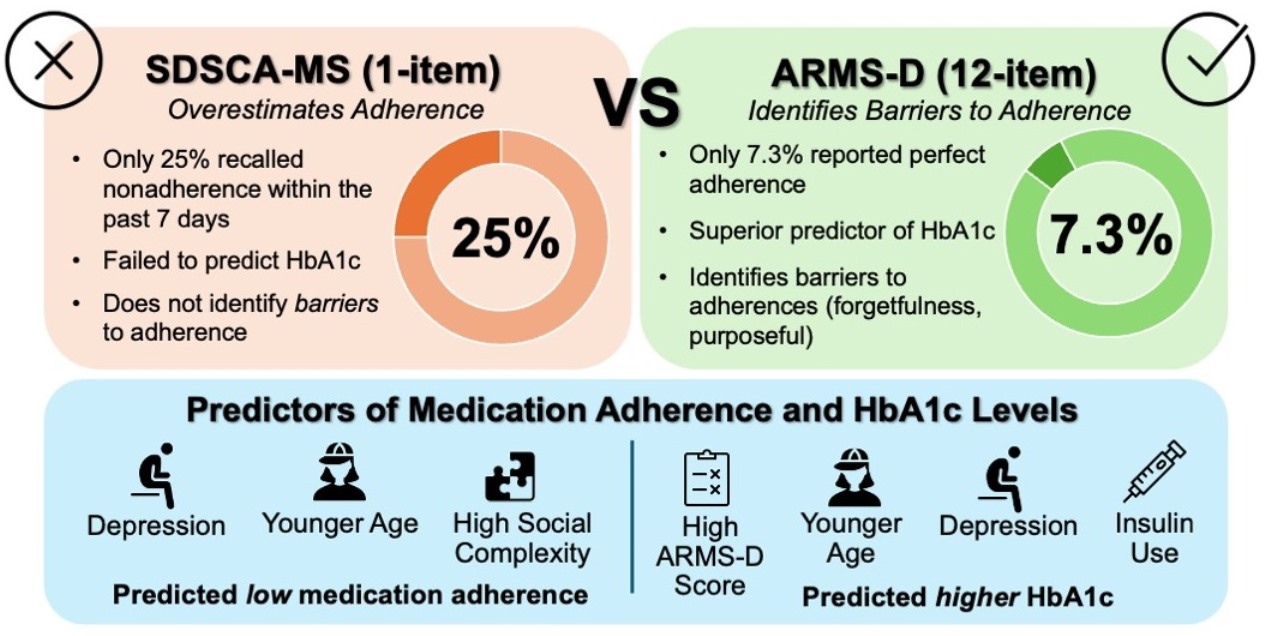
Background/Objectives: Uncontrolled diabetes and associated comorbidities disproportionately affect African American (AA) adults. Medication adherence is key to diabetes control yet is often suboptimal, particularly among AA adults. This study examined associations between patient characteristics and adherence among AA adults with uncontrolled diabetes and compared two medication adherence instruments for predicting diabetes control. Methods: This cross-sectional analysis used baseline data from the Management of Diabetes in Everyday Life (MODEL) study, a clinical trial to improve diabetes self-care among AA adults with uncontrolled diabetes. Internal consistency of the 12-item Adherence to Medication Refills and Medications Scale for diabetes medications (ARMS-D) was evaluated by comparing its Cronbach α to the standardized Cronbach α calculated from MODEL data. Associations with variables were examined using correlations, t-tests, or ANOVA, as appropriate. Stepwise multiple regression identified predictors of diabetes control assessed by hemoglobin A1c (HbA1c). Results: Among 665 participants (mean age = 54 years, HbA1c = 10.24%; 67% female; 73% high health literacy), 75% reported perfect adherence on the Summary of Diabetes Self-Care Activities Medications Subscale (SDSCA-MS) versus 7.3% on ARMS-D. ARMS-D showed strong internal consistency (α = 0.81). Lower adherence by ARMS-D was associated with younger age, higher social complexity, and depression (all p ≤ 0.001). ARMS-D score, age, depression, and insulin, dipeptidyl peptidase 4 inhibitor, and sodium-glucose co-transporter 2 inhibitor use predicted baseline HbA1c. Conclusions: This study demonstrates that younger age, depression, and high social complexity are associated with lower medication adherence measured using the ARMS-D. Adherence gaps identified by ARMS-D may validly predict diabetes control and help guide interventions to improve diabetes care in AA adults with uncontrolled diabetes.

Graphical Abstract

1. Introduction

Diabetes affects 11.7% of African American (AA) adults, and approximately 50% of U.S. adults with diabetes have uncontrolled diabetes [1]. Uncontrolled diabetes and its comorbidities including obesity, hypertension, hyperlipidemia, chronic kidney disease, and cardiovascular disease are more prevalent in AAs [2,3,4,5]. Diabetes treatment requires a multimodal approach that includes maximizing healthy nutrition and exercise patterns along with medication management.
However, medication adherence only averages 50% in developed countries like the United States for people with chronic diseases requiring daily medication [6]. The World Health Organization describes medication nonadherence as a worldwide problem with striking magnitude that worsens with the number of chronic diseases [6]. Compared to non-Hispanic Whites, AAs with diabetes are 12% less likely to take and overall less likely to refill their diabetes medication, even with equal access to medication [7,8]. Lower medication adherence leads to poorer glycemic control and higher risks of diabetes complications. AAs disproportionately suffer from diabetes-related microvascular and macrovascular complications, which are associated with increased morbidity, mortality, and health care expenditures [9,10,11]. Therefore, the racial disparity associated with medication adherence in AAs with diabetes widens the gap of adverse diabetes control, morbidity, and mortality.
The purposes of this study were to assess the demographic, social, and clinical characteristics associated with better medication adherence and diabetes control among AA adults with uncontrolled diabetes. In addition, we sought to assess the performance of two alternative medication adherence assessment tools, the Adherence to Medication Refills and Medications Scale to diabetes medications (ARMS-D) and the one-item Summary of Diabetes Self-Care Activities Medications Subscale (SDSCA-MS), in this population. Lastly, we sought to determine whether the ARMS-D or SDSCA-MS is more predictive of diabetes control.

2. Materials and Methods

2.1. Study Design and Population

The cross-sectional study leveraged data from the Management of Diabetes in Everyday Life (MODEL) study, a large multi-site pragmatic clinical trial that tested three interventions for diabetes self-care improvement in AAs with uncontrolled diabetes (HbA1c > 8% extracted from electronic health record data within 6 months before clinical trial randomization) living in medically underserved areas in the Mid-South United States [12,13]. Data were collected from November 2016 through December 2020. The parent MODEL study was approved by the Institutional Review Boards of the University of Tennessee Health Science Center, Methodist Healthcare, and Regional One Health (ClinicalTrials.gov #NCT02957513). This ancillary analysis used only de-identified data from that study; the University of Tennessee Health Science Center IRB determined it does not constitute human subjects research and does not require separate ethical approval. The MODEL inclusion and exclusion criteria are listed in Table 1 [13].

2.2. Medication Adherence Screening Instruments

Medication adherence was measured using two previously validated instruments: Adherence to Medication Refills and Medications Scale to diabetes medications (ARMS-D) [14] and the one-item Summary of Diabetes Self-Care Activities Medications Subscale (SDSCA-MS) [15].
The SDSCA-MS is a diabetes self-management assessment tool that includes self-report of nutrition, exercise, foot care, smoking, blood glucose testing, and medication adherence; therefore, the SDSCA-MS informed additional aspects of the data collection in the MODEL study [15]. However, for medication adherence, the 1-item SDSCA-MS asks, “On how many of the last seven days did you take your diabetes medication?” [14] Therefore, higher scores indicate higher adherence and are measured in days.
In contrast, the ARMS is a 12-item tool that includes an 8-item subscale of medication taking behaviors and 4-item subscale of medication refill behaviors [16]. ARMS-D is a revised version of the original ARMS tool that specifies diabetes medication in each question [16]. ARMS-D responses are measured on a 4-point rating scale: 1—“none of the time,” 2—“some of the time,” 3—“most of the time,” 4—“all the time.” ARMS was developed and validated in AA adults and patients with chronic diseases, including diabetes [14]. ARMS is also valid and reliable for use in patients with varying degrees of health literacy [14]. In contrast to SDSCA-MS, ARMS-D identifies specific barriers to adherence through patient self-report including forgetfulness when taking or refilling medication, purposeful skipping medication, running out of medication, missing medication when feeling better, sick, or out of carelessness, multiple dosing, and how often they plan ahead to refill medication. The ARMS-D total score ranges from most to least adherent of 12–48. Therefore, a higher score indicates less adherence. This medication adherence assessment tool is further divided into the 8-item medication taking subscale with a possible range of scores from most to least adherent of 8–32 and the 4-item medication refill subscale with a possible range of scores from most to least adherent of 4–16.

2.3. Baseline Characteristics and Variables of Interest

For this study, several baseline demographic characteristics were analyzed for their ability to predict baseline HbA1c and association with medication adherence (as measured by ARMS-D and SDSCA-MS) (Table 2). These characteristics include age (<60 years or ≥60 years), sex (male, female), marital status, level of education, location (urban, suburban), cell phone type (smartphone, non-smartphone), and social complexity. High social complexity was defined as a baseline positive screen for depression, anxiety, substance abuse, or housing insecurity utilizing the validated Patient Health Questionnaire (PHQ-9), Generalized Anxiety Disorder (GAD-7), National Institute on Drug Abuse (NIDA) Quick Screen, and Homeless Screening Clinical Reminder, respectively. Treating these four variables as a single binary social complexity variable limits the ability to determine which specific component most strongly influences the observed associations with medication adherence and glycemic control. Diabetes medications were divided into pharmacologic classes, which included metformin, insulin, sulfonylurea, sodium–glucose co-transporter 2 inhibitor (SGLT2i), dipeptidyl peptidase 4 inhibitor (DPP4i), thiazolidinedione (TZD), meglitinide, alpha glucosidase inhibitor, bile acid sequestrant, and glucagon-like peptide 1 receptor agonist (GLP-1a).

2.4. Statistical Analyses

All statistical analyses were performed using SAS statistical software, Version 9.4 (SAS Institute Inc., Cary, NC, USA), except multiple regression, which was performed in R version 4.4.2. Descriptive statistics were used to summarize the baseline characteristics of the study population. Associations between baseline characteristics and SDSCA-MS, ARMS-D total score, subscales, or HbA1c were assessed using Pearson product-moment, point-biserial, or biserial correlation coefficients, as appropriate. For continuous variables compared with dichotomous variables, t-tests were performed. Education was analyzed by individual categories using least-squares means. Marital status was evaluated both categorically (least-squares means) and dichotomously (with a partner vs. without a partner) using t-tests.
Medications were grouped by pharmacologic category, and t-tests were used to examine associations with SDSCA-MS, ARMS-D total score, medication-taking and refill subscales, and HbA1c. The number of diabetes medication categories was also analyzed. Co-morbidities were assessed individually using t-tests, and the total number of co-morbidities was examined using correlation coefficients.
Stepwise bidirectional multiple linear regression was used to identify predictors of baseline HbA1c, ARMS-D score, and SDSCA-MS. Candidate predictors for each stepwise model were selected based on significant univariate association with that specific outcome and clinical relevance; all candidates were entered simultaneously with no imposed order of entry, and the bidirectional procedure used AIC as the selection criterion to determine inclusion in the final model. Stepwise selection is acknowledged to be data-driven and may produce results that are unstable across samples; hence, the findings should be interpreted as hypothesis-generating rather than confirmatory. Pearson correlation coefficients were used to examine the association between the ARMS-D total score and the SDSCA-MS. To compare the predictive utility of ARMS-D versus SDSCA-MS for HbA1c, previously reported Cronbach’s α values of the 12-item ARMS-D total (α = 0.86), medication-taking subscale (α = 0.84), and medication-refill subscale (α = 0.71), as well as SDSCA-MS, were compared to standardized Cronbach’s α values calculated from the MODEL study’s baseline ARMS-D scores. Cronbach’s α > 0.70 was considered indicative of good internal reliability.

3. Results

3.1. Study Population Demographics

The sample included 665 AA adults with uncontrolled diabetes (mean HbA1c of 10.24%). The demographic variables and results are listed in Table 2. The average age was 54.2 years, with 65% under 60 years old, 67% female, 81% with a high school education/GED or higher, and 73% with high health literacy. The most frequent diabetes medication categories included metformin (66.92%), insulin (55.94%), and sulfonylureas (32.78%). DPP4i, GLP-1a, and SGLT2i were less frequent. Patients were most frequently on two diabetes medication categories (36.09%), with 4.21% on no diabetes medication.

3.2. Performance of Alternative Instruments for Assessing Medication Adherence

The 12-item ARMS-D demonstrated good internal consistency, with a total standardized Cronbach’s alpha of 0.81, 0.81 for the medication-taking subscale, and 0.18 for the medication-refill subscale. The SDSCA-MS assessed adherence with a single question, with an average of 6.34 out of 7 days, and 501 participants (75%) reporting perfect adherence in the previous week. In contrast, the mean ARMS-D scores were 18.48 (total), 11.51 (medication-taking subscale), and 7.14 (medication-refill subscale), with only 3.9% of participants achieving perfect adherence (ARMS-D total score = 12). The ARMS-D scores were moderately and inversely correlated with the SDSCA-MS scores (r = −0.37, p < 0.001).

3.3. Predictors of Baseline Medication Adherence and Diabetes Control

In univariate analyses, older age (>60) was associated with lower ARMS-D total score (p < 0.001), ARMS-D medication taking (p < 0.001) and refill subscales (p = 0.004), higher SDSCA-MS score (p < 0.001), and poorer diabetes control as assessed by HbA1c (p < 0.001). (Table 3). Social complexity was associated with ARMS-D total, medication taking and refill subscales, and SDSCA-MS (all p < 0.001), indicating those with higher social complexity were more likely to have worse scores. However, social complexity was not related to HbA1c. Individuals with diagnosis of depression had a significantly higher ARMS-D total score (p = 0.001), medication taking subscale score (p = 0.003), and HbA1c (p = 0.005) and a lower SDSCA-MS score (p = 0.027) compared to scores in individuals without depression.
Additionally, individuals with a diagnosis of coronary artery disease had higher medication refill subscale scores versus those without coronary artery disease (p = 0.041), but there was no significant difference in the total ARMS-D, medication taking subscale, SDSCA-MS scores, or HbA1c. Participants with chronic obstructive pulmonary disease had lower SDSCA-MS scores compared to those without COPD (p = 0.021). There were no other co-morbidities (from Table 2) significantly related to the ARMS-D or SDSCA-MS scores or HbA1c.
Specifically for associations between medication class and HbA1c, individuals with prescriptions for SGLT2i (p < 0.001), DPP4i (p = 0.013), thiazolidinediones (p = 0.007), and sulfonylureas (p = 0.011) had lower HbA1c measurements. Conversely, individuals with prescriptions for insulin had higher HbA1c (p < 0.001). Neither the number of co-morbidities nor the number of medications were associated with the ARMS-D or SDSCA-MS scores or HbA1c.
Multivariate modeling identified social complexity, older age, and prescriptions for DPP4i and sulfonylureas as strong predictors of medication adherence as assessed by ARMS-D (Table 4). Similarly, social complexity, older age, prescriptions for insulin and DPP4i, and diagnosis of depression were identified as predictors of medication adherence as assessed by SDSCA-MS (Table 5).
Multivariate modeling identified a prescription for insulin, DPP4i, and SGLT2i, ARMS-D score, and older age, as strong predictors of the baseline HbA1c. SDSCA-MS was not found to be a predictor of HbA1c even in models excluding ARMS-D (p = 0.861). Thiazolidinedione and sulfonylurea use did not improve the model and were therefore excluded from the final regression model (Table 6).

4. Discussion

This study found that, when assessing medication adherence, the ARMS-D questionnaire was more clinically useful and accurate than the SDSCA-MS to measure barriers to adherence and identified these barriers to adherence. Additionally, the ARMS-D total and medication taking subscale were predictive for HbA1c, where the SDSCA-MS was not. When the ARMS-D score is high, indicating poorer adherence, this study found the HbA1c was also higher. The ARMS-D has also been specifically validated in AA participants, suggesting better generalizability than the SDSCA-MS [15].
Even though SDSCA-MS and ARMS-D both aim to measure medication adherence, and they were moderately correlated, the high adherence reported in the previous week by the SDSCA-MS (75% with perfect 7 out of 7 days adherence) differs significantly from the ARMS-D (3.9% perfect adherence). These results may be influenced by an aspect of the MODEL study design. Because of the two-week run-in period to demonstrate responsiveness to texts and voice messages, it is possible that during the week prior to their scheduled enrollment appointment, these participants took their medications as prescribed but had been largely noncompliant previously. Just the action of contacting the patient could serve as a reminder to take their medication.
Aligned with this study’s findings, the ARMS-D has previously demonstrated superior sensitivity for measuring medication adherence compared to the SDSCA-MA (79% ARMS-D versus 27% SDSCA-MA) [16]. The ARMS-D questionnaire also enlightens clinicians on specific issues of adherence (i.e., dosing frequency, forgetting, skipping, or missing medication in illness, feeling better, or carelessness). Once specific barriers are identified, clinicians can work on strategies to address them.

4.1. Predictive Characteristics of Medication Adherence and HbA1c

In this sample, younger age, high social complexity, and diagnosis of depression were generally associated with lower medication adherence. Additionally, individuals who were younger, had depression, or used insulin had a higher HbA1c. Depression has been previously associated with poorer medication adherence for multiple chronic diseases including diabetes, which these results support [17]. Asthma was the only condition associated with less medication refill adherence. It is possible this is related to the cost of inhalers or fewer refills for patients who have types of intermittent asthma and do not necessarily require daily medication or regular refills. Insulin was inversely associated with HbA1c, meaning those on insulin had a significantly higher HbA1c. The ability to titrate or personalize dosing with insulin makes this a surprising finding. However, it cannot be concluded whether these were patients new to insulin because of their elevated HbA1c, or whether they were on insulin but still have an elevated HbA1c. If individuals were on multiple injections of insulin per day, where more frequent dosing is associated with lower adherence [18], this might also explain the inverse association of insulin and HbA1c.
The ARMS-D total score, age, depression, and use of insulin, DPP4i, and SGLT2i are independently predictive of HbA1c, and by looking at them together, a larger proportion of variability can be explained in patients with uncontrolled T2D (HbA1c > 8%). This is a prediction model that can assist clinicians to identify possible characteristics of patients that can predict worse HbA1c and barriers to adherence. This clinical prediction model could be generalizable to those outside of the MODEL study because younger age, presence of depression, and use of insulin, DPP4i, or SGLT2i are commonly seen in clinical practice.

4.2. Comparison of MODEL Participants to Real World Data

The MODEL results differ compared to previous studies on medication adherence. Previous studies have found that patients are more likely to be adherent to diabetes medications if they are older, male, married, living in a region other than the South, have fewer numbers of antidiabetic medications, and have more chronic diseases [19,20,21,22,23]. In contrast, the MODEL participants were from the South and predominantly younger, female, and single. Therefore, in this study, higher medication nonadherence would be expected, which was found when using the ARMS-D and not with the SDSCA-MS. The previous data and this study support using the ARMS-D for better accuracy compared to the SDSCA-MS.

4.3. White-Coat Adherence

While the SDSCA-MS is a simple one-question tool, its clinical usefulness for medication adherence is limited. Clinically, this tool lacks any information beyond the number of days in the past week the patient took their medication. The SDSCA-MS limits the patient’s recall of medication adherence to the previous seven days, which leaves the opportunity for “white-coat adherence.” This concept is where medication adherence is markedly increased the days preceding and following a health care encounter [24,25]. While medication adherence is increased the week before the office visit, three days prior to the visit is most affected [26]. Therefore, restricting the recall of self-reported medication adherence to the week before the health care encounter leads to much lower sensitivity of medication adherence in the SDSCA-MS compared to the ARMS-D. Furthermore, white coat adherence would potentially affect medication adherence and not the change in HbA1c, since the HbA1c is a 3-month average measure of glycemia. However, because both tools share the same seven-day recall window, white-coat adherence alone cannot fully explain why scores differed so dramatically between the two measures. The difference in the number of items is also important. As a single-item measure, the SDSCA-MS is less reliable than the 12-item ARMS-D. Additionally, the directness of the SDSCA-MS question may increase susceptibility to social desirability bias, where patients feel pressure to report perfect adherence when asked one straightforward question. The ARMS-D assesses a broader range of behaviors and barriers, including running out of medication, changing doses, and delays in refilling prescriptions due to cost. This wider scope and less direct framing may reduce social desirability bias and better capture the true burden of nonadherence, which may also explain the greater predictive utility of the ARMS-D for HbA1c.
A better understanding is needed of factors of nonadherence and of clinician characteristics that affect adherence through medication choice and regimen. Surprisingly, although all patients had uncontrolled diabetes, 70.07% of patients were on two or fewer medication categories for diabetes. These patients have high health literacy and higher education than expected for this study population location [12], which was focused on medically underserved areas. This creates questions of why the patients are not on more diabetes medication if they are adherent (which is questionable, as described previously), yet their HbA1c is still elevated. With most patients on insulin, yet with uncontrolled diabetes, adherence specifically to insulin dosing (whether fixed or titration dosing) would be beneficial to explore. Other avenues to consider are clinician characteristics of medication choice. Is there an association of clinician education or type of clinician, assumptions of clinicians, age, gender, area of town, or types of insurance accepted, and categories or number of medications prescribed? Furthermore, sulfonylureas are known to be inexpensive but carry many risks (e.g., hypoglycemia, weight gain, limited efficacy over time, and questionable increase in cardiovascular risk). Many of these concerns are substantially reduced with other antidiabetic medication options (e.g., metformin, DDP4i, SGLT2i, and GLP-1a). Therefore, exploration into associations among provider, insurance, and patient factors with medication adherence could help improve understanding and create interventions to improve this disparity.

4.4. Limitations

The findings of this study may have limited generalizability outside of this specific patient population of people who are AA adults living in medically underserved areas with uncontrolled diabetes in the Mid-South United States. Additionally, measuring medication adherence through self-report screening tools may be less accurate than objective or observational sensors. Furthermore, while the ARMS-D identifies barriers in adherence that can be addressed in the clinic setting, it does not assess other pertinent factors to adherence such as cost, pharmacy, insurance or office issues (e.g., prior authorization, delay of clinician sending prescription, or pharmacy having to order medication), or transportation. These data were also collected from 2016 to 2019, and earlier in the study, SGLT2is were not as routinely used, weekly GLP1a was newly approved, and an oral GLP-1a was not available. This ancillary study’s cross-sectional design and measurement of HbA1c prior to assessment of medication adherence limits causal conclusions.
The medication-refill subscale of the ARMS-D demonstrated poor internal consistency in this sample (α = 0.18), which is notably lower than the α = 0.71 reported in the original validation study. This study sample was well-educated with high health literacy. It is plausible that the participants did not have significant barriers to medication refills, which may have resulted in uniformly high refill adherence with little variance across participants. This pattern may have reduced the Cronbach’s α, and findings from the medication-refill subscale should be interpreted with caution.

5. Conclusions

Racial disparities in diabetes prevalence, control, complications, and commonly associated co-morbidities in AA adults exist and are compounded by poorer medication adherence. While medication adherence impacts an individual’s health, clinician and healthcare system factors also exist that impact adherence. The accurate measurement and identification of barriers to medication adherence allows for individualized treatment plans to increase adherence. Careful attention should be given to individuals with depression, younger age, high social complexity, and using insulin, as this study found these characteristics to be associated with lower adherence. Clinicians should use the ARMS-D over SDSCA-MS to measure adherence.

Author Contributions

Conceptualization, E.K.M. and E.A.T.; methodology, E.K.M. and E.A.T.; formal analysis, E.K.M. and E.A.T.; investigation, J.E.B.; data curation, E.K.M. and E.A.T.; writing—original draft preparation, E.K.M.; writing—review and editing, E.K.M., E.A.T., and J.E.B.; supervision, J.E.B.; funding acquisition, E.K.M. and J.E.B. All authors have read and agreed to the published version of the manuscript.

Funding

This work was supported through a Patient-Centered Outcomes Research Institute (PCORI) Project Program Award (SC15-1503-28336), which advised on the parent study. PCORI did not contribute to the writing of this manuscript or the decision to submit it for publication. EKM received support for this work from the T32 Targeted Research and Academic Training Program for Nurses in Genomics (T32NR009759) at the University of Pittsburgh.

Institutional Review Board Statement

Not applicable.

Informed Consent Statement

Not applicable.

Data Availability Statement

The raw data supporting the conclusions of this article will be made available by the authors on reasonable request.

Conflicts of Interest

The authors declare no conflicts of interest. The funders had no role in the design of the study; in the collection, analyses, or interpretation of data; in the writing of the manuscript; or in the decision to publish the results.

Abbreviations

The following abbreviations are used in this manuscript:
AAAfrican American
ARMS-DAdherence to Medication Refills and Medications Scale for Diabetes medications
CADCoronary artery disease
COPDChronic obstructive pulmonary disease
DDP4iDipeptidyl peptidase 4 inhibitor
GAD-7Generalized Anxiety Disorder
GLP-1aGlucagon-like peptide 1 receptor agonist
HbA1cHemoglobin A1c
MODELManagement of Diabetes in Everyday Life
NIDANational Institute on Drug Abuse
PHQ-9Patient Health Questionnaire
SDSCA-MSSummary of Diabetes Self-Care Activities Medications Subscale
SGLT2iSodium–glucose transport protein 2 inhibitor
TZDThiazolidinedione

References

  1. American Diabetic Association. Statistics about Diabetes|ADA. Available online: https://www.diabetes.org/resources/statistics/statistics-about-diabetes (accessed on 27 September 2021).
  2. Kirk, J.K.; D’Agostino, R.B., Jr.; Bell, R.A.; Passmore, L.V.; Bonds, D.E.; Karter, A.J.; Narayan, K.V. Disparities in HbA1c levels between African-American and non-Hispanic white adults with diabetes: A meta-analysis. Diabetes Care 2006, 29, 2130–2136. [Google Scholar] [CrossRef]
  3. US Department of Health & Human Services. Obesity and African Americans—The Office of Minority Health. Available online: https://minorityhealth.hhs.gov/obesity-and-blackafrican-americans (accessed on 20 April 2026).
  4. US Department of Health & Human Services. Diabetes and African Americans—The Office of Minority Health. Available online: https://minorityhealth.hhs.gov/diabetes-and-blackafrican-americans (accessed on 20 April 2026).
  5. US Department of Health & Human Services. Heart Disease and African Americans—The Office of Minority Health. Available online: https://minorityhealth.hhs.gov/heart-disease-and-blackafrican-americans (accessed on 20 April 2026).
  6. Sabaté, E.; World Health Organization (Eds.) Adherence to Long-Term Therapies: Evidence for Action; World Health Organization: Geneva, Switzerland, 2003. [Google Scholar]
  7. Shenolikar, R.A.; Balkrishnan, R.; Camacho, F.T.; Anderson, R.T.; Whitmire, J.T. Race and medication adherence in medicaid enrollees with type-2 diabetes. J. Natl. Med. Assoc. 2006, 98, 1071–1077. [Google Scholar]
  8. Trinacty, C.M.; Adams, A.S.; Soumerai, S.B.; Zhang, F.; Meigs, J.B.; Piette, J.D.; Ross-Degnan, D. Racial differences in long-term adherence to oral antidiabetic drug therapy: A longitudinal cohort study. BMC Health Serv. Res. 2009, 9, 24. [Google Scholar] [CrossRef]
  9. Andreae, S.J.; Andreae, L.J.; Cherrington, A.L.; Richman, J.S.; Johnson, E.; Clark, D.; Safford, M.M. Peer coach delivered storytelling program improved diabetes medication adherence: A cluster randomized trial. Contemp. Clin. Trials. 2021, 104, 106358. [Google Scholar] [CrossRef] [PubMed]
  10. Hall, G.L.; Heath, M. Poor Medication Adherence in African Americans Is a Matter of Trust. J. Racial Ethn. Health Disparities 2021, 8, 927–942. [Google Scholar] [CrossRef] [PubMed]
  11. Shiyanbola, O.O.; Brown, C.M.; Ward, E.C. “I did not want to take that medicine”: African-Americans’ reasons for diabetes medication nonadherence and perceived solutions for enhancing adherence. Patient Prefer. Adherence 2018, 12, 409–421. [Google Scholar]
  12. Bailey, J.E.; Surbhi, S.; Gatwood, J.; Butterworth, S.; Coday, M.; Shuvo, S.A.; Dashputre, A.A.; Brooks, I.M.; Binkley, B.L.; Riordan, C.J.; et al. The management of diabetes in everyday life study: Design and methods for a pragmatic randomized controlled trial comparing the effectiveness of text messaging versus health coaching. Contemp. Clin. Trials. 2020, 96, 106080. [Google Scholar] [CrossRef]
  13. Bailey, J.E.; Surbhi, S.; Gatwood, J.; Butterworth, S.W.; Coday, M.; Chen, M.; Gutierrez, M.L.; Shuvo, S.A.; Brooks, I.M.; Binkley, B.L.; et al. Comparative effectiveness of diabetes self-care interventions in african-american adults: A three-arm randomized controlled trial. J. Gen. Intern. Med 2026, 41, 1573–1583. [Google Scholar] [CrossRef]
  14. Kripalani, S.; Risser, J.; Gatti, M.E.; Jacobson, T.A. Development and Evaluation of the Adherence to Refills and Medications Scale (ARMS) Among Low-Literacy Patients with Chronic Disease. Value Health 2009, 12, 118–123. [Google Scholar] [CrossRef]
  15. Toobert, D.J.; Hampson, S.E.; Glasgow, R.E. The summary of diabetes self-care activities measure: Results from 7 studies and a revised scale. Diabetes Care 2000, 23, 943–950. [Google Scholar] [CrossRef]
  16. Mayberry, L.S.; Gonzalez, J.S.; Wallston, K.A.; Kripalani, S.; Osborn, C.Y. The ARMS-D out performs the SDSCA, but both are reliable, valid, and predict glycemic control. Diabetes Res. Clin. Pract. 2013, 102, 96–104. [Google Scholar] [CrossRef]
  17. Grenard, J.L.; Munjas, B.A.; Adams, J.L.; Suttorp, M.; Maglione, M.; McGlynn, E.A.; Gellad, W.F. Depression and Medication Adherence in the Treatment of Chronic Diseases in the United States: A Meta-Analysis. J. Gen. Intern. Med. 2011, 26, 1175–1182. [Google Scholar] [CrossRef]
  18. Stolpe, S.; Kroes, M.A.; Webb, N.; Wisniewski, T. A systematic review of insulin adherence measures in patients with diabetes. J. Manag. Care Spec. Pharm. 2016, 22, 1224–1246. [Google Scholar] [CrossRef]
  19. Coleman, C.I.; Limone, B.; Sobieraj, D.M.; Lee, S.; Roberts, M.S.; Kaur, R.; Alam, T. Dosing frequency and medication adherence in chronic disease. J. Manag. Care Pharm. 2012, 18, 527–539. [Google Scholar] [CrossRef]
  20. Curkendall, S.M.; Thomas, N.; Bell, K.F.; Juneau, P.L.; Weiss, A.J. Predictors of medication adherence in patients with type 2 diabetes mellitus. Curr. Med. Res. Opin. 2013, 29, 1275–1286. [Google Scholar] [CrossRef]
  21. Pietrzykowski, Ł.; Michalski, P.; Kosobucka, A.; Kasprzak, M.; Fabiszak, T.; Stolarek, W.; Siller-Matula, J.M.; Kubica, A. Medication adherence and its determinants in patients after myocardial infarction. Sci. Rep. 2020, 10, 12028. [Google Scholar] [CrossRef]
  22. Rolnick, S.J.; Pawloski, P.A.; Hedblom, B.D.; Asche, S.E.; Bruzek, R.J. Patient characteristics associated with medication adherence. Clin. Med. Res. 2013, 11, 54–65. [Google Scholar] [CrossRef]
  23. Shiomi, M.; Kurobuchi, M.; Tanaka, Y.; Takada, T.; Otori, K. Pill Counting in the Determination of Factors Affecting Medication Adherence in Patients with Type 2 Diabetes: A Retrospective Observational Study. Diabetes Ther. 2021, 12, 1993–2005. [Google Scholar] [CrossRef] [PubMed]
  24. Cramer, J.A.; Scheyer, R.D.; Mattson, R.H. Compliance declines between clinic visits. Arch. Intern. Med. 1990, 150, 1509–1510. [Google Scholar] [CrossRef] [PubMed]
  25. Feinstein, A.R. On white-coat effects and the electronic monitoring of compliance. Arch. Intern. Med. 1990, 150, 1377–1378. [Google Scholar] [CrossRef] [PubMed]
  26. Zueger, T.; Gloor, M.; Lehmann, V.; Melmer, A.; Kraus, M.; Feuerriegel, S.; Laimer, M.; Stettler, C. White coat adherence effect on glucose control in adult individuals with diabetes. Diabetes Res. Clin. Pract. 2020, 168, 108392. [Google Scholar] [CrossRef]

Table 1. MODEL parent study inclusion and exclusion criteria.
Inclusion CriteriaExclusion Criteria
  • Self-identified as African American
  • Age ≥ 18 years
  • Hemoglobin A1c ≥ 8%
  • One or more specified chronic co-morbidities (i.e., hypertension, hyperlipidemia, coronary artery disease, cardiac arrhythmia, stroke, congestive heart failure, chronic kidney disease, chronic obstructive pulmonary disease, arthritis, depression, cancer, and osteoporosis)
  • Pregnancy
  • Inability to understand study consent or communicate using English language
  • Unstable psychiatric or neurological condition, dementia, severe head trauma, or brain tumor
  • Recent severe depression
  • Cognitive impairment
  • Uncontrolled psychiatric behaviors that could be a danger to others
  • Unwillingness or inability to participate in the study
Table 2. Baseline demographic characteristics.

Characteristic
(n = 665)
n (%)
Age (years)—mean (standard deviation)54.2 (11.5)
Age
     <60 years
     ≥60 years

435 (65.41)
230 (34.59)
Gender
     Female
     Male

446 (67.07)
219 (32.93)
Health Literacy
     Low health literacy
     High health literacy

179 (26.92)
486 (73.08)
Social Complexity
     Low social complexity
     High social complexity

406 (61.05)
259 (38.95)
Education (Highest Completed)
     Grade 6–8
     Grade 9–12
     High school diploma/GED
     Some college
     Associate degree
     Bachelor’s degree
     Graduate degree
     Other a

6 (0.9)
120 (18.05)
177 (26.62)
170 (25.56)
67 (10.08)
75 (11.28)
44 (6.62)
7 (1.05)
Marital Status
     Single/Never married
     Married
     Divorced
     Widowed
     Separated
     Cohabitating
     Other

254 (38.20)
194 (29.17)
112 (16.84)
56 (8.42)
46 (6.92)
2 (0.30)
1 (0.15)
Location
     Urban
     Rural

559 (84.06)
106 (15.94)
Phone Type
     Cellphone
     Smartphone

112 (16.87)
552 (83.13)
Comorbidities
Number of Comorbidities
     1 Comorbidity
     2 Comorbidities
     3 Comorbidities
     4 Comorbidities
     5 Comorbidities
     6 Comorbidities
     7 Comorbidities
     8 Comorbidities
     9 Comorbidities


89 (13.38)
178 (26.77)
176 (26.47)
113 (16.99)
57 (8.57)
33 (4.96)
13 (1.95)
3 (0.45)
3 (0.45)
Comorbidities
     Hypertension
     Hyperlipidemia
     Arthritis
     Depression
     Asthma
     Stroke
     Congestive heart failure
     Chronic kidney disease
     Arrhythmia
     Coronary artery disease
     COPD
     Cancer
     Osteoporosis

606 (91.13)
508 (76.39)
368 (40.30)
161 (24.21)
100 (15.04)
73 (10.98)
72 (10.83)
70 (10.53)
53 (7.97)
48 (7.22)
35 (5.26)
33 (4.96)
23 (3.46)
Medication Categories
Oral Diabetes Medications b
    Metformin
    Sulfonylurea
    Dipeptidyl peptidase 4 inhibitor (DPP-4i)
    Sodium–glucose transport protein 2 inhibitor (SGLT2i)
    Thiazolidinedione (TZD)
    Meglitinide
    Alpha glucosidase inhibitor
    Bile acid sequestrant
Injectable Diabetes Medications
    Glucagon-like peptide 1 (GLP-1) receptor agonist b
    Insulin
    Number of Diabetes Medication Categories Per Patient
    0
    1
    2
    3
    4
    5


445 (66.92)
218 (32.78)
125 (18.80)
51 (7.67)
22 (3.31)
5 (0.75)
3 (0.45)
1 (0.15)

85 (12.78)
372 (55.94)

28 (4.21)
198 (29.77)
240 (36.09)
152 (22.86)
42 (6.32)
5 (0.75)
Hemoglobin A1c (%)
    Mean
    Median

10.24 ± 1.9
9.7 (8.7, 11.4) c
ARMS-D—Mean
Total score
    8-item medication taking subscale
    4-item medication refill subscale

18.48 ± 4.79
11.51 ± 3.29
7.14 ± 1.61
SDSCA-MS: “On how many of the last seven days did you take your diabetes medication?” (Maximum score = 7)
    Mean
    Median
6.34 ± 1.46
7 (7, 7) c
ARMS-D, Adherence to Medication Refills and Medications Scale for Diabetes medications; SDSCA-MS, Summary of Diabetes Self-Care Activities Medications Subscale; a Vocational/trade school or technical college. b No participant on a dopamine agonist. Oral GLP1 agonist not available in oral formulation at time of study. c Reported as median (25th percentile, 75th percentile).
Table 3. Univariate associations of baseline characteristics with ARMS-D total, ARMS-D subscales, SDSCA-MS, and hemoglobin A1c.
VariableARMS-D Totalp-ValueARMS-D Medication Taking Subscalep-ValueARMS-D Medication Refill Subscalep-ValueSDSCA-MSp-ValueHbA1c (%)p-Value
Age ≥ 60 years17.544 ± 3.977<0.00110.835 ± 2.704<0.0016.883 ± 1.4450.0046.580 ± 1.161<0.0019.886 ± 1.804<0.001
Age < 60 years18.970 ± 5.109 11.860 ± 3.516 7.278 ± 1.676 6.207 ± 1.587 10.421 ± 1.932
High Social Complexity20.440 ± 5.350<0.00112.819 ± 3.776<0.0017.571 ± 1.725<0.0016.517 ± 1.600<0.00110.370 ± 1.9830.150
Low Social Complexity17.224 ± 3.924 10.668 ± 2.623 6.867 ± 1.470 6.054 ± 1.340 10.151 ± 1.850
CAD18.833 ± 5.7370.65312.146 ± 1.6620.4247.438 ± 4.1260.0416.125 ± 1.7700.38910.233 ± 2.0410.990
No CAD18.449 ± 4.716 11.653 ± 1.687 6.916 ± 3.374 6.353 ± 1.437 10.237 ± 1.894
COPD18.743 ± 4.0170.71711.886 ± 1.6480.7206.600 ± 3.3060.2015.486 ± 2.1740.0219.800 ± 1.6560.120
No COPD18.462 ± 4.835 11.678 ± 1.690 6.973 ± 3.442 6.384 ± 1.401 10.261 ± 1.914
Depression19.578 ± 5.0300.00112.404 ± 3.4180.0037.335 ± 1.5690.1226.087 ± 1.7080.02710.626 ± 2.0680.005
No Depression18.125 ± 4.666 11.460 ± 3.223 7.079 ± 1.619 6.416 ± 1.369 10.111 ± 1.834
SGLT2i18.275 ± 4.9960.76411.373 ± 3.4990.6517.196 ± 1.6860.5196.569 ± 0.9000.0769.508 ± 1.350<0.001
No SGLT2i18.494 ± 4.780 11.516 ± 3.277 7.137 ± 1.605 6.317 ± 1.500 10.296 ± 1.932
DDP4i17.456 ± 4.4000.00510.824 ± 3.0080.0117.104 ± 1.5340.4976.643 ± 0.934<0.0019.874 ± 1.7340.013
No DDP4i18.713 ± 4.853 11.663 ± 3.337 7.150 ± 1.628 6.265 ± 1.554 10.320 ± 1.934
Insulin18.570 ± 4.6200.57611.651 ± 3.1610.747.094 ± 1.5160.0166.446 ± 1.3010.03410.603 ± 1.978<0.001
No Insulin18.358 ± 5.010 11.321 ± 3.448 6.776 ± 1.723 6.197 ± 1.638 9.769 ± 1.699
TZD17.546 ± 3.9970.28110.864 ± 2.7650.4876.955 ± 1.4300.2286.682 ± 0.8390.0699.396 ± 1.3310.007
No TZD18.509 ± 4.818 11.527 ± 3.308 7.148 ± 1.616 6.325 ± 1.479 10.265 ± 1.915
Sulfonylurea18.674 ± 5.0820.47211.578 ± 3.4840.7486.986 ± 1.7050.1456.381 ± 1.3900.5769.983 ± 1.7090.011
No Sulfonylurea18.380 ± 4.649 11.470 ± 3.198 7.217 ± 1.558 6.315 ± 1.499 10.359 ± 1.983
ARMS-D, Adherence to Medication Refills and Medications Scale for Diabetes medications; HbA1c, hemoglobin A1c; CAD, coronary artery disease; COPD, chronic obstructive pulmonary disease; DDP4i, dipeptidyl peptidase 4 inhibitor; SDSCA-MS, Summary of Diabetes Self-Care Activities Medications Subscale; SGLT2i, sodium–glucose transport protein 2 inhibitor; TZD, thiazolidinedione. Higher ARMS-D score indicates worse adherence. Lower SDSCA-MS score indicates worse adherence. Bolded values indicate statistically significant results (α < 0.05).
Table 4. Multivariate associations of baseline characteristics with ARMS-D.
Simple Regression Coefficient ± Standard ErrorCorrelation Coefficient bp-ValuePartial Regression Coefficient ± Standard Errorp-Value
Social Complexity3.229 ± 0.3610.327<0.0013.042 ± 0.362<0.001
Older Age−1.431 ± 0.388−0.142<0.001−1.149 ± 0.3720.002
Prescription for DPP4i−1.260 ± 0.474−0.1030.008−0.963 ± 0.4500.033
Prescription for Sulfonylureas a0.291 ± 0.3970.0290.4630.587 ± 0.3770.120
Diagnosis of Depression1.469 ± 0.4320.130<0.001
ARMS-D, Adherence to Medication Refills and Medications Scale for Diabetes medications; DDP4i, dipeptidyl peptidase 4 inhibitor; SDSCA-MS, Summary of Diabetes Self-Care Activities Medications Subscale. a Simple regression results were not significant, but prescription for sulfonylureas remained in the step-wise regression model; b Pearson product-moment, point-biserial, and biserial correlation coefficients are reported as appropriate based on variable type; all are mathematically equivalent and computed identically to the Pearson correlation coefficient.
Table 5. Multivariate associations of baseline characteristics with SDSCA-MS.
Simple Regression Coefficient a ± Standard ErrorCorrelation Coefficient bp-ValuePartial Regression Coefficient ± Standard Errorp-Value
Social Complexity−0.463 ± 0.115−0.155<0.001−0.365 ± 0.1190.002
Older Age0.373 ± 0.1180.121<0.0010.322 ± 0.1180.007
Prescription for Insulin0.249 ± 0.1140.0850.0290.312 ± 0.1120.006
Prescription for DPP4i0.378 ± 0.1440.1010.0090.366 ± 0.1430.010
Diagnosis of Depression−0.329 ± 0.132−0.0960.013−0.179 ± 0.1360.189
DDP4i, dipeptidyl peptidase 4 inhibitor; SDSCA-MS, Summary of Diabetes Self-Care Activities Medications Subscale. a For simple regression results, only significant p-values (p < 0.05) are reported. b Pearson product-moment, point-biserial, and biserial correlation coefficients are reported as appropriate based on variable type; all are mathematically equivalent and computed identically to the Pearson correlation coefficient.
Table 6. Multivariate associations of baseline characteristics with hemoglobin A1c.
Simple Regression Coefficient a ± Standard ErrorCorrelation Coefficient bp-ValuePartial Regression Coefficient ± Standard Errorp-Value
Prescription for Insulin0.833 ± 0.1450.218<0.0010.75 ± 0.143<0.001
ARMS-D0.062 ± 0.0150.156<0.0010.049 ± 0.3150.001
Prescription for SGLT2i−0.79 ± 0.276−0.1100.004−0.67 ± 0.2660.012
Older Age−0.53 ± 0.154−0.1340.001−0.37 ± 0.1510.015
Diagnosis of Depression0.51 ± 0.1710.1160.0030.298 ± 0.1680.076
Prescription for DPP4i−0.45 ± 0.188−0.0920.018−0.26 ± 0.1820.149
Prescription for Sulfonylureas−0.38 ± 0.157−0.0930.016
Prescription for Thiazolidinediones−0.87 ± 0.412−0.0820.035
ARMS-D, Adherence to Medication Refills and Medications Scale for Diabetes medications; DDP4i, dipeptidyl peptidase 4 inhibitor; SGLT2i, sodium–glucose transport protein 2 inhibitor. a For simple regression results, only significant p-values (p < 0.05) are reported. b Pearson product-moment, point-biserial, and biserial correlation coefficients are reported as appropriate based on variable type; all are mathematically equivalent and computed identically to the Pearson correlation coefficient.
Disclaimer/Publisher’s Note: The statements, opinions and data contained in all publications are solely those of the individual author(s) and contributor(s) and not of MDPI and/or the editor(s). MDPI and/or the editor(s) disclaim responsibility for any injury to people or property resulting from any ideas, methods, instructions or products referred to in the content.