


Abstract
Background: Kidney transplant recipients (KTRs) with diabetes mellitus (DM) are at high cardiovascular risk, and heart failure (HF) is a major concern. Dapagliflozin has proven benefits in HF, but data in KTRs are scarce. Methods: Retrospective analysis of adult KTRs with DM and HF who received dapagliflozin. Data were collected at baseline, defined as dapagliflozin initiation, and at the most recent follow-up (April 2024). Outcomes included changes in LVEF, renal function, metabolic and hemodynamic parameters, hospitalizations, and adverse events. Results: In 32 KTRs (median age 60.5 years, 66% male), after a median follow-up of 2.2 years, left ventricular ejection fraction (LVEF) did not change significantly (60% to 58%, p = 0.28). Systolic BP decreased by 5 mmHg (p < 0.001) and diastolic BP by 3 mmHg (p = 0.034). HbA1c decreased from 7.3 [6.6–8.1] to 6.8 [6.3–7.7]% (p = 0.034), while LDL-c and triglycerides decreased (p = 0.013 and p < 0.001). Body weight and BMI also decreased (both p < 0.001). Renal function, as assessed by eGFR, remained stable (p = 0.633), with no major renal safety signals. No deaths, severe hypoglycemia, or ketoacidosis occurred; urinary tract infections in 12%. Conclusions: In this exploratory cohort, dapagliflozin use was followed by stable graft function and changes in metabolic and hemodynamic parameters. No significant change in LVEF was observed. Given the observational design, small sample size, limited echocardiographic data, and absence of a control group, causal inference is not possible. These hypothesis-generating findings require confirmation in prospective controlled trials of KTRs with diabetes and heart failure.
1. Introduction
Kidney transplant recipients (KTRs) remain at high cardiovascular risk despite the survival advantage conferred by transplantation. Cardiovascular disease is still a leading cause of death after kidney transplantation, and this excess risk reflects the combined burden of traditional risk factors, chronic kidney dysfunction, transplant-related metabolic complications, and long-term exposure to immunosuppressive therapy [1,2,3].
Diabetes mellitus (DM) further amplifies this risk in KTRs. Both pre-existing type 2 diabetes mellitus (T2DM) and post-transplant diabetes mellitus (PTDM) are associated with adverse cardiovascular outcomes after transplantation, and heart failure (HF) represents a particularly relevant clinical concern in this setting because of the frequent coexistence of hypertension, persistent renal dysfunction, and other cardiorenal risk factors [3,4,5,6].
Dapagliflozin has shown clinical benefit in HF, reducing worsening HF and cardiovascular death irrespective of diabetes status. In the DAPA-HF trial, dapagliflozin reduced the composite of worsening HF or cardiovascular death in patients with HF with reduced ejection fraction receiving guideline-directed medical therapy, and was also associated with lower rates of HF hospitalization and improved quality of life [7,8].
Despite robust evidence supporting SGLT2 inhibitors in non-transplant populations with diabetes, chronic kidney disease, and HF, KTRs have been largely excluded from major randomized trials. Therefore, the applicability of these benefits to KTRs remains uncertain. This uncertainty is particularly relevant in patients with concomitant DM and HF, in whom potential cardiorenal and metabolic benefits must be balanced against transplant-specific safety concerns, including urinary tract infections, volume depletion, acute kidney injury, graft dysfunction, and possible interactions with immunosuppressive therapy [9].
These considerations are particularly relevant in KTRs with DM and HF, a population at high cardiovascular risk in whom strategies able to reduce HF decompensation without compromising graft function are of special interest. Real-world data on dapagliflozin use in this setting may help inform clinical discussion and generate hypotheses for future controlled studies. Therefore, this study aimed to describe cardiac, renal, metabolic, hemodynamic, and safety outcomes after dapagliflozin initiation in KTRs with DM and HF in a real-world clinical setting.
2. Material and Methods
2.1. Study Design, Setting and Participants
This was a retrospective, single-center, exploratory subgroup analysis derived from a previously described real-world cohort of KTRs treated with SGLT2 inhibitors and/or GLP-1 receptor agonists between August 2013 and April 2024 [10]. The present analysis focused on adult KTRs with T2DM or PTDM and a documented diagnosis of HF who initiated dapagliflozin during routine clinical care. Given the observational and uncontrolled design, the study was intended to describe clinical trajectories after dapagliflozin initiation and to generate hypotheses for future prospective studies, rather than to establish causal treatment effects.
2.2. Inclusion and Exclusion Criteria
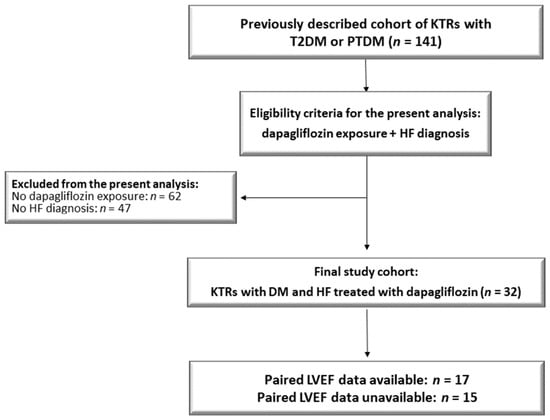
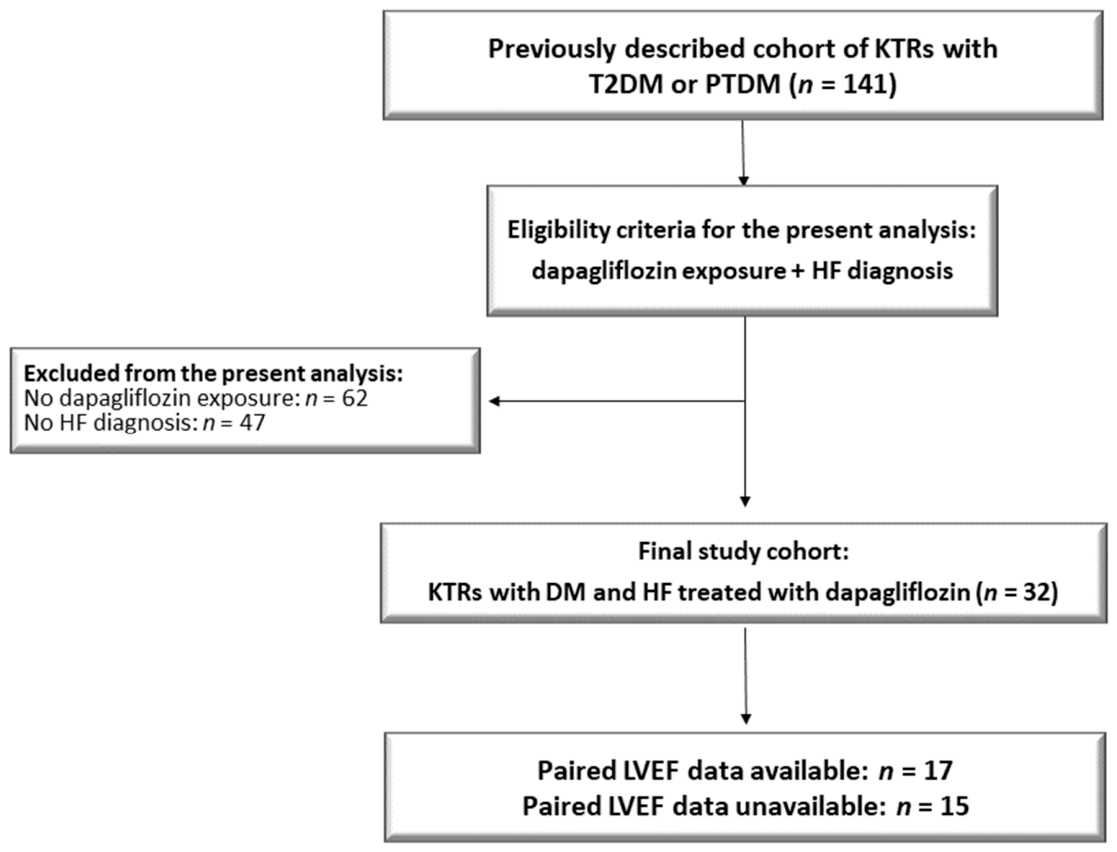
The present analysis was derived from a previously described cohort of KTRs with T2DM or PTDM. Eligibility required both dapagliflozin exposure and a diagnosis of HF. Patients without dapagliflozin exposure (n = 62) or without HF diagnosis (n = 47) were excluded, resulting in a final cohort of 32 KTRs with DM and HF treated with dapagliflozin. Paired LVEF data were available for 17 patients. A flow diagram detailing patient selection is provided in [Figure 1].
Figure 1.
Flowchart of Cohort Selection and Final Sample Composition.
2.3. Heart Failure Diagnostic Criteria
Heart failure (HF) was identified from electronic medical records using explicit clinical and/or echocardiographic criteria. A diagnosis of HF was considered if records documented at least one of the following: (i) a formal HF diagnosis by a cardiologist or nephrologist; (ii) typical symptoms (e.g., dyspnea on exertion, orthopnea, fatigue) combined with ≥two signs (e.g., peripheral edema, jugular distention, crackles, S3); (iii) elevated natriuretic peptides (BNP > 35 pg/mL or NT-proBNP > 125 pg/mL) in a suggestive clinical context; or (iv) echocardiographic evidence of structural/functional cardiac abnormality (e.g., reduced or preserved LVEF, diastolic dysfunction) accompanied by a clinical HF diagnosis. All cases were independently reviewed by two investigators (R.N., J.F.); discrepancies were resolved by consensus.
2.4. Ethical Approval
The study was reviewed and approved by the Institutional Review Board of the Department of Education, Training and Research (DEFI)—Clinical Research Service (Reference No. 2022.264 [209-DEFI/224-CE]; approval date: 19 April 2023). Given the retrospective and non-interventional nature of the study, and because the analysis relied exclusively on anonymized clinical records, the Ethics Committee formally waived the requirement for individual informed consent on 15 June 2023. This waiver was granted considering the impracticability of recontacting participants from a clinically complex transplant cohort, in which multiple comorbidities, high cardiovascular risk, and mortality during the observation period were anticipated. No identifiable patient information, images, or videos were used. Data were processed according to institutional anonymization procedures, and the study was conducted in accordance with the Declaration of Helsinki and applicable local regulations.
2.5. Data Collection
Relevant clinical data were extracted from institutional electronic medical records. Collected variables included demographic characteristics, anthropometric measures, comorbidities, immunosuppressive regimens, antidiabetic treatment history, cardiac and hemodynamic parameters, and laboratory data, including glycemic variables, lipid profile, renal function, microalbuminuria, serum electrolytes, and uric acid. Data were recorded using a pre-designed case report form. All parameters were assessed at baseline, defined as dapagliflozin initiation, and at the most recent follow-up (April 2024). Data extraction was performed using a standardized data collection form. When inconsistencies or missing values were identified, electronic records were reviewed again to confirm data accuracy. Because of the retrospective nature of the study, the number of available paired observations varied across outcomes; therefore, analyses were performed using available paired data for each variable, and the corresponding number of patients was reported when applicable.
2.6. Study Outcomes
The main cardiac outcome was the change in LVEF from baseline to the most recent available follow-up among patients with paired echocardiographic data. Other cardiac outcomes included changes in NYHA functional class, when available. Renal outcomes included eGFR and UACR. Metabolic, hemodynamic, anthropometric, and laboratory outcomes included HbA1c, lipid profile, blood pressure, body weight, BMI, serum electrolytes, and uric acid. Clinical events and safety outcomes included HF hospitalizations, cardiovascular mortality, adverse events, and treatment discontinuation.
2.7. Definitions
Diabetes mellitus included both T2DM and PTDM, the latter diagnosed according to American Diabetes Association criteria at least 3 months after transplantation in clinically stable patients [11,12]. Heart Failure was defined as a clinical syndrome with symptoms and/or signs caused by a structural and/or functional cardiac abnormality [13,14]; left ventricular ejection fraction (LVEF) was assessed by echocardiography and categorized according to current guideline-based criteria [15]. The operational criteria used to identify HF patients for this study are detailed in the Inclusion Criteria. Hypertension was defined as systolic BP ≥ 130 mmHg and/or diastolic BP ≥ 80 mmHg on repeated measurements [16]. Microalbuminuria was defined as a urinary albumin-to-creatinine ratio (UACR) ≥ 30 mg/g [16]. Renal function was assessed using the CKD-EPI 2021 equation for estimated glomerular filtration rate (eGFR) [17].
2.8. Statistical Analysis
Descriptive statistics were used to summarize baseline characteristics and study outcomes. Continuous variables were expressed as mean ± standard deviation (SD) for normally distributed data and as median with interquartile range (IQR) for non-normally distributed data. Normality was assessed using the Shapiro–Wilk test. Categorical variables were presented as counts and percentages. Within-group comparisons between baseline and the most recent follow-up were performed using paired t-tests for normally distributed continuous variables and Wilcoxon signed-rank tests for non-normally distributed variables. Clinical events and safety outcomes were analyzed descriptively. All statistical analyses were performed using SAS software version 9.4 (SAS Institute Inc., Cary, NC, USA), and a two-sided p value < 0.05 was considered statistically significant. Because of the retrospective and exploratory nature of the study, no formal a priori sample size calculation was performed. The final sample size reflected all eligible KTRs with DM and HF who received dapagliflozin during the study period. Given the small cohort size and the limited number of patients with paired echocardiographic data, the study was underpowered for confirmatory analyses, particularly for cardiac outcomes. Therefore, all statistical comparisons were interpreted as exploratory.
3. Results
3.1. Patients Characteristics and Demographics
At baseline, the final cohort comprised 32 KTRs with DM and HF treated with dapagliflozin. Median age was 60.5 [57.0–69.0] years, 66% were male, and 66% had received a deceased-donor transplant. The median time from kidney transplantation to study inclusion was 6.7 [3.5–12.6] years, and maintenance immunosuppression was predominantly based on corticosteroids (100%), tacrolimus (78%), and mycophenolate mofetil (88%). Pre-existing T2DM was present in 44% of patients and PTDM in 56%, with a median baseline HbA1c of 7.3 [6.6–8.1]%.
Baseline cardiovascular burden was substantial, with a median LVEF of 60.0 [52.0–64.0]%, prior HF hospitalization in 63%, ischemic heart disease in 34%, and previous myocardial infarction in 16% of patients. Median systolic and diastolic blood pressure were 142 [132–154] mmHg and 77 [68–89] mmHg, respectively, and most patients were receiving beta-blockers (78%), renin–angiotensin system blockers (ACE inhibitors 59%/ARBs 31%), and diuretics (44%). Baseline renal function was characterized by a median serum creatinine of 1.33 [1.04–1.75] mg/dL and eGFR of 54.0 [36.5–65.0] mL/min/1.73 m2. Median body weight and BMI were 76.0 [65.8–85.0] kg and 27.6 [24.8–31.0] kg/m2, respectively. These baseline characteristics highlight a high-risk population with substantial cardiovascular and metabolic burden, in which dapagliflozin was initiated as part of real-world clinical practice. Additional baseline characteristics are summarized in Table 1.
Table 1.
Baseline demographic and clinical characteristics of the study cohort.
3.2. Cardiovascular and Hemodynamic Outcomes
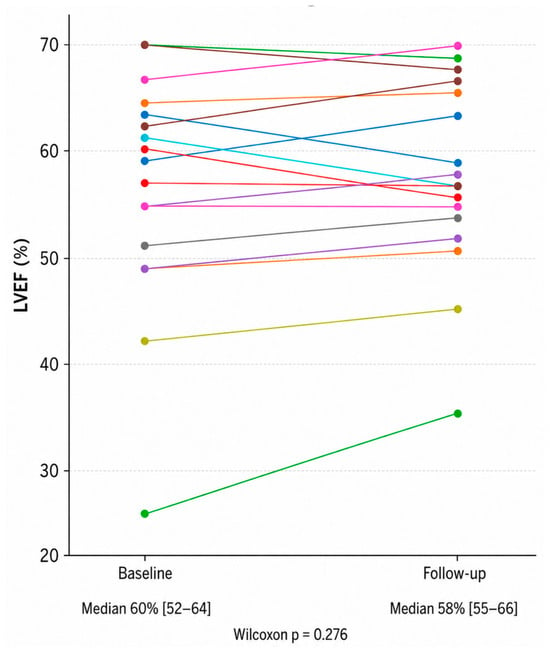
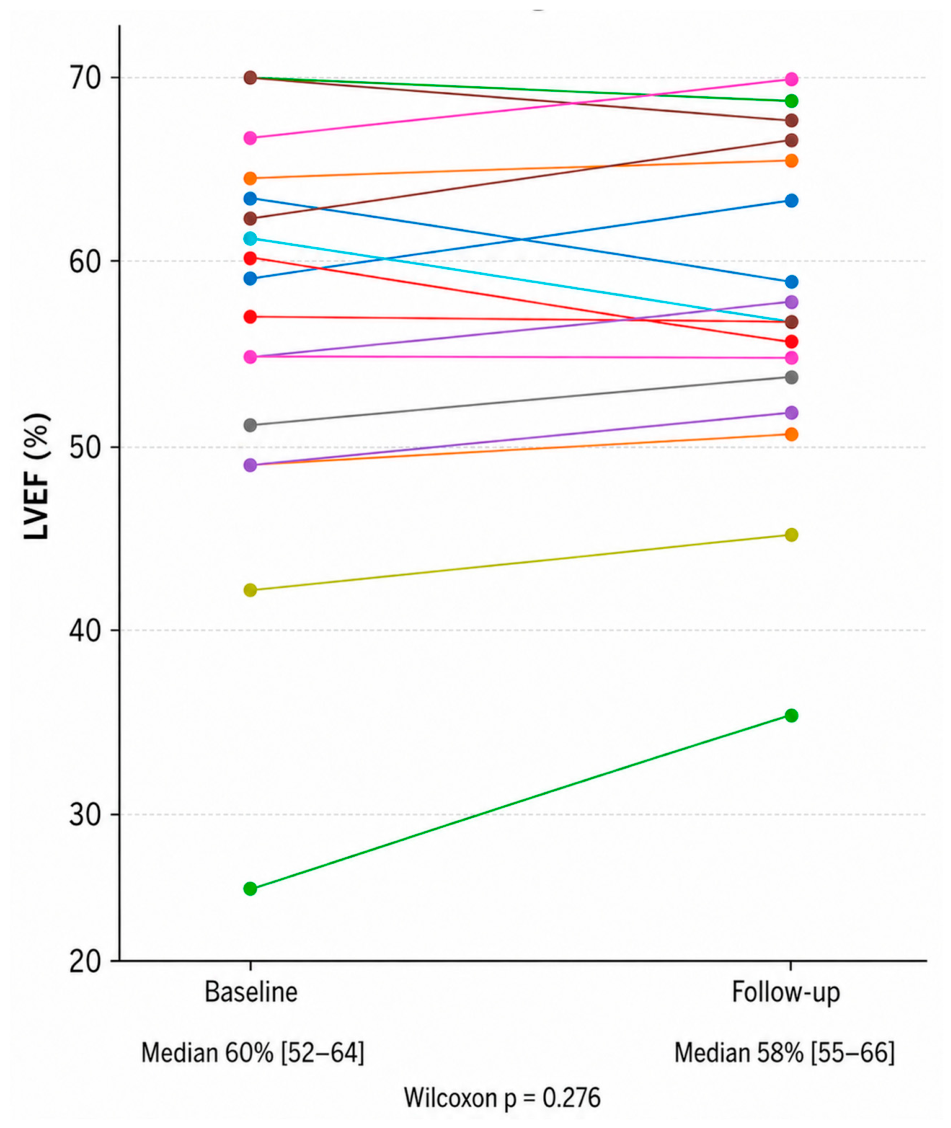
In our cohort, echocardiographic assessment of left ventricular function was available for approximately half of the patients. Paired left ventricular ejection fraction (LVEF) and NYHA data were available for 17 of 32 patients. In these patients, mean LVEF changed from 57.1 ± 11.2% at baseline to 58.3 ± 9.3% at follow-up; median LVEF was 60% [52–64] and 58% [55–66], respectively, with no significant change over time (Wilcoxon signed-rank test, p = 0.276), as illustrated in [Figure 2]. Among patients with available echocardiographic data, preserved EF predominated at baseline, whereas only 2 of 17 patients had LVEF < 50%. All patients with available NYHA data were classified as NYHA class II. Because echocardiographic data were not available for all patients, HF phenotype classification could not be consistently assigned across the entire cohort.
Figure 2.
Individual paired changes in LVEF from baseline to the most recent follow-up among patients with available paired echocardiographic data (n = 17). Each line represents one patient. No statistically significant change in LVEF was observed during follow-up.
Alongside the neutral LVEF findings, we observed consistent reductions in both systolic and diastolic blood pressure throughout follow-up. In the overall cohort (n = 32), median systolic BP decreased from 142 [132–154] to 138 [129–147] mmHg (p < 0.001), and median diastolic BP decreased from 77 [68–89] to 75 [68–82] mmHg (p = 0.034). No major changes were made to background antihypertensive therapy.
3.3. Metabolic and Anthropometric Outcomes
Regarding glycemic control, our data show a modest but statistically significant improvement. A reduction in median HbA1c was observed, decreasing from 7.3 [6.6–8.1] to 6.8 [6.3–7.7]% (p = 0.034). Similarly, LDL-c significantly decreased from 91 [71–117] to 78 [55–108] mg/dL (p = 0.013), as did triglycerides (161 [113–241] to 138 [99–182] mg/dL; p < 0.001). These findings were observed with background statin (100%) and ezetimibe (31%) use. Body weight (76.0 [65.8–85.0] vs. 71.7 [61.0–81.7] kg; p < 0.001) and BMI (27.6 [24.8–31.0] vs. 26.5 [23.7–29.6] kg/m2; p < 0.001) also significantly decreased.
3.4. Renal and Laboratory Outcomes
Median serum creatinine remained stable from baseline to follow-up (1.33 [1.04–1.75] vs. 1.26 [1.10–1.55] mg/dL; p = 0.150). Serum urea also did not change significantly (65.0 [51.0–87.0] vs. 63.5 [48.0–82.0] mg/dL; p = 0.521). Median eGFR remained stable (54.0 [36.5–65.0] vs. 50.0 [36.0–68.0] mL/min/1.73 m2; p = 0.633). Among patients with available paired UACR data (n = 21), an exploratory reduction in median UACR was observed, from 61.1 [19.7–386.2] to 54.6 [20.1–284.3] mg/g (p = 0.033). Median serum sodium (141 [139–143] vs. 141 [139–143] mmol/L; p = 0.345) and potassium (4.4 [4.0–4.9] vs. 4.4 [4.1–4.8] mmol/L; p = 0.478) remained stable, while median uric acid significantly decreased from 6.2 [5.1–7.5] to 6.2 [4.9–7.2] mg/dL (p = 0.006). A comprehensive summary is presented in [Table 2].
Table 2.
Metabolic, hemodynamic, renal, and laboratory variables at baseline and end of follow-up.
3.5. Clinical Events and Safety
The overall safety and tolerability profile of dapagliflozin was acceptable during follow-up. HF hospitalization occurred in 9 patients, while no cardiovascular or all-cause deaths were observed. Adverse events included urinary tract infections (UTIs), genital infections, hypoglycemia, volume depletion-related events, electrolyte disturbances, and treatment discontinuation. UTIs occurred in 4 patients (12%) and were managed according to routine clinical practice, including antimicrobial therapy when clinically indicated. These episodes did not result in graft dysfunction, hospitalization, or urosepsis. Overall, dapagliflozin was discontinued in 1 patient because of moderate symptoms. No genital infections were documented. Three isolated mild hypoglycemic episodes were recorded and were managed with simple carbohydrate intake, without the need for adjustment of concomitant glucose-lowering therapy. No cases of severe hypoglycemia, diabetic ketoacidosis, acute rejection, clinically significant dehydration, or major electrolyte abnormalities were observed during follow-up.
4. Discussion
In this exploratory retrospective cohort of 32 KTRs with DM and HF, dapagliflozin use was associated with stable graft function and favorable metabolic and hemodynamic changes, with no major safety signals observed. An exploratory reduction in UACR was observed among patients with available paired data. However, no significant change in LVEF was detected, and the uncontrolled design precludes causal inference. These findings are clinically relevant, as KTRs with DM and HF remain a high-risk and understudied population in major randomized trials.
Despite prolonged dapagliflozin use, with a median follow-up of 2.2 years, no modification in NYHA functional class was reported and no significant improvement in LVEF was observed among patients with available paired echocardiographic data. This finding is particularly relevant because the cohort was predominantly composed of patients with preserved ejection fraction, whereas only 2 of 17 patients with available echocardiographic data had LVEF < 50% at baseline. Therefore, the present study should not be interpreted as demonstrating improved cardiac function or cardiovascular efficacy. Rather, these results describe real-world clinical trajectories after dapagliflozin initiation in a selected high-risk transplant population. The reductions in systolic and diastolic blood pressure observed during follow-up are consistent with the known hemodynamic profile of SGLT2 inhibitors [18]; however, in the absence of a comparator group, these changes cannot be attributed solely to dapagliflozin and should be interpreted as exploratory associations.
HF hospitalizations were difficult to interpret in this uncontrolled retrospective cohort. Among the 9 patients with HF hospitalization, dapagliflozin was initiated shortly after an acute coronary syndrome event in 8, in the setting of poor glycemic control and after hemodynamic stabilization. Therefore, hospitalization outcomes in this subgroup are likely influenced by acute cardiovascular events, baseline clinical severity, and optimization of background therapy, and should not be interpreted as evidence of dapagliflozin-related cardiovascular benefit.
A central finding of our study was the stability of graft function during follow-up, with no significant change in serum creatinine or median eGFR. This finding is clinically reassuring in the context of a broader renal safety concern when introducing SGLT2 inhibitors in KTRs, particularly because of the potential for volume depletion, acute kidney injury, and drug–drug interactions with calcineurin inhibitors. In the non-transplant setting, DAPA-CKD demonstrated that dapagliflozin reduced the risk of sustained eGFR decline, end-stage kidney disease, and renal or cardiovascular death in patients with chronic kidney disease, with or without type 2 diabetes [19]. However, these results cannot be directly extrapolated to KTRs, who were not represented in this trial and who have transplant-specific risks related to immunosuppression, graft function, and infectious complications [20]. Therefore, the reduction in UACR observed in our cohort should be interpreted as a possible antiproteinuric signal rather than definitive evidence of nephroprotection.
Our findings are also corroborated by previous transplant-specific studies. Halden et al. [21] reported stable eGFR after 24 weeks of empagliflozin in KTRs, and Lemke et al. [22] observed no significant decline in graft function with dapagliflozin or empagliflozin over a 12-month period. Fructuoso et al. [23] similarly reported that SGLT2 inhibitor use was not associated with an increased risk of graft dysfunction. Taken together, these observational data, including our own, support the short-term renal safety of SGLT2 inhibitor use in selected KTRs and suggest a possible antiproteinuric signal. However, the present study should be interpreted as an incremental contribution to the transplant-specific SGLT2 inhibitor literature, rather than as evidence of superiority or definitive nephroprotective benefit. Its main contribution lies in the focus on KTRs with concomitant DM and HF and the relatively long real-world follow-up. These observations remain hypothesis-generating, and further prospective controlled studies are needed to clarify whether dapagliflozin confers clinically meaningful renal or graft-related benefits in the transplant population.
Beyond renal safety, the metabolic effects observed in our cohort were modest and consistent with the known profile of dapagliflozin. We observed reductions in HbA1c, body weight, BMI, LDL cholesterol, and triglycerides. In DECLARE-TIMI 58 [24], dapagliflozin was associated with modest reductions in body weight, systolic blood pressure, and HbA1c in patients with T2DM. Although these findings provide useful clinical context, they cannot be directly extrapolated to KTRs. In our cohort, the observed metabolic changes should also be interpreted cautiously because approximately half of the patients were receiving GLP-1 RAs, which may have contributed to changes in body weight, BMI, HbA1c, and lipid parameters. Therefore, these improvements cannot be attributed exclusively to dapagliflozin.
The absence of severe hypoglycemia, significant hyperkalemia, or acute kidney injury is consistent with safety observations reported in transplant-specific studies. Mahling et al. [25] and Schwaiger et al. [26] similarly reported low rates of adverse events in KTRs treated with SGLT2 inhibitors. Although mild genitourinary infections and volume depletion remain potential concerns, available transplant-specific data suggest that SGLT2 inhibitors are generally well tolerated in selected KTRs.
Potential interactions between dapagliflozin and immunosuppressive therapy are clinically relevant in transplant medicine. Previous transplant-specific data have not suggested major effects of SGLT2 inhibitors on immunosuppressive drug levels, although the available evidence remains limited [20,21]. In this cohort, no acute rejection episodes or major graft dysfunction events were observed during follow-up. However, systematic pharmacokinetic assessment of tacrolimus or mTOR inhibitor levels was not available, precluding formal interaction analysis.
Strengths and Limitations
Our study has several strengths, including the use of a well-characterized cohort from a high-volume tertiary transplant center, the focus on a clinically relevant and underexplored population of KTRs with DM and HF, and a median follow-up of 2.2 years after dapagliflozin initiation. Nevertheless, important limitations must be acknowledged. First, the retrospective, single-center design and the absence of a comparator group preclude causal inference; therefore, observed changes cannot be attributed solely to dapagliflozin and may have been influenced by concomitant therapies, optimization of diabetes or HF care, lifestyle changes, natural disease fluctuation, or regression to the mean. Second, the small sample size limits statistical power and external validity, particularly for cardiac outcomes, as paired echocardiographic data were available for only 17 patients. Third, HF phenotype and cardiac remodeling could not be fully characterized because echocardiographic assessments were performed as part of routine care and detailed parameters such as LV mass, left atrial volume, diastolic function, global longitudinal strain, and pulmonary artery pressure were not consistently available. Finally, concomitant GLP-1 receptor agonist use and the lack of systematic pharmacokinetic assessment of immunosuppressive drug levels may have confounded metabolic and transplant-related safety interpretations.
Despite these limitations, the study provides clinically relevant real-world data on the feasibility, tolerability, renal stability, and metabolic/hemodynamic trajectories observed after dapagliflozin initiation in a high-risk transplant population that remains underrepresented in clinical trials. Accordingly, any implication regarding heart failure benefit should remain cautious and hypothesis-generating, particularly because LVEF did not significantly improve and no comparator group was available.
5. Conclusions
In this exploratory retrospective cohort, dapagliflozin use was followed by stable graft function and changes in metabolic and hemodynamic parameters, without major safety signals. An exploratory reduction in UACR was observed among patients with available paired data. No significant change in LVEF was detected. Given the small sample size, limited paired echocardiographic data, and absence of a control group, these findings should be interpreted as hypothesis-generating and cannot establish cardiovascular or renal efficacy. Prospective controlled studies are needed to clarify the role of dapagliflozin in this high-risk transplant population.
Author Contributions
Conceptualization, R.E.T.N., L.S.M. and J.R.S.; methodology, R.E.T.N., L.S.M. and J.R.S.; software, R.E.T.N.; validation, L.S.M. and J.R.S.; formal analysis, R.E.T.N.; investigation, R.E.T.N., J.F., I.F. and J.L.S.; data curation, R.E.T.N., J.F., I.F. and J.L.S.; writing—original draft preparation, R.E.T.N.; review, validation, and editing of the final manuscript, R.E.T.N., L.S.M. and J.R.S.; supervision, L.S.M. and J.R.S. All authors have read and agreed to the published version of the manuscript.
Funding
This research did not receive any specific grant from funding agencies in the public, commercial, or not-for-profit sectors.
Institutional Review Board Statement
The study protocol was approved by the Ethics Committee of the ULS of Santo Antonio ICBAS (Reference No. 2022.264 [209-DEFI/224-CE], 19 April 2023). We also confirm that the study was conducted in accordance with the ethical standards of the institutional and national research committees and with the 2013 revision of the Declaration of Helsinki.
Informed Consent Statement
As this study utilized anonymized retrospective data, the requirement for informed consent was waived by the ethics committee.
Data Availability Statement
The data presented in this study are available on request from the corresponding author. The data are not publicly available due to privacy and ethical restrictions.
Conflicts of Interest
The authors declare no competing interests. No funding sources influenced the study’s design, execution, data collection, analysis, interpretation, or the preparation and approval of the manuscript.
References
- Weiner, D.E.; Carpenter, M.A.; Levey, A.S.; Ivanova, A.; Cole, E.H.; Hunsicker, L.; Kasiske, B.L.; Kim, S.J.; Kusek, J.W.; Bostom, A.G. Kidney function and risk of cardiovascular disease and mortality in kidney transplant recipients: The FAVORIT trial. Am. J. Transpl. 2012, 12, 2437–2445. [Google Scholar] [CrossRef] [Scilit] [PubMed]
- Reggiani, F.; Moroni, G.; Ponticelli, C. Cardiovascular Risk after Kidney Transplantation: Causes and Current Approaches to a Relevant Burden. J. Pers. Med. 2022, 12, 1200. [Google Scholar] [CrossRef] [Scilit]
- Birdwell, K.A.; Park, M. Post-Transplant Cardiovascular Disease. Clin. J. Am. Soc. Nephrol. 2021, 16, 1878–1889. [Google Scholar] [CrossRef] [Scilit] [PubMed]
- Rysz, J.; Franczyk, B.; Radek, M.; Ciałkowska-Rysz, A.; Gluba-Brzózka, A. Diabetes and Cardiovascular Risk in Renal Transplant Patients. Int. J. Mol. Sci. 2021, 22, 3422. [Google Scholar] [CrossRef] [Scilit]
- Jenssen, T.; Hartmann, A. Post-transplant diabetes mellitus in patients with solid organ transplants. Nat. Rev. Endocrinol. 2019, 15, 172–188. [Google Scholar] [CrossRef] [Scilit] [PubMed]
- Kanbay, M.; Siriopol, D.; Guldan, M.; Ozbek, L.; Topcu, A.U.; Siriopol, I.; Tuttle, K. Prognostic impact of post-transplant diabetes mellitus in kidney allograft recipients: A meta-analysis. Nephrol. Dial. Transpl. 2025, 40, 554–576. [Google Scholar] [CrossRef] [Scilit]
- McMurray, J.J.V.; Solomon, S.D.; Inzucchi, S.E.; Køber, L.; Kosiborod, M.N.; Martinez, F.A.; Ponikowski, P.; Sabatine, M.S.; Anand, I.S.; Bělohlávek, J.; et al. Dapagliflozin in Patients with Heart Failure and Reduced Ejection Fraction. N. Engl. J. Med. 2019, 381, 1995–2008. [Google Scholar] [CrossRef] [Scilit]
- Kondo, T.; Gasparyan, S.B.; Jhund, P.S.; Bengtsson, O.; Claggett, B.L.; de Boer, R.A.; Hernandez, A.F.; Inzucchi, S.E.; Kosiborod, M.N.; Køber, L.; et al. Use of Win Statistics to Analyze Outcomes in the DAPA-HF and DELIVER Trials. NEJM Evid. 2023, 2, EVIDoa2300042. [Google Scholar] [CrossRef] [Scilit]
- Pham, P.T. Optimal use of SGLT2 inhibitors in diabetic kidney transplant recipients. Front. Nephrol. 2022, 2, 1014241. [Google Scholar] [CrossRef] [Scilit]
- Navarrete, R.E.T.; Freitas, J.C.; Fonseca, I.; Cunha, A.; Sa, J.R.; Martins, L.S. Management of Type 2 and Post-Transplant Diabetes in Kidney Transplant Recipients: A Single-Center Clinical Experience with GLP-1 Receptor Agonists and SGLT-2 Inhibitors. Diabetology 2025, 6, 158. [Google Scholar] [CrossRef] [Scilit]
- American Diabetes Association Professional Practice Committee. 2. Classification and Diagnosis of Diabetes: Standards of Medical Care in Diabetes-2022. Diabetes Care 2022, 45, S17–S38. [Google Scholar] [CrossRef] [Scilit] [PubMed]
- Sharif, A.; Chakkera, H.; de Vries, A.P.J.; Eller, K.; Guthoff, M.; Haller, M.C.; Hornum, M.; Nordheim, E.; Kautzky-Willer, A.; Krebs, M.; et al. International consensus on post-transplantation diabetes mellitus. Nephrol. Dial. Transpl. 2024, 39, 531–549. [Google Scholar] [CrossRef] [Scilit]
- Bozkurt, B.; Coats, A.J.S.; Tsutsui, H.; Abdelhamid, C.M.; Adamopoulos, S.; Albert, N.; Anker, S.D.; Atherton, J.; Böhm, M.; Butler, J.; et al. Universal definition and classification of heart failure: A report of the Heart Failure Society of America, Heart Failure Association of the European Society of Cardiology, Japanese Heart Failure Society and Writing Committee of the Universal Definition of Heart Failure: Endorsed by the Canadian Heart Failure Society, Heart Failure Association of India, Cardiac Society of Australia and New Zealand, and Chinese Heart Failure Association. Eur. J. Heart Fail. 2021, 23, 352–380. [Google Scholar] [CrossRef] [Scilit]
- McDonagh, T.A.; Metra, M.; Adamo, M.; Gardner, R.S.; Baumbach, A.; Böhm, M.; Burri, H.; Butler, J.; Čelutkienė, J.; Chioncel, O.; et al. 2021 ESC Guidelines for the diagnosis and treatment of acute and chronic heart failure. Eur. Heart J. 2021, 42, 3599–3726. [Google Scholar] [CrossRef] [Scilit]
- Writing Committee Members; ACC/AHA Joint Committee Members. 2022 AHA/ACC/HFSA Guideline for the Management of Heart Failure. J. Card. Fail. 2022, 28, e1–e167. [Google Scholar] [CrossRef] [Scilit]
- Kidney Disease: Improving Global Outcomes (KDIGO) CKD Work Group. KDIGO 2024 Clinical Practice Guideline for the Evaluation and Management of Chronic Kidney Disease. Kidney Int. 2024, 105, S117–S314. [CrossRef] [Scilit]
- Delgado, C.; Baweja, M.; Crews, D.C.; Eneanya, N.D.; Gadegbeku, C.A.; Inker, L.A.; Mendu, M.L.; Miller, W.G.; Moxey-Mims, M.M.; Roberts, G.V.; et al. A Unifying Approach for GFR Estimation: Recommendations of the NKF-ASN Task Force on Reassessing the Inclusion of Race in Diagnosing Kidney Disease. J. Am. Soc. Nephrol. 2021, 32, 2994–3015. [Google Scholar] [CrossRef] [Scilit] [PubMed]
- Nassif, M.E.; Windsor, S.L.; Tang, F.; Khariton, Y.; Husain, M.; Inzucchi, S.E.; Mc-Guire, D.K.; Pitt, B.; Scirica, B.M.; Austin, B.; et al. Dapagliflozin Effects on Biomarkers, Symptoms, and Functional Status in Patients with Heart Failure with Reduced Ejection Fraction: The DEFINE-HF Trial. Circulation 2019, 140, 1463–1476. [Google Scholar] [CrossRef] [Scilit]
- Heerspink, H.J.L.; Stefánsson, B.V.; Correa-Rotter, R.; Chertow, G.M.; Greene, T.; Hou, F.-F.; Mann, J.F.E.; McMurray, J.J.V.; Lindberg, M.; Rossing, P.; et al. Dapagliflozin in Patients with Chronic Kidney Disease. N. Engl. J. Med. 2020, 383, 1436–1446. [Google Scholar] [CrossRef] [Scilit] [PubMed]
- Polychronopoulou, E.; Bourdon, F.; Teta, D. SGLT2 inhibitors in diabetic and non-diabetic kidney transplant recipients: Current knowledge and expectations. Front. Nephrol. 2024, 4, 1332397. [Google Scholar] [CrossRef] [Scilit]
- Halden, T.A.S.; Kvitne, K.E.; Midtvedt, K.; Rajakumar, L.; Robertsen, I.; Brox, J.; Bollerslev, J.; Hartmann, A.; Åsberg, A.; Jenssen, T. Efficacy and Safety of Empagliflozin in Renal Transplant Recipients with Posttransplant Diabetes Mellitus. Diabetes Care 2019, 42, 1067–1074. [Google Scholar] [CrossRef] [Scilit]
- Lemke, A.; Brokmeier, H.M.; Leung, S.B.; Mara, K.C.; Mour, G.K.; Wadei, H.M.; Hill, J.M.; Stegall, M.; Kudva, Y.C.; Shah, P.; et al. Sodium-glucose cotransporter 2 inhibitors for treatment of diabetes mellitus after kidney transplantation. Clin. Transpl. 2022, 36, e14718. [Google Scholar] [CrossRef] [Scilit]
- Fructuoso, A.I.S.; Raba, A.B.; Deras, E.B.; Sánchez, L.A.V.; Cecilio, R.V.S.; Esteve, A.F.; Vega, L.C.; Martínez, E.G.; Garcia, M.E.G.; Coronado, P.S.; et al. Sodium-glucose cotransporter-2 inhibitor therapy in kidney transplant patients with type 2 or post-transplant diabetes: An observational multicentre study. Clin. Kidney J. 2023, 16, 1022–1034. [Google Scholar] [CrossRef] [Scilit]
- Wiviott, S.D.; Raz, I.; Bonaca, M.P.; Mosenzon, O.; Kato, E.T.; Cahn, A.; Silverman, M.G.; Zelniker, T.A.; Kuder, J.F.; Murphy, S.A.; et al. Dapagliflozin and Cardiovascular Outcomes in Type 2 Diabetes. N. Engl. J. Med. 2019, 380, 347–357. [Google Scholar] [CrossRef] [Scilit] [PubMed]
- Mahling, M.; Schork, A.; Nadalin, S.; Fritsche, A.; Heyne, N.; Guthoff, M. Sodium-Glucose Cotransporter 2 (SGLT2) Inhibition in Kidney Transplant Recipients with Diabetes Mellitus. Kidney Blood Press. Res. 2019, 44, 984–992. [Google Scholar] [CrossRef] [Scilit] [PubMed]
- Schwaiger, E.; Burghart, L.; Signorini, L.; Ristl, R.; Kopecky, C.; Tura, A.; Pacini, G.; Wrba, T.; Antlanger, M.; Schmaldienst, S.; et al. Empagliflozin in posttransplantation diabetes mellitus: A prospective, interventional pilot study on glucose metabolism, fluid volume, and patient safety. Am. J. Transpl. 2019, 19, 907–919. [Google Scholar] [CrossRef] [Scilit] [PubMed]

Disclaimer/Publisher’s Note: The statements, opinions and data contained in all publications are solely those of the individual author(s) and contributor(s) and not of MDPI and/or the editor(s). MDPI and/or the editor(s) disclaim responsibility for any injury to people or property resulting from any ideas, methods, instructions or products referred to in the content. |
© 2026 by the authors. Licensee MDPI, Basel, Switzerland. This article is an open access article distributed under the terms and conditions of the Creative Commons Attribution (CC BY) license.