


Abstract
Red pitaya (Hylocereus polyrhizus) is an important source of thermolabile bioactive compounds, particularly betalains, whose stability can be significantly affected during extraction processes. This study evaluated the influence of pressurized liquid extraction (PLE) and different ultrasound-assisted extraction (UAE) configurations on the recovery and preservation of bioactive compounds from red pitaya pulp, with special emphasis on thermal management during processing. Static UAE (UAE-1), ice-assisted UAE (UAE-2), and two continuous-flow ultrasound systems operating at 10 mL/min (UAE-3) and 20 mL/min (UAE-4) were compared with PLE under different processing conditions. Betalain content, total phenolic compounds, antioxidant activity assessed using ferric reducing antioxidant power (FRAP) and 2,2′-azino-bis(3-ethylbenzothiazoline-6-sulfonic acid) (ABTS), thermal profiles, and metabolite composition determined by ultra-high-performance liquid chromatography–electrospray ionization–quadrupole time-of-flight mass spectrometry (UHPLC-ESI-QTOF-MS) were evaluated. Continuous-flow ultrasound processing significantly improved the preservation of betalains and thermolabile metabolites compared with conventional extraction approaches. Among all treatments, UAE-3 (10 mL/min) showed the best overall performance, combining high betalain recovery, enhanced antioxidant activity, and a broad metabolite profile. A total of 39 metabolites were tentatively identified, including phenolic acids, flavonoids, coumarins, amino acids, alkaloids, fatty acids, and glycerophospholipids. The results demonstrate that controlling heat accumulation is more relevant than increasing extraction intensity alone when processing thermolabile compounds. These findings highlight the potential of continuous-flow ultrasound systems with effective thermal management as a strategy to produce bioactive-rich ingredients from red pitaya pulp. AGSA-Prep classified all five extraction workflows as Acceptably Green (61.1–62.5%), while GEARS yielded component scores of 67% for ethanol and 83% for water.
1. Introduction
Red pitaya (Hylocereus polyrhizus) is a tropical fruit recognized for its attractive red-purple coloration and its high content of bioactive compounds, particularly betalains, phenolic compounds, flavonoids, and other secondary metabolites associated with antioxidant activity and potential health benefits [1,2,3,4]. However, many of these compounds are thermolabile and highly susceptible to degradation during postharvest handling and extraction processes, which may compromise their functional quality and limit their industrial application [5,6].
The recovery of these compounds depends strongly on the extraction technology employed. Conventional extraction methods often require long processing times and may promote oxidative and thermal degradation, reducing the stability of sensitive metabolites [5,6,7]. Consequently, there is increasing interest in developing extraction strategies capable of improving compound recovery while preserving their chemical integrity [8,9,10].
Among emerging extraction technologies, pressurized liquid extraction (PLE) and ultrasound-assisted extraction (UAE) have shown considerable potential for recovering bioactive compounds from plant matrices [11,12,13,14]. PLE uses moderate temperatures and elevated pressures to improve mass transfer and extraction efficiency while reducing solvent consumption. Similarly, the UAE promotes cavitation phenomena that facilitate cell disruption and accelerate the release of intracellular compounds [13,14].
However, maximizing extraction efficiency without controlling heat accumulation may accelerate the degradation of thermolabile compounds, particularly betalains, thereby reducing the functional quality of the final extracts [5,15,16,17]. Consequently, extraction strategies should not only focus on increasing compound recovery but also on preserving the chemical integrity of heat-sensitive metabolites throughout processing.
In ultrasound-assisted extraction, processing conditions such as ultrasonic intensity, extraction time, and fluid circulation directly influence heat generation and compound stability [13,14,15,16,17,18]. In this context, continuous-flow systems may offer important advantages by facilitating heat dissipation and reducing local temperature accumulation, thereby improving the preservation of thermolabile compounds [18,19]. Despite these potential benefits, studies evaluating the influence of thermal management during continuous-flow ultrasound processing of red pitaya remain scarce. Most available studies have primarily focused on maximizing extraction yield, whereas considerably less attention has been devoted to understanding how thermal management influences the preservation of thermolabile metabolites and the overall chemical quality of the extracts.
Continuous-flow ultrasound is an established process-intensification approach; therefore, the novelty of the present study does not lie in the invention of this technology. Rather, it lies in its application to red pitaya and in the direct comparison of static UAE, ice-assisted UAE, and two continuous-flow UAE configurations with PLE under systematic thermal monitoring. High-pressure extraction of Hylocereus polyrhizus has previously been reported, including supercritical CO2 extraction with aqueous ethanol as a co-solvent [20]. However, evidence specifically addressing hydroethanolic PLE in this matrix and directly comparing it with continuous-flow UAE from a thermal-management perspective remains limited.
Therefore, this study aimed to evaluate the influence of thermal management on the recovery and preservation of thermolabile metabolites from red pitaya (Hylocereus polyrhizus) pulp by comparing PLE and different ultrasound-assisted extraction configurations, including continuous-flow systems, and to characterize their metabolomic profiles and antioxidant properties. The environmental performance of the selected extraction workflows was also compared using AGSA-Prep and GEARS.
2. Materials and Methods
2.1. Chemicals
Ethanol, gallic acid, Folin–Ciocalteu reagent, sodium carbonate (Na2CO3), 2,4,6-tris(2-pyridyl)-s-triazine (TPTZ), ferric chloride (FeCl3), Trolox (6-hydroxy-2,5,7,8-tetramethylchroman-2-carboxylic acid), 2,2′-azinobis-(3-ethylbenzothiazoline-6-sulfonic acid) diammonium salt (ABTS), potassium persulfate, acetic acid, and sodium acetate were purchased from Sigma-Aldrich (St. Louis, MO, USA). Methanol, acetonitrile, and formic acid (HPLC grade) used for UHPLC-ESI-QTOF-MS analysis were also obtained from Sigma-Aldrich. Ultrapure water was produced using a Milli-Q purification system (Millipore, Billerica, MA, USA).
Prior to chromatographic analysis, all samples and solvents were filtered through 0.22 μm membrane filters (Millipore).
2.2. Raw Material and Proximate Characterization of Red Pitaya Pulp
Red pitaya (Hylocereus polyrhizus) fruits were harvested during a single harvest period in Yuto, Jujuy Province, Argentina (23°38′36″ S, 64°28′19″ W). Fruits were collected at commercial maturity and immediately transported to the laboratory in cardboard boxes at ambient temperature.
The fruits were washed with running water, disinfected in a 200 ppm sodium hypochlorite solution for 15 min, and manually peeled to separate the pulp from the peel. The pulp was freeze-dried using an L-A-B3 freeze dryer (Rificor, Buenos Aires, Argentina) at −45 °C for 48 h under vacuum conditions and subsequently ground to obtain a fine powder. The resulting powder was vacuum-packed in airtight containers and stored until further analysis.
The proximate composition of the freeze-dried pulp was determined according to AOAC methods: moisture (AOAC No. 920.151), ash (AOAC No. 923.03), lipids (AOAC No. 945.16), and protein (AOAC No. 970.22) using a nitrogen-to-protein conversion factor of 6.25 [10]. Carbohydrate content was calculated by difference. All analyses were performed in triplicate.
2.3. Pressurized Liquid Extraction (PLE)
PLE experiments were performed using a Speed SFE Helix system (Applied Separations, Allentown, PA, USA) [11]. For each extraction, 1.0 g of freeze-dried red pitaya pulp was loaded into a 24 mL extraction vessel, and the remaining volume was filled with glass beads to minimize dead volume.
A factorial experimental design was used to evaluate the effects of solvent composition (40% and 70% ethanol in water, v/v) and temperature (35, 45, and 55 °C) at a fixed pressure of 100 bar and a flow rate of 2 mL/min for 30 min. All experiments were performed in duplicate, resulting in a total of 12 extraction assays. The obtained extracts were stored at −22 °C until further analysis.
2.4. Ultrasound-Assisted Extraction (UAE)
Ultrasound-assisted extraction experiments were performed using a 100 W high-intensity ultrasonic processor (UP100H, Hielscher Ultrasonics GmbH, Teltow, Germany) operating at a frequency of 30 kHz. For all experiments, 2.0 g of freeze-dried red pitaya pulp and 40 mL of 40% (v/v) aqueous ethanol were used.
The study was conducted under four UAE configurations:
Static UAE (UAE-1): An MS7 probe (7 mm diameter; Hielscher Ultrasonics GmbH, Teltow, Germany) was immersed at a depth of 25 mm in a 50 mL vessel, maintaining a distance of 1 cm from the bottom.
Static UAE with ice bath (UAE-2): The same static configuration was used while the extraction vessel was immersed in an ice-water bath to minimize overheating during processing.
Continuous-flow UAE (UAE-3 and UAE-4): An MS7D probe coupled to a D7K flow-through cell and a peristaltic pump was used at flow rates of 10 and 20 mL/min, respectively.
For each UAE configuration, a three-level factorial design was applied using ultrasonic intensities of 26, 53, and 78 W/cm2 (20, 40, and 60% amplitude) and extraction times of 10, 15, and 20 min. Temperature was monitored by infrared thermography at 5 min intervals. The 36 independent experimental conditions resulting from the combination of extraction time, ultrasonic intensity, and UAE configuration are summarized in Table 1.
Table 1.
Factorial experimental design used to evaluate total betalain extraction under different ultrasound-assisted extraction (UAE) configurations.
All experiments were performed in duplicate, resulting in a total of 72 processed samples. The extracts were subsequently centrifuged at 4000 rpm for 5 min, and the supernatants were stored at −18 °C until further analysis.
2.5. Characterization, Preselection, and Identification of Compounds
2.5.1. Determination of Total Betalains (TB)
Spectrophotometric total betalain (TB) content was estimated in all extracts obtained by PLE and UAE by measuring absorbance at 538 nm for betacyanins and 480 nm for betaxanthins using a UV–Vis microplate spectrophotometer (Synergy HT, BioTek Instruments, Inc., Winooski, VT, USA), according to the method described by Tabio-García et al. [12]. TB was calculated using the following equation and expressed as the sum of the spectrophotometrically estimated betacyanin and betaxanthin contents (mg/100 g dry biomass). Because the method does not chromatographically separate individual pigments, the resulting values represent total absorbance-based estimates and may include contributions from co-absorbing matrix constituents.
where A is the absorbance, DF is the dilution factor, MW is the molecular weight (550 g/mol for betacyanins and 308 g/mol for betaxanthins), V is the extract volume (mL), ε is the molar extinction coefficient (65,000 L mol−1 cm−1 for betacyanins and 48,000 L mol−1 cm−1 for betaxanthins), L is the optical path length (cm), and M is the sample dry weight (g).
2.5.2. Characterization of Selected Extracts
Based on the total betalain (TB) results, the extracts exhibiting the highest pigment recovery for each extraction configuration (PLE, UAE-1, UAE-2, UAE-3, and UAE-4) were selected for further characterization and comparison.
The selected extracts were evaluated for:
Total phenolic compounds (TPC). TPC was determined using the Folin–Ciocalteu method described by Rigui Pessoa da Silva et al. [13]. Results were expressed as mg gallic acid equivalents (GAE) per 100 g dry biomass.
Ferric reducing antioxidant power (FRAP). FRAP analysis was performed according to the procedure described by Akter et al. [14]. Results were expressed as mg Trolox equivalents (TE) per g dry biomass.
ABTS radical scavenging activity. ABTS radical scavenging activity was determined according to the method described by Bekir et al. [15]. Results were expressed as mmol Trolox equivalents (TE) per g dry biomass.
2.5.3. UHPLC-ESI-QTOF-MS Analysis of the Selected Extract
Tentative annotation of secondary metabolites in the UAE-3 extract was performed using a UHPLC-ESI-QTOF-MS system, including an Ultimate 3000 RS UHPLC system with Chromeleon 6.8 software (Dionex GmbH, Idstein, Germany) and a Bruker maXis ESI-QTOFMS system with Data Analysis 4.0 software (Bruker Daltonik GmbH, Bremen, Germany). For analysis, 5 mg of UAE-3 extract was dissolved in 500 μL of 80% methanol, filtered through a polytetrafluoroethylene (PTFE) membrane, and 3 μL was injected into the system. The chromatographic system included a quaternary pump, an autosampler, a thermostated column compartment, and a photodiode array detector. A binary gradient system was used for elution, with eluent A consisting of 0.1% formic acid in water and eluent B consisting of 0.1% formic acid in 90% acetonitrile. The gradient profile was as follows: isocratic 12% B (0–1 min), 12–99% B (2–14 min), and isocratic 88% A (14–16 min). Separation was performed on a Kinetex C18 column (100 mm × 2.1 mm) at a flow rate of 0.4 mL min−1. ESI-QTOF-MS analyses were performed in negative and positive ionization modes over a scan range of m/z 50–1300. Electrospray ionization parameters included a capillary temperature of 230 °C, a capillary voltage of 4.5 kV, a dry gas flow rate of 8 L min−1, and a nebulization pressure of 2.5 bar. Data were acquired in automated MS/MS mode. Metabolites were tentatively annotated from accurate mass, ionization behavior, available fragmentation information, literature, and database comparisons. Authentic reference standards were not analyzed; therefore, none of the reported metabolites should be interpreted as a confirmed identification.
Pearson correlation analysis was performed to evaluate the relationships among total betalains (TB), total phenolic compounds (TPC), and antioxidant activity (FRAP and ABTS). Correlation coefficients (r) were interpreted to assess the strength and direction of the associations between variables.
2.6. Sustainability Assessment
The environmental performance of the five selected extraction workflows (PLE and UAE-1–UAE-4) was assessed using the Analytical Green Star Area for Sample Preparation (AGSA-Prep) framework [21]. The comparison included sample and solvent amounts, extraction time, throughput, workflow integration and automation, reusable materials, waste generation and management, energy-consuming operations, and operator-protection requirements. Energy consumption was calculated as E (Wh sample−1) = [power (W) × operating time (min)]/[60 × number of samples processed simultaneously]. The comparative boundary comprised solvent addition, extraction, recirculation when applicable, centrifugation or extract recovery, and collection of the supernatant. Initial freeze-drying, refrigerated storage, and the external UHPLC-ESI-QTOF-MS metabolite-profiling analysis were excluded because they were not part of the extraction workflows being compared. Consequently, AGSA-Prep Criterion 9 was considered genuinely not applicable and was excluded from the numerator and denominator. The Green Environmental Assessment and Rating for Solvents (GEARS; 2025 release) software [22] was applied separately to ethanol and water, because the official implementation evaluates individual solvents and does not calculate a volume-weighted score for mixtures. Experimental records, equipment specifications, product information, and waste-management practices were used as assessment inputs. Detailed inventories, calculations, criterion-level scores, and graphical profiles are provided in Supplementary Tables S1–S5 and Figures S1 and S2.
2.7. Statistical Analysis
Experimental data were analyzed using Statgraphics Centurion XV software (version 15; Statgraphics Technologies, Inc., Warrenton, VA, USA). Results are presented as mean ± standard deviation. Differences among treatments were evaluated by analysis of variance (ANOVA), and mean comparisons were performed using Tukey’s multiple range test at a 95% confidence level (p < 0.05).
3. Results
3.1. Proximate Composition of Hylocereus polyrhizus Pulp
The proximate composition of freeze-dried red pitaya (Hylocereus polyrhizus) pulp is presented in Table 2. According to Table 2, carbohydrates were the predominant macronutrient, followed by moisture, protein, ash, and lipids.
Table 2.
Proximate composition of freeze-dried red pitaya (Hylocereus polyrhizus) pulp.
According to Table 2, lyophilized red pitaya pulp was mainly composed of carbohydrates, followed by moisture, protein, ash, and lipids. The values obtained were comparable to those previously reported for pitaya pulp subjected to different drying methods. In particular, moisture, protein, and ash contents were higher than those reported by Harish et al. [16] for tray- and spray-dried pitaya pulp, whereas lipid and ash contents were similar to those described by Cheok et al. [19].
3.2. Effects of Solvent Composition and Temperature on PLE Performance
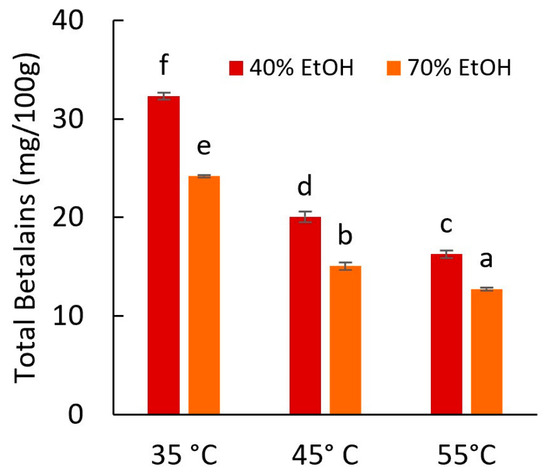
Figure 1 shows the total betalain (TB) content (mg/100 g dry biomass) obtained by pressurized liquid extraction. Solvent composition and extraction temperature significantly affected betalain recovery (p < 0.05). The highest TB content (32.3 ± 0.3 mg/100 g dry biomass) was obtained at the lowest extraction temperature (35 °C) using 40% ethanol (v/v). In contrast, increasing the extraction temperature to 55 °C reduced TB recovery under all evaluated solvent conditions (Figure 1).
Figure 1.
Total betalain (TB) content obtained by pressurized liquid extraction (PLE). Values are expressed as mean ± standard deviation (n = 3). Different lowercase letters indicate significant differences among treatments according to Tukey’s multiple range test (p < 0.05).
These findings are consistent with previous studies involving both Hylocereus species and other betalain-rich matrices. Gómez-López et al. [23] reported that lower temperatures (25 °C) combined with a 50% hydroethanolic mixture were optimal for betalain extraction from Opuntia stricta var. Dillenii using pressurized liquid extraction. Similarly, Fathordoobady et al. [20] successfully recovered betacyanins from red pitaya pulp using supercritical CO2 extraction (25 MPa and 50 °C) combined with 10% aqueous ethanol. Likewise, Nunes et al. [24] reported that the highest betalain recovery from prickly pear was achieved at 40 °C using supercritical CO2 extraction. Collectively, these studies reinforce the importance of moderate temperatures for preserving betalain stability during extraction processes.
3.3. Performance of the Ultrasound-Assisted Extraction Configurations
3.3.1. Static UAE
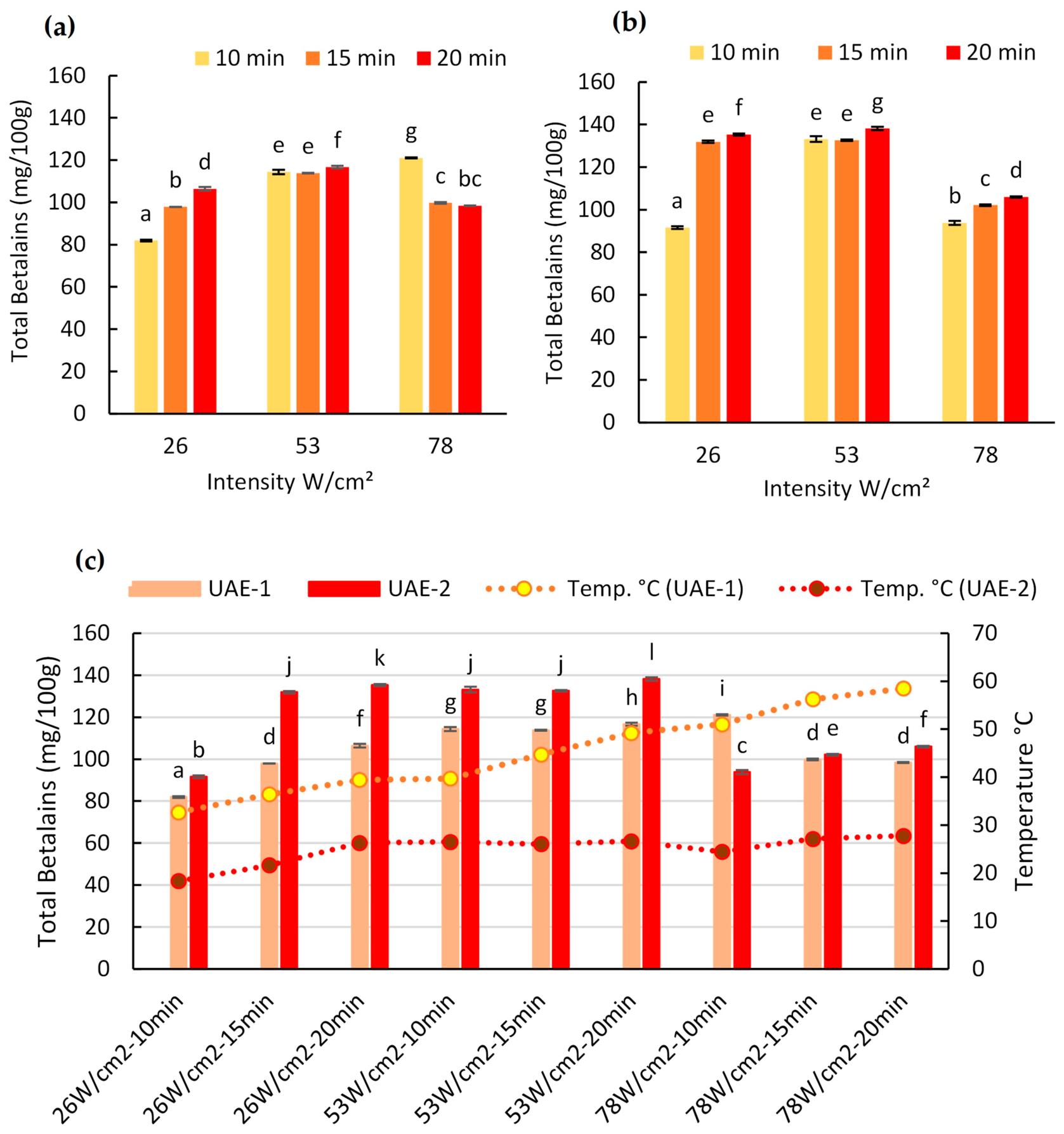
Figure 2 presents: (a) the total betalain (TB) content (mg/100 g dry biomass) obtained by static ultrasound-assisted extraction (UAE-1); (b) the corresponding content obtained with ice-bath temperature control (UAE-2); and (c) the temperature profiles recorded for both static extraction systems.
Figure 2.
Total betalain (TB) content (mg/100 g dry biomass) obtained by ultrasound-assisted extraction under static configurations: (a) static UAE (UAE-1); (b) static UAE with ice-bath temperature control (UAE-2); and (c) comparison of temperature profiles between both extraction systems. Values are expressed as mean ± standard deviation (n = 3). Different lowercase letters within each panel indicate significant differences among treatments according to Tukey’s multiple range test (p < 0.05).
The extraction efficiency was significantly affected by the interaction between treatment intensity and extraction time (p < 0.05). In UAE-1 (Figure 2a), TB recovery increased proportionally with both parameters, reaching a maximum value of 121.0 ± 0.3 mg/100 g at an intensity of 78 W/cm2 and an extraction time of 10 min, followed by a marked decrease at more severe conditions.
The incorporation of an ice bath during extraction (UAE-2, Figure 2b) improved betalain recovery compared with UAE-1. The optimum condition shifted to 53 W/cm2, reaching a maximum TB content of 138.2 ± 0.8 mg/100 g.
Temperature monitoring (Figure 2c) revealed that, in the absence of thermal control, temperature increased linearly as extraction intensity and time increased. Under UAE-1 conditions, an intensity of 78 W/cm2 applied for 10 min increased extract temperature to 51 ± 2 °C. In contrast, the incorporation of an ice bath maintained temperatures between 18 ± 2 °C and 28 ± 2 °C throughout all UAE-2 experiments, regardless of treatment intensity or extraction time.
3.3.2. Continuous-Flow UAE
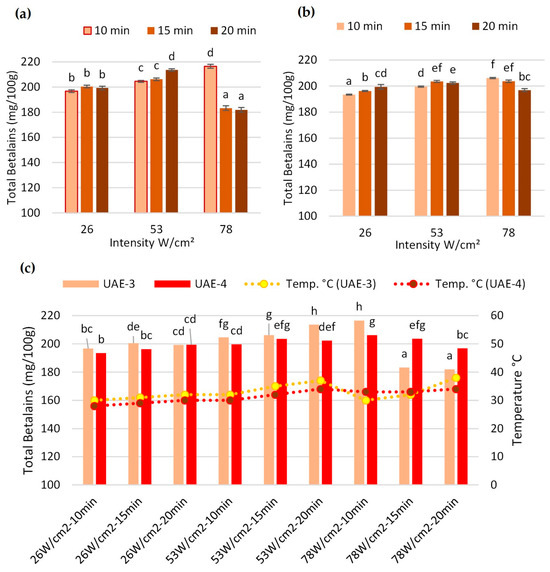
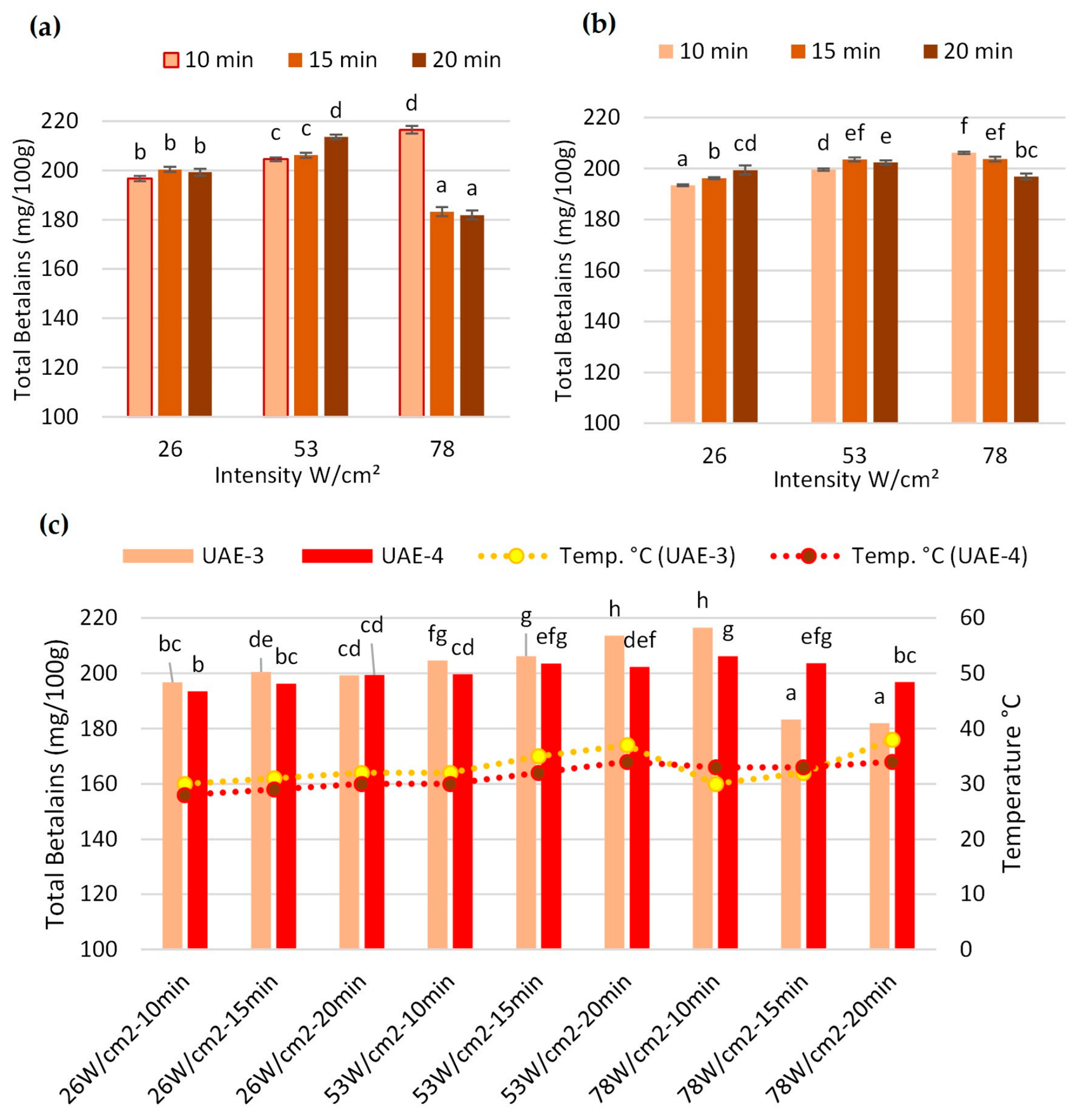
Figure 3 presents: (a) the total betalain (TB) content (mg/100 g dry biomass) obtained by continuous-flow UAE at 10 mL/min (UAE-3); (b) the corresponding content obtained at 20 mL/min (UAE-4); and (c) the temperature profiles recorded for both continuous-flow extraction systems. Ultrasonic intensity, extraction time, and flow rate significantly affected pigment recovery (p < 0.05).
Figure 3.
Total betalain (TB) content (mg/100 g dry biomass) obtained by continuous-flow ultrasound-assisted extraction: (a) UAE-3 (10 mL/min); (b) UAE-4 (20 mL/min); and (c) corresponding temperature profiles recorded under both continuous-flow extraction conditions. Values are expressed as mean ± standard deviation (n = 3). Different lowercase letters within each panel indicate significant differences among treatments according to Tukey’s multiple range test (p < 0.05).
Under both flow conditions, increasing ultrasonic intensity from 26 to 78 W/cm2 increased the amount of extracted betalains. For UAE-3 (10 mL/min), no significant differences (p > 0.05) were observed between 10 and 20 min at 26 W/cm2. At 53 W/cm2, TB content progressively increased with extraction time. The highest betalain content (217 ± 2 mg/100 g) was achieved at 78 W/cm2 after 10 min, followed by a significant decrease at 15 and 20 min (Figure 3a).
For UAE-4 (20 mL/min), TB content increased with extraction time at 26 and 53 W/cm2. At 78 W/cm2, the maximum yield (206 ± 1 mg/100 g) was obtained after 10 min, followed by a decrease at longer extraction times (Figure 3b).
Overall, UAE-3 exhibited higher extraction efficiency than UAE-4 under most experimental conditions. Temperature monitoring revealed that continuous-flow systems maintained temperatures between 28 ± 2 °C and 38 ± 2 °C throughout the extraction process (Figure 3c).
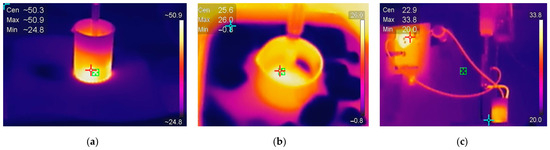
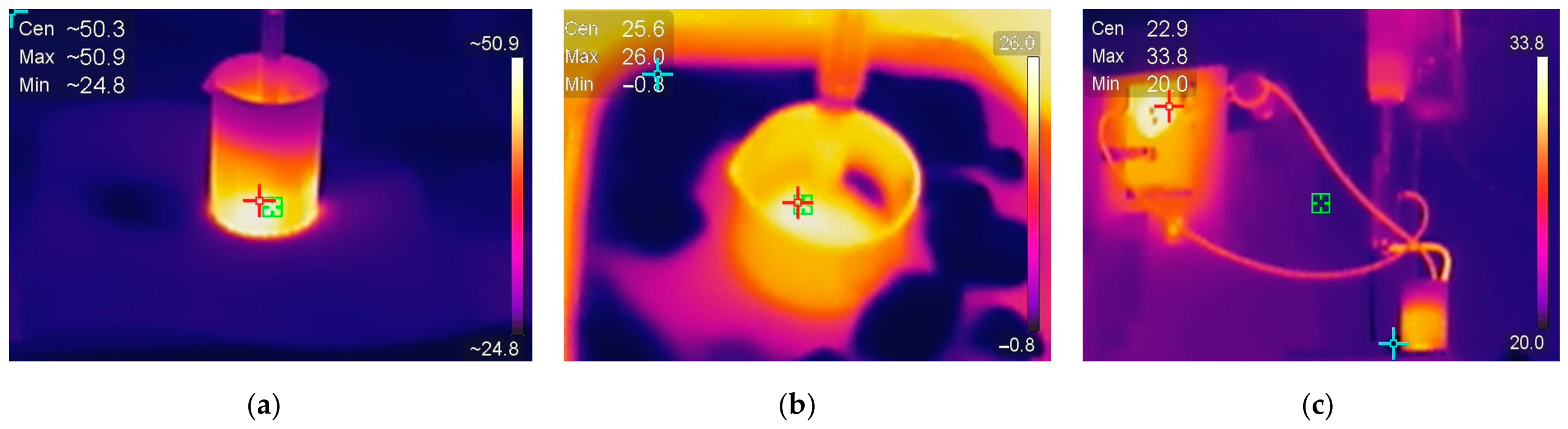
Thermographic analysis further supported these findings (Figure 4). The static UAE system without thermal control (Figure 4a) exhibited localized heat accumulation near the ultrasonic probe, whereas the incorporation of an ice bath reduced thermal gradients (Figure 4b). In contrast, continuous-flow systems (Figure 4c) showed a more homogeneous temperature distribution throughout the extraction system.
Figure 4.
Representative thermographic images obtained by infrared thermography during ultrasound-assisted extraction: (a) static UAE (UAE-1); (b) static UAE with ice-bath temperature control (UAE-2); and (c) continuous-flow UAE systems (UAE-3 and UAE-4). The false-color scale represents the surface temperature distribution. The red cross indicates the maximum-temperature point, the green square indicates the central/reference measurement point, and the cyan cross indicates the minimum-temperature point.
The extraction time was selected to capture the maximum betalain recovery before the decline associated with prolonged processing and temperature increase. To evaluate the temperature dependence of the UAE systems, non-isothermal extraction data were analyzed using an apparent first-order kinetic model and the Arrhenius relationship. Kinetic parameters were estimated with the Coats-Redfern integral approach [25,26]. Table 3 reports the heating rate (β), apparent activation energy (Ea), Arrhenius pre-exponential factor (A), and coefficient of determination (R2) for each condition. These parameters describe the combined temperature-dependent extraction/release process and should not be interpreted as a compound-specific degradation model.
Table 3.
Apparent kinetic parameters for non-isothermal betalain extraction using UAE methods.
The apparent activation energy ranged from 12.2 to 29.7 kJ mol−1 (Table 3). Within UAE-1, increasing ultrasonic intensity from 26 to 78 W cm−2 reduced apparent Ea from 29.7 to 15.4 kJ mol−1. UAE-3 showed a smaller decrease, from 15.2 to 12.2 kJ mol−1. At 53 W cm−2, increasing the flow rate from 10 to 20 mL min−1 reduced apparent Ea from 15.1 to 12.5 kJ mol−1, whereas at 26 W cm−2 the values were comparable (15.2 and 15.8 kJ mol−1). These results indicate that ultrasound intensity and flow configuration modified the apparent energy barrier governing pigment release, but they do not independently quantify betalain degradation.
3.4. Bioactive Compound Content and Antioxidant Capacity of the Selected Extracts
To compare the efficiency of the extraction methods, total betalains (TB), total phenolic compounds (TPC), and antioxidant capacity (FRAP and ABTS) were evaluated in the extracts obtained by pressurized liquid extraction (PLE) and ultrasound-assisted extraction (UAE-1, UAE-2, UAE-3, and UAE-4). The results are summarized in Table 4.
Table 4.
Total betalains (TB), total phenolic compounds (TPC), and antioxidant capacity (FRAP and ABTS) of selected extracts obtained by pressurized liquid extraction (PLE) and ultrasound-assisted extraction (UAE).
Significant differences (p < 0.05) were observed among extraction methods for all evaluated parameters. Overall, ultrasound-assisted extraction systems exhibited superior performance compared with PLE, particularly those incorporating thermal control strategies.
The highest TB values were obtained for the continuous-flow systems UAE-3 and UAE-4, whereas PLE showed the lowest recovery. A similar trend was observed for TPC and antioxidant activity (FRAP and ABTS), with UAE-3 and UAE-4 exhibiting the highest values among all extraction conditions.
Pearson correlation analysis was performed to evaluate the relationships among TB, TPC, and antioxidant activity (FRAP and ABTS). The correlation coefficients are presented in Table 5. Significant positive correlations were observed among all variables. The strongest associations were observed between TB and TPC (r = 0.9585), followed by TPC and FRAP (r = 0.9526). A positive correlation was also observed between FRAP and ABTS (r = 0.7883).
Table 5.
Pearson correlation coefficients among total betalains (TB), total phenolic compounds (TPC), and antioxidant activity (FRAP and ABTS).
3.5. UHPLC-ESI-QTOF-MS Tentative Annotation of the UAE-3 Extract
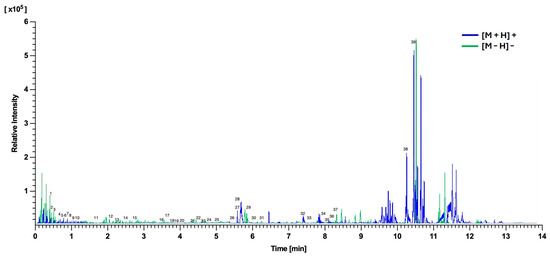
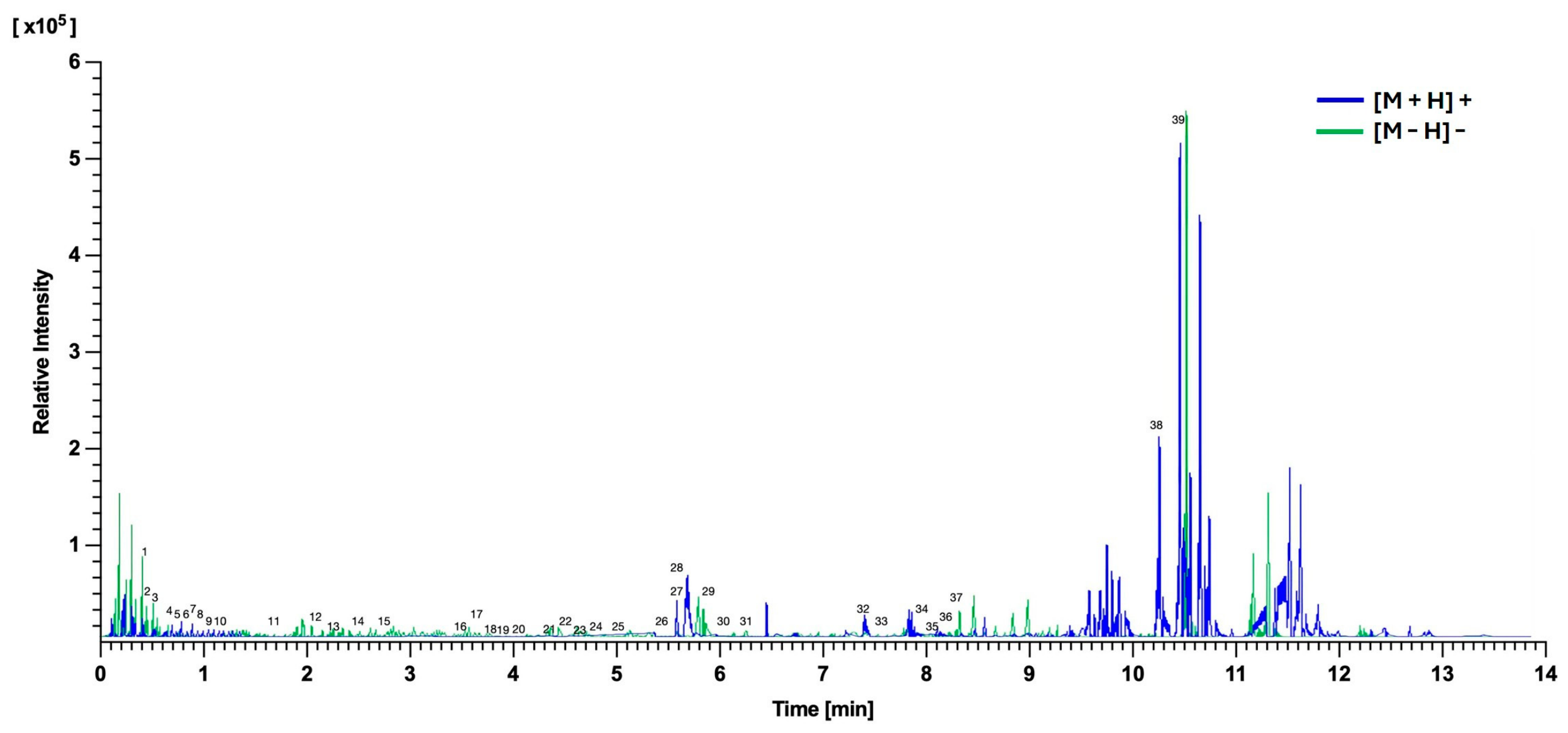
The UAE-3 extract, which exhibited the highest total betalain content and one of the highest antioxidant capacities among all extraction conditions, was further characterized by UHPLC-ESI-QTOF-MS analysis. A total of 39 metabolites were tentatively annotated, encompassing several chemical classes, including amino acids, coumarins, phenolic acids, flavonoids, alkaloids, fatty acids, glycerophosphates, and other lipid-derived metabolites (Table 6). The corresponding total ion chromatograms acquired in positive and negative ionization modes are presented in Figure 5.
Table 6.
Metabolites tentatively annotated in the UAE-3 extract by UHPLC-ESI-QTOF-MS analysis.
Figure 5.
UHPLC-ESI-QTOF-MS total ion chromatograms of the UAE-3 extract acquired in positive ([M + H]+, blue) and negative ([M − H]−, green) ionization modes. Peak numbers correspond to the tentatively annotated metabolites listed in Table 6. The chromatograms provide the overall separation profile and should not be interpreted as authentic-standard confirmation.
Among the identified phenolic acids, chlorogenic acid, 4-coumaric acid, 3-hydroxy-4-methoxycinnamic acid, and 4-methoxycinnamic acid were detected. Several flavonoids were also identified, including luteolin, isorhamnetin, irigenin, jaceidin, cirsimaritin, eupatorin, and skullcapflavone II. In addition, coumarin derivatives such as esculin hydrate, 6,7-dihydroxycoumarin, and esculetin were identified.
Overall, the metabolite profile revealed a predominance of phenolic and flavonoid-derived compounds, together with amino acids and lipid-related metabolites, indicating a broad chemical diversity in the UAE-3 extract obtained under continuous-flow ultrasound-assisted extraction conditions.
Several of the identified metabolites, including chlorogenic acid, luteolin, isorhamnetin, and eupatorin, have been previously associated with antioxidant and anti-inflammatory activities. Their simultaneous presence may contribute to the synergistic antioxidant behavior observed in UAE-3 extracts, suggesting that the preservation of thermolabile compounds may influence not only extraction yield but also the functional quality of the final extracts. This observation reinforces the importance of thermal management when processing complex phytochemical matrices.
3.6. Sustainability Performance of the Extraction Processes
AGSA-Prep classified all five extraction workflows as Acceptably Green. PLE, UAE-1, and UAE-2 each obtained 61.1%, whereas UAE-3 and UAE-4 obtained 62.5% (Supplementary Table S5 and Figure S1). The slightly higher scores of the continuous-flow configurations reflected their short extraction time, lower solvent-to-sample ratio relative to PLE, and recirculation of the same solvent charge. The calculated energy demands were 27.09 Wh sample−1 for UAE-1, 25.42 Wh sample−1 for UAE-2, and 27.92 Wh sample−1 for UAE-3 and UAE-4. For PLE, the available 75 W module rating yielded a partial estimate of 37.50 Wh sample−1; therefore, its energy contribution and final AGSA-Prep result should be interpreted as estimates rather than complete-system electrical measurements (Supplementary Table S3).
GEARS was applied separately to the components of the 40% (v/v) aqueous ethanol extraction solvent. Ethanol obtained 67%, with volatility, flammability, and the absence of solvent recovery as its principal limitations, whereas water obtained 83% because of its lower intrinsic hazard and favorable affordability profile (Supplementary Table S4 and Figure S2). Since the same hydroethanolic system was used for all selected workflows, these component scores were common to PLE and UAE-1–UAE-4; the principal between-workflow difference was the solvent volume, which was 60 mL per 1 g for PLE and 40 mL per 2 g for each UAE procedure.
4. Discussion
The present study demonstrates that extraction technology plays a critical role in determining the recovery and preservation of bioactive compounds from freeze-dried red pitaya pulp. Overall, UAE consistently achieved higher recoveries of betalains, phenolic compounds, and antioxidant activity, indicating that mild extraction conditions combined with efficient mass transfer are more suitable for preserving the thermolabile phytochemicals present in red pitaya.
The proximate composition observed in the freeze-dried red pitaya pulp may have been influenced by the lyophilization process applied prior to extraction. Freeze-drying removes water by sublimation under reduced pressure and low temperature, minimizing structural collapse, protein denaturation, and thermal degradation compared with conventional dehydration methods [17,18]. Consequently, this process likely contributed to preserving nitrogen-containing compounds during sample preparation, which may have favored the proximate composition observed in the present study. Similar proximate composition values have been reported by Cheok et al. [19], who identified carbohydrates as the predominant component (~76.5%) of lyophilized pitaya pulp. These findings reinforce the suitability of freeze-drying as a dehydration strategy for preserving both the nutritional composition and the integrity of thermolabile constituents in red pitaya biomass.
The lower betalain recovery observed at higher extraction temperatures during PLE suggests that these pigments are highly susceptible to thermal degradation, consistent with previous reports [5,27,28]. At each evaluated temperature, 40% ethanol yielded higher TB recovery than 70% ethanol, showing that increasing the ethanol proportion did not compensate for temperature-related pigment losses. This solvent effect is consistent with the high polarity of betalains: the lower-polarity 70% ethanol mixture likely reduced pigment solubility and extraction relative to the more aqueous 40% ethanol system. The limited performance of PLE compared with UAE may also be associated with the hygroscopic nature of the freeze-dried pitaya pulp, which could promote matrix compaction within the extraction vessel, thereby reducing porosity and limiting solvent penetration. In addition, although hydroalcoholic mixtures generally improve betalain extraction by reducing the polarity of water, excessive ethanol concentrations may decrease the extraction efficiency of these highly polar compounds [29].
The present study demonstrates that extraction performance was not exclusively determined by processing intensity but was strongly influenced by the ability to control heat accumulation throughout the extraction process. This finding is particularly relevant for red pitaya, whose major bioactive compounds, especially betalains, are highly susceptible to thermal degradation. Therefore, thermal management emerges as a critical factor for preserving the functional quality of thermolabile metabolites during ultrasound processing.
The increase in betalain recovery observed under UAE conditions can be attributed to acoustic cavitation, whereby the collapse of microbubbles generates localized shear forces that disrupt cell walls and enhance mass transfer between plant tissues and the extraction solvent [30]. However, previous studies have shown that the extraction efficiency of ultrasound-assisted extraction tends to stabilize or even decrease beyond optimal combinations of amplitude, frequency, and extraction time, highlighting the importance of carefully selecting process conditions [30,31,32,33].
The superior performance observed for UAE-3 (10 mL/min) suggests that moderate recirculation rates may provide a more favorable balance between acoustic energy transfer and heat dissipation. Unlike static systems, continuous recirculation promotes temperature homogenization and reduces localized heat accumulation, which may contribute to the preservation of thermolabile compounds without compromising extraction efficiency.
These findings suggest that extraction efficiency should not be interpreted solely as a function of ultrasonic intensity. Instead, an optimal balance between energy input, residence time, and thermal dissipation appears to be necessary to maximize the preservation of thermolabile compounds. This observation may explain why increasing extraction severity did not always translate into improved betalain recovery.
The superior extraction performance observed for UAE-3 may be associated with a longer residence time of the biomass within the recirculation chamber, allowing prolonged cavitation-induced disruption of cell walls and enhanced mass transfer between the solvent and plant matrix [34]. However, under more severe conditions (78 W/cm2 for 15–20 min), UAE-4 partially compensated for this effect, suggesting that solvent renewal and heat dissipation become the predominant factors at high ultrasonic intensities.
Continuous-flow systems also provided important thermal advantages over static UAE configurations. The circulation of the extraction medium promoted heat dissipation throughout the tubing system, preventing localized overheating and continuously renewing the solvent in contact with the biomass. These conditions likely minimized betalain degradation through hydrolysis, dehydrogenation, and decarboxylation reactions, which are known to occur under elevated temperatures [35,36,37].
The thermographic analysis further corroborated these observations by demonstrating a more homogeneous temperature distribution in continuous-flow systems. According to Tiwari [38], continuous-flow ultrasound processing facilitates thermal control and promotes a more uniform energy distribution than batch systems, which is particularly important for preserving thermolabile compounds.
The superior performance observed for UAE-3 and UAE-4 may be associated with the combined effects of acoustic cavitation, improved mass transfer, and more effective thermal management during extraction. In contrast, the lower performance of PLE may be related to the hygroscopic nature of the freeze-dried biomass, which could promote matrix compaction within the extraction cell, thereby reducing porosity and limiting solvent penetration.
Continuous-flow configurations appear to be advantageous not only because they enhance mass transfer but also because they facilitate thermal dissipation, thereby reducing the degradation of heat-sensitive metabolites throughout processing. This balance between extraction efficiency and temperature control may be particularly important when processing plant matrices rich in thermolabile compounds, such as red pitaya pulp.
The apparent Ea values obtained here (12.2–29.7 kJ mol−1) are of the same order of magnitude as the 33.73 kJ mol−1 reported by Lazar et al. for ultrasound-assisted polyphenol extraction from fir bark [39]. Their decrease with increasing intensity is also consistent with ultrasound-extraction kinetic studies in plant matrices [40]. These relatively low apparent activation energies are compatible with a process strongly influenced by mass transfer and diffusion [41]; however, Ea derived from the present extraction curves represents the combined effects of pigment release, transport, and possible thermal loss. It should therefore not be interpreted as thermodynamic enthalpy or as a betalain-specific degradation constant.
The strong positive correlations observed among TB, TPC, FRAP, and ABTS indicate a combined contribution of these metabolites to the antioxidant capacity of the extracts. In particular, TPC showed a strong association with both antioxidant assays, suggesting an important contribution of phenolic compounds to the reducing capacity of the extracts. Furthermore, the agreement observed between FRAP and ABTS supports the consistency of both methods for evaluating antioxidant activity and suggests that this activity results from the synergistic interaction of multiple metabolites rather than from a single class of compounds.
Overall, these findings are consistent with previous studies reporting higher extraction efficiencies for ultrasound-assisted extraction compared with pressurized techniques in different plant matrices [42,43,44].
The significant positive correlations observed among total betalains, total phenolic compounds, and antioxidant activity are consistent with previous reports in different plant matrices. Similar associations have been described by Abderrahim et al. [45], Abd Manan et al. [46], Zhang et al. [47], and Carpio-Rivas et al. [48], supporting the hypothesis that these bioactive compounds contribute synergistically to the antioxidant potential of plant-derived extracts.
The superior extraction performance observed for UAE-3 was further supported by the UHPLC-ESI-QTOF-MS analysis, which revealed a chemically diverse profile dominated by phenolic acids, flavonoids, and coumarin derivatives. The identification of chlorogenic acid, hydroxycinnamic acid derivatives, luteolin, isorhamnetin, jaceidin, cirsimaritin, eupatorin, and skullcapflavone II may partially explain the higher total phenolic content and antioxidant activity observed in the UAE-3 extract. These metabolites have been widely reported as effective hydrogen- and electron-donating molecules that contribute to free radical scavenging and ferric reducing activities. Furthermore, the detection of coumarin derivatives, such as esculin hydrate and esculetin, suggests an additional contribution to the functional potential of the extract. Overall, these findings indicate that continuous-flow ultrasound-assisted extraction not only improved betalain recovery but also promoted the simultaneous extraction of a broad spectrum of bioactive compounds while preserving thermolabile metabolites.
The predominance of phenolic acids, flavonoids, and coumarin derivatives identified in the UAE-3 extract may partially explain the high antioxidant activity observed in FRAP and ABTS assays. Several of these metabolites, including chlorogenic acid, luteolin, isorhamnetin, and esculetin, have been previously associated with radical scavenging and reducing activities. These findings suggest that the antioxidant capacity of the extract results from the synergistic contribution of multiple metabolites rather than from a single class of compounds, highlighting the ability of continuous-flow UAE to preserve chemically diverse bioactive constituents.
Collectively, these findings indicate that preserving thermolabile compounds requires a balance between extraction intensity and thermal control, rather than maximizing energy input alone. This perspective may contribute to the optimization of extraction strategies for thermolabile phytochemicals and support the development of continuous-flow ultrasound systems for producing bioactive-rich ingredients from red pitaya pulp and other plant matrices.
4.1. Methodological Considerations and Limitations
Three methodological limitations should be considered when interpreting the findings. First, the UHPLC-ESI-QTOF-MS assignments were based on accurate mass, ionization behavior, available fragmentation information, the literature, and database comparisons, but were not validated with authentic standards. Representative individual MS/MS fragment spectra were not available for inclusion. The reported compounds must therefore be regarded as tentatively annotated, and targeted confirmation using authentic standards and complete product-ion spectra is required in future work.
Second, betalains were estimated by UV–Vis absorbance rather than separated and quantified by HPLC. Although the applied spectrophotometric procedure is suitable for comparative screening under identical experimental conditions, co-absorbing phenolics and other matrix constituents may affect selectivity. Accordingly, the TB values should be interpreted as spectrophotometric estimates of total pigment content rather than compound-specific concentrations. Future studies should combine diode-array or mass-spectrometric separation with authentic betalain standards.
Third, the revised analysis includes apparent non-isothermal extraction kinetics based on first-order, Arrhenius, and Coats-Redfern treatments (Table 3). Nevertheless, the experimental design did not independently isolate chemical degradation from extraction, release, and mass-transfer phenomena. Accordingly, the estimated Ea and pre-exponential factors should be interpreted as apparent process parameters rather than as a temperature-dependent degradation model specific to individual betalains. Dedicated time-temperature experiments with chromatographically resolved betalain concentrations are still required to quantify degradation rate constants and activation energies for pigment loss.
4.2. Sustainability and Greenness Considerations
The sustainability assessment complements the extraction-performance results by showing that the analytical superiority of UAE-3 was accompanied by a small, but consistent, improvement in the AGSA-Prep score. All UAE workflows used one-third of the solvent volume per gram required by PLE (20 versus 60 mL g−1). UAE-3 and UAE-4 additionally recirculated the same solvent charge and completed the selected extraction in 10 min, although the sonicator, recirculation pump, and centrifuge remained energy-demanding operations. UAE-2 reduced heat accumulation but required 250 g of ice and 200 mL of water per extraction, introducing an external resource demand not captured by direct laboratory electricity. Reusable glass beads were favorable for PLE, but its higher solvent-to-sample ratio, pressurized operation, and 30 min extraction remained relevant hotspots. None of the workflows reached the Excellent Green category, indicating that further improvements should prioritize ethanol recovery or reduction, lower auxiliary-equipment energy demand, and waste minimization. Overall, UAE-3 and UAE-4 provided the most favorable balance between analytical performance and the sustainability criteria evaluated, while the small score difference should not be interpreted as a full life-cycle advantage.
5. Conclusions
This study demonstrated that continuous-flow ultrasound-assisted extraction is an effective strategy for improving the recovery and preservation of bioactive compounds from red pitaya (Hylocereus polyrhizus) pulp. Among the evaluated conditions, UAE-3 (10 mL min−1) showed the best overall performance, achieving the highest spectrophotometrically estimated betalain recovery while preserving high phenolic content, antioxidant capacity, and a chemically diverse tentatively annotated metabolite profile. This performance was consistent with improved heat dissipation and more homogeneous exposure of the extraction medium to ultrasonic cavitation. Nevertheless, the absence of authentic-standard confirmation and representative MS/MS spectra, HPLC-based betalain quantification, and a dedicated betalain-degradation model that separates pigment loss from extraction and mass transfer limits compound-level and mechanistic interpretation. Within these boundaries, the results indicate that controlling heat accumulation may be more relevant than increasing extraction intensity alone when processing thermolabile compounds. The sustainability assessment classified all workflows as Acceptably Green and identified UAE-3 and UAE-4 as the highest-scoring configurations (62.5%), although their advantage over PLE, UAE-1, and UAE-2 (61.1%) was modest. Ethanol reduction or recovery and lower auxiliary-energy demand remain the principal opportunities for improving the environmental profile.
Supplementary Materials
The following supporting information can be downloaded at: https://www.mdpi.com/article/10.3390/analytica7040070/s1: Table S1. Confirmed operational inventory for the extraction workflows; Table S2. AGSA-Prep criterion-by-criterion input matrix and scoring record; Table S3. Equipment-energy inventory and calculated energy consumption for AGSA-Prep Criterion 8; Table S4. GEARS solvent-component inventory and completed profiles for the compared extraction workflows; Table S5. Comparative AGSA-Prep and GEARS sustainability outcomes for the selected extraction workflows; Figure S1. AGSA-Prep star-area criterion profiles for PLE and UAE-1–UAE-4; Figure S2. GEARS criterion profiles for ethanol and water, the two components of the 40% (v/v) ethanol–water extraction system.
Author Contributions
Conceptualization, S.M., F.S.F., W.B.M. and M.L.F.; methodology, W.B.M., F.S.F. and J.S.; software, S.M.; validation, J.S., A.P. and P.Z.; formal analysis, J.S. and A.P.; investigation, J.S.; resources, F.S.F.; W.B.M., M.L.F., A.P. and P.Z.; data curation, J.S., S.M. and S.S.; writing—original draft, J.S., A.P. and S.S.; writing—review and editing, S.M., M.L.F., M.F.G., S.S., J.R.D.d.L. and P.Z.; visualization, J.S., M.F.G., S.M., S.S. and J.R.D.d.L.; supervision, S.M. and M.L.F.; project administration, S.M. and M.L.F.; funding acquisition, S.M. and M.L.F. All authors have read and agreed to the published version of the manuscript.
Funding
This work received no external grant funding. Institutional facilities and support were provided by the Universidad de Antofagasta and the Universidad Nacional de Jujuy. No specific grant number applies.
Data Availability Statement
The original contributions presented in this study are included in the article/Supplementary Material. Further inquiries can be directed to the corresponding authors.
Acknowledgments
The authors would like to thank the Laboratory of Microencapsulation of Bioactive Compounds at the Universidad de Antofagasta for hosting the research stay and for their support and collaboration during the development of the activities. We also acknowledge the Pontificia Universidad Católica de Chile for providing access to equipment acquired through Fondequip Project EQM170172. This project did not provide financial support for the present study.
Conflicts of Interest
The authors declare no conflicts of interest.
Abbreviations
The following abbreviations are used in this manuscript:
| PLE | pressurized liquid extraction |
| UAE | ultrasonic assisted extraction |
| AOAC | association of Official Analytical Chemists. |
| UAE-1 | static ultrasonic assisted extraction |
| UAE-2 | static ultrasonic assisted extraction using an ice bath |
| UAE-3 | ultrasonic assisted extraction and continuous flow at 10 mL/min |
| UAE-4 | ultrasonic assisted extraction and continuous flow at 20 mL/min |
| TB | total betalains |
| UV-Vis | ultraviolet-visible spectroscopy |
| TPC | total phenolic compounds |
| FRAP | Ferric-reducing antioxidant power |
| ABTS | 2,2′-azino-bis(3-ethylbenzothiazoline-6-sulfonic acid) |
| Temp. | temperature |
References
- Singh, S.; Kumar, S. A review on nutritional, medicinal and bio-active compound of dragon fruit Hylocereus polyrhizus (FAC Weber) Britton & Rose. Int. J. Biochem. Res. Rev. 2023, 32, 57–67. [Google Scholar] [CrossRef] [Scilit]
- Shah, K.; Chen, J.; Chen, J.; Qin, Y. Pitaya nutrition, biology, and biotechnology: A review. Int. J. Mol. Sci. 2023, 24, 13986. [Google Scholar] [CrossRef] [Scilit] [PubMed]
- Coelho, V.; de Moura, D.; Aguiar, L.; Ribeiro, L.; Silva, V.; da Veiga Correia, V.; Melo, J. The Profile of phenolic compounds identified in pitaya fruits, health effects, and food applications: An integrative review. Plants 2024, 13, 3020. [Google Scholar] [CrossRef] [Scilit] [PubMed]
- Paśko, P.; Galanty, A.; Zagrodzki, P.; Luksirikul, P.; Barasch, D.; Nemirovski, A.; Gorinstein, S. Dragon fruits as a reservoir of natural polyphenolics with chemopreventive properties. Molecules 2021, 26, 2158. [Google Scholar] [CrossRef] [Scilit] [PubMed]
- Sadowska-Bartosz, I.; Bartosz, G. Biological properties and applications of betalains. Molecules 2021, 26, 2520. [Google Scholar] [CrossRef] [Scilit] [PubMed]
- Kumorkiewicz-Jamro, A.; Świergosz, T.; Sutor, K.; Spórna-Kucab, A.; Wybraniec, S. Multi-colored shades of betalains: Recent advances in betacyanin chemistry. Nat. Prod. Rep. 2021, 38, 2315–2346. [Google Scholar] [CrossRef] [Scilit] [PubMed]
- Martins, R.; Barbosa, A.; Advinha, B.; Sales, H.; Pontes, R.; Nunes, J. Green extraction techniques of bioactive compounds: A state-of-the-art review. Processes 2023, 11, 2255. [Google Scholar] [CrossRef] [Scilit]
- Islam, M.; Malakar, S.; Rao, M.; Kumar, N.; Sahu, J. Recent advancement in ultrasound-assisted novel technologies for the extraction of bioactive compounds from herbal plants: A review. Food Sci. Biotechnol. 2023, 32, 1763. [Google Scholar] [CrossRef] [Scilit] [PubMed]
- Fraguela-Meissimilly, H.; Bastías-Monte, J.; Vergara, C.; Ortiz-Viedma, J.; Lemus-Mondaca, R.; Flores, M.; Toledo-Merma, P.; Alcázar-Alay, S.; Gallón-Bedoya, M. New trends in supercritical fluid technology and pressurized liquids for the extraction and recovery of bioactive compounds from agro-industrial and marine food waste. Molecules 2023, 28, 4421. [Google Scholar] [CrossRef] [Scilit] [PubMed]
- AOAC. Official Methods of Analysis of AOAC International, 19th ed.; AOAC: Rockville, MD, USA, 2012. [Google Scholar]
- Vardanega, R.; Fuentes, F.; Palma, J.; Bugueño-Muñoz, W.; Cerezal-Mezquita, P.; Ruiz-Domínguez, M. Valorization of granadilla waste (Passiflora ligularis, Juss.) by sequential green extraction processes based on pressurized fluids to obtain bioactive compounds. J. Supercrit. Fluids 2023, 194, 105833. [Google Scholar] [CrossRef] [Scilit]
- Tabio-García, D.; Paraguay-Delgado, F.; Sánchez-Madrigal, M.; Quintero-Ramos, A.; Espinoza-Hicks, J.; Meléndez-Pizarro, C.; Espitia-Rangel, E.; Ruiz-Gutiérrez, M.G. Optimisation of the ultrasound-assisted extraction of betalains and polyphenols from Amaranthus hypochondriacus var. Nutrisol. Ultrason. Sonochem. 2021, 77, 105680. [Google Scholar] [CrossRef] [Scilit] [PubMed]
- Righi Pessoa da Silva, H.; da Silva, C.; Bolanho, B.C. Ultrasonic-assisted extraction of betalains from red beet (Beta vulgaris L.). J. Food Process Eng. 2018, 41, e12833. [Google Scholar] [CrossRef] [Scilit]
- Akter, K.; Barnes, E.; Loa-Kum-Cheung, W.; Yin, P.; Kichu, M.; Brophy, J.; Jamie, J.; Barrow, R.A.; Imchen, I.; Vemulpad, S.R. Antimicrobial and antioxidant activity and chemical characterisation of Erythrina stricta Roxb. (Fabaceae). J. Ethnopharmacol. 2016, 185, 171–181. [Google Scholar] [CrossRef] [Scilit] [PubMed]
- Bekir, J.; Mars, M.; Souchard, J.P.; Bouajila, J. Assessment of antioxidant, anti-inflammatory, anti-cholinesterase and cytotoxic activities of pomegranate (Punica granatum) leaves. Food Chem. Toxicol. 2013, 55, 470–475. [Google Scholar] [CrossRef] [Scilit] [PubMed]
- Harish, T.; Narayana, C.; Pooja, K.; Preethi, P.; Karunakaran, G.; Rupa, T. Effect of cabinet tray drying method on physicochemical, nutritional and antioxidant status of dragon fruit (Hylocereus polyrhizus) powder: A comparative analysis on laboratory and commercial market sample. Plant Sci. Today 2025, 12, 1–8. [Google Scholar] [CrossRef] [Scilit]
- Uwineza, A.; Zhang, X. Application of Freeze-Drying Technology in the Food Industry: A Review. Foods 2026, 15, 790. [Google Scholar] [CrossRef] [Scilit] [PubMed]
- Calín-Sánchez, Á.; Lipan, L.; Cano-Lamadrid, M.; Kharaghani, A.; Masztalerz, K.; Carbonell-Barrachina, Á.; Figiel, A. Comparison of traditional and novel drying techniques and its effect on quality of fruits, vegetables and aromatic herbs. Foods 2020, 9, 1261. [Google Scholar] [CrossRef] [Scilit] [PubMed]
- Cheok, A.; Xu, Y.; Zhang, Z.; Caton, P.; Rodriguez-Mateos, A. Betalain-rich dragon fruit (pitaya) consumption improves vascular function in men and women: A double-blind, randomized controlled crossover trial. Am. J. Clin. Nutr. 2022, 115, 1418–1431. [Google Scholar] [CrossRef] [Scilit] [PubMed]
- Fathordoobady, F.; Mirhosseini, H.; Selamat, J.; Abd Manap, M. Effect of solvent type and ratio on betacyanins and antioxidant activity of extracts from Hylocereus polyrhizus flesh and peel by supercritical fluid extraction and solvent extraction. Food Chem. 2016, 202, 70–80. [Google Scholar] [CrossRef] [Scilit] [PubMed]
- Mansour, F.R.; Obaydo, R.H.; Locatelli, M.; Bedair, A. Analytical Green Star Area for Sample Preparation (AGSA–Prep) as a Comprehensive and Practice-Oriented Metric. Anal. Sci. Adv. 2026, 7, e70076. [Google Scholar] [CrossRef] [Scilit]
- Mansour, F.R.; Bedair, A. Green Environmental Assessment and Rating for Solvents (GEARS) as an Innovative Tool for Solvent Selection. Sustain. Chem. Pharm. 2025, 47, 102157. [Google Scholar] [CrossRef] [Scilit]
- Gómez-López, I.; Mendiola, J.; Portillo, M.; Cano, M. Pressurized green liquid extraction of betalains and phenolic compounds from Opuntia stricta var. Dillenii whole fruit: Process optimization and biological activities of green extracts. Innov. Food Sci. Emerg. Technol. 2022, 80, 103066. [Google Scholar] [CrossRef] [Scilit]
- Nunes, A.; Do Carmo, C.; Duarte, C. Production of a natural red pigment derived from Opuntia spp. using a novel high pressure CO2 assisted-process. RSC Adv. 2015, 5, 83106–83114. [Google Scholar] [CrossRef] [Scilit]
- Shakor, Z.M.; Tayib, Y.M.; AbdulRazak, A.A.; Shnain, Z.Y.; Al-Shafei, E. Thermogravimetric analysis integrated with mathematical methods and artificial neural networks for optimal kinetic modeling of biomass pyrolysis: A review. ACS Omega 2025, 10, 36750. [Google Scholar] [CrossRef] [Scilit] [PubMed]
- Monir, M.U.; Shovon, S.M.; Akash, F.A.; Habib, M.A.; Techato, K.; Abd Aziz, A.; Chowdhury, S.; Prasetya, T.A.E. Comprehensive characterization and kinetic analysis of coconut shell thermal degradation: Energy potential evaluated via the Coats–Redfern method. Case Stud. Therm. Eng. 2024, 55. [Google Scholar] [CrossRef] [Scilit]
- Azwanida Zakaria, N.N.; Harith, Z.T.; Abdul Rahman, N.; Abdul Rahman, K.A.M.; Buslima, N.A.; Pa’ee, F.; Salamah Ab Rhaman, S.M.; Abdul Kari, Z. Betalain Extraction Techniques, Principles, Optimal Conditions and Yield: A Review. Trop. J. Nat. Prod. Res. 2025, 9, 2355–2365. [Google Scholar] [CrossRef] [Scilit]
- Martinez, R.; Melo, C.; Pinto, I.; Mendes-Pierotti, S.; Vignoli, J.; Verri, W.; Casagrande, R. Betalains: A narrative review on pharmacological mechanisms supporting the nutraceutical potential towards health benefits. Foods 2024, 13, 3909. [Google Scholar] [CrossRef] [Scilit] [PubMed]
- Eyshi, S.; Ghareaghajlou, N.; Afshar Mogaddam, M.; Ghasempour, Z. Red beet betalains extraction process: A comprehensive review of methods, applications, and physicochemical properties. Food Sci. Nutr. 2024, 12, 8540–8558. [Google Scholar] [CrossRef] [Scilit] [PubMed]
- Gómez-López, I.; Lobo-Rodrigo, G.; Portillo, M.; Cano. Ultrasound-assisted “green” extraction (Uae) of antioxidant compounds (betalains and phenolics) from opuntia stricta var. dilenii’s fruits: Optimization and biological activities. Antioxidants 2021, 10, 1786. [Google Scholar] [CrossRef] [Scilit] [PubMed]
- Sharayei, P.; Azarpazhooh, E.; Zomorodi, S.; Ramaswamy, H. Ultrasound assisted extraction of bioactive compounds from pomegranate (Punica granatum L.) peel. LWT 2019, 101, 342–350. [Google Scholar] [CrossRef] [Scilit]
- Oroian, M.; Ursachi, F.; Dranca, F. Influence of ultrasonic amplitude, temperature, time and solvent concentration on bioactive compounds extraction from propolis. Ultrason. Sonochem. 2020, 64, 105021. [Google Scholar] [CrossRef] [Scilit] [PubMed]
- Kaur, S.; Panesar, P.; Chopra, H. Standardization of ultrasound-assisted extraction of bioactive compounds from kinnow mandarin peel. Biomass Convers. Biorefin. 2023, 13, 8853–8863. [Google Scholar] [CrossRef] [Scilit]
- Alexandru, L.; Cravotto, G.; Giordana, L.; Binello, A.; Chemat, F. Ultrasound-assisted extraction of clove buds using batch-and flow-reactors: A comparative study on a pilot scale. Innov. Food Sci. Emerg. Technol. 2013, 20, 167–172. [Google Scholar] [CrossRef] [Scilit]
- Esquivel, P. Betalains. In Handbook on Natural Pigments in Food and Beverages, 2nd ed.; Woodhead Publishing: Sawston, UK, 2024; pp. 147–167. [Google Scholar] [CrossRef] [Scilit]
- Prieto-Santiago, V.; Cavia, M.; Alonso-Torre, S.; Carrillo, C. Relationship between color and betalain content in different thermally treated beetroot products. J. Food Sci. Technol. 2020, 57, 3305–3313. [Google Scholar] [CrossRef] [Scilit] [PubMed]
- Herbach, K.; Stintzing, F.; Carle, R. Betalain stability and degradation—Structural and chromatic aspects. J. Food Sci. 2006, 71, R41–R50. [Google Scholar] [CrossRef] [Scilit]
- Tiwari, B. Ultrasound: A clean, green extraction technology. TrAC Trends Anal. Chem. 2015, 71, 100–109. [Google Scholar] [CrossRef] [Scilit]
- Lazar, L.; Talmaciu, A.I.; Volf, I.; Popa, V.I. Kinetic modeling of the ultrasound-assisted extraction of polyphenols from Picea abies bark. Ultrason. Sonochem. 2016, 32, 191–197. [Google Scholar] [CrossRef] [Scilit] [PubMed]
- González-Centeno, M.R.; Comas-Serra, F.; Femenia, A.; Rosselló, C.; Simal, S. Effect of power ultrasound application on aqueous extraction of phenolic compounds and antioxidant capacity from grape pomace (Vitis vinifera L.): Experimental kinetics and modeling. Ultrason. Sonochem. 2015, 22, 506–514. [Google Scholar] [CrossRef] [Scilit] [PubMed]
- Wang, Y.G.; Yue, S.T.; Li, D.Q.; Jin, M.J.; Li, C.Z. Kinetics and mechanism of Y(III) extraction with CA-100 using a constant interfacial cell with laminar flow. Solvent Extr. Ion Exch. 2002, 20, 345–358. [Google Scholar] [CrossRef] [Scilit]
- Rohilla, S.; Chutia, H.; Marboh, V.; Mahanta, C. Ultrasound and supercritical fluid extraction of phytochemicals from purple tamarillo: Optimization, comparison, kinetics, and thermodynamics studies. Appl. Food Res. 2022, 2, 100210. [Google Scholar] [CrossRef] [Scilit]
- Alves, T.; Triques, C.; Palsikowski, P.; da Silva, C.; Fiorese, M.; da Silva, E.; Fagundes-Klen, M. Improved extraction of bioactive compounds from Monteverdia aquifolia leaves by pressurized-liquid and ultrasound-assisted extraction: Yield and chemical composition. J. Supercrit. Fluids 2022, 181, 105468. [Google Scholar] [CrossRef] [Scilit]
- Spinelli, S.; Costa, C.; Conte, A.; La Porta, N.; Padalino, L.; Del Nobile, M. Bioactive compounds from Norway spruce bark: Comparison among sustainable extraction techniques for potential food applications. Foods 2019, 8, 524. [Google Scholar] [CrossRef] [Scilit] [PubMed]
- Abderrahim, F.; Huanatico, E.; Segura, R.; Arribas, S.; Gonzalez, M.; Condezo-Hoyos, L. Physical features, phenolic compounds, betalains and total antioxidant capacity of coloured quinoa seeds (Chenopodium quinoa Willd.) from Peruvian Altiplano. Food Chem. 2015, 183, 83–90. [Google Scholar] [CrossRef] [Scilit] [PubMed]
- Abd Manan, E.; Gani, S.S.; Zaidan, U.H.; Halmi, M. Characterization of antioxidant activities in red dragon fruit (Hylocereus polyrhizus) pulp water-based extract. J. Adv. Res. Fluid Mech. Therm. Sci. 2019, 61, 170–180. [Google Scholar]
- Zhang, L.; Dang, B.; Lan, Y.; Zheng, W.; Kuang, J.; Zhang, J.; Zhang, W. Metabolomics characterization of phenolic compounds in colored quinoa and their relationship with in vitro antioxidant and hypoglycemic activities. Molecules 2024, 29, 1509. [Google Scholar] [CrossRef] [Scilit] [PubMed]
- Carpio-Rivas, V.; Balois-Morales, R.; Ochoa-Jiménez, V.; Bello-Lara, J.; Tafolla-Arellano, J.; Berumen-Varela, G. Characterization of Pectin Extracted from the Peel of Dragon Fruit (Selenicereus cf. guatemalensis ‘Queen Purple’). Polysaccharides 2025, 6, 98. [Google Scholar] [CrossRef] [Scilit]

Disclaimer/Publisher’s Note: The statements, opinions and data contained in all publications are solely those of the individual author(s) and contributor(s) and not of MDPI and/or the editor(s). MDPI and/or the editor(s) disclaim responsibility for any injury to people or property resulting from any ideas, methods, instructions or products referred to in the content. |
© 2026 by the authors. Licensee MDPI, Basel, Switzerland. This article is an open access article distributed under the terms and conditions of the Creative Commons Attribution (CC BY) license.