


Abstract
This paper describes a simple and sensitive method for determining the content of five bisphenols at the µg L−1 level in tea infusion samples. The procedure uses a polypropylene hollow fiber filled with a deep eutectic solvent as the acceptor phase and 1-octanol as the supported liquid membrane, and the optimal conditions for the three-phase stir bar microextraction method were established as follows: a menthol–octanoic acid mixture (1:1 molar ratio) as the hollow-fiber filling, an extraction time of 1 h, and 80 µL of methanol for analyte desorption. The method demonstrated good linearity over the ranges of 1.5–30.0 µg L−1 (BPF, BPA, BPAF, and BADGE) and 6.0–120.0 µg L−1 (BPZ), with limits of detection between 0.28 and 1.01 µg L−1, and the relative recovery values were satisfactory (99–120%) with acceptable precision (RSD < 17%). Thus, the method was successfully applied to quantitatively analyze twenty commercial tea infusions, in which BPF was detected at concentrations above the LOQ, and the greenness and overall applicability of the approach were confirmed using the AGREEprep and BAGI assessment tools.
1. Introduction
Bisphenols are a group of synthetic hydroxyphenyl compounds extensively used as monomers or additives in the manufacture of polycarbonate plastics and epoxy resins, with the latter being used in food can linings and dental products such as sealants and fillings [1].
Among them, bisphenol A (BPA) has received considerable attention due to its widespread presence and well-documented endocrine-disrupting effects [2]. Recently, regulatory restrictions on BPA have increased, and the lowest dose of BPA considered safe by the FDA was 2.5 μg/kg body weight/day [3]. In contrast, the European Food Safety Authority (EFSA) has formally proposed reducing BPA’s estimated tolerable daily intake (TDI) by 20,000-fold (to 0.2 ng/kg body weight /day). This would essentially ban BPA use from food contact materials and from many plastics used in various consumer goods in the European Union [3,4]. For this reason, structural analogs, such as bisphenol F (BPF), bisphenol AF (BPAF), and bisphenol Z (BPZ), and BPA derivatives, such as bisphenol A diglycidyl ether (BADGE), have been increasingly used as substitutes. However, growing evidence suggests that these BPA alternatives may exhibit comparable or even greater toxicological effects, raising concerns about their safety [5]. For example, recent studies showed that BPS exhibits estrogen-potentiating effects [6], and BPF has been reported to affect locomotor behavior [7]. Current studies have shown that BPAF may induce oxidative stress, estrogenic effects, reproductive toxicity, and even transgenerational effects in organisms [8] and that BPZ influences estrogen receptor expression and oxidative stress-related RNA expression [9]. Finally, BADGE produces a stable hydrated product (BADGE·2H2O) that has been detected in human matrices such as blood, adipose tissue, and urine and exhibits estrogenic activity higher than that of BPA [10,11].
Humans are exposed to bisphenols primarily through the ingestion of food, water, and beverages stored in plastic and canned containers made with these compounds and secondarily via inhalation and, to a lesser degree, dermal exposure. Regarding beverages, bisphenols can leach into them during their preparation and consumption, especially when heat and prolonged contact time are involved in the processes. This migration of compounds occurs more readily in acidic beverages because low pH accelerates the degradation of plastics, especially polycarbonate and epoxy resin can linings. Damaging or reusing the packaging also increases the surface area-to-volume ratio, thus exposing more polymer to the liquid and facilitating greater migration of the compound [5,12].
Several studies analyze bisphenols in beverage matrices, including tea [13,14], juice [15,16], soft drinks [17,18], and bottled water [18,19]. Specifically, investigations on tea are mainly focused on bisphenols in tea leaves [13,20,21,22]. Also, diglycidyl ethers are scarcely studied, despite the European Food Safety Authority (EFSA) recommending their monitoring, as they are classified as suspect genotoxic agents [23] and potential endocrine disruptors [24].
Tea is the second most widely consumed beverage worldwide, and its ingestion may result in exposure to bisphenols. When hot water contacts plastic materials, such as tea bags or cup linings, bisphenols can migrate into the infusion [25]. Tea has a complex chemical composition, which includes polyphenols, amino acids, alkaloids, sugars, proteins, pectin, aromatic substances, enzymes, and organic acids [26]. For this reason, trace-level analysis of bisphenols in tea infusion samples requires sensitive and selective analytical methods, making sample preparation an essential step.
Microextraction techniques have emerged as attractive alternatives to conventional sample preparation methods due to their low solvent consumption, high extraction efficiency, and compatibility with green analytical chemistry principles [27]. Among them, solvent bar microextraction (SBME), a liquid-phase microextraction technique, has gained attention for its simplicity, high selectivity, and ability to provide efficient sample clean-up and enrichment [28]. An SBME device consists of a hollow fiber sealed at one end, a hollow lumen filled with a small amount of extraction solvent, and the hollow fiber sealed at the other end. The fiber is immersed in the extraction solvent to impregnate the pores. Finally, the device is immersed in a stirred sample for extraction while making sure that it moves freely. Additionally, SBME can be used in the aforementioned two-phase mode, with an organic acceptor solution filling the fiber lumen and pores, or in the three-phase mode, in which an organic solution impregnates the pores, separating the acceptor phase from the sample and acting as a liquid membrane. Generally, the volume of the acceptor solution is between 2 and 100 μL, depending on the length and the internal diameter of the hollow fiber [29], and SBME performance depends on the nature of the extractant phase, which should be compatible with the fiber material and have suitable polarity to extract the analytes [28].
Deep eutectic solvents (DESs) have recently been introduced as promising extractant phases in diverse microextraction techniques. The use of DESs is constantly expanding due to their safety, high biodegradability, affordability, eco-friendliness, thermal stability, and easy synthesis. DESs are formed by combining a hydrogen bond donor (HBD) and a hydrogen bond acceptor (HBA). They offer tunable polarity and low volatility, making them attractive alternatives to conventional toxic organic solvents and ionic liquids [30]. Their structural versatility enables the design of task-specific solvents with enhanced selectivity for phenolic compounds, such as bisphenols [15]. Thus, the combination of DESs with SBME represents a powerful and environmentally friendly approach for extracting bisphenols from complex liquid matrices.
Most analyses for determining bisphenols in tea samples are performed using liquid chromatography (LC) coupled with mass spectrometry (MS) due to its high sensitivity [31]. However, LC with fluorescence detection (FLD) remains a reliable and sensitive technique for determining bisphenols because they are fluorescent compounds [32]. Compared to LC-MS, LC-FLD offers lower analysis costs and is less susceptible to matrix effects, making it particularly suitable for routine analysis in food safety laboratories.
To assess the sustainability of a method, the AGREEprep tool is specifically designed to evaluate sample preparation methods and is easy to use, as its intuitive software makes the entire interaction process, from entering values to interpreting the results, efficient. By selecting a characteristic of the method to be evaluated in each of the criteria, the tool calculates the result and displays a numerical result on a scale from 0 (the worst performance) to 1 (the best performance) [33]. The blue applicability grade index (BAGI) evaluates ten aspects that determine the practicality of an analytical method: the type of analysis, the number of analytes and samples processed per hour, the reagents and materials used, the instrumentation required, the ability to process multiple samples simultaneously, the need for preconcentration, the degree of automation, the type of sample preparation, and the amount of sample required. These criteria allow for a comprehensive assessment of how simple, efficient, and applicable a method is within the context of green analytical chemistry. Using a color scale from white to dark blue, it represents the final score, indicating zero compliance to high compliance, respectively. It also generates a total numerical value, which is recommended to be greater than 60 for the analytical method to be considered practical [34].
The aim of this study was to develop an analytical method to determine BPA, BPF, BPAF, BPZ, and BADGE presence in infused tea samples using solvent bar microextraction with a deep eutectic solvent as the extractant phase, followed by HPLC-FLD. The SBSE procedure was optimized to maximize the enrichment factor, and the proposed method was validated in terms of linearity, precision, accuracy, and quantitation and detection limits. Finally, the method’s applicability was demonstrated by analyzing chamomile, peppermint, lemon, hibiscus, citrus, and green tea infusions. The novelty of this work lies in integrating a natural hydrophobic DES into a three-phase SBME configuration specifically tailored for tea infusion analysis, providing an environmentally friendly alternative to conventional SPE and DLLME methods with comparable analytical performance.
2. Materials and Methods
2.1. Reagents and Materials
The analytical standards of BPA, BPF, BPZ, BPAF, and BADGE (≥98%) were obtained from Sigma-Aldrich (St. Louis, MO, USA), and menthol (Mth), octanoic acid (OctA), glycerol (GlyOH), decanoic acid (DecA), tetrabutylammonium chloride (TBA), levulinic acid (LevA), and choline chloride (ChCl) were purchased from Sigma-Aldrich (St. Louis, MO, USA). Additionally, the solvents methanol, acetonitrile, acetone, and 1-octanol (HPLC grade) were obtained from Tecsiquim (Estado de México, México).
Deionized water (18.2 M Ω·cm resistivity) was obtained from a Millipore Simplicity UV system (Merck KGaA, Darmstadt, Germany), and working standard solutions were freshly prepared by diluting stock solutions with acetonitrile.
Accurel Q3/2 polypropylene hollow fibers with a 600 mm internal diameter, 200 mm wall thickness, and 0.2 mm pore size were purchased from Membrana Company (Wuppertal, Germany). A 50 µL microsyringe (Hamilton, Reno, NV, USA) was used to fill the hollow fiber lumen with the DES and to draw out the acceptor solution.
2.2. Instrumental Analysis
Chromatographic analyses were performed using a Waters UPLC Acquity Plus Class-H system (Milford, MA, USA) consisting of a quaternary pump, an autosampler, and a fluorescence detector. Detection was conducted at excitation (λex) and emission (λem) wavelengths of 230 and 315 nm, respectively. The injection volume was 2 μL, and analyte separation was performed on a ZORBAX RRHT Extend C18 column (4.6 × 50 mm, 1.8 µm, Agilent, Santa Clara, CA, USA). The mobile phase consisted of water (A) and acetonitrile (B) with the following elution gradient: 0 min, 55% B; 5 min, 95% B; and 6 min, 95% B. The post-run equilibration time was 1.5 min. The flow rate was 0.45 mL/min, and the temperature was maintained at 40 °C.
2.3. Synthesis of the DESs
Four types of DESs were synthesized as mixtures of HBD and HBA, including Mth:OctA (1:1 molar ratio, DES1), ChCl:GlyOH (1:2 molar ratio, DES2), TBA:DecA (1:2 molar ratio, DES3), and Mth:LevA (1:1 molar ratio, DES4). The eutectic mixtures were prepared via stirring at room temperature (20–25 °C) until a homogeneous colorless liquid was formed.
2.4. DES Characterization
To characterize the formation of the DES, Fourier Transform Infrared (FTIR) and nuclear magnetic resonance (NMR) spectroscopy were performed, and a Perkin Elmer Spectrum GX spectrometer (Shelton, CT, USA) equipped with a diamond ATR accessory was used to obtain the FTIR spectra. The spectra of HBD, HBA, and the DES were obtained in the 4000–600 cm−1 wavenumber region at room temperature without additional sample preparation (32 scans at a resolution of 4 cm−1), while 1H-NMR spectra were recorded using a Magritek Spinsolve 80 CARBON spectrometer (Wellington, New Zealand) with 128 scans at 80 MHz in CDCl3.
2.5. Preparation of Tea Infusion
To prepare the infusions, a tea bag was immersed in 140 mL of boiling deionized water for 5 min. The tea bag was then removed, and the tea infusion was left to cool to room temperature (20–25 °C).
2.6. SBME Procedure
The solvent bar was prepared by cutting the hollow fiber manually into 3.5 cm pieces (internal volume of 10 µL). Acetone was added to the fiber, and the mixture was sonicated for 5 min to remove contaminants. The fiber was dried before extraction. One side of the fiber was sealed with tweezers, and the lumen was filled with 10 µL of the DES. The other side was also sealed, and the fiber was rinsed with 1-octanol for 10 s to saturate the pores. Next, the fiber was rinsed with deionized water to remove any residual organic solvent on its surface. The three-phase solvent bar (TP-SB) was transferred to a 15 mL vial containing 10 mL of the sample (donor phase, prepared as indicated in Section 2.5) and a 10 mm stir bar. Extraction was achieved by stirring at 1000 rpm for 60 min at room temperature (20–25 °C) using a magnetic stirrer (Super-Nuova SP131825, Barnstead International, Dubuque, IA, USA). To recover the DES with the analytes, the TP-SB was removed from the sample solution, and its ends were carefully cut with scissors. The open solvent fiber was placed in a 3 mL reaction vial, and 80 µL of methanol was added. The vial was sonicated for 5 min, and the supernatant was placed in an autosampler vial with a 250 µL glass insert and injected into the UPLC-FLD system. For each extraction, a new fiber was used.
To minimize interferences in all the experiments, all sample collection, storage, and standard preparation steps were performed using glassware, avoiding polycarbonate and other plastics known to leach bisphenols. The glassware used for trace analysis was rinsed with methanol, then washed with Extran liquid alkaline phosphate-free detergent, then rinsed with deionized water, and finally heated to 550 °C for one hour. Also, the reagents and solvents were of the highest purity and were routinely screened through procedural blanks to identify potential background contamination.
2.7. Method Validation
The method was validated in accordance with the analytical performance criteria commonly used for food analysis methods at trace levels, as outlined in the validation guide SANTE/11312/2021 [35]. The application of these criteria was considered appropriate in the absence of specific guidelines for bisphenols in food, within a European regulatory context that establishes strict requirements for their presence [36].
The TP-SBME-UPLC-FLD method was validated using chamomile tea infusion samples, and linearity was evaluated using matrix-matched standards at six concentration levels for BPZ (6.0, 24.0, 48.0, 72.0, 96.0, and 120.0 µg L−1) and the other four analytes (1.5, 6.0, 12.0, 18.0, 24.0, and 30.0 µg L−1). For each concentration level, three replicates were made. The coefficient of determination (R2), as well as the confidence intervals (95%) for the slope and Y-intercept of the calibration curves, was calculated.
The enrichment factor (EF) of bisphenols in the DES was calculated using the ratio between the concentration of each analyte in the acceptor solution after extraction (Ca) and the initial concentration of bisphenols spiked into the sample (Cs).
Accuracy and precision (in terms of repeatability) were evaluated at the same concentration levels of the linearity. For each concentration, three replicates were made, and the relative recoveries (%RR) and relative standard deviation (RSD) were calculated for each level. Relative recoveries were calculated with the equation
where Area1 is the area of the spiked tea infusion sample extract and Area2 is the area of the spiked water extract.
%RR = (Area1/Area2) × 100,
The limit of detection (LOD) and limit of quantification (LOQ) were calculated using matrix-matched standards at signal-to-noise ratios (S/N) of 3 and 10, respectively.
2.8. Analysis of Tea Infusion Samples
Twenty tea samples were acquired from local markets (Toluca, Estado de México, México), and the samples were selected from the main commercial brands distributed in Mexico. Different kinds of tea samples were analyzed, including four chamomile, four peppermint, four lemon, three hibiscus, three citrus, and two green tea varieties. The TP-SBME-UPLC-FLD method was applied using the optimal conditions.
3. Results and Discussions
3.1. Selection of the DES
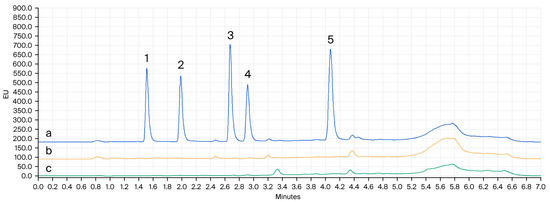
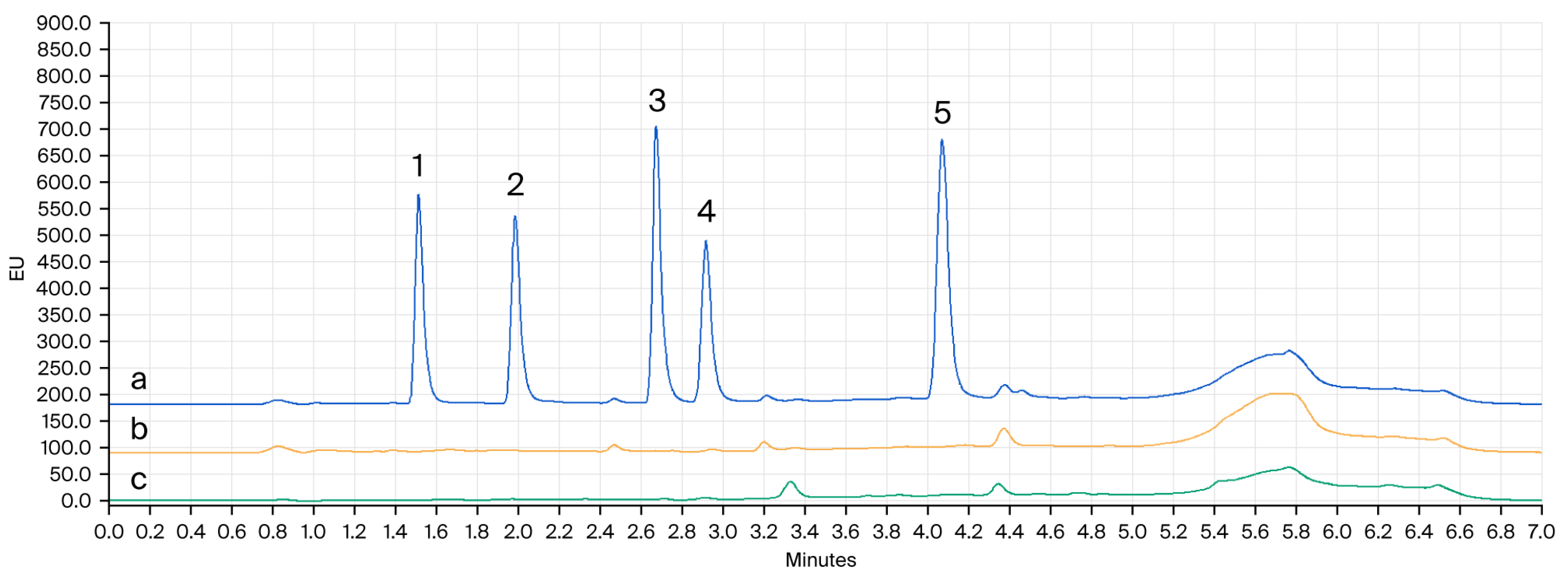
In the TP-SBME procedure, solvent selection for the supported liquid membrane is crucial for promoting analyte preconcentration. In this work, 1-octanol was selected because it was previously demonstrated to be a suitable solvent for extracting bisphenols from aqueous samples [37]. The type of acceptor solvent also significantly affects extraction efficiency and the chromatographic peak shape, and four DESs were evaluated as acceptor solvents. Among these, DES1 and DES2 provided better extraction efficiency and a good peak shape (Figure S1). There was no significant difference in the average analyte area (n = 3) obtained with these two DESs (Figure S1). Additionally, peak efficiency was higher with DES2, but DES1 yielded better repeatability in peak areas. The variability with DES2 was attributed to its high viscosity, which made it difficult to fill the hollow fiber lumen and reduced analyte mass transfer. As a result, DES1 was selected as the most suitable acceptor phase. Figure 1 shows the typical chromatograms obtained when DES1 was used.
Figure 1.
Chromatograms obtained for the (a) standard solution at 192 μg L−1 for BPZ and 48 μg L−1 for the other bisphenols, the (b) unspiked chamomile tea infusion, and (c) the extraction of ultrapure water (procedural blank). The chromatographic conditions are described in Section 2.2. Peak identification: 1. BPF, 2. BPA, 3. BPAF, 4. BPZ, and 5. BADGE.
The selection of the menthol–octanoic acid deep eutectic solvent (DES1) was primarily guided by analytical performance. However, its superior behavior can be explained on a physicochemical basis. In a previous study, strong interactions between BPA and menthol–octanoic acid-based DESs were demonstrated with computational methods, indicating a greater thermodynamic tendency for BPA to dissolve in those solvents [38]. The Mth-OctA DES exhibits pronounced hydrophobic character due to the terpene structure of menthol and the C8 alkyl chain of octanoic acid [38,39], which is well matched with the hydrophobic nature of the analytes (Table S1).
In addition, the carboxylic group of octanoic acid and the hydroxyl group of menthol may have hydrogen bonding interactions with the phenolic hydroxyl groups of the target bisphenols (BPA, BPF, BPAF, and BPZ) and ether or epoxide functionalities present in BADGE [38]. There may also be COOH-π bond formation between the carboxylic acid of octanoic acid and the π-π conjugated system of the aromatic ring in the bisphenols [14].
The synergistic contribution of hydrophobic partitioning and weak specific interactions likely enhances analyte solubilization into DES1, explaining the higher extraction efficiency and good repeatability observed experimentally.
3.2. Characterization of DES1
Figure S2A shows the FTIR spectra of OctA, Mth, and DES1. The O–H stretching vibration band is shifted from 3257.5 cm−1 in Mth to 3348.1 cm−1 in DES1, indicating the formation of a hydrogen bond between Mth (HBA) and OctA (HBD) [40,41]. A slight shift in the C=O stretching vibration band can also be observed—from 1705.9 cm−1 in OctA to 1709.3 cm−1 in DES1. This shift can be explained by the fact that pure OctA may exist as a dimer [42], in which the carbonyl group acts as an HBA for another OctA molecule. In DES1 [39], the 1:1 molar ratio promotes the liberation of the carbonyl group from hydrogen bonds, leading to an increase in the energy associated with the C=O stretching vibration [43].
Analysis of the 1H-NMR spectra for OctA, Mth, and DES1 (Figure S2B) clearly shows a shift in the proton signal associated with the carboxylic acid group of OctA. The acidic proton appears at 11.23 ppm, and upon DES1 formation, the signal shifts to 5.93 ppm, indicating electron donation from the oxygen atom of the alcohol group to the hydrogen of the carboxylic acid [40].
3.3. Optimization of Extraction Time
The extraction time directly affects the mass transfer and distribution of the analyte between the three phases. Extraction times of 20, 40, and 60 min were tested to determine the optimal extraction recovery. For most analytes, extraction recoveries increased with extraction time up to 60 min, except for BPF. Also, the variability decreased, demonstrating that 60 min is adequate for monitoring these non-polar compounds (Figure S3A).
3.4. Optimization of Desorption Volume
Different desorption volumes (80, 120, and 160 μL of methanol) were tested to obtain the highest recovery value. The recovery of BPF and BPA increased with volume, while no difference was observed for the remaining analytes (Figure S3B). However, the variability increased for all analytes at 160 μL. Thus, 80 µL was selected as the optimal desorption volume to avoid analyte dilution and maintain low variability.
3.5. TP-SBME-UPLC-FLD Method Validation
The method developed in this study was validated in terms of linearity, precision (repeatability), accuracy, LODs, and LOQs, and the results of the validation parameters are shown in Table 1. Adequate linearity was obtained with coefficients of determination (R2) higher than 0.99, and the confidence interval of the Y-intercept at 95% included the origin, indicating no systematic errors were present. LODs ranged from 0.28 to 1.01 μg L−1, while LOQs ranged from 0.85 to 3.05 μg L−1. The results demonstrate the high sensitivity of the method, which only uses 10 µL of the DES as the acceptor phase due to high enrichment factors (EFs) ranging from 29 to 72.
Table 1.
Results of TP-SBME-UHPLC-FLD method validation.
According to the European Food Safety Authority (EFSA), the specific migration limit (SML) for BPA is 600 µg kg−1 [44], and for BADGE and its derivatives, it is 9 mg kg−1 [45] in food products. In this context, the LODs obtained with the proposed method (Table 1) are adequate for reliably evaluating beverage samples and ensuring compliance with current regulatory requirements.
Accuracy and precision were evaluated at the same concentration levels. The relative recoveries (% RR) obtained were acceptable, with values from 99% to 120%, and precision showed RSDs ranging from 2% to 17%. The above results meet the acceptance criteria established in document SANTE/11312/2021 [35], which considers adequate recovery intervals between 70 and 120% and RSD values < 20%. The experimental results are shown in Table 2.
Table 2.
Results of TP-SBME-UHPLC-FLD method’s accuracy and precision.
The matrix effect values (−14% to +15%) across different tea matrices indicate low matrix interference, ensuring adequate quantification of the analytes and meeting the performance criteria established in the SANTE/11312/2021 guide [35]. Table 3 shows these results.
Table 3.
The matrix effect (ME%) obtained for different tea infusion samples spiked at 72 μg L−1 for BPZ and 18 μg L−1 for the remaining analytes (n = 3).
3.6. Real Sample Analysis
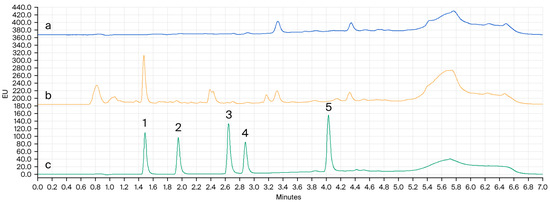
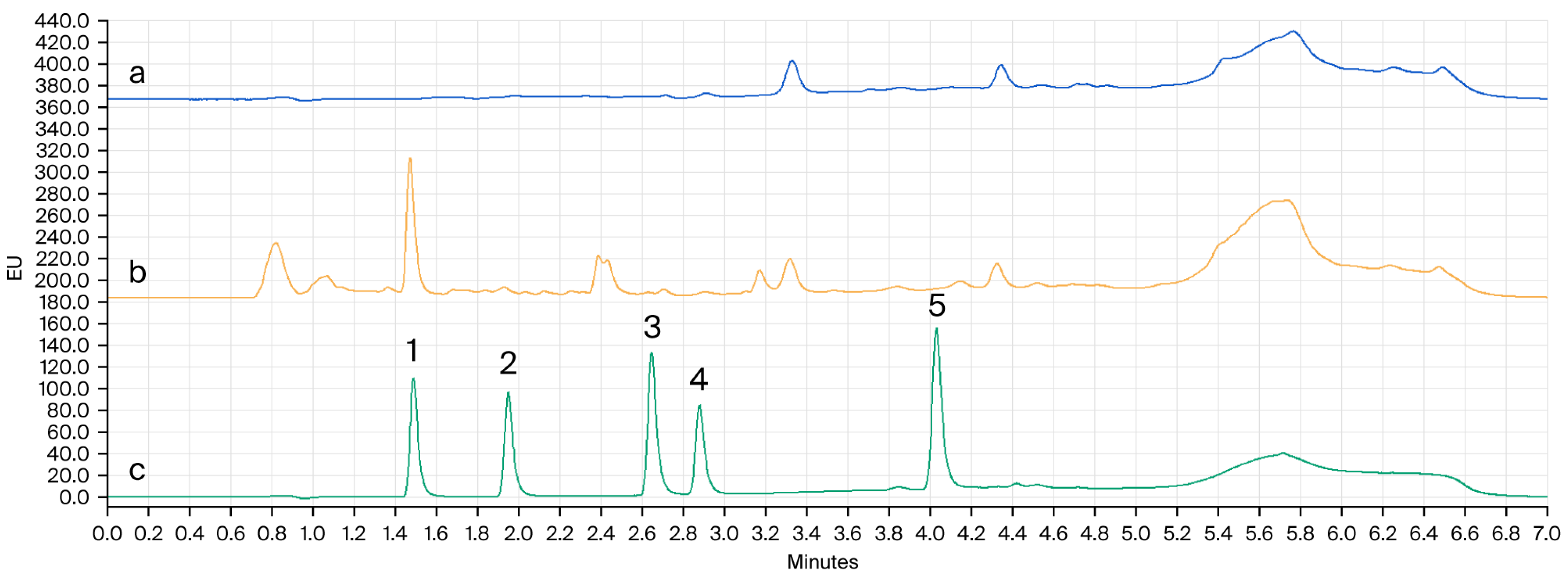
The developed TP-SBME-UPLC-FLD method was applied to 20 infused tea samples, and BPF was detected in infused citrus tea, as shown in the chromatogram presented in Figure 2. The BPF concentration in this sample was 5.3 ± 0.7 μg L−1 (n = 3), while the other bisphenols studied were not detected in any of the other infused tea samples analyzed.
Figure 2.
Chromatograms obtained by UPLC-FLD analysis of (a) ultrapure water extraction (blank), (b) TP-SBME extract of the citrus tea infusion, and (c) standard solution in methanol at 600 μg L−1. Peak identification: 1. BPF, 2. BPA, 3. BPAF, 4. BPZ, and 5. BADGE.
3.7. Greenness Evaluation
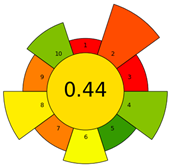
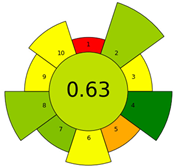
The greenness of the developed TP-SBME-UPLC-FLD method was evaluated using the AGREEprep and BAGI metric tools. The TP-SBME technique had an AGREE overall score of 0.63, indicating the green profile and sustainability of the sample preparation technique. The strengths of TP-SBME include low waste emission, low energy consumption, low use of hazardous materials, and good operator safety, while the main limitations are the lack of on-site sample preparation, material reusability, step integration, and automation. The practicality of the TP-SBME-UPLC-FLD method was evaluated using the BAGI tool, and the overall score was 65.0, which is generally considered practical and efficient. Additionally, a score of 60.0 suggests a good balance between efficiency, cost-effectiveness, and ease of use, making it a suitable choice for routine, rapid, and sustainable analytical workflows. The results are shown in Table 4.
Table 4.
Comparison of the developed TP-SBME-UPLC-FLD method with other methods reported in the literature for the analysis of bisphenols in tea samples.
3.8. Comparison with Other Recent Methods
Table 4 compares the developed method with other methods reported in the literature for the analysis of bisphenols in tea samples. The LODs in this work were comparable to or lower than those reported for other methods. TP-SBME does not require specialized instrumentation or materials, such as SPE or d-SPE [11,18,25,46,47], that require vacuum pumps, centrifuges, and sorbents. Also, TP-SBME produces minimal waste volume (<100 µL/sample).
Extraction time could be the main disadvantage of the proposed method. However, the possibility of making several extractions simultaneously increases the method’s high throughput. Although other techniques, such as LLME, require less extraction time, several additional steps are necessary, and some steps depend on the analyst’s skill (e.g., freezing the extractant phase and manual phase separation), which could increase variability during sample preparation [14,48]. TP-SBME also has the advantage that the extractant phase can be easily removed from the sample, and the entire procedure is performed at room temperature.
Cheng et al. [16] reported the use of a hollow fiber functionalized with Covalent Organic Frameworks (COFs) and filled with 1-octanol for the extraction of BPs from tea infusion samples. The reported functionalization process involves the use of toxic solvents and requires a total synthesis time exceeding 3 days. In this work, functionalization of the hollow fiber was not required, and the volume of 1-octanol used was minimal. It also has the advantages of lower consumption of toxic solvents and does not require special equipment such as a centrifuge. Therefore, this method can be considered a simple, low-cost, environmentally friendly, and sensitive alternative for determining bisphenols in tea infusions in routine analysis.
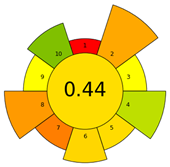
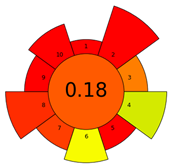
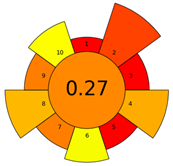
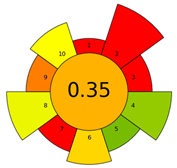
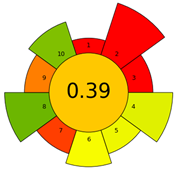
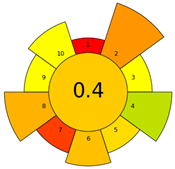
An evaluation of the proposed method and other methods reported in the literature using the AGREEprep and BAGI tools is presented in Table 4 and Table S2. The results showed that, while the methods reported in the literature achieve adequate analytical applicability (BAGI score of 55–65), their environmental performance is limited, with low-to-moderate AGREEprep values (0.18–0.44). This is particularly noticeable in procedures employing coupled LC-MS or LC-MS/MS systems. In these cases, the AGREEprep penalty is directly related to higher energy consumption, which is considered very significant within this metric. The use of additional gases and toxic reagents, such as acids and solvents, is a factor considered very significant in the results, particularly in the criteria for operator safety.
In contrast, this work employs conventional instrumentation, which significantly reduces the method’s environmental impact, as reflected in a higher AGREEprep score (0.63), along with further improvements from miniaturization, reduced reagent and waste use, and greater automation. Despite a common LC-FLD system being employed, the BAGI score remains competitive, confirming the method’s high practical viability.
4. Conclusions
In this study, a TP-SBME-UHPLC-FLD method was developed for the analysis of five bisphenols in tea infusions at trace levels. The DES consisting of Mth:OctA (1:1 molar ratio) was the optimum acceptor phase, and the support consisted of 1-octanol in the polypropylene hollow membrane pores. Relative recovery rates ranging from 99% to 120% with RSD values less than 17% were obtained, and the method was successfully applied to different tea infusions, showing its robustness. LODs and LOQs were comparable with other methods reported in recent studies, even with the use of more affordable instrumentation in comparison with LC-MS or LC-MS/MS systems. Additionally, the evaluation of the method with the AGREEprep and BAGI tools indicated an acceptable green profile and practicality, and only BPF was found in one of the analyzed samples at the ppb level (μg L−1).
Supplementary Materials
The following supporting information can be downloaded at: https://www.mdpi.com/article/10.3390/analytica7020033/s1, Table S1: Relevant physicochemical properties of the analytes; Table S2: Details of AGREEprep and BAGI parameters for selected references; Figure S1: Chromatograms obtained for the extraction of chamomile tea infusion spiked at 12 μg L−1 with the analytes; Figure S2: Comparison between TP-SBME method with DES1 and DES2 as acceptor phase; Figure S3: (A) FTIR spectra in the wavenumber region of 4000-600 cm−1 and (B) 1H-NMR spectra obtained at 80 MHz in deuterated chloroform; Figure S4: Results for the optimization of: (A) extraction time, and (B) desorption volume (MeOH). DES1 (Mth:OctA 1:1 molar ratio) was used as acceptor phase in both cases.
Author Contributions
I.O.-R.: conceptualization and writing—original draft, review, and editing. V.E.-P.: methodology, DES characterization, and writing—review and editing. J.C.-P.: writing—review and editing. V.-E.M.-G., A.M.-M. and L.-A.O.-G.: methodology, formal analysis, and review. J.d.J.O.-E.: conceptualization, funding acquisition, project administration, and writing—original draft. All authors have read and agreed to the published version of the manuscript.
Funding
This research received no external funding.
Data Availability Statement
The original contributions presented in this study are included in the article. Further inquiries can be directed to the corresponding author.
Acknowledgments
This work was supported by Consejo Nacional de Humanidades Ciencias y Tecnologías (CONAHCYT) under project 321878 and by Dirección General de Asuntos del Personal Académico from Universidad Nacional Autónoma de México (DGAPA-UNAM) under projects PAPIIT IN227323, PAPIIT IA204726, and PAPIIT IA104224. Financial support from the Faculty of Chemistry UNAM (PAIP 5000-9218) is gratefully acknowledged. The authors also want to thank M. en C. Elba Rojas Escudero for the technical support provided for the use of hollow fibers.
Conflicts of Interest
The authors declare no conflicts of interest.
References
- Liao, C.; Kannan, K. Concentrations and profiles of bisphenol A and other bisphenol analogues in foodstuffs from the United States and their implications for human exposure. J. Agric. Food Chem. 2013, 61, 4655–4662. [Google Scholar] [CrossRef]
- Tarafdar, A.; Sirohi, R.; Balakumaran, P.A.; Reshmy, R.; Madhavan, A.; Sindhu, R.; Binod, P.; Kumar, Y.; Kumar, D.; Sim, S.J. The hazardous threat of Bisphenol A: Toxicity, detection and remediation. J. Hazard. Mater. 2022, 423A, 127097. [Google Scholar] [CrossRef] [PubMed]
- Vom Saal, F.S.; Antoniou, M.; Belcher, S.M.; Bergman, A.; Bhandari, R.K.; Birnbaum, L.S.; Cohen, A.; Collins, T.J.; Demeneix, B.; Fine, A.M.; et al. The Conflict between Regulatory Agencies over the 20,000-Fold Lowering of the Tolerable Daily Intake (TDI) for Bisphenol A (BPA) by the European Food Safety Authority (EFSA). Environ. Health Perspect. 2024, 132, 45001. [Google Scholar] [CrossRef] [PubMed]
- Zoeller, R.T.; Birnbaum, L.S.; Collins, T.J.; Heindel, J.; Hunt, P.A.; Iguchi, T.; Kortenkamp, A.; Myers, J.P.; vom Saal, F.S.; Sonnenschein, C.; et al. European medicines agency conflicts with the European food safety authority (EFSA) on bisphenol a regulation. J. Endocr. Soc. 2023, 7, bvad107. [Google Scholar] [CrossRef] [PubMed]
- Litrenta, F.; Nava, V.; Potortì, A.G.; Lo Turco, V.; Sgrò, B.; Di Bella, G. Bisphenols, Toxic Elements, and Potentially Toxic Elements in Ready-to-Eat Fish and Meat Foods and Their Associated Risks for Human Health. Toxics 2025, 13, 433. [Google Scholar] [CrossRef]
- Makowska, K.; Vieira, C.; Silva, I.; Aprianto, Y.; Silva, D.; Bessa-Andrês, C.; Lopes, A.; Gonkowski, S.; Correia-de-Sá, P. Bisphenol A and Its Analogue Bisphenol S Inhibit Cholinergic Neurotransmission at the Tripartite Colonic Myenteric Synapse of CD1 Mice by Targeting Interstitial Cells of Cajal. Int. J. Mol. Sci. 2025, 26, 8279. [Google Scholar] [CrossRef]
- Stoklasova, V.; Mikula, P.; Hollerova, A.; Marsalek, P.; Peskova, N.; Franc, A.; Sedlackova, L.; Tichy, F.; Postulkova, E.; Mares, J.; et al. Enhanced toxicity of bisphenol F compared to its predecessor bisphenol A in rainbow trout (Oncorhynchus mykiss) during a six-week feeding trial. Aquat. Toxicol. 2025, 287, 107540. [Google Scholar] [CrossRef]
- Chen, Z.; Zhang, G.; Xie, M.; Zheng, Z.; Chen, Y.; Zhang, N.; Guo, Y.; Wang, Z.; Dong, Z. Toxic effects of environmental concentration Bisphenol AF exposure on the survival, growth and reproduction of adult male Oryzias curvinotus. Comp. Biochem. Physiol. C Toxicol. Pharmacol. 2024, 280, 109903. [Google Scholar] [CrossRef]
- Ding, Z.; Chen, H.; Cheng, H.; Wu, C.; Ruan, H.; Zhu, B.; Zhou, P.; Xu, Z.; Xiang, H. BPZ inhibits early mouse embryonic development by disrupting maternal-to-zygotic transition and mitochondrial function. Ecotoxicol. Environ. Saf. 2025, 289, 117693. [Google Scholar] [CrossRef]
- Marqueño, A.; Pérez-Albaladejo, E.; Flores, C.; Moyano, E.; Porte, C. Toxic effects of bisphenol A diglycidyl ether and derivatives in human placental cells. Environ. Pollut. 2019, 244, 513–521. [Google Scholar] [CrossRef]
- Miyazaki, I.; Nishiyama, C.; Nagoshi, T.; Miyako, A.; Ono, S.; Misawa, I.; Isse, A.; Tomimoto, K.; Masai, K.; Zensho, K.; et al. An Endocrine-Disrupting Chemical, Bisphenol A Diglycidyl Ether (BADGE), Accelerates Neuritogenesis and Outgrowth of Cortical Neurons via the G-Protein-Coupled Estrogen Receptor. NeuroSci 2025, 6, 53. [Google Scholar] [CrossRef] [PubMed]
- Abbasi, F.; De-la-Torre, G.E.; KalantarHormozi, M.R.; Schmidt, T.C.; Dobaradaran, S. A review of endocrine disrupting chemicals migration from food contact materials into beverages. Chemosphere 2024, 355, 141760. [Google Scholar] [CrossRef] [PubMed]
- Cladière, M.; Delaporte, G.; Le Roux, E.; Camel, V. Multi-class analysis for simultaneous determination of pesticides, mycotoxins, process-induced toxicants and packaging contaminants in tea. Food Chem. 2018, 242, 113–121. [Google Scholar] [CrossRef]
- Zhang, K.; Wang, Y.; Li, S.; Zhu, G. Air-assisted liquid-liquid microextraction based on the solidification of floating deep eutectic solvents for the simultaneous determination of bisphenols and polycyclic aromatic hydrocarbons in tea infusions via HPLC. Food Chem. 2021, 348, 129106. [Google Scholar] [CrossRef] [PubMed]
- Yang, D.; Wang, Y.; Li, H.; Yang, Y. Acid-base-governed deep eutectic solvent-based microextraction combined with magnetic solid-phase extraction for determination of phenolic compounds. Mikrochim. Acta 2020, 187, 124. [Google Scholar] [CrossRef]
- Cheng, S.T.; Qiao, J.Y.; Zhang, H.M.; Shen, X.F.; Pang, Y.H. Covalent organic framework reinforced hollow fiber bar for extraction and detection of bisphenols from beverages. Food Chem. 2024, 445, 138802. [Google Scholar] [CrossRef]
- Cao, X.-L.; Popovic, S. Solid phase extraction of large volume of water and beverage samples to improve detection limits for GC-MS analysis of bisphenol A and four other bisphenols. Food Addit. Contam. Part A 2018, 35, 49–55. [Google Scholar] [CrossRef]
- Liang, M.; Hou, X.; Xian, Y.; Wu, Y.; Hu, J.; Chen, R.; Wang, L.; Huang, Y.; Zhang, X. Analytical Methods Banana-peel-derived magnetic porous carbon as effective adsorbent for the enrichment of six bisphenols from beverage and water samples. Food Chem. 2022, 376, 131948. [Google Scholar] [CrossRef]
- Baute-Pérez, D.; Santana-Mayor, A.; Herrera-Herrera, A.-V.; Socas-Rodríguez, B.; Rodríguez-Delgado, M.-A. Analysis of alkylphenols, bisphenols and alkylphenol ethoxylates in microbial-fermented functional beverages and bottled water: Optimization of a dispersive liquid-liquid microextraction protocol based on natural hydrophobic deep eutectic solvents. Food Chem. 2022, 377, 131921. [Google Scholar] [CrossRef]
- Gao, G.; Chen, H.; Zhu, L.; Chai, Y.; Ma, G.; Wang, C.; Hao, Z.; Liu, X.; Lu, C. Simultaneous determination of bisphenol A and tetrabromobisphenol A in tea using a modified QuEChERS sample preparation method coupled with liquid chromatography-tandem mass spectrometry. Anal. Methods 2017, 9, 6769–6776. [Google Scholar] [CrossRef]
- Alnaimat, A.-S.; Barciela-Alonso, M.-C.; Bermejo-Barrera, P. Determination of bisphenol A in tea samples by solid phase extraction and liquid chromatography coupled to mass spectrometry. Microchem. J. 2019, 147, 598–604. [Google Scholar] [CrossRef]
- Carr Kinnear, E.-J.; Miller, K.-J.; Tong, A.-Z. Impacts of brewing time, brewing temperature and brands on the leaching of phthalates and bisphenol A in dry tea. Food Addit. Contam. Part A 2021, 38, 1755–1766. [Google Scholar] [CrossRef]
- European Food Safety Authority (EFSA). Scientific Opinion on the Risks to Public Health Related to the Presence of Bisphenol A (BPA) in Foodstuffs. EFSA J. 2015, 13, 3978. [Google Scholar] [CrossRef]
- Wang, D.; Zhao, H.; Fei, X.; Synder, S.A.; Fang, M.; Liu, M. A comprehensive review on the analytical method, occurrence, transformation and toxicity of a reactive pollutant: BADGE. Environ. Int. 2021, 155, 106701. [Google Scholar] [CrossRef]
- Li, X.; Lin, K.; Huang, Z.; Ge, Y.; Tang, X.; Lu, B.; Chen, X.; Chen, Y.; Kong, X.; Chen, Y.; et al. From brewing dynamics to population health: A Nationwide investigation of bisphenol analogues contamination and exposure risk in tea from China. Food Chem. 2026, 501, 147608. [Google Scholar] [CrossRef] [PubMed]
- Surma, S.; Barylski, M.; Filipiak, K.-J. Tea Consumption and Health: An Overview. In Handbook of Public Health Nutrition; Preedy, V.R., Patel, V.B., Eds.; Springer: Cham, Switzerland, 2025. [Google Scholar] [CrossRef]
- Jagirani, M.-S.; Soylak, M. Review: Microextraction technique based new trends in food analysis. Crit. Rev. Anal. Chem. 2022, 52, 968–999. [Google Scholar] [CrossRef]
- Musarurwa, H. Solvent bar micro-extraction (SBME) of analytes from complex matrices: Transition towards green solvents. Microchem. J. 2024, 206, 111537. [Google Scholar] [CrossRef]
- López-López, J.A.; Mendiguchía, C.; Pinto, J.J.; Moreno, C. Application of solvent-bar micro-extraction for the determination of organic and inorganic compounds. TrAC Trends Anal. Chem. 2019, 110, 57–65. [Google Scholar] [CrossRef]
- Khan, W.A.; Varanusupakul, P.; Haq, H.U.; Arain, M.B.; Marchel, M.; Boczkaj, G. Diverse roles, advantages and importance of deep eutectic solvents application in solid and liquid-phase microextraction techniques—A review. Sep. Purif. Technol. 2025, 358B, 130362. [Google Scholar] [CrossRef]
- Akbari, N.; Basaran, B.; Ghazi-Khansari, M.; Akbari-Adergani, B.; Bakhtiyari, A.; Shavali-gilani, P.; Sadighara, P. Common and novel methods for the identification of bisphenol A in tea samples: A systematic review study. Microchem. J. 2024, 207, 111724. [Google Scholar] [CrossRef]
- Orzel, J.; Swit, P. Comparison of quantitative detection methods based on molecular fluorescence spectroscopy and chromatographic techniques used for the determination of bisphenol compounds. Int. J. Mol. Sci. 2021, 22, 10569. [Google Scholar] [CrossRef]
- Wojnowski, W.; Tobiszewski, M.; Pena-Pereira, F.; Psillakis, E. AGREEprep e Analytical greenness metric for sample preparation. TrAC Trends Anal. Chem. 2022, 149, 116553. [Google Scholar] [CrossRef]
- Manousi, N.; Wojnowski, W.; Płotka-Wasylkac, J.; Samanidou, V. Blue applicability grade index (BAGI) and software: A new tool for the evaluation of method practicality. Green Chem. 2023, 25, 7598. [Google Scholar] [CrossRef]
- European Commission, Directorate General for Health and Food Safety (DG SANTE). Analytical Quality Control and Method Validation Procedures for Pesticide Residues Analysis in Food and Feed; Document No. SANTE/11312/2021, v2026; European Commission: Brussels, Belgium, 2021. [Google Scholar]
- European Commission. Commission Regulation (EU) 2024/3190 of 19 December 2024 on the Use of Bisphenol A and Other Bisphenols and Bisphenol Derivatives with Harmonised Classification for Specific Hazardous Properties in Certain Materials and Articles Intended to Come into Contact with Food; Official Journal of the European Union: Luxembourg, 2024. [Google Scholar]
- Nia, N.N.; Hadjmohammadi, M.R. The application of three-phase solvent bar microextraction based on a deep eutectic solvent coupled with high-performance liquid chromatography for the determination of flavonoids from vegetable and fruit juice samples. Anal. Methods 2019, 11, 5134–5141. [Google Scholar] [CrossRef]
- Fattahi, N.; Zohrabi, P.; Karimi, P.; Bordón Sosa, F.-H.; Hashemi, B.; Shiri, F. Screening terpene-based eutectic solvents for bisphenol A extraction from plastic-packed dairy products and water storage tanks: COSMO-RS and quantum chemistry calculations. J. Chromatogr. A 2026, 1768, 466709. [Google Scholar] [CrossRef]
- Cherniakova, M.; Varchenko, V.; Belikov, K. Menthol-Based (Deep) Eutectic Solvents: A Review on Properties and Application in Extraction. Chem. Rec. 2024, 24, e202300267. [Google Scholar] [CrossRef] [PubMed]
- Ribeiro, B.D.; Florindo, C.; Iff, L.C.; Coelho, M.A.; Marrucho, I.M. Menthol-based eutectic mixtures: Hydrophobic low viscosity solvents. ACS Sustain. Chem. Eng. 2015, 3, 2469–2477. [Google Scholar] [CrossRef]
- Adeoye, D.O.; Gano, Z.S.; Ahmed, O.U.; Shuwa, S.M.; Atta, A.Y.; Iwarere, S.A.; Jubril, B.Y.; Daramola, M.O. Synthesis and Characterisation of Menthol-Based Hydrophobic Deep Eutectic Solvents. Chem. Proc. 2023, 14, 98. [Google Scholar] [CrossRef]
- Socrates, G. Infrared and Raman Characteristic Group Frequencies: Tables and Charts; John Wiley & Sons: Hoboken, NJ, USA, 2024. [Google Scholar] [CrossRef]
- Ryu, I.S.; Liu, X.; Jin, Y.; Sun, J.; Lee, Y.J. Stoichiometric analysis of competing intermolecular hydrogen bonds using infrared spectroscopy. RSC Adv. 2018, 8, 23481–23488. [Google Scholar] [CrossRef]
- European Parliament and the Council of the European Union. Regulation (EC) No 1935/2004 of 27 October 2004 on Materials and Articles Intended to Come into Contact with Food (Consolidated Version, 27 March 2021); Official Journal of the European Union: Luxembourg, 2004; Volume 338. [Google Scholar]
- Shi, Y.-J.; Gong, F.; Hu, C.-Y.; Wang, Z.-W.; Hu, J.-P.; Xian, Y.-P. Binding mechanism and safety assessment of BADGE from epoxy-coated cans and protein. Food Chem. 2025, 476, 143347. [Google Scholar] [CrossRef]
- Hu, Z.; Sun, W.; Guo, J.; Wang, X.; Yong, L.; Ren, L.; Feng, D.; Zoua, X. Establishment and application of a high-performance liquid chromatography-mass spectrometry method for analysis of 15 bisphenols and halogenated phenols in tea. Food Chem. 2025, 469, 142561. [Google Scholar] [CrossRef]
- Yahaya, N.; Huang, Z.A.; Yan, B.; Chen, D.D.Y. Capillary electrophoresis–mass spectrometry analysis of bisphenol A and its analogues in bottled tea beverages with dynamic pH focusing. Food Chem. 2022, 372, 131220. [Google Scholar] [CrossRef]
- Zhang, K.; Wang, J.; Guo, R.; Nie, Q.; Zhu, G. Acid induced dispersive liquid–liquid microextraction based on in situ formation of hydrophobic deep eutectic solvents for the extraction of bisphenol A and alkylphenols in water and beverage samples. Food Chem. 2024, 442, 138425. [Google Scholar] [CrossRef]









Disclaimer/Publisher’s Note: The statements, opinions and data contained in all publications are solely those of the individual author(s) and contributor(s) and not of MDPI and/or the editor(s). MDPI and/or the editor(s) disclaim responsibility for any injury to people or property resulting from any ideas, methods, instructions or products referred to in the content. |
© 2026 by the authors. Licensee MDPI, Basel, Switzerland. This article is an open access article distributed under the terms and conditions of the Creative Commons Attribution (CC BY) license.