


Abstract
Older women often face barriers to sustained participation in physical activity (PA) while understanding the acute psychological effects of exercise may support their long-term adherence in PA. The aim of this study was to examine acute changes in mood following a single exercise session and the moderating role of previous exercise experience in +60-year-old women from southern Croatia. Participants were women (73.3 ± 5.71 years of age) involved in an outdoor community-based exercise program. They were classified into an experienced group (EG; n = 42) and a nonexperienced group (NEG; n = 21). Mood state was evaluated by the Brunel Mood Scale (BRUMS) before (pre-) and after exercise (post-measurement). Acute mood changes were analyzed by two-way repeated-measures ANOVA with Time (pre- vs. post-measurement) and Group (EG vs. NEG) as the main effects and Time × Group interaction. By exploratory correlation analyses, we examined changes in the associations among mood dimensions separately for the EG and NEG. Favorable changes were evidenced in depression (F test = 4.32, p < 0.05), anger (F test = 9.54, p < 0.01), and confusion (F test = 14.25, p < 0.001), and the total mood disturbance score (TMD) (F test = 6.41), with significant interaction effects evidenced for tension, vigor, fatigue, and TMD. Exploratory analyses suggested differences in the correlations between mood dimensions according to exercise experience, supporting the conclusion on the differential influence of exercise in the EG and NEG. Community-based exercise induced favorable acute mood responses in older women, but these responses were influenced by previous exercise experience, with more pronounced favorable effects observed in the EG. When exercise programs for older women are designed with consideration of exercise history may enhance positive exercise experiences and support sustained participation.
1. Introduction
Population aging is among the major demographic changes worldwide and is accompanied by substantial increases in the prevalence of chronic diseases, functional limitations, and mental health problems [1]. Although increased life expectancy represents an important public health achievement, preserving psychological well-being has become equally important, as emotional health is recognized as a key determinant of quality of life and healthy aging [2]. Older adults, particularly women, are more likely to experience mood disturbances, including increased tension, fatigue, depressive symptoms, and reduced psychological well-being, which may negatively affect everyday functioning, social participation, and overall health status [3]. Therefore, maintaining a positive mood state represents an important component of healthy aging.
Physical activity is widely recognized as one of the most effective nonpharmacological strategies for preserving and improving both physical and mental health throughout the lifespan [4,5,6]. Beyond its well-established role in preventing chronic diseases and maintaining functional capacity, a growing body of evidence indicates that regular physical activity has beneficial effects on psychological well-being and mood in older adults [7,8,9,10]. Although the long-term effects of regular exercise on mental health are well documented, recent evidence suggests that even a single bout of physical exercise may induce immediate improvements in mood states [11,12]. This is particularly important because such acute positive effects on mood could represent one of the primary mechanisms through which regular participation in physical activity contributes to long-term psychological well-being.
The acute psychological effects of physical activity have received increasing scientific attention over the past two decades. Although the majority of available evidence has focused on younger and middle-aged people, a growing number of studies indicate that older adults also experience immediate psychological benefits following a single bout of physical exercise [11]. Collectively, the available evidence suggests that acute exercise represents a promising strategy for enhancing the psychological status of older adults. Specifically, acute sessions of aerobic exercise (i.e., stationary cycling, line dancing), resistance training, and multicomponent exercise programs have consistently been associated with improvements in mood, reductions in negative affect, decreased anxiety, enhanced feelings of energy, and greater psychological well-being among older individuals [13,14,15,16]. These beneficial responses have been reported across a wide range of exercise modalities and settings, suggesting that positive changes in psychological status are not restricted to a specific type of physical activity. Although the exact mechanisms underlying these responses have not yet been fully elucidated, it is generally accepted that acute exercise induces a combination of neurophysiological and psychosocial processes, including changes in neurotransmitter activity, improved cerebral perfusion, enhanced self-efficacy, and positive social interactions, all of which may contribute to immediate improvements in mood [17,18,19]. Nevertheless, substantial interindividual variability in the observed acute effects of physical activity on mood status indicates that factors such as previous exercise experience, health status, and baseline mood may influence the magnitude of acute psychological adaptations.
Previous exercise experience (often referred to in the literature as habitual physical activity or exercise training status) represents one such factor. It is generally accepted that training status may influence affective responses to acute exercise, particularly through differences in exercise appraisal, perceived exertion, and physiological adaptation [20]. For example, in a study examining the effects of a single bout of vigorous exercise on mood and anxiety among young individuals with substantially different exercise participation histories, regular exercisers improved in mood and state anxiety, whereas nonregular exercisers initially worsened before they returned to baseline [21]. In another study with young adult males, the participants’ habitual activity level significantly predicted how positively they felt during the workup [22]. However, empirical evidence regarding the moderating role of previous exercise experience on acute mood responses in older women remains limited.
Collectively, the available evidence indicates that a single bout of exercise can induce favorable changes in mood and psychological well-being across different populations, including older women [11,14]. These benefits have been attributed to multiple physiological and psychological mechanisms, including neurochemical changes, improved cerebral blood flow, enhanced self-efficacy, and increased social interaction associated with organized exercise participation [8]. Nevertheless, several important gaps in the current literature remain. First, relatively few studies have examined whether previous exercise experience influences the magnitude of acute mood responses following a standardized exercise session in older people, particularly women. Second, previous investigations have focused predominantly on changes in individual mood dimensions, while little attention has been given to whether the relationships among different mood states also change following acute exercise. A better understanding of these structural changes may provide additional insight into the mechanisms underlying exercise-induced mood responses.
Therefore, the primary aim of this study was to examine the acute effects of a single exercise session on mood states in older women. The secondary aim was to compare acute mood responses between women with and without previous exercise experience. Such information may be valuable for optimizing exercise prescription in older women, as individualized exercise approaches are likely to facilitate more positive exercise experiences and improve long-term adherence. Additionally, this study explored whether the relationships among individual mood dimensions differed before and after exercise. It was hypothesized (i) that a single exercise session would improve overall mood and (ii) that women with previous exercise experience would demonstrate more favorable mood responses than their inexperienced counterparts would.
2. Results
Descriptive statistics for the anthropometric variables and post-exercise RPE values are presented in Table 1, together with t test differences between groups. In brief, nonexperienced women were taller (t test = 4.54, p < 0.001) and heavier (t test = 2.09, p < 0.05), reported higher RPE values after the exercise session (t test = 2.56, p < 0.01), with no significant differences between groups in age and BMI.
Table 1.
Descriptive statistics and t test differences between groups for age, anthropometric variables, and postexercise perceived exertion.
Descriptive statistics of the BRUMS-derived variables for the total sample of participants at pre-, and post-testing are presented in Table 2.
Table 2.
Descriptive statistics for the BRUMS variables.
Table 3 presents the results of the 2-way ANOVA for repeated measurements, which are interpreted considering the descriptive values presented in Table 2. Significant main effects for Time (pre-post measurement) were found for four mood dimensions, namely, for (i) depression (medium ES; decrease in numerical value of 0.6, 95%CI: 0.14–1.06), (ii) anger (medium ES; decrease in numerical value of 0.58, 95%CI: 0.27–0.90), (iii) fatigue (large ES; increase in numerical value of 0.67, 95%CI: 0.29–1.04), and (iv) confusion (large ES; decrease in numerical value of 1.00, 95%CI: 0.53–1.46), as well as for the composite mood index, TMD (medium ES; decrease in numerical value of 1.27, 95%CI: 0.09–2.44). Therefore, the results indicated favorable changes in depression, anger, confusion, and TMD, with unfavorable changes in the fatigue dimension. The ANOVA main effect for Group was significant for anger (medium ES), and depression (medium ES). The interaction effects were significant for tension (medium ES), vigor (medium ES), fatigue (large ES), and TMD (medium ES), indicating differential trends of mood changes in NEG and EG.
Table 3.
Two-way analysis of variance for repeated measurements of the BRUMS variables.
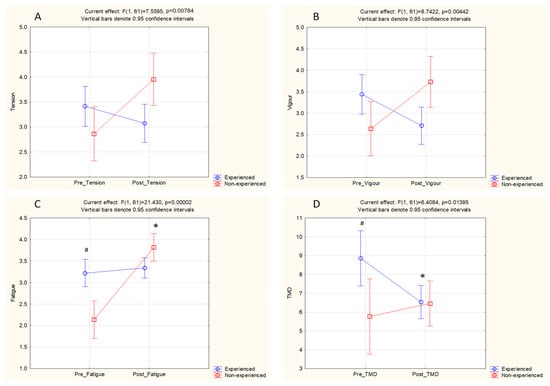
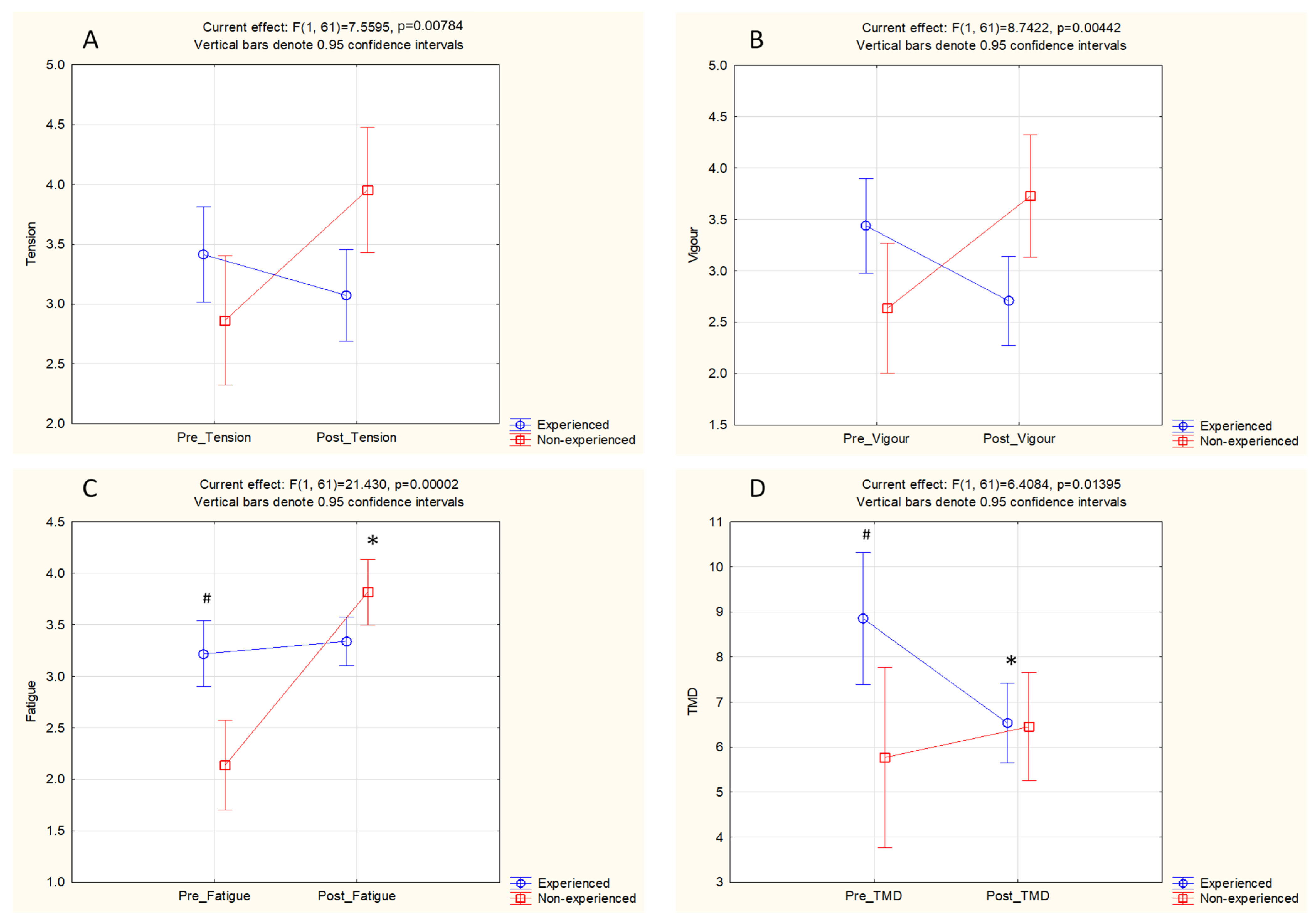
The descriptive statistics and significance of the least significant difference (LSD) for variables with significant ANOVA interactions are presented in Figure 1. Tension (Figure 1A) and vigor (Figure 1B) scores numerically increased in the NEG but decreased in the EG from pre- to post-measurement, with no significant within- or between-group differences. Fatigue numerically increased from pre- to post-testing, with a significant difference within the NEG group, and a significant difference between groups in the pre-test (Figure 1C). Finally, the numerical value of TMD was significantly higher in the EG at pre-testing, with a significant decrease from pre- to post-testing in the EG, indicating favorable changes in overall mood for EG (Figure 1D).
Figure 1.
Descriptive statistics and simple effect significance for BRUMS variables with significant ANOVA interactions for: tension (A), vigor (B), fatigue (C), and total mood disturbance—TMD (D) (*—significant differences within groups, #—significant differences between groups).
The correlation matrix among mood dimensions pre- and post-measurement is presented in the Supplementary Materials, while the following figures present heatmap illustrations of correlations for each study group.
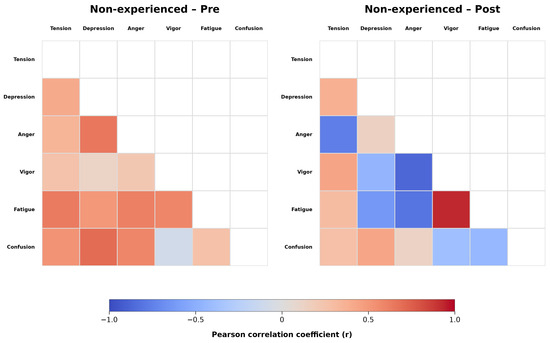
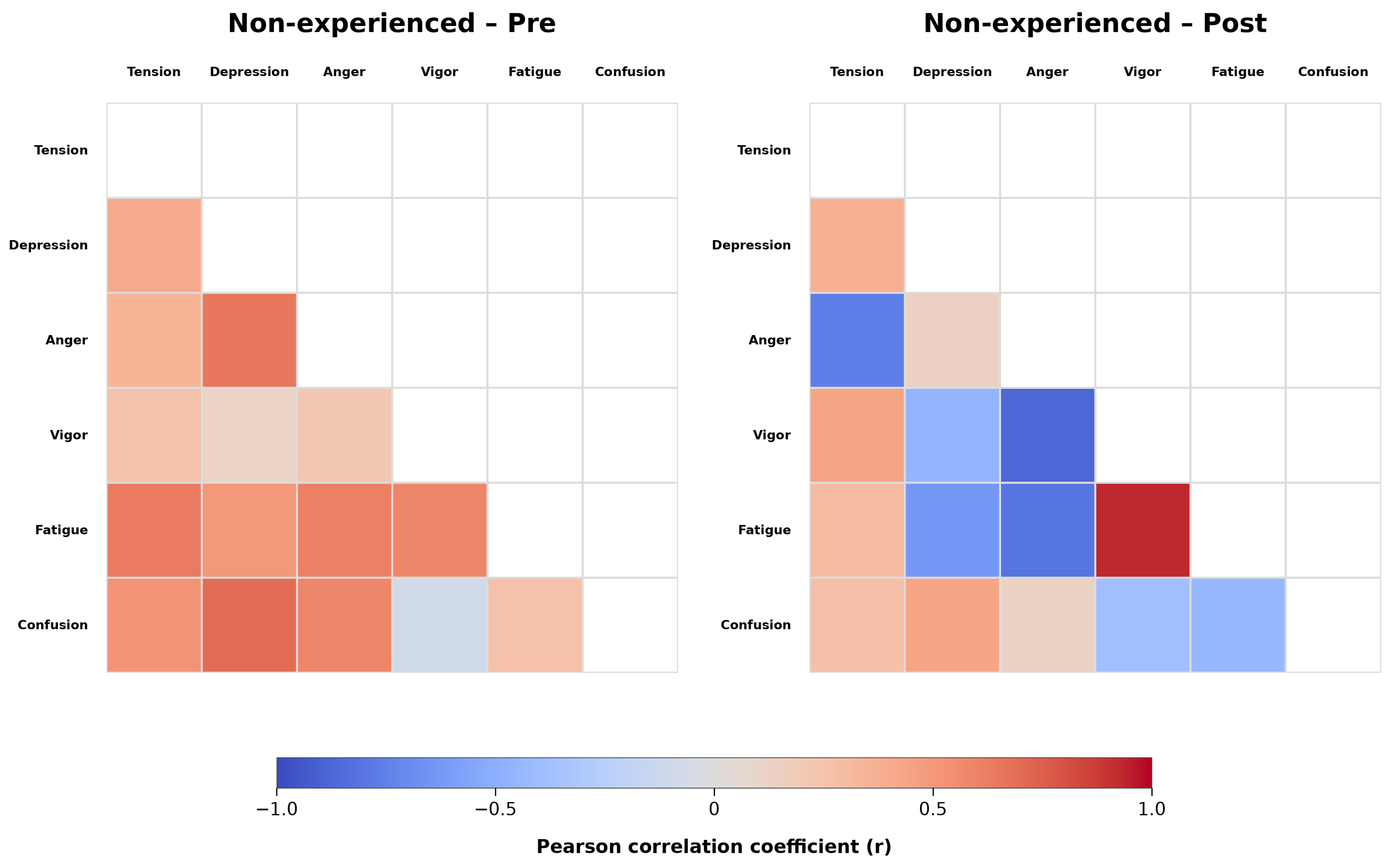
As illustrated in Figure 2, women without previous exercise experience exhibited a relatively dense network of positive correlations among negative BRUMS dimensions before the exercise session (left side of the figure). Following exercise, the correlation structure was characterized by weaker interrelationships among several negative mood dimensions and the emergence of new positive and negative associations involving vigor and fatigue (right side of the figure).
Figure 2.
Heatmaps of Pearson correlation coefficients among BRUMS mood dimensions before and after the exercise session in nonexperienced women.
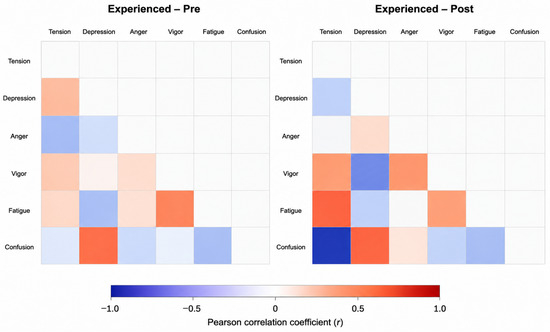
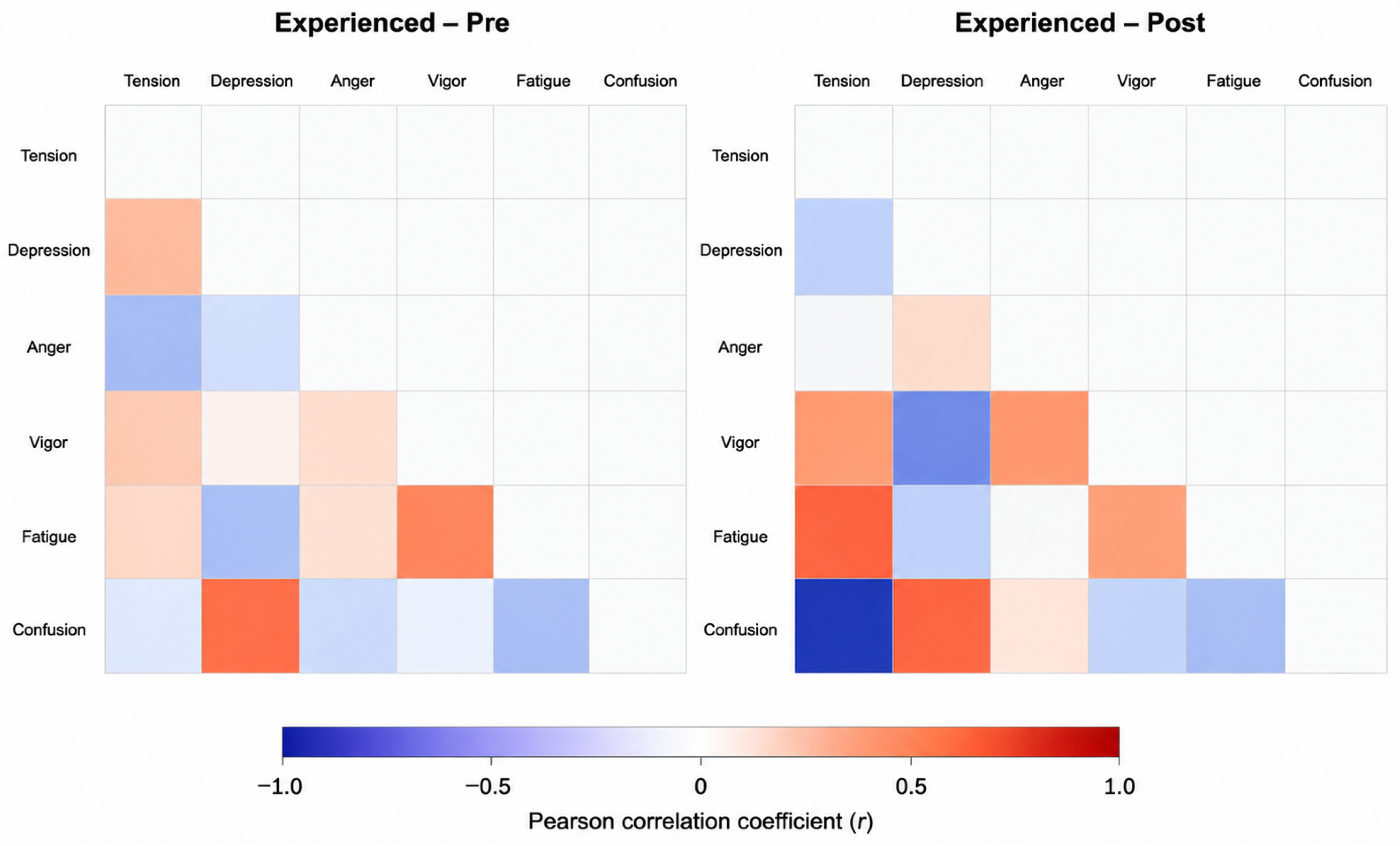
The correlation structure among the BRUMS mood dimensions in experienced women also changed following the exercise session. In contrast to the relatively sparse pre-exercise pattern of the correlations between mood dimensions (left side of the figure), the post-exercise heatmap (right side of the figure) reveals stronger correlated associations among several mood dimensions, particularly tension, vigor, and fatigue (Figure 3).
Figure 3.
Heatmaps of Pearson correlation coefficients among BRUMS mood dimensions before and after the exercise session in experienced women.
3. Discussion
There are several important findings of this study. First, favorable changes in several mood dimensions were observed in older women following a single 1 h exercise session performed in a public park. Second, previous exercise experience modified several acute mood responses, including tension, vigor, fatigue, and total mood disturbance, with more favorable changes in women who had previous exercise experience. Therefore, our initial study hypotheses can be accepted.
3.1. General Mood Changes
Following a single 1 h exercise session, participants reported reduced depression, anger, and confusion scores, accompanied by increased fatigue following exercise. This resulted in favorable changes in the TMD. Overall, these findings support the findings of previous studies reporting that even a single bout of physical exercise can elicit acute improvements in aspects of mood among older women [15,16]. An important practical implication of these findings is that beneficial acute mood responses were observed following a simple community-based exercise program conducted outdoors in a public park. The intervention combined aerobic, resistance, mobility, and relaxation exercises in a single group session involving more than 40 participants supervised by one instructor. These findings suggest that low-cost, scalable exercise programs may provide meaningful psychological benefits for older women and represent a feasible community-based health promotion strategy.
The significant reduction in depression is consistent with the findings of previous studies [11]. For example, positive effects on depression scores (obtained from the Profile of Mood States) were reported among trained older women (mean age 64.5 years) as a result of 75 min aerobic line dancing [16]. Similarly, one video-guided bodyweight resistance session performed during the COVID-19 pandemic resulted in lower BRUMS depression among older adults (mean age 67.7 years) [23]. Several mechanisms may contribute to this response, including acute neurochemical changes, enhanced cerebral blood flow, distraction from everyday concerns, and the positive affective experience associated with successful participation in physical activity [17,18,19].
Given that older women are frequently exposed to multiple age-related stressors, including chronic disease, loss of relatives (i.e., partners, husbands), and reduced independence, reductions in anger scores may be particularly meaningful from a well-being perspective. Although direct evidence in older women are scarce, previous studies have reported reductions in anger and hostility after acute exercise in older adults, suggesting that even a single bout of physical activity may facilitate more adaptive emotional regulation [16,23]. Different factors could lead to such results, including reduced physiological arousal following exercise, an improved affective state, and the opportunity to release accumulated psychological tension through physical activity.
Maintaining mental clarity (i.e., lack of confusion) is essential for preserving independence in older age, as many everyday activities depend on sustained attention, effective information processing, and appropriate decision-making. Although mental clarity represents a subjective psychological construct, it is closely related to the cognitive processes required for effective everyday functioning, including attention, information processing, and decision-making. Moreover, cognitive function (i.e., processing speed, executive function, memory, and orientation) is known to be an independent longitudinal predictor of loss of functional independence in older adults [24,25]. Therefore, it is particularly encouraging that confusion scores decreased significantly following the exercise session. However, the previous discussion should be taken with precaution since the confusion dimension of the BRUMS reflects subjective feelings of mental clarity, concentration, and cognitive organization rather than objective cognitive performance.
Contrary to the previously discussed dimensions, the fatigue scores increased from pre- to post-measurement. Owing to the physically demanding nature of the exercise session, and the fact that fatigue represents a normal physiological response to physical exertion, the increase in fatigue is not surprising [26]. Supportively, previous studies have consistently reported an acute increase in self-perceived fatigue as a result of physical exercise among older adults, including women [27]. Therefore, these results reflect the immediate demands imposed by the exercise session and should not be interpreted as an adverse psychological outcome. However, it is important to note that the increase in fatigue occurred simultaneously with reductions in depression, anger, and confusion (please see previous discussion and results for details), suggesting that higher physical tiredness after exercise should not be simultaneously reflected in unfavorable changes in mood states.
No overall changes were observed for tension or vigor following the exercise session. This finding may seem surprising at first glance, given the known mood-enhancing effects of exercise. For example, Pierce and Pate studied the effects of aerobic line dancing in 16 trained older women and reported a decrease in tension and an increase in vigor [16]. Moreover, Nouchi et al. examined the effects of 30 min of exercise and reported greater vigor in middle-aged and older females [15]. However, these relative inconsistencies between our and previous studies can be explained by taking into account several specific factors. First, the later study examined relatively short exercise sessions in comparison to our experiment (30 min vs. 60 min), which could naturally result in differential mood responses [15]. Also, the first cited study recruited exclusively trained older women, while we are currently discussing the total effects in the total sample (including experienced and nonexperienced exercisers) [16].
3.2. Differential Effects in Experienced and Unexperienced Participants
Despite the overall effects that were previously discussed, significant ANOVA interaction effects (e.g., differential effects) were identified for some of the variables, which highlights differential changes in mood dimensions in NEG and EG as a result of a single exercise session. In general, analyses revealed more favorable mood changes in EG. As specified in the Introduction, studies directly examining the moderating role of previous exercise experience on acute mood responses among older people are scarce. Therefore, in explaining the possible factors leading to observed differential effects in EG and NEG, we will focus mostly on general studies examining psychophysiological responses to exercise, as well as on evidence from sport training theory and methodology.
Although no significant simple effects were observed, the significance of the ANOVA interaction showed differential effects of exercise session on tension in the EG and NEG. In general, the numerical values slightly decreased in the EG but slightly increased in the NEG. Supportively, in a study examining the relationship between current activity status (more versus less active) and affective response during physical training (30 min of moderate-intensity exercise), more active participants reported more positive affect and tranquility [28]. Similarly, in a study with university students, the authors reported improved mood and lower anxiety in regular exercisers, whereas nonregular exercisers initially worsened their mood and anxiety before they returned to baseline [21]. The most likely reason for such differential effects could be exercise familiarity, which could naturally influence how participants perceived and responded to the overall demands of an exercise session. With regard to our investigation, it is possible that women with previous exercise experience perceived the session as a familiar and manageable stimulus. On the other hand, those without such experience may have experienced greater uncertainty, anticipatory stress, or perceived higher exertion despite participating in the same exercise program. This altogether could result in the opposite effect of physical exercise on changes in tension (increase in NEG and decrease in EG).
A differential response was also observed for the vigor dimension (again without significant simple effects), but this time with favorable changes in NEG and unfavorable changes in the EG. One possible explanation for this apparently paradoxical finding lies in the different ways in which the EG and NEG may perceive and evaluate exercise practices. It is expected that women without previous exercise experience (NEG) perceived the successful completion of the exercise session as a novel and rewarding achievement, resulting in enhanced feelings of energy and accomplishment (higher vigor). In contrast, women with previous exercise experience may have evaluated their post-exercise state more in relation to the immediate physical demands of the session than to the experience of participation itself. Generally, this is supported in previous studies where nonexperienced individuals perceived the successful completion of an exercise session as a meaningful personal achievement, eliciting increased feelings of energy and accomplishment, while this was not pronounced among experienced participants [29,30,31]. In other words, the personal sensation of vigor related to successful exercise could be less pronounced in the EG simply because the exercise session is somewhat already known and frequently experienced and, consequently, less exciting. Therefore, the observed differences in vigor may not necessarily reflect differences in the physiological effects of exercise but rather differences in how NEG and EG interpreted and experienced the exercise session.
Previous exercise experience modified changes in fatigue, with a substantially greater increase in fatigue in the NEG. This finding is easily explainable knowing the main characteristics of the psycho-physiological responses to exercise in the EG and NEG. Specifically, exercise experience is known to be positively correlated with conditioning capacity (fitness), with better fitness in individuals who are more engaged and more experienced in physical exercise [32,33]. Moreover, better fitness is inversely related to psychophysiological responses to physical exercise, and studies have confirmed that lower physiological strain on physical exercise occurs even among older people if they posses better fitness [34]. Translated to our study, this actually means that the same exercise session (note that all participants participated in the same exercise session) likely represented a greater relative workload for NEG because they were not accustomed to regular exercise. However, we must not ignore the potential influence of higher body weight in NEG, which could also influence the higher fatigue in this group, to some extent.
One could argue that better exercise experience does not necessarily imply superior physical fitness, and this is almost certainly true. However, it can hardly be argued that the EG participants were more familiar with the performed exercises and possessed better movement economy (movement efficacy), simply because of the longer participation and already mastered execution of specific movement patterns (i.e., Nordic walking, strength exercises, and balance exercises). It is relatively well supported that movement economy directly predicts metabolic strain, and this has been confirmed even in older adults [35,36]. Therefore, if we ignore theoretical differences in fitness levels, the better movement efficiency itself surely reduced metabolic strain and resulted in a smaller increase in perceived fatigue in the EG. This is altogether supported by preliminary statistics in which the NEG reported higher RPE than the EG did.
The differential responses observed for tension, vigor, and fatigue were also reflected in the TMD score, which decreased in EG but increased in NEG. As a composite indicator of overall mood state, TMD integrates changes across multiple mood dimensions and therefore provides a broader representation of the acute psychological response to exercise [37]. The opposite directions of change observed between groups support the fact that exercise experience actually modified the overall pattern of mood responses rather than isolated mood dimensions. However, we must state that the mechanisms discussed above should be observed as hypothetical and literature-based, as they were not directly assessed in the present study. Therefore, future studies incorporating physiological, neurobiological, and functional measures are needed to determine whether these mechanisms contribute to the observed mood responses.
3.3. Correlation Patterns Among Mood Dimensions
To further explore the differential mood responses observed between the EG and NEG, an exploratory correlation analysis was performed to examine the relationships among individual BRUMS dimensions before and after the exercise session. The analysis suggested distinct patterns of mood organization between the two groups. In brief, before exercise, women included in the NEG descriptively exhibited stronger associations among negative mood dimensions, whereas the pattern of correlations in the EG appeared comparatively sparse. Following the exercise session, the correlation matrices showed descriptively different patterns of associations among BRUMS dimensions in both groups. Before discussing it in more detail, we must state that no formal statistical comparisons of the pre- and post-exercise correlations were performed, and therefore these exploratory observations should be interpreted with caution.
Specifically, before exercise, the NEG exhibited a relatively dense cluster of interrelationships among negative mood dimensions (e.g., tension, depression, anger, confusion, and fatigue were relatively well correlated). In other words, women in the NEG who reported higher tension also tended to report greater depression, anger, confusion, and fatigue (and vice versa). In other words, negative mood states were generally well correlated. Following the exercise session, this pattern became less pronounced, and the strong correlations among negative mood dimensions decreased. Therefore, for NEG, these emotional states became less correlated after the exercise session. In explaining those results, several characteristic examples are presented.
As discussed previously, for some NEG participants, completing a training session can confer a sense of control or mastery, which may shift attention away from worries and reduce tension [38]. This phenomenon has been physiologically described in studies confirming the effects of exercise on the levels of circulating endocannabinoids—endogenous lipid-based signaling molecules important for modulating pain perception, stress responses, emotional regulation, and reward processing [18]. Therefore, it is plausible that some participants (especially those who initially reported higher tension) may have experienced a kind of emotional relief during the session. On the other hand, the fatigue increased because of physiological demands and metabolic strain. Because of such variable changes (numerical increase in one and simultaneous decrease in another mood indicator), the correlation between fatigue and tension changed considerably.
Also, the decrease in confusion (increase in mental clarity) and reduction in anger after the exercise session could have occurred because of the affective and social aspects of participation. These aspects are, however, hardly connectable to changes (increase) in fatigue, which definitively increases as a result of physical effort. Once again, this is particularly probable in NEG because of their (i) lower fitness level and (ii) poor movement economics, which altogether resulted in higher post-exercise fatigue levels [34,35,36]. These differential trends could weaken the correlations, resulting in a less coherent correlation matrix structure at postmeasurement.
In the EG, the post-exercise correlation matrix descriptively showed a different pattern of associations among mood dimensions compared with the pre-exercise matrix. In particular, tension became more closely integrated with vigor and fatigue, suggesting that post-exercise tension may have reflected physiological arousal associated with exercise in EG.
One possible explanation is that women with previous exercise experience were better able to differentiate between the physical sensations associated with exercise (i.e., breathing, heart rate frequency, muscle soreness), and negative emotional states. Indeed, experienced exercisers are more likely to define physical exertion as a natural consequence of physical effort and not as an “unpleasant” experience [39]. Therefore, the EG may have interpreted post-exercise bodily sensations as indicators of an effective workout and “training value”. Supportively, studies have shown that regular exercisers are more likely to interpret higher levels of exertion or even muscle discomfort as evidence of progress or worthwhile training, but this is not characteristic of nonregular exercisers [39]. Therefore, it is possible that increased physiological activation and physical tiredness (as a consequence of physical exercise) coexist with preserved emotional well-being, but only in experienced exercisers. Although exploratory, these findings suggest that previous exercise experience influences not only changes in individual mood dimensions but also the way in which different mood states are interconnected following acute exercise.
3.4. Limitations and Strengths
Several limitations of the present study should be acknowledged. First, only the acute effects of a single exercise session were examined, and the findings cannot be generalized to the long-term psychological effects of regular participation in this type of exercise program. Second, the use of a convenience sample and the absence of an a priori sample size calculation may have limited the precision of the estimates, particularly for the smaller NEG and the exploratory correlation analyses. Further, the absence of a non-exercise control condition prevents causal attribution of the observed mood changes to the exercise session itself. Also, other than the RPE, objective measures of physiological exercise intensity (i.e., heart rate and energy expenditure) were not assessed. Consequently, although supported in the literature, the proposed explanations regarding the role of exercise intensity and training status in shaping mood responses remain at least partially speculative. Furthermore, because participants were not randomly allocated to groups, potential confounding factors such as habitual physical activity, health status, functional capacity, or motivation may have contributed to the observed differences in mood responses between groups. This is particularly possible for anthropometrics, since groups significantly differed in body weight. The correlation analyses were exploratory and should be interpreted cautiously, particularly given the relatively small sample size of the NEG and the absence of formal statistical comparisons between pre- and post-exercise correlations. Finally, the study was conducted in a specific sample of older women who participated in a community-based outdoor exercise program that combined aerobic, resistance, mobility, and relaxation exercises, which limits the generalizability of the results.
Despite these limitations, the present study has several important strengths. First, although the specific characteristics of the exercise program limit the generalizability of the findings, they also enhance the ecological validity of the study, as the intervention closely reflects community-based exercise programs that are readily implemented in real-world settings. Second, this is among the few studies to examine whether previous exercise experience affects acute mood responses to exercise among older women. Finally, the study combined conventional analyses of changes in mood scores with an exploratory examination of the correlation structure among BRUMS dimensions. The authors believe that such a complementary approach provides additional insight into the studied problem and will hopefully initiate further research in the field.
4. Materials and Methods
4.1. Participants
The study included 63 older women aged 60 years and above who voluntarily participated in a community-based outdoor exercise program. Participants were recruited directly through the organizers of the exercise program and were informed about the purpose and procedures of the study before data collection (please see later for details on program organization and structure). Participation was voluntary, and all participants provided written informed consent prior to enrollment. The study protocol complied with the ethical principles of the Declaration of Helsinki and was approved by the Ethics Committee of the Faculty of Kinesiology, University of Split, and was preregistered at clinicaltrials.gov (NCT07365228). No a priori sample size calculation was performed. The sample size was determined by the number of eligible participants available within the ongoing community-based exercise program during the study period and therefore represented a convenience sample.
The participants represented a heterogeneous group with respect to previous exercise experience and health status, reflecting the characteristics of community-dwelling older women regularly participating in public health promotion initiatives. They were further classified according to their previous exercise experience. The experienced group (EG; n = 42) consisted of women who had participated in the community-based exercise program more than 10 times. The nonexperienced group (NEG; n = 21) included women who recently joined the program and had attended fewer than five exercise sessions before testing. For the purposes of this study, “previous exercise experience” was operationally defined exclusively as previous participation in the same community-based exercise program. Thus, this classification reflects participants’ familiarity and prior exposure to the specific exercise program rather than their overall exercise history, habitual physical activity, or training status. This classification enabled the examination of previous exercise experience as a potential moderator of acute mood responses. The cutoffs for group classification (EG vs. NEG) were defined a priori and reflected the familiarization procedure routinely used within the exercise program. During their first five sessions, new participants received continuous assistance and guidance from an exercise assistant to facilitate learning and correct execution of the exercises. After the fifth session, participants were expected to perform the exercises more independently, although the assistant continued to provide support when needed. After ten sessions, participants were considered sufficiently familiar with the exercise routine to participate without additional individual supervision. Participants who had completed between five and ten sessions were therefore considered to be in a transitional stage of familiarization and were excluded from the present analysis. This approach was intended to minimize overlap in program familiarity between the groups, particularly because the rate at which participants became familiar with the exercises varied between individuals. Consequently, particularly for the smaller NEG and the exploratory correlation analyses, emphasis was placed on effect estimates and their precision rather than on statistical significance alone (please see later for statistics).
A total of 75 women were initially approached. Among those participants, one did not complete the exercise session, one had incomplete pre- or post-exercise assessments, and 10 were excluded because they had completed between five and ten previous sessions and therefore belonged to the intermediate familiarization category. Consequently, the final sample comprised 63 women as previously specified.
4.2. Physical Exercise Program
The applied physical exercise program was conducted in a public park and consisted of supervised group exercise sessions held three times per week. The program was designed to maintain functional capacity and mobility while providing an accessible and sustainable model of community-based physical activity for older women and was led by the first author of the study. The observed session lasted 60 min and comprised three consecutive 20 min segments: (i) aerobic exercise, (ii) resistance (strength) and balance exercises, and (iii) flexibility and relaxation exercises. Nordic walking poles were used during the aerobic component and subsequently served as support during selected strength, balance and flexibility exercises, while elastic resistance bands were incorporated into the resistance training component. All activities were performed without musical accompaniment. Exercise intensity was self-regulated at a moderate-to-vigorous level, corresponding to approximately 6–7 on the 10-point Borg Category-Ratio Scale (CR10). Specifically, in the first few participations in the exercise program, participants were familiarized with the CR10 scale and instructed to regulate their exercise intensity to approximately 6–7 on the scale. Exercise intensity was self-adjusted throughout the session by modifying movement characteristics, such as step length, squat depth, and range of motion, according to individual perceived exertion. RPE was not continuously monitored during the session but was recorded immediately after its completion. The exercise routine was identical for all participants regardless of their previous exercise experience, with previously explained differences in exercise execution.
4.3. Variables
The variables included age, body height, body mass and body mass index, postexercise perceived exertion, and mood states.
Anthropometric characteristics were measured in a laboratory and included body height (in cm) and body mass (in kg), both of which were measured by a digital scale (Seca, Birmingham, UK). Body mass index (BMI) was calculated by dividing body mass by squared body height (in meters).
Perceived exertion was assessed immediately after the exercise session using the Borg Category-Ratio Scale (CR10), which is a valid and widely used measure of subjective exercise intensity across different populations, including older adults [40,41]. Participants rated the overall intensity of the completed exercise session on a scale ranging from 0 (nothing at all) to 10 (extremely strong/maximal). In the present study, RPE was used to provide a descriptive characterization of the perceived intensity of the exercise session and to compare perceived exercise demands between women with and without previous exercise experience.
Mood states were assessed using the Brunel Mood Scale (BRUMS), a 24-item self-report questionnaire developed to assess transient mood responses in exercise and sport settings and is widely used as a reliable and valid measurement tool in similar research, including among older adults, while its reliability and validity was confirmed in local languages [23,42,43,44]. The scale comprises six subscales—Tension, Depression, Anger, Vigor, Fatigue, and Confusion—each consisting of four items. Participants rated the extent to which each mood descriptor reflected their current feelings using a 5-point Likert scale ranging from 0 (not at all) to 4 (extremely). Subscale scores were calculated by summing the corresponding four items, yielding possible scores from 0 to 16 for each mood dimension. In general, favorable scores are indicated with lower numerical values for all dimensions but vigor, where higher scores indicate better mood states. In addition, total mood disturbance (TMD) was calculated using the following standard formula: (Tension + Depression + Anger + Fatigue + Confusion) − Vigor. Higher TMD scores indicate a less favorable overall mood profile. Participants completed the BRUMS immediately before and immediately after the exercise session, enabling the assessment of acute exercise-induced changes in mood.
4.4. Statistics
The normality of the data distribution was assessed using the Kolmogorov–Smirnov test. Descriptive statistics are presented as the means and standard deviations (SDs). Independent-samples t tests were used to compare groups in terms of age, anthropometric characteristics and RPE between the EG and NEG.
The effects of the exercise session on mood states were examined using two-way repeated-measures analysis of variance (ANOVA), with Time (pre-exercise vs. post-exercise) as the within-subject factor, Group (EG vs. NEG) as the between-subject factor, and the Time × Group interaction. Separate ANOVAs were performed for each BRUMS subscale (Tension, Depression, Anger, Vigor, Fatigue, and Confusion) and TMD. Follow-up simple effects analyses using Fisher’s least significant difference (LSD) test were conducted only when a significant Time × Group interaction was identified in the corresponding ANOVA; no follow-up comparisons were performed in the absence of a significant interaction. No additional adjustment for multiplicity across the separate BRUMS outcomes was applied. Partial eta squared (η2) was used to report ANOVA effect sizes, with values of 0.01, 0.06, and 0.14 interpreted as small, medium, and large effects, respectively.
To further explore the relationships among mood dimensions, exploratory Pearson product–moment correlation matrices were calculated separately for EG and NEG—women at the pre- and post-exercise assessments.
Data were analyzed using Statistica for Windows (version 14.5; Tibco Inc., Tulsa, OK, USA). Statistical significance was set at p < 0.05.
5. Conclusions
In conclusion, favorable acute changes in several mood dimensions were observed following a single session of community-based exercise in older women. However, the response was not uniformly favorable, as fatigue increased immediately after exercise; this increase may partly reflect the immediate physical demands of the session, although its subjective relevance was not directly assessed. Also, our results indicate that more favorable mood changes were detected in women with previous experience. Together with the exploratory findings on the correlation structure of mood dimensions, the results suggest that previous exercise experience could influence not only the magnitude of acute mood changes but also the way different mood states are associated following exercise.
The authors are of the opinion that these findings have some practical implications for the design and implementation of community-based exercise interventions for older women. Specifically, it seems that women with previous exercise experience may benefit from programs that maintain engagement while accommodating their specific psychophysiological response patterns. On the other hand, our results point to the fact that women without previous exercise experience may require more gradual progression, with particular attention given to perceived fatigue, emotional adaptation, and confidence during the initial stages of participation. Therefore, the study supports future investigation of whether individualized progression according to previous program participation improves psychological responses or long-term adherence.
Supplementary Materials
The following supporting information can be downloaded at https://www.dropbox.com/scl/fi/z2qd5p3ji6s4nkh76ni17/Supplementary-table-1.docx?rlkey=9vp2b79p4tm4pp44tiuwwqzfw&dl=0 (accessed on 10 September 2026).
Author Contributions
Conceptualization, N.Z., D.M. and D.S.; methodology, D.S., M.P.; formal analysis, N.Z. and T.J.S., investigation, N.Z., D.M. and D.S.; resources, N.Z., D.S. and M.P.; data curation, N.Z. and D.M.; writing—original draft preparation, N.Z., D.S., T.J.S. and D.M.; project administration, D.S.; funding acquisition, D.S., M.P. and T.J.S. All authors have read and agreed to the published version of the manuscript.
Funding
This research was funded by the European Union (NextGenerationEU) under the Croatian Recovery and Resilience Plan 2021–2026 (NRRP) through the University of Split institutional project “Open space and closed years” (IP-UNIST-23) approved by the Ministry of Science, Education and Youth of the Republic of Croatia. The study is registered at clinicaltrials.gov (NCT07365228).
Institutional Review Board Statement
The study was conducted in accordance with the Declaration of Helsinki, and approved by the Institutional or Ethics Committee of the Faculty of Kinesiology, University of Split (protocol code 003-08/26-04/001, 18 February 2026).
Informed Consent Statement
Informed consent was obtained from all subjects involved in the study.
Data Availability Statement
Data are available upon reasonable request from the corresponding author.
Acknowledgments
The authors are particularly grateful to all participants for their voluntary participation and support for the study. Figure 2 and Figure 3 were created with the assistance of OpenAI’s ChatGPT (GPT-5.6; OpenAI, San Francisco, CA, USA), based on data and prompts provided by the authors; the final content was reviewed and approved by the authors and the authors take full responsibility for the content.
Conflicts of Interest
The authors declare no conflicts of interest. The funders had no role in the design of the study; in the collection, analyses, or interpretation of data; in the writing of the manuscript; or in the decision to publish the results.
Abbreviations
The following abbreviations are used in this manuscript:
| RPE | Rating of Perceived Exertion |
| BRUMS | Brunel Mood Scale |
| TMD | Total Mood Disturbance |
| EG | Experienced exercisers group |
| NEG | Nonexperienced exercisers group |
| ANOVA | Analysis of variance |
References
- Wu, Y.; Lin, L.; Lee, H.L. Survival gains and healthy life expectancy across 185 countries: A global ageing surveillance study, 2000–2021. Arch. Gerontol. Geriatr. 2026, 150, 106362. [Google Scholar] [CrossRef] [Scilit]
- Gianfredi, V.; Nucci, D.; Pennisi, F.; Maggi, S.; Veronese, N.; Soysal, P. Aging, longevity, and healthy aging: The public health approach. Aging Clin. Exp. Res. 2025, 37, 125. [Google Scholar] [CrossRef] [Scilit]
- Kang, H.; Kim, H. Ageism and psychological well-being among older adults: A systematic review. Gerontol. Geriatr. Med. 2022, 8, 23337214221087023. [Google Scholar] [CrossRef] [Scilit]
- Roychowdhury, D. Using physical activity to enhance health outcomes across the life span. J. Funct. Morphol. Kinesiol. 2020, 5, 2. [Google Scholar] [CrossRef] [Scilit]
- Meyer, A.L.; Gullotta, T.P. (Eds.) Physical Activity Across the Lifespan: Prevention and Treatment for Health and Well-Being; Springer: New York, NY, USA, 2012. [Google Scholar]
- Ominyi, J.; Clifton, A. Barriers and Enablers to Physical Activity Participation Among Women in Underserved Communities: A Mixed-Methods Study. Women 2025, 5, 5. [Google Scholar] [CrossRef] [Scilit]
- Netz, Y.; Wu, M.-J.; Becker, B.J.; Tenenbaum, G. Physical activity and psychological well-being in advanced age: A meta-analysis of intervention studies. Psychol. Aging 2005, 20, 272. [Google Scholar] [CrossRef] [Scilit]
- Biddle, S.; Fox, K.R.; Boutcher, S.H. Physical Activity and Psychological Well-being; Routledge: London, UK, 2000; Volume 552. [Google Scholar]
- Schneider, A.; Leite, L.B.; Teixeira, J.E.; Forte, P.; Barbosa, T.M.; Monteiro, A.M. Effects of High-Intensity Interval Training on Functional Fitness, Body Composition, and Quality of Life in Older Women: A Randomized Controlled Trial. Women 2026, 6, 24. [Google Scholar] [CrossRef] [Scilit]
- León-Rubio, J.M.; Rivera-Rodríguez, C.; León-Pérez, J.M.; Sepúlveda, C.; Cantero-Sánchez, F.J. Dancing toward Well-Being: Effects on Mood and Well-Being of a 12-Week Flamenco Dance Workshop in Women Aged 60–80 Years. Women 2023, 3, 457–470. [Google Scholar] [CrossRef] [Scilit]
- Ali, A.W.; Robbie, C.M.V.A.; Kiersten, D.; Lotte, M.; Kop, W.J. Affective Responses to Acute Exercise: A Meta-Analysis of the Potential Beneficial Effects of a Single Bout of Exercise on General Mood, Anxiety, and Depressive Symptoms. Psychosom. Med. 2024, 86, 486–497. [Google Scholar] [CrossRef] [Scilit]
- Crush, E.A.; Frith, E.; Loprinzi, P.D. Experimental effects of acute exercise duration and exercise recovery on mood state. J. Affect. Disord. 2018, 229, 282–287. [Google Scholar] [CrossRef] [Scilit]
- Christofoletti, A.E.M.; Sebastião, E.; Ueno, D.T.; Bonolo, A.; Deutsch, S.; Nakamura, P.M. Effects of acute physical exercise and television viewing on mood in older active women. Mot. Rev. Educ. Física 2019, 25, e101973. [Google Scholar] [CrossRef] [Scilit]
- Boolani, A.; Sur, S.; Yang, D.; Avolio, A.; Aurora, G.; Sumona, M.; Fulk, G.; Christopher, C.T.; Mathew Lee, S. Six Minutes of Physical Activity Improves Mood in Older Adults: A Pilot Study. J. Geriatr. Phys. Ther. 2019, 44, 18–24. [Google Scholar] [CrossRef] [Scilit]
- Nouchi, R.; Haruka, N.; Kawashima, R. A Single 30 Minutes Bout of Combination Physical Exercises Improved Inhibition and Vigor-Mood in Middle-Aged and Older Females: Evidence from a Randomized Controlled Trial. Front. Aging Neurosci. 2020, 12, 179. [Google Scholar] [CrossRef] [Scilit]
- Pierce, E.F.; Pate, D.W. Mood alterations in older adults following acute exercise. Percept. Mot. Ski. 1994, 79, 191–194. [Google Scholar] [CrossRef] [Scilit]
- Dinoff, A.; Herrmann, N.; Swardfager, W.; Lanctôt, K.L. The effect of acute exercise on blood concentrations of brain-derived neurotrophic factor in healthy adults: A meta-analysis. Eur. J. Neurosci. 2017, 46, 1635–1646. [Google Scholar] [CrossRef] [Scilit]
- Angelique, G.B.; Kevin, M.C.; Hillard, C.; Koltyn, K. Endocannabinoid and Mood Responses to Exercise in Adults with Varying Activity Levels. Med. Sci. Sports Exerc. 2017, 49, 1688–1696. [Google Scholar] [CrossRef] [Scilit]
- Morris, J.K.; Kueck, P.J.; Kemna, R.E.; Green, Z.D.; John, C.S.; Winter, M.; Billinger, S.A.; Vidoni, E.D. Biomarker responses to acute exercise and relationship with brain blood flow. J. Alzheimer’s Dis. 2024, 97, 283–292. [Google Scholar] [CrossRef] [Scilit]
- Hall, E.E.; Ekkekakis, P.; Petruzzello, S.J. The affective beneficence of vigorous exercise revisited. Br. J. Health Psychol. 2002, 7, 47–66. [Google Scholar] [CrossRef] [Scilit]
- Hallgren, M.Å.; Moss, N.D.; Gastin, P. Regular exercise participation mediates the affective response to acute bouts of vigorous exercise. J. Sports Sci. Med. 2010, 9, 629. [Google Scholar]
- Farias-Junior, L.F.; Browne, R.A.; Astorino, T.A.; Costa, E.C. Physical activity level and perceived exertion predict in-task affective valence to low-volume high-intensity interval exercise in adult males. Physiol. Behav. 2020, 224, 112960. [Google Scholar] [CrossRef] [Scilit]
- de Souza Zanini, G.; Correa, M.M.S.; Fernandes, B.; do Amaral, V.T.; Ciolac, E.G. Acute remote home-based exercise improves mood profile in older individuals during the COVID-19 pandemic. Res. Sports Sci. 2022, 12, 20–23. [Google Scholar] [CrossRef] [Scilit]
- Handing, E.P.; Chen, H.; Rejeski, W.J.; Rosso, A.L.; Balachandran, A.T.; King, A.C.; Kritchevsky, S.B. Cognitive function as a predictor of major mobility disability in older adults: Results from the LIFE study. Innov. Aging 2019, 3, igz010. [Google Scholar] [CrossRef] [Scilit]
- Iwasa, H.; Gondo, Y.; Yoshida, Y.; Kwon, J.; Inagaki, H.; Kawaai, C.; Masui, Y.; Kim, H.; Yoshida, H.; Suzuki, T. Cognitive performance as a predictor of functional decline among the non-disabled elderly dwelling in a Japanese community: A 4-year population-based prospective cohort study. Arch. Gerontol. Geriatr. 2008, 47, 139–149. [Google Scholar] [CrossRef] [Scilit]
- Wilmore, J.H.; Costill, D.L.; Kenney, W.L. Physiology of Sport and Exercise; Human Kinetics: Champaign, IL, USA, 2004; Volume 20. [Google Scholar]
- Lane, A.M.; Crone-Grant, D.; Lane, H. Mood changes following exercise. Percept. Mot. Ski. 2002, 94, 732–734. [Google Scholar] [CrossRef]
- Magnan, R.E.; Kwan, B.M.; Bryan, A.D. Effects of current physical activity on affective response to exercise: Physical and social–cognitive mechanisms. Psychol. Health 2013, 28, 418–433. [Google Scholar] [CrossRef] [Scilit]
- Loy, B.D.; O’Connor, P.J.; Dishman, R.K. The effect of a single bout of exercise on energy and fatigue states: A systematic review and meta-analysis. Fatigue Biomed. Health Behav. 2013, 1, 223–242. [Google Scholar] [CrossRef] [Scilit]
- Hughes, D.; Baum, G.; Jovanovic, J.; Carmack, C.; Greisinger, A.; Basen-Engquist, K. An acute exercise session increases self-efficacy in sedentary endometrial cancer survivors and controls. J. Phys. Act. Health 2010, 7, 784–793. [Google Scholar] [CrossRef] [Scilit]
- Latimer, A.E.; Ginis, K.A.M. Change in self-efficacy following a single strength training session predicts sedentary older adults’ subsequent motivation to join a strength training program. Am. J. Health Promot. 2005, 20, 135–138. [Google Scholar] [CrossRef] [Scilit]
- Eriksen, L.; Grønbaek, M.; Helge, J.; Tolstrup, J. Cardiorespiratory fitness in 16 025 adults aged 18–91 years and associations with physical activity and sitting time. Scand. J. Med. Sci. Sports 2016, 26, 1435–1443. [Google Scholar] [CrossRef] [Scilit]
- Matthews, H.; Warren, V.; Graff, R.; Markofski, M. Positive Relationship Between VO2max And Leg Strength in Healthy Older Adults Who Regularly Exercise, But Not in Those Who Do Not Exercise. Int. J. Exerc. Sci. Conf. Proc. 2020, 2, 164. [Google Scholar]
- Ayabe, M.; Ishii, K.; Kohsaku, T.; Shindo, M.; Hiroaki, T. Alterations in Heart Rate, Blood Lactate Accumulation and Perceived Exertion at Lactate Threshold as a Consequence of Exercise Training in the Elderly. Int. J. Sport Health Sci. 2006, 4, 536–543. [Google Scholar] [CrossRef] [Scilit][Green Version]
- Valenti, G.; Bonomi, A.G.; Westerterp, K.R. Multicomponent fitness training improves walking economy in older adults. Med. Sci. Sports Exerc. 2016, 48, 1365–1370. [Google Scholar] [CrossRef] [Scilit]
- Hartman, M.; Fields, D.; Byrne, N.; Hunter, G. Resistance training improves metabolic economy during functional tasks in older adults. J. Strength Cond. Res. 2007, 21, 91–95. [Google Scholar] [CrossRef] [Scilit]
- Gibson, S.J. The measurement of mood states in older adults. J. Gerontol. Ser. B Psychol. Sci. Soc. Sci. 1997, 52, 167–174. [Google Scholar]
- Siebers, M.; Biedermann, S.; Bindila, L.; Lutz, B.; Fuss, J. Exercise-induced euphoria and anxiolysis do not depend on endogenous opioids in humans. Psychoneuroendocrinology 2021, 126, 105173. [Google Scholar] [CrossRef] [Scilit]
- Smith-Ricketts, J.; Beaumont, C.T.; Fleming, J.; Hornbuckle-Lampkin, L.M.; Strohacker, K. Exploring determinants of exercise-related affect in older adults who regularly engage in aerobic exercise: 503. Med. Sci. Sports Exerc. 2022, 54, 124. [Google Scholar] [CrossRef] [Scilit]
- Bove, A.M.; Lynch, A.D.; DePaul, S.M.; Terhorst, L.; Irrgang, J.J.; Fitzgerald, G.K. Test-retest reliability of rating of perceived exertion and agreement with 1-repetition maximum in adults. J. Orthop. Sports Phys. Ther. 2016, 46, 768–774. [Google Scholar] [CrossRef] [Scilit]
- Morishita, S.; Tsubaki, A.; Nakamura, M.; Nashimoto, S.; Fu, J.B.; Onishi, H. Rating of perceived exertion on resistance training in elderly subjects. Expert Rev. Cardiovasc. Ther. 2019, 17, 135–142. [Google Scholar] [CrossRef] [Scilit]
- Richardson, D.L.; Duncan, M.J.; Clarke, N.D.; Myers, T.D.; Tallis, J. The influence of COVID-19 measures in the United Kingdom on physical activity levels, perceived physical function and mood in older adults: A survey-based observational study. J. Sports Sci. 2021, 39, 887–899. [Google Scholar] [CrossRef] [Scilit]
- Rajkovic, I. Translation and Validation of Brunel Mood Scale for Serbian Athlete Population. Doctoral Dissertation, University of Jyväskylä, Jyväskylä, Finland, 2014. [Google Scholar]
- Karninčić, H.; Baić, M.; Slačanac, K.; Penjak, A.; Jelaska, I. Relationship between training experience and precompetition mood states in cadet wrestlers. Int. J. Wrestl. Sci. 2018, 8, 9–13. [Google Scholar]

Disclaimer/Publisher’s Note: The statements, opinions and data contained in all publications are solely those of the individual author(s) and contributor(s) and not of MDPI and/or the editor(s). MDPI and/or the editor(s) disclaim responsibility for any injury to people or property resulting from any ideas, methods, instructions or products referred to in the content. |
© 2026 by the authors. Licensee MDPI, Basel, Switzerland. This article is an open access article distributed under the terms and conditions of the Creative Commons Attribution (CC BY) license.