


Abstract
Gestational diabetes mellitus (GDM) is a prevalent metabolic disorder associated with adverse maternal and fetal outcomes. However, current diagnostic strategies have a limited capacity to identify women at risk early in pregnancy. In this longitudinal prospective pilot study, 200 pregnant Mexican women were recruited at 11–14 weeks and underwent follow-up throughout pregnancy. Of these, 34 women (19 with GDM and 15 with normal glucose tolerance [NGT]) completed follow-up and were included in the final analyses. Most withdrawals were due to logistical constraints, although the reduced final sample size should be considered when interpreting generalizability. Nine serum proteins (ADIPOQ, AFM, FABP4, IGFBP-5, PAPP-A, PAPP-A2, RBP4, RETN, SHBG) were measured simultaneously using an antibody array and subsequently validated by ELISA. FABP4 showed the greatest increase in the first trimester (4.9-fold, p = 0.0105) and the highest apparent discriminative performance (AUC = 0.91), which declined in the second and third trimesters. Exploratory, hypothesis-generating multivariable analyses suggested a stronger association when FABP4 was combined with gravidity and serum triglycerides (AUC up to 0.97). Overall, FABP4 emerged as a promising candidate biomarker for early GDM detection in Mexican women; however, these findings are preliminary and require validation in larger, independent cohorts to support early risk stratification.
1. Introduction
Gestational diabetes mellitus (GDM) is characterized by the onset of hyperglycemia during pregnancy, distinct from pre-existing diabetes [1], with a global prevalence of 14% [2]. GDM is associated with various maternal and fetal complications, including long-term health consequences such as an increased risk of impaired glucose metabolism and type 2 diabetes mellitus (T2DM) in both mothers and offspring, representing a multi-generational health issue [3]. GDM is typically diagnosed between the 24th and 28th gestational weeks using the oral glucose tolerance test (OGTT) based on established criteria. A major limitation of this approach is its timing, as insulin resistance is already well established by the second trimester and can be masked by compensatory hyperinsulinemia during early pregnancy [4].
Given the high prevalence of predisposing factors for GDM, including obesity, advanced maternal age, and a family history of T2DM, the American Diabetes Association (ADA) recommends early screening with OGTT before the 15th gestational week [1]. However, despite its widespread use, the International Federation of Gynecology and Obstetrics (FIGO) acknowledges that OGTT implementation is not always feasible, particularly in low- and middle-income countries, due to its high cost, leading to underdiagnosis of GDM [5].
In addition, OGTT is low in reproducibility, has a high rate of misclassification, and is time-consuming and uncomfortable. These limitations have promoted efforts to identify alternative diagnostic tools. Diaz et al. [6] proposed that the ideal biomarker should be easily measurable in biological fluids, cost-effective, reproducible, sensitive, and capable of detecting the disease early in pregnancy.
In this context, several circulating proteins associated with insulin resistance have been proposed as potential biomarkers for diagnosing GDM. For example, afamin levels are elevated in the first and second trimesters in women who later develop GDM, while pregnancy-associated plasma protein-A (PAPP-A) and sex-hormone-binding protein (SHBG) are lower, with SHBG showing diagnostic potential even in low-risk women. However, these findings come from independent studies using heterogeneous diagnostic and eligibility criteria [7]. Because circulating adipokines and insulin-resistance-related proteins may vary across populations with different baseline metabolic risk profiles and healthcare contexts, evaluating candidate biomarkers within locally relevant cohorts is essential to inform their clinical utility.
This consideration is particularly relevant in the Mexican population, where national survey data indicate a markedly high prevalence of overweight and obesity, with obesity affecting approximately one third of adults and central obesity exceeding 80%. In parallel, hyperglycemia and diabetes represent a substantial metabolic burden, contributing disproportionately to morbidity and mortality compared with global averages [8]. This adverse metabolic context may influence both baseline and pregnancy-related levels of biomarkers linked to insulin resistance and adiposity.
Within these candidate proteins, fatty acid-binding protein 4 (FABP4) has emerged as a particularly plausible marker. FABP4 is an adipokine mainly expressed in adipocytes and macrophages that regulates intracellular fatty acid transport and modulates metabolic and inflammatory pathways. Circulating FABP4 levels are strongly associated with adiposity and insulin resistance and increase during pregnancy. Elevated FABP4 concentrations have been reported in gestational metabolic disorders, including GDM, supporting its relevance as a candidate biomarker in this context [9].
It is also important to note that current diagnostic protocols, including early OGTT screening, are primarily designed to identify women with predisposing factors for GDM. This approach may inadvertently overlook women who develop the disease without traditional risk factors. Nevertheless, there remains a need for population-specific, longitudinal evaluations that integrate early pregnancy biomarkers with clinical variables to assess their potential utility for early risk stratification. Therefore, in this pilot study, we simultaneously assessed nine previously proposed candidate proteins for GDM diagnosis to identify the most promising biomarker in the Mexican population. We hypothesized that one or more of these candidate proteins, particularly FABP4, would be altered early in pregnancy among women who subsequently develop GDM and that their apparent discriminative performance would improve when considered together with selected clinical factors.
2. Results
2.1. Clinical Characteristics of the Population
The study flowchart is shown in Figure S1. A total of 200 pregnant women were recruited at 11–14 gestational weeks. Of these, 117 attended the second prenatal visit (24–28 weeks), and 108 remained eligible after application of the exclusion criteria. According to the International Association of the Diabetes and Pregnancy Study Groups (IADPSG) criteria, 25 women were diagnosed with GDM, representing a prevalence of 23.2%. By the third visit (30–33 weeks), 83 women remained in the follow-up. After reapplying the exclusion criteria, the final analytical cohort comprised 34 women: 19 with GDM and 15 with normal glucose tolerance (NGT).
The main reasons for withdrawal included lack of transportation to the hospital (45.3%), loss of interest in continuing the study (39.3%), pregnancy complications (12.0%), and miscarriage (3.4%), suggesting that attrition was driven largely by logistical rather than biological factors, although the possibility of selection bias cannot be excluded. Therefore, the final analytical cohort may not fully represent the initially recruited population, and the generalizability of our findings should be interpreted with caution.
Baseline demographics and clinical characteristics of the final analytical cohort are presented in Table 1. Compared with women in the NGT group, those who later developed GDM showed significantly higher maternal age (1.22-fold, p < 0.05), pre-gestational BMI (1.30-fold, p < 0.05), and mean gravidity (1.63-fold, p < 0.05). Although not statistically significant (p = 0.06), a higher proportion of multiparous women was observed in the GDM group. No significant differences were observed in the number of births, abortions, cesarean sections, or previous pregnancies with GDM. A family history of T2DM was reported by 73.7% of women with GDM and 47.0% of those with NGT, although this difference was not statistically significant.
Table 1.
Baseline demographics and clinical characteristics of study participants.
Anthropometric and biochemical characteristics throughout pregnancy are shown in Table 2. Women who developed GDM showed higher BMI values at all assessment points (1.25–1.36-fold, p < 0.001). Serum glucose and insulin concentrations were also elevated as early as the first trimester (1.26- and 3.52-fold, p < 0.0001) and remained higher than controls for NGT throughout pregnancy. In the NGT group, insulin levels declined from the first to the third trimester, whereas in the GDM group, they decreased but remained elevated, indicating persistent insulin resistance.
Table 2.
Anthropometric and biochemical characteristics of study participants across pregnancy.
As expected, serum lipid concentrations increased in both groups as pregnancy progressed. However, women who developed GDM exhibited significantly higher levels of cholesterol, triglycerides, and VLDL during the first trimester (1.11–1.53-fold, p < 0.05). Elevated triglycerides and VLDL concentrations persisted through the third trimester, although no statistical significance was reached in the second trimester. No significant differences in HDL or LDL levels were observed between the groups.
2.2. Early Alterations in Serum Proteins Associated with Gestational Diabetes Mellitus
The results of the simultaneous analysis of nine candidate proteins in first-trimester serum samples are presented in Table 3. Because this was an exploratory pilot study and no formal correction for multiple testing was applied, the p-values should be interpreted descriptively and in conjunction with the effect size and biological plausibility. After adjustment for relevant clinical covariates using linear regression models (Supplementary Tables S1–S4), FABP4, IGFBP-5, SHBG, and RBP4 showed statistically significant differences (p < 0.05) between women who later developed GDM and those with NGT. However, for RBP4, the adjusted statistical significance was not accompanied by a meaningful difference in mean values or fold change, suggesting that the observed difference is unlikely to be biologically meaningful.
Table 3.
Candidate serum proteins in the first trimester of pregnancy among study participants.
To further explore whether the simultaneous profile of the nine candidate proteins could distinguish women who later developed GDM from those with NGT, unsupervised hierarchical clustering and PCA were performed (Figures S2 and S3). However, no clear separation between groups was observed. To gain insight into the biological relationships among the analyzed proteins, functional and disease enrichment analysis was performed. As shown in Figure S4, the tree maps generated in IPA v.01-23-01 software (QIAGEN Digital Insights, Redwood City, CA, USA) revealed a predominant enrichment in clusters associated with metabolic disorders, particularly those involving atherogenic dyslipidemia (ADIPOQ and FABP4, p < 0.0001), diabetes mellitus (ADIPOQ, FABP4, RBP4, RETN, and SHBG; p < 0.0001), and metabolic syndrome (ADIPOQ, RBP4, and RETN; p < 0.0001). Interestingly, GDM was enriched exclusively through FABP4 (p = 0.0007).
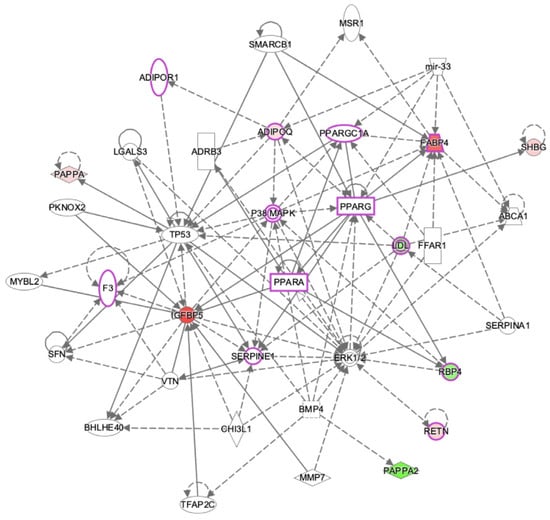
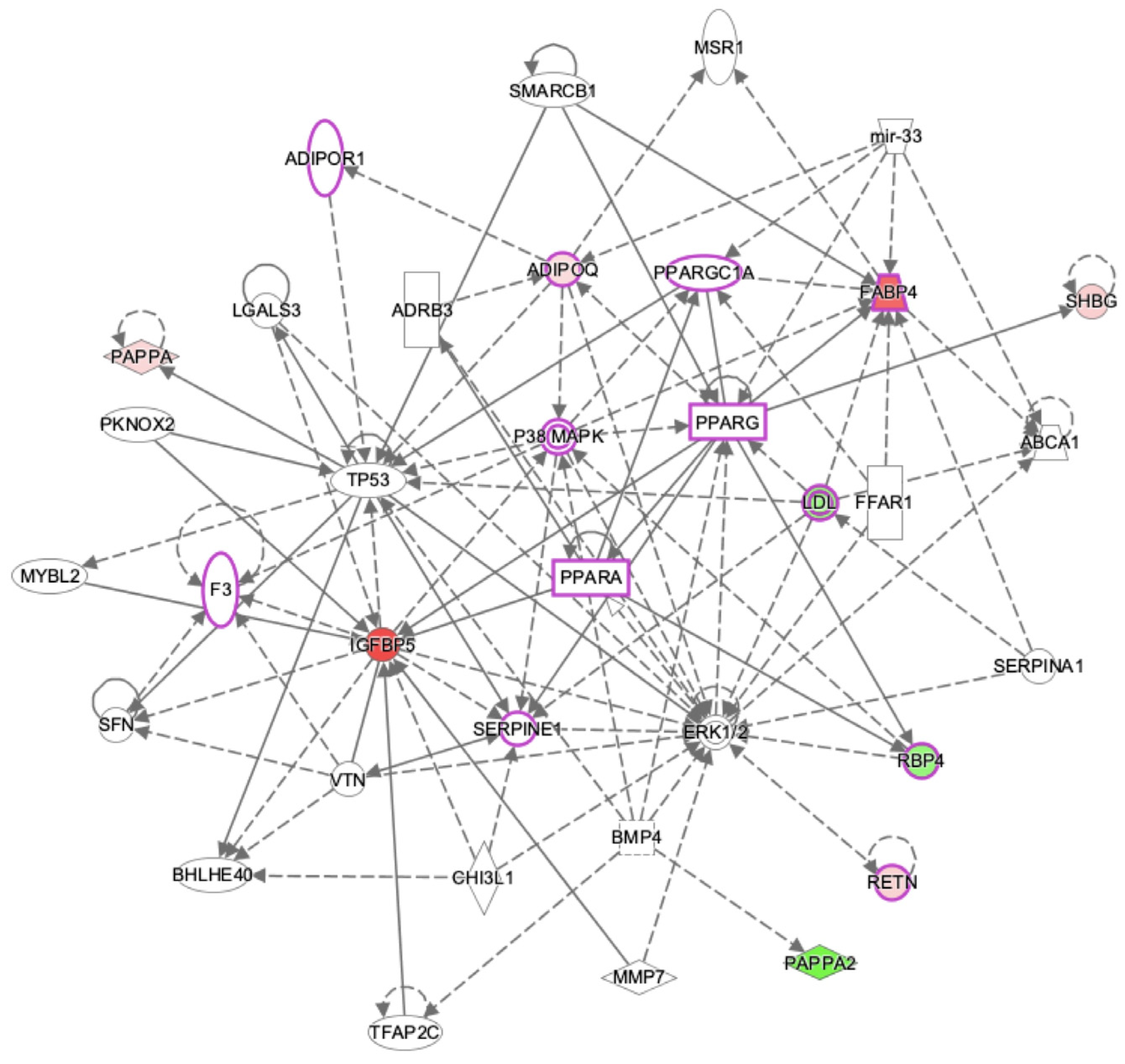
Of the nine candidate proteins, eight were successfully mapped to a metabolic network (Figure 1), as AFM was excluded due to limited annotation data. The red nodes indicate proteins upregulated in women with GDM; the green nodes represent those downregulated; and the uncolored nodes denote predicted molecules inferred by IPA. The proteins highlighted in purple are functionally related to insulin resistance pathways. Central regulatory proteins such as PPARγ, PPARα, and p38 MAPK were connected to adipokines, including FABP4, ADIPO, RBP4, and RETN, through metabolic pathways involved in glucose transport, lipid metabolism, and the inflammatory response [6,11]. These relationships reflect predictive, knowledge-based interactions designed to contextualize observed protein alterations and propose biologically plausible physiological connections.
Figure 1.
Protein–protein interaction network of serum proteins differentially expressed between women with GDM and NGT during the first trimester. Figure generated using Ingenuity Pathway Analysis (IPA v.01-23-01, QIAGEN Digital Insights, Redwood City, CA, USA). The red and green nodes indicate proteins that were up- or down-regulated in GDM women compared to the NGT group, respectively. The purple nodes correspond to proteins associated with insulin resistance. Solid lines represent direct molecular interactions, whereas dashed lines denote inferred relationships. ADIPOQ: adiponectin; FABP4: fatty acid-binding protein 4; GDM: gestational diabetes mellitus; IGFBP-5: insulin-like growth factor binding protein-5; NGT: normal glucose tolerance; PAPP-A: pregnancy-associated plasma protein-A; PAPP-A2: pregnancy-associated plasma protein-A2; RBP4: retinol-binding protein 4; RETN: resistin; SHBG: sex hormone-binding globulin.
2.3. Dynamic Changes in Selected Proteins During Pregnancy
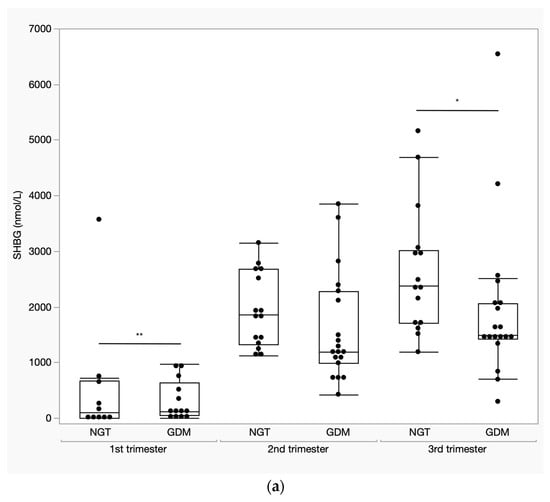
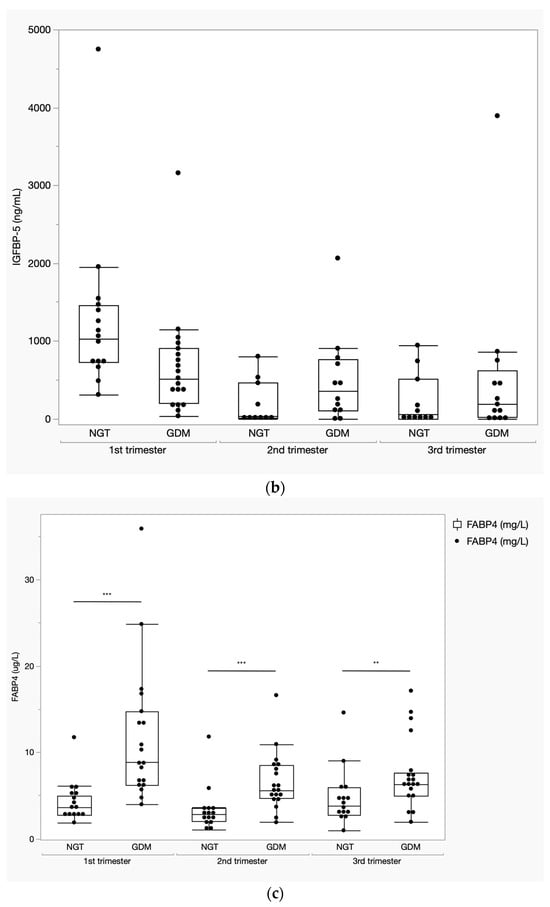
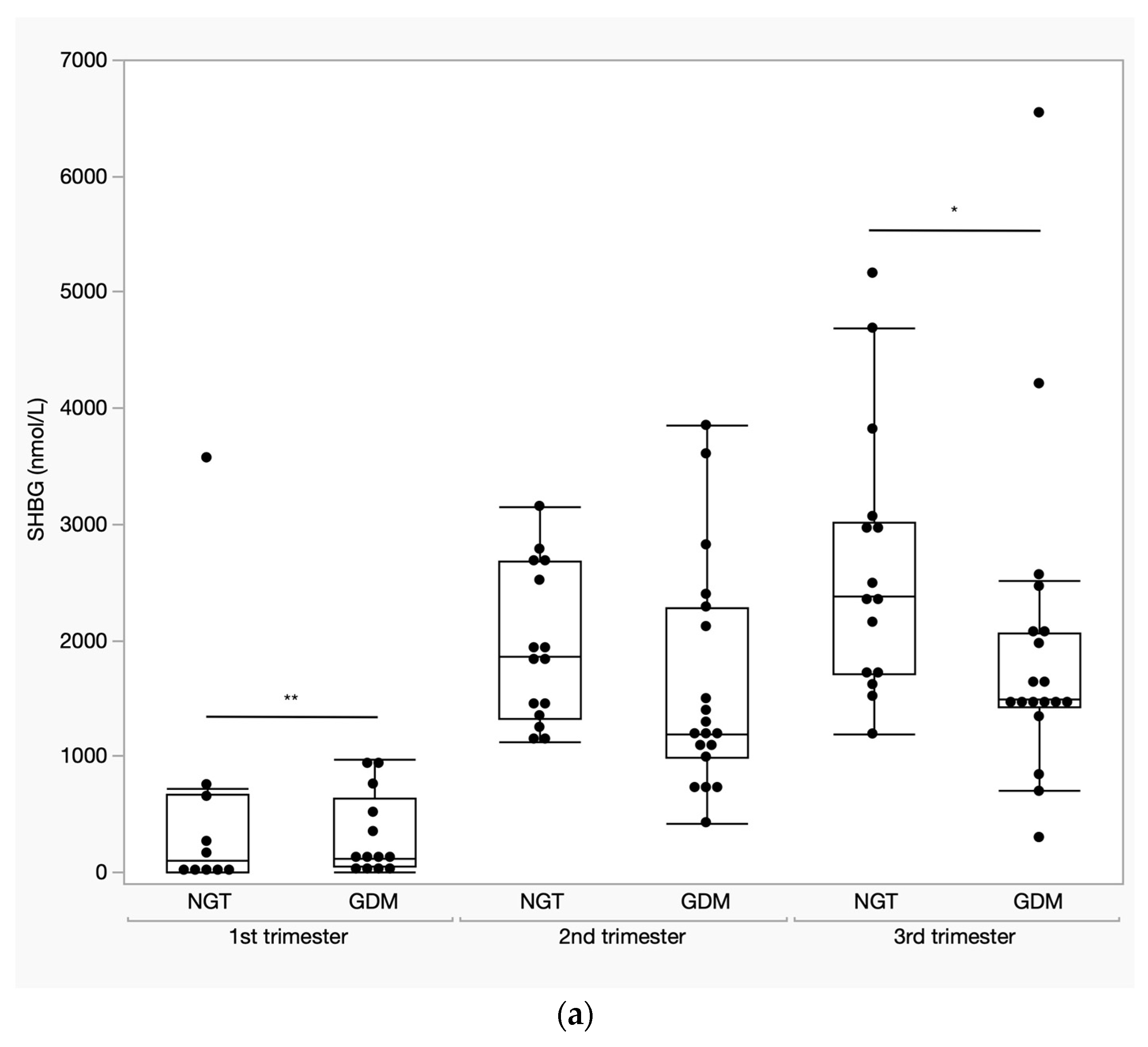
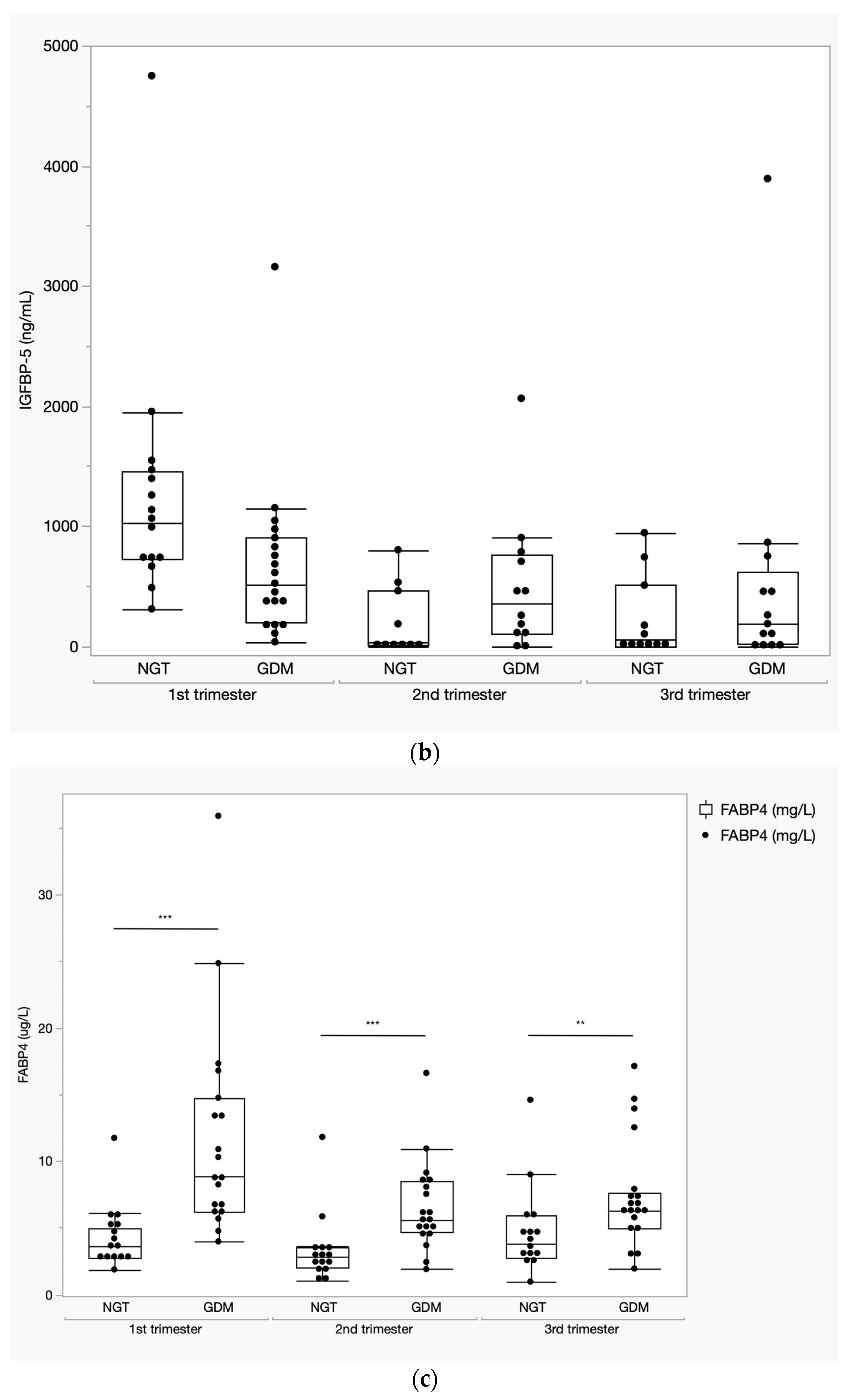
Serum concentrations of SHBG, IGFBP-5, and FABP4 across pregnancy are shown in Figure 2. SHBG concentrations were lower in women who developed GDM throughout the three trimesters (1.91-, 1.21-, and 1.36-fold, respectively), although no significant differences were observed in the second trimester. In both groups, SHBG levels increased from the second trimester onwards. IGFBP-5 concentrations were lower in women with GDM during the first trimester (1.6-fold), but did not differ significantly from those in the NGT group. In contrast, FABP4 concentrations remained higher in women with later developed GDM throughout pregnancy (2.69-, 1.95-, and 1.58-fold, respectively), with the greatest difference observed in the first trimester.
Figure 2.
Serum concentrations (a) SHBG, (b) IGFBP-5, and (c) FABP4 of study participants across pregnancy (NGT, n = 15; GDM, n = 19 at each gestational stage). The boxes represent the interquartile range (IQR, 25–75 percentile), the whiskers extend to I.5 × IQR, the horizontal lines indicate the median, and the dots represent individual data points. Statistical comparisons between groups were performed using the Mann–Whitney U-test. Significant differences were considered as p < 0.05 (*), p < 0.01 (**) or p < 0.001 (***). FABP4: fatty acid-binding protein 4; GDM: gestational diabetes mellitus; IGFBP-5: insulin-like growth factor binding protein-5; NGT: normal glucose tolerance; SHBG: sex hormone-binding globulin.
2.4. Analytical Validation of Selected Proteins as Serum Biomarkers for the Onset and Progression of Gestational Diabetes
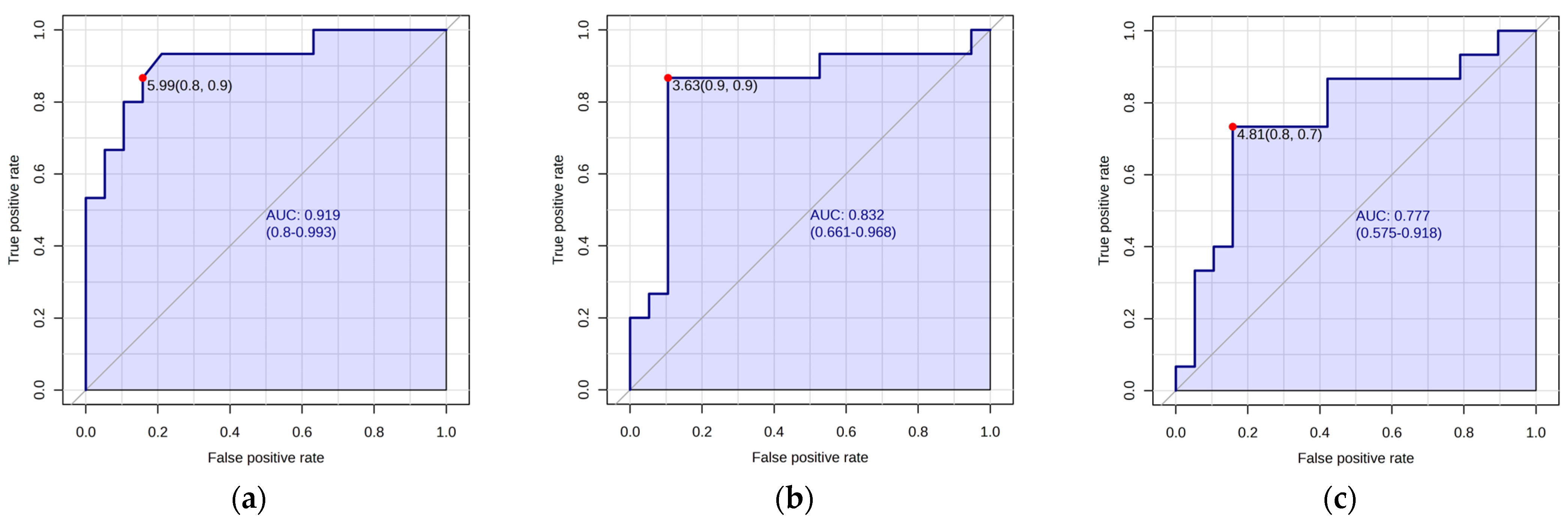
ROC curves were generated for SHBG, IGFBP-5, and FABP4 across pregnancy to characterize their apparent discriminative profiles (Supplementary Table S5). IGFBP-5 showed moderate apparent discriminative performance in the first trimester (AUC = 0.78), followed by limited discrimination in later gestational stages, whereas SHBG exhibited low to moderate apparent performance throughout pregnancy (AUC = 0.51–0.74). In contrast, FABP4 showed the highest apparent discriminative ability among the evaluated biomarkers in the first trimester (AUC = 0.91, p = 0.001), which decreased in the second and third trimesters (0.84 and 0.76, p < 0.05).
A data-derived cut-off value of 5.99 μg/L for FABP4 in the first trimester yielded a sensitivity of 86.7% and a specificity of 84.2%. In the second trimester, a cut-off of 3.63 μg/L corresponded to a sensitivity of 86.7% and a specificity of 89.5%. These cut-off values were derived from the observed data and are reported to descriptively illustrate the discriminative behavior of FABP4 across gestation rather than to define clinically validated thresholds. In the third trimester, FABP4 showed lower discriminative performance, as reflected in a lower AUC (Figure 3). However, given the limited sample size, these AUC values should be interpreted with caution.
Figure 3.
ROC curves depicting the discriminative performance of serum FABP4 across pregnancy in study participants in (a) first, (b) second, and (c) third trimester (NGT, n = 15; GDM, n = 19 at each gestational stage). The gray diagonal line represents the line of no discrimination (AUC = 0.5), corresponding to random classification. FABP4: fatty acid-binding protein 4; ROC: receiver operating characteristic.
2.5. Multivariate Logistic Regression Models That Integrate FABP4 Serum Concentrations with Clinical Variables for the Early Diagnosis of GDM
To explore whether the association between FABP4 serum concentrations and GDM could be influenced by selected covariates, including clinical, anthropometric, and biochemical factors, bivariate and multivariable logistic regression analyses were performed. Given the pilot nature of the study and the limited number of cases, these analyses should be considered exploratory and hypothesis-generating only. As summarized in Table 4, initial bivariate models suggested that FABP4 was consistently associated with GDM status. The inclusion of selected clinical variables as covariates in adjusted models, such as gravidity, triglycerides, or maternal age, was associated with higher apparent discriminative metrics when combined with FABP4. However, increasing model complexity resulted in unstable estimates, consistent with overfitting. The complete set of exploratory models is provided in Supplementary Table S6.
Table 4.
Discriminative performance of FABP4 alone and adjusted for gravidity in exploratory logistic regression models.
In multivariable analyses including multiple clinical covariates, FABP4 and gravidity remained statistically significant despite apparent increases in AUC values. Among the evaluated models, the combination of FABP4 with gravidity showed the most stable association with GDM in this dataset. Based on model stability and interpretability, the bivariate model including FABP4 and gravidity was retained for descriptive comparison. As shown in Table 5, this model demonstrated higher sensitivity and overall accuracy than FABP4 alone; however, these findings should be interpreted cautiously and do not constitute a clinically validated prediction model.
Table 5.
Discriminative performance of FABP4 alone and adjusted for gravidity.
3. Discussion
This study characterized early metabolic alterations in a cohort of Mexican women with GDM. Through a longitudinal design, we assessed a panel of previously proposed circulating proteins to explore their potential utility for the early discrimination and metabolic characterization of GDM. The prevalence of GDM observed in this cohort (23.3%) was higher than the global average estimate (14% in 2021) and previously reported national rates (8.7–17.7% in 2016) [2,12], highlighting the growing burden of GDM in middle-income countries such as Mexico.
Consistent with previous reports, women who later developed GDM were older, had a higher number of pregnancies, and exhibited a higher pregestational BMI than those with NGT. Li et al. [13] reported a linear increase in GDM risk of 6.5–12.7% for each additional year from a maternal age of 18 years, whereas Zhang et al. [14] identified an odds ratio of 2.47 for women ≥ 25 years. However, advanced maternal age, defined as ≥35 years [3], was present in only three participants, suggesting that other metabolic factors contributed more substantially to GDM development in this cohort. In particular, the high prevalence of pregestational overweight and obesity, together with elevated triglyceride, glucose, and insulin concentrations as early as the first trimester, indicates pre-existing metabolic dysregulation. In addition, socioeconomic and dietary factors, such as limited access to prenatal nutritional care and a high intake of refined carbohydrates and saturated fats characteristic of the urban Mexican diet [15], may have further contributed to these metabolic alterations.
Multiparity has been associated with a higher risk of GDM than nulliparity (8.3 vs. 3.0 times, respectively), and this effect increases with maternal age [16]. This relationship has been linked to increased adiposity, impaired insulin secretion, and worsening insulin resistance [17]. In our study, 32% of the women who developed GDM were multiparous and had a significantly higher number of pregnancies. Moreover, 68% of them presented pregestational overweight or obesity and maintained a higher BMI throughout pregnancy.
During pregnancy, physiological adaptations prioritize lipid metabolism to preserve glucose availability for fetal growth [18]. Elevated FABP4 levels have also been reported in umbilical cord serum from infants born to mothers with GDM, suggesting a potential influence on fetal metabolic programming [19,20]. In the present study, both groups showed increasing concentrations of triglycerides and cholesterol throughout pregnancy, but women who developed GDM exhibited consistently higher triglyceride and VLDL concentrations. Wani et al. [21] identified early hyperglycemia and hypertriglyceridemia as independent predictors of GDM, and Shen et al. [22] proposed elevated triglycerides as an independent risk factor for persistent insulin resistance in the second trimester.
We simultaneously assessed nine previously proposed proteins as candidate biomarkers for the early identification of GDM in other populations. Network and enrichment analyses provided insights into their potential involvement in insulin resistance and lipid metabolism pathways in early GDM. However, six of them, ADIPOQ, AFM, PAPP-A, PAPP-A2, RBP4, and RETN, were found at similar levels in women who did or did not develop GDM, even after adjustment for prenatal, anthropometric, and biochemical covariates. Among these, ADIPOQ is among the most extensively studied because of its strong association with insulin sensitivity, and its potential as an early biomarker of GDM has been reported in European and Asian cohorts, independent of maternal age and adiposity [23]. Similarly, AFM, PAPP-A, PAPP-A2, and RBP4 have been reported at higher concentrations in women who later develop GDM [24,25,26,27]. The lack of association in our cohort may reflect population-specific differences and/or the influence of additional maternal and metabolic factors not considered in this study.
Functional enrichment and network analyses were performed to contextualize the observed protein alterations within established metabolic pathways using curated biological knowledge. Accordingly, the molecular interactions identified through IPA represent predictive, literature-based relationships that provide a conceptual framework for exploring biologically plausible mechanisms related to insulin resistance and lipid metabolism, rather than direct experimental evidence of transcriptional or proteomic regulation in this cohort. Experimental validation of molecular interactions inferred from these predictive networks will require future studies that incorporate targeted gene expression and/or proteomic approaches in independent cohorts.
Among the proteins selected for follow-up validation, SHBG, IGFBP-5, and FABP4 showed the most notable alterations in women who later developed GDM. The lower SHBG concentrations observed in the GDM group during the first trimester are consistent with Mustaniemi et al. [28], who reported an inverse association between SHBG and fasting glucose levels, early-onset GDM, and insulin therapy requirement. Similarly, Bruno et al. [29] reported an association between SHBG and gestational age in women with GDM. SHBG has been proposed to promote the GLUT1 expression in placental tissue, thereby increasing glucose transport and potentially contributing to insulin resistance [30]. However, in our cohort, its apparent discriminative performance was only moderate, suggesting limited value as an early biomarker. In our longitudinal analysis, SHBG concentrations remained lower in the GDM group throughout pregnancy, although no significant differences were detected in mid-pregnancy. Li et al. [31] also reported lower SHBG concentrations throughout gestation without significant differences between women with and without GDM.
IGFBP-5 participates in placenta and fetal development by regulating cell proliferation and modulating insulin sensitivity through the IGF axis. Dysregulation of this pathway may contribute to impaired insulin signaling in GDM. Xuesong et al. [32] reported lower IGFBP-5 levels in early pregnancy among women who later developed GDM, whereas in our cohort, only slight, non-significant reductions were observed.
Among the proteins evaluated, FABP4 showed the highest apparent discriminative performance for the early identification of GDM; however, this finding should be regarded as preliminary. Although the potential of FABP4 as an early biomarker is attractive, confirmation in larger, independent populations and through analyses that appropriately correct for multiple testing is required. Nevertheless, accumulating evidence supports a biological link between FABP4 and metabolic dysregulation in GDM. In a multiethnic longitudinal study, Francis et al. [33] found that FABP4 concentrations were positively associated with the risk of GDM and remained elevated throughout gestation, even after adjustment for pre-pregnancy BMI. FABP4 has been associated with insulin resistance through interactions with inflammatory cytokines such as tumor necrosis factor (TNF)-α and interleukin (IL)-6, which affect insulin signaling. In addition, FABP4 promotes lipolysis, increasing circulating free fatty acids and potentially exacerbating insulin resistance [11]. Ron et al. [34] reported FABP4 overexpression in visceral white adipose tissue from women with GDM, where it acts as a co-activator of glucagon-induced hepatic gluconeogenesis. Nevertheless, these mechanistic links were not directly measured in the present cohort.
FABP4 has also been reported to be elevated in other pregnancy-related pathological conditions, such as preeclampsia, likely reflecting shared underlying mechanisms including insulin resistance, dyslipidemia, inflammation, and endothelial dysfunction [35]. In the present study, women with clinically diagnosed hypertensive disorders of pregnancy were not included, and blood pressure was not systematically recorded; therefore, the potential contribution of subclinical blood pressure alterations to FABP4 variability cannot be completely excluded.
Consistent with our results, Jun et al. [36] reported that women in the highest tertile of FABP4 during the first and second trimesters had more than twice the risk of developing GDM (adjusted OR = 2.05–2.45). Although our cut-off values (5.99 and 3.63 μg/L) were lower than those reported in their Chinese cohort (>61.6 ng/L for the highest tertile), these differences may reflect ethnic and/or metabolic variations across populations.
It is noteworthy, however, that FABP4 may reflect broader underlying metabolic dysregulation rather than a distinct GDM-specific biomarker. In our cohort, women who later developed GDM already had higher first-trimester BMI, glucose, insulin, triglycerides, and cholesterol. In addition, FABP4 levels are known to correlate strongly with adiposity. Consistent with this, Vorobjova et al. [37] found no significant differences in FABP4 levels between women with GDM and NGT during mid-pregnancy, although both groups showed higher FABP4 concentrations among women with overweight or obesity. These findings suggest that the relationship between FABP4 and GDM may be modulated, at least in part, by adiposity and related metabolic alterations. This hypothesis is also consistent with the proposed role of FABP4 in lipid accumulation and suppression of fatty acid β-oxidation [38].
The pleiotropic actions of FABP4 may explain why its inclusion alongside clinical and metabolic covariates was associated with improved discriminative metrics in exploratory models. Francis et al. [33] reported that a model based on conventional risk factors (maternal age, BMI, race, family history of DM, and glucose levels) was only slightly improved when FABP4 was added (AUC increased from 0.71 to 0.73 at 10–14 gestational weeks and from 0.75 to 0.77 at 15–26 weeks). In contrast, the addition of multiple adipokines, including FABP4, chemerin, soluble leptin receptor, and high-molecular-weight (HMW) adiponectin, increased the AUC up to 0.82, supporting the potential value of multi-biomarker models. In our cohort, FABP4 alone showed a high apparent discriminative ability for early identification of GDM at 10–14 gestational weeks (AUC = 0.91), which increased to 0.97 when gravidity was included as a covariate. However, given the limited sample size, these AUC values should be interpreted as exploratory.
Few studies have assessed the impact of gravidity on the development of GDM. In a rodent model, mice subjected to multiple pregnancies exhibited greater adiposity than virgin controls, developing progressive insulin resistance and compensatory pancreatic β-cell proliferation that led to cellular stress and accelerated β-cell aging. Similarly, a study of postpartum women with prior GDM or impaired glucose tolerance found that multiparous women had greater adiposity, higher fasting glycemia, and a lower Matsuda insulin sensitivity index. Together, these findings suggest that repeated exposure to pregnancy-related hormonal and inflammatory adaptations may increase the risk of GDM [17].
Diet and physical activity are also important modifiable determinants of GDM risk and glycemic control. Lifestyle interventions based on dietary improvement and regular physical activity have been shown to improve metabolic health during pregnancy and reduce adverse maternal outcomes, including GDM [39]. Since these factors were not assessed in the present pilot study, their potential influence on circulating FABP4 levels could not be determined.
This study has several strengths, including its longitudinal design, evaluation of circulating biomarkers at early stages of pregnancy, simultaneous assessment of multiple candidate proteins followed by ELISA validation across gestation, and inclusion of a Mexican population that remains underrepresented in gestational diabetes biomarker research. Nevertheless, several limitations should be acknowledged. The relatively small sample size reduced statistical power, increased the likelihood of wide confidence intervals, and restricted the robust application of predictive models. Because no internal resampling procedures or external validation were performed, the reported AUC values and multivariable model estimates should be interpreted as exploratory and potentially optimistic. Furthermore, because candidate proteins were evaluated without formal correction for multiple testing, the possibility of type 1 error inflation should also be considered. In addition, attrition during follow-up may have introduced selection bias, and the final analytical cohort may not fully represent the initially recruited population. Detailed lifestyle factors, blood pressure measurements, and maternal–neonatal outcomes were not systematically recorded, which may represent additional sources of metabolic and clinical confounding. Consequently, the present findings should be interpreted in light of these limitations and require confirmation in larger, well-characterized cohorts to assess their generalizability, biological specificity, and clinical relevance.
4. Materials and Methods
4.1. Study Design
A longitudinal, prospective, observational, and comparative pilot study was conducted, including 200 pregnant Mexican women recruited between 11 and 14 gestational weeks. All participants were monitored throughout pregnancy. Because of the exploratory nature of this pilot study, no a priori sample size calculation was performed, and the sample size was determined by feasibility and participant retention during follow-up. The study flowchart summarizing recruitment, follow-up, exclusions, and final sample is provided in Figure S1. Ethical considerations were strictly followed, and all participants provided written informed consent. The study protocol was approved by the Research Ethics Committee of the Universidad Autónoma de Querétaro (approval no. FONFIVE-CEI-56/24).
4.2. Participants
Participants were recruited at the Hospital del Niño y la Mujer in Querétaro, Mexico, using a non-probability consecutive sampling approach during routine prenatal consultations. Inclusion criteria consisted of Mexican women aged 18–40 years. Exclusion criteria included multiple pregnancies, preeclampsia, autoimmune disorders, and a previous diagnosis of hepatic dysfunction, renal injury, hypertension, cancer, and other chronic diseases. Participants who subsequently developed any of the exclusion criteria during pregnancy, changed hospitals, missed prenatal appointments, or voluntarily withdrew from the study were excluded from the final analysis. Of the 200 women initially recruited, 34 participants (19 with GDM and 15 with NGT) completed follow-up at all three gestational stages and were included in the final analytical cohort.
Participants were assessed at three gestational stages: 11–14, 24–28, and 30–33 weeks. Questionnaires were administered to collect clinical data, including gravidity (number of pregnancies), number of births, number of abortions, family history of diabetes mellitus, and previous pregnancies with GDM. Height and body weight were recorded to calculate body mass index (BMI). Serum concentrations of glucose, insulin, triglycerides, total cholesterol, and high-density lipoprotein (HDL) were determined using enzyme-colorimetric kits (Pointe Scientific, Canton Township, MI, USA) according to the manufacturer’s instructions on an automated chemistry analyzer (BS-200, Mindray Medical International Co., Nanshan, Shenzhen, China). All biochemical determinations were performed at the Clinical Service Units of the Universidad Autónoma de Querétaro (Querétaro, Querétaro, Mexico) under standardized laboratory conditions, including overnight 12-h fasting, maintenance of the usual diet in the preceding days, avoidance of strenuous physical activity before testing, and routine internal quality-control procedures. Low-density lipoprotein (LDL) and very low-density lipoprotein (VLDL) were estimated using Friedewald’s equations.
GDM was diagnosed between 24 and 28 gestational weeks using a one-step 75 g OGTT with glucose measurements obtained at fasting, 1 h, and 2 h. All OGTTs were performed after overnight fasting of at least 8 h, maintenance of the usual diet in the preceding days, and avoidance of strenuous physical activity before testing. Participants were classified as having GDM if fasting glucose was ≥92 mg/dL, 1 h glucose was ≥180 mg/dL, or 2 h glucose was ≥153 mg/dL, according to the ADA criteria [3].
4.3. Antibody Array Analysis
Serum samples collected at 11–14 gestational weeks were analyzed for nine proteins: adiponectin (ADIPOQ), afamin (AFM), fatty acid-binding protein 4 (FABP4), insulin-like growth factor binding protein-5 (IGFBP-5), pregnancy-associated plasma protein-A (PAPP-A), pregnancy-associated plasma protein-A2 (PAPP-A2), retinol-binding protein 4 (RBP4), resistin (RETN), and sex hormone-binding globulin (SHBG). Samples were analyzed simultaneously using a custom-designed human antibody array (RayBiotech, Peachtree Corners, GA, USA) according to the manufacturer’s instructions. The assay used a glass-chip sandwich ELISA platform in which each capture antibody was printed in quadruplicate. Fluorescence signals were detected using a laser scanner (GenePix4100A, Molecular Devices, San José, CA, USA), and data were processed using GenePix Pro 6.0 software (Molecular Devices, San José, CA, USA).
Negative control spots (protein-containing buffer) were used to estimate nonspecific background fluorescence, whereas positive control spots (equal amounts of biotinylated IgGs) were used to assess assay performance and support intra- and inter-array normalization. According to the manufacturer’s specifications and internal quality control procedures, intra-assay coefficients of variation (CVs) were <10% and inter-assay CVs were <15% for the analyzed proteins, values considered acceptable for quantitative immunoassay-based protein detection [40]. The antibody array generated semi-quantitative data based on relative fluorescence measurements.
4.4. ELISA Analysis of Selected Proteins
Candidate biomarkers identified by the antibody array were quantified in serum samples from all three trimesters using custom-designed sandwich ELISA kits (Raybiotech, Peachtree Corners, GA, USA), according to the manufacturer’s instructions. Concentrations were calculated from standard curves. All ELISA assays included duplicate measurements and were performed under the same quality-control criteria described above. According to the manufacturer’s specifications, assay precision met intra-assay CV thresholds of <10% and inter-assay CV thresholds of <15%.
4.5. Data Analysis
Data distribution and variance homogeneity were assessed using the Kolmogorov–Smirnov and Levene tests, respectively. Variables that met assumptions of normality and homoscedasticity were analyzed using Student’s t-test, whereas variables with non-normal distribution and/or unequal variances were analyzed using the Mann–Whitney U-test. Categorical variables were compared using the chi-square test. Statistical significance was set at p < 0.05. Given the exploratory and hypothesis-generating nature of this pilot study, no formal correction for multiple testing was applied; therefore, p-values should be interpreted descriptively, in conjunction with effect sizes and biological plausibility, and the possibility of type I error inflation should be considered.
Principal component analysis (PCA) was used to explore multivariate patterns and relationships among candidate biomarkers. Linear regression models were applied to evaluate associations between biomarker concentrations and GDM while adjusting for selected clinical covariates. Receiver operating characteristic (ROC) curve analyses were performed to assess the apparent discriminative ability of individual biomarkers across pregnancy. Optimal cut-off values were determined using the Youden index. Because of the limited sample size, no internal resampling procedures or external validation were conducted; therefore, AUC and discriminative performance values should be interpreted as exploratory, data-driven, and potentially optimistic.
In addition, multivariate logistic regression models were used to explore whether the association between FABP4 and GDM was modified by selected clinical variables. To minimize the risk of overfitting, model complexity was intentionally restricted, and all multivariable analyses were interpreted descriptively.
Statistical analyses were performed using JMP Student Edition 18.2.0 software (SAS Institute, Cary, NC, USA). ROC curves and PCA plots were constructed on the Metaboanalyst 6.0 interface (available online at https://www.metaboanalyst.ca, accessed on 23 October 2025). Functional enrichment and protein–protein interaction analyses were performed using Ingenuity Pathway Analysis v.01-23-01 software (IPA, QIAGEN Digital Insights, Redwood City, CA, USA) based on canonical pathways and disease associations. These analyses were used to provide biological context to the observed protein alterations and were not intended to infer functional molecular activity in this cohort.
5. Conclusions
FABP4 demonstrated strong discriminative ability for the early detection of GDM in Mexican women. Its integration with clinical covariates, such as pregnancy history, was associated with improved discriminative metrics, suggesting that combined biomarker–clinical approaches may contribute to early metabolic risk stratification in populations with similar metabolic profiles. The consistent elevation of FABP4 during early pregnancy underscores its relevance as a biologically plausible marker of metabolic dysregulation during gestation. Future studies integrating mechanistic and longitudinal approaches may further clarify the role of FABP4 in the pathophysiology of GDM and its utility within population-specific screening strategies.
Supplementary Materials
The following supporting information can be downloaded at: https://www.mdpi.com/article/10.3390/women6020026/s1, Figure S1: Study flowchart of participant recruitment, follow-up across pregnancy, and final analytical cohort; Figure S2: Hierarchical clustering heatmap of candidate serum proteins among study participants in the first trimester (unsupervised analysis); Figure S3: Principal component analysis biplot of candidate serum proteins among study participants in the first trimester (unsupervised analysis); Figure S4. Functional and disease enrichment analysis of serum proteins differentially expressed between women with GDM and NGT during the first trimester; Table S1: Exploratory linear regression analysis of clinical and biochemical covariates associated with serum SHBG concentrations in the first trimester; Table S2: Exploratory linear regression analysis of clinical and biochemical covariates associated with serum IGFBP-5 concentrations in the first trimester; Table S3: Exploratory linear regression analysis of clinical and biochemical covariates associated with serum RBP4 concentrations in the first trimester; Table S4: Exploratory linear regression analysis of clinical and biochemical covariates associated with serum FABP4 concentrations in the first trimester; Table S5: ROC analysis of serum protein discriminative performance across pregnancy; Table S6: Exploratory logistic regression models evaluating FABP4 adjusted for individual clinical and biochemical variables.
Author Contributions
Conceptualization, D.G.G.-G., J.A.E.-M. and I.F.P.-R.; formal analysis, S.A.-C., P.E.H.-M., E.R.-R., D.S.D.-O. and E.C.-T.; investigation, S.A.-C., P.E.H.-M. and E.R.-R.; resources, J.A.E.-M., D.G.G.-G. and I.F.P.-R.; writing—original draft preparation, D.S.D.-O. and I.F.P.-R.; writing—review and editing, S.A.-C., P.E.H.-M., E.R.-R., D.S.D.-O., E.C.-T., J.A.E.-M. and D.G.G.-G.; supervision, D.G.G.-G., J.A.E.-M. and I.F.P.-R.; project administration, D.G.G.-G. and I.F.P.-R.; funding acquisition, D.G.G.-G., J.A.E.-M. and I.F.P.-R. All authors have read and agreed to the published version of the manuscript.
Funding
This research was funded by Fondo para el Fortalecimiento de la Investigación, Vinculación y Extensión (FONFIVE-UAQ), grant number FQU202412.
Institutional Review Board Statement
The study was conducted in accordance with the Declaration of Helsinki and approved by the Research Ethics Committee of the Universidad Autónoma de Querétaro (protocol code: FONFIVE-CEI-56/24; date of approval: 30 July 2024) for studies involving humans.
Informed Consent Statement
Informed consent was obtained from all subjects involved in the study.
Data Availability Statement
The original contributions presented in this study are included in the article/Supplementary Materials. Further inquiries can be directed to the corresponding authors.
Acknowledgments
The authors are grateful to the Consejo Nacional de Ciencia y Tecnología (CONACYT, now SECIHTI) for the scholarships granted to S.A.-C. and E.R.-R., as well as to the FONFIVE-UAQ fund for the scholarship granted to P.E.H.-M. We thank the Unidad de Investigación Biomédica de Zacatecas of the Instituto Mexicano del Seguro Social (Zacatecas, Mexico) for providing facilities for the antibody array analysis. We also extend our appreciation to the Hospital de Especialidades del Niño y la Mujer (Quéretaro, Mexico) for their support in participant recruitment, and to all the women who kindly participated in this study.
Conflicts of Interest
The authors declare no conflicts of interest. The funders had no role in the design of the study; in the collection, analysis, or interpretation of data; in the writing of the manuscript; or in the decision to publish the results.
Abbreviations
The following abbreviations are used in this manuscript:
| ADA | American Diabetes Association |
| ADIPOQ | Adiponectin |
| AFM | Afamin |
| AUC | Area under the curve |
| BMI | Body mass index |
| T2DM | Type 2 diabetes mellitus |
| FABP4 | Fatty acid-binding protein 4 |
| FC | Fold change |
| FIGO | Federation of Gynecology and Obstetrics |
| GDM | Gestational diabetes mellitus |
| HDL | High-density lipoprotein |
| HMW | High-molecular weight |
| IGF | Insulin-like growth factor |
| IGFBP-5 | Insulin-like growth factor binding protein-5 |
| IL-6 | Interleukin-6 |
| LDL | Low-density lipoprotein |
| NGT | Normal glucose tolerance |
| OGTT | Oral glucose tolerance test |
| PAPP-A | Pregnancy-associated plasma protein-A |
| PAPP-A2 | Pregnancy-associated plasma protein-A2 |
| PCA | Principal component analysis |
| RBP4 | Retinol-binding protein 4 |
| RETN | Resistin |
| ROC | Receiver operating characteristic |
| SHBG | Sex hormone-binding globulin |
| TNF-α | Tumour necrosis factor-alpha |
| VLDL | Very low-density lipoprotein |
References
- American Diabetes Association Professional Practice Committee; American Diabetes Association Professional Practice Committee. Classification and diagnosis of diabetes: Standards of Medical Care in Diabetes—2022. Diabetes Care 2022, 45, S17–S38. [Google Scholar] [CrossRef] [Scilit] [PubMed]
- Wang, H.; Li, N.; Chivese, T.; Werfalli, M.; Sun, H.; Yuen, L.; Hoegfeldt, C.A.; Powe, C.E.; Immanuel, J.; Karuranga, S.; et al. IDF diabetes atlas: Estimation of global and regional gestational diabetes mellitus prevalence for 2021 by International Association of Diabetes in Pregnancy Study Group’s Criteria. Diabetes Res. Clin. Pract. 2022, 183, 109050. [Google Scholar] [CrossRef] [Scilit] [PubMed]
- American Diabetes Association Professional Practice Committee; American Diabetes Association Professional Practice Committee. Management of diabetes in pregnancy: Standards of Medical Care in Diabetes—2022. Diabetes Care 2022, 45, S232–S243. [Google Scholar] [CrossRef] [Scilit]
- Rani, P.R.; Begum, J. Screening and diagnosis of gestational diabetes mellitus, where do we stand. J. Clin. Diagn. Res. 2016, 10, QE01–QE04. [Google Scholar] [CrossRef] [Scilit] [PubMed]
- Hod, M.; Kapur, A.; Sacks, D.A.; Hadar, E.; Agarwal, M.; Di Renzo, G.C.; Roura, L.C.; McIntyre, H.D.; Morris, J.L.; Divakar, H. The International Federation of Gynecology and Obstetrics (FIGO) Initiative on gestational diabetes mellitus: A pragmatic guide for diagnosis, management, and care. Int. J. Gynaecol. Obstet. 2015, 131, S173–S211. [Google Scholar] [CrossRef] [Scilit]
- Dias, S.; Pheiffer, C.; Abrahams, Y.; Rheeder, P.; Adam, S. Molecular biomarkers for gestational diabetes mellitus. Int. J. Mol. Sci. 2018, 19, 2926. [Google Scholar] [CrossRef] [Scilit]
- Bogdanet, D.; Reddin, C.; Murphy, D.; Doheny, H.C.; Halperin, J.A.; Dunne, F.; O’Shea, P.M. Emerging protein biomarkers for the diagnosis or prediction of gestational diabetes—A scoping review. J. Clin. Med. 2021, 10, 1533. [Google Scholar] [CrossRef] [Scilit]
- Barquera, S.; Rivera, J.A. Obesity in Mexico: Rapid epidemiological transition and food industry interference in health policies. Lancet Diabetes Endocrinol. 2020, 8, 746–747. [Google Scholar] [CrossRef] [Scilit]
- Wang, X.; Liu, J.; Wang, D.; Zhu, H.; Kang, L.; Jiang, J. Expression and correlation of chemerin and FABP4 in peripheral blood of gestational diabetes mellitus patients. Exp. Ther. Med. 2020, 19, 710–716. [Google Scholar] [CrossRef] [Scilit]
- Zhou, T.; Huang, L.; Wang, M.; Chen, D.; Chen, Z.; Jiang, S.W. A critical review of proteomic studies in gestational diabetes mellitus. J. Diabetes Res. 2020, 2020, 6450352. [Google Scholar] [CrossRef] [Scilit]
- Shi, Y.; Wang, C.-C.; Wu, L.; Zhang, Y.; Xu, A.; Wang, Y. Pathophysiological insight into fatty acid-binding protein-4: Multifaced roles in reproduction, pregnancy, and offspring health. Int. J. Mol. Sci. 2023, 24, 12655. [Google Scholar] [CrossRef] [Scilit]
- Instituto Mexicano del Seguro Social. Diagnóstico y tratamiento de diabetes en el embarazo. Inst. Mex. Seg. Soc. 2016, 2016, 1–68. [Google Scholar]
- Li, Y.; Ren, X.; He, L.; Li, J.; Zhang, S.; Chen, W. Maternal age and the risk of gestational diabetes mellitus: A systematic review and meta-analysis of over 120 million participants. Diabetes Res. Clin. Pract. 2020, 162, 108044. [Google Scholar] [CrossRef] [Scilit] [PubMed]
- Zhang, Y.; Xiao, C.-M.; Zhang, Y.; Chen, Q.; Zhang, X.-Q.; Li, X.-F.; Shao, R.-Y.; Gao, Y.-M. Factors associated with gestational diabetes mellitus: A meta-analysis. J. Diabetes Res. 2021, 2021, 6692695. [Google Scholar] [CrossRef] [Scilit] [PubMed]
- Romero-Villanueva, D.; Dickinson, F.; Batún, J.L.; Castillo-Burguete, M.T.; Azcorra, H. The associations between maternal socioeconomic factors and adequacy of energy and macronutrient intakes in pregnant women from Yucatan, Mexico. Food Nutr. Bull. 2022, 43, 148–158. [Google Scholar] [CrossRef] [Scilit]
- Al-Rowaily, M.A.; Abolfotouh, M.A. Predictors of gestational diabetes mellitus in a high-parity community in Saudi Arabia. East. Mediterr. Health J. 2010, 16, 636–641. [Google Scholar] [CrossRef] [Scilit]
- Moon, J.H.; Lee, J.; Kim, K.H.; Kim, H.J.; Kim, H.; Cha, H.-N.; Park, J.; Lee, H.; Park, S.-Y.; Jang, H.C.; et al. Multiparity increases the risk of diabetes by impairing the proliferative capacity of pancreatic b cells. Exp. Mol. Med. 2023, 55, 2269–2280. [Google Scholar] [CrossRef] [Scilit]
- Rahnemaei, F.A.; Abdi, F.; Kazemian, E.; Shaterian, N.; Shaterian, N.; Aeen, F.B. Association between body mass index in the first half of pregnancy and gestational diabetes: A systematic review. SAGE Open Med. 2022, 10, 20503121221109911. [Google Scholar] [CrossRef] [Scilit]
- Nakshine, V.S.; Jogdand, S.D. A comprehensive review of gestational diabetes mellitus: Impacts on maternal health, fetal development, childhood outcomes, and long-term treatment strategies. Cureus 2023, 15, e47500. [Google Scholar] [CrossRef] [Scilit]
- Liu, X.; Zheng, T.; Xu, Y.-J.; Yang, M.-N.; Wang, W.-J.; Huang, R.; Zhang, G.-H.; Guo, Y.-N.; Zhang, J.; Ouyang, F.; et al. Sex dimorphic associations of gestational diabetes mellitus with cord plasma fatty acid binding protein 4 and estradiol. Front. Endocrinol. 2021, 12, 740902. [Google Scholar] [CrossRef] [Scilit]
- Wani, K.; Sabico, S.; Alnaami, A.M.; Al-Musharaf, S.; Fouda, M.A.; Turkestani, I.Z.; Al-Ajlan, A.; Alshingetti, N.M.; Alokail, M.S.; Al-Daghri, N.M. Early-pregnancy metabolic syndrome and subsequent incidence in gestational diabetes mellitus in Arab women. Front. Endocrinol. 2020, 11, 98. [Google Scholar] [CrossRef] [Scilit] [PubMed]
- Shen, H.; Liu, X.; Chen, Y.; He, B.; Cheng, W. Associations of lipid levels during gestation with hypertensive disorders of pregnancy and gestational diabetes mellitus: A prospective longitudinal cohort study. BMJ Open 2016, 6, e013509. [Google Scholar] [CrossRef] [Scilit]
- Gao, S.; Su, S.; Zhang, E.; Zhang, Y.; Liu, J.; Xie, S.; Yue, W.; Liu, R.; Yin, C. The effect of circulating adiponectin levels on incident gestational diabetes mellitus: Systematic review and meta-analysis. Ann. Med. 2023, 55, 2224046. [Google Scholar] [CrossRef] [Scilit]
- Köninger, A.; Mathan, A.; Mach, P.; Frank, M.; Schmidt, B.; Schleussner, E.; Kimmig, R.; Gellhaus, A.; Dieplinger, H. Is Afamin a novel biomarker for gestational diabetes mellitus? A pilot study. Reprod. Biol. Endocrinol. 2018, 16, 30. [Google Scholar] [CrossRef] [Scilit]
- Borna, S.; Ashrafzadeh, M.; Ghaemi, M.; Eshraghi, N.; Hivechi, N.; Hantoushzadeh, S. Correlation between PAPP-A serum levels in the first trimester of pregnancy with the occurrence of gestational diabetes, a multicenter cohort study. BMC Pregnancy Childbirth 2023, 23, 847. [Google Scholar] [CrossRef] [Scilit]
- Dereke, J.; Nilsson, C.; Strevens, H.; Landin-Olsson, M.; Hillman, M. Pregnancy-associated plasma protein-A2 levels are increased in early pregnancy gestational diabetes: A novel biomarker for early risk estimation. Diabet. Med. 2019, 37, 131–137. [Google Scholar] [CrossRef] [Scilit] [PubMed]
- Jin, C.; Lin, L.; Han, N.; Zhao, Z.; Liu, Z.; Luo, S.; Xu, X.; Liu, J.; Wang, H. Plasma retinol-binding protein 4 in the first and second trimester and risk of gestational diabetes mellitus in Chinese women: A nested case-control study. Nutr. Metab. 2020, 17, 1. [Google Scholar] [CrossRef] [Scilit] [PubMed]
- Mustaniemi, S.; Morin-Papunen, L.; Keikkala, E.; Öhman, H.; Surcel, H.-M.; Kaaja, R.; Gissler, M.; Eriksson, J.G.; Laivuori, H.; Kajantie, E.; et al. Associations of low sex hormone-binding globulin and androgen excess in early pregnancy with fasting and post-prandial hyperglycaemia, gestational diabetes, and its severity. Diabetes Metab. Res. Rev. 2022, 39, e3599. [Google Scholar] [CrossRef] [Scilit]
- Bruno, B.; Blessing, M.-M.K.; Izuchukwu, M.N.; Terry, G.T.; Faeren, D. Sex hormone-binding globulin is a valuable diagnostic indicator of gestational diabetes mellitus. Ghana Med. J. 2024, 58, 53–59. [Google Scholar] [CrossRef] [Scilit]
- Dinakaran, A.; Srinivasan, A.R.; Rajagambeeram, R.; Nanda, S.K.; Daniel, M. SHBG and insulin resistance—Nexus revisited. Bioinformation 2024, 20, 816–821. [Google Scholar] [CrossRef] [Scilit]
- Li, M.-Y.; Rawal, S.; Hinkle, S.N.; Zhu, Y.-Y.; Tekola-Ayele, F.; Tsai, M.Y.; Liu, S.-M.; Zhang, C.-L. Sex hormone-binding globulin, cardiometabolic biomarkers, and gestational diabetes: A longitudinal study and meta-analysis. Matern. Fetal Med. 2020, 2, 2–9. [Google Scholar] [CrossRef] [Scilit] [PubMed]
- Li, X.; Liu, C.; Hu, Z.; Zhang, Z.; Qian, Y.; Zhang, Y.; Song, Y.; Yang, J. IGFBP5 protein molecule and thyroid hormone in the diagnosis and effect of gestational diabetes. Int. J. Biol. Macromol. 2025, 309, 142737. [Google Scholar] [CrossRef] [Scilit] [PubMed]
- Francis, E.C.; Li, M.; Hinkle, S.N.; Cao, Y.; Chen, J.; Wu, J.; Zhu, Y.; Cao, H.; Kemper, K.; Rennert, L.; et al. Adipokines in early and mid-pregnancy and subsequent risk of gestational diabetes: A longitudinal study in a multiracial cohort. BMJ Open Diabetes Res. Care 2020, 8, e001333. [Google Scholar] [CrossRef] [Scilit]
- Ron, I.; Lerner, R.K.; Rathaus, M.; Livne, R.; Ron, S.; Barhod, E.; Hemi, R.; Tirosh, A.; Strauss, T.; Ofir, K.; et al. The adipokine FABP4 is a key regulator of neonatal glucose homeostasis. JCI Insight 2021, 6, e138288. [Google Scholar] [CrossRef] [Scilit] [PubMed]
- Scifres, C.M.; Catov, J.M.; Simhan, H. Maternal serum fatty acid binding protein 4 (FABP4) and the development of preeclampsia. J. Clin. Endocrinol. Metab. 2012, 97, E349–E356. [Google Scholar] [CrossRef] [Scilit]
- Jin, C.; Lin, L.; Han, N.; Zhao, Z.; Xu, X.; Luo, S.; Liu, J.; Wang, H. Risk of gestational diabetes mellitus in relation to plasma concentrations of Fatty Acid Binding Protein 4: A nested case-control study in China. J. Diabetes Res. 2021, 2021, 6681432. [Google Scholar] [CrossRef] [Scilit]
- Vorobjova, T.; Tagoma, A.; Talja, I.; Janson, H.; Kirss, A.; Uibo, R. FABP4 and I-FABP levels in pregnant women are associated with body mass index but not gestational diabetes. J. Diabetes Res. 2022, 2022, 1089434. [Google Scholar] [CrossRef] [Scilit]
- Li, X.; Yu, H.; Tian, R.; Wang, X.; Xing, T.; Xu, C.; Li, T.; Du, X.; Cui, Q.; Yu, B.; et al. FABP4 as a mediator of lipid metabolism and pregnant uterine dysfunction in obesity. Adv. Sci. 2025, 12, 2501077. [Google Scholar] [CrossRef] [Scilit]
- Nguyen, H.G.; Nguyen, K.T.H.; Nguyen, P.N. Non-pharmacological management of gestational diabetes mellitus with a high fasting glycemic parameter: A hospital-based study in Vietnam. J. Clin. Med. 2024, 13, 5895. [Google Scholar] [CrossRef] [Scilit]
- Aydin, S.; Emre, E.; Ugur, K.; Aydin, M.A.; Sahin, İ.; Cinar, V.; Akbulut, T. An overview of ELISA: A review and update on best laboratory practices for quantifying peptides and proteins in biological fluids. J. Int. Med. Res. 2025, 53, 3000605251315913. [Google Scholar] [CrossRef] [Scilit]

Disclaimer/Publisher’s Note: The statements, opinions and data contained in all publications are solely those of the individual author(s) and contributor(s) and not of MDPI and/or the editor(s). MDPI and/or the editor(s) disclaim responsibility for any injury to people or property resulting from any ideas, methods, instructions or products referred to in the content. |
© 2026 by the authors. Licensee MDPI, Basel, Switzerland. This article is an open access article distributed under the terms and conditions of the Creative Commons Attribution (CC BY) license.