Article

Parenting Self-Efficacy and Infant Feeding Experiences in Lower-Income Mothers Receiving Home Visitation


by
Rebecca G. Renegar
1,* and
Heidi E. Stolz
2
1
College of Social Work Office of Research and Public Service, University of Tennessee, Knoxville, TN 37996, USA
2
Department of Counseling, Human Development, and Family Science, University of Tennessee, Knoxville, TN 37996, USA
*
Author to whom correspondence should be addressed.
Women 2026, 6(2), 25; https://doi.org/10.3390/women6020025
Submission received: 14 November 2025 / Revised: 23 January 2026 / Accepted: 13 March 2026 / Published: 9 April 2026

Abstract

The purpose of this study was to examine relationships between infant feeding and parenting self-efficacy. Mothers (N = 121) receiving home visiting reported on PSE and infant feeding at two times (e.g., longitudinally). Mothers were exclusively formula feeding (46.7%), exclusively breastfeeding (19.8%) or combining breastfeeding and formula (33.1%). Infant feeding was regressed on parenting self-efficacy and relevant demographics using logistic regression. Mothers with higher parenting self-efficacy were more likely to be exclusively formula feeding or combination feeding at Time 1. Continued breastfeeding was not predicted by self-efficacy but rather by working status and earlier supplementation. Results suggest higher parenting self-efficacy associated with formula feeding suggests social reinforcement or feelings of success around the enactment of or choice in infant feeding method. Lower parenting self-efficacy associated with initial breastfeeding suggests unsuccessful enactment (i.e., breastfeeding challenges) or negative social reinforcement. More research is needed to understand infant feeding norms and practices in relationship to parenting self-efficacy to best promote breastfeeding intervention and support maternal mental health. Practitioners should work to extend exclusive breastfeeding through supportive positive reinforcement, while limiting formula supplementation. The importance of parental leave for longer breastfeeding duration should be considered when establishing leave policies.

1. Introductions

The first 1000 days of life contribute to nutrition patterns and health outcomes across the lifespan [1]. While breastfeeding is recommended for all children for the first year and beyond [2], U.S. breastfeeding rates are not equal among sub-populations [3]. Specifically, women who have lower levels of education (e.g., have not attended college), are under 30 years old at the time of birth, unmarried, live at or below the federal poverty level, or identify as non-Hispanic Black are less likely to engage in any or exclusive breastfeeding at three, six, and twelve months [3,4]. Additionally, breastfeeding rates steadily decline from high initiation through six months of age [3]. In the state of Tennessee, 49.2 precent of infants are exclusively breastfed at 6 months, a rate which has decreased in the last five years and ranks in the bottom 10 of all states in the U.S. [5].
There have been many approaches to breastfeeding intervention and breastfeeding rates remain somewhat stagnant. Despite promotion of breastfeeding by medical and health organizations, breastfeeding remains a personal parenting choice that is influenced by many factors. Breastfeeding studies have identified numerous factors related to sustained breastfeeding and the cessation of breastfeeding. In the first few weeks after birth, mothers often identify specific breastfeeding challenges such as sore nipples, latching difficulty, and concerns over milk supply as reasons for cessation [6,7]. Concerns over supply, lack of support, and returning to work are common challenges reported by mothers after six weeks [8,9]. A review of the breastfeeding literature from 2000 to 2009 identified structural factors that influence breastfeeding such as demographics (e.g., age, income, education, and relationship status) and modifiable factors such as breastfeeding intention, self-efficacy, and support [10]. Breastfeeding outcomes are often measured by breastfeeding initiation rates (i.e., whether breastfeeding begins soon after birth [6];) or exclusive breastfeeding rates (i.e., whether breastfeeding is supplemented with formula [11,12]).
Given that one potential modifiable factor associated with breastfeeding is self-efficacy, the current study explores how self-efficacy is related to infant feeding. Self-efficacy, which can be measured at a variety of levels (e.g., global, domain, and task-specific), is impacted by individual experiences, vicarious experiences, and social persuasion (i.e., social norms) [13]. In addition to a global sense of self-efficacy, role- or domain-specific self-efficacy can be ascribed to each of an individual’s identities (e.g., parenting self-efficacy) and will be directly associated with performance of that role. Domain-level parenting self-efficacy is context-sensitive, rather than behavior-dependent. This allows it to be applied broadly to reflect the mother’s perception of their own ability to meet the needs of their child, rather than being reflective of a specific caregiving norm. Thus, parenting self-efficacy is associated with, and potentially shapes, feeding choices based on social norms and confidence, guiding mothers toward the choice they feel is most viable within their specific circumstance and realm of social reinforcement.
Maternal attitudes, such as parenting self-efficacy, are often associated with nutrition-related behaviors [1], complimentary feeding [14], and childhood obesity [15]. In general, the results of this research suggest that supporting caregivers’ or mothers’ sense of self-efficacy promotes the adoption of adaptive health behaviors. In other words, increasing self-efficacy is more likely to result in positive or desired outcomes.
It is possible that the relationship between breastfeeding and self-efficacy is bi-directional. When discussing the results of their study, Chong et al. [16] hypothesized that the timing of the efficacy measure—before or after breastfeeding is initiated—is meaningful. The results of their study indicated that self-efficacy measured prenatally predicted breastfeeding outcomes, but efficacy measured at one month post-partum seemed to be influenced by actual breastfeeding experiences. Mannion et al. [8] also suggested that early positive breastfeeding experiences would lead to higher self-efficacy scores.
The only studies identified that explored domain-level parenting self-efficacy and breastfeeding show mixed results. A 2018 integrative review [17] identified only one study that examined associations between domain level parenting self-efficacy and breastfeeding. In this unpublished dissertation [18], the author reported that Hispanic mothers with lower breastfeeding intensity reported higher parenting self-efficacy. More recently, a 2020 cross-sectional study reported that mothers with successful breastfeeding initiation in the first week after birth reported higher parenting self-efficacy [19].
Often, breastfeeding studies, which rely on a task-specific measure of breastfeeding self-efficacy (BSE), suggest that mothers who are successful in breastfeeding are more efficacious about this behavior [20]. There are no known studies that examine task-specific self-efficacy associated with formula feeding. As BSE is task-specific to breastfeeding, it may provide little insight into how a mother feels about other modes of infant feeding, such as formula feeding or combination feeding. Thus, the current study relies instead on the domain level of parenting self-efficacy, which can influence all behaviors within the domain of parenting [21].
These findings taken together support the theoretical tenets of self-efficacy theory. Mothers who are successful in completing a task (e.g., successful in breastfeeding) are likely to experience temporary or sustained increases in their feelings of self-efficacy. Self-efficacy can also increase when individuals are positively reinforced for their behaviors, even if they do not feel intrinsically successful [14]. The current study seeks to better understand associations between self-efficacy and a range of infant-feeding behaviors (i.e., exclusive breastfeeding, exclusive formula feeding, and combination feeding).
In addition to the limited research on parenting self-efficacy and infant feeding practices, breastfeeding research often does not specifically focus on groups with lower breastfeeding rates (e.g., lower-income, younger, and mothers from communities of color) for whom infant feeding may be a more complex experience [22]. Demographic variables, including maternal and child health, mother’s education and employment, age, and race are often associated with breastfeeding rates [23]. While attitudes toward infant feeding are increasingly pro-breastfeeding [24], some groups of mothers prefer the known ingredients and nutrients in formula [25,26]. Exposure to social and familial beliefs about breastfeeding, which can vary by sociodemographic context, plays a significant role in feeding decisions [27]. Lower income mothers also receive less information and support from medical professionals and employers [25] while still facing typical breastfeeding problems, including trouble with latching and misgivings regarding their milk supply [6].
In addition to previously discussed sociodemographic variables, a mother’s residential and relationship status with the father can play a role in breastfeeding outcomes, perhaps due to varying levels of support from their partner [28]. Both Gibson-Davis and Brooks-Gunn [29] and Guzzo and Lee [28] used data from the Fragile Families and Wellbeing Study and reported that married women were more likely to breastfeed when compared with cohabiting couples or romantically involved couples who are not residing together, a finding that has been supported by subsequent research in other populations [30]. This is consistent with the 2016 report of breastfeeding rates from the CDC [3] in which married women had higher breastfeeding rates than unmarried women for every breastfeeding category measured including ever breastfed, breastfeeding at six months, breastfeeding at 12 months, and exclusive breastfeeding.
The current study aims to explore associations between parenting self-efficacy and infant feeding behavior (e.g., exclusively breastfeeding, exclusively formula feeding, and combination feeding) across time and within a group less likely to be breastfeeding (e.g., lower income mothers receiving home visitation). It is expected that by centering income, other differences in feeding will be revealed. To account for known associations between breastfeeding and sociodemographic variables, the models will include relevant covariates. In line with prior research, it is hypothesized that mothers who are successfully breastfeeding will report higher parenting self-efficacy.

2. Methods

2.1. Research Design

This study is structured as a prospective, longitudinal data analysis, drawing from a broader state-wide parenting intervention evaluation funded through the Tennessee Department of Health [31]. The longitudinal design allowed the research team to collect Time 1 survey data (up to six months after birth) and Time 2 data four months later. Participants were enrolled as they were deemed eligible, and not all participants were able to complete both survey points before the end of funding. All original data were collected in accordance with the approved IRB plan. Use of previously collected data was approved by the Blinded Review Board on 9 May 2019 (IRB-16-02963-FB).

2.2. Setting

Since 2010, Tennessee has ranked in the bottom ten states for any and exclusive breastfeeding [3]. During the period of data collection, Tennessee had a population of approximately 6.8 million, with a median household income of $53,320, and an estimated 13.9% of the population living in poverty [32]. The current study draws from the Tennessee Dad (TD) parenting program, which was implemented across 50 counties in Tennessee by eight agencies offering Maternal, Infant, and Early Childhood Home Visiting (MEICHV) services. MEICHV is a free, federally funded service for mothers aimed at supporting maternal and child health and well-being; the program typically provides services to lower-income mothers [5]. In 2020, 70% of participating families across the United States had household incomes at or below 100 percent of the Federal Poverty guidelines (e.g., $26,200 annually for a family of four).

2.3. Sample

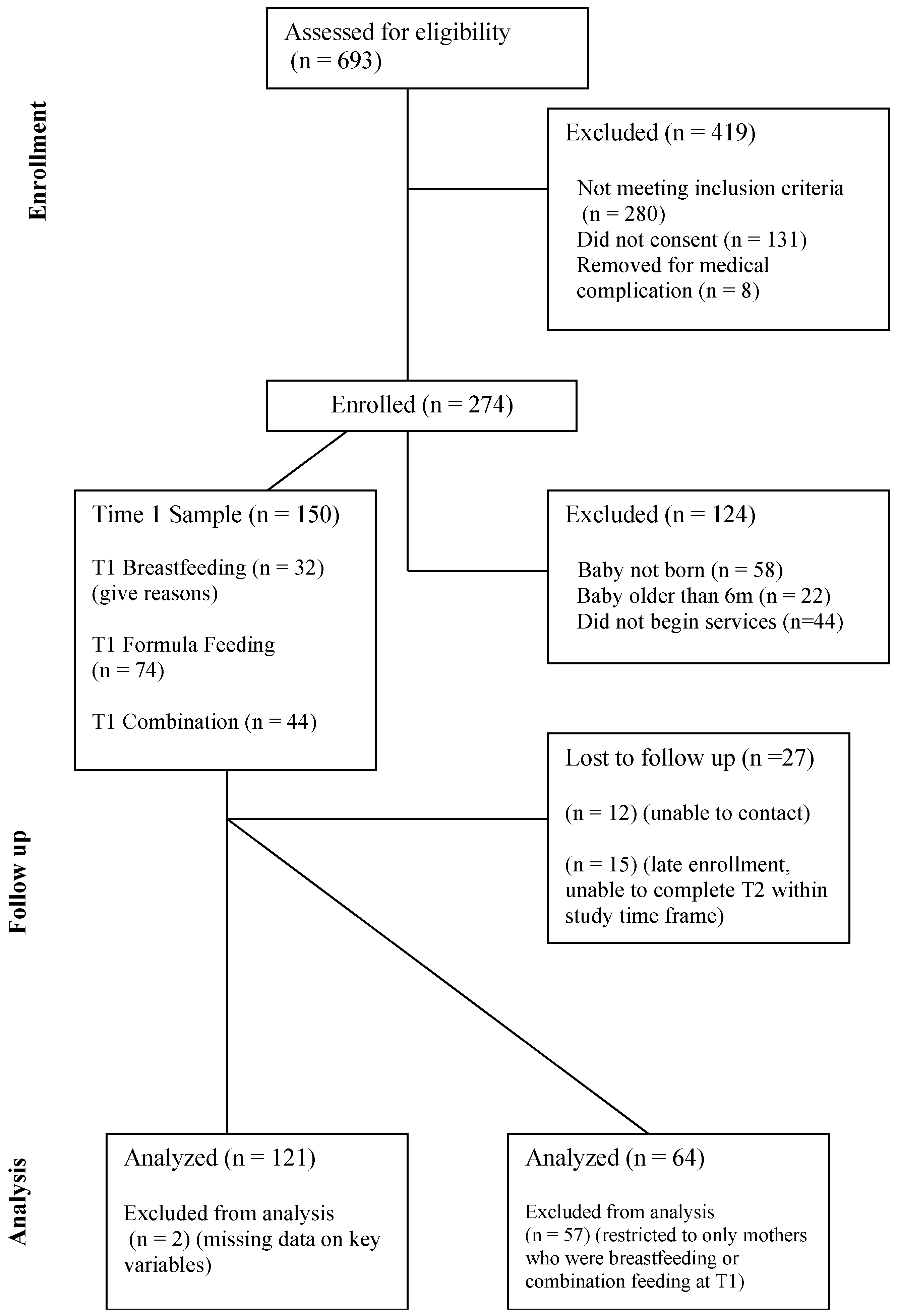
All mothers in this study received home visitation services and were recruited for participation in the TN Dad program by their home visitation agency. Any mother receiving services was eligible if they spoke English and identified a participating father (i.e., the biological father or father figure of the infant) who also agreed to participate. Mothers had the opportunity to provide data up to three times and received a $40 gift card for each completed survey. A total of 268 mothers agreed to participate in TN Dad. For the current study, the sample was restricted to mothers who completed the Time 1 survey (n = 245) and whose child had been born at Time 1 but was under six months of age (n = 164) and had responded to the Time 2 survey (n = 123). Less than 1% of all data was found to be missing; however, two participants were removed for missing information on parenting self-efficacy. The final sample of 121 mothers were included in the study whether exclusively breastfeeding (19.8%, n = 24), exclusively formula feeding (47.1%, n = 57), or combination feeding (33.1%, n = 40). For the second analysis, only mothers who were breastfeeding or combination feeding at Time 1 were included. No mothers who were formula feeding at Time 1 transitioned to any breastfeeding at Time 2. For a participant flow diagram, see Figure 1.

2.4. Measurement

Demographic information, including mothers’ age, race, education level, infant age, and infant prematurity, was collected at Time 1. At Time 2 mothers were asked if they were working a job for pay. All mothers who indicated they were not working were coded 0 (not working) and those who were working part-time or full-time were coded 1 (working). At both time points mothers were asked, “Is baby breastfed, formula fed, or both?” Based on their response, mothers were coded 1 (breastfeeding), 2 (formula feeding), or 3 (combination feeding) for Time 1. Mothers who were breastfeeding in any capacity (exclusive or in combination with formula) at Time 1 but not Time 2 were coded 0 (did not continue breastfeeding) while mothers who were breastfeeding in any capacity at both Time 1 and Time 2 were coded 1 (continued breastfeeding). Additionally, mothers who indicated they were both breastfeeding and formula feeding at Time 1 were coded 1 (supplementing) and mothers who indicated they were only breastfeeding at Time 1 were coded 0 (not supplementing).
Parenting self-efficacy was measured using the seven items that make up the Efficacy Subscale of the Parenting Sense of Competence Scale [33]. Mothers responded to each question on a Likert-scale ranging from 1 (strongly disagree) to 4 (strongly agree). Specific questions are shown in Table 1. Scores for each question were averaged to create a scale score with a higher score indicating a higher level of parenting self-efficacy (α = 0.75).

2.5. Data Collection

Data for this study were collected between July 2016 and July 2017. Participants were recruited and screened for the study as they were enrolled in home visitation during the third trimester of pregnancy, or during the early post-partum period. As participants were deemed eligible and provided informed consent via phone, they were asked to complete a baseline survey (Time 1). Trained interviewers used a standardized script to reduce the likelihood of altering the data collection process in response to any participant characteristics. Approximately four months following the baseline survey participants were again contacted via phone to complete a second survey (Time 2). Data were stored, and participant confidentiality was maintained, in accordance with our IRB-approved plan.

2.6. Data Analysis

Data were analyzed using Stata version 16. Two responses were removed from analysis for missing data on key variables; all other cases contained no missing values, allowing for complete case analysis. Preliminary analyses were conducted to determine if there were significant differences between groups (i.e., breastfeeding, combination feeding, and formula feeding) for each demographic variable. Ordinal (i.e., education level and employment status) and nominal variables (i.e., infant prematurity, relationship type, and race) were compared using chi-square tests of homogeneity. Independent sample t-tests were used for continuous variables (e.g., mothers’ age).
The outcome variables of initial infant feeding and continued breastfeeding were regressed on parenting self-efficacy while controlling for infant age and relevant demographic variables in the most parsimonious model. A multinomial logistic regression was used to test for differences among initial infant feeding methods (i.e., breastfeeding, formula feeding, and combination feeding). A binary logistic regression was to test for differences in continued breastfeeding from Time 1 to Time 2, and the analysis was limited to mothers who were combination feeding or exclusively breastfeeding at Time 1. The continued breastfeeding model also controlled for Time 1 supplementation. Results were reviewed to obtain a p-value for the full model as well as associated odds (i.e., RRR, OR) for significant variables (p < 0.05).

3. Results

3.1. Preliminary Analyses

Mothers in the full sample had a mean age of 23.8 years. Most mothers in the full sample were cohabiting (44.6%, n = 54) or married (34.7%, n = 42); other mothers had non-residential partners (15.7%, n = 19) or were single (5%, n = 6). Of those participants in the full sample who had graduated high school or earned a GED (82.6%, n = 100), 24% (n = 29) had attended college, and 5% (n = 6) had earned a college degree. On average, mothers reported high parenting self-efficacy (M = 3.6, SD = 0.38, range 2–4). Full participant details can be found for the full analysis and restricted breastfeeding continuation analysis in Table 2 and Table 3, respectively.
For the second regression model, the analysis was restricted to only mothers who were breastfeeding in some capacity at Time 1 (n = 64). As the Time 2 measure occurred approximately four months after Time 1, infants were, on average, 5.9 months old (range 114 days old to 331 days old). Although preliminary testing showed no significant differences between these groups, mothers who were breastfeeding or combination feeding at Time 1 were slightly older than the full sample with a mean age of 25.2 years (SD = 5.4). These mothers had higher rates of being married (40.6%, n = 26) or cohabiting (43.7%, n = 28). The racial identification was slightly different, with 64% (n = 41) identifying as White, 21.9% (n = 14) identifying as Black.
Prior to building models, each potential predictor variable was evaluated for the strength of the relationship with the outcome variable. Ordinal and nominal variables were examined using chi-square tests of homogeneity while independent samples t-tests were used for continuous variables. To increase power and parsimony of the model, only relevant predictors were included in each model. Linearity of continuous variables with respect to the logit of the dependent variable was assessed via the Box–Tidwell procedure.

3.2. Initial Breastfeeding

Our first aim was to examine associations between initial infant feeding method and parenting self-efficacy, controlling for relevant demographics including infant age. Results from the Hosmer–Lemeshow test [34] suggest this model fit the data adequately (p = 0.72). An R2 value of 0.25 indicates the model explained 25% of the variance in the outcome. A post hoc power analysis was run using Gpower version 3.1.9.7 [35]. Input parameters were two-tailed test, Pr = 0.4, N = 121, α = 0.05, and various specified odds ratios, aiming for Power (1–β) > 0.8. Results suggest the sample of 121 was sufficient for larger effects (e.g., OR/RRR > 2.85), but not small effects in the model.
Parenting self-efficacy was a significant predictor of infant feeding method. Using formula feeding as the comparison group, mothers with higher parenting self-efficacy were less likely to be exclusively breastfeeding (RRR = 0.09, CI [0.02, 0.42], p < 0.01) or combination feeding (RRR = 0.21, CI [0.06, 0.78], p = 0.02). Other significant predictors were mother’s education and racial identification. Compared to formula feeding mothers, mothers with higher education were 2.4 times more likely to be combination feeding (CI [1.17, 4.88], p = 0.02) and 2.9 times more likely to be exclusively breastfeeding (CI [1.15, 7.43], p = 0.02). Mother’s racial identification predicted differences between formula feeding and combination feeding but there were no differences noted between exclusively formula feeding and exclusively breastfeeding mothers. Compared to formula feeding mothers, mothers who identified as Black were 2.9 times more likely to be combination feeding (CI [1.33, 6.14], p < 0.01). All other variables were non-significant (see Table 4).

3.3. Continued Breastfeeding

Our second aim was to examine associations between continued breastfeeding and parenting self-efficacy, controlling for relevant demographics, infant age, and earlier supplementation. Results from the Hosmer–Lemeshow test suggest this model fit the data adequately (p = 0.55). An R2 value of 0.19 indicates the model explained 19% of the variance in the outcome. A post hoc power analysis was run using Gpower [35]. Input parameters were a two-tailed test, Pr = 0.4, N = 64, α = 0.05, and various specified odds ratios, aiming for Power (1–β) > 0.8. Results suggest the sample of 64 was sufficient for larger effects (e.g., OR > 4.5), but not small effects in the model.
While parenting self-efficacy was not a significant predictor of continued breastfeeding in this population, it is crucial to emphasize that the power to detect smaller effects was limited in this study. An association between parenting self-efficacy and continued breastfeeding may exist but was not identified in these results. Significant results included infant age, supplementation, and mothers’ work status. Mothers were more likely to have continued breastfeeding when their infant was older (i.e., four months old compared to one month old) at the time they completed the first survey (OR = 1.03, CI [1.01, 1.05], p < 0.01). Mothers were less likely to continue breastfeeding if they were supplementing at Time 1 (OR = 0.14, CI [0.02, 0.77], p = 0.02), or if they were not working at Time 2 (OR = 0.16, CI [0.03, 0.76], p = 0.02). No other variables were significant in the model (see Table 5).

4. Conclusions

This study aimed to explore the relationship between infant feeding methods (i.e., exclusively breastfeeding, formula feeding, or combination feeding) with mother’s parenting self-efficacy. Prior research often emphasizes the association between structural factors (e.g., demographics) and breastfeeding, but these disparities are likely reflective of system barriers and do provide an avenue for intervention. Parenting self-efficacy, on the other hand, is a frequent target of intervention [21], and higher parenting self-efficacy has been associated with desirable nutrition-related behaviors [1,14,17].
Self-efficacy theory [13] provides a foundation for understanding behavior. Behavioral expectations may be influenced by vicarious experiences and social norms. A person’s domain-level self-efficacy (e.g., parenting self-efficacy) is then built as the individual perceives success in domain level behaviors (e.g., caring for their child), especially when such behaviors are reinforcing social expectations (i.e., typical cultural practices).
To our knowledge, this is the first longitudinal study to explore the relationship between parenting self-efficacy and a variety of infant feeding behaviors and only the third study to explore these relationships cross-sectionally. Thus, this study could initiate a conversation about the role of parenting self-efficacy in current infant feeding practices, including formula feeding and combined formula and breastfeeding, and serve as a foundation for future nutrition and health behaviors.
The first model tested whether parenting self-efficacy or other relevant demographics predicted initial infant feeding (Time 1). Our second model tested whether parenting self-efficacy predicted continued breastfeeding while controlling for relevant demographic variables, infant age, and whether mothers were combination feeding (i.e., supplementing) at Time 1. The models predicted 25% or less of the variance in the outcome, suggesting other factors may be influencing infant feeding and should also be considered. For the first model, results showed that mothers with higher parenting self-efficacy were more likely to be combination feeding or exclusively formula feeding, rather than exclusively breastfeeding, although this was a small effect compared to other predictors. Parenting self-efficacy was not predictive in the second model after controlling for other relevant predictors, although the power to detect such an association was limited in this study. Thus, while results from both models contrast with our hypothesis that mothers who were or continued breastfeeding would report higher levels of self-efficacy, conclusions regarding continuation of breastfeeding and self-efficacy should be made with caution.
Only two prior studies that explored the association between breastfeeding and parenting self-efficacy were found. Results for the first model support those of Hernandez [18] who reported higher parenting self-efficacy when breastfeeding intensity was lower but partially contradict the findings of Botha and colleagues [19]. Similar to studies on breastfeeding self-efficacy, Botha et al. reported that mothers reported higher parenting self-efficacy in the first week postpartum when successfully enacting breastfeeding. In the current study, this connection was not seen. Mothers who continued to breastfeed did not show significantly higher levels of parenting self-efficacy.
Self-efficacy theory posits that successful enactment of a desired behavior increases feelings of efficacy. Similarly, social reinforcement of behaviors increases feelings of efficacy. Thus, our results could be interpreted in the following ways. It could be that mothers in this study were successfully enacting their chosen infant feeding method, or the method that was socially normative for them. However, without understanding the mother’s initial plans for infant feeding, this is speculative. Prior research does suggest successful breastfeeding is associated with higher breastfeeding or parenting self-efficacy. However, infant feeding behaviors in lower-income populations are complex [36] and many lower-income mothers report a preference for bottle feeding [7] or for the known ingredients and nutrition in formula [25]. Perhaps this sample of lower-income felt reinforced for or preferred formula or combination feeding and felt that they were successful in their enactment. A theme in qualitative breastfeeding research is that lower income mothers often feel judged and unsupported in their infant feeding choices [37]. It is possible that negative social reinforcement could serve to decrease parenting self-efficacy, until the behavior is changed or until positive reinforcement is found through different avenues. A comparison of breastfeeding and parenting self-efficacy may be warranted, along with consideration of mother’s feeding attitudes and infant feeding intentions.
Another possibility is that mothers who were exclusively breastfeeding may have experienced challenges in their experience or could be negatively reinforced for their choice. Breastfeeding can often be a challenging experience [7]; such challenges might equate to unsuccessful enactment of the behavior and could temporarily decrease self-efficacy. This could explain why parenting self-efficacy predicted infant feeding in the first six months but not continued breastfeeding. However, this is speculative, and causality cannot be determined without understanding the specific barriers faced by mothers. Again, it is important to note that mothers who continued breastfeeding may have experienced higher self-efficacy compared to those who did not, but this analysis was not powerful enough to detect that difference. Further research with a larger sample could elucidate differences. The reciprocal relationships between self-efficacy, behavior, and social reinforcement of infant feeding norms over time should be explored in future research.
Several other factors were found to be predictive of infant feeding in these models. In the first model, mothers with higher levels of education were more likely to be breastfeeding or combination feeding, which aligns with existing research and federal data [3]. While this association is common, it is not well explained by prior research. It is possible that mothers with higher levels of education may have greater knowledge, more normative experiences with breastfeeding, or resources that allow them to resolve breastfeeding challenges; these speculations should be explored in the future.
The other demographic variable that predicted infant feeding in the first model was mother’s racial identification. Previous research [25,38] has reported mothers who identify as Black are less likely to breastfeed than other racial groups. In the current study, we found that mothers identifying as Black and other minority races were more likely to be combining formula and breastfeeding than exclusively formula feeding. Quantitative breastfeeding research has often treated racial identity as a causal mechanism or fixed category and has not adequately addressed the complex relationship with medical professionals [39] and history of breastfeeding experienced by Black women [40]. Thus, we recommend interpreting this finding with caution. While we suggest that mothers identifying as Black may be more likely to supplement with formula (i.e., combination feeding) due to a lack of institutional support for exclusive breastfeeding in this population [40], this is hypothetical and such mechanisms and barriers were not directly measured in this study. Specific barriers to breastfeeding for Black mothers include discrepancies in maternity care and birth outcomes, parental leave, workplace breastfeeding support, and medical racism [39]. It is important for future researchers to consider racial identity and center this topic intentionally [40] to identify ways in which Black mothers can be supported and reduce broader social and structural barriers to breastfeeding success, rather than contributing feeding choices to individual-level characteristics.
In the second model, continued breastfeeding was predicted by the infant’s age, mother’s work status, and whether the mother was supplementing with formula at Time 1. With regard to infant age, it is unsurprising that mothers were more likely to continue breastfeeding when their baby was older at Time 1. Likely, these mothers had established the breastfeeding relationship and potentially overcome the obstacles that often lead to cessation [7]. A return to work is a common reason for breastfeeding cessation, especially when the infant is younger, and mothers have not had the opportunity to establish the breastfeeding relationship. Although breastfeeding and pumping in the workplace are protected, lower-income women are more likely to be employed in positions that are incompatible with breastfeeding such as service positions or those with less workplace flexibility and support [41] and individual workplace characteristics and supports have the potential to impact breastfeeding success. In fact, the return to work’s negative impact on breastfeeding duration is a concern world-wide [42]. Support from colleagues and employers is positively associated with breastfeeding. While workplace support may vary, lower-income women also tend to have less-flexible positions and reduced or nonexistent leave policies, work becomes a significant barrier to continued breastfeeding. The significance of formula supplementation provides a most meaningful avenue for intervention as supplementation is a common practice that has been associated with breastfeeding cessation [43]. Associations between parenting self-efficacy and breastfeeding duration and exclusivity should be considered in the future.

5. Implications for Research and Practice

The present study revealed an interesting negative association between breastfeeding and parenting self-efficacy. This association may be driven by challenges or successes in the enactment of breastfeeding behaviors or through social reinforcement for infant feeding choices. Given the age and specificity of the sample, results of this study may not be generalizable to the broader population, and the reciprocal nature of behavior and efficacy should be considered when interpreting these findings. Future research may repeat this study, with consideration of sample size and other potential confounding variables that may influence infant feeding outcomes.
As lower income mothers are at specific risk for not breastfeeding or ceasing breastfeeding early, it is especially important to promote breastfeeding in this population. Through a lens of self-efficacy theory, normalizing breastfeeding, engaging family and community members in positively reinforcing breastfeeding, and providing sufficient support through breastfeeding challenges could serve to increase breastfeeding uptake or duration and parenting self-efficacy concurrently. Specific interventions for lower-income mothers might include incorporating information on breastfeeding into general health education, increasing breastfeeding incentives for WIC participants, or prenatal breastfeeding education that includes partners and extended family. Future research should continue to explore associations between parenting self-efficacy and infant feeding (especially formula feeding and combination feeding) with specific attention to intervening on social norms or providing positive reinforcement for breastfeeding.

6. Limitations

The results of this study should be considered in light of the following limitations. First, the use of secondary data limits our ability to control the timing and specificity of measurements. This limits our ability to make strong causal claims or identify the true mechanisms whereby self-efficacy is impacted by infant feeding. Because some infants were six months old at Time 1 our study likely did not capture mothers who had ever breastfed and had discontinued breastfeeding prior to the Time 1 survey. Thus, it is likely that this study underestimates the number of mothers who ever breastfed. Furthermore, information regarding the duration of breastfeeding or specifics of supplementation (i.e., amount/frequency) was unavailable. Thus, this study does not contribute to an understanding how duration of breastfeeding or intricacies of supplementation impact self-efficacy. A relatively modest sample size of 121 mothers for initial infant feeding and 64 for continued breastfeeding likely limited our ability to detect smaller effects or to explore potential differences by subpopulation. Results should be interpreted cautiously, as coefficient estimates may be less stable and associated with wider confidence intervals. Furthermore, mothers engaged in any breastfeeding at Time 2 were included together to improve the sample size, rather than exploring only exclusive breastfeeding. In addition, we did not have information on previous infant feeding experiences or breastfeeding intentions, two factors that have been shown to influence breastfeeding outcomes for lower-income mothers [7]. While the results of this study provide some insight into the connections between parenting self-efficacy and infant feeding in this specific population, these results should be considered broad associations within the specific population, rather than specific causal relationships for all breastfeeding mothers.

Author Contributions

Program development and data collection, H.E.S.; conceptualization, R.G.R.; writing—original draft, R.G.R.; writing—review and editing, R.G.R., H.E.S. All authors have read and agreed to the published version of the manuscript.

Funding

This study was supported by Tennessee Department of Health (34347-51816).

Institutional Review Board Statement

The study was conducted in accordance with the Declaration of Helsinki and approved by the Institutional Review Board of the University of Tennessee (UTK IRB-16-02963-FB) on 9 May 2019.

Informed Consent Statement

Informed consent was obtained from all subjects involved in this study.

Data Availability Statement

The raw data supporting the conclusions of this article will be made available by the authors upon request.

Conflicts of Interest

The authors declare no conflicts of interest. The funders had no role in the design of this study, in the collection, analyses, or interpretation of data, in the writing of this manuscript, or in the decision to publish the results.

References

  1. Keebe, M.; Altazan, A.D.; Beyl, R.A.; Gilmore, L.A.; Redman, L.M. Infant feeding varies across eating behavior and feeding modalities in mothers with low income. J. Nutr. Educ. Behav. 2022, 54, 827–834. [Google Scholar] [CrossRef]
  2. Stuebe, A.M.; Schwarz, E.B. The risks and benefits of feeding practices for women and their children. J. Perinatol. 2010, 30, 155–162. [Google Scholar] [CrossRef]
  3. Centers for Disease Control and Prevention Breastfeeding Among, U.S. Children, National Immunization Survey. Available online: https://www.cdc.gov/breastfeeding-data/breastfeeding-report-card/index.html (accessed on 1 October 2025).
  4. Orozco, J.; Echeverria, S.E.; Armah, S.M.; Dharad, J.M. Household food insecurity, breastfeeding, and related feeding practices in US infants and toddlers: Results from NHANES 2009–2014. J. Nutr. Educ. Behav. 2020, 52, 588–594. [Google Scholar] [CrossRef] [PubMed]
  5. Tennessee Department of Health. Breastfeeding Data and Statistics. Available online: https://www.tn.gov/health/bf.html (accessed on 1 October 2025).
  6. Hornsby, P.P.; Gurka, K.K.; Conaway, M.R.; Kellams, A.L. Reasons for early cessation of breastfeeding among women with low income. Breastfeed. Med. 2019, 14, 375–381. [Google Scholar] [CrossRef]
  7. Rozga, M.R.; Kerver, J.M.; Olson, B.H. Self-reported reasons for breastfeeding cessation among low-income women enrolled in a peer counseling breastfeeding support program. J. Hum. Lact. 2015, 31, 129–137. [Google Scholar] [CrossRef] [PubMed]
  8. Mannion, C.A.; Hobbs, A.J.; McDonald, S.W.; Tough, S.C. Maternal perceptions of partner support during breastfeeding. Int. Breastfeed. J. 2013, 8, 4. [Google Scholar] [CrossRef] [PubMed]
  9. Rollins, N.C.; Bhandari, N.; Hajeebhoy, N.; Horton, S.; Lutter, C.K.; Martines, J.C.; Victoria, C.G. Why invest, and what it will take to improve breastfeeding practices? Lancet 2016, 387, 491–504. [Google Scholar] [CrossRef]
  10. Meedya, S.; Fahy, K.; Kable, A. Factors that positively influence breastfeeding duration to 6 months: A literature review. Women Birth 2010, 23, 135–145. [Google Scholar] [CrossRef]
  11. de Jager, E.; Broadbent, J.; Fuller-Tyszkiewicz, M.; Skouteris, H. The role of psychosocial factors in exclusive breastfeeding to six months postpartum. Midwifery 2014, 30, 657–666. [Google Scholar] [CrossRef]
  12. Glassman, M.E.; McKearney, K.; Saslaw, M.; Sirota, D.R. Impact of breastfeeding self-efficacy and sociocultural factors on early breastfeeding in an urban, predominantly Dominican community. Breastfeed. Med. 2014, 9, 301–307. [Google Scholar] [CrossRef]
  13. Bandura, A. Self-efficacy: Toward a unifying theory of behavioral change. Psychol. Rev. 1977, 84, 191–215. [Google Scholar] [CrossRef] [PubMed]
  14. Zhou, X.; Tian, Y.; Cai, Z.; Li, L.; Wu, Y.; Zeng, G.; Feng, J.; Rozelle, S.; Raat, H.; Zhou, H. Associations between personality traits, self-efficacy and complementary feeding behavior among infant caregivers in western rural China. Matern. Child Nutr. 2025, 21, e70021. [Google Scholar] [CrossRef] [PubMed]
  15. Hu, S.; Wacharasin, C.; Sangin, S. Factors associated with feeding behaviors among mothers of obese infants: A cross-sectional study. Transl. Pediatr. 2025, 12, 1004–1016. [Google Scholar] [CrossRef]
  16. Chong, A.; Biehle, S.N.; Kooiman, L.Y.; Mickelson, K.D. Postnatal depression: The role of breastfeeding efficacy, breastfeeding duration, and family-work conflict. Psychol. Women Q. 2016, 40, 518–531. [Google Scholar] [CrossRef]
  17. Bahorski, J.S.; Childs, G.D.; Loan, L.A.; Azueo, A.; Morrison, S.A.; Chandler-Laney, P.C.; Hodges, E.A.; Rice, M.H. Self-efficacy, infant feeding practices, and infant weight gain: An integrative review. J. Child Health Care 2018, 23, 286–310. [Google Scholar] [CrossRef]
  18. Hernandez, I.F. Acculturation, Self-Efficacy and Breastfeeding Behavior in a Sample of Hispanic Women. Ph.D. Thesis, University of South Florida, Tampa, FL, USA, 2014. [Google Scholar]
  19. Botha, E.; Helminen, M.; Kaunonen, M.; Lubbe, W.; Joronen, K. Mothers’ parenting self-efficacy, satisfaction and perceptions of their infants during the first days postpartum. Midwifery 2020, 88, 102760. [Google Scholar] [CrossRef]
  20. Lau, C.Y.K.; Lok, K.Y.W.; Tarrant, M. Breastfeeding duration and the theory of planned behavior and breastfeeding self-efficacy framework: A systematic review of observational studies. Matern. Child Health J. 2018, 22, 327–342. [Google Scholar] [CrossRef]
  21. Brenner, P.S.; Serpe, R.T.; Stryker, S. Role-specific self-efficacy as a precedent and product of the identity model. Sociol. Perspect. 2018, 61, 57–80. [Google Scholar] [CrossRef]
  22. Bridge, G. Consider the whole picture when discussing infant formula and breast milk. J. Nutr. 2021, 151, 1375–1377. [Google Scholar] [CrossRef]
  23. Schulze, P.A.; Carlisle, S.A. What research does and doesn’t say about breastfeeding: A critical review. Early Child Dev. Care 2010, 180, 703–718. [Google Scholar] [CrossRef]
  24. Swanson, V.; Power, K.G. Initiation and continuation of breastfeeding: Theory of planned behavior. J. Adv. Nurs. 2005, 50, 272–282. [Google Scholar]
  25. Hardison-Moody, A.; MacNeil, L.; Elliott, S.; Bowen, S. How social, cultural, and economic environments shape infant feeding for low-income women: A qualitative study in North Carolina. J. Acad. Nutr. Diet 2018, 118, 1886–1894. [Google Scholar] [CrossRef] [PubMed]
  26. Kaufman, L.; Deenadayalan, S.; Karpati, A. Breastfeeding ambivalence among low-income African American and Puerto Rican women in north and central Brooklyn. Matern. Child Health J. 2010, 14, 696–704. [Google Scholar] [CrossRef] [PubMed]
  27. DeVane-Johnson, S.; Woods-Giscombé, C.; Thoyre, S.; Fogel, C.; Williams, R., 2nd. Integrative Literature Review of Factors Related to Breastfeeding in African American Women: Evidence for a Potential Paradigm Shift. J. Hum. Lact. 2017, 33, 435–444. [Google Scholar] [CrossRef] [PubMed]
  28. Guzzo, K.B.; Lee, H. Couple relationships status and patterns in early parenting practices. J. Marriage Fam. 2008, 70, 44–61. [Google Scholar] [CrossRef]
  29. Gibson-Davis, C.M.; Brooks-Gunn, J. The association of couples’ relationship status and quality with breastfeeding initiation. J. Marriage Fam. 2007, 69, 1107–1117. [Google Scholar] [CrossRef]
  30. Alghamdi, S.; Hroodynski, M.; Stommel, M. Racial and ethnic differences in breastfeeding, maternal knowledge, and self-efficacy among low-income mothers. Appl. Nurs. Res. 2017, 37, 4–27. [Google Scholar] [CrossRef]
  31. Stolz, H.E.; LaGraff, M.R.; Mullican, K.N.; Connor, L.A.; Green, M.J.; Clouthier, S. Exploring fathers’ engagement with home visiting: The Tennessee dad project. Fam. Soc. 2020, 101, 498–513. [Google Scholar] [CrossRef]
  32. US Census Bureau. Quick Facts: Tennessee. Available online: https://www.census.gov/quickfacts/TN (accessed on 1 April 2023).
  33. Gibaud-Wallston, J.; Wandersmann, L.P. Development and utility of the Parenting Sense of Competence Scale. In Proceedings of the Meeting of the American Psychological Association, Toronto, ON, Canada, 27–30 August 1978. [Google Scholar]
  34. Hosmer, T.H.; Lemeshow, S. Goodness-of-fit tests for the multiple logistic regression model. Commun. Stat. 1989, 9, 1043–1069. [Google Scholar]
  35. Erdfelder, E.; Faul, F.; Buchner, A. GPOWER: A general power analysis program. Behav. Res. Methods Instrum. Comput. 1996, 28, 1–11. [Google Scholar] [CrossRef]
  36. Houghtaling, B.; Byker Shanks, C.; Jenkins, M. Likelihood of breastfeeding within the USDA’s Food and Nutrition Service Special Supplemental Nutrition Program for Women, Infants, and Children population. J. Hum. Lact. 2017, 33, 83–97. [Google Scholar] [CrossRef]
  37. Almeida, R.; Alvarez Gutierrez, S.; Whaley, S.E.; Ventura, A.K. A qualitative study of breastfeeding and formula-feeding mothers’ perceptions of and experiences in WIC. J. Nutr. Educ. Behav. 2020, 52, 615–624. [Google Scholar] [CrossRef]
  38. Merewood, A.; Bugg, K.; Burnham, L.; Krane, K.; Nickel, N.; Broom, S.; Edwards, R.; Feldman-Winter, L. Addressing racial inequities in breastfeeding in the southern United States. Pediatrics 2019, 143, e20181897. [Google Scholar] [CrossRef] [PubMed]
  39. Davis, D.A. Reproductive Injustice: Racism, Pregnancy, and Premature Birth; New York University Press: New York, NY, USA, 2019. [Google Scholar]
  40. Carter, S.K.; Stone, A.; Graham, L.; Cox, J.M. Creating intersectional subjects: A critical discourse analysis of health science breastfeeding research. Sociol. Race Ethn. 2022, 8, 129–144. [Google Scholar] [CrossRef]
  41. Whitley, M.; Banks, A. Work as an understudied driver of racial inequities in breastfeeding. New Solut. 2022, 32, 189–200. [Google Scholar] [CrossRef]
  42. Chang, Y.; Harger, L.; Beake, S.; Bick, D. Women’s and employers’ experiences and views of combining breastfeeding with a return to paid employment: A systematic review of qualitative studies. J. Midwifery Women’s Health 2021, 66, 641–655. [Google Scholar] [CrossRef] [PubMed]
  43. McCoy, M.B.; Heggie, P. In-hospital formula feeding and breastfeeding duration. Pediatrics 2020, 146, e20201221. [Google Scholar] [CrossRef]
Figure 1. Participant flow diagram.
Women 06 00025 g001
Table 1. Descriptive statistics for parenting self-efficacy (N = 121).
QuestionRangeMeanSD
1. The problems of taking care of a child are easy to solve once you know how your actions affect your child.1–43.600.568
2. I would make a fine model for a new mother to follow to learn what she would need to know to be a good parent.1–43.430.722
3. Being a parent is manageable, and any problems are easily solved.1–43.240.814
4. I meet my own personal expectations for caring for my child.1–43.700.526
5. If anyone can find the answer to what is troubling my child, I am the one.1–43.660.622
6. Being a parent feels familiar to me now.1–43.730.585
7. I believe I have all the skills necessary to be a good mother.1–43.780.451
Table 2. Participant demographics–analysis of initial infant feeding N = 121.
Characteristic MSDRange
Infant Age Time 1 (days) 67.146.81–183
Infant Age Time 2 (days) 181.351.672–331
Mother’s Age (years) 23.85.216–40
Characteristic  N%
Infant GenderMale5343.8
Female6856.2
Infant PrematurityYes3428.0
Mother’s EducationSome High School2016.5
Diploma/GED6352.1
Some College2924.0
Technical/Trade School21.6
Bachelor’s Degree43.3
Graduate Degree21.6
Mother’s Work StatusNot Working8469.4
Maternity Leave129.9
Working at Least 20 h per Week2419.8
Mother’s Relationship TypeMarried4234.7
Partnered/Cohabiting5444.6
Non-Residential Partner1915.7
Single64.9
Mother’s RaceAsian/Pacific Islander1<1.0
American Indian1<1.0
Black or African American2621.5
Hispanic32.5
White8469.4
Multiple Races43.3
Prefer Not to Answer1<1.0
Table 3. Participant demographics–analysis of continued breastfeeding N = 64.
Characteristic MSDRange
Infant Age Time 1 (days) 58.046.01–180
Infant Age Time 2 (days) 169.451.272–285
Mother’s Age (years) 23.95.216–40
Characteristic  N%
Infant GenderMale3351.5
Female3148.5
Infant PrematurityYes1320.0
Mother’s EducationSome High School69.4
Diploma/GED2945.3
Some College2132.8
Technical/Trade School23.1
Bachelor’s Degree46.2
Graduate Degree23.1
Mother’s Work StatusNot Working4164.1
Maternity Leave812.5
Working at Least 20 h per Week1523.4
Mother’s Relationship TypeMarried2335.9
Partnered/Cohabiting2945.3
Non-Residential Partner1015.6
Single23.1
Mother’s RaceAsian/Pacific Islander11.6
American Indian11.6
Black or African American1523.4
Hispanic34.7
White3960.9
Multiple Races46.2
Prefer Not to Answer11.6
Table 4. Multinomial Regression Model: predicting Time 1 infant feeding (N = 121).
CharacteristicRRR95% CIp Value
BreastfeedingMother’s self-efficacy *0.090.02, 0.420.002
Mother’s age1.000.88, 1.140.979
Mother’s education a**2.921.15, 7.430.024
Mother’s race b1.960.64, 6.020.237
Relationship type c0.540.27, 1.090.085
Infant prematurity d0.270.06, 1.180.082
Baby’s age (Time 1)0.990.97, 1.000.135
Combination FeedingMother’s self-efficacy *0.210.06, 0.0780.019
Mother’s age0.990.91, 1.090.848
Mother’s education a**2.391.17, 4.880.017
Mother’s race b**2.861.33, 6.140.007
Relationship type c0.720.39, 1.130.282
Infant prematurity d0.400.13, 1.250.114
Baby’s age (Time 1)0.990.98, 1.000.138
Note. Formula feeding is the reference category. a mother’s education: 1 = less than HS diploma, 2 = HS diploma, 3 = some college, 4 = college degree. b mother’s race: 0 = White, 1 = Black, 2 = other minority race. c relationship type 0 = married, 1 = cohabiting, 3 = single. d infant prematurity 0 = full term, 1 = premature. Note. * small effect; ** strong effect.
Table 5. Odds ratios, robust standard errors, and 95% confidence intervals for the logistic regression of continued breastfeeding self-efficacy (N = 64).
Odds RatioStandard Errorsp-Value95% Confidence Interval
Mother’s self-efficacy3.583.170.1491.6320.28
Mother’s education a3.412.510.0940.8114.41
Mother’s race b0.530.410.4120.122.42
Mother’s employment c (Time 2) **0.160.130.0210.030.76
Infant age (Time 1) *1.030.010.0061.011.05
Supplementation d**0.140.120.0240.020.77
Note. Continued breastfeeding is the reference category. a mother’s education: 1 = less than HS diploma, 2 = HS diploma, 3 = some college, 4 = college degree. b mother’s race: 0 = White, 1 = Black, 2 = other minority race. c employment type 0 = not working, 1 = working a job for pay. d supplementation 0 = exclusive breastfeeding at Time 1, 1 = combination feeding at Time 1. Note. * small effect; ** strong effect.
Disclaimer/Publisher’s Note: The statements, opinions and data contained in all publications are solely those of the individual author(s) and contributor(s) and not of MDPI and/or the editor(s). MDPI and/or the editor(s) disclaim responsibility for any injury to people or property resulting from any ideas, methods, instructions or products referred to in the content.