


Abstract
Hydraulic fracturing enhances productivity in low-permeability reservoirs. The introduction of nanomodified gels for hydraulic fracturing has raised the need to revise traditional approaches to their breakdown, as nanoparticles significantly change the kinetics and mechanisms of degradation. In this paper, for the first time, a systematic experimental study of the effects of chemical breakers on the rheological properties of nanomodified guar gels has been conducted. Two commercial oxidative breakers were used, which generate free radicals and cleave the guar polymer backbone, reducing viscosity. The effect of breaker concentration (0–1.82 wt%), as well as the concentration, size, and morphology of nanoparticles on gel breaking, has been studied. Guar gum was used as a gelling agent, and spherical SiO2 and Al2O3 nanoparticles, as well as aluminum oxide nanofibers (ANFs), were used as additives. An increase in breaker concentration accelerates gel breaking. For instance, at 0.68 wt% breaker, complete degradation occurs in about 3 h, whereas at 1.82 wt% it takes only about half an hour, with the viscosity dropping to 30 mPa·s. While nano-additives can either slow down or accelerate degradation depending on their type, size, and concentration, the addition of 0.4 wt% ANFs prolong the degradation time to more than two hours even at the highest breaker concentration. These effects are attributed to the competition between polymer chain scission by free radicals and the formation of physical crosslinks mediated by nanoparticles. The results demonstrate the possibility of purposefully controlling the kinetics of breaking of nanomodified gels for hydraulic fracturing by optimally selecting the breaker composition and nano-additive parameters.
1. Introduction
With the depletion of conventional hydrocarbon reserves, the development of unconventional oil and gas resources has become critically important to global energy supply, with hydraulic fracturing being the most widely used technology for their commercial development [1]. Therefore, hydraulic fracturing, as the most common method for developing unconventional oil and natural gas reserves, retains its high importance and is considered important for ensuring energy security [2]. In recent years, as a result of active developments in the field of increasing oil production, the effectiveness of this method has increased significantly. It has been successfully used under increasingly difficult geophysical conditions (temperatures up to 200 °C, pressures above 150 MPa, high salinity of waters in strata) [3]. Such deposits pose unique challenges for engineers. One of the urgent tasks relates to the heat resistance and rheological properties of hydraulic fracturing fluids [3,4,5].
The use of gels in oil production processes has become a common practice in oil fields [6]. Gel solutions are preferred for suspension of proppant and its transport and are therefore widely used in hydraulic fracturing in deep formations [7]. According to the review [8], systems based on natural plant gums and their derivatives are in high demand, accounting for about 90% of all currently used thickeners in the world. Of these, the traditional gel-forming agent guar gum shows the optimal ratio of indicators for the distribution of proppant over cracks. It thickens liquids perfectly, is resistant to temperatures and salinity, and is the cheapest among biopolymers. The viscosity of the fracturing fluid must be carefully balanced. Too low viscosity causes premature proppant settling and poor fracture conductivity. Too high viscosity increases pumping friction and, more importantly, may lead to incomplete gel breaking, resulting in formation damage and reduced well productivity. Numerous studies and reviews describe the physical and chemical mechanisms that ensure the effectiveness of guar. For example, the authors of [6] describe a natural mechanism that causes the hydration of polymer molecules due to hydrogen bonds between the polymer and water, while the addition of substituents to the guar molecule increases the number of such bonds and, moreover, increases the thermal oxidative and salt stability of the polymer. In [4], this mechanism of chemical modification of guar (derivatization) is most often analyzed in more detail in hydroxypropylguar or carboxymethylhydroxypropylguar. To work in deep wells, boron-based crosslinkers and metal crosslinking agents are added to the linear gel, which have been studied by many authors. Crosslinking occurs due to the binding of metal ions to the cis-hydroxyl groups of galactose side chains [6,9].
Modification of polymer liquids with nanoparticles offers broad application prospects in hydraulic fracturing, as nanoparticles can significantly alter the rheological properties of polymer solutions and gels. The improvement in rheological properties is strongly correlated with the phase behavior of nanoparticles, and a controlled degree of aggregation is essential for optimal rheological enhancement [10]. The underlying mechanism lies in nanoparticle aggregation, creating physical crosslinking nodes within the polymer network. Small aggregates connect multiple polymer chains through hydrogen bonding, which increases network density and restricts macromolecular mobility, thereby enhancing viscosity. However, excessive aggregation leads to large clusters that weaken the gel, highlighting the critical need to balance aggregation and dispersion [10].
Building on this principle, specific nanomaterials demonstrate tailored effects on gel characteristics. For instance, cellulose nanofibers enable the synthesis of supramolecular polymer gels characterized by high compressive strength, good heat resistance, and high degradation ability [11]. Incorporating nanoparticles allows reducing the breaker content in fracturing fluids while preserving their rheological properties [12]. The reinforcement arises from hydrogen bonding between the surface groups of nanoparticles, such as –Si–O– and –Si–OH, and the functional groups on polymer chains; this restricts thermal motion and forms a reinforced network [10,11,12]. Nanoparticles also serve as nucleation centers, which inhibit the autoassociation of guar molecules and promote a more homogeneous gel structure, thus simplifying subsequent degradation [10,12]. Furthermore, nanoparticles reduce asphaltene deposition and improve oil viscosity in field tests [13], and their synergistic effects with surfactants have been demonstrated for hydrocarbon filtration and interfacial tension reduction [14,15].
The multifunctional role of nanoparticles addresses several technological and economic challenges simultaneously, including reducing breaker consumption, protecting the reservoir, regulating asphaltene deposition, and lowering oil viscosity. These effects rely on physical crosslinking and phase transitions during gel-to-liquid conversion, ensuring both gel strength and controlled degradation. The practical relevance is supported by field trials, confirming readiness for industrial implementation.
Notably, the efficacy of these mechanisms depends not only on nanoparticle concentration but also on their geometric configuration. Beyond concentration, the geometry of nano-additives plays a decisive role in determining the rheological properties of gels. Spherical SiO2 nanoparticles restrain polymer aggregation, which yields a more homogeneous and durable gel structure [16]. In contrast, carbon nanotubes offer a larger surface area for polymer interaction, thereby reinforcing the gel matrix and generating significantly higher viscosity compared to spherical particles [17]. This distinction also manifests in heat resistance: gels containing carbon nanotubes maintain higher viscosity at elevated temperatures than those with spherical nanoparticles, even at substantially lower concentrations. Similar enhancements in heat resistance have been documented for hydrogels with cellulose nanofibres [6,17].
In previous studies, our research team conducted the first systematic investigation of the effect of nano-additives on the properties of crosslinked hydraulic fracturing gels [18,19]. The range of key parameters for nano-additives was studied: the concentration in gels ranged from 0.01 to 0.8 wt%, and the average particle size fell within the range of 11–216 nm. In terms of composition and morphology, spherical nanoparticles of silicon and aluminum oxides, aluminum oxide nanofibers, and single-walled carbon nanotubes were used. The temperature ranged from 25 to 70 °C. The study examined the effects of crosslinking on colloidal stability, viscosity, wettability, filtration losses, surface tension, and capillary absorption rate of crosslinked gels. For the first time, the non-monotonic dependencies of all the studied gel characteristics on the size and concentration of nanoparticles were established. The optimal concentration of nanoparticles for controlling the properties of the gel is 0.05–0.2 wt% for spherical nanoparticles and 0.05 wt% for carbon nanotubes, while the optimal average particle size was determined to be 70–80 nm. These results open up the prospect of more predictable management of the hydraulic fracturing process.
The productive development of models of “strong” gels has generated a classic contradiction, which is that the fracturing fluid has high stability during the working phase of injection, and after completing its work, it completely collapses [4,8]. According to the authors [5], in the active phase of hydraulic fracturing, the polymer concentration in the liquid increases 5–7 times during the process. The injections and cracks are closed due to the filtration phenomenon. Destroying such a liquid is problematic.
In high-temperature layers, degradation usually occurs naturally over time. To speed up this process, a breaker is added to the hydraulic fracturing fluid [5]. Fracturing gel breakers reduce the viscosity of the liquid, either cleaving polymer molecules or disintegrating the mesh, while chelating the crosslinking molecules. Three main types of chemicals are used to destroy polymer molecules: enzymes, oxidants, and acids [9]. Biological enzymes use catalytic degradation, which converts polymer chains into monosaccharides and disaccharides. This reduces the adhesion between the particles of the filtration sludge. As a result, the filtration sludge becomes more porous and easier to remove [3]. However, due to their low thermal stability, bioenzymes can be used at layer temperatures up to 60 °C; otherwise, the protein begins to break down. In addition, biological enzymes most often have little effect on liquids made from synthetic polymers [5]. The limitation of enzymes is also the narrow pH range in which they act as breakers (pH 3–8) with a peak at pH = 5 [20]. Oxidative breakers are more common. They generate free radicals, which provoke the rupture of the polymer chain into components with a lower molecular weight [6]. Some types of inorganic oxidizing agents (bromine) are suitable for working in layers at high temperatures [5]. Oxidant-based systems operate in the pH range from 3 to 14 [20]. Acidic breakers destroy the gel structure, reducing the pH of the hydraulic fracturing fluid [5], but they also have their drawbacks, in particular, when in contact with carbonate in the reservoir, the breaker reacts earlier with the reservoir than with the working fluid [20]. A newer type of breakers can be considered encapsulated breakers. They are designed to slow the release of the gel breaker and ensure that the polymer liquid completely destroys the gel after the proppant is laid [21,22]. However, the speed at which the breaker leaves the capsule is affected by so many factors that, in real-world reservoir conditions, monitoring the response time of an encapsulated breaker becomes an extremely difficult technical task [7,9]. The issue of the completeness of the destruction of guar gels continues to be very acute. Despite all its advantages, guar gum has the peculiarity of forming an insoluble residue that clogs pores and impairs conductivity, thereby causing irreparable damage to deposits [7,23,24]. The decrease in permeability by guar-based gels can reach 85% [6].
At the moment, the mechanisms of destruction of nanoparticle-modified gels have not been sufficiently studied. Most researchers are focused on the development of stabilized gels, while the processes of their destruction have been less well studied [9,23,25]. Enzymatic, oxidative, and acidic breakers were created for the most part for “ordinary” gels, but crosslinking using nanoparticles and subsequent destruction of such a system is much more complicated [19]. Data on how the shape and size of nanoparticles affect the operation of breakers are mostly fragmentary [6,12,19]. Research on the mechanisms of destruction of gels with nanoparticles is currently lagging behind the development of their stabilization.
The present study is aimed at obtaining systematic data on the relationship between the rheological characteristics of guar gum gels during degradation with nanoparticles of various sizes (18–114 nm) and shapes (spheres and fibers), depending on the breaker concentration (0.68–1.82 wt%). In contrast to our previous works [18,19], which focused on the equilibrium properties of fully cross-linked gels, the present study investigates the kinetics of degradation in linear gels in the presence of chemical breakers. This kinetic aspect is essential for controlling gel removal after hydraulic fracturing and complements our earlier findings on optimizing gel performance.
2. Materials and Methods
2.1. Materials
In this study, two breaker systems widely used in industrial hydraulic fracturing practice were employed as destructors: (1) the low-temperature breaker UpBLT (TU 20.59.59.-027-32110612-2019, Uralplast LLC, Yekaterinburg, Russia), and (2) the liquid breaker 3S24 (TU 20.59.42-010-05493384-2021, ZS POLYMERS LLC, Angarsk, Russia). Both reagents were introduced into the system in equal volume fractions. The total breaker concentration ranged from 0.68 to 1.82 wt%.
The breakers used belong to the class of oxidative destructors. According to the trademark registry data, the UpBLT breaker is classified as an organic peroxide-based composition (International Class 01—“peroxides; solutions of organic and inorganic peroxides in aqueous and non-aqueous media”). This confirms its affinity for the oxidative type of reagents that generate free radicals, initiating cleavage of the guar gum polymer chain. The exact chemical composition of the 3S24 product is proprietary and is not disclosed in open sources. However, given its functional purpose and application conditions, it also belongs to the class of oxidative breakers, which is consistent with patented analogs for similar systems.
The mechanism of action of oxidative breakers involves radical oxidation of glycosidic bonds in the polymer backbone, leading to a controlled reduction in gel viscosity. In the presence of activators (e.g., carboxylic acid esters), acid-catalyzed hydrolysis of borate crosslinks additionally occurs, enhancing the destruction of the polymer network. Thus, the introduction of breakers provides controlled degradation of the guar-based gel, which is essential for reducing the amount of insoluble residue that can impair formation conductivity.
A polymer based on guar gum (Water Gelling Agent J 580, Schlumberger Technology Corporation, Sugar Land, TX 77478, USA) was used as a gelling agent to create hydraulic fracturing gels. The mass concentration of the gelling agent in this series of experiments was 0.4 wt%. The concentration of 0.4 wt% was selected as it is typical for industrial fracturing fluids, providing an optimal balance between viscosity and cost efficiency [26].
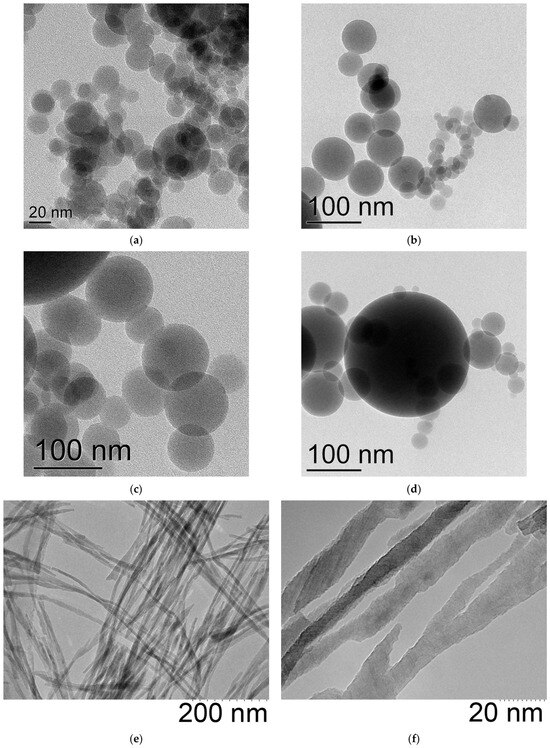
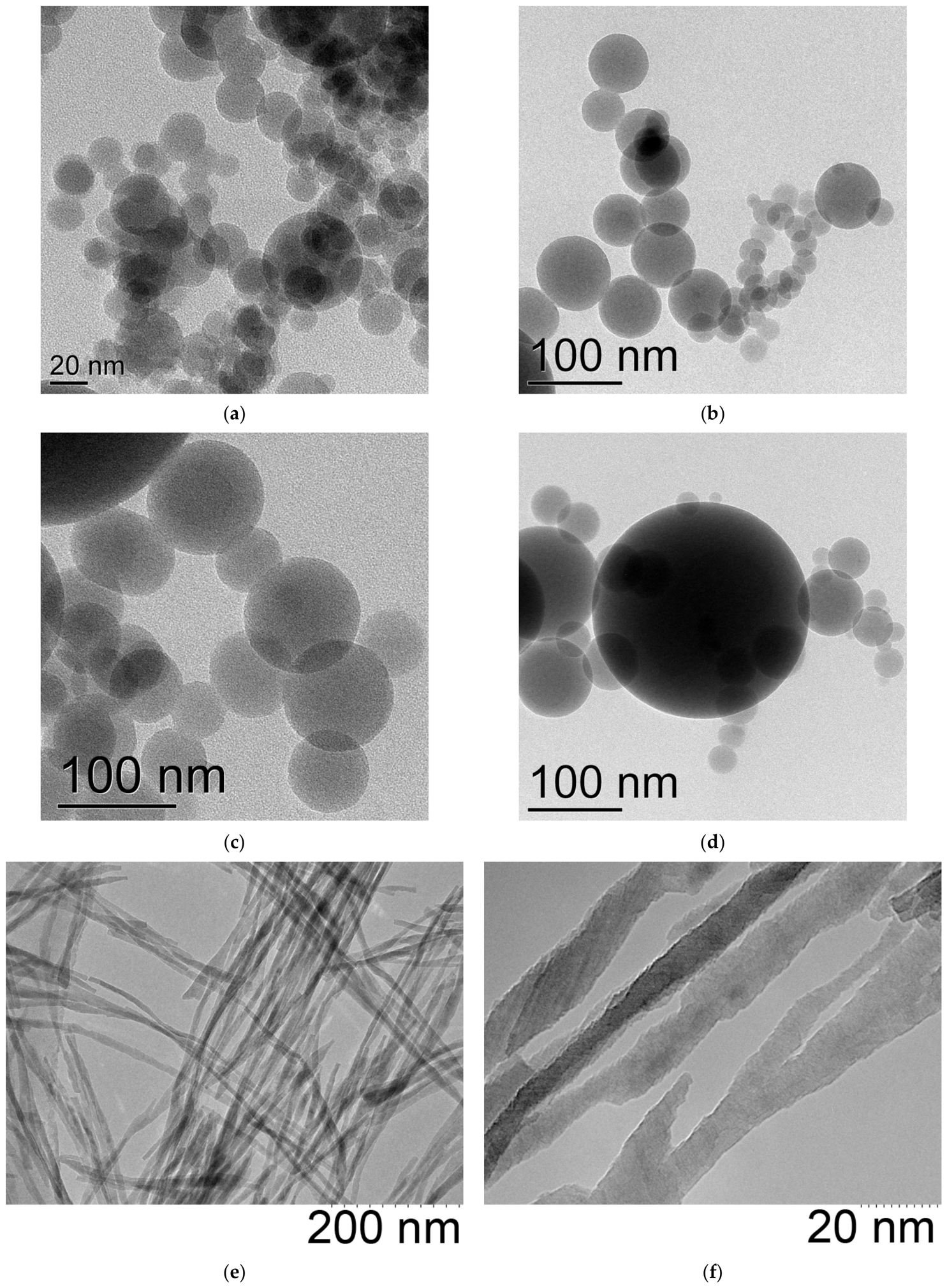
Spherical nanoparticles of silicon oxides (SiO2) of various sizes and aluminum oxide nanofibers (ANF) were used as nano-additives (Table 1). The morphology of representative nanomaterials is shown in Figure 1. The size of the nanoparticles ranged from 18 to 114 nm, and the mass concentration ranged from 0.2 to 0.8%.
Table 1.
Characterization of nano-additives.
Figure 1.
Transmission electron microscopy images of SiO2 spherical nanoparticles (a–d) and ANF (e,f). Specific surface area: (a) 149 m2/g; (b) 55 m2/g; (c) 30 m2/g; (d) 24 m2/g. Magnification: (e) ×50k; (f) ×300k.
ANFs were high-purity gamma alumina (γ-Al2O3), synthesized by the oxidation of molten aluminum, with a low content of impurities (no more than 1%). According to the TEM data (Figure 1e–f), the average diameter of individual fibers was 8.7 ± 2.4 nm. The initial macroscopic fibrous blocks are easily dispersed in an aqueous medium during shear and ultrasonic treatment, forming a suspension of individual nanofibers and their small bundles (3–5 fibers). The effective size (length) of such dispersed structures in suspension ranged from 200 to 1000 nm [27,28].
2.2. Methods
2.2.1. Nanoparticle Characterization
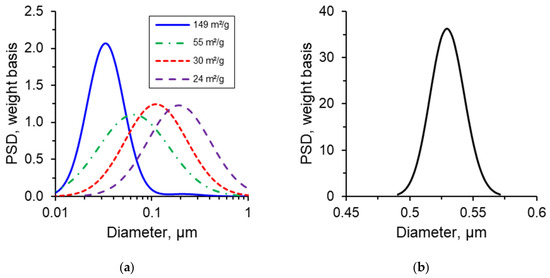
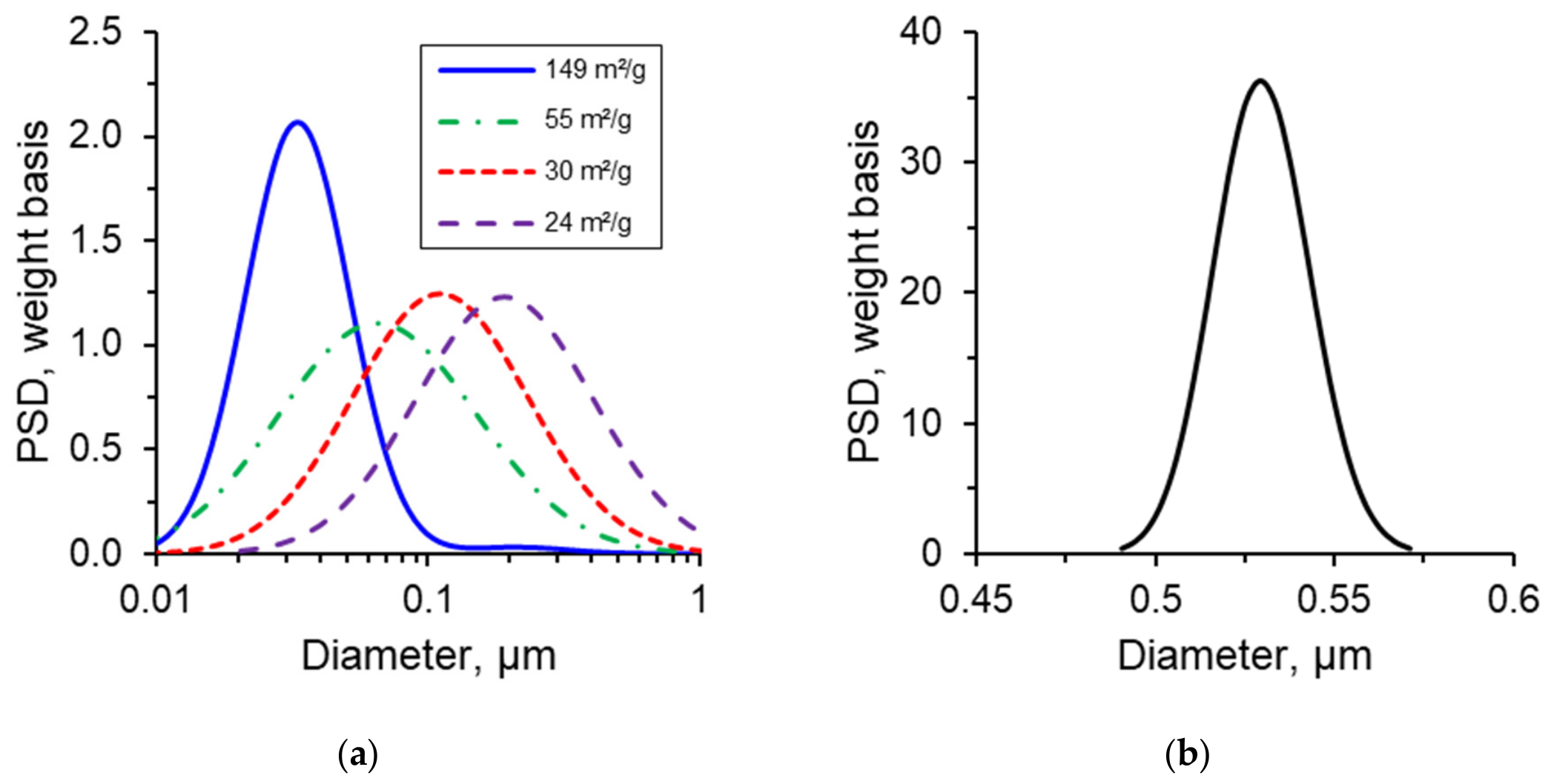
In addition to electron microscopy, the average effective size of nanoparticles was measured directly in the suspension. These measurements were carried out using an acoustic and electroacoustic spectrometer DT1202 (Dispersion Technology, Inc., Bedford Hills, NY, USA). This method is based on measuring ultrasonic attenuation and sound velocity in the dispersed system over a wide frequency range (1–100 MHz). Analysis of the attenuation spectrum allows calculation of the particle size distribution, including characterization of both spherical nanoparticles and high-aspect-ratio nanofibers directly in their native suspension state. The corresponding particle size distributions for silica and ANF nanoparticles are shown in Figure 2.
Figure 2.
Particle size distribution in the suspension: (a) SiO2; (b) ANF.
For spherical silicon dioxide nanoparticles, the measured average effective hydrodynamic diameters in suspension were 34 nm, 64 nm, 111 nm, and 191 nm, corresponding to nominal primary particle sizes of 18 nm, 50 nm, 90 nm, and 114 nm, respectively. This increase in effective size compared to the size of the primary particles is due to the formation of stable, non-aggregated hydrated layers around the nanoparticles and/or the presence of a small fraction of soft agglomerates, which are characteristic of well-dispersed colloidal systems.
Acoustic spectroscopy results for ANF revealed a monomodal distribution with an effective average size of approximately 500–530 nm. Since the mathematical processing of the attenuation spectra is based on a model assuming spherical particles, this value represents the effective hydrodynamic size of the dispersed nanofibers and their small bundles (usually 3–5 fibers) in an aqueous suspension. The true geometric parameters of the fibers, specifically an average diameter of 8.7 nm, were determined independently by transmission electron microscopy. The effective size of 500–530 nm is consistent with electron microscopy data and confirms the successful destruction of the initial macroscopic blocks to obtain a stable colloidal dispersion.
2.2.2. Preparation of Nanomodified Gels
The preparation of gels with nanoparticles was carried out in several stages. Initially, an aqueous suspension of nanoparticles was prepared. Nanosuspensions were prepared using a two-step method, a common approach for the synthesis of nanofluids. The required amount of nanoparticle powder was poured into a container with distilled water and subjected to mechanical stirring on a high-speed mixer for 15 min at 2000 rpm. The suspension was then processed using an ultrasonic dispersant UZTA-0.4/22-OM (Center for Ultrasonic Technologies of AltSTU LLC, Biysk, Russia) for 10 min to ensure uniform particle dispersion. A similar technique was used in the preparation of suspensions with ANF. After preparation of the suspension, the required amount of gelling agent was added to it and mixed on a high-speed PrinceCastle 152-18 stirrer (OFI Testing Equipment, Inc., Houston, TX 77065 USA) for 15 min to obtain a homogeneous polymer solution. A biopolymer of guar gum with a concentration of 0.4 wt% was used as a gelling agent and a breaker in a concentration that ranged from 0 to 1.82 wt%.
2.2.3. Rheological Measurements
The study was performed on a high-pressure and temperature viscometer HPHT OFITE 1100(OFI Testing Equipment, Inc., Houston, TX 77065 USA). The main technical characteristics of the viscometer are given in Table 2. All measurements were carried out at atmospheric pressure and a temperature of 298 K. Immediately after preparation of the gel with the breaker and nanoparticles, the dependence of its viscosity on the shear rate over time was measured. The spindle speed of the viscometer was in the range from 3 to 300 rpm, which corresponded to the range of shear rates from 5.1 to 510 s−1. The viscosity measurement error was 3%.
Table 2.
Technical characteristics of the OFITE 1100 viscometer.
3. Research Results and Discussion
3.1. Effect of Nanoparticle Concentration
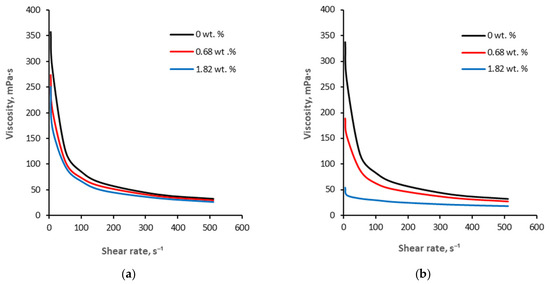
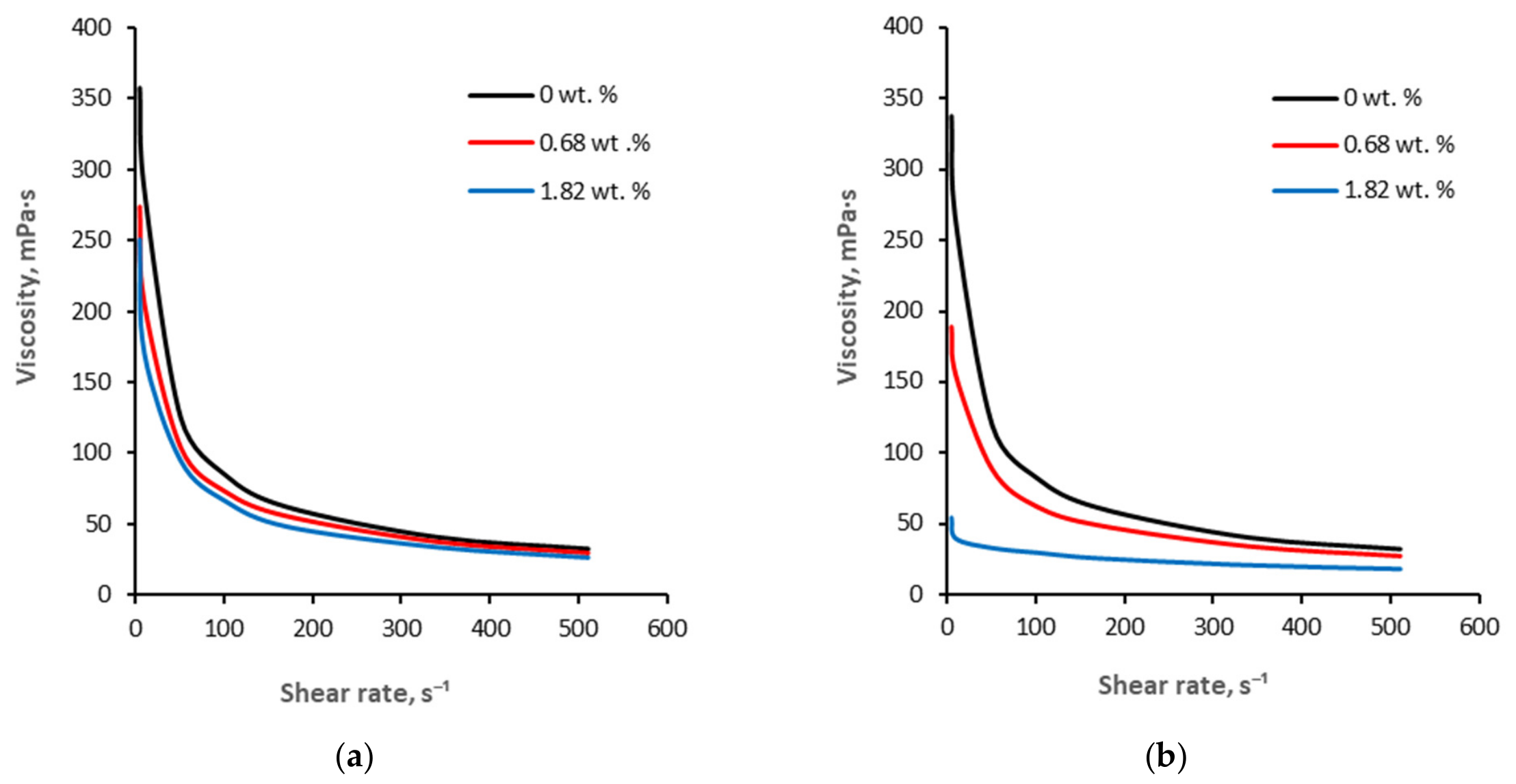
Typical results of measurements of the viscosity of gels from the shear rate at different concentrations of the breaker are shown in Figure 3. As can be seen, the presence of the breaker leads to the fact that the effective viscosity of the gel at low shear rates decreases fivefold within an hour, while the viscosity of the gel without the breaker remains practically stable. The analysis shows that as the concentration of the breaker increases, the viscosity decreases more. In this case, the dependence of the viscosity of the gel during degradation on the concentration of the breaker is close to linear.
Figure 3.
Dependence of the viscosity of the gels on the shear rate for different concentrations of the breaker at the initial time (a) and 1 h after preparation (b).
The observed nearly linear decrease in effective viscosity with increasing breaker concentration (at a fixed shear rate of 170 s−1) within the studied range (0–1.82 wt%) can be rationalized by macromolecular reaction kinetics. In this range, the rate of free radical generation is proportional to breaker concentration, leading to pseudo-first-order kinetics of chain scission. Consequently, the reduction in average molecular weight and, hence, viscosity exhibits a linear dependence on breaker concentration. This is consistent with guar degradation studies showing that a linear relationship between reciprocal molecular weight and degradation time is expected for this polymer [29]. Similar behavior has been reported for other polymer solutions [30]. However, this linearity is likely limited to the investigated range. At very low breaker concentrations, diffusion may limit the reaction, while at high concentrations, radical recombination may cause deviations. Notably, individual rheological parameters (consistency index, plastic viscosity, and yield stress) exhibit more complex, nonlinear behavior, reflecting the evolution of the gel network during degradation.
An analysis of the effect of nanoparticle additives on the behavior of the effective viscosity of gels with a breaker showed that the effect of nano-additives on the rheological characteristics of linear gels with a breaker generally follows the same patterns that we previously discovered for crosslinked gels without breakers [19]. This similarity arises because in both systems, nanoparticles modulate the balance between network formation and destruction. In crosslinked gels, they act as physical crosslinkers at low concentrations but cause shielding at high concentrations. In breaker-containing linear gels, they retard degradation by transient crosslinking at low concentrations but accelerate it by adsorbing chains and promoting radical attack at high concentrations. Thus, the non-monotonic dependence reflects the same underlying competition between structuring and destructuring effects [31].
Nanomaterial additives, depending on the concentration, size, material, and morphology of the particles, either increase or decrease the effective viscosity of gels with breakers, just as was the case for gels without a breaker. There is an optimal concentration and average size of nanoparticles that significantly increases the effective viscosity and rheological characteristics of gels with a breaker.
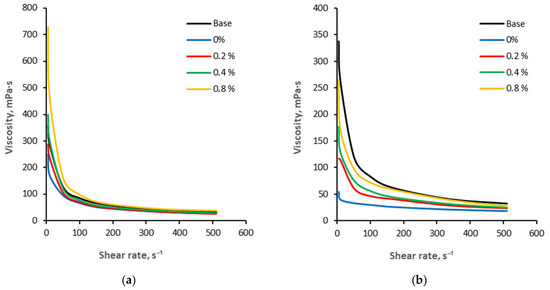
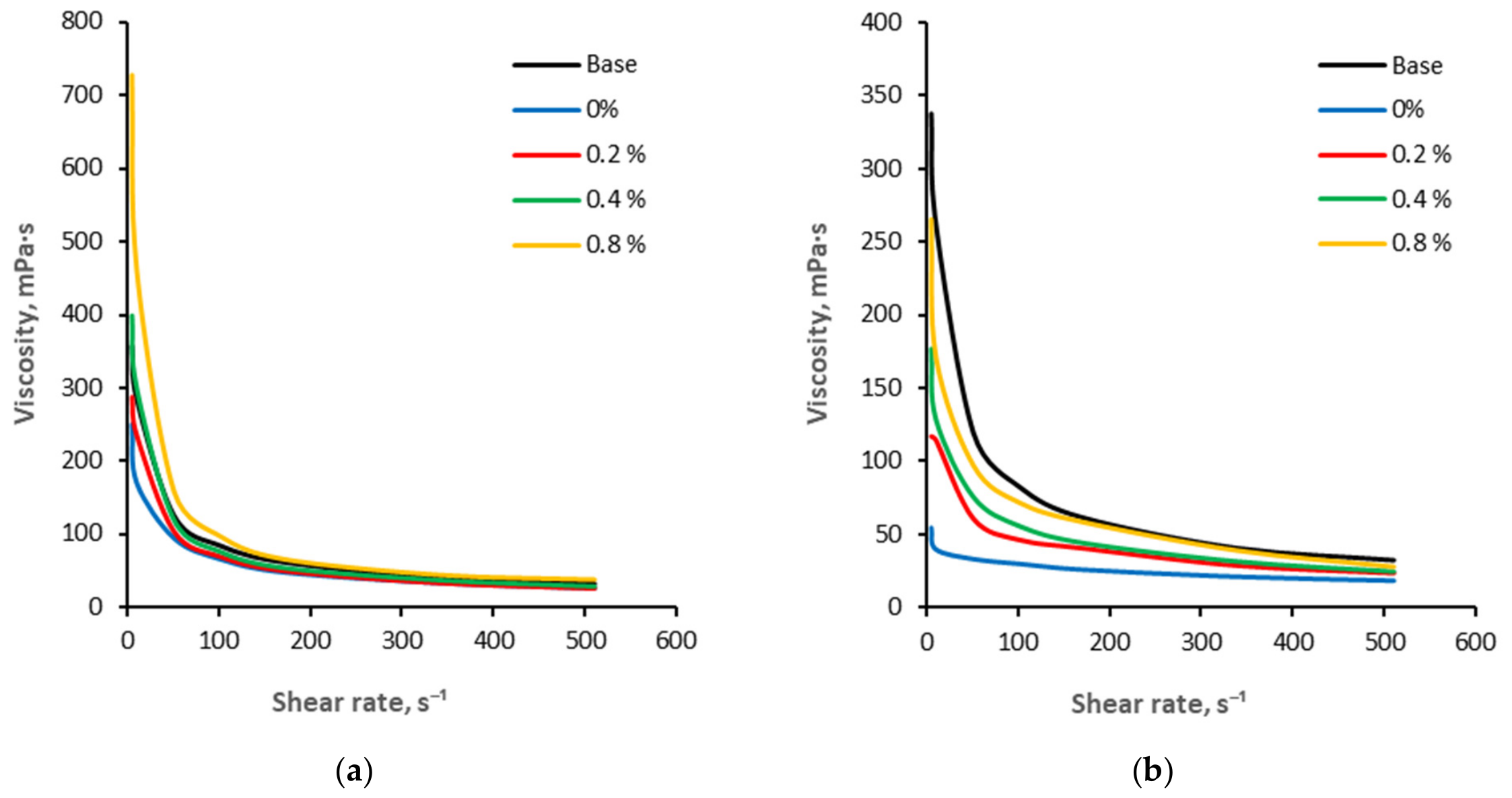
Figure 4 shows the dependence of viscosity on the shear rate of gels with a breaker when ANF is introduced into them with different concentrations. In this case, the introduction of nanofibers significantly increases the viscosity of the guar gel. At an additive concentration of 0.8 wt%, the effective viscosity of the gel increases by almost 5 times at low shear rates. This is mainly due to the morphology of these nanoparticles. Nanofibers have a high aspect ratio and tend to form spatial network structures in the volume of a liquid, similar to the structures of polymer molecules. For this reason, the addition of nanofibers, even at low concentrations, significantly increases the viscosity of dispersed systems. Moreover, at concentrations of more than 0.5%, aqueous suspensions of nanofibers tend to have a non-Newtonian behavior even without the introduction of a polymer [27]. For most spherical nanoparticles, aqueous suspensions become non-Newtonian at concentrations of more than 2 wt%.
Figure 4.
Dependence of the viscosity of gels on the shear rate for different concentrations of nanofibers at the initial time (a) and 1 h after preparation (b).
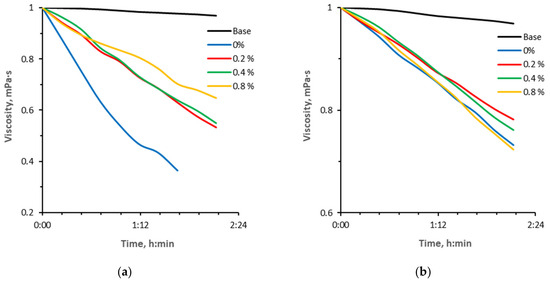
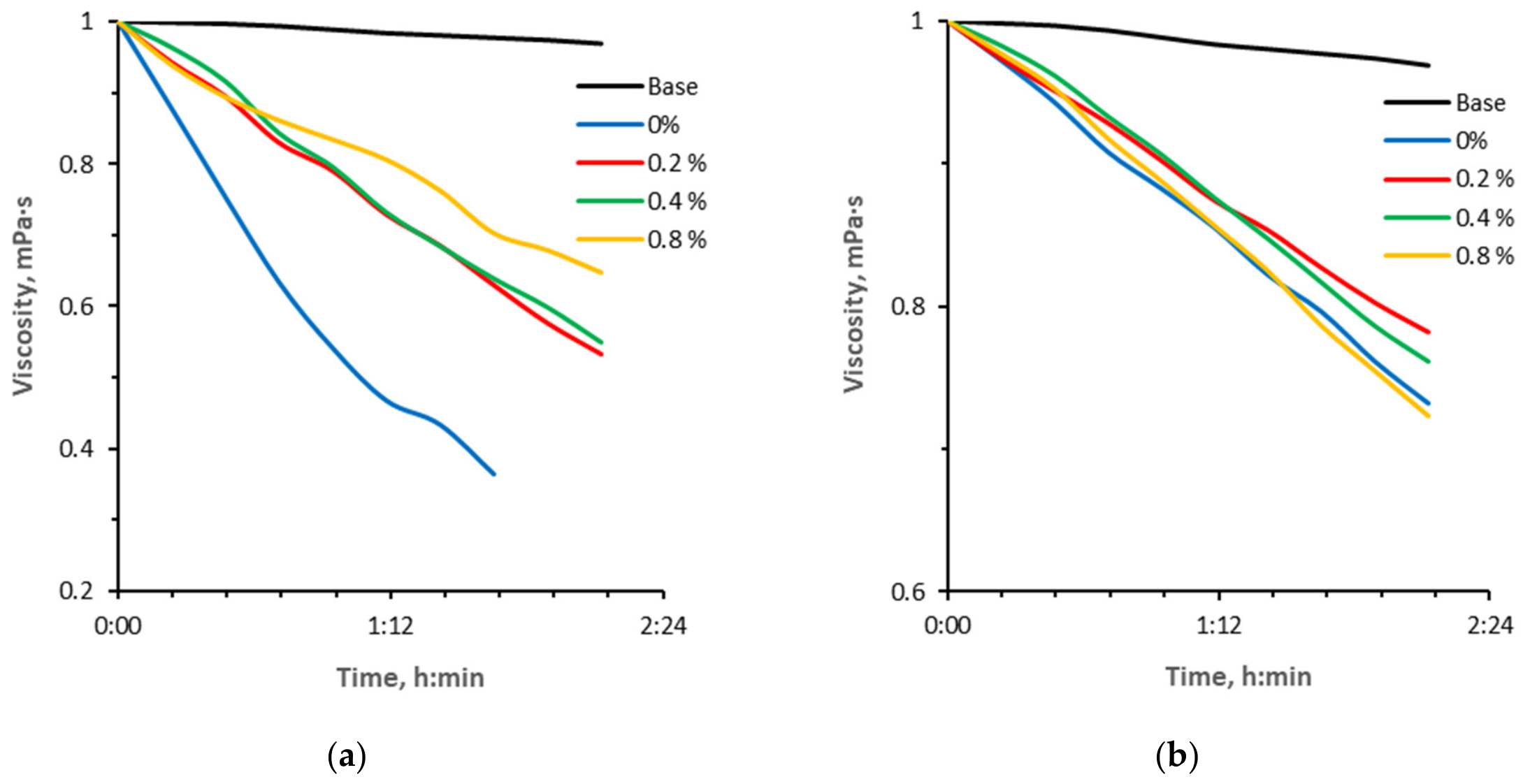
As a result, the time to gel destruction significantly changes for nanomodified gels when a breaker is added (Figure 5). It has been found that at concentrations of nanoparticles close to optimal due to an increase in effective viscosity, the time to reach the minimum viscosity during gel degradation increases significantly. For example, at a breaker concentration of 1.82 wt%, the gel viscosity value (at a shear rate of 170 s−1) drops by half in about an hour, and under similar conditions with the addition of 0.8% aluminum oxide nanofibers, the viscosity decreases by only 15% during this time (Figure 5a). This must be taken into account when designing the fracturing operation of nanomodified gels.
Figure 5.
Dependence of the relative viscosity (at a shear rate of 170 s−1) of gels without (base) and with a breaker of 1.82 wt% of the time at different concentrations of ANF (a) and SiO2 nanoparticles (50 nm) (b).
Spherical SiO2 nanoparticles have a different mechanism of action on the rheology of polymer solutions. Here, the main action of nanoparticles is to crosslink guar gum molecules. At the same time, the dependence of the polymer crosslinking process and rheology on the size and concentration of nanoparticles is nonlinear.
At low concentrations of nanoparticles, with an increase in their number, the degree of crosslinking and, consequently, the effective viscosity of solutions increases. At high concentrations of nanoparticles, due to electrostatic repulsion with micelles, nanoparticles prevent further crosslinking of guar molecules, and, accordingly, the viscosity begins to decrease [23]. This decrease is not caused by phase separation or severe aggregation.
As demonstrated in our previous work [18], the systems remain colloidally stable at high nanoparticle concentrations, as evidenced by low Turbiscan Stabilization Index values. Instead, the viscosity reduction is attributed to a shielding effect. At high concentrations, nanoparticle surfaces become saturated with adsorbed polymer layers, and electrostatic repulsion prevents interparticle bridging, thereby reducing the effective crosslink density.
Thus, there is an optimal concentration of nanoparticles at which the effective viscosity and rheological characteristics of nanomodified polymer solutions reach a maximum. In our work [19], it was shown that for silicon oxide nanoparticles, depending on their average size, this concentration is about 0.2 wt%. The results obtained for non-crosslinked gels with a breaker and the addition of silicon oxide nanoparticles (50 nm) generally confirm these conclusions (Figure 5b).
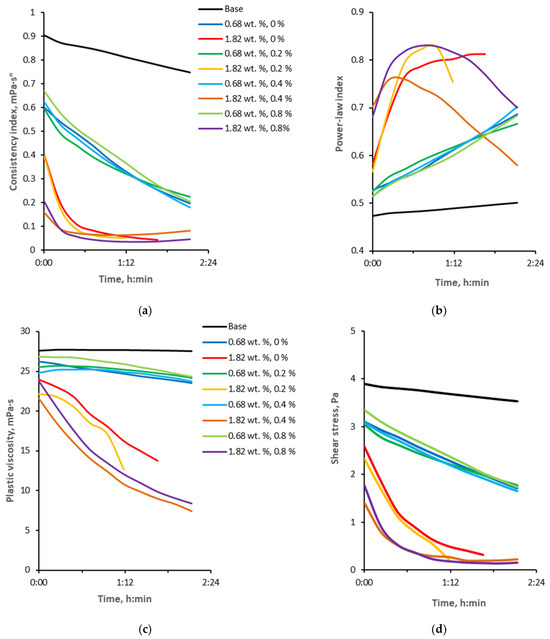
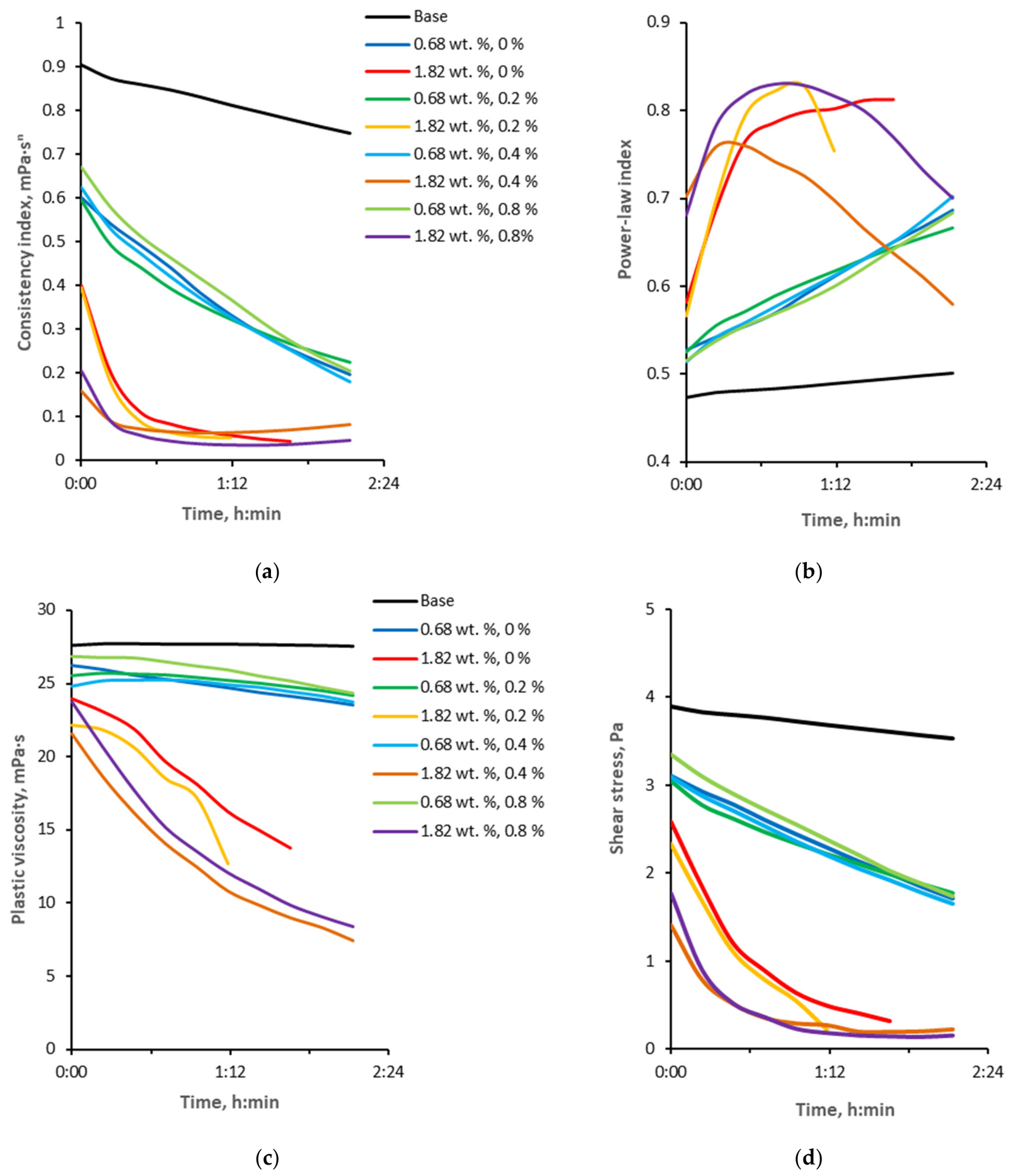
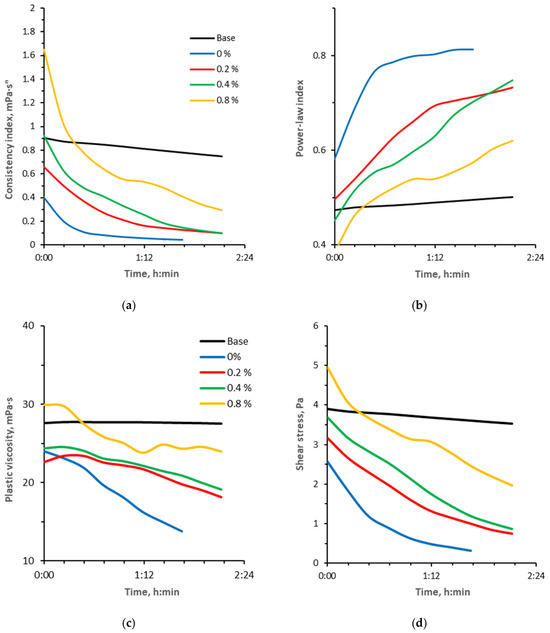
The dependencies of the viscosity coefficient μ on the shear rate , measured during the degradation of nanomodified gels, were approximated by two widespread rheological models of viscoplastic media. The power-law model and the Bingham model , were used, where is the plastic viscosity (mPa∙s), n is the power-law index, is the limiting shear stress (Pa), and K is the consistency index (Pa∙sn).
It should be noted that both the power-law and Bingham models were applied to the entire set of experimental data. However, the quality of approximation varied depending on the degradation stage. At the initial stages, the power-law model provided a superior fit (R2 > 0.998), whereas the Bingham model gave a lower coefficient of determination (R2 ≈ 0.979) for the same data. At the final stage, the Bingham model better described the experimental data (R2 > 0.974), while the power-law model showed a decreased fit (R2 ≈ 0.962). This quantitative comparison justifies the two-stage analysis. Figure 6 and Figure 7 present the temporal evolution of the parameters for each model, illustrating the gradual transition of the gel behavior from a viscoelastic network to a simpler fluid as degradation progresses.
Figure 6.
Behavior of rheological parameters of gels with different concentrations of the breaker and SiO2 nanoparticles: (a) consistency index; (b) power-law index; (c) plastic viscosity; (d) yield stress.
Figure 7.
Behavior of rheological parameters of the base gel and the gel with the breaker at a concentration of 1.82 wt% and various concentrations of ANF: (a) consistency index; (b) power-law index; (c) plastic viscosity; (d) yield stress.
As a result of the research, the time dependences of the rheological characteristics of nanomodified gels during the degradation process have been established. Typical results are shown in Figure 6 and Figure 7. The consistency index, plastic viscosity, and shear stress limit of nanomodified gels decrease with increasing breaker concentration, while the nonlinearity index, on the contrary, increases. Increasing the concentration of the breaker accelerates the process of gel degradation. So, in particular, at a breaker concentration of 0.68 wt% degradation of the gel occurs within about 3 h, and at a concentration of 1.82 wt% in about half an hour. Nano-additives, depending on their concentration, size, and type, can either prolong or accelerate this time. Thus, the addition of SiO2 nanoparticles significantly prolongs the degradation time (Figure 6).
The effect of SiO2 nanoparticles on gel properties depends on both the concentration of nanoparticles and the concentration of the breaker. The breaker causes polymer-chain scission in guar molecules, while SiO2 nanoparticles promote the formation of additional crosslinks. With a high content of both the breaker and nanoparticles, a noticeable decrease in viscosity is observed. Conversely, at lower concentrations of the breaker, the addition of nanoparticles slows down the process of gel destruction.
The dominance of the breaker at high concentrations of both components is not due to chemical deactivation of the nanoparticles but rather to kinetic factors. The breaker generates free radicals that rapidly and irreversibly cleave covalent bonds in the polymer backbone, whereas nanoparticles form weaker, dynamic hydrogen bonds with polymer chains. At high breaker concentrations, the rate of chain scission kinetically outpaces the formation of new hydrogen bonds between nanoparticles and polymer fragments [32].
Furthermore, at high nanoparticle concentrations, the particle surfaces become saturated with adsorbed polymer, potentially making the chains more accessible to radical attack. Consequently, the breaker kinetically dominates the degradation process, and viscosity reduction prevails over any crosslinking effect. These results demonstrate that by selecting appropriate concentrations of nano-additives, the time of gel degradation can be effectively controlled.
The observed non-monotonic dependencies of viscosity on nanoparticle concentration and size are consistent with findings reported in the literature. Mao et al. [21] demonstrated that nano-SiO2 significantly enhances the viscosity of guar solutions through physical crosslinking, with an optimal concentration above which the efficiency decreases. Wu et al. [33] demonstrated that the degree of formation damage after gel breaking depends on the residual viscosity, which aligns with our observation that achieving low residual viscosity is essential for effective gel removal. These comparisons confirm that our results are in good qualitative agreement with the existing literature, while providing new quantitative insights into the size and morphology effects of nanoparticles on degradation kinetics.
The effect of nano-additives on the destruction of the gel is complex and is determined by the concentration of both the nano-additives themselves and the breaker. In systems with high concentrations of both components, nanoparticles contribute to an accelerated decrease in viscosity. However, at moderate concentrations, they effectively slow down the destruction of the gel. By adjusting the ratio of nano-additives to the breaker, it is possible to control the service life of the gel in the reservoir. This, in turn, provides the basis for optimizing hydraulic fracturing parameters for various geological conditions.
3.2. Effect of Nanoparticle Size
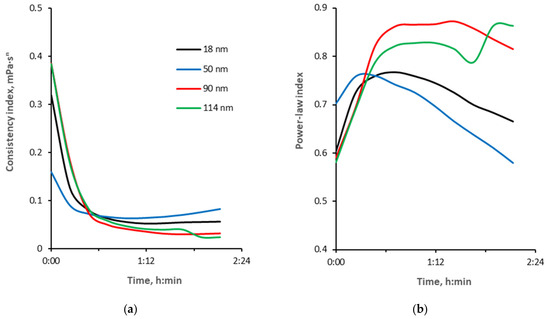
Next, the effect of nanoparticle size on the rate of destruction of nanomodified gels with a breaker was studied. Spherical silicon oxide nanoparticles were used as nano-additives. The size of the nanoparticles ranged from 18 to 114 nm, and the mass concentration in these experiments was 0.4%. The results of these experiments are shown in Figure 8. It was found that at the same concentration of nanoparticles, the rheological properties of gels significantly depend on their average size. The dependence of viscosity on the average particle size is an important property of nanosuspensions. In contrast, suspensions containing micron-sized additives usually do not exhibit pronounced size-dependent rheological properties.
Figure 8.
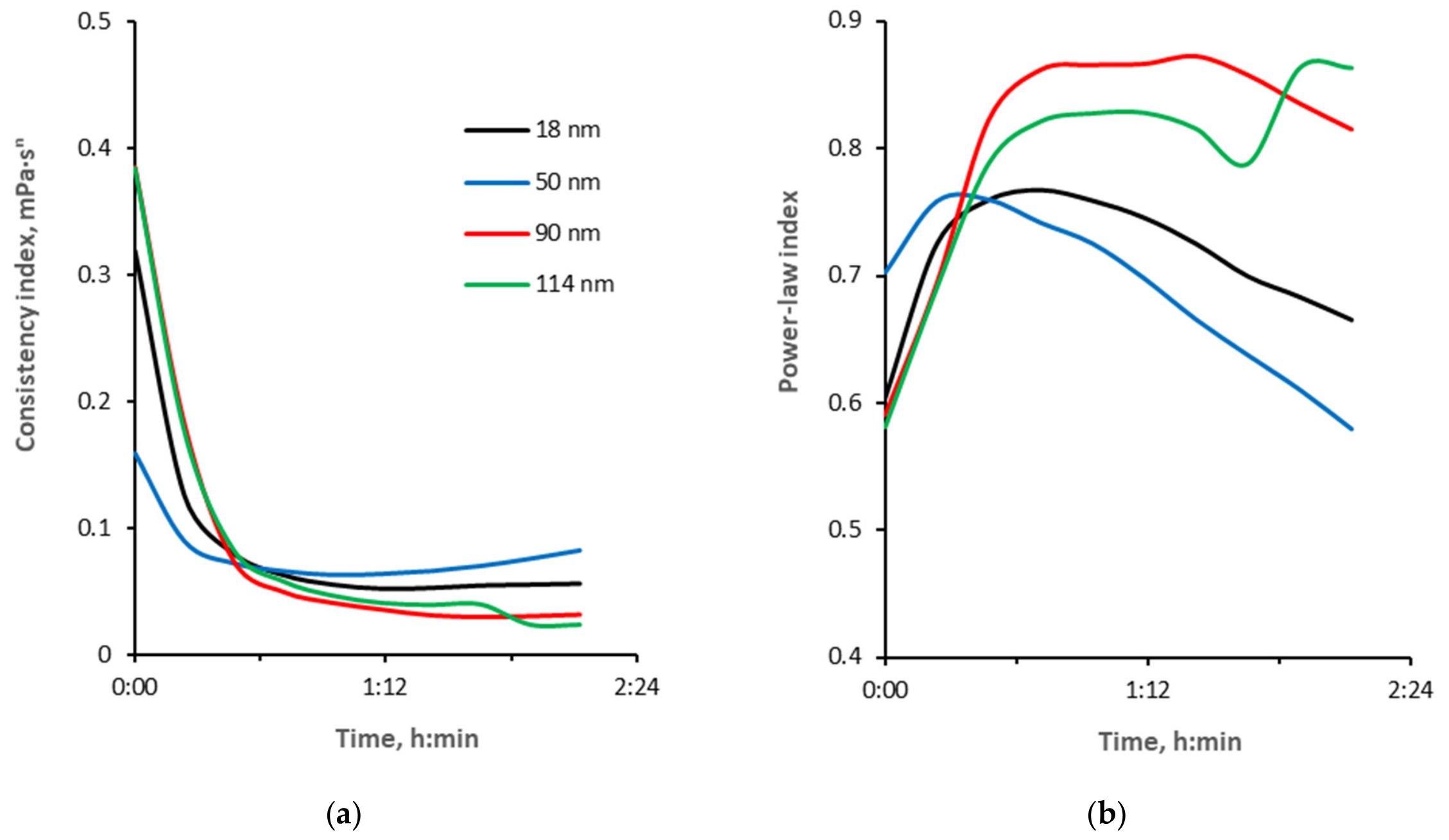
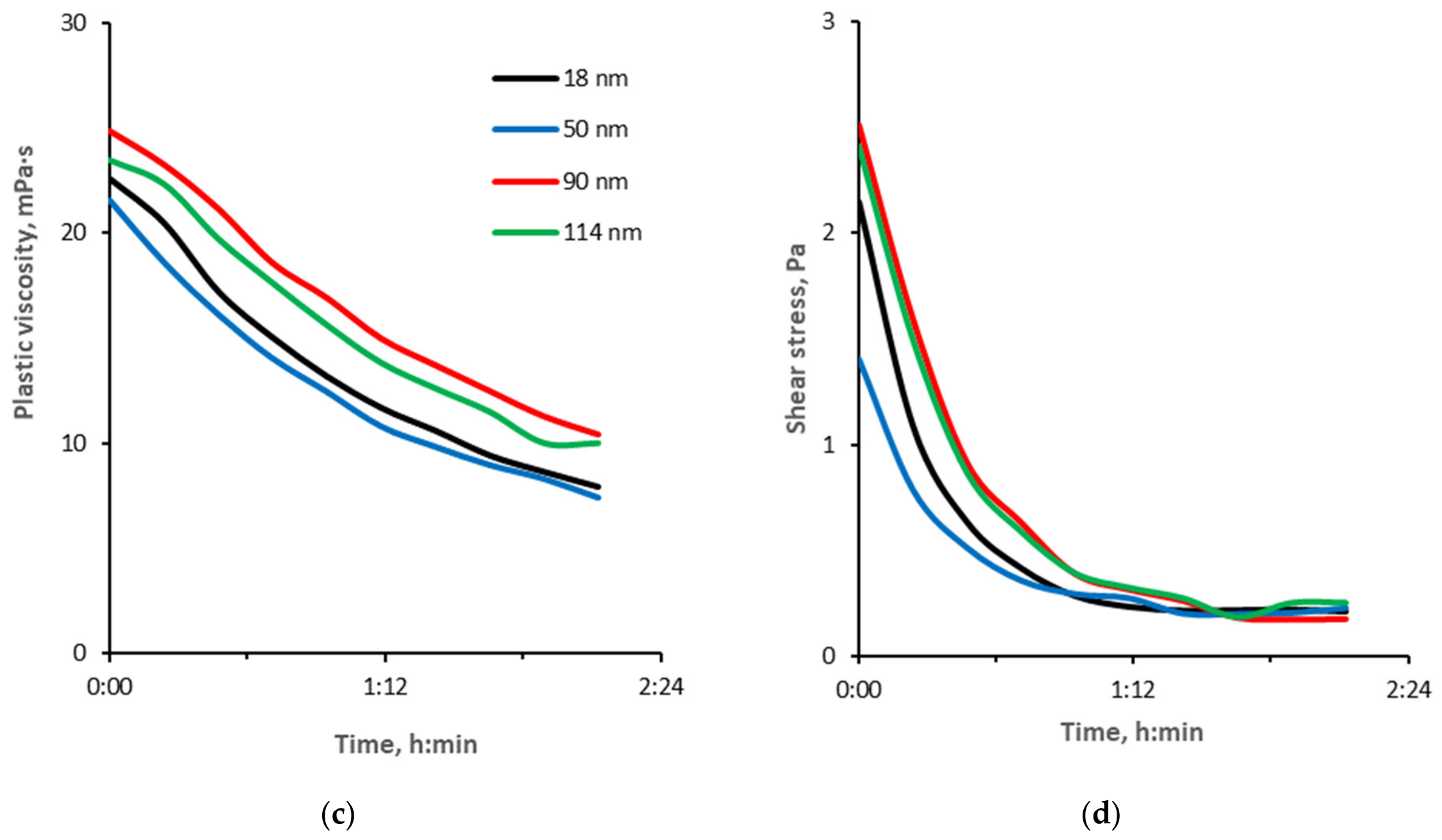
Behavior of rheological parameters of gels with a breaker concentration of 1.82 wt% and 0.4 wt% of SiO2 nanoparticles of various sizes: (a) consistency index; (b) power-law index; (c) plastic viscosity; (d) yield stress.
For guar gels with a breaker, it was found that the size of nanoparticles, as well as their concentration, affects the time of gel degradation. At a fixed concentration of nanoparticles, the effect of the size of the nanoparticles on the time of gel destruction can be up to 40 min. This 40 min variation is significant in the context of the total degradation time. For instance, at a fixed breaker concentration, gels containing 50 nm nanoparticles degraded in approximately 20 min, whereas those with 90 nm nanoparticles required about 1 h. This difference in the total degradation time confirms that nanoparticle size is a key parameter controlling the degradation kinetics. It is established that the dependence of the time of destruction of gels on the size of nanoparticles is non-monotonic. Additives of small and large nanoparticles, as a rule, lead to a decrease in the gel degradation time due to the fact that they reduce its viscosity. Additives of nanoparticles of optimal size of 90 nm, on the contrary, can significantly prolong the destruction process.
The dependence of the viscosity of aqueous nanosuspensions on the size of nanoparticles has been well studied [34]. For nanosuspensions with homogeneous liquids, the viscosity coefficient increases monotonously with a decrease in the average size of nanoparticles. This is due to the fact that the main mechanism of action of nanoparticles is the structuring of base liquid molecules near the particle surface. The higher the surface area, the more pronounced this effect is. At a fixed concentration, as their size decreases, the specific surface area increases quadratically. However, competing mechanisms are involved in polymer systems. On the one hand, as particle size decreases, the specific surface area increases, which increases the electrostatic repulsion between micelles and thereby prevents the crosslinking of polymer molecules. On the other hand, if the nanoparticles are too large, their specific area and number decrease significantly; in fact, they become ordinary macroscopic particles, and their effect on electrostatic repulsion is weakened. At the same time, their effect on the additional crosslinking of guar molecules is weakened.
Therefore, there is an optimal nanoparticle size at which these competing processes are compensated. A larger surface area does not necessarily promote crosslinking because it favors intramolecular binding. Small particles with high surface area become covered with dense polymer layers, and electrostatic repulsion prevents particle approach [32]. As a result, polymer chains bind predominantly to the same particle rather than forming bridges between different particles [35]. Large particles have fewer binding sites. The optimal size, approximately 90 nm, balances these effects, enabling intermolecular bridging while providing sufficient surface area.
Thus, as a result of a series of experiments, it was found that, using the size of nanoparticles, it is possible to control the process of destruction of nanomodified gels.
4. Conclusions
A systematic experimental study was conducted to investigate the effect of chemical breakers on the rheological properties of nanomodified guar gels. Linear guar gum gels served as the base fracturing fluid, while spherical silicon dioxide nanoparticles of various sizes and aluminum oxide nanofibers were used as nano-additives. The time-dependent evolution of rheological characteristics during the degradation process was determined.
As a result, the following conclusions were obtained:
- With increasing breaker concentration, the consistency index, plastic viscosity, and yield stress of nanomodified gels decrease more rapidly, while the power-law index increases. Complete degradation was achieved in approximately 3 h at a breaker concentration of 0.68 wt% and in about 30 min at 1.82 wt%.
- Nano-additives can either prolong or accelerate the degradation time, depending on their concentration. At concentrations close to the optimal values, the time required to reach the minimum viscosity increases significantly. For example, at a breaker concentration of 1.82 wt%, the viscosity dropped to 30 mPa·s within about 30 min. However, the addition of 0.4 wt% ANF extended this time to more than two hours.
- Both nanoparticle concentration and size have a significant impact on the degradation time. At a fixed nanoparticle concentration, varying the particle size can alter the degradation time by 40 min. The dependence of degradation time on nanoparticle size is non-monotonic: very small and very large particles tend to reduce the degradation time, whereas particles with an optimal size of approximately 90 nm significantly prolong the process.
Thus, the degradation kinetics of nanomodified polymer gels can be effectively controlled by adjusting the concentration, size, and morphology of nanoparticles. These results open up prospects for developing more efficient and tailored hydraulic fracturing fluid formulations with a specified service life.
Author Contributions
Conceptualization, A.M.; methodology, A.M. and A.N.; formal analysis, V.P. and M.P.; investigation, A.N., V.Z. and M.P.; resources, A.M.; writing—original draft preparation, A.M., V.Z. and V.P.; writing—review and editing, A.M., V.Z. and V.P.; visualization, V.P.; supervision, A.M.; project administration, A.M.; funding acquisition, A.M. All authors have read and agreed to the published version of the manuscript.
Funding
The research was funded by a grant from the Russian Science Foundation № 23-79-30022, https://rscf.ru/project/23-79-30022/ (accessed on 15 May 2026).
Data Availability Statement
The original contributions presented in this study are included in the article. Further inquiries can be directed to the corresponding authors.
Acknowledgments
SEM and TEM measurements were carried out using equipment of the Krasnoyarsk Regional Center of Research Equipment of the Federal Research Center “Krasnoyarsk Science Center SB RAS”. The authors would like to thank S. M. Zharkov (Research Equipment Center of Siberian Federal University) for conducting electron microscopic studies of spherical aluminum oxide nanoparticles.
Conflicts of Interest
The authors would like to thank “RusSilica” LLC for providing samples of silicasol and “Nanosyntez” LLC for providing samples of aluminum oxide nanofibers. The authors declare that this study received no financial support from “RusSilica” LLC or “Nanosyntez” LLC.
References
- He, X.; Li, P.; Qian, H.; Shi, H.; Ma, Z. Biogeochemistry during hydraulic fracturing: A critical review of reservoirs, fluids, processes, and implications. Geoenergy Sci. Eng. 2026, 256, 214143. [Google Scholar] [CrossRef] [Scilit]
- Luo, R.; Tan, J.; Wang, W.; Ding, Y.; Liu, X.; Han, G. A Review on Fracturability Evaluation of Shale Reservoirs: Advances and Outlook. Energy Fuels 2026, 40, 10265–10282. [Google Scholar] [CrossRef] [Scilit]
- Zhang, K.; Liu, X.-F.; Wang, D.-B.; Zheng, B.; Chen, T.-H.; Wang, Q.; Bai, H.; Yao, E.-D.; Zhou, F.-J. A review of reservoir damage during hydraulic fracturing of deep and ultra-deep reservoirs. Pet. Sci. 2024, 21, 384–409. [Google Scholar] [CrossRef] [Scilit]
- Almubarak, T.; Li, L.; Ng, J.H.; Nasr-El-Din, H.; AlKhaldi, M. New insights into hydraulic fracturing fluids used for high-temperature wells. Petroleum 2021, 7, 70–79. [Google Scholar] [CrossRef] [Scilit]
- Wu, H.; Zhai, X.; Li, Y.; Li, J.; Li, Z.; Sun, W. Modified guanidine gel fracturing fluid system and performance optimization for ultra-deep and ultra-high temperature oil and gas reservoirs. Sci. Rep. 2024, 14, 20764. [Google Scholar] [CrossRef] [Scilit] [PubMed]
- Telin, A.; Lenchenkova, L.; Yakubov, R.; Poteshkina, K.; Krisanova, P.; Filatov, A.; Stefantsev, A. Application of hydrogels and hydrocarbon-based gels in oil production processes and well drilling. Gels 2023, 9, 609. [Google Scholar] [CrossRef] [Scilit] [PubMed]
- Huang, Y.; Yao, X.; Dai, C.; Wu, Y.; Li, L.; Yuan, B. A supramolecular reinforced gel fracturing fluid with low permeability damage applied in deep reservoir hydraulic fracturing. Gels 2023, 10, 2. [Google Scholar] [CrossRef] [Scilit] [PubMed]
- Yang, S.; Yu, W.; Zhao, M.; Ding, F.; Zhang, Y. A review of weak gel fracturing fluids for deep shale gas reservoirs. Gels 2024, 10, 345. [Google Scholar] [CrossRef] [Scilit] [PubMed]
- Almubarak, T.; Ng, J.H.C.; AlKhaldi, M.; Panda, S.; Nasr-El-Din, H.A. Insights on potential formation damage mechanisms associated with the use of gel breakers in hydraulic fracturing. Polymers 2020, 12, 2722. [Google Scholar] [CrossRef] [Scilit] [PubMed]
- Yang, L.; Ge, J.; Wu, H.; Guo, H.; Shan, J.; Zhang, G. Phase behavior of colloidal nanoparticles and their enhancement effect on the rheological properties of polymer solutions and gels. RSC Adv. 2024, 14, 8513–8525. [Google Scholar] [CrossRef] [Scilit] [PubMed]
- Dai, L.; Sun, J.; Lv, K.; Liu, F.; Bai, Y.; Liao, B.; Yang, D.; Liu, C.; Li, M.-C. Cellulose nanofiber-reinforced supramolecular polymer gels for temporary plugging of fractured oil and gas reservoirs. Carbohydr. Polym. 2025, 356, 123370. [Google Scholar] [CrossRef] [Scilit] [PubMed]
- Giraldo, M.A.; Zabala, R.D.; Bahamón, J.I.; Ulloa, J.M.; Usurriaga, J.M.; Cárdenas, J.C.; Mazo, C.; Guzmán, J.D.; Lopera, S.H.; Franco, C.A.; et al. Development and evaluation from laboratory to field trial of a dual-purpose fracturing nanofluid: Inhibition of associated formation damage and increasing heavy crude oil mobility. Nanomaterials 2022, 12, 2195. [Google Scholar] [CrossRef] [Scilit] [PubMed]
- Mahmoudi Alemi, F.; Mousavi Dehghani, S.A.; Rashidi, A.; Hosseinpour, N.; Mohammadi, S. Potential application of Fe2O3 and functionalized SiO2 nanoparticles for inhibiting asphaltene precipitation in live oil at reservoir conditions. Energy Fuels 2021, 35, 5908–5924. [Google Scholar] [CrossRef] [Scilit]
- Hou, Z.; Huang, Q.; Wang, G.; Fan, J.; Wang, E.; Xie, S. Experimental study on the synergic effects of surfactants and nanoparticles on the seepage of water injected into coal seams. Geoenergy Sci. Eng. 2023, 231, 212418. [Google Scholar] [CrossRef] [Scilit]
- Negi, G.S.; Sircar, A.; Pandian, S. Engineering the rheology and IFT behavior of mixed formulations of anionic and non-ionic surfactants with added silica nanoparticles. Mater. Today Proc. 2023, 77, 223–233. [Google Scholar] [CrossRef] [Scilit]
- Guo, H.; Ge, J.; Li, L.; Zhang, G.; Li, Z.; Wang, W.; Liu, M. New insights and experimental investigation of high-temperature gel reinforced by nano-SiO2. Gels 2022, 8, 362. [Google Scholar] [CrossRef] [Scilit] [PubMed]
- Yehia, F.; Gado, W.; Al-Gamal, A.G.; Nishu Yang, C.; Liu, L.; Kabel, K.I. Synergistic effect of carbon nanotubes, zinc, and copper oxides on rheological properties of fracturing fluid: A comparative study. Processes 2024, 12, 611. [Google Scholar] [CrossRef] [Scilit]
- Minakov, A.V.; Pryazhnikov, M.I.; Neverov, A.L.; Sukhodaev, P.O.; Zhigarev, V.A. Wettability, interfacial tension, and capillary imbibition of nanomaterial-modified cross-linked gels for hydraulic fracturing. Capillarity 2024, 12, 27–40. [Google Scholar] [CrossRef] [Scilit]
- Minakov, A.V.; Pryazhnikov, M.I.; Neverov, A.L.; Sukhodaev, P.O.; Lysakova, E.I.; Skorobogatova, A.D. A systematic study of the effect of nano-additives on the functional characteristics of hydraulic fracturing gels. Colloids Surf. A Physicochem. Eng. Asp. 2024, 702, 135057. [Google Scholar] [CrossRef] [Scilit]
- Al-Hulail, I.; Al-Khabbaz, H.; Al-Janabi, Y.; Rahal, R.; Dahlan, M.; Al-Marshad, K. Fracturing fluid encapsulated breaker: High temperature up to 330 °F. In Proceedings of the SPE EOR Conference at Oil and Gas West Asia, Muscat, Oman, 26–28 March 2018. [Google Scholar] [CrossRef] [Scilit]
- Mao, Z.; Cheng, L.; Liu, D.; Li, T.; Zhao, J.; Yang, Q. Nanomaterials and technology applications for hydraulic fracturing of unconventional oil and gas reservoirs: A state-of-the-art review of recent advances and perspectives. ACS Omega 2022, 7, 29543–29570. [Google Scholar] [CrossRef] [Scilit] [PubMed]
- Fang, J.; Sun, J.; Feng, X.; Pan, L.; Bai, Y.; Yang, J. Research and development of a high-temperature-resistant, gel-breaking chemical gel plugging agent and evaluation of its physicochemical properties. Gels 2025, 11, 350. [Google Scholar] [CrossRef] [Scilit] [PubMed]
- Zhang, Z.; Liu, P.; Pan, H.; Zhao, M.; Li, X.; Zhang, Z. Preparation of a nanosilica cross-linker and investigation of its effect on properties of guar gum fracturing fluid. Micro Nano Lett. 2017, 12, 445–449. [Google Scholar] [CrossRef] [Scilit]
- Wu, B.; Sun, X.; Dai, C.; Hou, S.; Du, H. A novel CO2 sensitive and recyclable viscoelastic fluid system for fracturing. Front. Earth Sci. 2022, 10, 990963. [Google Scholar] [CrossRef] [Scilit]
- Huang, F.; Bai, Y.; Gu, X.; Kang, S.; Yang, Y.; Wang, K. A novel fracturing fluid based on functionally modified nano-silica-enhanced hydroxypropyl guar gel. Gels 2024, 10, 369. [Google Scholar] [CrossRef] [Scilit] [PubMed]
- Li, Q.; Wang, F.; Wang, Y.; Forson, K.; Cao, L.; Zhang, C.; Zhou, C.; Zhao, B.; Chen, J. Experimental investigation on the high-pressure sand suspension and adsorption capacity of guar gum fracturing fluid in low-permeability shale reservoirs: Factor analysis and mechanism disclosure. Environ. Sci. Pollut. Res. 2022, 29, 53050–53062. [Google Scholar] [CrossRef] [Scilit] [PubMed]
- Minakov, A.V.; Pryazhnikov, M.I.; Simunin, M.M.; Dobrosmyslov, S.S.; Kuular, A.A.; Molokeev, M.S.; Volochaev, M.N.; Khartov, S.V.; Voronin, A.S. Rheological properties of colloidal suspensions of alumina nanofibers. J. Mol. Liq. 2022, 367, 120385. [Google Scholar] [CrossRef] [Scilit]
- Minakov, A.V.; Lysakova, E.I.; Skorobogatova, A.D.; Pryazhnikov, M.I.; Ivleva, Y.O.; Voronin, A.S.; Simunin, M.M. Experimental study of the effect of crystalline aluminum oxide nanofibers on the properties of oil-based drilling fluids. J. Mol. Liq. 2023, 388, 122676. [Google Scholar] [CrossRef] [Scilit]
- Tayal, A.; Kelly, R.M.; Khan, S.A. Rheology and Molecular Weight Changes during Enzymatic Degradation of a Water-Soluble Polymer. Macromolecules 1999, 32, 294–300. [Google Scholar] [CrossRef] [Scilit]
- Kwaambwa, H.M.; Goodwin, J.W.; Hughes, R.W.; Reynolds, P.A. Viscosity, molecular weight and concentration relationships at 298K of low molecular weight cis-polyisoprene in a good solvent. Colloids Surf. A Physicochem. Eng. Asp. 2007, 294, 14–19. [Google Scholar] [CrossRef] [Scilit]
- Mackay, M.E.; Dao, T.T.; Tuteja, A.; Ho, D.L.; Van Horn, B.; Kim, H.-C.; Hawker, C.J. Nanoscale effects leading to non-Einstein-like decrease in viscosity. Nat. Mater. 2003, 2, 762–766. [Google Scholar] [CrossRef] [Scilit] [PubMed]
- Molinari, N.; Jung, G.; Angioletti-Uberti, S. Designing Nanoparticles as Glues for Hydrogels: Insights from a Microscopic Model. Macromolecules 2021, 54, 1992–2000. [Google Scholar] [CrossRef] [Scilit]
- Wu, G.-D.; Wang, L.-K.; Zhao, C.-Y.; Zhang, Z.-J.; Yin, J.-Y.; Anwaier, M.; Ren, H.-D.; Yang, D.; Yin, S.-L.; Cai, Z.-L.; et al. Experimental study of reservoir damage of water-based fracturing fluids prepared by different polymers. Pet. Sci. 2024, 21, 3298–3306. [Google Scholar] [CrossRef] [Scilit]
- Minakov, A.V.; Rudyak, V.Y.; Pryazhnikov, M.I. Systematic experimental study of the viscosity of nanofluids. Heat Transf. Eng. 2021, 42, 1024–1040. [Google Scholar] [CrossRef] [Scilit]
- Shao, Y.; Wang, Y.-L.; Tang, Z.; Wen, Z.; Chang, C.; Wang, C.; Sun, D.; Ye, Y.; Qiu, D.; Ke, Y.; et al. Scalable Synthesis of Photoluminescent Single-Chain Nanoparticles by Electrostatic-Mediated Intramolecular Crosslinking. Angew. Chem. 2022, 134, e202205183. [Google Scholar] [CrossRef] [Scilit]

Disclaimer/Publisher’s Note: The statements, opinions and data contained in all publications are solely those of the individual author(s) and contributor(s) and not of MDPI and/or the editor(s). MDPI and/or the editor(s) disclaim responsibility for any injury to people or property resulting from any ideas, methods, instructions or products referred to in the content. |
© 2026 by the authors. Licensee MDPI, Basel, Switzerland. This article is an open access article distributed under the terms and conditions of the Creative Commons Attribution (CC BY) license.