


Abstract
Background: Eating disorders are among the most serious psychiatric disorders and have the highest mortality rates. Medical students are a group highly vulnerable to mental disorders, including disordered eating, due to the chronic stress and risk of burnout associated with medical education, with the risk progressively increasing; however, little is known about eating disorders in Iraq. Objectives: This study aimed to investigate medical students at risk of developing eating disorders and their associated factors in Baghdad, Iraq. This study also aimed to identify vulnerable individuals, evaluate the influence of demographic variables, and determine the relationship between body mass index and eating disorders in this population. Subjects and methods: A cross-sectional study was conducted in two major Iraqi universities: the University of Baghdad and Al-Mustansiriyah University. Data were collected using an online Google Form: a semi-structured multiple-choice questionnaire with sections on sociodemographic factors; the Sick, Control, One, Fat, Food (SCOFF) questionnaire; and the Eating Attitudes Test (EAT-26) questionnaire for screening eating disorders. Body mass index was calculated. The non-probability snowball sampling technique was used. Data were analyzed using SPSS version 26, involving descriptive statistics and logistic regression, to identify factors independently and statistically significantly associated with eating disorders. Results: Of the 726 medical students screened [71.9% female; 28.1% male], the EAT-26 identified 250 (34.4%) as being at risk of developing eating disorders [37% females; 27.9% males], while the SCOFF questionnaire identified 336 (46.3%) as being at risk [46.6% females; 45.6% males]. According to the BMI calculations, 58.5% of the participants were of normal weight, 23.3% were overweight, 8.7% were obese, 6.5% were underweight, and 3% were severely underweight. Statistically significant associations varied according to the screening tool used, particularly for age, sex, a history of mental illness, and BMI (p < 0.05). Multivariate logistic regression analysis showed that students diagnosed with a mental illness had more than threefold higher odds of screening positive than students without a diagnosis (AOR = 3.69, 95% CI: 1.899–7.163, p < 0.001). These results highlight the urgent need for Iraqi medical colleges to adopt early prevention measures and strengthen mental health support. Conclusion: This study highlights the burden of eating disorder risk among Iraqi medical students. Many are at risk for eating disorders, with students diagnosed with mental illness carrying a higher risk than those without such a diagnosis.
Keywords:
eating disorders; medical students; Iraq; cross-sectional study; body mass index; SCOFF; EAT-26 1. Introduction
Eating disorders (EDs) are mental illnesses characterized by abnormalities in eating behavior in the form of excessive or insufficient eating, along with disturbances in thoughts and emotions, which ultimately affect an individual’s physical and emotional health [1]. These disorders can be life-threatening and have a high mortality rate, as they are associated with serious medical complications; their main symptoms include an excessive preoccupation with body weight, shape, and diet [2]. They usually begin in adolescence and can affect individuals of all ages, sexes, races, and backgrounds. They involve either inadequate or high food intake, both of which adversely affect an individual’s physical and emotional well-being. Bulimia nervosa and anorexia nervosa are the most common eating disorders [3]. Anorexia nervosa is defined as restricting nutrient intake relative to the body’s needs because of a fear of weight gain, secondary to distorted body image, leading to weight loss, while bulimia nervosa involves consuming large amounts of food at once and then purging it. In contrast, binge eating disorder is characterized by repeated episodes of consuming large amounts of food, often very quickly and to a degree of discomfort, accompanied by a feeling of loss of control, but without regular recourse to compensatory purging behaviors. Understanding the underlying causes of eating disorders is essential for explaining their development and progression [3].
The exact etiology of eating disorders remains unknown; however, current evidence supports the concept of a multifactorial interaction between biological, psychological, developmental, and sociocultural factors [4,5]. Notably, psychological factors, such as low self-esteem, perfectionism, body dissatisfaction, and traumatic experiences or adverse childhood events, are strongly linked to the development of eating disorders. Body image concerns can be exacerbated by these factors, which may contribute significantly to maladaptive eating behaviors [6]. Various genetic factors, as well as female sex, have been found to increase the risk of developing eating disorders [7,8]. Additionally, other mental disorders have been found to coexist with eating disorders, such as depression, anxiety, obsessive–compulsive disorder, and substance use disorders [9]. Furthermore, sociocultural factors such as the integration of thinness and muscularity ideals in different media, with pressures from peers, can affect and shape body image dissatisfaction [10].
Eating disorders are prevalent in Western societies, possibly due to a cultural emphasis on thinness reinforced by the media, fashion, and the diet industry [11]. Increased exposure to idealized images of bodies and diet trends on social media such as Instagram and TikTok results in body dissatisfaction, especially among students and young age groups. These comparisons lead to a higher risk of developing disordered eating behaviors [12,13]. Studies of affluent communities show that many schoolgirls and female college students diet at some point in their lives [14,15]. In the Middle East, particularly in the Arab Gulf region, cultural changes and the acceptance of Western body image standards, along with societal changes toward consumerism and individualism, have been linked to greater anxiety regarding body weight and a greater likelihood of developing eating disorders [16,17]. Social factors such as socioeconomic status, ethnicity, body image, social pressure, and performance sport may also play a large role in the development and persistence of these disorders [18]. Some groups of the population are more vulnerable. For example, medical students are one of the groups most affected by eating disorders due to heavy exams, the extensive knowledge required for medical training, high levels of stress, perfectionistic traits, and the development of unhealthy lifestyles and poor health habits [19]. The risk of these disorders also differs by age, sex, and daily or professional activities [20]. Therefore, knowledge about the specific behaviors and psychological concerns of at-risk groups, especially young females and university students taking high-stress, health-related courses, remains important for early intervention [21].
Eating disorders have been shown to have severe physical and mental consequences. Although eating disorders are sometimes categorized as psychiatric conditions, they can cause life-threatening medical complications, including cardiovascular disease; critical electrolyte imbalances; obesity; diabetes mellitus; and organ atrophy affecting the liver, kidneys, and gastrointestinal tract. Consequently, significant improvements in the prognosis and recovery outcomes of eating disorders can be achieved through early detection and timely intervention [22,23].
A systematic review examined data collected from 2000 to 2018 and reported the prevalence of global eating disorders to be 2.2% in men and 5.7% in women [24]. Interestingly, a recent meta-analysis reported a prevalence of 10.4% among medical students, which is notably higher than that of the general population [25].
In Western countries, EDs have been reported to be a major public health concern, impacting 30 million Americans across all demographics [26]. In the Arab world, a recent systematic review found that the lifetime prevalence of EDs was 6.1% and that the 12-month prevalence was 3.2%, indicating that they are widely prevalent [27].
Despite this, little is known about the prevalence of eating disorders in Arab students of medicine [28]. The etiology of eating disorders involves a complex interplay of several risk factors.
The aim of this study is to fill these gaps by screening for eating disorders in Iraqi medical students stratified by age, sex, and degree of medical education. As future healthcare providers, it is crucial that medical students at risk of developing such disorders are identified early and that specific prevention approaches are implemented. Awareness and early diagnosis can reduce clinical complications and mortality associated with these disorders and protect students’ academic performance and long-term professional careers. The aims of this study were to investigate the proportion of students screening positive for eating disorders in the target cohort and to explore demographic factors and body mass index (BMI) as possible associations with these disorders.
2. Materials and Methods
2.1. Ethical Considerations
This study was approved by the Ethical and Research Committee of Al-Kindi College of Medicine, University of Baghdad (Approval No. 13; 17 September 2025).
2.2. Study Design
This was a cross-sectional study that included medical students from two major universities in Iraq: the University of Baghdad and Al-Mustansiriyah University. It was conducted over four months, from 1 November 2025 to 1 March 2026.
2.3. Sample Size and Participants
The survey included medical students from the two universities during the 2025–2026 academic year. The participants were students in all academic years, that is, from the first to the sixth year, with approximately 2000 students per university. A total of 768 responses were received; however, 42 were invalid and were excluded from the final analysis.
The required sample size was calculated using Cochran’s formula with a 95% confidence interval, a 5% margin of error, and an estimated proportion of 0.5. The minimum required sample size was 384. We received 726 valid responses, exceeding the required sample size, thereby increasing the reliability and precision of the findings.
n_0 = (Z2 p(1 − p))/e2
Here, no is the initial sample size, Z is the Z-score (1,96 for 95% and 2,58 for 99%), p is the estimated proportion (0,5 if unknown), and e is the margin of error.
2.4. Data Collection
Data were collected electronically using an online Google Form, which was distributed to students via electronic classrooms and social media. Four students were selected to distribute the questionnaire in the universities. The questionnaire contained a mandatory statement of informed consent to enroll in the survey. It was a multiple-choice, semi-structured questionnaire that included sections on sociodemographic factors, the SCOFF questionnaire, and the Eating Attitudes Test (EAT-26) for the screening of eating disorders. Data confidentiality was ensured by allowing the participants to return the completed surveys anonymously via an electronic link. A non-probability snowball sampling technique was used.
2.5. Instruments
The Eating Attitudes Test-26 (EAT-26) and SCOFF are the most widely used tests for assessing eating disorder risk based on eating-related attitudes, feelings, and behaviors, as well as symptoms [29,30]. As English is the official language used in Iraqi medical education, the original English version was used in this study. The EAT-26 has three subscales: dieting, bulimia and food preoccupation, and oral control. In addition to the results of the EAT-26, the identification of individuals at risk of developing an eating disorder requires information about body mass index (BMI) and behavioral symptoms reflective of an eating disorder. BMI was calculated from height and weight; these were self-reported by the medical students, as they have high health literacy and frequent access to clinical equipment, which minimizes reporting errors compared with the general population. The following equation was applied:
BMI = (Weight (kg))/(Height (m2))
Based on BMI, the participants were classified as underweight, severely underweight, normal, overweight, and obese [31], following the methodology described in the Eating Disorders Inventory.
To evaluate the risk of developing eating disorders, this study used an integrated assessment approach. The EAT-26 used in this study includes the Eating Disorder Inventory-3 Referral Form (EDI-RF [32]), which contains four behavioral questions designed to determine the presence and frequency of extreme weight control behaviors. These questions assess self-reported binge eating, self-induced vomiting, laxative use, and treatment for an eating disorder within the preceding six months. The scale has 26 questions, in addition to the 4 behavioral questions. Responses are scored on a 6-point Likert scale. The first 26 questions have the following responses: Always, Usually, Often, Sometimes, Rarely, and Never. The last four behavioral questions have the following responses: Never, Once a month or less, 2–3 times a month, Once a week, 2–6 times a week, and Once a day or more. When performing statistical analyses, as well as to provide a clear presentation and facilitate further analysis and comparison, the responses to the first 26 questions were coded as follows: Always, Usually, and Often were coded as Yes, while Sometimes, Rarely, and Never were coded as No. For the EAT-26, good internal consistency (Cronbach’s α = 0.85) was reported.
The EAT-26 items were scored according to the standard scoring system, and a total score ≥ 20 was considered indicative of an increased risk of developing an eating disorder. The EAT-26 is a screening instrument and does not establish a clinical diagnosis.
For the SCOFF questionnaire, a score of ≥ 2 positive responses was considered indicative of an increased risk of developing an eating disorder. The SCOFF questionnaire is a screening instrument and does not establish a clinical diagnosis. Furthermore, the five-item SCOFF questionnaire was administered to screen for the core characteristics of anorexia nervosa and bulimia nervosa [32]. The SCOFF items—assessing self-induced vomiting due to fullness, loss of control over food intake, recent weight loss exceeding 6 kg within a three-month period, distorted body image, and food dominance—have a standard dichotomous (Yes/No) response format. The internal consistency of SCOFF in this study sample was relatively low (Cronbach’s α = 0.52), due to the limitation of Cronbach’s alpha in evaluating a brief 5-item scale with binary responses.
2.6. Statistical Analysis
The data were analyzed using SPSS version 26.0; categorical variables were summarized as frequencies and percentages. The primary outcomes, the EAT-26 and SCOFF screening results, were divided into indicators of eating disorder risk. Positive screens were coded as 1 and defined as EAT-26 ≥ 20 and SCOFF ≥ 2, while lower scores were coded as 0. Bivariate associations were assessed using Pearson’s chi-square test, with Fisher’s exact test used when more than 20% of the expected cell counts were below 5, such as for marital status and several age categories.
Multivariable logistic regression models were used to adjust for potential confounding factors. Covariates were selected a priori based on the relevant literature rather than bivariate statistical significance. The final models included gender, BMI category, personal history of psychiatric diagnosis, family history of mental illness, and academic year. Age was excluded because of its close relationship with academic year in this student population. Reference categories were male gender, normal BMI, and negative psychiatric history.
Model diagnostics included variance inflation factors (VIF < 5) and the Hosmer–Lemeshow goodness-of-fit test. As responses to the electronic questionnaire were required, there were no missing data. The regression results are presented as adjusted odds ratios (AORs) with 95% confidence intervals (CIs). Statistical significance was set at p < 0.05.
3. Results
3.1. Sociodemographic Variables
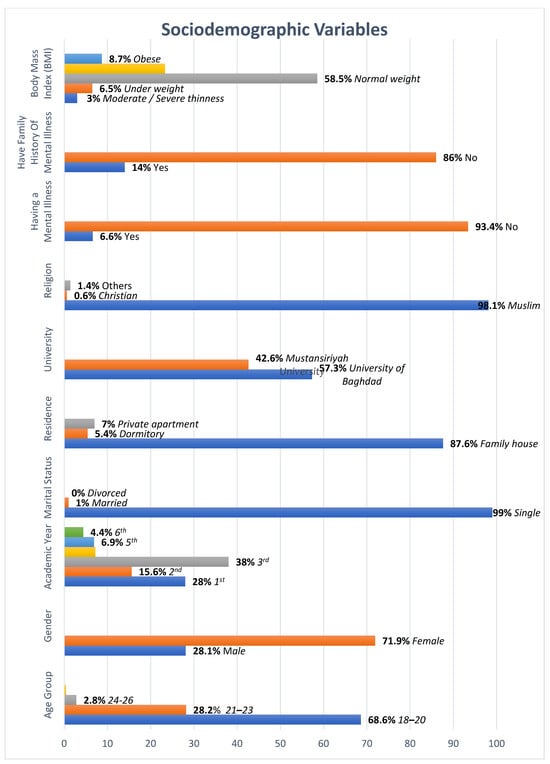
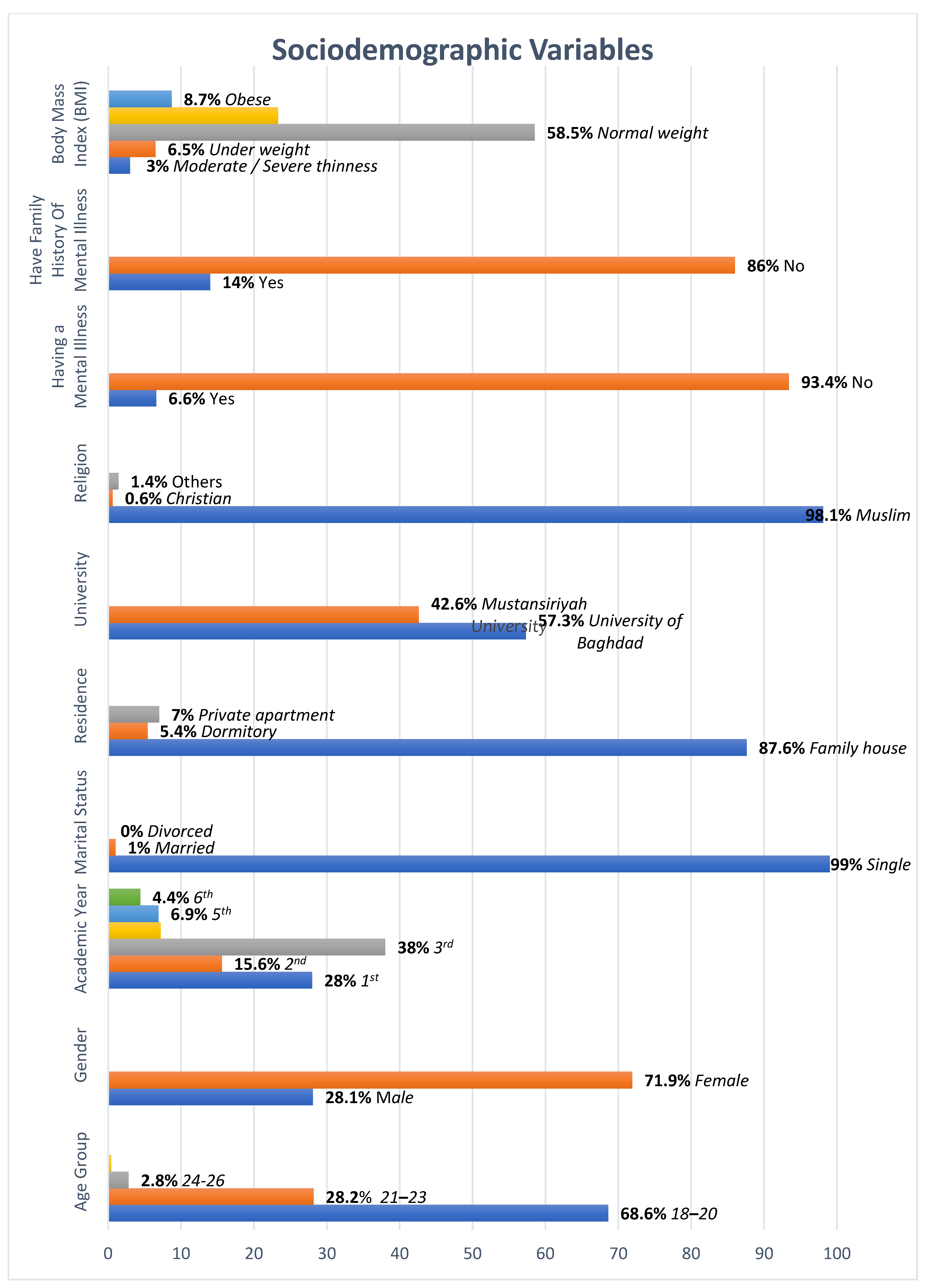
This study included 726 students, of whom 522 were female (71.9%) and 204 were male (28.1%). The participants ranged in age from 18 to 30 years old, with the vast majority (498 participants, 68.6%) aged between 18 and 20. Most participants were single (719 students, 99.0%) and lived at home (636 students, 87.6%). The highest response rate was recorded in the third academic year (276 participants, 38.0%). The participants were distributed almost equally between universities: 416 students (57.3%) were from the University of Baghdad, and 310 students (42.6%) were from Al-Mustansiriya University. Regarding religion, the vast majority of the participants were Muslim (712 students, 98.1%). Only 48 participants (6.6%) reported having a diagnosed mental illness, while the majority (678 participants, 93.4%) reported no history of mental illness. Additionally, 102 participants (14.0%) reported a family history of mental illness, while 624 participants (86.0%) reported no such family history (Figure 1). BMI analysis showed that most participants were within the normal weight category, comprising 58.5% of the sample. This was followed by the overweight category at 23.3%. A smaller percentage of participants were classified as obese (8.7%) and underweight (6.5%), while only 3% were identified as having moderate-to-severe thinness. Overall, the results show that more than half of the study participants had a normal BMI (58.5%) and that a significant proportion were overweight (either overweight or obese) (Figure 1).
Figure 1.
Sociodemographic characteristics of the study participants.
3.2. Results of the Eat-26 and Scoff Questionnaire and Their Relationship with Sociodemographic Characteristics
Bivariate analysis of sociodemographic and clinical characteristics relative to the EAT-26 outcomes revealed several statistically significant associations (Table 1). Notably, positive EAT-26 scores were significantly associated with female gender (37.0% vs. 27.9% in males; p = 0.021). Marital status was associated with a higher rate of positive EAT-26 screening results (85.7% vs. 33.9% in single individuals; p = 0.008), but this result is statistically unstable as it relies on only six students. Participants with a documented history of diagnosed mental illness (64.6% vs. 32.3%; p < 0.001) or a positive family history of mental illness (49.0% vs. 32.1%; p < 0.001) exhibited significantly higher rates of positive EAT-26 screening results. Furthermore, risk stratification scaled progressively with BMI (p < 0.001), peaking sharply among participants classified as obese (61.9%) and overweight (49.1%) compared with their normal-weight and underweight counterparts. Conversely, no statistically significant associations were observed regarding age group (p = 0.066), academic year (p = 0.283), residence (p = 0.652), or religious affiliation (p = 1.000).
Table 1.
Association between sociodemographic characteristics and EAT-26 and SCOFF screening results (N = 726).
In the case of SCOFF, bivariate analyses revealed significant associations between test positivity and several key demographic and clinical characteristics (Table 1). A statistically non-significant association was found with gender (χ2 = 0.184, p = 0.668), with females scoring higher on the SCOFF questionnaire (46.6%) than males (45.6%). A statistically significant difference was observed among age groups (χ2 = 8.493, p = 0.037). The highest percentage of positive results was recorded among participants aged 27–30 (100%), though this result is statistically unstable, as this category relies on three students; this was followed by participants aged 24–26 (70.0%). BMI showed no statistically significant association with the SCOFF results (χ2 = 4.529, p = 0.339). The proportion of students who screened positive on SCOFF was highest among overweight participants (52.7%), followed by obese participants (49.2%), whereas rates of 44.0% and 40.4% were observed in the normal-weight and underweight groups, respectively. No statistically significant association was found between the SCOFF scores and academic year (χ2 = 5.442, p = 0.364); however, the highest positive rate was recorded among fifth-year students (56.0%). Marital status was not significantly associated with the SCOFF screening results (p = 0.053), although married participants showed a higher proportion of positive screens (85.7%) than single participants (45.9%). No significant differences were identified based on residence (χ2 = 0.303, p = 0.859) or religious affiliation (p = 0.794). Finally, personal mental health history was significantly associated with screening positivity. The percentage of positive SCOFF scores was statistically significantly higher among participants diagnosed with a mental illness (72.9%) than among those without such a diagnosis (44.4%) (χ2 = 14.679, p < 0.001). In contrast, a family history of mental illness was not significantly associated with SCOFF positivity (χ2 = 0.029, p = 0.865), with similar positive screening rates among participants with (47.1%) and without (46.2%) a family history.
3.3. Logistic Regression of the Eat-26 Model
A personal diagnosis of mental illness was independently associated with eating disorder risk in the EAT-26 model (Table 2), with diagnosed students exhibiting more than threefold higher odds of screening positive than students without a diagnosis (AOR = 3.69, 95% CI: 1.899–7.163, p < 0.001). Overweight status showed a significantly elevated risk relative to normal weight status (AOR = 3.13, 95% CI: 2.102–4.646, p < 0.001); obesity was also significantly associated with increased risk (AOR = 5.60, 95% CI: 3.115–10.052, p < 0.001), while underweight and moderate/severe thinness showed no significant associations (both p > 0.05).
Table 2.
Logistic regression model for the EAT-26.
Female gender was independently associated with risk (AOR = 1.90, 95% CI: 1.285–2.818, p = 0.001). Family history of psychiatric illness (AOR = 1.53, 95% CI: 0.958–2.449, p = 0.075) was not independently associated with risk. Academic year similarly showed no effect: relative to first-year baseline students, the adjusted odds ranged from 0.85 (95% CI: 0.564–1.295, p = 0.458) in third-year students to 1.26 (95% CI: 0.640–2.497, p = 0.499) in fifth-year students, with second-, fourth-, and sixth-year cohorts showing no significant deviation (all p > 0.05).
3.4. SCOFF Multiple Regression Analysis
In the SCOFF model (Table 3), a personal history of mental health challenges was the strongest independent predictor of eating disorder risk. Furthermore, participants with prior mental health issues showed more than threefold higher odds of screening positive than those without such a history (AOR = 3.59, 95% CI: 1.818–7.090, p = 0.001). An elevated risk was shown for overweight status (AOR = 1.49, 95% CI: 1.029–2.158, p = 0.035), whereas moderate/severe thinness (AOR = 1.04, p = 0.935), underweight (AOR = 0.82, p = 0.576), and obesity (AOR = 1.35, p = 0.304) were not associated with increased odds compared with normal weight.
Table 3.
Logistic regression for SCOFF.
A family history of psychiatric illness did not significantly alter risk (AOR = 0.79, 95% CI: 0.502–1.240, p = 0.304). Female students demonstrated near-identical odds to males (AOR = 0.96, 95% CI: 0.684–1.348, p = 0.815). Academic year was similarly non-significant across all cohorts relative to first-year baseline students, with odds ranging from 0.81 in third-year students (p = 0.305) to 1.38 in fifth-year students (95% CI: 0.711–2.661, p = 0.344).
3.5. Eat-26 and Scoff Cross-Tabulation
To assess agreement between the two eating disorder screening tools, we cross-tabulated the paired data for all 726 participants (Table 4). In total, 250 (34.4%) participants screened positive on the EAT-26, and 336 (46.3%) screened positive on the SCOFF questionnaire. A total of 143 participants screened positive on both measures, and 283 participants screened negative on both instruments. Furthermore, 300 participants were identified as being at risk by only one tool (193 by SCOFF only and 107 by the EAT-26 only).
Table 4.
Cross-tabulation of EAT-26 and SCOFF.
The observed percentage agreement for both scales was 58.7%; however, Cohen’s Kappa analysis showed a value of 0.154 (p < 0.001). Although this is a statistically significant finding, it reflects only “slight agreement” between the two measures, indicating that the EAT-26 and SCOFF captured largely different at-risk subgroups in the study population.
4. Discussion
4.1. Risk Screen
To the best of our knowledge, this is the first multicenter study to assess eating disorders’ risk among medical students at two Iraqi universities. Medical students are considered a high-risk group for eating disorders [33,34]. This study found that a significant proportion of undergraduate medical students screened positive for eating disorder risk, with over one-third (250 students, 34.4%) scoring above the minimum threshold on the EAT-26 and 336 (46.3%) scoring above the minimum threshold on the SCOFF questionnaire. This percentage is higher than that recorded among medical students in other countries in the region, such as Lebanon [35], Egypt [36], and Yemen [37]. It also exceeds that recorded among 5061 medical students in the Middle East and North Africa region, where 24.8% screened positive for eating disorders [38]. Compared to Western countries, this percentage is also higher than that recorded in Europe; for example, 23.8% was reported in a multicenter European study [39]. Among medical students globally, the average risk of developing eating disorders is estimated at 10.5% [25], a very low figure compared with that in our study. In contrast, a recent study in Saudi Arabia reported that 49.6% of medical students screened positive for eating disorders, a percentage higher than that found in our study [40].
The findings of our study could be explained by those of previous studies linking the rigorous demands of medical education, sociocultural pressures, body image dissatisfaction, and social stigma to increased vulnerability to eating disorders. Medical education, characterized by extensive coursework, high-stakes exams, and prolonged study hours, generates significant psychological stress, often manifesting as maladaptive coping strategies such as substance use and eating disorders [41,42]. Simultaneously, sociocultural pressures surrounding body image—exacerbated by global beauty standards and the influence of social media—contribute to increased body dissatisfaction, particularly among female students [43]. Furthermore, the prevailing social stigma surrounding mental health in Iraqi society discourages early diagnosis and treatment, thereby exacerbating the risk of chronicity [44,45]. Consequently, medical students are less likely to seek professional help [46], resorting instead to self-management, such as self-prescribing medication [47]. As a result, the prevalence of mental illness is underestimated among medical students, leaving many cases untreated [48]. Limited institutional support, including inadequate access to nutritional counseling and guidance, exacerbates these vulnerabilities, creating an environment in which eating disorders are more likely to emerge and persist.
In 2021, a cross-sectional study was conducted among medical students in different departments in Baghdad, Iraq. For individuals with a normal BMI, the positive screening result was 64.47% using the EAT-26 versus 23.5% using SCOFF [49]. In the current study, the positive screening result among those with normal weight was 25.9% using the EAT-26 versus 44.0% using SCOFF. Additionally, eating disorders were found to be more common in overweight individuals than in underweight individuals [49], aligning with our study findings. Taken together, these findings suggest a high level of eating disorder risk among the medical students included in these studies, particularly females. In 2025, a cross-sectional study was conducted among medical students at Al-Nahrain University in Iraq, and it found that 27.2% of the sample screened positive [50]. Although most participants had a normal weight (55.7%), the researchers identified a highly significant correlation between an increased risk of developing eating disorders and being overweight (p = 0.0001) [50]. Despite this risk, compensatory behaviors were relatively uncommon, with over 80% of students reporting that they had never self-induced vomiting or misused laxatives for weight control [50]. However, a relevant clinical history was present across the cohort: 20.3% had experienced weight loss within the preceding six months, and 16% had a history of treatment for an eating disorder [50].
Furthermore, a cross-sectional study conducted at the University of Babylon’s College of Medicine in 2025 investigated the risk of night eating syndrome (NES) and its relationship with depressive symptoms among medical students. While most participants (63.5%) had a normal body mass index (BMI) and only 6.7% were classified as obese, full-syndrome NES was diagnosed in 3.9% of the sample studied. Regarding mental health, moderate, moderately severe, and severe depressive symptoms were reported by 12.8%, 6.1%, and 5.8% of students, respectively. Ultimately, NES demonstrated a statistically significant association with depressive symptoms, male sex, smoking, and an elevated BMI (p < 0.05) [51].
4.2. Sex
This study found that females were more likely to screen positive for eating disorder risk than males according to the EAT-26, whereas no significant sex difference was observed using the SCOFF questionnaire. This is consistent with the findings of several studies conducted in Lebanon, Syria, and Malaysia [35,52,53]. Various studies in diverse settings have highlighted the role of media exposure and its psychological impact, particularly on females, leading to body dissatisfaction that can develop into eating disorders [54]. This predominance among females could be explained by several factors, including their greater preoccupation with weight and appearance concerns [55]. The rates of stress and anxiety are also higher among females than males. Furthermore, female university students experiencing stress and anxiety are more prone to developing eating disorders [56,57]. The transition from school to university exposes women to a range of dietary risks, including extreme dieting, eating disorders, and body dissatisfaction [58].
4.3. BMI
The most striking finding of this study is the pronounced BMI gradient associated with eating disorder risk using the EAT-26. The statistical association between BMI and screening positivity was significant for the EAT-26 (χ2 = 53.551, p < 0.001), but not for SCOFF (χ2 = 4.529, p = 0.339). While 25.9% (EAT-26) and 44.0% (SCOFF) of normal-weight students screened positive—aligning with previous data from Lebanon, Syria, and Pakistan [35,52,59]—higher positive screening rates were observed among participants with higher BMIs using the EAT-26. Among participants with obesity, 61.9% (EAT-26) and 49.2% (SCOFF) screened positive.
The BMI gradient observed with the EAT-26 could be attributed to several factors. First, a significant proportion of this gradient is likely due to criterion contamination rather than a true differential prevalence of clinical eating disorders. Both the EAT-26 and SCOFF contain items assessing weight preoccupation, fear of fatness, calorie awareness, and dieting. Students with a higher BMI who are actively attempting to lose weight—often following standard medical advice—will endorse these items regardless of whether they have a psychiatric eating disorder. Consequently, the reduced specificity of the EAT-26 and SCOFF at higher BMIs is well documented in the literature, as normative weight management behaviors inevitably inflate total screening scores [60].
Second, the structural limitations of these instruments create a screening paradox in this specific population. Among eating disorders, binge eating disorder (BED) is the most robustly associated with obesity [61]. However, both tools are heavily oriented toward restrictive and purging pathology. BED is captured only weakly by the EAT-26 and by only a single item on the SCOFF questionnaire, as these tools were originally validated primarily to detect anorexia and bulimia nervosa [29,30]. Therefore, our study may simultaneously overestimate the overall risk of restrictive eating disorders in this group of participants (due to criterion contamination) and underestimate the specific presence of BED, the disorder most clinically relevant to them.
Finally, despite these diagnostic overlaps, genuine elevations in eating pathology among students with higher BMIs are highly plausible. The medical education environment heavily emphasizes the pathological consequences of obesity, which can inadvertently amplify weight stigma [62]. The resulting internalized weight bias is a well-known catalyst for psychological distress that drives extreme, compensatory weight control behaviors and stress-induced binge eating episodes [63,64]. Thus, while the data do not permit us to confirm that obese Iraqi medical students who screened positive have a clinical eating disorder, they strongly suggest a complex relationship between weight stigma, chronic dieting behavior, and psychological distress that warrants immediate clinical attention and more fine-grained diagnostic screening.
Studies involving university students from other regions in the UAE and Egypt reveal that eating disorders are associated with behavioral and other related factors; these findings also suggest the importance of screening and providing appropriate nutritional and mental health support for medical students [65,66].
4.4. Study Strengths and Limitations
This study has several strengths. First, this is the first multicenter study to examine eating disorder risk among medical students in Iraq, filling a significant gap in the literature. Second, the participation of many students from multiple universities increases its reliability and provides diversity, reducing bias compared with a single-institution study. Third, the use of validated instruments (the EAT-26 and SCOFF questionnaire) enhances the credibility of the results and their comparability with the results of international studies.
Conversely, several limitations should be noted. First, the cross-sectional design precludes the establishment of causal relationships between the identified factors and eating disorder risk. Second, the use of non-probability snowball sampling via electronic classrooms and social media precludes the calculation of a definitive response rate and introduces selection bias; participants with a pre-existing personal interest in eating and body image were plausibly more likely to complete and distribute the survey. Third, the resulting sample likely does not perfectly reflect the underlying student populations. The sex distribution was heavily skewed toward female respondents (71.9%), a demographic independently associated with higher positivity, and academic year distribution was markedly uneven, capturing far more third-year students (38.0%) than sixth-year students (4.4%), whose participation was limited by intense clinical schedules. Because these biases likely over-selected for highly engaged individuals and demographics with higher baseline positivity, our crude overall risk figures should be interpreted as upper-bound estimates.
Finally, data collection relied entirely on self-reported questionnaires rather than clinical interviews, which introduces the potential for reporting bias driven by social stigma or a desire for social acceptance. Therefore, positive screening results should not be interpreted as clinical diagnoses of eating disorders.
5. Conclusions
This study highlights the burden of eating disorder risk among the medical students included. More than one-third of participants screened positive for an increased risk of developing eating disorders. This study revealed that having a mental illness was independently associated with the risk of eating disorders.
To mitigate the risk of eating disorders among medical students, we urge officials and stakeholders to consider the following: (1) universities should adopt a comprehensive prevention strategy that integrates psychological support, nutritional education, and sociocultural awareness; (2) confidential counseling services and stress management workshops should be established, as they can help students cope with academic pressures; (3) nutritional and lifestyle education should be integrated into the curriculum to encourage the adoption of healthier eating habits and physical activity; and (4) routine screening programs and faculty training should be implemented, as they are essential for early detection and timely intervention.
Author Contributions
Conceptualization, N.A.H. and H.F.H.; methodology, L.T.A.-A.; software, A.A.S.; validation, A.A.S., H.F.H. and L.T.A.-A.; formal analysis, N.A.H.; investigation, H.F.H.; data curation, H.F.H.; writing—original draft preparation, N.A.H. and A.A.S.; writing—review and editing, L.T.A.-A.; supervision, N.A.H. All authors have read and agreed to the published version of the manuscript.
Funding
This study received no external funding.
Institutional Review Board Statement
This study was conducted in accordance with the Declaration of Helsinki and approved by the Ethical and Research Committee of Al-Kindy College of Medicine, University of Baghdad (Approval No. 13; 17 September 2025).
Informed Consent Statement
Informed consent was obtained from all subjects involved in the study.
Data Availability Statement
The data presented in this study are available from the corresponding author upon reasonable request.
Conflicts of Interest
The authors declare no conflicts of interest.
Abbreviations
The following abbreviations are used in this manuscript:
| ED | Eating disorder |
| EAT-26 | Eating Attitudes Test |
| SCOFF | Sick, Control, One, Fat, Food |
| BMI | Body mass index |
| NES | Night eating syndrome |
References
- American Psychiatric Association. Diagnostic and Statistical Manual of Mental Disorders (DSM-5), 5th ed.; American Psychiatric Publishing: Washington, DC, USA, 2013. [Google Scholar]
- Krug, I.; Liu, S.; Portingale, J.; Croce, S.; Dar, B.; Obleada, K.; Satheesh, V.; Wong, M.; Fuller-Tyszkiewicz, M. A meta-analysis of mortality rates in eating disorders: An update of the literature from 2010 to 2024. Clin. Psychol. Rev. 2025, 116, 102547. [Google Scholar] [CrossRef] [Scilit] [PubMed]
- Hudson, J.I.; Hiripi, E.; Pope, H.G., Jr.; Kessler, R.C. The prevalence and correlates of eating disorders in the National Comorbidity Survey Replication. Biol. Psychiatry 2007, 61, 348–358. [Google Scholar] [CrossRef] [Scilit] [PubMed]
- Olden, K.; White, S.L. Health-related disparities: Influence of environmental factors. Med. Clin. North Am. 2005, 89, 721–738. [Google Scholar] [CrossRef] [Scilit] [PubMed]
- Pedersen, L.; Hicks, R.E.; Rosenrauch, S. Sociocultural pressure as a mediator of eating disorder symptoms in a non-clinical Australian sample. Cogent Psychol. 2018, 5, 1523347. [Google Scholar] [CrossRef] [Scilit]
- Aloi, M.; Rania, M.; Lo Coco, G.; Carcione, A.; Castellini, G.; Waldherr, K.; Segura-Garcia, C. Editorial: Psychosocial risk factors in the development, maintenance and treatment outcome of eating disorders. Front. Psychol. 2024, 15, 1486941. [Google Scholar] [CrossRef] [Scilit] [PubMed]
- Watson, H.J.; Davies, H.L.; Palmos, A.B. Genetics of eating disorders. In Eating Disorders: An International Comprehensive View; Robinson, P., Wade, T., Herpertz-Dahlmann, B., Fernandez-Aranda, F., Treasure, J., Wonderlich, S., Eds.; Springer: Cham, Switzerland, 2024; pp. 747–771. [Google Scholar]
- Culbert, K.M.; Sisk, C.L.; Klump, K.L. A narrative review of sex differences in eating disorders: Is there a biological basis? Clin. Ther. 2021, 43, 95–111. [Google Scholar] [CrossRef] [Scilit] [PubMed]
- Carta, M.G.; Preti, A.; Moro, M.F.; Aguglia, E.; Balestrieri, M.; Caraci, F.; Dell’Osso, L.; Di Sciascio, G.; Drago, F.; Faravelli, C.; et al. Eating disorders as a public health issue: Prevalence and attributable impairment of quality of life in an Italian community sample. Int. Rev. Psychiatry 2014, 26, 486–492. [Google Scholar] [CrossRef] [Scilit] [PubMed]
- Stice, E. Risk and maintenance factors for eating pathology: A meta-analytic review. Psychol. Bull. 2002, 128, 825–848. [Google Scholar] [CrossRef] [Scilit] [PubMed]
- Nasser, M. Eating disorders: The cultural dimension. Soc. Psychiatry Psychiatr. Epidemiol. 1988, 23, 184–187. [Google Scholar] [CrossRef] [Scilit] [PubMed]
- Ferreira, A.M.A., Jr.; Pinto Junior, C.C.P.; Paraguassu, L.T.V.; Rodrigues, W.C.C.; Silva, L.M.C. A influência de redes sociais na percepção da imagem corporal e no desenvolvimento de transtornos alimentares: Uma revisão integrativa. Res. Soc. Dev. 2026, 15, e4015150511. [Google Scholar] [CrossRef] [Scilit]
- Zanella, E.; Lee, E. Integrative review on psychological and social risk and prevention factors of eating disorders including anorexia nervosa and bulimia nervosa: Seven major theories. Heliyon 2022, 8, e11422. [Google Scholar] [CrossRef] [Scilit] [PubMed]
- Keel, P.K.; Forney, K.J. Psychosocial risk factors for eating disorders. Int. J. Eat. Disord. 2013, 46, 433–439. [Google Scholar] [CrossRef] [Scilit] [PubMed]
- Fayet, F.; Petocz, P.; Samman, S. Prevalence and correlates of dieting in college women: A cross sectional study. Int. J. Women’s Health 2012, 4, 405–411. [Google Scholar] [CrossRef] [Scilit] [PubMed]
- Abdoli, M.; Scotto Rosato, M.; Desousa, A.; Cotrufo, P. Cultural Differences in Body Image: A Systematic Review. Soc. Sci. 2024, 13, 305. [Google Scholar] [CrossRef] [Scilit]
- Radwan, H.; Hasan, H.A.; Najm, L.; Zaurub, S.; Jami, F.; Javadi, F.; Deeb, L.A.; Iskandarani, A. Eating disorders and body image concerns as influenced by family and media among university students in Sharjah, UAE. Asia Pac. J. Clin. Nutr. 2018, 27, 695–700. [Google Scholar] [CrossRef] [Scilit] [PubMed]
- Barakat, S.; Maguire, S.; Surgenor, L.; Donnelly, B.; Mairs, R.; Hay, P. Risk factors for eating disorders: Findings from a rapid review. J. Eat. Disord. 2023, 11, 8. [Google Scholar] [CrossRef] [Scilit] [PubMed]
- Firth, J. Levels and sources of stress in medical students. Br. Med. J. (Clin. Res. Ed.) 1986, 292, 1177–1180. [Google Scholar] [CrossRef] [Scilit] [PubMed]
- Qian, J.; Wu, Y.; Liu, F.; Zhu, Y.; Jin, H.; Zhang, H.; Wan, Y.; Li, Y.; Yu, D. An update on the prevalence of eating disorders in the general population: A systematic review and meta-analysis. Eat. Weight Disord. 2022, 27, 415–428. [Google Scholar] [CrossRef] [Scilit] [PubMed]
- Jiménez-Limas, K.; Miranda-Barrera, V.A.; Muñoz-Díaz, K.F.; Novales-Huidobro, S.R.; Chico-Barba, G. Body Dissatisfaction, Distorted Body Image and Disordered Eating Behaviors in University Students: An Analysis from 2017–2022. Int. J. Environ. Res. Public Health 2022, 19, 11482. [Google Scholar] [CrossRef] [Scilit] [PubMed]
- Carlson, J.L.; Lemly, D.C. Medical considerations and consequences of eating disorders. Focus 2024, 22, 301–306. [Google Scholar] [CrossRef] [Scilit] [PubMed]
- Yu, Z.; Muehleman, V. Eating disorders and metabolic diseases. Int. J. Environ. Res. Public Health 2023, 20, 2446. [Google Scholar] [CrossRef] [Scilit] [PubMed]
- Galmiche, M.; Déchelotte, P.; Lambert, G.; Tavolacci, M.P. Prevalence of eating disorders over the 2000–2018 period: A systematic literature review. Am. J. Clin. Nutr. 2019, 109, 1402–1413. [Google Scholar] [CrossRef] [Scilit] [PubMed]
- Jahrami, H.; Sater, M.; Abdulla, A.; Faris, M.A.I.E.; AlAnsari, A. Eating disorders risk among medical students: A global systematic review and meta-analysis. Eat. Weight Disord. 2019, 24, 397–410. [Google Scholar] [CrossRef] [Scilit]
- Streatfeild, J.; Hickson, J.; Austin, S.B.; Hutcheson, R.; Kandel, J.S.; Lampert, J.G.; Myers, E.M.; Richmond, T.K.; Samnaliev, M.; Velasquez, K.; et al. Social and economic cost of eating disorders in the United States: Evidence to inform policy action. Int. J. Eat. Disord. 2021, 54, 851–868. [Google Scholar] [CrossRef] [Scilit] [PubMed]
- Melisse, B.; van Furth, E.F.; Hoek, H.W. Systematic review of the epidemiology of eating disorders in the Arab world. Curr. Opin. Psychiatry 2024, 37, 388–396. [Google Scholar] [CrossRef] [Scilit] [PubMed]
- Willroth, E.C.; Flett, J.A.M.; Mauss, I.B.; John, O.P. Emotional responses to a global stressor: Average patterns and individual differences. Eur. J. Personal. 2023, 37, 418–434. [Google Scholar] [CrossRef] [Scilit] [PubMed]
- Garner, D.M.; Olmsted, M.P.; Bohr, Y.; Garfinkel, P.E. The Eating Attitudes Test: Psychometric features and clinical correlates. Psychol. Med. 1982, 12, 871–878. [Google Scholar] [CrossRef] [Scilit]
- Morgan, J.F.; Reid, F.; Lacey, J.H. The SCOFF questionnaire: Assessment of a new screening tool for eating disorders. BMJ 1999, 319, 1467–1468. [Google Scholar] [CrossRef] [Scilit] [PubMed]
- Jan, A.; Weir, C.B. BMI classification percentile and cut-off points. In StatPearls; StatPearls Publishing: Treasure Island, FL, USA, 2021. Available online: https://www.ncbi.nlm.nih.gov/books/NBK541070/ (accessed on 9 August 2026).
- Garner, D.M. Eating Disorder Inventory-3 (EDI-3): Professional Manual; Psychological Assessment Resources: Lutz, FL, USA, 2004. [Google Scholar]
- Attia, E.; Walsh, B.T. Eating disorders: A review. JAMA 2025, 333, 1242–1252. [Google Scholar] [CrossRef] [Scilit] [PubMed]
- Schmidt, U.; Adan, R.; Böhm, I.; Campbell, I.C.; Dingemans, A.; Ehrlich, S.; Elzakkers, I.; Favaro, A.; Giel, K.E.; Harrison, A.; et al. Eating disorders: The big issue. Lancet Psychiatry 2016, 3, 313–315. [Google Scholar] [CrossRef] [Scilit] [PubMed]
- Bizri, M.; Geagea, L.; Kobeissy, F.; Talih, F. Prevalence of eating disorders among medical students in a Lebanese medical school: A cross-sectional study. Neuropsychiatr. Dis. Treat. 2020, 16, 1879–1887. [Google Scholar] [CrossRef] [Scilit] [PubMed]
- Ali, E.A.A.; Shehata, W.M. Eating disorder risk among medical students at Tanta University, Egypt. Egypt J. Community Med. 2020, 38, 17–23. [Google Scholar] [CrossRef] [Scilit]
- Al-Bawah, N.; Baklola, M.; Khalifeh, A.H.; Al-Eryani, A.; Nourelden, A.Z.; Alaribi, S.; Sharyan, E.; Al-Wesabi, F.; Al Wesabi, A.; Al-Jaberi, A.; et al. Prevalence and risk factors of disordered eating risk among Yemeni medical students: A national multicenter cross-sectional study. PLoS ONE 2026, 21, e0345771. [Google Scholar] [CrossRef] [Scilit] [PubMed]
- Belhaj Salem, S.; El Idrissi, F.E.; Fikry Mohamed, A.; Khrais, H.; Jad, R.E.; Haq, U.U.; Jouini, J.A.; Roble, R.M.F.; Haidar, R.; Zaouali, F.; et al. Screening of the risk of eating disorders among medical students in the MENA region and its associated factors: A multinational cross-sectional study. Brain Behav. 2025, 15, e70417. [Google Scholar] [CrossRef] [Scilit] [PubMed]
- Fekih-Romdhane, F.; Daher-Nashif, S.; Alhuwailah, A.H.; Al Gahtani, H.M.S.; Hubail, S.A.; Shuwiekh, H.A.M.; Khudhair, M.F.; Alhaj, O.A.; Bragazzi, N.L. The prevalence of feeding and eating disorders symptomology in medical students: An updated systematic review, meta-analysis, and meta-regression. Eat. Weight Disord. 2022, 27, 1991–2010. [Google Scholar] [CrossRef] [Scilit] [PubMed]
- Aljaffer, M.A.; Almadani, A.H.; Alshathry, A.H.; Alrobeia, M.A.; Abu Ghanim, F.A.; Alotaibi, F.M.; Alaskar, A.A.; Aleidan, M.E.; Alghamdi, A.H. Eating Disorders and Their Association with Depression and Anxiety Among Medical Students: A Saudi Cross-Sectional Study. Psychiatry Int. 2026, 7, 17. [Google Scholar] [CrossRef] [Scilit]
- Norphun, N.; Pitanupong, J.; Jiraphan, A. Stress and coping strategies among Thai medical students in a southern medical school. Siriraj Med. J. 2020, 72, 238–244. [Google Scholar] [CrossRef] [Scilit]
- Hasan, N.A.; Mahmood, H.R.; Al-Ameri, L.T. Patterns of substance use in medical students: Evidence from an Iraqi academic setting. Psychiatry Int. 2026, 7, 51. [Google Scholar] [CrossRef] [Scilit]
- Mohamed, B.A.A.; Idrees, M.H.D. Body image dissatisfaction and its relation to body mass index among female medical students in Sudan: A cross-sectional study, 2020–2021. BMC Women’s Health 2023, 23, 593. [Google Scholar] [CrossRef] [Scilit] [PubMed]
- Saied, A.A.; Ahmed, S.K.; Metwally, A.A.; Aiash, H. Iraq’s mental health crisis: A way forward? Lancet 2023, 402, 1235–1236. [Google Scholar] [CrossRef] [Scilit] [PubMed]
- Saied, A.A.; Ahmed, S.K.; Talib, H.; Abdulqadir, S.O.; Omar, R.M. Mental healthcare in Iraq—Time to be a priority. Asian J. Psychiatr. 2023, 84, 103539. [Google Scholar] [CrossRef] [Scilit] [PubMed]
- Alwan, I.H.; Ali, M.F.; Madalla, Z.T. Factors influencing stigma toward mental illness among students at the University of Baghdad. Int. J. Body Mind Cult. 2025, 12, 161–170. [Google Scholar] [CrossRef] [Scilit]
- Mohammed, S.S.; Mustafa, W.W. Knowledge and practice of undergraduate medical students regarding self-medication: A cross-sectional survey in Baghdad, Iraq. Iraqi Natl. J. Med. 2025, 7, 192–198. [Google Scholar]
- El-Khawaga, G.O.; Omar, Y.M.; Elsaadany, M.; Ghazy, M.; Abdelaal, A.K.; Hekal, M.; El-Gilany, A.-H.; H. S. B. Team of Collaborators. Healthcare-seeking behaviors and barriers among medical students in Egypt: A national cross-sectional study. BMC Public Health 2025, 25, 743. [Google Scholar] [CrossRef] [Scilit] [PubMed]
- Shanshal, A.M.; Al-Hadithi, T.S.; Al-Azzawi, A.J. Evaluating eating disorders among medical students in Baghdad, Iraq. Al-Rafidain J. Med. Sci. 2022, 3, 6–13. [Google Scholar] [CrossRef] [Scilit]
- Hussain, N.A.; Hussein, T.A. Prevalence of eating disorders among Al-Nahrain medical students/2025. North Am. J. Psychol. 2026, 28, 616. [Google Scholar]
- Mahdi, I.K.; Alfadhul, S.A. Prevalence of night eating syndrome and its relationship with depressive symptoms among medical students at Babylon University: A cross-sectional study. Middle East Curr. Psychiatry 2026, 33, 45. [Google Scholar] [CrossRef] [Scilit]
- Rasman, N.S.B.; Kay, N.A.K.M.R.; Ahmed, S.U.; Ahmed, M.K. Prevalence of eating disorders among medical students in Ipoh, Perak, Malaysia. Indian J. Nat. Sci. 2018, 8, 13024–13031. [Google Scholar]
- Alchallah, M.O.; Alolabi, H.; Safiah, M.H.; Ataya, S.; Alashabi, K.K.; Haffar, M.; Alistwani, D.; Alolabi, H.; Saeid, D.; Mohsen, F. Screening of eating disorders and its related factors among Syrian undergraduates: A cross-sectional study. Discov. Psychol. 2024, 4, 82. [Google Scholar] [CrossRef] [Scilit]
- Reyes-Rodríguez, M.L.; Franko, D.L.; Matos-Lamourt, A.; Bulik, C.M.; Von Holle, A.; Cámara-Fuentes, L.R.; Rodríguez-Angleró, D.; Cervantes-López, S.; Suárez-Torres, A. Eating disorder symptomatology: Prevalence among Latino college freshmen students. J. Clin. Psychol. 2010, 66, 666–679. [Google Scholar] [CrossRef] [Scilit] [PubMed]
- Keating, C.; Stephens, J.; Thomas, N.A.; Castle, D.J.; Rossell, S.L. Gender differences in weight-related and non-weight-related appearance concerns in a community sample. Aust. J. Psychol. 2016, 68, 11–19. [Google Scholar] [CrossRef] [Scilit]
- Fragkos, K.C.; Frangos, C.C. Assessing eating disorder risk: The pivotal role of achievement anxiety, depression and female gender in non-clinical samples. Nutrients 2013, 5, 811–828. [Google Scholar] [CrossRef] [Scilit] [PubMed]
- Rojas-Valverde, M.; Felipe-Castaño, E. Emotion Regulation as a Predictor of Disordered Eating Symptoms in Young Female University Students. Eur. J. Investig. Health Psychol. Educ. 2025, 15, 171. [Google Scholar] [CrossRef] [Scilit] [PubMed]
- Uchôa, F.N.M.; Uchôa, N.M.; Daniele, T.M.C.; Lustosa, R.P.; Garrido, N.D.; Deana, N.F.; Aranha, Á.C.M.; Alves, N. Influence of the mass media and body dissatisfaction on the risk in adolescents of developing eating disorders. Int. J. Environ. Res. Public Health 2019, 16, 1508. [Google Scholar] [CrossRef] [Scilit] [PubMed]
- Memon, A.A.; Adil, S.E.-R.; Siddiqui, E.U.; Naeem, S.S.; Ali, S.A.; Mehmood, K. Eating disorders in medical students of Karachi, Pakistan: A cross-sectional study. BMC Res. Notes 2012, 5, 84. [Google Scholar] [CrossRef] [Scilit] [PubMed]
- Master, C.M.; Paxton, S.J.; Maguire, S.; Hill, A.J.; Braet, C.; Seidler, A.L.; Nicholls, D.; Garnett, S.P.; Ahern, A.L.; Wilfley, D.E.; et al. The need for future research into the assessment and monitoring of eating disorder risk in the context of obesity treatment. Int. J. Eat. Disord. 2023, 56, 914–924. [Google Scholar] [CrossRef] [Scilit] [PubMed]
- Kessler, R.C.; Berglund, P.A.; Chiu, W.T.; Deitz, A.C.; Hudson, J.I.; Shahly, V.; Aguilar-Gaxiola, S.; Alonso, J.; Angermeyer, M.C.; Benjet, C.; et al. The Prevalence and Correlates of Binge Eating Disorder in the World Health Organization World Mental Health Surveys. Biol. Psychiatry 2013, 73, 904–914. [Google Scholar] [CrossRef] [Scilit] [PubMed]
- Gunsalus, K.T.W.; Mixon, J.K.; House, E.M. Medical Nutrition Education for Health, Not Harm: BMI, Weight Stigma, Eating Disorders, and Social Determinants of Health. Med. Sci. Educ. 2024, 34, 679–690. [Google Scholar] [CrossRef] [Scilit] [PubMed]
- Pearl, R.L.; Puhl, R.M. Weight Bias Internalization and Health: A Systematic Review. Obes. Rev. 2018, 19, 1141–1163. [Google Scholar] [CrossRef] [Scilit] [PubMed]
- Harleen, A.; Forer, R.; Etsell, K.; Mackey, C.; Cherry-Bukowiec, J.R.; Sonneville, K.R. Addressing Weight Stigma in Medical Education: Insights and Strategies from a Nutrition Curriculum Review. J. Med. Educ. Curric. Dev. 2026, 13, 23821205261420878. [Google Scholar] [CrossRef] [Scilit] [PubMed]
- Cheikh Ismail, L.; Faris, M.; Abdelrahim, D.N.; Zeb, F.; Mohamad, M.N.; Amer, E.; Alali, M.; Draghmeh, M.; Ben-Mustafa, N.; Stojanovska, L.; et al. High risk of disordered eating is associated with body composition, behavioural factors, and perceived stress among university students: A cross-sectional study from the UAE. J. Nutr. Sci. 2026, 15, e25. [Google Scholar] [CrossRef] [Scilit] [PubMed]
- Hagag, R.A.; Gewaifel, G.I.; Ibrahim, S.A.E.; Emara, R.H.; Ali, H.M.A. Prevalence and associated factors of eating disorders’ risk among Alexandria University medical students. BMC Public Health 2026, 26, 1867. [Google Scholar] [CrossRef] [Scilit] [PubMed]

Disclaimer/Publisher’s Note: The statements, opinions and data contained in all publications are solely those of the individual author(s) and contributor(s) and not of MDPI and/or the editor(s). MDPI and/or the editor(s) disclaim responsibility for any injury to people or property resulting from any ideas, methods, instructions or products referred to in the content. |
© 2026 by the authors. Licensee MDPI, Basel, Switzerland. This article is an open access article distributed under the terms and conditions of the Creative Commons Attribution (CC BY) license.