


Abstract
The deployment of green hydrogen technologies requires not only technological development but also adequate scientific and technological knowledge among future generations. This exploratory study evaluates group-level differences in hydrogen-related knowledge before and after a project-based educational programme implemented during the 2025/2026 academic year in four Portuguese secondary schools. The programme combined introductory activities on the green hydrogen value chain, scientific research and communication, development of scientific posters, and the construction and optimisation of hydrogen-powered remote-controlled vehicles. Knowledge was assessed using the same questionnaire before and after the programme. The baseline assessment included 106 students, while 91 completed the programme and 85 participated in the final assessment. Fourteen knowledge-oriented items were included in the analysis. The mean proportion of correct responses was 75.7% before the programme and 85.7% afterwards, corresponding to a difference of 10.0 percentage points. The largest difference was observed for questions addressing hydrogen-related challenges and future deployment (+20.9 percentage points), followed by production and energy (+10.9 percentage points). Particularly large differences were found for fuel-cell operation, hydrogen volumetric energy density, and hydrogen transport. The proportion of “I do not know” responses decreased from 15.5% to 5.0%. Although the unmatched group-level design does not allow individual learning trajectories or causal effects to be determined, the findings indicate higher group-level knowledge scores following the educational programme, particularly for more technically demanding hydrogen-related concepts.
1. Introduction
Hydrogen is increasingly considered an important energy vector for the transition towards low-carbon energy systems, particularly in sectors where direct electrification is technically difficult or economically challenging. However, the development of a hydrogen economy involves more than technological innovation and infrastructure deployment. Its implementation also requires adequate understanding of hydrogen production pathways, applications, benefits, limitations, and associated technological challenges.
Existing research consistently indicates that awareness of hydrogen does not necessarily translate into detailed knowledge. Bentsen et al. [1], for example, identified substantial uncertainty regarding hydrogen production pathways among the Norwegian public and showed that hydrogen in general may be incorrectly associated with environmentally sustainable green hydrogen. Recent reviews similarly indicate that familiarity with hydrogen remains limited and uneven and identify knowledge, information provision, communication, trust, safety, and previous technological experience as relevant factors in shaping public responses to hydrogen technologies [2,3]. Stakeholder-based research further shows that hydrogen deployment is associated with a complex combination of perceived technological, economic, environmental, and social benefits and risks, including concerns related to misinformation and public understanding [4].
Education therefore represents an important component of broader hydrogen engagement. Young people will experience the energy transition not only as future citizens and consumers but also as potential members of the scientific, technical, and industrial workforce needed to develop and operate emerging energy systems [5]. Nevertheless, empirical studies evaluating hydrogen-specific educational interventions remain relatively limited.
Energy literacy encompasses not only knowledge of energy concepts and technologies but also affective and behavioural dimensions, which should be distinguished when evaluating educational outcomes [6,7,8]. This distinction is particularly relevant for emerging energy technologies such as hydrogen, where familiarity with basic concepts does not necessarily imply a detailed understanding of technological challenges or broader societal implications.
Research specifically addressing hydrogen education remains relatively limited and methodologically heterogeneous. Alanne [9] evaluated self-reported hydrogen knowledge among engineering students, while Pitanga et al. [10] and Zambrano Hernández et al. [11] investigated practical educational activities involving hydrogen-powered vehicles and fuel cells. At the secondary-school level, Kramar and Knez [12] examined a gamified hydrogen-learning intervention using self-reported understanding, whereas Pablo-Lerchundi et al. [13] assessed renewable-energy knowledge through linked pre–post questionnaires. Participatory school-based initiatives in other scientific fields, such as the Portuguese RadAR project [14], also illustrate connections between scientific learning, research participation, and community communication. However, differences in educational settings, intervention duration, assessment instruments, and measured outcomes limit direct comparisons and highlight the need for context-specific evaluations.
Beyond hydrogen-specific educational initiatives, meta-analyses of project-based learning in science and broader educational contexts have generally reported positive effects on academic achievement compared with traditional instruction [15,16,17]. However, the magnitude of these effects varies across studies, educational levels, and subject areas, highlighting the importance of considering programme design and implementation when interpreting educational outcomes.
Recent reviews of STEM education, scientific literacy, and energy education further highlight the relevance of interdisciplinary approaches that connect scientific concepts with practical technological and societal contexts, while acknowledging substantial variability in implementation and assessment methods [18,19,20]. Within this context, the school project “Green Hydrogen in the Race to Decarbonisation” was implemented within the H2 Green Valley Agenda during the 2025/2026 academic year. The programme combined theoretical learning, scientific research and communication, hands-on experimentation, engineering problem-solving, and interaction with researchers and industry representatives. Eight participating classes developed scientific posters addressing different components of the green hydrogen value chain and constructed and optimised hydrogen-powered remote-controlled vehicles. By addressing different topics across the green hydrogen value chain, the poster activity also encouraged students to consider hydrogen from complementary scientific, technological, and societal perspectives.
The present study evaluates hydrogen-related knowledge before and after participation in this educational programme. Specifically, the objectives were to (i) assess group-level differences in overall hydrogen knowledge; (ii) determine which knowledge domains showed the largest differences between the two assessment periods; and (iii) identify the hydrogen-related concepts associated with the largest initial knowledge gaps and subsequent changes. The study therefore contributes empirical evidence on the application of project-based hydrogen education at the secondary-school level.
2. Materials and Methods
2.1. Study Design and Educational Context
The H2 Green Valley Agenda (www.h2greenvalley.pt, accessed on 25 September 2026), supported by the Portuguese Recovery and Resilience Plan (PRR), aimed to establish an integrated green hydrogen hub in Sines through the development of hydrogen transmission, storage, blending, and distribution infrastructure, together with end-use demonstration and research activities. In addition to these technological objectives, the agenda includes dissemination and outreach activities targeting schools, civil society, and the scientific and technical communities. Within this framework, the school project “Green Hydrogen in the Race to Decarbonisation” was implemented during the 2025/2026 academic year to introduce secondary-school students to the green hydrogen value chain and its role in the energy transition through scientific communication and practical learning activities.
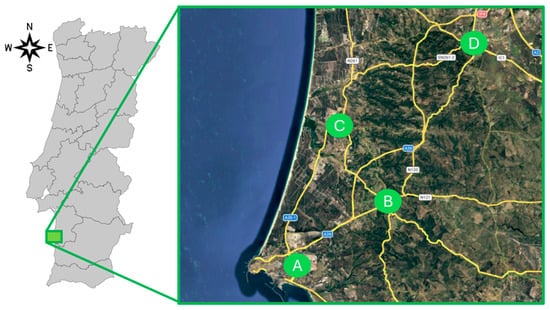
The programme involved eight classes from four secondary schools located across three municipalities (Sines, Santiago do Cacém, and Grândola) in southern Portugal. The geographical distribution of the participating schools is shown in Figure 1. A total of 91 students completed the educational programme, supported by eight teachers from STEM disciplines. Participants were enrolled in the 11th and 12th grades of secondary education, typically corresponding to approximately 16–18 years of age in Portugal. Overall, the project resulted in the development of eight scientific posters and eight hydrogen-powered vehicle prototypes.
Figure 1.
Geographical location of the four secondary schools participating in the H2 Green Valley school project in southern Portugal: (A) Escola Secundária Poeta Al Berto, Sines; (B) Escola Secundária Manuel da Fonseca, Santiago do Cacém; (C) Escola Secundária Padre António Macedo, Vila Nova de Santo André; and (D) Escola Secundária António Inácio da Cruz, Grândola. The four schools were distributed across three municipalities: Sines, Santiago do Cacém, and Grândola.
The evaluation followed an unmatched group-level pre–post design. The baseline questionnaire was completed by 106 students initially involved in the programme and was administered before the start of the educational activities at their respective schools.
A total of 91 students completed the educational programme, of whom 85 completed the post-programme questionnaire. Some students were absent during the administration of the final questionnaire. The reasons for programme discontinuation were not systematically recorded and were therefore not analysed.
The questionnaires were anonymous and did not contain an identifier that would allow individual responses to be linked between the two assessment periods. Consequently, the analysis evaluates differences between the groups assessed before and after the programme rather than individual learning trajectories.
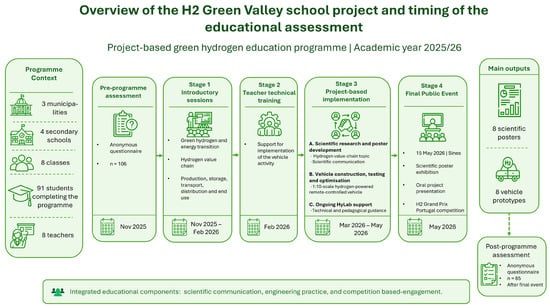
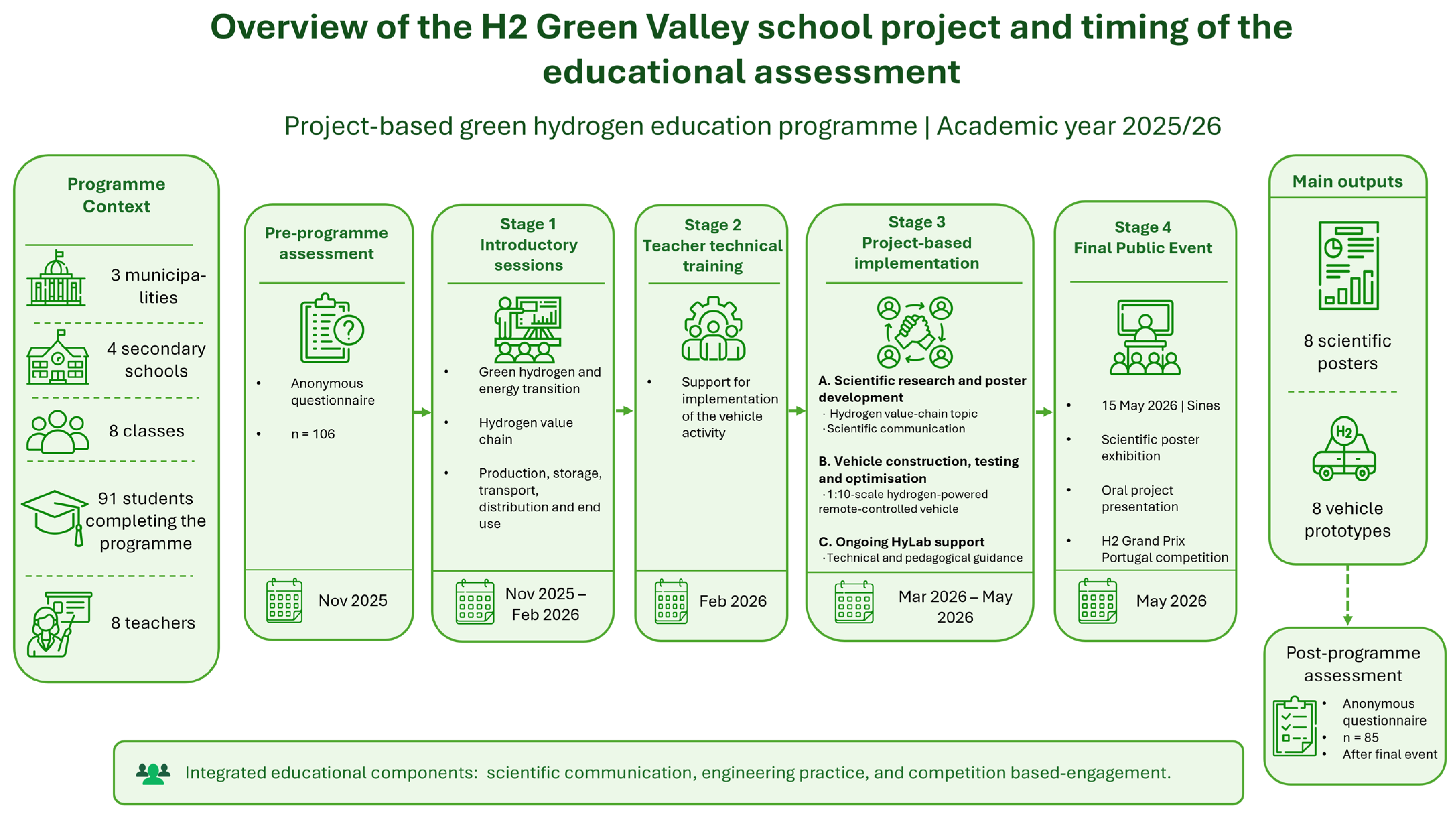
The overall structure of the school project, including its main educational components, implementation timeline, outputs, and the timing of the pre- and post-programme assessments, is summarised in Figure 2.
Figure 2.
Overview of the H2 Green Valley school project “Green Hydrogen in the Race to Decarbonisation”, showing the programme context, main educational phases, project-based activities, outputs, and timing of the anonymous pre- and post-programme knowledge assessments during the 2025/2026 academic year.
2.2. Educational Programme
As illustrated in Figure 2, the programme followed a phased structure combining introductory learning, teacher preparation, scientific research and communication, hands-on engineering activities, continued technical support, and a final public event.
Between November 2025 and February 2026, the HyLab project team delivered one introductory session of approximately 60–90 min to each of the eight participating classes.
These sessions addressed green hydrogen and its role in the energy transition, together with the main components of the hydrogen value chain, including production, storage, transport and distribution, end-use applications, and fuel cells, as well as relevant economic aspects associated with hydrogen production, deployment, and use. In February 2026, a four-hour technical training session was provided to the participating teachers to support the assembly, operation, and testing of the hydrogen-powered vehicle kits.
From March 2026 onwards, the practical and scientific components were developed in parallel. Each of the eight participating classes constituted a project team responsible for developing a scientific poster addressing a specific topic associated with the green hydrogen value chain and constructing a hydrogen-powered vehicle prototype. This activity required students to search for scientific and technical information, organise relevant content, work collaboratively, and communicate their findings in scientific poster format.
In parallel, each team constructed, configured, tested, and optimised a 1:10-scale hydrogen-powered remote-controlled vehicle, using educational kits supplied by Horizon Educational (Horizon Fuel Cell Europe, s.r.o., Prague, Czech Republic). This activity provided a practical framework for applying concepts related to hydrogen, fuel-cell operation, energy conversion, energy management, and engineering optimisation. The participating STEM teachers coordinated the educational activities within their respective classes, supported by the project team, which consisted of HyLab researchers. The HyLab researchers provided ongoing scientific and technical guidance, including support for poster development, vehicle assembly, testing, and optimisation.
The student-facing programme culminated on 15 May 2026 with a final public event in Sines. During the event, the teams presented their projects and scientific posters before a multidisciplinary jury and participated in the first H2 Grand Prix Portugal competition. The event also provided opportunities for interaction between students, teachers, researchers, industry representatives, and institutional stakeholders.
The post-programme questionnaire was administered between 19 and 28 May 2026, corresponding to 4–13 days after the final event.
2.3. Knowledge Assessment Instrument
The hydrogen-related knowledge of the students was assessed using the same multiple-choice questionnaire before and after the educational programme. The original questionnaire contained 15 items and explicitly informed participants that responses would be anonymous and used for educational and research purposes within the H2 Green Valley project. The questionnaire was developed specifically for this educational project, with its content reviewed by HyLab researchers specialising in green hydrogen, who are also co-authors of the present study. The instrument was intended for descriptive knowledge assessment rather than as a standardised or formally validated psychometric scale.
The questionnaire covered three thematic domains: General hydrogen knowledge, addressing fundamental properties and basic environmental aspects of hydrogen; Production and energy, addressing green hydrogen production, renewable energy sources, electrolysis, applications, and fuel-cell operation; and Challenges and future, addressing technological constraints related to hydrogen and factors affecting its future deployment. The structure of the questionnaire and the topics covered in each domain are summarised in Table 1.
Table 1.
Structure and main topics of the hydrogen knowledge assessment instrument used in the pre- and post-programme evaluations. The complete questionnaire is provided in Appendix A (Table A1).
The full instrument is reproduced in Appendix A (Table A1) as an English translation of the original Portuguese questionnaire. The same questionnaire was administered at both assessment points. Item 1.5 is retained in Table A1 to preserve the complete original instrument but was excluded from the analysis for the reasons described below.
For each question, students could select one of several responses, including “I do not know”. Responses were subsequently classified as correct, incorrect, or “I do not know” according to a predefined scoring key.
One of the 15 administered items asked whether hydrogen contributes to an increase in the greenhouse effect. This item was excluded from the present analysis because molecular hydrogen is not itself a direct greenhouse gas, while increases in atmospheric hydrogen can exert indirect warming effects through changes in methane, ozone, stratospheric water vapour, and aerosols [21]. A binary yes/no formulation was therefore considered insufficiently precise for scoring this scientifically more complex issue. The exclusion was based on content validity rather than on the distribution of responses obtained. The analytical questionnaire consequently comprised 14 items.
Item 1.4, addressing hydrogen and ozone-layer depletion, also involves a simplified binary formulation. Although hydrogen is not a conventional ozone-depleting substance, atmospheric hydrogen may indirectly affect stratospheric ozone chemistry under certain conditions [22]. Therefore, a sensitivity analysis excluding this item was conducted to evaluate the robustness of the main descriptive findings.
2.4. Data Analysis
For each of the 14 analysed questions, a correct response was assigned one point, whereas incorrect and “I do not know” responses received zero points. The resulting overall knowledge score therefore ranged from 0 to 14. Domain-specific scores ranged from 0 to 5 for General hydrogen knowledge, 0 to 6 for Production and energy, and 0 to 3 for Challenges and future. Exploratory, unadjusted 95% confidence intervals for the mean overall knowledge scores were calculated using Student’s t distribution. Cohen’s d was calculated as a descriptive measure of the standardized difference between group means. As an additional analysis, the proportion of correct answers among substantive responses was calculated by excluding “I do not know” and missing responses from the denominator.
Internal consistency was explored using the Kuder–Richardson Formula 20 (KR-20) for the 14 dichotomously scored items at each assessment point. A sensitivity analysis was also performed by excluding item 1.4 and recalculating the overall proportion of correct responses using the remaining 13 items.
Results were analysed descriptively using the number and percentage of correct, incorrect, and “I do not know” responses. Overall and domain-specific knowledge scores were summarised using the mean and standard deviation, while differences between the pre- and post-programme assessments were primarily expressed in percentage points (pp).
Because individual questionnaires could not be linked between assessment periods and the degree of overlap between the two samples could not be reconstructed, paired statistical testing was not appropriate. The analysis therefore focused on the direction and magnitude of group-level differences rather than estimating individual-level changes or causal intervention effects.
Given the unknown overlap between the assessment groups and the clustering of students within classes and schools, conventional independent-group hypothesis tests were not performed. Questionnaire data were processed and analysed using Microsoft Excel for Microsoft 365 (version 2610, Build 16.0.20527.20088; Microsoft Corporation, Redmond, WA, USA), while the graphical representation of the quantitative results was prepared using OriginPro 2026b SR1 (version 10.3.5.229; OriginLab Corporation, Northampton, MA, USA).
2.5. Ethical Considerations
Participation in the educational evaluation was voluntary. Written informed consent was obtained from the legal guardians of all participating students before participation. Students were informed about the purpose and voluntary nature of the assessment and were free to decline participation. The study, including its methodology and questionnaire administration, was authorised by the management of the participating schools.
The questionnaires were administered online, with students submitting their responses using mobile phones. The questionnaires did not request students’ names or unique personal identifiers. Responses were exported to Excel files without student-identifying information, and access to the data was restricted to the project team. Consequently, individual responses could not be linked between assessment periods, and no personally identifiable information was used in the analysis. The data will be retained for at least five years after the completion of the funding project to comply with potential audit requirements.
The consent procedure and data-collection approach were reviewed by the external legal support of HyLab prior to implementation. HyLab does not have an institutional ethics review board, and therefore no formal institutional ethics approval number was issued.
3. Results
3.1. Participation and Overall Knowledge
The baseline assessment included 106 students initially involved in the programme. Ninety-one students completed the educational programme, of whom 85 participated in the post-programme assessment.
Across the 14 questions included in the analysis, the mean proportion of correct responses was 75.7% before the programme and 85.7% afterwards, corresponding to a difference of 10.0 percentage points.
The exploratory KR-20 coefficients were 0.71 and 0.54 for the baseline and post-programme assessments, respectively. Excluding item 1.4 in a sensitivity analysis resulted in overall correct-response proportions of 75.0% and 85.8%, respectively, corresponding to a group-level difference of 10.8 percentage points. The mean overall knowledge score was 10.59 ± 2.41 out of 14 in the baseline assessment and 12.00 ± 1.74 out of 14 in the post-programme assessment. The median scores were 11 and 12 in the baseline and post-programme groups, respectively. The corresponding exploratory, unadjusted 95% confidence intervals for the mean scores were 10.13–11.06 and 11.62–12.38, respectively. The descriptive standardized difference between groups was Cohen’s d = 0.66.
The proportion of “I do not know” responses decreased markedly, from 15.5% before the programme to 5.0% afterwards. Incorrect responses accounted for 8.4% and 9.2% of all possible responses in the baseline and post-programme assessments, respectively; six responses (0.4%) were missing at baseline. When “I do not know” and missing responses were excluded, the proportion of correct answers among substantive responses was 90.0% at baseline and 90.3% in the post-programme assessment. Thus, the higher overall proportion of correct responses was primarily accompanied by a reduction in explicitly uncertain responses rather than a substantial difference in the accuracy of substantive answers.
3.2. Differences Across Knowledge Domains
The magnitude of the pre–post difference varied considerably across the three knowledge domains. Table 2 summarises the percentage of correct responses obtained in the pre- and post-programme assessments for each domain and overall, together with the corresponding group-level differences in percentage points.
Table 2.
Percentage of correct responses in the pre- and post-programme assessments by knowledge domain and overall, with the corresponding group-level differences in percentage points (pp). Differences were calculated from unrounded values.
General hydrogen knowledge was already high before the programme and showed only a modest difference between the two assessment periods. A larger difference was observed for Production and energy, while the largest difference occurred for Challenges and the future, which also presented the lowest baseline level of correct responses.
The domain-level results therefore indicate that the largest differences were concentrated in the areas where initial knowledge was lower, particularly those addressing technological limitations and practical challenges associated with hydrogen deployment.
3.3. Item-Level Differences
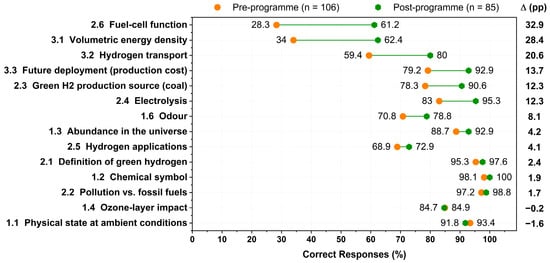
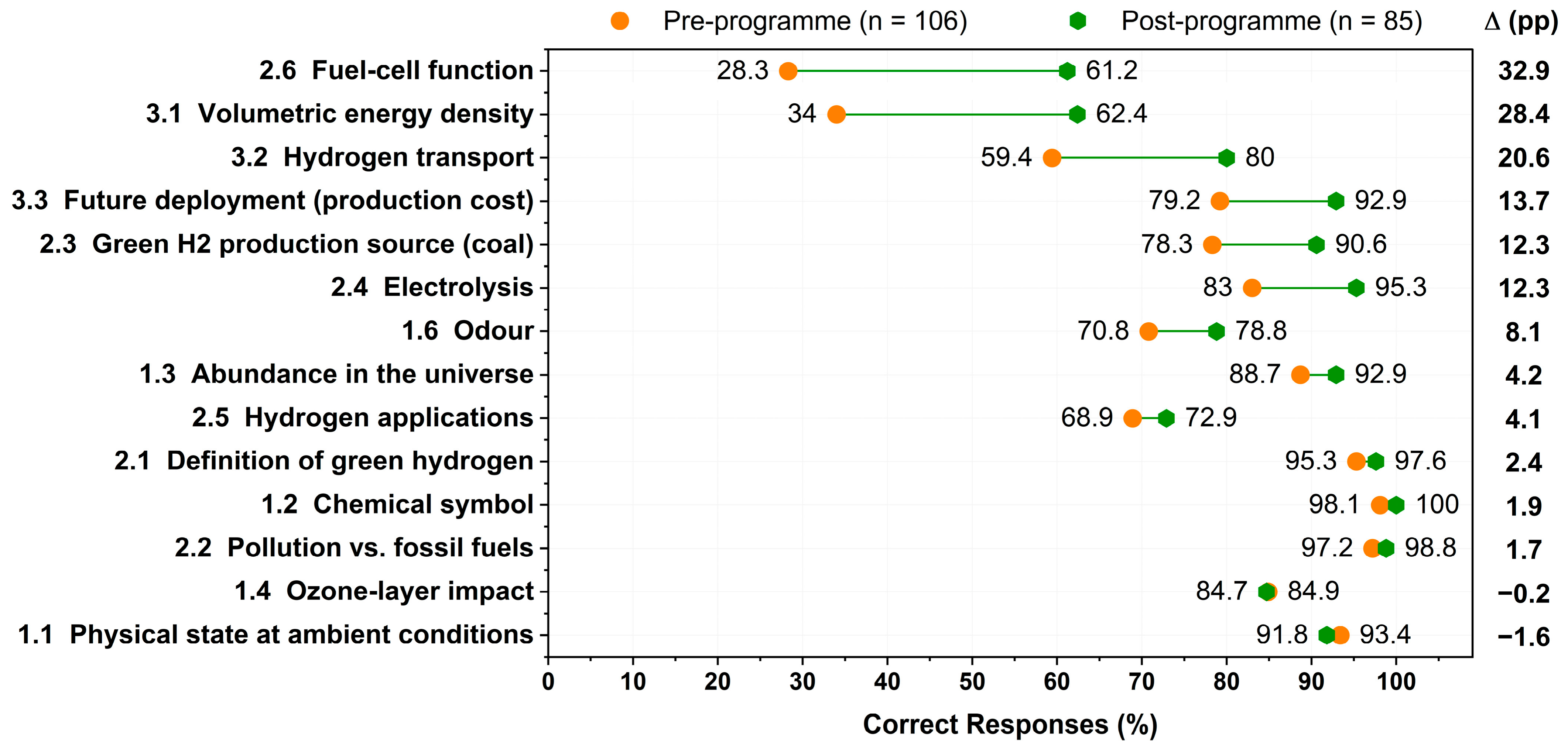
Item-level analysis provided further insight into the specific concepts associated with the largest differences between assessment periods. Figure 3 presents the percentage of correct responses obtained for each of the 14 questionnaire items in the pre-programme and post-programme assessments, ordered according to the magnitude of the pre–post difference.
Figure 3.
Item-level differences in correct responses between the pre-programme and post-programme assessments. Each dumbbell represents one questionnaire item. The left marker shows the percentage of correct responses in the pre-programme assessment, and the right marker shows the corresponding percentage in the post-programme assessment. Items are ordered by the difference between post- and pre-programme results, from the largest positive to the smallest post–pre difference.
The largest difference occurred for the question addressing the function of a fuel cell. Correct responses increased from 28.3% to 61.2%, corresponding to a difference of 32.9 percentage points. At baseline, almost half of the students (49.1%) selected “I do not know” for this question; this proportion decreased to 8.2% after the programme.
A similarly pronounced difference was observed for the question addressing the low volumetric energy density of hydrogen as a technological challenge, with correct responses increasing from 34.0% to 62.4% (+28.4 pp). Knowledge of the difficulties associated with hydrogen transport also differed substantially between assessments, increasing from 59.4% to 80.0% (+20.6 pp).
Other notable differences were observed for the identification of production-cost reduction as an important factor for future green hydrogen deployment (+13.7 pp), recognition of coal as incompatible with green hydrogen production (+12.3 pp), and identification of electrolysis as the process used to produce hydrogen from water (+12.3 pp).
In contrast, several basic concepts already presented high baseline scores and consequently showed only limited differences between assessments. For example, 98.1% of students correctly identified the chemical symbol of hydrogen at baseline, while more than 93% already recognised its gaseous state under ambient conditions. Small negative differences were also observed for some items, including hydrogen’s physical state under ambient conditions (93.4% versus 91.8%), although these questions already presented high baseline proportions of correct responses.
Overall, the item-level results presented in Figure 3 show that the largest positive differences were concentrated in concepts that were initially less familiar to students and that are more closely related to the technological and applied dimensions of hydrogen.
4. Discussion
4.1. Main Findings
The present study evaluated hydrogen-related knowledge before and after a sustained project-based educational programme implemented in four Portuguese secondary schools. The post-programme group presented a higher overall proportion of correct responses than the baseline group, with a difference of 10.0 percentage points across the 14 analysed questions.
The magnitude of the difference varied substantially across knowledge domains. General hydrogen knowledge showed only a modest difference between assessment periods, whereas larger differences were observed for Production and energy and, particularly, Challenges and the future.
4.2. General Awareness Versus Technological Knowledge
The relatively high baseline score for general hydrogen knowledge is consistent with research showing that awareness of hydrogen can be relatively widespread while more detailed technological understanding remains limited. The high baseline scores for several general hydrogen knowledge items also suggest a potential ceiling effect, limiting the magnitude of additional positive differences that could be observed in this domain.
Bentsen et al. [1], for example, identified misunderstandings regarding hydrogen production methods even in a country with considerable policy and industrial attention to hydrogen. Reviews of European evidence similarly describe a pattern in which general awareness and favourable views of hydrogen coexist with limited familiarity and shallow technical knowledge [2,3].
The present findings illustrate a similar distinction among secondary-school students. Most participants already understood basic concepts such as the physical state and chemical symbol of hydrogen and the renewable origin of green hydrogen. In contrast, knowledge was substantially lower for fuel-cell operation, volumetric energy density, and hydrogen transport. This uneven baseline knowledge profile is consistent with broader assessments of multidimensional energy literacy among secondary-school students, such as Chen et al. [23], who observed that while students often display familiarity with high-level environmental concepts, their underlying cognitive knowledge regarding technical energy processes remains disproportionately lower and fragmented prior to targeted interventions.
This distinction is relevant for hydrogen education because awareness alone does not necessarily provide individuals with the knowledge required to understand the technical opportunities and constraints associated with an emerging energy system.
4.3. Project-Based and System-Level Hydrogen Education
The educational programme combined several complementary activities that provide context for interpreting the observed group-level differences. Students were not exposed only to theoretical information. They were required to research hydrogen topics, prepare and communicate scientific information, construct and optimise fuel-cell-powered vehicles, and apply hydrogen-related concepts within an engineering challenge.
The programme also shares several characteristics with challenge- and maker-based STEM learning frameworks. Torralba and Membrillo-Hernández [24], for example, describe a Challenge-Based Learning through Making model in which students collaboratively develop tangible solutions to real-world-oriented challenges through iterative design, prototyping, testing, and improvement, supported by expert mentorship and culminating in the communication of their solutions to an authentic audience. In their nine-week middle-school engineering project, students demonstrated their understanding of STEM concepts through the artifacts they produced, their written and verbal explanations, and the iterative design process itself. Although the present programme was not formally designed according to this specific framework, similar elements were present through the construction and optimisation of hydrogen-powered vehicles, continued technical support, scientific poster development, and presentation of the teams’ work to researchers, industry representatives, and a multidisciplinary jury.
This approach is consistent with the system-level perspective advocated by Alanne [9]. In that study, university engineering students worked on an assignment integrating hydrogen production, storage, safety, energy balances, and end-use applications rather than considering each component independently. Alanne concluded that hydrogen education should address hydrogen as part of a larger energy system and should provide problem settings that combine creativity with realistic engineering constraints.
The present programme extends this principle to secondary-school education through a combination of scientific communication and hands-on engineering activities. The development and optimisation of hydrogen-powered vehicles required students to engage with fuel-cell technology, energy conversion, system performance, and hydrogen consumption, while the scientific posters encouraged them to place these technologies within the broader green hydrogen value chain. This aligns with findings by Pecen et al. [25], who demonstrated that applied renewable energy projects foster technological literacy and STEM engagement by allowing students to explore complex relationships between mathematics, physical sciences, and engineering within practical problem-solving environments.
Previous work using hydrogen-powered vehicle projects with secondary-school students similarly supports the educational potential of maker- and project-based approaches [10]. Hands-on experimentation with hydrogen components [11] can provide a bridge between abstract chemical and physical principles and applied engineering. In the present study, larger group-level differences were observed for technically demanding concepts such as fuel-cell operation and hydrogen-related engineering challenges, although the study design does not allow these differences to be attributed to specific programme activities. More broadly, participatory science programmes implemented in schools have shown that active involvement in scientific processes can strengthen scientific understanding and connect classroom learning with real-world problems [14].
4.4. Reduction in “I Do Not Know” Responses
One particularly relevant result was the reduction in “I do not know” responses from 15.5% to 5.0% across the analysed questionnaire.
The largest reductions occurred for the same technologically demanding topics that showed the largest differences in correct responses. For example, “I do not know” responses decreased by approximately 41 percentage points for fuel-cell operation and by approximately 32 percentage points for hydrogen’s volumetric energy challenge.
Research on metacognitive monitoring distinguishes decisions to provide or withhold an answer from confidence calibration, which requires confidence judgements to be compared with actual response accuracy [26,27]. Because the questionnaire did not collect confidence ratings, the decrease in “I do not know” responses cannot be interpreted as evidence of improved confidence calibration or individual knowledge gains. Rather, it indicates that this response option was selected less frequently in the post-programme assessment.
The similar accuracy among substantive responses suggests that the higher overall proportion of correct answers was largely associated with fewer explicitly uncertain responses, while incorrect answers remained present. However, given the unmatched assessment design, changes in individual response patterns or the persistence of misconceptions within the same students cannot be established.
4.5. Comparison with Previous Hydrogen and Energy Education Research
The present findings can be contextualised within previous studies investigating educational interventions addressing hydrogen and renewable energy technologies. However, differences in participant characteristics, assessment methods, and intervention design must be considered when comparing their outcomes.
Alanne [9] evaluated hydrogen-related knowledge among 93 Finnish university-level energy engineering students and reported increases in self-assessed knowledge ranging from 0.69 to 1.74 points on a six-point scale, depending on the topic. Although these findings suggest differences in students’ perceived understanding following a hydrogen-related learning assignment, direct quantitative comparison with the present study is not appropriate. Whereas Alanne relied on self-reported knowledge, the present assessment used multiple-choice questions with predefined expected answers. This distinction is important because perceived understanding does not necessarily correspond to the ability to correctly answer specific technical questions. Furthermore, the present study involved secondary-school students rather than university-level engineering students.
A more comparable age group was investigated by Kramar and Knez [12], who evaluated a gamified hydrogen-education intervention involving 111 adolescents aged 13–15. Their study reported an increase in mean self-reported knowledge scores from 2.54 to 3.94 on a five-point scale, with particularly pronounced differences in perceived understanding of fuel cells and hydrogen-powered vehicles. This thematic pattern is noteworthy in relation to the present study, where fuel-cell operation was also the item showing the largest group-level difference in correct responses, increasing from 28.3% to 61.2%. Nevertheless, the two studies assessed different constructs: Kramar and Knez measured perceived understanding through self-reported ratings, whereas the present study evaluated responses to factual knowledge questions. In addition, their intervention consisted of a four-hour activity, while the present programme extended across the academic year. These differences prevent direct comparison of the magnitude of the reported outcomes or attribution of the present results to programme duration.
Pablo-Lerchundi et al. [13] provide a particularly relevant methodological comparison. Their study evaluated renewable-energy knowledge among pre-university students following a 2.5 h gamified escape-room activity, reporting an increase in mean knowledge scores from 2.57 to 3.92 out of 6. Unlike the present study, their assessment used anonymous individual identifiers to link responses across assessment periods, together with different but equivalent knowledge items, allowing paired statistical analysis. In contrast, the questionnaires used in the present study could not be individually matched, and the observed differences therefore describe assessment groups rather than individual learning trajectories. This distinction illustrates the importance of assessment design when interpreting pre–post findings and highlights the methodological value of individually linked questionnaires in future evaluations.
Beyond differences in assessment design, the findings of Pablo-Lerchundi et al. [13] also illustrate the importance of distinguishing knowledge-related outcomes from broader educational dimensions. Despite reporting higher renewable-energy knowledge scores, their study found no significant change in most measures of attitudes towards science and technology, renewable energy, and related careers. Similarly, Kramar and Knez [12] reported more pronounced differences in perceived hydrogen-related understanding than in broader awareness and interest. The present study did not assess attitudes, motivation, confidence, technology acceptance, or career intentions, and its results cannot establish whether the educational programme was associated with differences in these dimensions. As also emphasised by previous research [9,12,13], knowledge and attitudes should be considered distinct outcomes rather than assuming that higher knowledge necessarily corresponds to greater interest in or acceptance of emerging energy technologies.
Overall, the contribution of the present study lies in documenting hydrogen-related knowledge across different conceptual domains within a sustained educational programme combining scientific communication and practical engineering activities. In contrast to studies relying primarily on self-reported understanding, the present assessment provides item-level information on specific technological knowledge gaps, including fuel-cell operation, hydrogen storage challenges, and transport limitations. Nevertheless, the unmatched design and absence of a control group prevent causal conclusions regarding the contribution of the programme or its individual activities. Future studies should combine objective knowledge assessments with individually linked measurements and additional indicators addressing attitudes and other dimensions of energy literacy [9,12,13].
4.6. Implications for Hydrogen Education
The development of hydrogen technologies will require both specialised technical skills and broader scientific understanding among future generations. Secondary-school initiatives may therefore provide an opportunity to introduce hydrogen concepts before students make higher-education and professional choices. Evidence from higher education further suggests that authentic project-based STEM experiences can influence students’ perceptions of their STEM skills and the utility of STEM learning, factors that may in turn be associated with STEM career aspirations [28]. Although such findings cannot be directly extrapolated to secondary-school hydrogen education, they support the value of investigating whether sustained project-based hydrogen programmes may also influence dimensions beyond knowledge, including self-efficacy, perceived relevance, and future educational or career interest.
This need is consistent with previous studies highlighting persistent knowledge gaps regarding hydrogen technologies and recommending targeted educational programmes addressing their scientific principles, benefits, and practical applications [29].
Research on K–12 science education also identifies engineering activities as relevant contexts for connecting scientific knowledge with design and practical problem-solving [30].
The approach evaluated here provides a potential framework combining scientific knowledge, research, communication, teamwork, and practical technological application. It also connects schools with research organisations and industry, allowing students to encounter hydrogen not simply as an abstract energy concept but as a developing scientific and industrial field.
4.7. Limitations and Future Work
Several limitations should be considered when interpreting the results. First, the questionnaires were anonymous and could not be individually matched between the two assessment periods. The results therefore represent group-level differences rather than individual learning trajectories. Differences in programme participation and questionnaire completion resulted in different sample sizes and potentially different group compositions. Selection bias cannot be ruled out, as students with greater motivation or engagement may have been more likely to complete the post-programme assessment, potentially contributing to the higher knowledge scores observed. Students were nested within eight classes across four schools. The exploratory confidence intervals were not adjusted for potential within-class or within-school correlation and should therefore be interpreted cautiously. As the post-programme assessment was conducted 4–13 days after the final event, the findings reflect short-term post-programme knowledge and do not establish longer-term knowledge retention, which would require additional follow-up assessments [31].
Second, no control group was included, and the observed differences cannot therefore be attributed exclusively to the educational programme. Third, the questionnaire was developed specifically for the project and was not a previously validated psychometric instrument. It assesses selected hydrogen-related knowledge rather than the broader multidimensional concept of hydrogen literacy. One item was excluded from the main analysis due to its scientifically ambiguous binary formulation, while a sensitivity analysis was performed for another item concerning ozone-layer depletion. Furthermore, the heterogeneous content of the questionnaire and the relatively low post-programme KR-20 coefficient warrant caution when interpreting the overall knowledge score as a single measure.
Finally, the participating students were drawn from four secondary schools within a specific Portuguese region, limiting generalisation to other educational and geographical contexts. Future implementations should consider anonymous linkable identifiers, as successfully applied in other pre–post educational studies [13], comparison groups, and delayed follow-up assessments to evaluate knowledge retention. The importance of longitudinal follow-up has also been highlighted in school-based pre-post intervention research outside the energy domain. For example, Moussi et al. [32] observed significant differences in knowledge immediately following a school-based educational campaign but identified the single post-intervention assessment point as an important limitation because it prevented evaluation of whether the observed differences persisted over time. Future studies should therefore combine individually linkable assessments with delayed follow-up measurements and validated instruments addressing additional dimensions such as attitudes, perceived risk, technology acceptance, and interest in hydrogen-related education and careers.
5. Conclusions
This study assessed hydrogen-related knowledge before and after participation in a project-based green hydrogen education programme implemented in four Portuguese secondary schools. Across the 14 questions included in the analysis, the proportion of correct responses was 75.7% at baseline and 85.7% after completion of the programme.
The largest differences were observed for technological topics in which initial knowledge was lowest. These included fuel-cell operation, low volumetric energy density of hydrogen, and challenges associated with hydrogen transport. In contrast, general hydrogen knowledge was already comparatively high before the programme and showed only limited additional change. The proportion of “I do not know” responses also decreased substantially, from 15.5% to 5.0%.
The findings provide an exploratory description of hydrogen-related knowledge following a school programme combining theoretical learning, scientific communication, and hands-on engineering activities. However, because the assessments were anonymous and unmatched and no control group was included, the results should be interpreted as group-level differences rather than as causal estimates of individual learning. Future studies incorporating longitudinally linkable assessments and longer-term follow-up would allow the educational impact and persistence of hydrogen-related knowledge to be evaluated more robustly.
Author Contributions
Conceptualization, N.C.; methodology, M.C.R. and N.C.; formal analysis, M.C.R., M.S. and A.G.; investigation, M.C.R., M.S. and A.G.; resources, K.P., M.M.M., G.G. and N.C.; data curation, M.C.R. and N.C.; writing—original draft preparation, M.S., A.G. and N.C.; writing—review and editing, K.P., M.M.M., G.G., P.C. and N.C.; visualization, M.C.R., M.S. and N.C.; supervision, K.P., M.M.M., G.G. and N.C.; project administration, M.C.R., P.C. and N.C.; funding acquisition, P.C. All authors have read and agreed to the published version of the manuscript.
Funding
This research was funded by the H2 Green Valley Agenda, grant numbers 02/C05-i01.02/2022.PC645551860-00000064 and 01/C05-i11/2024.PC645551860-00000064, managed by IAPMEI and funded by the call Aviso Convite n.º02/C05-i01/2022 of the Portuguese Recovery and Resilience Plan. The HyLab authors acknowledge the Base Funding Project of the Collaborative Laboratory (operation code 01/C05-i02/2022.P188), managed by ANI—Agência Nacional de Inovação, awarded under the call RE-C05-i02—Missão Interface No. 01/C05-i02/2022, and funded by the Portuguese Recovery and Resilience Plan (PRR).
Institutional Review Board Statement
The study was conducted as part of an educational outreach programme. HyLab does not have an institutional ethics review board and, therefore, no formal institutional ethics approval number was issued. Written informed consent was obtained from the legal guardians of all participating students. The consent and data-collection procedures were reviewed by external legal support of HyLab prior to implementation, and the questionnaires were administered anonymously.
Informed Consent Statement
Written informed consent was obtained from the legal guardians of all students participating in the educational programme and its associated evaluation.
Data Availability Statement
The anonymized data supporting the findings of this study are available from the corresponding author upon reasonable request, subject to applicable project and data-protection requirements.
Acknowledgments
The authors acknowledge the students and teachers from the participating secondary schools for their engagement throughout the project. The authors also acknowledge Maria Beira for her contribution to the initial implementation of the project, including supporting Marcelo C. Rosário in the initial engagement with school directors, teachers, and students, contributing to the development of the questionnaire, and supporting the administration of the pre-programme assessment. The authors also acknowledge the support of the H2 Green Valley partners and the organisations involved in the implementation of the final event, particularly REN, Instituto Superior Técnico, Bosch, Floene, Sines Tecnopolo, and the Municipality of Sines.
During the preparation and revision of this manuscript, the authors used ChatGPT (OpenAI; GPT-5.6 and GPT-6) to assist with language editing, text refinement, and manuscript revision. All AI-assisted content was critically reviewed and edited by the authors, who take full responsibility for the final content of the publication.
Conflicts of Interest
Pedro Carola is an employee of REN Gás, S.A. This affiliation is disclosed for transparency and did not influence the design, analysis, interpretation, or reporting of the study. The remaining authors declare no conflicts of interest.
Appendix A
The questionnaire used for the pre- and post-programme knowledge assessments is reproduced below. The original instrument was administered in Portuguese. Table A1 provides an English translation for publication purposes. The wording, response structure, and item numbering reproduce the original questionnaire.
Table A1.
English translation of the hydrogen knowledge questionnaire administered before and after the educational programme. The questionnaire was originally administered in Portuguese. Question wording is shown in bold, while the response options presented to participants are shown in regular text. The expected response used for scoring is provided for each analysed item. Item 1.5 is included to reproduce the complete original 15-item instrument but was excluded from the present analysis because its binary formulation did not adequately represent the scientifically more complex indirect climatic effects of atmospheric hydrogen.
References
- Bentsen, H.L.; Skiple, J.K.; Gregersen, T.; Derempouka, E.; Skjold, T. In the Green? Perceptions of Hydrogen Production Methods among the Norwegian Public. Energy Res. Soc. Sci. 2023, 97, 102985. [Google Scholar] [CrossRef] [Scilit]
- Maketo, L.; Ashworth, P. Social Acceptance of Green Hydrogen in European Union and the United Kingdom: A Systematic Review. Renew. Sustain. Energy Rev. 2025, 218, 115827. [Google Scholar] [CrossRef] [Scilit]
- Jensen, A.M.; Jensen, E.A.; Martin, D.; Wagoner, B. Evidence Synthesis: Public Perceptions of Hydrogen and Fuel Cell Technologies in the European Union. Open Res. Eur. 2025, 5, 393. [Google Scholar] [CrossRef] [Scilit]
- Parente, C.; Teixeira, F.; Cerdeira, J. Stakeholders’ Perceptions of Hydrogen and Reflections on Energy Transition Governance. Energy Sustain. Soc. 2024, 14, 15. [Google Scholar] [CrossRef] [Scilit]
- McHenry, R.; Krishnan, S.; Tuck, L. Knowledge, Skills, and Attributes Needed for Developing a Hydrogen Engineering Workforce: A Systematic Review of Literature on Hydrogen Engineering Education. Int. J. Hydrogen Energy 2024, 72, 380–387. [Google Scholar] [CrossRef] [Scilit]
- DeWaters, J.E.; Powers, S.E. Energy Literacy of Secondary Students in New York State (USA): A Measure of Knowledge, Affect, and Behavior. Energy Policy 2011, 39, 1699–1710, Correction in Energy Policy 2018, 117, 278. [Google Scholar] [CrossRef] [Scilit]
- DeWaters, J.; Qaqish, B.; Graham, M.; Powers, S. Designing an Energy Literacy Questionnaire for Middle and High School Youth. J. Environ. Educ. 2013, 44, 56–78. [Google Scholar] [CrossRef] [Scilit]
- Santillán, O.S.; Cedano, K.G. Energy Literacy: A Systematic Review of the Scientific Literature. Energies 2023, 16, 7235. [Google Scholar] [CrossRef] [Scilit]
- Alanne, K. A Survey of Finnish Energy Engineering Students’ Knowledge and Perception of Hydrogen Technology. Int. J. Hydrogen Energy 2018, 43, 10205–10214. [Google Scholar] [CrossRef] [Scilit]
- Pitanga, Â.F.; da Silva, D.A.N.; de Menezes, D.D.; Mota, F.d.S. Building Hydrogen-Powered Unmanned Vehicles: A Thematic Proposal—Maker Chemistry—on Green Hydrogen Production. J. Chem. Educ. 2025, 102, 137–146. [Google Scholar] [CrossRef] [Scilit]
- Zambrano Hernández, M.L.; Serrano, J.; Flores, E.; Batista, A.; Pinzón, R.; Álvarez, M.; Fábrega Duque, J.R. Workshop with Hydrogen Cells: A Pedagogical and Motivating Experience for the Study of Unconventional Forms of Energy Generation in Pre-School Students in Panama City. Sustainability 2025, 17, 4149. [Google Scholar] [CrossRef] [Scilit]
- Kramar, U.; Knez, M. Gamified Learning for Sustainability: An Innovative Approach to Enhance Hydrogen Literacy and Environmental Awareness Through Simulation-Based Education. Sustainability 2025, 17, 2694. [Google Scholar] [CrossRef] [Scilit]
- Pablo-Lerchundi, I.; Sastre-Merino, S.; Riquelme-Dominguez, J.M.; Mahtani, K.; Mendonça, H. Gamifying Renewable Energy: Enhancing Pre-University Students’ Knowledge and Attitudes Toward Science and Technology. Educ. Sci. 2025, 15, 1500. [Google Scholar] [CrossRef] [Scilit]
- Felizardo, M.; Lage, J.; Antunes, C.; Simão, I.; Reis, M.; Andrade, E.; Gonçalves, S.; Fonseca, H.; Malta, M.; Almeida, M.; et al. Does Citizen Science Have the Potential of Reducing Exposure to Indoor Radon? Humanit. Soc. Sci. Commun. 2026, 13, 1834. [Google Scholar] [CrossRef] [Scilit]
- Balemen, N.; Keskin, M.Ö. The Effectiveness of Project-Based Learning on Science Education: A Meta-Analysis Search. Int. Online J. Educ. Teach. 2018, 5, 849–865. [Google Scholar]
- Doğan, Y.; Yener, D.; Daşdemir, I.; Ekşi, Z.; Batdı, V. Project-Based Learning in Schools: A Multi-Complementary Study of Its Effectiveness. Humanit. Soc. Sci. Commun. 2026, 13, 505. [Google Scholar] [CrossRef] [Scilit]
- Chen, C.-H.; Yang, Y.-C. Revisiting the Effects of Project-Based Learning on Students’ Academic Achievement: A Meta-Analysis Investigating Moderators. Educ. Res. Rev. 2019, 26, 71–81. [Google Scholar] [CrossRef] [Scilit]
- Halawa, S.; Lin, T.-C.; Hsu, Y.-S. Exploring Instructional Design in K-12 STEM Education: A Systematic Literature Review. Int. J. STEM Educ. 2024, 11, 43. [Google Scholar] [CrossRef] [Scilit]
- Xie, Y.; Yusuf, A. Advancing Scientific Literacy: A Systematic Review of Trends, Pedagogies and Challenges in the 21st Century. Rev. Educ. 2026, 14, e70140, Correction in Rev. Educ. 2026, 14, e70154. [Google Scholar] [CrossRef] [Scilit]
- Oviedo Díaz, S.M.; Jiménez Sierra, Á.A.; Bayona Velásquez, E.M. Integrating Energy Education Through STEM/STEAM: Conceptual and Pedagogical Foundations from a Systematic Review. Sustainability 2026, 18, 10024. [Google Scholar] [CrossRef] [Scilit]
- Sand, M.; Skeie, R.B.; Sandstad, M.; Krishnan, S.; Myhre, G.; Bryant, H.; Derwent, R.; Hauglustaine, D.; Paulot, F.; Prather, M.; et al. A Multi-Model Assessment of the Global Warming Potential of Hydrogen. Commun. Earth Environ. 2023, 4, 203. [Google Scholar] [CrossRef] [Scilit]
- Lakshmanan, S.; Bhati, M. Unravelling the Atmospheric and Climate Implications of Hydrogen Leakage. Int. J. Hydrogen Energy 2024, 53, 807–815. [Google Scholar] [CrossRef] [Scilit]
- Chen, K.L.; Liu, S.Y.; Chen, P.H. Assessing Multidimensional Energy Literacy of Secondary Students Using Contextualized Assessment. Int. J. Environ. Sci. Educ. 2015, 10, 201–218. [Google Scholar] [CrossRef]
- Torralba, J.; Membrillo-Hernández, J. Challenge-Based Learning Through Making: Representing STEM Crosscutting Concepts Through Designing and Making in Middle School Engineering. Educ. Sci. 2025, 15, 1292. [Google Scholar] [CrossRef] [Scilit]
- Pecen, R.; Yildiz, F.; Humston, J.L. Promoting STEM to Young Students by Renewable Energy Applications. J. STEM Educ. 2012, 13, 62–73. [Google Scholar]
- Fleming, S.M. Metacognition and Confidence: A Review and Synthesis. Annu. Rev. Psychol. 2024, 75, 241–268. [Google Scholar] [CrossRef] [Scilit] [PubMed]
- Hattie, J. Calibration and Confidence: Where to Next? Learn Instr. 2013, 24, 62–66. [Google Scholar] [CrossRef] [Scilit]
- Beier, M.E.; Kim, M.H.; Saterbak, A.; Leautaud, V.; Bishnoi, S.; Gilberto, J.M. The Effect of Authentic Project-based Learning on Attitudes and Career Aspirations in STEM. J. Res. Sci. Teach. 2019, 56, 3–23. [Google Scholar] [CrossRef] [Scilit]
- Palanca, A.G.; Chao, C.L.V.; Yap, K.J.R.; de Leon, R.L. Bridging the Gap: Public Perception and Acceptance of Hydrogen Technology in the Philippines. Sustainability 2025, 17, 324. [Google Scholar] [CrossRef] [Scilit]
- Antink-Meyer, A.; Brown, R.A.; Parker, M.E.; Smith, J. A Review of Research on Engineering in K-12 Science Education. Sci. Educ. 2025, 109, 893–910. [Google Scholar] [CrossRef] [Scilit]
- Pacini, A.; Brüggemann, M.; Flottmann, M.; Großschedl, J.; Schlüter, K. Sustainability Education Through Green Facades: Effects of a Short-Term Intervention on Environmental Knowledge, Attitude, and Practices. Sustainability 2025, 17, 2609. [Google Scholar] [CrossRef] [Scilit]
- Moussi, C.; Tahan, L.; Habchy, P.; Kattan, O.; Njeim, A.; Abou Habib, L.; El Bitar, W.; El Asmar, B.; Chahine, M.N. School-Based Pre- and Post-Intervention Tests Assessing Knowledge about Healthy Lifestyles: A National School Health Awareness Campaign on Children Aged between 3 and 12 Years Old. Children 2024, 11, 213. [Google Scholar] [CrossRef] [Scilit] [PubMed]

Disclaimer/Publisher’s Note: The statements, opinions and data contained in all publications are solely those of the individual author(s) and contributor(s) and not of MDPI and/or the editor(s). MDPI and/or the editor(s) disclaim responsibility for any injury to people or property resulting from any ideas, methods, instructions or products referred to in the content. |
© 2026 by the authors. Licensee MDPI, Basel, Switzerland. This article is an open access article distributed under the terms and conditions of the Creative Commons Attribution (CC BY) license.