


Abstract
The electrochemical regeneration of sodium borohydride (NaBH4) from spent metaborate is a central bottleneck for circular hydrogen storage. (1) Background: The eight-electron reduction of the aqueous borate species B(OH)4− to BH4− is thermodynamically out-competed by the hydrogen-evolution reaction (HER) by about 0.41 V at every pH, so selectivity can only be won kinetically. (2) Methods: We advance an ambiphilic-site hypothesis, screen 30 candidate metal centres using entirely experimental, tabulated descriptors (bulk HER exchange current density; gas-phase M-O bond energy) with no new electronic-structure computation, and then audit the transferability of both descriptor axes against published, corrected DFT datasets for nitrogen-coordinated single-atom sites. (3) Results: At the parent-metal level, the two axes are orthogonal (Spearman ρ = 0.02) and the score passes a family-level experimental validation over seven bulk-electrode metals (ρ = 0.69; exact permutation p = 0.050), separating the HER-dominated noble-metal family from the single-atom Mn benchmark. The site-level audit shows that the oxophilicity axis transfers to M-N4 sites almost quantitatively (ρ = −0.84 pyridine-4N, −0.95 pyrrole-4N, n = 23) while the bulk HER axis does not, and that site-level scaling between oxygen and hydrogen binding narrows the productive window to oxophilic centres that over-bind hydrogen. (4) Conclusions: The site-anchored screen redirects the search from the parent-metal leaders (La, Ce, Y, Ti, Sc) to refractory single-atom centres, with W, Nb and Mo as priority synthesis targets (Re excluded on scarcity; Zr, Hf, Ta as data-supported extensions; Ti as the sustainability-anchored borderline case) and the lanthanides retained only as explicitly extrapolative candidates. All data and analysis code are openly deposited.
1. Introduction
Sodium borohydride is one of the most attractive solid-state hydrogen carriers and fuels [1,2]. It is a stable solid with high gravimetric hydrogen content, and it releases hydrogen on demand by hydrolysis [3,4,5]. The obstacle to a circular NaBH4 economy is the reverse step, namely regenerating NaBH4 from the spent metaborate NaBO2, which today is dominated by energy-intensive thermochemical, mechanochemical and hydrogen-transformation routes [6,7]. A direct, room-temperature electrochemical regeneration would close the cycle, but the reaction is uniquely demanding. It is an eight-electron reduction and, in strongly alkaline solution, the dissolved boron species is the tetrahydroxyborate anion B(OH)4− rather than the linear metaborate ion, so the operative half-reaction is B(OH)4− + 4 H2O + 8 e− to BH4− + 8 OH− (the customary shorthand NaBO2 denotes the same species after dehydration). It must be driven in aqueous alkaline media where the hydrogen-evolution reaction (HER) is the overwhelming competitor.
The appeal of a borohydride-based carrier is best understood against the wider hydrogen storage landscape. Compressed and liquefied hydrogen demands either very high pressures or cryogenic temperatures, while metal hydrides and liquid organic carriers trade gravimetric capacity against release temperature and kinetics [8]. Sodium borohydride occupies an attractive niche because it stores 10.8 wt% hydrogen nominally, is non-flammable as a solid and releases hydrogen by hydrolysis under mild conditions, which has motivated the extensive study of both its hydrolysis catalysis and its use as a fuel [1,9]. What keeps this chemistry from being genuinely circular is the cost and energy of remaking the fuel: hydrolysis converts NaBH4 to sodium metaborate, and unless the metaborate can be returned to borohydride economically, the carrier is single-use.
The thermodynamics make the constraint explicit. The standard potential of the BO2−/BH4− couple (−1.24 V vs. SHE) lies about 0.41 V below the alkaline HER (−0.83 V vs. SHE), and because both couples shift identically with pH, the selectivity gap is pH-invariant. There is, therefore, no thermodynamic operating window in which borohydride formation is favoured over hydrogen evolution, and selectivity must be an entirely kinetic achievement of the catalyst and electrolyte. Reported electrochemical routes bear this out, because every verified route to date sits below about 30% Faradaic efficiency. The best result is a single-atom Mn catalyst (MnO@Mn-N-C) at 27.8% [10], while earlier silver-electrode work achieved only 17% conversion with rigorous product identification [11,12].
This paper asks the design question that follows directly: which single-atom metal centre is most likely to win the kinetic competition? Single-atom catalysts (SACs) with nitrogen-coordinated M-Nx (x = 4–6) motifs are the natural platform, because they present isolated, tunable metal centres, and the record electrochemical result is already an SAC [10,13]. Experimentally, such N-coordinated single atoms are not limited to compact 3d metals: yttrium and scandium single atoms have been synthesised on nitrogen-doped carbon, where their large radii favour six-fold N/C coordination rather than the planar N4 pocket [14], and praseodymium- and neodymium-based single-atom catalysts have been demonstrated for CO2 electroreduction [15,16]. We, therefore, use M-Nx as shorthand for this family of motifs, with x set by the metal radius. The conventional route to answering this is high-throughput DFT. We deliberately take the opposite approach and build a screening descriptor from experimental, tabulated physical quantities only, so that the whole analysis is transparent and reproducible without electronic-structure computation. This is not a replacement for first-principles modelling but a hypothesis-generating filter that indicates where such modelling should look. More precisely, the score is a competitor-suppression and substrate-affinity filter: it contains no positive descriptor for the eight-electron reduction itself, and Section 3.7 measures, rather than assumes, how far each of its axes transfers from the parent metal to the single-atom site.
Single-atom catalysts have emerged as a powerful platform for exactly this kind of selectivity problem. By dispersing isolated metal centres in a nitrogen-doped carbon matrix, an M-N4 site presents a single, well-defined and tunable active centre whose behaviour is governed by the identity of the metal and its coordination environment [13,17]. Recent work on both oxygen and hydrogen electrocatalysis has shown that the performance of such centres can be rationalised, and even predicted, from compact electronic or bond strength descriptors rather than from full mechanistic calculation [18,19]. This descriptor-based view is attractive here because it converts an open-ended search over the periodic table into a two-dimensional map that can be inspected directly and validated against the handful of catalysts that have already been tested.
Descriptor-based screening of single-atom catalysts also has a substantial prior literature that frames the present work. Gas-phase and cationic oxygen-affinity scales have been used as coherent reactivity descriptors for oxygenate catalysis [20], scaling relations and unconventional mechanisms have been mapped for oxygen intermediates on SACs [21], and data-driven screens have been reported for CO2 and nitrate electroreduction [22,23]. For graphene-supported SACs specifically, curated DFT datasets of hydrogen and hydroxyl adsorption free energies are now available across the 3d-5d series [24,25], and the widely used 2018 universal-descriptor dataset was retracted and replaced by a corrected 2024 dataset after convergence and lattice-strain errors were identified [26]; only the corrected data are used here. Against this background, the specific contributions of the present work are the application to borohydride regeneration and the explicit, quantitative audit of descriptor transferability from parent metal to single-atom site.
We propose that selectivity on an M-Nx site is governed by two nearly independent metal properties. The first is HER suppression: the intrinsic hydrogen-evolution activity of the metal must be low, so that protons are not simply reduced to H2. This is quantified by the experimental HER exchange current density, log10 i0, from the classical Trasatti and Norskov volcano compilation [27,28]. The second is oxophilicity: the metal must bind oxygen strongly enough to adsorb and activate the B-O bond of the borate substrate and to stabilise the partially hydrogenated intermediates. We quantify this by the experimental gas-phase M-O bond-dissociation energy, D(M-O), consistent with the Kepp oxophilicity scale [29,30]. A productive centre needs both properties, so it must be ambiphilic, meaning hydrogen-repelling, yet oxygen-embracing. Because these two properties are only weakly related across the d-block, the productive region is a narrow corner of descriptor space, which we show explains both why single-atom Mn works and why HER-suppressing but weakly oxophilic metals such as Ag give only modest conversion.
The paper proceeds in three steps that the reader can follow independently. First, a parent-metal screen ranks 30 candidate centres using only the two tabulated descriptors (Section 2.1, Section 2.2, Section 2.3, Section 3.1, Section 3.2, Section 3.3, Section 3.4, Section 3.5 and Section 3.6). Second, that screen is validated, with its statistical limits stated in full, against the seven metals for which experimental borohydride-regeneration or selectivity behaviour is reported (Section 3.3). Third, and decisive for the final recommendations, both descriptor axes are audited against published DFT adsorption energies computed for nitrogen-coordinated single-atom sites, which determines what survives the transfer from parent metal to actual site and re-derives the shortlist from the site-level data (Section 2.4 and Section 3.7).
2. Materials and Methods
2.1. Descriptor Dataset
We compiled a dataset of 30 candidate metal centres spanning the transition metals, the early lanthanides and selected p-block metals. Every descriptor is an experimental or tabulated literature value, and no quantity is simulated, fitted or computed in this work. For each metal, we recorded the following: the Pauling electronegativity (CRC Handbook [31]); the HER exchange current density log10 i0 in acid, taken from the Trasatti volcano compilation and the Norskov reinterpretation [27,28], as the HER-activity descriptor (lower means more strongly HER-suppressing); the gas-phase diatomic M-O bond-dissociation energy D(M-O) from Luo and from the Moltved–Kepp oxophilicity dataset [30,32], as the oxophilicity descriptor; the crustal abundance in ppm (CRC and Taylor–McLennan); an ordinal supply-risk score (one to ten, informed by the EU critical-raw-materials assessment [33]); and an ordinal toxicity flag (0 low, 1 moderate, 2 high). Representative descriptor uncertainties are +/− 0.3 to 1.2 dex for log10 i0 and +/− 10 to 40 kJ/mol for D(M-O); these are propagated in Section 3.4. Using simple, tabulated descriptors as proxies for adsorption energetics follows established scaling-relation practice [24,34]. The i0 compilation is measured in acidic media; the pH-transfer assumption this introduces and the deeper metal-to-site transfer assumption are examined explicitly and quantitatively in Section 3.3 and Section 3.7. Because the score depends on log10 i0 only through a monotone normalisation, a uniform pH-induced shift in all exchange currents leaves the ranking strictly unchanged; under independent per-metal perturbations of up to three decades, at least three of the five parent-metal leaders remain in the top five with probability 0.998, and La does so with probability 0.974 (Monte–Carlo; full results in the deposited dataset, see Data Availability Statement).
The choice of descriptors deserves comment. The HER exchange current density is the most direct experimental measure of how readily a metal reduces protons to molecular hydrogen, and it spans more than ten orders of magnitude across the metals considered here, which makes it a sensitive discriminator. The gas-phase M-O bond-dissociation energy is used as a transferable, experimentally grounded proxy for oxophilicity; although it is a diatomic quantity rather than a surface adsorption energy, it correlates with established oxophilicity scales and with computed oxygen binding energies, and it has the practical advantage of being tabulated for essentially every metal in the set. Where a metal had more than one reported value, we used the most recent critically evaluated compilation and recorded a conservative uncertainty that brackets the spread of literature values.
2.2. Ambiphilic Selectivity Score
The two raw descriptors were normalised to a common [0, 1] range with a soft floor at 0.05, so that the extreme metals are not forced to hard zeros. HER suppression increases as log10 i0 decreases, so we used the reversed, normalised log10 i0 as the HER-suppression coordinate (HERsupp). Oxophilicity increases with D(M-O), giving the oxophilicity coordinate (Oxo). Because a productive centre must satisfy both requirements at once, we combined them with a geometric mean, S = √(HERsupp × Oxo), which collapses to a low score if either property is missing (AND logic). A weighted linear combination Slinear = λ × HERsupp + (1 − λ) × Oxo was retained as an alternative for the sensitivity analysis.
Two features of the scoring deserve emphasis. First, the geometric mean is deliberately unforgiving: a centre that is excellent on one axis but poor on the other receives a low score, which encodes the physical requirement that both proton rejection and oxygen binding must be present simultaneously. Second, the soft floor at 0.05 prevents a single extreme metal from collapsing the normalisation. Without it, the least-oxophilic metal in the set is mapped to exactly zero and drags the score of every borderline case artificially downward; the soft floor keeps the ordering physically meaningful at the edges of the descriptor range. Because the floor was introduced after inspecting the validation set, Section 3.3 reports the score under both the hard and the soft normalisation and sweeps the floor over 0.01–0.20, so that the choice is audited rather than asserted.
2.3. Validation, Ranking and Sustainability
The score was validated against an independent set of seven metals for which experimental borohydride-regeneration or selectivity behaviour is reported, with each assigned an ordinal performance rank and a product-identification rigour flag (one to three). Agreement was measured by the Spearman rank correlation. To carry the descriptor uncertainties into the ranking, we ran a Monte–Carlo simulation (20,000 draws, fixed seed), perturbing log10 i0 and D(M-O) by their uncertainties, re-normalising and re-scoring each draw, and recording the median score, the fifth to 95th percentile band and the probability of finishing in the top five (P_top5). Sustainability was assessed by combining normalised scarcity, supply risk and toxicity into a single cost, and by locating the Pareto-optimal set that maximises S while minimising this cost. Robustness was checked across seven scoring variants (different λ values, geometric versus linear combination, an electronegativity-based oxophilicity proxy and a value-free rank-only variant), extended in this revision by saturating and volcano-shaped oxophilicity variants (ten variants in total). Beyond the headline correlation, four statistics quantify the strength and the limits of the validation: an exact one-sided permutation p-value computed over all 5040 orderings of the seven performance ranks; a leave-one-out analysis; a leverage decomposition that recomputes the correlation after removing the extreme metals (the Mn benchmark and the platinum-group anchors); and the pairwise Monte–Carlo probability that each candidate outranks Mn. An alkaline-sensitivity test perturbs the acidic i0 values with random pH-transfer penalties.
2.4. Literature Site-Level Transferability Audit
To measure how far each parent-metal descriptor survives at an actual nitrogen-coordinated single-atom site, we benchmarked both axes against published DFT datasets computed for graphene-hosted single-atom sites: the corrected adsorption free energies of OH* and H* reported by Xu et al. for pyridine-4N and pyrrole-4N coordination (the corrected 112-system dataset) [26], and the independent H-adsorption compilations of Fung et al. (PBE) and Di Liberto et al. (PBE + D3 and PBE + U) [24,25]. Transfer was quantified by Spearman rank correlation over the 23 metals common to our candidate set, comparing like with like: oxophilicity D(M-O) against site ΔGOH*, bulk HER activity log10 i0 against site HER activity −(|ΔGH*|), and the volcano-consistent measure (HER activity depends on the distance of ΔGH* from zero, not on its sign). For the site-level screen itself, we replace relative min–max normalisation with physically anchored criteria: substrate capture requires ΔGOH* < 0, and HER suppression requires ΔGH* ≤ −0.4 eV on the over-binding branch, the only branch compatible with strong oxygen binding given the site-level scaling reported in Section 3.7. No new DFT calculation was performed in this work.
3. Results
3.1. The Two Descriptor Axes Are Orthogonal
Across the 30 metal centres, the HER-activity descriptor and the oxophilicity descriptor are statistically independent at the parent-metal level. The Spearman correlation between log10 i0 and D(M-O) is 0.02, so knowing how strongly a metal suppresses hydrogen tells us essentially nothing about how strongly it binds oxygen. Electronegativity is moderately anti-correlated with oxophilicity (Pearson −0.56), as expected from the Kepp scale, but the two performance-relevant axes are orthogonal. This orthogonality is the structural reason the productive region is small: satisfying one requirement does not deliver the other, and only metals that happen to sit in the correct corner of the plane satisfy both.
It is worth making the consequence of this orthogonality explicit. If HER suppression and oxophilicity were positively correlated, a single descriptor would suffice and the search would be trivial; if they were negatively correlated, the two requirements would be mutually exclusive and no productive centre could exist. The observation that they are essentially uncorrelated (Spearman ρ = 0.02) is the intermediate and most interesting case: productive centres exist but are rare, because a metal has to independently satisfy two conditions that its position in the periodic table does not couple. This is the quantitative foundation of the ambiphilic hypothesis and, to our knowledge, has not been articulated for borohydride regeneration before. Section 3.7 shows that this independence is a property of the parent-metal descriptors and does not persist at the single-atom site, where the two adsorption energies obey a common scaling relation; the two-tier structure of this paper follows from exactly that contrast.
3.2. The Ambiphilic Map
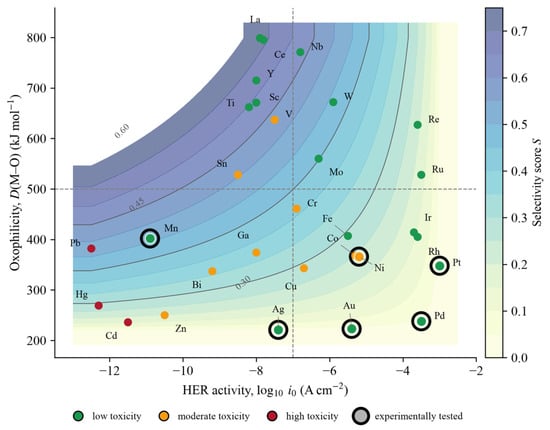
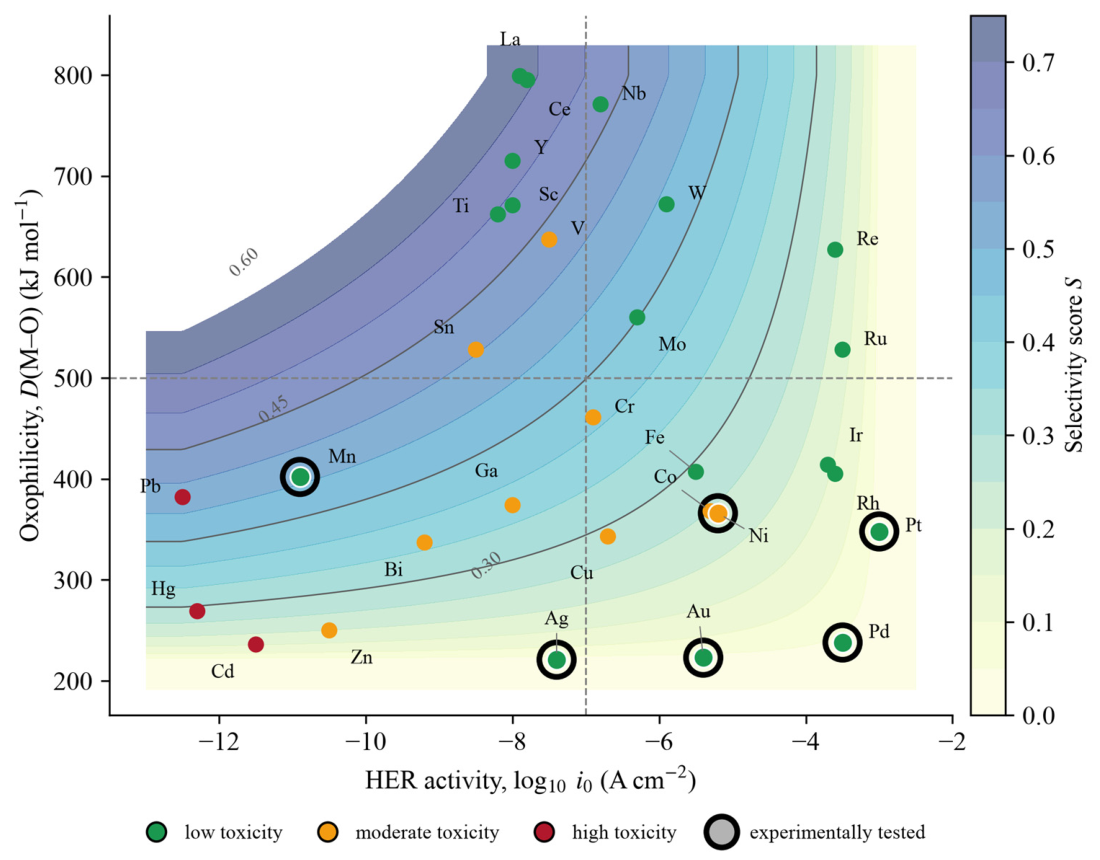
Figure 1 is the central parent-metal result. The productive region is the upper-left corner, where a metal is both HER-suppressing (log10 i0 below about −7, toward the left) and oxophilic (D(M-O) above about 500 kJ/mol, toward the top). The opposite corner, at the lower right, is the HER-dominated region occupied by the platinum-group metals (Pt, Pd, Rh, Ir), which are excellent hydrogen-evolution catalysts and weakly oxophilic, and are therefore the worst possible choices for this reaction. The known catalysts fall exactly where the hypothesis predicts. Single-atom Mn sits high on HER suppression (log10 i0 = −10.9) with moderate oxophilicity (D(M-O) = 402 kJ/mol), placing it just inside the productive band, consistent with its status as the best verified electrochemical catalyst. Silver is strongly HER-suppressing but the least-oxophilic metal in the set (D(M-O) = 221 kJ/mol), so it sits low in the map, consistent with its modest measured conversion. The map thus unifies the Mn works and Ag-underperformance observations in a single picture.
Figure 1.
Ambiphilic selectivity map for nitrogen-coordinated single-atom centres (parent-metal tier). The horizontal axis is the experimental HER exchange current density (log10 i0; more negative means stronger HER suppression) and the vertical axis is the gas-phase M-O bond-dissociation energy (oxophilicity). Filled colour shows the selectivity score S; point colour encodes toxicity (green low, orange moderate, red high); black rings mark the experimentally tested metals. Dashed lines at log10 i0 = −7 and D(M-O) = 500 kJ/mol delimit the productive corner.
3.3. Validation Against Experiment
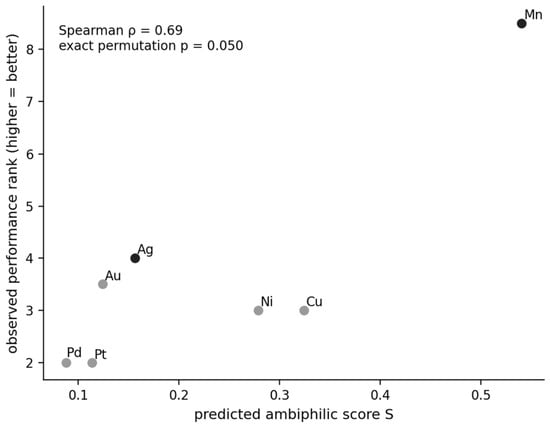
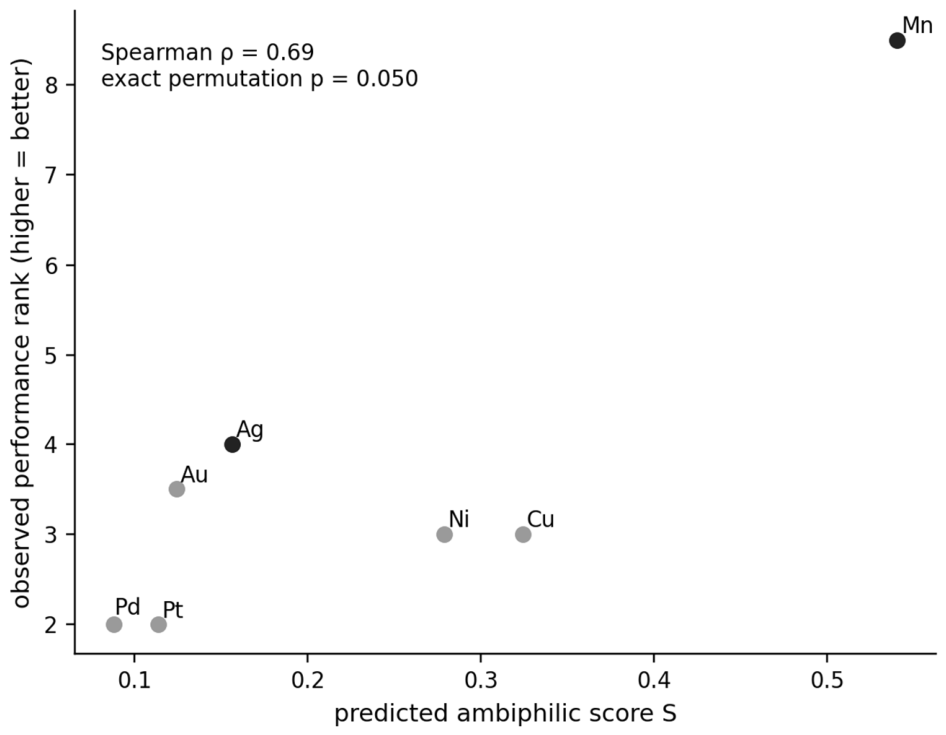
The predicted score tracks the observed family-level ordering (Figure 2). Over the seven metals with reported regeneration or selectivity behaviour, the Spearman correlation between predicted S and observed performance rank is 0.69 (n = 7; exact one-sided permutation p = 0.050, computed over all 5040 orderings of the performance ranks). The single-atom Mn benchmark is correctly placed at the top and the platinum-group metals at the bottom.
Figure 2.
Validation of the selectivity score against experiment. Predicted score S is plotted against the observed performance rank for seven metals with reported behaviour. Darker points denote rigorous product identification (NMR/RRDE); lighter points denote borohydride-inferred proxies. The Spearman rank correlation is 0.69 (n = 7; exact one-sided permutation p = 0.050).
Three further statistics delimit what this correlation does and does not establish. Leave-one-out refitting gives a mean ρ of 0.68 with a minimum of 0.50 when the Mn benchmark is removed: no single metal creates the correlation, but Mn is clearly the most informative point. A leverage decomposition shows that the signal is carried by the extremes: removing the platinum-group anchors leaves ρ = 0.15 (n = 5), and removing both Mn and the platinum-group metals leaves ρ = −0.74 over the four intermediate metals (Ag, Au, Ni, Cu). Because those four span barely one ordinal rank unit, with ties, the correct reading is that the intermediate ordering is unresolved by the available experiments, not falsified. The validation therefore supports the score as a family-level filter, separating the HER-dominated noble-metal family from the Mn benchmark, rather than as a fine-grained predictive model, and every claim in this paper is made at that level. We also note a partial circularity at the noble-metal end: the low performance ranks of the platinum-group anchors derive in part from the same HER-dominance reasoning that the descriptor encodes, whereas the Mn and Ag points, which carry rigorous product identification, are free of this.
We initially found that a hard [0, 1] normalisation collapsed silver to a false zero score, because it is the least-oxophilic metal, which is a normalisation-boundary artefact rather than a physical prediction. Introducing the soft floor at 0.05 removed the artefact and restored monotonic agreement. Because this floor was introduced after inspecting the validation set, we audit it in full. With the floor at exactly zero, the validation correlation is 0.284; with any floor in the range 0.01–0.20, it is 0.691; and the leading candidate set (La, Ce, Y, Ti, Sc) is identical at every floor value including zero. The choice is therefore binary (avoid mapping the extreme metal to exactly zero) rather than a tuned parameter, and both scores are reported so the reader can judge.
3.4. Ranking with Propagated Uncertainty
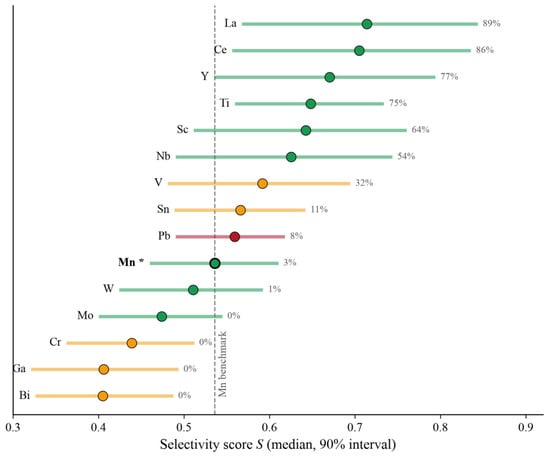
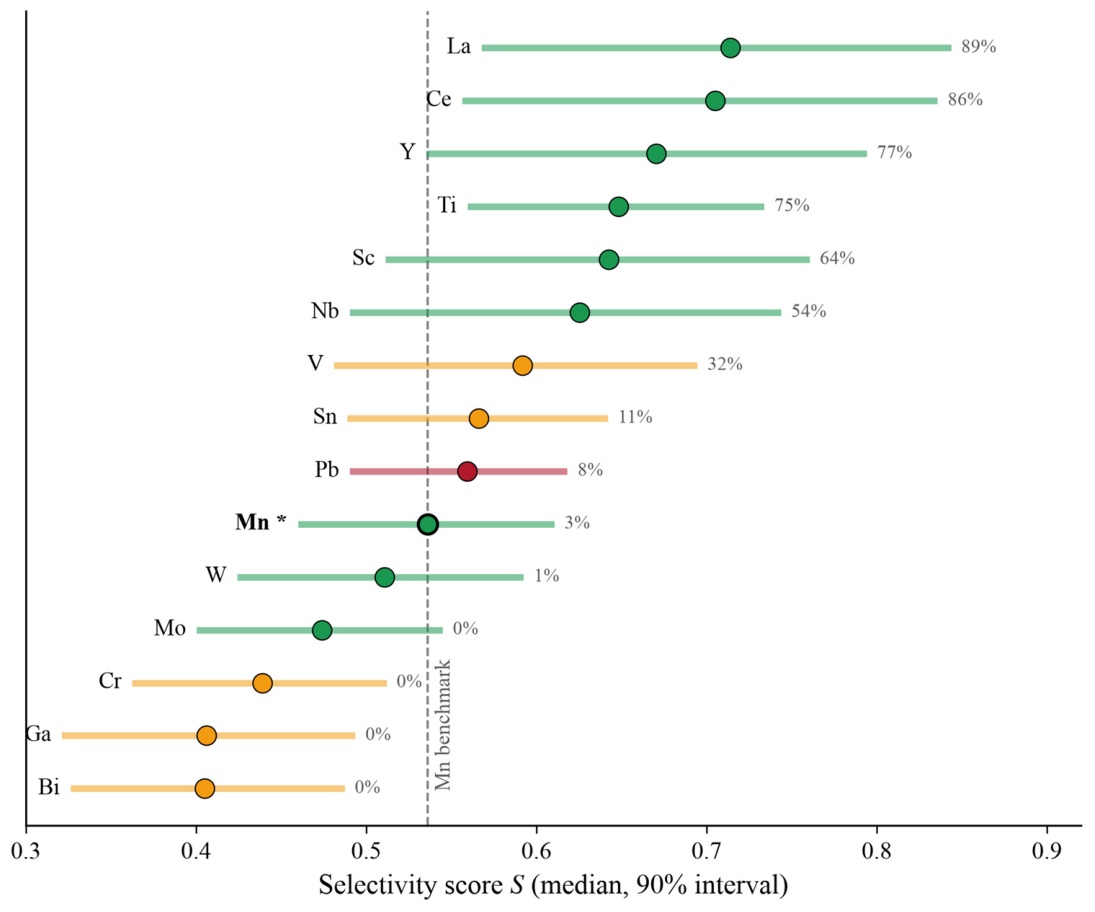
Within the parent-metal tier, propagating the descriptor uncertainties through 20,000 Monte–Carlo draws (Figure 3), the top-ranked centres are earth-abundant and non-toxic: La (median S = 0.71, top-5 probability 0.89), Ce (0.71, 0.86), Y (0.67, 0.77), Ti (0.65, 0.75) and Sc (0.64, 0.64). All five rank above the experimental Mn benchmark (median S = 0.54). The ranking is probabilistic rather than a single ordering, and the uncertainty bands overlap, but the separation between the earth-abundant leaders and the Mn benchmark is robust to the descriptor scatter.
Figure 3.
Ranked candidates with propagated descriptor uncertainty (parent-metal tier). For the fifteen highest-scoring metals, the marker is the Monte–Carlo median score and the bar is the 5th to 95th percentile band. The value at right is the probability of finishing in the top five. Asterisks mark experimentally tested metals; the dashed line is the Mn benchmark.
The chemical reading of this ranking is consistent across the leaders. The early transition metals and light lanthanides (Sc, Ti, Y, La, Ce) are strongly oxophilic, with M-O bond energies of roughly 660 to 800 kJ per mol, far above the 402 kJ per mol of manganese, while remaining poor intrinsic HER catalysts. They therefore occupy the same low-HER region as the Mn benchmark but bind oxygen much more strongly, which is precisely the combination the ambiphilic hypothesis rewards. Manganese, by contrast, achieves its record performance mainly through very strong HER suppression and only moderate oxophilicity, which is consistent with the reported need for a directed protonation strategy to lower its rate-determining barrier. The predicted leaders are expected to relieve that oxophilicity limitation intrinsically, without such a strategy. Section 3.7 tests whether this parent-metal expectation survives at the site and finds that it does for the oxophilicity half only; the parent-metal ranking is therefore read as a hypothesis tier, not as the final shortlist.
3.5. Sustainability Screen
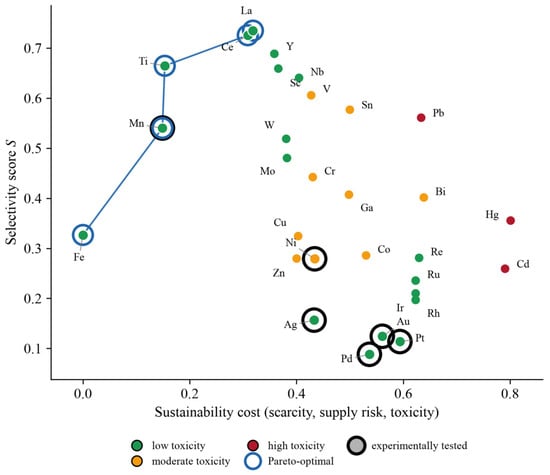
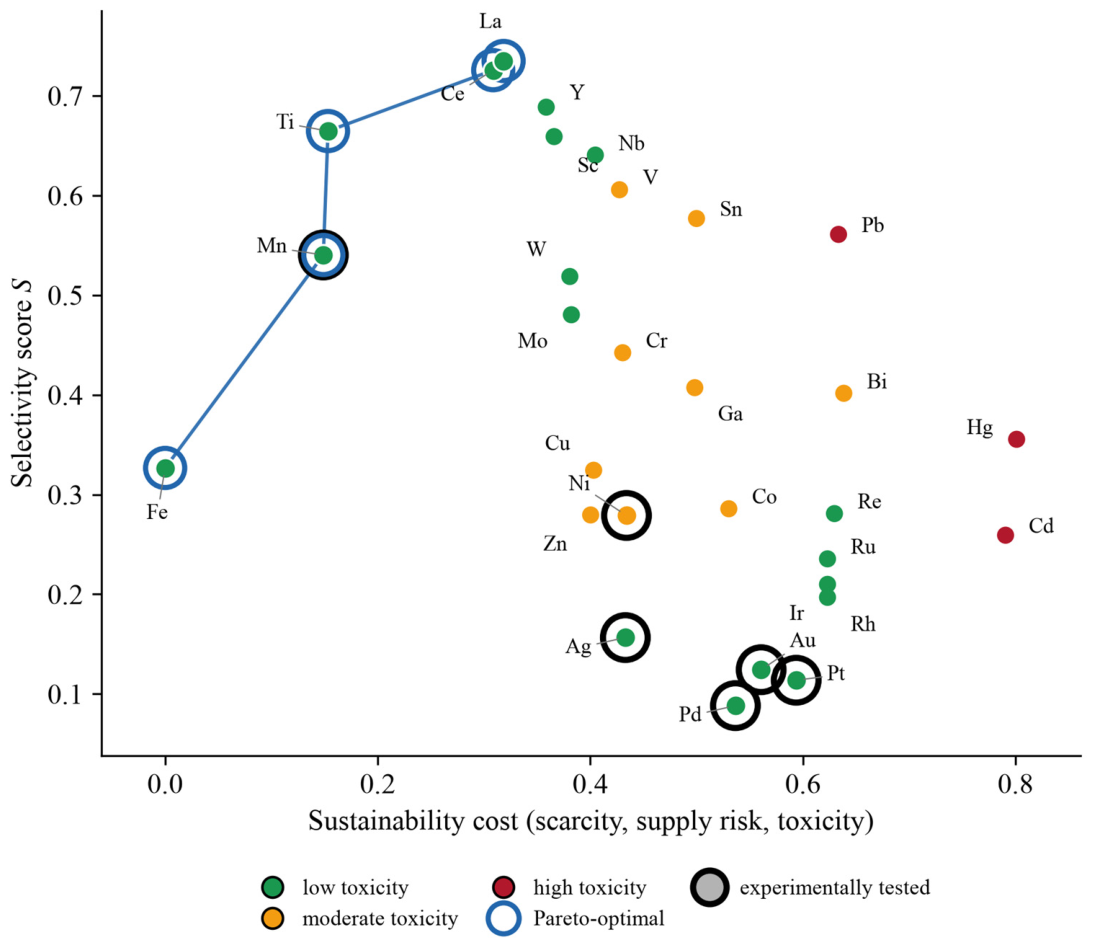
Combining the selectivity score with a composite sustainability cost that folds together scarcity, supply risk and toxicity gives the trade-off in Figure 4. The Pareto-optimal front, the set of metals for which no other metal is both more selective and more sustainable, is La, Ce, Ti, Mn and Fe. Among these, titanium is the practical optimum: it combines a high selectivity score (S = 0.66) with a near-zero sustainability cost, an abundance of about 5650 ppm and no toxicity concern. Lanthanum and cerium score higher on selectivity but carry a modest additional cost, while iron anchors the sustainable end at a lower score. The earth-abundant, non-toxic candidates that combine a high selectivity score with a low sustainability cost are La, Ce, Ti and Sc, together with Y; titanium is the clear knee of the trade-off.
Figure 4.
Sustainability screen (parent-metal tier). Selectivity score S is plotted against a composite sustainability cost that combines scarcity, supply risk and toxicity. The Pareto-optimal front (blue rings) marks the non-dominated set. Point colour encodes toxicity and black rings mark experimentally tested metals.
3.6. Robustness Across Scoring Choices
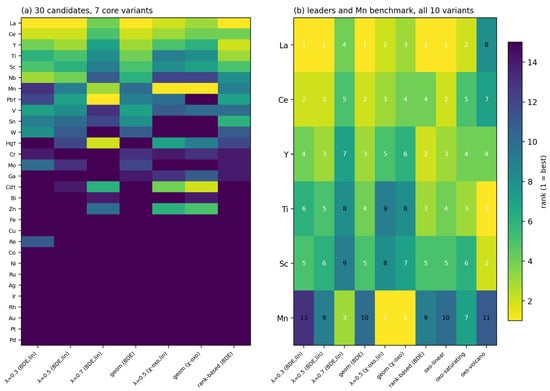
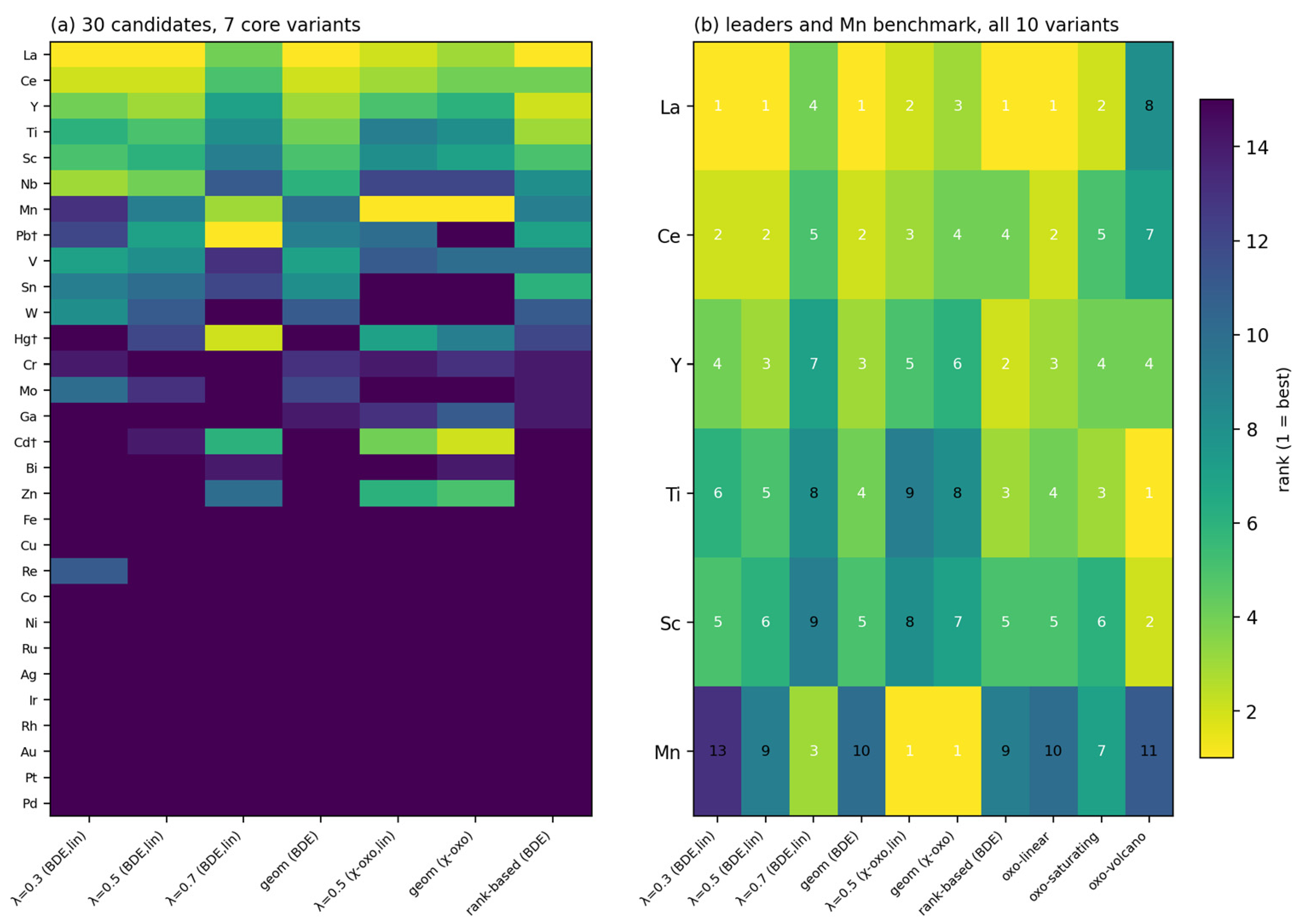
The shortlist is stable against the scoring choices (Figure 5). Lanthanum and cerium remain in the top six in nine of ten variants and yttrium in 80% of them, while titanium and scandium are robust in a majority. The exception is instructive: heavy HER-weighting (λ = 0.7) and the electronegativity-based oxophilicity proxy promote the toxic metals, namely lead, cadmium and mercury, which is a proxy-dependent artefact rather than a genuine recommendation, because those metals are strongly HER-suppressing but their oxophilicity is poorly captured by the electronegativity surrogate. Two variant families are singled out because they matter later. Under the electronegativity, proxy manganese itself rises to first place, consistent with our warning that this surrogate misrepresents oxophilicity; and under a volcano-shaped, over-binding-penalised oxophilicity variant lanthanum falls from first to eighth, which anticipates the site-level finding of Section 3.7 that over-binding, rather than monotone oxophilicity, controls behaviour at the site. The robust, defensible recommendation within this tier is therefore the earth-abundant set led by La, Ce and Y, with Ti and Sc close behind.
Figure 5.
Shortlist stability across scoring variants. Panel (a) shows each of the 30 candidates’ ranks (rows ordered by median rank) under the seven core scoring variants; panel (b) shows the five leaders and the Mn benchmark under all ten variants, including the saturating and volcano-shaped oxophilicity variants added in this revision. Daggers flag high-toxicity metals that enter the shortlist only as a proxy-dependent artefact.
3.7. Transferability of the Descriptors to Nitrogen-Coordinated Single-Atom Sites
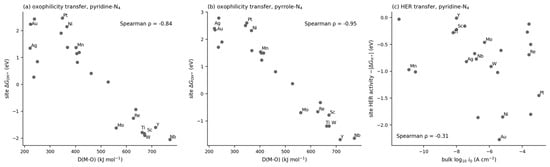
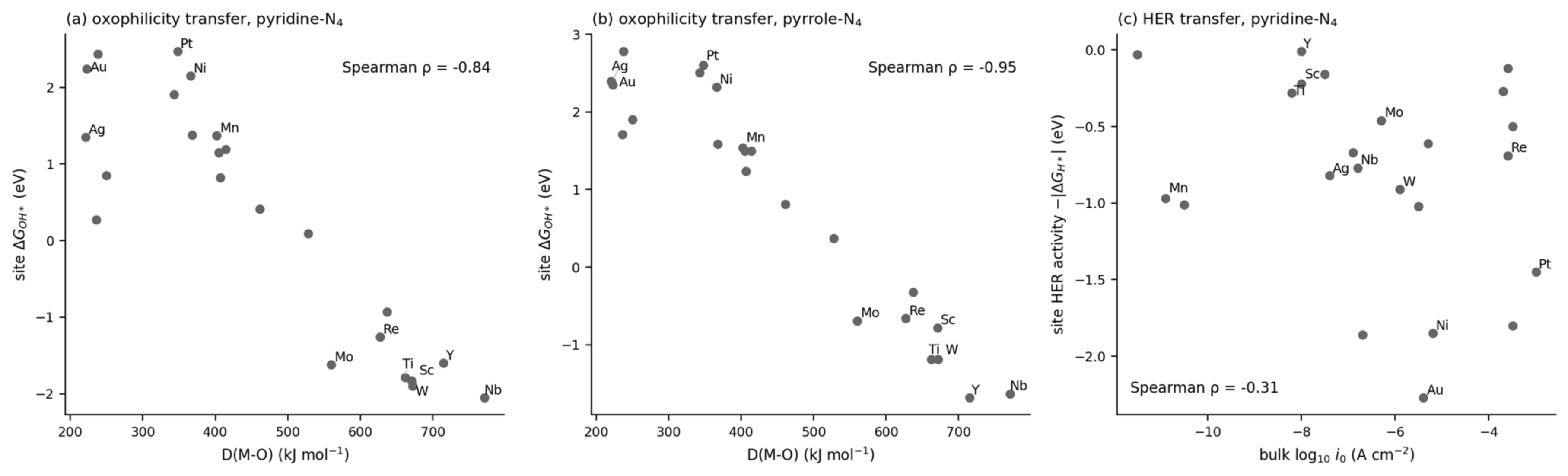
The parent-metal tier of Section 3.1, Section 3.2, Section 3.3, Section 3.4, Section 3.5 and Section 3.6 stands on bulk and gas-phase quantities; whether its two axes survive at an actual single-atom site is a measurable question, and we measured it against the corrected literature DFT datasets described in Section 2.4 (Figure 6). The oxophilicity axis transfers almost quantitatively: the tabulated D(M-O) rank-orders the computed ΔGOH* at nitrogen-coordinated sites with ρ = −0.84 (pyridine-4N) and −0.95 (pyrrole-4N) over the 23 common metals (p < 1 × 10⁻⁶). The gas-phase diatomic bond energy is thus an excellent, freely available proxy for site-level oxygen affinity. The bulk HER axis does not transfer: bulk log10 i0 shows no positive correlation with site HER activity −(|ΔGH*|) (ρ = −0.31 pyridine-4N, +0.14 pyrrole-4N). The failure is systematic rather than noisy, because the three independent site datasets agree closely with one another (cross-functional rank correlations 0.84–0.94) [24,25,26]: closed-shell late metals such as Pt and Pd, the best bulk HER catalysts, become the most HER-inert N4 sites, while Mn, the most suppressed bulk metal, is only moderately suppressed at the site.
Figure 6.
Transferability audit of the two descriptor axes against corrected literature DFT data for nitrogen-coordinated single-atom sites [24,25,26]. (a,b) The tabulated gas-phase bond energy D(M-O) rank-orders the computed ΔGOH* at pyridine-4N (a) and pyrrole-4N (b) sites (Spearman ρ = −0.84 and −0.95, n = 23). (c) The bulk HER exchange current density does not rank-order site HER activity −(|ΔGH*|) (ρ = −0.31, pyridine-4N).
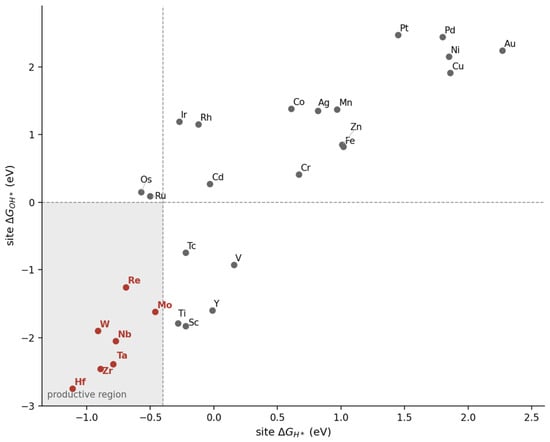
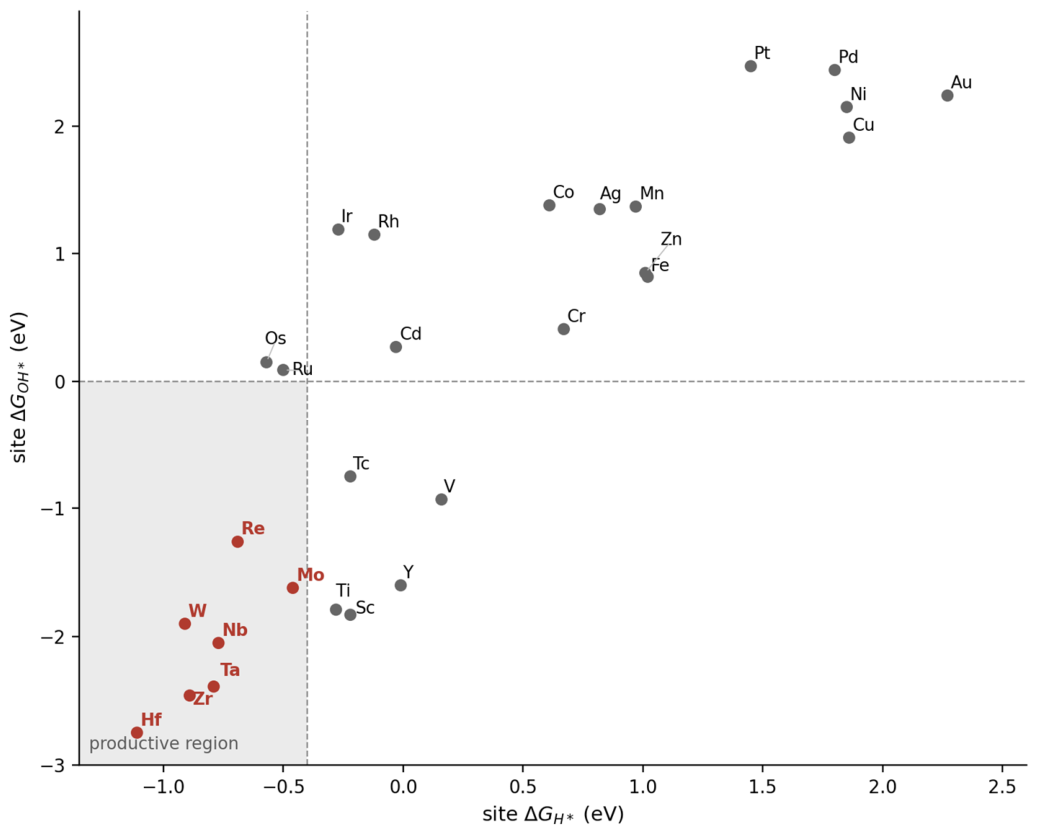
The site data also revise the orthogonality result. At the site, ΔGOH* and ΔGH* obey a common scaling relation (ρ = +0.84 pyridine-4N, +0.79 pyrrole-4N): a centre that binds oxygen strongly also binds hydrogen strongly. The parent-metal orthogonality of Section 3.1 is therefore a genuine property of the bulk/gas-phase descriptor pair but not of the site, and the ambiphilic window at the site takes a different form: it is populated by centres that suppress the HER by over-binding hydrogen (ΔGH* well below zero, off the volcano top on the strong-binding side) while binding oxygen strongly. Applying the anchored criteria of Section 2.4 (ΔGOH* < 0, ΔGH* ≤ −0.4 eV) to the corrected dataset places W, Nb, Mo and Re inside the productive region in both N4 coordinations (Figure 7), with Ti borderline (ΔGH* = −0.28 eV, pyridine-4N). The extended dataset also places Zr, Hf and Ta, which lie outside our original 30-metal candidate set, deep inside the same region; they should be treated as additional, data-supported candidates. By contrast, Y and Sc sit essentially on the volcano top (ΔGH* = −0.01 and −0.22 eV, pyridine-4N) and are in fact predicted in the source dataset to be among the best N4 HER catalysts [26], which disqualifies them as HER-suppressed centres at the site level despite their excellent oxophilicity. La and Ce are absent from all available site datasets; their candidacy rests on the parent-metal tier alone and is flagged as explicitly extrapolative, the more so as large ions favour higher N/C coordination numbers [14].
Figure 7.
Site-level ambiphilic map built from the corrected literature DFT dataset (pyridine-4N) [26]. The shaded anchored productive region (ΔGOH* < 0 and ΔGH* ≤ −0.4 eV) contains the refractory centres W, Nb, Mo and Re, together with Zr, Hf and Ta from outside the original candidate set; Ti is borderline and Y/Sc sit on the HER volcano top.
Two mechanistic caveats bound this site-level shortlist. First, suppression by over-binding raises the possibility of H* site blocking under operating conditions; whether a strongly hydridic M-H at an oxophilic centre poisons the site or, on the contrary, mediates the hydride delivery to the bound borate that the net reaction requires is precisely the question a focused electronic-structure or experimental study should answer first. Second, the site energies carry their own method uncertainty, of order 0.1–0.5 eV depending on the functional [25], so the anchored thresholds should be read as band edges rather than sharp lines. On sustainability, the site-validated set is less abundant than the parent-metal leaders (Nb about 20 ppm; W and Mo about 1 ppm crustal abundance, both with supply-risk flags [33]) and rhenium is excluded outright on scarcity; titanium therefore remains the sustainability anchor of the combined shortlist, and the Pareto logic of Section 3.5 carries over to the site tier with these revised inputs.
4. Discussion
The picture that emerges is that borohydride regeneration is not a problem of finding a more active catalyst in the usual sense, but of finding a catalyst that is deliberately inactive for the competing reaction while remaining active for the oxygen-bearing substrate. This reframing follows directly from the pH-invariant 0.41 V thermodynamic penalty: since no potential window favours borohydride formation, the only lever is the relative kinetics of the two reactions on the same surface. The ambiphilic descriptor operationalises exactly that lever, and its orthogonality result (ρ = 0.02) at the parent-metal level explains why good catalysts are rare, because the two requirements must be met independently.
The most immediate experimental consequence is a concrete, falsifiable and now two-tier set of targets. The site-anchored tier, grounded in the corrected literature DFT for the actual N4 coordination, predicts that single-atom W, Nb and Mo centres (with Re excluded on scarcity, and Zr, Hf and Ta as data-supported extensions) should combine strong borate binding with kinetically suppressed hydrogen evolution; these are the priority synthesis targets, with Ti as the borderline, sustainability-anchored option. The distinction between Ti and the superficially similar Sc is worth stating precisely. In pyridine-N4 coordination, their site-level values are close (ΔGH* = −0.28 vs. −0.22 eV; ΔGOH* = −1.79 vs. −1.83 eV), but they separate in pyrrole-N4, where Ti keeps strong oxygen binding (ΔGOH* = −1.19 eV) while Sc weakens to −0.78 eV, and across the ten scoring variants, Ti reaches the top five more consistently (60% of variants vs. 50%). Ti is also roughly two orders of magnitude more abundant in the crust, and experimentally reported Sc single atoms adopt six-fold N/C coordination rather than the planar N4 geometry assumed by the site datasets, adding a structural uncertainty that Ti does not carry. Ti is therefore retained as the borderline candidate and Sc is not. The parent-metal tier retains La and Ce as higher-risk, explicitly extrapolative candidates whose site behaviour is unmeasured. Synthesising the corresponding M-N-C materials and measuring Faradaic efficiency and product identity by NMR and RRDE would directly confirm or refute the ranking; a subsequent electronic-structure study, focused on this shortlist and on the H*-poisoning versus hydride-delivery question, would be the natural way to convert the screen into mechanistic understanding.
There are several reasons to take the shortlist seriously, and one to hold it lightly. The descriptors are independent experimental measurements rather than fitted quantities; the family-level validation, with its exact permutation probability, leave-one-out and leverage analyses reported in full, shows the score captures the operative bulk-electrode chemistry; and the site tier is anchored in three mutually consistent literature DFT datasets, with the oxophilicity having half of the hypothesis transferring almost quantitatively. The reason for restraint is equally explicit: the HER half does not transfer from parent metal to site, which is why the final targets are read off the site-level map rather than the parent-metal ranking. We regard this measured self-audit, carried out entirely with published data and no new computation, as the central methodological contribution of the paper.
Several limitations bound the strength of the claims. The parent-metal proxy remains the largest, but it is now quantified rather than assumed: transfer succeeds for oxophilicity and fails for HER. The site datasets cover only pyridine- and pyrrole-N4 graphene hosts, whereas real materials present a distribution of coordinations, including the higher M-Nx coordinations favoured by large ions [14]. The validation set is small, ordinal and family-level, with a documented leverage structure and a partial circularity at the noble-metal end. The site-level thresholds inherit the DFT method uncertainty of up to a few tenths of an eV [25]. The score contains no positive descriptor for the eight-electron reduction itself, so it filters out losing centres rather than guaranteeing winning ones. And the lanthanide candidates are untested at the site level. None of these limitations affects the central, testable output: a short, site-anchored list of refractory single-atom targets, with Ti as the sustainable borderline case and La/Ce as declared extrapolations.
5. Conclusions
We have introduced an ambiphilic-site screening framework for the electrochemical regeneration of sodium borohydride, built entirely from tabulated experimental data and published, corrected DFT datasets, with no new electronic-structure computation. At the parent-metal level, the two axes, HER suppression and oxophilicity, are orthogonal, and the score passes a family-level experimental validation (ρ = 0.69; exact permutation p = 0.050) whose leverage structure, leave-one-out behaviour and normalisation choices are reported in full. The transferability audit is the decisive step: the oxophilicity axis carries to nitrogen-coordinated single-atom sites almost quantitatively (ρ up to −0.95), the bulk HER axis does not, and site-level scaling between oxygen and hydrogen binding reshapes the productive window into the over-binding, oxophilic corner. The search is accordingly redirected to refractory single-atom centres, with W, Nb and Mo as priority synthesis targets, Zr, Hf and Ta as data-supported extensions, Ti as the sustainability-anchored borderline case, and La and Ce retained only as explicitly extrapolative parent-metal candidates. The framework, its self-audit and all underlying data and code are released openly and can be applied to other multi-electron electrocatalytic problems where a dominant side reaction must be suppressed.
Funding
This research received no external funding.
Data Availability Statement
All descriptor tables, scored outputs, Monte–Carlo, permutation, leave-one-out, leverage, floor-sweep and site-transferability results, together with the complete deterministic analysis code (fixed seeds), are openly deposited on Zenodo at https://doi.org/10.5281/zenodo.21706670. Every physical descriptor is a tabulated literature value cited in the text; the site-level adsorption free energies are taken from the cited published datasets [24,25,26]; no data were simulated or computed in this work.
Conflicts of Interest
The author declares no conflicts of interest.
References
- Kaya, C. Sodium Borohydride (NaBH4) as a Maritime Transportation Fuel. Hydrogen 2024, 5, 540–558. [Google Scholar] [CrossRef] [Scilit]
- Celik, C.; San, F.G.B.; Sarac, H.I. Influences of sodium borohydride concentration on direct borohydride fuel cell performance. J. Power Sources 2010, 195, 2599–2603. [Google Scholar] [CrossRef] [Scilit]
- Demirci, U.B.; Miele, P.; Garin, F. Catalysis in hydrolysis of sodium borohydride and ammonia borane, and electrocatalysis in oxidation of sodium borohydride. Catal. Today 2011, 170, 1–2. [Google Scholar] [CrossRef] [Scilit]
- Zhuang, D.W.; Zhang, J.J.; Dai, H.B.; Wang, P. Hydrogen generation from hydrolysis of solid sodium borohydride promoted by a cobalt-molybdenum-boron catalyst and aluminum powder. Int. J. Hydrogen Energy 2013, 38, 10845–10850. [Google Scholar] [CrossRef] [Scilit]
- Metin, O.; Ozkar, S. Hydrogen Generation from the Hydrolysis of Ammonia-borane and Sodium Borohydride Using Water-soluble Polymer-stabilized Cobalt(0) Nanoclusters Catalyst. Energy Fuels 2009, 23, 3517–3526. [Google Scholar] [CrossRef] [Scilit]
- Zhong, H.; Ouyang, L.; Liu, J.; Peng, C.; Zhu, X.; Zhu, W.; Fang, F.; Zhu, M. Sodium borohydride regeneration via direct hydrogen transformation of sodium metaborate tetrahydrate. J. Power Sources 2018, 390, 71–77. [Google Scholar] [CrossRef] [Scilit]
- Kemmitt, T.; Gainsford, G. Regeneration of sodium borohydride from sodium metaborate, and isolation of intermediate compounds. Int. J. Hydrogen Energy 2009, 34, 5726–5731. [Google Scholar] [CrossRef] [Scilit]
- Agyekum, E.B.; Oriquat, G.A.; Rashid, F.L. Advances and future directions in sodium borohydride-based hydrogen storage: A comprehensive review. Sustain. Energy Technol. Assess. 2025, 83, 104658. [Google Scholar] [CrossRef] [Scilit]
- Abdelhamid, H.N. A review on hydrogen generation from the hydrolysis of sodium borohydride. Int. J. Hydrogen Energy 2021, 46, 726–765. [Google Scholar] [CrossRef] [Scilit]
- Liu, Z.; Qin, C.; Yin, Z.; Wu, X.; Dong, S.; Lv, X.; Zhang, H.; Cao, H.; Zheng, G. Directed protonation strategy for efficient electrochemical metaborate reduction to sodium borohydride at the interface of manganese single atoms and manganese oxide nanoparticles. J. Colloid Interface Sci. 2026, 702, 138827. [Google Scholar] [CrossRef] [Scilit] [PubMed]
- Sanli, A.E.; Kayacan, I.; Uysal, B.Z.; Aksu, M.L. Recovery of borohydride from metaborate solution using a silver catalyst for application of direct rechargable borohydride/peroxide fuel cells. J. Power Sources 2010, 195, 2604–2607. [Google Scholar] [CrossRef] [Scilit]
- Milikic, J.; Stamenovic, U.; Vodnik, V.; Otonicar, M.; Skapin, S.; Sljukic, B. Combining silver, polyaniline and polyvinylpyrrolidone for efficient electrocatalysis of borohydride oxidation reaction. Mol. Catal. 2023, 547, 113310. [Google Scholar] [CrossRef] [Scilit]
- Wang, A.; Li, J.; Zhang, T. Single atom catalysts push the boundaries of heterogeneous catalysis. Nat. Commun. 2021, 12, 5884. [Google Scholar] [CrossRef] [Scilit] [PubMed]
- Liu, J.; Kong, X.; Zheng, L.; Guo, X.; Liu, X.; Shui, J. Rare Earth Single-Atom Catalysts for Nitrogen and Carbon Dioxide Reduction. ACS Nano 2020, 14, 1093–1101. [Google Scholar] [CrossRef] [Scilit] [PubMed]
- Hu, F.; Liao, L.; Chi, B.; Wang, H. Rare earth praseodymium-based single atom catalyst for high performance CO2 reduction reaction. Chem. Eng. J. 2022, 436, 135271. [Google Scholar] [CrossRef] [Scilit]
- Yang, T.; Yang, F.; Ding, Y.; Cao, F.; Zhang, Q. Rare-earth neodymium single atom catalyst for efficient electrochemical CO2 reduction. Catal. Today 2025, 449, 115199. [Google Scholar] [CrossRef] [Scilit]
- Ran, L.; Xu, Y.; Zhu, X.; Chen, S.; Qiu, X. Mn Single-Atom Tuning Fe-N-C Catalyst Enables Highly Efficient and Durable Oxygen Electrocatalysis and Zinc-Air Batteries. ACS Nano 2023, 18, 750–760. [Google Scholar] [CrossRef] [Scilit] [PubMed]
- Liu, J.; Zhu, J.; Xu, H.; Cheng, D. Rational Design of Heteroatom-Doped Fe-N-C Single-Atom Catalysts for Oxygen Reduction Reaction via Simple Descriptor. ACS Catal. 2024, 14, 6952–6964. [Google Scholar] [CrossRef] [Scilit]
- Baek, D.S.; Lee, J.; Lim, J.S.; Joo, S.H. Nanoscale electrocatalyst design for alkaline hydrogen evolution reaction through activity descriptor identification. Mater. Chem. Front. 2021, 5, 4042–4058. [Google Scholar] [CrossRef] [Scilit]
- Li, H.; Yan, P.; Xu, B.Q.; Zhang, Z.C. Oxygen affinity of transition metal cations: A coherent descriptor elucidating catalytic performance. J. Catal. 2022, 412, 21–29. [Google Scholar] [CrossRef] [Scilit]
- Zhong, L.; Li, S. Unconventional Oxygen Reduction Reaction Mechanism and Scaling Relation on Single-Atom Catalysts. ACS Catal. 2020, 10, 4313–4318. [Google Scholar] [CrossRef] [Scilit]
- Shi, Y.; Liang, Z. Machine learning accelerates the screening of single-atom catalysts towards CO2 electroreduction. Appl. Catal. A 2024, 676, 119674. [Google Scholar] [CrossRef] [Scilit]
- Zhu, Z.; Gao, S.; Zhang, J.; Kang, X.; Li, S.; Duan, X. Identifying the Catalytic Descriptor of Single-Atom Catalysts in Nitrate Reduction Reaction. ACS Catal. 2026, 16, 2010–2022. [Google Scholar] [CrossRef] [Scilit]
- Fung, V.; Hu, G.; Wu, Z.; Jiang, D. Descriptors for Hydrogen Evolution on Single Atom Catalysts in Nitrogen-Doped Graphene. J. Phys. Chem. C 2020, 124, 19571–19578. [Google Scholar] [CrossRef] [Scilit]
- Di Liberto, G.; Cipriano, L.A.; Pacchioni, G. Universal Principles for the Rational Design of Single Atom Electrocatalysts? Handle with Care. ACS Catal. 2022, 12, 5846–5856. [Google Scholar] [CrossRef] [Scilit]
- Xu, H.; Cheng, D.; Cao, D.; Zeng, X.C. Revisiting the universal principle for the rational design of single-atom electrocatalysts. Nat. Catal. 2024, 7, 207–218. [Google Scholar] [CrossRef] [Scilit]
- Trasatti, S. Work function, electronegativity, and electrochemical behaviour of metals. J. Electroanal. Chem. 1972, 39, 163–184. [Google Scholar] [CrossRef]
- Norskov, J.K.; Bligaard, T.; Logadottir, A.; Kitchin, J.R.; Chen, J.G.; Pandelov, S.; Stimming, U. Trends in the Exchange Current for Hydrogen Evolution. J. Electrochem. Soc. 2005, 152, J23. [Google Scholar] [CrossRef] [Scilit]
- Kepp, K.P. A Quantitative Scale of Oxophilicity and Thiophilicity. Inorg. Chem. 2016, 55, 9461–9470. [Google Scholar] [CrossRef] [Scilit] [PubMed]
- Moltved, K.A.; Kepp, K.P. The Chemical Bond between Transition Metals and Oxygen: Electronegativity, d-Orbital Effects, and Oxophilicity as Descriptors of Metal-Oxygen Interactions. J. Phys. Chem. C 2019, 123, 18432–18444. [Google Scholar] [CrossRef] [Scilit]
- Haynes, W.M. (Ed.) CRC Handbook of Chemistry and Physics, 97th ed.; CRC Press: Boca Raton, FL, USA, 2016. [Google Scholar]
- Luo, Y.-R. Comprehensive Handbook of Chemical Bond Energies; CRC Press: Boca Raton, FL, USA, 2007. [Google Scholar]
- Girtan, M.; Wittenberg, A.; Grilli, M.L.; de Oliveira, D.P.S.; Giosue, C.; Ruello, M.L. The Critical Raw Materials Issue between Scarcity, Supply Risk, and Unique Properties. Materials 2021, 14, 1826. [Google Scholar] [CrossRef] [Scilit] [PubMed]
- Norskov, J.K.; Rossmeisl, J.; Logadottir, A.; Lindqvist, L.; Kitchin, J.R.; Bligaard, T.; Jonsson, H. Origin of the Overpotential for Oxygen Reduction at a Fuel-Cell Cathode. J. Phys. Chem. B 2004, 108, 17886–17892. [Google Scholar] [CrossRef] [Scilit] [PubMed]
Disclaimer/Publisher’s Note: The statements, opinions and data contained in all publications are solely those of the individual author(s) and contributor(s) and not of MDPI and/or the editor(s). MDPI and/or the editor(s) disclaim responsibility for any injury to people or property resulting from any ideas, methods, instructions or products referred to in the content. |
© 2026 by the author. Licensee MDPI, Basel, Switzerland. This article is an open access article distributed under the terms and conditions of the Creative Commons Attribution (CC BY) license.