


Abstract
Decarbonizing industry, improving urban sustainability, and expanding clean energy use are key global priorities. This study presents a techno-economic analysis (TEA) and life-cycle assessment (LCA) of green hydrogen (GH2) production via water electrolysis for low-carbon applications in the Central Asian region, with Uzbekistan considered as a representative case study. Solar PV and wind power are used as renewable electricity sources for a 44 MW electrolyzer. The assessment also incorporates recent advances in alkaline water electrolyzers (AWE) enhanced with metal–organic framework (MOF) materials, reflecting improvements in efficiency and hydrogen output. The LCA, performed using SimaPro, evaluates the global warming potential (GWP) across the full hydrogen production chain. Results show that the MOF-enhanced AWE system achieves a lower levelized cost of hydrogen (LCOH) at 5.18 $/kg H2, compared with 5.90 $/kg H2 for conventional AWE, with electricity procurement remaining the dominant cost driver. Environmentally, green hydrogen pathways reduce GWP by 80–83% relative to steam methane reforming (SMR), with AWE–MOF delivering the lowest footprint at 1.97 kg CO2/kg H2. In transport applications, fuel cell vehicles powered by hydrogen derived from AWE–MOF emit 89% less CO2 per 100 km than diesel vehicles and 83% less than using SMR-based hydrogen, demonstrating the substantial climate benefits of advanced electrolysis. Overall, the findings confirm that MOF-integrated AWE offers a strong balance of economic viability and environmental performance. The study highlights green hydrogen’s strategic role in the Central Asian region, represented by Uzbekistan’s energy transition, and provides evidence-based insights for guiding low-carbon hydrogen deployment.
1. Introduction
The global transition toward low-carbon energy systems is driven by the urgent need to mitigate greenhouse gas (GHG) emissions and reduce dependence on fossil fuels [1]. Renewable energy sources (RES), particularly solar and wind, have become essential in achieving these targets due to their abundance, scalability, and declining costs [2,3]. Electricity generated from RES can be converted into storable and transportable chemical fuels through green hydrogen (GH2) production, offering a sustainable pathway for decarbonizing energy-intensive industries [4]. Hydrogen serves as both an energy carrier and a feedstock for the synthesis of chemicals such as methanol and ammonia, and it supports applications ranging from stationary power systems to transportation and aviation [5,6].
Unlike fossil-based hydrogen, GH2 derived from renewable-powered electrolysis emits no CO2 during utilization or production [7,8]. Hydrogen is generally categorized by production route: “green” when derived from renewables, and “blue” when produced from fossil fuels with partial carbon capture [9,10]. The continuing expansion of RES, combined with the sharp decline in the levelized cost of energy (LCOE), strengthens the economic competitiveness of green hydrogen as a clean alternative [10]. The integration of improved electrolyzer technologies and digital optimization tools has further accelerated this transition [11].
Uzbekistan’s energy landscape is undergoing a gradual yet strategic transformation to reduce its dependence on fossil fuels and strengthen the share of renewable energy sources (RES) within the national energy mix [12]. The country remains one of the most energy-intensive economies in Central Asia, largely dominated by natural gas in electricity generation, heat supply, and transport applications. However, national energy strategies and development roadmaps emphasize improving energy efficiency, diversifying the energy portfolio, and encouraging the integration of renewables, particularly solar and wind power [13]. Uzbekistan, located in Central Asia, possesses significant solar irradiation and favorable wind potential in its western regions [14]. These resources present a strong opportunity for deploying renewable-powered hydrogen production to enhance energy security, diversify the industrial base, and support climate mitigation goals [15]. The country’s national strategies increasingly recognize hydrogen as a critical component of future sustainable infrastructure and low-carbon industrial development [15].
Recent government programs, supported by international cooperation, have initiated the installation of large-scale photovoltaic and wind power plants with the aim of achieving 25% renewable electricity generation by 2030 [16]. The potential for renewable hydrogen production from these sources is increasingly recognized as a key pathway for decarbonizing both industry and transport. Hydrogen deployment could play a dual role, first as an energy carrier for integrating variable renewables into the grid, and second as a clean fuel for heavy transport sectors such as rail, freight, and long-haul applications [17]. In this context, research on techno-economic and environmental aspects of hydrogen production becomes particularly valuable for guiding Central Asian countries, such as Uzbekistan, in their low-carbon energy transition and long-term sustainability goals.
Globally, however, most hydrogen production remains reliant on steam methane reforming (SMR) [18], a process that is technically mature and economically efficient but environmentally damaging. SMR emits approximately 12 kg CO2 eq per kg H2 [19], largely due to the combustion of natural gas and the high process energy demand [20]. In contrast, water electrolysis enables carbon-free hydrogen generation using renewable electricity [21].
Among existing electrolysis technologies like alkaline water electrolysis (AWE), proton exchange membrane (PEM), solid oxide (SOE), and anion exchange membrane (AEM) systems, AWE remains the most commercially established, owing to its low cost, simplicity, and proven reliability [22,23]. AWE systems typically operate between 30–80 °C using nickel-based electrodes immersed in alkaline electrolytes, separated by ion-permeable diaphragms [24,25,26]. Hydroxide ions migrate through the membrane from cathode to anode, producing hydrogen and oxygen gases [27]. These systems are durable, operate at moderate pressures, and utilize non-precious materials [28,29].
Recent advances have enhanced AWE efficiency by optimizing pressure, current density, and electrode structure [30]. Innovations include the development of metal–organic frameworks (MOFs) as catalytic or structural enhancers that improve reaction kinetics, gas bubble detachment, and long-term stability [31,32,33]. Additionally, polymer-based anion exchange membranes have been introduced, offering higher conductivity and chemical resistance [34]. Emerging design technologies aiming to increase the electrolysis process efficiencies and reduce the specific energy consumption as much as possible to 40.4 kWh/kg H2, approaching the 2050 targets set by the International Renewable Energy Agency (IRENA) [35]. These new designs may minimize bubble accumulation, reduce ohmic losses, and increase electrode wettability [36,37]. Recently, metal–organic frameworks (MOFs), a class of advanced porous materials that have gained significant attention for their exceptional ability to capture and store gases such as hydrogen, were recognized with the 2025 Nobel Prize in Chemistry for the groundbreaking contributions of researchers in this field [38]. Despite these technological advancements, significant uncertainties remain concerning the environmental footprint of new materials, system lifetimes, and regional deployment conditions.
Therefore, life cycle assessment (LCA) provides a systematic framework to evaluate the environmental sustainability of GH2 systems. Studies show that renewable-driven hydrogen production achieves substantial reductions in global warming potential (GWP) compared with fossil-based methods. Using solar PV electrolysis may reduce the global warming potential impact (GWP) to 3 kg CO2 eq kg/H2 [39]. Also, extending system lifetimes can further reduce the GWP by around 4 kg CO2 eq kg−1 H2 [40]. In addition, local energy mixes and geographic conditions can substantially influence LCA results, highlighting the need for region-specific assessments [41]. While GH2 systems eliminate direct emissions during operation, upstream stages such as material extraction, component manufacturing, and infrastructure installation still contribute to environmental burdens [42]. Techno-economic analysis (TEA), in parallel, is crucial to evaluate the financial feasibility and competitiveness of hydrogen technologies [43]. Combining TEA and LCA provides a holistic understanding of both economic and environmental performance, informing strategic decisions for investment, policy, and technology adoption.
In this context, the present study performs an integrated TEA–LCA assessment of green hydrogen production in Uzbekistan, representing the Central Asia region, through MOF-enhanced alkaline water electrolysis (AWE) powered by solar photovoltaic (PV) and wind energy. The work evaluates the system’s performance, economic feasibility, and environmental impacts for a 44 MW plant operating over a 20-year lifespan. The approach in this study identifies potential emission reductions and evaluates the contribution of metal–organic framework (MOF) materials in enhancing electrolyzer efficiency and durability. The emerging metal–organic framework (MOF) technology, considered in this study, aims to improve electrolyzer efficiency and reduce energy consumption, aligning with IRENA’s 2050 target of achieving hydrogen production with energy use below 42 kWh/kg [42]. By emphasizing the Central Asian region, mainly Uzbekistan’s renewable energy potential and its industrial decarbonization roadmap, the study aims to (i) demonstrate the environmental and economic feasibility of renewable-based hydrogen, (ii) support national hydrogen deployment strategies, and (iii) contribute to the global knowledge base on low-carbon hydrogen systems driving sustainable energy transitions.
2. Methods and Materials
In the techno-economic evaluation, capital costs encompass the installation of electrolyzers, while operational costs include energy consumption, maintenance, and the levelized hydrogen production cost for a 44 MW plant operating over a 20-year period in Uzbekistan. The life cycle assessment (LCA) was conducted to quantify the global warming potential (GWP) throughout the entire renewable-based hydrogen production value chain. Conventional steam methane reforming (SMR) serves as the reference pathway for comparative analysis of both economic and environmental performance metrics. The developed methodology enables the quantification of hydrogen production costs, operational expenditures, and life-cycle CO2 emissions, providing a consistent framework for benchmarking green hydrogen (GH2) performance against SMR routes.
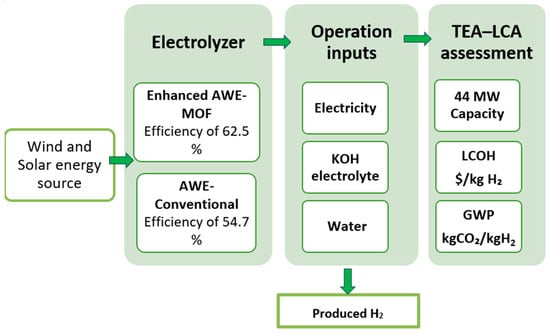
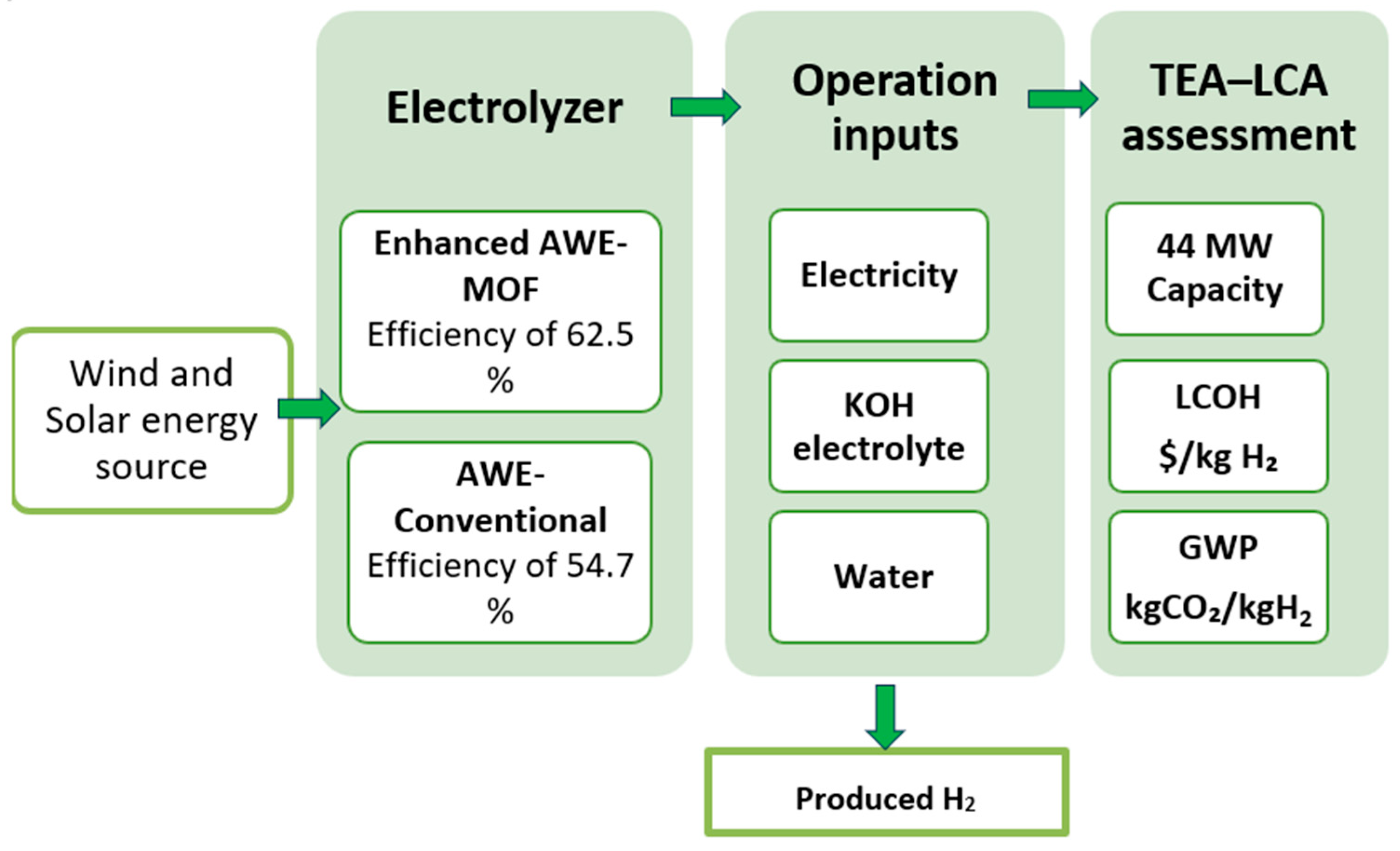
This life cycle assessment (LCA) primarily examines the electrolysis phase of hydrogen generation, evaluating the influence of these advanced materials while also exploring the integration of solar photovoltaic (PV) and wind energy sources to power the production process in Uzbekistan. A clear definition of the system boundaries is essential, as it determines the included inputs and process stages. Figure 1 presents the system boundaries and the main stages considered in this study. The system consists of two primary units: renewable electricity generation (solar PV and wind) and hydrogen production via water electrolysis, evaluated under two scenarios: conventional alkaline water electrolysis (AWE) and enhanced MOF-based AWE. For each unit, the integrated techno-economic and environmental analysis accounts for the material used, manufacturing, operation, and maintenance phases. The economic and environmental outcomes are reported using the levelized cost of hydrogen (LCOH, $/kg H2) and global warming potential (GWP, kg CO2/kg H2) as key performance indicators.
Figure 1.
Flowchart of the current techno-economic and environmental analysis of hydrogen production.
2.1. LCA Inventory
The life cycle assessment (LCA) was performed using SimaPro software (version 9.3.0.3), chosen for its strong impact assessment and inventory analysis capabilities. Data were obtained from literature, project sources, industry experts, and the SimaPro database. Following ISO 14044 and hydrogen-specific guidelines [44,45], the study covered four stages: goal and scope, inventory, impact assessment, and interpretation. The life cycle assessment (LCA) approach employed in this study follows the International Reference Life Cycle Data System (ILCD) framework, as recommended by the European Commission [46]. The ILCD 2011 Midpoint method, implemented in SimaPro, was selected for its precision in applying characterization factors. This method ensures consistency with previous LCA investigations on electrolytic hydrogen production [47,48], thereby supporting meaningful comparison and reinforcing the robustness of the results. The analysis is carried out using 1 kg of hydrogen as the functional unit, produced at 33 bar pressure, 40 °C temperature, and 99.8% of purity.
The analysis focuses on the global warming potential (GWP) impacts defined by the system boundaries and technical conditions of the case study. The primary life cycle stages assessed include the electricity supply chain and the construction and operation of the electrolysis-based hydrogen production system. The study examines the process for several phases: material extraction, industrial manufacturing, transportation, operation, maintenance, end-of-life decommissioning, and waste treatment.
In the inventory stage, all process-related inputs and outputs were identified and analyzed for their global warming potential (GWP) using SimaPro software. The evaluation also included auxiliary systems such as storage vessels, heat exchangers, pumps, inverters, filtration units, and gas separation components. Although these supporting elements contribute less to the overall environmental impact than the main electrolyzer system, their effects were nonetheless quantified to ensure a comprehensive assessment. The detailed life-cycle inventory of the AWE–MOF electrolysis system with a nominal capacity of 44 MW, including the main structural materials, is provided in Supplementary Table S1. This inventory supports the modeling of electrolysis system infrastructure in the current LCA and TEA study, with material quantities scaled according to installed power capacity and assuming linear scaling of balance-of-plant components under steady-state operation.
To enhance methodological accuracy, this study integrated region-specific operational parameters, such as water usage, maintenance needs, and electricity supply, into the modeling framework. When possible, Uzbekistan-specific datasets were employed, while data from Central Asia served as complementary sources where local information was unavailable. The electrolyzer production process was modeled in SimaPro using the Ecoinvent v3 database, capturing all material and energy inputs throughout the manufacturing phase. The LCA framework also addresses end-of-life sustainability by incorporating component reuse and recycling strategies aimed at minimizing landfill dependency. Consistent with procedures outlined in related studies [49], the system assumes manual dismantling of the hydrogen production infrastructure to maximize material recovery. Current industrial recycling efficiencies are applied, with steel achieving about 60% to reuse, aluminum reaching 96% of recycling, and other materials, such as nickel, polymers, and electronic parts, attaining approximately 99% recovery, leaving only 1% residual waste destined for landfill disposal. This final waste route is limited to cases where material recovery is technically infeasible or economically unjustified, aligning with the principles of a circular economy.
2.2. Technical Scope of the Electrolyzers
This study models a 44 MW hydrogen production system based on three 15 MW alkaline water electrolysis (AWE) units, each containing ten stacks with 139 cells, with a total active electrode (cathode) area for all stacks of 232 m2 [50]. Two configurations were examined: the conventional alkaline water electrolysis (AWE) and the advanced MOF-enhanced alkaline water electrolysis (AWE). The MOF-based electrolyzer integrates argon plasma-treated NiCo–MOF electrocatalysts at the oxygen evolution reaction (OER) electrode, and ruthenium (Ru) at the hydrogen evolution reaction (HER) electrode, within an alkaline electrolysis environment [51]. The NiCo–MOF provides a highly porous structure with numerous active sites that facilitate the OER, while the low-pressure argon plasma treatment introduces additional surface defects and active centers, improving charge transfer at the anode and lowering the OER overpotential. Together with the Ru catalyst at the cathode, these enhancements increase overall electrolyzer efficiency from 54.7% to 62.5%, reducing the specific energy consumption per kilogram of hydrogen produced [51].
Both electrolyzer types share similar metallic construction materials (nickel, aluminium, steel, and copper) for electrodes and frames, but differ in the active layer and catalyst compositions. The AWE–MOF includes argon plasma-treated NiCo–MOF and ruthenium (Ru)–MOF electrocatalysts, representing a technological innovation aimed at improving electrochemical performance [51]. Therefore, based on the collected data, the advanced AWE–MOFs electrolyzer utilizes material quantities comparable to those of the conventional AWE system for core components such as the cell frame, gaskets, anodes, and cathodes (composed of nickel, steel, aluminum, copper, etc.). However, the MOF-enhanced design includes an additional layer of metal–organic framework materials integrated into the electrode surfaces, primarily consisting of porous, transition-metal-based compounds that enhance catalytic performance and overall system efficiency. A carbon paper layer incorporating NiCo–MOF is utilized for the anode, with a mass loading of 4.02 mg/cm2. For the cathode, a carbon paper layer with a mass loading of 0.82 mg/cm2 is employed [51]. Moreover, the balance-of-plant (BoP), including pumps, heat exchangers, inverters, gas separators, and storage tanks, was also incorporated into the LCA model, though its environmental contribution is comparatively minor. The total system lifetime was set at 20 years, operating at 33 bar and 85 °C for 7446 h annually.
Moreover, it should be mentioned that the long-term performance of the AWE–MOF electrolyzer system may be affected by several critical parameters, particularly the potential aging and degradation of the framework. Structural instability, ligand leaching, and metal dissolution under operational conditions can compromise durability and reduce overall sustainability. Although quantitative data on these degradation pathways remain limited, it is important to acknowledge their potential impact. Future investigations should therefore focus on the durability of NiCo–MOFs in such applications, including accelerated aging studies and recycling strategies, to ensure more accurate assessment and reliable implementation of this advanced technology.
2.3. Electricity Source
In this study, the electrolysis process is fully powered by renewable electricity, equally sourced from solar photovoltaic (PV) and onshore wind energy. This configuration aligns with Uzbekistan’s renewable energy potential and supports continuous electrolyzer operation under variable conditions [52]. The renewable electricity mix was modeled in SimaPro using Ecoinvent v3 datasets adapted to Central Asian parameters, reflecting region-specific solar irradiation and wind resources [53].
The hybrid renewable system, rated at approximately 44 MW, supplies the alkaline electrolyzer unit with stable electricity. The PV subsystem consists of ground-mounted multi-crystalline silicon modules with inverters and cleaning units, while the wind component comprises 4–5 MW turbines with towers, rotors, and electrical infrastructure [54]. Lifecycle data include manufacturing, installation, operation, and maintenance stages. Reported greenhouse gas intensities for wind and PV electricity are 10 g CO2-eq/kWh and 17 g CO2-eq/kWh, respectively, consistent with international LCA benchmarks [55,56].
Operational inputs include deionized water (10 L/kg H2) and a 25% potassium hydroxide (KOH) electrolyte, replenished periodically. The AWE stack and electrolyte are assumed to last ten years, requiring one replacement during the 20-year system lifetime. Auxiliary utilities such as steam and nitrogen are included for maintenance operations. The analysis boundary covers electricity generation and electrolysis stages, to emphasize the environmental and performance outcomes of renewable-powered hydrogen production in Uzbekistan.
Additionally, the assumed 50/50 solar–wind electricity mix is consistent with the Power Purchase Agreement (PPA) schemes currently implemented in Uzbekistan for utility-scale solar [57] and wind projects [58]. This combination reflects the complementary nature of solar and wind generation profiles in the region and reduces overall supply variability compared to reliance on a single renewable source. In practice, electricity procured through PPAs is delivered via the national grid, allowing short-term renewable intermittency to be balanced at the system level rather than directly limiting electrolyzer operation [59]. Consequently, the annual operating time of 7446 h represents an effective equivalent operating duration enabled by grid-integrated power supply, rather than continuous on-site renewable generation. This configuration offers higher operational reliability and economic stability than stand-alone renewable systems [60] and is aligned with Uzbekistan’s evolving electricity market and renewable energy policy framework [61]. Stable power availability under this arrangement supports consistent hydrogen production and associated storage and refueling systems, while moderating the impact of renewable variability on overall performance [62].
2.4. Economic Methods
The estimated hydrogen production rate and the associated system costs for the 44 MW electrolyzer are summarized in Table 1 which also presents the overall investment and hydrogen conversion cost analysis. Capital expenditure (CAPEX) was estimated by accounting for the costs of the electrolyzer stacks, auxiliary equipment, and an additional 30% allocation for engineering, procurement, and construction (EPC) services. This assumption is consistent with values commonly reported in recent techno-economic assessments and supported by available electrolyzer industry cost data [63,64,65]. Due to the limited availability of publicly accessible electrolyzer cost information specific to Uzbekistan, internationally recognized cost benchmarks were adopted to ensure consistency and comparability with global hydrogen studies. Also, stack replacement was assumed to occur twice over the 20-year operational lifetime, representing approximately 36.1% of the initial CAPEX [65]. This proportion aligns with values reported in large-scale alkaline electrolyzer studies and reflects typical expectations for stack durability and refurbishment cycles. Operational expenditure (OPEX) was estimated based on water consumption costs, excluding electricity inputs, following methodologies commonly applied in related literature [63].
Table 1.
Hydrogen production, system investment, and conversion costs for the MOF-enhanced alkaline water electrolyzer (AWE).
The parameters summarized in Table 1 were subsequently applied to estimate the Levelized Cost of Hydrogen (LCOH), expressed in €/kg H2, using Equation (1) as defined in [63]:
Here, denotes the annual electricity expenditure during the 20-year operation period (2025–2044) [69], while represents the annual hydrogen output (kg H2/year) as shown in Table 1. The project lifetime is assumed to be 20 years, and a discount rate r of 6% is considered [70,71].
Accordingly, LCOH incorporates all relevant operational and capital costs associated with hydrogen generation through the electrolyzer system. For comparative analysis, a fossil diesel benchmark price in Uzbekistan of 1.009 $/L is also adopted as the baseline scenario [72,73].
3. Results and Discussion
The life-cycle and techno-economic evaluation of the proposed MOF-enhanced alkaline water electrolysis system was conducted to quantify its environmental and cost performance under Uzbekistan’s renewable-energy conditions. The modelling integrated region-specific electricity mixes derived from solar and wind power purchase agreements (PPAs), representing the operational framework of future hydrogen hubs in the country. The economic and environmental assessments for hydrogen production with 44 MW capacity were conducted using the data and the methodologies described in the previous sections.
3.1. Economic Analysis
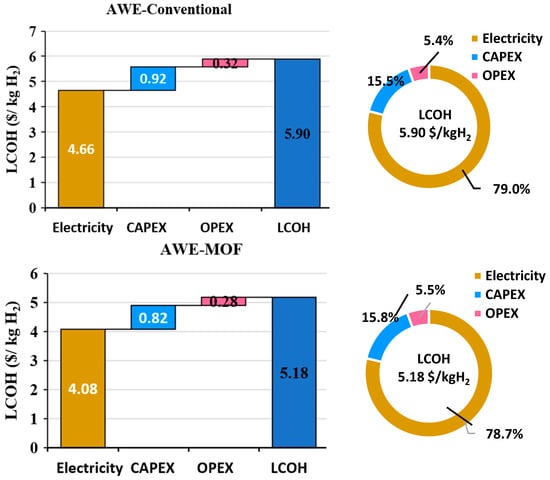
The total investment associated with the electrolysis system was considered in estimating the LCOH, providing a comprehensive measure of hydrogen production economics. The calculated LCOH values were 5.18 $/kg H2 for the AWE–MOF enhanced system and 5.90 $/kg H2 for the conventional AWE configuration.
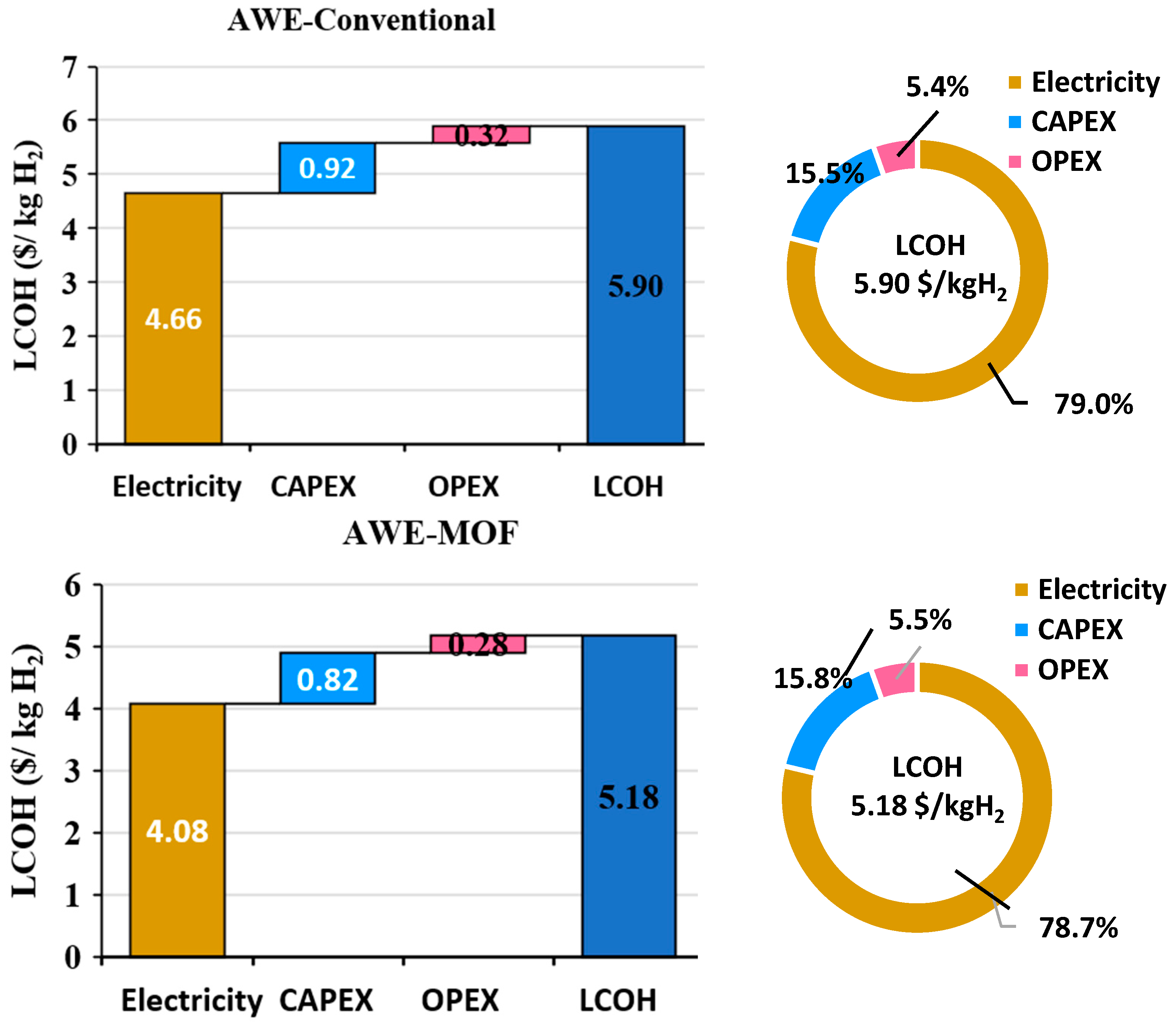
As illustrated in Figure 2, the LCOH composition includes the relative contributions of electricity supply, capital expenditure (CAPEX), and operational expenditure (OPEX) for both setups. The integration of MOF-based electrodes resulted in a cost reduction of 0.72 $/kg H2 compared to the baseline case. This improvement primarily arises from the higher electrical efficiency and lower specific energy consumption of the MOF-enhanced electrolyzer, along with its greater hydrogen output rate, while the additional cost of MOF and Ru materials had an almost negligible influence on the overall LCOH.
Figure 2.
Distribution of costs across electricity, capital, and operational phases contributing to the Levelized Cost of Hydrogen.
In quantitative terms, the advanced electrolyzer system, AWE–MOF enhanced system, achieved an annual hydrogen production of 6511 tons H2, surpassing the 5698 tons H2/year generated by the conventional AWE system (Table 1). Higher productivity contributes to an effective economy of scale, thereby lowering the unit cost of hydrogen. Furthermore, electricity procurement remains the largest cost driver, accounting for 4.08 $/kg H2 in the AWE–MOF case and 4.66 $/kg H2 in the conventional configuration, followed by CAPEX and OPEX. These results highlight that, despite the initial investment requirements, efficiency improvements significantly influence the cost competitiveness of MOF-assisted electrolysis under renewable energy supply conditions. Moreover, with hydrogen production in this study set to utilize electrolysis powered by solar and wind energy, the project is positioned to deliver greater environmental advantages and potentially contribute to the long-term price stability of green hydrogen.
Moreover, a sensitivity analysis is conducted to evaluate several parameters that may influence the hydrogen production cost, mainly electricity price fluctuations CAPEX variation, discount rate, and the stack lifetime. The ranges of some parameters and corresponding LCOH results are described in Table 2.
Table 2.
Deviation of the input parameters and LCOH Results for sensitivity analysis.
The values shown for parameters 1, 2, and 3 in Table 2 come from the fact that AWE–MOF enhanced technology is still under investigation and has not been thoroughly tested in high-capacity projects and for long operation periods. Therefore, the uncertainty of the electricity price is assumed here as ±10%, and the uncertainty of the discount rate is ±2%, while the uncertainty of the lifetime is assumed here to address 5 years to 15 years, as changes in these selected parameters may occur due to the use of MOF materials.
As shown in Table 2, electricity price variations lead to the largest change in LCOH, with values ranging from 4.75 to 5.62 $/kg H2 for a ±10% deviation, indicating the strong dependence of hydrogen production costs on electricity input. Changes in the discount rate within ±2% result in a narrower LCOH range (5.01–5.34 $/kg H2), suggesting a moderate sensitivity to related assumptions. In comparison, extending the stack lifetime from 5 to 15 years has a limited impact on LCOH (5.20–5.16 $/kg H2), indicating that, within the examined range, lifetime improvements contribute less to cost reduction than electricity price variations. These results confirm that electricity cost is the most critical driver of hydrogen production economics, given its dominant share in electrolyzer operation.
It should be mentioned that according to the European Hydrogen Observatory, the average cost of green hydrogen production in Europe is around 5.2 €/kg H2, already slightly below the cost of grey hydrogen produced via steam methane reforming [74]. Grey hydrogen costs are strongly influenced by natural gas prices, which are expected to rise due to carbon pricing and resource limitations, while green hydrogen costs are declining rapidly as renewable electricity and electrolyzer investment costs decrease [75].
3.2. Environmental Analysis
Within Life Cycle Assessment (LCA) methodologies, Global Warming Potential (GWP), expressed in kilograms of CO2 (kg CO2), serves as a key indicator of climate impact. To ensure dependable results for electrolysis hydrogen systems, it is crucial to apply precise input variables and reliable technical data, as these elements directly affect the integrity and applicability of the findings in strategic decision-making [76,77].
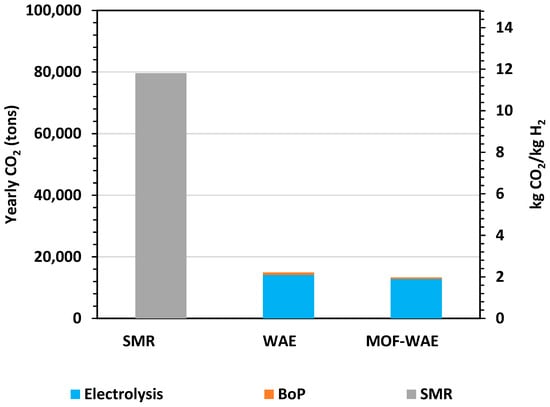
Figure 3 illustrates the Global Warming Potential (GWP) outcomes for the two assessed scenarios: AWE–MOFs and AWE–conventional. The data is presented in terms of total annual CO2 emissions (in tons) and CO2 emissions per kilogram of hydrogen produced via AWE (kg CO2/kg H2). This comparison highlights the environmental impact differences between traditional grey hydrogen production using Steam Methane Reforming (SMR) and the green hydrogen alternatives represented by AWE–MOFs and AWE–conventional approaches.
Figure 3.
Comparative annual Global Warming Potential (GWP) for AWE and AWE–MOF scenarios, presented as total carbon dioxide emissions (t CO2/year) and emission intensity per kilogram of hydrogen output (kg CO2/kg H2).
The Steam Methane Reforming (SMR) pathway demonstrates the highest Global Warming Potential (GWP), generating approximately 79,589 tons of CO2 annually, equating to nearly 11.8 kg of CO2 per kilogram of hydrogen produced. This result highlights the substantial carbon emissions typically associated with grey hydrogen production. In comparison, both green hydrogen alternatives show a marked reduction in greenhouse gas emissions. The AWE–conventional method results in just under 14,915 tons of CO2 per year, or about 2.21 kg CO2/kg H2, while the AWE–MOF configuration performs even better, emitting around 13,340 tons annually, which corresponds to 1.97 kg CO2/kg H2. A closer examination of the emissions profile reveals that the electrolysis phase is the primary contributor to the overall GWP in both green hydrogen scenarios. The variation between the two scenarios primarily stems from the greater energy demand for hydrogen production in the conventional AWE setup, which operates with lower energy conversion efficiency compared to electrolyzer-based systems. Furthermore, the AWE–MOF system offers a pronounced environmental advantage, achieving an 83% reduction in annual CO2 emissions compared to the SMR baseline. The conventional AWE scenario also results in emissions being lowered by approximately 80% relative to SMR. These findings underscore the climate benefits of using renewable energy sources integrated with advanced electrolyzer technologies, highlighting their critical role in shaping more sustainable hydrogen production pathways for future energy projects.
However, it should be mentioned that previous studies reported a wide range of GWP values for hydrogen production using different renewable sources and electrolysis technologies. For wind-powered electrolysis, a study found a GWP of 0.68 kg CO2/kg H2 [78], while solar PV-based systems yielded 3.1 kg CO2/kg H2 [39]. Also, a range of 4.0–9.0 kg CO2/kg H2 was reported for PV-driven electrolysis depending on system lifetime [40], slightly higher than the values obtained in this study. These differences in reported results are primarily due to variations in key parameters, including energy source, system lifetime, electrolyzer efficiency, and assumptions in the life cycle inventory and methodology.
Moreover, it is important to mention that the LCA results presented are subject to uncertainties arising from input data variability, modeling assumptions, and methodological choices. Key sources of uncertainty include the electricity supply mix, material production inventories, system boundaries, and operational parameters such as water consumption and maintenance requirements. While region-specific datasets were employed whenever available, data gaps were supplemented with literature or generic Central Asian values, which may introduce additional variability. Acknowledging these uncertainties highlights the need for continued data refinement and conducting more scenario comparisons in future studies.
3.3. Example Application in Automotive Use
To extend the relevance and comparability of the techno-economic and environmental assessment, the study further contextualizes its findings through an illustrative case of hydrogen utilization in the automotive sector in Uzbekistan. When hydrogen is produced from renewable energy sources and used in hydrogen fuel-cell vehicles, it can further reduce life cycle GHG emissions, strengthening their potential contribution to climate mitigation [79]. This section, by implementing an example application of hydrogen in hydrogen fuel-cell vehicles, facilitates intuitive benchmarking of green hydrogen adoption against both grey hydrogen derived from steam methane reforming (SMR) and conventional diesel fuel use in passenger cars and broader transport and logistics applications. The conversion framework is based on fuel consumption characteristics, expressed as kilograms of hydrogen or liters of diesel per 100 km of driving, for each powertrain configuration, namely diesel engines and fuel cell vehicles. Three hydrogen supply pathways are considered: grey hydrogen from SMR, green hydrogen from conventional water electrolysis (AWE), and advanced green hydrogen from MOF-enhanced AWE systems.
By integrating the calculated levelized cost of hydrogen (LCOH) and the global warming potential (GWP) per kilogram of fuel, the analysis derives the corresponding cost and GWP per 100 km of vehicle operation. Therefore, the fuel consumption, cost, and GWP implications of operating a passenger car over 100 km using different fuel types and hydrogen supply pathways are summarized in Table 3.
Table 3.
Fuel consumption, cost, and GWP per 100 km for one vehicle operation in several scenarios.
As expected, the diesel vehicle shows the highest environmental burden, emitting 18.09 kg CO2 per 100 km, along with a comparable cost ($6.76) to green hydrogen options. In contrast, fuel cell vehicles (FCVs) powered by green hydrogen, either from conventional AWE or MOF-enhanced AWE, exhibit substantially lower emissions, achieving reductions of nearly 90% compared with diesel. The MOF-enhanced AWE route provides the most favorable outcome, lowering both cost ($5.18 per 100 km) and GWP (1.97 kg CO2) relative to standard electrolysis. However, when hydrogen is sourced from SMR, the FCV loses most of its environmental advantage: although SMR hydrogen results in the lowest cost ($1.50 per 100 km), its GWP (11.8 kg CO2) remains significantly higher than that of green pathways and only moderately below diesel.
The AWE–MOF scenario emits 1.97 kg CO2 per 100 km, which corresponds to an avoidance of 16.12 kg CO2 relative to the diesel car (18.09 kg CO2), representing an 89.1% reduction. Compared with grey hydrogen from SMR (11.8 kg CO2), AWE–MOF avoids 9.83 kg CO2 per 100 km, equivalent to an 83.3% reduction. Even relative to conventional green hydrogen (2.21 kg CO2), the MOF–enhanced pathway still prevents 0.24 kg CO2, offering an additional 10.9% reduction. These comparisons confirm that integrating MOF materials into electrolysis systems meaningfully amplifies the climate benefits of hydrogen-powered mobility, making AWE–MOF the lowest-emission option among the evaluated fuel pathways.
Presenting the results per 100 km of driving enhances interpretability for policymakers, fleet operators, and industry stakeholders assessing hydrogen adoption strategies based on combined economic and sustainability criteria. These results demonstrate that the sustainability benefits of hydrogen mobility are strongly dependent on the upstream production pathway, underscoring the importance of deploying low-carbon hydrogen technologies, particularly advanced MOF-integrated electrolyzers, for meaningful emissions mitigation in Uzbekistan’s transport sector. Furthermore, as renewable energy deployment expands and the cost of clean electricity continues to decline, together with ongoing improvements in electrolyzer efficiency, the GWP associated with green hydrogen production is expected to decrease over time, further strengthening the environmental and economic viability of hydrogen-powered mobility solutions.
Finally, the results of this study offer relevant insights into the techno-economic and environmental performance for the development of green hydrogen in Uzbekistan. The country’s energy system is heavily dependent on natural gas and has high energy intensity, but it also has significant solar and wind resources. The study shows that renewable-powered alkaline water electrolysis (AWE) can produce hydrogen at competitive costs (~$5.18/kg) with low greenhouse gas emissions (~1.97 kg CO2/kg H2). To support large-scale adoption, targeted policies such as subsidies for electrolyzer deployment, well-structured Power Purchase Agreements (PPAs), and carbon pricing mechanisms are important. These measures can reduce financial risks, encourage private-sector investment, and enable integration of hydrogen into industry and transport. In addition, renewable hydrogen can help balance variable electricity generation from solar and wind, contributing to grid stability while advancing national climate and energy transition goals.
4. Conclusions
This study presented an integrated techno-economic and life-cycle assessment of green hydrogen production in Uzbekistan using MOF-enhanced alkaline water electrolysis powered by solar PV and wind energy. The findings demonstrate that the AWE–MOF system not only improves environmental performance but also enhances productivity and cost competitiveness. Quantitatively, the MOF-integrated electrolyzer achieved an annual hydrogen output of 6511 tons—surpassing the 5698 tons produced by the conventional AWE system—thereby benefiting from economies of scale and improved system efficiency. Electricity procurement remains the dominant cost component, accounting for 4.08 $/kg H2 in the AWE–MOF scenario and 4.66 $/kg H2 in the conventional case, followed by CAPEX and OPEX. Despite higher initial investment needs, the efficiency gains enabled by MOF materials substantially strengthen the economic viability of renewable-based hydrogen production.
From an environmental perspective, the results show that conventional SMR remains the most carbon-intensive option, emitting nearly 79,600 tons of CO2 annually (11.8 kg CO2/kg H2), whereas renewable-based hydrogen routes achieve substantial reductions of 80–83% in life-cycle emissions. Among them, the MOF-integrated AWE system delivers the strongest performance, reducing annual emissions to 13,340 tons and lowering GWP to 1.97 kg CO2/kg H2 due to its improved energy efficiency. Extending the analysis to hydrogen mobility further highlights the benefits of advanced electrolysis technologies: FCVs powered by MOF-enhanced green hydrogen emit 89% less CO2 per 100 km than diesel vehicles and 83% less than SMR-derived hydrogen, while also offering lower operational costs compared with conventional electrolysis.
These findings underscore the critical role of MOF-enabled electrolyzers and renewable energy integration in advancing Uzbekistan’s decarbonization ambitions and supporting the transition toward a low-carbon hydrogen economy. As photovoltaic and wind capacities expand and clean electricity costs decline, the environmental advantages of green hydrogen, particularly through next-generation electrolyzer designs, are expected to strengthen even further, reinforcing its potential as a cornerstone of sustainable transport and industrial energy systems.
Supplementary Materials
The following supporting information can be downloaded at: https://www.mdpi.com/article/10.3390/hydrogen7010007/s1, Table S1: The main materials and inputs for the structure of the AWE-MOF system with 44 MW capacity.
Funding
This research and the APC were funded by New Uzbekistan University.
Data Availability Statement
The original contributions presented in this study are included in the article/Supplementary Material. Further inquiries can be directed to the corresponding author.
Acknowledgments
The authors gratefully acknowledge the support provided by New Uzbekistan University and the Department of Mechanical Engineering, as well as contributions from industry partners in Uzbekistan.
Conflicts of Interest
The authors declare no conflict of interest.
Nomenclature
| AWE | alkaline water electrolyzer |
| CAPEX | Capital expenditure |
| CO2 | Carbon dioxide |
| FCVs | Fuel cell vehicles |
| GHG | Greenhouse gas |
| GWP | Global warming potential |
| HRS | Hydrogen refueling station |
| LCA | Life cycle assessment |
| LCOH | Levelized cost of hydrogen |
| MOF | metal–organic framework |
| OPEX | The annual operational expenditure |
| PEM | Proton-exchange membrane electrolysis |
| SMR | Steam methane reforming |
| TEA | Techno-economic analysis |
References
- Our World in Data. Renewable Energy. 2023. Available online: https://ourworldindata.org/renewable-energy (accessed on 1 October 2025).
- Daiyan, R.; Macgill, I.; Amal, R. Opportunities and Challenges for Renewable Power-to-X. ACS Energy Lett. 2020, 5, 3843–3847. [Google Scholar] [CrossRef] [Scilit]
- Adeli, K.; Nachtane, M.; Faik, A.; Saifaoui, D.; Boulezhar, A. How Green Hydrogen and Ammonia Are Revolutionizing the Future of Energy Production: A Comprehensive Review of the Latest Developments and Future Prospects. Appl. Sci. 2023, 13, 8711. [Google Scholar] [CrossRef] [Scilit]
- Chisholm, G.; Zhao, T.; Cronin, L. Hydrogen from Water Electrolysis; Elsevier Inc.: Amsterdam, The Netherlands, 2022. [Google Scholar]
- Wang, L.; Chen, M.; Küngas, R.; Lin, T.E.; Diethelm, S.; Maréchal, F.; Van Herle, J. Power-to-fuels via solid-oxide electrolyzer: Operating window and techno-economics. Renew. Sustain. Energy Rev. 2019, 110, 174–187. [Google Scholar] [CrossRef] [Scilit]
- Yusaf, T.; Faisal Mahamude, A.S.; Kadirgama, K.; Ramasamy, D.; Farhana, K.; Dhahad, H.A.; Abu Talib, A.R. Sustainable hydrogen energy in aviation—A narrative review. Int. J. Hydrogen Energy 2024, 52, 1026–1045. [Google Scholar] [CrossRef] [Scilit]
- Thomas, J.M.; Edwards, P.P.; Dobson, P.J.; Owen, G.P. Decarbonising energy: The developing international activity in hydrogen technologies and fuel cells. J. Energy Chem. 2020, 51, 405–415. [Google Scholar] [CrossRef] [Scilit] [PubMed]
- Oliveira, A.M.; Beswick, R.R.; Yan, Y. A green hydrogen economy for a renewable energy society. Curr. Opin. Chem. Eng. 2021, 33, 100701. [Google Scholar] [CrossRef] [Scilit]
- Oni, A.O.; Anaya, K.; Giwa, T.; Di Lullo, G.; Kumar, A. Comparative assessment of blue hydrogen from steam methane reforming, autothermal reforming, and natural gas decomposition technologies for natural gas-producing regions. Energy Convers. Manag. 2022, 254, 115245. [Google Scholar] [CrossRef] [Scilit]
- Phan-Van, L.; Dinh, V.N.; Felici, R.; Duc, T.N. New models for feasibility assessment and electrolyser optimal sizing of hydrogen production from dedicated wind farms and solar photovoltaic farms, and case studies for Scotland and Vietnam. Energy Convers. Manag. 2023, 295, 117597. [Google Scholar] [CrossRef] [Scilit]
- Adeli, K.; Nachtane, M.; Faik, A.; Rachid, A.; Tarfaoui, M.; Saifaoui, D. A deep learning-enhanced framework for sustainable hydrogen production from solar and wind energy in the Moroccan Sahara: Coastal regions focus. Energy Convers. Manag. 2024, 302, 118084. [Google Scholar] [CrossRef] [Scilit]
- Yakhshilikov, J.; Cavana, M.; Leone, P. A Review of the Energy System and Transport Sector in Uzbekistan in View of Future Hydrogen Uptake. Energies 2024, 17, 3987. [Google Scholar] [CrossRef] [Scilit]
- Mostafaeipour, A.; Hosseini Dehshiri, S.S.; Hosseini Dehshiri, S.J.; Almutairi, K.; Taher, R.; Issakhov, A.; Techato, K. A thorough analysis of renewable hydrogen projects development in Uzbekistan using MCDM methods. Int. J. Hydrogen Energy 2021, 46, 31174–31190. [Google Scholar] [CrossRef] [Scilit]
- International Energy Agency (IEA). Uzbekistan Energy Profile; IEA: Paris, France, 2020; pp. 1–47. Available online: https://www.iea.org/reports/uzbekistan-energy-profile (accessed on 1 October 2025).
- World Bank Group. Roadmap for the Development of Low Carbon Hydrogen in Uzbekistan; World Bank: Washington, DC, USA, 2022; pp. 1–105. [Google Scholar]
- International Energy Agency (IEA). Solar Energy Policy in Uzbekistan: A Roadmap; IEA: Paris, France, 2022; pp. 1–53. Available online: www.iea.org/t&c/ (accessed on 1 October 2025).
- Hossain Bhuiyan, M.M.; Siddique, Z. Hydrogen as an alternative fuel: A comprehensive review of challenges and opportunities in production, storage, and transportation. Int. J. Hydrogen Energy 2025, 102, 1026–1044. [Google Scholar] [CrossRef] [Scilit]
- Suleman, F.; Dincer, I.; Agelin-Chaab, M. Environmental impact assessment and comparison of some hydrogen production options. Int. J. Hydrogen Energy 2015, 40, 6976–6987. [Google Scholar] [CrossRef] [Scilit]
- Farhana, K.; Shadate Faisal Mahamude, A.; Kadirgama, K. Comparing hydrogen fuel cost of production from various sources—A competitive analysis. Energy Convers. Manag. 2024, 302, 118088. [Google Scholar] [CrossRef] [Scilit]
- Shiva Kumar, S.; Lim, H. An overview of water electrolysis technologies for green hydrogen production. Energy Reports 2022, 8, 13793–13813. [Google Scholar] [CrossRef] [Scilit]
- Elgowainy, A.; Han, J.; Zhu, H. Updates to Parameters of Hydrogen Production; Argonne National Laboratory: Argonne, IL, USA, 2013; pp. 2–5. Available online: https://greet.es.anl.gov/files/h2-13 (accessed on 1 October 2025).
- Schmidt, O.; Gambhir, A.; Staffell, I.; Hawkes, A.; Nelson, J.; Few, S. Future cost and performance of water electrolysis: An expert elicitation study. Int. J. Hydrogen Energy 2017, 42, 30470–30492. [Google Scholar] [CrossRef] [Scilit]
- Kim, M.; Lee, D.; Qi, M.; Kim, J. Techno-economic analysis of anion exchange membrane electrolysis process for green hydrogen production under uncertainty. Energy Convers. Manag. 2024, 302, 118134. [Google Scholar] [CrossRef] [Scilit]
- Li, R.; Jin, X.; Yang, P.; Zheng, M.; Zheng, Y.; Cai, C.; Sun, X.; Luo, Z.; Zhao, L.; Huang, Z.; et al. Capacity optimization of a wind-photovoltaic-electrolysis-battery (WPEB) hybrid energy system for power and hydrogen generation. Int. J. Hydrogen Energy 2023, 52, 311–333. [Google Scholar] [CrossRef] [Scilit]
- Brauns, J.; Turek, T. Alkaline water electrolysis powered by renewable energy: A review. Processes 2020, 8, 248. [Google Scholar] [CrossRef] [Scilit]
- Seetharaman, S.; Balaji, R.; Ramya, K.; Dhathathreyan, K.S.; Velan, M. Graphene oxide modified non-noble metal electrode for alkaline anion exchange membrane water electrolyzers. Int. J. Hydrogen Energy 2013, 38, 14934–14942. [Google Scholar] [CrossRef] [Scilit]
- Abe, I. Alkaline Water Electrolysis. In Energy Carriers and Conversion Systems; UNESCO–Encyclopedia Life Support Systems: Chiba, Japan, 2009; Volume I. [Google Scholar]
- Shiva Kumar, S.; Ramakrishna, S.U.B.; Krishna, S.V.; Srilatha, K.; Devi, B.R.; Himabindu, V. Synthesis of titanium (IV) oxide composite membrane for hydrogen production through alkaline water electrolysis. S. Afr. J. Chem. Eng. 2018, 25, 54–61. [Google Scholar] [CrossRef] [Scilit]
- Burnat, D.; Schlupp, M.; Wichser, A.; Lothenbach, B.; Gorbar, M.; Züttel, A.; Vogt, U.F. Composite membranes for alkaline electrolysis based on polysulfone and mineral fillers. J. Power Sources 2015, 291, 163–172. [Google Scholar] [CrossRef] [Scilit]
- Roy, A.; Watson, S.; Infield, D. Comparison of electrical energy efficiency of atmospheric and high-pressure electrolysers. Int. J. Hydrogen Energy 2006, 31, 1964–1979. [Google Scholar] [CrossRef] [Scilit]
- Anwar, S.; Khan, F.; Zhang, Y.; Djire, A. Recent development in electrocatalysts for hydrogen production through water electrolysis. Int. J. Hydrogen Energy 2021, 46, 32284–32317. [Google Scholar] [CrossRef] [Scilit]
- de Groot, M.T.; Kraakman, J.; Garcia Barros, R.L. Optimal operating parameters for advanced alkaline water electrolysis. Int. J. Hydrogen Energy 2022, 47, 34773–34783. [Google Scholar] [CrossRef] [Scilit]
- Zou, Z.; Dastafkan, K.; Shao, Y.; Zhao, C.; Wang, Q. Electrocatalysts for alkaline water electrolysis at ampere-level current densities: A review. Int. J. Hydrogen Energy 2023, 51, 667–684. [Google Scholar] [CrossRef] [Scilit]
- Marinkas, A.; Struźyńska-Piron, I.; Lee, Y.; Lim, A.; Park, H.S.; Jang, J.H.; Kim, H.J.; Kim, J.; Maljusch, A.; Conradi, O.; et al. Anion-conductive membranes based on 2-mesityl-benzimidazolium functionalised poly(2,6-dimethyl-1,4-phenylene oxide) and their use in alkaline water electrolysis. Polymer 2018, 145, 242–251. [Google Scholar] [CrossRef] [Scilit]
- IRENA. Green Hydrogen Cost Reduction. 2020. Available online: https://www.irena.org/publications/2020/Dec/Green-hydrogen-cost-reduction (accessed on 1 October 2025).
- Tiwari, P.; Tsekouras, G.; Wagner, K.; Swiegers, G.F.; Wallace, G.G. A new class of bubble-free water electrolyzer that is intrinsically highly efficient. Int. J. Hydrogen Energy 2019, 44, 23568–23579. [Google Scholar] [CrossRef] [Scilit]
- Swiegers, G.F.; Terrett, R.N.L.; Tsekouras, G.; Tsuzuki, T.; Pace, R.J.; Stranger, R. The prospects of developing a highly energy-efficient water electrolyser by eliminating or mitigating bubble effects. Sustain. Energy Fuels 2021, 5, 1280–1310. [Google Scholar] [CrossRef] [Scilit]
- Directorate-General for Climate Action. Nobel Prize 2025: Award-Winning Chemistry for a Cleaner Planet. 2025. Available online: https://climate.ec.europa.eu/news-other-reads/news/nobel-prize-2025-award-winning-chemistry-cleaner-planet-2025-10-14_en (accessed on 15 October 2025).
- Sadeghi, S.; Ghandehariun, S.; Rosen, M.A. Comparative economic and life cycle assessment of solar-based hydrogen production for oil and gas industries. Energy 2020, 208, 118347. [Google Scholar] [CrossRef] [Scilit]
- Zhang, J.; Ling, B.; He, Y.; Zhu, Y.; Wang, Z. Life cycle assessment of three types of hydrogen production methods using solar energy. Int. J. Hydrogen Energy 2022, 47, 14158–14168. [Google Scholar] [CrossRef] [Scilit]
- Koj, J.C.; Wulf, C.; Schreiber, A.; Zapp, P. Site-dependent environmental impacts of industrial hydrogen production by alkalinewater electrolysis. Energies 2017, 10, 860. [Google Scholar] [CrossRef] [Scilit]
- Suleman, F.; Dincer, I.; Agelin-Chaab, M. Comparative impact assessment study of various hydrogen production methods in terms of emissions. Int. J. Hydrogen Energy 2016, 41, 8364–8375. [Google Scholar] [CrossRef] [Scilit]
- Guven, D. Transitioning Istanbul’s bus rapid transit system to green hydrogen: An environmental and economic analysis. Environ. Impact Assess. Rev. 2026, 117, 108209. [Google Scholar] [CrossRef] [Scilit]
- International Organization for Standardization (ISO). Environmental Management e Life Cycle Assessment e Principles and Framework. 2006. Available online: https://www.iso.org/obp/ui/#iso:std:iso:14040:ed-2:v1:en (accessed on 20 October 2025).
- Lozanovski, A.; Schuller, O.; Faltenbacher, M.; Fischer, M.; Sedlbauer, K.; Fraunhofer-Institut für Bauphysik. Guidance Document for Performing LCA on Hydrogen Production Systems; Fraunhofer Institute for Building Physics (Fraunhofer IBP): Stuttgart, Germany, 2013; Volume 9. [Google Scholar]
- 46. European Comission. Recommendations for Life Cycle Impact Assessment in the European Context—Based on Existing Environmental Impact Assessment Models and Factors; European Commission, Joint Research Centre (JRC): Ispra, Italy, 2011. [Google Scholar]
- Koj, J.C.; Schreiber, A.; Zapp, P.; Marcuello, P. Life Cycle Assessment of Improved High Pressure Alkaline Electrolysis. Energy Procedia 2015, 75, 2871–2877. [Google Scholar] [CrossRef] [Scilit]
- Delpierre, M.; Quist, J.; Mertens, J.; Prieur-Vernat, A.; Cucurachi, S. Assessing the environmental impacts of wind-based hydrogen production in the Netherlands using ex-ante LCA and scenarios analysis. J. Clean. Prod. 2021, 299, 126866. [Google Scholar] [CrossRef] [Scilit]
- Lotrič, A.; Sekavčnik, M.; Kuštrin, I.; Mori, M. Life-cycle assessment of hydrogen technologies with the focus on EU critical raw materials and end-of-life strategies. Int. J. Hydrogen Energy 2021, 46, 10143–10160. [Google Scholar] [CrossRef] [Scilit]
- Nel Hydrogen. The World’s Most Efficient and Reliable Electrolysers; Nel Hydrog.: Wallingford, CT, USA, 2020; p. 16. Available online: https://nelhydrogen.com/resources/electrolysers-brochure/#:~:text=Summary,to%20meet%20any%20customer%20requirements (accessed on 9 October 2025).
- Su, Y.L.; Yu, S.E.; Ni, I.C.; Wu, C.I.; Chen, Y.S.; Chuang, Y.C.; Cheng, I.C.; Chen, J.Z. Low-Pressure Plasma-Processed NiCo Metal–Organic Framework for Oxygen Evolution Reaction and Its Application in Alkaline Water Electrolysis Module. J. Compos. Sci. 2024, 8, 19. [Google Scholar] [CrossRef] [Scilit]
- Mork, J.; Saparova, D.; Bilek, P. Uzbekistan’ s Electricity Demand Forecasting: An Outlook Until 2035; German Economic Team (GET): Berlin, Germany, 2024. [Google Scholar]
- International Energy Agency (IEA). Uzbekistan 2022 Energy Policy Review; IEA: Paris, France, 2020; pp. 1–158. Available online: https://www.oecd.org/content/dam/oecd/en/publications/reports/2022/10/uzbekistan-2022-energy-policy-review_b94a8e4a/be7a357c-en.pdf (accessed on 1 October 2025).
- European Communities: Wind Turbine Grid Connection and Interaction. 2001. Available online: https://www.scribd.com/document/37078205/Wind-Turbine-Grid-Connection-and-Interaction (accessed on 1 October 2025).
- Schleisner, L. Life cycle assessment of a wind farm and related externalities. Renew. Energy 2000, 20, 279–288. [Google Scholar] [CrossRef] [Scilit]
- Reichel, D.H.N.C.; Müller, A.; Friedrich, L.; Herceg, S.; Mittag, M.; Protti, A. CO2 Emissions of Silicon Photovoltaic Modules—Impact of Module Design and Production Location. In Proceedings of the 8th World Conference on Photovoltaic Energy Conversion, Milan, Italy, 26–30 September 2022; pp. 1617–1619. [Google Scholar]
- Acwa Power. Tashkent Solar PV and BESS Project Republic of Uzbekistan; Acwa Power: Riyadh, Saudi Arabia, 2023. [Google Scholar]
- Acwa Power. Nukus 200 MW Phase 2 Wind Farm Uzbekistan; Acwa Power: Riyadh, Saudi Arabia, 2025. [Google Scholar]
- Allsop, A.; Bortolotti, M. Clean Hydrogen Definition. 2022. Available online: https://h2sciencecoalition.com/briefings/clean-hydrogen-definition/ (accessed on 20 October 2025).
- IRENA. Hydrogen: A Renewable Energy Perspective; September 2019. Available online: https://www.irena.org/publications/2019/Sep/Hydrogen-A-renewable-energy-perspective (accessed on 20 October 2025).
- Faia, R.; Lezama, F.; Soares, J.; Pinto, T.; Vale, Z. Local electricity markets: A review on benefits, barriers, current trends and future perspectives. Renew. Sustain. Energy Rev. 2024, 190, 114006. [Google Scholar] [CrossRef] [Scilit]
- Yates, J.; Daiyan, R.; Patterson, R.; Egan, R.; Amal, R.; Ho-Baille, A.; Chang, N.L. Techno-economic Analysis of Hydrogen Electrolysis from Off-Grid Stand-Alone Photovoltaics Incorporating Uncertainty Analysis. Cell Reports Phys. Sci. 2020, 1, 100209. [Google Scholar] [CrossRef] [Scilit]
- Assunção, R.; Ajeeb, W.; Eckl, F.; Gomes, D.M.; Neto, R.C. Decentralized hydrogen-oxygen co-production via electrolysis for large hospitals with integrated hydrogen refueling station. Int. J. Hydrogen Energy 2025, 103, 87–98. [Google Scholar] [CrossRef] [Scilit]
- Ayers, K. Nel Hydrogen Proton Exchange Membrane Electrolyzer Technology: Challenges and Advancements. 2023. Available online: https://energy.mit.edu/wp-content/uploads/2023/06/Ayers-Proton-exchange-membrane-electrolyzer-technology-compressed-min-min-red-compressed.pdf (accessed on 15 October 2025).
- Roeder, T.; Rosenstiel, A.; Monnerie, N.; Sattler, C. Impact of expected cost reduction and lifetime extension of electrolysis stacks on hydrogen production costs. Int. J. Hydrogen Energy 2024, 95, 1242–1251. [Google Scholar] [CrossRef] [Scilit]
- Lichner, C. Electrolyzer Prices—What to Expect; pv Magazine International: Berlin, German, 2024. [Google Scholar]
- BloombergNEF’s Electrolyzer Price Survey 2024. 2024. Available online: https://www.bnef.com/ (accessed on 5 October 2025).
- Henry, A.; McStay, D.; Rooney, D.; Robertson, P.; Foley, A. Techno-economic analysis to identify the optimal conditions for green hydrogen production. Energy Convers. Manag. 2023, 291, 117230. [Google Scholar] [CrossRef] [Scilit]
- Assunçao, R.; Eckl, F.; Ramos, C.; Correia, C.; Neto, R.C. Oxygen liquefaction economical value in the development of the hydrogen economy. Int. J. Hydrogen Energy 2024, 62, 109–118. [Google Scholar] [CrossRef] [Scilit]
- Coppitters, D.; De Paepe, W.; Contino, F. Surrogate-assisted robust design optimization and global sensitivity analysis of a directly coupled photovoltaic-electrolyzer system under techno-economic uncertainty. Appl. Energy 2019, 248, 310–320. [Google Scholar] [CrossRef] [Scilit]
- Rajeshwar, K.; McConnell, R.; Licht, S. Solar Hydrogen Generation; Springer: Berlin/Heidelberg, Germany, 2008. [Google Scholar]
- Global Petrol Prices. Uzbekistan Diesel Prices. 2025. Available online: https://www.globalpetrolprices.com/Uzbekistan/diesel_prices/ (accessed on 5 October 2025).
- Golden Pages. The Cost of Gasoline and Dizel in Fuel Stations of Tashkent, Uzbekistan. 2025. Available online: https://www.goldenpages.uz/en/benzin-cena/ (accessed on 1 October 2025).
- European Hydrogen Observatory. Cost of Hydrogen Production; European Commission: Brussels, Belgium, 2022. [Google Scholar]
- International Energy Agency (IEA). Global Hydrogen Review 2023; IEA: Paris, France, 2023. [Google Scholar]
- Ajeeb, W.; Baptista, P.; Costa, R. Life cycle analysis of hydrogen production by different alkaline electrolyser technologies sourced with renewable energy. Energy Convers. Manag. 2024, 316, 118840. [Google Scholar] [CrossRef] [Scilit]
- Ajeeb, W.; Costa, R.; Baptista, P. Life cycle assessment of green hydrogen production through electrolysis: A literature review. Sustain. Energy Technol. Assess. 2024, 69, 103923. [Google Scholar] [CrossRef] [Scilit]
- Ghandehariun, S.; Kumar, A. Life cycle assessment of wind-based hydrogen production in Western Canada. Int. J. Hydrogen Energy 2016, 41, 9696–9704. [Google Scholar] [CrossRef] [Scilit]
- Khanna, D.; Gemechu, E.; Mahbub, N.; Joy, J.; Kumar, A. Assessment of life cycle environmental impacts of materials, driving pattern, and climatic conditions on battery electric and hydrogen fuel cell vehicles in a cold region. Environ. Impact Assess. Rev. 2025, 110, 107680. [Google Scholar] [CrossRef] [Scilit]
- UZauto Motors. Chevrolet Cobalt. 2025. Available online: https://uzautomotors.com/cars/chevrolet_cobalt (accessed on 1 October 2025).
- H2 Mobility. Hyundai ix35. 2025. Available online: https://h2.live/en/fuelcell-cars/hyundai-ix35/ (accessed on 21 October 2025).
- Akhmadov, K.S.; Nazarova, N.M.; Juraev, A.R.; Avezov, I.Y. Technical and economic analysis, calculation and justification of hydrogen production through solar thermochemical reactor in Republic of Uzbekistan. In Proceedings of the VII International Conference on Actual Problems of the Energy Complex and Environmental Protection (APEC-VII-2024), Karshi, Uzbekistan, 22–24 January 2024; E3S Web of Conferences. Volume 524. [Google Scholar] [CrossRef] [Scilit]
- Canada Natural Resources. Learn the Facts: Emissions from Your Vehicle; Natural Resources Canada: Ottawa, Canada, 2014; Available online: https://natural-resources.canada.ca/sites/www.nrcan.gc.ca/files/oee/pdf/transportation/fuel-efficient-technologies/autosmart_factsheet_9_e.pdf (accessed on 1 October 2025).
- Mickūnaitis, V.; Pikūnas, A.; Mackoit, I. Reducing fuel consumption and CO2 emission in motor cars. Transport 2007, 22, 160–163. [Google Scholar] [CrossRef] [Scilit]
- Mercedes-Benz. The Mercedes-Benz Sprinter; Mercedes-Benz AG: Stuttgart, Germany, 2019; Available online: https://www.mercentro.pt/folder/pagina/imagem4/51_Sprinter.pdf (accessed on 25 October 2025).
- Mercedes-Benz, V. Mercedes-Benz Shows Sprinter F-CELL Van with Fuel Cell Drive. Fuel Cell Bull 2018, 8, 3–4. [Google Scholar] [CrossRef] [Scilit]

Disclaimer/Publisher’s Note: The statements, opinions and data contained in all publications are solely those of the individual author(s) and contributor(s) and not of MDPI and/or the editor(s). MDPI and/or the editor(s) disclaim responsibility for any injury to people or property resulting from any ideas, methods, instructions or products referred to in the content. |
© 2026 by the author. Licensee MDPI, Basel, Switzerland. This article is an open access article distributed under the terms and conditions of the Creative Commons Attribution (CC BY) license.