


Abstract
High-Andean grasslands in the Central Andes of Peru are severely degraded by Lepidium meyenii (maca) cultivation, compromising pasture structure and forage availability for sustainable livestock production. A factorial field experiment evaluated restoration timing and pasture-oriented seed mixtures by manipulating resting time after abandonment (0, 1, 2, and 3 years) and restoration treatment (control; Festuca dolichophylla monoculture; full mixture of Dactylis glomerata + Lolium spp. + Trifolium repens + F. dolichophylla; and mixture without F. dolichophylla) across 64 plots. Vegetation was assessed eight months after seeding, and responses were analysed with ordination, PERMANOVA with restricted permutations, PERMDISP, and generalised linear models and mixed-effects models for diversity metrics. Community composition differed significantly among resting times and seed treatments, with resting time explaining the largest proportion of variance (R2 = 0.353), followed by treatment (R2 = 0.236), while the interaction was significant but smaller (R2 = 0.102, p = 0.002). PERMDISP detected significant differences in multivariate dispersion for both Resting Time and Treatment, indicating that compositional differences may reflect both centroid shifts and heterogeneity among groups. Passive recovery and Festuca-only plots showed slower, more variable compositional change, whereas productive mixtures produced clearer, treatment-specific trajectories over time, suggesting possible divergence in community development patterns, rather than providing formal evidence of distinct alternative stable states. Establishment was consistently high for D. glomerata and Lolium spp., supporting rapid ground cover, which may be associated with short-term forage potential, while F. dolichophylla showed chronically low establishment consistent with limited germination performance. The invasive Pennisetum clandestinum was most pronounced under passive recovery and was reduced under seeded mixtures, suggesting a potential competitive suppression effect. Overall, early seeding with productive mixtures appeared to influence community assembly trajectories, while resting time remained the dominant driver of compositional variation, suggesting potential implications for restoration management in maca-degraded landscapes, although outcomes related to sustainable grazing systems were not directly evaluated.
1. Introduction
High-Andean grasslands (pajonal and césped de puna) of the Central Andes (3800–4800 m a.s.l.) constitute critical ecosystems that provide essential services, including carbon sequestration, water regulation, livestock forage, and biodiversity conservation [1,2,3]. These ecosystems harbour distinctive assemblages of cushion plants (Azorella spp., Aciachne pulvinata), tussock grasses (Festuca spp., Calamagrostis vicunarum, Stipa spp.), and endemic forbs adapted to extreme environmental conditions characterised by intense solar radiation, frequent freeze–thaw cycles and marked climatic seasonality [2,4,5,6]. From a community assembly perspective, these environments impose severe abiotic filters that govern species recruitment and persistence [7] Beyond their ecological importance, High-Andean grasslands constitute the primary forage base sustaining extensive livestock systems (cattle, sheep, and camelids), which represent a central pillar of local and regional economies in the central Andes of Peru. Livestock production in these high-elevation systems underpins household livelihoods, food security, and cultural practices, particularly in areas where alternative economic activities are limited.
In recent decades, however, the intensification of Lepidium meyenii Walp. (maca) Cultivation, a high-value Andean tuber crop, is associated with significant land-use conversion of these grasslands in the Junín and Pasco regions of Peru, resulting in severe soil degradation, biodiversity loss, and landscape fragmentation [7,8,9,10]. This land-use transition has not only disrupted native plant communities but has also reduced vegetation structure and ground cover, forage availability, and carrying capacity, directly constraining the sustainability of livestock-based production systems in post-maca landscapes.
Maca cultivation imposes multiple stressors on High-Andean grasslands, acting primarily through intensive mechanical tillage and high nutrient extraction rates [11]. Mechanical tillage disrupts soil physical structure and depletes soil seed banks by burying seeds beyond their recruitment depth or promoting the germination of short-lived ruderal species [12,13]. Furthermore, the rapid extraction of nitrogen and phosphorus during the maca growth cycle, combined with altered hydrological conditions, favours ruderal and invasive species over native perennial vegetation [14,15]. Following harvest or abandonment, degraded sites often undergo prolonged and unpredictable secondary succession, frequently becoming arrested in degraded alternative states dominated by opportunistic forbs [16,17]. From a pastoral perspective, such successional trajectories frequently yield vegetation with low palatability, poor nutritional quality, and limited biomass [18], rendering natural regeneration insufficient to meet the forage demands of grazing systems. These apprehended trajectories represent a failure in community re-assembly, where priority effects of ruderal species prevent the re-establishment of native tussock grasses [19].
Passive restoration through natural regeneration commonly fails due to dispersal limitation, persistent soil legacy effects, and priority effects that reinforce early colonisation by competitive species [19,20,21]. Active restoration through seed addition has therefore emerged as a potentially effective strategy to bypass dispersal filters, although the optimal timing of intervention and appropriate seed mixture composition remain poorly resolved [22,23]. Importantly, restoration strategies oriented exclusively toward native species recovery may be ecologically desirable but are often constrained by low seed availability, poor germination, and slow establishment, limiting their short- to medium-term effectiveness for restoring functional pasture suitable for livestock use.
Seed mixture composition constitutes a second major axis of restoration decision-making, involving trade-offs between rapid vegetation cover and long-term recovery of native communities [24,25,26]. Productive introduced pasture species, including Dactylis glomerata, Lolium spp., and Trifolium repens, are widely used due to their commercial availability, high germination rates, rapid biomass accumulation, and competitive ability against invasive species [27,28]. In High-Andean livestock systems, these species are frequently valued for their ability to rapidly restore ground cover, enhance short-term forage supply, and stabilise degraded soils, thereby supporting grazing continuity and reducing pressure on remnant natural grasslands. This tension highlights a fundamental management dilemma: whether restoration should prioritise rapid recovery of pasture function for sustainable livestock production or longer-term reconstruction of native plant communities, particularly under conditions of severe degradation and socio-economic dependence on grazing.
Despite the importance of these ecosystems, empirical evidence on how the timing of intervention interacts with the composition of the species pool to steer successional trajectories remains scarce. To address this gap, this study evaluates the interactive effects of post-abandonment resting time and seed-based restoration treatments on community composition, diversity, and successional trajectories in High-Andean grasslands degraded by Lepidium meyenii cultivation in central Peru. The following hypotheses were tested: (i) increasing resting time before intervention allows for a partial recovery of soil conditions but also increases the dominance of undesirable ruderal species; (ii) the use of multi-species mixtures accelerates community stabilisation and reduces invasion risk compared to passive recovery; and (iii) the effectiveness of restoration mixtures is contingent upon the resting time, with early interventions (A0) providing the strongest suppression of invasive taxa.
2. Materials and Methods
2.1. Study Site and Environmental Context
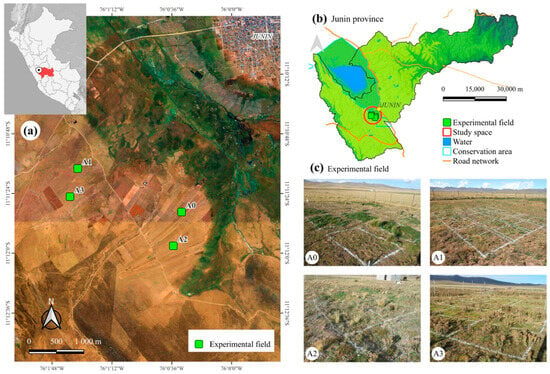
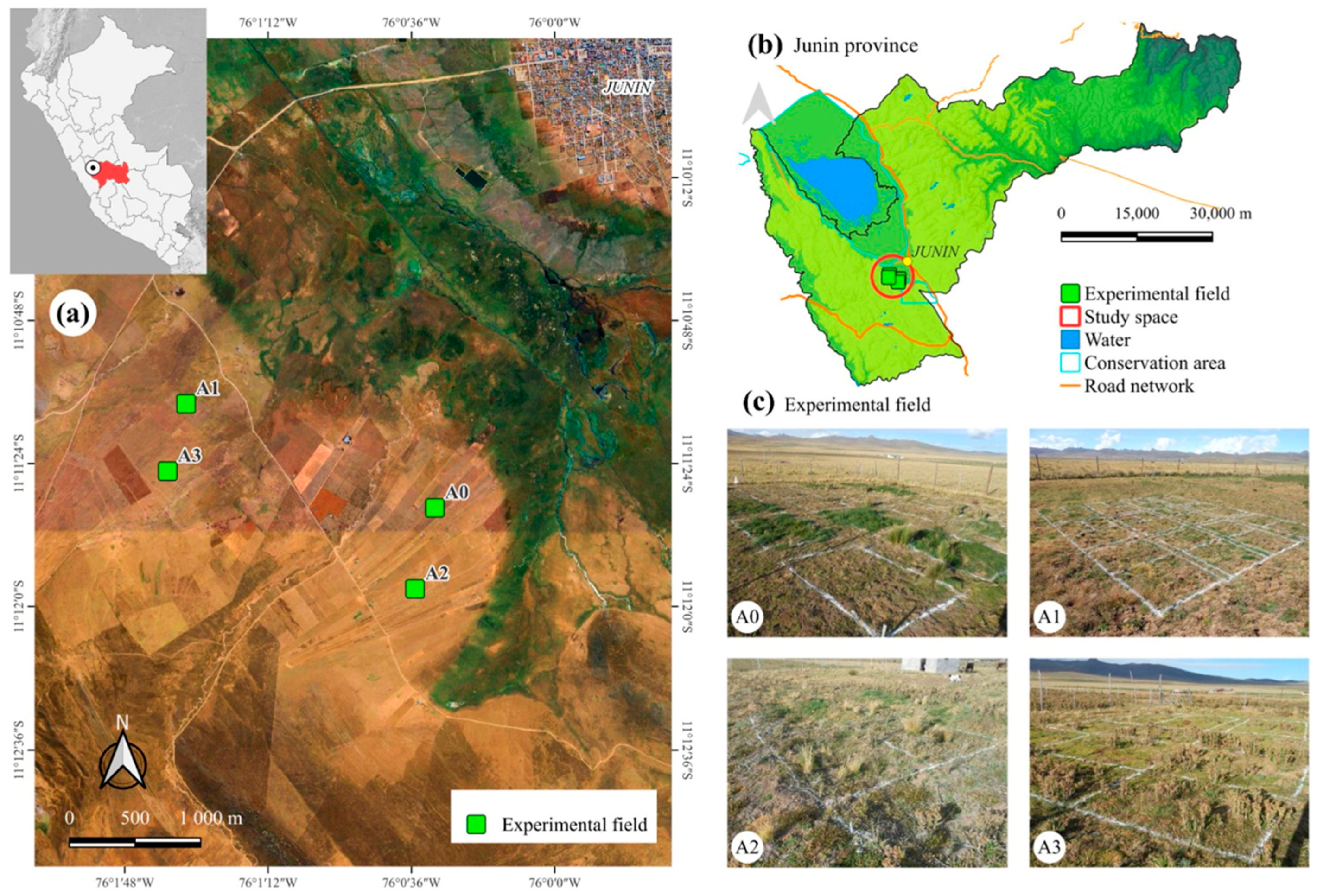
The study was conducted in degraded High-Andean grasslands of the Central Andes, Junín Region, Peru, at elevations between 4000 and 4200 m a.s.l. The regional climate is classified as cold semi-arid (Köppen Cwb), with a pronounced wet season from October to April and a dry season from May to September. Mean annual temperature ranges from 3 to 6 °C, with frequent nocturnal frosts (occurring on average 100–120 days per year, predominantly between May and August) [29]. Mean annual precipitation ranges from 600 to 800 mm (austral summer), based on regional meteorological data from 1995 to 2024 [30]. The geographic location and environmental setting of the study area are shown in Figure 1.
Figure 1.
Geographic location and environmental setting of the study area. (a) Location of the Junín region within the Central Andes of Peru; (b) Distribution of the experimental sites (High-Andean grasslands); (c) Layout of the experimental sector showing the chronosequence of Lepidium meyenii (maca) cultivation fields abandoned at different resting times (0, 1, 2, and 3 years).
Soils are predominantly Andisols and Inceptisols derived from volcanic parent materials (Source: Regional Soil Map, Ministry of Agriculture), characterised by high organic matter content (8–15%) and acidic pH (4.5–5.5). Aluminium toxicity in these soils acts as a major constraint, primarily by limiting root elongation and reducing nutrient uptake (P and Ca) in sensitive species. The experimental area comprised Lepidium meyenii cultivation fields abandoned at different time points (0, 1, 2, and 3 years). Before abandonment, these fields underwent 2–3 consecutive years of maca cultivation with traditional organic fertilisation and manual tillage.
2.2. Experimental Design
The experiment followed a Randomised Complete Block Design (RCBD) to account for potential site-level variability across the chronosequence. The factors were
- Factor A: Resting Time (A0: 0 years; A1: 1 year; A2: 2 years; A3: 3 years). Each resting-time level was represented by four independent blocks (BlockID) to avoid pseudoreplication.
- Factor T: Restoration Treatment: (T1: Control; T2: Festuca dolichophylla monoculture; T3: Multi-species mixture; T4: Multi-species mixture without Festuca).
The design generated 16 treatment combinations; each replicated four times (n = 64). Each plot (4 m × 4 m) was separated by 2 m buffer zones. Field identity was incorporated as a random effect in the linear mixed-effects model used for Shannon diversity, while species richness was analysed using a generalised linear model without a random-effect term. Each agricultural field was treated as a block (BlockID), representing the experimental unit for the whole-plot factor (Resting Time). Therefore, the term BlockID is used consistently throughout the manuscript to refer to this hierarchical level.
2.3. Seed Material and Germination Assessment
To ensure reproducibility and comparability between laboratory and field conditions, germination assays were conducted using a standardised protocol. For each species, seeds were distributed evenly within plastic containers (replicates) over a moist cotton substrate, avoiding overlap and ensuring homogeneous spacing. Each container constituted one experimental unit, with multiple independent replicates per species. Germination was monitored daily over a 14-day period under ambient conditions (approximately 15–20 °C) and natural photoperiod. A seed was considered germinated upon visible radicle emergence.
For the field-based assay (in situ), seeds were sown manually in prepared soil beds subdivided into quadrants to maintain spatial consistency. Within each quadrant, seeds were distributed at uniform density and lightly incorporated into the soil surface. Emergence was recorded periodically during the establishment phase, using visible seedling emergence as the criterion for successful germination. Although exact germination counts in field conditions are subject to environmental variability, mean emergence proportions were used as a proxy for realised germination.
Laboratory (in vitro) and field (in situ) germination values were thus derived from independent but methodologically comparable assays, allowing qualitative and quantitative comparison with subsequent field establishment observed in experimental plots. The germination process and representative stages of seedling development for all species are documented in Supplementary Figure S1.
2.4. Vegetation Sampling
Vegetation was surveyed in June 2021 (8 months post-seeding, representing the early stages of community establishment). A 1 m × 1 m frame was used with the 100-point intercept method [31]. All vertical contact between the pin and vascular plants was recorded to account for vertical layering. Frequencies were expressed on a 0–100 scale [32]. All vascular plants were identified to species level in situ by specialist using regional floras [33]. Taxonomic nomenclature follows World Flora Online and Global Biodiversity Information Facility. Frequencies of bare soil, rock, and plant litter were also recorded to provide environmental context for community patterns.
2.5. Data Processing and Quality Control
The quality control included a check for duplicate records via unique plot-species ID verification. Outlier screening was performed using Cook’s distance with a threshold of 4/n. Taxonomic synonymy was resolved using the taxize package in R (R version 4.3.1), accessing GBIF and WFO databases. Missing values were replaced with zeros only after verifying species absence across all strata in the 100-point grid.
2.6. Statistical Analyses
2.6.1. Community Composition
Species frequency data were analysed using Bray–Curtis dissimilarity [34,35] computed from raw (untransformed) data. Treatment effects on community composition were assessed using PERMANOVA (adonis2, 999 permutations) [36]. Given the hierarchical structure of the experimental design, where Resting Time (A) was assigned at the field level (whole-plot factor) and Treatment (T) was applied to plots nested within blocks (BlockID) (subplot factor), the permutation scheme was constrained to respect this structure. Permutations were restricted using BlockID as the permutation stratum, ensuring that exchangeability occurred only among plots within the same block (BlockID). This prevents inappropriate permutation of the whole-plot factor (Resting Time), which is not randomly assigned at the plot level. Under this restricted permutation framework, Treatment and A × T effects are evaluated within fields, while inference for Resting Time is based on comparisons among independent blocks (BlockID), consistent with its implementation as a whole-plot factor. Because Resting Time was assigned at the field level, permutations for this factor are effectively constrained among independent fields (BlockID), whereas Treatment and A × T effects are evaluated within fields. This approach ensures that the hierarchical structure of the split-plot design is respected and avoids inappropriate permutation of the whole-plot factor.
2.6.2. Ordination and Successional Trajectories Analysis
Community composition was visualised using Principal Coordinates Analysis (PCoA) based on Bray–Curtis dissimilarity calculated from species frequency data [37]. This approach provides a robust representation of compositional differences among plots in a reduced-dimensional space. Successional trajectories were analysed by tracking centroid movement across resting-time levels for each treatment combination. Trajectory metrics were calculated from centroid positions in ordination space. Total path length was defined as the cumulative Euclidean distance between consecutive centroid positions across resting-time levels. Net displacement was calculated as the Euclidean distance between the initial (A0) and final (A3) centroid positions. The directionality index was computed as the ratio between net displacement and total path length. Trajectory angles were calculated based on the orientation of the displacement vector in the two-dimensional PCoA space. Differences in trajectory direction, magnitude, and dispersion were interpreted in relation to restoration effects and successional dynamics, and potential dispersion heterogeneity in multivariate analyses [38,39].
2.6.3. Diversity Metrics and Modelling
Species richness was modelled using a negative binomial generalised linear model to account for overdispersion. Shannon diversity was analysed using a linear mixed-effects model (LMM) fitted with restricted maximum likelihood (REML), including Resting Time, Treatment, and their interaction as fixed effects, and BlockID as a random intercept:
Shannon ~ A × T + (1 | BlockID)
Mixed-effects modelling was applied only to Shannon diversity, whereas species richness was analysed using a generalised linear model without a random-effect term. This structure accounts for the hierarchical experimental design plots nested within blocks (BlockID) and controls for block-level variability.
2.6.4. Establishment of Key Species and Invasion Dynamics
Establishment success of sown species (Dactylis glomerata, Festuca dolichophylla, Lolium spp., Trifolium repens) was quantified using mean frequency, variability, and prevalence across A × T combinations. Observed field performance was compared with germination rates to assess seed quality constraints. Additionally, the dynamics of the invasive grass Pennisetum clandestinum were analysed to evaluate treatment effects on invasion suppression [40].
2.6.5. Software
Multivariate analyses and diversity models were conducted in R 4.3.1 using the vegan, lme4, glmmTMB, and performance packages. Figures were produced using ggplot2. Hierarchical clustering and heatmap visualisation were performed using Euclidean distance with Ward.D2 linkage applied to standardised species frequency data.
3. Results
3.1. Dataset Overview and Experimental Balance
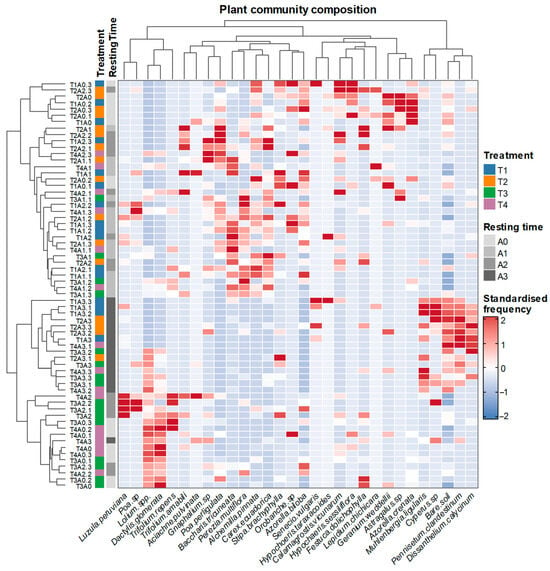
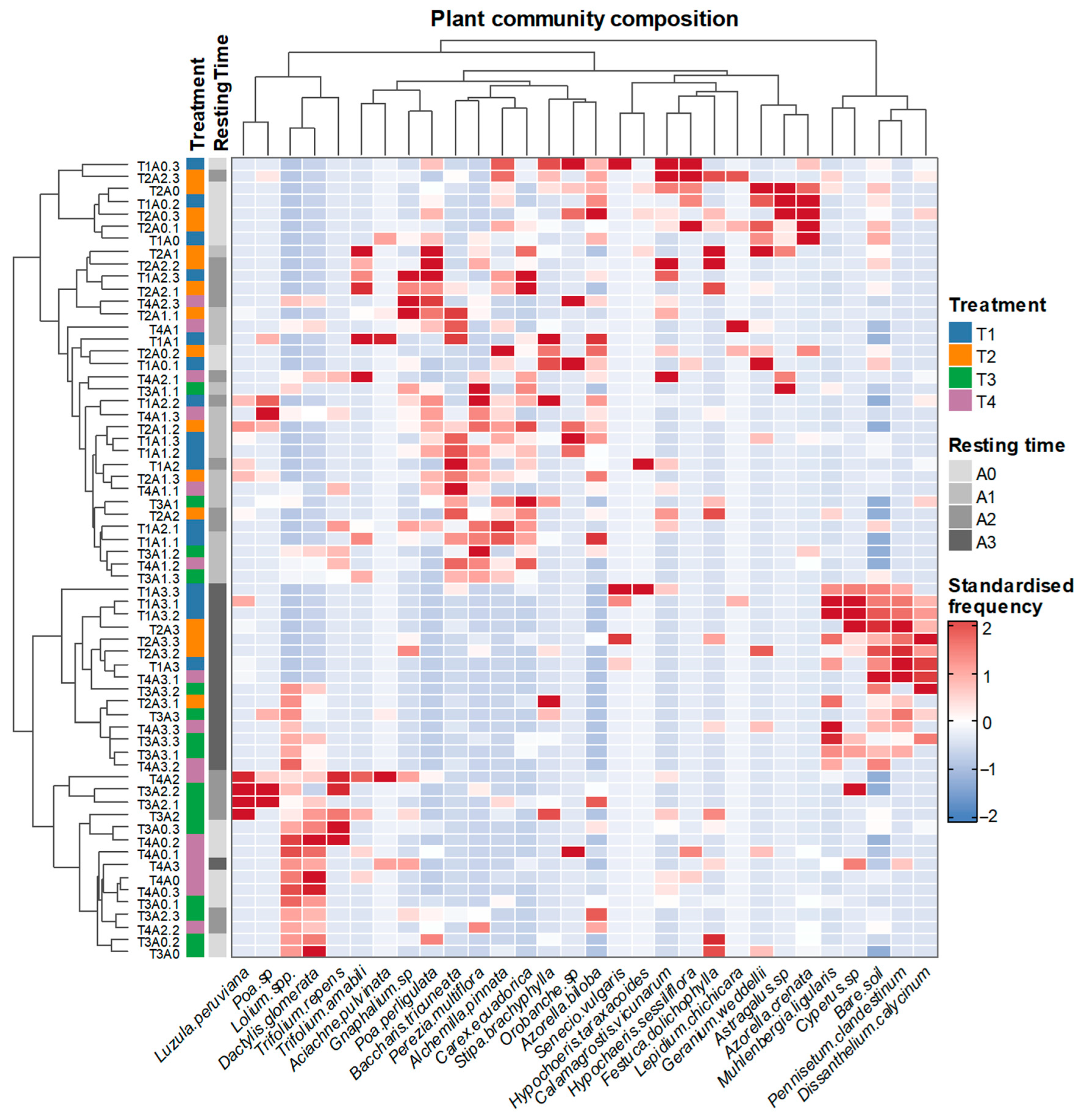
The final dataset comprised 64 plots distributed evenly across 16 treatment combinations (4 resting times × 4 restoration treatments), with four replicates per combination. No plots were lost, resulting in a fully balanced factorial design. The species matrix contained 41 vascular plant taxa. Plot-level richness ranged from 4 to 14 species (mean = 8.98 ± 2.81 SD). Total vegetation frequency (sum across species) ranged from 60 to 100 (mean = 85.30 ± 12.04), indicating moderate to high cover across most plots. Community-level indices showed substantial variation among experimental units: mean Shannon diversity was 1.72 ± 0.40 (range: 0.92–2.68), Simpson diversity was 0.75 ± 0.12 (range: 0.46–0.92), and Berger–Parker dominance was 0.34 ± 0.10 (range: 0.15–0.61). Bare soil averaged 9.14 ± 8.94%, with higher values in recently abandoned sites (A0) and lower values in 3-year resting plots (A3), consistent with progressive ground cover recovery along the resting-time gradient. Hierarchical clustering of species associations based on standardized frequency data is presented in Figure 2.
Figure 2.
Hierarchical clustering was performed using Euclidean distance with Ward.D2 linkage applied to standardised species frequency data to identify species associations and grouping patterns.
3.2. Multivariate Community Composition
3.2.1. PERMANOVA
PERMANOVA revealed significant effects of resting time, restoration treatment, and their interaction on community composition (Table 1). Resting time explained the largest proportion of variance (R2 = 0.353, F = 18.27, p = 0.001), indicating a strong structuring effect of successional stage on plant assemblages. Treatment also contributed significantly (R2 = 0.236, F = 12.24, p = 0.001), confirming that restoration interventions influenced community composition across sites. The interaction between resting time and treatment (A × T) was significant but accounted for a smaller proportion of variance (R2 = 0.102, F = 1.76, p = 0.004), suggesting that treatment effects varied depending on successional stage but with a comparatively moderate effect size.
Table 1.
PERMANOVA results for plant community composition based on Bray–Curtis dissimilarity (adonis2, 999 restricted permutations within blocks).
Collectively, the factorial model (A + T + A × T) explained 69.1% of the total compositional variance, indicating a strong experimental signal in community assembly. The remaining 30.9% of unexplained variance likely reflects fine-scale environmental heterogeneity, unmeasured site conditions, and stochastic ecological processes. Permutations were restricted using BlockID as the permutation stratum (999 permutations), ensuring that the hierarchical structure of the experimental design was respected. These results indicate that resting time is the dominant driver of community composition, while restoration treatments exert additional but context-dependent effects.
3.2.2. Homogeneity of Multivariate Dispersion (PERMDISP)
Homogeneity of multivariate dispersion was assessed separately for Resting Time and Treatment. Significant differences in dispersion were detected for both Resting Time (PERMDISP: F = 7.081, p = 0.001) and Treatment (PERMDISP: F = 5.980, p = 0.002). These results indicate that the significant effects identified by PERMANOVA may reflect both differences in group centroids and heterogeneity in within-group dispersion, as summarized in Table 2.
Table 2.
PERMDISP results for homogeneity of multivariate dispersion based on Bray–Curtis dissimilarity (999 permutations).
3.2.3. Community Ordination Patterns and Successional Trajectories
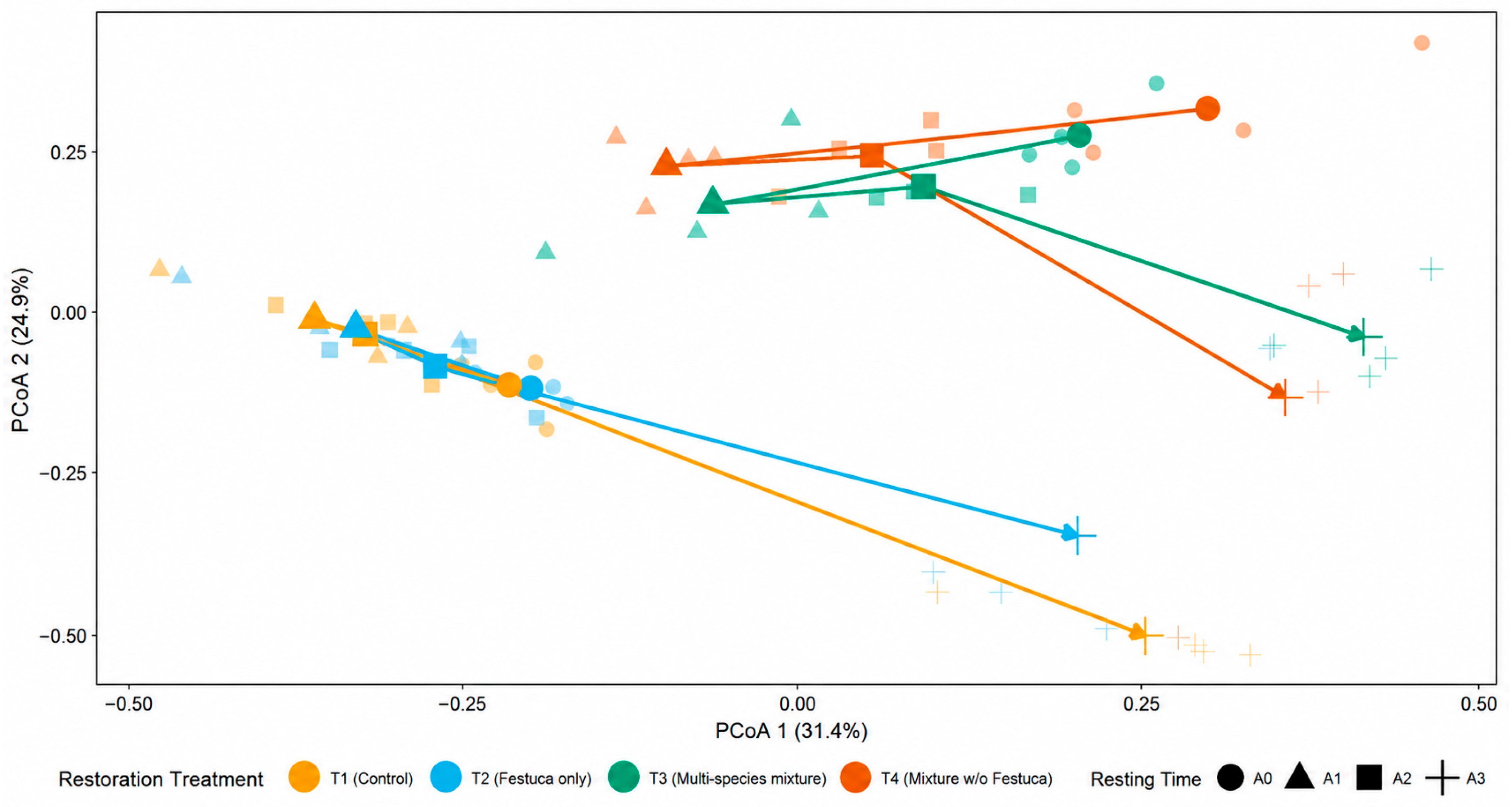
Community patterns were visualised using Principal Coordinates Analysis (PCoA) based on Bray–Curtis dissimilarities. This metric approach provides a robust representation of compositional differences among the 64 experimental plots, avoiding the interpretative limitations associated with non-metric multidimensional scaling (NMDS) in high-dimensional ecological datasets. The ordination revealed a clear structuring of community composition, where Axis 1 primarily captured the temporal gradient associated with resting time, while Axis 2 reflected variation linked to restoration treatments. At the onset of the experiment (A0), centroids for all treatments remained tightly clustered in the ordination space (mean PCoA1 ≈ −0.20; PCoA2 ≈ 0.10 for T1 and T2), indicating high compositional similarity immediately after field abandonment. This pattern is consistent with the initial homogenisation of vegetation following agricultural disturbance.
As resting time progressed towards A3, a marked divergence among restoration strategies became evident. Passive recovery (T1) and the Festuca-only treatment (T2) exhibited a pronounced shift towards negative values along Axis 2 (reaching PCoA2 ≈ −0.45 at A3), whereas multi-species mixtures (T3 and T4) followed a distinct trajectory towards positive values along Axis 1 (reaching PCoA1 > 0.35). These contrasting trajectories suggest that restoration treatments may influence the direction of compositional change over time. The separation between seeded and non-seeded treatments suggests that the introduction of multi-species mixtures may have altered community assembly patterns, likely through the establishment of sown species and the reduction in early-stage ruderal taxa. However, these patterns should be interpreted as divergence in compositional trajectories rather than definitive evidence of alternative stable states, given the relatively short temporal scale of the study. Patterns of centroid movement suggested differences in community development among treatments. However, because PERMDISP detected significant dispersion heterogeneity (Section 3.2.2), these ordination patterns should be interpreted cautiously, as they may reflect both centroid shifts and differences in within-group dispersion. The overall ordination structure and centroid trajectories are presented in Figure 3.
Figure 3.
PCoA ordination of plant community composition based on Bray–Curtis dissimilarity. Points represent individual plots (n = 64), coloured by treatment and shaped by resting time. Larger symbols indicate treatment centroids, and arrows represent centroid trajectories across resting-time levels (A0–A3).
3.3. Successional Trajectory Metrics
Trajectory metrics derived from centroid movement in ordination space are presented in Table 3. Total path length was greatest for the control (T1: 1.86) and Festuca-only treatment (T2: 1.69), and lower for seeded treatments (T3: 1.39; T4: 1.63), consistent with faster stabilisation (reduced cumulative turnover) under seed addition. Net displacement was highest in T1 (0.734) and T2 (0.698), but lower in T3 (0.320) and T4 (0.471), suggesting that seed addition constrained communities into a narrower region of species space. Directionality indices were moderate-to-low across all treatments, indicating that trajectories reflected multi-phase compositional change. Trajectory angles suggested that seeded treatments shifted along a different primary direction than controls.
Table 3.
Quantitative metrics of successional trajectories derived from PCoA centroid movement across restoration treatments.
3.4. Diversity Responses
Patterns observed in multivariate analyses were partially reflected in diversity responses, although relationships between composition and diversity metrics were not always congruent.
3.4.1. Species Richness
Species richness was modelled using a negative binomial generalised linear model. Treatment had a significant effect (χ2 = 10.61, df = 3, p = 0.014), whereas resting time and the interaction were not significant. At the coefficient level, richness showed a marginal decline at A3 (estimate = −0.495, p = 0.051), suggesting a potential reduction in species number under longer resting periods. Similarly, treatment T4 exhibited a marginal negative effect.
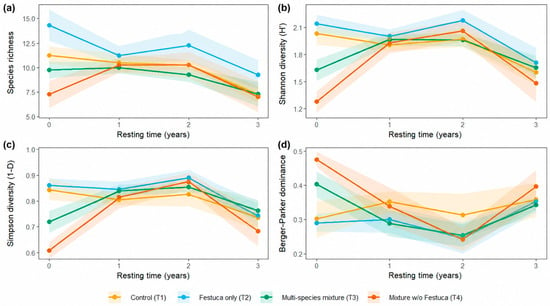
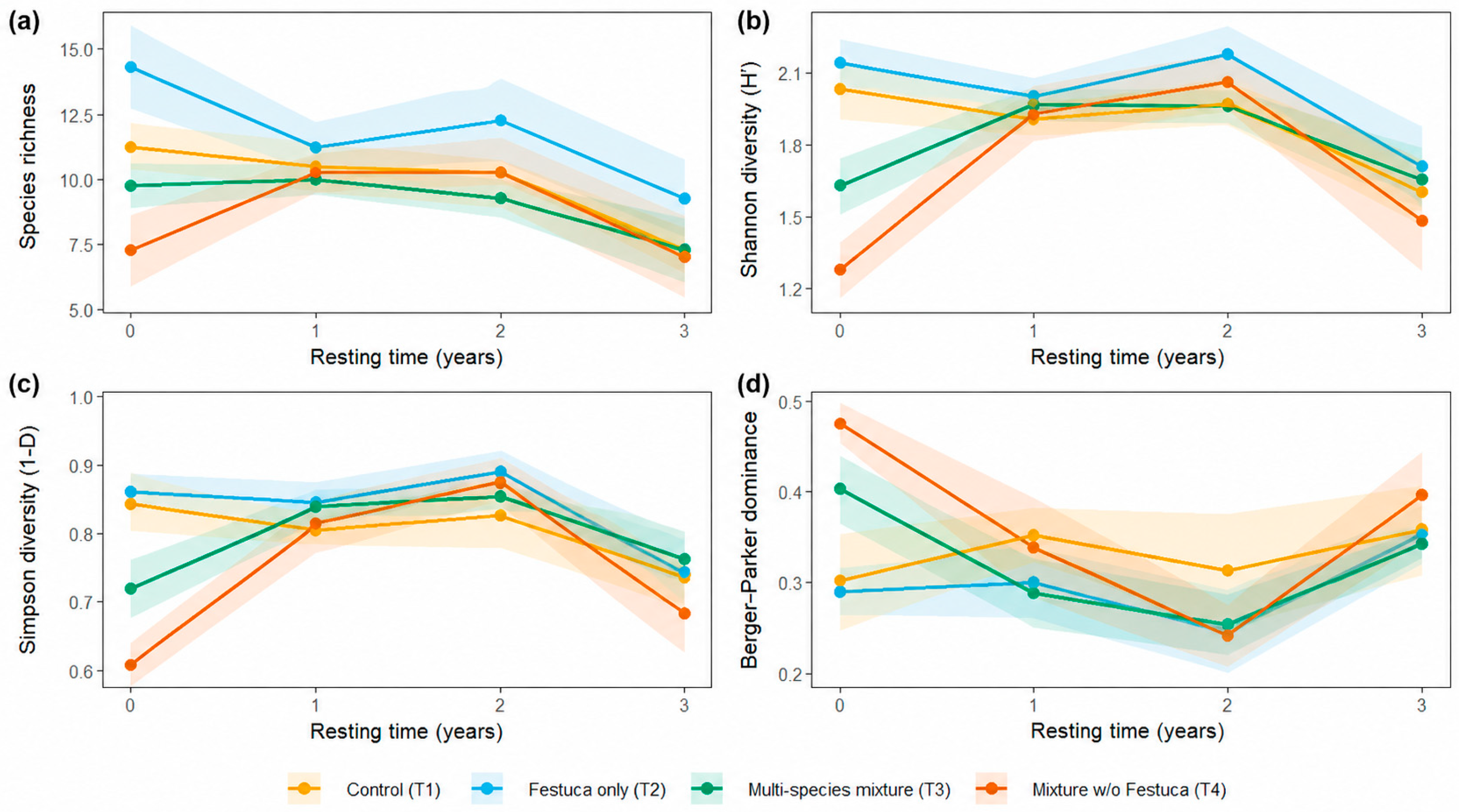
The model explained a substantial proportion of deviance (pseudo-R2 = 0.482), indicating moderate explanatory power. Overall, richness patterns were primarily associated with treatment effects rather than resting time or their interaction. Diversity patterns across resting times and restoration treatments are summarized in Figure 4, while detailed parameter estimates of the negative binomial model are presented in Table 4.
Figure 4.
Diversity metrics across resting times and restoration treatments. Panels show (a) species richness, (b) Shannon diversity, (c) Simpson diversity, and (d) Berger–Parker dominance. Values represent mean ± standard error (n = 4 per treatment combination).
Table 4.
Negative binomial model for species richness including main effects and interaction terms.
3.4.2. Shannon Diversity
Shannon diversity was analysed using a linear mixed-effects model including BlockID as a random intercept. The estimated random effect variance (0.116) indicates that block-level heterogeneity contributed substantially to variation in diversity. No significant effects of resting time, treatment, or their interaction were detected. The model showed a conditional R2 of 0.691 and marginal R2 of 0.299, indicating that most explained variance was attributable to random (block-level) effects rather than fixed experimental factors. Detailed parameter estimates for the linear mixed-effects model are presented in Table 5.
Table 5.
Linear mixed-effects model (LMM) for Shannon diversity including BlockID as a random effect.
3.5. Establishment of Sown Species
3.5.1. Dactylis glomerata and Lolium spp.
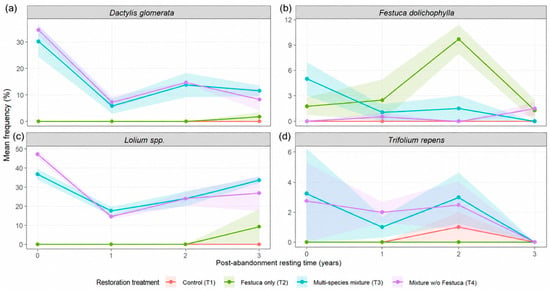
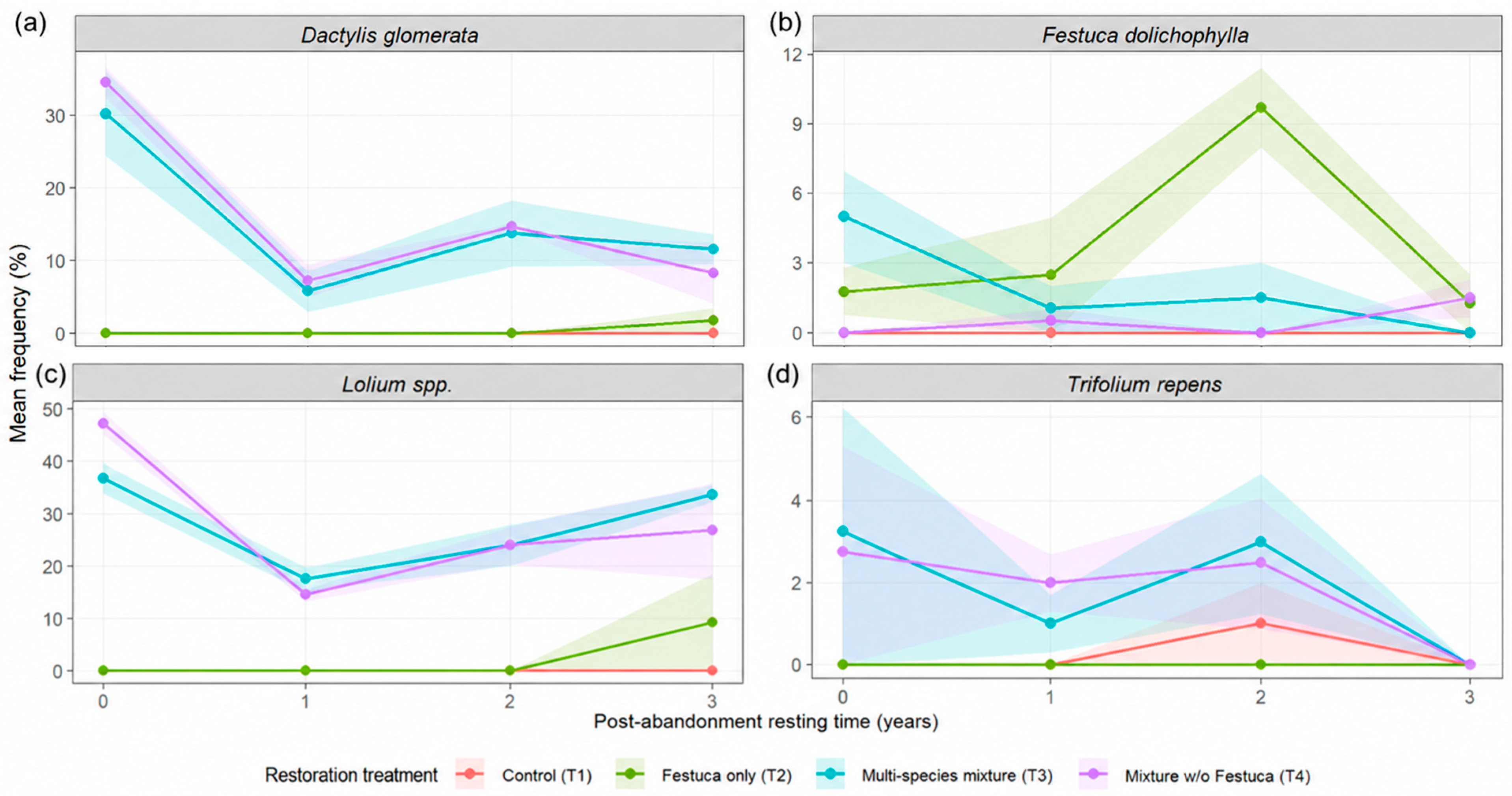
Dactylis glomerata and Lolium spp. showed higher frequencies in the seeded mixtures, particularly in recently abandoned plots (A0; Figure 5a,c). However, low background occurrence was also observed in some non-target treatments, indicating that their presence should not be interpreted exclusively as establishment from experimental sowing. Dactylis achieved mean frequencies of 15.3% in T3 and 16.2% in T4, while Lolium exhibited mean frequencies of 28.1% in T3 and 28.3% in T4. These patterns suggest stronger early establishment in the productive mixtures, especially under short post-abandonment resting time. Accordingly, laboratory germination values should be interpreted as an indicator of potential performance, while field frequencies integrate both germination and post-emergence processes.
Figure 5.
Establishment and occurrence patterns of key sown species across resting times and restoration treatments. Panels show mean frequency (±SE) for (a) Dactylis glomerata, (b) Festuca dolichophylla, (c) Lolium spp., and (d) Trifolium repens.
3.5.2. Festuca dolichophylla
In contrast to introduced grasses, Festuca dolichophylla exhibited low establishment across all treatments (Figure 5b). Mean frequencies were 3.8% in T2 and 1.9% in T3. Festuca was present in only 50% of T2 plots and 38% of T3 plots. The poor field performance is consistent with low germination rates (approximately 15% in situ and 23% in vitro), as derived from the germination assays described in Section 2.3.
3.5.3. Trifolium repens
Trifolium repens showed low overall frequencies across treatments (Figure 5d). Mean frequencies were 1.8% in both T3 and T4, although low background occurrence was also detected in some control plots.
3.6. Invasive Species Dynamics: Pennisetum clandestinum
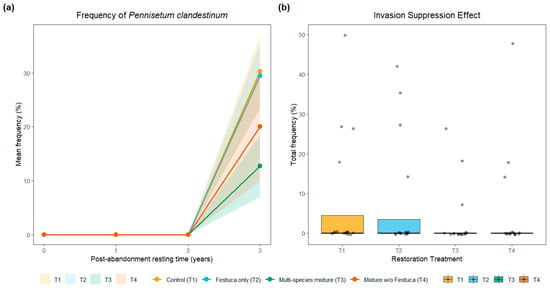
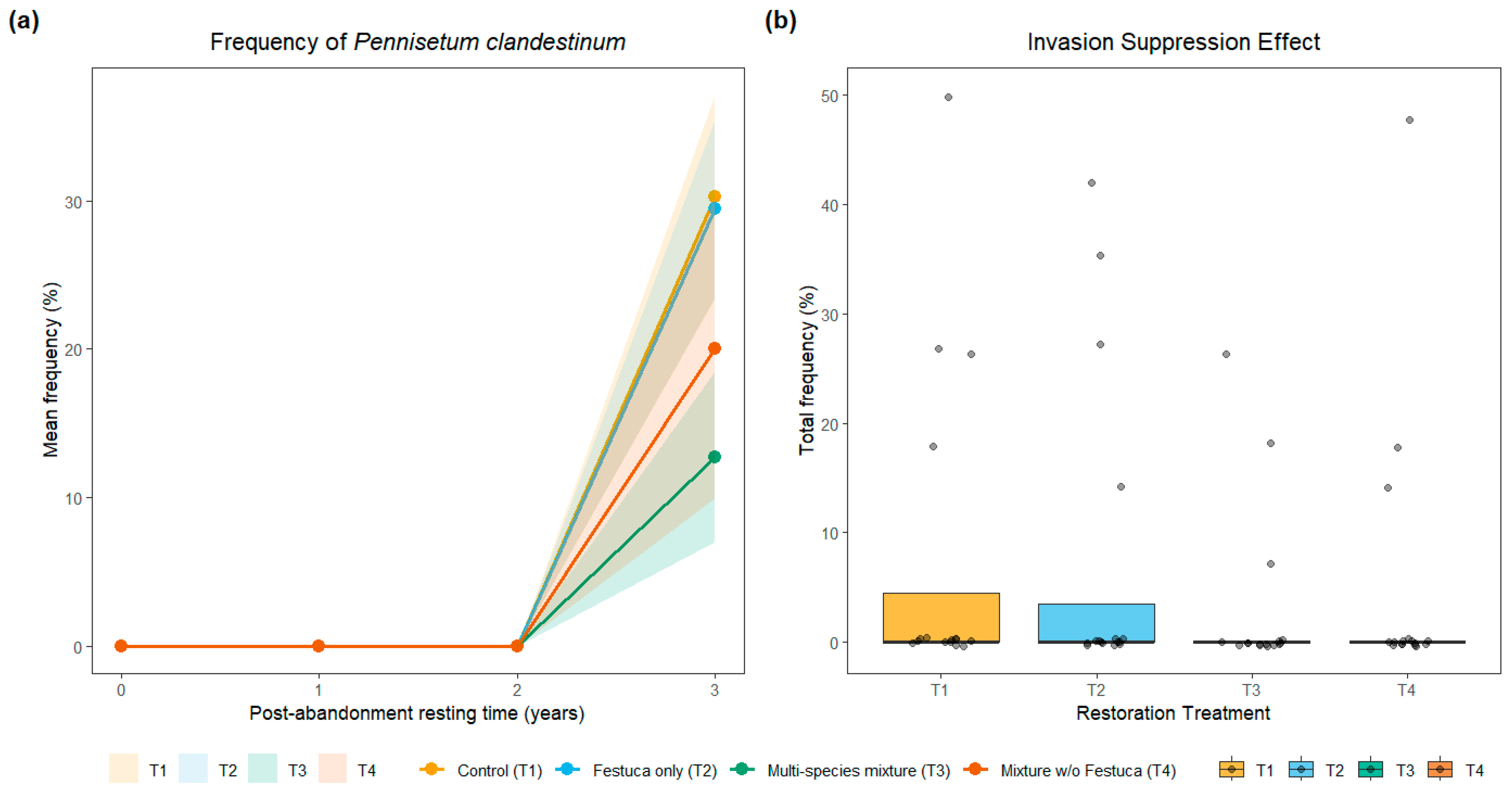
Pennisetum clandestinum showed treatment-dependent suppression under seeded mixtures. Mean frequency was highest in controls (T1: 7.56%) and lower under the multi-species mixture (T3: 3.19%). These patterns suggest a potential reduction in P. clandestinum under seeded mixtures; however, no formal statistical test was conducted to evaluate differences among treatments, and the underlying mechanisms cannot be directly inferred. Patterns of P. clandestinum occurrence across restoration treatments are shown in Figure 6.
Figure 6.
Dynamics of the invasive grass Pennisetum clandestinum across restoration treatments. (a) Mean frequency (%) across resting times (±SE). (b) Distribution of total frequency by treatment. Boxplots show median and interquartile range (IQR), with individual points representing plots (n = 64).
4. Discussion
4.1. Interactive Effects of Resting Time and Restoration Treatment on Community Assembly
The factorial experiment provides empirical evidence that community assembly in maca-degraded High-Andean grasslands is governed by the interactive effects of post-abandonment resting time and restoration treatment. The interaction between these factors was statistically significant but accounted for a comparatively small proportion of variance (R2 = 0.102, p = 0.004), indicating that interaction effects are present but not dominant drivers of community composition. Resting time explained the largest proportion of variance (R2 = 0.353), confirming its role as the primary driver of compositional change, while treatment also contributed substantially (R2 = 0.236), indicating additional but context-dependent effects. As evidenced by the PCoA ordination, passive recovery and seeded treatments followed contrasting compositional trajectories. However, these differences are better interpreted as divergence in community trajectories rather than shifts towards fundamentally distinct or alternative compositional states. These findings highlight that germination constitutes only one stage within the regeneration process, and that successful establishment depends on the interaction between seed viability, environmental filtering, and biotic interactions operating after emergence.
This interaction is expressed through several patterns. First, diversity responses were not consistently aligned with compositional changes, as Shannon diversity did not show significant treatment or interaction effects, indicating a decoupling between diversity metrics and multivariate composition. Second, multivariate analysis suggests treatment-specific trajectory directionality, indicating that restoration strategies influence the pathway of community development, although the underlying mechanisms remain inferential. Third, the establishment success of sown species varies among taxa, although this variability is limited for highly viable species such as Dactylis glomerata and Lolium spp.
From a community assembly perspective, these results are consistent with the hypothesis that restoration interventions simultaneously modify multiple assembly filters [41]. Seed addition directly alters the local species pool, reducing dispersal limitation that constrains passive recovery. As an assisted restoration strategy, seeding modifies the early successional environment by introducing high-viability species that establish quickly, potentially generating priority effects that shape subsequent community development [42]. Resting time, in contrast, modulates abiotic filters (soil structure recovery, nutrient availability) and biotic filters (resident vegetation density), which jointly influence species interactions [21].
Importantly, although resting time appears to drive broad compositional change, seed addition may also influence community development trajectories. However, given the significant dispersion differences detected by PERMDISP, these patterns likely reflect both shifts in centroid position and heterogeneity in within-group dispersion.
4.2. Treatment-Dependent Diversity Trajectories and Recovery Dynamics
Diversity responses to resting time did not show consistent statistical differences among treatments, revealing complex recovery dynamics. In control plots, Shannon diversity showed a declining tendency after three years of resting, although this effect was not statistically significant, which may be consistent with competitive exclusion reducing evenness during secondary succession [43]. This pattern suggests that passive recovery does not necessarily enhance diversity over time, although this interpretation should be considered with caution given the lack of significant effects.
In contrast, T4 showed a non-significant pattern consistent with a potential two-phase trajectory, where initial diversity suppression after seeding may reflect dominance by rapidly establishing sown species. This phase may be followed by a tendency towards recovery of Shannon diversity at longer resting times, although this pattern was not statistically supported in the mixed-effects model. This interpretation is consistent with successional theory describing transient dominance by early colonisers, followed by diversification as later-arriving species establish themselves [44]. While richness remains constrained in T4, Shannon variation appears to be driven primarily by evenness rather than species number, highlighting the importance of dominance dynamics [45].
From a restoration management perspective, these findings highlight trade-offs between rapid vegetation establishment and maximising native species richness. Productive mixtures (T3, T4) promote ground cover and may contribute to invasion resistance [46,47]. However, their implications for forage provision were not directly evaluated in this study and should therefore be interpreted cautiously.
4.3. Successional Trajectories: Directionality, Convergence, and Alternative States
Successional trajectory analysis suggests that seed addition modifies both the magnitude and the predictability of community change [48]. The PCoA results reveal a tendency towards reduced dispersion around centroids for treatments T3 and T4 over time. However, PERMDISP detected significant differences in multivariate dispersion, indicating that these patterns should be interpreted considering both centroid shifts and dispersion heterogeneity. This indicates a potential tendency towards compositional convergence, where seed addition may act as an assembly filter, reducing stochasticity relative to passive recovery (T1). The divergence at A3—where T3 and T4 occupy a distinct region of ordination space compared to T1 and T2—suggests that restoration treatments influence the direction of successional trajectories. However, these patterns do not provide sufficient evidence to support the existence of alternative stable states, particularly given the short duration of the study and the absence of direct tests of system stability [49,50]. Control plots exhibiting high Pennisetum clandestinum frequencies may represent undesirable trajectories, but their stability cannot be confirmed within the scope of this study. It is hypothesised that priority effects, soil legacies, and competitive feedbacks may stabilise such states, limiting future restoration opportunities [51]. These findings underscore the importance of early intervention to steer communities away from invasion-prone trajectories.
However, these trajectory patterns are based on descriptive centroid movement in PCoA space and were not formally tested using trajectory-specific statistical methods. Therefore, they should be interpreted as descriptive evidence of possible directional change rather than as statistically confirmed differences among successional trajectories.
4.4. Seed Quality as Constraint on Native Species Establishment
Seed quality appears to be an important limiting factor, although its causal role cannot be confirmed within the present experimental design. High-germination species established consistently, whereas Festuca dolichophylla exhibited poor establishment irrespective of treatment or resting period. The consistently low establishment of Festuca dolichophylla appears to be associated with its limited germination performance under both laboratory and field conditions. However, this pattern should be interpreted cautiously, as germination constraints likely interact with additional factors such as seed dormancy, local adaptation, and soil microsite conditions. This pattern suggests that germinability is likely an important determinant of field performance. Consequently, the poor establishment of F. dolichophylla represents a potential bottleneck for native grassland restoration. This is visually supported by the PCoA ordination, where the trajectories of the Festuca-only treatment (T2) remained closely aligned with the erratic and stochastic path of the control (T1), reflecting limited deviation from passive succession. However, because seed quality was not experimentally manipulated, its role cannot be confirmed as the dominant causal factor, and alternative explanations such as site-specific constraints, soil conditions, or biotic interactions cannot be excluded [52]. Nevertheless, addressing the physiological quality of native seeds remains a priority, requiring targeted investment in seed technology to bypass this successional arrest [53,54].
4.5. Competitive Suppression of Invasion: A Key Restoration Benefit
Productive seed mixtures were associated with lower Pennisetum clandestinum abundance relative to passive recovery. However, this pattern is descriptive, as no formal statistical test was performed to evaluate differences among treatments. Therefore, the observed reduction should not be interpreted as statistically confirmed suppression. This pattern may be consistent with a potential competitive suppression effect, possibly related to resource pre-emption by sown species, which occupy space and intercept light [55,56]. However, as competitive interactions were not directly quantified, this mechanism should be considered inferential rather than experimentally confirmed. These results are consistent with interpretations of the diversity–invasibility relationship, whereby dense vegetation confers resistance regardless of native species richness per se [57]. Preventing invasion through early restoration is likely more cost-effective than post-invasion control [47,58].
5. Conclusions
This factorial field experiment demonstrates that early community assembly in High-Andean grasslands degraded by Lepidium meyenii cultivation is shaped by the interaction between post-abandonment resting time and seed-based restoration strategies. However, resting time emerged as the dominant driver of community composition, while treatment effects were secondary but significant and context dependent. The results do not support the existence of clearly distinct or alternative stable states but rather indicate that restoration treatments influence the direction of community trajectories during early succession. Seed addition contributed to more consistent compositional patterns, although this tendency towards convergence was not statistically supported by dispersion analysis (PERMDISP).
A restoration strategy based on competitive grass–legume mixtures was associated with enhanced vegetation establishment and reduced abundance of Pennisetum clandestinum. These outcomes are consistent with a likely mechanism of competitive suppression, although this was not directly tested. In contrast to initial expectations, diversity metrics did not show significant responses to treatments or resting time, indicating a partial decoupling between community composition and diversity patterns. Restoration efforts relying on native species such as Festuca dolichophylla face a critical limitation due to poor establishment. While seed viability is a plausible explanation, its role cannot be confirmed as the primary causal factor within the current experimental design, and additional constraints may be involved. Nevertheless, improving native seed quality remains a priority for restoration.
From a management perspective, early intervention using productive mixtures may enhance vegetation recovery and reduce invasion risk. However, implications for sustainable grazing systems remain preliminary, as forage biomass, forage quality, and livestock responses were not directly assessed in this study. Potential trade-offs between rapid functional recovery and long-term native species restoration should therefore be addressed through adaptive management strategies.
Supplementary Materials
The following supporting information can be downloaded at https://www.mdpi.com/article/10.3390/ecologies7020042/s1, Figure S1: Laboratory germination assay used to assess seed viability and early seedling development of the sown species; Figure S2: Field experimental plots illustrating the restoration setup and vegetation establishment under different treatments across post-abandonment resting times.
Author Contributions
Conceptualization, R.P. and R.Y.; methodology, R.P. and R.Y.; software, R.P. and R.D.; validation, D.C., R.Y. and R.P.; formal analysis, R.D. and R.P.; investigation, W.T. and R.P.; data curation, R.D. and R.P.; writing—original draft preparation, R.P., D.C. and H.B.; writing—review and editing, R.P., H.B., R.Y. and D.C.; visualisation, R.P. and R.D.; supervision, R.Y. and R.P.; project administration, R.P. and R.Y.; funding acquisition, R.P. All authors have read and agreed to the published version of the manuscript.
Funding
This research received no external funding.
Data Availability Statement
The data supporting the findings of this study are openly available in Figshare at https://doi.org/10.6084/m9.figshare.31227937.
Acknowledgments
The authors gratefully acknowledge Juan Peñaloza Espinoza for his valuable support during fieldwork activities, particularly in plot establishment and on-site coordination. Special thanks are extended to Amilcar Joseph Peñaloza Fernández for his assistance in field conditioning, logistical preparation, and vegetation sampling under High-Andean conditions. Their technical support and commitment were essential for the successful execution of the experimental design. During the preparation of this manuscript, the authors used Gemini 3.1 pro for language editing, structuring of scientific text, and refinement of academic writing. The authors have reviewed and edited all generated content and take full responsibility for the content of this publication.
Conflicts of Interest
The authors declare no conflicts of interest.
Abbreviations
The following abbreviations are used in this manuscript:
| m a.s.l. | Metres above sea level |
| ANOVA | Analysis of variance |
| PERMANOVA | Permutational multivariate analysis of variance |
| PCoA | Principal coordinates analysis |
| GLM | Generalised linear model |
| OLS | Ordinary least squares |
| SE | Standard error |
| SD | Standard deviation |
| H′ | Shannon diversity index |
| 1 − D | Simpson diversity index |
References
- Cuesta, F.; Muriel, P.; Llambí, L.D.; Halloy, S.; Aguirre, N.; Beck, S.; Carilla, J.; Meneses, R.I.; Cuello, S.; Grau, A.; et al. Latitudinal and Altitudinal Patterns of Plant Community Diversity on Mountain Summits across the Tropical Andes. Ecography 2017, 40, 1381–1394. [Google Scholar] [CrossRef] [Scilit]
- Sklenář, P.; Hedberg, I.; Cleef, A.M. Island Biogeography of Tropical Alpine Floras. J. Biogeogr. 2014, 41, 287–297. [Google Scholar] [CrossRef] [Scilit]
- Tovar, C.; Arnillas, C.A.; Cuesta, F.; Buytaert, W. Diverging Responses of Tropical Andean Biomes under Future Climate Conditions. PLoS ONE 2013, 8, e63634. [Google Scholar] [CrossRef] [Scilit]
- Körner, C. Alpine Plant Life; Springer: Berlin/Heidelberg, Germany, 2003. [Google Scholar]
- Ramsay, P.; Oxley, E. An Assessment of Aboveground Net Primary Productivity in Andean Grasslands of Central Ecuador. Mt. Res. Dev. 2001, 21, 161–167. [Google Scholar] [CrossRef] [Scilit]
- Renvoize, S.; Luteyn, J.; Churchill, S.; Griffin, D., III; Gradstein, S.R.; Sipman, H.J.M.; Gavilanes, M.R.A. Paramos: A Checklist of Plant Diversity, Geographical Distribution, and Botanical Literature (Memoirs of the New York Botanical Garden Volume 84). Kew Bull. 2000, 55, 1017–1018. [Google Scholar] [CrossRef] [Scilit]
- Flores, H.E.; Walker, T.S.; Guimarães, R.L.; Bais, H.P.; Vivanco, J.M. Andean Root and Tuber Crops: Underground Rainbows. HortSci 2003, 38, 161–167. [Google Scholar] [CrossRef] [Scilit]
- Gonzales, G.F. Ethnobiology and Ethnopharmacology of Lepidium meyenii (Maca), a Plant from the Peruvian Highlands. Evid.-Based Complement. Altern. Med. 2012, 2012, 193496. [Google Scholar] [CrossRef] [Scilit]
- Meissner, H.O.; Mscisz, A.; Baraniak, M.; Piatkowska, E.; Pisulewski, P.; Mrozikiewicz, M.; Bobkiewicz-Kozlowska, T. Peruvian Maca (Lepidium peruvianum)—III: The Effects of Cultivation Altitude on Phytochemical and Genetic Differences in the Four Prime Maca Phenotypes. Int. J. Biomed. Sci. 2017, 13, 58–73. [Google Scholar] [CrossRef] [Scilit]
- Solórzano-Acosta, R.; Chanco, M.; Seminario, M.; Cabello-Torres, R.; Camel, V.; Lastra, S.; Arias, A.; Verástegui, P.; Quispe, K.; Carbajal-Llosa, C.; et al. Soil Management in Lepidium meyenii (Maca) Monoculture: Trends and Challenges for Small Farmers around Lake Chinchaycocha in the Andean Highlands of Junin (Peru). Front. Soil Sci. 2025, 4, 1419745. [Google Scholar] [CrossRef] [Scilit]
- Rolando, J.L.; Dubeux, J.C.B., Jr.; Ramirez, D.A.; Ruiz-Moreno, M.; Turin, C.; Mares, V.; Sollenberger, L.E.; Quiroz, R. Land Use Effects on Soil Fertility and Nutrient Cycling in the Peruvian High-Andean Puna Grasslands. Soil Sci. Soc. Am. J. 2018, 82, 463–474. [Google Scholar] [CrossRef] [Scilit]
- Farley, K.A.; Kelly, E.F.; Hofstede, R.G.M. Soil Organic Carbon and Water Retention after Conversion of Grasslands to Pine Plantations in the Ecuadorian Andes. Ecosystems 2004, 7, 729–739. [Google Scholar] [CrossRef] [Scilit]
- Podwojewski, P.; Poulenard, J.; Zambrana, T.; Hofstede, R. Overgrazing Effects on Vegetation Cover and Properties of Volcanic Ash Soil in the Páramo of Llangahua and La Esperanza (Tungurahua, Ecuador). Soil Use Manag. 2002, 18, 45–55. [Google Scholar] [CrossRef] [Scilit]
- Buytaert, W.; Célleri, R.; De Bièvre, B.; Cisneros, F.; Wyseure, G.; Deckers, J.; Hofstede, R. Human Impact on the Hydrology of the Andean Páramos. Earth-Sci. Rev. 2006, 79, 53–72. [Google Scholar] [CrossRef] [Scilit]
- Hofstede, R.G.M.; Groenendijk, J.P.; Coppus, R.; Fehse, J.C.; Sevink, J. Impact of Pine Plantations on Soils and Vegetation in the Ecuadorian High Andes. Mt. Res. Dev. 2002, 22, 159–167. [Google Scholar] [CrossRef] [Scilit]
- Cramer, V.; Hobbs, R.; Standish, R. What’s New about Old Fields? Land Abandonment and Ecosystem Assembly. Trends Ecol. Evol. 2008, 23, 104–112. [Google Scholar] [CrossRef] [Scilit]
- Prach, K.; Pyšek, P. Using Spontaneous Succession for Restoration of Human-Disturbed Habitats: Experience from Central Europe. Ecol. Eng. 2001, 17, 55–62. [Google Scholar] [CrossRef] [Scilit]
- Okayasu, T.; Okuro, T.; Jamsran, U.; Takeuchi, K. Degraded Rangeland Dominated by Unpalatable Forbs Exhibits Large-Scale Spatial Heterogeneity. Plant Ecol. 2012, 213, 625–635. [Google Scholar] [CrossRef] [Scilit]
- Fukami, T. Historical Contingency in Community Assembly: Integrating Niches, Species Pools, and Priority Effects. Annu. Rev. Ecol. Evol. Syst. 2015, 46, 1–23. [Google Scholar] [CrossRef] [Scilit]
- Cano, D.; Pizarro, S.; Cacciuttolo, C.; Peñaloza, R.; Yaranga, R.; Gandini, M.L. Study of Ecosystem Degradation Dynamics in the Peruvian Highlands: Landsat Time-Series Trend Analysis (1985–2022) with ARVI for Different Vegetation Cover Types. Sustainability 2023, 15, 15472. [Google Scholar] [CrossRef] [Scilit]
- Young, T.P.; Chase, J.M.; Huddleston, R.T. Community Succession and Assembly: Comparing, Contrasting and Combining Paradigms in the Context of Ecological Restoration. Ecol. Rest. 2001, 19, 5–18. [Google Scholar] [CrossRef] [Scilit]
- Holl, K.D.; Aide, T.M. When and Where to Actively Restore Ecosystems? For. Ecol. Manag. 2011, 261, 1558–1563. [Google Scholar] [CrossRef] [Scilit]
- Prach, K.; Walker, L.R. Four Opportunities for Studies of Ecological Succession. Trends Ecol. Evol. 2011, 26, 119–123. [Google Scholar] [CrossRef] [Scilit]
- Funk, J.L.; Cleland, E.E.; Suding, K.N.; Zavaleta, E.S. Restoration through Reassembly: Plant Traits and Invasion Resistance. Trends Ecol. Evol. 2008, 23, 695–703. [Google Scholar] [CrossRef] [Scilit]
- Prach, K.; Hobbs, R.J. Spontaneous Succession versus Technical Reclamation in the Restoration of Disturbed Sites. Restor. Ecol. 2008, 16, 363–366. [Google Scholar] [CrossRef] [Scilit]
- Pywell, R.F.; Bullock, J.M.; Roy, D.B.; Warman, L.; Walker, K.J.; Rothery, P. Plant Traits as Predictors of Performance in Ecological Restoration. J. Appl. Ecol. 2003, 40, 65–77. [Google Scholar] [CrossRef] [Scilit]
- Schläpfer, F.; Schmid, B. Ecosystem Effects of Biodiversity: A Classification of Hypotheses and Exploration of Empirical Results. Ecol. Appl. 1999, 9, 893–912. [Google Scholar] [CrossRef]
- Tilman, D. Community Invasibility, Recruitment Limitation, and Grassland Biodiversity. Ecology 1997, 78, 81–92. [Google Scholar] [CrossRef]
- Trasmonte, G.; Chavez, R.; Segura, B.; Rosales, J.L. Frost Risks in the Mantaro River Basin. Adv. Geosci. 2008, 14, 265–270. [Google Scholar] [CrossRef] [Scilit]
- Adler, P.B.; Morales, J.M. Influence of Environmental Factors and Sheep Grazing on an Andean Grassland. J. Range Manag. 1999, 52, 471–481. [Google Scholar] [CrossRef] [Scilit]
- Jonasson, S. Evaluation of the Point Intercept Method for the Estimation of Plant Biomass. Oikos 1988, 52, 101–106. [Google Scholar] [CrossRef] [Scilit]
- Goodall, D. Some Considerations in the Use of Point Quadrats for the Analysis of Vegetation. Aust. J. Biol. Sci. 1952, 5, 1–41. [Google Scholar] [CrossRef] [Scilit]
- Mostacero León, J.; Mejía Coico, F.R.; Gamarra Torres, O. (Eds.) Fanerógamas Del Perú: Taxonomía, Utilidad y Ecogeografía. In Ciencias Exactas y Naturales, 1st ed.; CONCYTEC: Trujillo, Perú, 2009. [Google Scholar]
- Bray, J.R.; Curtis, J.T. An Ordination of the Upland Forest Communities of Southern Wisconsin. Ecol. Monogr. 1957, 27, 325–349. [Google Scholar] [CrossRef] [Scilit] [PubMed]
- Faith, D.P.; Minchin, P.R.; Belbin, L. Compositional Dissimilarity as a Robust Measure of Ecological Distance. Vegetatio 1987, 69, 57–68. [Google Scholar] [CrossRef] [Scilit]
- Anderson, M.J. A New Method for Non-parametric Multivariate Analysis of Variance. Austral Ecol. 2001, 26, 32–46. [Google Scholar] [CrossRef] [Scilit]
- McArdle, B.H.; Anderson, M.J. Fitting Multivariate Models to Community Data: A Comment on Distance-Based Redundancy Analysis. Ecology 2001, 82, 290–297. [Google Scholar] [CrossRef]
- Anderson, M.J.; Walsh, D.C.I. PERMANOVA, ANOSIM, and the Mantel Test in the Face of Heterogeneous Dispersions: What Null Hypothesis Are You Testing? Ecol. Monogr. 2013, 83, 557–574. [Google Scholar] [CrossRef] [Scilit]
- De Cáceres, M.; Coll, L.; Legendre, P.; Allen, R.; Wiser, S.; Fortin, M.-J.; Condit, R.; Hubbell, S. Trajectory Analysis in Community Ecology. Ecol. Monogr. 2019, 89, e01350. [Google Scholar] [CrossRef] [Scilit]
- Pyšek, P.; Richardson, D.M. Traits Associated with Invasiveness in Alien Plants: Where Do We Stand? In Biological Invasions; Nentwig, W., Ed.; Ecological Studies; Springer: Berlin/Heidelberg, Germany, 2007; Volume 193, pp. 97–125. [Google Scholar]
- Lortie, C.J.; Brooker, R.W.; Choler, P.; Kikvidze, Z.; Michalet, R.; Pugnaire, F.I.; Callaway, R.M. Rethinking Plant Community Theory. Oikos 2004, 107, 433–438. [Google Scholar] [CrossRef] [Scilit]
- Fargione, J.; Brown, C.S.; Tilman, D. Community Assembly and Invasion: An Experimental Test of Neutral versus Niche Processes. Proc. Natl. Acad. Sci. USA 2003, 100, 8916–8920. [Google Scholar] [CrossRef] [Scilit]
- Huston, M. Biological Diversity: The Coexistence of Species on Changing Landscapes; Cambridge University Press: Cambridge, UK, 1994. [Google Scholar]
- Connell, J.H.; Slatyer, R.O. Mechanisms of Succession in Natural Communities and Their Role in Community Stability and Organization. Am. Nat. 1977, 111, 1119–1144. [Google Scholar] [CrossRef] [Scilit]
- Smith, B.; Wilson, J.B. A Consumer’s Guide to Evenness Indices. Oikos 1996, 76, 70–82. [Google Scholar] [CrossRef] [Scilit]
- Buisson, E.; Alvarado, S.T.; Le Stradic, S.; Morellato, L.P.C. Plant Phenological Research Enhances Ecological Restoration. Restor. Ecol. 2017, 25, 164–171. [Google Scholar] [CrossRef] [Scilit]
- Kettenring, K.M.; Mercer, K.L.; Reinhardt Adams, C.; Hines, J. Application of Genetic Diversity–Ecosystem Function Research to Ecological Restoration. J. Appl. Ecol. 2014, 51, 339–348. [Google Scholar] [CrossRef] [Scilit]
- Choi, Y. Theories for Ecological Restoration in Changing Environment: Toward ‘Futuristic’ Restoration. Ecol. Res. 2004, 19, 75–81. [Google Scholar] [CrossRef] [Scilit]
- Folke, C.; Carpenter, S.; Walker, B.; Scheffer, M.; Elmqvist, T.; Gunderson, L.; Holling, C.S. Regime Shifts, Resilience, and Biodiversity in Ecosystem Management. Annu. Rev. Ecol. Evol. Syst. 2004, 35, 557–581. [Google Scholar] [CrossRef] [Scilit]
- Lewontin, R.C. The Meaning of Stability. Brookhaven Symp. Biol. 1969, 22, 13–24. [Google Scholar]
- Temperton, V.M.; Hobbs, R.J.; Nuttle, T.; Halle, S. (Eds.) Assembly Rules and Restoration Ecology: Bridging the Gap Between Theory and Practice; Island Press: Washington, DC, USA, 2004. [Google Scholar]
- Larson, J.E.; Sheley, R.L.; Hardegree, S.P.; Doescher, P.S.; James, J.J. Seed and Seedling Traits Affecting Critical Life Stage Transitions and Recruitment Outcomes in Dryland Grasses. J. Appl. Ecol. 2015, 52, 199–209. [Google Scholar] [CrossRef] [Scilit]
- Holl, K.D.; Brancalion, P.H.S. Tree Planting Is Not a Simple Solution. Science 2020, 368, 580–581. [Google Scholar] [CrossRef] [Scilit]
- Shackelford, N.; Hobbs, R.J.; Burgar, J.M.; Erickson, T.E.; Fontaine, J.B.; Laliberté, E.; Ramalho, C.E.; Perring, M.P.; Standish, R.J. Primed for Change: Developing Ecological Restoration for the 21st Century. Restor. Ecol. 2013, 21, 297–304. [Google Scholar] [CrossRef] [Scilit]
- Daehler, C.C. Performance Comparisons of Co-Occurring Native and Alien Invasive Plants: Implications for Conservation and Restoration. Annu. Rev. Ecol. Evol. Syst. 2003, 34, 183–211. [Google Scholar] [CrossRef] [Scilit]
- Davis, M.A.; Grime, J.P.; Thompson, K. Fluctuating Resources in Plant Communities: A General Theory of Invasibility. J. Ecol. 2000, 88, 528–534. [Google Scholar] [CrossRef] [Scilit]
- Kennedy, T.A.; Naeem, S.; Howe, K.M.; Knops, J.M.H.; Tilman, D.; Reich, P. Biodiversity as a Barrier to Ecological Invasion. Nature 2002, 417, 636–638. [Google Scholar] [CrossRef] [Scilit]
- Zavaleta, E.S.; Hobbs, R.J.; Mooney, H.A. Viewing Invasive Species Removal in a Whole-Ecosystem Context. Trends Ecol. Evol. 2001, 16, 454–459. [Google Scholar] [CrossRef] [Scilit]

Disclaimer/Publisher’s Note: The statements, opinions and data contained in all publications are solely those of the individual author(s) and contributor(s) and not of MDPI and/or the editor(s). MDPI and/or the editor(s) disclaim responsibility for any injury to people or property resulting from any ideas, methods, instructions or products referred to in the content. |
© 2026 by the authors. Licensee MDPI, Basel, Switzerland. This article is an open access article distributed under the terms and conditions of the Creative Commons Attribution (CC BY) license.