Article

Feeding Ecology of the Endangered Barbary Deer (Mammalia: Cervidae) in the Akfadou Forest Enclosure, North Algeria


by
Nassima Khammes-Talbi
1,
Farid Bounaceur
2,
Nora Khammes-el-Homsi
1,
Fatima Zohra Bissaad
3,
Naceur Benamor
2,4,
Fatine Lasgaa
2 and
Stéphane Aulagnier
5,*
1
Laboratoire D’écologie et de Biologie des Ecosystèmes Terrestres, Faculté des Sciences Biologiques et des Sciences Agronomiques, Université Mouloud Mammeri, Tizi Ouzou 15000, Algeria
2
Equipe de Recherche Biologie de la Conservation en Zones Arides et Semi Arides, Institut des Sciences de la Nature et de la Vie, Université de Tissemsilt, Tissemsilt 38000, Algeria
3
Laboratoire de Recherche de Bioinformatique, Microbiologie Appliquée et Biomolécules (LBMAB), Faculté des Sciences, Université M’Hamed Bougara, Boumerdes 35000, Algeria
4
Faculté des Sciences de la Nature et de la Vie, Université de Tiaret, Tiaret 14000, Algeria
5
Comportement et Ecologie de la Faune Sauvage, INRAE, Université de Toulouse, CS 52627, 31326 Castanet-Tolosan Cedex, France
*
Author to whom correspondence should be addressed.
Ecologies 2026, 7(2), 41; https://doi.org/10.3390/ecologies7020041
Submission received: 26 February 2026 / Revised: 29 April 2026 / Accepted: 30 April 2026 / Published: 7 May 2026

Abstract

The last native population of Barbary deer (Cervus elaphus barbarus) lives across the northern border of Algeria and Tunisia; its small population size and global-change pressures limit conservation options, and basic habitat requirements, including diet, remain poorly known. In the Akfadou Forest enclosure (Algeria), where concerns have been raised about woodland condition and limited perennial seedling recruitment, we assessed dietary preferences using micro-histological analysis of faecal samples collected across four seasons. A wide variety of plants was ingested; grasses dominated overall, particularly Avena sterilis and Carex spp., while evergreen trees and woody shrubs also contributed substantially, including Cytisus triflorus, Hedera helix, and Cistus salvifolius. The balance between grazing and browsing indicates that the Barbary deer is an intermediate feeder. Diet composition varied seasonally, with more forbs in winter, more grasses in spring, and greater consumption of trees and shrubs in summer and autumn. These results provide baseline information to support enclosure management and to guide conservation actions for this threatened endemic subspecies, and they highlight the value of complementary analyses of food availability and nutritional quality.

1. Introduction

Knowledge of feeding ecology including foraged plants, diet quality and interspecific competition, is fundamental for the management of large ungulates [1,2]. Moreover, investigating seasonal food habits is essential for understanding and evaluating the carrying capacity of habitat types for large herbivores [3,4,5]. On this basis, identifying potential food resources is necessary to minimise damage to forests and crops [6,7]. Food quality significantly impacts growth, reproduction, and the longevity of animals, the main factors of population dynamics [8]. Therefore, studies on the diet and dietary habits of herbivores are required before implementing habitat management and other conservation strategies. Seasonal, latitudinal and altitudinal variations are fundamental factors for determining vegetation diversity [9], which regulates the dietary habits of herbivores [10].
The Barbary deer (Cervus elaphus barbarus Bennett, 1833) is the only Cervidae on the African continent. The historical range of this Mediterranean deer covered large parts of northern Algeria, Tunisia and possibly Morocco. During the last century, the species increasingly declined throughout its former range, due primarily to poaching, excessive hunting and severe habitat degradation as a consequence of the expansion of permanent agriculture and increased livestock grazing pressure. Nowadays, native Barbary deer are restricted to a small area of cork oak (Quercus suber) and Aleppo pine (Pinus halepensis) forest at the Algerian–Tunisian border [11,12]. This small population is particularly susceptible to diseases and forest fires, which are not uncommon in the region [13,14,15,16], and is of major conservation concern. However, few studies have focused on Barbary deer ecology in its native range with a view to directing the best management actions, and most of them are quite old [17,18,19]. Food habits were mainly investigated by Burthey [20], reported later in Burthey–Mandret and Burthey [21]. After several students’ studies [22,23,24,25,26], we decided to publish a quantitative analysis of the diet of an Algerian population of Barbary deer. Due to the threatened status and low population size of this deer, it was appropriate to use non-invasive sampling to gain much-needed information on its resource and niche requirements.
In this study, we quantified the plant consumption by Barbary deer throughout the seasons in Akfadou Nature Reserve (Bejaia Province), more precisely in the enclosure devoted to unique captive breeding, to provide baseline data for improving habitat management and conservation of this cervid.

2. Materials and Methods

2.1. Study Area

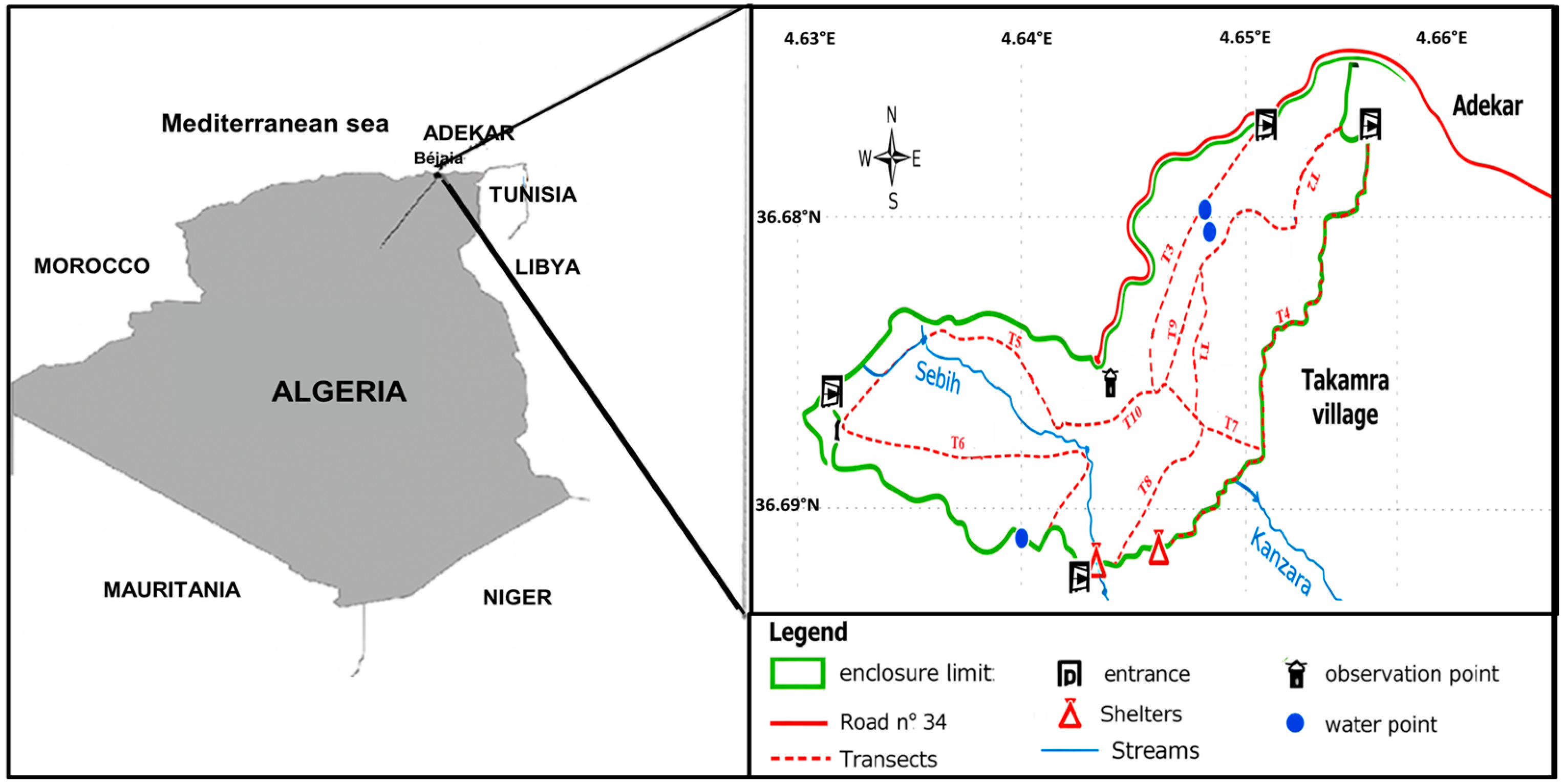
This study was conducted in the 200 ha Akfadou Forest enclosure, located in the Kabylie region, north-west of Bejaia city, Algeria (36°41.128′ N, 4°38.876′ E) (Figure 1). The study area has a sub-humid climate (average annual rainfall: 684 mm, and temperature: 18–19 °C) characterised by relatively cold (average temperature in January: 5.6 °C) and wet winters, and hot (average temperature in July: 22.3 °C) and dry summers [27].
The deer enclosure occupies a range of altitudes between 995 and 1190 m a.s.l. It is located on a rather steep mountain slope, with many valleys. The enclosure is crossed by a network of watercourses. In addition to two recently installed water troughs, there are several permanent streams, such as Targa El Ouard and Targa Asfel (Figure 1). The fence surrounding the AFE is 8000 m long. In this enclosure, the forest stand is very homogeneous with a dominance of oaks (Q. suber, Q. canariensis and Q. afares), along with Arbutus unedo, Ampelodesma mauritanicum, Cytisus triflorus, and Prunus avium [27,28]. At the time of the study, the Barbary deer population was estimated between 26 and 32 individuals, including 20–26 hinds. The main potentially competing animals were a few wild boars Sus scrofa and wild rabbits Oryctolagus cuniculus.

2.2. Faecal Sampling, Epidermis References, and Faecal Analysis

Faecal pellets of Barbary deer were collected from January to December 2015, during the first days of each month. Following the protocols of Stewart and Stewart [29], Benamor et al. [30,31], and Bounaceur et al. [32], ten fresh pellets were randomly collected per month from different scattered latrine sites to avoid resampling the same individuals. Fresh pellets, identified by their colour and shiny appearance, were air-dried and stored in paper bags.
In accordance with García-González [33], we prepared a reference collection of epidermis of the main 52 plant species (16 families) collected within the enclosure. Plant fragments were carefully scraped with a scalpel to separate the epidermal tissues from leaves (adaxial and abaxial surfaces), stems, and flowers. Epidermal fragments were rinsed in 12% sodium hypochlorite, washed in distilled water, mounted on slides in 50% glycerine, and sealed with nail varnish [33].
Diagnostic features, including cells, fibres, trichomes, stomata, vessels, intercellular structures and cell walls, were photographed using a Sony Cyber-Shot DSC-W380 camera attached to an optical microscope at 10× and 40× magnification. Following Chapuis [34], we identified the first 300 epidermal fragments from 30 pooled pellets per season by comparison with reference slides. This pooling of pellets per season unfortunately prevents us from studying within-season variability of diet, which could weaken our results.

2.3. Data Analysis

The diet composition was quantified as the mean relative numerical abundance (N%) for each plant taxon. The relative abundance of a given taxon (nᵢ) was calculated as the number of fragments of that taxon divided by the total number of fragments of all plant taxa [35]. Seasonal trophic diversity was assessed using the Shannon–Wiener diversity index (H’). Seasonal variations in diet composition were further explored using chi-square tests and a factorial correspondence analysis (FCA) computed on the number of fragments for each plant taxon, followed by a hierarchical classification on factorial coordinates. Multivariate analyses were conducted using PAST version 1.37 [36].

3. Results

3.1. Annual Diet

The annual diet of Cervus elaphus barbarus in the Akfadou Forest enclosure included 22 plant species, and was dominated by shrubs and trees (51.54%) over grasses (29.19%) and forbs (14.97%) (Table 1). At the species level, deer showed a consistent consumption of grasses, particularly Avena sterilis (18.90%) and Carex sp. (10.29%), which were also the most consumed plants throughout the year. Shrubs and trees were less dominant but present across all seasons, including Cytisus triflorus (7.93%), Hedera helix (7.24%), Cistus salvifolius (7.16%), Quercus canariensis (5.6%) and Rubus ulmifolius (4.98%). Forbs also contributed notably to the diet, with Asphodelus microcarpus and Galium aparine representing 4.31% and 4.01% of fragments, respectively. The Shannon–Wiener diversity index (H′) of dietary plant species was higher in spring (2.66), than in summer (2.64), and much higher than in autumn (2.48) and winter (2.47); however, the plant species richness did not vary among seasons (chi-square = 0.33, DF = 3, p > 0.95).

3.2. Seasonal Variations in Diet

On the contrary, the seasonal consumption of the three plant categories revealed some significant differences. If the consumption of shrubs and trees was quite similar among seasons (chi-square = 4.59, DF = 3, p > 0.05), variations were significant for forbs (chi-square = 12.15, DF = 3, p < 0.01), and highly significant for grasses (chi-square = 15.81, DF = 3, p < 0.001).
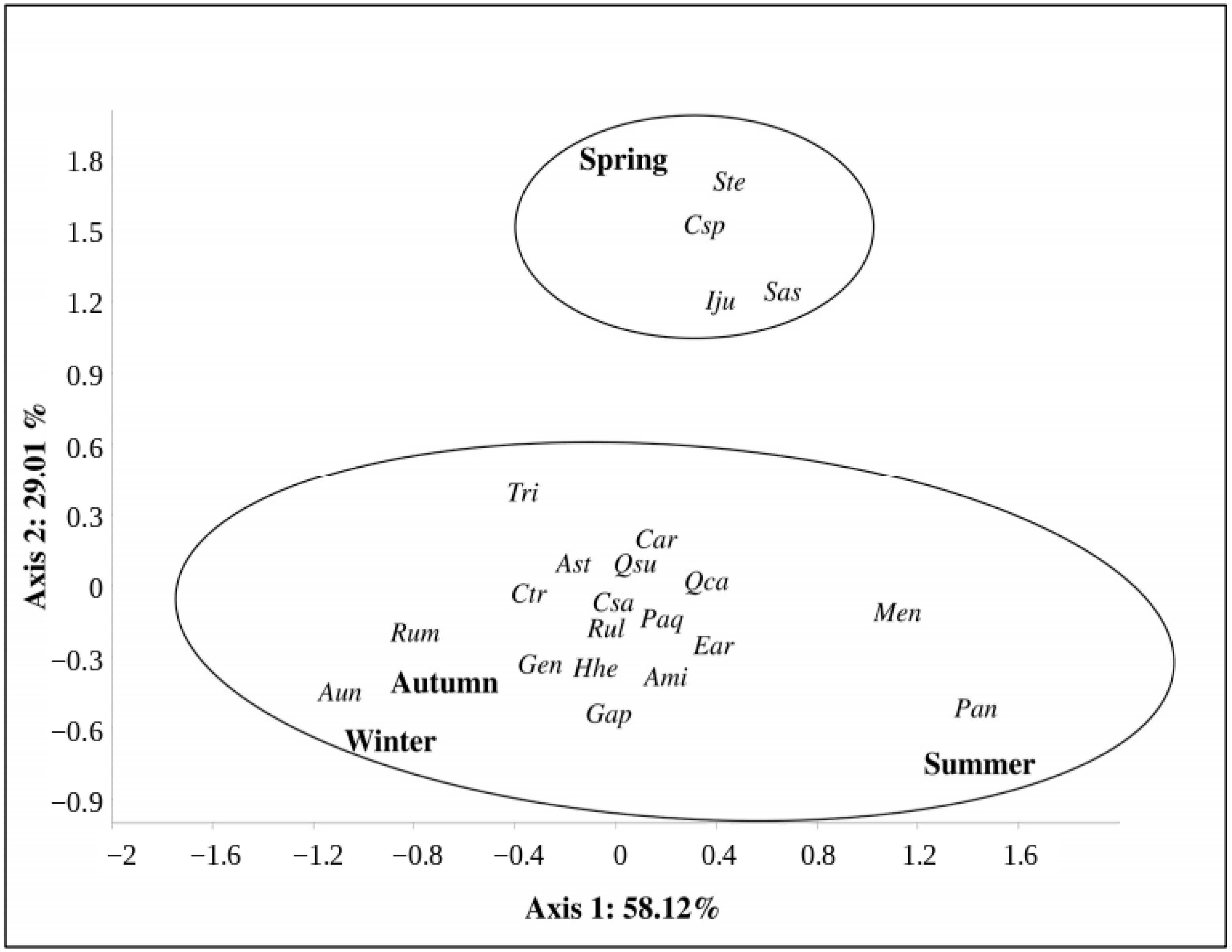
At the species level, the first axis of the FCA (58.12% of the variance) contrasts the plant species most consumed in summer (Phillyrea angustifolia, Mentha sp.) versus autumn–winter (Arbutus unedo, Rumex sp.) (Figure 2). However, most plant species were consumed all year round. The second axis of the FCA (29.01% of the variance) shows some plant species mainly consumed in spring (Stellaria sp., Calycotome spinosa, Smilax aspera, Iris juncea). However, none of these species is abundant in the diet, and further comparisons are needed to better explain seasonal variations.

3.2.1. Winter Diet

In winter, shrubs and trees were the most represented group in the diet (46.67%), with Cytisus triflorus (10.22%) and Hedera helix (8.78%) as the main taxa. Consumed grasses (30.31%) were Avena sterilis (23.05%) and Carex sp. (7.26%). Forbs (19.82%) included mainly Galium aparine (6.98%) and Asphodelus microcarpus (5.81%). Shrubs like Quercus canariensis (2.75%) and Rubus ulmifolius (2,83%) are less consumed than in the other seasons, indicating that these plants are either less available or less desirable during the cold winter months. As a consequence, this diet is the most balanced among the seasons.

3.2.2. Spring Diet

In spring, Barbary deer primarily consumed shrubs and trees (48.19%), including Cytisus triflorus (8.03%), Cistus salvifolius (7.00%), Quercus canariensis (6.87%), Hedera helix (3.63%), Rubus ulmifolius (4.11%) and Calycotome spinosa (3.23%). But grasses (34.22%) were quite abundant in the diet, including Avena sterilis (19,31%) and almost a significant consumption of Carex sp. (14,91%) when compared to the other seasons (chi-square = 9.48, DF = 3, p < 0.05), suggesting that fresh green vegetation could be sought during this season, when forbs are not available yet.

3.2.3. Summer Diet

In summer, shrubs and trees (57.92%) like Phillyrea angustifolia (12.62%), Erica arborea (7.54%), Quercus canariensis (7.17%), Hedera helix (7.13%) and Rubus ulmifolius (5.52%) were still the most consumed plant group. Forbs (16.48%), including mainly Asphodelus microcarpus (5.04%) and Galium aparine (4.91%), were also abundant in the diet together along with grasses (20.33%), like Avena sterilis (11.45%), which was nevertheless less consumed than in the other seasons (chi-square = 13.04, DF = 3, p < 0.01), and Carex sp. (8.88%).

3.2.4. Autumn Diet

In autumn, shrubs and trees were still the most abundant group and were overdominant (53.13%), with Hedera helix (9.41%), Cytisus triflorus (8.08%), Rubus ulmifolius (7.47%), Cistus salvifolius (7.23%), Quercus canariensis (5.62%) and Erica arborea (5.38%). Grasses (31.88%) like Avena sterilis (21.78%) and Carex sp. (10.10%) dominated forbs (only 10.35%).

4. Discussion

The accuracy of faecal analysis to determine herbivore diet composition has been widely investigated by a number of researchers. Serious problems with this method include (1) technician error [2], (2) differential digestibility of plant species [37,38], (3) low discernibility of epidermal fragments due to a lack of identifiable characteristics [39], (4) sample preparations [2,40], and (5) the biased perception of the biomass intake [40]. Nevertheless, the micro-histological analysis of faeces is a non-invasive technique which continues to be useful for investigating the quantitative diet of threatened species as long as genetic approaches cannot yet estimate the true abundance of each food species. Its accuracy for estimating the diet composition of herbivores has been demonstrated for a long time [2], especially in comparative studies and in environments with low plant diversity, and is still used for studying the feeding ecology of red deer [41,42,43,44].

4.1. Annual Diet

The annual diet of the Barbary deer in the Akfadou Forest enclosure included 22 identified plant taxa, of which 10 were shrubs and trees, nine were forbs and only three were grasses (Table 1). This number is quite different to the numbers reported previously, varying from at least nine species in Morocco [42] to 29 in Tunisia [16], and 17 in Algeria [20] (Appendix A).
Beyond the quite high number of plant species, the annual diet of the Barbary deer in the Akfadou Forest enclosure was mainly composed of shrubs and trees. In the Beni Salah natural reserve, shrubs and trees were also the main forage of this cervid [26,45], a result confirmed by subsequent studies, either for free-ranging populations in north-western Tunisia [16,46] or in enclosures [21,42]. The main species identified by Burthey–Mandret and Burthey [21] were Arbutus unedo and Phillyrea angustifolia, whereas Kacem et al. [46] recorded a higher frequency of Pistacia lentiscus, Myrtus communis and Crataegus monogyna, Oumani [16] the prevalence of Arbutus unedo and Hordeum murinum, and Mouadna [26] the main occurrence of Quercus suber in north-eastern Algeria. Our analyses identified two grass species as the main food for Barbary deer in the Akfadou Forest enclosure, Avena sterilis and Carex sp. This discrepancy should be further studied by measuring the availability of each plant species in the enclosure.
In the northern Mediterranean region, three main studies reported the diets of Spanish red deer based upon similar micro-histological analyses of faeces content which can be compared; browsing data are restricted to shrubs and trees [47,48,49], and rumen analyses [50] introduce different biases. Miranda et al. [41] reported a diet including a large amount shrubs and trees (55%), and a balanced consumption of grasses and forbs, a result which is rather similar to ours. In the two other studies [44,51], the amount of shrubs and trees was higher (81%) with a balanced low consumption of grasses and forbs. More widely, the variations in diet composition of red deer [52] are mainly explained by their foraging habitat, implying that food availability is a key determinant of the diet. Diet composition in a particular study area will therefore rarely be relevant to other areas.
Our findings confirm that the Barbary deer is an intermediate feeder, able to switch between browse- and grass-dominated diets [53,54,55]. The consumption of shrubs and trees may be due to the need for nutrients including crude protein. In this case, the digestion of protein can be influenced by soluble phenolics, like tannins, which bind protein to form irreversible complexes, thereby reducing protein availability and digestibility of cell solubles [56,57]. However, salivary protein of red deer may have a high capacity to bind tannins, hence reducing the effects of tannins [58]. Measuring the nutrient values of plants browsed by Barbary deer in the National Park of El Kala (eastern Algeria), Arbouche and Arbouche [59] showed that the most energetic plants were identified in the herbaceous layer and the acorns of Quercus suber. Among shrubs, Arbutus unedo delivered an energy value comparable to that of green grass fodder, followed by Phillyrea augustifolia, Erica arborea and Pistacia lentiscus. None of these most energetic plant species were among those most consumed by Barbary deer in the Akfadou Forest enclosure, highlighting again the need to measure the availability and nutrient value of each plant species in the enclosure.

4.2. Seasonal Diet

A seasonal change in diet can be caused not only by a lack of access to certain food types in given seasons, but also to a change in the nutritive properties of the same plants over different seasons [60]. In Mediterranean areas, seasonal variation in ungulate diets is usually marked as herbaceous vegetation usually dries up in summer due to high temperatures and a lack of rainfall. So, the red deer was reported to increase browsing on bushes and tree saplings until autumn, when acorns and other forest fruits become available [61]. Such browsing can be intense on shoots of trees and shrubs, especially on some preferred species (e.g., genus Quercus and Phillyrea), which may put at risk the conservation of natural vegetation under conditions of high red deer density and/or low relative abundance of browse [42,48,62].
In the Akfadou Forest enclosure the diet of Barbary deer exhibited a similar diversity throughout the year, even though the botanical composition varied. Such a result was previously reported in Algeria [20], and Tunisia [16]. Unfortunately, none of the published studies from the Mediterranean region [47,48,49,50,51] provided either a list of consumed species or even species richness in the diet for comparison. More widely, in Europe, as most analyses rely on rumens from hunted animals, such information is only available for autumn and winter times [52].
In winter, the diet is the most balanced among the seasons. Barbary deer consumed a low number of plant species, including the largest seasonal amount of forbs and the lowest amount of shrubs and trees, even if Avena sterilis (23,05%) was the most consumed plant species. Forbs were less abundant in the diets reported by Burthey [20], Oumani [16] and Ismaili et al. [42]. The consumption of shrubs and trees shows the opposite trend, and grasses were more abundant in diets reported by Ismaili et al. [42] and by Oumani [16] who identified 66.01% of grasses and only 24.18% of shrubs and trees. On the Iberian Peninsula, the diet includes a larger number of shrubs and trees [41,52], reaching 92% in research by Cazorla [51]. Such winter consumption of shrubs and trees is frequently reported in European populations of red deer [53]. Westoby [63] and Belovsky [64] suggested that herbivores would specialise when resource levels were high and generalise when they were low. The main plant species consumed were Poaceae, Arbutus unedo and Erica arborea in Ben Salah Natural Reserve [21], Poaceae and Hordeum murinum in Mhebès Reserve [16]. In Tazekka National Park, Ulex boivini is overdominant in the diet of the reintroduced population. In our study the main plant species in the winter diet was Avena sterilis, which reflects either a local abundance of this species, or the scarcity of more appetent shrub species. Again, the availability of each plant species in the enclosure should be measured to identify preferences of Barbary deer.
In spring, Barbary deer consumed the greatest diversity of plant species, including the largest amount of grasses. A similar result was reported in Ben Salah Natural Reserve [21], in Tazekka National Park [42], in Sierra Morena [50], and also for juveniles of Ammotragus lervia in the fenced Amassine nature reserve in Morocco [65]. In Tunisia (Mhebès Reserve), Oumani [16] reported a shift between grasses (39.31%) and shrubs and trees (51.11%) compared with the winter diet, which is surprising. Such high consumption of shrubs and trees was also recorded at Ain Baccouch [16]. Indeed, for wild ungulates spring is the season of moulting, parturition, and early lactation, so they have high energy requirements, when grasses and forb leaves provide highly soluble cell content, including proteins and carbohydrates [66]. Whereas Poaceae were the most abundant species in several diets [21,42], in Tunisia these plant species are counterbalanced by Hordeum murinum and Arbutus unedo in Mhebès Reserve, and by Myrtus communis and Arbutus unedo at Ain Baccouch [16]. In central Spain, even if the spring diet was dominated by forbs, the shrubs Pistacia spp. were a main food source too [41].
In summer, in our study and also in Mhebès Reserve [16] and Tazekka National Park [42], shrubs and trees were the most consumed over the year, whereas at Ain Baccouch grasses were the main food source for Barbary deer [16]. In Ben Salah Natural Reserve, these two groups were balanced in the diet [21]. We also recorded the lowest percentage of grasses, particularly Avena sterilis, in the summer diet when Phillyrea angustifolia was particularly abundant. This species was also much-consumed in Ben Salah Natural Reserve [21] together with Liliaceae. In Tunisia, Arbutus unedo and Smilax aspersa were the main plant species in Mhebès Reserve versus Poaceae and Brachypodium distachyum at Ain Baccouch [16]. In Tazzeka National Park, reintroduced Barbary deer mainly consumed Quercus faginea (61%) [42]. These results suggest that summer is a season of nutritional constraint for deer inhabiting Mediterranean environments. Differences among diets could be linked to the local environment but also to climate conditions. So, in Portugal, Bugalho and Milne [59] reported that red deer ingested a higher proportion of browse in summer during drier years than during a wet year.
In autumn, the diet of Barbary deer was characterised by the lowest amount of forbs, a large amount of desiccated grasses and of shrubs and trees, as a consequence of heat and prolonged drought in the study area. This new shift suggests that some fresh grasses benefited from the first rainfall, when shrubs and trees still provided nutritious options as other sources, mainly forbs, declined. Such low seasonal consumption of forbs, mainly compensated by high consumption of grasses, was previously recorded in Ben Salah Natural Reserve [21], in Mhebès Reserve [16] and in Tazekka National Park [42]. This seasonal contribution of grasses does not support the more extensive consumption of dicots during the dry season, when monocots show reduced protein and increased fibre content [67]. In this context, Kleynhans et al. [68] noted that this high grass contribution to the diet is likely due to the shortage of forbs, which is not counterbalanced by a switch to browse when good quality grass runs out. Together with grasses, the main plant species in this autumn diet were Hedera helix, Cytisus triflorus, Rubus ulmifolius and Cistus salvifolius versus Ulex boivini in Tazekka National Park [42], or Arbutus unedo in both Ben Salah Natural Reserve [21] and Mhebès Reserve [16]. Arbutus unedo was also the most browsed species by red deer in Corsica [69], and fruits were the main food source (75%) in southern Spain due to acorn production [50]. In central Spain, the autumn diet was primarily associated with shrub species: Cistus spp., Hallimium ocymoides, Quercus spp., Rosa sp. and Rubus ulmifolius [41].
The seasonal plasticity in the feeding ecology of red deer in different Mediterranean areas can be associated with local habitats which offer varying numbers of plant species; different availabilities of highly digestible food rich in cellulose, hemicellulose and nitrogen [41]; and possible avoidance of high contents of lignin and tannin, which are digestive retardants [57,66,70]. Then, the response of vegetation to an increase in the abundance of herbivorous mammals is a reduction in the abundance of the most palatable (or preferred) species and an increase in the least palatable (or avoided) species [71,72]. Many studies of deer note the potential for ecosystem change and degradation resulting from long-term grazing [73,74,75]. Following Spitzer et al. [55], their impact on the herbaceous layer and implications for plant ecosystems should be investigated, particularly in enclosures, as well as their trophic interactions with sympatric wild herbivores and livestock.

5. Conclusions

The diet of Barbary deer in the Akfadou Forest enclosure is composed, in decreasing order, of shrubs and trees, grasses and forbs, with large seasonal variations that can be linked to plant availability, palatability and nutrient content. As such variations can be linked to climate conditions [61], even within a season, it would be valuable to carry out further faecal analyses every month, or better still every two weeks, in conjunction with food availability surveys to investigate within-season variability and diet selection by the last native Barbary deer, including the influence of foliar characteristics (such as fibre) and chemical defences that have been found to affect palatability to deer [76,77]. The partitioning of food resources between male and female wild ungulates has important management implications [78], and it has been suggested that their management requires consideration that the sexes behave as if they were different species [79]. So, further analyses should be conducted on stags and hinds separately. Identifying preferences and impact on vegetation by each sex would improve management actions for the fruitful conservation of this threatened subspecies of red deer.

Author Contributions

N.K.-T.: Conceptualization, field investigation; methodology; F.B.: Conceptualization, visualisation, supervision, writing—original draft preparation, review and editing; N.K.-e.-H.: Conceptualization, supervision; F.Z.B.: Data curation, formal analysis, revising the final draft; N.B.: Formal analysis, revising the final draft; F.L.: Data curation, commenting on results; S.A.: Conceptualization, visualisation, supervision, validation, formal analysis, writing—review and editing. All authors have read and agreed to the published version of the manuscript.

Funding

This research did not receive any specific grant from funding agencies in the public, commercial, or not-for-profit sectors.

Institutional Review Board Statement

The study was based on the analysis of deer faeces collected through non-invasive field monitoring. No animals were captured or handled at any stage. Therefore, the research does not raise any ethical concerns regarding animal welfare.

Data Availability Statement

Data analysed during this study are available from the corresponding author upon reasonable request.

Conflicts of Interest

The authors declare no conflicts of interest.

Appendix A

Table A1. Seasonal diet of the Barbary deer Cervus elaphus barbarus in Beni Salah Natural Reserve (Algeria). Revised data from [20]. Plant categories are in bold.
Plant Categories and SpeciesWinterSpringSummerAutumnAnnual
N%N%N%N%N%
Shrubs and trees52.6643.7542.0436.8643.65
Arbutus unedo31.1727.006.6619.3822.04
Calycotome spinosa2.620.060.080.170.57
Crataegus oxyacantha1.148.941.500.154.14
Cytisus triflorus2.320.771.328.432.75
Erica arborea8.735.330.310.103.86
Hedera helix0.59-0.350.190.22
Quercus faginea0.500.207.312.272.14
Quercus suber0.510.012.180.260.60
Myrtus comunis1.340.030.010.330.33
Phillyrea angustifolia1.540.7120.115.085.74
Rubus ulmifolius1.000.181.580.200.63
Others1.210.530.630.310.63
Grasses31.5140.6240.5946.6440.15
Liliaceae indet.4.634.0627.1916.7111.52
Poaceae indet.26.8836.5613.4029.9328.63
Forbs13.3213.5810.248.5111.80
Coronilla juncea0.55-0.641.010.44
Galium aparine0.721.852.301.781.72
Others12.0511.737.305.729.64
Indeterminates2.482.057.137.994.40
Number of fragments801017,1498758882542,742
Table A2. Seasonal diet of the Barbary deer Cervus elaphus barbarus in two areas of Tunisia: Mhebès Reserve (year 2004–2005) and Ain Baccouch (April–August 2004. Others: non-identified epidermal fragments. Data from Oumani [16]. Plant categories are in bold.
Plant Categories and SpeciesMhebès ReserveAin Baccouch
SpringSummerAutumnWinterAnnualSpringSummer
N%N%N%N%N%N%N%
Shrubs and trees51.1157.4836.4624.1841.6356.9530.77
Arbutus unedo10.4713.3616.504.1610.9011.917.44
Calycotome vilosa3.991.301.735.893.331.847.60
Cistus monspeliensis2.373.020.700.261.510.972.71
Cistus salvifoliius4.471.802.262.482.740.902.43
Crataegus azarolus2.242.500.450.111.251.882.22
Cytisus villosus0.711.891.373.942.060.250.70
Erica arborea0.750.692.751.991.590.570.75
Myrtus comunis6.8610.206.700.795.9022.102.20
Phyllerea angustifolia6.738.82--3.635.701.01
Pistacia lentiscus1.291.590.570.250.890.610.70
Quercus canariensis0.13--1.220.371.330.42
Quercus suber0.18-0.82-0.25--
Rubus ulmifolius1.632.29--0.920.971.59
Viburnum tinus9.3010.022.604.096.327.941.00
Grasses39.3132.7054.6766.0149.1338.7558.05
Brachypodium distachyum4.461.667.629.616.051.079.29
Briza maxima1.691.370.470.080.860.600.73
Bromus robens0.52-1.311.610.901.251.54
Carex distachya1.174.422.084.573.110.661.64
Cyperus balli1.550.948.575.644.331.043.02
Digitaria sanguinalis0.350.161.501.961.050.881.97
Hordeum murinum12.974.368.549.258.816.343.28
Melica minuta1.040.863.003.112.070.420.52
Phalaris minor0.280.238.003.873.220.43-
Poaceae indet.12.898.671.7218.9713.0618.7127.73
Smilax aspersa2.3910.032.867.345.677.348.32
Forbs7.976.373.023.685.143.074.04
Centorium umbellatum0.071.751.551.331.19--
Euphorbia retusa0.08-0.200.120.10--
Plantago crassifolia2.70-0.982.221.511.330.58
Trifolium campestre5.114.620.28-2.351.753.46
Others1.603.465.845.134.091.227.15
Number of fragments432435506455863922,96867025724

References

  1. Kufeld, R.C. Foods eaten by the Rocky Mountain elk. J. Range Manag. 1973, 26, 106–113. [Google Scholar] [CrossRef]
  2. Holechek, J.L.; Vavra, M.; Pieper, R.D. Botanical composition of determination of range herbivore diets: A review. J. Range Manag. 1982, 35, 309–315. [Google Scholar] [CrossRef]
  3. Leslie, D.M., Jr.; Starkey, E.E.; Vavra, M. Elk and deer diets in old-growth forests in western Washington. J. Wildl. Manag. 1984, 48, 762–775. [Google Scholar] [CrossRef]
  4. Hobbs, N.T.; Carpentier, L.H. Viewpoint: Animal unit equivalents should be weighted by dietary differences. J. Range Manag. 1986, 39, 470–471. [Google Scholar] [CrossRef]
  5. Minder, I. Local and seasonal variations of roe deer diet in relation to food resource availability in a Mediterranean environment. Eur. J. Wildl. Res. 2012, 58, 215–225. [Google Scholar] [CrossRef]
  6. Cornelis, J.; Casaer, J.; Hermy, M. Impact of season, habitat and research techniques on diet composition of roe deer (Capreolus capreolus): A review. J. Zool. 1999, 248, 195–207. [Google Scholar] [CrossRef]
  7. Jackson, J.E. Feeding habits of deer. Mammal Rev. 1974, 4, 93–101. [Google Scholar] [CrossRef]
  8. Pekins, P.J.; Smith, K.S.; Mautz, W.W. The energy cost of gestation in white-tailed deer. Can. J. Zool. 1998, 76, 1091–1097. [Google Scholar] [CrossRef]
  9. Oommen, M.A.; Shanker, K. Elevational species richness patterns emerge from multiple local mechanisms in Himalayan woody plants. Ecology 2005, 86, 3039–3047. [Google Scholar] [CrossRef]
  10. Barančeková, M.; Krojerová-Prokešová, J.; Šustr, P.; Heurich, M. Annual changes in roe deer (Capreolus capreolus L.) diet in the Bohemian Forest, Czech Republic/Germany. Eur. J. Wildl. Res. 2010, 56, 327–333. [Google Scholar] [CrossRef]
  11. Kowalski, K.; Rzebik-Kowalska, B. Mammals of Algeria; Polish Academy of Sciences: Warsaw, Poland, 1991. [Google Scholar]
  12. De Smet, K. Distribution and Habitat Choice of Larger Mammals in Algeria with Special Reference to Nature Protection. Ph.D. Thesis, Rijksuniversiteit Gent. Faculteit Landbouwkundige en Toegepaste Biologische Wetenschappen, Gent, Belgium, 1989. [Google Scholar]
  13. Kock, D.; Schomber, H.W. Beitrag zur Kenntnis der Verbreitung und des Bestandes des Atlashirsches (Cervus elaphus barbarus) sowie eine Bemerkung zu seiner Geweihausbildung. Säugetierkd. Mitt. 1961, 9, 51–54. [Google Scholar]
  14. Ian, M.T.; Colin, W.C. Threatened deer of the world: Conservation status. Biol. Conserv. 1973, 5, 243–250. [Google Scholar] [CrossRef]
  15. Dolan, J.M. A deer of many lands—A guide to the subspecies of the red deer (Cervus elaphus L.). Zoonooz 1988, 62, 4–34. [Google Scholar]
  16. Oumani, A. Ecobiologie du Cerf de Barbarie (Cervus elaphus barbarus) en Kroumirie–Mogods (Tunisie). Ph.D. Thesis, Université du 7 Novembre à Carthage, Tunis, Tunisia, 2006. [Google Scholar]
  17. Salez, M. Statut actuel du Cerf de Barbarie (Ceruus elaphus barbarus). Rev. Écol. (Terre Vie) 1959, 13, 64–65. [Google Scholar] [CrossRef]
  18. Meyer, P. Zur Biologie und Ökologie des Atlashirsches Cervus elaphus barbarus, 1833. Z. Säugetierkd. 1972, 37, 101–116. [Google Scholar]
  19. Hasnaoui, B. Déséquilibre de l’écosystème forestier et ses conséquences sur la faune sauvage en Tunisie: Cas du sanglier et du cerf de Berbérie. Forêt Méditerranéenne 1995, 16, 361–368. [Google Scholar]
  20. Burthey, C. Étude du Régime Alimentaire du Cerf de Barbarie par Analyse des Fèces. Diploma Thesis, École Pratique des Hautes Études, Paris, France, 1991. [Google Scholar]
  21. Burthey-Mandret, A.; Burthey, F. Régime alimentaire saisonnier du Cerf de Barbarie (Cervus elaphus barbarus, Bennet 1833) en Algérie. Gibier Faune Sauvag. (Game Wildl.) 1997, 14, 551–567. [Google Scholar]
  22. Chadli, F.; Hadj Saadi, A. Contribution à l’Analyse du Régime Alimentaire D’une Population Réintroduite du Cerf de Berbérie Cervus elaphus barbarus (Bennett, 1833) dans la Forêt de l’Akfadou. Master’s Thesis, University of Mouloud Mammer, Tizi Ouzzou, Algeria, 2016. [Google Scholar]
  23. Arkam, N.; Messaoui, N. Etude du Régime Alimentaire et des Parasites D’une Population de Cerf de Berbèrie (Cervus elaphus barbarus Bennet 1833) Réintroduite dans la Forêt de l’Akfadou. Master’s Thesis, University of Mouloud Mammeri, Tizi Ouzzou, Algeria, 2019. [Google Scholar]
  24. Amzal, S.; Boudjellouah, L. Contribution à l’Étude du Régime Alimentaire du Cerf de Bérberie Cervus elaphus barbarus (Bennett, 1833) au Niveau de l’Enclos d’Addekar (Bejaïa). Master’s Thesis, University of Mouloud Mammeri, Tizi Ouzzou, Algeria, 2022. [Google Scholar]
  25. Berradj, R.; Ouali, L. Contribution à l’Étude du Régime Alimentaire D’une Population du Cerf de Berbérie (Cervus elaphus barbarus Bennett 1833) dans l’Enclos d’Adekar (Bejaïa). Master’s Thesis, University of Mouloud Mammeri, Tizi Ouzzou, Algeria, 2023. [Google Scholar]
  26. Mouadna, A. The Diet Selection of the Barbary Deer in Béni Salah Natural Reserve. Master’s Thesis, University of Guelma, Algeria, 2023. [Google Scholar]
  27. Messaoudene, M.; Laribi, M.; Derridj, A. A study of flora diversity in Algeria’s Akfadou Forest. Bois For. Trop. 2007, 291, 75–81. [Google Scholar] [CrossRef]
  28. Laribi, M. Contribution à l’Étude Phytosociologique des Formations Caducifoliées à Quercus canariensis Willd. et Quercus afares Pomel du Massif d’Ath Ghobri-Akfadou (Grande Kabylie). Magister Thesis, University of Mouloud Mammeri of Tizi-Ouzou, Tizi-Ouzou, Algeria, 2000. [Google Scholar]
  29. Stewart, D.R.M.; Stewart, J. Comparative food preferences of five East African ungulates at different seasons. In The Scientific Management of Animal and Plant Communities for Conservation; Watt, E., Duffey, A.S., Eds.; Blackwell Scientific Publications: Oxford, UK, 1971; pp. 351–366. [Google Scholar]
  30. Benamor, N.; Bounaceur, F.; Baha, M.; Aulagnier, S. First data on the seasonal diet of the vulnerable Gazella cuvieri (Mammalia: Bovidae) in the Djebel Messaâd forest, northern Algeria. Folia Zool. 2019, 68, 253–260. [Google Scholar] [CrossRef]
  31. Benamor, N.; Bounaceur, F.; Aulagnier, S. Dietary overlap of wild ungulate Cuvier’s gazelle with livestock (sheep and goats) in Djebel Messaâd Forest, Algeria. Russ. J. Theriol. 2021, 20, 31–43. [Google Scholar] [CrossRef]
  32. Bounaceur, F.; Benamor, N.; Bissaad, F.Z.; Lasgaa, F.; Baghadid, S.; Rezigua, F.; Aulagnier, S. Feeding ecology of the vulnerable aoudad (Ammotragus lervia) in north-western Sahara. Afr. J. Ecol. 2023, 61, 28–36. [Google Scholar] [CrossRef]
  33. García-González, R. Epidermis foliares de algunas especies de Festuca, Poa y Bellardiochloa en el Pirineo Occidental. An. Jard. Bot. Madr. 1983, 39, 389–404. [Google Scholar]
  34. Chapuis, J.-L. Méthodes d’étude du régime alimentaire de lapin de garenne Oryctolagus cuniculus (L.) par l’analyse micrographique des fèces. Rev. Écol. (Terre Vie) 1980, 34, 159–198. [Google Scholar] [CrossRef]
  35. Zaime, A.; Gautier, J.Y. Comparaison des régimes alimentaires de trois espèces sympatriques de Gerbillidae en milieu saharien au Maroc. Rev. Écol. (Terre Vie) 1989, 44, 263–278. [Google Scholar] [CrossRef]
  36. Hammer, Ø.; Harper, D.A.T.; Ryan, P.D. PAST: Paleontological statistics software package for education and data analysis. Palaeontol. Electron. 2001, 4, 9. [Google Scholar]
  37. Vavra, M.; Rice, R.W.; Hansen, R.M. A comparison of esophageal fistula and fecal material to determine steer diets. J. Range Manag. 1978, 31, 11–13. [Google Scholar] [CrossRef]
  38. Leslie, D.M.; Vavra, M.; Starkey, E.E.; Slater, R.C. Correcting for differential digestibility in microhistological analysis involving common coastal forages of the Pacific Northwest. J. Range Manag. 1983, 36, 730–732. [Google Scholar] [CrossRef]
  39. Todd, J.W.; Hansen, R.M. Plant fragments in the feces of bighorns as indicators of food habits. J. Wildl. Manag. 1973, 37, 363–366. [Google Scholar] [CrossRef]
  40. Vavra, M.; Holechek, J.L. Factors influencing microhistological analysis of herbivore diets. J. Range Manag. 1980, 33, 371–374. [Google Scholar] [CrossRef]
  41. Miranda, M.; Sicilia, M.; Bartolomé, J.; Molina-Alcaide, E.; Gálvez-Bravo, L.; Cassinello, J. Foraging sexual segregation in a Mediterranean environment: Summer drought modulates sex-specific resource selection. J. Arid Environ. 2012, 85, 97–104. [Google Scholar] [CrossRef]
  42. Ismaili, B.; Diouri, M.; Ouijja, A. Getting the dietary knowledge to restore a missing species: Seasonal diet of Atlas deer Cervus elaphus barbarus in Tazekka National Park, Morocco. Wildl. Biol. 2018, 2018, 1–8. [Google Scholar] [CrossRef]
  43. Gort-Esteve, A.; Riera, J.L.; Ruiz-Olmo, J.; Pérez-Haase, A.; Bartolomé, J. Diet Composition and Habitat Use by Red Deer in Two Rewilded Mountain Areas. Int. J. Zool. Anim. Biol. 2023, 6, 1–13. [Google Scholar] [CrossRef]
  44. Filella, J.B.; Morán, F.; Kemp, Y.J.; Munir, H.; Gort-Esteve, A.; Cassinello, J. Diet comparison between sympatric European bison, red deer and fallow deer in a Mediterranean landscape. Biodivers. Conserv. 2024, 33, 1775–1791. [Google Scholar] [CrossRef]
  45. Bensafia, N. Contribution à l’Étude de la Capacité d’Accueil du Milieu: Besoins Alimentaires du Cerf de Barbarie (Cervus elaphus barbarus, Bennet 1833) dans la Réserve Naturelle des Beni-Salah. Engeneer Thesis, Institut National Agronomique (INA), Algiers, Algeria, 1990. [Google Scholar]
  46. Kacem, S.B.H.; Muller, H.P.; Wiesner, H. Gestion de la Faune Sauvage et des Parcs Nationaux en Tunisie: Réintroduction, Gestion et Aménagement; Deutsche Gesellschaft für Technische Zusammenarbeit (GTZ) GmbH/Direction générale des forêts: Tunis, Tunisia, 1994. [Google Scholar]
  47. Maillard, D.; Casanova, J.B.; Gaillard, J.-M. Dynamique de l’abroutissement dû au Cerf de Corse (Cervus elaphus corsicanus) sur la végétation des enclos du parc de Quenza (Corse). Mammalia 1995, 59, 363–372. [Google Scholar] [CrossRef]
  48. Casula, P.; Murgia, A. Selectivity and context dependence of Corsican red deer browsing in a Mediterranean coppice system. Hystrix 2017, 28, 157–164. [Google Scholar] [CrossRef]
  49. Aboling, S.; Ahmed, F.; Kreisel, G.; Kamphues, J.; Cappai, M.G. Sardinian deer increase feeding diversity within sheltering vegetation in a fragmented Mediterranean landscape. Sci. Rep. 2024, 14, 30544. [Google Scholar] [CrossRef]
  50. Azorit, C.; Tellado, S.; Oya, A.; Moro, J. Seasonal and specific diet variations in sympatric red and fallow deer of southern Spain: A preliminary approach to feeding behaviour. Anim. Prod. Sci. 2012, 52, 720–727. [Google Scholar] [CrossRef]
  51. García-González, R.; Cuartas, P. Food habits of Capra pyrenaica, Cervus elaphus and Dama dama in the Cazorla Sierra (Spain). Mammalia 1992, 56, 195–202. [Google Scholar] [CrossRef][Green Version]
  52. Gebert, C.; Verheyden-Tixier, H. Variations of diet composition of red deer (Cervus elaphus L.) in Europe. Mammal Rev. 2001, 31, 189–201. [Google Scholar] [CrossRef]
  53. Hofmann, R.R.; Stewart, D.R.M. Grazer or browser: A classification based on the stomach structure and feeding habits of East African ruminants. Mammalia 1972, 36, 226–240. [Google Scholar] [CrossRef]
  54. Gordon, I.J.; Prins, H.H.T. The Ecology of Browsing and Grazing; Springer: Berlin, Germany, 2008. [Google Scholar]
  55. Spitzer, R.; Felton, A.; Landman, M.; Singh, N.J.; Widemo, F.; Cromsigt, J.P.G.M. Fifty years of European ungulate dietary studies: A synthesis. Oikos 2020, 129, 1668–1680. [Google Scholar] [CrossRef]
  56. Robbins, C.T.; Hanley, T.A.; Hagerman, A.E.; Hjeljord, O.; Baker, D.L.; Schwartz, C.C.; Mautz, W.W. Role of tannins in defending plants against ruminants: Reduction in protein availability. Ecology 1987, 68, 98–107. [Google Scholar] [CrossRef]
  57. Robbins, C.T.; Mole, S.; Hanley, T.A.; Hagerman, A.E. Role of tannins in defending plants against ruminants: Reduction in dry matter digestion. Ecology 1987, 68, 1606–1615. [Google Scholar] [CrossRef]
  58. Hagerman, A.E.; Robbins, C.T. Specificity of tannin-binding salivary proteins relative to diet selection by animals. Can. J. Zool. 1993, 71, 628–633. [Google Scholar] [CrossRef]
  59. Arbouche, H.S.; Arbouche, F. Évaluation de la valeur énergétique des espèces végétales prélevées par le cerf de Barbarie (Cervus elaphus barbarus, Bennet 1833) dans la zone d’El Ayoune (Parc National d’El Kala, Algérie). Rev. Écol. (Terre Vie) 2007, 62, 375–380. [Google Scholar] [CrossRef]
  60. Verheyden-Tixier, H.; Renaud, P.C.; Morellet, N.; Jamot, J.; Besle, J.-M.; Dumont, B. Selection for nutrients by red deer hinds feeding on a mixed forest edge. Oecologia 2008, 156, 715–726. [Google Scholar] [CrossRef]
  61. Bugalho, M.N.; Milne, J.A. The composition of the diet of red deer (Cervus elaphus) in a Mediterranean environment: A case of summer nutritional constraint? For. Ecol. Manag. 2003, 181, 23–29. [Google Scholar] [CrossRef]
  62. Perea, R.; Girardello, M.; San Miguel, A. Big game or big loss? High deer densities are threatening woody plant diversity and vegetation dynamics. Biodivers. Conserv. 2014, 23, 1303–1318. [Google Scholar] [CrossRef]
  63. Westoby, M. An analysis of diet selection by large generalist herbivores. Am. Nat. 1974, 108, 290–304. [Google Scholar] [CrossRef]
  64. Belovsky, G.E. Diet optimization in a generalist herbivore: The moose. Theor. Popul. Biol. 1978, 4, 105–134. [Google Scholar] [CrossRef]
  65. Bachiri, H.; Znari, M.; Ait Baamrane, M.A.; Aourir, M. Spring diet differs among age–sex classes in Atlas Barbary sheep (Ammotragus lervia lervia) in a fenced nature reserve, Morocco. Mammalia 2021, 85, 315–324. [Google Scholar] [CrossRef]
  66. Van Soest, P.J. Nutritional Ecology of the Ruminant; Cornell University Press: Ithaca, NY, USA, 1994. [Google Scholar]
  67. Stelfox, B.; Hudson, R.J. Body condition of male Thomson’s and Grant’s gazelles in relation to season and resource use. Afr. J. Ecol. 1986, 24, 111–120. [Google Scholar] [CrossRef]
  68. Kleynhans, E.J.; Jolles, A.E.; Bos, M.R.; Olff, H. Resource partitioning along multiple niche dimensions in differently sized African savanna grazers. Oikos 2011, 120, 591–600. [Google Scholar] [CrossRef]
  69. Maillard, D.; Casanova, J.B. Palatability of several ligneous plant-communities for Corsican red deer. Mammalia 1994, 58, 371–381. [Google Scholar] [CrossRef]
  70. Duncan, A.J.; Poppi, D.P. Nutritional ecology of grazing and browsing ruminants. In The Ecology of Browsing and Grazing; Gordon, I.J., Prins, H.H.T., Eds.; Springer: Berlin, Germany, 2008; pp. 89–116. [Google Scholar] [CrossRef]
  71. Augustine, D.J.; McNaughton, S.J. Ungulate effects on the functional species composition of plant communities: Herbivore selectivity and plant tolerance. J. Wildl. Manag. 1998, 62, 1165–1183. [Google Scholar] [CrossRef]
  72. Wardle, D.A.; Barker, G.M.; Yeats, G.W.; Bonner, K.I.; Ghani, A. Introduced browsing mammals in New Zealand natural forests: Above-ground and below-ground consequences. Ecol. Monogr. 2001, 71, 587–614. [Google Scholar] [CrossRef]
  73. Putman, R.J. Deer impact on conservation vegetation in England and Wales. In Population Ecology, Management and Welfare of Deer; Goldspink, C.R., King, S., Putman, R.J., Eds.; Manchester Metropolitan University: Manchester, UK, 1998; pp. 61–66. [Google Scholar]
  74. Gill, R.M.A.; Beardall, V. The impact of deer on woodlands: The effects of browsing and seed dispersal on vegetation structure and composition. Forestry 2001, 74, 209–218. [Google Scholar] [CrossRef]
  75. Côté, S.D.; Rooney, T.P.; Tremblay, J.-P.; Dussault, C.; Waller, D.M. Ecological impacts of deer overabundance. Annu. Rev. Ecol. Evol. Syst. 2004, 35, 113–147. [Google Scholar] [CrossRef]
  76. Forsyth, D.M.; Richardson, S.J.; Menchenton, K. Foliar fibre predicts diet selection by invasive red deer (Cervus elaphus scoticus) in a temperate New Zealand forest. Funct. Ecol. 2005, 19, 495–504. [Google Scholar] [CrossRef]
  77. Zweifel-Schielly, B.; Leuenberger, Y.; Kreuzer, M.; Suter, W. A herbivore’s food landscape: Seasonal dynamics and nutritional implications of diet selection by a red deer population in contrasting alpine habitats. J. Zool. 2012, 286, 68–80. [Google Scholar] [CrossRef]
  78. McCullough, D.R.; Hirth, D.R.; Newhouse, S.J. Resource partitioning between sexes in white-tailed deer. J. Wildl. Manag. 1989, 53, 277–283. [Google Scholar] [CrossRef]
  79. Bowyer, R.T. Sexual segregation in ruminants: Definitions, hypotheses, and implications for conservation and management. J. Mammal. 2004, 85, 1039–1052. [Google Scholar] [CrossRef]
Figure 1. Geographic location of the Akfadou Forest enclosure in North Algeria. T1–T10: transects.
Ecologies 07 00041 g001
Figure 2. Plot of the first two axes of the factorial correspondence analysis (FCA) and first groups of plant species identified by automatic classification according to Ward’s criterion in the diet of Cervus elaphus barbarus in the Akfadou Forest enclosure (north Algeria) in 2015. Ami: Asphodelus microcarpus; Aun: Arbutus unedo; Car: Carex sp.; Csa: Cistus salvifolius; Csp: Calycotome spinosa; Ctr: Cytisus triflorus; Ear: Erica arborea; Gen: Genista sp.; Gap: Galium aparine; Hhe: Hedera helix; Iju: Iris juncea; Men: Mentha sp.; Paq: Pteridium aquilinum; Pan: Phillyrea angustifolia; Ast: Avena sterilis; Qca: Quercus canariensis; Qsu: Quercus suber; Rum: Rumex sp.; Rul: Rubus ulmifolius; Sas: Smilax aspera; Ste: Stellaria sp.; Tri: Trifolium sp.
Ecologies 07 00041 g002
Table 1. Annual diet of the Barbary deer Cervus elaphus barbarus in the Akfadou Forest enclosure, northern Algeria, identified from January to December 2015. Others: non-identified epidermal fragments. Plant categories are in bold.
Plant Categories and SpeciesWinter
N (%)
Spring
N (%)
Summer
N (%)
Autumn
N (%)
Annual
N (%)
Shrubs and trees46.6748.4957.9253.1351.54
Arbutus unedo0.61001.590.55
Calycotome spinosa0.283.23000.88
Cistus salvifolius8.287.006.147.237.16
Cytisus triflorus10.228.035.418.087.93
Erica arborea4.854.267.545.385.51
Genista sp.5.531.552.193.783.26
Hedera helix8.783.637.139.417.24
Phillyrea angustifolia02.9312.620.113.91
Quercus canariensis2.756.877.175.625.60
Quercus suber2.542.933.404.463.33
Rubus ulmifolius2.834.115.527.474.98
Smilax aspera03.950.8001.19
Grasses30.3134.2220.3331.8829.19
Avena sterilis23.0519.3111.4521.7818.90
Carex sp.7.2614.918.8810.1010.29
Forbs19.8213.2116.4810.3514.97
Asphodelus microcarpus5.812.135.044.274.31
Galium aparine6.981.034.913.124.01
Iris juncea01.290.160.180.41
Mentha sp.0.341.753.2801.34
Pteridium aquilinum3.962.543.090.822.60
Rumex sp.0000.380.10
Stellaria sp.01.51000.38
Trifolium sp.2.732.9601.581.82
Others3.194.115.284.664.31
Number of fragments3003003003001200
Plant species richness1720171822
Diet diversity H2.472.662.642.482.69
Disclaimer/Publisher’s Note: The statements, opinions and data contained in all publications are solely those of the individual author(s) and contributor(s) and not of MDPI and/or the editor(s). MDPI and/or the editor(s) disclaim responsibility for any injury to people or property resulting from any ideas, methods, instructions or products referred to in the content.