


Abstract
Kansei Engineering enables users’ emotional perceptions to be incorporated into the design process; however, its integration with sustainability and cost criteria remains limited, particularly in the field of museum exhibition design. The aim of this research is to evaluate a design-support framework that integrates Kansei Engineering, statistical analysis, and supervised machine learning to jointly analyze perceived desirability, perceived sustainability, and perceived economic efficiency during the early stages of museum display-case design and alternative selection. As a case study, four museum display case configurations were developed, differentiated primarily by their materials and construction solutions, and evaluated by 150 participants using twelve Kansei semantic pairs. Different algorithms were compared for predicting desirability, with Random Forest achieving the best performance under participant-level validation (RMSE = 0.711; MAE = 0.546; MAPE = 11.81%; ), and reliability emerging as the main predictor. Desirability showed an overall positive association with perceived sustainability () and a negative association with perceived economic efficiency (); however, both relationships were conditioned by the alternative evaluated. When used in isolation, desirability showed limited predictive ability for perceived sustainability (; ) and perceived economic efficiency (; ). When the different design alternatives were incorporated into the models, predictive performance increased to approximately and , respectively. The results indicate that desirability, perceived sustainability, and perceived economic efficiency should be addressed jointly as a multicriteria problem. The proposed model therefore provides a tool for comparing configurations and guiding the generation and selection of alternatives toward solutions that balance emotional acceptance, sustainability, and economic considerations from the early stages of the design process.
1. Introduction
Kansei Engineering (KE) is a user-centered methodology aimed at incorporating users’ emotional and sensory perceptions into the product development process. Its main purpose is to establish relationships between users’ subjective responses and specific product attributes, enabling impressions, emotions, and preferences to be translated into design parameters that can be systematically analyzed. Since its development, Kansei Engineering has been applied to a wide variety of industrial products and has progressively evolved from traditional statistical approaches toward methods capable of representing complex relationships between product characteristics and users’ affective responses [1,2,3,4].
This approach is particularly relevant in contemporary product design, where functional performance is no longer the sole determining factor in user acceptance. Appearance, materials, geometry, perceived quality, reliability, and other emotional attributes can significantly influence user preferences and overall product evaluation. In this context, design methodologies such as Kansei Engineering provide a systematic framework for incorporating user perception from the early stages of development and reducing the gap between designers’ intentions and users’ expectations [4,5].
Recent advances have expanded the capabilities of Kansei Engineering through its integration with machine learning techniques. These approaches make it possible to identify relationships, including nonlinear ones, between product attributes, design specifications, and affective responses, as well as to develop predictive models capable of estimating users’ perceptions of different product configurations. Quan et al. [5], for example, combined Kansei Engineering with neural networks and machine learning techniques to establish relationships between product properties and user preferences, demonstrating the potential of these models not only to evaluate existing alternatives but also to support product design and development processes. More recent approaches have extended this framework by combining Kansei models with generative artificial intelligence techniques, enabling users’ affective requirements to be transformed into new design proposals [6].
However, contemporary product design requires the consideration of criteria that extend beyond emotional acceptance. Environmental sustainability and economic performance have become increasingly relevant requirements, driving the development of methodologies that incorporate environmental, economic, and technical criteria from the early stages of product development. Sustainable design approaches particularly emphasize the influence of material selection, manufacturing processes, product architecture, and end-of-life strategies, since these decisions significantly determine the environmental and economic performance of products [7,8].
The relationship between sustainability and design decisions becomes particularly important when different configurations can fulfill the same function. Different combinations of materials, manufacturing technologies, geometries, and structural solutions can result in considerably different environmental and economic performances. Consequently, sustainable product development can be approached as a multicriteria decision-making problem in which designers must identify appropriate solutions by balancing functional performance, sustainability, economic feasibility, and user acceptance.
Previous research has begun to explore the integration of Kansei Engineering with sustainable design. For example, the combination of Design Thinking and Kansei Engineering has been used to incorporate users’ emotional preferences into the development of products conceived according to sustainability principles [8]. Similarly, other recent studies have linked users’ Kansei needs with specific design elements and artificial intelligence techniques to accelerate the generation of new design alternatives [6]. These studies suggest that emotional, environmental, and economic requirements do not necessarily need to be addressed as independent domains, but can instead be integrated within common decision-support models.
These considerations are equally applicable to museum exhibition and display design. Museum exhibition products must simultaneously satisfy aesthetic, functional, technical, economic, and conservation requirements while seeking to reduce the environmental impact associated with their manufacture. The selection of materials, structural systems, and construction solutions therefore has consequences not only for technical performance, but also for the sustainability and cost of museum installations. Muñoz-López et al. [7], for example, demonstrated through the analysis of two alternatives for a traveling cultural exhibition that different exhibition design strategies can generate significant differences in their environmental, economic, and social indicators.
Despite the extensive application of Kansei Engineering to product design, its use in the field of museum exhibition design remains limited. More specifically, there is a lack of research aimed at integrating users’ affective responses with sustainability and economic efficiency criteria within a common predictive framework. Studies based on Kansei Engineering have mainly focused on establishing relationships between product attributes and emotional responses, whereas sustainable design research typically relies on environmental and economic indicators without explicitly considering the affective acceptance of the resulting alternatives. This separation makes it difficult for designers to simultaneously assess whether a particular configuration is emotionally desirable and how it is perceived in terms of sustainability and economic efficiency.
To address this issue, the present study proposes a methodological framework that combines Kansei Engineering, statistical analysis, and supervised learning techniques to support decision-making during the early stages of museum product design [9]. The approach builds on previous methodological developments carried out by the research group, currently undergoing peer review, aimed at integrating Kansei Engineering with supervised learning models to analyze and predict users’ affective responses. On this basis, the present study adapts and extends this approach to the museum exhibition context by explicitly incorporating perceived sustainability and perceived economic efficiency as complementary dimensions to desirability.
The methodology analyzes how different design configurations, defined primarily by the selection of materials and construction solutions, generate differentiated perceptual profiles among users. Desirability is adopted as the central affective response and is examined jointly with perceptions of sustainability and economic efficiency, without assuming a priori that greater emotional acceptance necessarily implies a more favorable evaluation of the other dimensions. In this way, the research extends conventional Kansei analysis toward a multicriteria framework that enables conceptual alternatives to be compared while simultaneously considering emotional acceptance, perceived sustainability, and perceived economic efficiency. The ultimate objective is to provide designers with complementary information to identify appropriate trade-off solutions according to the specific requirements of each project.
Accordingly, the aim of this research is to evaluate a design-support framework that integrates Kansei Engineering, statistical analysis, and supervised machine learning to jointly analyze perceived desirability, perceived sustainability, and perceived economic efficiency during the early stages of museum display-case design and alternative selection.
2. Objectives
Consistent with the overall research aim stated in the Introduction, the study was operationalized through the following six specific objectives:
- To identify and select the relevant Kansei variables for characterizing users’ perceptions of different museum display case configurations, considering aesthetic, functional, environmental, economic, and emotional dimensions.
- To evaluate the perceptual differences generated by the different material and construction configurations analyzed while keeping the geometry and overall functionality of the product as constant as possible.
- To apply and compare different supervised learning models—Principal Component Regression (PCR), K-Nearest Neighbors (KNN), Random Forest (RF), Gradient Boosting (GB), and Artificial Neural Networks (ANNs)—to estimate perceived desirability from the selected Kansei variables across the four design configurations, and to compare their predictive performance using data from participants not involved in model training [5,10,11,12].
- To compare the predictive performance of the models using standardized error metrics, in order to identify the approach that achieves the lowest prediction error under the experimental conditions considered.
- To analyze the relationships among desirability, perceived sustainability, and perceived economic efficiency, distinguishing between the overall associations observed and those that remain after statistically accounting for the effect of the design alternative.
- To explore the usefulness of the proposed framework as a decision-support tool during the conceptual stages of the design process, enabling the comparison of the evaluated alternatives and the identification of potential trade-off solutions among emotional acceptance, perceived sustainability, and perceived economic efficiency.
Overall, these objectives aim to provide additional evidence regarding the applicability of a methodological approach progressively developed by the research group, while extending its use to a specific and relatively underexplored field such as museum exhibition design. The contribution of the present study therefore lies not only in applying Kansei Engineering and supervised learning to a new product typology, but also in incorporating a multicriteria interpretation of user responses that enables emotional, environmental, and economic dimensions to be considered jointly.
These objectives operationalize the overall research aim through measurable analytical outcomes: the definition of the Kansei semantic space (Objective 1), statistical comparison of the four configurations (Objective 2), predictive modeling of desirability (Objective 3), comparison of predictive performance using standardized metrics (Objective 4), statistical assessment of the relationships among the three perceptual outcomes (Objective 5), and evaluation of their combined usefulness for comparing design alternatives (Objective 6).
Accordingly, the study addresses the following research questions:
- RQ1.
- Do the four museum display-case configurations generate significantly different Kansei perceptual profiles, particularly in terms of perceived desirability, sustainability, and economic efficiency?
- RQ2.
- To what extent can the selected Kansei variables predict perceived desirability, and which supervised learning approach provides the best predictive performance within the investigated design space?
- RQ3.
- How are perceived desirability, perceived sustainability, and perceived economic efficiency related, and how can their joint evaluation support the comparison of museum display-case alternatives?
3. Background
Previous studies on sustainable design and ecodesign agree that decisions made during the early stages of the design process have a decisive influence on both the total cost and the environmental impact of a product throughout its life cycle [13]. This has encouraged the development of methodological approaches that explicitly integrate economic and sustainability criteria to guide the selection of materials, manufacturing processes, dimensions, and product geometry from a life-cycle perspective [14,15].
3.1. Sustainable Product Design and Life-Cycle Approach
Sustainable product design is fundamentally supported by Life Cycle Assessment (LCA) and Life Cycle Costing (LCC), which enable the joint evaluation of environmental impacts and costs associated with the different stages of a product’s life cycle [16]. These approaches provide a quantitative basis for comparing design alternatives and formulating decision-making problems in which product variables are optimized under functional constraints while simultaneously minimizing environmental impacts and costs associated with manufacturing, use, and end-of-life stages [13,16].
Reviews of sustainable design and product development show that the integration of LCA and LCC facilitates the explicit identification of trade-offs between cost and sustainability, particularly in decisions concerning material selection and manufacturing process configuration [17,18]. In this context, life-cycle-oriented design frameworks have been proposed that combine environmental, economic, and technical performance information, providing a basis for the subsequent formulation of multi-objective optimization models in engineering and design [14].
3.2. Multi-Objective Optimization in Product Design
Multi-objective optimization has become a relevant tool in sustainable product design, as it enables the generation of Pareto fronts describing trade-off solutions among technical performance, cost, and environmental impacts [19]. Numerous studies employ both mathematical programming techniques and evolutionary algorithms to address problems related to material selection, geometric configuration, and process planning, integrating indicators such as greenhouse gas emissions, energy consumption, and life-cycle costs [20].
In particular, models combining the minimization of life-cycle costs with the reduction of environmental impacts have been developed, demonstrating their applicability to real industrial cases of different types [14]. These contributions emphasize the importance of incorporating optimization into the early stages of the design process, when changes in dimensions, geometry, materials, and manufacturing processes are more flexible, less costly, and potentially more influential on the overall sustainability of the product [21].
3.3. Design Variables: Materials, Manufacturing Processes, and Geometry
Studies on sustainable design identify material selection as one of the design decisions with the greatest impact on product cost and environmental performance, due to its relationship with energy efficiency, recyclability, and the required transformation processes. The formulation of material selection models combining LCA, cost criteria, and manufacturability constraints enables sustainability and economic competitiveness objectives to be explicitly incorporated into design decision-making [13,20].
Complementarily, manufacturing processes and product geometry determine parameters such as material efficiency, energy consumption, and waste generation, which translate into direct costs and environmental impacts. The literature proposes integrated design and process-planning frameworks that simultaneously address manufacturing constraints, costs, and environmental metrics, with the aim of identifying product and process configurations that are both economically efficient and environmentally sustainable [20].
3.4. Kansei Engineering and User Affective Response
Kansei Engineering has been developed as a systematic approach for translating users’ perceptions, emotions, and preferences into formal design parameters, connecting the semantic space (adjectives and affective impressions) with the physical product space (forms, materials, textures, and proportions). Through statistical techniques, this approach enables the relationship between design attributes and users’ affective responses to be modeled, allowing the emotional dimension to be integrated alongside functional, technical, and economic criteria within the product design process [1].
In recent years, methodologies combining Kansei Engineering with sustainability objectives have been proposed, incorporating, for example, ecodesign principles into the development of products that simultaneously seek low environmental impact, price competitiveness, and high emotional acceptance [22,23,24]. Likewise, recent applications of Kansei Engineering in design-for-sustainability and innovation contexts show that affective evaluations can be aligned with low-impact strategies, contributing to increased acceptance of sustainable solutions by end users [22,23,24].
3.5. Need for Integrated Cost–Sustainability–Kansei Processes
Reviews of sustainable design and Kansei Engineering point to the need for integrated processes that simultaneously incorporate economic, environmental, and affective criteria into design decision-making [16]. The combination of multi-objective optimization models based on LCA and LCC with Kansei models opens up the possibility of formulating design methodologies in which decisions regarding materials, manufacturing processes, dimensions, and geometry are made by jointly considering cost, sustainability, and users’ emotional responses, thereby providing a solid foundation for the methodological proposal developed in the following sections.
4. Materials and Methods
The methodological framework was derived from the research gap identified through the literature review presented in Section 1 and Section 3. Previous research was examined to identify established approaches for affective product evaluation, sustainable design, economic assessment, and predictive modeling. Kansei Engineering was selected because the study focuses on users’ affective responses to design alternatives; repeated-measures statistical methods were used because each participant evaluated all four configurations; and supervised machine learning was incorporated to assess the predictive capacity of the selected Kansei variables. These complementary methods were therefore selected according to the nature of the research questions rather than as interchangeable analytical techniques.
The proposed methodology integrates Kansei Engineering, statistical analysis, and machine learning techniques with the aim of transforming users’ emotional perceptions into useful information for decision-making during the early stages of industrial design, in line with recent studies combining affective design and the optimization of technical performance in industrial products [5]. Unlike approaches focused exclusively on predicting an overall affective response, the present study adopts an extended predictive framework in which perceived desirability constitutes the central emotional response, while perceived sustainability and perceived cost or perceived economic efficiency are considered complementary outcomes of the evaluation process. The methodological procedure is structured into six stages:
- Definition of the product and engineering variables;
- Generation of design alternatives;
- Selection of Kansei variables;
- Data collection and preprocessing;
- Modeling of desirability; and
- Analysis of the relationship between perceived desirability, perceived sustainability and cost, including the evaluation of their predictive capacity, in order to formulate redesign rules oriented toward cost, sustainability, and manufacturability.
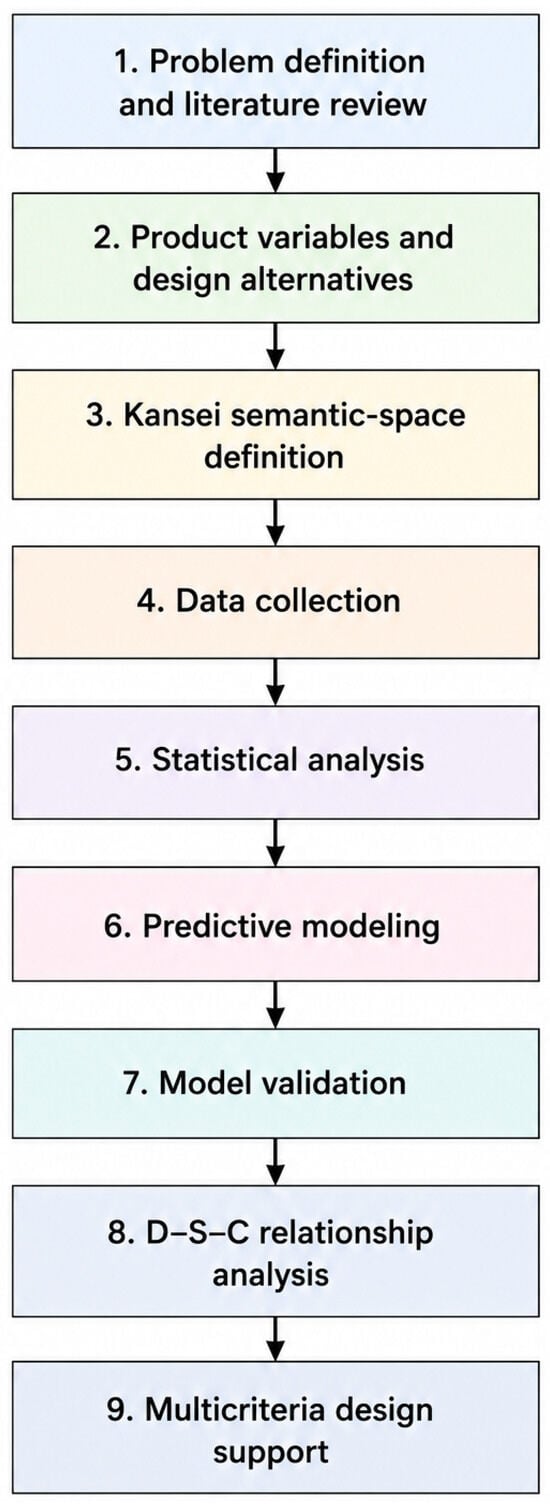
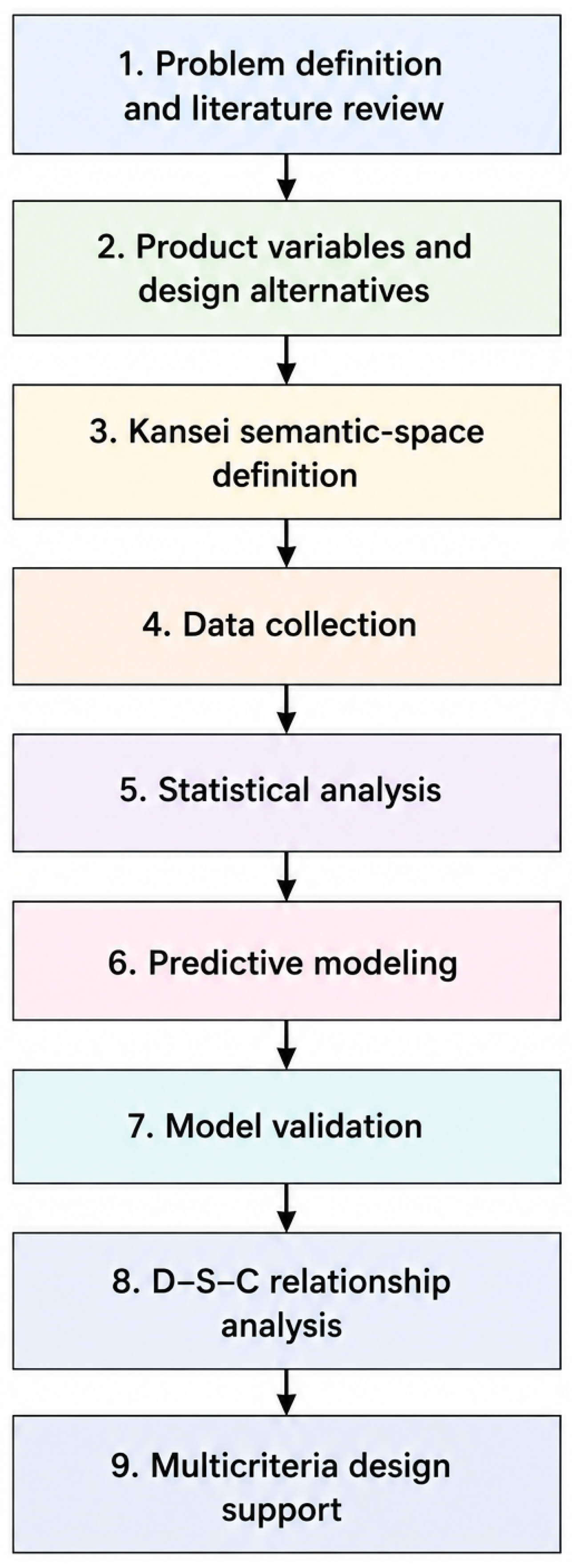
Thus, the proposed model can be conceptually expressed as Figure 1. Summarizes the complete research workflow, from the identification of the research problem and definition of the semantic and product spaces to data collection, statistical analysis, predictive modeling, validation, and multicriteria interpretation.
Figure 1.
Overall methodological framework and sequence of the research process.
4.1. Kansei Experimental Design and Product Under Study
In the first phase, the product family was selected and the Kansei adjectives associated with the target emotional perception were defined through a literature review, user interviews, and semantic refinement, following the classical approaches proposed by Nagamachi and subsequent developments by Schütte et al. and Lokman in emotional design contexts [1,3]. In parallel, the engineering design variables and other parameters that may affect regulatory requirements were established, in accordance with life-cycle-oriented sustainable design frameworks and the Kansei-driven specification approach.
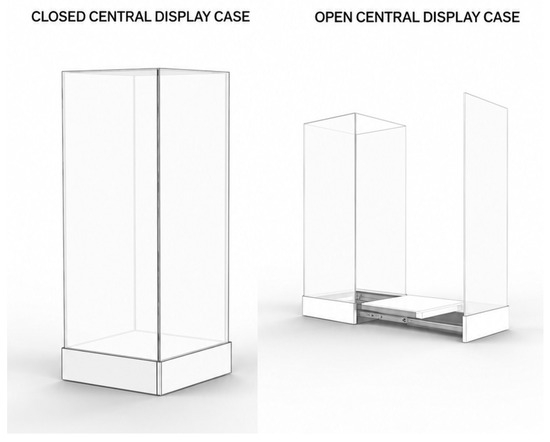
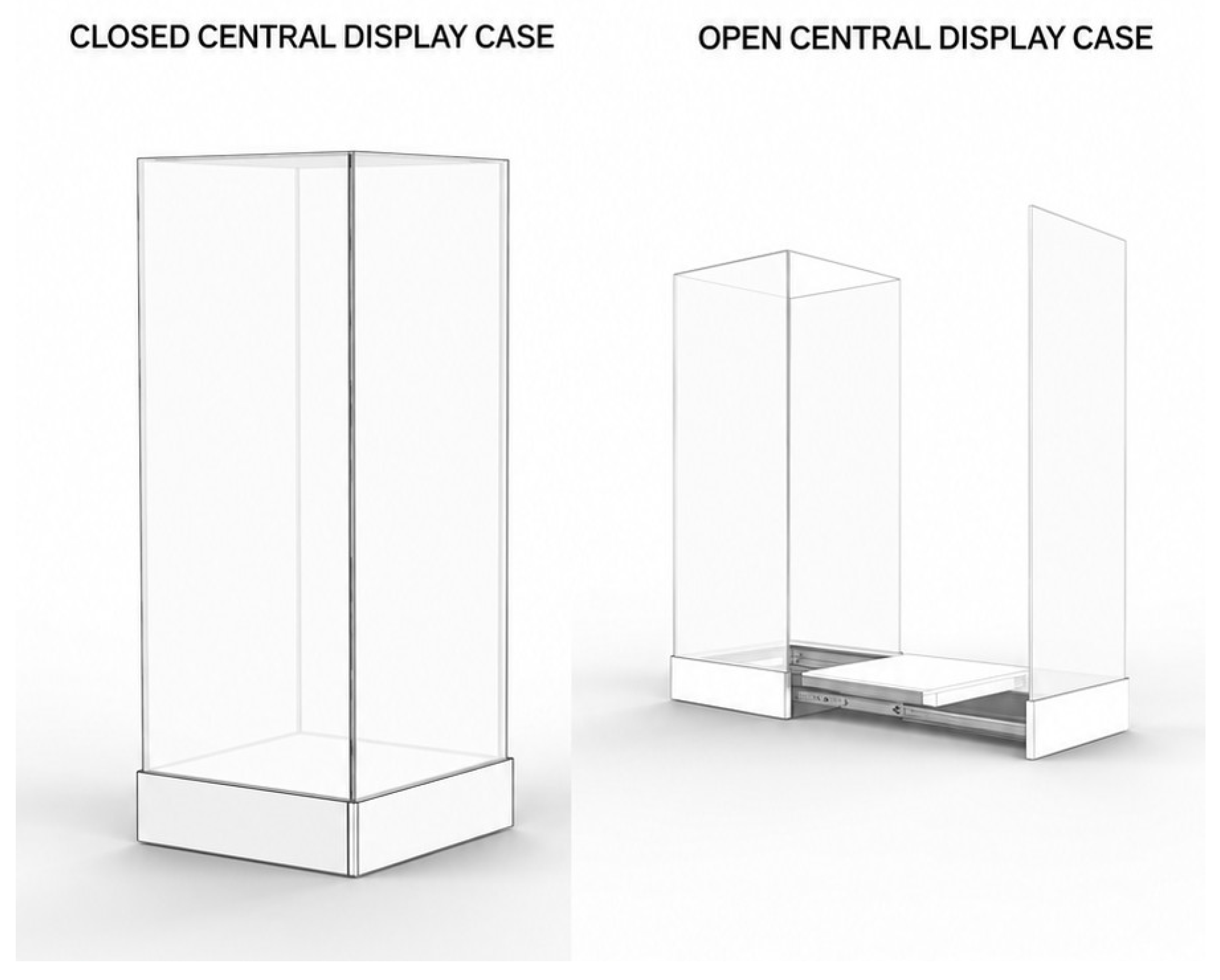
To analyze the influence of different design solutions on users’ emotional perceptions, a museum display case designed for the exhibition and conservation of cultural heritage objects in museum environments was selected as the case study (Figure 2). The display case is a fundamental element of contemporary museum exhibition design, as it must simultaneously satisfy requirements related to preventive conservation, security, maintenance accessibility, exhibition functionality, and aesthetic quality.
Figure 2.
Model selected for the study. Museum display case.
The reference display case used in this research corresponds to a square-plan model designed for permanent or temporary exhibitions. Its overall configuration consists of a transparent prismatic volume supported by a technical plinth that integrates the components required for the conservation and maintenance of the exhibited objects. The assembly features a simple, orthogonal geometry, commonly used in museum display cases to minimize visual interference and facilitate the viewing of the exhibited objects.
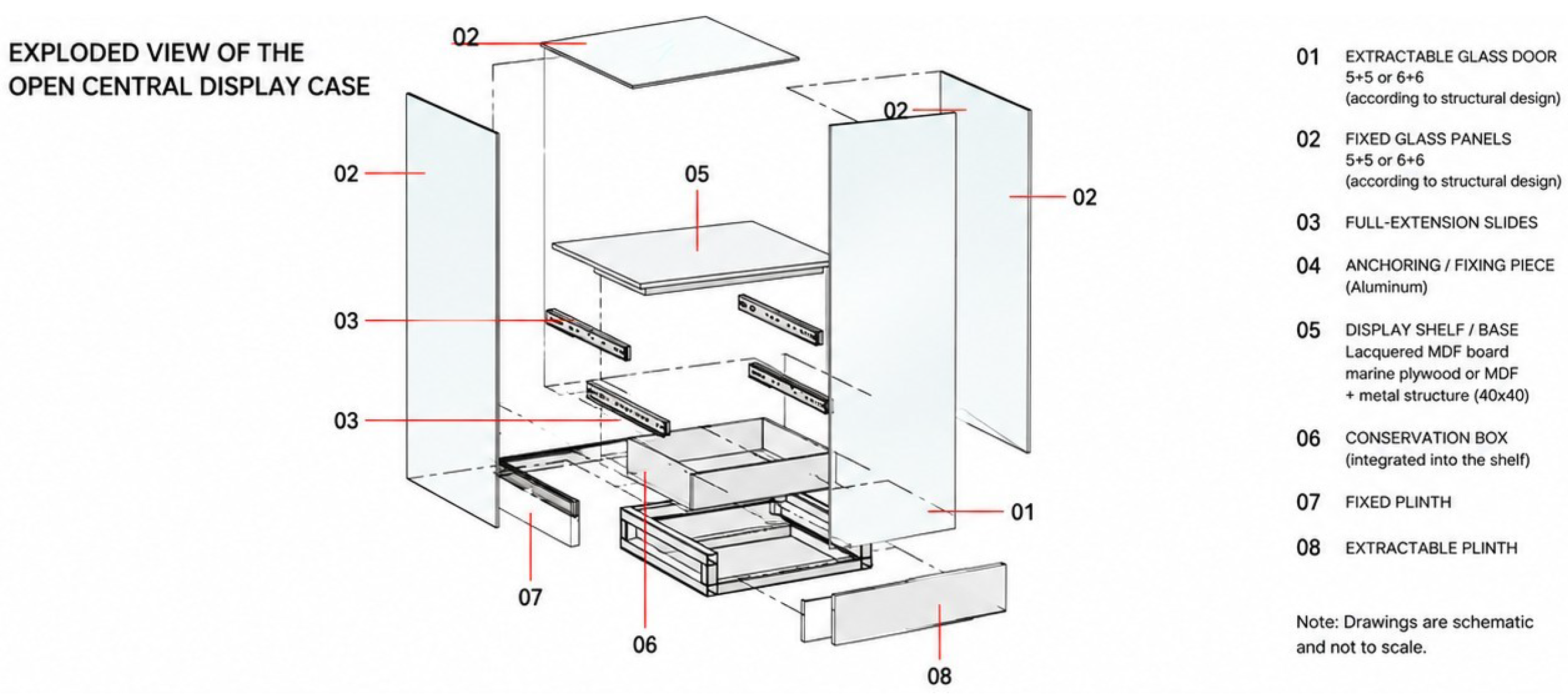
From a construction perspective, the display case consists of three main subsystems: the transparent enclosure, the supporting structure, and the technical base. The enclosure is composed of vertical panels and a top cover made of laminated safety glass with varying thicknesses (5 + 5 mm or 6 + 6 mm, depending on the requirements of the construction project), providing physical protection and visual transparency for the appropriate viewing of the exhibited objects.
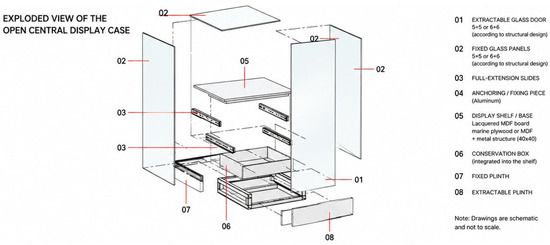
The structure incorporates aluminum anchoring and fastening components designed to ensure the stability of the assembly and enable the connection of its different elements. The system also includes a removable front access door that facilitates the installation, removal, and handling of the exhibited collections. The opening mechanism is complemented by full-extension guides, providing convenient and safe access to the interior of the display case (Figure 3).
Figure 3.
Display case detail.
One of the most relevant aspects of the design is the incorporation of a multifunctional technical base. This base consists of a platform made of marine-grade plywood or MDF reinforced by a metal structure composed of tubular profiles. A technical compartment is integrated within the base to accommodate preventive conservation components, such as humidity-control systems, absorbent materials, or environmental monitoring devices. The assembly is completed by a system comprising a fixed plinth and a removable plinth, facilitating maintenance operations and the replacement of technical components without requiring the complete disassembly of the display case.
The selection of this display case as the reference product responds to several methodological considerations. First, it represents a typological configuration widely used in science, technology, archaeology, and art museums, thereby supporting the external validity of the results obtained. Second, its modular design allows the materials used in the different subsystems to be modified in a controlled manner without significantly altering the overall geometry, dimensions, or functionality of the product. Finally, the conceptual separation between the transparent enclosure, structure, and plinth cladding makes it possible to specifically investigate how material-related design decisions influence users’ emotional perceptions.
4.2. Design Alternatives
Four integrated design concepts were developed while maintaining the overall geometry and functional typology of the display case. Several material-related attributes vary simultaneously within each concept; consequently, the experiment enables comparison of the perceptual response generated by complete material configurations, but it does not permit the independent causal effect of each individual material to be isolated.
The four concepts were intentionally selected to span contrasting material and construction strategies while preserving the overall geometry, dimensions, and functional typology of the reference display case. Each alternative is represented through comparable visual stimuli or physical prototypes, following good practices in Kansei experimentation to minimize presentation bias [25].
Alternative A was oriented toward preventive conservation and perceived quality, incorporating high-performance laminated extra-clear glass, an anodized aluminum structure, and a continuous-finish cladding.
Alternative B was configured according to a technological and contemporary design language, using laminated extra-clear glass, a lacquered metal structure, and aluminum cladding.
Alternative C was specifically conceived according to sustainability and disassembly criteria, combining laminated extra-clear glass, recycled aluminum, and FSC-certified birch plywood.
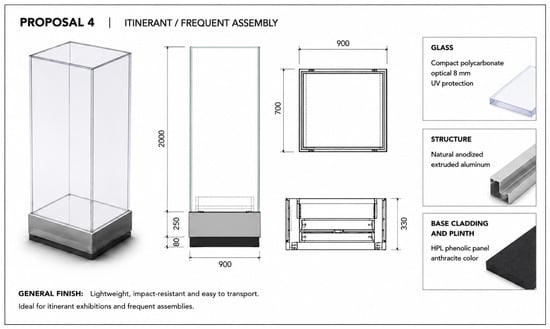
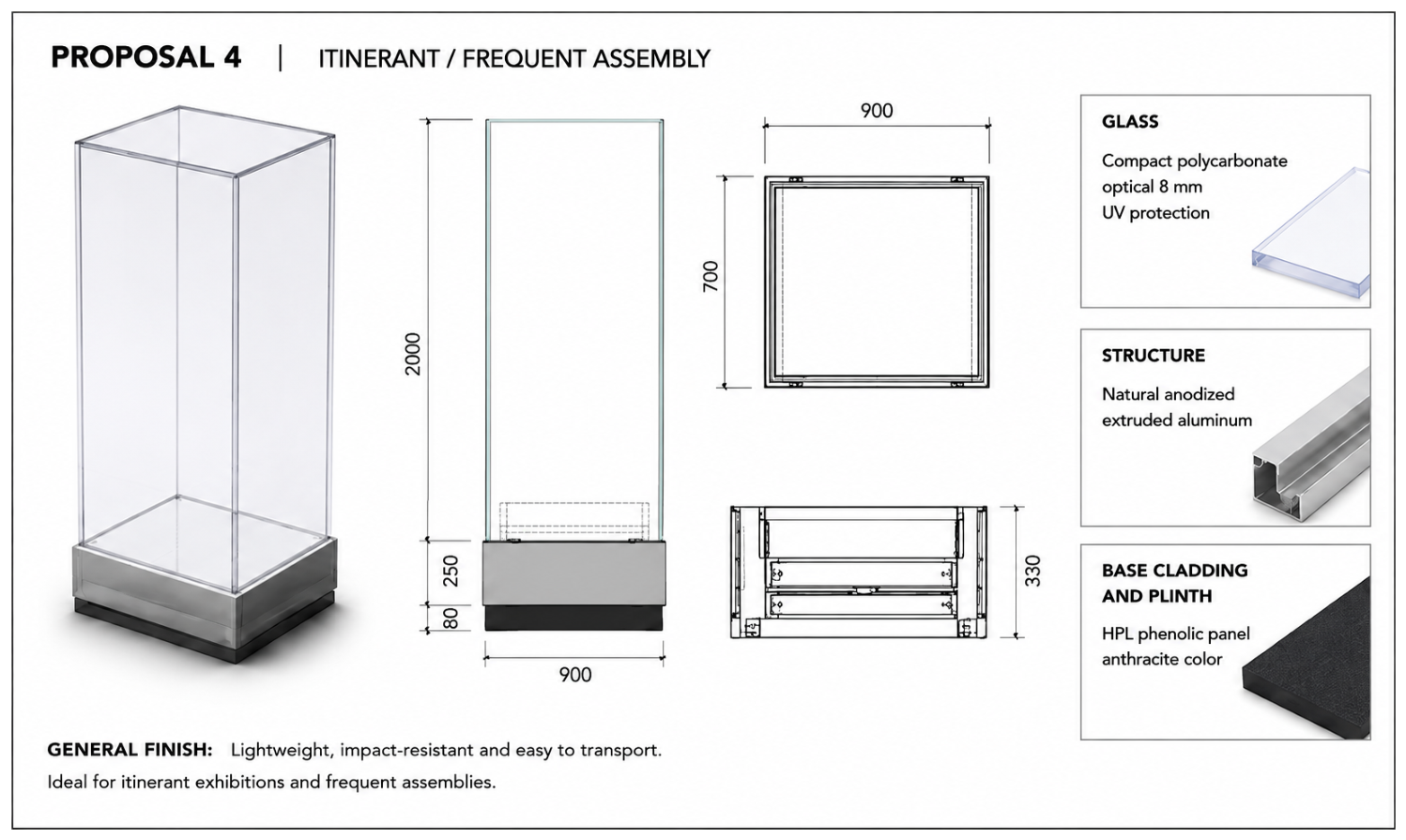
Finally, Alternative D was designed for traveling or temporary exhibitions using lightweight materials resistant to transportation, including optical-grade polycarbonate, an extruded aluminum structure, and HPL cladding.
These four configurations make it possible to compare clearly differentiated strategies in terms of visual appearance, conservation, sustainability, mobility, and perceived economic performance without substantially modifying the overall product typology.
4.3. Final Design Proposals
Based on the combination of the alternatives described above, four complete configurations representing different design strategies were defined.
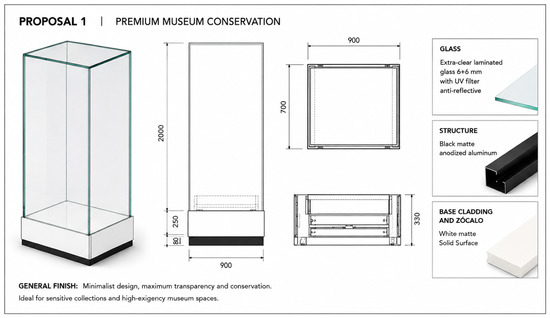
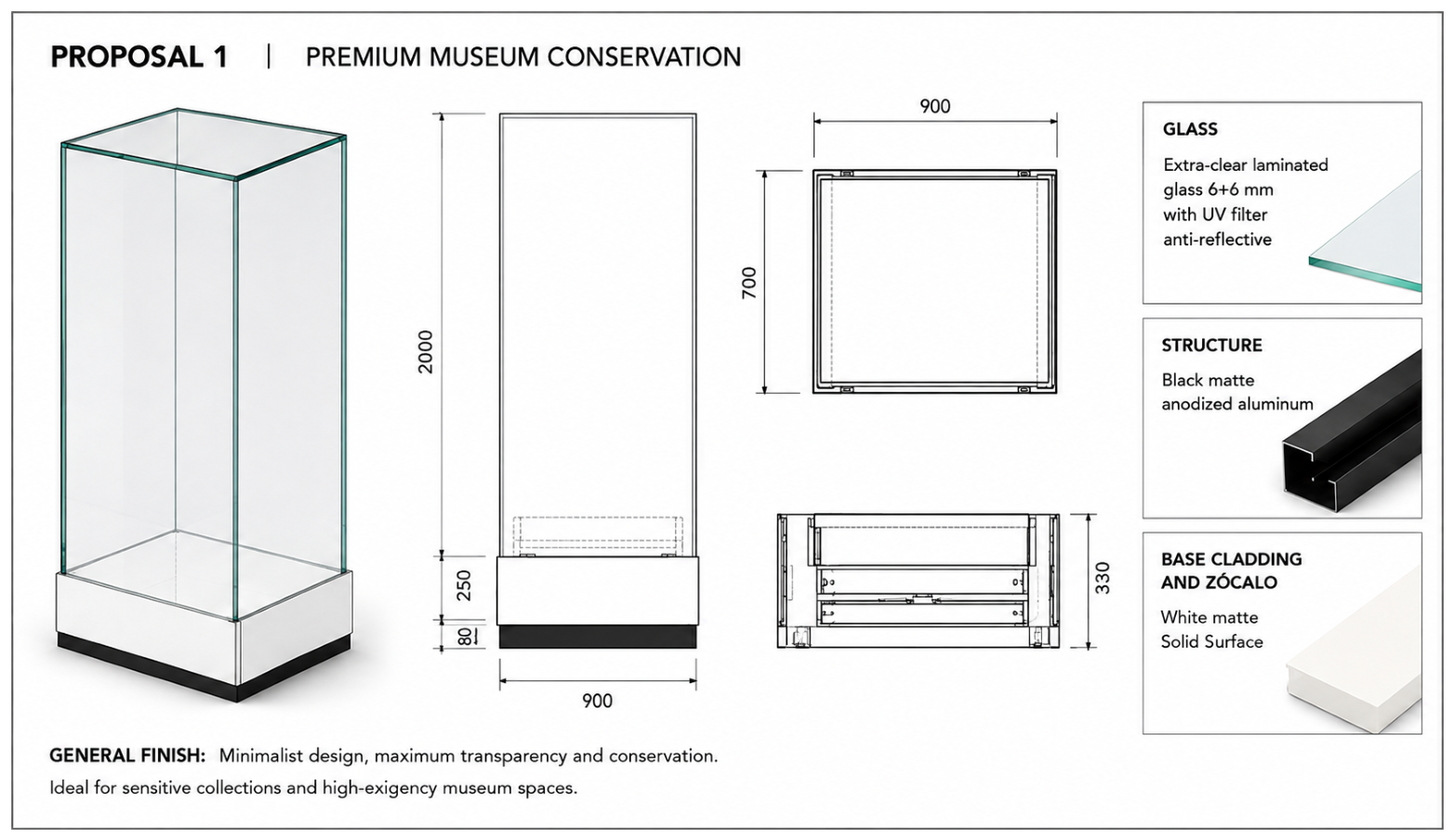
Proposal 1 (Figure 4) prioritizes preventive conservation and maximum museographic quality through the combination of laminated extra-clear glass with anti-reflective treatment and UV filtering, a black anodized aluminum structure, and a base made of matte white Solid Surface.
Figure 4.
Design alternative 1.
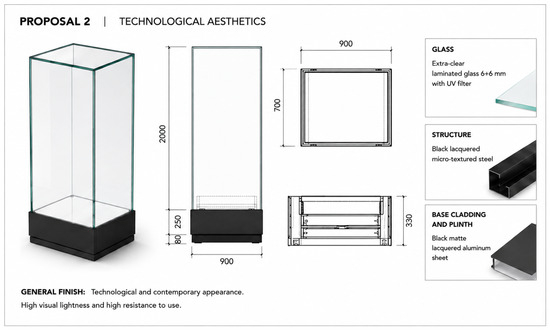
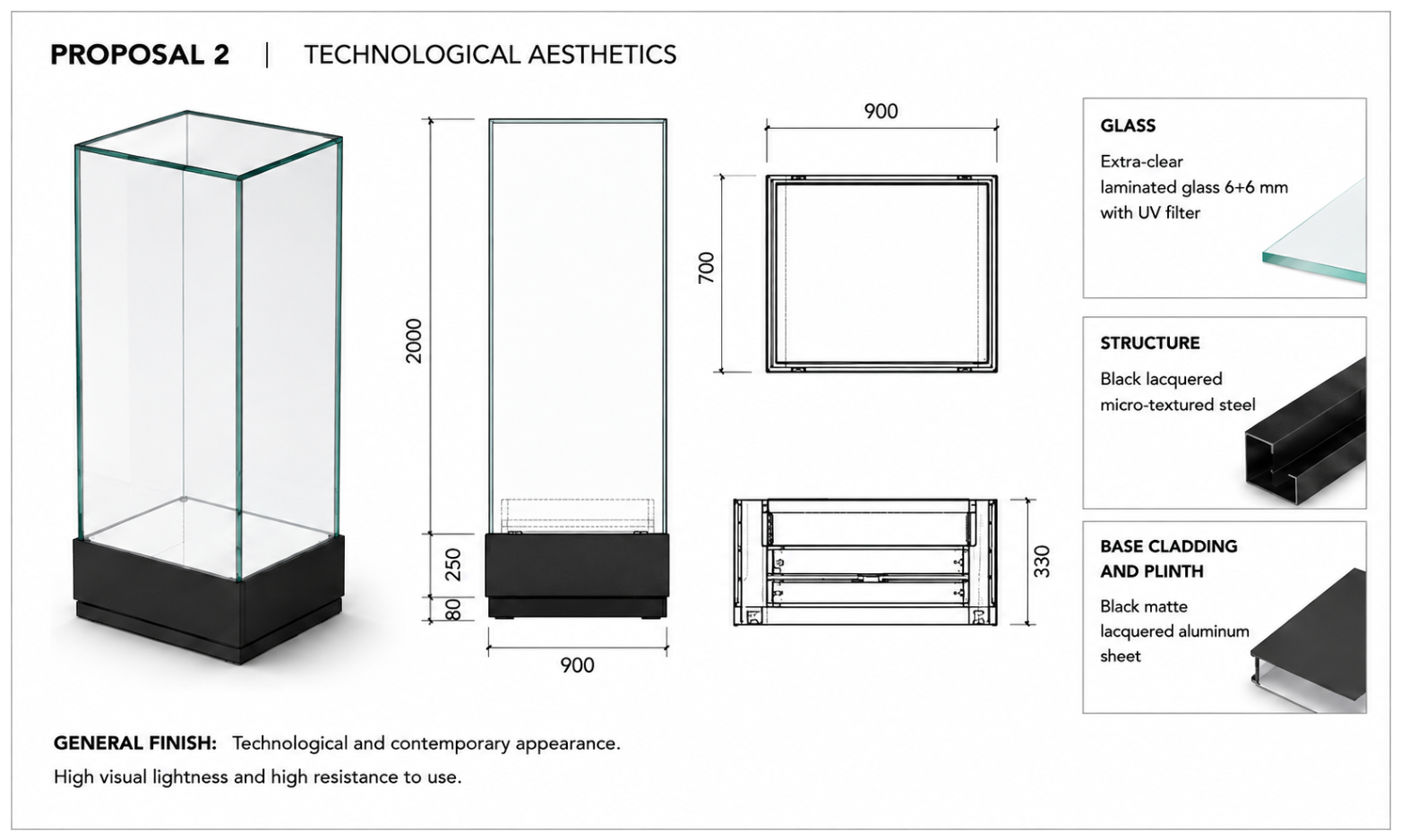
Proposal 2 (Figure 5) pursues a technological and contemporary aesthetic, which is particularly suitable for science and technology museums, incorporating laminated extra-clear glass, a micro-textured black lacquered steel structure, and a plinth made of lacquered aluminum sheet.
Figure 5.
Design alternative 2.
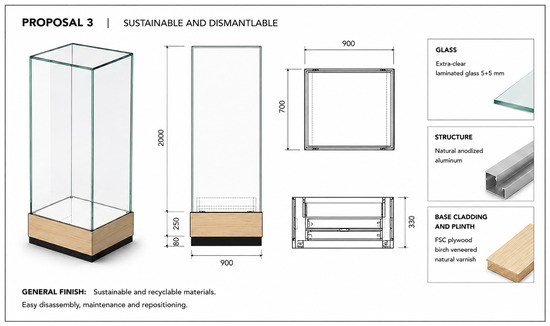
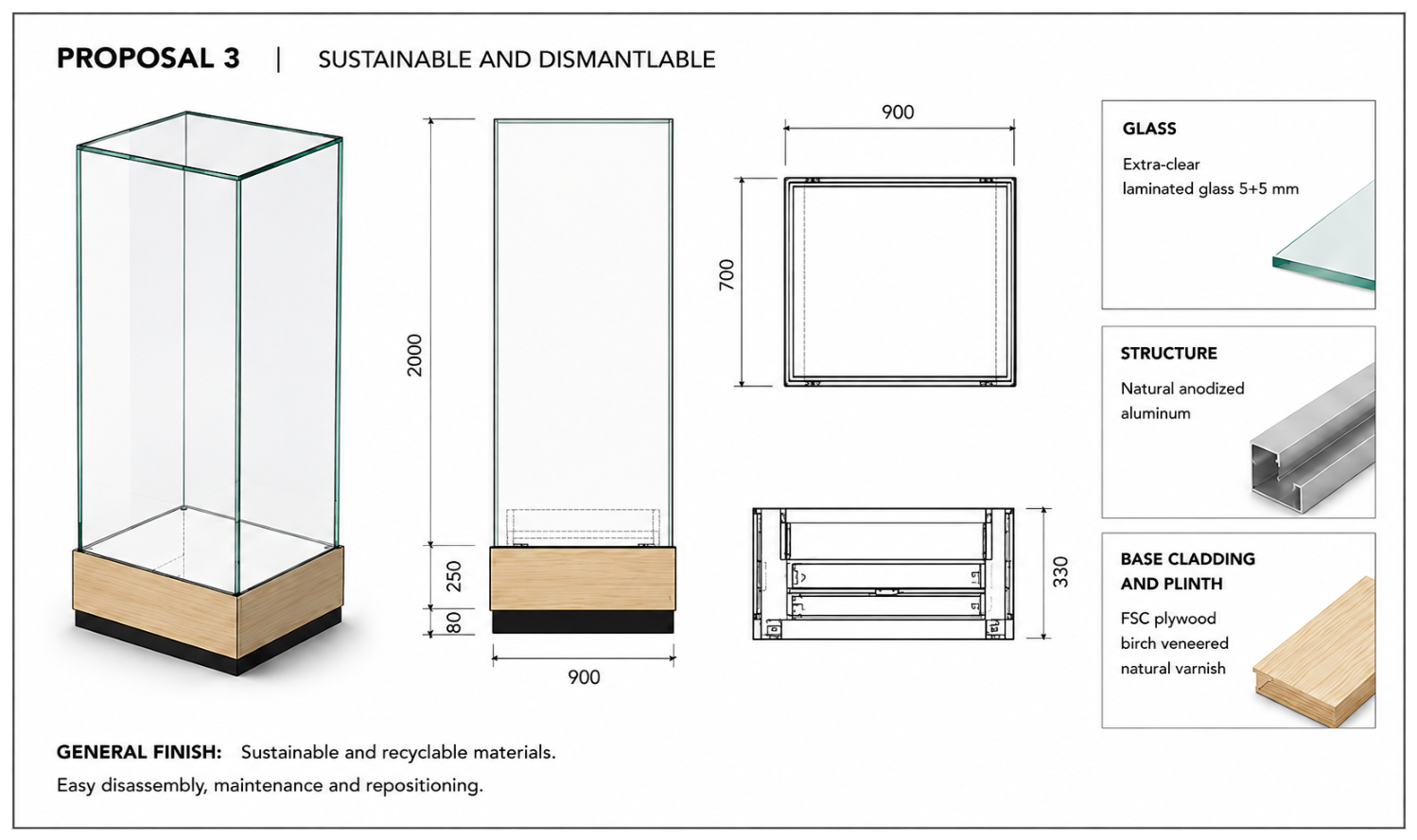
Proposal 3 (Figure 6) is oriented toward environmental sustainability through the use of laminated extra-clear glass, profiles made from recycled aluminum, and FSC-certified birch plywood cladding with a natural finish, while also facilitating future disassembly and maintenance.
Figure 6.
Design alternative 3.
Finally, Proposal 4 (Figure 7) addresses the requirements of traveling exhibitions or temporary installations through the use of solid optical-grade polycarbonate, an extruded aluminum structure, and high-resistance HPL panel cladding, thereby minimizing the overall weight of the assembly while increasing its resistance to transportation.
Figure 7.
Design alternative 4.
The following table summarizes each component, its alternatives, and their main advantages, together with the recommended application for each case (Table 1).
Table 1.
Summary of the proposed design alternatives for the display case.
4.4. Kansei Variables Used in the Study
The Kansei word selection phase constitutes one of the most relevant steps within the methodology, as these adjectives make it possible to translate users’ emotional and cognitive responses into measurable variables and subsequently relate them to specific design attributes [1,3]. The quality of the results obtained depends largely on whether the selected terms are capable of adequately representing the perceptions generated by users when visually interacting with the proposed design alternatives.
The construction of the semantic space was carried out as a separate methodological stage prior to the main experiment. Candidate terms were collected from three complementary sources:
- Previous Kansei Engineering and emotional-design studies dealing with product appearance, perceived quality, functionality, sustainability, economic value, and overall affective evaluation;
- Professional experience;
- Terminology associated with the functional and perceptual requirements of museum display cases.
This procedure generated an initial pool of 120 terms, organized into 60 bipolar adjective pairs. As a first screening stage, the authors independently evaluated the candidate pairs according to their relevance to the product under study and their ability to capture meaningful aspects of its perception. Adjective pairs with limited or no direct relevance to the characteristics of the product were excluded. This preliminary screening reduced the initial pool from 60 to 24 candidate adjective pairs (Table 2). The 24 remaining pairs were then subjected to a final selection process based primarily on two criteria: their degree of relevance to the objectives and characteristics of the product under study, and their semantic distinctiveness with respect to the other candidate pairs. When two or more pairs conveyed the same or a highly similar meaning, the pair considered most relevant, representative, and appropriate for evaluating the product was retained, while the synonymous or semantically redundant alternatives were removed. This process was intended to obtain a concise set of semantic differential pairs covering the relevant perceptual dimensions while minimizing conceptual overlap and redundancy among the selected descriptors.
Table 2.
Screening and selection of candidate semantic differential pairs.
After semantic refinement and the elimination of redundant terms or descriptors with lower relevance or discriminative capacity, the final evaluation instrument comprised 12 Kansei semantic pairs organized according to their respective dimensions (Table 3). These semantic pairs were subsequently used in the experimental phase and evaluated by the participants.
Table 3.
Kansei pairs included in the final analysis.
This selection reduces the questionnaire burden while maintaining a balanced representation of the fundamental dimensions involved in the design of the museum display case.
4.5. Data Collection and Preprocessing
Kansei perception was assessed through questionnaires in which participants evaluated each product model using a multi-level Likert scale for the selected adjectives, replicating the measurement design applied in previous studies conducted by the research group to which the authors belong. The sample size and participant selection were defined according to the target user profile (users, informed users, or general participants), following common criteria in Kansei studies and subjective evaluations of industrial products and regulated equipment [26].
Based on the survey results, the final dataset consisted of 150 valid participants, corresponding to those respondents who explicitly provided informed consent. The sample comprised 92 men (61.3%) and 58 women (38.7%). Participants ranged in age from 26 to 73 years, with a mean age of 43.85 years, representing an adult population with sufficient maturity and experience to evaluate criteria related to the design of museum exhibition equipment.
For each of the four design alternatives, participants were asked to indicate the degree to which their perception corresponded to each of the 12 bipolar semantic pairs listed in Table 3. Each item was rated on a seven-point semantic differential scale, with the opposite adjectives placed at the two ends of the scale. Thus, each participant completed the same 12 perceptual evaluations for each of the four configurations. The questionnaire also included sociodemographic items concerning age, sex, educational level, professional occupation, and previous museum or exhibition experience. The Kansei pairs were selected through the screening and refinement procedure described in Section 4.4.
Regarding educational level, the sample was characterized by a high degree of academic qualification. Most participants held a Bachelor’s degree (84 participants; 56.0%), followed by a Master’s degree (32; 21.3%) and Vocational Training qualifications (17; 11.3%). Smaller proportions of participants had completed Secondary Education (7; 4.7%), a Doctoral degree (2; 1.3%), or other qualifications (8; 5.3%). This educational profile is particularly suitable for a product design perception study, as it supports informed and consistent evaluations of the functional, aesthetic, and construction-related aspects of the alternatives assessed.
The study was not designed as an expert-only evaluation. Its target population was adult users and potential museum visitors with heterogeneous professional backgrounds. Previous museum or exhibition experience was collected as a descriptive characteristic rather than as an eligibility criterion for expert status. Therefore, the 47 participants reporting previous experience should not be interpreted as a formally defined expert panel.
With respect to professional occupation, the sample included highly diverse profiles, with participants from fields such as design, museology, conservation and restoration, education, public administration, finance, and other professional sectors. This heterogeneity contributes to reducing potential biases associated with a single field of expertise and provides a broader perspective on the emotional perceptions generated by the different display case alternatives.
Overall, the participant population (Table 4) can be considered appropriate for the objectives of this research, as it combines a high level of academic qualification, a balanced representation of participants with and without museum-related experience, and broad professional diversity. These characteristics provide a solid basis for the subsequent statistical analysis using Kansei Engineering techniques, as well as for the development of predictive models, enabling a sufficiently robust exploration of the relationship between the design characteristics of the display cases and users’ emotional perceptions.
Table 4.
Sociodemographic characteristics of the study participants ().
The numerical ratings in this study should not be seen as objective measurements of emotion or perception. They are standardized self-reported evaluations that allow subjective responses to be compared across the different design alternatives within the Kansei Engineering framework. A quantitative approach was used because the goal was to compare perceptual responses and analyze their statistical relationships, rather than to explore the personal meanings behind those perceptions. A complementary qualitative approach could add interpretive depth and is a relevant direction for future research.
4.6. Definition of Target Variables
The proposed model considers three outcomes of interest for the study. Perceived desirability (D) was considered the global affective response of interest in the Kansei evaluation. Unlike a composite index obtained by aggregating several semantic ratings, desirability was directly assessed by participants through the corresponding semantic item. Therefore, no predefined mathematical weights were assigned to the remaining Kansei attributes to calculate D.
For participant i evaluating design alternative j, perceived desirability was defined as:
Rather than imposing an a priori functional form or weighting scheme, this mapping was established empirically from the observed responses. First, Spearman rank correlation coefficients were calculated to quantify the individual association between each Kansei attribute and perceived desirability. Second, supervised predictive models were used to evaluate the joint capacity of the semantic attributes to predict D. This approach allows the relative contribution of the Kansei descriptors to desirability to emerge from the empirical data.
In addition to desirability, two composite indices were defined to represent the participants’ perceptions of perceived sustainability and economic efficiency. These indices represent subjective evaluations and should therefore not be interpreted as objective environmental Life Cycle Assessment (LCA) or Life Cycle Costing (LCC) indicators.
For each participant i and alternative j, the perceived sustainability index (S) was calculated as the arithmetic mean of the Sustainable and Ecological semantic ratings:
Similarly, the perceived economic efficiency index (C) was calculated as:
Consequently, the three main perceptual outcomes were obtained through two different procedures: D corresponds to a directly evaluated global affective response, whereas S and C are composite indices calculated from semantically related ratings (Table 5).
Table 5.
Definition of the main perceptual outcomes used in the study.
The second analytical level examined whether perceived desirability was associated with perceived sustainability and economic efficiency. These relationships were first evaluated at the pooled level using Spearman rank correlations:
However, because all participants evaluated different design alternatives and the alternatives presented clearly differentiated material and constructive configurations, pooled correlations may partially reflect between-configuration differences. Therefore, complementary linear mixed-effects models were used to examine whether the relationship between desirability and each perceptual index remained after controlling for the design alternative while accounting for the repeated evaluations provided by the same participant.
These analyses were intended to quantify statistical associations rather than causal effects. Consequently, the proposed framework does not assume a sequential causal relationship of the form or . Instead, perceived desirability, perceived sustainability, and perceived economic efficiency are treated as complementary perceptual outcomes whose relationships can be examined within the Kansei-based design evaluation framework.
The following table (Table 6) presents the internal consistency of the proposed indices, evaluated using the Spearman–Brown coefficient. The perceived sustainability index achieved a value of , indicating adequate consistency between its two components. The perceived economic-efficiency index obtained a value of , indicating more moderate consistency between its two components and therefore requiring greater caution in its interpretation.
Table 6.
Internal consistency of the proposed indices.
Based on these definitions, the analytical mapping was conducted in two stages. First, the relationship between the Kansei semantic space and perceived desirability was examined, treating D as the global affective response and the remaining semantic evaluations as explanatory variables. Second, the relationships of D with the perceived sustainability (S) and perceived economic efficiency (C) indices were analyzed. These relationships were examined both at the overall level and after controlling for the design alternative. Finally, the predictive capacity of desirability for estimating S and C was evaluated. This analytical sequence distinguishes between association and prediction and does not imply causal relationships among the three perceptual outcomes.
The two economic items were selected a priori as related indicators of the economic-value dimension of the Kansei evaluation rather than as a previously validated unidimensional psychometric scale. Because both items were measured using the same seven-point response format and no theoretical basis existed for assigning unequal weights, the composite index was calculated using their arithmetic mean.
For two-item measures, internal consistency was evaluated using the Spearman–Brown coefficient. The perceived economic-efficiency index yielded a Spearman–Brown coefficient of 0.661, compared with 0.787 for the perceived sustainability index. The lower coefficient indicates that the two economic items share a more moderate degree of common variance and therefore that the composite should be interpreted as an exploratory perceptual summary.
Alternative treatments, including considering the two economic items separately, were also considered. However, the composite measure was retained because the two items were defined a priori as complementary indicators of the same perceived economic-value dimension and were measured on the same response scale. Nevertheless, given its moderate internal consistency, results based on this index are interpreted cautiously.
4.7. Statistical Analysis and Repeated-Measures Structure
Because each participant evaluated all four display-case alternatives, the resulting 600 observations were not considered statistically independent. Therefore, the repeated-measures structure of the data was explicitly taken into account in the inferential analyses.
Differences among the four design alternatives were assessed using the Friedman test, which is appropriate for comparing repeated evaluations provided by the same participants. For the subsequent association analyses, linear mixed-effects models were used to account for participant-level dependence. Participant was included as a random intercept, while design alternative and the variables of interest were included as fixed effects. In particular, these models were used to examine the relationships between perceived desirability, perceived sustainability, and perceived economic efficiency while accounting for both differences among design alternatives and repeated evaluations from the same participant.
Pooled Spearman rank correlations were retained as descriptive measures of the overall monotonic relationships among variables. However, inferential conclusions regarding these relationships were based on the mixed-effects models, thereby accounting for the non-independence of repeated observations.
For the predictive analysis, data partitioning was performed at the participant level in order to prevent information leakage between the training and testing subsets. Participants were randomly allocated using an 80/20 split, corresponding to 120 participants (480 observations) for model development and 30 participants (120 observations) for testing. All four evaluations provided by a given participant were therefore assigned exclusively to one subset. A fixed random seed of 123 was used to ensure reproducibility.
Predictive performance was evaluated using Root Mean Squared Error (RMSE), Mean Absolute Error (MAE), Mean Absolute Percentage Error (MAPE), and the coefficient of determination (). In addition, a simple baseline model predicting the mean desirability observed in the training dataset was included as a reference. Ninety-five percent confidence intervals for predictive performance were estimated using 2000 bootstrap resamples performed at the participant level, thereby preserving the clustered structure of the four evaluations provided by each participant. Performance was also examined separately for each design alternative.
5. Results
The modeling was performed using the valid responses from 150 participants, as described in the previous section. Each participant evaluated the four display case alternatives using twelve Kansei semantic pairs on a seven-point scale. Consequently, the analytical dataset consisted of 600 observations (150 participants × 4 alternatives).
5.1. Perceptual Differences Between Alternatives
The four alternatives produced significantly different Kansei profiles. The Friedman test revealed statistically significant differences for all twelve variables analyzed ( in all cases), as shown in Table 7, confirming that material and construction configurations substantially influence product perception.
Table 7.
Mean recoded scores and Friedman test results for each Kansei variable.
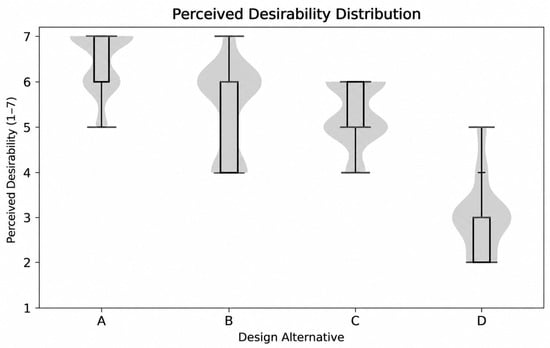
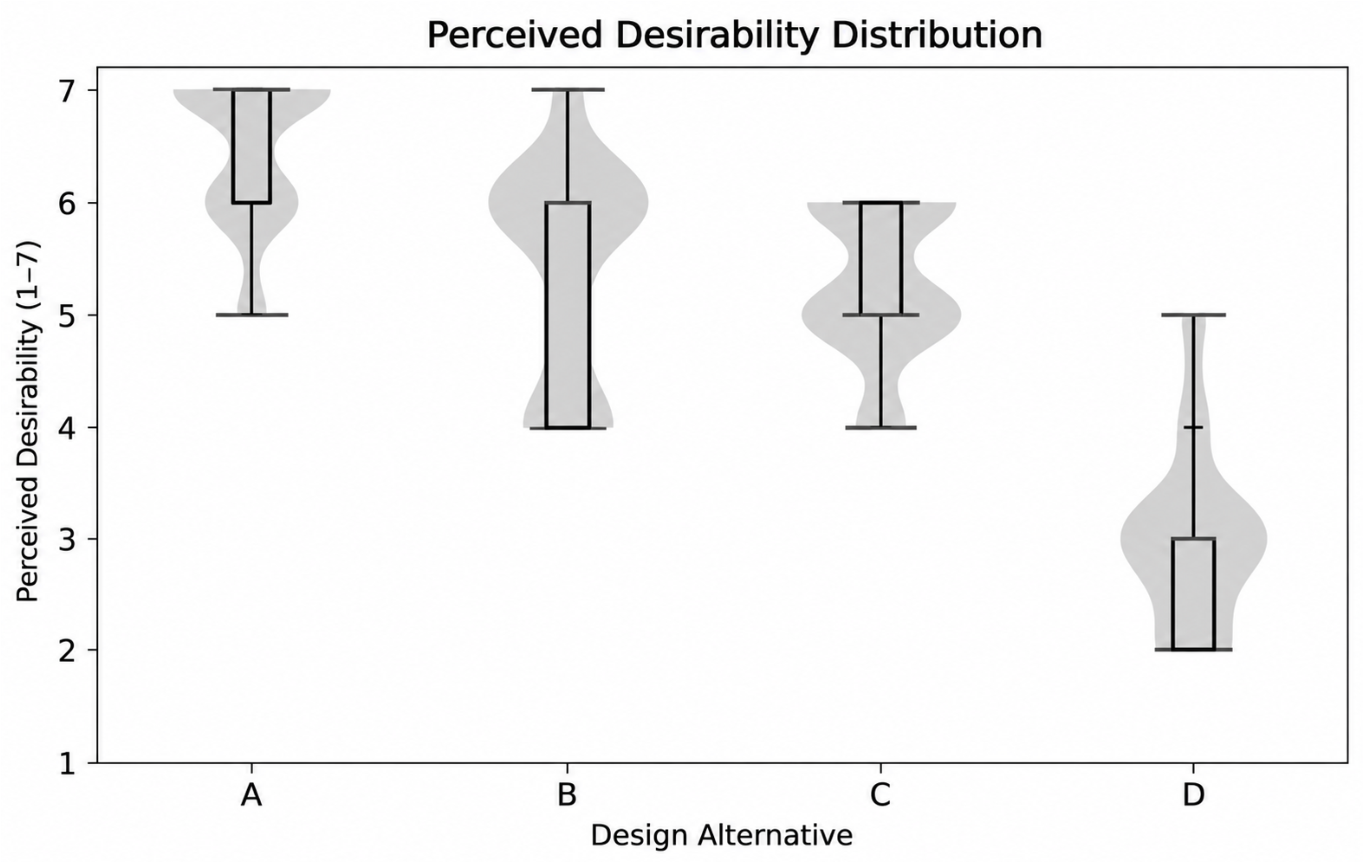
In terms of desirability (Table 8), Alternative A obtained the highest mean score (), followed by B () and C (). Alternative D received a clearly lower evaluation ().
Table 8.
Comparison of the three main dimensions across alternatives.
Figure 8 shows the distribution of desirability scores across the four solutions. The alternatives exhibit clearly differentiated profiles, with a concentration of higher scores among the best-rated configurations and greater dispersion among the proposals generating more polarized responses.
Figure 8.
Distribution of perceived desirability across the four alternatives. Scores were recoded so that higher values indicate greater desirability.
The pattern differed for the environmental and economic dimensions (Table 8). Alternative C achieved the highest perceived sustainability score (), whereas Alternative D obtained the highest perceived economic efficiency score ().
This differentiation represents a key finding of the study, as it reveals the presence of perceptual trade-offs among emotional acceptance, sustainability, and economic efficiency. In other words, when users perceive improvements in one of these dimensions, they tend to simultaneously evaluate one or more of the others less favorably. This pattern indicates a perceptual balance in which the four alternatives evaluated revealed clear trade-offs among desirability, perceived sustainability, and perceived economic efficiency.
5.2. Mapping of Kansei Variables to Perceived Desirability
Perceived desirability (D) was considered the global affective response of interest and was directly obtained from the Desirable–Undesirable semantic pair, as defined in Section 4.6. Therefore, D was not calculated as a weighted combination of the remaining Kansei adjectives. Instead, the mapping between the Kansei semantic space and desirability was established empirically by examining the association of each semantic variable with D and subsequently evaluating their joint predictive capacity through supervised learning models. Accordingly, the mapping can be conceptually expressed as:
where represents the set of Kansei semantic evaluations used as predictors and D represents the directly assessed perceived desirability.
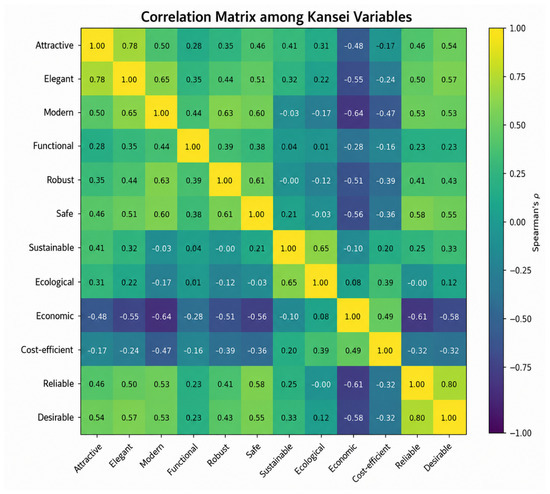
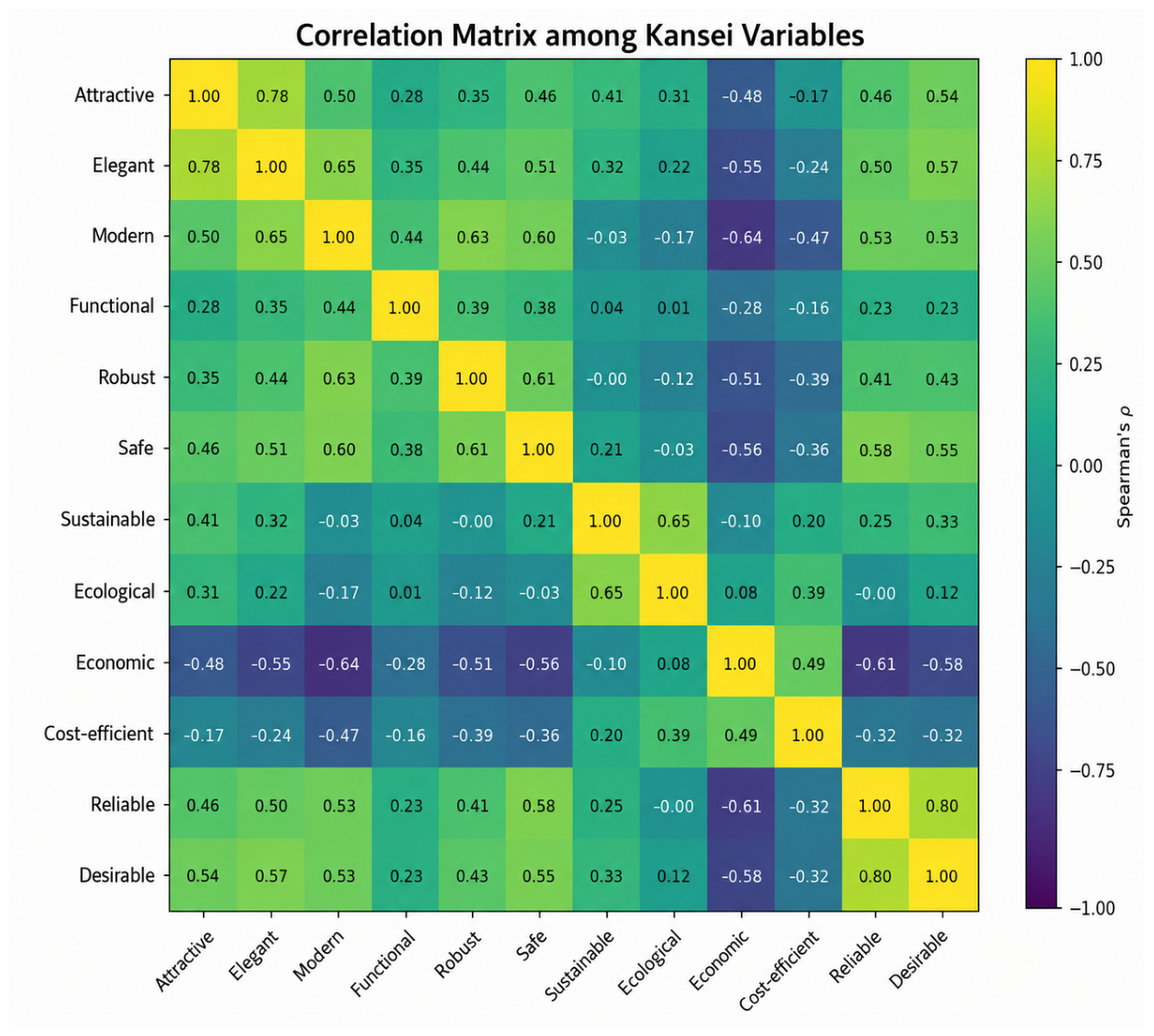
The relationship between desirability and the remaining variables was examined using Spearman’s correlation coefficient (Table 9). The strongest association was found for perceived reliability (), followed by perceived economy (), elegance (), safety (), attractiveness (), and modernity (). The negative correlation with the economic dimension indicates that, across the set of alternatives, a stronger perception of low cost did not necessarily translate into greater desirability. On the contrary, solutions perceived as more economical tended to be associated with lower overall emotional preference. This result suggests the existence of a potential trade-off between perceived economy and formal or museographic quality (Figure 9).
Table 9.
Spearman correlations between predictor variables and desirability.
Figure 9.
Spearman correlation matrix among the Kansei variables.
The modeling strategy adopted follows the methodological framework previously developed by the research group to explore the ability of different supervised learning techniques to represent Kansei responses. In the present study, this approach is specifically applied to predicting the desirability of the museum display case alternatives evaluated. For this purpose, five supervised regression methods were compared: Principal Component Regression (PCR), K-Nearest Neighbors (KNN), Random Forest (RF), Gradient Boosting (GB), and Artificial Neural Networks (ANNs).
Predictive performance was evaluated using RMSE, MAE, MAPE, and . In addition, the supervised models were compared with a baseline model that assigned each test observation the mean perceived desirability observed in the training dataset. Confidence intervals were estimated through participant-level bootstrap resampling. Table 10 summarizes the resulting predictive performance.
Table 10.
Comparison of predictive performance for perceived desirability. Confidence intervals were estimated using participant-level bootstrap resampling.
All supervised models substantially outperformed the mean-prediction baseline. The baseline model produced an RMSE of 1.462, an MAE of 1.227, and a MAPE of 30.95%, with essentially no explained variance (). In contrast, all supervised approaches achieved values close to or above 0.70.
Random Forest achieved the best overall predictive performance, with an RMSE of 0.711, an MAE of 0.546, a MAPE of 11.81%, and an of 0.763. The corresponding 95% bootstrap confidence intervals were 0.604–0.820 for RMSE and 0.665–0.833 for . Gradient Boosting showed a very similar performance (RMSE = 0.722; ), whereas PCR produced the largest error among the non-neural regression approaches. The comparison with the baseline confirms that the predictive models capture substantial information beyond the average desirability level of the training sample.
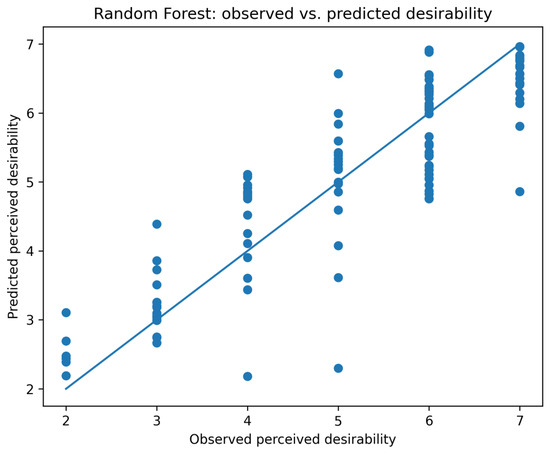
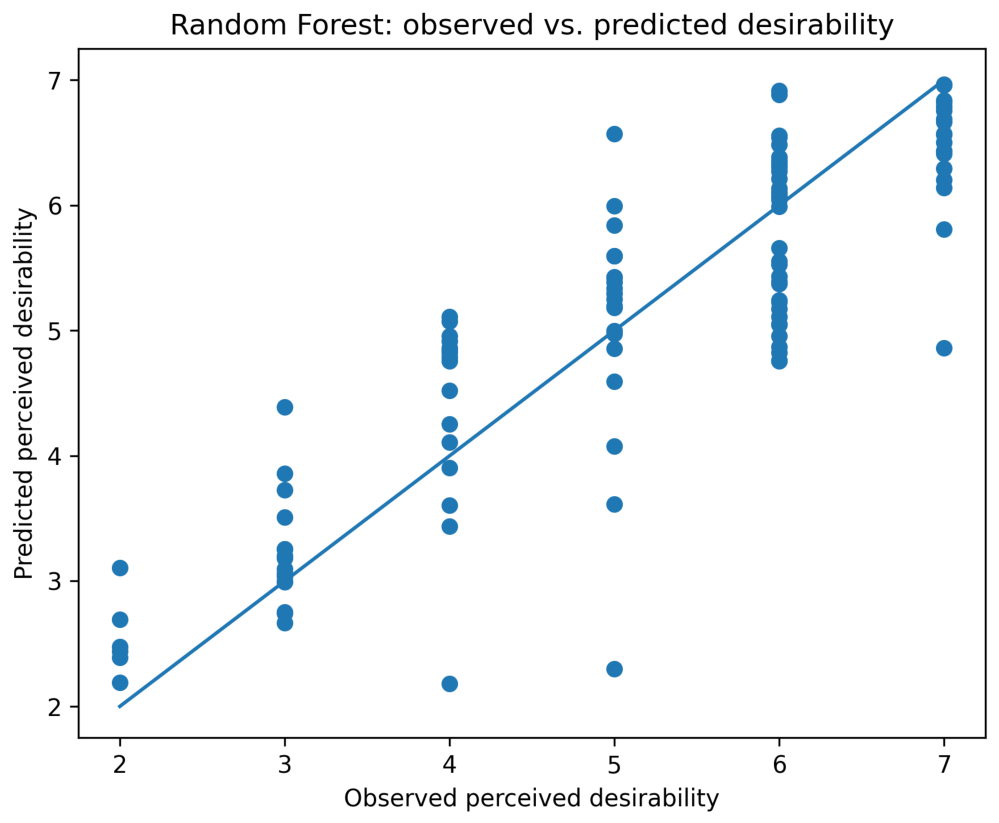
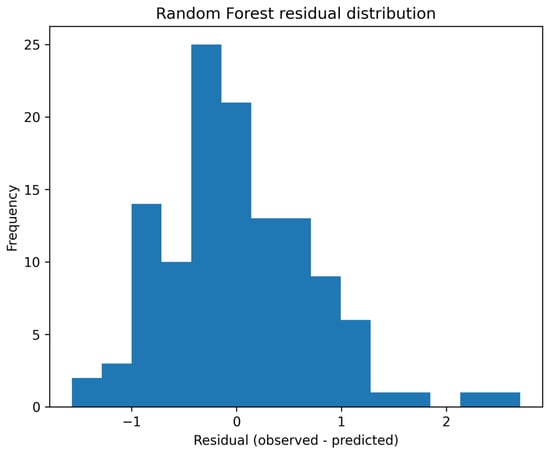
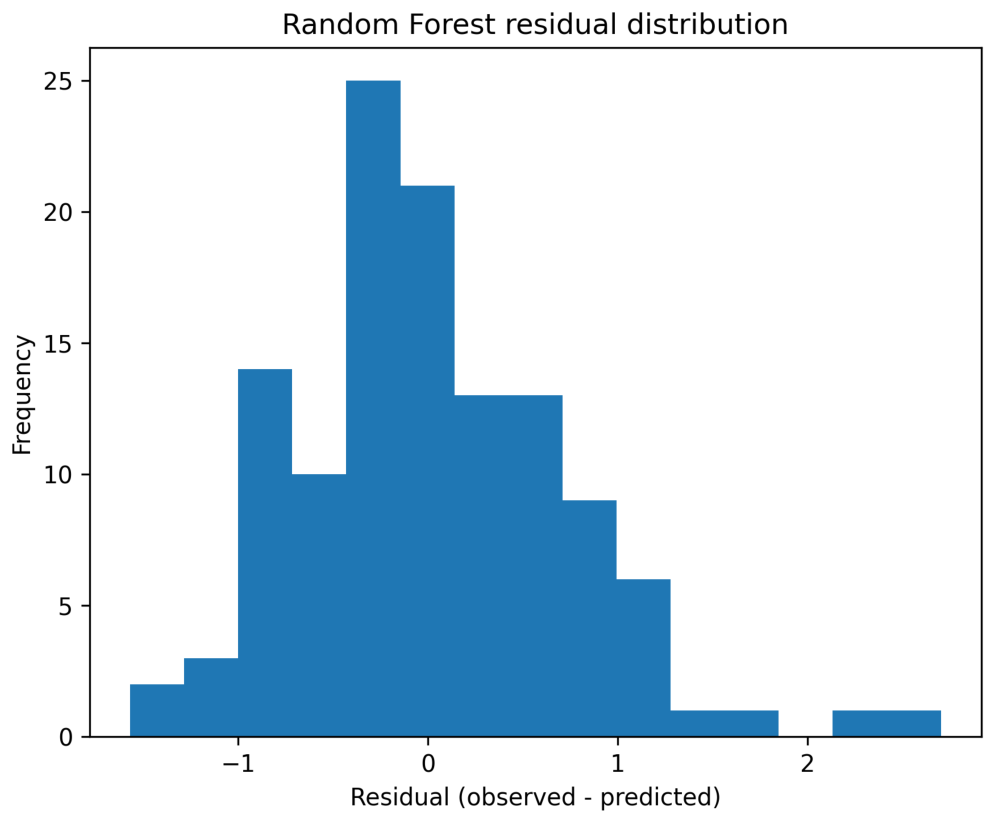
Alternative-specific performance showed that the absolute prediction error remained below one Kansei scale point for all four configurations. The lowest RMSE was obtained for Alternative B (0.647), followed by C (0.660), A (0.708), and D (0.818). The higher MAPE observed for Alternative D (17.31%) is partly related to its lower desirability scores, since percentage-based errors increase when the observed response values are smaller. The relatively low values obtained for some individual alternatives should also be interpreted cautiously because the range of desirability scores within a single configuration is substantially narrower than that of the complete dataset (Table 11, Figure 10 and Figure 11).
Table 11.
Random Forest predictive performance across the four evaluated design alternatives.
Figure 10.
Observed versus predicted perceived desirability for the Random Forest model in the participant-level test dataset. The diagonal line represents perfect agreement between observed and predicted values.
Figure 11.
Distribution of prediction residuals for the Random Forest model in the participant-level test dataset. Residuals were calculated as observed minus predicted perceived desirability.
5.3. Relationship Between Perceived Desirability, Perceived Sustainability, and Perceived Cost
Having established the empirical mapping between the Kansei semantic variables and perceived desirability in Section 5.2, the second analytical stage examined how perceived desirability is associated with perceived sustainability (S) and perceived economic efficiency (C). As defined in Section 4.6, S and C are composite perceptual indices, whereas D is a directly assessed affective response. Therefore, the relationships examined here should be interpreted as statistical associations rather than causal mappings.
This second analytical stage can be conceptually represented as:
Two complementary analyses were performed. First, Spearman’s rank correlation was used to quantify the overall association between desirability and each perceptual index across the complete dataset. Second, regression models including the design alternative as a control variable were used to determine whether these associations remained after accounting for systematic differences among the four configurations. Table 12 summarizes the results.
Table 12.
Direct relationship between perceived desirability, perceived sustainability and cost.
Desirability initially showed a positive association with perceived sustainability. In particular, the Sustainable indicator exhibited a correlation of with a significance level of , whereas the Ecological indicator yielded and . When the combined perceived sustainability index was used, the relationship remained similar, reaching with , thereby confirming a consistent association between desirability and overall perceived sustainability. Therefore, the relationship indicates that more desirable solutions tend, at the overall level, to also be perceived as more sustainable.
However, this relationship disappears when the model controls for the alternative evaluated. In other words, when the relationship between both variables is examined within each alternative, removing the effect of some display cases being generally rated more favorably than others, the resulting coefficient is practically null (, ). Consequently, there is insufficient evidence to conclude that, within the same alternative, greater desirability implies either higher or lower perceived sustainability.
Therefore, when accounting for the potential effect of materials and construction configuration, desirability does not make a significant contribution to perceived sustainability.
The relationship between desirability and perceived economic efficiency showed a different pattern. The Economical and Cost-efficient variables exhibited negative correlations with desirability (, ) and (, ), respectively. The combined economic efficiency index confirmed this trend, reaching with .
However, after controlling for the design alternative, the sign of the relationship was reversed and a small positive contribution emerged (, ). This result indicates that the strong negative association observed in the overall analysis is primarily conditioned by differences between alternatives and that, within each alternative, the relationship between desirability and perceived economic efficiency is weak but positive.
5.4. Predictive Capacity of Desirability for Perceived Sustainability and Cost
To determine whether desirability can be used directly as a predictor of perceived sustainability and perceived economic efficiency, models were initially fitted using only D as the predictor variable. The results (Table 13) showed limited predictive capacity, particularly for perceived sustainability (; ), and somewhat greater predictive capacity for the economic dimension (; ).
Table 13.
Predictive capacity of desirability for sustainability and economic efficiency.
These values indicate that desirability, when considered in isolation, does not allow either dimension to be estimated with sufficient accuracy. The improvement obtained when incorporating the design alternative demonstrates that prediction depends not only on the user’s emotional response but also on the specific characteristics defining each design solution or alternative.
This result supports the development of a design-support model that integrates desirability with the remaining variables defining the product, thereby guiding the generation and selection of new alternatives toward solutions that achieve a better balance among desirability, perceived sustainability, and cost in the context considered here.
6. Discussion
From a methodological perspective, the results obtained provide additional evidence regarding the applicability of the Kansei Engineering and supervised learning framework that the research group has been developing across different product typologies. Its application to the field of museum exhibition design is particularly relevant due to the need to simultaneously address aesthetic, functional, conservation, and economic requirements. Furthermore, the present study introduces an extension to the previous methodological approach by explicitly incorporating perceived sustainability and perceived economic efficiency, thereby enabling users’ affective responses to be analyzed from a multicriteria perspective.
The first relevant point of discussion is that these dimensions are not equivalent and do not necessarily evolve in the same direction. The alternative with the highest perceived desirability was Proposal A, whereas Alternative C obtained the highest perceived sustainability score and Alternative D the highest perceived economic-efficiency score.
This result is consistent with the physical configuration of the proposals themselves. Alternative A was conceived to convey museographic quality and conservation performance, Alternative C to prioritize sustainable materials and solutions, and Alternative D to reduce weight and facilitate transportation. The participants’ responses therefore reflect perceptual differences that are consistent with the design strategies initially established.
Reliability remains the main factor associated with desirability. This result is particularly relevant in the museum exhibition context, where users evaluate not only visual attractiveness but also the apparent ability of the product to protect collections, provide stability, and convey institutional quality.
The incorporation of perceived sustainability and perceived economic efficiency, however, introduces a more complex interpretation. At the pooled level, perceived sustainability showed a positive association with desirability (). However, this relationship was no longer statistically significant after accounting for the design alternative (, ). Therefore, the pooled association should not be interpreted as evidence of an independent relationship between desirability and perceived sustainability. Rather, it appears to be largely associated with differences among the evaluated design configurations. These findings indicate that higher perceived desirability does not necessarily correspond to higher perceived sustainability.
A similar distinction is required when interpreting perceived economic efficiency. At the pooled level, desirability was negatively associated with perceived economic efficiency (), indicating that observations with higher desirability scores tended to receive lower perceived economic-efficiency ratings. However, after accounting for the design alternative, the association changed in direction and a small positive coefficient was observed (, ). This change indicates that the pooled correlation is strongly influenced by differences among the four design configurations and should not be interpreted as a general inverse relationship between desirability and perceived economic efficiency. Accordingly, the adjusted result should also be interpreted cautiously as a within-study association rather than as evidence that increasing desirability causes an increase in perceived economic efficiency.
From a predictive perspective, desirability can be incorporated as one of the variables considered when estimating perceived sustainability and perceived economic efficiency. However, its predictive capacity is limited when used in isolation. The substantially higher explanatory capacity obtained when the design alternative is included indicates that the characteristics of the evaluated configuration play a major role in these perceptual outcomes. Therefore, desirability should not be interpreted as a direct determinant of either perceived sustainability or perceived economic efficiency.
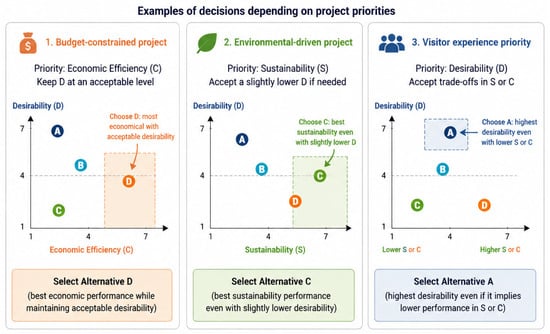
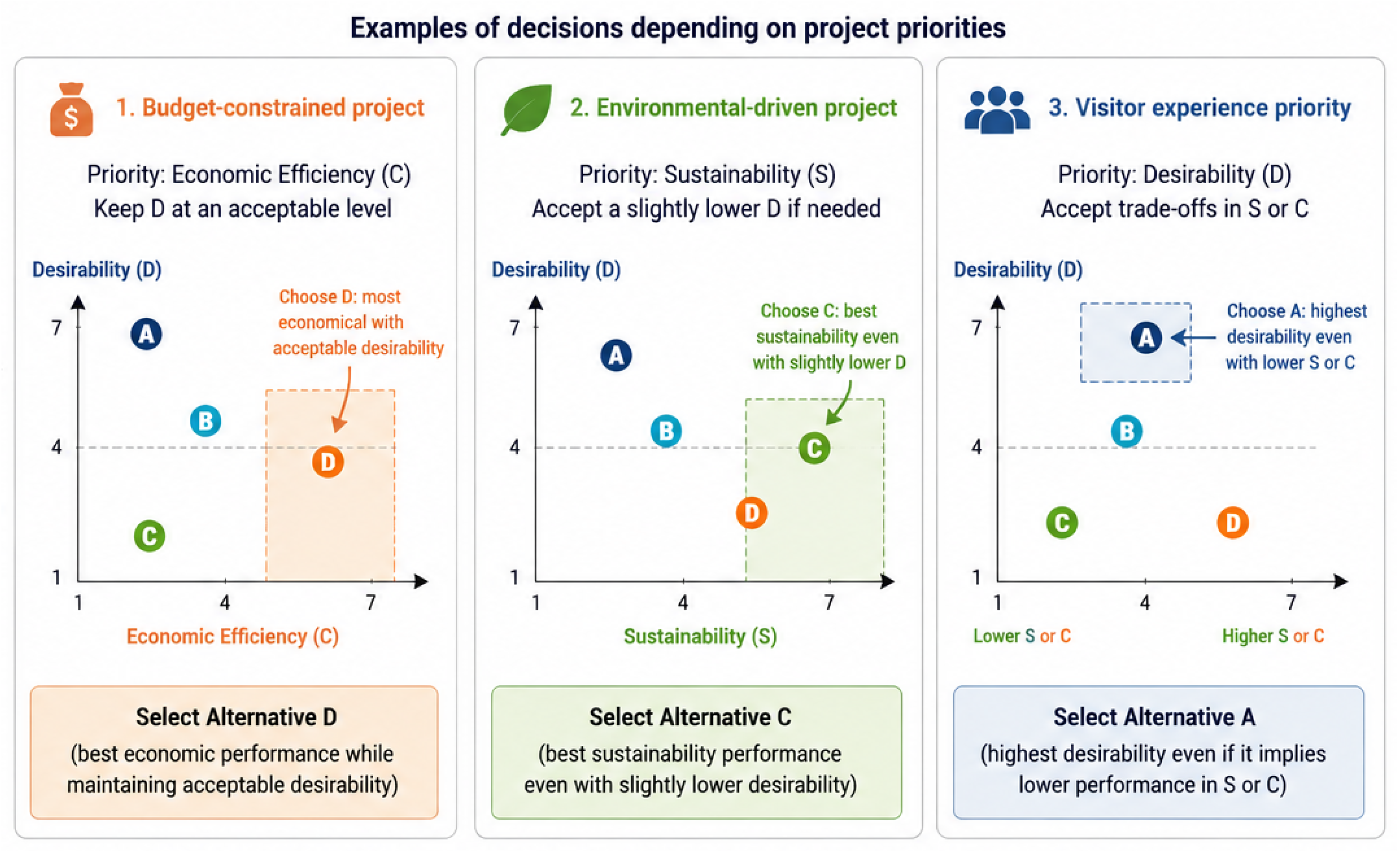
The main practical application of the model lies in its ability to support designers in seeking a balance among the different criteria considered, rather than directing the design process toward the isolated maximization of any single criterion. Thus, during the generation and evaluation of alternatives, the model enables different configurations to be compared and the solution presenting the most appropriate combination of desirability, sustainability, and economic efficiency according to the specific project requirements to be selected. For example, in a project subject to budget constraints, an alternative perceived as more economical could be prioritized while maintaining an acceptable level of desirability; whereas in a project where environmental requirements are more relevant, a configuration with better perceived sustainability performance could be selected even if its predicted desirability were slightly lower. In projects where visitor experience constitutes the primary criterion, the designer could choose a solution with higher desirability even if this entails less favorable performance in one of the remaining dimensions. The model therefore enables these trade-off solutions to be systematically identified and compared from the early stages of the design process. As illustrated in Figure 12, the proposed framework enables designers to systematically identify and compare trade-off solutions according to project-specific priorities.
Figure 12.
Decision-making framework illustrating how different project priorities can lead to different design alternatives by balancing perceived desirability, sustainability, and economic efficiency.
Nevertheless, an important limitation of the study is that the sustainability and cost dimensions incorporated into the model represent users’ perceptual evaluations rather than objective indicators derived from technical or economic analyses. Consequently, perceived sustainability () cannot be considered equivalent to sustainability quantified through Life Cycle Assessment (), just as perceived cost () does not represent the actual cost determined through Life Cycle Costing (). Therefore, the model should be understood as a user-perception-based design-support tool rather than as an instrument for directly estimating emissions, energy consumption, carbon footprint, or actual manufacturing costs.
Future integration of Life Cycle Assessment data, Life Cycle Costing, weight, material quantities, manufacturing energy consumption, and actual component costs would make it possible to relate Kansei responses to objective indicators and develop a comprehensive multicriteria model.
A further limitation concerns the geographical and cultural scope of the sample. The study was not designed to establish universal perceptual preferences across all regions or cultural contexts. Kansei evaluations may be influenced by cultural background, previous experience, and contextual factors. Consequently, the findings should be interpreted as evidence derived from the population sampled in the present study and should not be automatically generalized to all provinces or population groups.
Cross-cultural and international generalization would require replication of the experiment with independent samples from different geographical and cultural contexts. Future studies could also complement the quantitative Kansei evaluation with structured interviews or expert panels involving museum designers, conservators, and exhibition professionals from different countries. Such validation would enable the stability of the identified perceptual relationships across contexts to be assessed.
The predictive scope of the present study should be distinguished from generalization to completely new display-case designs. The participant-level validation strategy ensured that all evaluations from the same participant were assigned exclusively to either the training or the testing subset. Therefore, the reported predictive performance reflects the ability of the models to estimate responses from participants not involved in model training within the investigated design space. However, because only four design configurations were experimentally evaluated, this validation does not demonstrate generalization to completely new display-case designs. Furthermore, the predictive inputs are perceptual Kansei evaluations rather than direct physical design parameters. Consequently, the current models should not be interpreted as validated predictors of the desirability of previously unseen display-case configurations before those configurations have been perceptually evaluated.
Generalization to new designs would require a substantially larger and more diverse set of configurations and an external or design-level validation strategy in which complete alternatives are excluded from model development.
7. Conclusions
This study addressed three research questions concerning the perceptual differentiation of museum display-case configurations, the prediction of perceived desirability, and the relationships among desirability, perceived sustainability, and perceived economic efficiency.
Regarding RQ1, the four evaluated design configurations generated significantly different perceptual profiles. Alternative A achieved the highest perceived desirability, Alternative C the highest perceived sustainability, and Alternative D the highest perceived economic efficiency. These results confirm that the three perceptual dimensions do not necessarily evolve in the same direction and support their joint consideration during alternative evaluation.
Regarding RQ2, the selected Kansei variables provided relevant information for estimating perceived desirability. Random Forest achieved the best overall predictive performance under participant-level validation, with an RMSE of 0.711, an MAE of 0.546, a MAPE of 11.81%, and an of 0.763, while reliability emerged as the variable most strongly associated with desirability. The results therefore demonstrate predictive capacity for previously unseen participants within the investigated design space.
Regarding RQ3, perceived desirability was associated with perceived sustainability and perceived economic efficiency, although these relationships were strongly conditioned by the design alternative. Consequently, desirability should not be interpreted as an independent determinant of either dimension. Instead, the three perceptual outcomes provide complementary information that can support the comparison of alternative design configurations and the identification of trade-off solutions during early design stages.
Overall, achievement of the six specific objectives and the answers obtained for the three research questions support the applicability of the proposed Kansei-based framework as a perceptual decision-support approach for the evaluated museum display-case configurations. Its contribution lies in integrating emotional acceptance with perceived sustainability and perceived economic efficiency rather than optimizing any of these dimensions independently.
Finally, it should be emphasized that the present study analyzes perceived sustainability and cost rather than objective life-cycle indicators or monetary costs. As a future research direction, the integration of the Kansei model with LCA and LCC data is proposed, together with quantifiable engineering variables, such as weight, material volume, embodied energy, disassemblability, recyclability, and manufacturing cost. This extension would enable the proposed approach to evolve from a perceptual prediction tool into a comprehensive multicriteria optimization system for industrial design.
Another important extension of the present research would be to investigate the individual contribution of the different design components. In the current study, the four stimuli represent complete, bundled design concepts rather than a full factorial combination of individual design elements. Consequently, the differences observed among the alternatives should be interpreted as configuration-level effects and cannot be directly attributed to specific components. In particular, the current experimental design does not allow the independent effects of glazing, structural system, or base cladding, nor the potential interactions among these factors, to be determined. Future research could therefore implement a factorial experimental design in which the relevant material and constructive variables are systematically combined.
Author Contributions
Conceptualization, Ó.L. and A.G.G.; methodology, Ó.L.; software, Ó.L.; validation, Ó.L. and A.G.G.; formal analysis, Ó.L.; investigation, Ó.L. and A.G.G.; resources, Ó.L. and A.G.G.; data curation, Ó.L. and A.G.G.; writing—original draft preparation, Ó.L.; writing—review and editing, A.G.G.; visualization, Ó.L.; supervision, A.G.G.; project administration, A.G.G.; funding acquisition, Ó.L. and A.G.G. All authors have read and agreed to the published version of the manuscript.
Funding
This work was partially funded by the Spanish Ministry of Science and Innovation’s European and Regional Government of Extremadura (Spain), (GR24148, PID2023-147409NB-C22 funded by MCIN/AEI/10.13039/501100011033).
Institutional Review Board Statement
Ethical review and approval were not required for this study because the survey was voluntary and anonymous, no personally identifiable information was collected, and the data were analyzed exclusively in aggregated form for research purposes.
Informed Consent Statement
Informed consent was obtained from all participants prior to completing the survey. Participants were informed about the purpose of the study, the voluntary and anonymous nature of their participation, and the statistical use of the collected data.
Data Availability Statement
The data supporting the findings of this study are available from the corresponding author upon reasonable request.
Acknowledgments
The authors would like to acknowledge the following institutions. This work was partially funded 85% by the European Union through the European Regional Development Fund and the Junta de Extremadura. Managing Authority: Ministerio de Hacienda.
Conflicts of Interest
The authors declare no conflicts of interest.
References
- Nagamachi, M. Kansei Engineering: A New Ergonomic Consumer-Oriented Technology for Product Development. Int. J. Ind. Ergon. 1995, 15, 3–11. [Google Scholar] [CrossRef] [Scilit]
- Nagamachi, M. Kansei Engineering and Its Applications in Automotive Design. In SAE Technical Paper; 1999-01-1265; SAE International: Warrendale, PA, USA, 1999. [Google Scholar]
- Schütte, S.T.W.; Eklund, J.; Axelsson, J.R.C.; Nagamachi, M. Concepts, Methods and Tools in Kansei Engineering. Theor. Issues Ergon. Sci. 2004, 5, 214–231. [Google Scholar] [CrossRef] [Scilit]
- López, O.; Murillo, C.; González, A. Systematic Literature Reviews in Kansei Engineering for Product Design—A Comparative Study from 1995 to 2020. Sensors 2021, 21, 6532. [Google Scholar] [CrossRef] [Scilit] [PubMed]
- Quan, H.; Li, S.; Hu, J. Product Innovation Design Based on Deep Learning and Kansei Engineering. Appl. Sci. 2018, 8, 2397. [Google Scholar] [CrossRef] [Scilit]
- Du, Y.; Liu, X.; Cai, M.; Park, K. A Product’s Kansei Appearance Design Method Based on Conditional-Controlled AI Image Generation. Sustainability 2024, 16, 8837. [Google Scholar] [CrossRef] [Scilit]
- Muñoz-López, N.; Biedermann, A.; Santolaya-Sáenz, J.L.; Valero-Martín, J.I.; Serrano-Tierz, A. Sustainability in the Design of an Itinerant Cultural Exhibition. Study of Two Alternatives. Appl. Sci. 2021, 11, 9863. [Google Scholar] [CrossRef] [Scilit]
- Muñoz López, N.; Valero Martín, J.I.; Biedermann, A.; Santolaya Sáenz, J.L.; Fernández-Vazquez, A. Projecting More Sustainable Product and Service Designs. Sustainability 2021, 13, 11872. [Google Scholar] [CrossRef] [Scilit]
- Marco-Almagro, L.; Tort-Martorell, X. Statistical Methods in Kansei Engineering: A Case of Statistical Engineering. Qual. Reliab. Eng. Int. 2012, 28, 563–573. [Google Scholar] [CrossRef] [Scilit]
- Breiman, L. Random Forests. Mach. Learn. 2001, 45, 5–32. [Google Scholar] [CrossRef] [Scilit]
- Friedman, J.H. Greedy Function Approximation: A Gradient Boosting Machine. Ann. Stat. 2001, 29, 1189–1232. [Google Scholar] [CrossRef] [Scilit]
- Strobl, C.; Boulesteix, A.L.; Zeileis, A.; Hothorn, T. Bias in Random Forest Variable Importance Measures: Illustrations, Sources and a Solution. BMC Bioinform. 2007, 8, 25. [Google Scholar] [CrossRef] [Scilit] [PubMed]
- Ramani, K.; Ramanujan, D.; Bernstein, W.Z.; Zhao, F.; Sutherland, J.; Handwerker, C.; Choi, J.K.; Kim, H.; Thurston, D. Integrated Sustainable Life Cycle Design: A Review. J. Mech. Des. 2010, 132, 091004. [Google Scholar] [CrossRef] [Scilit]
- Zhang, X.; Zhang, L.; Fung, K.Y.; Bakshi, B.R.; Ng, K.M. Sustainable Product Design: A Life-Cycle Approach. Chem. Eng. Sci. 2020, 217, 115508. [Google Scholar] [CrossRef] [Scilit]
- Cerri, D. Multi-Objective Optimization of Product Life-Cycle Costs and Environmental Impacts. Master’s Thesis, Politecnico di Milano, Milan, Italy, 2011. [Google Scholar]
- Miah, J.H.; Koh, S.C.L.; Stone, D. A Hybridised Framework Combining Integrated Methods for Environmental Life Cycle Assessment and Life Cycle Costing. J. Clean. Prod. 2017, 168, 846–866. [Google Scholar] [CrossRef] [Scilit]
- Hannouf, M.; Assefa, G. A Life Cycle Sustainability Assessment-Based Decision-Analysis Framework. Sustainability 2018, 10, 3863. [Google Scholar] [CrossRef] [Scilit]
- Mengistu, A.T.; Dieste, M.; Panizzolo, R.; Biazzo, S. Sustainable Product Design Factors: A Comprehensive Analysis. J. Clean. Prod. 2024, 463, 142260. [Google Scholar] [CrossRef] [Scilit]
- Ameli, M.; Mansour, S.; Ahmadi-Javid, A. A Multi-Objective Model for Selecting Design Alternatives and End-of-Life Options under Uncertainty: A Sustainable Approach. Resour. Conserv. Recycl. 2016, 109, 123–136. [Google Scholar] [CrossRef] [Scilit]
- Zhou, C.C.; Yin, G.F.; Hu, X.B. Multi-Objective Optimization of Material Selection for Sustainable Products: Artificial Neural Networks and Genetic Algorithm Approach. Mater. Des. 2009, 30, 1209–1215. [Google Scholar] [CrossRef] [Scilit]
- Morini, A.A.; Ribeiro, M.J.; Hotza, D. Early-Stage Materials Selection Based on Embodied Energy and Carbon Footprint. Mater. Des. 2019, 178, 107861. [Google Scholar] [CrossRef] [Scilit]
- Lian, K.Y. Affective-Blue Design Methodology for Product Design Based on Integral Kansei Engineering. Math. Probl. Eng. 2022, 2022, 5019588. [Google Scholar] [CrossRef] [Scilit]
- Rasamoelina, F.; Bouchard, C.; Aoussat, A. Towards a Kansei-Based User Modeling Methodology for Eco-Design. Int. J. Affect. Eng. 2013, 12, 337–348. [Google Scholar] [CrossRef] [Scilit][Green Version]
- Li, H.; Jiang, H.; Xu, Q. Kansei Engineering in Sustainable Design: Enhancing User Perceptual Imagery for Recycled Material Products under the Double Carbon Objective. Glob. NEST J. 2026, 28, 1–14. [Google Scholar] [CrossRef] [Scilit]
- Bouchard, C.; Lim, D.; Aoussat, A. Mapping a Multi-Sensory Identity Territory at the Early Design Stage. Int. J. Affect. Eng. 2013, 12, 191–200. [Google Scholar] [CrossRef] [Scilit][Green Version]
- Xiong, Y.; Li, Y.; Pan, P.; Chen, Y. A Regression-Based Kansei Engineering System Based on Form Feature Lines for Product Form Design. Adv. Mech. Eng. 2016, 8, 1–12. [Google Scholar] [CrossRef] [Scilit]

Disclaimer/Publisher’s Note: The statements, opinions and data contained in all publications are solely those of the individual author(s) and contributor(s) and not of MDPI and/or the editor(s). MDPI and/or the editor(s) disclaim responsibility for any injury to people or property resulting from any ideas, methods, instructions or products referred to in the content. |
© 2026 by the authors. Licensee MDPI, Basel, Switzerland. This article is an open access article distributed under the terms and conditions of the Creative Commons Attribution (CC BY) license.