


Abstract
This work focuses on studying the magnetohydrodynamic flow and heat transfer mechanism of a Casson–Maxwell nanofluid due to a stretching surface through a porous medium, using a physics-informed neural network (PINNs) approach as the main tool for the solution of the physical problem. The mathematical model describes the phenomena of viscosity variation with temperature, viscous dissipation, thermal slip, Brownian motion, thermophoresis, and drag force due to a porous medium, which give a realistic physical scenario of the coupled transport phenomena of momentum, heat, and nanoparticles. First, the nonlinear partial differential equations are converted into a dimensionless boundary layer model using similarity transformations. Then, the yielded system is solved via the PINNs approach, which integrates physical law within the optimization procedure. The proposed technique does not require a significant number of labeled datasets and provides accurate and stable predictions of the strongly nonlinear flow. A comprehensive parametric analysis was performed to explore the impact of the dimensionless controlling factors on the velocity, temperature, and nanoparticle concentration distributions. It is found that the interaction of magnetic field effects, porous media resistivity, thermal and concentration slip, viscosity variation, and viscous heating significantly modifies the transport features for the studied model of the Casson–Maxwell nanofluid, which can be used effectively to control the rate of heat and mass transfer. This study proves the efficiency of the PINN technique in solving this type of model, and it also provides useful insights for designing thermal systems, energy conversion devices, and electrically conducting viscoelastic nanofluid transport problems. The close concordance between the present findings and established data from the literature validates the precision and dependability of the developed PINN-based framework.
1. Introduction
The study of Maxwell nanofluids has recently received increased attention from the scientific community, mainly due to their ability to combine two different properties of materials, which are, on one hand, the viscoelastic nature of Maxwell non-Newtonian fluids and, on the other, the impressive thermal performance provided by the presence of nanoparticles in the solution. In fact, this allows them to achieve better heat transfer performance along with a more controlled flow behavior. The ability of Maxwell nanofluids to accurately simulate the stress relaxation behavior and at the same time improve the thermal conductivity makes them extremely attractive for use as working fluids in the framework of novel thermal engineering applications. As far as their practical applications are concerned, the potential of Maxwell nanofluids covers a wide variety of industrial sectors, among which one can include electronic cooling systems, polymer production, biological fluid handling, solar energy collection, nuclear thermal management, and material processing. These important applications motivate the large number of studies devoted to the physics of the phenomena governing the Maxwell nanofluids flow. Irfan et al. [1] discussed the simultaneous effects of magnetic field and heat generation or absorption in the convective Maxwell nanofluid flow and their notable impact on momentum and heat flow phenomena. Furthermore, Sravanthi and Gorla [2] studied the simultaneous effect of the heat sink or source, chemical reaction, and magnetohydrodynamics in the Maxwell nanofluid flow over an exponentially stretching surface using the homotopy analysis method. Mukhtar et al. [3] analyzed the radiative magnetohydrodynamic flow of Maxwell nanofluid over a stretching sheet numerically through heat transfer process. These contributions were followed by Razzaq et al. [4], who investigated the effect of nonsimilarity on the forced convection flow of Maxwell nanofluids over an exponentially stretching sheet with convective boundary conditions. Ganga et al. [5] also made recent significant progress by applying the concepts of unsupervised neural networks to the Maxwell fluids and the flow over curved surfaces having nonlinear convection effects and thermally dependent properties. In another study, Khader et al. [6] presented a novel numerical scheme for the solution of the Maxwell nanofluids with heat generation and convective heating using the Mohand transform along with the Adomian decomposition technique. These important studies clearly highlight the rising importance of Maxwell nanofluids and the need for research in this area.
Casson nanofluids have proven to be an important category of non-Newtonian nanofluids because of their unique ability to merge the yield stress nature of Casson fluids with the high thermal conductivities offered by nanoparticle dispersion. Such features enable the improved transport of heat, enhanced flow control, and practical representation of real fluids used in the industry, which show nonlinear rheological behaviors. Due to such benefits, Casson nanofluids have become incredibly useful in many engineering applications, including biomedical applications, blood flow analysis, lubrication, cooling of electronic parts, metallurgy production, chemical process industry, and microfluidics, where effective thermal control and non-Newtonian fluid dynamics prediction play a key role. Therefore, many efforts have been made to investigate Casson nanofluids thermally and hydrodynamically through various physical mechanisms. The studies by Shit and Mandal [7] on entropy generation in unsteady magnetohydrodynamics flow of Casson nanofluids over a stretching vertical plate while considering thermal radiation provided important information regarding thermodynamic irreversibility. In another study, Tawade et al. [8] considered the effect of Brownian motion, thermophoresis, and chemical reactions on the flow of Casson nanofluids over stretching surfaces. Furthermore, Alali and Megahed [9] studied the effect of velocity slip and radiation on the dissipative magnetohydrodynamic flow of Casson nanofluid film on an unsteady stretching sheet. In yet another interesting work, Umavathi et al. [10] presented results on magnetohydrodynamic squeezing flow of Casson nanofluids between parallel disks with convection heating. Triveni et al. [11] carried out a study to analyze the heat transfer characteristics of magnetohydrodynamic Casson nanofluid flow with a nonlinear stretching surface and non-uniform heat source, providing the significant thermal characteristics of the system due to internal heat generation in the system. Another highly important study was conducted by Senthilvadivu et al. [12], in which the authors analyzed the time-dependent Darcy–Forchheimer flow of hybrid Casson nanofluid with carbon nanotubes over a Riga plate with nonlinear thermal radiation and viscous dissipation. The most recent work was carried out by Wang et al. [13], where the authors analyzed the numerical investigation of hybrid Casson nanofluid flow with a magnetic dipole and gyrotactic microorganisms. The latest research in the field was carried out by Alblawi et al. [14], where the authors suggested a new Reynolds model to analyze the thermal characteristics of Casson nanofluids in moving and fixed frames of references.
Casson–Maxwell nanofluids are a highly developed group of non-Newtonian nanofluids which combine the yield stress features of the Casson fluid along with the viscoelastic nature of the Maxwell fluid, in addition to the enhanced thermal conductivity of the suspended nanoparticles. Such a combination of properties enables accurate simulation of the behavior of complex fluids encountered in various industries and biology, in which the plastic and elastic relaxation properties play critical roles in transport processes. The unique nature of these fluids makes them applicable in a range of engineering applications, including energy storage, electronics cooling, solar energy harvesting, chemical reactions, flows in porous media, surface coatings, and precision machining. Therefore, considerable attention has been paid to studying Casson–Maxwell nanofluid transport mechanisms. Mushtaq et al. [15] performed a combined numerical and statistical analysis of Casson–Maxwell nanofluid flow with the Cattaneo–Christov heat flux model to understand the non-Fourier heat transport mechanism in viscoelastic nanofluids. Later, Gowda et al. [16] studied Casson–Maxwell nanofluid flow with wall slips in between two stretching disks and showed that the wall slip conditions can influence the heat and momentum transport properties. Raafat and Ibrahim [17] performed an extensive analysis of entropy generation and thermal efficiency of Casson–Maxwell, Casson–Jeffrey, and Casson–Oldroyd-B binary nanofluids in a parabolic trough solar collector, emphasizing the thermal differences in the different rheological models in solar energy systems. In another numerical investigation, Althobaiti [18] studied the effect of activation energy on dissipative magnetohydrodynamic Casson–Maxwell fluid flow through a porous medium, considering chemical reactions, Joule heating, and Soret effects. Elsaid et al. [19] studied three-dimensional Casson–Maxwell nanofluid flow subject to the effects of an exponentially varying heat source, thermal radiation, and pollutant concentration, thus providing more insight into the multi-dimensional transport which can be found in many applications. The effects of activation energy on the Casson–Maxwell fluid flow over a porous medium in the presence of blowing and suction effects were studied by Jayaprakash et al. [20]. The works mentioned above prove the increasing importance of Casson–Maxwell nanofluids in modern thermal fluid engineering and provide a good foundation for developing more complicated models.
In spite of the high efficiency of deep learning techniques in modeling complicated physical phenomena [21,22], they require vast amounts of data for training purposes, which is hardly applicable in scientific and engineering areas where data are rare or costly to obtain. Physics-informed neural networks (PINNs) serve as an excellent alternative to deep learning methods since they incorporate physical laws in the process of training [23]. Specifically, the corresponding partial differential equations, along with all of their initial and boundary conditions, are included in the loss function. Consequently, the use of physics knowledge greatly decreases the necessity of having big data for the task at hand. Physics-informed neural networks (PINNs) have become a powerful computational framework for solving complex fluid mechanics and heat transfer problems by incorporating physical laws into neural network training, enabling their widespread use across various scientific and engineering disciplines. Specifically, Zhong et al. [24] designed a PINN technique for low-temperature plasma modeling, which exhibited its capability of predicting physically realistic behavior and being independent of classical numerical discretization methods. Nguyen et al. [25] further extended the applicability range of PINNs to thermo-mechanical non-Newtonian fluid problems through the successful simulation of the rubber calendering process. Xiao et al. [26] proposed a hard boundary constraint technique using PINNs to improve the accuracy of predicting solutions with enhanced numerical stability. Moreover, Mekheimer et al. [27] implemented a physics-informed deep learning scheme to investigate magnetohydrodynamic particle-laden suspension flow with heat transfer in porous annular-sector ducts, which verified the applicability of PINNs to solve coupled transport in porous media.
Although significant progress has been made in modeling non-Newtonian nanofluids and in applying physics-informed neural networks (PINNs) to nonlinear transport problems, existing PINN studies have mainly focused on simplified physical models or benchmark flow configurations. Their capability to accurately solve strongly coupled boundary-layer systems involving simultaneous temperature-dependent viscosity, viscous dissipation, thermal slip, Brownian diffusion, thermophoresis, magnetohydrodynamic effects, and porous-medium resistance has remained largely unexplored. The novelty of the present work therefore extends beyond the introduction of a more sophisticated Casson–Maxwell nanofluid models. It demonstrates that a single physics-informed learning framework can accurately capture the interaction among multiple nonlinear transport mechanisms without requiring labeled training data or mesh generation. By embedding the complete governing equations and boundary conditions directly into the optimization process, the proposed PINN provides stable and accurate predictions for the coupled momentum, thermal, and nanoparticle concentration fields while maintaining excellent agreement with established benchmark solutions. Consequently, this study not only broadens the applicability of PINNs to highly coupled non-Newtonian nanofluid systems but also establishes a reliable computational framework for solving complex multiphysics transport problems that are challenging for conventional numerical approaches.
2. Methodology
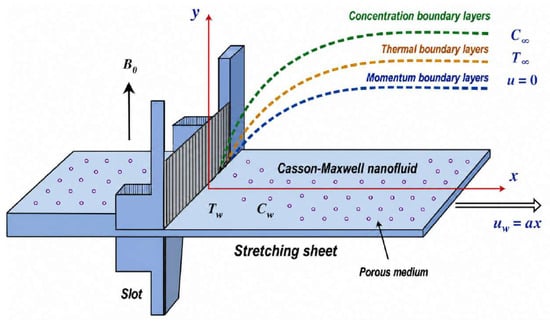
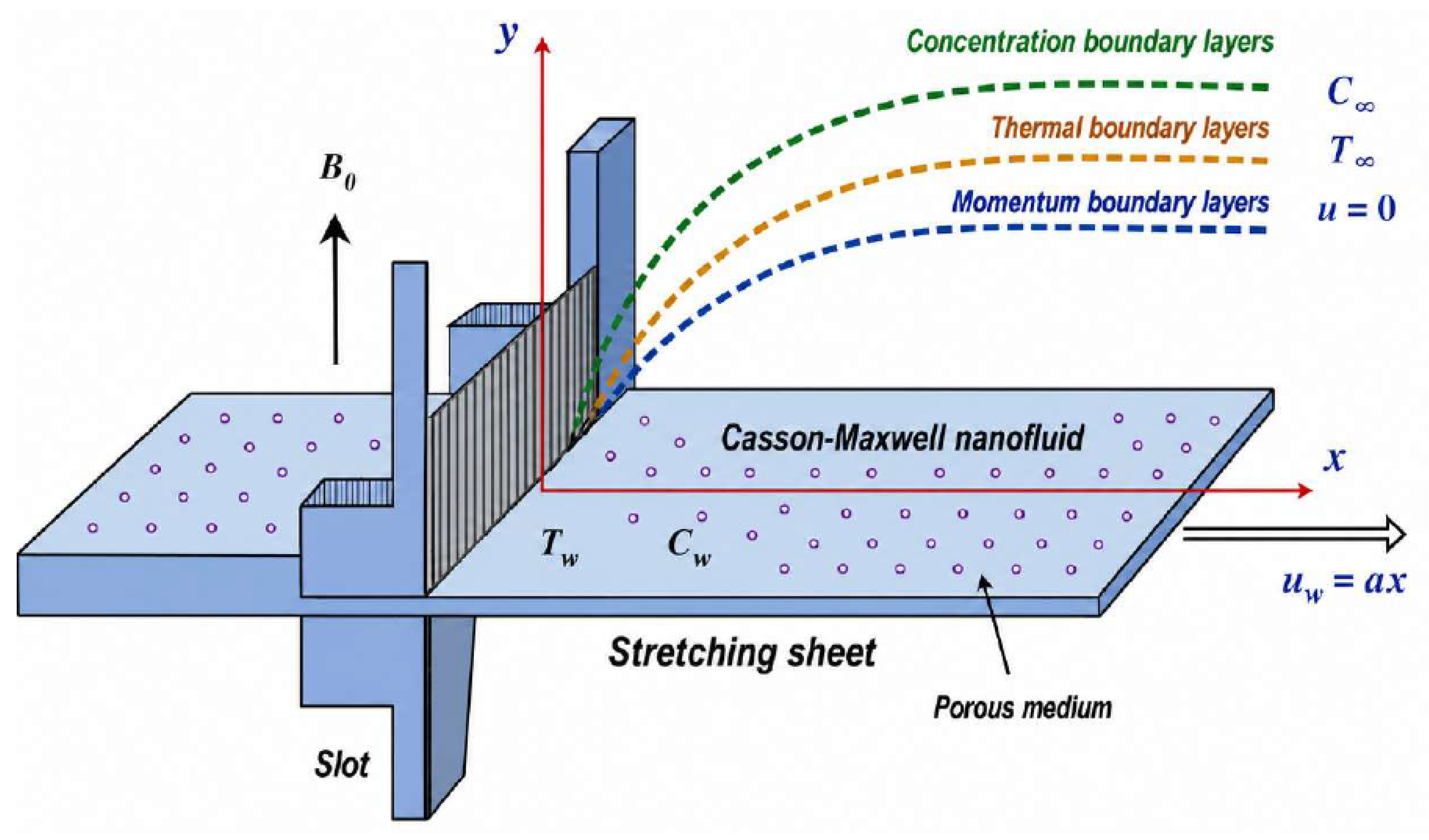
The mathematical description of the current problem is made through the continuity, momentum, energy, and concentration equations of nanoparticles that describe the MHD flow with heat and mass transfer of Casson–Maxwell nanofluids in a porous medium, considering the impact of Brownian motion, thermophoresis, and nonlinear rheology. Moreover, the flow geometry together with the coordinate system used is presented schematically in Figure 1 below. The governing equations are mathematically written as follows [17]:
Figure 1.
Physical structure with coordinates.
In this model, Equation (1) expresses the conservation of mass, while Equation (2) represents the momentum balance, accounting for viscous diffusion, inertial effects, magnetic resistance, porous-medium drag, and the elastic contributions associated with the fluid rheology. The thermal behavior is governed by Equation (3), which incorporates heat conduction, viscous dissipation, Brownian diffusion, thermophoretic transport, and convective energy transfer. Finally, Equation (4) describes the nanoparticle concentration field by considering the combined effects of Brownian motion, thermophoresis, and advective mass transport. Together, these equations capture the coupled momentum, thermal, and species transport mechanisms that characterize the flow system under investigation. Here, is the Casson parameter, is the magnetic field intensity, is the fluid thermal conductivity, is the nanofluid Brownian diffusion coefficient, is the electric conductivity, k is the permeability of the porous medium, is the ambient temperature, is the specific heat, is the thermophoretic diffusion coefficient, u and v are the velocity vector components, is the fluid viscosity, is the fluid density, is the fluid’s relaxation coefficient, and G is the concentration. Furthermore, the diverse engineering applications and practical significance of nanofluids were comprehensively discussed by Zulfiqar et al. [28].
The fluid viscosity is treated in this work as a temperature-sensitive property governed by the following relationship [29]:
Here, denotes the dynamic viscosity at the ambient reference temperature , while is the dimensionless viscosity variation parameter that characterizes the sensitivity of viscosity to the temperature. The nondimensional temperature ratio varies from 0 at the ambient fluid to 1 at the wall, ensuring a physically consistent exponential variation of viscosity within the boundary layer. In the present study, is restricted to the investigated range, for which this model has been widely adopted in the literature [29]. Additionally, for a comprehensive discussion of the physical significance, mathematical modeling, and engineering applications of variable fluid properties, readers are referred to the work of Min et al. [30]. Also, to properly capture the influence of slip phenomena on both thermal and concentration fields, the boundary conditions are prescribed as follows [31]:
where is the suction velocity and A and B denote positive dimensional constants, each carrying units of length. Now, in order to simplify the governance model, similarity transformations, as described below, are used to transform the dimensional partial differential formulae (Equations (1)–(4)) into dimensionless ordinary differential equations. This is for reducing the complexity of the mathematics without changing the physics, thus enabling the solution process to become more computationally efficient [31]:
where is the kinematic viscosity. Invoking the dimensionless variables defined in Equation (8), the governing formulae (Equations (1)–(4)) together with the boundary conditions in Equations (6) and (7), transform into
From the foregoing, it is clear that the physical model is controlled by certain parameters that determine the velocity, temperature, and concentration profiles as well as the rate of heat and mass transfer; these parameters can be expressed as follows:
Any rigorous analysis of the current model requires adequate knowledge of three dimensionless groups which have industrial importance: the skin friction coefficient , the local Nusselt number , and the local Sherwood number . Contrary to what may be thought at first glance, these dimensionless groups play the role of diagnostic tools; the skin friction coefficient estimates the resistive frictional forces, while the local Nusselt number gives an estimate of the convective heat exchange at the wall, and the local Sherwood number indicates the efficiency of the mass transfer process. All of them give a complete characterization of the transport phenomena in the flow and are defined by the following relations:
where is the local Reynolds number.
3. PINN Solution
3.1. Mathematical Formulation and Neural Network Design
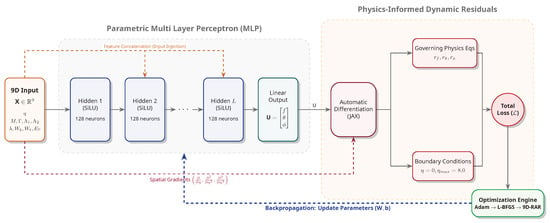
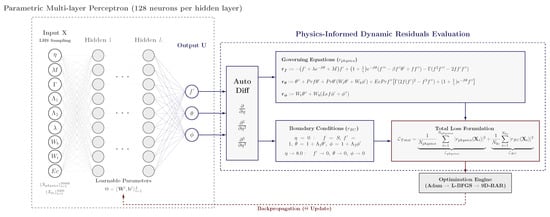
The resultant highly nonlinear coupled BVP is solved using the parametric physics-informed neural network (PPINN). As opposed to using the discretization of meshes, the PPINN models a continuous mapping of the surrogates , in which is the input vector composed of the similarity variable and the nondimensional parameter set. The set of trainable parameters is defined as , where are the weights and biases of the hidden layers (Figure 2). The neurons in each hidden layer have a count of 128 with a SiLU activation function, allowing for ease of learning the physics behind the nonlinear system.
Figure 2.
Architectural overview of the developed parametric physics-informed neural network (PINN) framework.
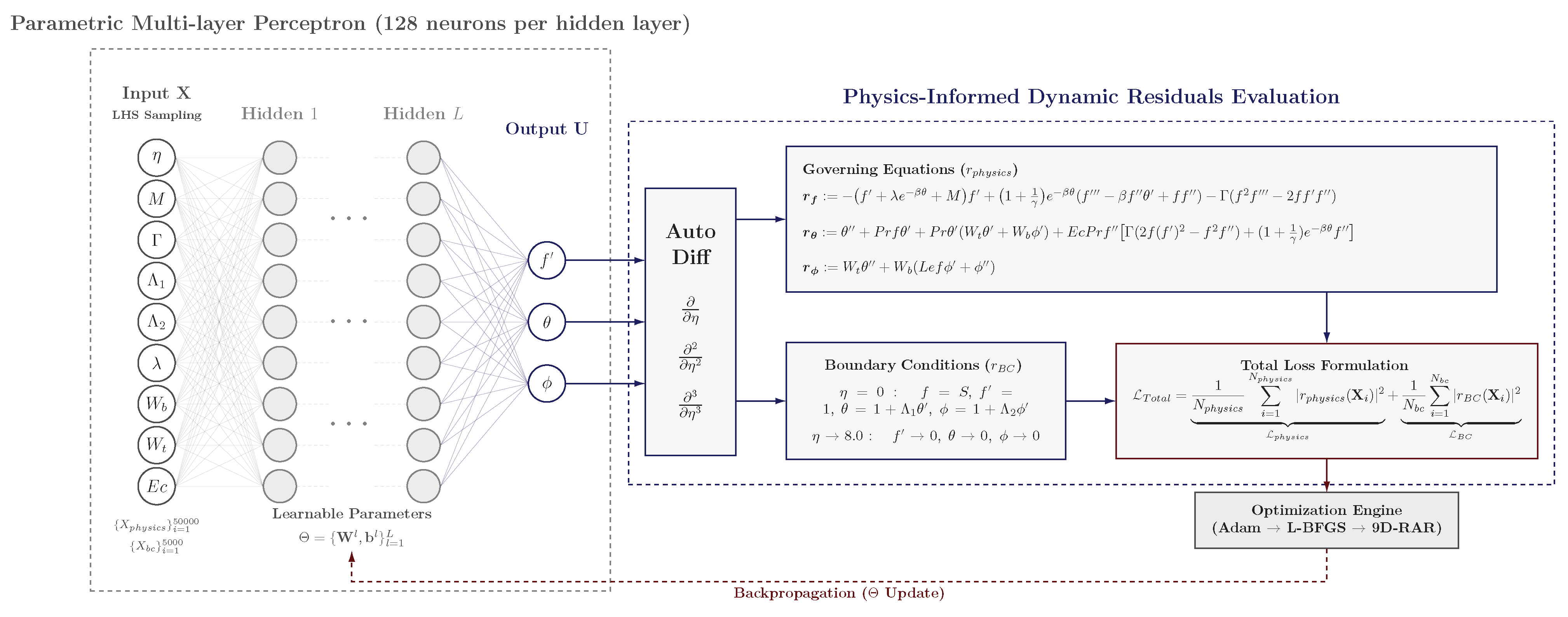
The neural architecture (Figure 3) is configured to establish a direct mapping from the 9D parametric input space to the continuous physical solution fields at the output layer. The embedded physical constraints are enforced through the Automatic Differentiation (AD) engine implemented in JAX, which accurately computes the spatial derivatives required by the governing equations while avoiding the numerical truncation errors inherent in conventional finite-difference discretization methods [32].
Figure 3.
Illustrative diagram of the physics-based residual computation procedure within the PINN architecture.
Furthermore, the proposed architecture employs an input-concatenated residual multi-layer perceptron (MLP) as a nine-dimensional parametric surrogate, comprising five hidden layers with 128 neurons per layer and sigmoid linear unit (SiLU) activation functions. The training dataset consisted of 55,000 active collocation points, including 5000 static boundary points generated using Latin Hypercube Sampling (LHS), 45,000 dynamic interior collocation points, and 5000 adaptive points introduced through a 9D Residual-Based Adaptive Refinement (9D-RAR) strategy. All input variables were normalized to the interval using Min–Max scaling. The optimization procedure was performed in two stages. First, the Adam optimizer was employed for 34,000 epochs with an exponentially decaying learning rate initialized at . Subsequently, the L-BFGS optimizer was applied with a convergence tolerance of and a maximum of 15,000 iterations. Additionally, the nine-dimensional input space bounds used for training were strictly defined as follows: , , , , , , , , and .
3.2. Physics-Informed Dynamic Residuals
The key advancement of the PINN model is the self-supervised optimization approach, where the network’s predictions are checked for physically acceptable results by measuring and penalizing any deviation from the basic governing equations, which include the Navier–Stokes momentum transport equations along with the energy and species conservation equations. The physics-based residuals are precisely formulated based on the established mathematical basis.
- Momentum Residual :
- Thermal Residual :
- Concentration Residual :
Simultaneously, the physical boundary conditions at the solid wall and the free stream are enforced through the boundary residual vector :
3.3. Optimization Protocol and Residual-Based Adaptive Refinement (RAR)
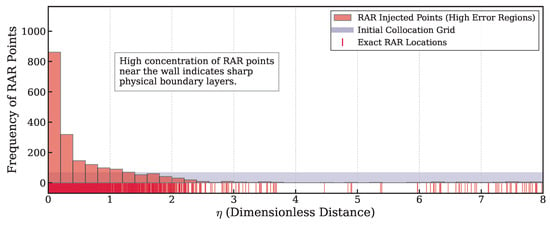
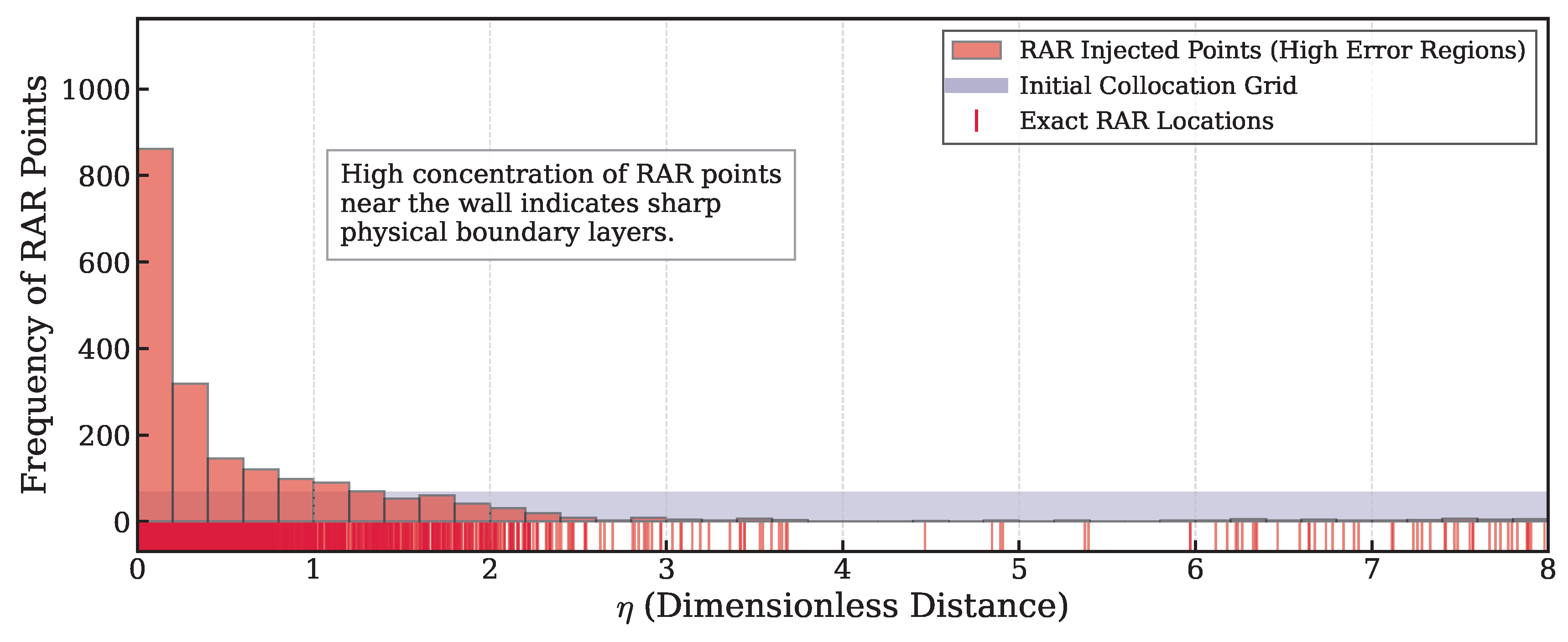
The surrogate model is trained by minimizing a unified loss function that simultaneously enforces the governing physical equations and the prescribed boundary conditions through a mean squared error criterion [33]. The optimization process adopts a hybrid strategy in which the Adam optimizer performs the initial global exploration, followed by the L-BFGS algorithm for accurate local convergence and enhanced solution refinement. To further improve prediction accuracy in regions with steep boundary-layer gradients, a 9D Residual-Based Adaptive Refinement (RAR) scheme is incorporated, dynamically enriching the collocation points in regions exhibiting large physics residuals (Figure 4).
Figure 4.
Spatial distribution of adaptively sampled collocation points produced through the 9D Residual-Based Adaptive Refinement (RAR) strategy.
3.4. Convergence Analysis and Computational Profiling
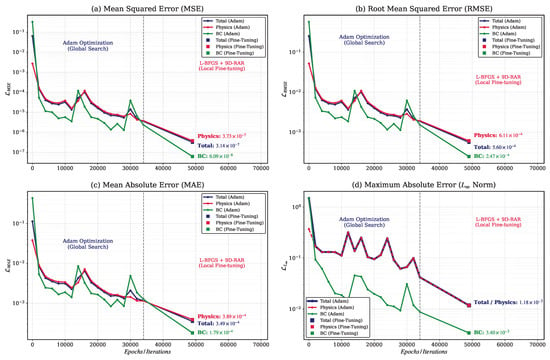
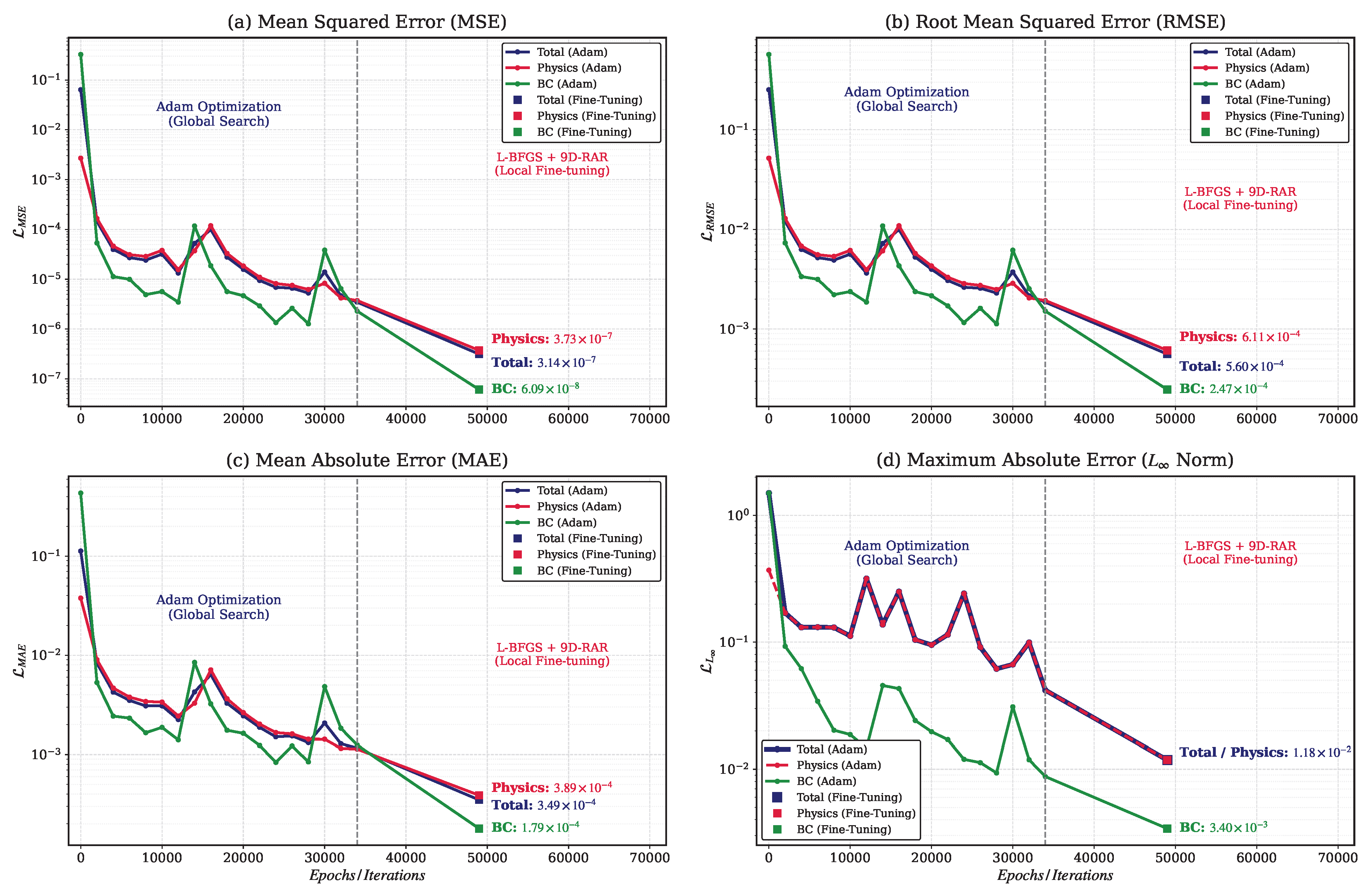
The success of the proposed 9D-RAR hybrid optimization is quantitatively validated through the loss convergence history. As illustrated in Figure 5, the Adam optimizer first establishes broad structural convergence across the loss landscape, after which the L-BFGS quasi-Newton optimizer aggressively drives the residuals toward their minimum. Following the application of the 9D Residual-Adaptive Refinement (9D-RAR) strategy, the surrogate model attains a terminal composite loss of . Moreover, the maximum absolute error (-norm) asymptotically converges to , rigorously confirming that the peak physical deviation was encountered at the most demanding parametric configuration within the nine-dimensional input.
Figure 5.
Training convergence profiles of key error indicators throughout the hybrid optimization procedure over the 8D parametric space: (a) mean squared error (MSE), (b) root mean squared error (RMSE), (c) mean absolute error (MAE), and (d) maximum absolute error.
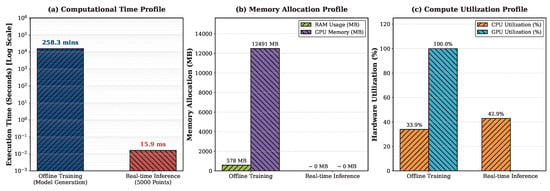
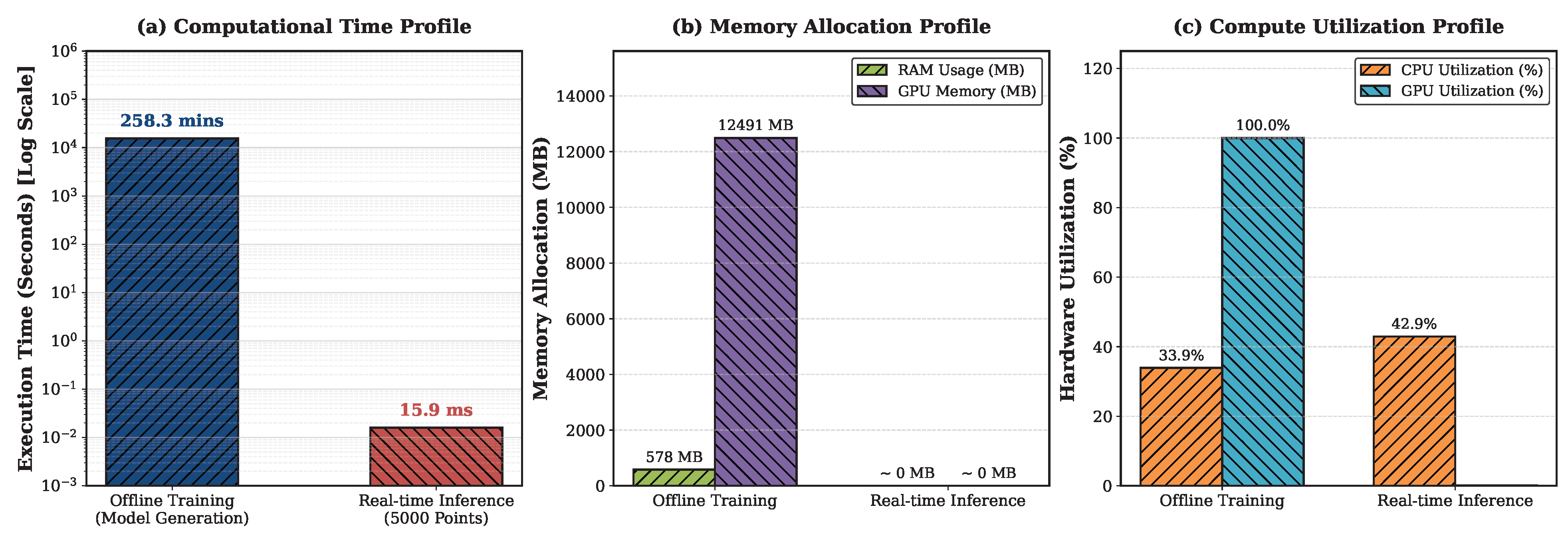
Furthermore, Figure 6 delineates the computational resource allocation and execution efficiency of the model. Although offline model generation involved a substantial one-time training cost of 258.3 min, the true engineering value of the PINN manifested itself in its inference paradigm. The fully trained 9D surrogate resolved 5000 discrete parametric points in merely 15.9 milliseconds using CPU hardware, effectively bypassing the stiff iterative integration schemes required by traditional Runge–Kutta or shooting methods.
Figure 6.
Resource utilization assessment of the PINN framework, where bar charts compare the offline training phase against real-time inference in terms of (a) computational time, (b) GPU or RAM usage, and (c) overall hardware load.
4. Verification of the Physics-Informed Neural Network Approach
In order to investigate the accuracy and reliability of the developed PINN framework, the current results for the skin friction coefficient were validated by comparing them with those of Ibrahim et al. [34], which were obtained using the Homotopy Analysis Method (HAM). This comparison was made for the same Casson parameter with and but for different values of Casson fluid parameter . Clearly, from Table 1, the current findings of the PINN approach showed good correlation with the existing HAM solution. The relative error lied between to , with the minimum error recorded when and the maximum error recorded when . These extremely small errors confirm the highly accurate nature of the proposed PINN approach for solving the present nonlinear MHD Casson–Maxwell nanofluid model.
Table 1.
values in changing with and .
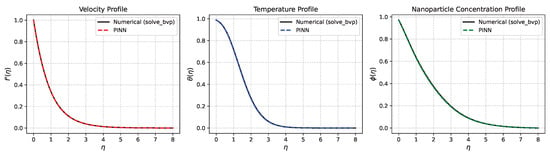
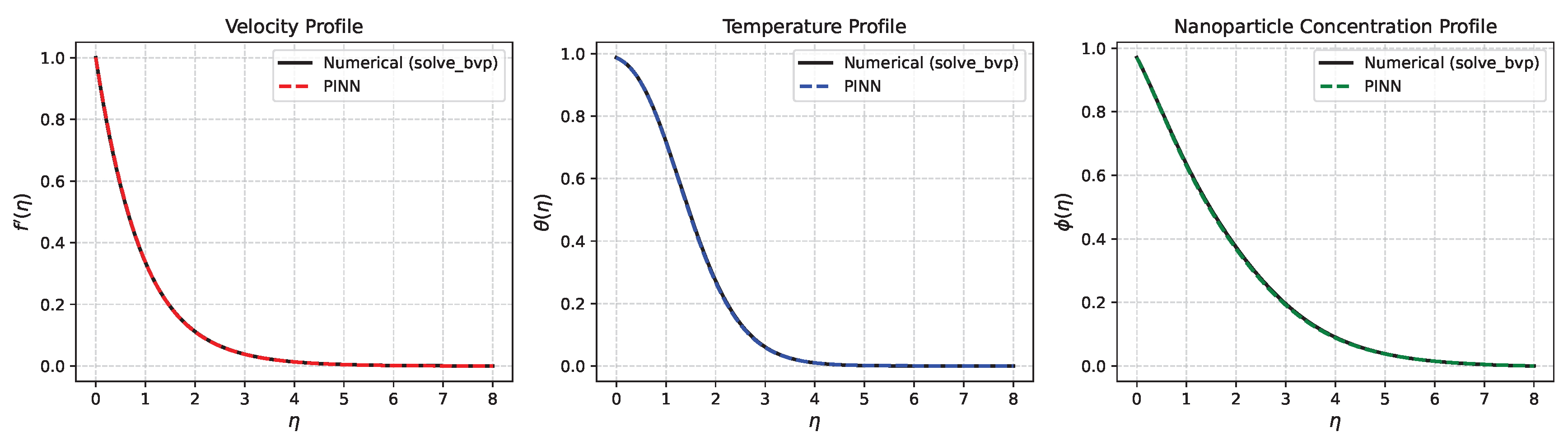
To further validate the proposed PINN framework, an additional benchmark was carried out against the well-established numerical boundary value solver under the same physical conditions of the complete mathematical model, including the effects of a variable density () and porous medium (). As summarized in both Figure 7 and Table 2, the predicted velocity, temperature, and concentration profiles exhibited excellent agreement with the numerical solution, with mean absolute errors to the order of – and maximum absolute errors below . These results provide strong evidence for the accuracy and robustness of the proposed PINN in solving the full nonlinear coupled transport model.
Figure 7.
Comparison with an established numerical solver.
Table 2.
Error analysis of the proposed PINN model compared with the solve_bvp solution.
5. Computational Results and Physical Analysis
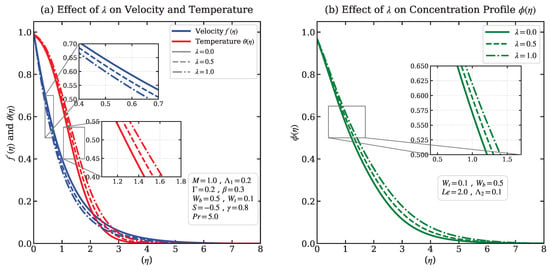
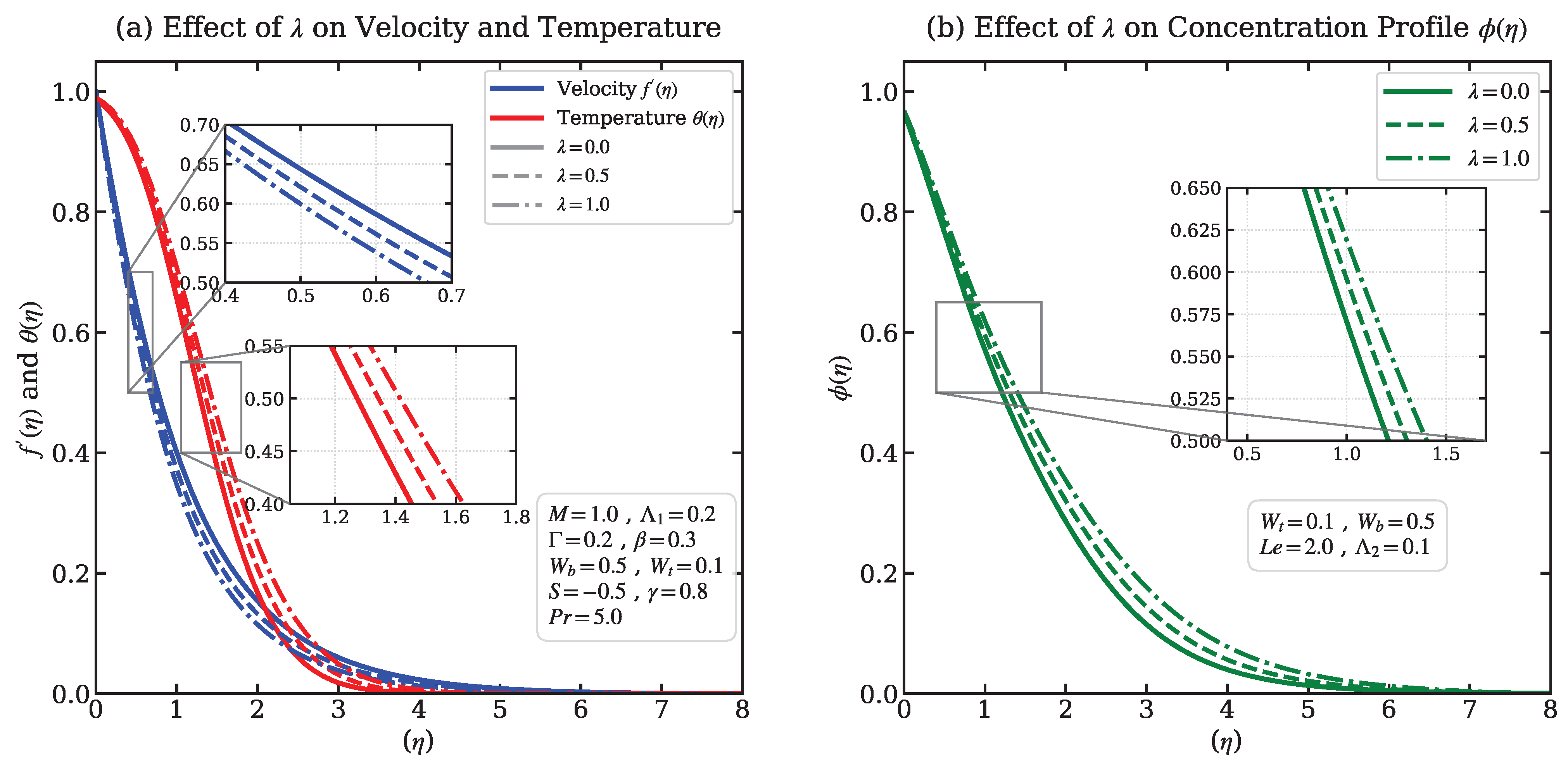
In this part, a detailed numerical analysis of the suggested model is performed using the PINN approach. The findings are presented and explained to demonstrate the influence of physical parameters that rule the governing process on the flow, thermal, and concentration behavior of MHD Casson–Maxwell nanofluid flow due to a stretching sheet through a porous medium, taking into account the impact of viscous dissipation, variable viscosity, and thermal slip effects. Specific attention was paid to the ability of the suggested approach to accurately predict the physical behavior of the governing process. Figure 7 illustrates the impact of the porous factor on the velocity , temperature , and nanoparticle concentration distribution. It is evident that an increase in this parameter led to a gradual decrease in the velocity, while for the temperature and nanoparticle concentrations, the case was reversed. From a physical perspective, an increase in the value of the porous parameter implies that there is increased resistance exerted by the porous medium on the fluid motion, thus reducing the momentum transfer and slowing down the flow. The reduced velocity means that there is reduced convection of thermal energy and hence increased thermal energy within the fluid, leading to an increased temperature distribution. Similarly, due to the decreased convection of nanoparticles, there is an increased nanoparticle concentration.
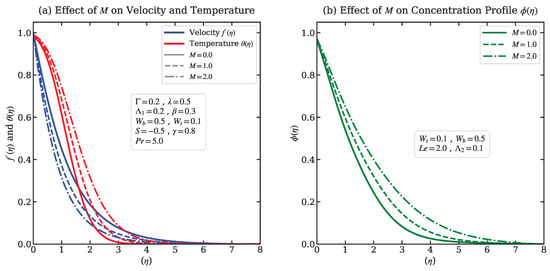
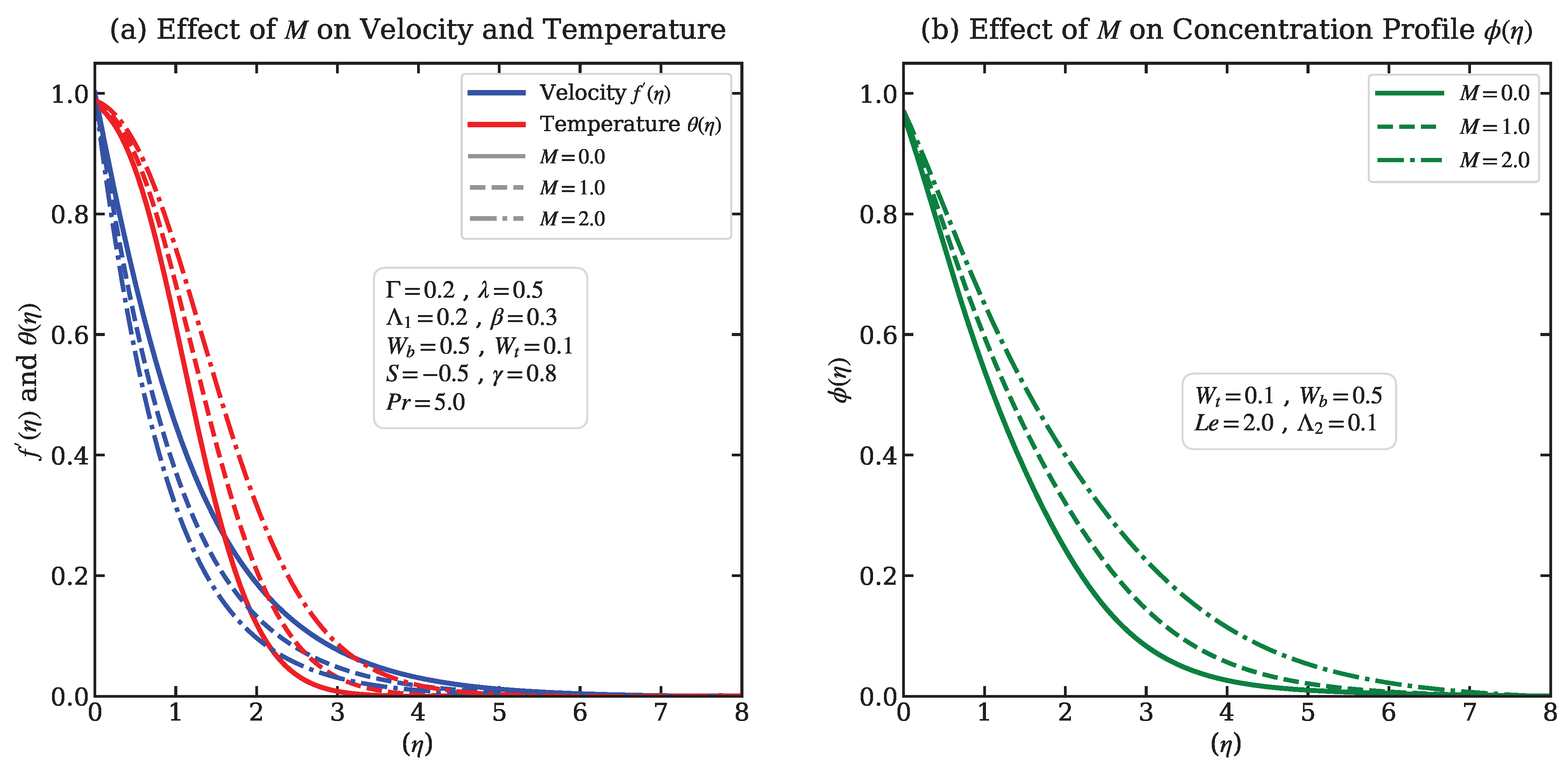
The effect of the magnetic field M on the velocity , temperature , and concentration profiles is shown in Figure 8 below. It can be easily observed that the increase in the magnetic field factor gradually slowed down the velocity profile while increasing both the temperature and nanoparticle concentration. Physically, this phenomenon can be attributed to the presence of the created Lorentz force due to the interaction of the applied magnetic field and electrically conducting nanofluid. As the force acted in the opposite direction of the flow, it inhibited the flow velocity and the momentum boundary layer. With the reduction in velocity of the fluid, some kinetic energy of the fluid was converted into thermal energy, which helped the fluid retain more heat and thus increased the temperature distribution. Also, due to the reduced fluid velocity, the convective transport of the nanoparticles decreased, leading to enhanced the residence time of the nanoparticles in the boundary layer, which increased the concentration boundary layer. Additionally, the diverse applications and practical importance of magnetic fields in transport phenomena were comprehensively highlighted by Ijaz et al. [35] and Abdel Wahab et al. [36].
Figure 8.
Impact of the porous factor on (a) the velocity and the temperature as well as (b) the concentration profiles.
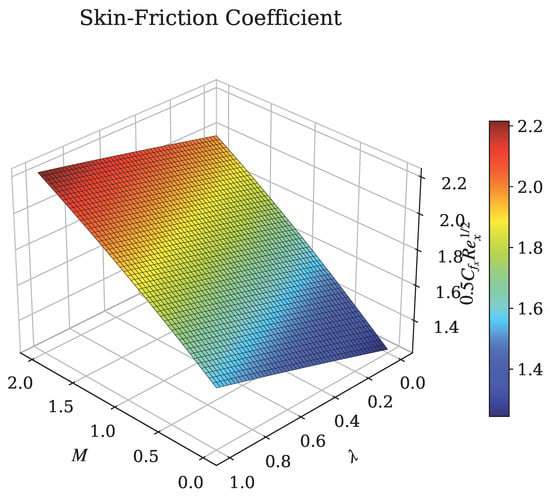
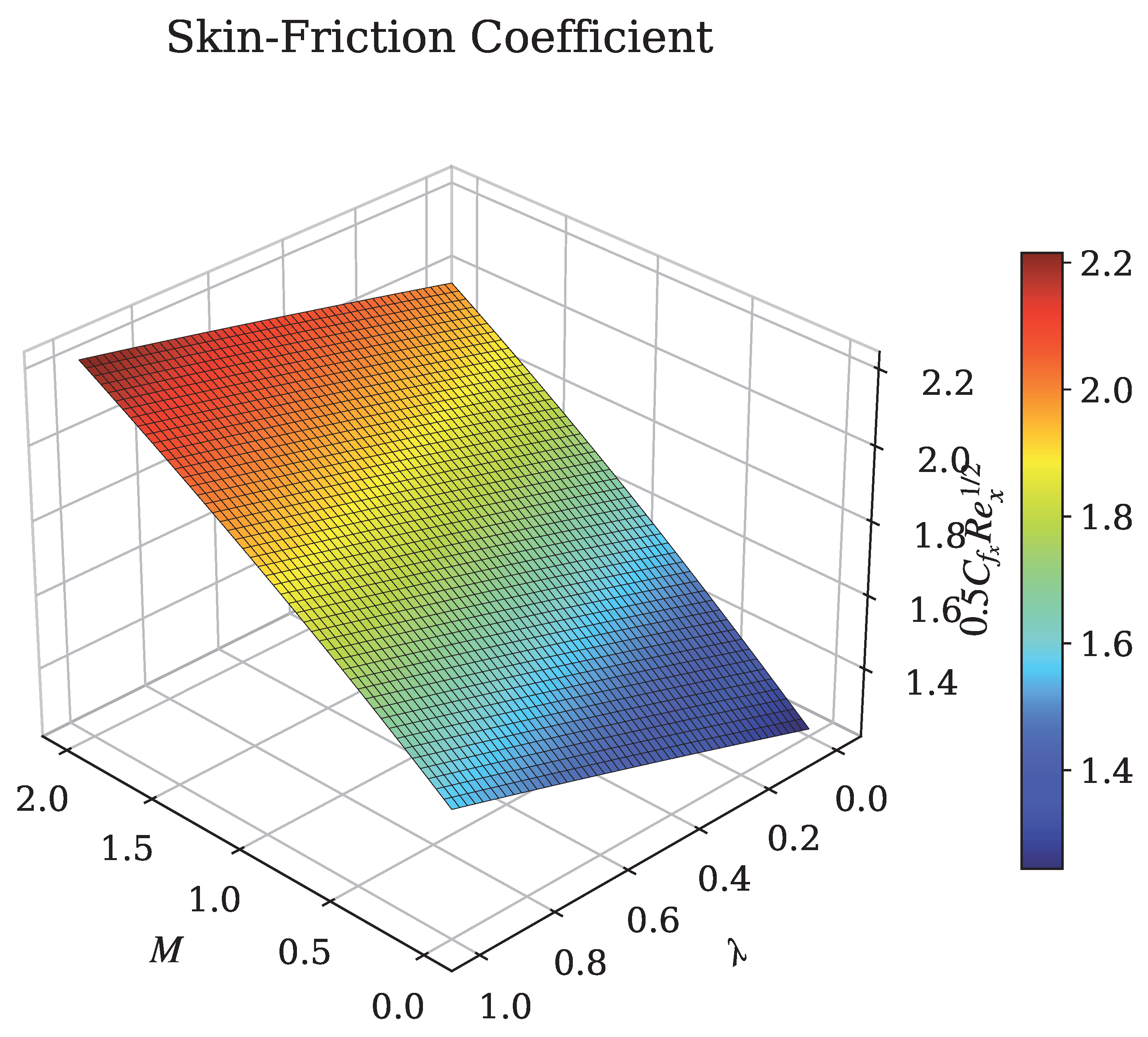
In Figure 9, the cumulative impacts of the porous and magnetic field M parameters on the skin friction coefficient are explored. It can be observed that there is a noticeable enhancement in the skin friction coefficient with the increase in each of the parameters, but the impact of the magnetic field was noticeably higher than that of the porous medium. Physically, both parameters act as resistance to the flow by creating extra resistance forces, which causes an increased near-wall velocity gradient, resulting in greater shear stress and hence increasing the skin friction coefficient. However, the magnetic field caused electromagnetic resistance due to the action of the Lorentz force, which directly acted uniformly throughout the fluid, creating a greater momentum loss compared with that created by the distributed resistance effect of the porous material. Hence, a larger near-wall velocity gradient and hence a greater skin friction coefficient were achieved because of the magnetic effect.
Figure 9.
Impact of the magnetic field factor M on (a) the velocity and the temperature as well as (b) the concentration profiles.
The impact of the Maxwell parameter on the velocity , temperature , and nanoparticle concentration fields is clearly demonstrated through Figure 10. It was found that enhancing the Maxwell parameter resulted in a slight decrease in the temperature profile, along with a small increase in the nanoparticle concentration. The effect of the same factor on the velocity field, in contrast, was characterized by two behaviors. Firstly, alongside the stretching wall, a small increase in the velocity was noticed, while away from the sheet, the effect reversed itself, causing a noticeable decrease in the velocity. The above characteristics resulted from the viscoelastic characterestics of the Maxwell fluid. With an increase in the value of the Maxwell factor, the effects of elasticity became more pronounced, allowing for better deformation energy storage and recovery in the near-wall flow region and thus slightly accelerating the flow close to the wall. Away from the wall, on the other hand, the resulting elastic stresses worked against the fluid flow, inhibiting momentum transfer and thus causing a decrease in velocity.
Figure 10.
Skin friction response to variations in M and .
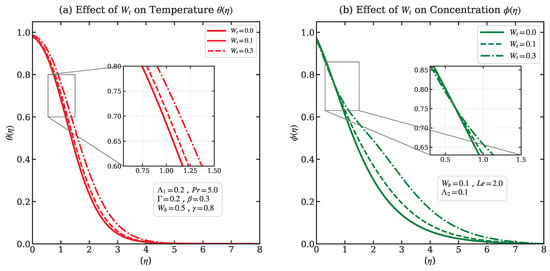
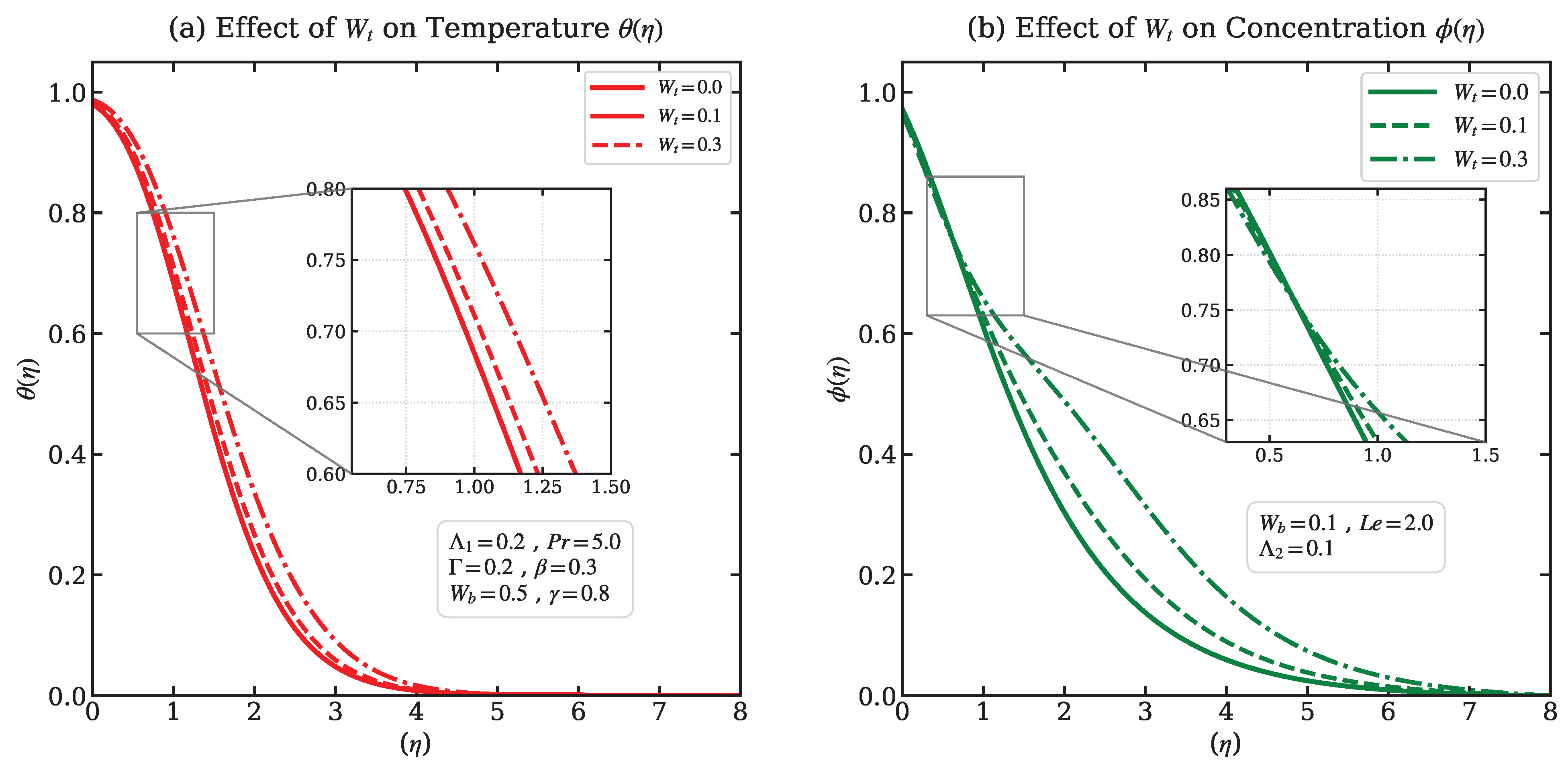
Figure 11 depicts the impact of the thermophoresis parameter on both the temperature and nanoparticle concentration fields. According to the findings, an increase in the this parameter significantly improved the temperature profile inside the thermal boundary layer. On the other hand, its impact on the concentration profile was mixed; in the near-wall location, there was a slight decline in the concentration, but away from the sheet surface, there was a sharp increase. Physically, this behavior happened due to the effect of thermophoresis, where the nanoparticles moved from warm to cold areas under the existing temperature gradient. With an increase in , more nanoparticles moved away from the wall and near-wall nanoparticle concentration drops. The nanoparticles that moved from the wall accumulated away the wall sheet, resulting in a sharp increase in the nanoparticle concentration at the outer parts of the wall. At the same time, the increase in thermophoretic transport caused more thermal energy storage in the flow and a thickening of the thermal boundary layer.
Figure 11.
Impact of the Maxwell parameter on (a) the velocity and temperature as well as (b) the concentration profiles.
Figure 12 shows the effect of the thermal slip parameter on the temperature and nanoparticle concentration fields. It can be seen that increasing the value of this parameter led to a clear decrease in the temperature and nanoparticle concentration profiles, but the magnitude of the change in the concentration profile was much smaller than the magnitude of the change in the temperature profile. Here, as the thermal slip decreased, the thermal effect of the heated wall on the neighboring fluid was the creation of a temperature jump in the wall, which reduced the amount of heat flowing from the wall into the fluid, causing the thermal boundary layer to become thinner. Considering that nanoparticle transport is highly dependent upon the thermally induced diffusion, the consequent temperature drop makes the driving force for nanoparticle migration weaker, reducing the concentration boundary layer’s thickness.
Figure 12.
Impact of the thermophoresis parameter on (a) the temperature and (b) concentration profiles.
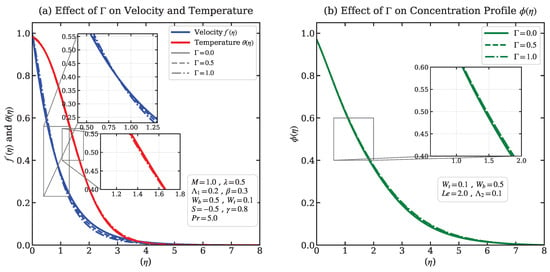
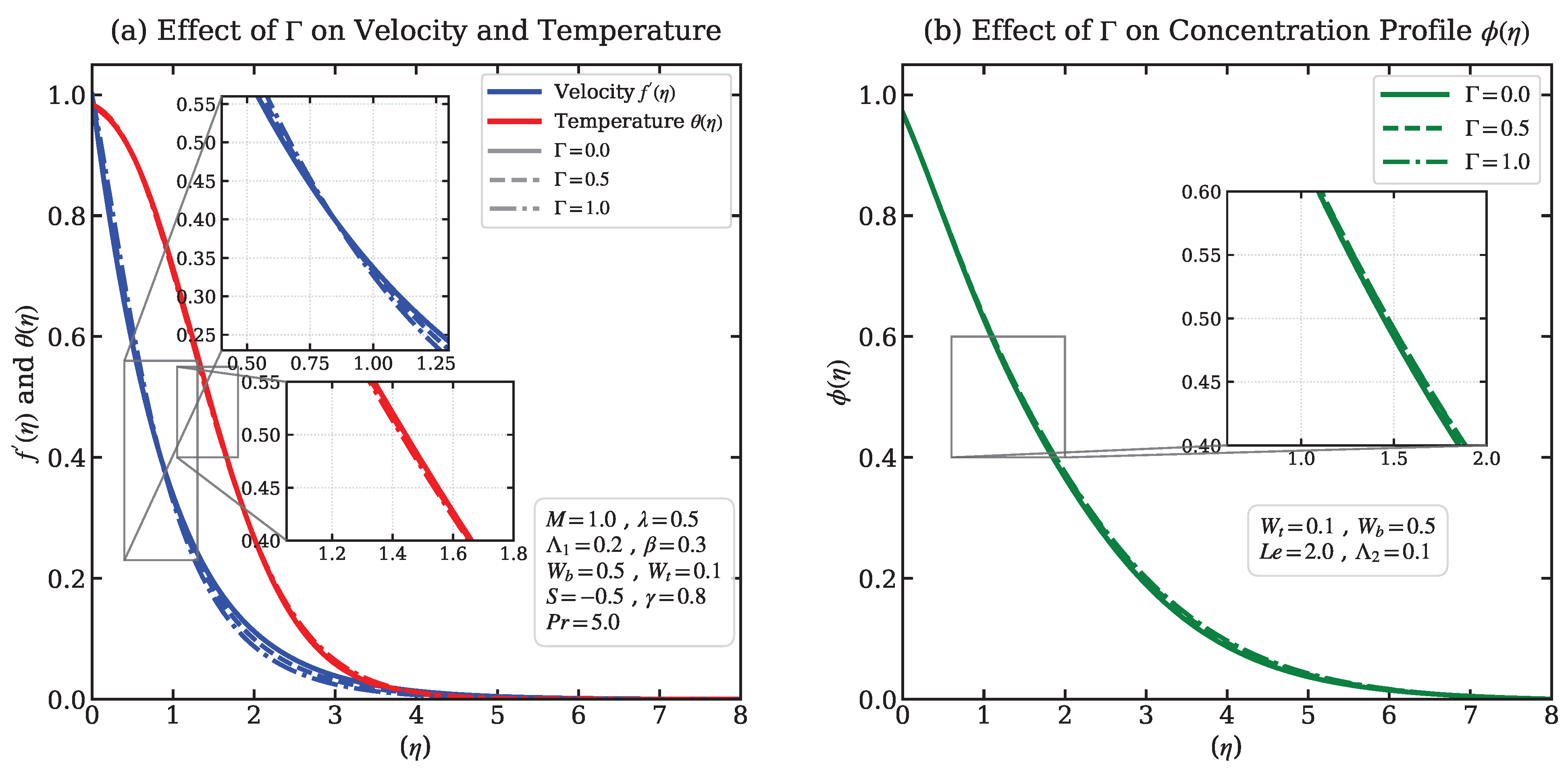
Figure 13 depicts the impact of the slip parameter for the concentration on the concentration and temperature profiles. Clearly, an increase in this parameter value led to an obvious decrease in the concentrations and temperatures, although the decrease in the temperatures was not as significant as the one seen in the concentration profile. Physically, the concentration slip reduced the mass transfer process between the wall and the neighboring fluid due to a difference in nanoparticle concentration at the interface. Therefore, the diffusion of nanoparticles from the wall to the fluid decreased, and the temperature distribution was affected. The fact that there is an intrinsic relationship between the processes of heat and mass transfer and, in particular, nanoparticle diffusion means that the decrease in the mass transport process also resulted in less thermal energy transport. Hence, the temperature profile also decreased, albeit slightly. It is worth mentioning that although the temperature profile decreased, this does not necessarily imply a reduction in the wall heat transfer rate, since the Nusselt number is governed by the temperature gradient at the wall rather than the temperature magnitude within the boundary layer.
Figure 13.
Impact of the thermal slip parameter on (a) the temperature and (b) concentration profiles.
The three-dimensional variation in the local Nusselt number against the thermal slip parameter and concentration slip parameter is shown in Figure 14. Clearly, for increasing values, there was a monotonically decreasing trend in the Nusselt number throughout the range of parameter values, which is physically justified since thermal slip reduced the temperature gradient at the wall, thereby reducing the convection heat transfer coefficient. On the other hand, an increase in the value of resulted in an increment in the value of the Nusselt number. From the combined effects of both parameters, it is observed that the dominant suppressive effect of the parameter existed at smaller values, while higher values mitigated the reduction in the Nusselt number.
Figure 14.
Impact of the slip parameter for concentration on (a) the temperature and (b) concentration profiles.
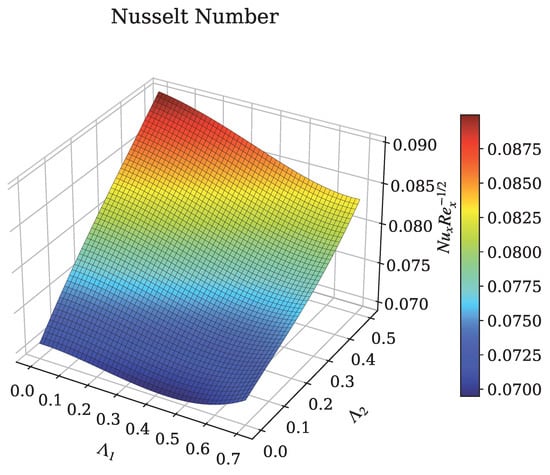
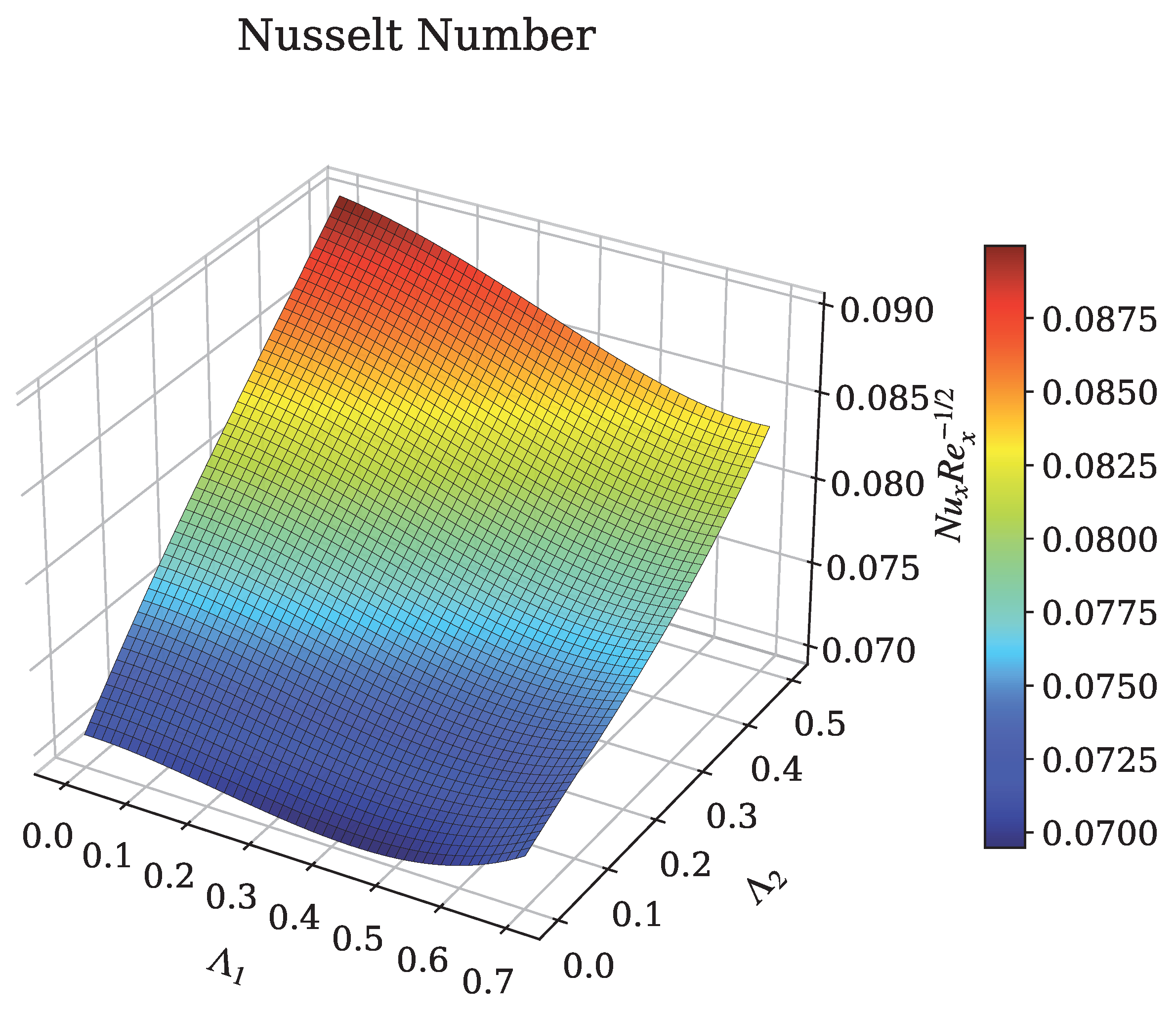
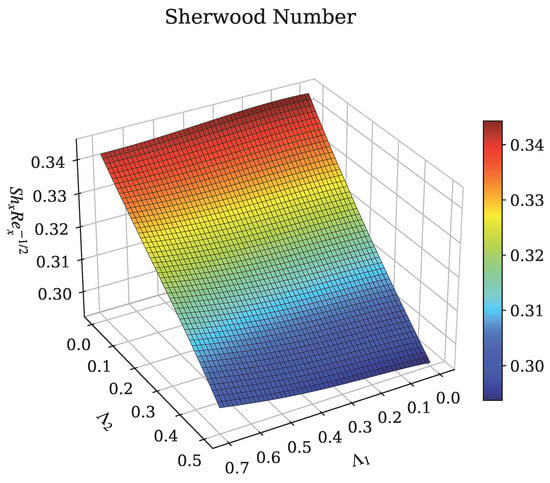
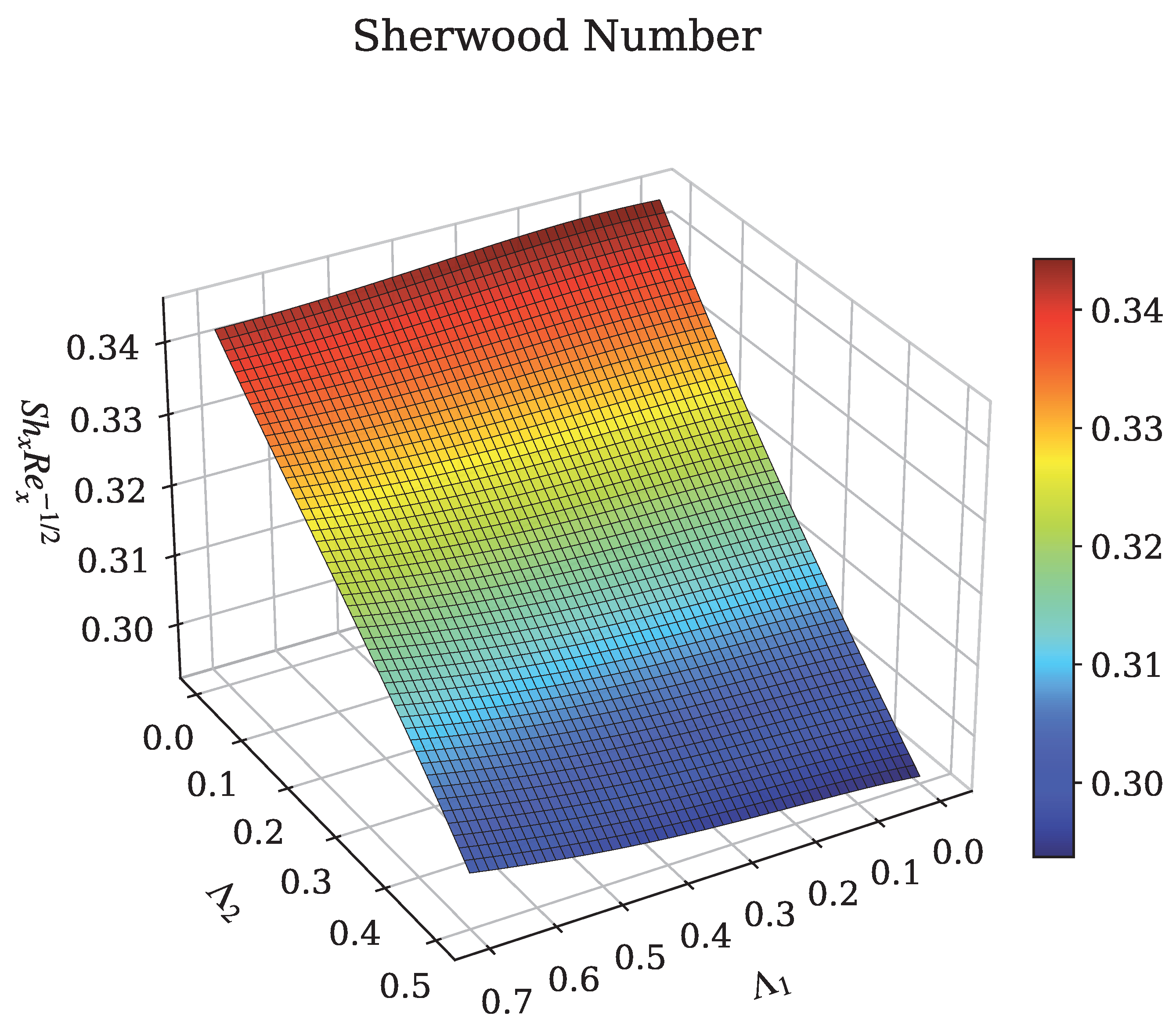
Figure 15 and Figure 16 depicts the combined effect of the thermal slip parameter and concentration slip parameter on the local Nusselt number and the local Sherwood number; respectively. From the graph, it can clearly be seen that an increase in resulted in a small rise in the Sherwood number, while an increase in caused a greater fall in the Sherwood number. This is because thermal slip reduced heat transfer from the wall, which resulted in a higher concentration gradient and hence a small rise in the Sherwood number. On the other hand, concentration slip reduced the concentration gradient of the nanoparticles at the wall due to limited diffusion of species across the wall, hence reducing the Sherwood number.
Figure 15.
Nusselt number response to variations in and .
Figure 16.
Sherwood number response to variations in and .
6. Concluding Remarks
The present study demonstrated the competence of PINNs in solving the coupled fluid flow, heat transfer, and concentration problem of MHD Casson–Maxwell nanofluid moving due to a stretching sheet embedded in a porous medium, with consideration of the viscous dissipation, variable viscosity, concentration, and thermal slip. The outcomes of this research demonstrate extremely good matching with the previously published reference values. Thus, it is clear that the presented approach is accurate and robust enough to model complex nonlinear transport processes while significantly lowering dependence on conventional numerical techniques. Being computationally efficient and precise enough, the developed method can be regarded as a prospective technique for applications in thermal and energy engineering and porous media. The key findings of this research are listed below:
- 1.
- The magnetic field enhanced the skin friction coefficient more effectively than the porous medium factor by inducing stronger flow resistance.
- 2.
- The combined action for both the magnetic field and porous medium collectively impeded the fluid velocity while fostering the expansion of both the thermal and concentration fields as a consequence of diminished convective transport.
- 3.
- Concentration slip dominated the mass transfer behavior by reducing the Sherwood number, while thermal slip exerted only a minor enhancing effect.
- 4.
- The Maxwell parameter exhibited a dual influence on the velocity field while slightly reducing the temperature and enhancing the nanoparticle concentration.
- 5.
- Thermophoresis elevated the temperature field and promoted nanoparticle accumulation away from the wall.
- 6.
- Thermal slip weakened both heat and mass transfer, with a more pronounced reduction in the thermal field.
- 7.
- The proposed PINN framework provides an efficient and accurate computational approach for solving the considered nonlinear transport problem while maintaining excellent agreement with benchmark numerical solutions.
Author Contributions
Conceptualization, A.M.A. (A. M. Amer); Methodology, N.I.G.; Software, A.M.M. and A.M.A. (Amr M. Abdallah); Validation, N.I.G.; Formal analysis, A.M.M.; Investigation, H.R.S.M. and A.M.A. (Amr M. Abdallah); Resources, S.B.I.-Z. and M.E.N.; Writing—original draft, A.M.M. and A.M.A. (Amr M. Abdallah); Writing—review & editing, M.E.N.; Visualization, A.M.A. (Amr M. Abdallah); Funding acquisition, A.M.A. (A. M. Amer), S.B.I.-Z., H.R.S.M., N.I.G. and M.E.N. All authors have read and agreed to the published version of the manuscript.
Funding
This research received no external funding.
Institutional Review Board Statement
Not applicable.
Informed Consent Statement
Informed consent was obtained from all subjects involved in the study.
Data Availability Statement
The original contributions presented in this study are included in the article. Further inquiries can be directed to the corresponding author.
Conflicts of Interest
The authors declare no conflicts of interest.
References
- Irfan, M.; Khan, M.; Khan, W.A.; Ayaz, M. Modern development on the features of magnetic field and heat sink/source in Maxwell nanofluid subject to convective heat transport. Phys. Lett. A 2018, 382, 1992–2002. [Google Scholar] [CrossRef] [Scilit]
- Sravanthi, C.S.; Gorla, R.S.R. Effects of heat source/sink and chemical reaction on MHD Maxwell nanofluid flow over a convectively heated exponentially stretching sheet using homotopy analysis method. Int. J. Appl. Mech. Eng. 2018, 23, 137–159. [Google Scholar] [CrossRef] [Scilit]
- Mukhtar, T.; Jamshed, W.; Aziz, A.; Alae-Kouz, W. Computational investigation of heat transfer in a flow subjected to magnetohydrodynamic of maxwell nanofluid over a stretched flat sheet with thermal radiation. Numer. Methods Partial Differ. Equ. 2023, 39, 3499–3519. [Google Scholar] [CrossRef] [Scilit]
- Razzaq, R.; Farooq, U.; Mirza, H.R. Nonsimilar forced convection analysis of maxwell nanofluid flow over an exponentially stretching sheet with convective boundary conditions. ZAMM-J. Appl. Math. Mech/Z. Angew. Math. Mech. 2023, 103, e202200623. [Google Scholar] [CrossRef] [Scilit]
- Ganga, S.; Uddin, Z.; Asthana, R. Unsupervised neural networks for Maxwell fluid flow and heat transfer over a curved surface with nonlinear convection and temperature-dependent properties. Int. J. Numer. Methods Fluids 2024, 96, 1576–1591. [Google Scholar] [CrossRef] [Scilit]
- Khader, M.M.; Adel, M.; Messaoudi, M. Modeling and numerical simulation of Maxwell nanofluid flow with heat generation and convective heating: A combined Adomian decomposition method and Mohand transform. Bound Value Probl. 2025, 2025, 66. [Google Scholar] [CrossRef] [Scilit]
- Shit, G.C.; Mandal, S. Entropy analysis on unsteady MHD flow of Casson nanofluid over a stretching vertical plate with thermal radiation effect. Int. J. Appl. Comput. Math. 2020, 6, 2. [Google Scholar] [CrossRef] [Scilit]
- Tawade, J.V.; Guled, C.N.; Noeiaghdam, S.; Fernandez-Gamiz, U.; Govindan, V.; Balamuralitharan, S. Effects of thermophoresis and Brownian motion for thermal and chemically reacting Casson nanofluid flow over a linearly stretching sheet. Results Eng. 2022, 15, 100448. [Google Scholar] [CrossRef] [Scilit]
- Alali, E.; Megahed, A.M. MHD dissipative Casson nanofluid liquid film flow due to an unsteady stretching sheet with radiation influence and slip velocity phenomenon. Nanotechnol. Rev. 2022, 11, 463–472. [Google Scholar] [CrossRef] [Scilit]
- Umavathi, J.C.; Prakasha, D.G.; Alanazi, Y.M.; Lashin, M.M.; Al-Mubaddel, F.S.; Kumar, R.; Gowda, R.P. Magnetohydrodynamic squeezing Casson nanofluid flow between parallel convectively heated disks. Int. J. Mod. Phys. B 2023, 37, 2350031. [Google Scholar] [CrossRef] [Scilit]
- Triveni, B.; Rao, M.V.S.; Gangadhar, K.; Chamkha, A.J. Heat transfer analysis of MHD Casson nanofluid flow over a nonlinear stretching sheet in the presence of nonuniform heat source. Numer. Heat Transf. A 2024, 85, 2145–2164. [Google Scholar] [CrossRef] [Scilit]
- Senthilvadivu, K.; Eswaramoorthi, S.; Loganathan, K.; Abbas, M. Time-dependent Darcy-Forchheimer flow of Casson hybrid nanofluid comprising the CNTs through a Riga plate with nonlinear thermal radiation and viscous dissipation. Nanotechnol. Rev. 2024, 13, 20230202. [Google Scholar] [CrossRef] [Scilit]
- Wang, F.; Zhang, J.; Algarni, S.; Naveed Khan, M.; Alqahtani, T.; Ahmad, S. Numerical simulation of hybrid Casson nanofluid flow by the influence of magnetic dipole and gyrotactic microorganism. Waves Random Complex Media 2025, 35, 1467–1482. [Google Scholar] [CrossRef] [Scilit]
- Alblawi, A.; Nadeem, S.; Zahra, M.; Ishtiaq, B.; Alzabut, J.; AlZubaidi, A. Thermal properties of Casson nanofluid with newly developed Reynolds model in moving and fixed frames of references. Z. Angew. Math. Mech. 2025, 105, e70207. [Google Scholar] [CrossRef] [Scilit]
- Mushtaq, T.; Rauf, A.; Shehzad, S.A.; Mustafa, F.; Hanif, M.; Abbas, Z. Numerical and statistical approach for Casson-Maxwell nanofluid flow with Cattaneo-Christov theory. Appl. Math. Mech.-Engl. Ed. 2021, 42, 1063–1076. [Google Scholar] [CrossRef] [Scilit]
- Gowda, R.J.P.; Rauf, A.; Naveen Kumar, R.; Prasannakumara, B.C.; Shehzad, S.A. Slip flow of Casson-Maxwell nanofluid confined through stretchable disks. Indian J. Phys. 2022, 96, 2041–2049. [Google Scholar] [CrossRef] [Scilit]
- Raafat, P.B.; Ibrahim, F.N. Entropy and heat transfer investigation of Casson-Maxwell, Casson-Jeffrey, and Casson-Oldroyd-B binary nanofluids in a parabolic trough solar collector: A comparative study. J. Therm. Anal. Calorim. 2023, 148, 4477–4493. [Google Scholar] [CrossRef] [Scilit]
- Althobaiti, N. Importance of activation energy on magnetized dissipative Casson-Maxwell fluid through porous medium incorporating chemical reaction, joule heating, and soret effects: Numerical study. J. Appl. Math. 2024, 2024, 5730530. [Google Scholar] [CrossRef] [Scilit]
- Elsaid, E.M.; Alharthi, T.N.; Eid, M.R.; Abdel-wahed, M.S. 3D flow of Casson-Maxwell nanofluid using nonuniform heat source with analysis of thermal radiation and pollutant concentration effects. Case Stud. Therm. Eng. 2025, 75, 107070. [Google Scholar] [CrossRef] [Scilit]
- Jayaprakash, J.; Govindan, V.; Byeon, H. Effect of activation energy on Casson-Maxwell fluid via porous media including blowing and suction mechanisms. Partial Differ. Equ. Appl. Math. 2025, 13, 101060. [Google Scholar] [CrossRef] [Scilit]
- Soltani Motlagh, H.R.; Issa-Zadeh, S.B.; Kalifullah, A.H.; Colak, A.T.I.; Zoolfakar, M.R. Sustainable energy and exergy analysis in offshore wind farms using machine learning: A Systematic Review. Eng 2025, 6, 105. [Google Scholar] [CrossRef] [Scilit]
- Soltani Motlagh, H.R.; Issa-Zadeh, S.B.; Zoolfakar, M.R.; Garay-Rondero, C.L. Enhancing ship propulsion efficiency predictions with integrated physics and machine learning. J. Mar. Sci. Eng. 2025, 13, 1487. [Google Scholar] [CrossRef] [Scilit]
- Soltani Motlagh, H.R.; Amer, A.M.; Ghoneim, N.I.; Megahed, A.M.; Abdallah, A.M.; Issa-Zadeh, S.B. Physics-Informed Neural Networks for Dissipative Micropolar Nanofluid Flow with Microrotation Dynamics and Zero Nanoparticle Mass Flux. Modelling 2026, 7, 145. [Google Scholar] [CrossRef] [Scilit]
- Zhong, L.; Wu, B.; Wang, Y. Low-temperature plasma simulation based on physics-informed neural networks:Frameworks and preliminary applications. Phys. Fluids 2022, 34, 087116. [Google Scholar] [CrossRef] [Scilit]
- Nguyen, T.N.K.; Dairay, T.; Meunier, R.; Mougeot, M. Physics-informed neural networks for non-Newtonian fluid thermo-mechanical problems: An application to rubber calendering process. Eng. Appl. Artif. Intell. 2022, 114, 105176. [Google Scholar] [CrossRef] [Scilit]
- Xiao, Z.; Ju, Y.; Li, Z.; Zhang, J.; Zhang, C. On the Hard Boundary Constraint Method for Fluid Flow Prediction based on the Physics-Informed Neural Network. Appl. Sci. 2024, 14, 859. [Google Scholar] [CrossRef] [Scilit]
- Mekheimer, K.S.; Mohamed El-Sayed, M.O.; Akbar, N.S.; Gouda, A.A. Physics-informed deep learning study for MHD particle-fluid suspension flow with heat transfer in porous annular-sector duct. Heat Transf. 2024, 53, 1749–1769. [Google Scholar] [CrossRef] [Scilit]
- Zulfiqar, M.; Arain, M.B.; Zubair, M.; Usman; Alhazmi, H. A numerical investigation of heat and mass transfer in the bioconvective Oldroyd B nanofluid flow through the porous stretching Riga surface with gyrotactic microorganism. Case Stud. Therm. Eng. 2025, 72, 106431. [Google Scholar] [CrossRef] [Scilit]
- Megahed, A.M. Numerical solution for variable viscosity and internal heat generation effects on boundary layer flow over an exponentially stretching porous sheet with constant heat flux and thermal radiation. J. Mech. 2014, 30, 395–402. [Google Scholar] [CrossRef] [Scilit]
- Min, Z.; Anwaar, H.; Arain, M.B.; Shaheen, S.; Al-Yarimi, F.A.M. Numerical investigation of the effects of variable fluid properties on cilia-driven flow of tangent hyperbolic fluid in a channel with heat and mass transfer: A new approach to microfluidic pumps. Case Stud. Therm. Eng. 2024, 62, 105120. [Google Scholar] [CrossRef] [Scilit]
- Abdelsalam, S.I.; Abbas, W.; Megahed, A.M.; Said, A.A.M. A comparative study on the rheological properties of upper convected Maxwell fluid along a permeable stretched sheet. Heliyon 2023, 9, e22740. [Google Scholar] [CrossRef] [Scilit] [PubMed]
- Raissi, M.; Perdikaris, P.; Karniadakis, G.E. Physics-informed neural networks: A deep learning framework for solving forward and inverse problems involving nonlinear partial differential equations. J. Comput. Phys. 2019, 378, 686–707. [Google Scholar] [CrossRef] [Scilit]
- Wang, S.; Teng, Y.; Perdikaris, P. Understanding and mitigating gradient flow pathologies in physics-informed neural networks. SIAM J. Sci. Comput. 2021, 43, 3055–3081. [Google Scholar] [CrossRef] [Scilit]
- Ibrahim, S.M.; Kumar, P.V.; Lorenzini, G.; Lorenzini, E.; Mabood, F. Numerical study of the onset of a chemical reaction and heat source on dissipative MHD stagnation point flow of casson nanofluid over a nonlinear stretching sheet with velocity slip and convective boundary conditions. J. Eng. Thermophys. 2017, 26, 256–271. [Google Scholar] [CrossRef] [Scilit]
- Ijaz, N.; Zeeshan, A.; Taha, T.; Hashem, A.F. Controlled AI for flow forecasting in Lorentz force dominance over power-index in streamline: Applications in catalytic cooling systems. Int. Commun. Heat Mass Transf. 2026, 176, 111366. [Google Scholar] [CrossRef] [Scilit]
- Abdel Wahab, M.; El-Bakry, M.Y.; Hamza, S.E.E.; El-ashhab, A.G. A Theoretical investigation of Magnetohydrodynamics flow and the heat transfer process of a fluid between two porous discs. Benha J. Appl. Sci. 2021, 6, 309–318. [Google Scholar] [CrossRef] [Scilit]

Disclaimer/Publisher’s Note: The statements, opinions and data contained in all publications are solely those of the individual author(s) and contributor(s) and not of MDPI and/or the editor(s). MDPI and/or the editor(s) disclaim responsibility for any injury to people or property resulting from any ideas, methods, instructions or products referred to in the content. |
© 2026 by the authors. Licensee MDPI, Basel, Switzerland. This article is an open access article distributed under the terms and conditions of the Creative Commons Attribution (CC BY) license.