


Abstract
Blockchain is a distributed database technology that enables immutable, verifiable data recording, properties that are useful for failure analysis processes requiring high data integrity and traceability. In conveyor belt failure analysis, there is a growing need for reliable management of experimentally obtained data, especially for long-term monitoring of operating and failure states. The presented article focuses on customizing the blockchain architecture to support recording and validating experimental data used in the failure analysis of rubber-textile conveyor belts in pipe conveyors. The proposed methodology integrates a private blockchain system as a layer for storing and validating raw measured data obtained during experiments. The system meets technical accuracy requirements and is defined as a private blockchain with a permissioned system, which uses the Proof of Authority consensus algorithm and is characterized by centrally managed administration. The prototype of the “LogBlock” application demonstrates the storage and validation of data in the form of plain text and compressed (.zip) files, providing robust protection against unauthorized data modifications, auditability, and resistance to unauthorized interference, while being adapted to the specific requirements of the analyzed technical system. Experimental results indicate the feasibility of the proposed blockchain system in storing, validating, and managing raw measurement data, processed data, metadata, and related source files throughout the failure analysis process. The achieved results confirm the system’s ability to identify unauthorized data modifications and ensure their traceability after entering the system. The implemented solution confirms the suitability of using blockchain as a support tool for technically oriented failure analysis applications of conveyor systems.
1. Introduction
Developments in digital technologies create opportunities to introduce new approaches to the failure analysis process across various areas, including the assessment of rubber-textile belt damage and operating conditions in pipe conveyors. Digital technologies enable automated processing and analysis of experimental data, thereby increasing the accuracy and efficiency of failure analysis. Failure analysis is a systematic process of collecting and analyzing data to identify the cause of a failure, usually with the goal of determining corrective action or liability [1]. Failure analysis is often confused with damage identification or fault detection. However, they differ from failure analysis in that their goal is the process of identifying the occurrence of a failure and classifying it [2,3].
Issues directly or indirectly related to the failure analysis of rubber-textile conveyor belts on pipe conveyors and their operation are the subject of several types of research that have already been implemented. Their content focuses on areas such as conveyor belt rotation detection [4], measuring indentation rolling resistance [5], detecting missing rollers [6], and investigating the influence of rainwater [7]. All the research mentioned is based on experimental measurements and material analyses, using raw and processed data obtained through online monitoring [8] or laboratory experiments. In published research on the failure analysis of rubber-textile conveyor belts and their operation, the safety, validation, and reliability of raw measurement data, processed data, metadata, and related source files have not been addressed in detail. These data and datasets can be obtained through online monitoring [8] or laboratory experiments [9].
In the published research on the failure analysis of rubber-textile conveyor belts and their operation, the safety, validation, and reliability of processed data and source files have not been addressed in detail. Despite the importance of measurement accuracy and data management, this issue has not been sufficiently addressed until recently. In addition to work focused on diagnostics, online monitoring, and analysis of conveyor belt failures, it is worth considering recent research in related technical areas, where blockchain is used not only as a data repository but also as part of a trusted data and validation workflow. In the field of structural health monitoring, blockchain has been used to support traceability, data integrity, and the automation of sensor data management in a digital twin environment [10]. Similarly, in other application areas, blockchain frameworks have been proposed that integrate traceability, smart contracts, and maintenance process management into a single, process-oriented whole [11]. Other works also show that blockchain has scientific value, especially when it is integrated into a broader framework of monitoring, reliability assessment, and analytical processing, rather than being used only for static data storage [12]. These findings suggest that the benefits of blockchain-based solutions do not arise from the mere ability to store data on a blockchain, but from the domain-specific integration of technology into a broader analytical, validation, and decision-making process. In this context, the issue of blockchain-supported validation and the management of experimental data in the failure analysis of rubber-textile conveyor belts and hose conveyors remains only partially addressed. The present study, therefore, addresses this gap by proposing a domain-adapted framework for working with experimental data in this specific industrial context.
Blockchain can be considered a suitable technology for data management in failure analysis, as also indicated by earlier work in related areas, for example, research focused on blockchain-based federated learning for device failure detection in industrial IoT [13].
Blockchain addresses critical challenges in failure analysis, particularly in transparency, resistance to unauthorized data modification, and data security. Its application can significantly enhance the credibility of experimental measurements and the effectiveness of data validation. It enables monitoring of the measurement chain and ensures its reliability [14]. It can significantly improve the quality of the measurement process, especially by managing measured data and enhancing the reliability of the measurement chain [15]. At the same time, it can provide security for the entire measurement process [16], including subsequent evaluation of data and digital files. It increases the trust in measured data [17]. Implementing blockchain technology into the measurement chain for the failure analysis of rubber-textile conveyor belts thus has great potential to improve overall efficiency [18].
Blockchain has potential in conjunction with other digital technologies, such as smart contracts, and, based on the research results presented so far in the field of pipe conveyors, its use for identifying selected types of damage [19], recording operational indicators [20], or managing the maintenance process [21].
In parallel with the development of decentralized technologies, the field of intelligent fault diagnosis is oriented towards the use of large language models (LLMs), which bring advances in adaptive data processing. Recent studies have demonstrated their effectiveness in analyzing domain-specific texts in transportation [22] and processing multimodal industrial data using expert feedback [23]. To increase reliability, LLMs are integrated with knowledge graphs for causal reasoning [24], while innovative approaches (LLM-AD) allow for the direct detection of anomalies in time series even without the need for text descriptions [25]. These trends represent a significant evolution of digital diagnostic systems towards greater autonomy and analytical depth.
This study focuses on designing and implementing a blockchain-based methodology to validate and manage experimental data for failure analysis of conveyor-belt damage and operating conditions in rubber-textile belts. The aim is to explore ways to increase the reliability and credibility of measured data in an industrial environment.
The contribution of the presented study does not lie in the general use of blockchain technology for data storage and verification, but in the design and demonstration of a domain-adapted framework for handling experimental data within the failure analysis process of rubber-textile conveyor belts in pipe conveyors. The proposed approach combines a block structure adapted to failure analysis information, two forms of data entry, and a validation workflow designed to verify the integrity, traceability, and verifiability of raw measurement data, processed data, metadata, and related source files. At the same time, the study shows how these elements can be arranged within the LogBlock environment to support transparent, auditable, and reproducible processing of experimental data for industrial failure analysis.
While existing studies focus on fault detection, our study addresses the comprehensive process of failure analysis, which we define as a holistic engineering process for condition assessment. Unlike the work of Zhang et al., which focuses on automated device failure detection via federated learning, this study addresses the broader engineering process of failure analysis, including data validation and traceability of experimental source files. In the field of conveyor belts, there is a lack of solutions for ensuring the integrity of experimental and source files (.zip, Base64), which is critical for subsequent analysis.
In this study, the term failure analysis denotes the overall engineering process used to evaluate conveyor-belt condition and related measured data. Physical defects of the belt, such as cracks, puncture, or edge damage, are referred to as damage types. By contrast, non-nominal operating states, such as increased friction or asymmetrical tensioning, are described as operating-condition anomalies. The term failure is used only where a functional loss or actual breakdown of the conveyor-belt system is concerned. The presented solution is a domain-adapted framework specifically designed for failure analysis processes in industry.
2. Proposed Framework
In this manuscript, raw measurement data denote unprocessed values obtained directly from experimental measurements or online monitoring. Processed data denote data that have already undergone evaluation, filtering, transformation, or analytical treatment. Metadata denote descriptive and contextual information related to the data, such as timestamps, identifiers, validation status, and provenance. Source files denote the original digital files in which raw measurement data, processed data, or metadata are stored.
Blockchain technology allows data and information to be stored, preserved, and made available in a way that guarantees their integrity, authenticity, and uniqueness. It ensures data tamper-evident storage, integrity checking, and strong resistance to unauthorized modification under the chosen governance model. It enables trust to be established between individual users without requiring direct contact. Depending on the need, it offers different levels of decentralization and management options, with or without central authority.
Blockchain represents an up-and-coming tool for the field of measurement and instrumentation science and technology, which offers the following benefits:
- Traceability of measured data and source files.
- Identification of measured data and source files.
- Proof of ownership of measured data and source files.
- Support for cooperation in the use of measured data and source files.
- Security against unauthorized access to measured data and source files.
- Automation of processes associated with the use of measured data and source files.
- Support for the distribution of measured data and source files.
For failure analysis, it is generally possible to use any of the three blockchain types (public, consortium, or private). Each has specific application possibilities for failure analysis (Table 1).
Table 1.
Comparison of blockchain types from the perspective of failure analysis data management.
However, the final choice of blockchain type depends on the purpose for which the measured data will be used and the method of working with it.
Blockchain is a distributed database that chronologically and immutably records transactions in structures known as “blocks”. Each block contains information that is thoroughly verified and inextricably linked to the previous block in the chain.
This methodology ensures a continuous, unalterable record chronology, making the system extremely secure and transparent. Although blockchain technology is best known for its use in cryptocurrencies such as Bitcoin, its applications are constantly expanding. They are found in several industries, from supply chains to healthcare to election systems, wherever a high degree of trustworthiness and record security is required. Blockchain technology has massive potential in failure analysis.
In failure analysis, the blockchain within the created blocks will record measured data and source files instead of transactions, ensuring their validity and reliability.
Based on cryptographic principles that underpin its security, blockchain is not just an ordinary algorithm. It is a complex system that integrates various technological principles and components, working in synergy to create a robust, durable system.
Blockchain consists of several essential components—blocks, transactions, hashing, consensus algorithms, and nodes, which together create a robust and secure system that could be defined as follows:
- Blocks—Units of data in a chain that contain information or transactions.
- Transactions—Actions or operations recorded in blocks.
- Hashing—Generating a cryptographic digest used to identify data and detect modifications.
- Consensus Algorithms—A private blockchain network that determines agreement on the blockchain’s state and the transactions’ authenticity.
- Users (Nodes)—Active devices or servers in the network that maintain copies of the blockchain and can participate in the verification process or consensus mechanism.
Currently, we know of several approaches to secure logging and data validation (Table 2).
Table 2.
Qualitative comparison of selected approaches to secure logging and data validation.
Table 2 presents a qualitative expert comparison of selected approaches to ensuring data integrity, validation and traceability. The assessment is conceptual and illustrative and does not constitute an experimentally validated benchmark. Its goal is not the universal superiority of blockchain over all, but rather that, given the requirements for workflow—in particular, record immutability, auditability, temporal traceability, and shared trust among multiple actors—blockchain represents an architectural solution.
Blockchain, compared to traditional conventional data management solutions, offers the capabilities for failure analysis that are presented in Table 3. The comparison is qualitative in nature and serves only to contextualize the proposed blockchain workflow within the framework of failure analysis. It does not represent quantitative benchmarking or controlled experimental comparison with conventional data management systems.
Table 3.
Qualitative comparison of selected data-management approaches for failure analysis data handling.
Characteristics of the Used Blockchain Application
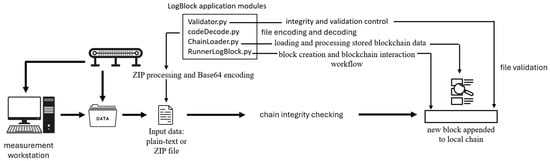
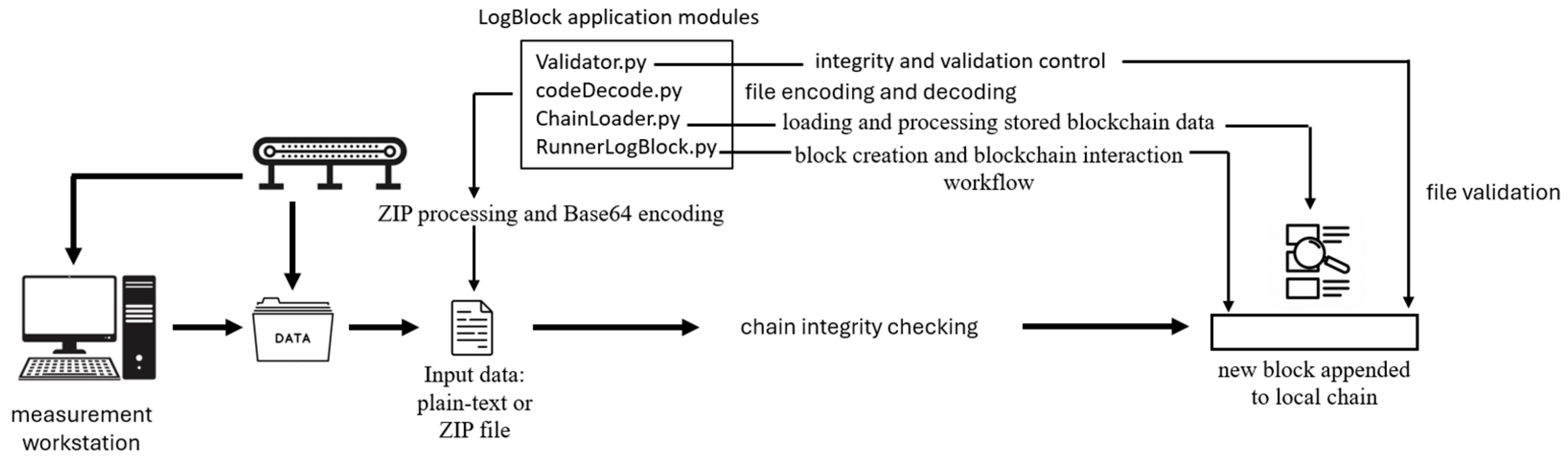
A centralized Blockchain application, “LogBlock”, was created to support the research, which aimed to store measured data on the operation of transport systems and use it for failure analysis. The ‘LogBlock’ application was designed as a domain-specific, permission-controlled solution for working with measurement and diagnostic data related to failure analysis of conveyor belts. In this application context, the recorded data is not intended for unrestricted public access, but for controlled processing and traceable use within a predefined circle of authorized entities. This application creates processes and searches blocks within the chain of blocks created. In addition, it can write data in various formats, which can be compressed into “.zip” format, but also store data in its native form as “plain text”. This application feature was implemented to support working with various data file types that may contain measured data for digital transformation needs. The application also includes a descriptive section of the block, adapted to verify license keys using predefined smart contracts. The application supports two data input formats: plain text or compressed “.zip” files (Figure 1).
Figure 1.
Schematic representation of the LogBlock application workflow for processing measurement data in the failure analysis of conveyor belts. The diagram shows a data input from the measurement workstation, the processing of plain-text and ZIP inputs, ZIP processing and Base64 encoding of file input, string integrity check, appending a new block to the local string, file validation, and the role of the main application modules involved in the workflow.
The integrity check of the currently maintained local chain is then performed by verifying the internal consistency of the links between the stored blocks before appending the new block to the local chain.
The implemented workflow also distinguishes two control mechanisms. The first is chain integrity checking, which verifies the consistency of the blockchain chain structure and the continuity of hashed records. The second is file validation, which verifies that the uploaded file matches the reference content stored in the application. In this way, the LogBlock prototype supports controlled data recording, integrity-oriented verification, and traceability of work with measured data in the failure analysis of conveyor belts. The application can include a license key and support two user levels. The first is a user who can write “–Dcode”, which can place any files in the chain via the “.zip” compression mechanism. The second type is a lower-level user who can enter data in native form, i.e., plain text.
The application also includes a section for checking and validating the block. This control mechanism primarily serves to verify data integrity against the blockchain by comparing cryptographic hashes, encoded file content (Base64 strings), and file sizes. The result is information about whether a block with source files is valid or invalid.
In addition, the application within the blockchain mechanism includes control mechanisms that verify block validity and measure data. This mechanism can detect manipulated blocks (e.g., an intervention in the measured values), locate them, and still work even with a “hard” intervention in the chain. The application also contains snapshots of the chain, which store copies of it. They are created and destroyed during changes directly related to the blockchain chain. They serve as a safety feature.
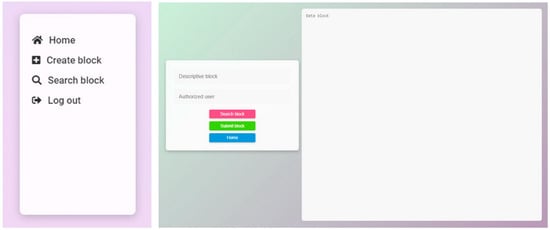
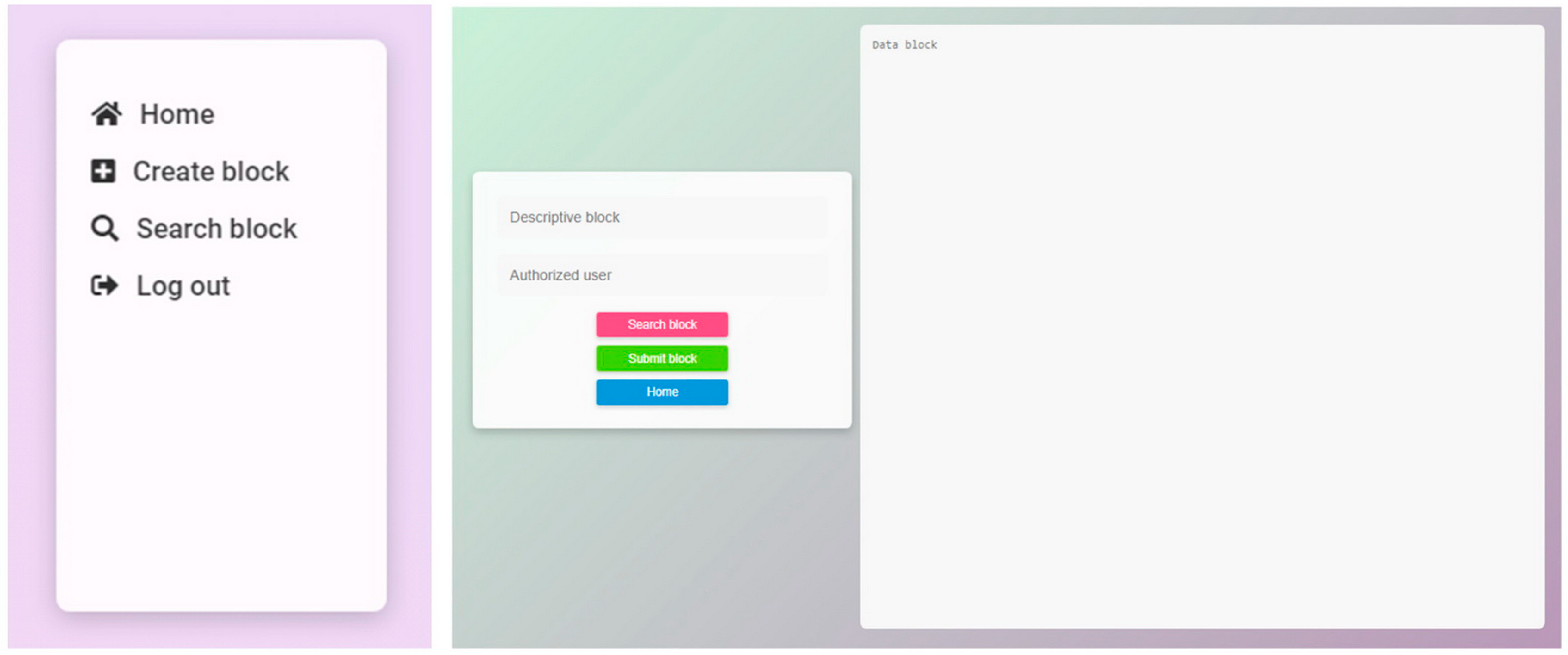
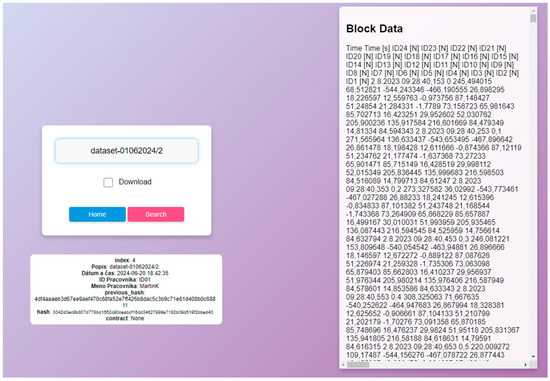
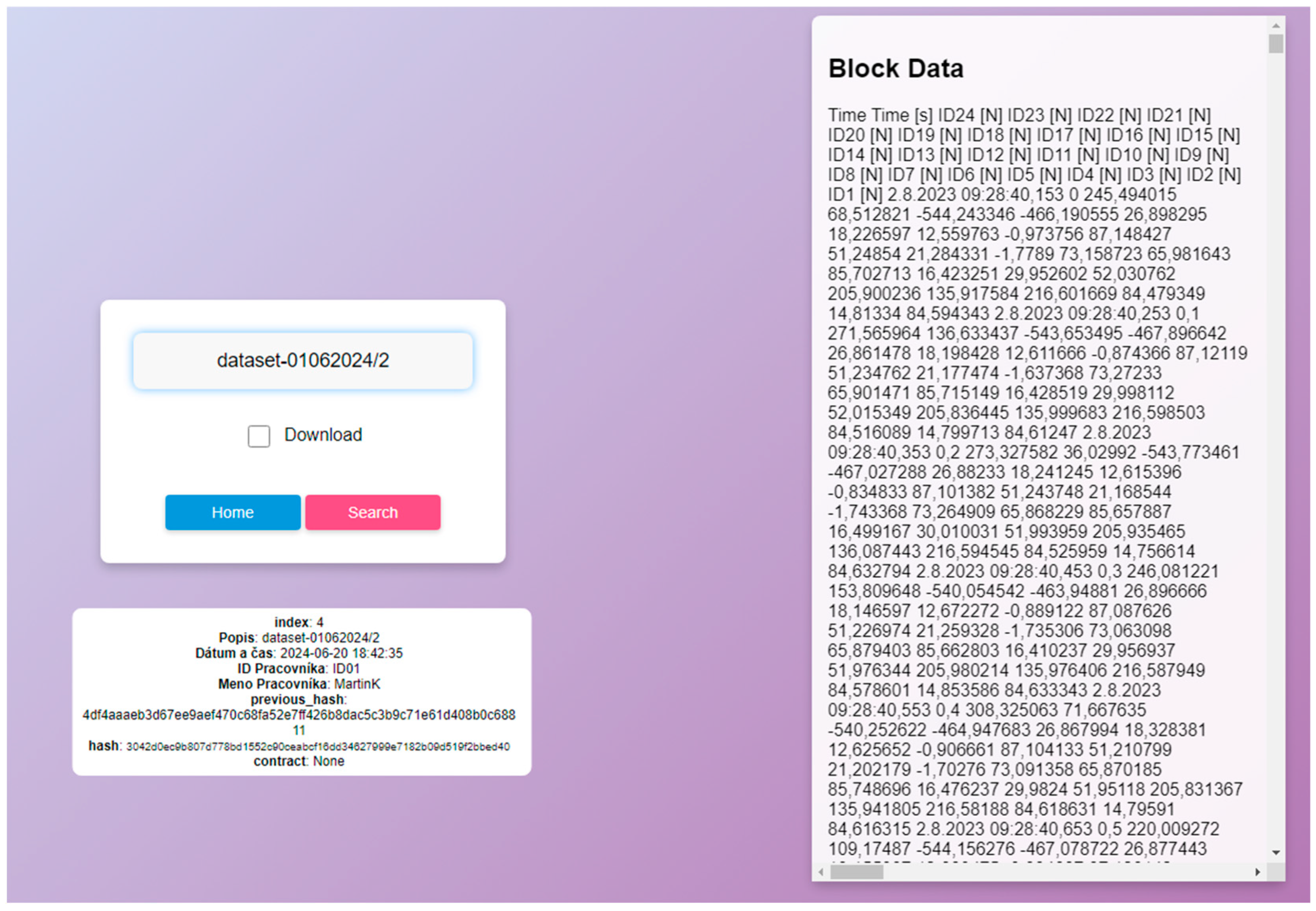
The application is therefore capable of storing any measured data that can be compressed into a “.zip” file, verifying their integrity against the network, and including a validation mechanism to check existing data. This application also provides a user interface for browsing blocks and their contents. The web interface automatically trims content for large files, but it can only be downloaded or previewed as text in the app. For smaller data volumes, the block’s content is displayed directly in the web interface, without the data section. Data sections, most blocks, are large volumes of characters. The main menu of the “LogBlock” application includes options to create a block, search for a block, and log out of the system (Figure 2).
Figure 2.
Main menu of the “LogBlock” application (example).
For long-term collection of high-frequency IoT data, scalability is a significant limitation of the proposed solution. The Proof of Authority (PoA) consensus algorithm reduces computational overhead by allowing a limited number of authorized nodes to perform validation; however, it does not address the growing volume of stored data. If each IoT record were stored as a separate block, the chain size, validation time, and storage requirements would gradually increase as the number of records grew. Therefore, when storing high-frequency data for several years, it is not appropriate to write all raw measurements directly to the blockchain chain. A more practical approach is to store primarily aggregated data batches, control hashes, timestamps, and metadata in the chain, while voluminous IoT data can be stored in an external database or in time-oriented storage. The blockchain record then serves as an auditable layer to verify the integrity and traceability of the data, not the primary storage of all measurements.
The application uses the “Proof of Authority” consensus algorithm. Its advantage is the fast creation of blocks.
The application “LogBlock” was created only to research and verify the possibility of using blockchain technology in measurement and instrumentation science and technology. However, the development of the application itself was different from the research subject.
The proposed solution is not intended as a performance replacement for a traditional encrypted SQL database. SQL databases are better suited for applications that require low latency, indexed search, transactional processing, and parallel access to large numbers of records. The proposed system introduces additional computational and storage overhead, mainly due to encoding the input file, calculating hashes of individual blocks, and validating the continuity of the hash chain. Therefore, it may exhibit higher latency and greater storage requirements than an optimized database infrastructure. The main benefit of the solution is not higher performance, but auditability of records and the ability to detect subsequent changes or corruption of stored data. Quantitative measurement of latency and resource consumption will be the subject of further research.
3. System Design
The use of blockchain technology in failure analysis has considerable potential, particularly for the traceable, tamper-evident management of data on conveyor-belt damage, operating anomalies, and maintenance events. Its use in this area has been infrequent, and many experts in this technology do not see a clear path to advance the field of failure analysis. However, this opinion is incorrect, primarily because blockchain, as a digital technology, is practically unexplored in the context of failure analysis. Research into its application in failure analysis has not yet been realized. Blockchain technology offers the following possibilities for use in the field of failure analysis:
- Secure and immutable records:
Blockchain technology enables the creation of immutable records documenting detected damage, operating anomalies, maintenance interventions, their probable causes, and the corresponding corrective actions. Authorized entities can access all data related to belt damage, operating-condition anomalies, and maintenance history at any time without risking unauthorized modification, which is a fundamental advantage of the adopted blockchain framework. This guarantees that the data will not be manipulated or falsified. Stored records related to failure analysis can be stored on the blockchain as measured data, digital graphics, video, or audio files. This requires selecting an appropriate consensus algorithm to verify blocks against the records. At the same time, selecting the appropriate blockchain type will be necessary to ensure smooth, issue-free block writing and subsequent reading.
- Transparency and auditability:
Authorized entities can access all data related to belt damage, operating-condition anomalies, and maintenance history at any time without risking unauthorized modification, which is a fundamental advantage of the adopted blockchain framework. Such an approach will improve the ability to monitor failure trends and take action. The data necessary for failure analysis will thus be available immediately after it is written to the block and subsequently included in the blockchain. At the same time, individual data can be traced if necessary.
- Automated reporting using smart contracts:
Smart contracts, as one of the essential blockchain-based crypto technologies, can be used to automate the recording, identification, and possible analysis of failures. They can, for example, use classification algorithms or various types of oracles. Smart contracts can trigger subsequent automated responses, such as notifications, service orders, and service protocol updates. Such an approach will significantly speed up the decision-making process when identifying a failure. At the same time, the resolution of potential accidents can be automatically initiated. A significant benefit is that the data on which everything will be based will be valid and unchangeably archived.
- Component and product lifecycle tracking:
The component and product lifecycle is a frequently used information base in failure analysis, providing the necessary basis for it. Blockchain can thus store valid information about production, its course, materials, technologies, and tools. At the same time, it can store information on maintenance events, repairs, detected damage, and, where applicable, actual component failures. Thanks to this, accurate identification of problematic elements will be possible, as will prediction of their service life and the likelihood of failure. Application possibilities can be further increased by using digital twin technology.
- Trustworthy collaboration between multiple entities:
Blockchain technology ensures trustworthy collaboration among multiple entities in the failure analysis process. All entities can fully trust each other to be working with reliable data verified by a consensus algorithm. Blockchain thus ensures that all parties have access to accurate information related to the failure analysis.
- Data traceability in insurance and legal claims:
During failure analysis, the causes of failures are often sought. This can usually be an activity based on data tracing and subsequent evaluation. Since the data recorded in individual blocks is immutable, it is possible to obtain undeniable evidence of when the fault occurred and under what conditions, and to identify any responsibility for its occurrence. This fact can benefit science and research, as well as complaints, insurance claims, litigation, and the determination of the quality and service life of individual components.
- Integration with IoT devices:
IoT sensors are essential for failure analysis and have been widely used in recent years. Their main advantage is that they can record data on consumption, power ratios, operating conditions, and various anomalies in real time, then store and write them to blocks. Such an approach enables more accurate analysis of fault causes and their early identification. The data stored in this way can be used for predictive maintenance.
Based on the aforementioned blockchain properties, the LogBlock application was designed and implemented to validate experimental data for conveyor belt failure analysis. The following section describes the implementation details.
Characteristics of the Used Blockchain Application
The proposed LogBlock solution was conceived as a domain-specific application for the controlled processing of measurement and diagnostic data in the process of the failure analysis of conveyor belts. In this context, blockchain is not a theoretical model intended for mathematical analysis, but an application framework that supports integrity, traceability, and controlled data recording. For this reason, this section focuses on the conceptual data architecture of the system, the logic of block organization, and the main workflow steps, including input data processing, chain integrity checking, and file input validation.
To preserve the original content, the input data file is processed as a binary file and encoded before being stored in the blockchain record. The system does not analyze or modify the internal content of the document. Therefore, when reconstructing it, the original byte content is preserved, including formatting, internal structure, and metadata that are part of the file or archive itself. Data integrity is verified by comparing the reconstructed output with the original encoded representation and validating the hash string. This validation recalculates the hash of each block and checks whether the previous_hash value matches the hash of the previous block, identifying discrepancies in checks for possible disclosure of this data or unauthorized alteration of the record.
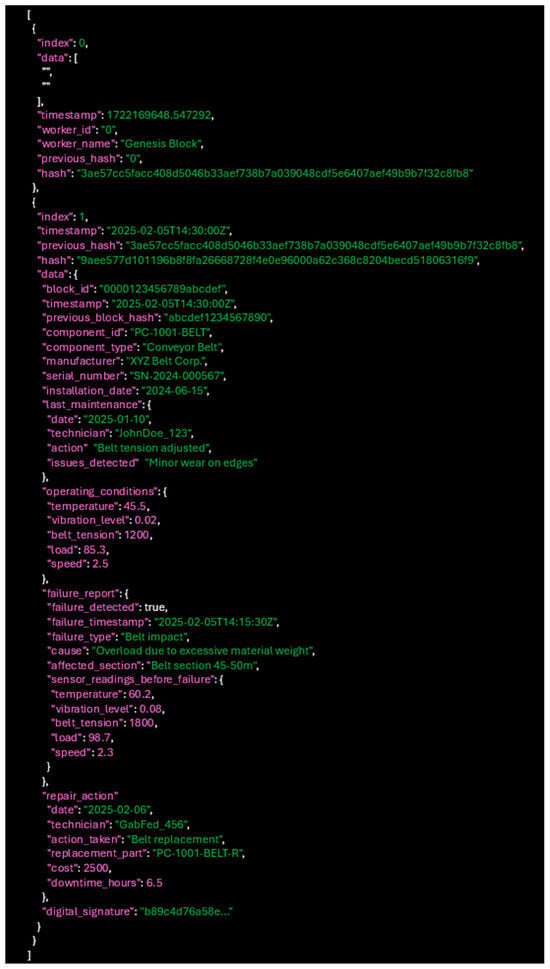
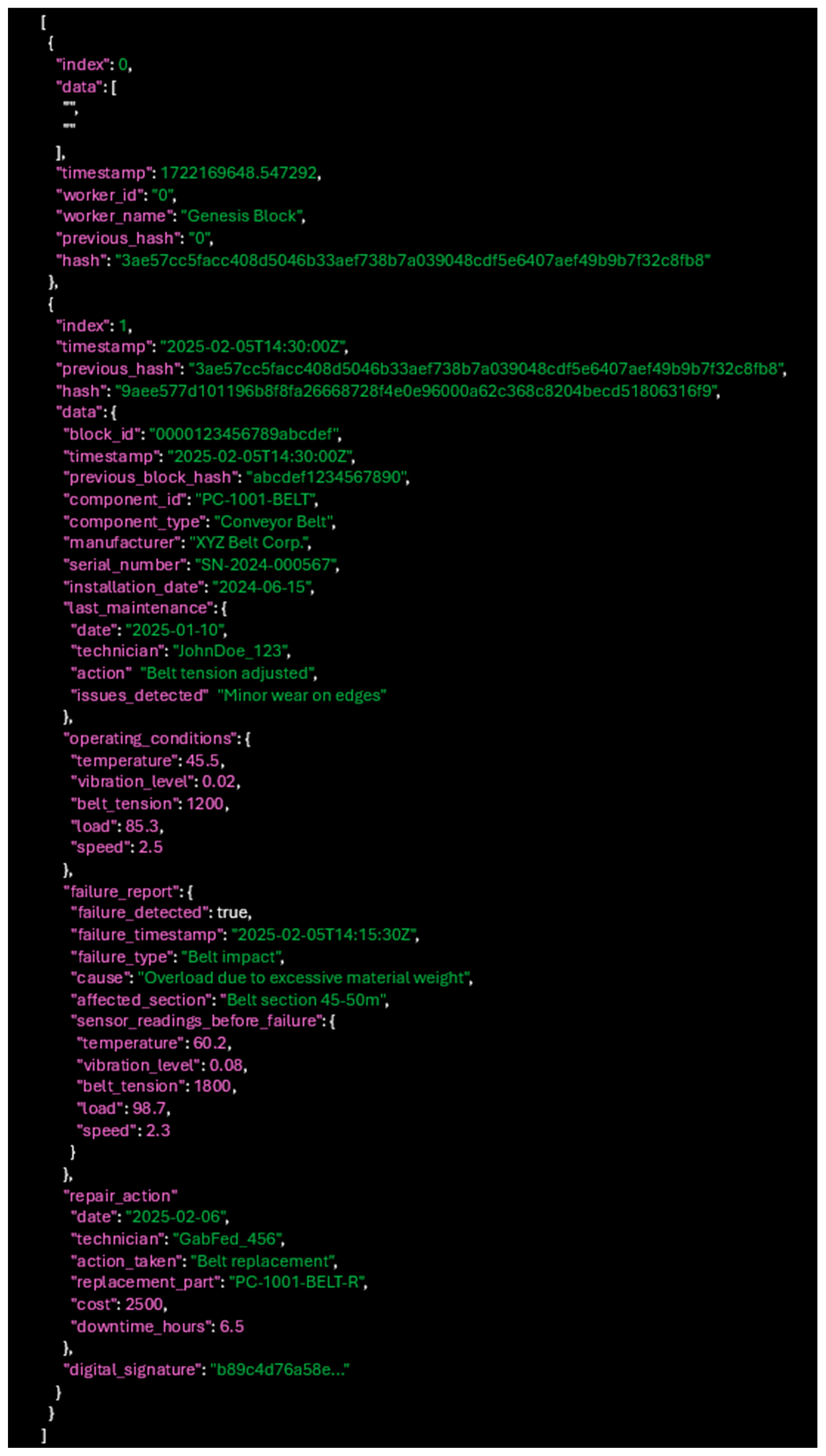
The block structure to be created and saved for the failure analysis of rubber-textile conveyor belts on pipe conveyors must contain all the necessary information for implementation. In terms of content, it should consist of structured data about the component, operating conditions, maintenance records, and failures for failure analysis (Figure 3). This structured data can be divided into the following sections:
Figure 3.
Example of the structure of a block in the blockchain with the recorded data for the needs of failure analysis of rubber-textile conveyor belts for pipe conveyors.
- 6.
- Block identification data section:
- block_id: unique block ID;
- timestamp: time of creation of the record;
- previous_block_hash: reference to the previous block’s hash (ensures chaining).
- 7.
- Conveyor belt data section:
- component_id: unique component ID (e.g., belt);
- component_type: component type (e.g., Conveyor Belt);
- manufacturer: manufacturer;
- serial_number: serial number;
- installation_date: installation date.
- 8.
- Section record of the last maintenance or service intervention:
- When the maintenance was performed and what measures were taken;
- Identification of the technique by a technician (can be anonymized).
- 9.
- Section operating conditions before the failure:
- Sensor data (temperature, vibration_level, belt_tension, load, speed);
- This data can be collected in real-time using IoT;
- Section records of the failure;
- When it was detected (failure_timestamp);
- Category of what was damaged (failure_type);
- Probable cause (cause);
- Sensor values before the failure.
- 10.
- Section record of the repair:
- Who and when performed the repair (technician);
- What was the repair intervention (action_taken);
- Costs (cost) and downtime (downtime_hours).
- 11.
- Digital signature section:
- digital_signature: cryptographic protection to prevent unauthorized manipulation of data.
The above parts represent the minimum information base necessary for failure analysis. Each newly generated block contains the hash of the previous block, ensuring strong data resistance to unauthorized modification. A new block with updated data is generated after each maintenance (service) or failure. The block is written to the blockchain using the appropriate consensus algorithm. To increase the efficiency of the entire process, it is possible to use smart contracts to automate tasks, such as ordering spare parts. At the same time, combined with a classification algorithm and possibly oracles, they can be used to identify individual failure types in rubber-textile conveyor belts and pipe conveyors.
The application possibilities and significance of blockchain functionalities for conveyor-belt failure analysis are presented in Table 4. The table evaluates the relevance of the selected blockchain functionalities for specific categories of belt damage and operating-condition anomalies, with a focus on their identification, traceability, and assessment.
Table 4.
Structured author assessment of the relative relevance of selected blockchain features for categories of conveyor-belt damage and operating-condition anomalies on a five-point scale (1 = very low relevance, 5 = very high relevance).
Table 4 presents a structured assessment of the relative relevance of selected blockchain features for individual conveyor belt failure types on a five-point scale, where 1 = very low relevance, 2 = low relevance, 3 = medium relevance, 4 = high relevance, and 5 = very high relevance. The assessment was carried out based on predefined criteria, in particular, the extent to which a given blockchain feature supports data traceability, record immutability, process transparency, and result verifiability for a specific damage category. The values presented are not experimentally validated metrics or statistically derived models, but rather a structured author’s assessment of the relative importance of individual blockchain features in the context of conveyor belt failure analysis.
The types of damage listed in Table 4 serve to illustrate the application context in which the blockchain solution can be used. The proposed blockchain workflow itself does not perform diagnostics or classification of these damages. Its significance lies in providing a trusted framework for managing, validating, and ensuring the traceability of data, which can subsequently be used in diagnostic, detection, or classification algorithms.
4. Results and Discussion
Blockchain technology is key to the evaluation process, enabling reliable operation. However, the measured data must undergo a predefined process before it can be applied.
As part of this process, the measured data must first be verified. Then, the data is evaluated to determine whether it is complete, whether the relevant methodology was followed in obtaining it through measurement, and whether its informational value is assessed. If, as part of the verification process, facts are discovered that preclude the use of the measured data for various reasons, the measured data will be excluded and rejected.
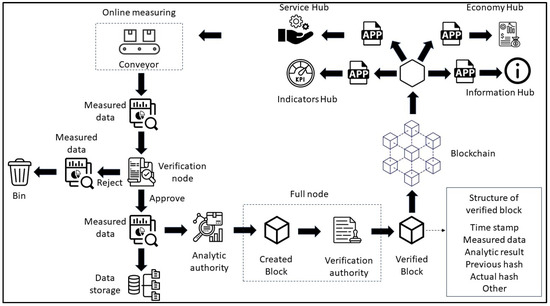
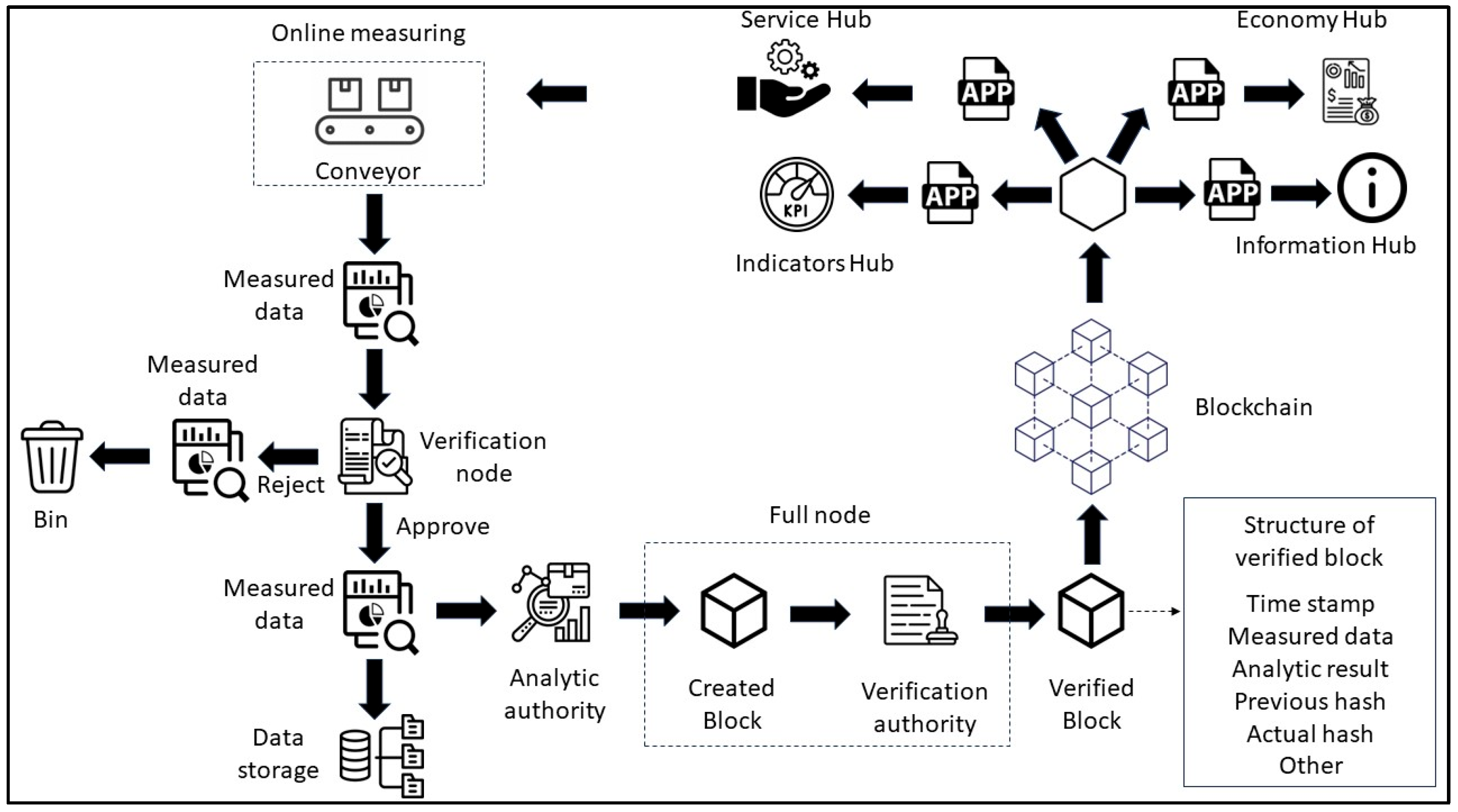
An original methodology was proposed to meet the abovementioned criteria within the failure analysis of rubber-textile conveyor belts on pipe conveyors (Figure 4).
Figure 4.
Methodology and system for managing raw measured data using blockchain technology in the framework of the failure analysis of rubber-textile conveyor belts for pipe conveyors.
Measured data that passes verification by the verification node must be saved and archived. At the same time, they will be received by the analytical authority. Its task is to evaluate them and define the necessary starting points for digital transformation needs. The obtained starting points, along with the corresponding data file, are placed in a new block that needs to be verified. The verification authority reviews the information and then decides whether to approve the block. If approved, the verification authority writes the block into the blockchain. Subsequently, individual users have access to this block and thus receive the information necessary for failure analysis and the operation of a continuous transport system.
4.1. Creation of a Block with the Measured Data
The first implementation hypothesis that was verified within the research was the possibility of creating a block with measured data and including it in a blockchain that would contain measured values related to the operation of a continuous conveyor system (Figure 4). These data serve as input to the failure analysis process during pipe-conveyor operation. They record force ratios on a hexagonal roller table and, based on previous research, can be used to identify the type of damage affecting the rubber-textile conveyor belt.
The hypothesis was verified using a data set of actual measurements. The aim was to confirm whether it is possible to work with such a file containing measured data, use it for failure analysis of the rubber-textile conveyor belt of the pipe conveyor, and, at the same time, store the measured data on the blockchain to ensure their non-interchangeability. A block containing measured data was created during the research via a user interface provided by the centralized blockchain application “LogBlock”, developed for the research.
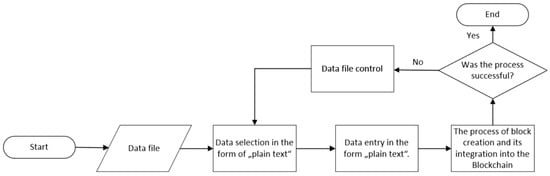
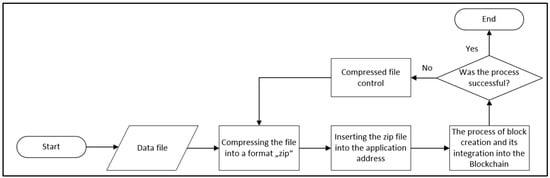
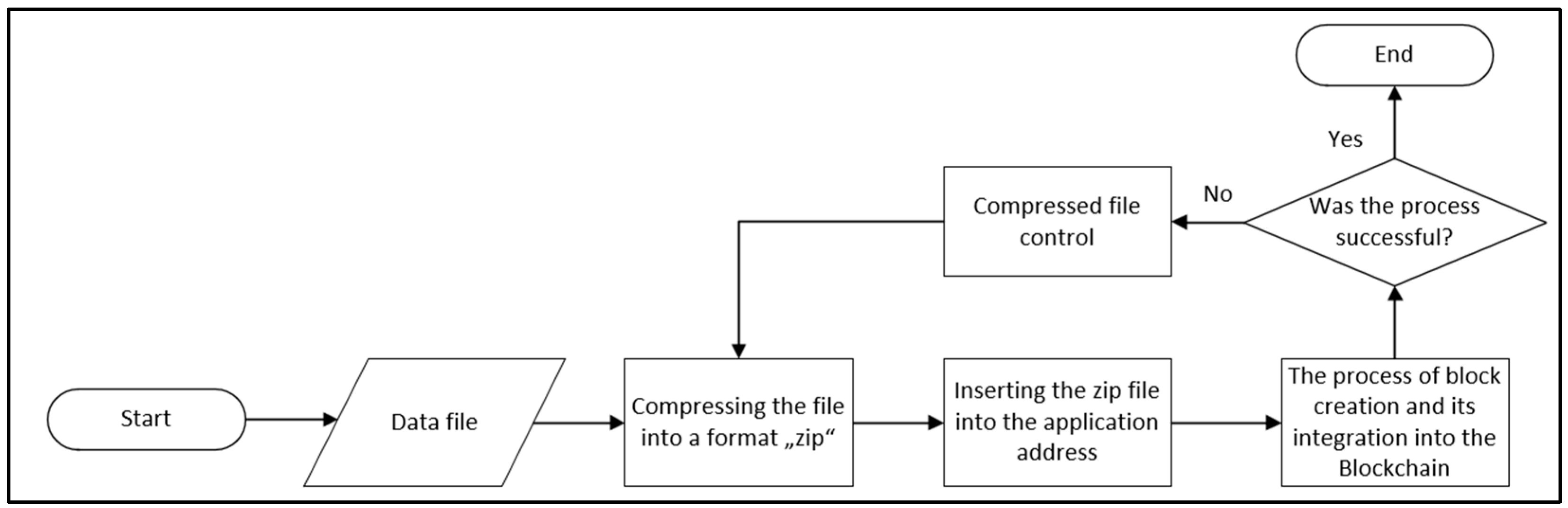
To empirically verify the proposed workflow, two different methods for entering data into the system were employed. In the first case, the measured data were entered directly as plain text (Figure 5), which is a simple method that does not preserve the original structure of the source file (Figure 6).
Figure 5.
The process of block creation and its integration into the blockchain using “plain text”.
Figure 6.
The process of creating a block of measured data in the form of “plain text”.
In the second case, the original source file was imported into the system in compressed .zip format, thereby preserving its original structure and enabling subsequent validation in an unchanged form (Figure 7).
Figure 7.
The process of block creation and its integration into the blockchain using a “compressed data file”.
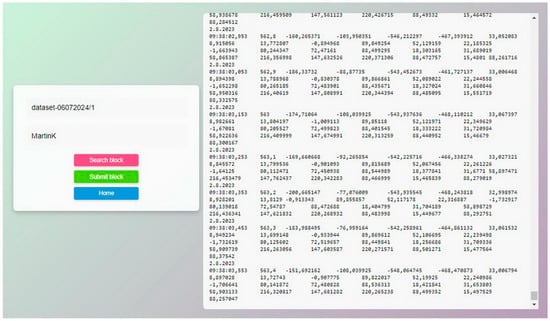
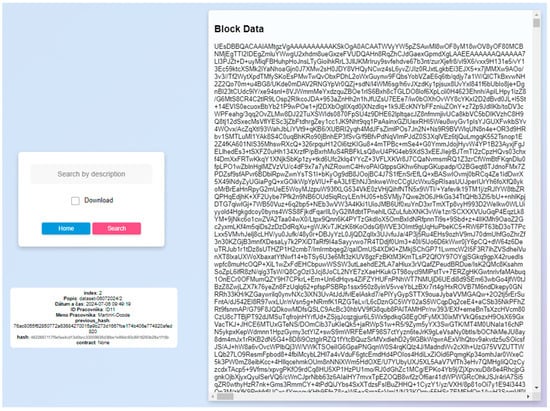
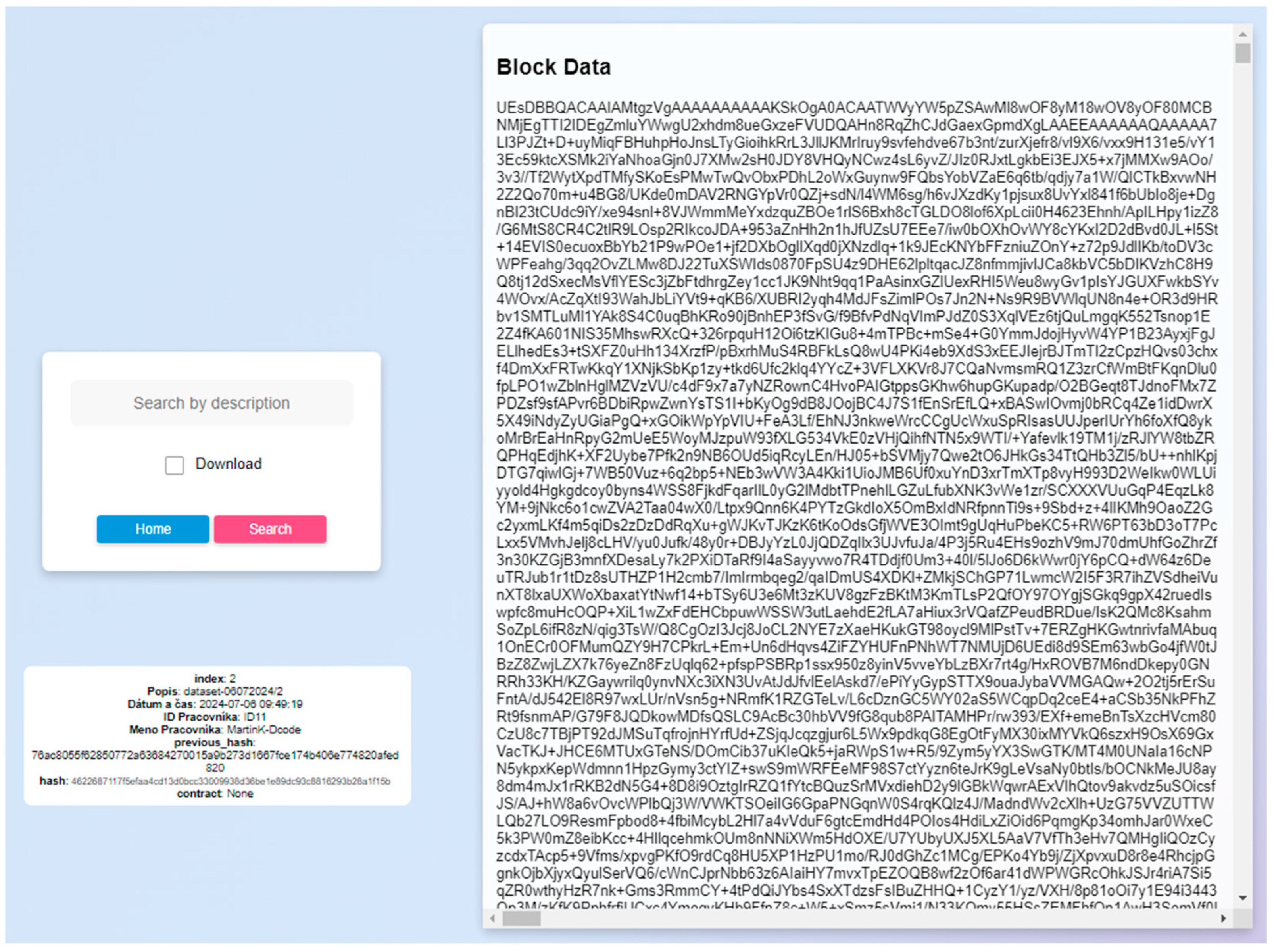
The results showed that after saving the input data to the blockchain record, the record could subsequently be retrieved and used in the next validation step (Figure 8). From a failure analysis perspective, it is important that the proposed procedure supports not only data archiving but also the traceability and controlled use of the data in subsequent processing.
Figure 8.
Example of listing the content of a created block in the blockchain by uploading a file in its original format using the data compression mechanism.
The results also showed the difference between the two recording methods. When directly inserting data in plain text, it is primarily a simple way of archiving the data content itself. When recording as a compressed source file, in addition to saving the data, the original file structure is preserved, which increases the practical usability of the recording for further work with the data.
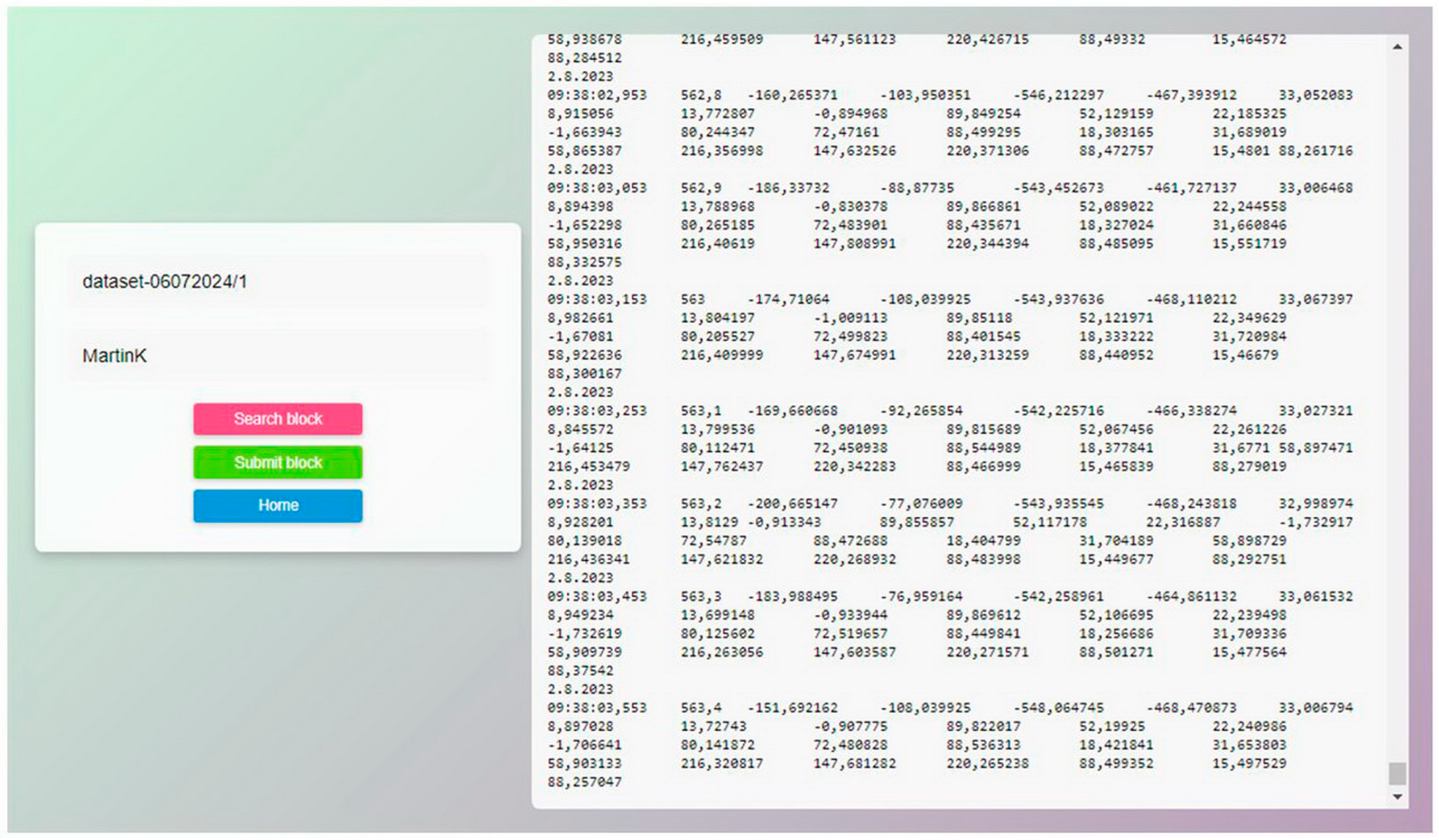
Based on these results, the first hypothesis was confirmed at the functional demonstration level. The proposed blockchain-based workflow enabled the storage of measured data and source files in blockchain records and supported their subsequent retrieval for failure analysis purposes (Figure 9). Therefore, the results allow for the technical feasibility of the proposed solution, but not its quantitative superiority over a conventional data management system.
Figure 9.
Example of listing the contents of a created block in the blockchain.
Based on the facts, the first scientific research hypothesis that blockchain can store files containing measured data or the data itself was validated within the tested scenario, supporting the feasibility of the proposed functionality. Thus, it is possible to conclude that blockchain suits the needs of digital transformation. It allows a user to create and implement blocks containing measured data or the files themselves, and simultaneously enables a user to work with those source files and data as part of the subsequent failure analysis.
4.2. Validation of the Block with the Measured Data
The second implementation hypothesis investigated in the research was whether the data stored in the blockchain can be fully used to validate source files against measured data, which are then further processed through the failure analysis process.
The subsequent verification aimed to practically assess whether the stored blockchain record can serve as a reference base for checking the integrity of the corresponding source file. From the perspective of failure analysis, this step is important because it allows distinguishing between unchanged and modified content before further data processing. As part of the experimental verification, two basic scenarios were considered.
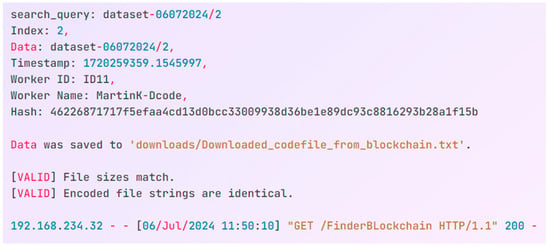
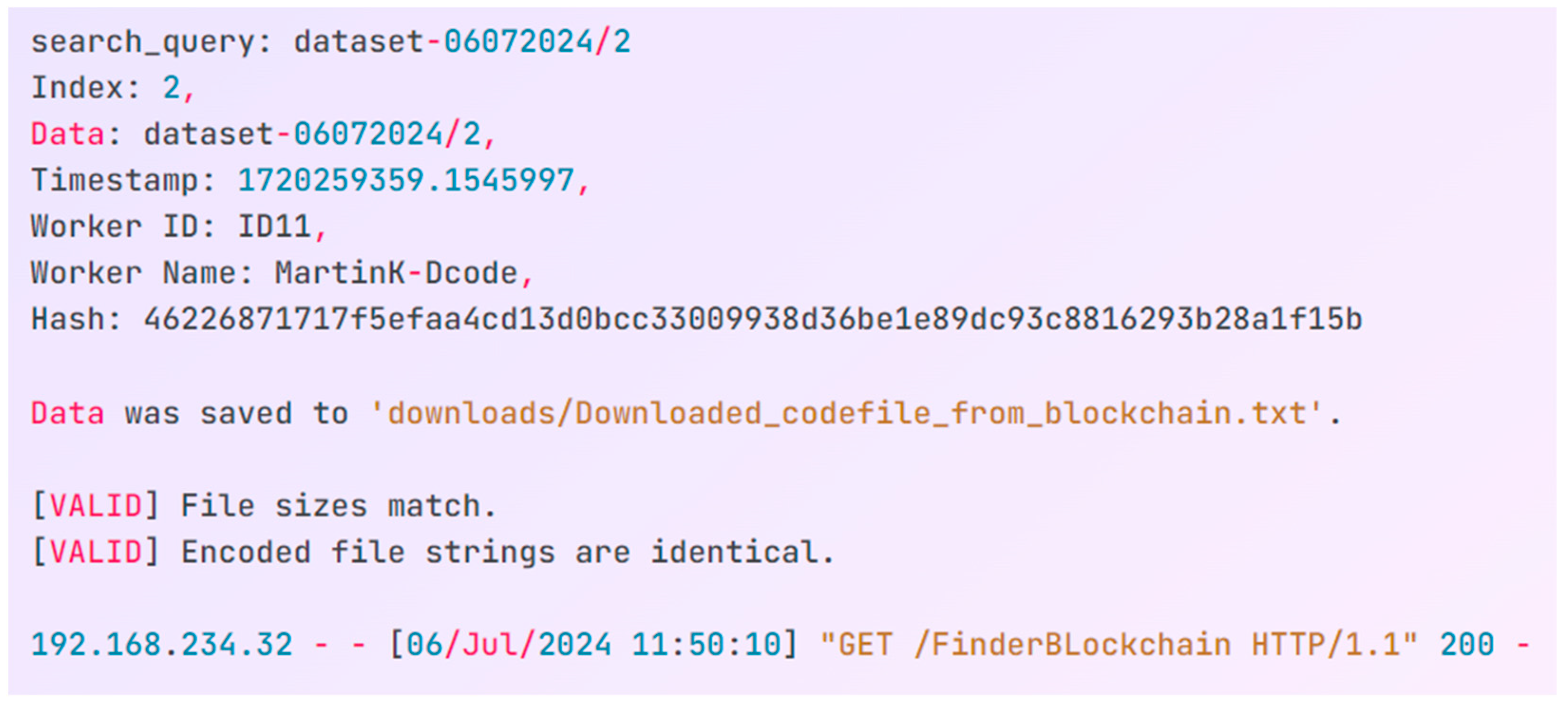
In the first scenario, an unchanged source file corresponding to the content stored in the blockchain was validated. In the second scenario, a file was verified that was modified after storage or its content or structural consistency had been changed. The scenarios designed in this way allowed us to assess whether the system could distinguish between a correct and a corrupted data record. The results showed that when validating an unchanged file, the process was successful and the system confirmed the match between the validated file and the blockchain record (Figure 10). It means the stored block could serve as a reference to verify the integrity of the relevant data. From a practical point of view, this result shows that the designed workflow supports traceable, controllable work with data to be used in subsequent failure analysis.
Figure 10.
Presentation of the monitoring of the validation process for the downloaded file.
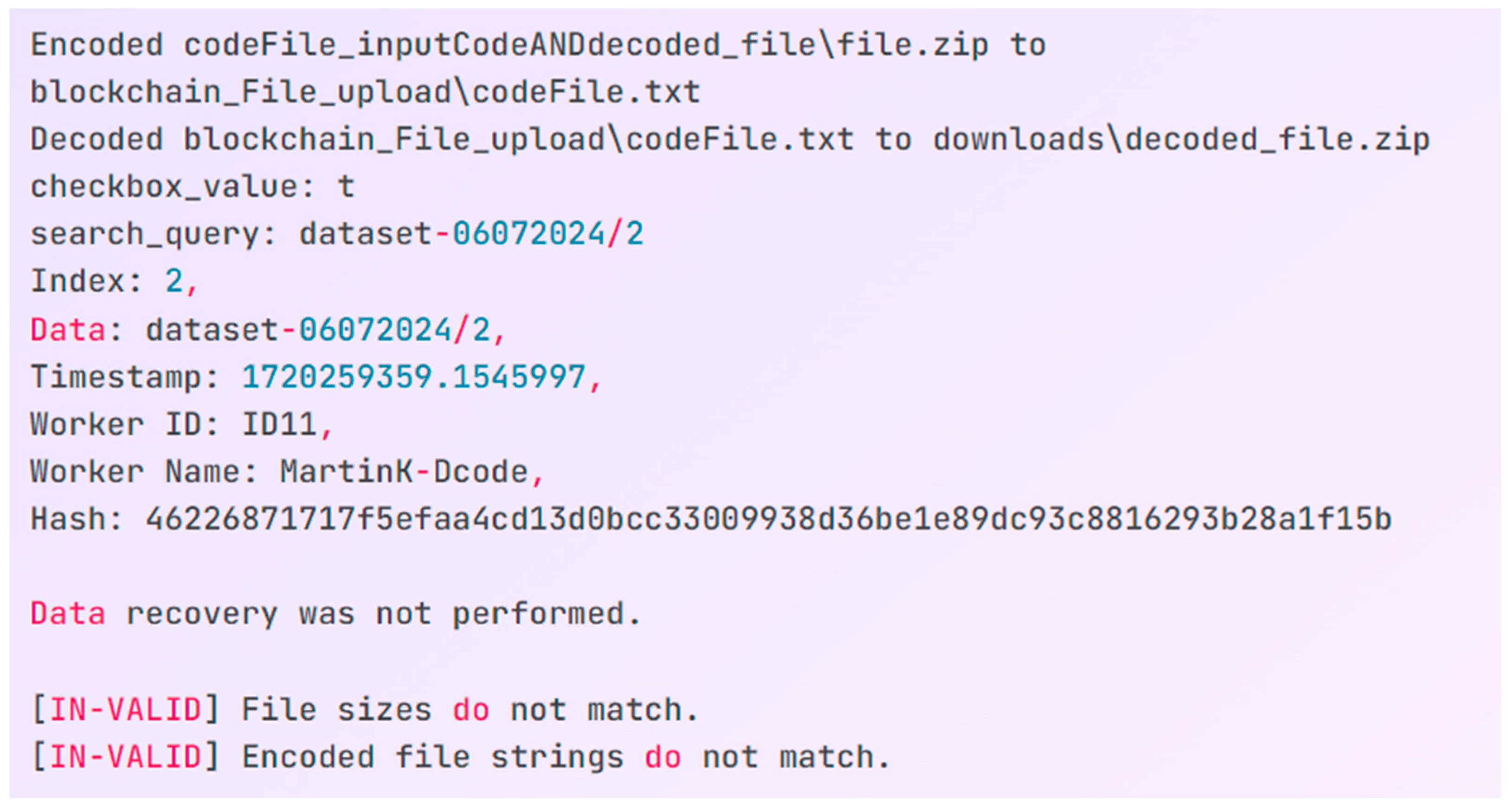
In the second scenario, where the file was modified after being saved, the validation failed. The system identified a discrepancy between the blockchain record and the submitted file, confirming its ability to detect unauthorized changes to the stored content. This result is particularly important from a data integrity perspective, as it shows that the proposed approach supports not only data archiving but also subsequent control and detection of manipulation (Figure 11).
Figure 11.
Information about the failed validation of the data file with the measured data.
Based on the results presented, the validity of the second implementation hypothesis can be confirmed. All data recorded on the blockchain can be used for validation to verify the data’s trustworthiness for use in the failure analysis process. This will ensure that failure analysis will take place transparently and trustworthily. At the same time, there will be reliable proof that the measured data has not been edited or modified without prior approval, and this information will be recorded on the blockchain.
The research results showed that blockchain is a suitable tool for the validation and management of experimental data in the framework of failure analysis. The proposed methodology enabled reliable data archiving, strong resilience to unauthorized data modification and monitoring integrity. Implementing the LogBlock application confirmed the blockchain’s ability to enhance the credibility of measured data and support transparency in failure analysis processes.
5. Conclusions
Blockchain technology has significant potential as a support tool for the failure analysis of rubber-textile conveyor belts, particularly by improving the transparency, reliability, and traceability of data on belt damage, operating anomalies, and maintenance processes. Compared to traditional database systems, it offers higher data management, strong resistance to unauthorized modification of data records, and data trustworthiness. The proposed blockchain-based support system records and validates experimental data used in failure analysis, facilitates collaboration among multiple entities, and strengthens user trust. This study has a character of a functional demonstration of the proposed blockchain workflow and does not include quantitative benchmarking or direct experimental comparison with conventional data management systems. The paper does not evaluate the scalability of the proposed solution with large-scale industrial data flows or long-term monitoring; these issues remain the subject of further research.
The presented solution was not designed as a public or fully decentralized blockchain network, but as a permission-controlled application prototype designed to work with measurement and diagnostic data in the failure analysis of conveyor belts. This architectural choice was made intentionally to ensure controlled access to data, integrity-oriented validation, and traceable data processing within a predefined circle of authorized entities. At the same time, however, this approach represents a compromise, as it does not provide the level of decentralization, trust distribution, and fault tolerance typical of public multi-node blockchain networks. The practical benefit of the proposed solution therefore lies primarily in supporting data integrity control, auditability, and traceability in a domain-specific application context, not in imitating a fully decentralized public blockchain.
The main contribution of this work is the design and functional demonstration of a domain-adapted blockchain framework (LogBlock) for managing, validating, and ensuring the traceability of experimental data throughout the conveyor belt failure analysis process. The proposed system does not serve as a new diagnostic method but as a support tool that ensures the integrity and auditability of digital records after they enter the analytical workflow, thereby increasing the overall credibility of the failure analysis results. The real contribution: a blockchain-based support system for recording and validating experimental data.
The paper does not evaluate attacks or manipulations that may occur before data is entered into the blockchain workflow. The security benefit of the proposed solution, therefore, primarily relates to the integrity, validation, and traceability of data after it is entered into the system. The benefit of the proposed solution, therefore, lies primarily in supporting data integrity and traceability within the analytical workflow, not in directly improving diagnostic or classification performance.
Further research in blockchain-based technologies, specifically focusing on advanced smart contracts and broader IoT integration, could expand the possibilities of failure analysis, for example, in automated process control or predictive fault diagnostics. Blockchain can thus not only speed up failure analysis but also ensure more accurate results and more effective decision-making.
Author Contributions
Conceptualization, G.F. and N.M.; methodology, M.K.; software, M.K.; validation, V.M., J.F. and N.M.; formal analysis, V.M.; investigation, M.K.; resources, G.F.; data curation, J.F.; writing—original draft preparation, J.F.; writing—review and editing, V.M.; visualization, M.K.; supervision, G.F.; project administration, J.F.; funding acquisition, G.F. All authors have read and agreed to the published version of the manuscript.
Funding
This research was funded by grant numbers VEGA 1/0674/24, KEGA 001TUKE-4/2025, KEGA 009STU-4-2025, APVV-21-0195, VEGA 1/0249/26, KEGA 038TUKE-4/2026, and project NFP401101B855, which focuses on logistics solutions in production systems.
Institutional Review Board Statement
Not applicable.
Data Availability Statement
The original contributions presented in the study are included in the article, further inquiries can be directed to the corresponding author.
Conflicts of Interest
The authors declare no conflicts of interest.
Abbreviations
The following abbreviations are used in this manuscript:
| IoT | Internet of Things |
| GenAI | Generative Artificial Intelligence |
| ID | Identifier |
References
- Samson, O.T.; Michael, I.O.; Akanni, A.A.; Pelumi, I.P.; Avidime, A.S. A Review of Failure Analyses in Engineering: Causes, Effects and Possible Solutions. In Proceedings of the 2023 International Conference on Science, Engineering and Business for Sustainable Development Goals (SEB-SDG), Omu-Aran, Nigeria, 5–7 April 2023; Volume 1, pp. 1–8. [Google Scholar]
- Tibaduiza Burgos, D.A.; Gomez Vargas, R.C.; Pedraza, C.; Agis, D.; Pozo, F. Damage Identification in Structural Health Monitoring: A Brief Review from its Implementation to the Use of Data-Driven Applications. Sensors 2020, 20, 733. [Google Scholar] [CrossRef] [Scilit]
- Leite, D.; Andrade, E.; Rativa, D.; Maciel, A.M.A. Fault Detection and Diagnosis in Industry 4.0: A Review on Challenges and Opportunities. Sensors 2025, 25, 60. [Google Scholar] [CrossRef] [Scilit] [PubMed]
- Wang, X.; Hao, N.; Yun, Y.; Zhang, M.; Zhang, Y.; Zhong, Z. D2net: A dual-branch lightweight network for conveyor belt rotation detection in pipe belt conveyors. J. Real-Time Image Process. 2025, 22, 37. [Google Scholar] [CrossRef] [Scilit]
- dos Santos e Santos, L.; Ribeiro Filho, P.R.C.F.; Macêdo, E.N. Development of idler for measuring indentation rolling resistance in pipe conveyor belts. Meas. J. Int. Meas. Confed. 2020, 153, 107413. [Google Scholar] [CrossRef] [Scilit]
- Molnar, V.; Fedorko, G.; Stehlikova, B.; Michalik, P. Analysis of a pipe conveyor’s idler housing failure due to a missing roller in terms of contact forces. Eng. Fail. Anal. 2021, 127, 105527. [Google Scholar] [CrossRef] [Scilit]
- Santos, L.d.S.e.; Soares, W.K.d.S.; Filho, P.R.C.F.R. A method for investigating the influence of rainwater on the useful life of idlers in pipe belt conveyors during seasonal operations. Eng. Fail. Anal. 2022, 141, 106702. [Google Scholar] [CrossRef] [Scilit]
- Molnar, V.; Fedorko, G.; Andrejiova, M.; Grincova, A.; Michalik, P. Online monitoring of pipe conveyors part II: Evaluation of selected operational parameters for the design of expert system. Measurement 2017, 104, 1–11. [Google Scholar] [CrossRef] [Scilit]
- Zheng, Y.; Liu, Q.; Li, Y.; Gindy, N. Investigation on concentration distribution and mass flow rate measurement for gravity chute conveyor by optical tomography system. Measurement 2006, 39, 643–654. [Google Scholar] [CrossRef] [Scilit]
- Mariniello, G.; Gragnaniello, C.; Asprone, D. Enhancing structural health monitoring data management and damage detection in digital twins with blockchain and smart contracts. Autom. Constr. 2025, 180, 106558. [Google Scholar] [CrossRef] [Scilit]
- Omar, I.A.; Hasan, H.R.; AlKhader, W.; Jayaraman, R.; Salah, K.; Omar, M. Blockchain-based trusted accountability in the maintenance of medical imaging equipment. Expert Syst. Appl. 2024, 241, 122718. [Google Scholar] [CrossRef] [Scilit]
- Jalapathy, P.; Mubashir Unnissa, M. Blockchain-enhanced reliability modeling for decentralized systems. Comput. Ind. Eng. 2026, 211, 111648. [Google Scholar] [CrossRef] [Scilit]
- Zhang, W.; Lu, Q.; Yu, Q.; Li, Z.; Liu, Y.; Lo, S.K.; Chen, S.; Xu, X.; Zhu, L. Blockchain-Based Federated Learning for Device Failure Detection in Industrial IoT. IEEE Internet Things J. 2021, 8, 5926–5937. [Google Scholar] [CrossRef] [Scilit]
- Takatsuji, T.; Watanabe, H.; Yamashita, Y. Blockchain technology to visualize the metrological traceability. Precis. Eng. 2019, 58, 1–6. [Google Scholar] [CrossRef] [Scilit]
- Melo, W.S.; Bessani, A.; Neves, N.; Santin, A.O.; Carmo, L.F.R.C. Using Blockchains to Implement Distributed Measuring Systems. IEEE Trans. Instrum. Meas. 2019, 68, 1503–1514. [Google Scholar] [CrossRef] [Scilit]
- Melo, W.; Machado, R.C.S.; Peters, D.; Moni, M. Public-Key Infrastructure for Smart Meters using Blockchains. In Proceedings of the 2020 IEEE International Workshop on Metrology for Industry 4.0 & IoT; IEEE: New York, NY, USA, 2020; pp. 429–434. [Google Scholar]
- Milicevic, K.; Omrcen, L.; Kohler, M.; Lukic, I. Trust Model Concept for IoT Blockchain Applications as Part of the Digital Transformation of Metrology. Sensors 2022, 22, 4708. [Google Scholar] [CrossRef] [Scilit] [PubMed]
- Melo, W.; Carmo, L.F.R.C.; Bessani, A.; Neves, N.; Santin, A. How blockchains can improve measuring instruments regulation and control. In Proceedings of the 2018 IEEE International Instrumentation and Measurement Technology Conference (I2MTC); IEEE: New York, NY, USA, 2018; pp. 1–6. [Google Scholar]
- Molnar, V.; Fedorko, G.; Stehlikova, B.; Michalik, P.; Kostial, D. Identification of Selected Failures in a Pipe Conveyor’s Operation with the Use of the Discrimination Method Based on Continuous Measurement. Appl. Sci. 2023, 13, 6864. [Google Scholar] [CrossRef] [Scilit]
- Molnar, V.; Fedorko, G.; Honus, S.; Andrejiova, M.; Grincova, A.; Michalik, P. Prediction of contact forces on idler rolls of a pipe conveyor idler housing for the needs of its online monitoring. Measurement 2019, 139, 177–184. [Google Scholar] [CrossRef] [Scilit]
- Santos, L.S.; Macedo, E.N.; Ribeiro Filho, P.R.C.F.; Cunha, A.P.A.; Cheung, N. Belt Rotation in Pipe Conveyors: Failure Mode Analysis and Overlap Stability Assessment. Sustainability 2023, 15, 11312. [Google Scholar] [CrossRef] [Scilit]
- Peng, C.; Peng, J.; Wang, Z.; Wang, Z.; Chen, J.; Xuan, J.; Shi, T. Adaptive fault diagnosis of railway vehicle on-board controller with large language models. Appl. Soft Comput. 2025, 185, 113919. [Google Scholar] [CrossRef] [Scilit]
- Wang, Z.; Chen, J.; Wang, C.; Peng, C.; Xuan, J.; Shi, T.; Zuo, M. CNC-VLM: An RLHF-optimized industrial large vision-language model with multimodal learning for imbalanced CNC fault detection. Mech. Syst. Signal Process. 2026, 245, 113838. [Google Scholar] [CrossRef] [Scilit]
- Nie, Q.; Geng, J.; Tang, D.; Liu, C. Industrial knowledge-enhanced fault diagnosis method: Integrating LLM and knowledge graph for fault reasoning and maintenance recommendation in CNC machine tools. Comput. Ind. Eng. 2026, 214, 111879. [Google Scholar] [CrossRef] [Scilit]
- Zhong, G.; Liu, J.; Liu, F.; Jiang, J.; Wang, B.; Zhang, F.; Chen, C.L.P. Unsupervised Textless Prompt with LLMs for Multivariate Time Series Anomaly Detection. IEEE Trans. Comput. Soc. Syst. 2026, 14, 1–13. [Google Scholar] [CrossRef] [Scilit]

Disclaimer/Publisher’s Note: The statements, opinions and data contained in all publications are solely those of the individual author(s) and contributor(s) and not of MDPI and/or the editor(s). MDPI and/or the editor(s) disclaim responsibility for any injury to people or property resulting from any ideas, methods, instructions or products referred to in the content. |
© 2026 by the authors. Licensee MDPI, Basel, Switzerland. This article is an open access article distributed under the terms and conditions of the Creative Commons Attribution (CC BY) license.