


Abstract
Thermal energy storage (TES) plays a crucial role in improving the efficiency and reliability of solar thermal systems, particularly when low-cost and readily available materials are desired. This study experimentally investigates the performance of a water–salt thermal energy storage system using sodium chloride (NaCl) at different concentrations in a simple solar collector setup. Experiments were conducted using a laboratory-scale solar thermal energy system under controlled conditions, with water serving as the heat transfer fluid and a fixed flow rate of 15 L/h. The storage medium consisted of water mixed with salt, which was obtained from the Dead Sea before any treatment. In its raw form, this type of salt contains impurities, mainly sand, at a fixed concentration of approximately 1% by weight. The effects of salt concentration on storage temperature, system efficiency, and effective heat capacity were analyzed. The results show that moderate NaCl concentrations improved the average storage temperature by up to 12–18%, increased thermal storage efficiency by approximately 1%, and enhanced the effective specific heat capacity compared to pure water. In contrast, higher salt concentrations resulted in a performance reduction of up to 8–12% due to increased thermal resistance and reduced heat transfer effectiveness. An optimal salt concentration range was identified at which maximum storage efficiency and heat capacity were achieved. These findings demonstrate that common sodium chloride can serve as an effective and economical enhancement material for thermal energy storage when properly optimized. The study provides quantitative evidence and practical insights for the development of low-cost, salt-based thermal energy storage systems for solar thermal applications. This study highlights the importance of concentration optimization and provides practical insights for the development of low-cost, salt-based thermal storage systems for solar energy applications.
1. Introduction
Thermal energy storage is a key component in improving the efficiency and operational stability of solar thermal collectors, particularly under fluctuating irradiation conditions. Among sensible heat storage media, saline water and brine solutions are attractive due to their low cost, availability, and favorable thermophysical properties, including relatively high density and specific heat capacity. These characteristics make water–salt solutions suitable candidates for short to medium term thermal storage in low- and medium-temperature solar applications.
Despite these advantages, the use of water–salt sensible storage in solar collector systems remains limited by an insufficient understanding of heat storage performance under realistic operating conditions. Existing studies primarily focus on conventional water-based storage or phase change materials, while fewer investigations systematically examine how salt concentration influences thermal charging, discharging behavior, and overall storage efficiency in direct coupling with solar collectors. In particular, the impact of salinity on heat retention and thermal response under transient solar input has not been adequately quantified.
This study addresses this gap by experimentally evaluating the sensible thermal storage performance of water–salt solutions integrated with a solar collector. The novelty of the work lies in the direct comparison of different salt concentrations under identical operating conditions, allowing the influence of salinity on thermal efficiency and storage stability to be isolated. The results provide practical insights into the feasibility of water–salt-based sensible storage for solar thermal systems and contribute data that can support the design and optimization of cost-effective thermal energy storage solutions.
A summary of various solar thermal energy storage materials and thermal energy storage systems that are currently in use is presented by Alva et al. [1]. The properties of solar thermal energy storage materials are discussed and analyzed. The dynamic performances of solar thermal energy storage systems in recent investigations are also presented and summarized.
Abánades et al. [2] addressed the limitation of conventional water-based thermal energy storage in district heating and cooling systems, particularly when medium temperature applications above 100 °C are required, such as double-effect absorption chillers. The authors identify that while molten nitrate salts are commonly used in concentrated solar power plants, their relatively high melting temperatures make them unsuitable for district energy systems operating in lower temperature ranges. To overcome this gap, the study proposes the use of an innovative molten salt mixture with a melting temperature below 150 °C, enabling operation between 150 and 250 °C. Within the framework of the WEDISTRICT project, the researchers design and propose a thermocline molten salt storage tank capable of integrating concentrated solar technologies into district heating and cooling networks. The expected outcome is an increased renewable energy share in district systems by enabling solar heat to supply services traditionally covered by fossil-fuel boilers, particularly high-temperature-driven absorption chillers, thereby improving overall system performance and sustainability.
Tian et al. [3] investigated the high-temperature thermal behavior of a Na2CO3–NaCl–KCl ternary eutectic molten salt for renewable energy storage, combining laboratory experiments with deep potential molecular dynamics simulations. Because experimental measurements of molten salts are challenging due to corrosion and toxicity, the researchers developed a multiscale predictive framework that integrates first-principle molecular dynamics data with the DP GEN enhanced sampling strategy. Experimentally, the ternary salt exhibited a melting point of 852.65 K, an enthalpy of fusion of 392.00 J per gram, and a specific heat capacity of 1.268 J per gram per kelvin, confirming strong heat storage capability. The DP-based simulations closely matched experimental results, with density deviations below 2.68 percent and specific heat capacity error as low as 0.63 percent. As the temperature increased from 873 K to 1073 K, density and viscosity decreased, while thermal conductivity slightly declined, consistent with theoretical transport relationships.
Thermal energy storage technologies developed for solar and industrial applications can be broadly categorized according to operating temperature range and storage mechanism, namely sensible heat storage, latent heat storage, and thermochemical storage.
High-temperature thermal energy storage systems, typically operating above 300 °C, are predominantly associated with concentrated solar power applications. In this category, molten salts have been extensively investigated due to their thermal stability and high energy density. Myers et al. [4] conducted an early systematic evaluation of chloride salts and eutectic mixtures, providing key data on phase equilibria, latent heat, and material costs. More recent studies have expanded this database to include radiative thermal properties, corrosion behavior, and long-term stability, reinforcing the suitability of molten chloride salts for high-temperature power generation systems (Zhao et al., 2024; Boretti, 2024) [5,6]. However, the high melting points, corrosion concerns, and system complexity associated with molten salts limit their applicability to centralized, high-temperature installations rather than low-temperature solar collectors.
Xu et al. [7] investigated the thermophysical properties and corrosion behavior of a eutectic MgCl2–KCl molten salt mixture intended for high-temperature heat transfer and thermal energy storage applications in concentrating solar power systems operating up to 800 °C. The researchers experimentally measured key properties, including vapor pressure, heat capacity, density, viscosity, and thermal conductivity across relevant temperature ranges, and developed temperature-dependent correlations suitable for industrial design use. In parallel, they evaluated the corrosion resistance of two nickel-based alloys by exposing them to the molten salt at 800 °C for periods ranging from one to sixteen weeks, followed by tensile strength testing to assess mechanical degradation. The results showed that when the salt was properly processed to remove water and oxygen before operation, both corrosion rates and strength loss in the alloys remained relatively low, indicating that the MgCl2–KCl eutectic system can be a viable high-temperature storage and heat transfer medium provided adequate salt purification is implemented.
At intermediate temperature levels, both sensible and latent heat storage approaches have been explored. Koçak et al. [8] reviewed sensible thermal energy storage materials used in solar industrial applications, highlighting the advantages of system simplicity and sustainability. Experimental comparisons by Suresh et al. [9] demonstrated that while latent heat storage systems using paraffin-based phase change materials achieve higher energy density, they exhibit longer charging times and increased sensitivity to thermal conductivity and flow conditions compared to sensible systems. Salt hydrates, widely studied as phase change materials, have also attracted attention due to their high latent heat; however, issues such as supercooling, phase segregation, and long-term cycling degradation remain unresolved, as summarized by Purohit and Sistla [10].
Although latent heat storage systems offer higher energy density, most phase change materials inherently suffer from low thermal conductivity and slow melting and solidification responses. As a result, extensive heat transfer enhancement techniques are typically required, such as the integration of optimized fin geometries, metal foams, or nanoparticle additives, which significantly increase system complexity and cost. Numerous studies have explicitly addressed this limitation through geometric and material optimization, including parametric optimization of Cesàro fins for melting enhancement, combined fin–foam–nanoparticle configurations for solidification improvement, and nature-inspired lotus-shaped fin structures coupled with hybrid nanoparticles and metal foam. While these approaches improve heat transfer performance, they introduce additional manufacturing challenges and economic constraints, particularly for low-temperature, low-cost solar applications. In contrast, sensible heat storage using NaCl–water avoids phase change-related thermal resistance and does not require structural heat transfer augmentation, offering a simpler and more economically scalable solution.
Low-temperature thermal energy storage, generally below 100 °C, is particularly relevant for solar thermal collectors, building integration, and water–energy systems. In this temperature range, large-scale sensible storage concepts such as brine aquifers and salinity gradient solar ponds have been investigated. Liu et al. [11] analyzed heat storage behavior in brine aquifers and showed that salinity and porosity significantly influence storage efficiency and thermal breakthrough. Solar pond studies using natural and industrial brines have demonstrated effective heat trapping and thermal stability over extended periods [12,13,14]. Despite their effectiveness, these systems require large land areas, strict stratification control, or favorable geological conditions, which restrict their scalability and integration with compact solar collectors.
Tian et al. [15] investigated the use of an active machine learning strategy, specifically the Deep Potential GENerator approach, to model and predict the structural and thermophysical properties of a Na2CO3–NaCl heterogeneous eutectic molten salt used for high-temperature thermal energy storage. They constructed a deep potential model through active learning and validated it by comparing simulated density and radial distribution functions with experimental and ab initio molecular dynamics results. The density prediction showed only a 2.54 percent deviation from experimental data, while the melt structure accuracy differed by just 0.92 percent from AIMD simulations, confirming high reliability. Structurally, the system forms tetrahedral configurations between Na and O ions, while CO32− maintains a stable triangular geometry. Thermally, as temperature increases from 973 K to 1173 K, viscosity decreases significantly and self-diffusion increases, whereas thermal conductivity slightly declines.
Abir et al. [16] reviewed the role of nanoparticles in enhancing molten salts for thermal energy storage in concentrated solar power systems. Rather than conducting new experiments, the authors systematically analyze existing research on molten salt nanofluids, focusing on how different nanoparticle and salt combinations influence specific heat capacity and thermal conductivity. The review examines synthesis techniques used to prepare these nanofluids, along with experimental characterization methods for measuring thermophysical properties and assessing particle dispersion. It also evaluates the practical and technical challenges associated with reliable measurement and stability. The findings highlight that certain nanoparticle additions can significantly increase the specific heat capacity of molten salts, though the enhancement mechanisms are still under debate. The study concludes by identifying key research gaps and outlining future directions needed to optimize nanofluid design and improve the performance of thermal energy storage systems in CSP applications.
Thermochemical energy storage systems have also been proposed for low- to medium-temperature applications. Recent work by Liu et al. [17] demonstrated high energy storage density and temperature lift using composite sorption materials based on hygroscopic salts such as CaCl2. While thermochemical systems offer long-term storage with minimal thermal losses, their reliance on complex material synthesis, moisture management, and reactor design increases system cost and operational complexity.
In contrast, aqueous sodium chloride solutions represent a low-temperature sensible heat storage medium that combines simplicity, low cost, and material availability. Unlike molten salts, NaCl water operates safely at low temperatures and avoids corrosion and solidification issues. Compared with phase change and thermochemical systems, it offers stable thermal behavior without supercooling, phase separation, or complex control requirements. Although NaCl-based systems are widely used in large-scale brine storage and solar pond applications, systematic experimental studies evaluating NaCl water as a sensible storage medium directly coupled with solar thermal collectors remain limited.
Accordingly, this study focuses on NaCl water as a low-temperature sensible thermal energy storage medium for solar collectors. By positioning NaCl water relative to molten salts, phase change materials, and thermochemical storage technologies, the present work aims to clarify its suitability as a practical, scalable, and cost-effective solution for low-temperature solar thermal applications.
2. Experiment Setup
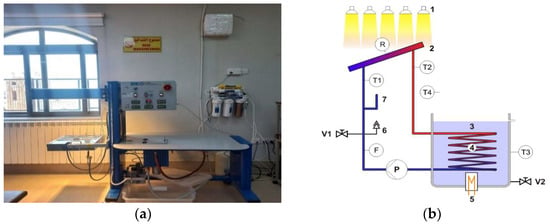
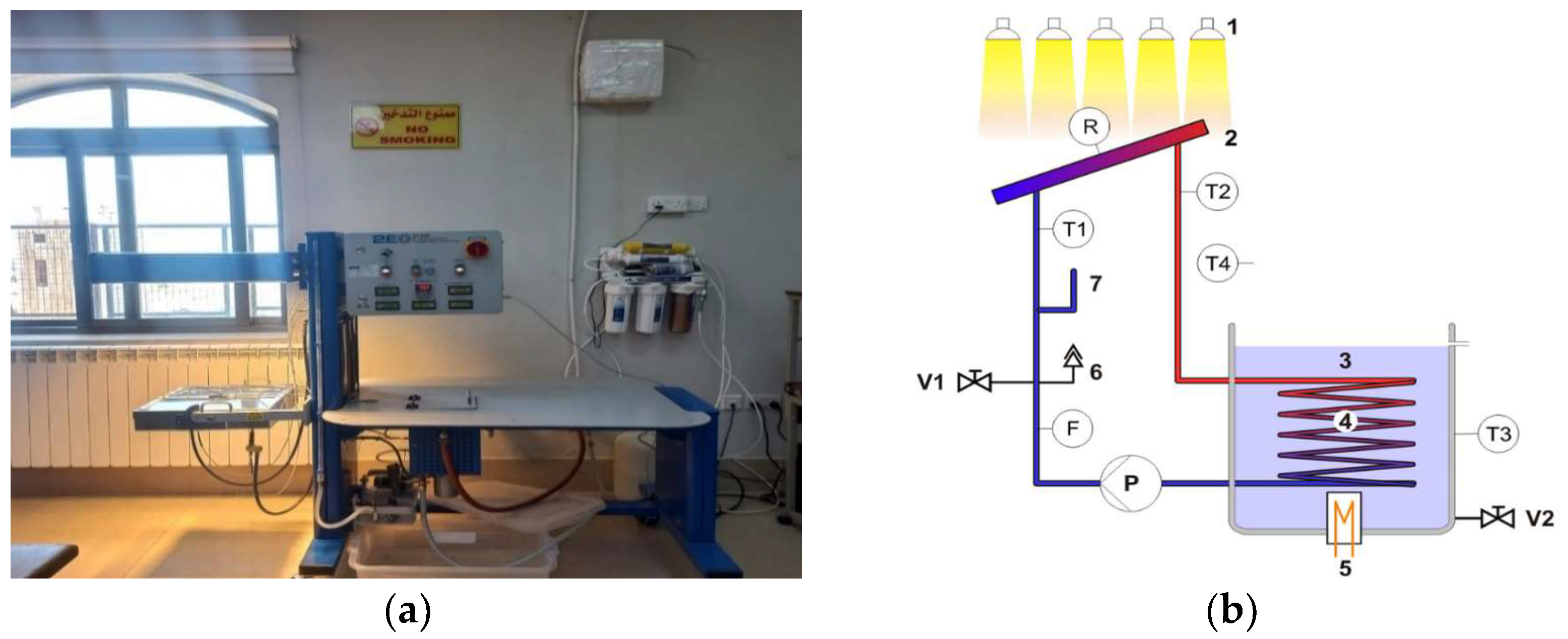
The experimental study was conducted using the ET 202 Solar Thermal Energy System (GUNT, Hamburg, Germany), which enables the controlled investigation of solar thermal energy collection and storage processes under laboratory conditions. A schematic representation of the experimental apparatus is shown in Figure 1.
Figure 1.
(a) Experiment setup, (b) schematic diagram of the system.
Artificial solar irradiation was provided by a lighting unit composed of 25 halogen lamps, ensuring uniform and adjustable thermal input to the system. The emitted radiation was directed onto a flat plate solar collector, where the absorbed heat was transferred to the circulating heat transfer fluid (HTF).
Water was used as the HTF and circulated through the collector by an electrically driven pump. The flow rate was adjustable in the range of 5–30 L/h. Based on preliminary experiments, a flow rate of 15 L/h was selected as the optimal operating condition and maintained throughout the main experimental campaign. Preliminary tests were conducted at different flow rates within the operational range of 5–30 L/h. A flow rate of 15 L/h was selected because it provided a stable temperature rise across the collector, ensured sufficient residence time within the heat exchanger, and avoided excessive thermal losses associated with very high or very low flow rates. This intermediate value allowed consistent and comparable evaluation of storage performance under all salt concentration conditions.
The heated heat transfer fluid left the collector and flowed into a spiral heat exchanger positioned inside a cylindrical thermal storage tank. Within this exchanger, thermal energy was transferred from the fluid to the storage medium, which consisted of water blended with untreated salt sourced from the Dead Sea. In its raw state, this salt contains impurities, primarily sand, at a fixed concentration of about 1 percent by weight.
The thermal storage tank was rectangular with a volume of 6 L. The tank walls were insulated using Polyurethane foam with a thickness of 40 mm. The tank was sealed to prevent evaporative heat losses during operation. Ambient laboratory temperature was maintained at approximately [25 ± 1 °C] throughout the experiments to ensure consistent boundary conditions. No active cooling or external airflow was applied around the tank during testing. These controlled conditions ensured that variations in storage temperature and calculated efficiency were primarily attributable to changes in NaCl concentration rather than environmental fluctuations.
Temperature measurements were obtained using calibrated thermocouples installed at key locations within the system. The inlet and outlet temperatures of the HTF at the solar collector were measured by sensors T1 and T2, respectively, while the storage tank temperature was monitored using sensor T3. Ambient temperature was recorded by sensor T4. All temperature data were continuously recorded using a data acquisition system.
Each experimental run was conducted for approximately four hours to ensure sufficient thermal development and quasi-steady-state conditions. The recorded data were subsequently analyzed to assess temperature evolution, stored thermal energy, and overall system efficiency under different salt concentrations.
All measurement instruments were calibrated prior to experimentation. The K-type thermocouples used for temperature measurement had an accuracy of ±0.5 °C within the operating temperature range. The flow rate measurement device integrated in the ET 202 system had an accuracy of ±2% of the measured value. The data acquisition system had a resolution of 0.1 °C for temperature readings. These accuracy specifications were considered in the subsequent uncertainty analysis to ensure reliable interpretation of the experimental results.
The experiments were conducted for sodium chloride concentrations of 0 (pure water), 1.67 g/L, 3.33 g/L, 5 g/L, 6.67 g/L, 8.33 g/L, 10 g/L and 13.3 g/L. Each concentration level was tested under identical operating conditions and repeated three times to ensure experimental reliability. The reported values in the results section represent the average of these repeated measurements. The standard deviation obtained from repeated tests was used to construct error bars in the presented figures.
System Efficiency Definition
The thermal storage system efficiency was calculated as the ratio of useful thermal energy stored in the tank to the total thermal energy delivered by the heat transfer fluid from the solar collector. The efficiency is expressed as
where
= thermal storage system efficiency.
Qstored = useful thermal energy accumulated in the storage tank (J).
Qinput = thermal energy supplied by the heat transfer fluid (J).
The stored thermal energy was calculated as
where
ms = mass of storage medium (kg).
Cp,s = effective specific heat capacity of the storage medium (J/kg·K).
Tfinal, Tinitial = final and initial storage tank temperatures (°C).
The thermal energy supplied by the collector was calculated as
where
= mass flow rate of heat transfer fluid (kg/s).
= specific heat capacity of the heat transfer fluid (J/kg·K).
Tout, Tin = outlet and inlet temperatures of the collector (°C).
Δt = duration of operation (s).
3. Results and Discussion
The experimental results clearly demonstrate that the performance of the thermal energy storage (TES) system is strongly influenced by salt particle concentration. Quantitative analysis of temperature evolution, storage efficiency, and heat transfer behavior was carried out to evaluate the impact of sodium chloride (NaCl) addition under a constant flow rate of 15 L/h.
All data points presented in Figure 2, Figure 3 and Figure 4 represent the mean values obtained from three independent experimental runs. Error bars indicate the standard deviation associated with repeatability. The relatively small deviation values confirm good experimental consistency and support the statistical significance of the observed trends.
3.1. Effect of Salt Concentration on Storage Temperature
Figure 2 illustrates the variation in the average storage tank temperature as a function of sodium chloride (NaCl) concentration in the storage medium. The results clearly indicate that the addition of salt has a pronounced influence on the thermal behavior of the storage system; however, this influence is non-linear.
Figure 2.
Average storage tank temperature under different NaCl concentrations.
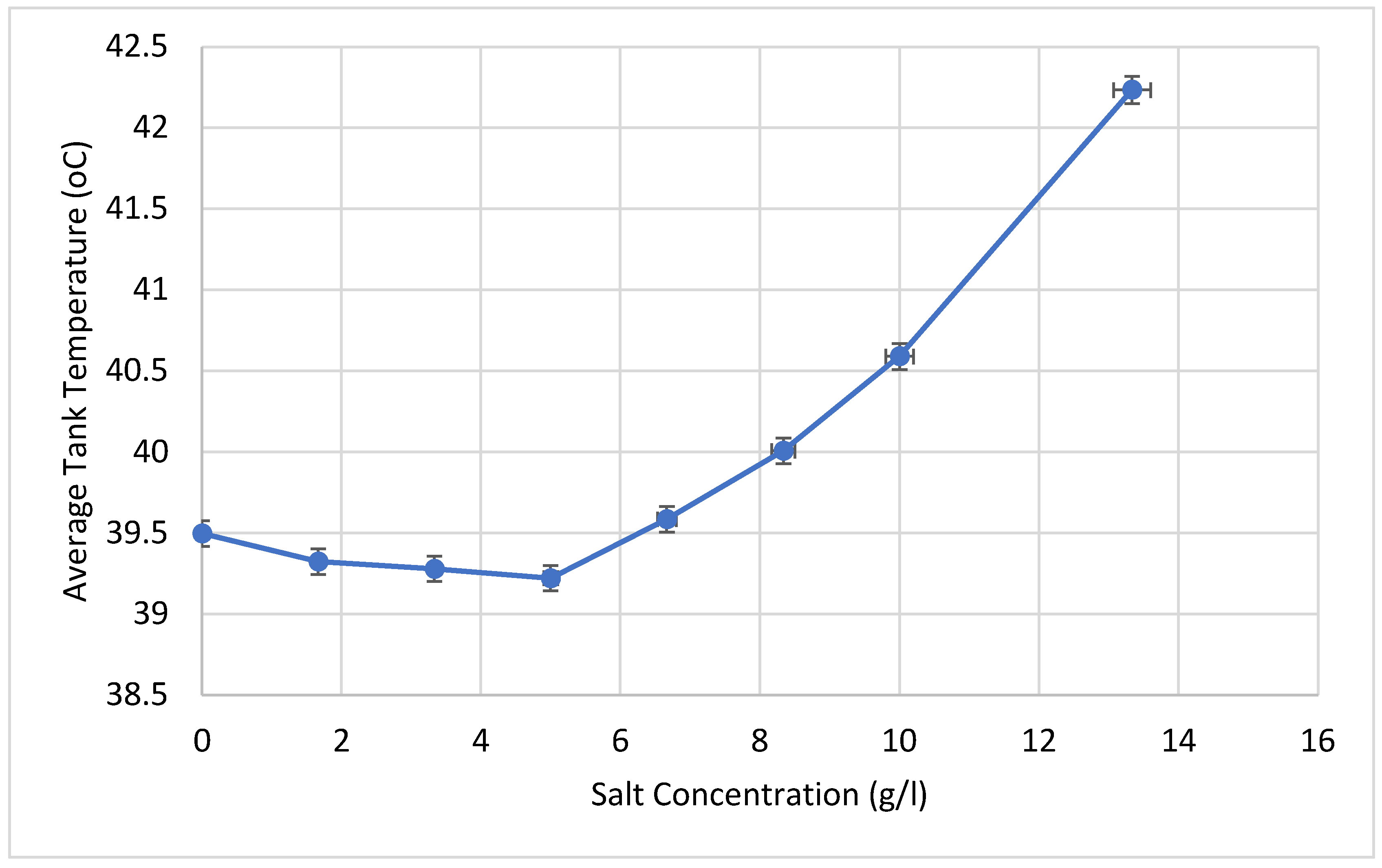
At low salt concentrations, the average storage temperature increases compared to pure water. This enhancement can be attributed to the higher density and modified thermal properties of saline water, which improve heat retention and reduce convective heat losses within the storage tank. The presence of dissolved NaCl increases the effective thermal inertia of the storage medium, allowing it to absorb and maintain thermal energy more efficiently during the charging period.
As the salt concentration continues to increase, the storage temperature reaches a maximum, indicating the existence of an optimal concentration range. At this point, the beneficial effects of increased heat capacity and reduced internal convection dominate, resulting in improved thermal stratification and energy retention. This behavior is consistent with previous studies on salt-enhanced thermal energy storage systems, which report improved heat storage performance at moderate salinity levels.
Beyond the optimal concentration, a decline in the average storage temperature is observed. This reduction may be explained by several competing effects. Higher salt concentrations increase the viscosity of the storage medium, which can hinder effective heat transfer from the heat exchanger to the bulk fluid. In addition, excessive salt content may promote localized crystallization or uneven particle distribution, particularly in the presence of solid additives such as sand, leading to increased thermal resistance and reduced heat diffusion. Furthermore, higher salinity can enhance conductive heat losses to the surroundings due to increased thermal conductivity gradients.
During the experimental runs, no visible salt crystallization, sedimentation, or phase separation was observed within the storage tank. The saline solution remained visually homogeneous throughout the charging period, indicating that the performance decline at higher concentrations was more likely associated with increased viscosity and reduced convective heat transfer rather than precipitation effects.
These results demonstrate that while NaCl addition can significantly enhance thermal storage performance, excessive concentrations are counterproductive. The findings emphasize the importance of optimizing salt concentration rather than maximizing it, especially for low-cost and practical solar thermal storage applications. Identifying and operating within this optimal concentration range is essential to achieving maximum storage temperature and overall system effectiveness.
It is to be noted that the observed temperature enhancement at moderate NaCl concentrations is consistent with findings reported in brine-based thermal storage systems, where increased salinity improves thermal retention due to higher density and reduced convective losses [12]. However, unlike large-scale aquifer or solar pond systems, the present study demonstrates similar enhancement within a compact collector-integrated configuration.
3.2. Storage System Efficiency
Figure 3 presents the variation in the thermal storage system efficiency with respect to sodium chloride (NaCl) concentration in the storage medium. The results demonstrate that storage efficiency is strongly dependent on salt concentration and follows a trend similar to that observed for storage temperature, confirming the close relationship between thermal retention and overall system performance.
At low NaCl concentrations, the storage efficiency shows a noticeable improvement compared to the baseline case of pure water. This enhancement can be attributed to improved heat absorption and reduced thermal losses within the storage tank. The presence of salt increases the density and thermal inertia of the storage medium, enabling more effective utilization of the thermal energy transferred from the heat exchanger during the charging process. As a result, a larger fraction of the collected solar energy is successfully stored rather than dissipated to the surroundings.
As the salt concentration increases further, the system efficiency reaches a maximum, indicating an optimal operating range. Within this range, the balance between enhanced thermal capacity, favorable heat transfer characteristics, and minimized internal convection leads to the most efficient storage performance. The improved efficiency at moderate salt concentrations suggests that the added NaCl enhances thermal stratification and reduces mixing-related losses, allowing the system to retain useful thermal energy more effectively over time.
Figure 3.
Storage system efficiency under different NaCl concentrations.
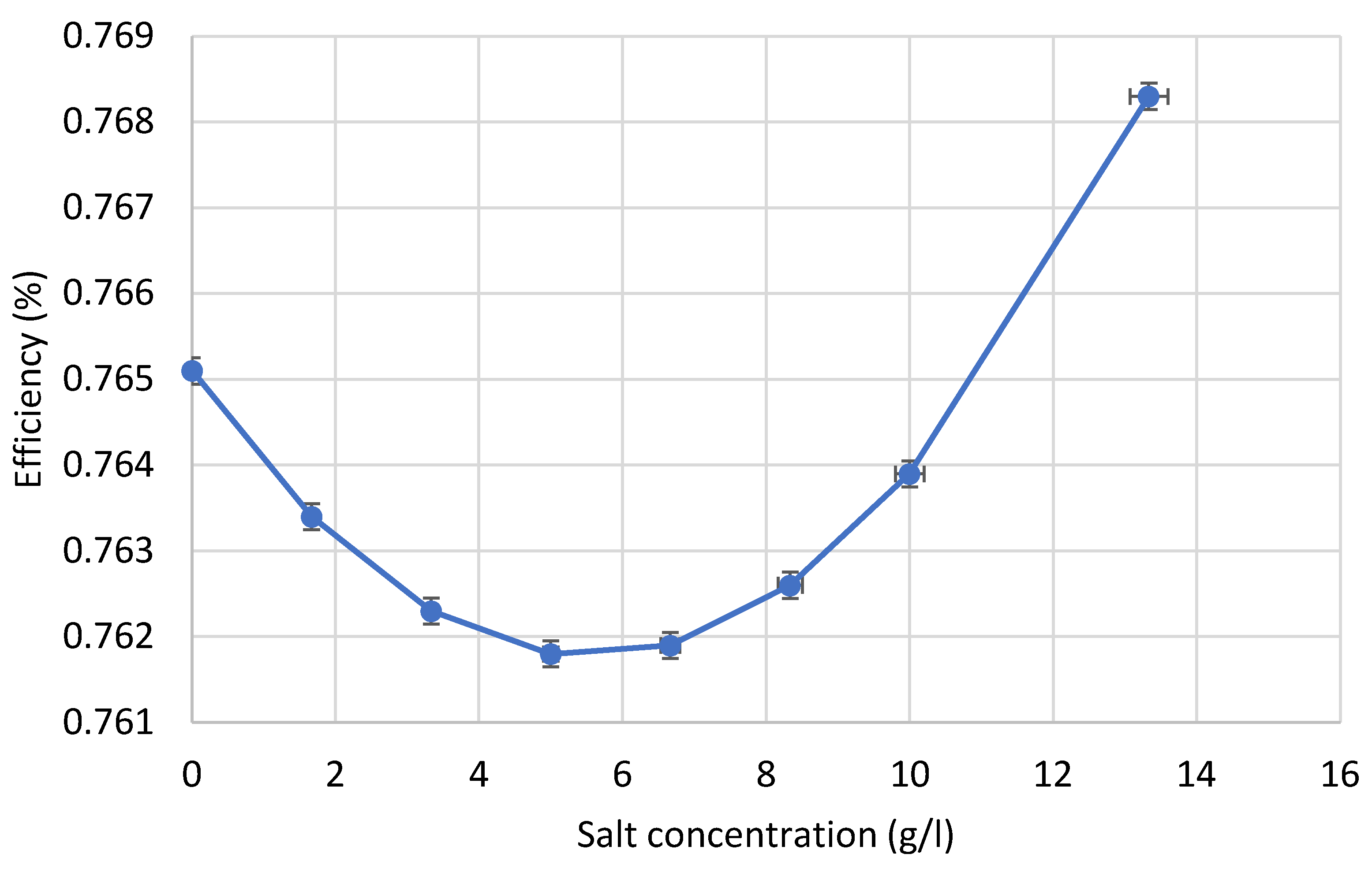
Beyond the optimal concentration, a gradual decline in storage efficiency is observed. This reduction is likely caused by increased viscous resistance and impaired heat transfer between the heat exchanger and the storage medium at higher salt concentrations. Elevated salinity can also increase thermal resistance within the tank due to uneven salt distribution or interaction with solid particles, such as sand, leading to localized temperature gradients and reduced effective heat utilization. Additionally, higher salt concentrations may amplify heat losses through the tank walls due to altered thermal conductivity behavior, further decreasing efficiency.
These findings highlight that maximizing salt concentration does not equate to maximizing efficiency. Instead, system performance depends on identifying an optimal salt concentration that enhances energy retention without introducing adverse heat transfer or loss mechanisms. The results reinforce the importance of careful material and concentration selection in the design of low-cost, salt-based thermal energy storage systems for solar applications.
The efficiency improvement observed in this study, although moderate, aligns with trends reported in sensible heat storage systems where material modification improves thermal inertia without introducing phase change-related resistance [8]. Compared to latent heat systems, which often require conductivity enhancement techniques [9], the present NaCl–water system achieves performance gains without structural heat transfer augmentation.
3.3. Heat Capacity
Figure 4 illustrates the variation in the average heat capacity of the storage medium as a function of sodium chloride (NaCl) concentration. The results indicate that salt concentration has a significant impact on the effective heat capacity of the thermal energy storage system, directly influencing its ability to absorb and retain thermal energy.
At low NaCl concentrations, the average heat capacity increases relative to pure water. This behavior can be attributed to the combined effect of increased mass density and enhanced thermal inertia of the saline solution. Although the specific heat capacity of saline water is slightly lower than that of pure water.
Figure 4.
Average heat capacity under different NaCl concentrations.
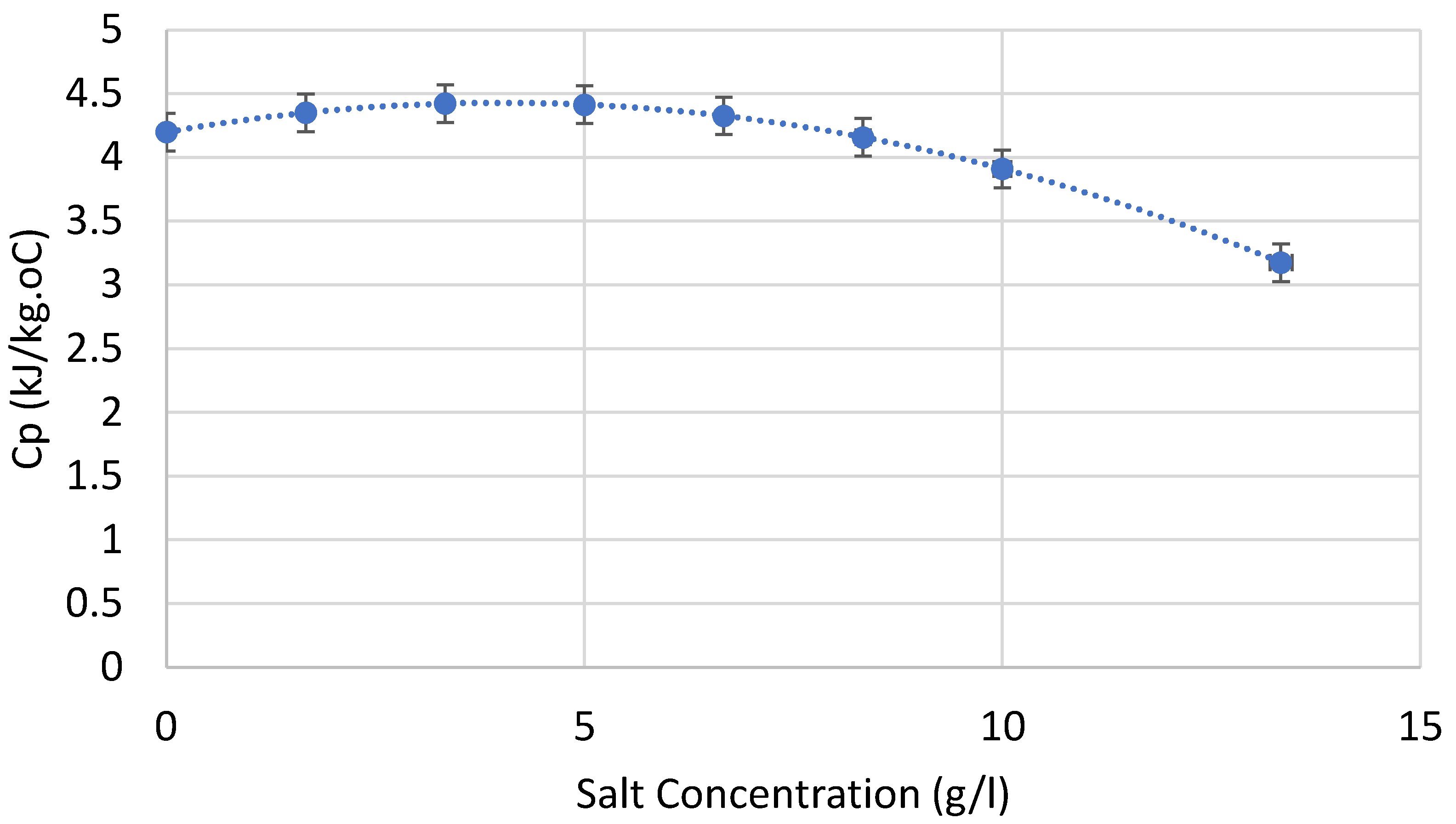
The overall specific heat capacity increases due to the higher density of the salt–water mixture. Consequently, the storage medium can retain a greater amount of thermal energy per unit volume, which contributes positively to system performance.
As the salt concentration increases further, the heat capacity reaches a maximum value, corresponding to the optimal concentration range observed in Figure 2 and Figure 3. In this range, the thermal storage medium achieves a favorable balance between density enhancement and effective heat transfer, allowing for maximum thermal energy accumulation without excessive internal resistance. The presence of sand particles in equal proportions may also contribute to this effect by increasing the effective thermal mass of the storage medium, further stabilizing temperature fluctuations.
Beyond the optimal concentration, a reduction in average heat capacity is observed. This decline may be attributed to several interacting factors. At higher salt concentrations, increased solution viscosity can limit convective heat transfer within the storage tank, reducing the effective utilization of the available thermal mass. Additionally, excessive salt content may lead to non-uniform salt distribution or localized crystallization, which can reduce the effective heat storage volume and introduce thermal resistance. These effects collectively diminish the system’s ability to store thermal energy efficiently, despite the increased material mass.
It should be noted that, while saline solutions typically exhibit a slightly lower specific heat capacity than pure water, the observed variations may result from the effective thermal response of the composite storage medium, including sand addition and altered heat transfer dynamics within the tank. Therefore, the improvement in storage performance at moderate salt concentrations is primarily attributed to enhanced thermal retention and density-related effects rather than an intrinsic increase in specific heat capacity alone.
The results demonstrate that the effective heat capacity of a salt-enhanced thermal storage system is not solely governed by material quantity but by the interaction between thermophysical properties and heat transfer mechanisms. The importance of internal heat transfer mechanisms in cylindrical thermal systems has also been emphasized by Abu Shaban et al. [18], who demonstrated the influence of thermal dispersion on transient temperature fields. The observed trend reinforces the conclusion that an optimal salt concentration exists, at which the thermal storage medium achieves maximum heat capacity and overall performance. This finding is particularly important for low-cost solar thermal applications, where material simplicity and operational efficiency must be carefully balanced.
The increase in effective thermal capacity at optimal salinity levels is consistent with the density-driven volumetric enhancement observed in saline storage systems (Liu et al., 2020) [11]. Unlike PCM-based systems, where latent heat dominates but thermal conductivity remains limiting, the current system demonstrates stable sensible heat performance under repeated operation.
These findings emphasize that salt-enhanced TES systems require careful optimization of particle concentration. Simply adding salt does not guarantee improved performance; instead, an optimal concentration range exists where thermal losses are minimized and energy retention is maximized.
3.4. Uncertainty and Statistical Analysis
An uncertainty analysis was conducted to evaluate the reliability and precision of the experimental measurements. The primary measured parameters were temperature, flow rate, and time. The K-type thermocouples used in the study had a measurement accuracy of ±0.5 °C, while the flow rate measurement system had an uncertainty of ±2% of the measured value. Time measurement uncertainty was considered negligible compared to temperature and flow rate uncertainties.
The uncertainty in the calculated stored thermal energy was estimated using the standard error propagation method, expressed as
where Q is stored thermal energy, T is the temperature, is the mass flow rate, UT and Uin represent temperature and flow rate uncertainties, respectively.
Based on this analysis, the combined uncertainty in the calculated stored thermal energy was estimated to be within ±6–8%, while the uncertainty associated with the calculated system efficiency did not exceed ±7%. These uncertainty ranges are significantly smaller than the experimentally observed variations (up to 12–18% in temperature and 8–12% in performance), confirming that the reported trends are statistically meaningful.
To further ensure experimental reliability, selected tests were repeated under identical operating conditions. The standard deviation of average storage temperature across repeated runs remained below ±1.2 °C, corresponding to a relative deviation of approximately 3–4%. Similarly, variations in calculated efficiency between repeated tests remained below 5%, indicating good repeatability and measurement consistency.
4. Conclusions
This study experimentally investigated the performance of a low-cost water–salt thermal energy storage (TES) system for solar thermal applications, with particular emphasis on the effect of sodium chloride (NaCl) concentration on storage behavior. Using a controlled laboratory-scale solar thermal setup, the influence of salt concentration on storage temperature, system efficiency, and effective heat capacity was systematically evaluated.
The results demonstrate that the incorporation of NaCl into the storage medium significantly affects TES performance in a non-linear manner. Moderate salt concentrations enhanced the average storage temperature, improved system efficiency, and increased the effective heat capacity compared to pure water. These improvements are attributed to increased thermal inertia, improved energy retention, and reduced internal thermal losses. However, excessive salt concentrations led to a decline in performance, likely due to increased viscosity, reduced heat transfer effectiveness, and potential non-uniform salt distribution within the storage tank.
An optimal salt concentration range was identified, within which the TES system achieved maximum thermal efficiency and energy storage capacity. The uncertainty and repeatability analyses confirmed that the observed performance trends were statistically significant and experimentally reliable. These findings emphasize that simply increasing salt concentration does not guarantee improved thermal storage performance and that careful optimization is essential.
Overall, the study confirms that common sodium chloride is a viable, economical, and readily available material for enhancing thermal energy storage when properly optimized. The proposed water–salt TES system offers a practical solution for low-cost solar thermal applications, particularly in regions where affordability and material availability are critical. Future work should focus on long-term stability, cyclic performance, and scaling effects to further assess the applicability of this approach in real-world solar energy systems.
Author Contributions
Conceptualization, M.H.; Methodology, E.A. and S.A. (Salman Ajib); Validation, E.A.; Investigation, S.A. (Shahnaz Alkhalil) and M.S.; Data curation, S.A. (Shahnaz Alkhalil) and M.S.; Writing—original draft, E.A.; Writing—review & editing, S.A. (Salman Ajib); Supervision, M.H. All authors contributed equally to complete this work. All authors have read and agreed to the published version of the manuscript.
Funding
This research received no external funding.
Data Availability Statement
Data available upon request.
Conflicts of Interest
The authors declare no conflict of interest.
References
- Alva, G.; Liu, L.; Huang, X.; Fang, G. Thermal energy storage materials and systems for solar energy applications. Renew. Sustain. Energy Rev. 2017, 68, 693–706. [Google Scholar] [CrossRef] [Scilit]
- Abánades, A.; Rodríguez-Martín, J.; Roncal, J.J.; Caraballo, A.; Galindo, F. Proposal of a thermocline molten salt storage tank for district heating and cooling. Appl. Therm. Eng. 2023, 218, 119309. [Google Scholar] [CrossRef] [Scilit]
- Tian, H.; Liu, T.; Zhang, W. Thermal properties of Na2CO3–NaCl–KCl ternary eutectic salt for high-temperature thermal energy storage: Experimental and deep potential molecular dynamics combined. J. Chem. Phys. 2025, 163, 084503. [Google Scholar] [CrossRef] [Scilit] [PubMed]
- Myers, P.D., Jr.; Goswami, D.Y. Thermal energy storage using chloride salts and their eutectics. Appl. Therm. Eng. 2016, 109, 889–900. [Google Scholar] [CrossRef] [Scilit]
- Zhao, L.; Wang, J.; Cui, L.; Li, B.; Du, X.; Wu, H. Performance design of high-temperature chloride salts as thermal energy storage material. J. Therm. Sci. 2024, 33, 479–490. [Google Scholar] [CrossRef] [Scilit]
- Boretti, A. Optimizing concentrated solar power: High-temperature molten salt thermal energy storage for enhanced efficiency. Energy Storage 2024, 6, e70059. [Google Scholar] [CrossRef] [Scilit]
- Xu, X.; Wang, X.; Li, P.; Li, Y.; Hao, Q.; Xiao, B.; Elsentriecy, H.; Gervasio, D. Experimental test of properties of KCl–MgCl2 eutectic molten salt for heat transfer and thermal storage fluid in concentrated solar power systems. J. Sol. Energy Eng. 2018, 140, 051011. [Google Scholar] [CrossRef] [Scilit]
- Koçak, B.; Fernandez, A.I.; Paksoy, H. Review on sensible thermal energy storage for industrial solar applications and sustainability aspects. Sol. Energy 2020, 209, 135–169. [Google Scholar] [CrossRef] [Scilit]
- Suresh, C.; Saini, R.P. Thermal performance of sensible and latent heat thermal energy storage systems. Int. J. Energy Res. 2020, 44, 4743–4758. [Google Scholar] [CrossRef] [Scilit]
- Purohit, B.K.; Sistla, V.S. Inorganic salt hydrate for thermal energy storage application: A review. Energy Storage 2021, 3, e212. [Google Scholar] [CrossRef] [Scilit]
- Liu, X.; Wang, Y.; Li, S.; Jiang, X.; Fu, W. The influence of reinjection and hydrogeological parameters on thermal energy storage in brine aquifer. Appl. Energy 2020, 278, 115685. [Google Scholar] [CrossRef] [Scilit]
- Ellauzi, M.; Khawaja, M.K. Thermal energy storage using Dead Sea brine. In Proceedings of the 12th International Renewable Engineering Conference (IREC 2021), Amman, Jordan, 14–15 April 2021; pp. 1–5. [Google Scholar]
- Wu, Q.; Wang, Y.; Zhang, J.; Zhang, K.; Li, J.; He, Z.; Nie, Z. Experimental study on brine storage for overwintering by using salinity-gradient solar pond in Zabuye Salt Lake, Tibet. Separations 2025, 12, 54. [Google Scholar] [CrossRef] [Scilit]
- Janusz-Szymańska, K.; Wiciak, G.; Remiorz, L.; Hulak, D. Heat storage using solar pond technology and post-mining brine—Preliminary analysis. Heat Transf. Eng. 2025, 46, 310–320. [Google Scholar] [CrossRef] [Scilit]
- Tian, H.; Zhang, W.; Liu, T. Unraveling the structure and thermophysical property of heterogeneous eutectic salt by machine learning potential for solar thermal energy storage. Sustain. Mater. Technol. 2025, 45, e01451. [Google Scholar] [CrossRef] [Scilit]
- Abir, F.M.; Altwarah, Q.; Rana, M.T.; Shin, D. Recent advances in molten salt-based nanofluids as thermal energy storage in concentrated solar power: A comprehensive review. Materials 2024, 17, 955. [Google Scholar] [CrossRef] [Scilit] [PubMed]
- Liu, X.; Liu, X.; Yang, F.; Wu, Y. Experimental investigation of low-temperature fluidised bed thermochemical energy storage with salt–mesoporous silica composite materials. Appl. Energy 2024, 362, 122953. [Google Scholar] [CrossRef] [Scilit]
- Abu Shaban, N.; Manasrah, A.; Nasser, I. Investigation of transient and steady heat transfer in saturated porous medium filled in a vertical cylinder with thermal dispersion and radiation. Therm. Sci. 2022, 26, 3143–3155. [Google Scholar] [CrossRef] [Scilit]
Disclaimer/Publisher’s Note: The statements, opinions and data contained in all publications are solely those of the individual author(s) and contributor(s) and not of MDPI and/or the editor(s). MDPI and/or the editor(s) disclaim responsibility for any injury to people or property resulting from any ideas, methods, instructions or products referred to in the content. |
© 2026 by the authors. Licensee MDPI, Basel, Switzerland. This article is an open access article distributed under the terms and conditions of the Creative Commons Attribution (CC BY) license.