1. Introduction
The maintenance of frequency stability within power systems is critical for ensuring the reliable and efficient provision of electrical energy. A delicate equilibrium exists between power generation and consumption; even minor imbalances can precipitate deviations in system frequency, potentially leading to equipment damage, operational inefficiencies, and, in extreme scenarios, cascading failures and widespread blackouts [
1]. The growing penetration of renewable energy resources, distinguished by their inherent stochasticity and intermittency, introduces further complexity to this balance, posing significant challenges to the maintenance of frequency stability. Therefore, the implementation of robust and sophisticated Load Frequency Control (LFC) strategies is essential for addressing these challenges and preserving system equilibrium [
2,
3].
1.1. The Critical Role of Frequency Stability in Power Systems
Frequency stability refers to a power system’s ability to maintain its nominal frequency (50 Hz or 60 Hz) after disturbances, such as sudden load or generation shifts. Deviations from this frequency can trigger a series of negative consequences [
4]. Many electrical devices are designed to operate within specific frequency tolerances, and frequency fluctuations can cause malfunctions or damage, resulting in higher maintenance costs and increased safety risks [
5]. Additionally, generators and motors are most efficient at nominal frequencies, and deviations can reduce their efficiency, increasing fuel consumption and operational costs. Large frequency deviations may activate protective relays, disconnect generators or loads and potentially cause widespread outages or blackouts [
6].
The growing integration of renewable energy sources like wind and solar introduces further variability and uncertainty into power systems. These sources are intermittent, and their output fluctuates rapidly with changing weather conditions. This variability challenges the maintenance of frequency stability, as traditional power systems were not designed to handle such dynamic inputs. As a result, modern power grids require advanced control strategies to manage these fluctuations and ensure stable operation [
7].
1.2. Challenges Posed by Load Variations and Disturbances
Load variations and disturbances are intrinsic to power systems due to the dynamic nature of electricity consumption and generation, challenging system stability [
8]. Consumer electricity demand fluctuates daily due to factors like weather, economic activity, and societal behaviors, requiring continuous adjustments in power generation to maintain supply-demand balance and frequency stability [
9]. The integration of renewable energy adds variability, as wind power depends on wind speeds and solar output fluctuates with cloud cover and time of day [
10]. Power systems are also susceptible to disturbances like equipment failures or transmission faults, which can cause sudden shifts in power balance and significant frequency deviations if not managed promptly [
11].
The increasing use of inverter-based renewable energy, such as solar PV, reduces system inertia compared to traditional synchronous generators, limiting the system’s ability to naturally mitigate frequency fluctuations [
2,
3]. Addressing these challenges requires advanced control strategies that can respond rapidly and robustly to maintain frequency stability in today’s dynamic power systems [
8].
1.3. Overview of Existing Control Methods for LFC
LFC is essential for maintaining system frequency within limits and managing power exchange between interconnected areas. Various control methods have been developed: Proportional-Integral-Derivative (PID), Robust Control, Model Predictive Control (MPC), and Adaptive Control.
PID control is commonly used in LFC due to its ability to ensure stability and performance by combining proportional, integral, and derivative components [
12]. While PID offers high accuracy, rapid response, and robustness, it requires complex tuning to balance the gains and is prone to noise amplification, which can lead to instability if not managed carefully.
Robust control methods, such as H∞ [
13], sliding mode [
14], and invariant set control [
15], maintain performance despite uncertainties and disturbances. However, they can be complex to design and often need detailed system models. Despite the strong theoretical robustness of the H∞, it typically relies on accurate system modeling and weighting function selection (selected by a trial and error approach), which can limit its performance in low-inertia microgrids with high renewable penetration. Nevertheless, H∞ control remains a widely recognized benchmark robust control technique in load frequency control studies and is therefore adopted in this work as a reference method for comparative evaluation.
MPC predicts future behavior using a system model to optimize control over a specified horizon, handling multivariable systems and constraints well. However, it demands accurate models and substantial computational resources, limiting its real-time applicability in dynamic environments [
16].
Adaptive control adjusts parameters in real time to handle system changes, with techniques like adaptive PID and self-tuning regulators [
12]. While adaptive control improves performance in varying conditions, its design can be complex, and stability must be carefully managed. The choice of method depends on factors like system complexity, disturbance nature, computational resources, and performance requirements.
1.4. Active Disturbance Rejection Control in LFC
Active Disturbance Rejection Control (ADRC) has emerged as a promising control strategy for addressing the challenges of Load Frequency Control in modern power systems. ADRC offers several advantages that make it particularly suitable for this application:
ADRC operates with a reduced dependence on precise plant models, offering a model-independent control approach.
Real-time estimation and compensation of internal dynamics and external disturbances by ADRC contribute to enhanced robustness against model uncertainties and parametric variations.
A significant disturbance rejection capability is inherent in ADRC, actively mitigating the effects of disturbances, which is particularly advantageous for power systems experiencing continuous load variations and fluctuating renewable energy generation.
The simplified structure of ADRC allows for straightforward implementation across various systems without substantial modifications, providing adaptability for diverse LFC scenarios.
ADRC has become a robust control strategy for LFC in power systems due to its ability to estimate and compensate for system uncertainties and disturbances in real time, without relying on precise system modeling. This model-free nature has led to its widespread use in both single-area and multi-area power systems. The foundational work of [
17] established ADRC as effective for managing uncertainties and disturbances in dynamic systems, particularly in LFC, where it mitigates frequency deviations caused by load changes and renewable energy integration.
Research has led to the development of various ADRC-based LFC architectures aimed at improving dynamic performance. For example, ref. [
18] introduced an ADRC-based LFC method to enhance system robustness, showing superior performance compared to traditional PID controllers, with reduced frequency deviations and shorter settling times. Ref. [
19] incorporated an Extended State Observer (ESO) in the ADRC framework, allowing for accurate disturbance compensation and improved frequency regulation.
Further advancements include [
20], which proposed an optimized ADRC scheme for interconnected systems using swarm intelligence for dynamic parameter tuning, improving adaptability and disturbance resilience. Ref. [
21] applied ADRC-based LFC in microgrids with high renewable energy penetration, demonstrating its ability to handle fluctuations from wind and solar generation.
Despite its advantages, ADRC faces challenges in parameter tuning and computational demands, particularly in large-scale systems. Recent research on adaptive ADRC and AI-driven optimization has shown promising results in addressing these issues [
22]. Future work is expected to focus on integrating ADRC with intelligent algorithms to enhance its performance and expand its use in smart grids.
1.5. Paper’s Contribution
The main contributions of this paper are summarized as follows:
- 1-
A novel frequency regulation framework based on Elephant Herding Optimization-tuned Active Disturbance Rejection Control (ADRC) is developed for isolated renewable microgrids with low inertia.
- 2-
A multi-objective ADRC parameter optimization strategy is formulated, simultaneously considering dynamic performance indices and robustness against disturbances and system uncertainties.
- 3-
A comprehensive comparative assessment is conducted under deterministic load variations, stochastic renewable power fluctuations, and parametric uncertainty scenarios.
- 4-
The proposed ADRC–EHO strategy is shown to consistently outperform the standard ADRC, PSO-optimized ADRC, and classical H∞ robust control in terms of frequency deviation suppression, settling time, and robustness.
While ADRC is a well-established control framework, its performance in isolated microgrids is highly sensitive to the tuning of its internal gains. Current literature often relies on trial-and-error or standard heuristic methods that struggle with the high-dimensional search space of non-linear microgrid dynamics. This paper addresses this gap by proposing an Elephant Herd Optimization (EHO) framework specifically tailored for ADRC parameter synthesis. The main contribution of this work, therefore, lies in the development and validation of an EHO-driven optimization approach that systematically enhances the disturbance rejection capabilities of ADRC, rather than the modification of the ADRC structure itself.
The paper is organized as follows:
Section 2 provides an overview of the Active Disturbance Rejection Control (ADRC) framework, including its principles, components, mathematical formulation for Load Frequency Control (LFC), and discusses the implementation of LFC using standard ADRC.
Section 3 examines the application of ADRC with metaheuristic optimization algorithms, specifically Elephant Herding Optimization (EHO) and Particle Swarm Optimization (PSO), to enhance the performance of the LFC.
Section 4 presents the microgrid’s frequency response results under various system uncertainties.
Section 5 covers practical considerations and discusses the results. The paper concludes with the final remarks in
Section 6.
2. ADRC Framework
2.1. Concept of ADRC
ADRC is a control methodology designed to improve system robustness by dynamically estimating and mitigating internal uncertainties and external disturbances. Unlike traditional model-dependent control strategies, ADRC does not require an accurate mathematical model of the system, making it highly adaptable to a wide range of applications. The ADRC framework consists of three main components: the tracking differentiator (TD), the extended state observer (ESO), and the nonlinear state error feedback (NLSEF), each playing a specific role in achieving precise control performance.
2.2. Components of ADRC
2.2.1. Tracking Differentiator (TD)
The tracking differentiator (TD) is responsible for generating smooth reference signals and their derivatives while filtering out high-frequency noise. By ensuring a gradual transition in reference input, the TD improves system stability and prevents excessive overshoots or oscillations in response. This function is particularly beneficial in applications where rapid changes in setpoints occur.
2.2.2. Extended State Observer (ESO)
The extended state observer (ESO) is the core component of ADRC, designed to estimate both system states and disturbances in real time. Unlike conventional observers that only estimate internal system states, the ESO treats external disturbances as an additional state variable, allowing the controller to compensate for their effects dynamically. The ESO operates based on an adaptive mechanism that continuously updates the estimated states, ensuring robust disturbance rejection.
2.2.3. Nonlinear State Error Feedback (NLSEF)
The nonlinear state error feedback (NLSEF) component generates the control signal based on the estimated states and system errors. Instead of relying on traditional linear feedback mechanisms, NLSEF employs nonlinear functions to enhance adaptability and precision. This approach ensures better performance in systems with strong nonlinearity or time-varying dynamics.
2.2.4. Mathematical Modeling of ADRC for LFC
ADRC typically employs a TD for reference derivative estimation, crucial for noise mitigation. However, given a noise-free reference in this study, the TD is unnecessary. We utilize a time-domain ADRC design, selecting a simplified methodology.
A linear
n-th order plant with output
y, input
u, and input disturbance
q as:
The aggregate disturbance
q comprises both model uncertainties and external disturbances. It is widely observed that second-order system representations such as
are prevalent in numerous practical industrial applications.
The plant modeling and total disturbance can be approximated by:
with
.
Within the framework of linear ADRC, a Luenberger observer is implemented to provide estimations of both the plant’s state variables and the aggregate disturbance
q [
23,
24]:
The matrices
A,
B, and
C are:
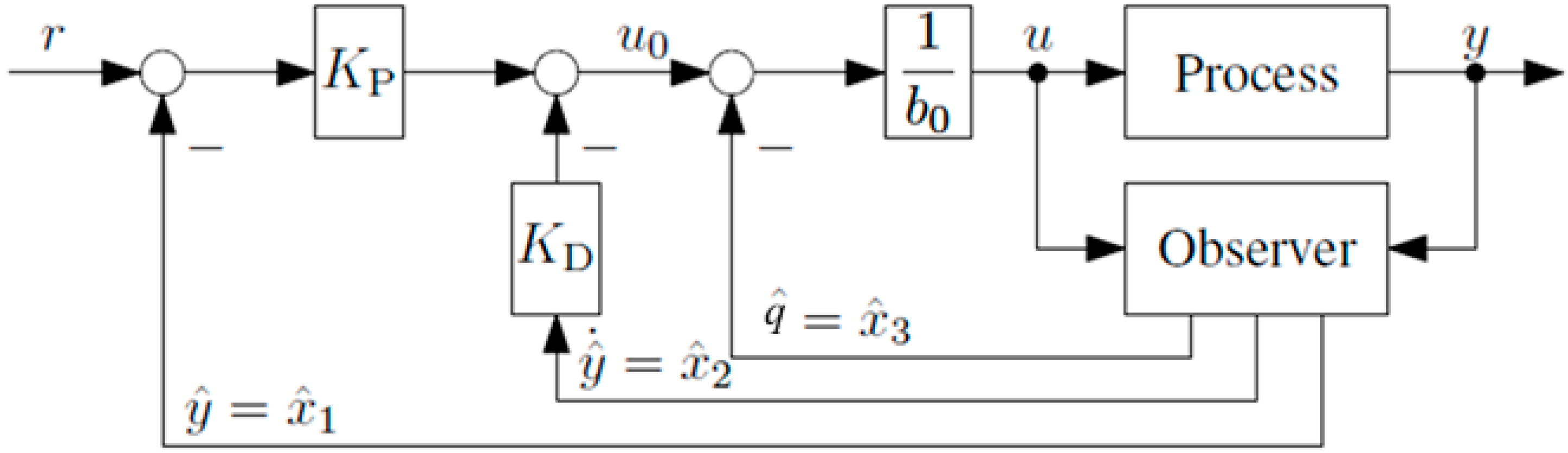
A state-space controller, incorporating disturbance rejection, is synthesized utilizing the estimated state variables
. This control scheme can be generically expressed as illustrated in
Figure 1 as follows:
2.3. LFC Using Standard ADRC
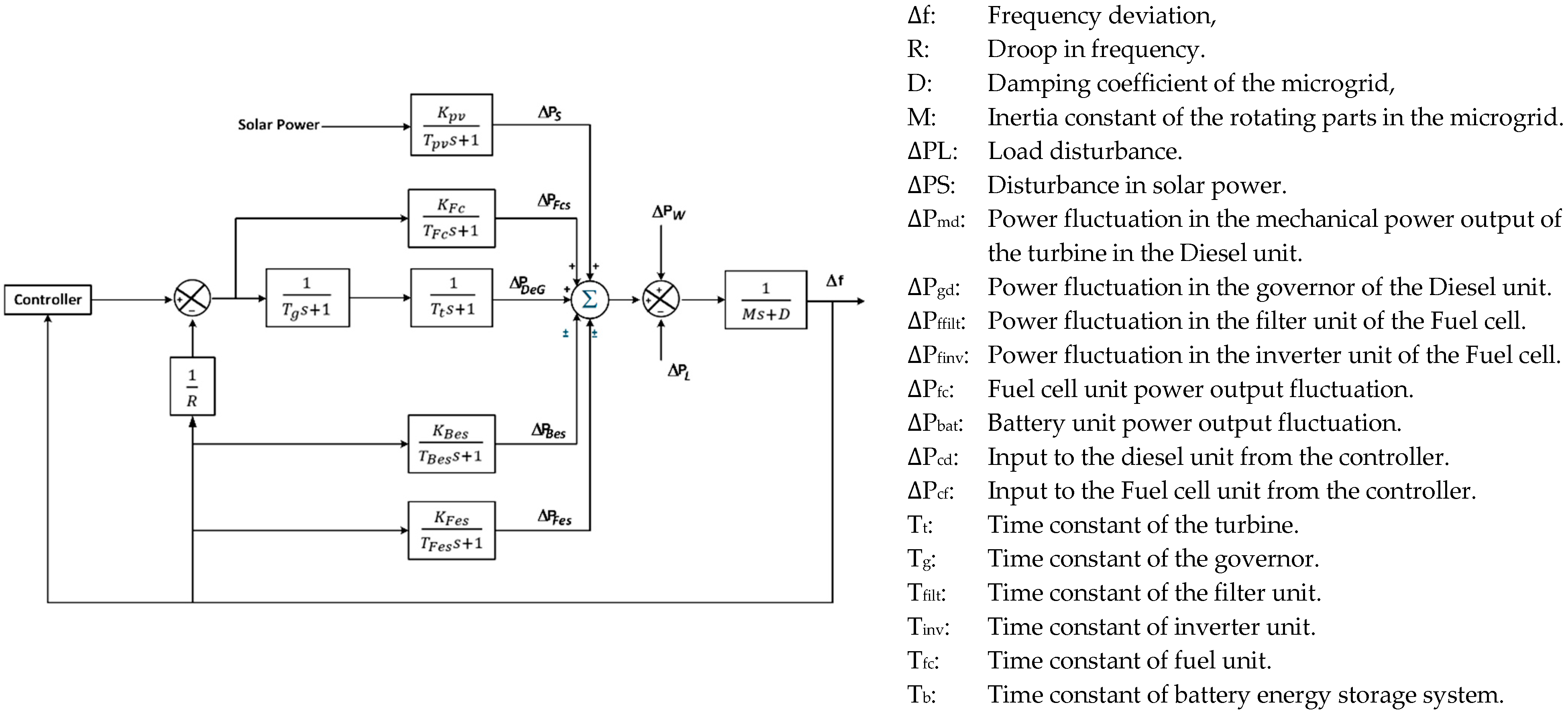
Figure 2 depicts the block diagram of the isolated microgrid, which features a diesel generator, fuel cell, wind turbine, solar photovoltaic array, and battery energy storage system, as given in [
25,
26]. The diesel generator’s control loop utilizes a second-order ADRC strategy. The ADRC parameters are specifically chosen through pole placement techniques, aiming to achieve a pre-defined settling time for the closed-loop system, thereby ensuring the desired dynamic performance. The frequency error, representing the deviation between the reference and actual system frequency, serves as the input to the ADRC-based controller. This controller, in turn, generates control signals that are applied to the fuel cell and diesel generator units. Given the operational assumption that renewable energy sources are operating at their maximum output capacity, the fuel cell and diesel generator units are designated as the sole controllable power generation units within the microgrid. A discrete-time state-space model of the microgrid, as detailed in [
27].
The state-space model in Equation (6) represents the dynamic behavior of the microgrid shown in
Figure 2, using the parameters detailed in
Table 1. The system matrices
A,
B,
C, and
D, which define the state-space representation, are detailed in Equation (7).
Regulation of load frequency is accomplished by adjusting control inputs to the diesel and fuel cell systems. This is implemented using standard ADRC, as defined in Equations (1)–(5). The ADRC feedback gain vector is selected according to the dominant plant dynamics:
The final stage involves the selection of observer gains L in Equation (3), to ensure that the observer poles are significantly far located to the left of the closed-loop poles within the complex s-plane. A typical approach is to assign all closed-loop poles to a common location, s
CL (
= desired settling time), and to position the extended state observer poles at s
ESO (3 …10).s
CL [
23].
A pole-zero analysis of the plant indicates dominant second-order dynamic behavior, thereby justifying the implementation of a second-order ADRC. The design of this ADRC requires only parameter b0, which can be derived from the step response of the approximate second-order model representing the original LFC system.
Through the determination of the system’s DC gain and dominant time constant, b0 = 2.1637. For a chosen closed-loop settling time Ts = 3 s, the observer poles are placed around −65. The observer gain is L = [296, 13,786, 4.3721 × 10⁵]’.
The parameter b0 represents an approximation of the process dynamics. The controller parameters, KP and KD, can be selected through pole placement techniques, aiming to achieve a specified settling time for the closed-loop system. For ADRC implementation, a common heuristic tuning methodology, as documented in [
24], determines that
.
3. LFC Using ADRC-Based Metaheuristic Algorithm
3.1. Elephant Herding Optimization (EHO)
Elephant Herding Optimization (EHO) is a nature-inspired metaheuristic algorithm based on the social behavior of elephant herds. Proposed by [
28], this algorithm models how elephant groups maintain hierarchical structures and cooperative movements to enhance survival and resource allocation. EHO has been widely applied in optimization problems across engineering, artificial intelligence, and power systems due to its efficiency in handling complex, nonlinear problems.
Although no metaheuristic optimization algorithm can be regarded as universally optimal for all classes of control problems, the selection of Elephant Herding Optimization (EHO) in this study is motivated by its favorable balance between global exploration and local exploitation. Compared with classical swarm-based algorithms such as Particle Swarm Optimization (PSO), Genetic Algorithms (GA), and Ant Colony Optimization (ACO), EHO incorporates a clan-based updating mechanism and a separating operator that collectively enhance population diversity and mitigate premature convergence. In contrast to ACO, which relies on pheromone memory and is more suited to discrete combinatorial problems, EHO operates directly in continuous search spaces with lower computational complexity. These characteristics make EHO particularly suitable for tuning ADRC parameters in nonlinear, low-inertia microgrid frequency control problems, where the optimization landscape is highly nonconvex and sensitive to local minima.
3.2. Mechanism of EHO
EHO divides a population into several clans, each representing a group of elephants. Within each clan, elephants move according to two key mechanisms:
Clan Updating Operator: The matriarch, the oldest and most experienced elephant, leads the movement of the clan. Other elephants adjust their positions based on the matriarch’s influence, allowing the herd to converge toward optimal solutions. Each elephant in a clan updates its position based on the influence of the matriarch (the best elephant in the clan). The updated position is given by:
where
Zi,j(t): position of the i-th elephant in the j-th dimension at iteration t.
Zm,j(t): position of the matriarch in the same dimension.
α: scaling factor controlling how much the elephant moves towards the matriarch (typically 0 ≤ α ≤ 1).
This equation facilitates the transmission of information from the clan’s optimal solution to individual elephants, driving the population towards convergence.
Separating Operator: The weakest or least-fit elephant in a clan is replaced by a newly generated individual. This ensures diversity and prevents premature convergence. Preservation of population diversity and avoidance of premature convergence is achieved through a mechanism that replaces the least fit individual within a clan with a newly initialized, randomly generated member:
where,
Znew(t + 1): position of the newly randomly generated elephant.
Zmin, Zmax: minimum and maximum search space boundaries.
r: A randomly generated value within the range [0, 1], ensuring variability in the new solution.
Population diversity is augmented by this mechanism, which prevents convergence to local optima.
Control system performance assessment can be conducted using a range of evaluation criteria. Typically, the integral of the controller error,
e(
t), serves as the foundation for objective function formulation. Common performance indices include ISE, IAE, ISTE, and ITAE, with ITAE being widely recognized for its engineering applicability [
29,
30,
31]. While integral performance metrics offer valuable insights, exclusive reliance on them during controller design can prioritize dynamic response characteristics excessively, potentially resulting in inflated control parameters and increased control effort. To address this limitation, a multi-objective optimization approach is implemented, which incorporates overshoot and rise time as additional performance objectives, alongside integral error measures, to facilitate a balanced control strategy. The parameters of the ADRC controller subjected to optimization are the bandwidth (
ω), proportional gain (
KP), and derivative gain (
KD). The proposed fitness function is:
where
wi (
i = 1, 2, 3, 4) is the weight factor.
λ is the overshoot of the system, and
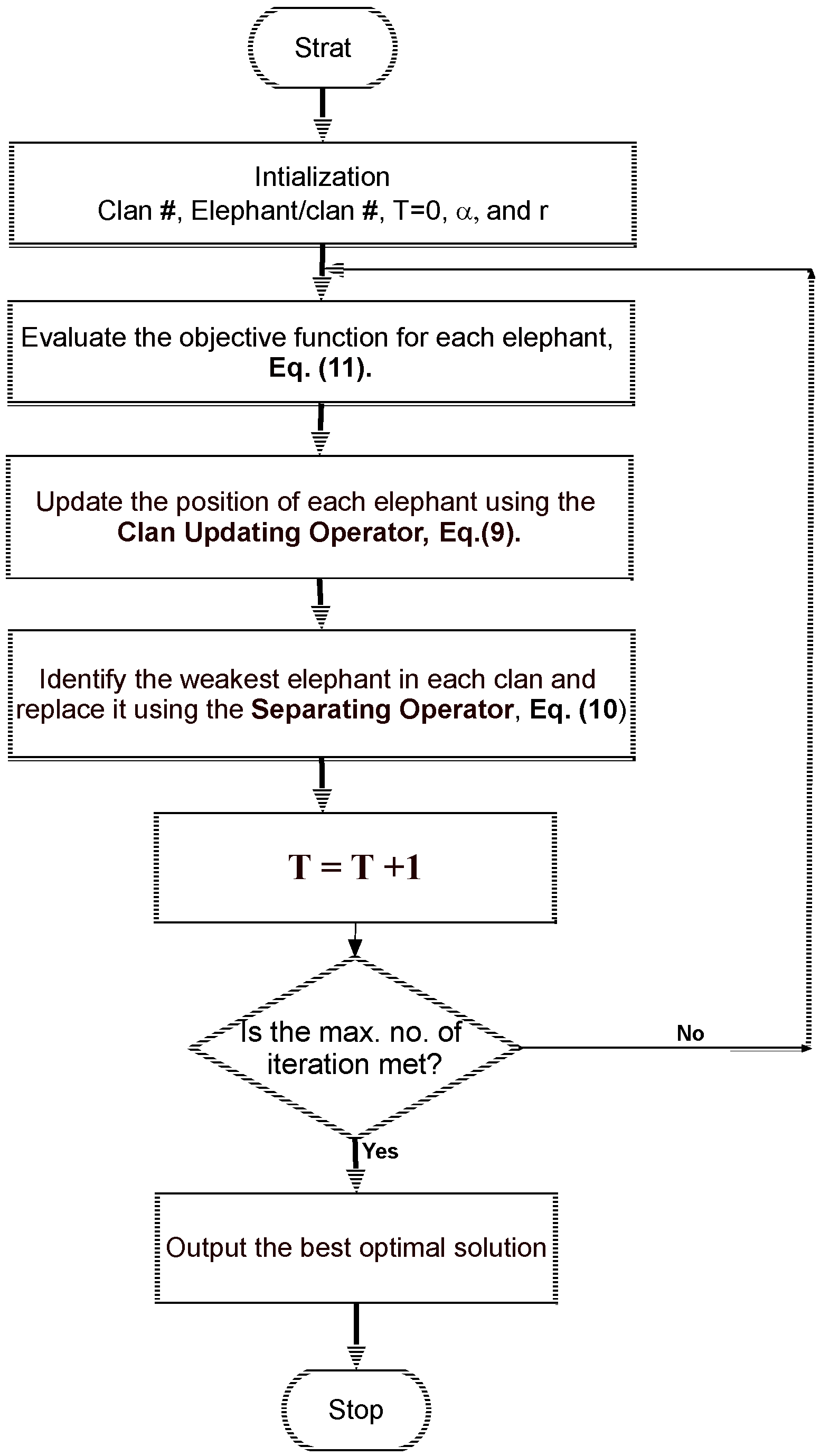
tr is the rise time of the system. The EHO algorithm is given in the flowchart illustrated in
Figure 3.
During the optimization process, the fitness value associated with each candidate solution is evaluated through time-domain simulations of the complete microgrid frequency regulation model. The objective function in (11) is not limited to a step-response test; instead, it incorporates system performance under deterministic load disturbances, stochastic renewable power fluctuations, and parametric uncertainty scenarios. For each candidate set of ADRC parameters, the microgrid model is simulated over a predefined time horizon, and the resulting frequency deviation is used to compute the ITAE index, maximum overshoot, and rise time. This evaluation strategy ensures that the optimized controller achieves not only fast dynamic response but also robust frequency regulation under realistic operating conditions.
3.3. Particle Swarm Optimization (PSO)
PSO effectively automates ADRC parameter tuning by iteratively optimizing “particle” parameters within a search space, enhancing ADRC’s robustness. Through iterative movements guided by individual and global best positions, the swarm converges towards an optimal parameter configuration that minimizes a predefined fitness function, such as tracking error or settling time. This allows for a more efficient and accurate determination of ADRC gains, enhancing the controller’s performance in dynamic and uncertain environments. However, PSO suffers from potential premature convergence to local optima, sensitivity to its parameter selection, and high computational cost, particularly in complex systems [
30,
31]. Equation (11) provides the mathematical expression for the fitness function, which governs the particle evaluation within the PSO process.
To ensure a fair and unbiased comparison between the EHO-based and PSO-based ADRC tuning approaches, both algorithms employ the same fitness function, search space boundaries, and stopping criteria. The PSO parameters, including swarm size, inertia weight, and cognitive and social acceleration coefficients, were selected according to commonly accepted guidelines in the literature and were sufficiently iterated to ensure convergence. Consequently, the reported performance of the ADRC–PSO controller represents the best attainable performance of PSO under the same optimization framework adopted for EHO. Therefore, EHO is selected for the proposed ADRC tuning task, as it exhibits enhanced robustness and reduced sensitivity to local minima in the proposed nonlinear control problem.
4. Results
The efficacy of the microgrid’s LFC was quantitatively evaluated through simulation studies conducted within the MATLAB 2023b computational environment. A detailed schematic representation of the isolated microgrid architecture served as the basis for the simulation framework. The performance of the proposed LFC system, incorporating an ADRC strategy enhanced by EHO based parameter tuning mechanism, was rigorously analyzed across three distinct operational scenarios. These scenarios encompassed: (i) deterministic load variations, (ii) stochastic disturbances reflecting real-world fluctuations in Wind power, and (iii) parametric uncertainties simulating potential deviations in system components. In each scenario, a comparative analysis was undertaken, juxtaposing the proposed ADRC-EHO tracker against the performance of a standard ADRC implementation, an ADRC-PSO, and H∞ robust control scheme. This comparative assessment aimed to provide a comprehensive evaluation of the proposed tracker’s robustness and dynamic performance characteristics. The parametric configurations of the ADRC controllers, derived from the standard, PSO-optimized, and EHO-optimized approaches, are detailed in
Table 2.
To ensure transparency and full reproducibility of the presented results, it is important to clarify that the implemented test case is based on the state-space microgrid model reported in [
27], with minor modifications introduced to align with the disturbance-rejection control framework adopted in this study. Specifically, the diesel generator control loop was reformulated to incorporate a second-order ADRC structure, while the fuel cell and diesel generator units were considered the only controllable sources, assuming wind and photovoltaic units operate at maximum available power. The ADRC parameters were recalculated using the standard tuning approach described in [
24], and the optimization-based tuning (PSO and EHO) was performed using the multi-objective fitness function defined in (11). The nominal system parameters are provided in
Table 1, while disturbance scenarios and inertia variations (±30% in M) were implemented as described in Tables 4 and 5. All simulations were conducted in MATLAB 2023b using a fixed-step time-domain solver over a 60 s simulation horizon. These clarifications ensure that the case study can be independently reproduced and validated.
4.1. H∞ Controller
The H∞ controller is included in this study as a benchmark robust control strategy to provide a reference comparison with the proposed ADRC-based approaches. Although H∞ control offers guaranteed robustness margins under bounded uncertainties, its performance may degrade in practical microgrid applications due to model mismatch, reduced system inertia, and stochastic renewable disturbances. The comparison with H∞ control, therefore, serves to highlight the advantages of disturbance-observer-based control schemes, such as ADRC, in handling strong uncertainties and real-time disturbances.
The detailed methodology for the synthesis of the H∞ controller, as presented in [
27], leverages the inherent robustness properties of H∞ control to minimize the system uncertainties and disturbances. Specifically, by minimizing the H∞ norm of the closed-loop transfer function, the design guarantees a predefined level of performance even in the presence of bounded uncertainties, resulting in the following gain parameters [
27]:
4.2. Scenario 1: Deterministic Disturbance
4.2.1. Case 1: Multiple Disturbance Steps in Load Power
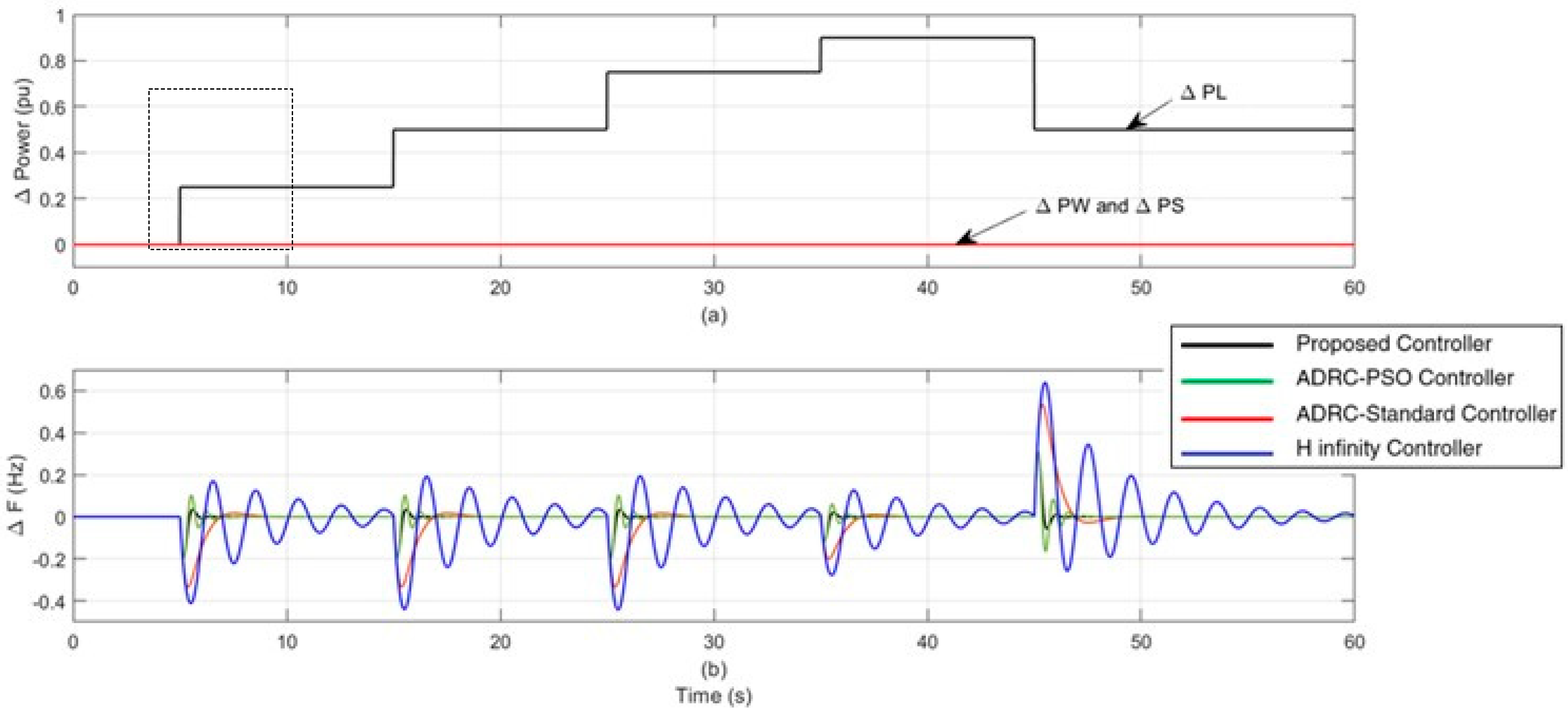
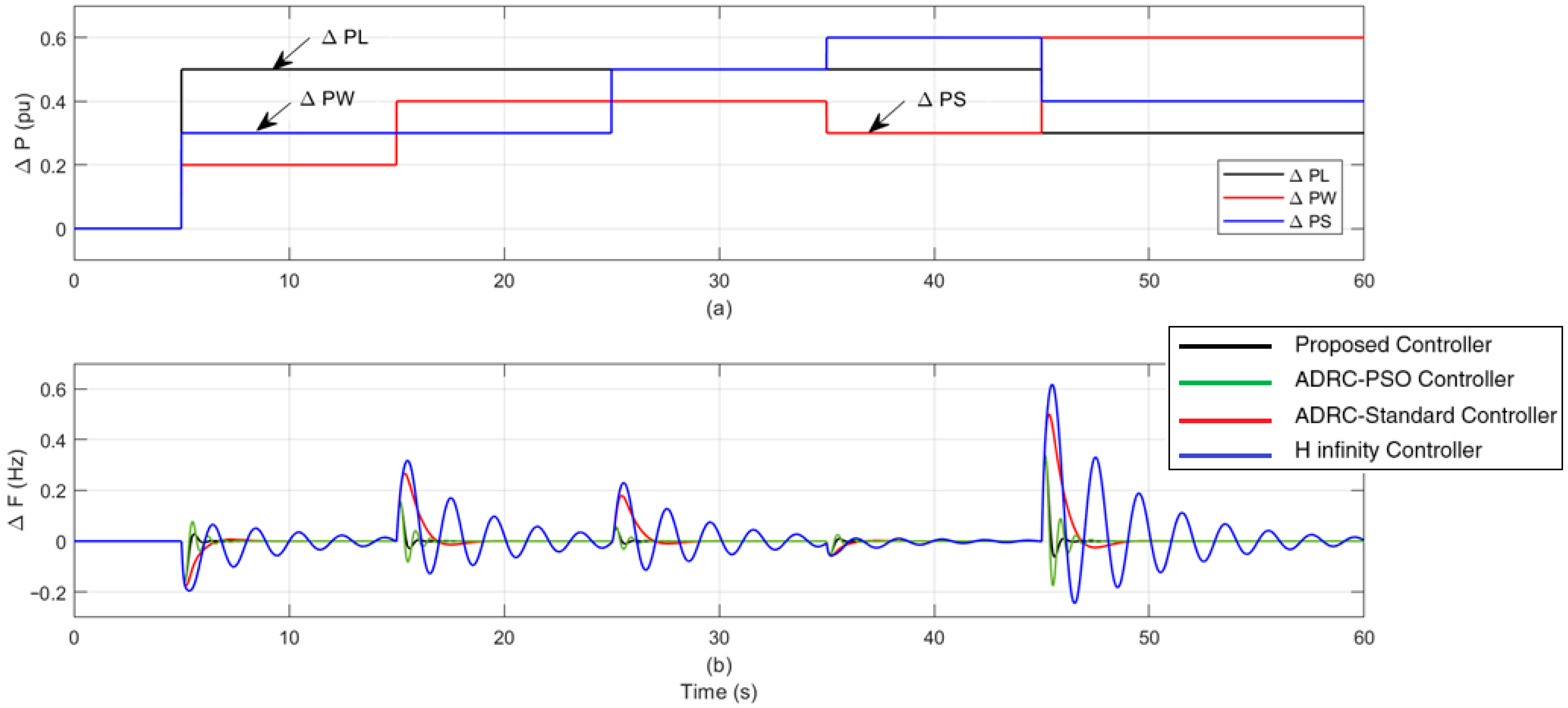
The transient behavior of the microgrid’s frequency was observed in response to a fluctuating load profile, featuring multiple-step disturbances occurring at irregular intervals of 5, 15, 25, 35, and 45 s. The progression of this load variation is visually represented in
Figure 4a, while the resulting frequency variations within the microgrid are shown in
Figure 4b. The proposed control strategy exhibited enhanced performance, demonstrating reduced frequency deviations in comparison to the ADRC-standard, ADRC-PSO, and H∞ control schemes. The subsequent series of positive and negative load changes further highlighted the effectiveness of the proposed control approach in managing frequency oscillations, as detailed in
Figure 4a. To provide an objective evaluation of the control systems’ performance, a set of metrics, including maximum overshoot, rise time, settling time, and steady-state error, were quantified and are presented in
Table 3. In
Table 3, OS (%) denotes the maximum percentage overshoot, t
r (s) represents the rise time, t
s (s) is the settling time, and SSE denotes the steady-state frequency error.
The nonzero steady-state error observed for the H∞ controller is attributed to model mismatch and the absence of integral action, whereas ADRC-based strategies actively compensate for disturbances through real-time estimation. However, Variations in overshoot magnitude across disturbance instants are influenced by the direction and magnitude of successive load steps; however, the proposed ADRC–EHO controller consistently achieves faster damping and reduced settling time across all cases.
4.2.2. Case 2: Multiple-Step Disturbances in Wind Power, Solar Power and Load Power
The system’s sensitivity to multi-step disturbances within the wind, solar, and load power inputs was examined. A pattern of several load step changes was introduced at time intervals of 5, 15, 25, 35, and 45 s, as detailed in
Table 4. The specific profile of these load step variations is graphically represented in
Figure 5a. The corresponding microgrid (MG) frequency deviation response using the four control methodologies is illustrated in
Figure 5b. The proposed control strategy demonstrated superior performance relative to the ADRC-PSO, standard ADRC, and H-infinity controllers, as evidenced by a reduction in percentage overshoot, settling time, rise time, and steady-state error.
Table 3 presents a quantitative evaluation of control system performance, based on maximum overshoot, rise time, settling time, and steady-state error metrics.
4.3. Scenario 2: Stochastic Disturbance
4.3.1. Case 1: Stochastic Perturbations in Wind Power Without Load and PV Power Changes
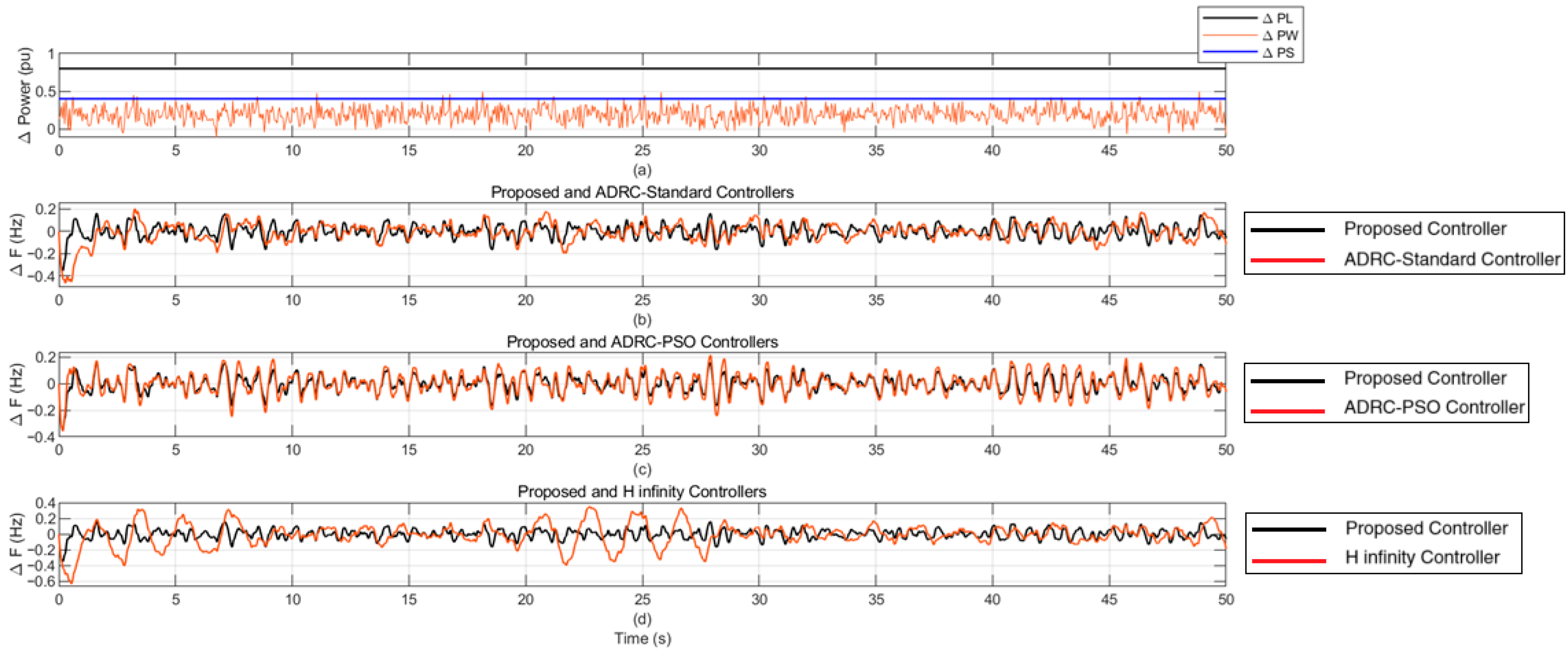
Figure 6a presents the MG frequency response subjected to stochastic wind power fluctuations. In this case, solar power and load demand were held constant at 0.4 pu and 0.8 pu, respectively. Comparative analyses of MG frequency deviation are depicted in
Figure 6b–d, where the proposed tracker is compared with standard ADRC, ADRC-PSO, and H-infinity controllers, respectively. The results demonstrate that the proposed tracker effectively eliminates steady-state frequency deviation, exhibiting superior performance relative to the alternative control strategies.
4.3.2. Case 2: Stochastic Perturbations in Wind Power with Load and PV Power Changes
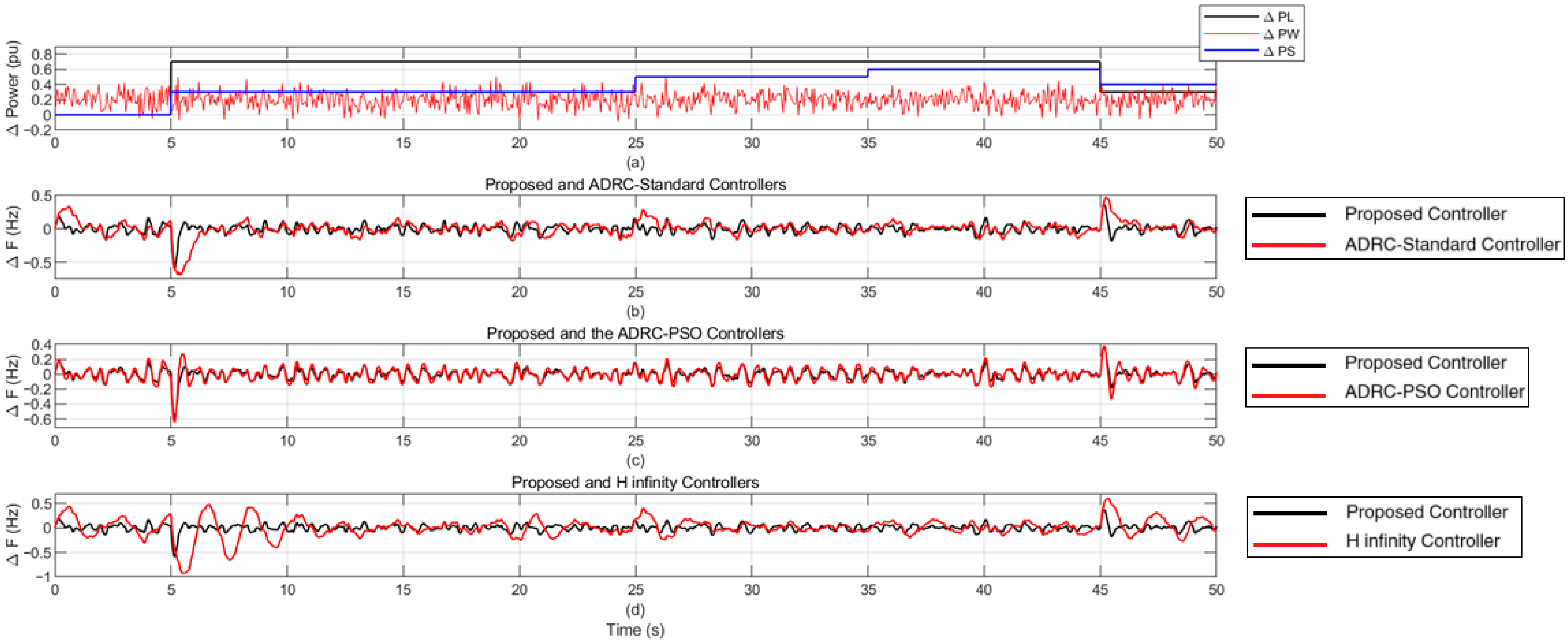
Figure 7a illustrates the microgrid (MG) frequency response under stochastic wind power fluctuations, with solar power and load demand undergoing multi-step changes as detailed in
Table 5. Comparative frequency deviation analyses are presented in
Figure 7b–d. Specifically,
Figure 7b compares the proposed tracker against standard ADRC,
Figure 7c against ADRC-PSO, and
Figure 7d against an H-infinity controller. The proposed tracker consistently eliminates steady-state frequency deviation, demonstrating superior performance compared to the alternatives.
4.3.3. Scenario 3: Robustness to Parameter Changes
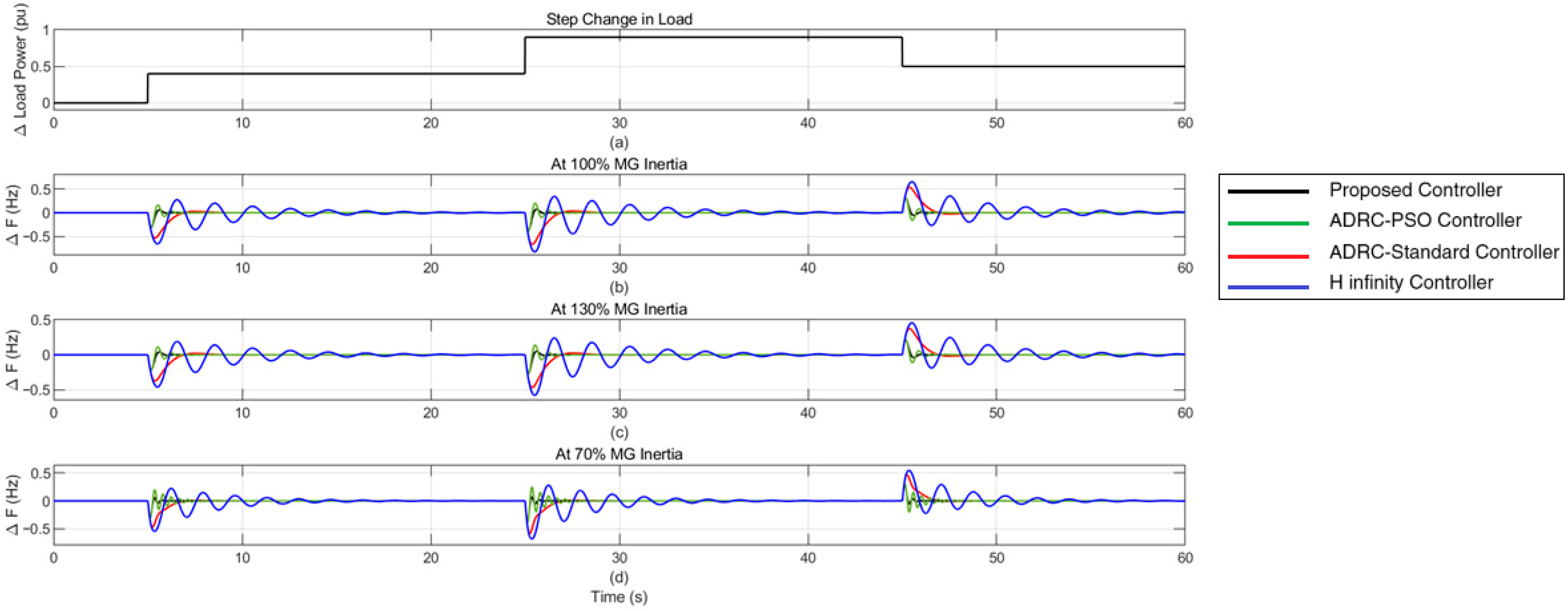
This scenario investigates the robustness of the proposed tracking controller in comparison to standard ADRC, ADRC-PSO, and H-infinity controllers. The analysis evaluates performance under parametric uncertainty, specifically examining the impact of ±30% deviations in MG inertia (H).
Figure 8a depicts the load step changes applied during the simulations.
Figure 8b presents the MG frequency responses of the proposed tracker and the three comparative controllers under nominal inertia conditions (100% H).
Figure 8c,d illustrate the MG frequency responses for 130% H and 70% H, respectively, demonstrating the system’s behavior under parameter variations.
Figure 8 also shows magnified views at t = 5 s. The proposed tracker consistently exhibits rapid and robust frequency regulation across all inertia values and during load step changes, indicating superior performance in the presence of parametric uncertainty.
5. Discussion and Practical Considerations
ADRC offers robust LFC by handling uncertainties and disturbances without a precise system model. Its real-time disturbance estimation improves stability, transient response, and adaptability, making it a strong alternative to traditional PID controllers and other disturbance reduction techniques such as H∞ in complex power systems.
Unlike traditional optimization techniques, probabilistic methods are specifically designed to avoid getting trapped in local minima. To determine how EHO measures up against PSO, we focus on computational time as our key benchmark.
In our study, the computational times were as follows: PSO is 1.367 s, and EHO is 1.0086 s. The results demonstrate that EHO is faster and more efficient at calculating the parameters for our proposed system than PSO. It is worth noting that finding solid theoretical proof that one algorithm avoids local minima better than another is quite rare. Because of this, we follow the standard research practice of using computational execution time to compare and validate their respective performances.
In comparison with the previously published ADRC parameterization strategies based on fixed heuristic tuning or single-objective PSO, the proposed EHO-tuned ADRC exhibits improved performance margins without increasing controller complexity. The clan-based exploration mechanism of EHO enables a more balanced trade-off between bandwidth expansion and noise sensitivity, resulting in enhanced damping characteristics and improved stability margins under nonlinear operating conditions. This is particularly evident in scenarios involving stochastic renewable disturbances and inertia variations, where conventional tuning approaches tend to exhibit either excessive overshoot or prolonged settling times. By contrast, the EHO-based tuning maintains consistent transient performance across operating points, indicating superior robustness to nonlinearities and parameter coupling inherent in isolated renewable microgrids.
The proposed Elephant Herding Optimization (EHO)-based tuning strategy is implemented in an offline manner and therefore does not impose any additional computational burden during real-time microgrid operation. Once the optimal ADRC parameters are obtained through EHO, the online control structure is identical to that of a standard ADRC implementation, involving only the execution of the extended state observer and the feedback control law. Consequently, the real-time computational complexity of the proposed ADRC–EHO controller is comparable to that of ADRC–PSO and conventional ADRC schemes. Although online metaheuristic tuning may be computationally demanding for fast time-scale frequency regulation, the offline optimization strategy adopted in this work ensures practical feasibility for real-world microgrid applications. Periodic re-optimization using EHO can be performed at a supervisory level to accommodate long-term changes in operating conditions or system parameters, without affecting real-time control performance.
ADRC implementation for LFC presents challenges related to: (1) complex, non-standardized parameter tuning, (2) potential estimation errors from the Extended State Observer (ESO), (3) high computational demands, and (4) integration complexities in large-scale power systems. Addressing these issues is crucial for wider adoption.
Future research on ADRC for LFC should prioritize: (1) intelligent parameter tuning via machine learning and optimization; (2) integration with deep reinforcement learning for adaptive control; (3) hybridization with advanced control strategies like MPC and fuzzy logic; (4) real-world validation through HIL simulations and pilot deployments; and (5) cybersecurity considerations for smart grid applications. These efforts will advance the development of robust and intelligent LFC solutions.
6. Conclusions
This manuscript successfully demonstrated the efficacy of an Elephant Herding Optimization (EHO)-tuned Active Disturbance Rejection Control (ADRC) strategy for enhanced load frequency regulation within an isolated microgrid. The comprehensive simulation, which encompassed a diverse microgrid model, validated the proposed ADRC-EHO’s significant performance improvements compared to ADRC-standard, ADRC-PSO, and H∞ controllers. Across three distinct test scenarios, namely deterministic and stochastic disturbances, and microgrid parameter variations, the ADRC-EHO consistently demonstrated superior robustness and, crucially, a fast response to frequency deviations. The optimization of ADRC parameters through EHO proved pivotal in achieving these enhanced results, particularly in mitigating the effects of intermittency inherent in renewable energy sources. This study establishes a strong foundation for the application of ADRC-EHO as a viable solution for frequency regulation in isolated microgrids. However, the scope was constrained by the assumption of constant battery storage output. Future investigations should expand the analysis to include variable storage output scenarios and explore the impact of battery state-of-charge on frequency management, thereby broadening the practical applicability of the proposed control strategy to more complex and dynamic microgrid configurations.
Author Contributions
Conceptualization, E.H.E.B.; Methodology, E.H.E.B. and H.M.S.; Software, E.H.E.B.; Validation, H.M.S.; Formal analysis, E.H.E.B. and H.M.S.; Investigation, E.H.E.B., H.M.S. and M.S.; Resources, E.H.E.B.; Data curation, M.S.; Writing—original draft, E.H.E.B. and M.S.; Writing—review & editing, E.H.E.B. and H.M.S.; Supervision, E.H.E.B.; Project administration, E.H.E.B. All authors have read and agreed to the published version of the manuscript.
Funding
This research received no external funding.
Institutional Review Board Statement
Not applicable.
Informed Consent Statement
Not applicable.
Data Availability Statement
The original contributions presented in this study are included in the article. Further inquiries can be directed to the corresponding author.
Conflicts of Interest
The authors declare no conflict of interest.
References
- Rusilawati, R.; Irfan, I.; Wirapratama, G.E.; Winarno, I. Analysis of voltage and frequency stability of electric power system network with photovoltaic-based generation penetration. J. INFOTEL 2023, 15, 412–418. [Google Scholar] [CrossRef]
- He, C.; Geng, H.; Rajashekara, K.; Chandra, A. Analysis and Control of Frequency Stability in Low-Inertia Power Systems: A Review. IEEE/CAA J. Autom. Sin. 2024, 11, 2363–2383. [Google Scholar] [CrossRef]
- Ahmed, F.; Al Kez, D.; McLoone, S.; Best, R.J.; Cameron, C.; Foley, A. Dynamic grid stability in low carbon power systems with minimum inertia. Renew. Energy 2023, 210, 486–506. [Google Scholar] [CrossRef]
- Khan, I.A.; Mokhlis, H.; Mansor, N.N.; Illias, H.A.; Awalin, L.J.; Wang, L. New trends and future directions in load frequency control and flexible power system: A comprehensive review. Alex. Eng. J. 2023, 71, 263–308. [Google Scholar] [CrossRef]
- Zhang, Z.; Guo, Y.; Zhu, S.; Jiao, F.; Gong, D.; Song, X. A model-free and finite-time active disturbance rejection control method with parameter optimization. Expert Syst. Appl. 2025, 278, 127370. [Google Scholar] [CrossRef]
- Maroufi, S.; Monteiro, R.V.; Bretas, A.; Dhulipala, S.C. Smart Grids Volt-VAR Frequency Control: A Smart Building Distributed Model Predictive Control Based Approach. In Proceedings of the 2020 52nd North American Power Symposium (NAPS), Tempe, AZ, USA, 11–14 April 2021; pp. 1–6. [Google Scholar] [CrossRef]
- Zhang, J.; Wang, H.; Liu, G.; Tian, G.; Rivera, M.; Wheeler, P. Virtual Synchronous Generator Control Strategy of Grid-Forming Matrix Converter for Renewable Power Generation. IEEE Access 2024, 12, 106672–106684. [Google Scholar] [CrossRef]
- Erenoğlu, A.K.; Sengor, I.; Erdinç, O. Power System Resiliency: A Comprehensive Overview from Implementation Aspects and Innovative Concepts. Energy Nexus 2024, 15, 100311. [Google Scholar] [CrossRef]
- Panda, S.; Mohanty, S.; Rout, P.K.; Sahu, B.K.; Parida, S.M.; Samanta, I.S.; Bajaj, M.; Piecha, M.; Blazek, V.; Prokop, L. A comprehensive review on demand side management and market design for renewable energy support and integration. Energy Rep. 2023, 10, 2228–2250. [Google Scholar] [CrossRef]
- Hassan, Q.; Algburi, S.; Sameen, A.Z.; Salman, H.M.; Jaszczur, M. A review of hybrid renewable energy systems: Solar and wind-powered solutions: Challenges, opportunities, and policy implications. Results Eng. 2023, 20, 101621. [Google Scholar] [CrossRef]
- Farooq, U.; Bass, R.B. Frequency Event Detection and Mitigation in Power Systems: A Systematic Literature Review. IEEE Access 2022, 10, 61494–61519. [Google Scholar] [CrossRef]
- Ramachandran, R.; Madasamy, B.; Veerasamy, V.; Saravanan, L. Load frequency control of a dynamic interconnected power system using generalised Hopfield neural network based self-adaptive PID controller. IET Gener. Transm. Distrib. 2018, 12, 5713–5722. [Google Scholar] [CrossRef]
- Huo, Z.; Xu, C. Distributed event-triggered cooperative H∞ load frequency control for interconnected networked power systems. IET Energy Syst. Integr. 2021, 3, 481–497. [Google Scholar] [CrossRef]
- Mahmoud, G.; Chen, Y.; Zhang, L.; Li, M. Sliding Mode Based Nonlinear Load Frequency Control for Interconnected Coupling Power Network. Int. J. Control Autom. Syst. 2022, 20, 3731–3739. [Google Scholar] [CrossRef]
- Awad, H.; Bayoumi, E.H.; Soliman, H.M.; Ibrahim, A.M. Invariant-set design of robust switched trackers for bidirectional power converters in hybrid microgrids. Ain Shams Eng. J. 2023, 14, 102123. [Google Scholar] [CrossRef]
- Banis, F.; Guericke, D.; Madsen, H.; Poulsen, N.K. Load–frequency control in microgrids using target-adjusted MPC. IET Renew. Power Gener. 2020, 14, 118–124. [Google Scholar] [CrossRef]
- Gao, Z. Active disturbance rejection control: A paradigm shift in feedback control system design. In Proceedings of the 2006 American Control Conference, Minneapolis, MN, USA, 14–16 June 2006; pp. 2399–2405. [Google Scholar] [CrossRef]
- Liu, Q.; He, M.; Fang, Z.; Gui, T.; Dong, C.; An, J. Load Frequency Control of Power Systems Based on ADRC. In Proceedings of the 2020 2nd International Conference on Civil Architecture and Energy Science (CAES 2020), Changchun, China, 20–22 March 2020; Volume 165. [Google Scholar] [CrossRef]
- Dorado-Rojas, S.A.; Cortes-Romero, J.; Rivera, S.; Mojica-Nava, E. ADRC for Decentralized Load Frequency Control with Renewable Energy Generation. In Proceedings of the 2019 IEEE Milan PowerTech, Milan, Italy, 23–27 June 2019; pp. 1–6. [Google Scholar] [CrossRef]
- Wang, J.; Sun, Y. Load Frequency Active Disturbance Rejection Control Based on Improved Particle Swarm Optimization. Electronics 2024, 13, 1268. [Google Scholar] [CrossRef]
- Elnoby, A.M.; Mohamed, T.H.; Mahmoud, M.M.; Qudaih, Y.; Hassan, A.M. Adaptive frequency control in smart microgrid using controlled loads supported by real-time implementation. PLoS ONE 2023, 18, e0283561. [Google Scholar] [CrossRef]
- Tu, Y.-H.; Wang, R.-F.; Su, W.-H. Active Disturbance Rejection Control—New Trends in Agricultural Cybernetics in the Future: A Comprehensive Review. Machines 2025, 13, 111. [Google Scholar] [CrossRef]
- Awad, H.; Soliman, H.M.; Bayoumi, E.H. Disturbance-rejection control for unbalanced operation of microgrids: Invariant-set approach. ISA Trans. 2024, 153, 334–349. [Google Scholar] [CrossRef]
- Cui, W.; Tan, W.; Li, D.; Wang, Y. Tuning of Linear Active Disturbance Rejection Controllers Based on Step Response Curves. IEEE Access 2020, 8, 180869–180882. [Google Scholar] [CrossRef]
- Bevrani, H.; Habibi, F.; Babahajyani, P.; Watanabe, M.; Mitani, Y. Intelligent frequency control in an AC microgrid: Online PSO-based fuzzy tuning approach. IEEE Trans. Smart Grid 2012, 3, 1935–1944. [Google Scholar] [CrossRef]
- Tudu, A.K.; Naguru, N.; Dey, S.H.N.; Paul, S. Load frequency control of an isolated microgrid using optimized model predictive control by GA. Electr. Eng. 2024, 106, 4171–4183. [Google Scholar] [CrossRef]
- Soliman, H.; Bayoumi, E.; Lee, S. Ellipsoidal Design of Robust Secure Frequency Control in Smart Cities Under Denial-of-Service Cyberattack. Smart Cities 2025, 8, 39. [Google Scholar] [CrossRef]
- Wang, G.-G.; Deb, S.; Coelho, L.D.S. Elephant Herding Optimization. In Proceedings of 3rd International Symposium on Computational and Business Intelligence (ISCBI), Bali, Indonesia, 7–9 December 2015; pp. 1–5. [Google Scholar] [CrossRef]
- Wang, Z.; Zu, R.; Duan, D.; Li, J.; Liu, X.; Yu, T. Tuning of ADRC for QTR in Transition Process Based on NBPO Hybrid Algorithm. IEEE Access 2019, 7, 177219–177240. [Google Scholar] [CrossRef]
- Bayoumi, E.H.; Soliman, H.M.; Soliman, M. Minimal Overshoot V-F control for Islanded Microgrids. Int. J. Model. Identif. Control 2020, 35, 127–139. [Google Scholar] [CrossRef]
- Bayoumi, E.; Soliman, M.; Soliman, H. Deadbeat PQ Control for Islanded Smart Grids. Eur. J. Electr. Eng. Comput. Sci. 2020, 4, 1–9. [Google Scholar] [CrossRef]
Figure 1.
The closed-loop control system utilizing ADRC.
Figure 1.
The closed-loop control system utilizing ADRC.
Figure 2.
Schematic representation of the proposed isolated microgrid for the LPC.
Figure 2.
Schematic representation of the proposed isolated microgrid for the LPC.
Table 1.
MG system parameters.
Table 1.
MG system parameters.
| Parameter | Value | Parameter | Value |
|---|
| Tpv | 1.5 | KBes | 1 |
| Tg | 0.08 | KFes | 1 |
| Tt | 0.4 | KFcs | 1 |
| TBes | 0.1 | M | 0.1667 |
| TFes | 0.1 | D | 0.015 |
| TFcs | 0.26 | R | 3 |
| Kpv | 1 | | |
Figure 3.
The closed-loop control system utilizing ADRC.
Figure 3.
The closed-loop control system utilizing ADRC.
Table 2.
Parametric configurations of the ADRC controllers.
Table 2.
Parametric configurations of the ADRC controllers.
| Control Technique | b0 | KP | KD |
|---|
| ADRC-standard | 2.1637 | | |
| ADRC-PSO | 2.11 | 213.76 | 78.27 |
| ADRC-EHO (proposed) | 2.07 | 254.92 | 38.43 |
Figure 4.
Multiple-step disturbance: (a) load power, wind power, and solar power; (b) MG frequency change response using the proposed controller, ADRC-PSO, ADRC- standard, and H∞.
Figure 4.
Multiple-step disturbance: (a) load power, wind power, and solar power; (b) MG frequency change response using the proposed controller, ADRC-PSO, ADRC- standard, and H∞.
Table 3.
Timing of the multi-step disturbances in scenario 1/cases 1 and 2.
Table 3.
Timing of the multi-step disturbances in scenario 1/cases 1 and 2.
| Scenario Number/Case Number | Step-Time (s) | Proposed | ADRC-PSO | ADRC-Standard | H-Infinity |
|---|
| OS (%) | tr (s) | ts (s) | SSE | OS (%) | tr (s) | ts (s) | SSE | OS (%) | tr (s) | ts (s) | SSE | OS (%) | tr (s) | ts (s) | SSE |
|---|
| Scenario1/Case 1 | t = 5 | 3.12 | 0.57 | 0.891 | 0.0 | 3.55 | 0.48 | 1.42 | 0.0 | 9.56 | 1.92 | 3.1 | 0.0 | 12.3 | 1.13 | 9.21 | 0.04 |
| t = 15 | 3.13 | 0.56 | 0.892 | 0.0 | 3.78 | 0.51 | 1.47 | 0.0 | 9.58 | 1.97 | 3.05 | 0.0 | 13.1 | 1.15 | 9.52 | 0.05 |
| t = 25 | 3.10 | 0.54 | 0.883 | 0.0 | 3.95 | 0.49 | 1.45 | 0.0 | 9.62 | 2.01 | 3.12 | 0.0 | 12.7 | 1.14 | 9.43 | 0.05 |
| t = 35 | 1.56 | 0.47 | 0.721 | 0.0 | 1.95 | 0.42 | 1.21 | 0.0 | 8.21 | 1.76 | 2.78 | 0.0 | 14.2 | 1.21 | 9.92 | 0.03 |
| t = 45 | 2.87 | 0.53 | 0.909 | 0.0 | 3.71 | 0.48 | 1.46 | 0.0 | 9.24 | 1.88 | 3.12 | 0.0 | 12.8 | 1.17 | 9.62 | 0.04 |
| Scenario1/Case2 | t = 5 | 3.24 | 0.58 | 0.912 | 0.0 | 4.52 | 0.55 | 1.67 | 0.0 | 9.23 | 1.94 | 3.22 | 0.0 | 8.46 | 1.01 | 9.34 | 0.03 |
| t = 15 | 2.45 | 0.61 | 0.923 | 0.0 | 3.23 | 0.57 | 1.71 | 0.0 | 8.76 | 1.92 | 3.18 | 0.0 | 12.6 | 1.23 | 9.56 | 0.05 |
| t = 25 | 1.64 | 0.59 | 0.894 | 0.0 | 2.11 | 0.56 | 1.69 | 0.0 | 5.24 | 1.87 | 2.78 | 0.0 | 11.2 | 1.21 | 9.87 | 0.04 |
| t = 35 | 0.93 | 0.37 | 0.462 | 0.0 | 1.45 | 0.29 | 0.72 | 0.0 | 4.76 | 1.27 | 1.35 | 0.0 | 7.72 | 0.83 | 7.25 | 0.01 |
| t = 45 | 3.41 | 0.62 | 0.922 | 0.0 | 5.72 | 0.58 | 1.73 | 0.0 | 13.4 | 2.13 | 3.31 | 0.0 | 18.6 | 1.12 | 9.93 | 0.04 |
Figure 5.
Response to multi-step disturbances: (a) Profiles of wind, solar, and load power variations; (b) microgrid frequency deviation under control by four methodologies.
Figure 5.
Response to multi-step disturbances: (a) Profiles of wind, solar, and load power variations; (b) microgrid frequency deviation under control by four methodologies.
Figure 6.
Stochastic perturbations in wind power: (a) load power, wind power, and solar power; (b) MG frequency responses of the proposed vs. the ADRC-standard controllers; (c) MG frequency responses of the proposed controller vs. ADRC-PSO controllers; (d) MG frequency responses of the proposed vs. the H-infinity controllers.
Figure 6.
Stochastic perturbations in wind power: (a) load power, wind power, and solar power; (b) MG frequency responses of the proposed vs. the ADRC-standard controllers; (c) MG frequency responses of the proposed controller vs. ADRC-PSO controllers; (d) MG frequency responses of the proposed vs. the H-infinity controllers.
Table 4.
Timing of the multi-step disturbances in scenario 1/case 2.
Table 4.
Timing of the multi-step disturbances in scenario 1/case 2.
| Time (s) | Load Power (pu) | Wind Power (pu) | Solar Power (pu) |
|---|
| t = 5 | 0.50 | 0.30 | 0.20 |
| t = 15 | 0.50 | 0.30 | 0.40 |
| t = 25 | 0.50 | 0.50 | 0.40 |
| t = 35 | 0.50 | 0.60 | 0.30 |
| t = 45 | 0.30 | 0.40 | 0.60 |
Figure 7.
Stochastic wind perturbations: (a) Power profiles; (b–d) MG frequency response Comparisons; (b) Proposed vs. ADRC-standard; (c)Proposed vs. ADRC-PSO; (d)Proposed vs. H-infinity.
Figure 7.
Stochastic wind perturbations: (a) Power profiles; (b–d) MG frequency response Comparisons; (b) Proposed vs. ADRC-standard; (c)Proposed vs. ADRC-PSO; (d)Proposed vs. H-infinity.
Figure 8.
Robustness to Inertia Variations (±30% H): (a) Load Power Step Changes; (b) MG Frequency Response at 100% H; (c) MG Frequency Response at 130% H; (d) MG Frequency Response at 70% H.
Figure 8.
Robustness to Inertia Variations (±30% H): (a) Load Power Step Changes; (b) MG Frequency Response at 100% H; (c) MG Frequency Response at 130% H; (d) MG Frequency Response at 70% H.
Table 5.
Timing of the multi-step disturbances in scenario 2/case 2.
Table 5.
Timing of the multi-step disturbances in scenario 2/case 2.
| Time (s) | Load Power (pu) | Wind Power (pu) | Solar Power (pu) |
|---|
| t = 5 | 0.70 | 0.20 Stochastic | 0.30 |
| t = 15 | 0.70 | 0.20 Stochastic | 0.30 |
| t = 25 | 0.70 | 0.20 Stochastic | 0.50 |
| t = 35 | 0.70 | 0.20 Stochastic | 0.60 |
| t = 45 | 0.30 | 0.20 Stochastic | 0.40 |
| Disclaimer/Publisher’s Note: The statements, opinions and data contained in all publications are solely those of the individual author(s) and contributor(s) and not of MDPI and/or the editor(s). MDPI and/or the editor(s) disclaim responsibility for any injury to people or property resulting from any ideas, methods, instructions or products referred to in the content. |