


Abstract
The construction industry is central to the socio-economic and infrastructural advancement of developing countries; however, it continues to face persistent performance challenges, most notably recurrent cost overruns. While systematic cost risk management is recognized as a critical approach to improving project outcomes, its adoption across the industry remains limited. This study seeks to identify and rank the critical obstacles that hinder contractors from integrating systematic cost risk management into building construction projects. A comprehensive methodology was employed, including an in-depth literature review and three rounds of Delphi. The Relative Importance Index (RII) was used to evaluate the severity of the identified barriers, and Holm-corrected Spearman’s rank correlation analysis was applied to examine the relationships among them. The findings reveal that the most influential barriers include the absence of structured risk management frameworks within organizations, insufficient top management support, the lack of collaborative risk management mechanisms among stakeholders, limited technical knowledge and skills in risk management, and inadequate client support. The strong positive correlations among these barriers highlight their interdependent nature and underscore the systemic challenges facing contractors. This study contributes to the broader field of civil and structural engineering by providing evidence-based insights that can support the development of targeted strategies to enhance cost risk management practices in developing-country construction environments.
1. Introduction
The construction industry (CI) plays a pivotal role in the socio-economic development of any country [1], with its impact more significant in developing countries [2]. In Ethiopia, for example, the CI contributed up to 9.9% of the country’s GDP in 2020 [3]. The industry’s contribution is measured by the achievement of project objectives: time, cost, and quality [4,5], commonly referred to as the iron triangle [6].
Cost overrun—the amount by which the final project cost exceeds the original contract amount [7]—is a significant challenge in the CI [8]. Globally, several studies have been conducted to explore the severity of cost overrun in construction projects. For example, an older study by Arditi et al. [9] evaluated the cost performance of 126 public construction projects in Turkey and found that cost overruns of, on average, 110.95% were recorded. Another study, by Flyvbjerg et al. [10], assessed the cost overrun in 258 construction projects from 20 countries on 5 continents and concluded that nine out of 10 projects have encountered cost overruns. Similarly, Park and Papadopoulou [11] evaluated the extent of cost overruns in 35 infrastructure construction projects in 12 Asian countries and found that no project was completed within budget, with cost overruns of up to 98.23% recorded. A study by Mahamid and Bruland [12] investigated the statistical relationship between the estimated and actual cost of 169 road projects in Palestine and found that 76% of the projects had encountered cost overruns of up to 98%. An earlier study by Alhammadi et al. [13] analyzed cost overruns in 27 higher education building projects in Riyadh and found that 93% of the projects experienced a cost overrun of up to 10%.
In the case of the Ethiopian construction industry (ECI), Belachew et al. [14] evaluated the cost performance of eight road projects constructed in the Southern Ethiopian district and found overruns of up to 83.2%. A study by Belay et al. [15] evaluated the extent of cost overruns in buildings and infrastructure construction projects in different cities of Ethiopia and identified overruns of up to 248% and 61%, respectively. According to a study by Berihu et al. [16], a cost overrun of up to 25% is recorded among 12 water supply projects constructed in the Tigray region of Ethiopia. In general, the findings of the above studies show that cost overrun is the main challenge in the construction industry, irrespective of the country’s economic status and the project type.
Project objectives, such as cost, time, and quality, are defined by knowledgeable experts who aim to account for risks by including mitigation measures such as contingencies. As a result, significant deviations in these objectives are typically attributed to unforeseen risks arising during project execution. However, cost overruns also result from intentional underestimation to attract sponsors or to win bids [17]. Not undermining the significance of underestimations in construction projects that are due to technical issues such as poor techniques, inadequate data, honest mistakes, poor future forecasts, and lack of experience on the part of estimators, Flyvbjerg et al. [18] determined that cost overrun in infrastructure projects is mainly due to deliberate underestimation related to economic, psychological, and political issues; thus, cost overruns are caused by strategic misrepresentation. Therefore, cost risk management is different from general risk management, as it requires an understanding of corporate culture and pressure from owners, in addition to the effects of unforeseen risks.
Decision-makers in the CI have a consensus on the benefits of implementing systematic risk management in promoting project success: it facilitates the achievement of project objectives—cost, time, and quality; it increases the internal communication between decision-makers; and it increases the management’s confidence in complex decision-making [19,20,21]. In tackling cost overruns, for example, Welde and Klakegg [22] evaluated the cost performance of 96 projects in Norway and found that projects with systematic project planning and estimation achieved favorable cost outcomes, with final costs averaging 4.4% below budget. In contrast, the ECI is characterized by ineffective implementation of project risk management practices [23]. Kivrak and Udan [24] analyzed the responses of 63 experts from 32 construction companies in the Somali regional state of Ethiopia and concluded that the majority of the companies did not implement systematic risk management. According to Yadeta [23], many construction projects in Ethiopia have encountered cost overruns, delays, and even termination due to the effects of unmanaged risks. This aligns with the findings of Ayalew et al. [25], who noted that the application of project management procedures, tools, and techniques, particularly safety, risk, and time management, is very limited in the ECI.
Despite persistent project cost overruns and the recognized potential of systematic cost risk management to mitigate them, the ECI continues to struggle with ineffective cost risk management practices. However, there remains a notable empirical gap in understanding the underlying barriers that hinder the implementation of systematic cost risk management. Thus, this study aims to address the gap by identifying the critical barriers preventing Ethiopian contractors from adopting systematic cost risk management in building construction projects. This study is designed to address this aim by answering the following research questions:
- RQ1: What are the critical barriers hindering Ethiopian contractors from implementing systematic cost risk management in building construction projects?
- RQ2: What is the level of correlation between these barriers?
1.1. Literature Review
1.1.1. Cost Risk Management in Construction Projects
Construction projects are inherently complex and risky [26]. Risk is defined as an uncertain event that may affect the achievement of project objectives, such as cost, time, and quality [27]. For the context of this study, cost risk is defined as an uncertain event that causes cost overrun, and cost risk management is the systematic art of dealing with those risks.
The literature is rich in providing the steps in the formal risk management process [28,29], and several comparative studies have been conducted to identify the convergence and divergence between those provisions. For instance, Vargas and Campos [30] compared the risk management provisions of the Project Management Institute [27] and the International Organization for Standardization [31] and concluded that they are fundamentally similar in describing the basic structure of formal risk management processes except for minor differences in nomenclature. This consensus, affirmed by studies such as those of Goh et al. [32] and Alfreahat and Sebestyén [33], confirms the universality of risk management principles. Therefore, the steps in cost risk management can be summarized as cost risk identification, cost risk analysis, cost risk response, and cost risk monitoring and control [34,35,36].
The fundamental step in cost risk management—cost risk identification—is the systematic recognition and documentation of potential risks that could cause cost overrun [27]. The second step, known as cost risk analysis, involves the evaluation and prioritization of cost risk factors based on the combined effects of their probability of occurrence and impact [37,38]. Following the identification and analysis of these factors, the next step is cost risk response, which involves assigning their respective mitigation strategies [36]. Risk avoidance, risk reduction, risk transfer, and risk acceptance are among the basic risk mitigation strategies [39,40]. The final step—cost risk monitoring and control—involves tracking the effectiveness of the implemented cost risk management strategies and making necessary adjustments throughout the project lifecycle [37]. Systematic risk management is not a one-time process but an iterative effort, with the frequency of updates determined by the complexity and dynamics of the project [27,32,37]. Systematic risk management should be integrated, comprehensive, customized, inclusive, and dynamic [31].
The academic literature and institutional guidelines have suggested a number of tools and techniques to support the effective implementation of systematic risk management [27,41]. Monte Carlo simulation, sensitivity analysis, artificial neural networks (ANNs), the expected monetary value (EMV), Bayesian networks (BNs), the program evaluation and review technique (PERT), and earned value analysis (EVA) are common in the academic literature [41,42]. However, the practical utilization of proven risk management tools and techniques is limited [41,43]. Risk management in the CI tends to be informal and not adequate for construction project risk management [19,40], largely due to the barriers that hinder systematic risk management in the CI [41].
1.1.2. Barriers to Risk Management in Construction Projects
The concept and benefits of systematic risk management are well-recognized in the literature. However, its effective utilization in the CI is affected by human and non-human elements. Several studies have been conducted to identify the critical barriers hindering the implementation of systematic risk management in construction projects. However, it has been claimed that existing studies predominantly focus on the construction industries of developed countries [44]. Moreover, most of the studies have emphasized ranking the barriers, whereas exploring the interrelationships among them could provide deeper insights for strategic decision-making.
Furthermore, the literature lacks consensus in identifying the most significant barriers. According to Chileshe et al. [45], for example, the lack of knowledge and skills, the lack of experience, the lack of available risk management consultants, the lack of support from clients and project stakeholders, and the lack of a joint risk management system among parties were the top five barriers in the Iranian CI. However, the lack of funding, the lack of time, low profit margins, projects not being economical, and the lack of knowledge were the most critical barriers in Sri Lanka’s CI [46]. This inconsistency is not surprising, as a barrier in one context may not be considered a barrier in another [40]. Risk management is dependent on factors such as project complexity, project ownership (private versus public), organizational culture, stakeholders’ attitudes, and the status of the CI within a country [46,47]. Thus, identifying context-specific barriers tailored to the country, project type, and stakeholder perspectives can support the development of targeted and resource-efficient mitigation strategies. Furthermore, the majority of these studies have adopted simple surveys and have not conducted statistical correlations among these barriers. Therefore, the aim of this study is to fill these gaps by utilizing ECI experts’ consensus in the identification of critical barriers to the implementation of systematic cost risk management and assessing their correlations. Table 1 summarizes the critical risk management barriers identified from the relevant literature.
Table 1.
Risk management implementation barriers identified from the literature.
2. Materials and Methods
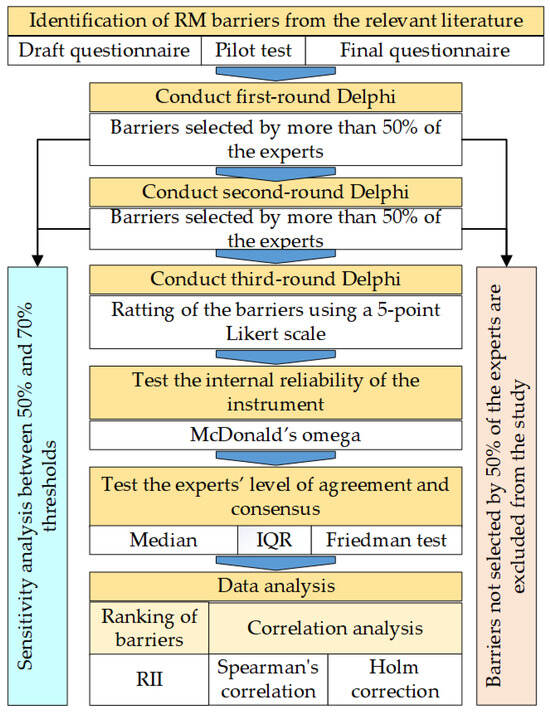
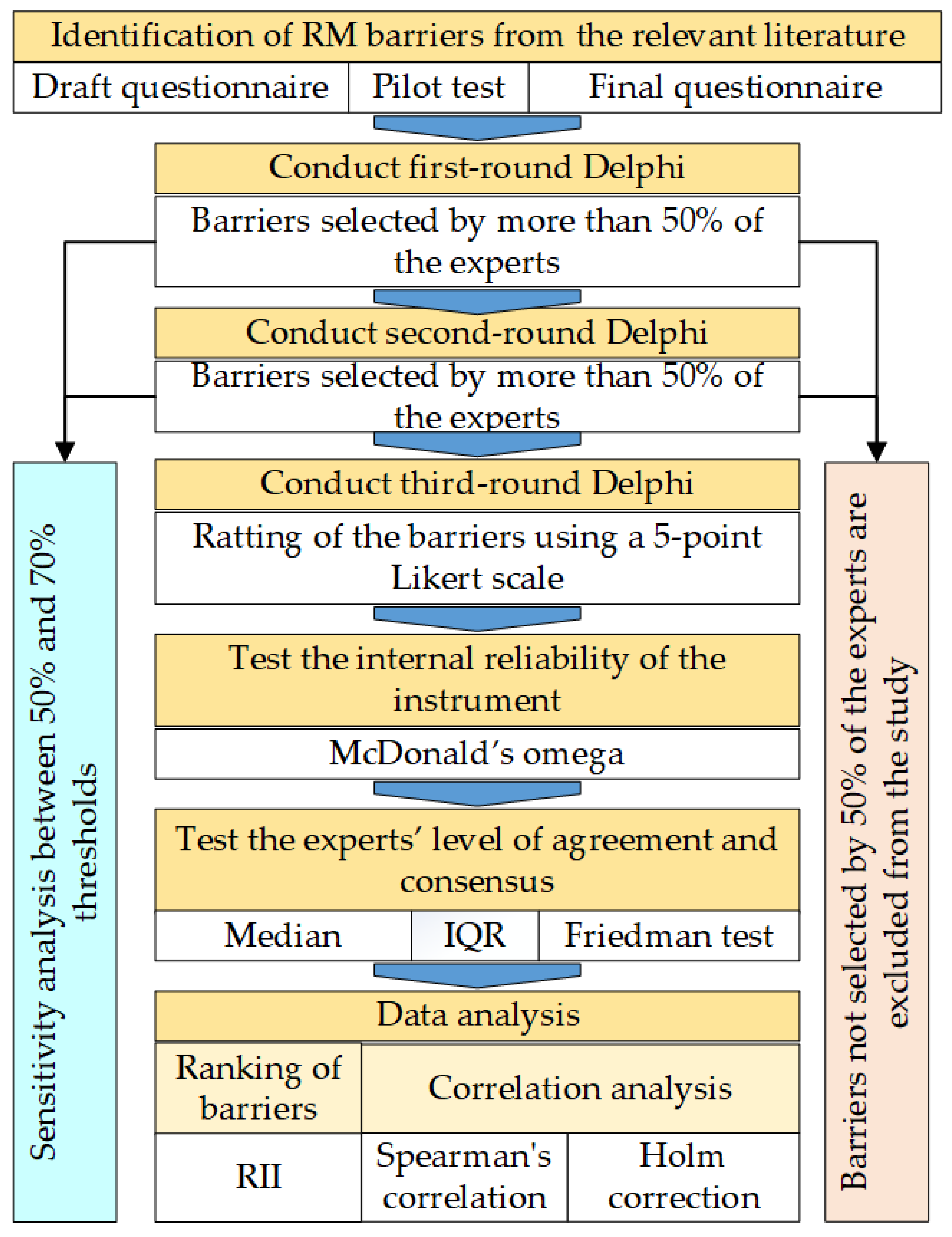
To systematically answer the research questions, the study adopts a sequential exploratory mixed-methods Delphi research design, which combined qualitative and quantitative approaches. During the qualitative approach, initially, construction project risk management implementation barriers were identified from the relevant literature. Then, an iterative two-round Delphi technique was used to qualitatively refine these barriers by utilizing the experts’ consensus. At this level, the barriers that are not essential to cost risk management in the ECI were excluded from the subsequent rounds. The quantitative component was implemented in the third round, where the severity of the refined barriers was evaluated using a 5-point Likert scale. This round enabled the numerical evaluation of expert opinions and facilitated statistical analysis of the relative importance and level of agreement for each barrier.
Finally, the Relative Importance Index (RII) was used to analyze the data. In addition to the % agreement cut-off threshold, the experts’ level of agreement and consensus were assessed with the median and inter quartile range (IQR) and supported with the Friedman test. The internal reliability of the instrument was assessed with the omega reliability coefficient calculated by Jamovi-2.6.44. Spearman’s correlation analysis and Holm correction were also utilized to assess the correlation among barriers. The overall research design and the sequence of the methods are described in Figure 1, and detailed descriptions are provided in the following sub-sections.
Figure 1.
The research process.
2.1. Questionnaire Design
In order to identify barriers hindering the systematic implementation of risk management and to use as inputs for this study, an extensive review of the relevant literature from databases such as Scopus and Web of Science was conducted. Keywords including risk management, cost overruns, barriers, challenges, and construction projects were used. No limitation was made to the case country, the project type, or the project objectives. This deliberate choice was made to provide experts with the most comprehensive possible list of construction risk management barriers, from which those specifically related to cost risk could be identified. Accordingly, 17 barriers were identified from the literature (Table 1), forming the basis of the first-round Delphi questionnaire. Prior to distribution, the questionnaire was pilot tested by two professionals: one is a PhD holder in construction risk management, and the other is an M.Sc. holder in construction project management. Both of them are serving as adjunct professors in local universities. In addition, these experts have more than 19 and 25 years of experience in the ECI, respectively. They were invited to (1) assess the clarity and structure of the questionnaire and (2) suggest any additional cost risk management barriers relevant to the ECI. While no new barriers were proposed, wording refinements were made, and the final first-round Delphi questionnaire was developed.
2.2. Delphi Techniques
The Delphi technique is a structured multi-stage research method that involves distributing a series of questionnaires known as rounds. Except for the first round, each subsequent questionnaire is developed based on the results of the previous rounds [52]. It is considered an alternative to focused group discussions that can be implemented without face-to-face contact among the experts [53]. Thus, the technique is advantageous in situations where expert consensus is required anonymously, minimizing individual influence [54]. In addition, it is instrumental when there is a shortage of accurate information or literature on the subject under investigation [55]. Hence, anonymity, iteration, controlled feedback, and the statistical aggregation of group responses are the key features of the Delphi technique [56]. Due to the dynamic and transient nature of the CI, traditional research methods such as surveys and interviews are failing to answer some advanced research questions, such as those on risk management [57]. Thus, the Delphi technique is becoming a robust tool commonly utilized in research on construction engineering and management [58]. This study utilized a three-round Delphi technique to explore and rank the critical barriers hindering Ethiopian building contractors from implementing systematic cost risk management. To ensure the reliability, credibility, and rigor of the application, the Delphi procedures suggested by Junger et al. [59] were utilized.
Informed decision-making regarding the number of rounds, as well as the number and quality of experts, are fundamental requirements in Delphi techniques. The decision on the number of rounds depends upon the available resources, such as time, and whether the researcher starts the first round with one broad question [54]. The literature has identified up to six rounds of Delphi techniques; however, more than three rounds are uncommon as they are costly, time-consuming, and result in experts’ fatigue and low response rates [60]. Similarly, finalizing results in one or two rounds may lead to misleading conclusions [61]. A three-round Delphi is commonly used in construction engineering and management research [57,61,62]. Therefore, a three-round Delphi was adopted for this study.
Careful expert selection is the other requirement of Delphi [61], which uses purposive sampling [63]. Key considerations in ensuring expert quality include their knowledge and experience in the issue under investigation, willingness to participate, commitment to the process, and availability of sufficient time for each round [64,65]. The decision on the number of experts is affected by the nature of the topic under investigation and the availability of the resources required for questionnaire preparation, distribution, and data analysis [52,66]. Ameyaw, Hu, Shan, Chan, and Le [60] evaluated 88 Delphi technique-based research papers in the field of CI and found that the majority of papers (41 out of 88) used a sample of 8–20 experts. Accordingly, the inclusion of 30 experts in this study is considered acceptable.
Expert selection for this study began with the identification of construction companies that are assumed to have better organizational structures and project management practices. In this regard, the Ethiopian Conformity Assessment Enterprise (ECAE) is responsible for certifying the management system and product system of construction companies in Ethiopia. It is therefore assumed professionals working within ECAE-certified companies have a more comprehensive understanding of overall project management practices, particularly cost risk management within the contemporary ECI. Accordingly, a list of contractors certified in System Management was requested from the ECAE. As of 2 December 2024, only seven contactors were certified. From this list, four privately owned companies were purposely selected based on their experience and extent of participation in different regions of the country. Though the role of public contractors in the ECI is significant, private contractors participate more actively in Ethiopian building construction projects in the different regions. Furthermore, maintaining homogeneity among companies is advantageous in maintaining the equilibrium of respondents’ risk perception.
Following company selection, the heads of the selected companies were initially contacted and provided with a brief overview of the research objectives. Then, they were requested to suggest technical people who are sufficiently competent and fit to participate in the Delphi survey. Given that risk management is knowledge-intensive and requires specific skills and experience, explicit inclusion criteria were established. To be included in the expert panel, participants were required to hold at least a bachelor’s degree and have a minimum of five years of professional experience in the ECI. In addition, they should be participating in activities such as project risk management, cost estimation, contract administration, project coordination, or project management.
The Delphi technique is known for its poor response rate in subsequent rounds [54]. However, starting the first-round Delphi in a face-to-face way is recommended to increase the commitment of experts in the subsequent rounds [63,67]. Accordingly, this study used face-to-face data collection in the first round. During the first round, detailed explanations were given to the experts about the research aim, the Delphi procedures and techniques, and the number of rounds to be employed. In addition, experts were requested to provide their email addresses to confirm their willingness to participate in the subsequent rounds. Accordingly, all respondents showed their willingness to participate in the subsequent rounds and provided their email addresses. In the second and third rounds, experts were contacted via their email addresses.
The literature identifies several barriers to construction project risk management in general. Thus, the aim of the first and second rounds of the Delphi technique was to establish the experts’ consensus on which of these barriers are specifically relevant to cost risk management within the context of the ECI. In the first round, experts were requested to select the barriers they are familiar with from the provided list. Then, frequency analysis was conducted, and barriers selected by the majority (more than 50%) of the experts were used for the second-round Delphi. Similarly, in the second round, the experts were requested to select from the barriers identified in the first round. Then, frequency analysis was conducted, and barriers that received more than 50% approval were forwarded to the third round. Similar cut-off logic is utilized in Delphi studies [61,68,69]. Though a higher agreement threshold, such as ≥70%, is commonly suggested in most Delphi studies [59], no universal standard exists, and the adoption of the agreement level is dependent on factors such as study aims [59,70]. Considering the exploratory nature of early Delphi rounds and to avoid a premature exclusion of barriers from the final analysis, this study utilized a 50% agreement cut-off threshold. To further assess the robustness of this choice, a sensitivity analysis comparing 50% and 70% agreement was conducted.
Finally, in the third round, experts were requested to rate the level of severity of those barriers identified as common to cost risk management implementation in the ECI. A 5-point Likert scale (1 = Strongly Disagree, 2 = Disagree, 3 = Undecided, 4 = Agree, 5 = Strongly Agree) was used for this purpose. Consensus was defined as a median score ≥ 4 and an interquartile range (IQR ≤ 1). Because the data in the third round were ordinal, obtained from repeated responses of the same experts, a non-parametric test, the Friedman test, was utilized to assess the existence of statistical significance among experts in rating the barriers. The null hypothesis assumes experts have rated all barriers equally. Statistical Package for the Social Sciences (SPSS 27) was used for the analysis, and statistical significance was assumed at p < 0.05.
2.3. Data Analysis Method
2.3.1. Relative Importance Index
The third round of the Delphi technique utilized a five-point Likert scale to assess the level of severity of the barriers in the context of the ECI. A Likert scale is an ordinal scale that quantitatively measures experts’ attitudes [71]. According to Siegel [72], ordinal scales are measured using non-parametric statistics, such as RII, to analyze and rank the experts’ preferences on a Likert scale [73]. Several construction engineering and management researchers have successfully utilized RII to analyze Likert scale data [74,75,76]. Similarly, this study used RII (Equation (1)) to rank the level of severity of the barriers. The RII values range from 0 to 1, with a higher RII showing a higher level of significance. Microsoft Excel was used to calculate the RII:
where W represents the weight specified by the expert; A is the maximum weight; N is the total number of experts; and n1, n2… are the number of experts who selected each respective Likert scale rating from 1 to 5.
The RII was selected over other multi-criteria techniques such as the Analytic Hierarchy Process (AHP). One of the objectives of this study is to identify and rank the barriers that are better addressed by RII rather than the AHP. While the AHP is designed to model the hierarchical or network relationships among factors [77], it assumes independence among the barriers, which conflicts with the second objective of this study: assessing the correlation between the ranked barriers [78]. The AHP requires a pairwise comparison among each barrier, which would significantly increase the cognitive burden to experts and result in fatigue and unreliable judgments [78]. In contrast, RII provides a simple, transparent, and widely accepted approach for ranking barriers in construction management studies.
2.3.2. Correlation Analysis
Correlation analysis is a statistical method used to quantitatively measure the possible relationship between two variables as observed in their natural environment [79]. There are different correlation measurement techniques identified in the literature [80]. However, Spearman’s correlation analysis—proposed by Spearman [81]—is most suitable for describing the monotonic relationship between two variables in ordinal data, such as the Likert scale [79,80,82]. Correlation coefficients are scaled from −1 to +1, where 0 indicates that there is no monotonic association between the variables [82]. Although there is no defined rule in interpreting the meanings of the coefficients [82], a higher value shows a stronger relationship between the variables and vice versa [83]. A correlation coefficient of up to 0.5 indicates low-to-moderate correlation, whereas a coefficient of greater than 0.5 indicates moderate-to-high correlation [79,84]. Thus, this study used Spearman’s correlation analysis to assess the correlation between the identified barriers, as suggested by other similar studies such as those of [45,79,85]. In order to address the risk of inflated type I error for the multiple Spearman’s correlation test, Holm–Bonferroni correction, as suggested by Armstrong [86], was applied to the p-values. SPSS was used to calculate the correlation coefficients.
3. Results
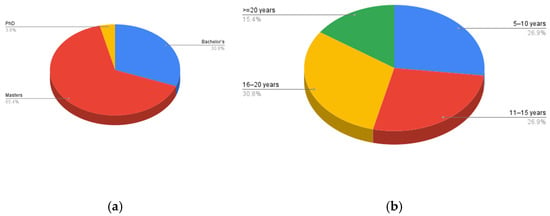
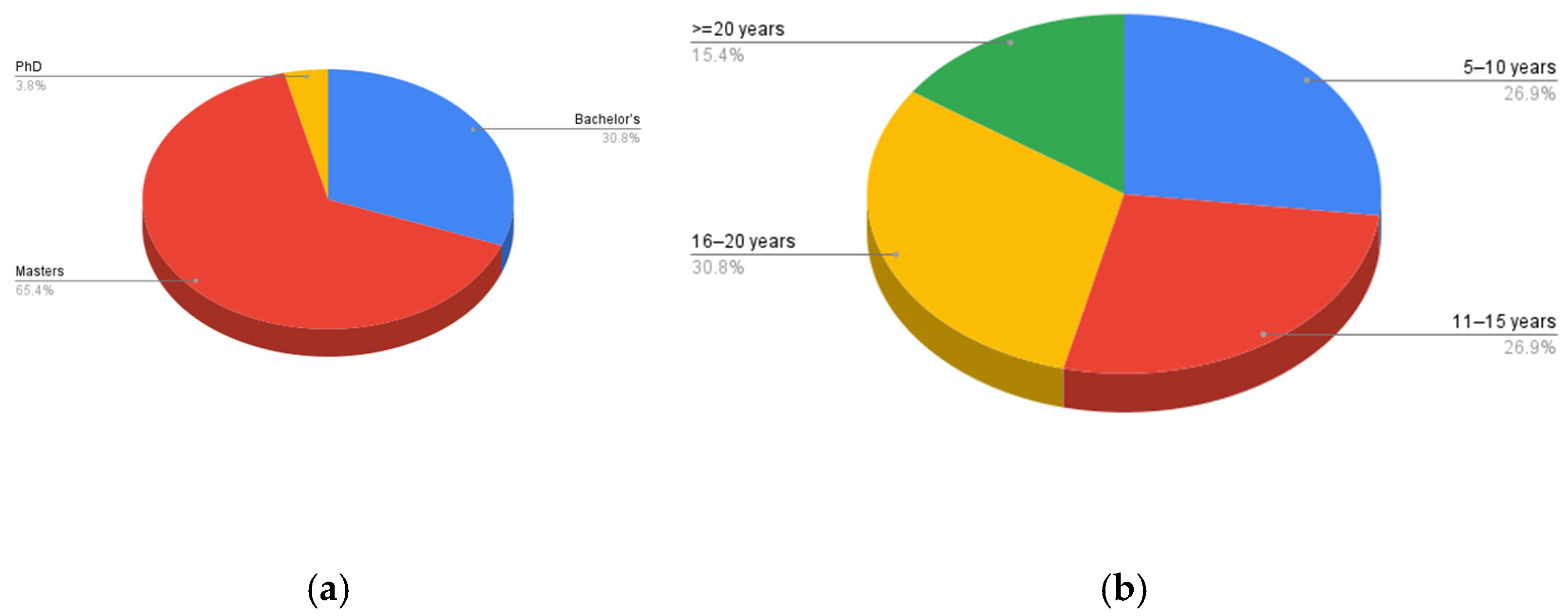
The Delphi survey began with the participation of 30 experts in the first round and was completed with 26 experts in the third round, resulting in a response rate of 86.67%, which is considered acceptable. Furthermore, the expert panel size is consistent with other Delphi studies and guidelines, such as those of [59,60].Though the diversity of experts in terms of companies seems limited, the participants possessed relevant experience and academic backgrounds, confirming their capacity to understand the current cost risk management practices of the ECI. The majority of the experts have more than 10 years of experience. Figure 2a,b shows the experts’ demographics.
Figure 2.
Experts’ demographics: (a) academic status of experts; (b) years of professional experience.
Prior to detailed analysis, the internal consistency of the data was evaluated using reliability analysis. The literature suggests different internal consistency test techniques [87]. In this study, McDonald’s omega was utilized, as it is suited for expert consensus-based instruments such as Delphi techniques [88]. Accordingly, the McDonald’s omega value was calculated and found to be 0.856, indicating good reliability.
Table 2 shows the results of the study. The first and second rounds of the Delphi survey show that, out of the 17 risk management barriers identified in the literature, only 8 received the experts’ approval as being common to ECI cost risk management. In the first round, the majority of experts (>50%) selected nine barriers, which were then refined to eight in the second round and exported to the third round for ranking.
Table 2.
Results of the Delphi analysis.
In the third round, the selected barriers were ranked with a 5-point Likert scale. The majority of the barriers (except BR8, M = 3.5) achieved overall expert agreement, with a median score of 4. However, the level of consensus is variable, as there are some barriers with a median of 4 but IQR > 1. The top-ranked barriers demonstrated strong consensus, with a median of 4 and an IQR of 1, confirming significance in the final ranking. Lower-ranked barriers (BR6, BR7, and BR8) received expert agreement but did not achieve full consensus. This variability could be due to organizational differences and personal experience, suggesting a context-specific strategy for addressing these barriers. While further Delphi rounds could be conducted for items without consensus, a fourth round was deemed unnecessary in this study, as consensus was reached for the most critical barriers. The Friedman test results (X2(7) = 10.013, p = 0.188) indicate no statistically significant difference among experts in their rating, suggesting overall consensus.
A sensitivity analysis between 50% and 70% agreement thresholds revealed that adopting a strict threshold (≥70%) would have excluded some barriers (BR2, BR3, and BR5) that were ultimately ranked as important. By using the 50% cut-off, these top-ranked barriers were retained. This technique is acceptable, as it aligns with the requirements of Delphi best practice, emphasizing transparency and sensitivity analyses over rigid adherence to a single consensus definition.
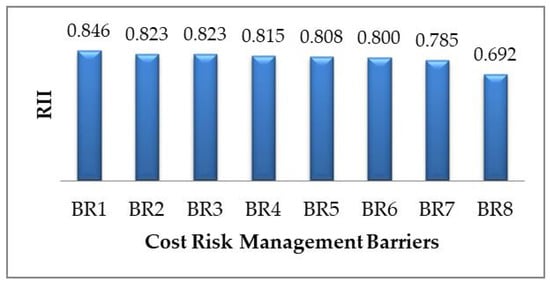
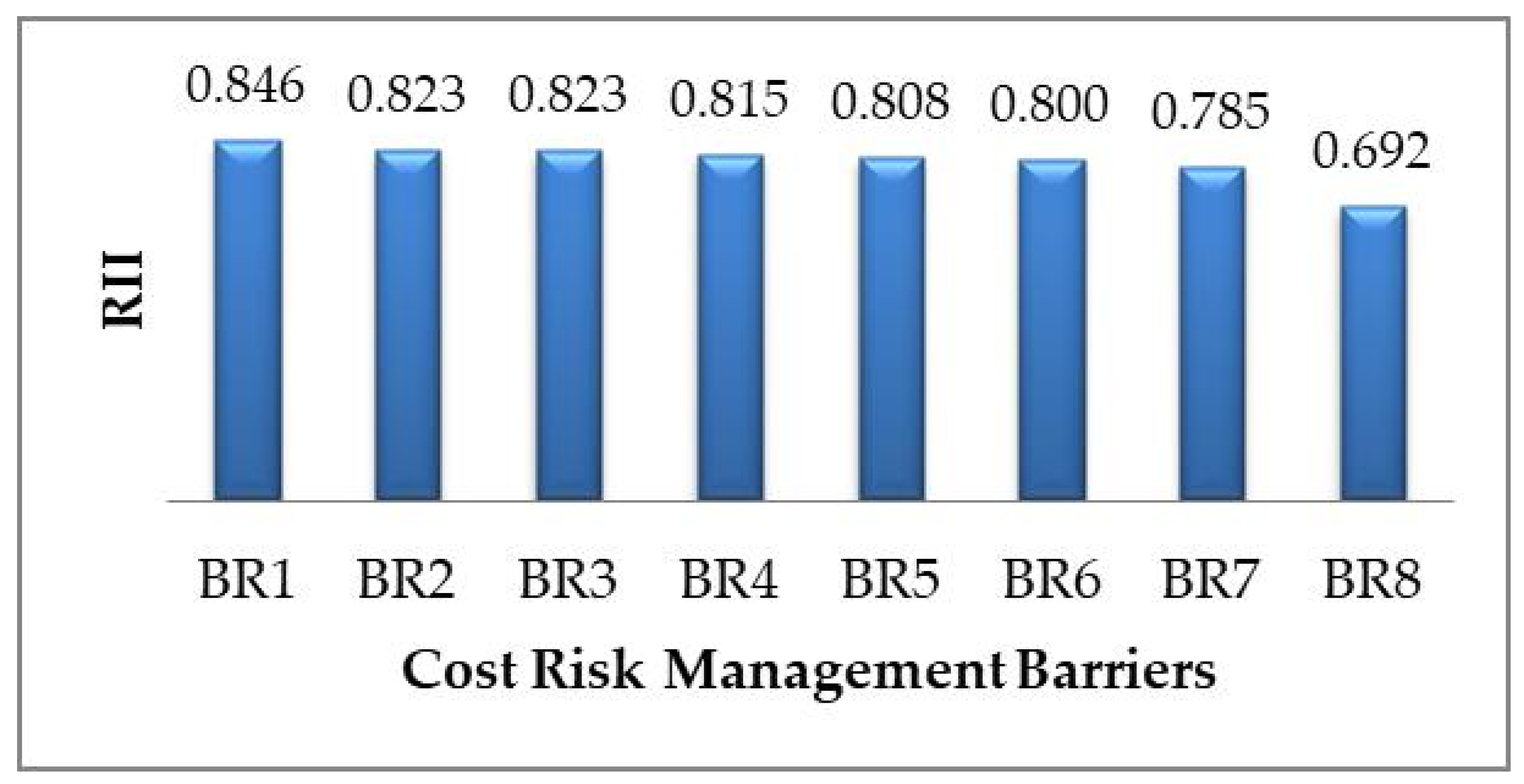
According to the results of the RII, the lack of a structured risk management program within a company—BR1 (RII = 0.846), the lack of top management support—BR2 (RII = 0.823), the lack of joint risk management mechanisms among stakeholders—BR3 (RII = 0.823), the lack of risk management knowledge and skills—BR4 (RII = 0.815), and the lack of support from the client—BR5 (RII = 0.808) are the top five barriers. Barriers such as the lack of risk management expertise—BR6, the lack of risk management experience—BR7, and the lack of a budget—BR8 were ranked lower; however, they are still relevant due to their relatively high level of RII. Figure 3 shows the ranking of these barriers.
Figure 3.
Results of the RII analysis.
Table 3 shows the results of Spearman’s correlation analysis among the eight barriers identified and ranked by the experts. To control for multiple comparisons, Holm–Bonferroni correction was conducted. The analysis revealed eleven statistically significant correlations after correction, indicating strong associations among these barriers, while the remaining correlations were not statistically significant.
Table 3.
Results of the correlation analysis.
4. Discussion
4.1. Ranking of the Most Critical Barriers
The findings of the RII show that the absence of a structured risk management program within a company is the most significant barrier to systematic cost risk management implementation in the ECI. This finding aligns with the findings of Shibani, Hasan, Saaifan, Sabboubeh, Eltaip, Saidani, and Gherbal [48]. Similarly, Kivrak and Udan [24] concluded that the majority of construction companies in Ethiopia do not have a risk management program due to a lack of knowledge, the lack of a budget, and the complex nature of risk management tools and techniques. This finding is also supported by Lebunu Hewage, Wadu Mesthrige, and Too [46], who emphasized that the lack of an organizational risk management program is a reason for project failure. Risk management standards like those of the Project Management Institute [27] and international standards [31] have provided the general procedures for project risk management. However, it has been suggested that companies should develop their own specific risk management program [19,21].
Insufficient top management support is ranked as the second most significant barrier, aligning with the findings of Senesi, Javernick-Will, and Molenaar [21] and Adamtey and Kereri [19]. It is suggested that top management must buy into the benefits of risk management and assign the required personnel, finance, and other resources to the risk management program for its successful implementation [19]. However, the top management can resist the implementation of risk management due to a lack of awareness and understanding of the benefits of risk management [47]. Conversely, the management may be aware of the benefits of project risk management, but they may resist its implementation due to a poor attitude towards project risk management [49]. Top management support is known to be one of the significant project success factors that is critical in the allocation of sufficient resources, in addition to increasing the project manager’s confidence in decision-making [36].
A lack of joint risk management mechanisms among parties is another significant barrier, in agreement with the findings of Tang, Qiang, Duffield, Young, and Lu [40]. Systematic risk management is based on teamwork that requires the contribution of all project stakeholders [27]. According to Tang, Qiang, Duffield, Young, and Lu [40], incorporating a joint risk management system facilitates open communication among parties so that they can contribute their organizational historical data and personal experiences. According to Rahman and Kumaraswamy [89], effective risk management involves the effort of all contracting parties, as there are risks that cannot be managed by a single party.
Limited technical knowledge and skills is ranked as the fourth barrier, aligning with Lebunu Hewage, Wadu Mesthrige, and Too [46] and Shibani, Hasan, Saaifan, Sabboubeh, Eltaip, Saidani, and Gherbal [48]. It is evidenced that effective implementation of risk management requires trained experts with a thorough understanding of the basic techniques [19]. In addition, decision-makers and project managers must be able to interpret the results of the risk management tools and techniques [21]. According to Kivrak and Udan [24], risk management tools and techniques such as Monte Carlo simulation are not implemented in the ECI due to a lack of knowledge of their utilization.
Client support is recognized as one of the project success factors [36]. However, inadequate client support is another significant barrier in ECI cost risk management implementation. This is in agreement with the findings of Chileshe, Hosseini, and Jepson [45]. Risk management is based on group work that involves support from all project stakeholders, including the client [27]. Furthermore, risk management implementation requires costs that may increase the contractors’ project estimate [4]. Subsequently, it results in a project cost increase that requires the consent of the client. The client is the one who is responsible for financing and, subsequently, utilizing the project [90].
4.2. Assessment of the Correlations Between Barriers
Spearman’s correlation results, after Holm correction, suggest that experts evaluated certain barriers as strongly associated. For example, the top-ranked barrier—absence of a structured risk management program within a company (BR1)—showed strong positive correlations with several other barriers, including BR2, BR3, BR4, BR6, and BR7, highlighting its central influence on cost risk management practices in the ECI. The strong correlation among these barriers suggests they are interrelated. Therefore, developing a strategy to address one barrier, such as BR1, could also impact others that are significantly correlated with BR1. Conversely, barriers without significant correlation lack related dimensions and will require separate, targeted strategies.
4.3. Implication and Limitation
This study holds significance for both practitioners and researchers in the CI. The findings of the study highlight the critical barriers hindering the effective implementation of systematic cost risk management, as well as risk management in general, within the ECI. It also reveals significant correlations among these barriers, providing a structured basis for formulating organizational policies, allocating resources, and developing targeted strategies to enhance cost control performance in construction projects.
For researchers, the study significantly contributes to the existing body of knowledge by extending the understanding of cost risk management practices in the ECI. The study provides empirical support for the current practices while identifying gaps for possible future investigation. Furthermore, the methodological approach adopted—particularly the Delphi procedures—can serve as a reference for other researchers conducting similar studies in related contexts. The study also points to potential directions for future research, including the development and evaluation of mitigation strategies for the identified barriers. Thus, it provides a valuable reference point for researchers for further exploration of risk management practices both in Ethiopia and in other national contexts. Subsequent studies could expand the scope to include additional project performance dimensions, such as time and quality, and examine perspectives from other key stakeholders, including clients and consultants. Comparative investigations across countries with similar economic and institutional contexts would further enrich understanding and support broader generalization of the findings.
Although this study provides a valuable understanding of the cost risk management barriers in the CI, it is not without limitations. First, the data were collected from a limited number of experts, which could lead to a problem of generalizability. Furthermore, these experts were selected from the ECI. This will also limit the generalizability of its findings to other countries with a different economic context. The results also reflect the risk management practices that are specific to the study period. Thus, the ranking of these barriers may also vary over time due to evolving industry dynamics. The other limitation of the study is that alternative multi-criteria decision-making techniques such as the AHP were not applied.
5. Conclusions and Recommendations
This study provides empirical evidence that the systematic implementation of cost risk management is a critical determinant of construction project success, particularly in mitigating or preventing cost overruns. Despite its recognized importance, the ECI continues to experience persistent cost overruns, largely attributable to deficiencies in the structured application of cost risk management practices. Addressing this gap, the present study identified and analyzed the critical barriers hindering the effective implementation of systematic cost risk management within the ECI.
Among the eight evaluated barriers, BR1 was ranked as the most critical, achieving the highest RII value (0.846), followed by BR2 and BR3, which were ranked as the second most significant barriers, with an RII value of 0.823. BR4 and BR5 were ranked fourth and fifth, respectively. Furthermore, these five top-ranked barriers have a median score of 4 and an IQR of 1, indicating strong expert agreement and consensus. These results underscore the dominant influence of organizational and human-related factors over technical or procedural constraints. Furthermore, the correlation analysis revealed that most barriers are moderately to strongly interrelated, suggesting that cost risk management challenges in the ECI are systemic in nature rather than isolated issues.
Based on these findings, this study recommends targeted capacity-building interventions at multiple institutional levels. In particular, top management within construction organizations should receive structured training to enhance their competency in risk management principles, tools, and decision-making processes. Professional bodies, such as contractors’ associations, can play a pivotal role by organizing continuous professional development programs, including workshops and seminars focused on practical risk management applications. Additionally, academic institutions should strengthen their curricula by incorporating advanced construction risk management courses to better prepare graduates for industry challenges. At the regulatory level, relevant authorities within the ECI are encouraged to establish and enforce policies that mandate the adoption of systematic risk management practices in construction projects, alongside supportive measures aimed at alleviating the identified barriers. It is suggested that future studies could incorporate the AHP to further validate and refine the relative weights of the identified barriers. Furthermore, increasing the number and diversity of experts could enhance the generalizability of the findings.
Author Contributions
K.T.B.: Conceptualization, Data curation, Formal analysis, Investigation, Methodology, Project administration, Resources, Software, Validation, Visualization, Writing—original draft. A.K.W.: Conceptualization, Methodology, Supervision, Validation, Writing—review and editing. A.T.S.: Conceptualization, Methodology, Supervision, Validation, Writing—review and editing. W.A.W.: Conceptualization, Methodology, Resources, Software, Supervision, Validation, Visualization, Writing—review and editing. W.Z.T.: Conceptualization, Resources, Supervision, Validation, Writing—review and editing. All authors have read and agreed to the published version of the manuscript.
Funding
This research received no external funding.
Institutional Review Board Statement
Not applicable.
Informed Consent Statement
Not applicable.
Data Availability Statement
The raw data supporting the conclusions of this article will be made available by the authors on request.
Conflicts of Interest
The authors declare no conflicts of interest.
References
- Ofori, G.; Toor, S.-u.-R. Leadership and Construction Industry Development in Developing Countries. J. Constr. Dev. Ctries. 2012, 17, 1–21. [Google Scholar]
- Giang, D.T.H.; Pheng, L.S. Role of Construction in Economic Development: Review of Key Concepts in the Past 40 Years. Habitat Int. 2011, 35, 118–125. [Google Scholar] [CrossRef] [Scilit]
- ASCC. African Statistical Yearbook; United Nations Publications: New York, NY, USA, 2021. [Google Scholar]
- Hwang, B.-G.; Zhao, X.; Toh, L.P. Risk management in small construction projects in Singapore: Status, barriers and impact. Int. J. Proj. Manag. 2014, 32, 116–124. [Google Scholar] [CrossRef] [Scilit]
- Albtoush, A.M.F.; Doh, S.I.; Rahman, R.A.; Al-Momani, A.H. Critical Success Factors of Construction Projects in Jordan: An Empirical Investigation. Asian J. Civ. Eng. 2022, 23, 1087–1099. [Google Scholar] [CrossRef] [Scilit]
- Atkinson, R. Project management: Cost, time and quality, two best guesses and a phenomenon, its time to accept other success criteria. Int. J. Proj. Manag. 1999, 17, 337–342. [Google Scholar] [CrossRef] [Scilit]
- Flyvbjerg, B.; Ansar, A.; Budzier, A.; Buhl, S.; Cantarelli, C.; Garbuio, M.; Glenting, C.; Holm, M.S.; Lovallo, D.; Lunn, D.; et al. Five Things You Should Know about Cost Overrun. Transp. Res. Part A Policy Pract. 2018, 118, 174–190. [Google Scholar] [CrossRef] [Scilit]
- Shah, F.H.; Bhatti, O.S.; Ahmed, S. A Review of the Effects of Project Management Practices on Cost Overrun in Construction Projects. Eng. Proc. 2023, 44, 1. [Google Scholar]
- Arditi, D.; Akan, G.T.; Gurdamar, S. Cost Overruns in Public Projects. Int. J. Proj. Manag. 1985, 3, 218–224. [Google Scholar] [CrossRef] [Scilit]
- Flyvbjerg, B.; Skamris Holm, M.K.; Buhl, S.L. How Common and How Large are Cost Overruns in Transport Infrastructure Projects? Transp. Rev. 2003, 23, 71–88. [Google Scholar] [CrossRef] [Scilit]
- Park, Y.I.; Papadopoulou, T.C. Causes of Cost Overruns in Transport Infrastructure Projects in Asia: Their Significance and Relationship with Project Size. Built Environ. Proj. Asset Manag. 2012, 2, 195–216. [Google Scholar] [CrossRef] [Scilit]
- Mahamid, I.; Bruland, A. Cost Deviation in Road Construction Projects: The Case of Palestine. Aust. J. Constr. Econ. Build. 2012, 12, 58–71. [Google Scholar] [CrossRef] [Scilit]
- Alhammadi, Y.; Al-Mohammad, M.S.; Rahman, R.A. Modeling the Causes and Mitigation Measures for Cost Overruns in Building Construction: The Case of Higher Education Projects. Buildings 2024, 14, 487. [Google Scholar] [CrossRef] [Scilit]
- Belachew, A.S.; Mengesha, W.J.; Mohammed, M. Causes of Cost Overrun in Federal Road Projects of Ethiopia in Cases of Southern District. Am. J. Civ. Eng. 2017, 5, 27–40. [Google Scholar] [CrossRef] [Scilit]
- Belay, S.M.; Tilahun, S.; Yehualaw, M.; Matos, J.; Sousa, H.; Workneh, E.T. Analysis of Cost Overrun and Schedule Delays of Infrastructure Projects in Low Income Economies: Case Studies in Ethiopia. Adv. Civ. Eng. 2021, 2021, 4991204. [Google Scholar] [CrossRef] [Scilit]
- Berihu, L.G.; Grum, B.; Tariku, Z.; Abebe, B.A. Causes, Effects, and Mitigation Measures of Time and Cost Overruns in Water Supply Projects: Case of Tigrai Region, Northern Ethiopia. Adv. Civ. Eng. 2023, 2023, 7113730. [Google Scholar] [CrossRef] [Scilit]
- Hulett, D. Integrated Cost-Schedule Risk Analysis; Gower Publishing: Farnham, UK, 2011. [Google Scholar]
- Flyvbjerg, B.; Holm, M.S.; Buhi, S. Underestimating Costs in Public Works Projects. J. Am. Plan. Assoc. 2002, 68, 279–295. [Google Scholar] [CrossRef] [Scilit]
- Adamtey, S.; Kereri, J.O. Risk management in residential projects in the United States: Implementation status, evaluation techniques and barriers. J. Eng. Des. Technol. 2023, 21, 1481–1500. [Google Scholar] [CrossRef] [Scilit]
- Mok, C.K.; Tummala, V.M.R.; Leung, H.M. Practices, barriers and benefits of risk management process in building services cost estimation. Constr. Manag. Econ. 1997, 15, 161–175. [Google Scholar] [CrossRef] [Scilit]
- Senesi, C.; Javernick-Will, A.; Molenaar, K.R. Benefits and Barriers to Applying Probabilistic Risk Analysis on Engineering and Construction Projects. Eng. Manag. J. 2015, 27, 49–57. [Google Scholar] [CrossRef] [Scilit]
- Welde, M.; Klakegg, O.J. Avoiding Cost Overrun Through Stochastic Cost Estimation and External Quality Assurance. IEEE Trans. Eng. Manag. 2024, 71, 1984–1997. [Google Scholar] [CrossRef] [Scilit]
- Yadeta, A.E. Critical Risks in Construction Projects in Ethiopia. J. Adv. Res. Civ. Eng. Archit. 2019, 1, 1–9. [Google Scholar]
- Kivrak, S.; Udan, O.H. Risk Management Practices in Ethiopian Somali Regional State Construction Projects. Buildings 2023, 13, 3130. [Google Scholar] [CrossRef] [Scilit]
- Ayalew, T.; Dakhli, Z.; Lafhaj, Z. Assessment on Performance and Challenges of Ethiopian Construction Industry. J. Archit. Civ. Eng. 2016, 2, 1–11. [Google Scholar]
- Flanagan, R.; Norman, G. Risk Management and Construction; Royal Institution of Chartered Surveyors: London, UK, 1993. [Google Scholar]
- PMI. A Guide to the Project Management Body of Knowledge; PMI: Newtown Square, PA, USA, 2017. [Google Scholar]
- Dikmem, I.; Birgonul, M.T.; Arikan, A.E. A Critical Review of Risk Management Support Tools. In Proceedings of the 20th Annual ARCOM Conference; Heriot-Watt University Edinburgh: Edinburgh, UK, 2004. [Google Scholar]
- Tah, J.H.M.; Carr, V. Information modelling for a construction project risk management system. Eng. Constr. Archit. Manag. 2000, 7, 107–119. [Google Scholar] [CrossRef] [Scilit]
- Vargas, D.B.; Campos, L.M.d.S. Risk Management: A Parallel Between ISO 31000 (2018) and the PMBOK Guide (2017). In Proceedings of the International Conference on Industrial Engineering and Operations Management, Istanbul, Turkey, 7–10 March 2022. [Google Scholar]
- ISO3100; Risk Management-Guidelines. ISO: Geneva, Switzerland, 2018.
- Goh, C.S.; Abdul-Rahman, H.; Samad, Z.A. Applying Risk Management Workshop for a Public Construction Project: Case Study. J. Constr. Eng. Manag. 2013, 139, 572–580. [Google Scholar] [CrossRef] [Scilit]
- Alfreahat, D.; Sebestyén, Z. A Construction–Specific Extension to a Standard Project Risk Management Process. Organ. Technol. Manag. Constr. 2022, 13, 2666–2674. [Google Scholar] [CrossRef] [Scilit]
- Sudarsana, D.K. Development of an Integrated Cost, Time, Quality and Safety Risk Analysis Tool in a Construction Project. Int. J. Cond. Monit. Diagn. Eng. Manag. 2023, 26, 3. [Google Scholar]
- Mahmoudi, A.; Abbasi, M.; Deng, X.; Ikram, M.; Yeganeh, S. A Novel Model for Risk Management of Outsourced Construction Projects using Decision-Making Methods: A Case Study. Grey Syst. Theory Appl. 2020, 10, 97–123. [Google Scholar] [CrossRef] [Scilit]
- Pinto, J.K. Project Management: Achieving Competitive Advantage, 5th ed.; Pearson: New York, NY, USA, 2019; p. 564. [Google Scholar]
- Kerzner, H. Project Management: A Systems Approach to Planning, Scheduling, and Controlling, 12th ed.; Wiley: Hoboken, NJ, USA, 2017; p. 814. [Google Scholar]
- Cooper, D.; Bosnich, P.; Grey, S.; Purdy, G.; Raymond, G.; Walker, P.; Wood, M. Project Risk Management Guidelines: Managing Risk with ISO 31000 and IEC 62198; Wiley: Hoboken, NJ, USA, 2014. [Google Scholar]
- Radi Al-Aga, S.F.; Burhan, A.M. Appropriate Risk Response Planning of Build Operate Transfer Contracts for the Transportation Projects in Iraq. Civ. Environ. Eng. 2022, 18, 430–437. [Google Scholar] [CrossRef] [Scilit]
- Tang, W.; Qiang, M.; Duffield, C.F.; Young, D.M.; Lu, Y. Risk Management in the Chinese Construction Industry. J. Constr. Eng. Manag. 2007, 133, 944–956. [Google Scholar] [CrossRef] [Scilit]
- Zaneldin, E.; Ahmed, W. A Generic Framework for Managing Schedule and Cost Risks of Construction Activities Using PERT and the EV Technique. Buildings 2024, 14, 1918. [Google Scholar] [CrossRef] [Scilit]
- Khodakarami, V.; Abdi, A. Project cost risk analysis: A Bayesian networks approach for modeling dependencies between cost items. Int. J. Proj. Manag. 2014, 32, 1233–1245. [Google Scholar] [CrossRef] [Scilit]
- Hillson, D.; Simon, P. Practical Project Risk Management: The ATOM Methodology, 3rd ed.; Berrett-Koehler Publishers, Inc.: Oakland, CA, USA, 2020. [Google Scholar]
- Dehdasht, G.; Mohamad Zin, R.; Keyvanfar, A. Risk Classification and Barrier of Implementing Risk Management in Oil and Gas Construction Companies. J. Teknol. 2015, 77, 161–169. [Google Scholar] [CrossRef] [Scilit]
- Chileshe, N.; Hosseini, M.R.; Jepson, J. Critical Barriers to Implementing Risk Assessment and Management Practices (RAMP) in the Iranian Construction Sector. J. Constr. Dev. Ctries. 2016, 21, 81–112. [Google Scholar] [CrossRef] [Scilit]
- Lebunu Hewage, U.W.A.; Wadu Mesthrige, J.; Too, E.G. Barriers to risk management in small construction projects in Sri Lanka. Built Environ. Proj. Asset Manag. 2024, 14, 296–311. [Google Scholar] [CrossRef] [Scilit]
- Prakash, A.; Ambekar, S. Barriers to the implementation of enterprise risk management in Indian construction firms. Constr. Innov. 2026, 26, 440–463. [Google Scholar] [CrossRef] [Scilit]
- Shibani, A.; Hasan, D.; Saaifan, J.; Sabboubeh, H.; Eltaip, M.; Saidani, M.; Gherbal, N. Financial risk management in the construction projects. J. King Saud Univ.–Eng. Sci. 2022, 36, 552–561. [Google Scholar] [CrossRef] [Scilit]
- Perrenoud, A.; Alnassar, J.; Lines, B.; Bigelow, B. A Review of the Barriers to Implementing Project Risk Management and a Study of Their Impact on Electrical Contractors’ Risk Maturity Levels. In Proceedings of the Construction Research Congress 2018, New Orleans, LA, USA, 2–4 April 2018; pp. 272–281. [Google Scholar]
- El-Sayegh, S.M. Project Risk Management Practices in the UAE Construction Industry. Int. J. Proj. Organ. Manag. 2014, 6, 121–137. [Google Scholar] [CrossRef] [Scilit]
- Chileshe, N.; Kikwasi, G.J. Perception of Barriers to Implementing Risk Assessment and Management Practices by Construction Professionals in Tanzania. In Proceedings of the Procs 29th Annual ARCOM Conference, Reading, UK, 2–4 September 2013; pp. 1137–1146. [Google Scholar]
- Sumsion, T. The Delphi Technique: An Adaptive Research Tool. Br. J. Occup. Ther. 1998, 61, 153–156. [Google Scholar] [CrossRef] [Scilit]
- Franc, J.M.; Hung, K.K.C.; Pirisi, A.; Weinstein, E.S. Analysis of Delphi Study 7-Point Linear Scale Data by Parametric Methods: Use of the Mean and Standard Deviation. Methodol. Innov. 2023, 16, 226–233. [Google Scholar] [CrossRef] [Scilit]
- Keeney, S.; Hasson, F.; McKenna, H.P. The Delphi Technique in Nursing and Health Research; Wiley-Blackwell: Chichester, UK, 2011. [Google Scholar]
- Linstone, H.A.; Turoff, M. The Delphi Method: Techniques and Applications; Addison Wesley: Boston, MA, USA, 2002. [Google Scholar]
- Rowe, G.; Wright, G. The Delphi technique as a forecasting tool: Issues and analysis. Int. J. Forecast. 1999, 15, 353–375. [Google Scholar] [CrossRef] [Scilit]
- Hallowell, M.R.; Gambatese, J.A. Qualitative Research: Application of the Delphi Method to CEM Research. J. Constr. Eng. Manag. 2010, 136, 99–107. [Google Scholar] [CrossRef] [Scilit]
- Ameyaw, E.E.; Chan, A.P.C. A Fuzzy Approach for the Allocation of Risks in Public–Private Partnership Water-Infrastructure Projects in Developing Countries. J. Infrastruct. Syst. 2016, 22, 04016016. [Google Scholar] [CrossRef] [Scilit]
- Junger, S.; Payne, S.A.; Brine, J.; Radbruch, L.; Brearley, S.G. Guidance on Conducting and REporting DElphi Studies (CREDES) in palliative care: Recommendations based on a methodological systematic review. Palliat. Med. 2017, 31, 684–706. [Google Scholar] [CrossRef] [Scilit]
- Ameyaw, E.E.; Hu, Y.; Shan, M.; Chan, A.P.C.; Le, Y. Application of Delphi Method in Construction Engineering and Management Research: A Quantitative Perspective. J. Civ. Eng. Manag. 2016, 22, 991–1000. [Google Scholar] [CrossRef] [Scilit]
- Perera, B.A.K.S.; Rameezdeen, R.; Chileshe, N.; Hosseini, M.R. Enhancing the Effectiveness of Risk Management Practices in Sri Lanka Road Construction Projects: A Delphi Approach. Int. J. Constr. Manag. 2014, 14, 1–14. [Google Scholar] [CrossRef] [Scilit]
- Perrenoud, A.; Short, E.; Cowan, D. Development and Validation of Elements for the Construction Risk Maturity Assessment (CRMA). Int. J. Constr. Educ. Res. 2023, 19, 42–60. [Google Scholar] [CrossRef] [Scilit]
- Hasson, F.; Keeney, S.; McKenna, H. Research Guidelines for the Delphi Survey Technique. J. Adv. Nurs. 2000, 32, 1008–1015. [Google Scholar] [CrossRef] [Scilit]
- Keeney, S.; Hasson, F.; McKenna, H.P. A Critical Review of the Delphi Technique as a Research Methodology for Nursing. Int. J. Nurs. Stud. 2001, 38, 195–200. [Google Scholar] [CrossRef] [Scilit]
- Skulmoski, G.J.; Hartman, F.T.; Krahn, J. The Delphi Method for Graduate Research. J. Inf. Technol. Educ. 2007, 6, 1–21. [Google Scholar] [CrossRef] [Scilit]
- Chalmers, J.; Armour, M. The Delphi Technique. In Handbook of Research Methods in Health Social Sciences; Liamputtong, P., Ed.; Springer: Singapore, 2018; pp. 1–21. [Google Scholar]
- McKenna, H.P. The Delphi Technique: A Worthwhile Research Approach for Nursing? J. Adv. Nurs. 1994, 19, 1221–1225. [Google Scholar] [CrossRef] [Scilit]
- Perera, H.P.; Perera, B.A.K.S.; Palihakkara, D.A. Financial and Economic Risk Management in Coastal Land Reclamation Projects. Constr. Innov. 2023, 23, 878–897. [Google Scholar] [CrossRef] [Scilit]
- Xu, Y.; Yeung, J.F.Y.; Chan, A.P.C.; Chan, D.W.M.; Wang, S.Q.; Ke, Y. Developing a Risk Assessment Model for PPP Projects in China—A Fuzzy Synthetic Evaluation Approach. Autom. Constr. 2010, 19, 929–943. [Google Scholar] [CrossRef] [Scilit]
- Gracht, H.A.v.d. Consensus measurement in Delphi studies. Technol. Forecast. Soc. Change 2012, 79, 1525–1536. [Google Scholar] [CrossRef] [Scilit]
- Boone, H.; Boone, D. Analyzing Likert Data. J. Ext. 2012, 50, 48. [Google Scholar] [CrossRef] [Scilit]
- Siegel, S.Y. Nonparametric Statistics. Am. Stat. 1957, 11, 13–19. [Google Scholar] [CrossRef] [Scilit]
- Waris, M.; Shahir Liew, M.; Khamidi, M.F.; Idrus, A. Criteria for the Selection of Sustainable Onsite Construction Equipment. Int. J. Sustain. Built Environ. 2014, 3, 96–110. [Google Scholar] [CrossRef] [Scilit]
- Alshihri, S.; Al-Gahtani, K.; Almohsen, A. Risk Factors That Lead to Time and Cost Overruns of Building Projects in Saudi Arabia. Buildings 2022, 12, 902. [Google Scholar] [CrossRef] [Scilit]
- Datta, S.D.; Sobuz, M.H.R.; Nafe Assafi, M.; Sutan, N.M.; Islam, M.N.; Mannan, M.B.; Akid, A.S.M.; Hasan, N.M.S. Critical project management success factors analysis for the construction industry of Bangladesh. Int. J. Build. Pathol. Adapt. 2025, 43, 482–511. [Google Scholar] [CrossRef] [Scilit]
- Tessema, A.T.; Alene, G.A.; Wolelaw, N.M. Assessment of Risk Factors on Construction Projects in Gondar City, Ethiopia. Heliyon 2022, 8, e11726. [Google Scholar] [CrossRef] [Scilit]
- Saaty, R.W. The Analytic Hierarchy Process-What it is and How it is Used. Mathl Model. 1987, 9, 161–176. [Google Scholar] [CrossRef] [Scilit]
- Ishizaka, A.; Labib, A. Analytic Hierarchy Process and Expert Choice: Benefits and limitations. OR Insight 2009, 22, 201–220. [Google Scholar] [CrossRef] [Scilit]
- Lamprou, A.; Vagiona, D.G. Identification and Evaluation of Success Criteria and Critical Success Factors in Project Success. Glob. J. Flex. Syst. Manag. 2022, 23, 237–253. [Google Scholar] [CrossRef] [Scilit]
- Zar, J.H. Spearman Rank Correlation. In Encyclopedia of Biostatistics; John Wiley & Sons: Hoboken, NJ, USA, 2005. [Google Scholar]
- Spearman, C. The Proof and Measurement of Association Between Two Things. Am. J. Psychol. 1994, 15, 72–101. [Google Scholar] [CrossRef] [Scilit]
- Schober, P.; Boer, C.; Schwarte, L.A. Correlation Coefficients: Appropriate Use and Interpretation. Anesth. Analg. 2018, 126, 1763–1768. [Google Scholar] [CrossRef] [Scilit]
- Munga, L.; Mwiya, B. Development of a Public Road Works Contract Management Framework for the Zambian construction industry. J. S. Afr. Inst. Civ. Eng. 2025, 66, 16–24. [Google Scholar] [CrossRef] [Scilit]
- Touran, A. Probabilistic Cost Estimating with Subjective Correlations. J. Constr. Eng. Manag. 1993, 119, 58–71. [Google Scholar] [CrossRef] [Scilit]
- Adafin, J.; Rotimi, J.O.B.; Wilkinson, S. Risk impact assessments in project budget development: Quantity surveyors’ perspectives. Int. J. Constr. Manag. 2018, 20, 13–28. [Google Scholar] [CrossRef] [Scilit]
- Armstrong, R.A. When to use the Bonferroni correction. Ophthalmic Physiol. Opt. 2014, 34, 502–508. [Google Scholar] [CrossRef] [Scilit]
- Zinbarg, R.E.; Revelle, W.; Yovel, I.; Li, W. Cronbach’s α, Revelle’s β, and McDonald’s ω: Their Relations with Each Other and Two Alternative Conceptualizations of Reliability. Psychometrika 2005, 70, 123–133. [Google Scholar] [CrossRef] [Scilit]
- Dunn, T.J.; Baguley, T.; Brunsden, V. From alpha to omega: A Practical Solution to the Pervasive Problem of Internal Consistency Estimation. Britsh J. Psychol. 2013, 105, 399–412. [Google Scholar] [CrossRef] [Scilit]
- Rahman, M.M.; Kumaraswamy, M.M. Joint risk management through transactionally efficient relational contracting. Constr. Manag. Econ. 2002, 20, 45–54. [Google Scholar] [CrossRef] [Scilit]
- Chitkara, K.K. Construction Project Management: Planning, Scheduling and Controlling, 3rd ed.; McGraw Hill Education Private Limited: Chennai, India, 2014. [Google Scholar]

Disclaimer/Publisher’s Note: The statements, opinions and data contained in all publications are solely those of the individual author(s) and contributor(s) and not of MDPI and/or the editor(s). MDPI and/or the editor(s) disclaim responsibility for any injury to people or property resulting from any ideas, methods, instructions or products referred to in the content. |
© 2026 by the authors. Licensee MDPI, Basel, Switzerland. This article is an open access article distributed under the terms and conditions of the Creative Commons Attribution (CC BY) license.