


Abstract
Control panel and monitoring interfaces require operators to perform visual search while assessing system status. This study examined how Target Color Contrast and Target Eccentricity, operationalizing specific visual and spatial aspects associated with the Salience and Effort components of the SEEV framework, were related to target acquisition in simulated control panel displays. Thirty-four participants completed a controlled eye-tracking experiment using a fully repeated-measures two-by-two design, and computational image analyses characterized the physical properties of the experimental stimuli. Target Eccentricity yielded the largest omnibus effect on Time to First Fixation (TTFF). Critically, however, the effect of Target Color Contrast depended on target location: the High-Contrast condition was associated with substantially shorter TTFF under High Eccentricity, whereas no reliable contrast difference was observed under Low Eccentricity. This interaction remained significant after excluding 16 observations with TTFF equal to zero milliseconds. The findings provide context-specific evidence that the manipulated visual and spatial factors were jointly, rather than independently, associated with target acquisition. From a design perspective, the results suggest a potential hierarchical approach in which spatial layout is considered first and visual prominence is selectively increased when central placement is impractical. This approach represents a design implication requiring validation in operational environments.
1. Introduction
Human operators in complex monitoring environments must process information from multiple sources while identifying task-relevant information among competing visual stimuli. As monitoring systems incorporate more information sources and visually complex displays, the efficient allocation of visual attention becomes increasingly important [1]. Delays in locating critical information can impede its subsequent interpretation and may affect situation awareness and task performance [2,3]. Within cognitive ergonomics, the SEEV framework—Salience, Effort, Expectancy, and Value—is widely used to describe and predict the allocation of visual attention [4]. Salience and Effort are particularly relevant to interface design because specific aspects of these broader constructs can be influenced through visual and spatial design choices.
Although the SEEV framework has been applied in aviation, driving, and supervisory-control contexts, controlled experiments remain valuable for examining how specific interface characteristics are associated with visual attention. In the present study, Target Color Contrast was used to operationalize one visual aspect associated with Salience, while Target Eccentricity was used to operationalize the spatial component of Effort. Target Eccentricity was defined geometrically as the distance between the target and the center of the display. Using simulated control panel displays, participants performed a visual-search task in which Target Color Contrast and Target Eccentricity were systematically varied while their eye movements were recorded. Time to First Fixation (TTFF) served as the primary measure of how rapidly gaze reached the target Area of Interest.
The objective of this study was to quantify the individual and interactive associations of Target Color Contrast and Target Eccentricity with TTFF during visual search in simulated control panel displays. A further objective was to examine whether these experimentally manipulated visual and spatial characteristics provide context-specific evidence about the joint influence of aspects associated with Salience and Effort. The study also aimed to derive carefully bounded implications for interface design, rather than to evaluate complete operator or control-system performance.
1.1. Hypotheses
Hypothesis 1.
High Target Color Contrast will be associated with shorter Time to First Fixation (TTFF) than Low Target Color Contrast.
Hypothesis 2.
Low Target Eccentricity (central placement) will be associated with shorter TTFF than High Target Eccentricity (peripheral placement).
Hypothesis 3.
The association between Target Color Contrast and TTFF will depend on Target Eccentricity, such that the difference between the High- and Low-Contrast conditions will be greater under High Target Eccentricity than under Low Target Eccentricity.
1.2. Contribution
This study contributes controlled eye-tracking evidence concerning how two modifiable interface characteristics—Target Color Contrast and Target Eccentricity—are jointly associated with visual target acquisition in simulated control panel displays. Its principal theoretical contribution is the examination of their interaction: rather than treating the manipulated aspects associated with Salience and Effort as independent determinants, the study evaluates whether the association between Target Color Contrast and TTFF depends on target location. In this way, the study provides a context-specific empirical extension of the SEEV framework while recognizing that the experimental variables represent only particular aspects of the broader Salience and Effort constructs.
The study also derives a bounded interface-design implication from the observed interaction. The findings suggest that spatial layout and visual prominence should be considered jointly and motivate a potential hierarchical approach in which target placement is considered before selective visual enhancement. This approach is presented as a design implication to be tested in future operational studies, rather than as a strategy whose effectiveness was directly validated by the present visual-search experiment.
2. Background
This study draws on research concerning situation awareness, visual attention, visual search, and cognitive ergonomics. Together, these areas provide a theoretical basis for examining how specific interface characteristics are associated with the allocation of visual attention during monitoring tasks. The present study focuses on the initial visual acquisition of target information rather than on the complete perceptual, cognitive, and decision-making processes involved in operational performance.
2.1. Situation Awareness
Human operators in control rooms, transportation systems, healthcare environments, and other monitoring-intensive domains must acquire and interpret information to make effective decisions. A central concept for understanding cognition in such environments is Situation Awareness (SA), defined as the perception of relevant elements, comprehension of their meaning, and projection of their future status [2].
Visual attention is relevant to the perceptual stage of situation awareness because visually presented information must generally be attended to before it can be interpreted and integrated into an understanding of system state. Limitations in attentional resources may therefore delay access to relevant information and affect subsequent monitoring and decision-making processes [3,5]. Sustained monitoring can be particularly demanding in environments containing multiple competing information sources [6]. Nevertheless, rapid visual acquisition alone does not establish that information was correctly comprehended or used effectively in a decision.
Interface design can influence the accessibility and visual prominence of displayed information. Recent human–computer interaction research illustrates the use of behavioral and perceptual measures to evaluate interactions with engineered systems. Veloz et al. incorporated peripheral-vision and visual-response tasks into an assessment of driver psychomotor performance [7], while Paulino et al. demonstrated how quantitative interaction data can support the evaluation of interface design and functionality [8]. Research on teleoperation interfaces likewise emphasizes the importance of graphical interface design for supporting visual perception and situation awareness [9]. These studies motivate the examination of visual attention in interface design, while also underscoring that measures of initial target acquisition, such as TTFF, represent only one component of the broader processes supporting situation awareness and operational performance.
2.2. Visual Attention and Search
Visual attention enables individuals to prioritize relevant information while limiting the processing of competing stimuli. Early research demonstrated that attention can be directed toward particular spatial locations and that shifts of spatial attention produce measurable benefits and costs in information processing [10,11]. These findings established spatial location as an important determinant of how efficiently information is selected within a visual environment.
Visual-search research has further shown that attentional selection is influenced by both stimulus characteristics and observer goals. Feature Integration Theory proposed that certain elementary visual features, including color, size, and orientation, can support efficient target selection, whereas searches involving combinations of features may require more focused attention [12]. Guided Search Theory subsequently described visual search as the result of combined bottom-up and top-down guidance, through which attention is directed toward locations considered more likely to contain a target [13,14].
Related accounts distinguish stimulus-driven influences associated with visual conspicuity from goal-directed influences associated with task objectives, expectations, and prior knowledge [15,16]. These influences are complementary rather than mutually exclusive: visually distinctive information may receive greater attentional priority, but its selection also depends on the observer’s task and the surrounding visual context. Multimodal studies using eye-movement measures provide further evidence that stimulus properties and goal-directed processes jointly shape visual attention [17].
Computational models similarly represent visual prominence through contrasts among image features that contribute to spatial priority or saliency maps [18,19]. Such models provide image-based descriptions of stimulus conspicuity but do not fully represent task goals, semantic meaning, or learned expectations. Experimental research nevertheless indicates that distinctive visual properties can facilitate target selection and influence search behavior [14,20]. Together, these theoretical and computational perspectives provide a basis for examining how target-color properties and spatial target location are jointly associated with the time required for gaze to reach task-relevant information.
2.3. The SEEV Framework
The SEEV framework describes visual-attention allocation as a function of four factors: Salience, Effort, Expectancy, and Value [3,4]. Salience refers broadly to the extent to which information is visually conspicuous relative to its surroundings. Effort concerns the costs associated with directing attention or gaze toward an information source. Expectancy refers to the anticipated likelihood that relevant information will occur at a particular location, while Value concerns the importance of that information for the observer’s task.
A central feature of SEEV is its integration of influences arising from display characteristics and task demands. Salience reflects stimulus-driven visual properties, while Effort is influenced by the spatial and physical organization of information sources. Expectancy and Value reflect goal-directed influences associated with learned probabilities, task priorities, and the anticipated relevance of displayed information [4]. The framework therefore complements general visual-search theories by organizing multiple determinants of attention within a model developed for applied visual environments.
SEEV-based approaches have been applied in aviation, driving, and supervisory-control contexts. Horrey et al. demonstrated the use of related models for predicting visual scanning during interactions with in-vehicle technologies [21]. Subsequent work developed computational implementations for predicting fixation distributions and noticing behavior within visual workspaces [22,23]. More recent research continues to apply the framework to attention in complex systems [24], while developments in eye-tracking technology provide additional opportunities to evaluate visual-attention allocation in human–machine interfaces [25].
Salience and Effort are both relevant to interface design, but neither construct is determined by a single display property. Salience can depend on color, luminance, contrast, size, motion, surrounding context, and semantic associations. Effort can depend on spatial distance, required eye or head movements, display organization, and the observer’s current gaze position. Target Color Contrast and Target Eccentricity should therefore be treated as experimental operationalizations of particular aspects associated with these constructs rather than as direct equivalents of Salience and Effort in their entirety.
In the present study, the implemented target-color manipulation was used to examine one visual aspect associated with Salience, while target location relative to the center of the display was used to examine the spatial component of Effort. Expectancy and Value were not experimentally manipulated or independently measured. The study consequently does not test the complete SEEV framework; instead, it examines whether two modifiable visual and spatial interface characteristics exhibit independent or interactive associations with TTFF during a controlled visual-search task.
2.4. Study Motivation
Previous research has established the importance of visual attention for monitoring tasks and has shown that attentional allocation depends on both stimulus properties and spatial context. The SEEV framework provides an applied basis for organizing these influences, but its components represent broad constructs that can be operationalized through different interface characteristics. Controlled experiments are therefore useful for examining how specific visual and spatial manipulations relate to measurable aspects of visual search.
A focused question concerns whether target-related visual properties and spatial target location are associated with target acquisition independently or interactively. Examining only their separate associations may overlook the possibility that a visual manipulation is more consequential at some display locations than at others. Investigating this interaction can provide context-specific evidence about how experimentally manipulated aspects associated with Salience and Effort jointly relate to attention allocation.
The present study addressed this question using a controlled repeated-measures eye-tracking experiment involving simulated control panel displays. Target Color Contrast and Target Eccentricity were systematically varied, and Time to First Fixation (TTFF) was used to measure how rapidly gaze reached the target AOI. The study was designed to quantify the main and interactive associations of these interface characteristics with TTFF and to derive appropriately bounded implications for visual interface design. It did not evaluate the complete SEEV framework or broader operational outcomes such as situation awareness, decision accuracy, workload, or control-system performance.
3. Materials and Methods
3.1. Participants
Thirty-six participants (13 male and 23 female), aged 19–25 years, were recruited for the study and provided informed consent prior to participation. Two participants were excluded because reliable eye-tracker calibration could not be achieved after two calibration attempts. The final sample therefore comprised 34 participants (13 male and 21 female; years, ). All participants included in the final sample reported normal or corrected-to-normal vision and completed the experiment under identical laboratory conditions.
3.2. Experimental Design
The experiment employed a fully repeated-measures factorial design with Target Color Contrast and Target Eccentricity as within-participant factors. These experimental factors were used to operationalize specific visual and spatial aspects associated with the Salience and Effort components of the SEEV framework, respectively. They were not intended to represent the full theoretical scope of either SEEV component.
The first experimental factor was Target Color Contrast which operationalized one aspect of visual salience. It consisted of two levels: High Contrast (HC) and Low Contrast (LC). The manipulation altered the color of the target numerical value and its associated label while maintaining the overall control panel layout. The High-Contrast condition used a bright red color scheme, whereas the Low-Contrast condition used an industrial yellow color scheme. Consequently, the two conditions differed not only in measured color contrast but also in hue and potentially in the conventional meanings associated with red and yellow in industrial interfaces. The experimental factor is therefore interpreted as the implemented target-color manipulation rather than as an exhaustive or exclusively contrast-based manipulation of salience.
The second experimental factor was Target Eccentricity, which operationalized the spatial component of visual-search effort. It consisted of two levels: Low Eccentricity (LE) and High Eccentricity (HE). Target Eccentricity was varied through target location relative to the center of the display. Low-Eccentricity targets were positioned in the central region of the control panel, whereas High-Eccentricity targets were positioned in peripheral regions. This manipulation captured the spatial distance between the target AOI and the display center but did not encompass other determinants of search effort.
Combining both factors produced four experimental conditions: HC–LE, LC–LE, HC–HE, and LC–HE. Each condition was represented by five control panel displays, resulting in 20 experimental stimuli. Every participant viewed each stimulus once, yielding a maximum of 20 observations per participant.
The primary dependent variable was Time to First Fixation (TTFF), defined as the elapsed time between stimulus onset and the participant’s first fixation within the predefined Area of Interest (AOI) containing the target value. TTFF was selected as a measure of how rapidly visual attention reached the task-relevant target during visual search.
3.3. Apparatus
Eye movements were recorded using a Tobii Pro Nano remote eye tracker (Tobii AB, Danderyd, Sweden) operating at a sampling frequency of 60 Hz. The eye tracker used firmware version 2.41.0-f2dc56e and was configured using the default Eye Tracking Mode. Tobii Pro Lab (Version 24.21) was used for stimulus presentation, data acquisition, and gaze-data processing. Eye-tracker communication and configuration were managed through Tobii Eye Tracker Manager (Version 2.6.1) using driver version 1.8.15.0. The experiment was conducted using a 24-inch monitor with a native display resolution of pixels. The experimental stimuli were PNG images with dimensions of pixels and were presented through Tobii Pro Lab. All participants completed the study using the same hardware and software configuration under identical laboratory conditions.
Participants were seated approximately one arm’s length from the display, without a chin rest, while remaining within the recommended operating range of the eye tracker. Before the experiment, a standard nine-point calibration procedure was performed for each participant using the default Tobii calibration settings, consisting of a gray background and white calibration targets. If calibration quality was considered unsatisfactory, the calibration procedure was repeated. Participants for whom satisfactory calibration could not be achieved after two attempts were excluded before data analysis.
Stimulus presentation, trial sequencing, and eye-movement recording were controlled using Tobii Pro Lab.
3.4. Experimental Stimuli
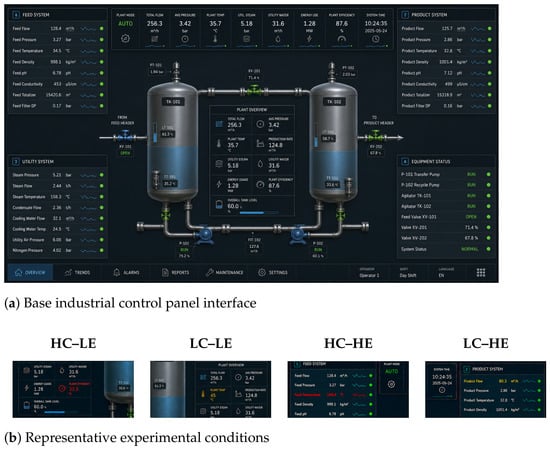
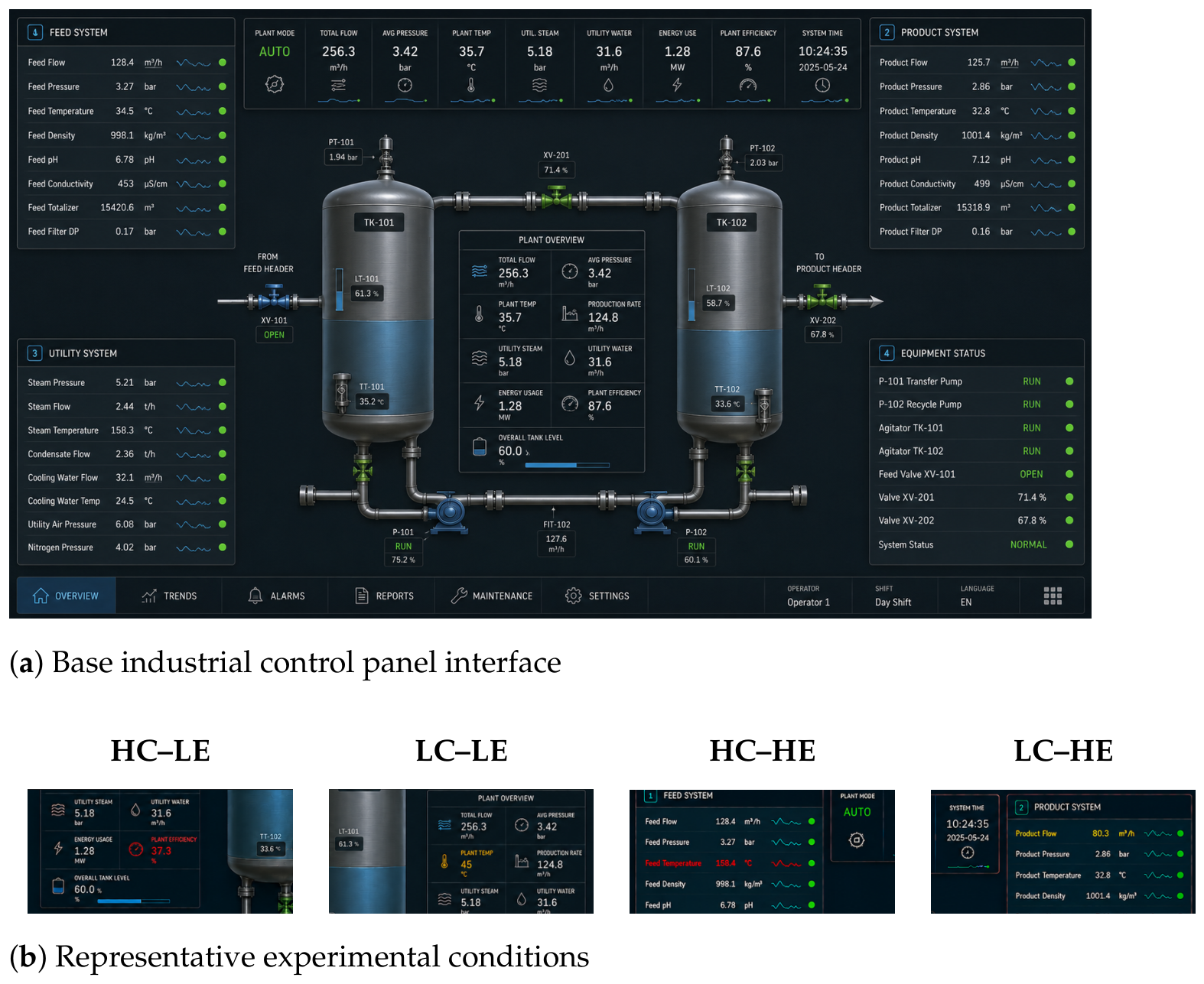
Experimental stimuli consisted of standardized control panel displays developed specifically for this study to manipulate Target Color Contrast and Target Eccentricity while limiting variation in unrelated interface characteristics. Each stimulus contained a single target numerical value and its associated label. Their color and spatial location were varied according to the assigned experimental condition. The displays were designed to resemble industrial monitoring interfaces and contained multiple gauges, indicators, numerical readouts, and status displays arranged within a consistent base layout. Display dimensions, target typography, graphical style, and the organization of the remaining interface elements were held constant across stimuli, as illustrated in Figure 1.
Figure 1.
Experimental interface and representative stimuli. (a) Base industrial control panel interface used throughout the experiment. (b) Representative stimuli illustrating the four experimental conditions obtained by combining Target Color Contrast (High Contrast, HC; Low Contrast, LC) and Target Eccentricity (Low Eccentricity, LE; High Eccentricity, HE). The color and position of the target numerical value and its associated label varied according to the experimental condition, while the remaining interface elements followed the same base layout and graphical style.
The control panel displays were generated using ChatGPT 5.5 (OpenAI) to produce visually consistent industrial monitoring interfaces suitable for the eye-tracking experiment. The stimuli were exported as PNG images ( pixels, 96 dpi) and imported into Tobii Pro Lab for stimulus presentation.
Target Color Contrast was manipulated by altering the color of the target numerical value and its corresponding label. In the High-Contrast (HC) condition, both were displayed in bright red, whereas in the Low-Contrast (LC) condition they were displayed in industrial yellow. These colors are commonly used in industrial interfaces to distinguish abnormal and cautionary conditions while maintaining legibility against dark backgrounds. Target size, typography, and surrounding interface elements were held constant between contrast conditions. Because the manipulation used different colors, it necessarily varied hue together with the measured contrast properties.
Target Eccentricity was manipulated through target location relative to the center of the display. Low-Eccentricity (LE) targets were positioned in the central region of the control panel, whereas High-Eccentricity (HE) targets were positioned in peripheral regions. The physical distance between the center of each target AOI and the center of the display was subsequently quantified as part of the computational characterization of the stimuli.
Combining both factors produced four experimental conditions: HC–LE, LC–LE, HC–HE, and LC–HE. Five control panel displays were created for each condition, yielding 20 experimental stimuli. Each stimulus contained a single predefined target AOI, and each target position appeared only once throughout the experiment. The presentation order was randomized before data collection using the RAND() function in Microsoft Excel and then fixed so that all participants viewed the same stimulus sequence.
For each stimulus, a rectangular Area of Interest (AOI) was manually defined in Tobii Pro Lab to encompass the target numerical value and its associated label. The same AOI-definition criteria were applied across all stimuli to support consistent TTFF measurement.
3.5. Experimental Procedure
Each experimental session was conducted individually under controlled laboratory conditions using the same equipment and protocol. Upon arrival, participants received a brief explanation of the study, provided informed consent, and completed a short demographic questionnaire.
Participants were familiarized with the task using representative control panel displays illustrating the interface and the target-location task. A standard nine-point calibration was then performed in Tobii Pro Lab, followed by practice trials to confirm that participants understood the task and that satisfactory eye-tracking calibration had been achieved.
Participants were instructed that each control panel display contained a single target and that their task was to locate it by directing their gaze toward it. They were informed that their eye movements would be recorded but were not instructed to respond as quickly as possible, thereby avoiding an explicit emphasis on speed over natural viewing behavior.
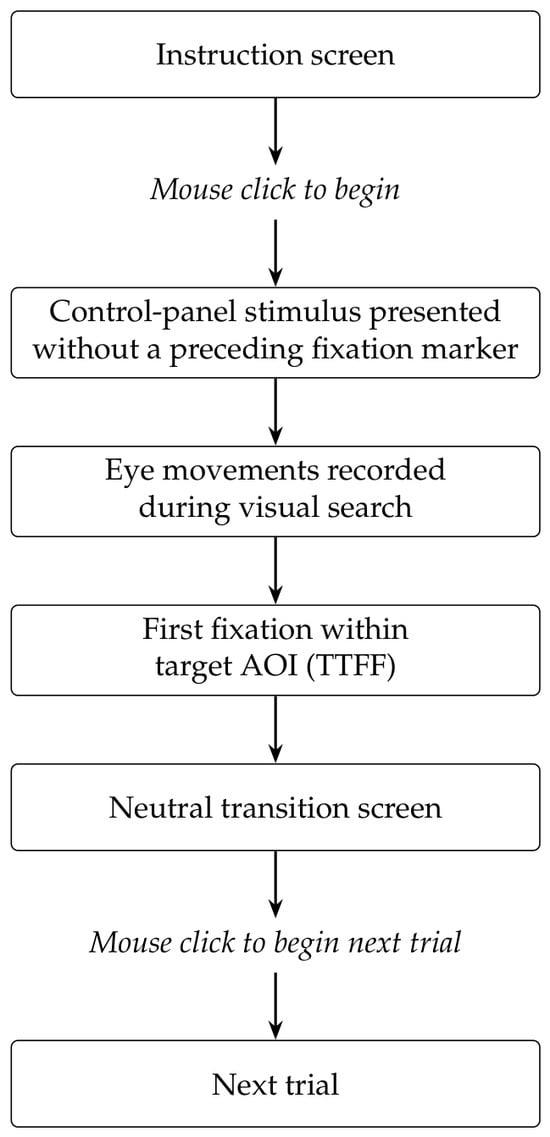
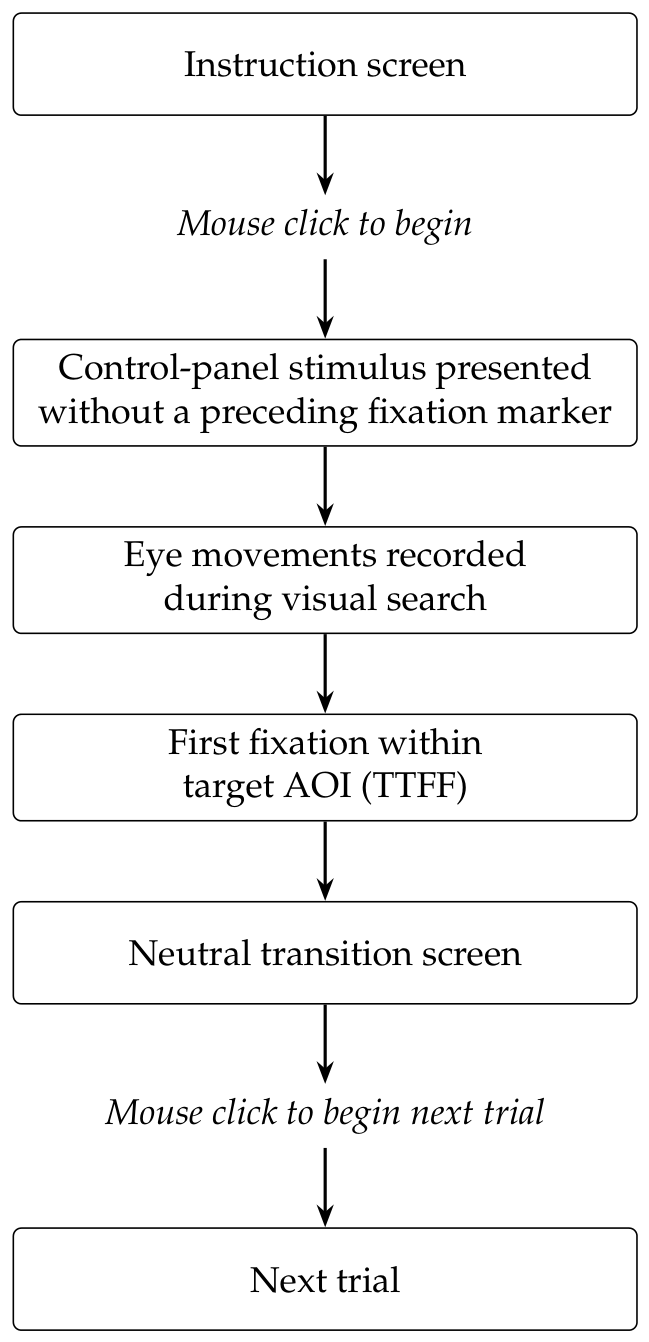
Each trial began with an instruction screen (Figure 2). The participant initiated stimulus presentation with a mouse click. No fixation marker was presented immediately before stimulus onset; therefore, the participant’s initial gaze position was not experimentally controlled. The control panel stimulus was then displayed while eye movements were recorded. Following the participant’s first fixation within the target AOI, the experiment advanced automatically to a neutral transition screen. The participant initiated the next trial from this screen with another mouse click.
Figure 2.
Sequence of events during a single experimental trial. After the participant initiated the trial, the control panel stimulus was presented without a preceding fixation marker while eye movements were recorded. Following the participant’s first fixation within the target Area of Interest (AOI), the experiment advanced automatically to a neutral transition screen, from which the participant initiated the next trial with a mouse click.
The experiment consisted of 20 control panel stimuli representing the four experimental conditions, with five stimuli per condition. Every participant viewed each stimulus once, following the fixed presentation order established before data collection.
Eye movements were recorded continuously throughout the experiment. Time to First Fixation (TTFF) was computed automatically by Tobii Pro Lab as the elapsed time between stimulus onset and the participant’s first fixation within the predefined target AOI. Trials in which no valid first fixation within the AOI was recorded produced a missing TTFF value and were excluded from analyses requiring an observed TTFF, without imputation.
3.6. Eye-Tracking Measures and Data Processing
The primary outcome measure was Time to First Fixation (TTFF), defined as the elapsed time between stimulus onset and the participant’s first fixation within the predefined Area of Interest (AOI). TTFF was computed automatically by Tobii Pro Lab and reported in milliseconds. The first fixation detected within the target AOI also served as the event that advanced the experiment to the neutral transition screen.
Fixations were identified using the default fixation-classification algorithm implemented in Tobii Pro Lab. For each stimulus, a rectangular AOI was manually defined to encompass the target numerical value and its corresponding label. The same AOI-definition criteria were applied across all 20 stimuli to support consistent TTFF measurement.
Data exported from Tobii Pro Lab were inspected before statistical analysis to verify participant identifiers, experimental-condition coding, and TTFF measurements. The analytical dataset was organized in long format, with each row representing a single participant–stimulus observation and containing the participant identifier, Image Set, Target Color Contrast, Target Eccentricity, experimental condition, and TTFF.
Quality-control procedures included screening for duplicate observations, missing TTFF values, negative or otherwise implausible response times, and inconsistencies in experimental-condition coding. The complete design comprised 680 participant–stimulus observations. Six observations contained missing TTFF values, indicating that no valid first fixation within the target AOI had been recorded, and were excluded from analyses requiring an observed TTFF without imputation. This resulted in 674 observations for the primary analysis.
The dataset also contained 16 observations with TTFF equal to 0 ms. All occurred in the Low-Eccentricity conditions: 9 in LC–LE and 7 in HC–LE. No zero-valued TTFF observations occurred in either High-Eccentricity condition. Given that no fixation marker was presented immediately before stimulus onset, this pattern is consistent with participants’ gaze already being located within the target AOI when the stimulus appeared, thereby satisfying the AOI-fixation criterion at the beginning of the trial. However, the analytical dataset did not retain the fixation-event timestamps and gaze coordinates required to verify the precise mechanism retrospectively for each observation. The zero-valued observations were therefore retained as recorded in the primary analysis, and an additional sensitivity analysis was conducted after excluding all 16 observations.
Participant, Image Set, Target Color Contrast, Target Eccentricity, and experimental condition were assigned predefined categorical factor levels before statistical modeling.
Because TTFF distributions are commonly positively skewed and the dataset included TTFF values equal to 0 ms, a secondary outcome was calculated using the transformation for robustness analysis. The transformed values were used only to evaluate the sensitivity of the inferential conclusions to departures from normality. The primary analysis and its estimated marginal means were based on the original TTFF values to preserve interpretation in milliseconds.
3.7. Computational Characterization of the Experimental Factors
To characterize the physical properties associated with the experimental manipulations, all stimuli were analyzed using a custom image-processing pipeline developed in Python 3.14.6 (Python Software Foundation, Wilmington, DE, USA) with the OpenCV 5.0.0 and NumPy 2.5.1 libraries. These analyses were performed independently of the eye-tracking data and were used exclusively to quantify image-based differences between the experimental conditions.
The physical properties of the Target Color Contrast manipulation were characterized by measuring the chromatic difference between the target Area of Interest (AOI) and its surrounding region in the CIE color space using the CIE76 color-difference metric () [26]. Local chromatic and luminance contrast between the target AOI and its surrounding region were also calculated to quantify image-based differences in target distinctiveness. These measurements characterized the physical contrast properties of the implemented red and yellow target conditions but did not quantify differences in hue-associated semantic meaning.
As complementary image-based descriptors, three computational saliency models were applied to every stimulus: the Spectral Residual model proposed by Hou and Zhang [27], the Fine-Grained saliency model proposed by Montabone and Soto [28], and a custom local CIE contrast model developed for this study. For each model, values within the target AOI were compared with those of the remainder of the display to characterize the relative image-based prominence of the target.
Target Eccentricity was characterized geometrically as the Euclidean distance between the center of the target AOI and the center of the stimulus image. Both absolute pixel distance and normalized eccentricity were calculated. Because participants’ initial gaze positions were not experimentally controlled, these measurements represent target eccentricity relative to the display center rather than the target’s retinal eccentricity from each participant’s actual gaze position at stimulus onset.
These computational metrics were used exclusively to characterize and document physical differences between the experimental conditions. They were not included as predictors or dependent variables in the eye-tracking analyses.
3.8. Statistical Analysis
All statistical analyses were performed in R (Version 4.6.0). The primary model and the original robustness analyses were implemented using an analysis pipeline developed before manuscript preparation. Statistical significance was evaluated using a two-sided significance level of , and all confidence intervals were calculated at the 95% level.
The primary analysis consisted of a linear mixed-effects model accounting for the repeated-measures design. Time to First Fixation (TTFF), expressed in milliseconds, was specified as the dependent variable. Target Color Contrast, Target Eccentricity, their interaction, and Image Set were included as fixed effects, and Participant was modeled using a random intercept. The model was estimated using Restricted Maximum Likelihood (REML). Categorical predictors were coded using sum-to-zero contrasts, and the statistical significance of the fixed effects was evaluated using Type III analysis of variance with Satterthwaite approximations for the denominator degrees of freedom. The primary model included 674 observed TTFF values and retained the 16 observations with TTFF equal to 0 ms.
Estimated marginal means (EMMs) were calculated to facilitate interpretation of the factorial effects. Planned comparisons examined the effect of Target Color Contrast within each level of Target Eccentricity and the effect of Target Eccentricity within each level of Target Color Contrast. Multiple comparisons were adjusted using Holm’s sequential correction procedure. Estimated marginal means, pairwise differences, and corresponding 95% confidence intervals were reported.
Model assumptions were evaluated using residual diagnostics, quantile–quantile plots, and assessments of homoscedasticity. Because TTFF values were positively skewed, the complete analysis was repeated using the transformation . The addition of 1 permitted the 16 zero-valued observations to remain in the transformed analysis. This model was used only to evaluate the robustness of the inferential conclusions to the outcome distribution; the primary analysis and its estimated marginal means remained based on untransformed TTFF values to preserve interpretation in milliseconds.
To assess whether the zero-valued observations influenced the findings, an additional sensitivity analysis repeated the primary linear mixed-effects model after excluding all 16 observations with TTFF equal to 0 ms. This model included 658 observations from all 34 participants and retained the same fixed-effects structure, participant random intercept, sum-to-zero contrast coding, REML estimation, Type III omnibus tests, denominator-degree-of-freedom approximation, estimated marginal means, and planned comparisons as the primary model.
Effect sizes for the omnibus tests were reported as approximate partial estimates derived from the corresponding F statistics, with 95% confidence intervals obtained using the noncentral-F method.
Additional robustness analyses comprised a leave-one-participant-out sensitivity analysis and parametric bootstrap confidence intervals based on 2000 simulated datasets generated from the fitted model. Model performance was summarized using marginal and conditional values together with the intraclass correlation coefficient (ICC).
The analyses used established R packages for mixed-effects modeling, estimated marginal means, effect-size estimation, model diagnostics, and data processing, including lme4, lmerTest, emmeans, performance, effectsize, broom.mixed, and writexl.
4. Results
A total of 680 observations were available for analysis. Six observations contained missing Time to First Fixation (TTFF) values because no valid first fixation within the target Area of Interest (AOI) was recorded; these observations were excluded without imputation, yielding 674 observations for the primary analysis. The dataset included 16 observations with TTFF equal to 0 ms, all of which occurred in the Low-Eccentricity conditions. These observations were retained as recorded in the primary and log-transformed analyses. An additional sensitivity analysis excluded all 16 zero-valued observations, resulting in 658 observations from all 34 participants.
The results are presented in four stages. First, computational image analyses characterize the physical properties associated with the Target Color Contrast and Target Eccentricity manipulations. Second, descriptive statistics summarize visual-search performance across the experimental conditions. Third, the primary linear mixed-effects analyses evaluate the effects of Target Color Contrast and Target Eccentricity on Time to First Fixation (TTFF), followed by robustness and sensitivity analyses, including an analysis excluding the zero-valued TTFF observations. Finally, representative eye-tracking visualizations provide qualitative illustrations of participants’ visual-search behavior across the experimental conditions.
4.1. Results of the Computational Characterization
To characterize the physical properties associated with the experimental manipulations, all stimuli were analyzed using computational image analyses (Table 1). Target Color Contrast was quantified by comparing the target Area of Interest (AOI) with its immediate surrounding region using the CIE76 color difference (), together with local luminance and chromatic contrast. Target Eccentricity was quantified as the normalized Euclidean distance between the center of the target AOI and the center of the display.
Table 1.
Computational Metrics of Target Color Contrast and Eccentricity.
The computational image analyses demonstrated that the intended experimental variations produced measurable differences in the corresponding visual properties. The High-Contrast condition exhibited a larger mean CIE76 color difference () than the Low-Contrast condition, whereas the High-Eccentricity condition exhibited a substantially larger normalized eccentricity than the Low-Eccentricity condition.
These findings provide an independent physical characterization of the experimental stimuli and support the interpretation of the subsequent behavioral eye-tracking results.
The complete results of the local chromatic and luminance contrast analyses and the three computational saliency models are provided in the accompanying Zenodo repository.
4.2. Descriptive TTFF Statistics
Table 2 summarizes the observed TTFF distributions across the four experimental conditions. Visual-search performance differed primarily as a function of Target Eccentricity, with substantially longer TTFF values observed under the High-Eccentricity conditions than under the Low-Eccentricity conditions. Within the High-Eccentricity conditions, the High-Contrast displays exhibited shorter TTFF values than the Low-Contrast displays, whereas only small differences were observed between the two Low-Eccentricity conditions.
Table 2.
Descriptive statistics for Time to First Fixation (TTFF) across the four experimental conditions.
Across all experimental conditions, mean TTFF exceeded the corresponding median, particularly under High Eccentricity, indicating positively skewed distributions. Consequently, both mean ± standard deviation and median with interquartile range are reported to summarize the observed data before formal statistical modeling.
4.3. Mixed-Effects Analysis of TTFF
A linear mixed-effects model was fitted to evaluate the effects of Target Color Contrast, Target Eccentricity, their interaction, and Image Set on Time to First Fixation (TTFF), with Participant included as a random intercept. Results of the omnibus tests are presented in Table 3.
Table 3.
Omnibus tests from the linear mixed-effects model for Time to First Fixation (TTFF).
Significant main effects were observed for both Target Color Contrast, , , partial , 95% CI [0.006, 0.053], and Target Eccentricity, , , partial , 95% CI [0.220, 0.329]. Target Eccentricity yielded a larger omnibus effect size than Target Color Contrast; however, the significant interaction reported below indicates that the effect of Target Color Contrast was conditional on Target Eccentricity.
The interaction between Target Color Contrast and Target Eccentricity was also significant, , , partial , 95% CI [0.011, 0.064], indicating that the effect of Target Color Contrast on TTFF depended on Target Eccentricity. Image Set likewise showed a significant effect, , , partial , 95% CI [0.036, 0.111].
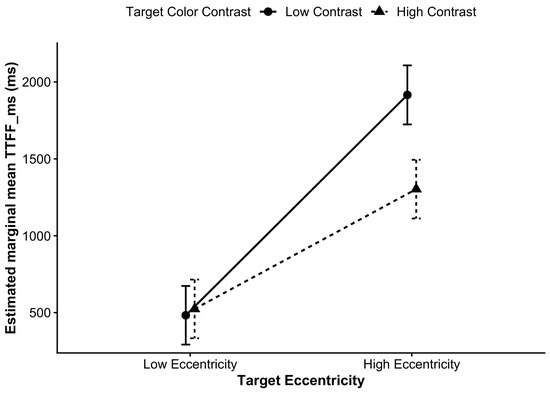
Figure 3 presents the estimated marginal means for the four experimental conditions. Under Low Eccentricity, estimated TTFF was similar for the Low- and High-Contrast conditions. Under High Eccentricity, however, estimated TTFF was substantially lower under High Contrast than under Low Contrast, further illustrating the significant interaction between the two experimental factors.
Figure 3.
Estimated marginal means of Time to First Fixation (TTFF) across the four experimental conditions. Error bars represent 95% confidence intervals.
4.4. Estimated Marginal Means and Planned Comparisons
Estimated marginal means (EMMs) from the linear mixed-effects model are presented in Table 4. The adjusted means closely matched the observed descriptive statistics, with similar TTFF values for the two Low-Eccentricity conditions and substantially higher TTFF values under High Eccentricity. Within the High-Eccentricity conditions, estimated TTFF remained markedly lower under High Contrast than under Low Contrast.
Table 4.
Estimated marginal means for Time to First Fixation (TTFF) across the four experimental conditions.
Planned comparisons quantified the simple effects underlying the interaction. Under Low Eccentricity, TTFF did not differ significantly between the High- and Low-Contrast conditions (estimated mean difference = 41 ms, 95% CI [, 239], ). Under High Eccentricity, however, TTFF was significantly lower under High Contrast than under Low Contrast (estimated mean difference = ms, 95% CI [, ], ).
Increasing Target Eccentricity significantly increased TTFF under both contrast conditions. Relative to the corresponding Low-Eccentricity condition, High Eccentricity increased estimated TTFF by 1433 ms under Low Contrast (95% CI [1234, 1631], ) and by 779 ms under High Contrast (95% CI [581, 977], ). The smaller increase observed under High Contrast is consistent with the significant interaction, indicating that the effect of increased Target Color Contrast became more pronounced as Target Eccentricity increased.
4.5. Participant-Level Distributions
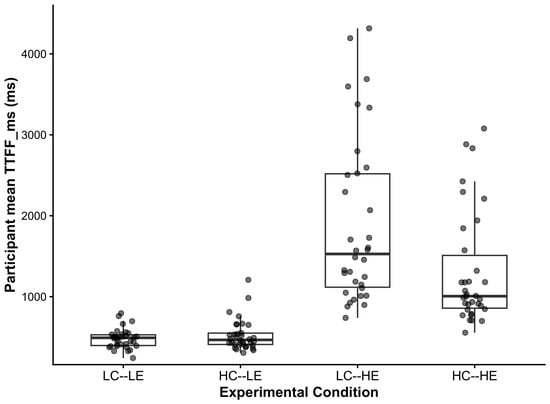
Figure 4 presents the participant-level distributions of Time to First Fixation (TTFF) across the four experimental conditions. The two Low-Eccentricity conditions exhibited similar distributions with relatively low variability, whereas substantially longer TTFF values and greater dispersion were observed under the High-Eccentricity conditions. Positive skew was particularly evident for the Low-Contrast High-Eccentricity condition, consistent with the descriptive statistics reported previously.
Figure 4.
Participant-level distributions of Time to First Fixation (TTFF) across the four experimental conditions. Boxes represent the median and interquartile range, whiskers extend to 1.5 times the interquartile range, and points represent participant-level observations.
4.6. Robustness and Sensitivity Analyses
Several robustness analyses were conducted to evaluate the stability of the primary findings. Repeating the analysis using the transformed outcome, , yielded the same overall pattern of results. The Target Color Contrast × Target Eccentricity interaction remained significant, , , partial , 95% CI [0.002, 0.039].
The primary analysis was also repeated after excluding the 16 observations with TTFF equal to 0 ms. This sensitivity model included 658 observations from all 34 participants and produced the same inferential conclusions as the primary model. Target Color Contrast remained significant, , , partial , 95% CI [0.006, 0.053], as did Target Eccentricity, , , partial , 95% CI [0.207, 0.317]. Critically, the Target Color Contrast × Target Eccentricity interaction remained significant and essentially unchanged in magnitude, , , partial , 95% CI [0.010, 0.064].
The corresponding estimated marginal means were 506 ms for LC–LE, 553 ms for HC–LE, 1916 ms for LC–HE, and 1303 ms for HC–HE. Under Low Eccentricity, the contrast difference remained nonsignificant (estimated mean difference = 47 ms, 95% CI [, 251], ). Under High Eccentricity, High Contrast remained associated with a substantially shorter TTFF than Low Contrast (estimated mean difference = ms, 95% CI [, ], ). Excluding the zero-valued observations therefore did not alter the substantive interpretation of the interaction.
For the primary model, the fixed effects explained 29.4% of the variance (marginal ), whereas the full model, including participant-level random effects, explained 39.4% (conditional ). The Target Color Contrast × Target Eccentricity interaction remained statistically significant in all 34 leave-one-participant-out models. In addition, a 2000-replication parametric bootstrap completed without failed samples and produced confidence intervals consistent with those from the primary mixed-effects analysis.
Collectively, these analyses demonstrated that the principal findings were stable across outcome transformation, exclusion of the zero-valued TTFF observations, leave-one-participant-out analyses, and bootstrap-based statistical inference. In particular, the Target Color Contrast × Target Eccentricity interaction and the reduction in TTFF associated with High Contrast under High Eccentricity remained consistent across analyses. Reproducible code and detailed outputs for these robustness and sensitivity analyses are available in the public data repository identified in the Data Availability Statement.
4.7. Representative Eye-Tracking Patterns
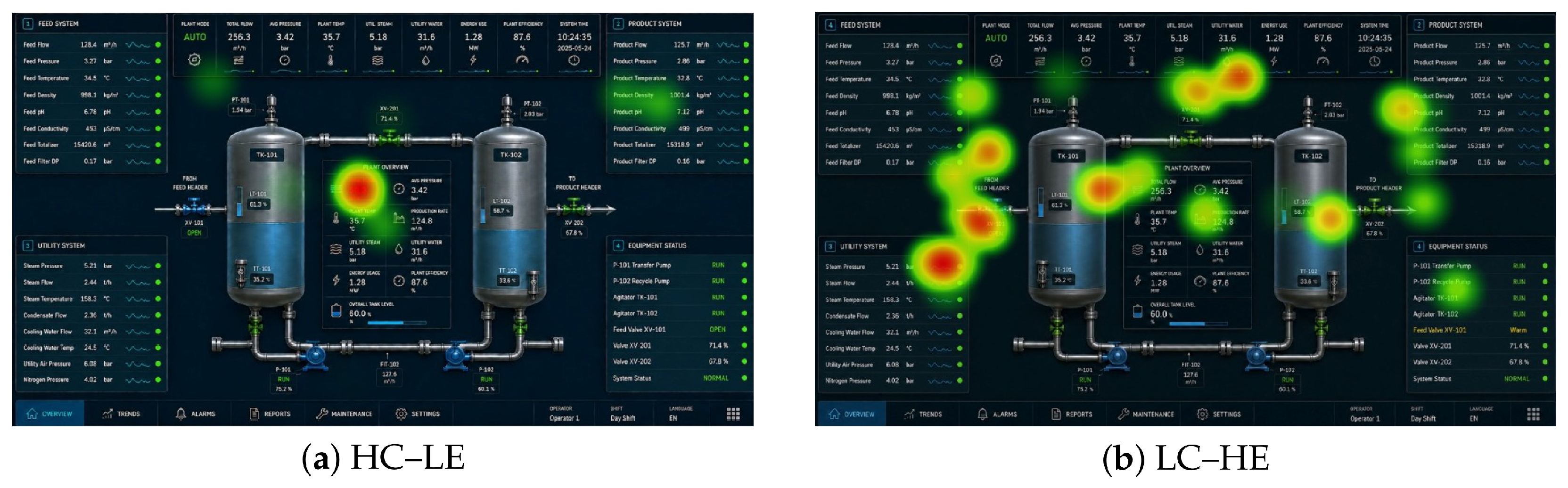
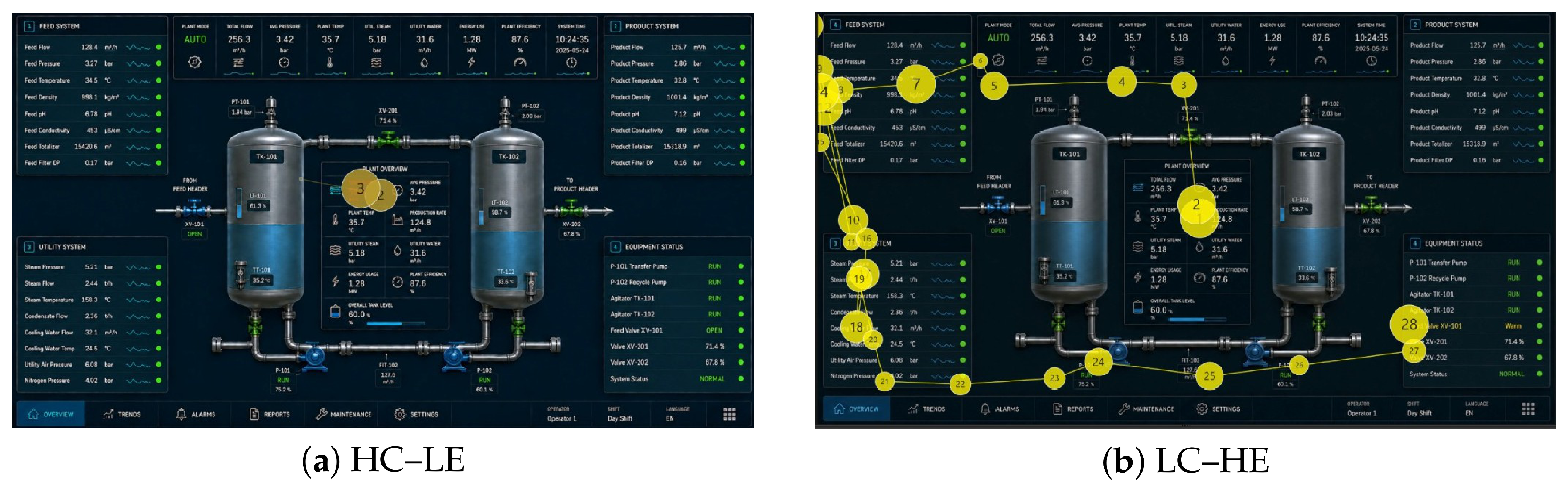
Representative heat maps and scan paths are presented to provide qualitative illustrations of gaze behavior under contrasting experimental conditions. These visualizations are intended solely to complement the quantitative statistical analyses and should not be interpreted as statistical evidence.
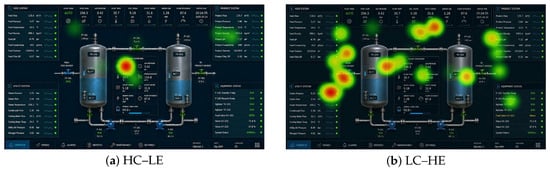
Figure 5 compares representative examples from the HC–LE and LC–HE conditions. The HC–LE example shows gaze activity concentrated around the target AOI, whereas the LC–HE example exhibits a broader spatial distribution of gaze before the first fixation reached the target AOI.
Figure 5.
Representative Tobii heat maps from two contrasting experimental conditions. Colors indicate relative gaze concentration, progressing from green (lower concentration) through yellow to red (higher concentration). The HC–LE example illustrates concentrated gaze activity around the target AOI, whereas the LC–HE example illustrates a broader spatial distribution of gaze prior to the first fixation within the target AOI.
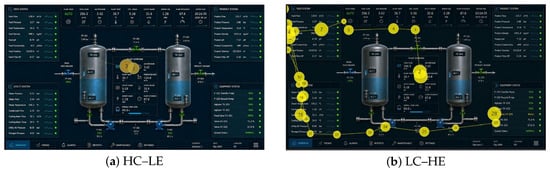
Figure 6 presents the corresponding representative scan paths. The HC–LE example shows a comparatively direct sequence of fixations toward the target AOI, whereas the LC–HE example shows a longer and more spatially dispersed sequence before the first fixation reached the target AOI.
Figure 6.
Representative Tobii scan paths from two contrasting experimental conditions. The numbered circles indicate fixations in chronological order, the connecting lines indicate the sequence between fixations, and circle size represents fixation duration. The HC–LE example illustrates a comparatively direct fixation sequence toward the target AOI, whereas the LC–HE example illustrates a longer and more spatially dispersed sequence before the first fixation reached the target AOI.
Although these examples are illustrative rather than inferential, the observed gaze patterns are qualitatively consistent with the quantitative findings. In particular, they visually reflect the longer TTFF observed under High Eccentricity and the greater effect of increased Target Color Contrast when targets were located in high-eccentricity regions of the display.
5. Discussion
5.1. Target Color Contrast and Target Eccentricity
The present findings indicate that Target Color Contrast and Target Eccentricity were both associated with Time to First Fixation (TTFF), although their effects cannot be interpreted independently. Target Eccentricity produced the larger omnibus effect under the conditions examined, with substantially longer TTFF values for targets positioned farther from the center of the display. Target Color Contrast also showed a significant omnibus effect; critically, however, its association with TTFF depended on Target Eccentricity. High Contrast was associated with a substantially shorter TTFF under High Eccentricity, whereas no corresponding reduction was observed under Low Eccentricity.
This conditional pattern qualifies the support for the hypothesis that High Contrast would generally reduce TTFF. Under Low Eccentricity, the estimated TTFF was slightly longer for High Contrast than for Low Contrast (524 vs. 483 ms). However, the estimated difference was small relative to its uncertainty and was not statistically significant (estimated mean difference = 41 ms, 95% CI [, 239], ). The direction of this nonsignificant difference should therefore not be interpreted as evidence that High Contrast impaired visual search under Low Eccentricity. Instead, the results indicate that the study did not detect a reliable effect of the implemented target-color manipulation when targets were located near the center of the display. In contrast, under High Eccentricity, High Contrast was associated with a 613-ms reduction in TTFF relative to Low Contrast.
The substantially shorter TTFF observed for Low-Eccentricity targets supports the importance of spatial target location for rapid visual acquisition in the present task. Nevertheless, because initial gaze position was not experimentally controlled, the magnitude of this difference may reflect both target position relative to the display center and participants’ gaze position at stimulus onset. Accordingly, the eccentricity effect should be interpreted as an effect of the implemented central-versus-peripheral target-location manipulation rather than as an uncontaminated estimate of retinal eccentricity alone.
Overall, these findings suggest that spatial placement and target-color properties jointly shape the time required for gaze to reach task-relevant information. Under the controlled conditions examined here, changing the target from the Low-Contrast yellow condition to the High-Contrast red condition was associated with shorter TTFF primarily when the target was positioned in a high-eccentricity region. The findings therefore concern visual-search behavior, as measured by TTFF, and do not by themselves establish corresponding improvements in broader operator or control-system performance.
5.2. Interaction Between Target Color Contrast and Target Eccentricity
The principal contribution of this study lies in the interaction between Target Color Contrast and Target Eccentricity. The implemented target-color manipulation did not produce a uniform change in TTFF across target locations. Under Low Eccentricity, TTFF did not differ significantly between the High- and Low-Contrast conditions. Under High Eccentricity, however, the High-Contrast condition was associated with a substantial reduction in TTFF. Thus, the association between target-color properties and visual acquisition depended on the spatial context in which the target appeared.
This interaction extends the interpretation of the two experimental factors beyond separate main effects. If the manipulated aspects of Salience and Effort operated independently and additively in this task, the difference between the High- and Low-Contrast conditions would be expected to remain comparatively similar across eccentricity levels. Instead, the observed contrast difference changed substantially as a function of Target Eccentricity. The findings therefore provide evidence that these specific visual and spatial determinants of attention were jointly associated with target acquisition: the influence of the target-color manipulation was greater when the target was positioned farther from the center of the display.
Within the SEEV framework, the result is consistent with the proposition that attentional allocation reflects the combined influence of multiple determinants rather than the isolated contribution of a single factor [4,22,23]. The present study provides a controlled, context-specific empirical extension of this proposition by demonstrating a statistical interaction between experimental operationalizations of aspects of Salience and Effort. It does not constitute a test of the complete SEEV framework, because Target Color Contrast and Target Eccentricity capture only particular aspects of Salience and Effort, while Expectancy and Value were not experimentally manipulated.
From an interface-design perspective, the interaction suggests that spatial placement and visual enhancement should be considered jointly rather than as independent or interchangeable design decisions. The results support treating layout optimization as an initial design priority and considering selective increases in target prominence when important information must be placed farther from the center of the display. However, this hierarchical approach is a design implication derived from the observed TTFF pattern; its effectiveness as an operational design strategy was not directly tested in the present study.
In practical terms, selective visual enhancement may be most relevant for critical indicators, warning information, or status variables that must remain in peripheral display regions because of functional grouping, spatial constraints, or an established interface architecture. However, the present findings do not imply that all peripheral information should be made more visually prominent. Indiscriminate enhancement could reduce the differentiation between high- and low-priority information and introduce competing visual signals. Decisions about visual prominence should therefore consider task relevance, urgency, display context, and applicable domain conventions. Given the controlled visual-search task and the combined contrast, hue, and semantic differences between the red and yellow conditions, these recommendations should be treated as provisional design implications rather than prescriptive operational guidelines.
5.3. Relationship to Previous Literature
The present findings are broadly consistent with established accounts of visual attention while adding evidence about the conditions under which target-related visual properties are associated with faster visual acquisition. Feature Integration Theory proposes that distinctive visual features can facilitate attentional selection during visual search [12], and Guided Search Theory describes how bottom-up stimulus properties and top-down guidance jointly influence attentional priority [13,14]. Computational accounts similarly represent visual conspicuity as dependent on feature contrast relative to the surrounding context [19]. The present results are consistent with these accounts because the implemented target-color manipulation was associated with shorter TTFF; however, this association emerged primarily when targets were positioned farther from the center of the display.
This conditional pattern is important because it shows that changing target-color properties did not produce a uniform reduction in TTFF. The findings therefore extend beyond a general demonstration that visually distinctive targets can be acquired more rapidly. They indicate that the magnitude of this association depended on a spatial characteristic of the display, suggesting that conclusions about visual prominence should account for target location and the broader search context. Nevertheless, the present experiment was not designed to discriminate among Feature Integration Theory, Guided Search Theory, or computational saliency accounts, and the results should not be interpreted as uniquely validating any one of these theoretical perspectives.
The findings also complement prior research based on the SEEV framework, in which Salience, Effort, Expectancy, and Value are treated as complementary determinants of attentional allocation in applied visual environments [4,23]. Previous research has shown that the noticeability of visually salient information can depend on task demands and display context, such that salience alone does not guarantee attention capture [22]. The present study adds controlled eye-tracking evidence that experimental operationalizations of specific aspects of Salience and Effort can exhibit an interactive rather than merely additive association with target acquisition. This contribution is necessarily context-specific: it was observed in a static visual-search task using simulated control panel displays, while Expectancy and Value were not experimentally manipulated.
5.4. Limitations
The present findings should be interpreted in light of several limitations.
- The experiment employed static simulated control panel displays under controlled laboratory conditions and examined a single visual-search task without imposed time pressure. Operational control environments commonly involve dynamic displays, changing system states, multiple concurrent tasks, time pressure, and varying workload. The present findings therefore concern target acquisition during controlled visual search and should not be interpreted as direct evidence of improved operator performance, situation awareness, decision making, or control-system performance in operational settings.
- The participant sample consisted of young university students rather than experienced control-room operators. This sample was suitable for examining visual-search behavior under controlled conditions, but experienced operators may employ different search strategies because of domain knowledge, learned display expectations, and operational priorities. Replication with experienced operators is therefore necessary before extending the findings to safety-critical work settings.
- The Target Color Contrast manipulation used bright red in the High-Contrast condition and industrial yellow in the Low-Contrast condition. Although the computational analyses documented differences in the physical contrast properties of these conditions, changing between red and yellow also changed hue and may have introduced differences in conventional semantic meaning. In industrial displays, red and yellow can communicate different levels or types of urgency. Consequently, the observed differences cannot be attributed exclusively to physical color contrast. Future studies should manipulate contrast while holding hue and semantic meaning constant or independently vary these properties.
- Target Color Contrast and Target Eccentricity represented experimental operationalizations of specific aspects of the broader Salience and Effort components of SEEV. Salience can depend on multiple visual and contextual properties, while search effort can be influenced by factors other than spatial target location. Moreover, Expectancy and Value were neither experimentally manipulated nor independently measured. The findings therefore do not constitute a test of the complete SEEV framework and should be interpreted as applying to the specific visual and spatial manipulations examined under the present task conditions.
- Participants’ gaze position at stimulus onset was not controlled using a fixation marker. Because Low-Eccentricity targets were positioned near the center of the display, part of their shorter TTFF may reflect participants beginning some trials near or within the target AOI rather than the effect of target location alone. Consistent with this possibility, all 16 observations with TTFF equal to 0 ms occurred in the Low-Eccentricity conditions. The available analytical dataset did not retain the event-level timestamps and gaze coordinates required to verify the precise origin of each zero-valued observation. Nevertheless, excluding all 16 observations in a sensitivity analysis did not alter the statistical significance, effect-size magnitude, or substantive interpretation of the Target Color Contrast × Target Eccentricity interaction. Future studies should present a controlled fixation marker before each stimulus and retain event-level eye-tracking data.
- Each experimental condition was represented by five stimuli constructed from a common control panel design. Including Image Set in the statistical model accounted for systematic mean differences among the five sets used in the experiment, but the limited number and variety of stimuli constrain generalization to other layouts, target configurations, and interface designs. The selection of five stimuli per condition provided repeated observations within each experimental cell but should not be interpreted as establishing broad stimulus-level generalizability. Replication with a larger and more diverse sample of displays is needed.
- TTFF was selected as the primary outcome because it measured the time required for gaze to reach the target AOI. However, TTFF captures only the initial stage of visual search and does not measure target comprehension, decision accuracy, manual response time, workload, or subsequent visual processing. The heat maps and scan paths presented in this study were illustrative rather than inferential and did not quantify the number or duration of fixations preceding target acquisition. Future research should supplement TTFF with measures such as fixation count before target acquisition, fixation duration, dwell time, scan-path characteristics, response time, task accuracy, and subjective workload.
- Although stimulus order was randomized before data collection, the same fixed sequence was used for all participants; therefore, stimulus-specific effects cannot be fully separated from potential order or carryover effects.
5.5. Future Work
Future research should examine whether the Target Color Contrast × Target Eccentricity interaction generalizes to more realistic supervisory-control environments. Such studies should include dynamic displays, evolving system states, competing tasks, time pressure, and participants with operational experience. Using a larger and more diverse sample of interface layouts and target configurations would also permit stronger conclusions about stimulus-level generalizability. Complementary outcomes—including fixation count before target acquisition, dwell time, response time, accuracy, situation awareness, and workload—should be incorporated to determine whether the observed TTFF pattern extends to broader dimensions of operator performance.
Subsequent experiments should provide a controlled fixation marker before each stimulus and retain event-level gaze coordinates and fixation timestamps. These changes would make it possible to distinguish trials in which gaze begins within the target AOI from trials involving subsequent target acquisition and would provide a cleaner estimate of the effect of target location. Future studies should also separate physical contrast from hue and semantic meaning, for example by manipulating contrast within a constant hue or by independently varying contrast and color category.
Further extensions should examine Target Color Contrast and Target Eccentricity alongside experimentally manipulated Expectancy and Value. This would permit a more comprehensive test of how the four SEEV components jointly influence attentional allocation and would clarify whether the interaction observed here persists when target probability and operational importance vary.
Finally, the hierarchical design approach suggested by the present results should be evaluated directly rather than assumed to follow automatically from the observed TTFF pattern. Controlled comparisons could test whether first optimizing the spatial placement of critical information and then selectively increasing its visual prominence improves visual-search performance, situation awareness, and decision making relative to alternative design strategies. Such evidence would be needed before treating this hierarchical approach as a validated guideline for operational interface design.
6. Conclusions
This study examined how Target Color Contrast and Target Eccentricity were associated with visual target acquisition in simulated control panel displays. Target Eccentricity produced the larger omnibus effect on Time to First Fixation (TTFF), with targets positioned farther from the center of the display requiring substantially more time to acquire. However, the significant interaction showed that the association between Target Color Contrast and TTFF was conditional on target location. The High-Contrast condition was associated with substantially shorter TTFF under High Eccentricity, whereas no reliable contrast difference was detected under Low Eccentricity. This pattern remained stable after excluding the 16 observations with TTFF equal to 0 ms.
The findings provide controlled, context-specific evidence that experimental operationalizations of aspects of Salience and Effort can exhibit an interactive rather than merely additive association with visual attention. Accordingly, spatial placement and visual prominence should not be treated as independent or interchangeable interface properties. Within the conditions examined, central target placement was associated with shorter TTFF, while the High-Contrast red condition was associated with faster target acquisition when targets were located farther from the center of the display. Because the contrast conditions also differed in hue and potential semantic meaning, this latter association cannot be attributed exclusively to physical color contrast.
From a design perspective, the observed interaction suggests a potential hierarchical approach in which the spatial arrangement of critical information is considered first and visual prominence is then selectively increased when central placement is impractical. This approach represents a design implication derived from the present visual-search findings rather than a directly validated operational strategy. Further research using dynamic tasks, diverse interface layouts, controlled initial fixation, experienced operators, and broader performance measures is required before translating this implication into general guidance for control and monitoring systems.
Author Contributions
Conceptualization, N.L. and S.K.; methodology, N.L.; software, N.L.; validation, N.L. and S.K.; formal analysis, N.L.; investigation, N.L.; resources, N.L.; data curation, N.L.; writing—original draft preparation, N.L.; writing—review and editing, N.L. and S.K.; visualization, N.L.; supervision, N.L.; project administration, N.L. All authors have read and agreed to the published version of the manuscript.
Funding
This research received no external funding.
Institutional Review Board Statement
Ethical review and approval were waived for this study because the experiment involved minimal risk, anonymous eye-tracking data collection, and no clinical, medical, or sensitive personal information.
Informed Consent Statement
Informed consent was obtained from all subjects involved in the study.
Data Availability Statement
The data, experimental materials, analysis code, and results supporting this study are openly available in Zenodo at https://doi.org/10.5281/zenodo.22946443.
Acknowledgments
During the preparation of this study and manuscript, the authors used ChatGPT 5.5 (OpenAI) to generate the experimental control panel images and to assist with language and grammar review in selected sections of the manuscript. All AI-generated images and textual suggestions were reviewed and approved by the authors. The authors take full responsibility for the experimental stimuli and for the content of the manuscript.
Conflicts of Interest
The authors declare no conflicts of interest.
References
- Burch, M.; Kuriger, A.; Pehar, F.; Bekavac, B. Flights and Airports—A Visual Analytics Perspective. In Proceedings of the 2025 MIPRO 48th ICT and Electronics Convention, Opatija, Croatia, 2–6 June 2025; pp. 1558–1563. [Google Scholar] [CrossRef] [Scilit]
- Endsley, M.R. Toward a Theory of Situation Awareness in Dynamic Systems. Hum. Factors J. Hum. Factors Ergon. Soc. 1995, 37, 32–64. [Google Scholar] [CrossRef] [Scilit]
- Wickens, C.D.; McCarley, J.S.; Gutzwiller, R.S. Applied Attention Theory; CRC Press: Boca Raton, FL, USA, 2022. [Google Scholar]
- Wickens, C.D. Noticing Events in the Visual Workplace: The SEEV and NSEEV Models. In The Cambridge Handbook of Applied Perception Research, 1st ed.; Hoffman, R.R., Hancock, P.A., Scerbo, M.W., Parasuraman, R., Szalma, J.L., Eds.; Cambridge University Press: Cambridge, UK, 2015; pp. 749–768. [Google Scholar] [CrossRef] [Scilit]
- Wickens, C.D. Situation Awareness and Workload in Aviation. Curr. Dir. Psychol. Sci. 2002, 11, 128–133. [Google Scholar] [CrossRef] [Scilit]
- Warm, J.S.; Parasuraman, R.; Matthews, G. Vigilance Requires Hard Mental Work and Is Stressful. Hum. Factors J. Hum. Factors Ergon. Soc. 2008, 50, 433–441. [Google Scholar] [CrossRef] [Scilit] [PubMed]
- Veloz, J.L.; Alcívar-Cedeño, A.; Cedeño-Zambrano, T.M.; Zamora-Plaza, D.M.; Fernández-Arias, P.; Vergara, D.; Del Bosque, A. The Design and Assessment of a Virtual Reality System for Driver Psychomotor Evaluation. Eng 2025, 6, 301. [Google Scholar] [CrossRef] [Scilit]
- Paulino, D.; Netto, A.T.; Brito, W.A.T.; Paredes, H. WebTraceSense—A Framework for the Visualization of User Log Interactions. Eng 2024, 5, 2206–2222. [Google Scholar] [CrossRef] [Scilit]
- Wolf, M.M.; Schmidt, H.; Christl, M.; Fank, J.; Diermeyer, F. A User-Centered Teleoperation GUI for Automated Vehicles: Identifying and Evaluating Information Requirements for Remote Driving and Assistance. Multimodal Technol. Interact. 2025, 9, 78. [Google Scholar] [CrossRef] [Scilit]
- Posner, M.I. Orienting of Attention. Q. J. Exp. Psychol. 1980, 32, 3–25. [Google Scholar] [CrossRef] [Scilit] [PubMed]
- Posner, M.I.; Petersen, S.E. The Attention System of the Human Brain. Annu. Rev. Neurosci. 1990, 13, 25–42. [Google Scholar] [CrossRef] [PubMed]
- Treisman, A.; Gelade, G. A Feature-Integration Theory of Attention. Cogn. Psychol. 1980, 12, 97–136. [Google Scholar] [CrossRef] [Scilit] [PubMed]
- Wolfe, J.M. Guided Search 2.0 A revised model of visual search. Psychon. Bull. Rev. 1994, 1, 202–238. [Google Scholar] [CrossRef] [Scilit] [PubMed]
- Wolfe, J.M.; Horowitz, T.S. Five factors that guide attention in visual search. Nat. Hum. Behav. 2017, 1, 58. [Google Scholar] [CrossRef] [Scilit] [PubMed]
- Egeth, H.E.; Yantis, S. VISUAL ATTENTION: Control, Representation, and Time Course. Annu. Rev. Psychol. 1997, 48, 269–297. [Google Scholar] [CrossRef] [Scilit] [PubMed]
- Corbetta, M.; Shulman, G.L. Control of goal-directed and stimulus-driven attention in the brain. Nat. Rev. Neurosci. 2002, 3, 201–215. [Google Scholar] [CrossRef] [Scilit] [PubMed]
- Du, X.; Wu, J.; Tang, X.; Lv, X.; Jia, L.; Xue, C. Predicting User Attention States from Multimodal Eye–Hand Data in VR Selection Tasks. Electronics 2025, 14. [Google Scholar] [CrossRef] [Scilit]
- Itti, L.; Koch, C.; Niebur, E. A model of saliency-based visual attention for rapid scene analysis. IEEE Trans. Pattern Anal. Mach. Intell. 1998, 20, 1254–1259. [Google Scholar] [CrossRef] [Scilit]
- Itti, L.; Koch, C. Computational modelling of visual attention. Nat. Rev. Neurosci. 2001, 2, 194–203. [Google Scholar] [CrossRef] [Scilit] [PubMed]
- Yantis, S.; Jonides, J. Abrupt visual onsets and selective attention: Evidence from visual search. J. Exp. Psychol. Hum. Percept. Perform. 1984, 10, 601–621. [Google Scholar] [CrossRef] [PubMed]
- Horrey, W.J.; Wickens, C.D.; Consalus, K.P. Modeling drivers’ visual attention allocation while interacting with in-vehicle technologies. J. Exp. Psychol. Appl. 2006, 12, 67–78. [Google Scholar] [CrossRef] [Scilit] [PubMed]
- Steelman, K.S.; McCarley, J.S.; Wickens, C.D. Modeling the Control of Attention in Visual Workspaces. Hum. Factors J. Hum. Factors Ergon. Soc. 2011, 53, 142–153. [Google Scholar] [CrossRef] [Scilit] [PubMed]
- Steelman, K.S.; McCarley, J.S.; Wickens, C.D. Theory-based Models of Attention in Visual Workspaces. Int. J.–Hum.–Comput. Interact. 2017, 33, 35–43. [Google Scholar] [CrossRef] [Scilit]
- Green, P. Applying the SEEV Model to Assess Where People Will Look: Practical Considerations. Proc. Hum. Factors Ergon. Soc. Annu. Meet. 2024, 68, 566–571. [Google Scholar] [CrossRef] [Scilit]
- Minas, D.; Tews, L.; Fotopoulos, A.; Xenos, M.; Calvo-Córdoba, A.; Rivas-Vidal, M. Eye-Tracking Technologies for Facilitating Multimodal Interaction in Aviation Environments. In Proceedings of the 14th EASN International Conference on “Innovation in Aviation & Space Towards Sustainability Today & Tomorrow”, Thessaloniki, Greece, 8–11 October 2024; p. 110. [Google Scholar] [CrossRef] [Scilit]
- McLAREN, K. XIII—The Development of the CIE 1976 (L* a* b*) Uniform Colour Space and Colour-difference Formula. J. Soc. Dye. Colour. 1976, 92, 338–341. [Google Scholar] [CrossRef] [Scilit]
- Hou, X.; Zhang, L. Saliency Detection: A Spectral Residual Approach. In Proceedings of the 2007 IEEE Conference on Computer Vision and Pattern Recognition, Minneapolis, MN, USA, 17–22 June 2007; pp. 1–8. [Google Scholar] [CrossRef] [Scilit]
- Montabone, S.; Soto, A. Human Detection Using a Mobile Platform and Novel Features Derived from a Visual Saliency Mechanism. Image Vis. Comput. 2010, 28, 391–402. [Google Scholar] [CrossRef] [Scilit]

Disclaimer/Publisher’s Note: The statements, opinions and data contained in all publications are solely those of the individual author(s) and contributor(s) and not of MDPI and/or the editor(s). MDPI and/or the editor(s) disclaim responsibility for any injury to people or property resulting from any ideas, methods, instructions or products referred to in the content. |
© 2026 by the authors. Licensee MDPI, Basel, Switzerland. This article is an open access article distributed under the terms and conditions of the Creative Commons Attribution (CC BY) license.