
This is an early access version, the complete PDF, HTML, and XML versions will be available soon.
Article

Damage Plasticity Modeling of a Concrete Block Masonry Material

by
Henok Hailemariam
1,2,* and
Frank Wuttke
3
1
Formerly of Geomechanics and Geotechnics, Kiel University, Ludewig-Meyn-Straße 10, 24118 Kiel, Germany
2
GeoAnalysis-Engineering GmbH, Schauenburger Straße 116, 24118 Kiel, Germany
3
Geomechanics and Geotechnics, Kiel University, Ludewig-Meyn-Straße 10, 24118 Kiel, Germany
*
Author to whom correspondence should be addressed.
CivilEng 2026, 7(4), 68; https://doi.org/10.3390/civileng7040068

Submission received: 1 August 2026 / Revised: 7 September 2026 / Accepted: 30 September 2026 / Published: 8 October 2026
(This article belongs to the Section Construction and Material Engineering)

Abstract

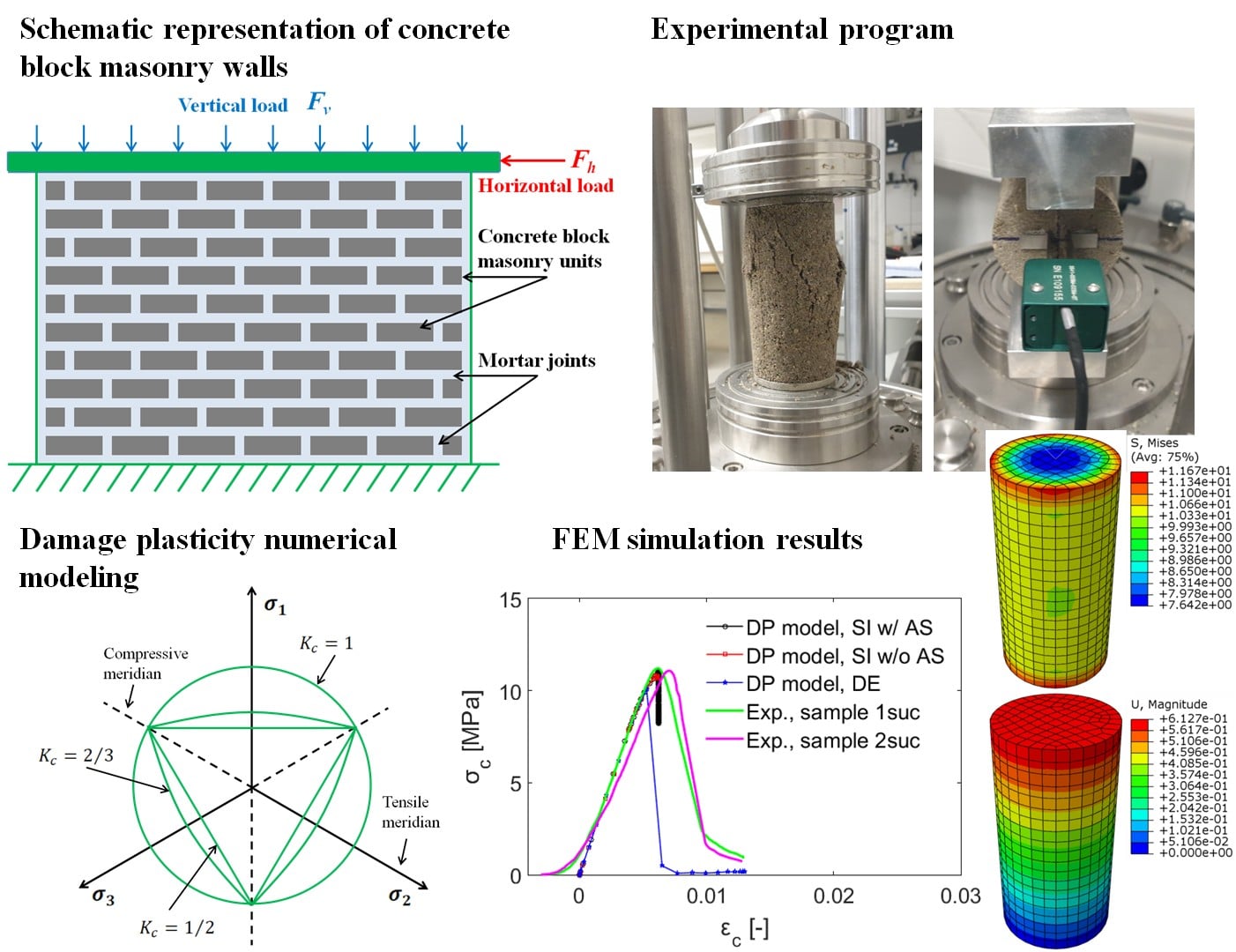
Masonry walls constructed of brick or block units have tended to suffer more serious damage when subjected to loads of both static and cyclic (such as an earthquake) nature as compared to other concrete or steel structures. Hence, the static and cyclic loading behavior of these masonry building units should be carefully investigated prior to the design and construction of the structures. In this study, a damage plasticity (DP) model for the static and cyclic loading analysis of a concrete block masonry material is proposed by modifying the stress-strain regime of the widely used Concrete Damage Plasticity (CDP) model to be suitable for concrete block masonry units/materials. The various parameters of the DP model, which is based on the theory of continuum damage mechanics and plasticity, are calibrated using detailed experimental data obtained by testing a concrete block masonry material (CBMM) (including results from static or monotonic uniaxial compressive loading tests). The CBMM used is a laboratory lightweight concrete mixture aimed at approximating the behavior and properties of actual field concrete masonry units or materials. Results of model prediction/numerical simulation of static and cyclic loading on cylindrical samples of concrete masonry material performed using the DP model, implemented in the finite element software ABAQUS, are presented. The DP model is validated by comparing the model prediction output against experimental results of cyclic uniaxial compression tests performed on the selected concrete block masonry material with satisfactory findings.
Keywords: damage plasticity; concrete block masonry material; static loading; cyclic loading; compression; tension; modeling damage plasticity; concrete block masonry material; static loading; cyclic loading; compression; tension; modeling
Graphical Abstract