


Abstract
Background/Objectives: Patients aged ≥65 years undergoing colorectal cancer surgery are at increased risk of postoperative complications and mortality due to advanced age, comorbidity burden, frailty, and reduced physiological reserve. The aim of this study was to evaluate perioperative predictors associated with early in-hospital mortality in patients aged ≥65 years undergoing colorectal cancer surgery. Methods: This single-center retrospective cohort study included 438 patients aged ≥65 years who underwent colorectal cancer surgery at a tertiary referral center between January 2017 and December 2018. Demographic characteristics, comorbidities, American Society of Anesthesiologists (ASA) classification, surgical urgency, perioperative laboratory parameters, and transfusion requirements were analyzed. The primary endpoint was early in-hospital mortality. Survival analysis was performed using Kaplan–Meier curves and Cox proportional hazards regression analysis. Results: The overall in-hospital mortality rate was 9.4% (41/438). Emergency surgery was associated with significantly reduced in-hospital survival compared with elective procedures (log-rank p < 0.001). Non-survivors more frequently presented with emergency surgical indications, higher ASA scores, greater comorbidity burden, anemia, nutritional impairment, elevated inflammatory markers, renal dysfunction, and increased transfusion requirements. In univariate Cox regression analysis, emergency surgery, ASA score ≥ 3, elevated creatinine, leukocyte count, and C-reactive protein levels, lower hemoglobin, albumin and total protein levels, and red blood cell transfusion were significantly associated with mortality. In multivariate analysis, elevated creatinine (HR 1.004, p = 0.030), leukocyte count (HR 1.064, p = 0.004), C-reactive protein (HR 1.009, p < 0.001), and lower hemoglobin concentration (HR 0.938, p < 0.001) remained independent predictors of in-hospital mortality. Conclusions: Early in-hospital mortality after colorectal cancer surgery in patients aged ≥65 years is associated with systemic inflammation, anemia, and renal dysfunction. Routinely available clinical and laboratory parameters may assist in identifying high-risk patients and improving perioperative risk assessment and postoperative management.
1. Introduction
Colorectal cancer (CRC) is one of the leading causes of cancer-related morbidity and mortality worldwide, with incidence strongly increasing with advancing age [1,2,3,4,5]. Due to population ageing and improved cancer detection, the number of patients aged ≥65 years requiring surgical treatment for CRC continues to rise [1,2,3].
Surgical resection remains the cornerstone of curative treatment for nonmetastatic colorectal cancer and is performed in the majority of patients with localized disease [3,5]. However, patients aged ≥65 years frequently present with multiple comorbidities, reduced physiological reserve, frailty, nutritional impairment, and more advanced disease, all of which may increase the risk of postoperative complications and mortality [4,5,6,7,8,9,10,11].
Despite advances in surgical techniques, perioperative care, and anesthesiological management, early postoperative mortality after colorectal cancer surgery remains a significant clinical challenge, particularly among older patients with limited physiological reserve and those requiring urgent surgical intervention [12,13,14,15]. Previous studies have identified several factors associated with adverse outcomes, including emergency surgery, high American Society of Anesthesiologists (ASA) score, anemia, nutritional impairment, systemic inflammation, and impaired organ function [9,12,14,15,16,17,18].
Emergency colorectal cancer surgery is particularly associated with unfavorable outcomes due to acute complications such as bowel obstruction, perforation, bleeding, and sepsis, which are more frequently encountered in patients aged ≥65 years [12,17,18,19]. In addition, routinely available perioperative laboratory parameters, including hemoglobin, albumin, inflammatory biomarkers, and renal function markers, may provide important prognostic information regarding postoperative survival [20,21,22,23,24,25].
Although numerous studies have evaluated individual predictors of postoperative outcomes following colorectal cancer surgery, the relative contribution of routinely available clinical and laboratory parameters to early in-hospital mortality in patients aged ≥65 years remains incompletely characterized, particularly in high-risk populations undergoing urgent surgical treatment. Furthermore, early in-hospital mortality represents a clinically relevant outcome because it reflects the combined influence of preoperative condition, surgical stress, and early postoperative deterioration.
The novelty of this study lies in the evaluation of early in-hospital mortality after colorectal cancer surgery in patients aged ≥65 years using routinely available perioperative clinical and laboratory parameters. By focusing on short-term surgical outcomes rather than long-term oncological survival, this study aims to identify practical risk factors that may support perioperative risk stratification and individualized management of high-risk patients.
We hypothesized that perioperative inflammatory, hematological, and biochemical parameters, together with clinical characteristics such as surgical urgency and comorbidity burden, are associated with early in-hospital mortality in patients aged ≥65 years undergoing colorectal cancer surgery.
Therefore, the aim of this study was to evaluate perioperative predictors associated with early in-hospital mortality after colorectal cancer surgery in patients aged ≥65 years. Identification of routinely available risk factors may contribute to improved perioperative risk stratification, optimization of high-risk patients, and individualized postoperative management.
2. Materials and Methods
This single-center retrospective cohort study included patients aged ≥65 years who underwent colorectal surgery for histologically confirmed colorectal adenocarcinoma at the Clinic for Digestive Surgery, University Clinical Center Nis, Serbia, between January 2017 and December 2018. The age threshold of ≥65 years was selected according to commonly used definitions of older adults in surgical and oncological research. Although chronological age alone does not fully reflect biological aging, this cutoff allows identification of a population with increased prevalence of comorbidities, reduced physiological reserve, and higher vulnerability to perioperative complications. Patients with colon and rectal cancer were analyzed together because the primary aim of the study was to identify perioperative predictors of early in-hospital mortality after colorectal cancer surgery rather than to assess tumor-specific oncological outcomes or long-term survival. The selected study period enabled analysis of a clearly defined cohort with complete perioperative clinical data, laboratory parameters, surgical characteristics, and in-hospital outcome information available from institutional medical records. This period was selected because it represented a consistent interval with complete and standardized institutional records, allowing reliable retrospective assessment of perioperative variables and early in-hospital outcomes. The study was conducted at a single tertiary referral center and approved by the institutional Ethics Committee (Decision No. 14546/1, 11 May 2026) in accordance with the Declaration of Helsinki.
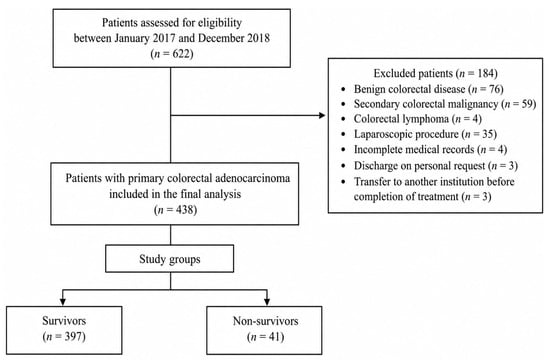
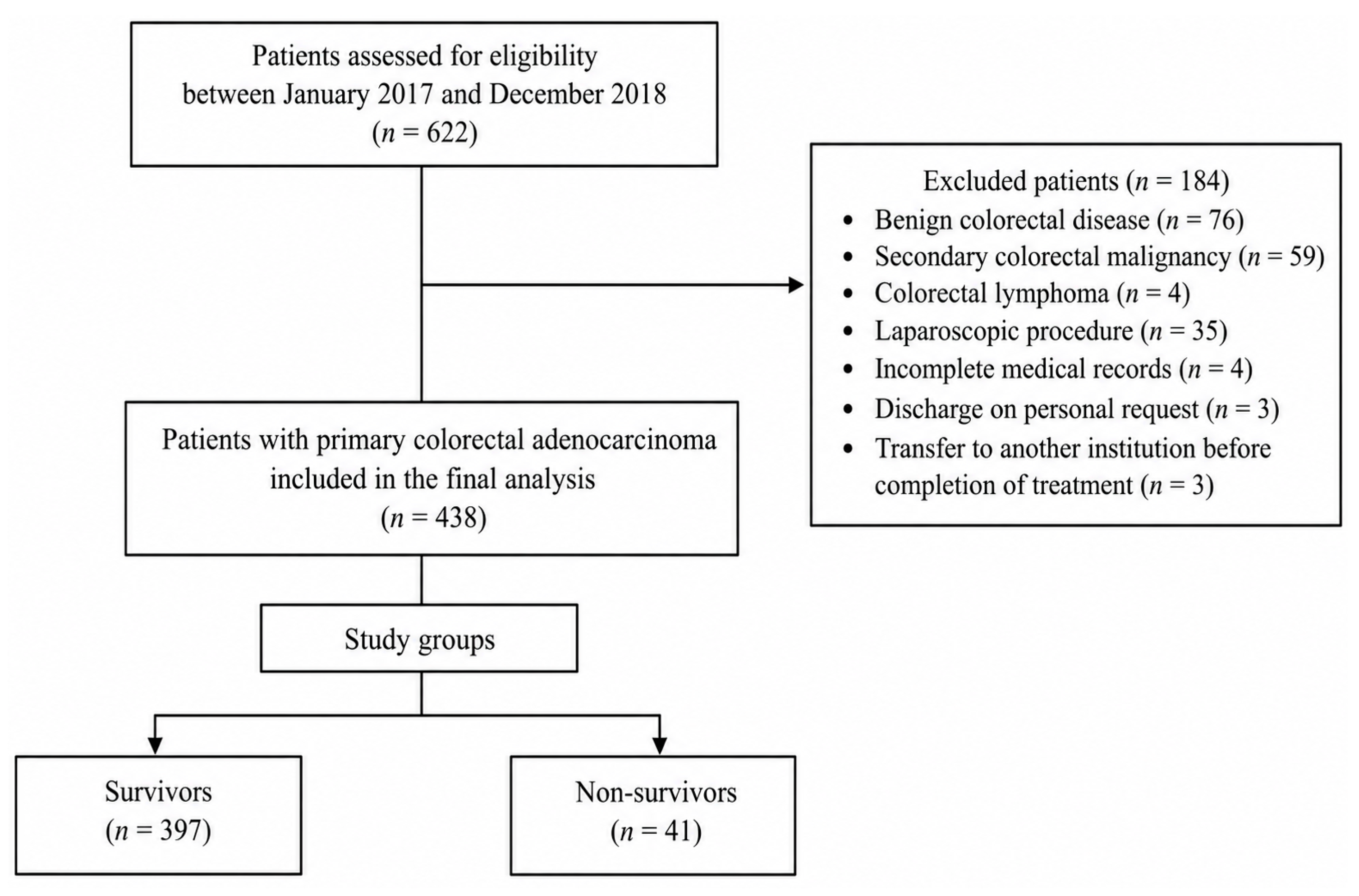
A total of 622 patients aged ≥65 years who underwent colorectal surgery during the study period were initially screened. Patients were excluded for the following reasons: benign colorectal disease (n = 76), secondary colorectal malignancy (n = 59), colorectal lymphoma (n = 4), laparoscopic procedure (n = 35), incomplete medical records (n = 4), discharge on personal request (n = 3), and transfer to another institution before completion of treatment (n = 3). After applying the predefined exclusion criteria, 438 patients with primary colorectal adenocarcinoma were included in the final analysis (Figure 1).
Figure 1.
Flow diagram illustrating patient selection, exclusion criteria, and the final study cohort included in the retrospective analysis.
No patients were lost to in-hospital follow-up. Patients were stratified according to surgical urgency (elective vs. emergency surgery), sex, age groups (65–69, 70–74, 75–79, and ≥80 years), and postoperative outcome (survivors vs. non-survivors during hospitalization). Emergency surgery was defined as a procedure performed during the same hospitalization due to acute colorectal cancer-related complications requiring urgent surgical intervention, including bowel obstruction or perforation. Elective procedures were performed in patients with non-obstructing colorectal cancer undergoing planned oncological resection, whereas emergency surgery was undertaken primarily for bowel obstruction and, less frequently, for tumor perforation or active bleeding requiring urgent intervention.
The management of obstructive rectal tumors was individualized according to the patient’s clinical condition, tumor characteristics, and feasibility of definitive surgical treatment. In patients presenting with acute obstruction and poor general condition or in those unsuitable for immediate definitive resection, decompressive procedures, including diverting loop stoma creation or Hartmann’s procedure, were performed. Emergency rectal resections were not performed with primary anastomosis in this cohort.
Recorded variables included demographic characteristics, clinical presentation of colorectal cancer, surgical indication, type of surgical procedure, comorbidities (chronic obstructive pulmonary disease, heart failure, chronic kidney disease, cerebrovascular disease, and diabetes mellitus), American Society of Anesthesiologists (ASA) physical status classification, perioperative blood transfusion requirements (red blood cell and fresh frozen plasma units), and routine laboratory and biochemical parameters. Comorbidities were identified from documented pre-existing diagnoses in the patients’ medical records.
Surgical procedures were categorized into three groups according to the presence and intended duration of fecal diversion and restoration of intestinal continuity: (1) continent colorectal procedures, including right or left hemicolectomy and high anterior resection of the rectum without protective stoma; (2) definitive incontinent procedures, including abdominoperineal resection of the rectum (Miles procedure) and permanent stoma formation in patients with unresectable tumors; and (3) temporary incontinent procedures, including low anterior rectal resection with protective stoma, Hartmann’s procedure, and diverting loop stoma creation as a first-stage procedure in patients with severe clinical deterioration or poor general condition. Palliative surgical procedures were performed in patients with unresectable disease or those who were not candidates for curative resection due to advanced local disease or poor general condition. In these cases, the surgical approach was primarily aimed at relieving symptoms, maintaining intestinal function, or preventing complications such as obstruction.
Laboratory analyses included hemoglobin, erythrocyte count, leukocyte count, serum creatinine, albumin, total protein, sodium, potassium, C-reactive protein (CRP), procalcitonin (PCT), and glycemia. Missing data were not imputed. Analyses were performed using the available data for each variable, and the number of observations contributing to individual analyses therefore depended on the availability of the corresponding clinical or laboratory measurements in the medical records. Because the original patient-level dataset is no longer available for additional statistical analysis, the exact variable-specific number and proportion of missing observations could not be retrospectively reconstructed for all variables. This limitation was taken into account when interpreting the results, as differential availability of laboratory measurements may have introduced selection bias if missingness was related to patient characteristics or clinical outcome. These parameters were selected because they represent routinely available indicators of hematological status, systemic inflammation, nutritional condition, and organ function in the perioperative setting. Laboratory measurements were obtained at two predefined time points. Baseline laboratory values were recorded at hospital admission, within the first 24 h before surgery, and were considered the preoperative measurements used for prognostic analysis. A second measurement was obtained during the final hospital assessment, defined as hospital discharge in survivors or the time of in-hospital death in non-survivors. These final measurements were used only for descriptive longitudinal comparisons and were not considered baseline prognostic predictors, as their timing was dependent on the subsequent clinical course and, in non-survivors, could have occurred shortly before death. Inflammatory biomarkers (CRP and PCT) were primarily evaluated at admission because these values reflected the initial systemic inflammatory status before surgical intervention.
The primary study endpoint was early in-hospital mortality, defined as death occurring after colorectal cancer surgery and before hospital discharge during the same hospitalization. All deaths included in the analysis therefore occurred after the surgical procedure; no patients who died before surgery were included as mortality events. For non-survivors, the primary clinical cause of death was retrospectively determined from medical records, including postoperative complications, cardiovascular events, respiratory failure, and other documented causes contributing to in-hospital mortality. As the study endpoint was limited to in-hospital outcomes, no post-discharge follow-up was performed.
Whenever clinically feasible, patients undergoing elective surgery received standard preoperative management according to institutional protocols, including optimization of comorbid conditions, perioperative antibiotic prophylaxis, and bowel preparation when indicated. Patients undergoing emergency surgery received initial resuscitation and stabilization measures according to their clinical condition before urgent surgical intervention. These perioperative management measures were not included as independent variables in the present analysis. Detailed intraoperative variables, including operative duration, estimated blood loss, and intraoperative hemodynamic parameters, were not consistently available in the retrospective database and were therefore not included in the present analysis.
All procedures included in the present analysis were performed using an open surgical approach. Minimally invasive procedures were excluded because laparoscopic colorectal surgery was not routinely implemented as the standard approach at our institution during the study period, resulting in a predominantly open surgical cohort. This approach allowed analysis of a more homogeneous group of patients with comparable surgical management. Surgical procedures included standard colorectal resections and definitive or temporary incontinent procedures when indicated according to tumor localization, disease stage, clinical presentation, and intraoperative findings.
Patients were followed until hospital discharge or in-hospital death. For the Cox proportional hazards analysis, time-to-event was calculated from the date of colorectal cancer surgery to the date of in-hospital death or, for survivors, the date of hospital discharge. Patients who were discharged alive were treated as censored at the date of hospital discharge. Because the primary endpoint was specifically defined as in-hospital mortality, deaths occurring after hospital discharge were outside the scope of the endpoint and were not assessed, as no post-discharge follow-up was performed.
Statistical Analysis
Statistical analysis was performed using the R software package (version 4.5.1; R Foundation for Statistical Computing, Vienna, Austria). Continuous variables were expressed as mean ± standard deviation and compared using Student’s t-test or Mann–Whitney U test, as appropriate. Categorical variables were analyzed using the chi-square test or Fisher’s exact test.
Changes in numerical laboratory variables between baseline and the final available hospital measurement were assessed using repeated-measures analysis of variance (ANOVA), with the time × outcome-group interaction reported where applicable. Because only two time points were compared, the sphericity assumption was not applicable. The analysis was based on the two measurements available for each patient; however, the interval between baseline and the final measurement was not uniform, as the final measurement corresponded to hospital discharge in survivors and the time of in-hospital death in non-survivors. Therefore, these repeated-measures results were interpreted as changes observed between baseline and the final available hospital assessment rather than as measurements obtained at standardized postoperative time points. Where appropriate, post hoc comparisons were performed using the Wilcoxon signed-rank test or Mann–Whitney U test.
Survival differences between elective and emergency surgical procedures were evaluated using Kaplan–Meier curves and compared using the log-rank test.
Predictors of in-hospital mortality were assessed using Cox proportional hazards regression analysis (univariate and multivariate models). Variables demonstrating statistical significance in univariate Cox regression analysis were considered for inclusion in the multivariate model, together with selected clinically relevant perioperative variables. Variable selection was additionally guided by the limited number of outcome events to minimize overfitting and maintain model stability. Because only 41 in-hospital deaths occurred, inclusion of all variables showing univariate associations was considered likely to result in an overly complex model relative to the number of outcome events. Accordingly, the final model was restricted to a parsimonious set of variables selected on the basis of their statistical and clinical relevance Variables without significant associations in univariate analysis were generally not entered into the final model unless considered clinically relevant. Results are presented as hazard ratios (HR) with corresponding 95% confidence intervals (CI). The proportional hazards assumption was not formally assessed in the original analysis. Because the original patient-level dataset is no longer available, formal retrospective testing of this assumption could not be performed during the revision.
A p-value < 0.05 was considered statistically significant.
3. Results
A total of 438 patients with histologically confirmed colorectal adenocarcinoma were included in the study, including 259 males (59.1%) and 179 females (40.9%). The overall in-hospital mortality rate was 9.4% (n = 41).
Among the non-survivor patients, cardiovascular complications represented the leading cause of death (20 patients, 48.8%), followed by respiratory failure (8 patients, 19.5%), anastomotic leakage (7 patients, 17.1%), postoperative wound dehiscence (4 patients, 9.8%), and diffuse postoperative intra-abdominal bleeding (2 patients, 4.9%).
The distribution of demographic characteristics, clinical presentation, comorbidities, perioperative laboratory findings, and transfusion requirements according to survival status is summarized in Table 1.
Table 1.
Baseline demographic, clinical and perioperative characteristics of patients aged ≥65 years undergoing colorectal cancer surgery according to in-hospital survival outcome.
Significant differences in sex distribution were observed between survivors and non-survivors (p < 0.001). Male patients were more frequently represented among survivors (252 [63.5%] vs. 7 [17.1%]), whereas female patients accounted for the majority of in-hospital deaths (34 [82.9%] vs. 145 [36.5%]) (Table 1).
Age distribution differed significantly between survivors and non-survivors (p < 0.001). Patients aged ≥75 years were substantially overrepresented among non-survivors, with individuals aged 75–79 years accounting for 34.1% of deaths and those aged ≥80 years accounting for an additional 31.7%. In contrast, younger age groups predominated among survivors (Table 1).
Emergency surgical procedures were significantly more frequent among non-survivors than among survivors (33 [80.5%] vs. 75 [18.9%], p < 0.001), whereas elective procedures predominated among survivors (322 [81.1%] vs. 8 [19.5%]). Obstructive colorectal cancer represented the leading documented emergency indication, accounting for 31 (75.6%) of all non-survivors, while tumor-related bleeding was documented in 2 (4.9%). Other emergency presentations, including tumor perforation, were less frequent. Because of the limited number of patients within individual emergency-indication categories, no separate subgroup analysis of inflammatory biomarkers according to specific emergency indication was performed (Table 1).
Comorbidities were significantly associated with in-hospital mortality. Chronic obstructive pulmonary disease (COPD) was more frequent among non-survivors (15 [36.6%] vs. 40 [10.1%], p < 0.001), as was heart disease (40 [97.6%] vs. 269 [67.8%], p < 0.001). Chronic kidney disease (CKD) and cerebrovascular disease (CVI) were documented in 5 non-survivors (12.2%) each and were not documented among survivors. Given the small numbers and the resulting small cell counts, these findings were interpreted cautiously, and CKD and CVI were not included as independent covariates in the multivariable Cox regression model. Diabetes mellitus did not show a statistically significant difference between groups (p = 0.112) (Table 1).
Significant differences were also observed in ASA classification (p < 0.001), with ASA IV–V patients being substantially more frequent among non-survivors compared with survivors (22 [53.7%] vs. 7 [1.8%]). In contrast, ASA II–III patients predominated among survivors. (Table 1).
Perioperative laboratory parameters are summarized in Table 1. Compared with survivors, non-survivors demonstrated significantly higher creatinine values and inflammatory markers, including leukocyte count, C-reactive protein (CRP), and procalcitonin (PCT), indicating a greater systemic inflammatory burden and more pronounced renal dysfunction. In contrast, hemoglobin concentration, erythrocyte count, albumin, and total protein levels were significantly lower among non-survivors, reflecting the adverse impact of perioperative anemia and impaired nutritional status. Final hospital assessments showed less favorable laboratory profiles among non-survivors; however, these measurements were obtained at different clinical time points and were therefore interpreted as descriptive longitudinal findings rather than prognostic predictors. In addition, transfusion requirements were significantly higher among non-survivors, with both red blood cell (RBC) and fresh frozen plasma (FFP) administration being substantially increased compared with survivors (Table 1).
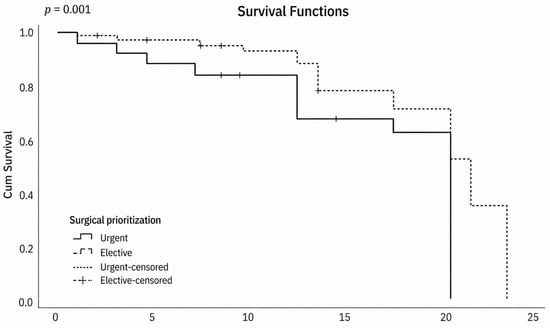
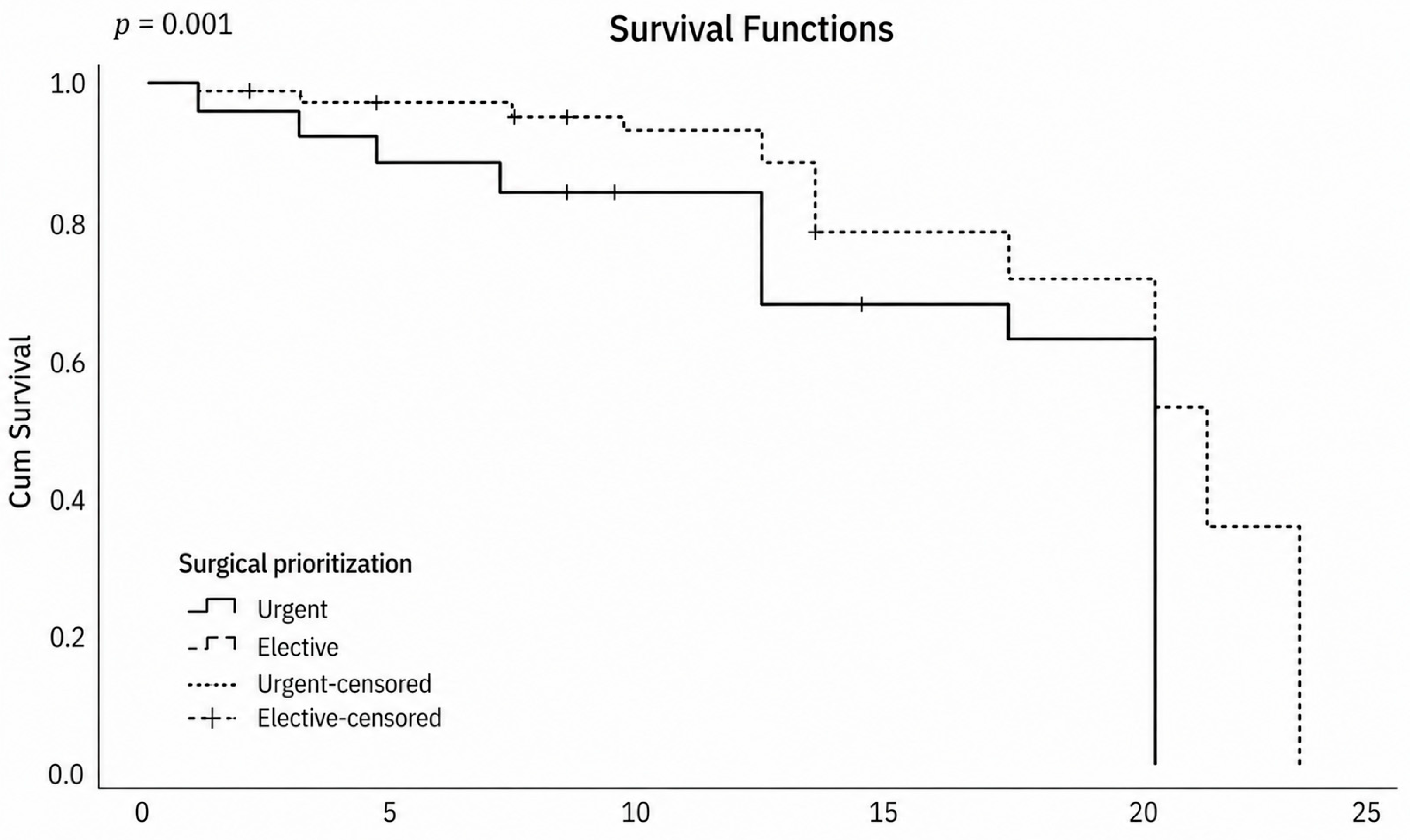
Kaplan–Meier survival analysis was performed to evaluate in-hospital survival according to surgical urgency. The analysis demonstrated a significant difference in survival probability between patients undergoing elective and emergency colorectal cancer surgery, with significantly reduced in-hospital survival observed among patients requiring urgent surgical intervention (log-rank test, p < 0.001) (Figure 2).
Figure 2.
Kaplan–Meier survival curves showing in-hospital survival according to surgical urgency (emergency vs. elective colorectal cancer surgery). Survival distributions were compared using the log–rank test (p < 0.001).
The survival curves diverged early after surgery and remained consistently separated throughout hospitalization, indicating a persistently higher risk of in-hospital mortality in the emergency surgery group.
In univariate Cox regression analysis, male sex (HR 0.29, 95% CI 0.12–0.68, p = 0.004), emergency surgery (HR 2.97, 95% CI 1.52–5.81, p = 0.001), ASA score ≥ 3 (HR 4.528, 95% CI 2.160–9.490, p < 0.001), creatinine at admission (HR 1.011, 95% CI 1.008–1.014, p < 0.001), total protein at admission (HR 0.932, 95% CI 0.909–0.955, p < 0.001), albumin at admission (HR 0.901, 95% CI 0.873–0.931, p < 0.001), erythrocyte count at admission (HR 0.71, 95% CI 0.58–0.87, p < 0.001), leukocyte count at admission (HR 1.067, 95% CI 1.037–1.099, p < 0.001), hemoglobin at admission (HR 0.949, 95% CI 0.933–0.965, p < 0.001), CRP at admission (HR 1.011, 95% CI 1.007–1.014, p < 0.001), and red blood cell transfusion requirement (HR 1.116, 95% CI 1.032–1.206, p = 0.006) were significantly associated with in-hospital mortality (Table 2).
Table 2.
Univariate and multivariate Cox proportional hazards regression analysis of predictors of in-hospital mortality.
Variables demonstrating statistical significance in univariate analysis, together with clinically relevant parameters, were considered for inclusion in the multivariate Cox regression model. In multivariate analysis, creatinine at admission (HR 1.004 per μmol/L, 95% CI 1.000–1.008, p = 0.030), leukocyte count at admission (HR 1.064 per 109/L, p = 0.004), hemoglobin at admission (HR 0.938 per g/L, p < 0.001), and CRP at admission (HR 1.009 per mg/L, p < 0.001) remained independently associated with in-hospital mortality (Table 2). The relatively small hazard ratio for creatinine reflects the use of μmol/L as the measurement unit.
4. Discussion
The present study evaluated perioperative predictors of early in-hospital mortality in patients aged ≥65 years undergoing surgery for colorectal cancer. The findings confirmed our initial hypothesis that routinely available perioperative clinical and laboratory parameters are strongly associated with early in-hospital mortality in this vulnerable population. The overall in-hospital mortality rate was 9.4%, with significantly worse outcomes observed among patients undergoing emergency surgery and those presenting with a higher inflammatory burden, anemia, renal dysfunction, and impaired nutritional status. Although several demographic, clinical, and laboratory variables were associated with mortality in univariate analysis, multivariate Cox regression identified elevated creatinine and leukocyte count, increased CRP levels, and lower hemoglobin concentration at admission as independent predictors of early in-hospital mortality. These findings highlight the prognostic importance of systemic inflammation, perioperative anemia, and renal dysfunction in patients aged ≥65 years undergoing colorectal cancer surgery [17,19,20,21,22,23,24,25].
The factors associated with early in-hospital mortality in this cohort may be considered in two broad clinical domains. The first includes factors reflecting general perioperative vulnerability and the ability to tolerate surgical and anesthetic stress, such as advanced age, comorbidity burden, higher ASA classification, anemia, renal dysfunction, and systemic inflammatory status. The second includes factors related to the specific colorectal surgical setting, particularly emergency presentation, bowel obstruction or perforation, the need for urgent or staged procedures, and procedure-related complications such as anastomotic leakage, postoperative bleeding, and wound complications. The present study primarily evaluated baseline clinical and laboratory characteristics as predictors of overall in-hospital mortality and was not designed to determine the independent contribution of individual surgical or procedure-related complications.
Emergency colorectal cancer surgery was strongly associated with poor early postoperative outcomes in the present study. Patients undergoing urgent procedures demonstrated significantly lower in-hospital survival compared with those treated electively, with an in-hospital mortality rate of 30.6% following emergency surgery compared with 2.4% after elective procedures. Obstructive colorectal cancer represented the leading indication for urgent surgical intervention and accounted for the majority of deaths observed in the study cohort. In this context, emergency presentation should be considered not only as a surgical circumstance but also as a marker of advanced disease, delayed presentation, and reduced physiological reserve [17,18].
Several factors may explain the high mortality observed in emergency cases. Patients ≥ 65 years presenting with bowel obstruction, tumor perforation, or tumor-related bleeding often exhibit dehydration, electrolyte imbalance, bacterial translocation, systemic inflammatory response, sepsis, and hemodynamic instability before surgery, substantially increasing perioperative risk [17,18]. Furthermore, emergency procedures are commonly performed in patients with advanced disease, poor physiological reserve, and multiple comorbidities, limiting their ability to tolerate major surgical stress. Serum lactate may also provide additional information regarding tissue hypoperfusion and physiological deterioration in patients presenting with emergency colorectal conditions; however, its retrospective availability was insufficient for inclusion in the present analysis.
Analysis of the causes of in-hospital mortality demonstrated that cardiovascular complications represented the leading cause of death, accounting for 20 of the 41 fatal outcomes (48.8%). Respiratory failure was identified in 8 patients (19.5%), while surgical complications contributed to a smaller proportion of deaths, including colorectal anastomotic leakage in 7 patients (17.1%), postoperative wound dehiscence in 4 patients (9.8%), and diffuse postoperative intra-abdominal bleeding in 2 patients (4.9%). These findings suggest that although technical surgical complications remain clinically important, perioperative cardiovascular and respiratory events constitute the predominant causes of early postoperative mortality in elderly patients undergoing colorectal cancer surgery [25]. The distribution of the primary causes of in-hospital mortality is summarized in Supplementary Table S1.
Although contemporary management strategies for malignant colorectal obstruction increasingly include endoscopic stenting or staged procedures in selected patients [14], these approaches were not routinely available at our institution during the study period. Consequently, emergency surgery remained the predominant treatment strategy for acute colorectal cancer complications. Similar findings have been reported in previous studies demonstrating substantially higher morbidity and mortality following emergency colorectal surgery in patients aged ≥65 years populations compared with elective procedures [17,18].
Interestingly, although emergency surgery was significantly associated with mortality in univariate analysis, this association did not remain statistically significant after multivariable adjustment. This attenuation may reflect confounding, overlap among correlated clinical variables, limited statistical power related to the number of outcome events, or model instability. Therefore, the present analysis does not establish a mediation effect or a causal mechanism linking emergency surgery to mortality. Rather, the findings suggest that the association between emergency presentation and mortality may be influenced by the patients’ underlying physiological condition and the clinical factors accompanying urgent presentation. The lack of an independent association between emergency surgery and mortality in the multivariable model should therefore not be interpreted as indicating that emergency surgery is clinically unimportant.
ASA classification and comorbidity burden also demonstrated a strong association with postoperative mortality in aged ≥65 years old colorectal cancer patients. Non-survivors had significantly higher ASA grades compared with survivors, reflecting poorer preoperative physical status and reduced physiological reserve. ASA IV–V classification was substantially more frequent among non-survivors, accounting for 53.7% of all deaths, whereas no survivors belonged to these categories. Although ASA score did not remain independently significant in multivariate analysis, its strong association with mortality in univariate analysis is consistent with previous studies identifying ASA classification as an important perioperative risk indicator in colorectal surgery [17,18,26,27,28,29].
Female sex was also strongly associated with in-hospital mortality in the univariate analysis, with women representing the majority of non-survivors. This finding should be interpreted cautiously, as sex was not retained in the multivariable model and the present retrospective dataset does not provide sufficient information to determine the mechanisms underlying this observed difference. Potential explanations may include differences in baseline health status, comorbidity patterns, disease presentation, tumor characteristics, physiological reserve, or treatment-related factors; however, these hypotheses could not be directly evaluated in the present study. Therefore, the observed sex difference should be considered an exploratory finding requiring confirmation in larger, adequately adjusted cohorts.
Patients aged ≥65 years frequently present with multiple chronic comorbidities, frailty, sarcopenia, and impaired cardiopulmonary reserve, all of which may impair the ability to tolerate major surgical stress. In the present cohort, chronic obstructive pulmonary disease, heart disease, chronic kidney disease, and cerebrovascular disease were more frequent among non-survivors, further supporting the importance of baseline health status in determining postoperative outcomes. However, detailed frailty assessment, functional status evaluation, and sarcopenia measurements were not routinely available during the study period and therefore could not be incorporated into the present analysis. Validated frailty instruments, such as the Clinical Frailty Scale and the Modified Frailty Index, may provide additional prognostic information beyond chronological age and conventional comorbidity measures by capturing functional dependence, physiological vulnerability, and cumulative health deficits. Incorporating standardized frailty assessment into future risk models may therefore improve discrimination of patients at particularly high risk of postoperative complications and mortality and may support more individualized perioperative decision-making. Future prospective studies including frailty, functional status, and sarcopenia measures may provide additional insight into individualized risk prediction in patients aged ≥65 years undergoing colorectal cancer surgery.
Markers of systemic inflammation at hospital admission were strongly associated with early in-hospital mortality in the present cohort. Because CRP and leukocyte count were assessed at admission, before surgery, their elevation reflects the preoperative inflammatory state rather than a postoperative complication. In patients requiring emergency surgery, this inflammatory response may reflect acute disease-related processes such as bowel obstruction, tumor perforation, bacterial translocation, incipient intra-abdominal infection, or sepsis, whereas in elective patients it may also reflect the underlying tumor burden or other pre-existing inflammatory conditions. Although procalcitonin was markedly elevated among non-survivors, it was not independently associated with mortality, possibly because of the limited number of events and its correlation with other inflammatory markers. Postoperative complications may subsequently amplify the inflammatory response and contribute to mortality, but they cannot account for the association observed with the admission values analyzed in the present study.
Elevated inflammatory markers may reflect advanced disease, bowel obstruction or perforation, bacterial translocation, postoperative infectious complications, or early sepsis, all of which are associated with increased postoperative mortality risk. Similar associations between elevated inflammatory biomarkers and adverse postoperative outcomes following colorectal surgery have been reported in previous studies [22,23,24,30,31]. The present findings further support the association between systemic inflammation and early postoperative deterioration, particularly in patients aged ≥65 years with limited physiological reserve.
Perioperative anemia and impaired nutritional status were also associated with adverse postoperative outcomes. Non-survivors had lower hemoglobin, albumin, total protein, and erythrocyte counts than survivors, while lower hemoglobin concentration remained an independent predictor of in-hospital mortality in multivariate analysis. These findings suggest that anemia and impaired nutritional status may serve as markers of limited physiological reserve in patients aged ≥65 years undergoing colorectal cancer surgery.
Anemia may contribute to impaired tissue oxygenation, delayed wound healing, cardiovascular strain, and increased susceptibility to postoperative complications. Similarly, hypoalbuminemia and reduced total protein levels may reflect malnutrition and frailty and have been associated with poorer surgical outcomes and increased mortality in older oncologic patients [20,21,22,30,31,32,33,34]. In the present study, although albumin and total protein levels were significantly associated with mortality in univariate analysis, they did not remain independently significant after multivariate adjustment, suggesting that their prognostic effects may overlap with systemic inflammation and renal dysfunction.
In addition, perioperative transfusion requirements were significantly higher among non-survivors, which is in agreement with previous studies linking blood transfusion and severe perioperative anemia with increased postoperative mortality risk [25]. Patients aged ≥65 years are particularly vulnerable to the adverse effects of perioperative anemia due to reduced cardiopulmonary reserve and higher prevalence of cardiovascular comorbidities.
Renal dysfunction was also significantly associated with postoperative mortality. Baseline creatinine was higher among non-survivors than survivors, and creatinine at admission remained an independent predictor of in-hospital mortality in multivariate analysis. In older surgical patients, impaired renal function may reflect preexisting chronic kidney disease, dehydration, hemodynamic instability, systemic inflammation, or early multiorgan dysfunction.
Renal impairment is associated with reduced physiological reserve and increased susceptibility to postoperative complications, including cardiovascular events, electrolyte disturbances, infectious complications, and prolonged recovery. In patients aged ≥65 years undergoing emergency colorectal cancer surgery, even moderate deterioration of renal function may represent an early marker of physiological deterioration and limited ability to tolerate surgical stress. Previous studies have similarly identified elevated creatinine and impaired renal function as important predictors of poor postoperative outcomes and increased mortality following colorectal surgery in patients aged ≥65 years [17,35,36]. The present findings further emphasize the importance of careful perioperative renal assessment, fluid management, and hemodynamic optimization in this high-risk population.
The present findings have important clinical implications for perioperative risk stratification and management of aged ≥65 years colorectal cancer patients. The observed in-hospital mortality rate of 9.4% reflects the substantial vulnerability of this population, particularly among patients presenting with emergency surgical indications and limited physiological reserve. In our cohort, the main causes of in-hospital death were cardiovascular complications (n = 20) and respiratory insufficiency (n = 8), while surgical complications included colorectal anastomotic dehiscence (n = 7), postoperative wound dehiscence (n = 4), and diffuse intra-abdominal bleeding (n = 2). These findings indicate that early mortality after colorectal cancer surgery in patients aged ≥65 years is not related to a single mechanism but results from the interaction between preoperative vulnerability, systemic inflammatory response, organ dysfunction, and procedure-related complications.
Early identification of high-risk patients using routinely available clinical and laboratory parameters may support perioperative decision-making and closer postoperative monitoring. Particular attention should be directed toward patients presenting with elevated inflammatory markers, anemia, renal dysfunction, and poor general condition, especially in emergency surgical settings. Preoperative optimization, when clinically feasible, should include correction of anemia and fluid-electrolyte disturbances, assessment and optimization of nutritional status, careful hemodynamic stabilization, and early recognition and treatment of systemic infection or inflammatory deterioration. Given that cardiovascular and respiratory complications represented the leading causes of death in our cohort, close postoperative monitoring of cardiopulmonary status, early recognition of respiratory or hemodynamic deterioration, appropriate fluid management, and timely escalation of care may be particularly important in this vulnerable population. Multidisciplinary perioperative management involving surgeons, anesthesiologists, intensivists, geriatricians, and nutrition specialists may facilitate individualized risk assessment and coordinated postoperative care. These measures should be considered as potential strategies for risk reduction, although their effectiveness was not directly evaluated in the present retrospective study.
Surgical decision-making and operative technique may also influence early postoperative mortality, particularly in patients undergoing emergency colorectal surgery. The choice between definitive resection, Hartmann’s procedure, diverting stoma, staged procedures, or other approaches is influenced by the patient’s physiological condition, disease characteristics, degree of contamination, and the surgeon’s intraoperative assessment. Similarly, operative factors such as extent of resection, anastomotic strategy, operative duration, blood loss, and intraoperative hemodynamic instability may affect the risk of postoperative complications, including respiratory failure, anastomotic leakage, bleeding, and cardiovascular deterioration. In the present study, although the type of surgical procedure was recorded, detailed operative decision-making and intraoperative technical variables were not consistently available and therefore could not be evaluated as independent predictors of mortality. Future prospective studies should incorporate these variables together with standardized assessment of postoperative complications. Although the present study did not directly evaluate the effectiveness of these interventions, a coordinated multidisciplinary approach may facilitate earlier recognition of physiological deterioration, appropriate timing and selection of emergency surgery, individualized operative planning, and closer postoperative monitoring, potentially contributing to improved perioperative outcomes.
Several limitations of this study should be acknowledged. First, this was a retrospective single-center study, which may limit the generalizability of the findings and introduces the possibility of selection bias. The retrospective nature of data collection may also have resulted in incomplete or inconsistently recorded clinical, laboratory, and perioperative information, although only variables available in the institutional medical records were analyzed. The relatively high in-hospital mortality observed in our cohort (9.4%) and the high proportion of patients undergoing emergency surgery reflect the high-risk case mix of this single-center tertiary referral population and may limit the transferability of the findings to institutions with lower rates of emergency presentation or different patient characteristics. Therefore, the identified associations should be interpreted primarily as risk factors within this high-risk surgical population rather than as universally applicable estimates of mortality risk. Patients excluded during the screening process were not included in the subsequent statistical analysis, and baseline characteristics of excluded patients were not systematically available for comparison with the final study cohort. Therefore, selection bias related to the predefined exclusion criteria, particularly exclusion of patients transferred to another institution or discharged on personal request, cannot be completely excluded. Another limitation concerns the retrospective handling of missing laboratory data. Although no data were imputed and analyses were based on available observations for each variable, the exact variable-specific extent of missingness could not be reconstructed after the original patient-level dataset became unavailable. Therefore, differential availability of laboratory measurements cannot be excluded as a potential source of bias. Second, although the cohort included a substantial number of aged ≥65 years colorectal cancer patients, the number of in-hospital deaths was relatively limited, which may have influenced the stability of some regression estimates. The pronounced sex imbalance between survivors and non-survivors should also be interpreted cautiously, as only seven deaths occurred among male patients, potentially resulting in an unstable estimate of the association between sex and mortality. Furthermore, the relatively small number of mortality events in relation to the number of candidate covariates raises the possibility of model overfitting and selection bias; therefore, the multivariable Cox regression findings should be considered exploratory and require external validation in larger cohorts. In addition, the proportional hazards assumption of the Cox regression model was not formally assessed in the original analysis, and this could not be retrospectively evaluated because the original patient-level dataset was no longer available. Similarly, the original patient-level dataset was no longer available to independently reproduce the Cox regression analysis or perform additional diagnostic assessments of model specification. Therefore, the reported multivariable estimates should be interpreted with appropriate caution. Formal assessment of model discrimination, such as Harrell’s concordance index, and calibration could not be performed because the original patient-level dataset was not available for additional statistical analysis. Furthermore, the timing of the final laboratory assessment was not standardized, as it corresponded to hospital discharge in survivors and the time of in-hospital death in non-survivors. Consequently, repeated-measures comparisons should be interpreted cautiously because changes over time may partly reflect differences in length of hospital stay and clinical trajectory. Third, detailed assessment of frailty, functional capacity, sarcopenia, and comprehensive geriatric parameters was not routinely available during the study period and therefore could not be included in the analysis. Similarly, detailed oncological variables, including complete tumor staging, tumor location, histopathological characteristics, and long-term oncological outcomes, were not consistently available and therefore were not incorporated into the analysis. Tumor stage and location may influence disease severity and postoperative mortality risk [31]. Therefore, the absence of detailed tumor-related characteristics may have introduced residual confounding and limits the interpretation of the observed associations. Future studies should incorporate detailed tumor stage, anatomical location, and other oncological characteristics to further refine mortality risk prediction. Furthermore, detailed intraoperative variables, including operative duration, estimated blood loss, and intraoperative hemodynamic parameters, were not consistently available in the retrospective dataset and therefore could not be incorporated into the statistical models. These limitations also prevented assessment of the independent contribution of surgical decision-making and operative technique to early mortality. Similarly, serum lactate was not consistently available as a standardized preoperative measurement across the study cohort and therefore could not be included in the analysis. Lactate may provide important information regarding tissue hypoperfusion, metabolic derangement, and physiological severity, particularly in patients undergoing emergency colorectal surgery, and its absence represents a limitation of the present risk assessment. In addition, minimally invasive colorectal surgery was not routinely performed at our institution during the study period (2017–2018), and therefore the present cohort consisted almost exclusively of patients treated with an open surgical approach.
In addition, postoperative complications were not analyzed as separate outcome measures, and the study focused primarily on predictors associated with early in-hospital mortality. Future prospective multicenter studies incorporating frailty assessment, functional status, standardized postoperative complication grading, and broader oncological parameters are warranted to further clarify risk prediction in patients aged ≥65 years undergoing colorectal cancer surgery.
Despite these limitations, the present study provides clinically relevant information by identifying routinely available perioperative laboratory and clinical parameters associated with early mortality in a high-risk aged ≥65 years colorectal cancer population.
5. Conclusions
Early in-hospital mortality in patients aged ≥65 years undergoing colorectal cancer surgery was associated with elevated preoperative inflammatory markers, anemia, and renal dysfunction. Elevated leukocyte count, increased C-reactive protein levels, higher creatinine values, and lower hemoglobin concentration at admission were identified as independent predictors of in-hospital mortality. Emergency surgery, higher ASA classification, comorbidity burden, impaired nutritional status, and increased transfusion requirements were associated with mortality in univariate analysis, highlighting their contribution to overall perioperative risk.
Routinely available clinical and laboratory parameters may assist in early identification of aged ≥65 years colorectal cancer patients at increased risk of postoperative mortality and may support perioperative risk stratification and individualized management strategies. Further prospective studies incorporating frailty assessment, functional status, and comprehensive perioperative variables are needed to improve mortality prediction in this vulnerable population.
Supplementary Materials
The following supporting information can be downloaded at: https://www.mdpi.com/article/10.3390/surgeries7030103/s1, Table S1: Primary causes of in-hospital mortality among patients aged ≥65 years undergoing colorectal cancer surgery (n = 41).
Author Contributions
Conceptualization, I.P., I.G., M.N., M.P. and T.B.; Methodology, I.P., V.P. and A.I.; Software, Z.D., M.P. and A.P.; Validation, M.P., V.P. and T.B.; Formal Analysis, A.P. and A.I.; Investigation, I.P., I.G., M.N., M.G., Z.D. and T.B.; Data Curation, I.P. and V.P.; Writing—Original Draft Preparation, I.P.; Writing—Review and Editing, I.G., M.N., M.G. and Z.D.; Visualization, A.P.; Project Administration, I.P. All authors have read and agreed to the published version of the manuscript.
Funding
This research received no external funding.
Institutional Review Board Statement
The study was conducted in accordance with the Declaration of Helsinki and approved by the Ethics Committee of the University Clinical Center Nis (Decision No. 14546/1, 11 May 2026).
Informed Consent Statement
Patient consent was waived due to the retrospective design of the study and the use of anonymized clinical data.
Data Availability Statement
The data supporting the findings of this study are not publicly available because they were derived from retrospective clinical records and contain patient-related information subject to privacy and ethical restrictions. The original patient-level dataset is no longer available for additional analysis.
Conflicts of Interest
The authors declare no conflicts of interest.
Abbreviations
The following abbreviations are used in this manuscript:
| ASA | American Society of Anesthesiologists |
| CI | Confidence interval |
| CKD | Chronic kidney disease |
| COPD | Chronic obstructive pulmonary disease |
| CRP | C-reactive protein |
| CRC | Colorectal cancer |
| FFP | Fresh frozen plasma |
| HR | Hazard ratio |
| PCT | Procalcitonin |
| RBC | Red blood cell |
| CVI | Cerebrovascular insult |
| DM | Diabetes mellitus |
| HGB | Hemoglobin |
References
- Pilleron, S.; Sarfati, D.; Janssen-Heijnen, M.; Vignat, J.; Ferlay, J.; Bray, F.; Soerjomataram, I. Global cancer incidence in older adults, 2012 and 2035: A population-based study. Int. J. Cancer 2019, 144, 49–58. [Google Scholar] [CrossRef] [Scilit] [PubMed]
- Ferlay, J.; Colombet, M.; Soerjomataram, I.; Dyba, T.; Randi, G.; Bettio, M.; Gavin, A.; Visser, O.; Bray, F. Cancer incidence and mortality patterns in Europe: Estimates for 40 countries and 25 major cancers in 2018. Eur. J. Cancer 2018, 103, 356–387. [Google Scholar] [CrossRef] [Scilit] [PubMed]
- Brenner, H.; Kloor, M.; Pox, C.P. Colorectal cancer. Lancet 2014, 383, 1490–1502. [Google Scholar] [PubMed]
- Xavier, H.H.; Bhattacharya, Y.; Poobalan, A.; Brazzelli, M.; Ramsay, G. Outcomes reported in elective colorectal cancer surgery research for older patients: A scoping review. Colorectal Dis. 2024, 26, 1871–1882. [Google Scholar] [CrossRef] [Scilit] [PubMed]
- Itatani, Y.; Kawada, K.; Sakai, Y. Treatment of elderly patients with colorectal cancer. BioMed Res. Int. 2018, 2018, 2176056. [Google Scholar] [CrossRef] [Scilit] [PubMed]
- Grainger, R.; Temperley, T.S.; Temperley, H.C.; Creavin, B.; Harrold, E.; Clancy, C.; O’Riordan, J.; Gallagher, D.; Mehigan, B.J.; Larkin, J.; et al. Outcomes following colorectal cancer resection in elderly patients. Curr. Oncol. 2025, 32, 652. [Google Scholar] [CrossRef] [Scilit] [PubMed]
- Cavadas, A.S.; Rodrigues, J.; Costa-Pereira, C.; Costa-Pereira, J. Evaluating surgical outcomes and survival in colon cancer patients over 80 years old. Cureus 2024, 16, e64059. [Google Scholar] [CrossRef] [Scilit] [PubMed]
- Hukkinen, T.; Olenius, T.; Koskensalo, S.; Lepistö, A.; Koskenvuo, L.; Böckelman, C. Short- and long-term survival among elderly colorectal cancer patients in Finland, 2006–2015: A nationwide population-based registry study. Cancers 2024, 16, 135. [Google Scholar] [CrossRef] [Scilit] [PubMed]
- Church, S.; Rogers, E.; Rockwood, K.; Theou, O. A scoping review of the clinical frailty scale. BMC Geriatr. 2020, 20, 393. [Google Scholar] [CrossRef] [Scilit] [PubMed]
- Al-Khamis, A.; Warner, C.; Park, J.; Marecik, S.; Davis, N.; Mellgren, A.; Nordenstam, J.; Kochar, K. Modified frailty index predicts early outcomes after colorectal surgery: An ACS-NSQIP study. Colorectal Dis. 2019, 21, 1192–1205. [Google Scholar] [CrossRef] [Scilit] [PubMed]
- Simon, H.L.; Reif de Paula, T.; Profeta da Luz, M.M.; Nemeth, S.K.; Moug, S.J.; Keller, D.S. Frailty in older patients undergoing emergency colorectal surgery: USA National Surgical Quality Improvement Program analysis. Br. J. Surg. 2020, 107, 1363–1371. [Google Scholar] [CrossRef] [Scilit] [PubMed]
- Lee, S.M.; Shin, J.S. Colorectal cancer in octogenarian and nonagenarian patients: Clinicopathological features and survivals. Ann. Coloproctol. 2020, 36, 323–329. [Google Scholar] [CrossRef] [Scilit] [PubMed]
- Moreno-Carmona, M.R.; Serra-Prat, M.; Riera, S.A.; Estrada, O.; Ferro, T.; Querol, R. Effect of frailty on postoperative complications, mortality, and survival in older patients with non-metastatic colon cancer: A systematic review and meta-analysis. J. Geriatr. Oncol. 2024, 15, 101639. [Google Scholar] [CrossRef] [Scilit] [PubMed]
- Ma, Q.; Li, H.; Jiang, Y.; Wang, Y.; Liang, J. Oncological and surgical outcomes of radical surgery in elderly colorectal cancer patients with intestinal obstruction. Front. Surg. 2023, 10, 1251461. [Google Scholar] [CrossRef] [Scilit] [PubMed]
- Vashistha, N.; Singhal, S.; Budhiraja, S.; Singhal, D. Evaluation of ACS-NSQIP and CR-POSSUM risk calculators for the prediction of mortality after colorectal surgery: A retrospective cohort study. J. Minimal Access Surg. 2022, 20, 142–147. [Google Scholar] [CrossRef] [Scilit] [PubMed]
- Thungathurthi, K.; Wei, M.; Othman, B.; Jain, A.; Girdlestone, P.; Chandra, R. Outcomes in octogenarians following elective colorectal cancer surgery. J. Gastrointest. Oncol. 2023, 14, 1726–1734. [Google Scholar] [CrossRef] [Scilit] [PubMed]
- Kent, I.; Ghuman, A.; Sadran, L.; Rov, A.; Lifschitz, G.; Rudnicki, Y.; White, I.; Goldberg, N.; Avital, S. Emergency colectomies in the elderly population—Perioperative mortality risk-factors and long-term outcomes. J. Clin. Med. 2023, 12, 2465. [Google Scholar] [CrossRef] [Scilit] [PubMed]
- Brolese, M.; Vittori, A.; Todisco, M.; Zuin, N.; Cusano, V.; Valli, V.; Vallese, L.; Baldan, N.; Valmasoni, M.; Da Dalt, G.; et al. Mortality risk prediction in octogenarians undergoing emergency colorectal surgery: A tertiary center experience and systematic review of the literature. Front. Surg. 2025, 12, 1649766. [Google Scholar] [CrossRef] [Scilit] [PubMed]
- Mathis, G.; Lapergola, A.; Alexandre, F.; Philouze, G.; Mutter, D.; D’Urso, A. Risk factors for in-hospital mortality after emergency colorectal surgery in octogenarians: Results of a cohort study from a referral center. Int. J. Colorectal Dis. 2023, 38, 270. [Google Scholar] [CrossRef] [Scilit] [PubMed]
- Zhang, X.; Edwards, B.J. Malnutrition in older adults with cancer. Curr. Oncol. Rep. 2019, 21, 80. [Google Scholar] [CrossRef] [Scilit] [PubMed]
- Capurso, C.; Lo Buglio, A.; Bellanti, F.; Serviddio, G. C-reactive protein/albumin ratio vs. prognostic nutritional index as the best predictor of early mortality in hospitalized older patients, regardless of admitting diagnosis. Nutrients 2025, 17, 2907. [Google Scholar] [CrossRef] [Scilit] [PubMed]
- Li, Y.; Wu, H.; Xing, C.; Hu, X.; Zhang, F.; Peng, Y.; Li, Z.; Lu, T. Prognostic evaluation of colorectal cancer using three new comprehensive indexes related to infection, anemia and coagulation derived from peripheral blood. J. Cancer 2020, 11, 3834–3845. [Google Scholar] [CrossRef] [Scilit] [PubMed]
- Hu, Y.; Ren, J.; Lv, Z.; Liu, H.; Qiu, X. Procalcitonin and C-reactive protein as early predictors in patients at high risk of colorectal anastomotic leakage. J. Int. Med. Res. 2024, 52, 3000605241258160. [Google Scholar] [CrossRef] [Scilit] [PubMed]
- Chen, Y.; Zhao, Y.; Liu, J.; Teng, Y.; Ou, M.; Hao, X. Predictive value of perioperative procalcitonin, C reactive protein and high-sensitivity C reactive protein for the risk of postoperative complications after non-cardiac surgery in elderly patients: A nested case-control study. BMJ Open 2023, 13, e071464. [Google Scholar] [CrossRef] [Scilit] [PubMed]
- Buhl, H.; Norgaard, A.; Otkjaer, A.; Jorgensen, L.N.; Jorgensen, H.L. The impact of anemia and blood transfusion on mortality after open abdominal surgery in the elderly. Langenbeck’s Arch. Surg. 2023, 408, 421. [Google Scholar] [CrossRef] [Scilit] [PubMed]
- Turri, G.; Caliskan, G.; Conti, C.; Martinelli, L.; De Giulio, E.; Ruzzenente, A.; Guglielmi, A.; Verlato, G.; Pedrazzani, C. Impact of age and comorbidities on short- and long-term outcomes of patients undergoing surgery for colorectal cancer. Front. Oncol. 2022, 12, 959650. [Google Scholar] [CrossRef] [Scilit] [PubMed]
- Zhang, X.; Wang, X.; Wang, M.; Gu, J.; Guo, H.; Yang, Y.; Liu, J.; Li, Q. Effect of comorbidity assessed by the Charlson Comorbidity Index on the length of stay, costs, and mortality among colorectal cancer patients undergoing colorectal surgery. Curr. Med. Res. Opin. 2023, 39, 187–195. [Google Scholar] [CrossRef] [Scilit] [PubMed]
- Ou, Y.; Yang, Y.; Yang, W.; Pan, Y.; Tian, W.; Wang, Z.; Yu, X.; Luo, J.; Wang, L. Analysis of risk factors and establishment of early warning model for recent postoperative complications of colorectal cancer. Front. Oncol. 2024, 14, 1411817. [Google Scholar] [CrossRef] [Scilit] [PubMed]
- van den Bosch, T.; Warps, A.K.; de Nerée Tot Babberich, M.P.M.; Stamm, C.; Geerts, B.F.; Vermeulen, L.; Wouters, M.W.; Dekker, J.W.T.; Tollenaar, R.A.; Tanis, P.J.; et al. Predictors of 30-day mortality among Dutch patients undergoing colorectal cancer surgery, 2011–2016. JAMA Netw. Open 2021, 4, e217737. [Google Scholar] [CrossRef] [Scilit] [PubMed]
- Shevchenko, I.; Serban, D.; Simion, L.; Motofei, I.; Cristea, B.M.; Dumitrescu, D.; Tudor, C.; Dascalu, A.M.; Serboiu, C.; Tribus, L.C.; et al. Clinical Significance of Blood Cell-Derived Inflammation Markers in Assessing Potential Early and Late Postoperative Complications in Patients with Colorectal Cancer: A Systematic Review. J. Clin. Med. 2025, 14, 2529. [Google Scholar] [CrossRef] [Scilit] [PubMed]
- Seow-En, I.; Tan, W.J.; Dorajoo, S.R.; Soh, S.H.L.; Law, Y.C.; Park, S.Y.; Choi, G.S.; Tan, W.S.; Tang, C.L.; Chew, M.H. Prediction of overall survival following colorectal cancer surgery in elderly patients. World J. Gastrointest. Surg. 2019, 11, 247–260. [Google Scholar] [CrossRef] [Scilit] [PubMed]
- Hu, W.H.; Eisenstein, S.; Parry, L.; Ramamoorthy, S. Preoperative malnutrition with mild hypoalbuminemia associated with postoperative mortality and morbidity of colorectal cancer: A propensity score matching study. Nutr. J. 2019, 18, 33. [Google Scholar] [CrossRef] [Scilit] [PubMed]
- Wang, Z.; Zhao, L.; Cheng, P.; Bao, M.; Huang, F.; Tian, R.; Li, J.; Liu, H.; Zheng, Z. Pretreatment comprehensive nutritional index predicts survival in locally advanced rectal cancer after neoadjuvant chemoradiotherapy and surgery. Biomol. Biomed. 2026, 26, 1603–1613. [Google Scholar] [CrossRef] [Scilit] [PubMed]
- Teraishi, F.; Yoshida, Y.; Shoji, R.; Kanaya, N.; Matsumi, Y.; Shigeyasu, K.; Kondo, Y.; Kagawa, S.; Tamura, R.; Matsuoka, Y.; et al. Subjective global assessment for nutritional screening and its impact on surgical outcomes: A prospective study in older patients with colorectal cancer. Langenbeck’s Arch. Surg. 2024, 409, 356. [Google Scholar] [CrossRef] [Scilit] [PubMed]
- Hultink, D.; Souwer, E.T.D.; Bastiaannet, E.; Dekker, J.W.T.; Steup, W.H.; Hamaker, M.E.; Sonneveld, D.J.A.; Consten, E.C.J.; Neijenhuis, P.A.; Portielje, J.E.A.; et al. The prognostic value of a geriatric risk score for older patients undergoing emergency surgery of colorectal cancer: A retrospective cohort study. J. Geriatr. Oncol. 2024, 15, 101711. [Google Scholar] [CrossRef] [Scilit] [PubMed]
- Chan, T.Y.; Foo, C.C.; Law, W.L.; Lo, O. Outcomes of colorectal cancer surgery in the nonagenarians: 20-year result from a tertiary center. BMC Surg. 2019, 19, 155. [Google Scholar] [CrossRef] [Scilit] [PubMed]

Disclaimer/Publisher’s Note: The statements, opinions and data contained in all publications are solely those of the individual author(s) and contributor(s) and not of MDPI and/or the editor(s). MDPI and/or the editor(s) disclaim responsibility for any injury to people or property resulting from any ideas, methods, instructions or products referred to in the content. |
© 2026 by the authors. Licensee MDPI, Basel, Switzerland. This article is an open access article distributed under the terms and conditions of the Creative Commons Attribution (CC BY) license.