


Abstract
The green transition requires citizens to sustain attention, agency and cooperation over prolonged institutional change. Yet repeated environmental communication, proliferating claims and cumulative behavioural demands may also elicit fatigue. This conceptual article defines sustainability fatigue narrowly as a sustainability-specific, experienced state of diminished cognitive, emotional and/or motivational readiness for renewed engagement, relative to one’s previous capacity. It is analytically distinct from its antecedents (exposure, overload, low efficacy and unfairness) and its possible outcomes (avoidance, scepticism and resistance). The Multilevel Sustainability Fatigue Framework (MSFF) specifies how macro-level policy pressures are translated through organizational and market practices into repeated micro-level appraisals and potentially persistent fatigue. Theory synthesis is disciplined through explicit source-selection criteria, consideration of contradictory evidence and a pathway-to-proposition map. The presented model proposes falsifiable within-person temporal and cross-level relationships, while identifying rival explanations and protective conditions. Proposition 11 predicts that fatigue in one sustainability domain will carry over to a later demand in another domain, beyond message fatigue and situational overload. The framework is presented as a hypothesis-generating conceptual model, not an empirically established causal structure.
1. Introduction
Climate change mitigation and adaptation are no longer peripheral policy concerns. They increasingly shape energy systems, mobility, food, finance, tourism, housing, organizational reporting, consumer markets, and everyday routines. The scientific case for rapid emissions reduction is strong [1], while transition scholarship has shown that deep sustainability change involves interacting technological, institutional, market, cultural, and behavioural processes rather than isolated innovations [2,3]. In Europe, the policy architecture of the green transition further embeds decarbonization and resource efficiency across sectors and levels of governance [4]. This expansion is necessary, but it also creates a less examined challenge: people are expected to remain attentive, motivated, trusting, and behaviourally responsive to sustainability demands over a transition that may last for decades.
A growing body of evidence suggests that this assumption cannot be taken for granted. Climate change is now a persistent object of news, policy communication, corporate marketing, workplace initiatives, product labelling, social media, and educational messaging. Recent research demonstrates that repeated climate messaging can generate message fatigue and that such fatigue is associated with lower sustainability intentions and lower policy acceptance, partly through psychological reactance [5]. This finding extends earlier work defining message fatigue as exhaustion and tedium caused by prolonged exposure to similar messages [6] and showing that fatigue can reduce persuasive outcomes through both reactance and disengagement [7]. The problem is therefore not simply whether sustainability is communicated, but how cumulative exposure is experienced over time.
A parallel concern emerges in markets. Sustainability information is intended to help consumers make better choices, yet an expanding landscape of scores, labels, claims, certifications, carbon information, ESG language, and ethical attributes can make evaluation more difficult. Font et al. [8], for example, found that perceived sustainability-information overload increased perceived greenwashing among British and German travellers. Thus, more disclosure is not automatically experienced as more clarity. A communication environment designed to support informed choice can become cognitively costly when the volume, complexity, or inconsistency of information exceeds the recipient’s practical capacity to process it.
Negative responses to the green transition should not, however, be collapsed into a single category. Climate anxiety and eco-anxiety concern distress related to environmental threat and loss. Validated scales show that these reactions are multidimensional [9,10], and cross-national research indicates that climate anxiety can coexist with pro-environmental behaviour and activism even while being negatively associated with wellbeing [11]. A recent meta-analysis similarly found a small-to-moderate positive association between eco-anxiety and pro-environmental behaviour, with particularly strong associations for public and collective action [12]. Younger people may experience substantial climate distress and frustration with inadequate institutional responses [13]. These findings make a crucial point: feeling worried about climate change is not the same as being fatigued by the social processes through which sustainability is communicated and demanded.
This conceptual article proposes sustainability fatigue as a sustainability-specific psychological STATE: a subjectively experienced reduction in cognitive readiness, emotional capacity, and/or motivational energy to engage with a subsequent sustainability demand, relative to the person’s prior functioning. The definition deliberately excludes message volume, unfairness, low efficacy, perceived greenwashing, and other antecedents; it also excludes avoidance, scepticism, policy opposition, and other consequences. The phrase “depletion” is phenomenological—it denotes experienced reduced readiness, not an assertion that a finite psychological resource has been experimentally consumed. The MSFF separately theorizes how prior exposures and their appraisals may produce this state and what responses may follow. A new construct is warranted only if this sustainability-specific carryover explains later responses beyond established predictors.
Three core criteria define the proposed state: (i) the reduced readiness concerns engagement with sustainability-related demands; (ii) the individual reports a change from their own prior readiness, preferably observed repeatedly; and (iii) the experience involves cognitive tiredness, emotional weariness, or diminished motivational energy directed at renewed engagement. Cumulative exposure is an expected causal history, NOT a diagnostic criterion; observable avoidance or resistance is an outcome to be tested independently, NOT a requirement for classifying fatigue. Cognitive, emotional and motivational manifestations can occur singly, but a generalized fatigue profile requires persistence or carryover beyond the initiating situation. Such criteria permit a respondent to feel fatigued yet continue acting, and allow non-engagement without fatigue. “Claim discounting” refers to assigning reduced evidential weight to an environmental claim, whether because of fatigue, perceived greenwashing, or rational verification concerns.
The theoretical contribution addresses three explanatory deficits. The fragmentation deficit concerns how communication fatigue, burdensome choice, institutional distrust and reactance combine rather than merely coexist. The temporal deficit concerns state dependence: under comparable current demands, an individual with a history of exhausting sustainability encounters is predicted to report less readiness than the same individual after otherwise equivalent but non-depleting experiences. The level-of-analysis deficit concerns translation: organizational claim density and local policy conditions can shape experienced burden beyond the individual’s prior environmental attitudes. Distinctively, the MSFF predicts persistence and cross-domain transfer after conditioning on contemporaneous message fatigue, generic exhaustion, environmental concern, ideology and access constraints. Failure of these incremental predictions would undermine the case for sustainability fatigue as a separate construct.
The guiding research question is: Under what conditions does sustained exposure to sustainability-related communication, policies, market signals, and behavioural expectations shift from supporting engagement with the green transition to producing fatigue and disengagement? The paper develops eleven numbered proposition pathways and an empirical agenda for testing this question. It is positioned explicitly as conceptual theory development: the literature is used as theoretical material for construct differentiation, mechanism integration, and boundary specification rather than as a closed review sample from which prevalence or pooled effects are inferred.
2. Conceptual Development Approach
2.1. Theoretical Problem and Design
Integrative reviews can combine evidence from different research traditions, and methodological guidance distinguishes these reviews from other forms of literature synthesis [14,15,16]. The present article adopts a conceptual theory-synthesis design [17]. PRISMA 2020 [18] is cited to distinguish systematic-review reporting from the purposive approach used here. Problematization and criteria for conceptual contribution guide the formulation of the theoretical problem and the assessment of what the framework adds [19,20]. Conceptual material was selected purposefully from seven relevant domains (Section 2.2). Candidate relationships were retained only when they (a) concerned the proposed sustainability-specific state or an identifiable antecedent/outcome, (b) could be positioned in a temporal sequence, (c) generated a prediction distinct from an established single-domain theory, and (d) admitted a plausible competing explanation. Evidence from health or general communication is labelled analogical, not direct confirmation of sustainability fatigue; sustainability-specific studies anchor contextual applicability. No claim is made that iterative theoretical source engagement is exhaustive, reproducible as a systematic database screen, or representative of all published findings.
The synthesis followed four decisions: construct-boundary comparison; identification of temporally ordered exposure–appraisal–state–response sequences; scrutiny of positive, null, mixed and contrary results; and integration across macro, meso and micro levels. In particular, choice-overload effects are not universal [21], anxiety can support climate action [11,12], and selective avoidance can be reasoned rather than depleted [22,23]. These counterinstances limit the proposed pathways instead of being coded as confirming evidence. “Conceptual sufficiency” means the mechanisms could be distinguished and expressed as falsifiable propositions; it does not mean all available evidence was retrieved.
2.2. Theory-Building Domains
Seven theoretical domains were examined for complementary and rival explanations: message/issue fatigue; information/choice overload; climate emotions and coping; reactance/autonomy; greenwashing and trust; environmental agency, identity and spillover; and climate-policy fairness and backlash. Starting with primary message-fatigue studies [5,6,7], source engagement followed the mechanisms cited in their theoretical antecedents and consequences, then incorporated closely related sustainability findings [8,11,12,22,23,24,25,26,27,28,29,30,31]. Foundational sources clarified constructs, reviews/meta-analyses tested boundary assumptions, and recent studies illustrated sustainability-specific settings. Sources were retained for conceptual contrast and mechanism identification rather than for a presumed effect direction. Theoretical arguments deriving solely from other domains are explicitly treated as analogical.
Appendix A assigns each source one primary role. The categories describe how a source is used in this article, not its quality or all of its possible uses. “Closest empirical comparator” denotes a study that measures climate-message fatigue, a narrower construct than sustainability fatigue. “Proximal” denotes a sustainability-related study used to explain an adjacent mechanism or measure. “Analogical” denotes a study used to transfer a mechanism or measurement idea from a non-sustainability setting, such as health messaging, general news, or consumer choice. “Contextual” denotes a source used to establish a setting, boundary condition, or rival explanation. “Foundational” denotes a source used chiefly for general theory or conceptual methodology. When a source could serve more than one purpose, Table A1 records the primary use only. No category signifies direct validation of the proposed state or the full MSFF.
2.3. Construct Integration and Proposition Development
To derive the propositions, each stream was translated into five model elements: temporally prior exposure, individual appraisal, experienced state, subsequent response, and an explicitly testable moderator. Each proposition specifies a predicted direction and a disconfirming observation. The source roles in Appendix A distinguish conceptual grounding from direct tests of the proposed state. A claim remained outside the core model if ordinary message fatigue, source distrust, ideological opposition or structural inaccessibility could explain it without requiring a prior change in sustainability-specific readiness. The new cross-level propositions distinguish organization-level exposure density from within-person responses rather than equating them.
The resulting framework is an abductive theoretical synthesis rather than a claim that all cited studies measure the same latent variable. Sustainability fatigue is invoked only where cumulative exposure, cross-domain demands, and depletion over time add explanatory content that cannot be captured adequately by any one adjacent construct. Where an established construct such as reactance, information overload, or eco-anxiety already explains a specific response, that construct is retained. The propositions therefore represent theoretically plausible relationships derived from convergent mechanisms and boundary conditions and require direct empirical testing.
2.4. Scope and Theoretical Boundary Conditions
The framework is bounded in three ways. It explains depletion associated with cumulative sustainability-related demands, not general stress or all forms of environmental inaction. It treats neighbouring constructs as antecedents, moderators, or outcomes where appropriate rather than absorbing them into sustainability fatigue. And it makes claims only at the level of a testable conceptual architecture: empirical validation must establish dimensionality, discriminant validity, temporal ordering, and cross-context generalizability. Table 1 summarizes the theory-building logic.
Table 1.
Conceptual development logic and theoretical domains.
3. Conceptual Development of Sustainability Fatigue
3.1. Construct Boundaries: What Sustainability Fatigue Is—And Is Not
The starting conceptual claim is that sustainability fatigue should be conceptualized as a time-indexed state of reduced readiness rather than a stable attitude. Message fatigue is the closest precursor. It captures perceptions of overexposure, redundancy, exhaustion, and tedium associated with repeated messages [6,7]. In climate communication, de Graaf et al. [5] show that such fatigue is consequential for intentions and policy acceptance. Sustainability fatigue, however, is broader because the green transition is encountered not only as communication but also as decisions, costs, obligations, labels, policy constraints, organizational expectations, and moral responsibility.
The distinct focal state and its closest neighbouring constructs are compared in Table 2; each boundary is grounded in the referenced theoretical stream.
Table 2.
Distinguishing sustainability fatigue from adjacent constructs.
Psychological reactance is another adjacent construct. Reactance occurs when people perceive their freedom to choose as threatened. Reviews show that controlling language, perceived pressure, anger, and counterarguing are central to this process [41,42], and experimental work conceptualizes reactance as an intertwined combination of negative cognition and affect [43]. The foundational theory treats reactance as motivation to restore a threatened freedom [44]. Sustainability fatigue can generate reactance, and autonomy-threatening sustainability messages can contribute to fatigue, but the two are not synonymous. Fatigued people may simply disengage or filter information without actively resisting it.
Information overload is a proposed antecedent of cognitive depletion, not a manifestation of the fatigue state. Research across organizational and consumer domains defines overload as a condition in which information-processing requirements exceed available capacity [32]. Classic consumer experiments already demonstrated that increasing information can degrade decision quality once processing limits are exceeded [33]. Choice research similarly shows that very large assortments can reduce motivation in some contexts [34], although meta-analytic evidence cautions that choice-overload effects are contingent rather than universal [21]. This contingency is useful: sustainability fatigue should likewise be expected to depend on context and individual appraisal, not exposure volume alone.
Greenwashing and green scepticism provide the credibility pathway. Greenwashing can be driven by institutional, market, organizational, and individual incentives [39], and systematic review work documents diverse forms in which environmental performance can be overstated or ambiguously represented [40]. Perceived greenwashing reduces green trust and can increase consumer confusion and perceived risk [24]. At a field level, greenwashing also creates spillover risk by degrading confidence in sustainability claims more generally [36]. Consumer responses are especially negative when green advertising conflicts with poor environmental performance [37], while vague or misleading nature-evoking advertising can activate sceptical persuasion knowledge [38].
Eco-anxiety is different. It refers primarily to distress about environmental deterioration and anticipated harm, whereas sustainability fatigue concerns depletion in responding to the transition’s information, demands, and responsibilities. A person may be highly anxious and highly active; conversely, another may accept climate science but feel exhausted by the expectation to continuously evaluate sustainable choices. The construct therefore separates concern about the environmental problem from fatigue with the processes through which society asks people to respond to it.
Necessary Characteristics and Dimensional Logic
Sustainability fatigue is a time-indexed, person-level state of reduced cognitive, emotional or motivational readiness to engage with sustainability-related demands, relative to one’s own prior functioning. Cognitive depletion is felt difficulty mustering attention for another sustainability task. Emotional depletion is felt weariness at the prospect of re-engaging. Motivational depletion is felt loss of energy to begin or sustain a further task. Any one manifestation may be present without the others. The distinction between situational fatigue and generalized fatigue concerns persistence and transfer, which require repeated observation. Prior exposure, overload, low efficacy, moral responsibility and distrust are model inputs or conditions, not state indicators. Avoidance, reactance and scepticism are possible outcomes and should be measured separately. The dimensional structure is an empirical question.
A decisive empirical comparison would hold current message content, environmental concern and perceived credibility constant while varying independently recorded prior sustainability demands. MSFF predicts that earlier taxing encounters reduce subsequent sustainability-specific readiness and that this state accounts for later choices beyond contemporaneous overload, general exhaustion and reactance. By contrast, a person who rejects an objectively misleading green claim while reporting unchanged readiness exemplifies rational scepticism, not fatigue. Likewise, climate distancing can reflect psychological scale, values or perceived relevance without any loss of capacity. These non-fatigue cases are not anomalies; they define the construct’s empirical boundary. Table 2 maps the adjacent constructs to their principal sources and states which features cannot, by themselves, identify sustainability fatigue.
3.2. Exposure, Saturation, and the Nonlinear Engagement Hypothesis
The relevance of sustainability is not merely that the topic appears in an environmental message. Three features potentially change the meaning of otherwise familiar mechanisms: (i) responsibility is morally and politically distributed across consumers, firms and governments; (ii) the same person encounters overlapping demands in energy, food, mobility, finance and work; and (iii) success is collective, delayed and difficult to attribute to individual sacrifice. Unlike a single health appeal, recurring sustainability requests can therefore create a perceived mismatch between repeated personal effort and visible systemic reciprocity. The MSFF predicts that this combined exposure history affects future sustainability-specific readiness, not that information overload or reactance become different psychological laws. Context-specific effects and cross-domain carryover—not a generic negative reaction to information—must establish the construct’s incremental value.
Sustainability communication typically assumes that greater salience will improve awareness and action. At low or moderate exposure levels this is plausible: repeated messages can increase accessibility, normalize behaviours, strengthen norms, and keep environmental issues on the public agenda. Yet the message-fatigue literature indicates that repetition can eventually become self-defeating [5,6,7]. The key theoretical move is therefore to replace a monotonic exposure assumption with a nonlinear one.
The proposed relationship is therefore best understood as diminishing returns with a possible saturation threshold rather than as a universally fixed inverted-U curve. Early exposure can produce learning and salience, after which marginal gains decline as information becomes familiar. Under some combinations of redundancy, moralization, controlling language, low novelty, and weak efficacy, additional exposure may become depleting. The exact threshold should vary across individuals and contexts. The proposition therefore predicts a non-monotonic possibility without assuming that every population will display the same functional form.
Proposition 1
(conditional saturation). When current sustainability exposure is comparable, accumulated low-utility or repetitive exposure over preceding periods predicts a progressively smaller gain in engagement and, beyond an individually variable change point, a higher probability of sustainability-specific fatigue. The hypothesized response is a segmented nonlinear function, not a universal population threshold. A consistently positive marginal exposure effect after conditioning on prior demands and appraisal would challenge this proposition.
Operationally, exposure can be recorded daily and modeled with within-person spline or change-point models, with individual random thresholds; “fatigue” must be assessed separately from subsequent engagement. Exposure that provides new actionable information or visible progress may remain positively associated with action, and such cases delimit rather than refute the conditional formulation.
3.3. Cognitive Depletion: Information, Labels, and Decision Complexity
Sustainable choices often require more cognitive work than conventional ones. Environmental impacts may be indirect, temporally distant, or hidden in supply chains. Consumers may need to compare carbon emissions, materials, recyclability, durability, energy efficiency, certification, sourcing, biodiversity effects, labour conditions, packaging, or end-of-life options. Some attributes conflict. A locally produced item is not always lower carbon; an efficient appliance may have a higher purchase price; a reusable product may require repeated use before its footprint becomes favourable. The consumer therefore faces both information quantity and multi-attribute complexity.
Research on overload suggests that the relevant threshold is subjective processing capacity rather than objective information volume [32,33]. Sustainability adds a distinctive layer because information is normatively charged: users are not merely asked to understand; they may feel they ought to choose correctly. Font et al. [8] show that excessive sustainability information can also activate perceived greenwashing, linking cognitive overload directly to credibility erosion. This suggests that simplifying information without improving trust may be insufficient, and improving trust without reducing decision complexity may likewise fail.
Proposition 2
(cognitive mediation). Meso-level sustainability-claim density increases subsequent individual verification burden and perceived information overload; this appraisal predicts a later cognitive fatigue state, which in turn predicts subsequent information avoidance. Claim density is an upstream context, overload a mediator, fatigue an experienced state, and avoidance an outcome. The pathway is challenged if the state adds no predictive power over overload alone.
Theoretical implication: information avoidance and decision simplification are treated as downstream responses rather than defining features of fatigue; their presence should therefore be tested as outcomes in longitudinal designs.
3.4. Emotional Depletion: From Concern to Unresolved Activation
Climate communication necessarily deals with threat. Fires, floods, heat, biodiversity loss, food insecurity, sea-level rise, and social disruption are not invented communication devices; they are material consequences of environmental change. Still, repeated exposure to threat does not guarantee sustained behavioural activation. The eco-anxiety literature is particularly helpful because it shows why negative emotion should not be treated as uniformly dysfunctional. Climate anxiety is associated with pro-environmental behaviour in many contexts [11,12], and climate concern can support engagement when people see meaningful avenues for action.
The proposed fatigue mechanism therefore depends on unresolved activation. Emotional concern becomes depleting when individuals repeatedly encounter threat while perceiving that solutions are inaccessible, unaffordable, politically blocked, socially unreciprocated, or too small to matter. The same emotional signal can thus lead to action under high efficacy and to exhaustion under low efficacy. Work on climate coping and hope supports this distinction: constructive hope is more likely when people can identify meaningful pathways for agency rather than rely on denial or wishful thinking [46]. Eco-anxiety scholarship similarly emphasizes that distress can be adaptive or maladaptive depending on coping resources and context [35].
Emotional depletion refers to feeling emotionally worn out when facing another sustainability-related demand. The strength of concern, whether the concern remains unresolved, and whether the person believes action is effective are separate variables. A person may be highly concerned without feeling emotionally depleted.
Proposition 3
(efficacy moderation). Repeated unresolved climate concern predicts later emotional fatigue more strongly under low personal or collective efficacy than under high efficacy. The test is the exposure-by-efficacy interaction predicting state change; durable engagement under low efficacy or no interaction would weaken this claim.
3.5. Motivational Depletion: Responsibility Overload and Reciprocity
The green transition often reaches citizens through a long list of individual actions: consume less, recycle correctly, reduce food waste, choose low-carbon mobility, avoid unnecessary flights, eat differently, save energy, purchase efficient appliances, repair rather than replace, invest responsibly, and support environmentally preferable firms. Behavioural science demonstrates that values, environmental identity, and situational conditions all matter for pro-environmental action [47,48,49,50,51]. Yet sustainability fatigue draws attention to what happens when responsibility itself accumulates.
Values and identity can sustain demanding behaviour. Biospheric values shape environmental concern [47], environmental self-identity predicts a range of pro-environmental judgments and intentions [48], and intervention frameworks emphasize that behaviour reflects an interaction of motivation and context [49,50]. Norm activation theory likewise suggests that awareness of consequences and ascribed responsibility can activate personal norms, providing a useful foundation for understanding when responsibility becomes motivating rather than burdensome [52]. At the same time, Gifford’s ‘dragons of inaction’ show that perceived risk, distrust, conflicting goals, sunk costs, and limited cognition can obstruct action even when environmental concern exists [51]. The fatigue perspective adds a temporal dimension: each new request is interpreted against a history of previous requests, efforts, costs, and perceived outcomes.
Responsibility can be empowering when it is accompanied by agency. Collective efficacy research shows that believing one’s group can effect change can increase self-efficacy and pro-environmental intentions [25], while social-identity approaches explain why collective action is more likely when people perceive shared identity, injustice, and efficacy [53]. Meta-analytic evidence on climate adaptation similarly highlights the importance of efficacy-related beliefs and risk appraisals [54]. The danger arises when responsibility is individualized while causally powerful institutions appear unchanged.
Proposition 4
(reciprocity moderation). Repeated sustainability responsibilities predict later motivational fatigue more strongly where visible institutional reciprocity is low. Reciprocity is a cross-level context moderator rather than part of the fatigue definition; equivalent fatigue regardless of reciprocity would challenge the claim.
This proposition combines responsibility intensity with reciprocity rather than assuming a universal curvilinear effect. Moderate responsibility may support agency, but the critical fatigue mechanism is the perceived mismatch between requested personal sacrifice and visible collective or institutional contribution.
3.6. Autonomy Threat, Persuasion Knowledge, and Reactance
Sustainability policies often touch domains that people experience as personal: mobility, food, home heating, travel, and consumption. Self-determination theory distinguishes autonomous motivation from controlled motivation and predicts better persistence when people experience volition and competence rather than coercion [45]. Reactance theory makes the complementary prediction that explicit threats to behavioural freedom can trigger resistance [41,42,43,44]. The effect is especially relevant when messages use forceful language or frame compliance as obligatory.
Persuasion knowledge provides another mechanism. People learn to recognize persuasive intent and to infer the motives of message sources [55]. In sustainability contexts, repeated exposure to corporate claims, public campaigns, influencer content, and ESG narratives can make the persuasive intent itself salient. If the communicator is seen as self-interested, inconsistent, or moralizing, recipients may shift from evaluating the environmental information to evaluating the persuasion tactic. That shift can increase cognitive resistance and accelerate fatigue.
Proposition 5a
(autonomy mediation). Repeated exposure to controlling rather than autonomy-supportive sustainability appeals predicts greater perceived restriction of choice, which in turn predicts higher subsequent sustainability fatigue.
Measure readiness before exposure and use it as a baseline covariate when estimating later fatigue. Baseline readiness is not a moderator in P5a. Measure perceived restriction after the appeals and before fatigue, and model immediate reactance separately. An indirect effect on reactance without a corresponding indirect effect on later fatigue would not support P5a.
Proposition 5b
(downstream reactance). Prior sustainability-fatigue state predicts increased reactance to a later, otherwise identical environmental appeal beyond baseline reactance and political attitudes. The claim fails if reactance appears only contemporaneously with controlling messages and does not follow prior fatigue.
Together, P5a and P5b define a recursive autonomy–fatigue pathway: controlling communication can contribute to depletion, while prior depletion can make later communications more likely to be interpreted as controlling. The two relationships should be tested separately before stronger feedback claims are made.
3.7. Credibility Depletion: Greenwashing, Scepticism, and Trust
Trust allows people to act under uncertainty. Most citizens cannot independently verify lifecycle emissions, corporate supply chains, carbon offsets, complex energy models, or the distributional effects of every policy. They therefore rely on institutions and intermediaries. Greenwashing undermines this delegation by making environmental claims harder to interpret [24,36,37,38,39,40]. Once scepticism generalizes from a particular claim to a class of claims, even credible sustainability communication can face a higher burden of proof.
This mechanism matters for fatigue because repeated verification is cognitively expensive. If recipients believe every green claim must be investigated for hidden caveats, sustainability ceases to function as a useful decision signal. Instead, it becomes a warning that further cognitive effort will be required. The person may then cope by discounting all claims, defaulting to price and convenience, or withdrawing from the topic. Such responses can look like weak environmental values even when they originate in credibility exhaustion.
Proposition 6a
(verification mediation). Repeated exposure to hard-to-verify sustainability claims predicts greater verification burden, which in turn predicts higher subsequent cognitive fatigue.
Proposition 6b
(trust moderation). The effect of repeated exposure to hard-to-verify sustainability claims on perceived verification burden is stronger when prior trust in the communicating institution is low.
P6a predicts an indirect effect through verification burden. P6b locates trust on the exposure-to-burden link, without assuming that trust changes the burden-to-fatigue link. A study should measure trust before exposure, vary verifiability while holding claim frequency and topic constant, then measure burden and cognitive fatigue in sequence. Rejecting a deceptive claim without a change in readiness is a rival explanation.
3.8. Policy Burden, Fairness, and Economic Pressure
The macro context determines whether sustainability demands are interpreted as legitimate collective action or as additional burden. Trust in government competence is associated with climate-policy support [56]. Reviews of carbon pricing show that perceived distributional and procedural fairness are central to acceptability [26], while policy design, revenue use, perceived effectiveness, and communication can reduce resistance to carbon taxes [57]. More broadly, the social acceptance of energy transitions includes socio-political, community, and market dimensions [58], and local opposition cannot be reduced to simple selfishness because place identity and procedural experience shape reactions to infrastructure change [59].
Drews and van den Bergh’s review of climate-policy support similarly shows that policy costs, fairness, perceived effectiveness, trust, values, and contextual factors all influence acceptance [60]. From a fatigue perspective, these factors determine how quickly repeated demands become depleting. A household facing high energy, housing, and food costs will interpret a sustainability premium differently from an affluent household. Likewise, a policy perceived as procedurally fair and visibly effective may be accepted despite inconvenience, whereas an inconsistent policy may impose a much larger motivational cost.
Proposition 7
(policy-burden interaction). The association of repeated household-level transition demands with later motivational fatigue is stronger when economic pressure is high and perceived procedural/distributive fairness is low. Policy opposition without state change or an interaction would support a direct cost/fairness explanation instead.
The burden-fairness pathway predicts that identical policy demands can generate different fatigue responses because affordability, accessibility, procedural voice, and burden distribution alter perceived legitimacy and reciprocity.
3.9. Message Design, Fear, and the Need for Actionability
Threat communication provides a useful boundary condition. Meta-analytic research across domains finds that fear appeals can influence attitudes, intentions, and behaviours, but their effectiveness depends on how threat is paired with response information [61,62]. In climate communication, the practical problem is that repeated fear is difficult to resolve through one discrete protective action. Climate change is systemic, temporally extended, and partly outside individual control. Repeated threat without credible pathways can therefore become a source of unresolved activation rather than sustained motivation.
Actionability is consequently central. Messages should not merely tell recipients that sustainability matters; they should reduce uncertainty about what to do, why the action matters, how difficult it is, and how individual effort connects to collective change. Hope can be constructive when it rests on agency and realistic pathways rather than denial [46]. In the MSFF, actionability and visible progress are therefore protective moderators that convert sustainability exposure into efficacy rather than depletion.
Proposition 8a
(actionability moderation). Clear feasible actions and observable collective progress weaken the relationship between repeated environmental warnings and later fatigue by strengthening efficacy; absence of this conditional reduction would challenge the claim.
Proposition 8b
(source/autonomy moderation). Verified source behaviour and autonomy-supportive communication separately weaken the relationship between repeated sustainability appeals and subsequent fatigue, net of immediate message credibility and reactance. If either factor predicts only immediate attitudes but not later fatigue, the corresponding extension is unsupported.
This protective pathway does not imply that communication must be less ambitious; it predicts that the same level of transition ambition can be experienced differently depending on whether messages reduce uncertainty, demonstrate reciprocity, and show credible progress.
4. The Multilevel Sustainability Fatigue Framework
4.1. Macro, Meso, and Micro Architecture
The MSFF is a cross-level exposure–appraisal–state–response model rather than a taxonomy of factors. Its unit of psychological explanation is person i at time t. Macro policies, local norms and economic conditions vary across places and periods; meso actors translate these into repeated observable messages, labels, choices and demands; the micro-level respondent appraises those encounters and may experience reduced readiness for the next demand. Individual outcomes may aggregate into organizational and political responses, but a macro feedback effect remains speculative until independently observed. This architecture differs from the landscape–regime–niche model of socio-technical transitions [2,3].
Four links define cross-level testability. First, policy disclosure rules and media conditions predict organization-level claim frequency, label density or behavioural requests (macro→meso). Second, exposure to organizations with denser or more inconsistent claims predicts higher verification burden for the same person, net of individual predispositions (meso→micro). Third, the perceived consequences of local policy costs and fairness predict motivational fatigue, comparing otherwise similar individuals across institutional settings (macro→micro). Fourth, aggregated individually measured fatigue can potentially predict subsequent audience-level avoidance and later organizational communication adjustments (micro→meso), but no feedback to policy legitimacy is asserted as empirically established. Local cultural interpretation can moderate every translation step; the identical global message may be made meaningful—or psychologically distant—by local narratives, a condition addressed in the section Connections to Avoidance, Spillover, and Backlash Literatures.
Proposition 9
(macro-to-meso-to-micro translation). Where policy/reporting pressures generate higher organizational claim density, individuals exposed to those organizations show greater later cognitive fatigue through independently measured verification burden, relative to comparable individuals with lower exposure. The prediction is falsified if density changes neither verification burden nor fatigue after contextual and individual adjustment.
Proposition 10
(contextual cross-level buffering). Local policy fairness and culturally meaningful, actionable framing moderate the meso-exposure-to-micro-fatigue slope: comparable message density is predicted to produce less later fatigue where collective contribution and locally credible benefits are visible. An invariant slope across these contexts would challenge the proposition.
A genuinely multilevel test would sample individuals nested in organizations and places across repeated waves, measure meso claim density independently of individual appraisal, and use independently measured policy costs and local discourse. Within-person fatigue would be distinguished from stable ideological opposition through person fixed effects; cross-level interactions would test whether the exposure–fatigue slope changes with local fairness or culturally grounded relevance. Aggregated changes in public acceptance are possible downstream indicators, not diagnostic evidence of an individual state. The model therefore retains a minimal core—prior demands → appraisal → experienced fatigue → later response—with cross-level inputs and conditional modifiers.
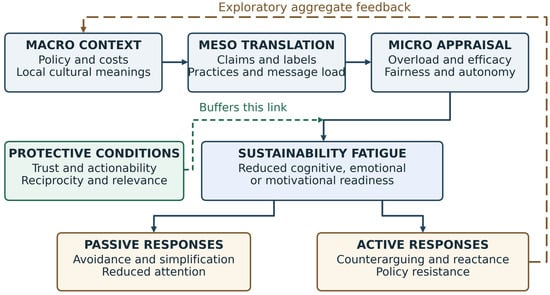
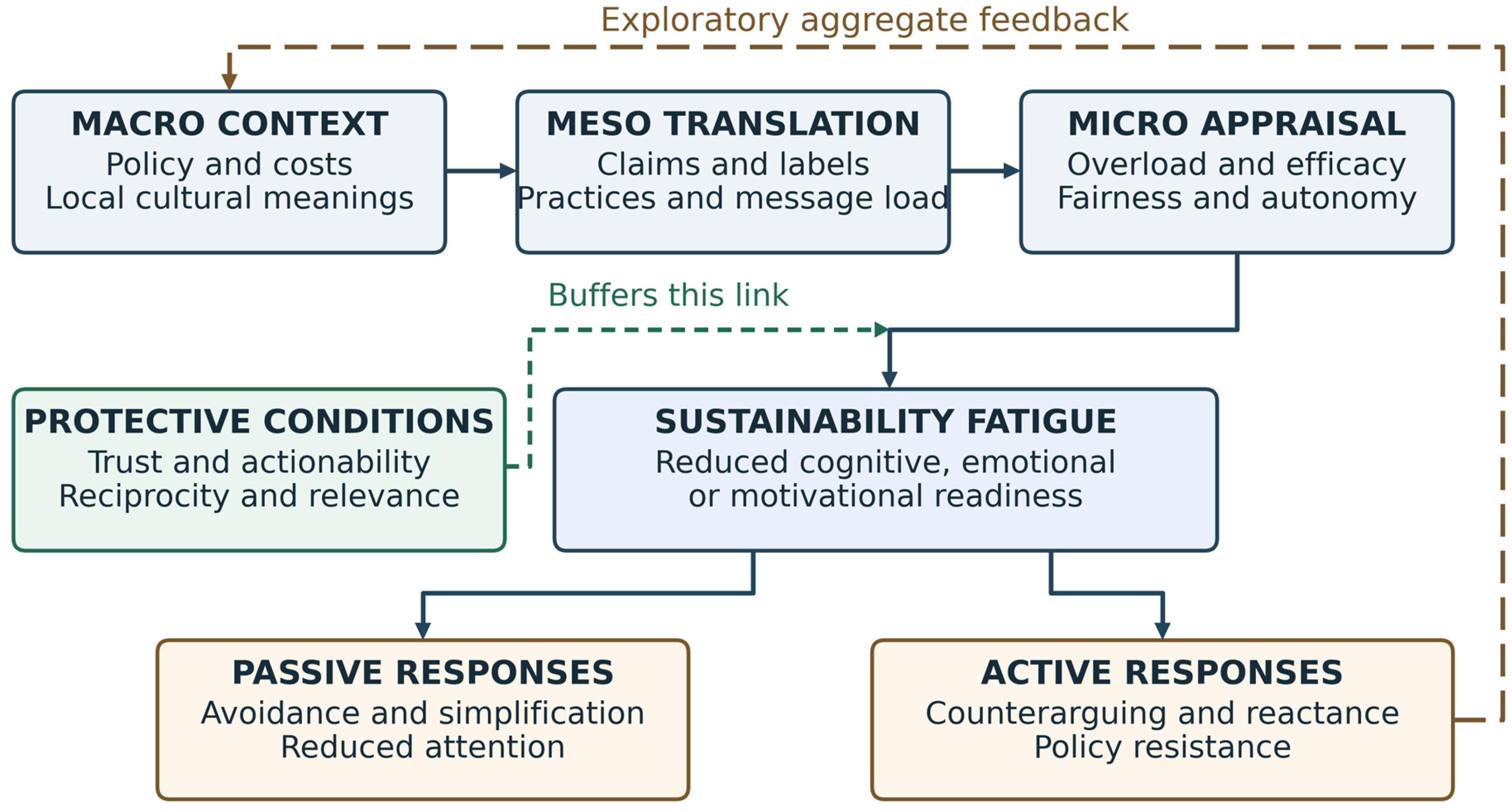
Figure 1 shows the core temporal chain and distinguishes levels of exposure from person-level state and later responses.
Figure 1.
The Multilevel Sustainability Fatigue Framework (MSFF).
Solid arrows denote hypothesized pathways. The short-dashed connector shows that protective conditions moderate the link from micro appraisal to fatigue. The long-dashed arrow shows exploratory aggregate feedback from active responses to the macro context.
4.2. Sustainability Fatigue as a Dynamic Process
The temporal sequence is explicit: externally observable demands at t − 2 precede appraisal at t − 1, experienced sustainability fatigue at t, and a new response to a different or repeated demand at t + 1. This ordering is a testable assumption, not established by existing cross-sectional correlations. A respondent may experience situational fatigue after a specific campaign; generalization requires repeated states and statistically demonstrable carryover to another domain, such as prior green-advertising exhaustion predicting later engagement with a transport-policy message. No universal interval is proposed: relevant lags may range from days for repeated campaigns to months for accumulated policy expectations, and should be empirically calibrated using experience sampling and panels. Depletion means experienced reduced readiness, not proven exhaustion of a literal finite mental resource.
Reverse causation must be tested explicitly: people already disengaged may report greater retrospective fatigue. Designs should therefore compare cross-lagged pathways, randomize prior exposure and hold the later message fixed, and include baseline values and competing explanations. Sustained engagement despite high exposure is predicted when messages are novel, locally meaningful, fair and actionable. Such positive trajectories are an essential countercase rather than a result to suppress.
Cross-domain carryover is a stronger prediction than persistence within one domain. For example, taxing exposure to green claims in household shopping may leave a person less ready to engage with a transport-policy proposal even though the later topic and source are new. A matched non-sustainability task helps distinguish sustainability-specific carryover from general tiredness.
Proposition 11
(cross-domain carryover). Under identical later demands in sustainability domain B, greater independently measured fatigue following earlier demands in sustainability domain A predicts a larger subsequent decline in readiness for B, beyond baseline readiness for B, domain-specific message fatigue, current information overload and general fatigue. Readiness for B is assessed in a later wave and is not used to score fatigue in A.
The prediction is not supported if the lagged association is confined to repeated demands in A, disappears after accounting for the competing constructs, or is equally strong for a matched non-sustainability task. A single cross-domain association does not establish a stable generalized fatigue profile.
The framework also specifies counterfactual boundary cases in which sustainability fatigue should not be the primary explanation. It should be less applicable when sustainability exposure is low; when disengagement clearly predates repeated sustainability demands; when opposition is driven principally by ideology or identity conflict; when sustainable alternatives are structurally unavailable rather than psychologically depleting; when the response is temporary annoyance without reduced capacity or willingness to engage; or when negative emotion continues to mobilize action rather than produce exhaustion. These boundary cases are essential for distinguishing fatigue from other explanations of non-participation.
4.3. Theoretical Streams Underpinning the MSFF
Table 3 shows how the theoretical streams inform the propositions of the MSFF. It distinguishes sources that explain how sustainability demands are appraised from those that explain when fatigue may arise or how it may shape later responses. It also identifies moral licensing as a rival explanation for reduced effort when readiness to engage remains unchanged.
Table 3.
Theoretical sources and their roles in the MSFF propositions.
5. Discussion
5.1. Theoretical Contributions
The principal contribution of the conceptual framework is to reframe a set of seemingly separate sustainability problems as parts of one cumulative process. Existing research often treats message fatigue, information overload, greenwashing, eco-anxiety, reactance, and policy resistance as different outcomes located in different disciplines. The MSFF does not claim that these constructs are interchangeable. Instead, it proposes that they can become sequentially or simultaneously connected when people experience sustainability as an increasingly dense environment of information, moral expectations, market signals, costs, and behavioural demands.
A disconfirming pattern would be that fatigue indicators show no within-person change, no lagged effect, and no incremental ability to account for responses after controlling for domain-specific message fatigue. Conversely, continued engagement despite repetition is entirely compatible with the conditional model when efficacy and relevance remain high. This renders the theory falsifiable and guards against treating any environmental disagreement as pathology.
The distinctive claim is the cross-domain prediction in P11. Its contribution would be supported if fatigue measured in an earlier domain predicts a later change in readiness for a different sustainability demand beyond established predictors. If it does not, a broader fatigue construct may add little to domain-specific explanations.
The second contribution is multilevel. Behavioural sustainability research frequently asks why individuals fail to act consistently with environmental values. That question can unintentionally individualize failure. The MSFF shifts part of the explanatory burden to the transition environment itself. If policies are inconsistent, institutions are untrusted, green claims are difficult to verify, sustainable options are costly, and communications are repetitive, disengagement cannot be understood solely as an absence of environmental concern. Fatigue may be partly system-produced.
Then the framework adds a temporal boundary condition to persuasion and behaviour-change research. Much empirical work examines responses to one intervention. Yet people arrive at each intervention with an exposure history. The hundredth sustainability appeal is psychologically different from the first. This history can affect attention, persuasion knowledge, perceived novelty, and assumptions about source credibility. Longitudinal designs are therefore particularly important for sustainability fatigue because the focal phenomenon is accumulation.
And the article clarifies the relationship between negative environmental emotion and disengagement. Climate anxiety is sometimes discussed as though distress automatically inhibits action. The evidence is more nuanced [11,12]. The MSFF suggests that what matters is whether concern is converted into efficacy and collective agency or remains chronically unresolved. This distinction may explain why similar levels of environmental concern lead to activism in one context and withdrawal in another.
Taken together, these contributions support a broader governance perspective that can be termed the psychological sustainability of the transition. In this article, the phrase refers to the capacity of transition systems to maintain citizens’ cognitive capacity, motivation, perceived agency, trust, and willingness to cooperate over extended periods of change. It is not proposed as a second latent construct. Rather, it is a normative governance implication derived from the MSFF: transition policies may be environmentally ambitious while differing substantially in the extent to which they preserve the human resources required for durable participation. The conceptual hierarchy is therefore explicit: sustainability fatigue is the focal construct, the MSFF is the theoretical framework, and psychological sustainability of the transition is a governance implication.
Connections to Avoidance, Spillover, and Backlash Literatures
The MSFF also connects with bodies of literature that were previously peripheral to the core model. General pro-environmental behaviour research shows that values, situational conditions, risk perceptions, and broader climate-belief structures jointly shape action [63,64,65,66,67]. This matters because fatigue should not be interpreted as a universal explanation for non-action; it is one pathway among several, and incremental validity over these established determinants is a necessary empirical test.
Issue-fatigue research shows that prolonged exposure to a topic can generate both cognitive and emotional forms of fatigue followed by information avoidance [27]. Environmental information-avoidance research likewise identifies excessive exposure, repeated content, emotional arousal, weak agency, and credibility concerns as motives for deliberately disengaging from environmental information [22]. Experimental work on green nudges demonstrates that people may strategically avoid environmental information when behavioural requests become effortful or identity-relevant [23]. These findings strengthen the MSFF’s treatment of avoidance as a downstream coping response rather than a defining component of fatigue.
Guilt and pride can motivate pro-environmental behaviour [28], cynicism can undermine trust in green claims [29], and economic or cultural disagreement can generate climate-policy backlash [30]. None of these responses by itself identifies fatigue. Moral licensing is a separate rival explanation [31]. A person may make less effort after an earlier pro-environmental action because they feel that they have already done their share, even if their readiness is unchanged. Studies should measure perceived prior moral credit separately from fatigue. Reference [31] therefore informs a rival test, not P4.
Two ethnographic and qualitative studies specify a crucial rival explanation. Uryga et al. [68] show how climate issues conceptualized at global versus locally tangible scales can foster distancing without implying depleted sustainability-specific readiness. Scoville-Simonds [69] demonstrates that cultural and religious narratives shape how climate change is interpreted, so the same policy or message cannot be assumed to have the same meaning across contexts. These findings qualify the MSFF: psychological distance and locally situated meaning should be measured independently, and a fatigue explanation should be rejected when disengagement is explained by scale or worldview without within-person depletion.
5.2. Implications for Public Policy and Transition Governance
Public-policy implications are hypotheses to be tested, not established prescriptions. Proposition 7 predicts that affordability and fairness may moderate a future fatigue state; Propositions 4 and 10 propose reciprocity and locally meaningful framing as possible buffers. Policy pilots should therefore measure perceived cost, confusion, institutional trust and ideology alongside fatigue, because any of these alternatives may independently explain resistance. Reducing redundant messages may help some groups, while limiting reliable environmental information could harm others.
Fairness should be treated as a psychological resource as well as a distributional outcome. Procedurally fair processes, understandable justifications, predictable policy pathways, and credible compensation can preserve legitimacy when costs are unavoidable [26,57,60]. Conversely, abrupt or contradictory measures may impose motivational costs beyond their direct financial effect because they weaken confidence that present sacrifices form part of a coherent and reciprocated transition.
Governments may need to manage communication portfolios rather than evaluate individual campaigns in isolation. Different agencies and levels of government can independently produce reasonable sustainability messages that become excessive or contradictory in aggregate. Coordination can reduce duplication, shifting terminology, and incompatible advice. The same principle applies to labels and reporting systems: harmonization should be tested as a means of lowering citizens’ verification and decision burden.
5.3. Implications for Firms, Marketers, and Sustainability Communication
For firms, the framework suggests experimentally testing whether a small set of verifiable sustainability indicators protects later engagement more effectively than claim proliferation (P2, P6a–P6b, P9). Claims about managerial benefits remain hypothetical until individual fatigue is measured separately from immediate consumer confusion, greenwashing perceptions or price sensitivity. Authenticity and autonomy support may also affect acceptance directly without operating through fatigue (P8b), a rival path that future tests must retain.
If a valid measure can be developed, marketers could eventually segment by fatigue state rather than environmental concern alone. A highly concerned but fatigued consumer is theoretically different from an unconcerned consumer: the former may respond to simplification, autonomy, evidence of collective progress, or reduced verification burden, whereas the latter may require salience and relevance. This is a hypothesis generated by the MSFF, not yet an evidence-based segmentation practice, and should be validated experimentally before managerial application.
A further implication concerns tone. Sustainability appeals that rely heavily on guilt, moral status, or controlling language may produce short-term compliance in some audiences but accelerate reactance in others. Autonomy-supportive language does not mean neutrality about environmental consequences. It means communicating choices, trade-offs, and efficacy without unnecessarily implying that the recipient is morally deficient. This is consistent with self-determination and reactance research [41,42,43,44,45].
5.4. Research Agenda and Measurement Development
Scale development should measure the experienced state, using a common time window and sustainability target across items. Candidate indicators include “Right now, it feels harder than usual to muster attention for another sustainability-related task” (cognitive), “Right now, I feel emotionally worn out at the thought of another sustainability-related task” (emotional), and “Right now, I have less energy than usual to get started on another sustainability-related task” (motivational). These are illustrative items, not a validated scale. Measure overload, unresolved concern, efficacy, unfairness and perceived control in separate items. Record avoidance, scepticism and resistance separately as possible outcomes. Use cognitive interviews and repeated observations to assess item interpretation and compare competing dimensional models before selecting a scoring rule.
Construct validation should test discriminant validity against message fatigue, information overload, climate anxiety, environmental concern, general stress/fatigue, green scepticism, reactance, political ideology, and environmental identity. Incremental validity is essential: sustainability fatigue should explain outcomes such as information avoidance, claim discounting, behavioural disengagement, and policy acceptance beyond these established constructs. Measurement invariance should be tested across countries because transition intensity, environmental discourse, trust, purchasing power, and policy regimes vary substantially.
Longitudinal and experimental research should then examine causality. Panel studies can test whether fatigue predicts subsequent withdrawal or whether disengaged individuals retrospectively report greater fatigue. Experience-sampling methods could capture exposure across daily contexts. Experiments can manipulate repetition, information density, choice complexity, autonomy-supportive wording, efficacy, fairness, and source consistency. For P11, measure baseline readiness for domains A and B, vary the burden of earlier demands in A, and assess fatigue before giving everyone the same later task in B. Measure readiness for B before behaviour, and include a matched non-sustainability task to check for general tiredness. Compare a baseline model containing message fatigue, current overload and general fatigue with a model that also includes prior sustainability fatigue (Table 4).
Table 4.
Priority empirical tests of the MSFF.
5.5. Limitations
The propositions are hypotheses. The closest empirical comparator measures climate-message fatigue, not the broader state proposed here. Adjacent sustainability studies and evidence from other settings help explain why particular links might hold, but they do not establish the causal sequence or cross-domain transfer.
The paper is a conceptual theory-synthesis article rather than a systematic review or meta-analysis; its engagement with the literature is purposive and organized around theory development.
Much of the relevant empirical grounding comes from high-income contexts, especially Europe, North America, Australia, and New Zealand. Sustainability fatigue may operate differently where climate vulnerability is more acute, sustainability communication is less saturated, or sustainable alternatives are structurally unavailable.
The temporal and cross-domain assumptions of the MSFF remain largely untested; longitudinal evidence is needed to distinguish fatigue from pre-existing disengagement and to determine when situational fatigue generalizes across domains.
Withdrawal can be a rational response to misleading information or impracticable demands. Scepticism and resistance should not be interpreted as fatigue without separate evidence of reduced readiness.
6. Conclusions
The green transition is often discussed as a race to accelerate technology, regulation, investment, and behavioural change. Acceleration is necessary, but it creates a complementary governance problem: the transition must preserve the human capacity to participate in it. This conceptual article has argued that repeated sustainability exposure can become depleting when information is excessive, choices are complex, responsibility appears unreciprocated, autonomy is threatened, claims are difficult to trust, costs appear unfair, or effort seems ineffective. The resulting MSFF is deliberately presented as a testable conceptual architecture rather than a validated causal model.
Sustainability fatigue is a sustainability-specific state of reduced cognitive, emotional or motivational readiness for renewed engagement, relative to the person’s prior functioning. Exposure and appraisals are proposed antecedents. Avoidance, scepticism and resistance are possible consequences, not criteria for identifying the state. The distinctive test is whether fatigue in one sustainability domain predicts later reduced readiness in another after competing explanations are taken into account (P11).
The practical question is whether the design of transition demands can help people sustain engagement over time. That question depends on empirical tests of the state’s dimensional structure, its distinction from adjacent constructs and its incremental predictive value. The MSFF offers hypotheses for these tests and does not imply that ambitious environmental policy should be weakened.
Funding
This research received no external funding.
Institutional Review Board Statement
Not applicable.
Informed Consent Statement
Not applicable.
Data Availability Statement
No new empirical data were created or analyzed in this conceptual study. The theoretical framework is grounded in the published sources cited in the reference list.
Acknowledgments
ChatGPT Codex based on GPT-6 (OpenAI) assisted with translation to English and preparation of Figure 1. The author takes responsibility for the manuscript and its references.
Conflicts of Interest
The author declares no conflicts of interest.
Abbreviations
Abbreviations used in the manuscript.
| Abbreviation | Meaning |
| MSFF | Multilevel Sustainability Fatigue Framework |
| ESG | Environmental, Social and Governance |
| EFA | Exploratory Factor Analysis |
| CFA | Confirmatory Factor Analysis |
Appendix A. Theoretical Foundations of the MSFF
Table A1 gives each source one primary role using the criteria in Section 2.2. The proposition column records the main conceptual application, not an empirical validation. Reference [5] is the closest empirical comparator. The message-fatigue, health and news studies [6,7,27] provide analogical evidence. Reference [31] informs the rival explanation of moral licensing.
Table A1.
Mapping of cited sources to conceptual roles in the Multilevel Sustainability Fatigue Framework.
References
- IPCC. Climate Change 2023: Synthesis Report. Contribution of Working Groups I, II and III to the Sixth Assessment Report of the Intergovernmental Panel on Climate Change; IPCC: Geneva, Switzerland, 2023. [Google Scholar] [CrossRef] [Scilit]
- Geels, F.W. Technological transitions as evolutionary reconfiguration processes: A multi-level perspective and a case-study. Res. Policy 2002, 31, 1257–1274. [Google Scholar] [CrossRef] [Scilit]
- Markard, J.; Raven, R.; Truffer, B. Sustainability transitions: An emerging field of research and its prospects. Res. Policy 2012, 41, 955–967. [Google Scholar] [CrossRef] [Scilit]
- European Commission. The European Green Deal; COM(2019) 640 Final; European Commission: Brussels, Belgium, 2019. [Google Scholar]
- de Graaf, J.; Bal, M.; de Wit, J.; Stok, M. Tired of climate change communication: Why message fatigue predicts lower sustainability intentions and policy acceptance after climate change threat messages. Appl. Environ. Educ. Commun. 2026, 25, 125–140. [Google Scholar] [CrossRef] [Scilit]
- So, J.; Kim, S.; Cohen, H. Message fatigue: Conceptual definition, operationalization, and correlates. Commun. Monogr. 2017, 84, 5–29. [Google Scholar] [CrossRef] [Scilit]
- Kim, S.; So, J. How message fatigue toward health messages leads to ineffective persuasive outcomes: Examining the mediating roles of reactance and inattention. J. Health Commun. 2018, 23, 109–116. [Google Scholar] [CrossRef] [Scilit]
- Font, X.; Andreu, L.; Mattila, A.S.; Aldas-Manzano, J. Sustainability information overload: Its effect on customers’ greenwashing perceptions, perceived value, and behavioral intentions. J. Hosp. Tour. Manag. 2025, 62, 196–204. [Google Scholar] [CrossRef] [Scilit]
- Clayton, S.; Karazsia, B.T. Development and validation of a measure of climate change anxiety. J. Environ. Psychol. 2020, 69, 101434. [Google Scholar] [CrossRef] [Scilit]
- Hogg, T.L.; Stanley, S.K.; O’Brien, L.V.; Wilson, M.S.; Watsford, C.R. The Hogg Eco-Anxiety Scale: Development and validation of a multidimensional scale. Glob. Environ. Change 2021, 71, 102391, Correction in Glob. Environ. Change 2023, 78, 102623. [Google Scholar] [CrossRef] [Scilit]
- Ogunbode, C.A.; Doran, R.; Hanss, D.; Ojala, M.; Salmela-Aro, K.; van den Broek, K.L.; Bhullar, N.; Aquino, S.D.; Marot, T.; Aitken Schermer, J.; et al. Climate anxiety, wellbeing and pro-environmental action: Correlates of negative emotional responses to climate change in 32 countries. J. Environ. Psychol. 2022, 84, 101887. [Google Scholar] [CrossRef] [Scilit]
- Davì, D.; Lo Destro, C.; Melchiori, F. How does eco-anxiety relate to pro-environmental behavior? A correlational meta-analysis with clinical and social implications. Soc. Sci. 2026, 15, 88. [Google Scholar] [CrossRef] [Scilit]
- Hickman, C.; Marks, E.; Pihkala, P.; Clayton, S.; Lewandowski, R.E.; Mayall, E.E.; Wray, B.; Mellor, C.; van Susteren, L. Climate anxiety in children and young people and their beliefs about government responses to climate change: A global survey. Lancet Planet. Health 2021, 5, e863–e873. [Google Scholar] [CrossRef] [Scilit]
- Whittemore, R.; Knafl, K. The integrative review: Updated methodology. J. Adv. Nurs. 2005, 52, 546–553. [Google Scholar] [CrossRef] [Scilit]
- Torraco, R.J. Writing integrative literature reviews: Guidelines and examples. Hum. Resour. Dev. Rev. 2005, 4, 356–367. [Google Scholar] [CrossRef] [Scilit]
- Snyder, H. Literature review as a research methodology: An overview and guidelines. J. Bus. Res. 2019, 104, 333–339. [Google Scholar] [CrossRef] [Scilit]
- Jaakkola, E. Designing conceptual articles: Four approaches. AMS Rev. 2020, 10, 18–26. [Google Scholar] [CrossRef] [Scilit]
- Page, M.J.; McKenzie, J.E.; Bossuyt, P.M.; Boutron, I.; Hoffmann, T.C.; Mulrow, C.D.; Shamseer, L.; Tetzlaff, J.M.; Akl, E.A.; Brennan, S.E.; et al. The PRISMA 2020 statement: An updated guideline for reporting systematic reviews. BMJ 2021, 372, n71. [Google Scholar] [CrossRef] [Scilit]
- Alvesson, M.; Sandberg, J. Generating research questions through problematization. Acad. Manag. Rev. 2011, 36, 247–271. [Google Scholar] [CrossRef] [Scilit]
- MacInnis, D.J. A framework for conceptual contributions in marketing. J. Mark. 2011, 75, 136–154. [Google Scholar] [CrossRef] [Scilit]
- Scheibehenne, B.; Greifeneder, R.; Todd, P.M. Can there ever be too many options? A meta-analytic review of choice overload. J. Consum. Res. 2010, 37, 409–425. [Google Scholar] [CrossRef] [Scilit]
- Deline, M.B.; Rickard, L.N.; Katreeb, M.; Adams, M. ‘Hide Our Heads in the Sand’: Environmental information avoidance motives in the United States. Front. Commun. 2024, 9, 1468968. [Google Scholar] [CrossRef] [Scilit]
- d’Adda, G.; Gao, Y.; Golman, R.; Tavoni, M. Strategic information avoidance, belief manipulation and the effectiveness of green nudges. Ecol. Econ. 2024, 222, 108191. [Google Scholar] [CrossRef] [Scilit]
- Chen, Y.-S.; Chang, C.-H. Greenwash and green trust: The mediation effects of green consumer confusion and green perceived risk. J. Bus. Ethics 2013, 114, 489–500. [Google Scholar] [CrossRef] [Scilit]
- Jugert, P.; Greenaway, K.H.; Barth, M.; Büchner, R.; Eisentraut, S.; Fritsche, I. Collective efficacy increases pro-environmental intentions through increasing self-efficacy. J. Environ. Psychol. 2016, 48, 12–23. [Google Scholar] [CrossRef] [Scilit]
- Maestre-Andrés, S.; Drews, S.; van den Bergh, J. Perceived fairness and public acceptability of carbon pricing: A review of the literature. Clim. Policy 2019, 19, 1186–1204. [Google Scholar] [CrossRef] [Scilit]
- Schumann, C. When news topics annoy—Exploring issue fatigue and subsequent information avoidance and extended coping strategies. Journal. Media 2022, 3, 538–556. [Google Scholar] [CrossRef] [Scilit]
- Shipley, N.J.; van Riper, C.J. Pride and guilt predict pro-environmental behavior: A meta-analysis of correlational and experimental evidence. J. Environ. Psychol. 2022, 79, 101753. [Google Scholar] [CrossRef] [Scilit]
- Policarpo, M.C.; Apaolaza, V.; Hartmann, P.; Paredes, M.R.; D’Souza, C. Social cynicism, greenwashing, and trust in green clothing brands. Int. J. Consum. Stud. 2023, 47, 1950–1961. [Google Scholar] [CrossRef] [Scilit]
- Patterson, J.; Anisimova, K.; Logg-Scarvell, J.; Kaiser, C. Reactions to policy action: Socio-political conditions of backlash to climate change policy. Policy Sci. 2025, 58, 287–320. [Google Scholar] [CrossRef] [Scilit]
- Yuriev, A. The slippery slope of green deeds: A scoping review of moral licensing in studies on proenvironmental behaviors. Sustain. Dev. 2026, e71601. [Google Scholar] [CrossRef] [Scilit]
- Eppler, M.J.; Mengis, J. The concept of information overload: A review of literature from organization science, accounting, marketing, MIS, and related disciplines. Inf. Soc. 2004, 20, 325–344. [Google Scholar] [CrossRef] [Scilit]
- Jacoby, J.; Speller, D.E.; Kohn, C.A. Brand choice behavior as a function of information load. J. Mark. Res. 1974, 11, 63–69. [Google Scholar] [CrossRef] [Scilit]
- Iyengar, S.S.; Lepper, M.R. When choice is demotivating: Can one desire too much of a good thing? J. Pers. Soc. Psychol. 2000, 79, 995–1006. [Google Scholar] [CrossRef]
- Pihkala, P. Anxiety and the ecological crisis: An analysis of eco-anxiety and climate anxiety. Sustainability 2020, 12, 7836. [Google Scholar] [CrossRef] [Scilit]
- Lyon, T.P.; Montgomery, A.W. The means and end of greenwash. Organ. Environ. 2015, 28, 223–249. [Google Scholar] [CrossRef] [Scilit]
- Nyilasy, G.; Gangadharbatla, H.; Paladino, A. Perceived greenwashing: The interactive effects of green advertising and corporate environmental performance on consumer reactions. J. Bus. Ethics 2014, 125, 693–707. [Google Scholar] [CrossRef] [Scilit]
- Schmuck, D.; Matthes, J.; Naderer, B. Misleading consumers with green advertising? An affect–reason–involvement account of greenwashing effects in environmental advertising. J. Advert. 2018, 47, 127–145. [Google Scholar] [CrossRef] [Scilit]
- Delmas, M.A.; Burbano, V.C. The drivers of greenwashing. Calif. Manag. Rev. 2011, 54, 64–87. [Google Scholar] [CrossRef] [Scilit]
- de Freitas Netto, S.V.; Sobral, M.F.F.; Ribeiro, A.R.B.; Soares, G.R.L. Concepts and forms of greenwashing: A systematic review. Environ. Sci. Eur. 2020, 32, 19. [Google Scholar] [CrossRef] [Scilit]
- Steindl, C.; Jonas, E.; Sittenthaler, S.; Traut-Mattausch, E.; Greenberg, J. Understanding psychological reactance: New developments and findings. Z. Psychol. 2015, 223, 205–214. [Google Scholar] [CrossRef] [Scilit]
- Rains, S.A. The nature of psychological reactance revisited: A meta-analytic review. Hum. Commun. Res. 2013, 39, 47–73. [Google Scholar] [CrossRef] [Scilit]
- Dillard, J.P.; Shen, L. On the nature of reactance and its role in persuasive health communication. Commun. Monogr. 2005, 72, 144–168. [Google Scholar] [CrossRef] [Scilit]
- Brehm, J.W. A Theory of Psychological Reactance; Academic Press: New York, NY, USA, 1966. [Google Scholar]
- Deci, E.L.; Ryan, R.M. The ‘what’ and ‘why’ of goal pursuits: Human needs and the self-determination of behavior. Psychol. Inq. 2000, 11, 227–268. [Google Scholar] [CrossRef] [Scilit]
- Ojala, M. Hope and climate change: The importance of hope for environmental engagement among young people. Environ. Educ. Res. 2012, 18, 625–642. [Google Scholar] [CrossRef] [Scilit]
- Stern, P.C.; Dietz, T. The value basis of environmental concern. J. Soc. Issues 1994, 50, 65–84. [Google Scholar] [CrossRef] [Scilit]
- van der Werff, E.; Steg, L.; Keizer, K. I am what I am, by looking past the present: The influence of biospheric values and past behavior on environmental self-identity. Environ. Behav. 2014, 46, 626–657. [Google Scholar] [CrossRef] [Scilit]
- Steg, L.; Vlek, C. Encouraging pro-environmental behaviour: An integrative review and research agenda. J. Environ. Psychol. 2009, 29, 309–317. [Google Scholar] [CrossRef] [Scilit]
- White, K.; Habib, R.; Hardisty, D.J. How to SHIFT consumer behaviors to be more sustainable: A literature review and guiding framework. J. Mark. 2019, 83, 22–49. [Google Scholar] [CrossRef] [Scilit]
- Gifford, R. The dragons of inaction: Psychological barriers that limit climate change mitigation and adaptation. Am. Psychol. 2011, 66, 290–302. [Google Scholar] [CrossRef] [Scilit]
- Schwartz, S.H. Normative influences on altruism. Adv. Exp. Soc. Psychol. 1977, 10, 221–279. [Google Scholar] [CrossRef] [Scilit]
- van Zomeren, M.; Postmes, T.; Spears, R. Toward an integrative social identity model of collective action: A quantitative research synthesis of three socio-psychological perspectives. Psychol. Bull. 2008, 134, 504–535. [Google Scholar] [CrossRef] [Scilit]
- van Valkengoed, A.M.; Steg, L. Meta-analyses of factors motivating climate change adaptation behaviour. Nat. Clim. Change 2019, 9, 158–163. [Google Scholar] [CrossRef] [Scilit]
- Friestad, M.; Wright, P. The Persuasion Knowledge Model: How people cope with persuasion attempts. J. Consum. Res. 1994, 21, 1–31. [Google Scholar] [CrossRef] [Scilit]
- Kitt, S.; Axsen, J.; Long, Z.; Rhodes, E. The role of trust in citizen acceptance of climate policy: Comparing perceptions of government competence, integrity and value similarity. Ecol. Econ. 2021, 183, 106958. [Google Scholar] [CrossRef] [Scilit]
- Carattini, S.; Carvalho, M.; Fankhauser, S. Overcoming public resistance to carbon taxes. WIREs Clim. Change 2018, 9, e531. [Google Scholar] [CrossRef] [Scilit]
- Wüstenhagen, R.; Wolsink, M.; Bürer, M.J. Social acceptance of renewable energy innovation: An introduction to the concept. Energy Policy 2007, 35, 2683–2691. [Google Scholar] [CrossRef] [Scilit]
- Devine-Wright, P. Rethinking NIMBYism: The role of place attachment and place identity in explaining place-protective action. J. Community Appl. Soc. Psychol. 2009, 19, 426–441. [Google Scholar] [CrossRef] [Scilit]
- Drews, S.; van den Bergh, J.C.J.M. What explains public support for climate policies? A review of empirical and experimental studies. Clim. Policy 2016, 16, 855–876. [Google Scholar] [CrossRef] [Scilit]
- Tannenbaum, M.B.; Hepler, J.; Zimmerman, R.S.; Saul, L.; Jacobs, S.; Wilson, K.; Albarracín, D. Appealing to fear: A meta-analysis of fear appeal effectiveness and theories. Psychol. Bull. 2015, 141, 1178–1204. [Google Scholar] [CrossRef] [Scilit]
- Witte, K.; Allen, M. A meta-analysis of fear appeals: Implications for effective public health campaigns. Health Educ. Behav. 2000, 27, 591–615. [Google Scholar] [CrossRef] [Scilit]
- Stern, P.C. New environmental theories: Toward a coherent theory of environmentally significant behavior. J. Soc. Issues 2000, 56, 407–424. [Google Scholar] [CrossRef] [Scilit]
- Steg, L.; Bolderdijk, J.W.; Keizer, K.; Perlaviciute, G. An integrated framework for encouraging pro-environmental behaviour: The role of values, situational factors and goals. J. Environ. Psychol. 2014, 38, 104–115. [Google Scholar] [CrossRef] [Scilit]
- van der Linden, S. The social-psychological determinants of climate change risk perceptions: Towards a comprehensive model. J. Environ. Psychol. 2015, 41, 112–124. [Google Scholar] [CrossRef] [Scilit]
- Hornsey, M.J.; Harris, E.A.; Bain, P.G.; Fielding, K.S. Meta-analyses of the determinants and outcomes of belief in climate change. Nat. Clim. Change 2016, 6, 622–626. [Google Scholar] [CrossRef] [Scilit]
- Capstick, S.; Whitmarsh, L.; Poortinga, W.; Pidgeon, N.; Upham, P. International trends in public perceptions of climate change over the past quarter century. WIREs Clim. Change 2015, 6, 35–61, Correction in WIREs Clim. Change 2015, 6, 435. [Google Scholar] [CrossRef] [Scilit]
- Uryga, D.; Geirbo, H.C.; Romanowska, M.; Duda, E. Two crises. Constructing the meaning of the “climate crisis” by the residents of Gdańsk. Polit. Geogr. 2025, 123, 103422. [Google Scholar] [CrossRef] [Scilit]
- Scoville-Simonds, M. Climate, the Earth, and God—Entangled narratives of cultural and climatic change in the Peruvian Andes. World Dev. 2018, 110, 345–359. [Google Scholar] [CrossRef] [Scilit]

Disclaimer/Publisher’s Note: The statements, opinions and data contained in all publications are solely those of the individual author(s) and contributor(s) and not of MDPI and/or the editor(s). MDPI and/or the editor(s) disclaim responsibility for any injury to people or property resulting from any ideas, methods, instructions or products referred to in the content. |
© 2026 by the author. Licensee MDPI, Basel, Switzerland. This article is an open access article distributed under the terms and conditions of the Creative Commons Attribution (CC BY) license.