


Highlights
- Proposed an asymmetric bilateral teleoperation architecture combining master-side impedance control for force feedback and slave-side adaptive SMC for robust tracking.
- Integrates RBFNN-based adaptive compensation into slave SMC to reduce sensitivity to model parameter uncertainty.
- Demonstrates substantially lower tracking errors than conventional SMC under 20–40% parameter mismatch.
- Lyapunov analysis establishes bounded adaptive estimation errors and asymptotic slave position-error convergence under the stated conditions.
Abstract
This paper investigates bilateral teleoperation under time-varying communication delays and dynamic uncertainties. A role-specific asymmetric master–slave control architecture is proposed, in which impedance control is assigned to the master side for interaction-dynamics shaping and force feedback, while adaptive sliding mode control (SMC) is employed at the slave side for robust position tracking. A radial basis function neural network (RBFNN) is integrated into the slave-side SMC to compensate for uncertain nonlinear dynamics without requiring exact identification of the slave model. The adaptive laws are derived using Lyapunov stability analysis, and the approximation and adaptive estimation errors are explicitly considered. Under the stated boundedness conditions, the adaptive estimation errors and sliding variable remain bounded, and the slave position tracking error asymptotically converges to zero. The simulation results show that the proposed method substantially reduces the sensitivity of tracking performance to model uncertainty, with the IAPE remaining between 0.0031 and 0.0035 under 20–40% mismatch, compared with 0.2029–0.4057 for conventional SMC. Additional simulations with time-varying communication delays demonstrate bounded tracking performance, although delay-induced phase shifts and transient oscillations remain. The results demonstrate the robustness of the proposed role-specific architecture under the considered uncertainty and communication conditions, while higher-DOF and experimental validation remain subjects for future work.
1. Introduction
The concept of bilateral teleoperation dates back to the 1950s [1,2], when early systems were developed for the remote manipulation of robotic devices operating in hazardous or inaccessible environments. Since then, it has evolved into a key enabling technology for a wide range of applications, including telesurgery [3], space robotics [4]. The primary objective of a bilateral teleoperation system is to achieve high transparency, allowing the human operator to perceive the remote environment as if interacting with it directly [5]. This requires accurate position synchronization between the master and slave manipulators, along with stable and realistic force feedback. A typical teleoperation system consists of a master device manipulated by a human operator and a slave device interacting with a remote environment, connected via a bilateral communication channel [6]. The two subsystems therefore have different physical functions: the master should provide an appropriate interaction response and convey environmental force information to the operator, whereas the slave should accurately execute the commanded motion while rejecting disturbances and uncertainties. From a networked control perspective, such systems can be modeled as distributed dynamic systems in which stability, transparency, and robustness must be maintained under uncertain and time-varying communication conditions [7].
To satisfy these requirements, numerous control strategies have been proposed for bilateral teleoperation systems. Passivity-based approaches, including the Time Domain Passivity Approach [8,9] and wave-variable methods [10,11,12], are widely adopted to guarantee stability under communication delays. However, this is often achieved by introducing additional damping, which degrades transparency and reduces the fidelity of force feedback. Impedance control [13,14] provides an intuitive framework for regulating interaction dynamics and performs effectively under nominal conditions; nevertheless, its performance is sensitive to time delays and parameter uncertainties, which may deteriorate interaction quality in networked environments. In addition, a passive environment is required.
Robust control techniques such as Sliding Mode Control (SMC) have been widely studied for robotic systems because of their strong robustness against disturbances and modeling uncertainties, as shown in prior works on adaptive and nonsingular sliding-mode control strategies [15,16]. For bilateral teleoperation, SMC enables reliable tracking performance [17,18]. Despite this advantage, they may suffer from complexity, chattering effects, and require careful parameter tuning to achieve smooth control action. Adaptive and intelligent approaches [19,20], including neural-network-based methods, have been introduced to handle unknown nonlinear dynamics. Other techniques, such as fuzzy logic systems [21,22,23] and deep learning-based controllers [24,25], also provide powerful approximation capabilities. However, they often rely on extensive tuning or training data and may lack rigorous stability guarantees, which limits their applicability in real-time and safety-critical systems. In addition, most of them use the position-position structure that reduces the force reflection quality.
In addition, model-mediated teleoperation methods have been proposed to mitigate communication delays by introducing local models of the remote environment. While effective in reducing the impact of delays, their performance strongly depends on model accuracy, and modeling errors may result in distorted force feedback and reduced transparency. Four-channel control architectures [26,27] have also been extensively studied due to their potential to achieve high transparency through bidirectional transmission of position and force signals. Various extensions have been proposed, including combinations with wave-variable techniques [28] to improve stability under communication delays, as well as integrations with advanced control methods such as Sliding Mode Control (SMC) [29] to enhance robustness. However, these approaches often increase structural complexity and still face challenges in simultaneously maintaining stability, transparency, and robustness in the presence of time-varying delays and model uncertainties.
Although these approaches have demonstrated effectiveness in specific aspects of bilateral teleoperation, several limitations remain when model uncertainty and time-varying communication delays occur simultaneously. In particular, adaptive RBFNN- and SMC-based methods have been widely investigated for nonlinear teleoperation systems, but the control objectives of the master and slave subsystems are often not explicitly separated according to their different functional roles. Symmetric position-position architectures can simplify controller design but may attenuate force feedback, whereas asymmetric architectures can become sensitive to inaccuracies in the slave dynamic model. These observations motivate a control architecture that distinguishes interaction-oriented control at the master side from robust motion control at the slave side.
The present work addresses this issue through a role-specific asymmetric bilateral control architecture. The contribution is not the introduction of a fundamentally new impedance controller, SMC formulation, or RBFNN, since these techniques are individually well established. Instead, the contribution lies in their coordinated allocation according to the different functional requirements of the master and slave subsystems. Impedance control [30] is employed at the master side to regulate the desired interaction dynamics and force feedback, whereas RBFNN-based adaptive SMC [31,32] is employed at the slave side to compensate for uncertain nonlinear dynamics and improve position tracking robustness. From a theoretical perspective, this role-specific allocation enables the adaptive compensation mechanism to be incorporated into the slave-side robust controller while retaining the interaction-oriented impedance structure at the master side, providing a coordinated framework for analyzing tracking robustness under model uncertainties. From a practical perspective, the asymmetric allocation avoids imposing the same control objective on both subsystems: the master prioritizes interaction and force feedback, whereas the slave prioritizes accurate and robust motion execution. The effectiveness of this coordinated architecture is further evaluated under parameter mismatches and time-varying communication delays, demonstrating its ability to maintain low tracking errors under the considered conditions.
To further improve performance under unknown nonlinearities, a three-layer Radial Basis Function (RBF) neural network [33] is incorporated as an adaptive approximator. The adaptation mechanism is designed based on a Lyapunov stability framework, ensuring convergence of the estimation process and stability of the overall closed-loop system. In addition, a comprehensive evaluation framework is established to assess system performance under both nominal conditions with accurately known parameters and uncertain conditions with parameter mismatches, providing a systematic validation of tracking accuracy and robustness.
The main contributions of this work can therefore be summarized as follows: (1) A role-specific asymmetric bilateral teleoperation architecture is developed, assigning master-side impedance control to interaction and force-feedback regulation and slave-side adaptive SMC to robust motion tracking; (2) An RBFNN-based adaptive compensation mechanism is incorporated into the slave SMC to reduce dependence on an exact slave dynamic model, with approximation and adaptive estimation errors explicitly considered in the Lyapunov analysis; (3) The stability analysis establishes boundedness of the sliding variable and adaptive estimation errors and asymptotic convergence of the slave position tracking error under the stated conditions; and (4) The proposed controller is quantitatively evaluated against conventional SMC under nominal parameters, 20–40% parameter mismatch, and time-varying communication delays, demonstrating substantially improved robustness to the considered model uncertainties.
The remainder of this paper is organized as follows. Section 2 describes the bilateral teleoperation model and control structure. Section 3 presents the master-side impedance controller and slave-side sliding-mode controller. Section 4 develops the RBFNN-based adaptive sliding-mode controller and its Lyapunov-based stability analysis. Section 5 presents simulation results under nominal parameters, parameter uncertainties, and time-varying communication delays. Section 6 discusses the obtained results and limitations of the current study, and Section 7 concludes the paper.
2. Bilateral Teleoperation Structures
The bilateral teleoperation system comprises a master device that directly interacts with humans and a slave device that executes tasks remotely. The master and slave robots communicate with each other via a communication environment. Both the master and slave are n-DOF systems, specifically characterized by the following equations:
where Mm and Ms are the inertia matrices, Cm and Cs are the Coriolis and centrifugal matrices, Gm and Gs are the gravity vectors. um and us are the control inputs applied to the master and slave robot, fh is the force applied by the human operator to the master robot, and fe is the environmental force applied to the slave robot. and are the master and slave position vectors.
The mathematical formulation in (1) and (2) is expressed for a general N-DOF master–slave system. This general formulation is retained throughout the controller design and stability analysis. For numerical evaluation, however, a 1-DOF case is considered to provide a transparent assessment of the adaptive compensation mechanism and its sensitivity to parameter uncertainty and communication delay. Therefore, the N-DOF formulation represents the theoretical scope of the controller, whereas the 1-DOF simulation defines the scope of the numerical validation presented in this study.
The objective of bilateral teleoperation is to enable the slave robot to track the master robot’s position while the force feedback at the master side tracks the environment force.
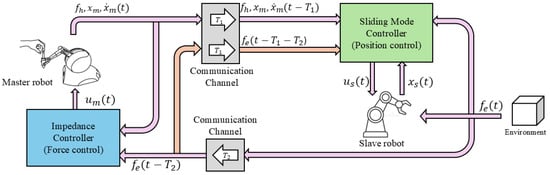
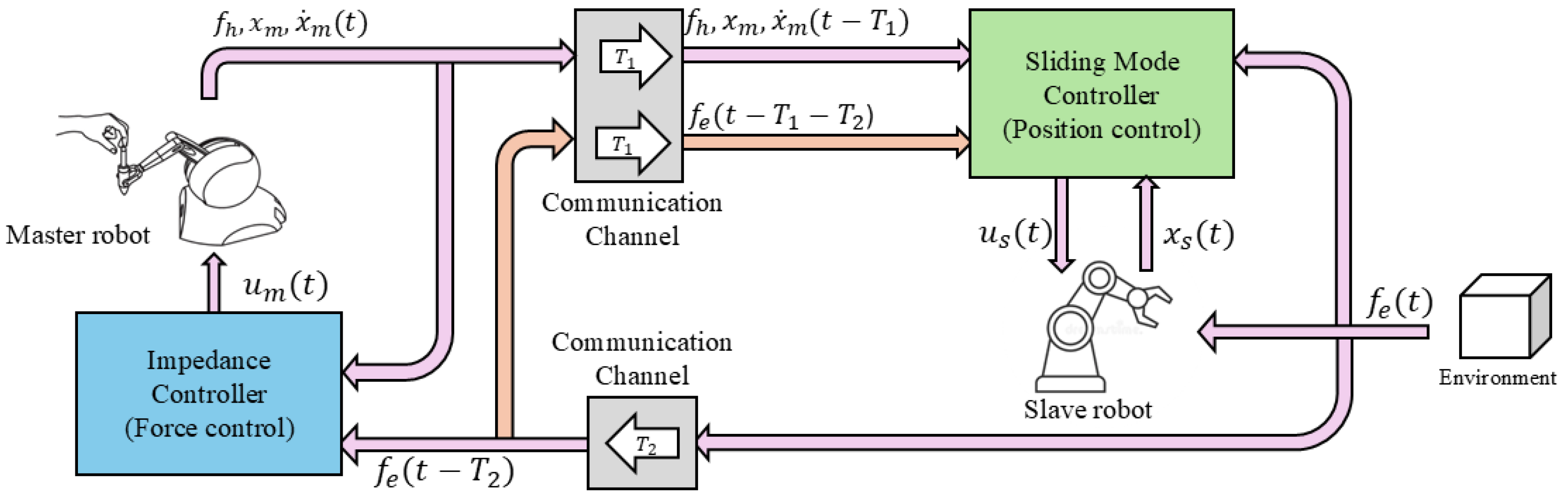
xsd(t) = kpxm(t − T1); , where xsd(t) is the reference for the position controller at the slave site, and fmd(t) is the reference for the force controller at the master site. T1, T2 are the communication delay times, and kp, kf are scaling factors. To achieve this objective, this paper proposes a sliding mode position controller at the slave side that guarantees position tracking and overall system stability despite communication time delays and scaling. At the master side, impedance control is employed to achieve force tracking. Figure 1 shows the diagram of the proposed control scheme. The design procedure is presented in the following sections.
Figure 1.
The proposed bilateral teleoperation scheme.
3. Control Design
3.1. Impedance Control
For the master side, the desired impedance characteristic is designed for the master as [30]:
where M, B and K are the inertia, damping, and stiffness of the desired impedance, kf is the force scaling factor (representing the attenuation or amplification of the force transmitted from the slave side). By combining (3) with (1) to remove , the control input for the master is calculated as:
3.2. Sliding Mode Control
Define , , , then (2) becomes:
Choose the sliding surface as:
where , and . λ is the positive diagonal matrix. Then:
In addition, , and , which leads to:
Then,
By choosing the reaching law , the control input is determined as:
Substituting , , into (10), the sliding mode controller in the detailed form is expressed as follows:
To prove the system stability with control law (11), choose a Lyapunov candidate function as:
Then . Hence, the sliding variable is driven toward the sliding manifold under the reaching-law condition. When s = 0, the sliding-surface definition gives where λ is the positive diagonal matrix. Consequently, the tracking position error asymptotically converges to 0.
It is important to distinguish this convergence result from a claim of delay-free teleoperation performance. The convergence condition derived for the slave tracking error does not explicitly contain the communication delay or the position and force scaling factors. Nevertheless, the communication delays remain present in the delayed reference signals and therefore affect the transient synchronization and interaction performance of the bilateral system.
With the impedance controller (4) of the master robot and position controller (11) of the slave robot, the system operates as expected: the master and slave exhibit identical motion with negligible position tracking error, and the interaction force with the environment is transmitted to the master through the force-feedback channel according to the selected impedance and scaling parameters.
4. Adaptive Sliding Mode Control for the Slave Robot
The controller in (11) relies heavily on the system model, which is time-varying and difficult to identify accurately. To address this issue and enhance system performance, an RBF-based adaptive mechanism is introduced to approximate the system model. The RBFNN is a feedforward neural network consisting of an input layer, a hidden layer, and an output layer. The RBF neural network output y is calculated as:
where is the network weight vector, is the Gaussian function vector. The Gaussian function hj is determined by
where is the input vector, is the center and bj is the radius of the Gaussian function.
In this paper, two RBF neural networks are used to approximate and G(x). The ideal output values of the RBF networks are calculated as:
with εf and εg are the estimated error vectors. W* and V* are ideal weight matrices. In addition, the estimation and of and G(x) are calculated as:
where and are estimated weight matrices.
By using the estimated functions instead of the real function, the control law (10) now becomes
The adaptive weight-update laws are then derived as follows. From (7) we have:
where ; ; and , .
Substituting (8) and (15) into (20) yields:
Choose a Lyapunov candidate function V2 as
Then,
Assuming that εf + εgus is bounded, i.e., ‖εf + εgus‖ ≤ D, by choosing η ≥ D then sT(εf + εgus) ≤ D‖s‖ ≤ η‖s‖ = ηsTsign(s). This leads to sT[εf + εgus − ηsign(s)] ≤ 0
In addition, choose the weight updating law
With the weight updating laws (23) and (24), the derivative of the Lyapunov candidate function . For V2 ≥ 0 and , V2 is bounded, which means s, and are bounded. Furthermore, when s = 0, the invariant-set condition gives . By LaSalle’s invariance principle, the slave tracking error xs − xsd asymptotically converges to zero under the stated boundedness and approximation-error conditions. The analysis therefore establishes bounded adaptive estimation errors and asymptotic slave position-error convergence; it does not require convergence of the individual RBFNN weights to their ideal values.
5. Simulation Results
The simulation study is intentionally restricted to a 1-DOF bilateral teleoperation system. This choice is made to isolate the effects of model parameter mismatch and time-varying communication delays and to allow a direct quantitative comparison between conventional SMC and the proposed adaptive SMC. The restriction to 1-DOF should not be interpreted as a limitation of the mathematical formulation, which is developed for an N-DOF system in Section 2, Section 3 and Section 4. Rather, it defines the scope of the present numerical validation. Higher-DOF simulations and experimental implementation are reserved for future work.
To evaluate the efficacy of the proposed adaptive SMC, numerical simulations were performed on a 1-DOF bilateral teleoperation system. The proposed algorithm is benchmarked against conventional SMC in terms of tracking accuracy and robustness to parameter uncertainties. The Integral of Absolute Position Error (IAPE) and Integral of Absolute Velocity Error (IAVE) are used to quantify position and velocity synchronization, respectively, while the Maximum Absolute Position Error (MAPE) is introduced to characterize the largest instantaneous position tracking error during the simulation. The evaluation is conducted under both nominal conditions and parameter-mismatch scenarios to assess the tracking performance and robustness of the two controllers.
The physical parameters of the master and slave robots are configured as follows: Mm = 0.5 kg, Ms = 1 kg, bs = 3, bm = 5. The initial positions of both robots are set at the origin (0 m). For the impedance controller, the target parameters are selected as M = 1 kg, B = 5 Ns/m, and K = 0 N/m. The force and position scaling factors are set to unity kp = kf = 1. The external environment is modeled as a spring with a stiffness coefficient of Ke = 1000 (N/m) and a boundary position of x0 = 0.2 m (where the environmental force is zero if the object’s position is less than x0).
In the human–robot interaction scenario, the operator initially applies a constant force of 5 N to the master robot for 3 s, causing the robot to move forward. Subsequently, the operator applies a force of 5 N in the opposite direction to pull the robot back toward its initial position, x = 0. This scenario is used to evaluate the tracking and synchronization performance of the proposed controller under changes in the direction of the human-applied force.
5.1. In Case of Precise Parameters (Ideal Case)
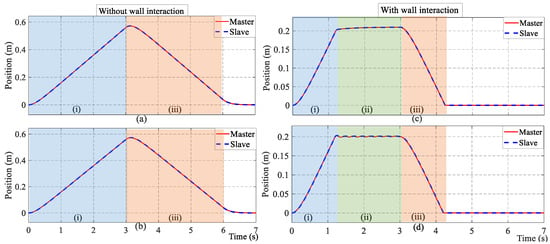
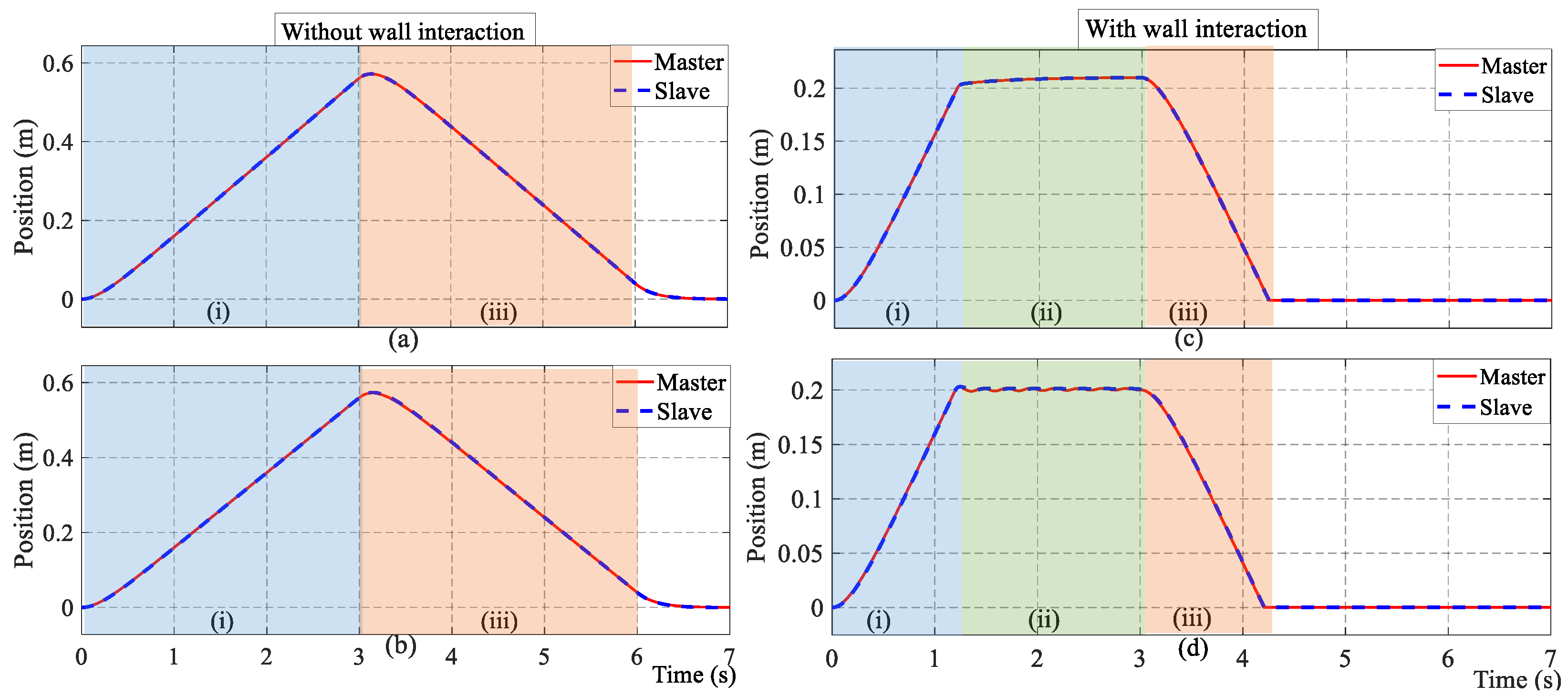
When the system parameters are precisely known, the tracking responses of both control methods are illustrated in Figure 2 and quantified in Table 1. The conventional controller achieves near-perfect synchronization between the master and slave units. Both IAPE, IAVE, and MAPE approach zero. The proposed adaptive control scheme similarly drives the tracking errors to zero within a short duration, maintaining the IAPE, IAVE, and MAPE at remarkably low levels (0.002617, 0.04785, and 0.0041, respectively).
Figure 2.
Position tracking under precise parameters: (a) conventional SMC without wall interaction, (b) Adaptive SMC without wall interaction, (c) conventional SMC with wall interaction, and (d) Adaptive SMC with wall interaction. (i) forward free motion, (ii) wall interaction, and (iii) reverse free motion.
Table 1.
IAPE, IAVE, and MAPE of the two controllers during wall-contact conditions under different parameter uncertainties.
During the free-motion phase, the trajectories of the master and slave overlap seamlessly, demonstrating high-fidelity tracking performance. Upon environmental interaction, a subtle backward movement of the master is observed before it converges back to the desired trajectory, resulting in minor transient oscillations. This behavior can be attributed to the transient estimation dynamics of the RBFNN during environmental interaction, as the RBFNN requires a brief estimation lag to accurately identify the true system parameters. Nevertheless, these oscillations are significantly mitigated through meticulous tuning of the weight updating laws.
5.2. In Case of Parameter Uncertainties
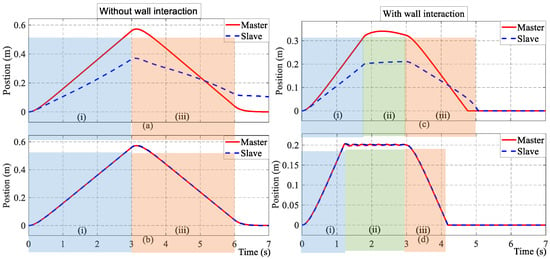
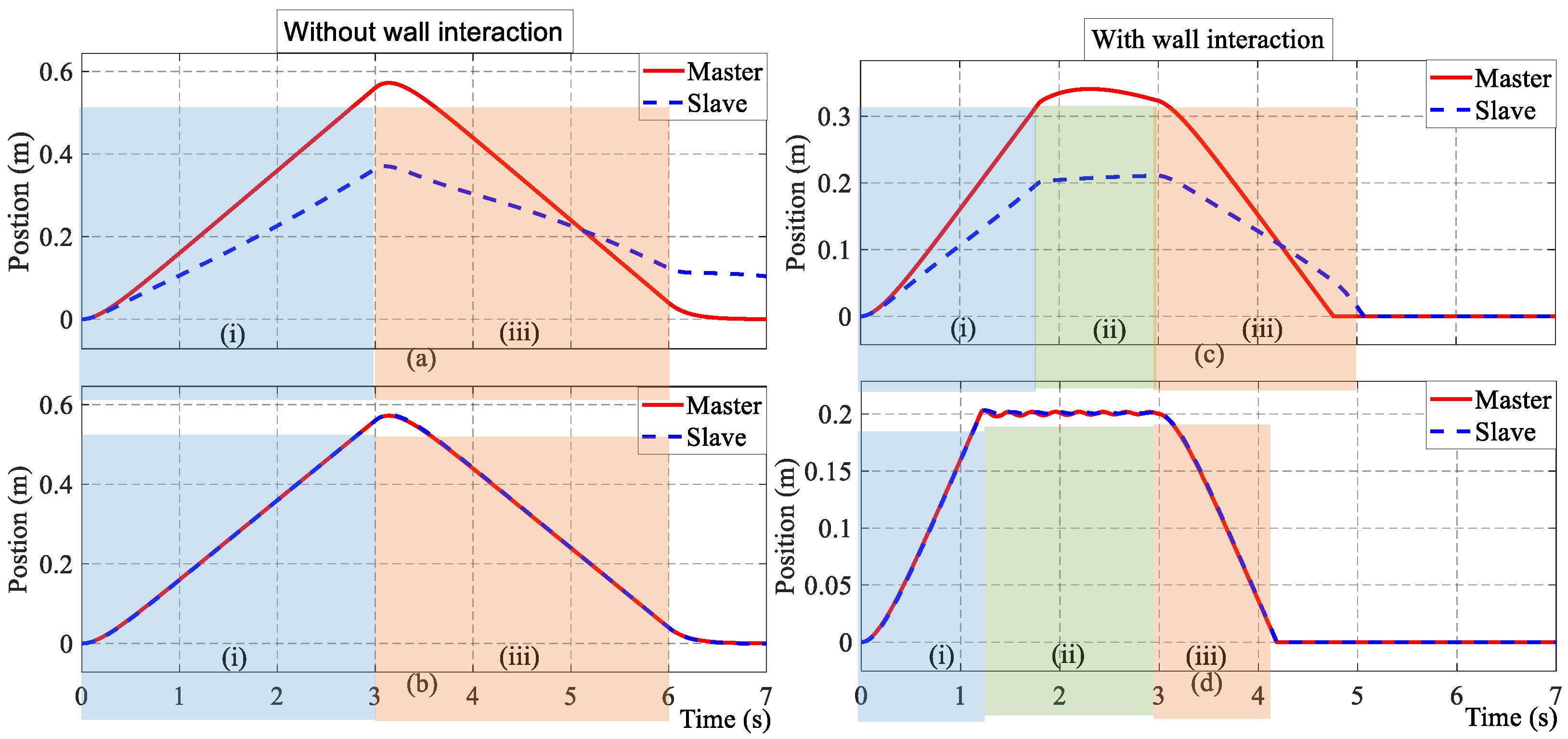
To evaluate the robustness of the proposed algorithm, the system was subjected to deliberate parameter mismatches ranging from 20% to 40%. The quantitative comparisons are tabulated in Table 1, and the trajectories are visualized in Figure 3.
Figure 3.
Position tracking under 40% uncertainty parameters: (a) conventional SMC without wall interaction, (b) Adaptive SMC without wall interaction, (c) conventional SMC with wall interaction, and (d) Adaptive SMC with wall interaction. (i) Forward free motion, (ii) wall interaction, and (iii) reverse free motion.
System performance degrades severely in the presence of model uncertainties. As the parameter mismatch scales from 20% to 40%, the IAPE increases substantially from 0.2029 to 0.4057, while the IAVE rises from 0.1399 to 0.2673. A similar trend is observed in the MAPE, which increases from 0.0699 at 20% mismatch to 0.1338 at 40% mismatch, indicating a substantial increase in the maximum instantaneous position deviation between the master and slave systems. As depicted in Figure 3, a pronounced desynchronization occurs between the master and slave, indicating that the conventional SMC is highly sensitive to mathematical model accuracy.
In contrast, the proposed Adaptive SMC maintains consistently low tracking errors over the considered range of parameter mismatches. The IAPE increases only slightly from 0.0031 at 20% mismatch to 0.0035 at 40% mismatch, while the IAVE increases from 0.0568 to 0.0635. The MAPE similarly changes only from 0.0049 to 0.005678. These results indicate that the adaptive compensation mechanism substantially reduces the sensitivity of the tracking performance to the considered parameter uncertainties. The master and slave trajectories also remain closely synchronized across the mismatch levels, as shown in Figure 3.
The relative improvement becomes particularly clear when the proposed controller is compared with conventional SMC. For a 40% parameter mismatch, the IAPE of conventional SMC reaches 0.4057, whereas the proposed controller maintains an IAPE of only 0.0035. The corresponding MAPE values are 0.1338 and 0.005678, respectively. Thus, within the tested 1-DOF scenario, the adaptive mechanism substantially reduces both accumulated and peak position-tracking errors under model uncertainty.
These results demonstrate robustness for the parameter-mismatch conditions investigated in this study. They should not, however, be interpreted as direct validation of high-DOF robotic implementation. In higher-DOF systems, additional effects such as coupled dynamics, actuator constraints, and computational complexity would need to be evaluated explicitly.
5.3. In Case of Time-Varying Communication Delays
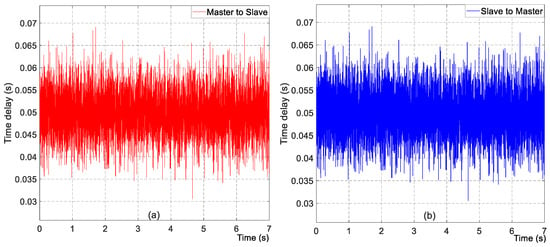
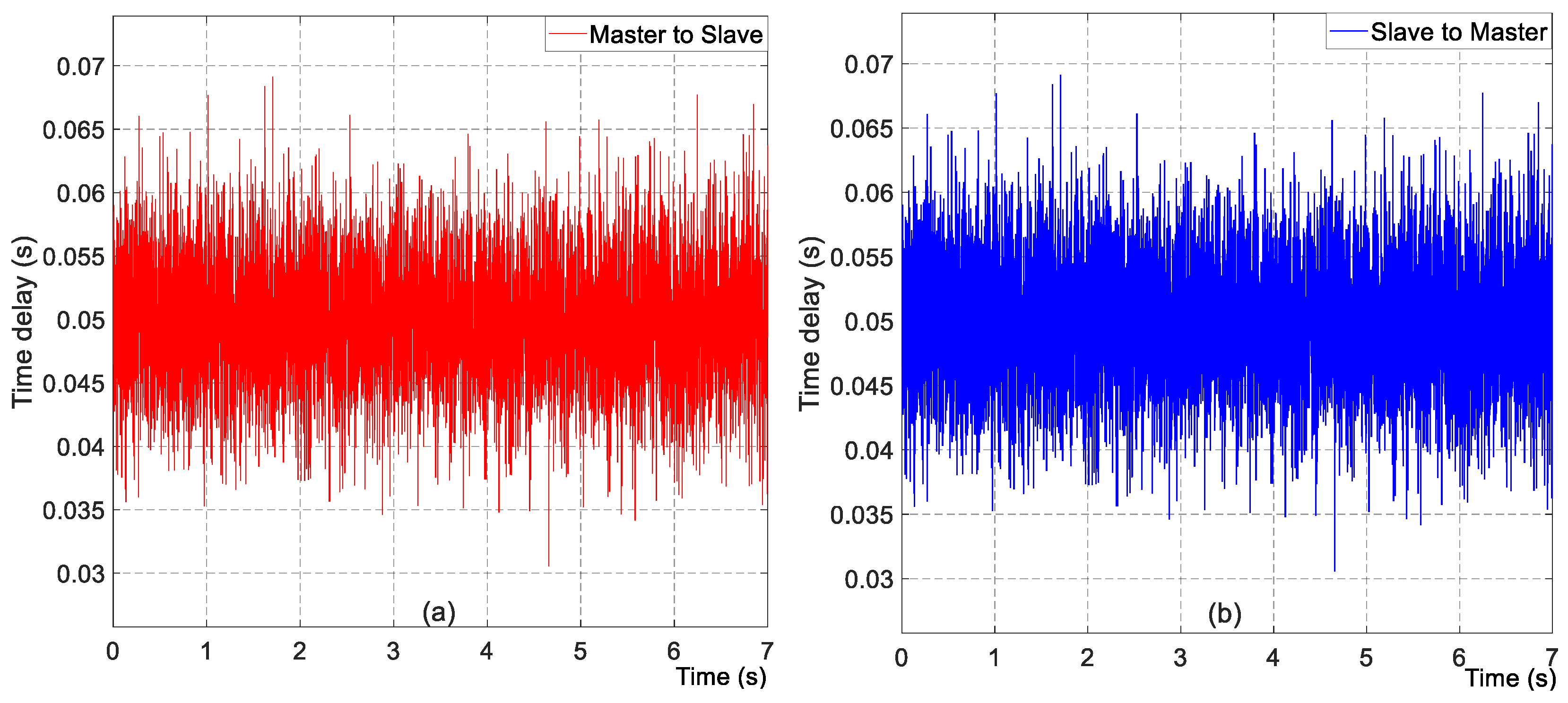
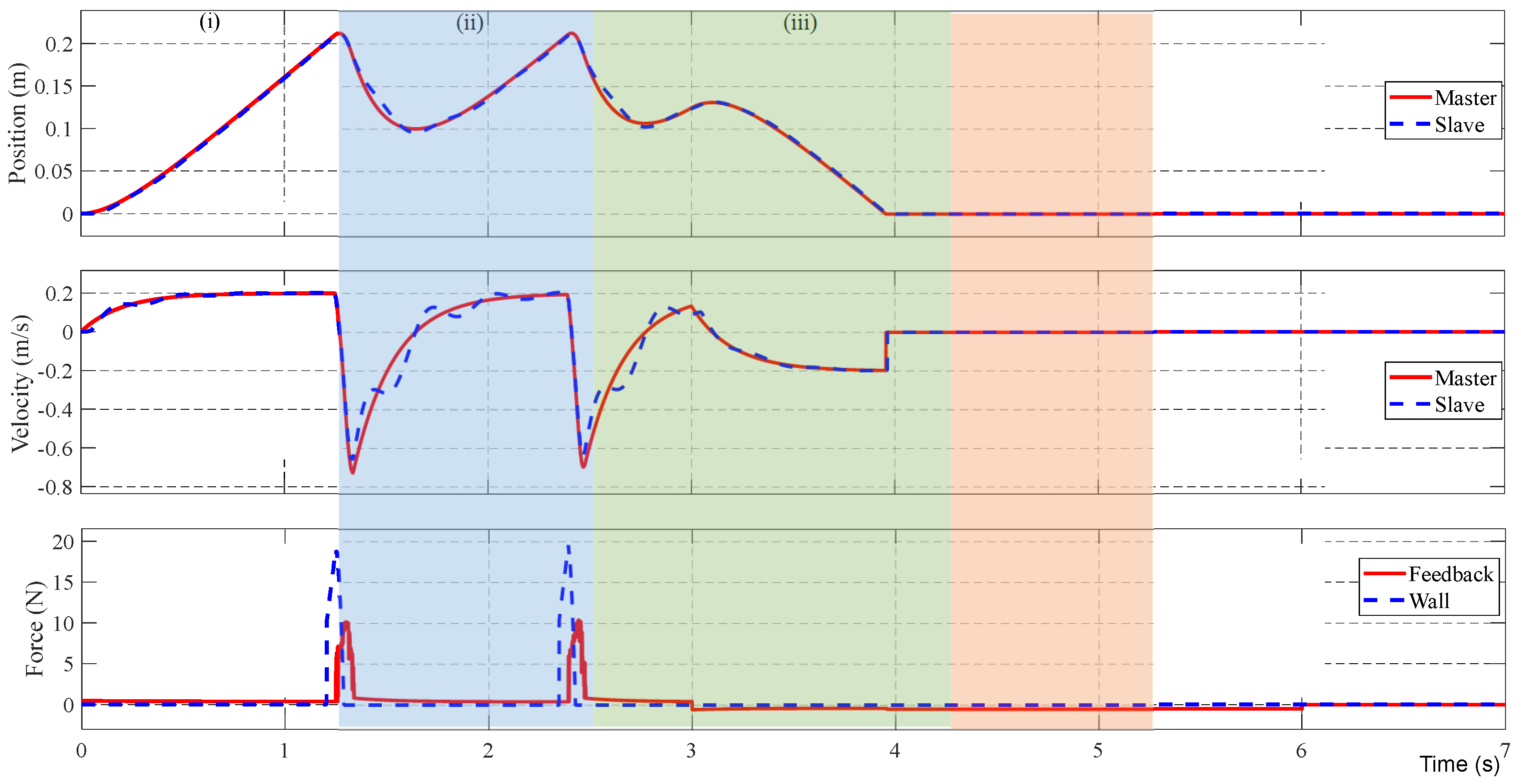
Lastly, the system was evaluated under a case scenario featuring simultaneous parameter uncertainties and time-varying communication delays within the master–slave network. Time-varying communication delays were introduced into both the master-to-slave and slave-to-master communication channels, as illustrated in Figure 4, using Gaussian-distributed random signals. Specifically, the delay in each communication channel was generated with a mean value of 0.05 s and a standard deviation of 0.005 s. Therefore, approximately 99.7% of the generated delay samples are expected to lie within 0.035–0.065 s. The delay signals were updated with a sampling interval of 0.001 s. A fixed seed of 0.2 was used to ensure reproducibility of the simulation results. The corresponding position, velocity, and force profiles are illustrated in Figure 5.
Figure 4.
Time-varying communication delays: (a) master-to-slave channels, (b) slave-to-master channels.
Figure 5.
Performance of the adaptive sliding mode control with time-varying delays. (i) Forward free motion, (ii) wall interaction, and (iii) reverse free motion.
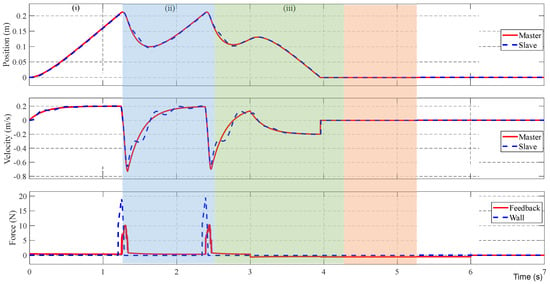
Under the considered time-varying delay conditions, the proposed Adaptive SMC maintains low and bounded position and velocity tracking errors despite continuous variations in communication latency, as shown in Figure 5. The time-varying delays introduce a phase shift between the master and slave responses and lead to localized transient oscillations, particularly during changes in the interaction dynamics. Nevertheless, the master and slave trajectories remain closely synchronized, and the interaction force remains bounded throughout the simulation. These results indicate that the proposed adaptive controller can maintain satisfactory tracking performance under the specific time-varying delay conditions considered in this study. The results do not imply that communication-delay effects are eliminated. Instead, the adaptive controller preserves bounded tracking while mitigating the adverse effects associated with the considered delay variations. The remaining phase shifts and transient oscillations indicate that explicit delay-compensation mechanisms would be beneficial for further improvement.
6. Discussions
The results demonstrate that assigning different control functions to the master and slave subsystems provides a consistent framework for bilateral teleoperation under model uncertainty. The master-side impedance controller is responsible for shaping the desired interaction dynamics and transmitting environmental force information through the bilateral communication channel, whereas the slave-side adaptive SMC focuses on robust motion tracking and compensation of uncertain nonlinear dynamics. The two controllers therefore address complementary objectives rather than imposing an identical control objective on both sides of the teleoperation system.
This distinction is important when comparing the proposed approach with conventional symmetric position-position architectures. The present framework does not attempt to achieve all control objectives through the same controller structure. Instead, interaction-oriented behavior is assigned to the master and robust motion execution is assigned to the slave. The resulting architecture provides a systematic way to combine impedance-based interaction control with adaptive robust tracking control.
The proposed approach shares several fundamental elements with previous adaptive bilateral teleoperation studies, including adaptive neural approximation, sliding mode control, bilateral communication, and consideration of time-varying delays. Therefore, these individual techniques are not claimed as fundamentally new contributions. In particular, Huang et al. [20] also investigated an RBFNN-based adaptive sliding mode controller for nonlinear bilateral teleoperation under time-varying delays. The present work is consequently positioned as a coordinated control-architecture contribution rather than as a fundamentally new RBFNN or SMC formulation.
The main distinction is the functional allocation of the control strategies within the bilateral system. In the proposed framework, impedance control is assigned to the master side to regulate interaction dynamics and force feedback, while RBFNN-based adaptive SMC is assigned to the slave side to compensate for uncertain dynamics and improve position tracking. This role-specific allocation explicitly separates interaction-oriented control from robust motion execution.
A second distinction is the explicit treatment of the RBFNN approximation and adaptive estimation errors in the Lyapunov analysis. The proposed controller is evaluated under systematic parameter mismatches of 20%, 30%, and 40%. The results show that the IAPE of the proposed controller changes only from 0.0031 to 0.0035 over this range, whereas conventional SMC increases from 0.2029 to 0.4057. Similarly, the MAPE remains between 0.0049 and 0.005678 for the proposed controller compared with 0.0699–0.1338 for conventional SMC. These results quantitatively demonstrate the robustness benefit of the adaptive compensation mechanism for the tested conditions.
The time-varying-delay simulation demonstrates that the proposed controller maintains bounded position and velocity tracking errors when communication latency varies in both directions of the master–slave communication channel. The delays generate phase shifts and transient oscillations, but the trajectories remain closely synchronized, and the interaction force remains bounded.
The results should therefore be interpreted as evidence of robustness under the considered communication conditions rather than as evidence of complete delay compensation. The proposed controller does not remove the physical effect of communication latency; rather, it maintains bounded tracking despite the delayed reference signals. More advanced delay-compensation techniques could be incorporated in future work to further reduce the observed transient oscillations.
A limitation of the present study is that the numerical validation is restricted to a 1-DOF bilateral teleoperation system. Although the plant model, control formulation, and stability analysis are expressed for an N-DOF system, the simulation does not directly demonstrate the scalability of the controller to coupled multi-DOF robotic manipulators. Similarly, no experimental validation is included in the present study. These limitations are important when interpreting the practical applicability of the proposed framework.
Nevertheless, the 1-DOF study provides a focused quantitative assessment of the adaptive mechanism and clearly demonstrates its reduced sensitivity to the tested parameter mismatches. Future work will therefore focus on higher-DOF simulation, experimental implementation, actuator constraints, and explicit delay-compensation mechanisms.
7. Conclusions
This study developed a role-specific asymmetric bilateral teleoperation framework that assigns impedance control to the master side and RBFNN-based adaptive sliding mode control to the slave side. The control strategies are selected according to the different functional requirements of the two subsystems: the master controller regulates interaction dynamics and force feedback, while the slave controller provides robust position tracking in the presence of dynamic uncertainties. The contribution of the proposed framework therefore lies in the coordinated allocation of established control techniques rather than in introducing a fundamentally new impedance, SMC, or RBFNN algorithm.
A Lyapunov-based adaptive mechanism was incorporated into the slave controller to compensate for uncertain and unmodeled dynamics without requiring exact knowledge of the robot parameters. Under the stated boundedness and approximation-error conditions, the adaptive estimation errors and sliding variable remain bounded, and the slave position tracking error asymptotically converges to zero. The convergence condition does not explicitly contain the communication delay or scaling factors. Nevertheless, communication delays remain present in the reference signals and consequently affect the transient synchronization and interaction performance.
The numerical results demonstrate that the proposed controller substantially reduces the sensitivity of tracking performance to parameter mismatch. Under 20–40% parameter uncertainty, the proposed controller maintains IAPE values between 0.0031 and 0.0035, whereas conventional SMC produces values between 0.2029 and 0.4057. The MAPE similarly remains between 0.0049 and 0.005678 for the proposed controller, compared with 0.0699–0.1338 for conventional SMC. The time-varying-delay simulation further shows that the proposed controller maintains bounded tracking performance under the considered communication conditions, although delay-induced phase shifts and transient oscillations remain observable.
The theoretical formulation is developed for an N-DOF bilateral teleoperation system, whereas the numerical validation is restricted to a 1-DOF model. The present simulations therefore provide focused evidence of the robustness of the adaptive compensation mechanism but do not by themselves establish the practical scalability of the method to higher-DOF robotic systems. Experimental validation is also not included in the present study.
Future work will focus on extending the proposed controller to higher-DOF bilateral teleoperation systems, evaluating coupled dynamic effects and actuator constraints, incorporating explicit delay-compensation techniques, and experimentally validating the framework on a physical teleoperation platform.
Author Contributions
Conceptualization, T.L.T. and M.D.D.; methodology, M.T.H.; software, Q.N.T. and H.P.N.; validation, B.K.N., T.C.T. and T.L.T.; formal analysis, M.D.D.; investigation, T.L.T.; resources, Q.N.T. and H.P.N.; data curation, M.T.H.; writing—original draft preparation, Q.N.T.; writing—review and editing, T.L.T., H.P.N. and M.D.D.; visualization, B.K.N.; supervision, T.C.T.; project administration, T.L.T.; funding acquisition, T.L.T. All authors have read and agreed to the published version of the manuscript.
Funding
This research is funded by Hanoi University of Industry under Project No. 12-2025-RD/HD-ĐHCN.
Data Availability Statement
The original contributions presented in this study are included in the article. Further inquiries can be directed to the corresponding author.
Acknowledgments
The authors thank the School of Electrical and Electronic Engineering, Hanoi University of Industry, for access to experimental facilities.
Conflicts of Interest
The authors declare no conflicts of interest.
Abbreviations
The following abbreviations are used in this manuscript:
| SMC | Sliding Mode Control |
| RBFNN | Radial Basis Function Neural Network |
| IAPE | Integral of Absolute Position Error |
| IAVE | Integral of Absolute Velocity Error |
| MAPE | Maximum Absolute Position Error |
| DOF | Degree of Freedom |
References
- Deng, Y.; Zhang, L.; Wang, X.; Liu, Y. A Review of Bilateral Teleoperation Control Strategies with Soft Environment. In Proceedings of the 2021 6th IEEE International Conference on Advanced Robotics and Mechatronics (ICARM), Chongqing, China, 3–5 July 2021; pp. 459–464. [Google Scholar]
- Hokayem, P.F.; Spong, M.W. Bilateral teleoperation: An historical survey. Automatica 2006, 42, 2035–2057. [Google Scholar] [CrossRef] [Scilit]
- Sharifi, M.; Behzadipour, S.; Salarieh, H. Nonlinear Bilateral Adaptive Impedance Control with Applications in Telesurgery and Telerehabilitation. J. Dyn. Syst. Meas. Control 2016, 138, 111010. [Google Scholar] [CrossRef] [Scilit]
- Xia, B.; Wang, D.; Wu, C.; Liu, Y. Agent-Based Space Teleoperation: Mitigating Time Delays with Deep Reinforcement Learning. IEEE Trans. Syst. Man Cybern. Syst. 2025, 55, 6517–6529. [Google Scholar] [CrossRef] [Scilit]
- Valenzuela-Urrutia, D.; Muñoz-Riffo, R.; Ruiz-del-Solar, J. Virtual Reality-Based Time-Delayed Haptic Teleoperation Using Point Cloud Data. J. Intell. Robot. Syst. 2019, 96, 387–400. [Google Scholar] [CrossRef] [Scilit]
- Rozaini, I.A.; Ishak, N.S.; Ahmad, S.; Zulkifli, A. Bilateral Teleoperation with a Shared Design of Master and Slave Devices for Robotic Excavators in Agricultural Applications. Int. J. Electr. Electron. Eng. Res. 2023, 35, 119–127. [Google Scholar] [CrossRef] [Scilit]
- Wang, C.; Luo, R.; Whitney, J.P.; Padir, T. Practical Approaches Towards Transparent and Stable Bilateral Teleoperation Under Time-Varying Network Delay. Int. J. Soc. Robot. 2025, 17, 409–426. [Google Scholar] [CrossRef] [Scilit]
- Buongiorno, D.; Chiaradia, D.; Marcheschi, S.; Solazzi, M.; Frisoli, A. Multi-DoFs Exoskeleton-Based Bilateral Teleoperation with the Time-Domain Passivity Approach. Robotica 2019, 37, 1641–1662. [Google Scholar] [CrossRef] [Scilit]
- Salehi, M.; Ahmadi, A. Improvement in the Conservatism of the Time Domain Passivity Approach in Delayed Position-Position Teleoperation System. Int. J. Intell. Robot. Appl. 2024, 8, 619–628. [Google Scholar] [CrossRef] [Scilit]
- Sun, D.; Naghdy, F.; Du, H. Application of Wave-Variable Control to Bilateral Teleoperation Systems: A Survey. Annu. Rev. Control 2014, 38, 12–31. [Google Scholar] [CrossRef] [Scilit]
- Kumar, N.; Thakur, N.; Khanna, Y. Time Delay Independent of Bilateral Tele-Robotic System Using Wave Variable Approach. In Proceedings of the 2022 8th International Conference on Signal Processing and Communication (ICSC), Noida, India, 1–3 December 2022; pp. 669–674. [Google Scholar]
- Tian, J.; Zhou, Y.; Yin, L.; AlQahtani, S.A.; Tang, M.; Lu, S.; Wang, R.; Zheng, W. Control Structures and Algorithms for Force Feedback Bilateral Teleoperation Systems: A Comprehensive Review. Comput. Model. Eng. Sci. 2025, 142, 973–1019. [Google Scholar] [CrossRef] [Scilit]
- Michel, Y.; Buerger, S.P.; Hogan, N. Bilateral Teleoperation with Adaptive Impedance Control for Contact Tasks. IEEE Robot. Autom. Lett. 2021, 6, 5429–5436. [Google Scholar] [CrossRef] [Scilit]
- Liu, Y.; Wang, X.; Zhang, L. A Position-Based Impedance Control Strategy of Bilateral Teleoperation System with Force Feedback. In Proceedings of the 2021 China Automation Congress (CAC), Beijing, China, 22–24 October 2021; pp. 6924–6929. [Google Scholar]
- Hamza, M.F. Adaptive Sliding Mode Control for Robust Trajectory Tracking of Quadrotor UAVs Under Disturbances and Uncertainties. Automation 2026, 7, 112. [Google Scholar] [CrossRef] [Scilit]
- Wang, X.; Liang, X.; Hu, S.; Xin, Q. Non-Singular Fast Sliding Mode Control of Robot Manipulators Based on Integrated Dynamic Compensation. Actuators 2025, 14, 215. [Google Scholar] [CrossRef] [Scilit]
- Gao, H.; Ma, C. Event-Triggered Aperiodic Intermittent Sliding-Mode Control for Master–Slave Bilateral Teleoperation Robotic Systems. Ind. Robot 2023, 50, 467–482. [Google Scholar] [CrossRef] [Scilit]
- Dao, P.N.; Liu, Y.; Wang, X. Finite-Time Sliding Mode Control Strategies for Perturbed Input-Constrained Nonlinear Bilateral Teleoperation Systems with Variable-Time Communication Delays. Intell. Serv. Robot. 2025, 18, 363–378. [Google Scholar] [CrossRef] [Scilit]
- Niemeyer, G.; Slotine, J.-J.E. Stable Adaptive Teleoperation. IEEE J. Ocean. Eng. 1991, 16, 152–162. [Google Scholar] [CrossRef] [Scilit]
- Huang, F.; Guo, Y.; Liu, X.; Zhang, H. RBFNN-Based Adaptive Sliding Mode Control Design for Nonlinear Bilateral Teleoperation System Under Time-Varying Delays. IEEE Access 2019, 7, 11905–11912. [Google Scholar] [CrossRef] [Scilit]
- Rahem, H.; Mellah, R.; Zidane, M.; Saim, A. Neuro-Fuzzy Control of Bilateral Teleoperation System with Transmission Time Delay and Force Feedback Using Arduino Due Board. Majlesi J. Electr. Eng. 2025, 19, 1–14. [Google Scholar]
- Farooq, U.; Hasan, K.M.; Gu, J.; Asad, M.U. Fuzzy Model Based Bilateral Control Design of Nonlinear Tele-Operation System Using Method of State Convergence. IEEE Access 2016, 4, 4119–4135. [Google Scholar] [CrossRef] [Scilit]
- Chen, Z.; Huang, F.; Yang, C.; Yao, B. Adaptive Fuzzy Backstepping Control for Stable Nonlinear Bilateral Teleoperation Manipulators with Enhanced Transparency Performance. IEEE Trans. Ind. Electron. 2020, 67, 746–756. [Google Scholar] [CrossRef] [Scilit]
- Ochi, H.; Wan, W.; Yang, Y.; Harada, K. Deep Learning Scooping Motion Using Bilateral Teleoperations. In Proceedings of the 2018 3rd IEEE International Conference on Advanced Robotics and Mechatronics (ICARM), Singapore, 18–20 July 2018; pp. 118–123. [Google Scholar]
- Al-Wajih, Y.; Hamdan, M.; Mohaya, T.; Mahmoud, M.; Alyazidi, N. Deep Learning-Based Attack Detector for Bilateral Teleoperation Systems. Int. J. Robot. Control Syst. 2022, 3, 19–31. [Google Scholar] [CrossRef] [Scilit]
- Takanashi, H.; Shimono, T.; Natori, K. Cyber-Secure Teleoperation with Encrypted Four-Channel Bilateral Control. IEEE Trans. Control Syst. Technol. 2025, 33, 2163–2177. [Google Scholar] [CrossRef] [Scilit]
- Gong, X.; Wang, L.; Mou, Y.; Song, J. Improved Four-Channel PBTDPA Control Strategy Using Force Feedback Bilateral Teleoperation System. Int. J. Control Autom. Syst. 2022, 20, 1002–1017. [Google Scholar] [CrossRef] [Scilit]
- Huang, Z.; Huang, R. Using Dual-Wave Variable Transformation for Four-Channel Bilateral Teleoperation Control System Under Time Delays. In Proceedings of the 2024 International Annual Conference on Complex Systems and Intelligent Science (CSIS-IAC), Shenzhen, China, 20–22 September 2024; pp. 705–710. [Google Scholar]
- Wang, K.; Gao, Z.; Peng, F.; Chen, C.; Tang, X.; Liu, Z. Four-Channel Sliding Mode Control for Haptic Teleoperation System with Disturbance in Contact with Adaptive Stiffness Environments. In Proceedings of the 2022 41st Chinese Control Conference (CCC), Hefei, China, 25–27 July 2022; pp. 3852–3857. [Google Scholar]
- Spong, M.W.; Hutchinson, S.; Vidyasagar, M. Robot Modeling and Control; John Wiley & Sons: Hoboken, NJ, USA, 2006; pp. 315–340. [Google Scholar]
- Buttolo, P.; Braathen, P.; Hannaford, B. Sliding Control of Force Reflecting Teleoperation: Preliminary Studies. Presence Teleoperators Virtual Environ. 1994, 3, 158–172. [Google Scholar] [CrossRef] [Scilit]
- Park, J.H.; Cho, H.C. Sliding-Mode Controller for Bilateral Teleoperation with Varying Time Delay. In Proceedings of the 1999 IEEE/ASME International Conference on Advanced Intelligent Mechatronics, Atlanta, GA, USA, 19–23 September 1999; pp. 311–316. [Google Scholar]
- Liu, J. Neural Network Sliding Mode Control. In Radial Basis Function (RBF) Neural Network Control for Mechanical Systems; Springer: Berlin/Heidelberg, Germany, 2013; pp. 125–160. [Google Scholar]

Disclaimer/Publisher’s Note: The statements, opinions and data contained in all publications are solely those of the individual author(s) and contributor(s) and not of MDPI and/or the editor(s). MDPI and/or the editor(s) disclaim responsibility for any injury to people or property resulting from any ideas, methods, instructions or products referred to in the content. |
© 2026 by the authors. Licensee MDPI, Basel, Switzerland. This article is an open access article distributed under the terms and conditions of the Creative Commons Attribution (CC BY) license.