


Abstract
The paper investigates the effect of ultrasonic cavitation, in combination with catalysts, on the fractional composition of high-viscosity oil. Ultrasonic treatment was carried out at a frequency of 22 kHz and a power of 50 W for 10 min in the presence of HY-zeolite, NiFe/Y-zeolite and NiFe/microsphere (1 wt%) catalysts. Results showed that ultrasonic treatment without a catalyst leads to a reduction in the yield of the target distillate fractions. The HY-zeolite demonstrates the greatest efficiency, increasing the yield of the light fraction with a boiling point of up to 200 °C by 7.9% compared with the initial oil. The NiFe/zeolite and NiFe/microsphere catalysts contributed to the formation of naphthenic and aromatic structures in the light and middle fractions of high-viscosity oil; however, the yields of light fractions with a boiling point of up to 200 °C and at 200–300°C decreased.
1. Introduction
Currently, the processing of ultra-heavy oils and oil residues using traditional deep processing technologies remains one of the most difficult tasks in the oil refining industry, both from an economic and an environmental perspective [1,2,3,4]. The high content of resinous-asphaltene substances in the composition of heavy hydrocarbon raw materials significantly complicates the processing, contributing to intensive coke formation, reducing the yield of target products and accelerating deactivation of catalysts. In this regard, in recent years, increasing attention has been paid to the development and implementation of non-conventional methods for treating heavy crude oil, aimed at improving its operational characteristics and enhancing the efficiency of its refining. Among promising technologies, ultrasound processing based on the phenomenon of acoustic cavitation is of particular interest [5,6].
In the scientific literature [7,8,9,10], the possibilities of using ultrasound exposure in various fields of the oil industry have been studied quite extensively. It has been established that ultrasonic waves can effectively intensify the processes of oil production, increase the efficiency of desalination of oil raw materials, improve the separation of oil and water phases, reduce the intensity of sedimentation on the surface of heat exchange equipment and pipelines, and also help reduce the viscosity of heavy oils.
According to [11,12,13], ultrasonic exposure contributes to a significant decrease in the viscosity of heavy oils and oil residues, as well as an increase in the yield of light fractions. In the process of acoustic cavitation, local zones with extremely high temperatures and pressures arise, contributing to a change in the molecular structure of heavy hydrocarbons. Shock waves formed during the collapse of cavitation bubbles intensify the processes of destruction of high-molecular resinous-asphaltene compounds and weakening of intermolecular interactions in the dispersed oil system. As a result, there is a violation of the colloidal structure of the oil system, a partial destruction of heavy components, and a decrease in the degree of association of asphaltenes, which leads to a significant decrease in the viscosity of the oil raw materials. In addition, free radical processes initiated by cavitation play an important role in the mechanism of ultrasound exposure [14]. During the collapse of cavitation bubbles, highly reactive free radicals are formed, which participate in the reaction of breaking chemical bonds in high-molecular-weight oil components. As a result, the destruction processes of heavy hydrocarbon molecules are accelerated, accompanied by the formation of lower-molecular-weight compounds and an increase in the content of light hydrocarbon fractions in the composition of oil raw materials.
A number of studies [15,16,17,18] have shown that the combination of ultrasound treatment and the use of hydrogen donors can increase the efficiency of destructive transformations of heavy hydrocarbons. In the presence of hydrogen donors, the processes of recombination of free radicals are suppressed, which helps to stabilize the resulting low-molecular-weight products and increase the yield of light distillate fractions. A decrease in the concentration of high-molecular-weight components is accompanied by a decrease in the propensity of the raw material to form carbonaceous residues. This makes it possible to increase efficiency of subsequent processes of deep oil processing, including catalytic cracking and hydrocracking. Reducing the content of resinous-asphaltenic materials and carbonaceous residues helps to reduce the load on technological equipment and extend the service life of catalysts, providing both technological and economic advantages in the processing of heavy hydrocarbon raw materials.
The paper [19] studied the effectiveness of using ultrasound exposure of various frequencies in combination with magnetic γ-Fe2O3 nanoparticles to reduce the content of asphaltenes and the kinematic viscosity of heavy oil. The results obtained showed that the combined use of ultrasound and magnetic nanoparticles contributes to a more efficient destruction of associated asphaltene structures, a decrease in oil viscosity and an improvement in rheological characteristics compared with the use of each of the factors separately.
However, the results of studies on the effect of ultrasound on oil properties are not always unambiguous. Along with numerous studies demonstrating a decrease in viscosity of oil after ultrasonic treatment, the literature presents data indicating a possible increase in oil viscosity after exposure to ultrasound [20]. It is noted that the nature and extent of viscosity changes depend on the composition of the feedstock, the parameters of ultrasonic exposure and the conditions of the experiment.
Publications [21,22] describe a significant effect of the time factor on the rheological properties of the treated oil. It has been found that the initial viscosity reduction after ultrasonication can be temporary, and a partial or complete viscosity recovery is observed during subsequent storage. This phenomenon is associated with the process of recombination of free radicals, the re-formation of associations of resinous-asphaltene substances, and the gradual restoration of the colloidal structure of the oil dispersion system. The presence of contradictory literature data indicates the need for further studies of the mechanisms of ultrasonic exposure to heavy hydrocarbon raw materials and the factors that determine the stability of the achieved changes in their properties.
The paper [23] studied the kinetics of mutual transformations of oils, resins and asphaltenes in high-viscosity oil during ultrasonic treatment in the presence of acid zeolites. The obtained results showed that, under the influence of ultrasound and a zeolite catalyst, the processes of transformation of resins into oily components and asphaltenes into resins are the most intensive. It has been established that the combined use of ultrasonic exposure and acid zeolites contributes to the destruction of high-molecular-weight components of the petroleum dispersion system and their subsequent transformation into lighter fractions.
The obtained data confirm the possibility of directional control of the conversion processes of high-molecular-weight components of heavy oils by combining ultrasonic exposure with catalytic systems.
The purpose of this work is to study the effect of ultrasonic cavitation in the presence of acid and metal-containing catalysts on the yield of light and medium distillate fractions of high-viscosity oil, as well as on changes in their group chemical composition.
In this work, the thermal effect was considered an integral part of the ultrasound process, and the results obtained reflect the combined effects of ultrasonic cavitation, the associated heating and catalysts.
2. Materials and Methods
High-viscosity oil from the Karazhanbas oil field (Republic of Kazakhstan) was used as feedstock. The physical and chemical parameters of the oil are given in Table 1.
Table 1.
Physical and chemical characteristics of high-viscosity oil.
The studied oil exhibits a high density of 0.934 g/cm3 and an increased dynamic viscosity at 20 °C (1325 mPa·s), indicating that it can be classified as a heavy, high-viscosity oil [24].
The elemental composition of the samples was determined using a Thermo FlashSmart CHNS/O analyzer (Thermo Fisher Scientific, Waltham, MA, USA). The content of C, H, N and S was determined by burning the sample in an oxygen stream, followed by separation of the combustion products and their detection using a thermal conductivity detector. The oxygen content was calculated from the difference after determination of C, H, N, and S.
The fractional composition of oil is characterized by a low content of light distillates: the yield of the fraction up to 200 °C is 6.8%, and the fraction of 200–300 °C is 20.4%. The total yield of light fractions up to 300 °C does not exceed 27.2%, which indicates a high proportion of heavy high-boiling components.
Acidic HY-zeolites, NiFe/Y-zeolites and NiFe/microspheres were used as catalysts for the ultrasonic treatment of high-viscosity oil.
The zeolite was acid-activated prior to use: 20 g of zeolite was treated with 300 mL of a 20% hydrochloric acid solution at a temperature of 60–70 °C. After acid treatment, the sample was repeatedly washed with distilled water to a neutral pH, then filtered and dried in an oven at 105 °C to constant weight.
The activated sample was also used as a support for the preparation of the NiFe/Y-zeolite catalyst. For preparation of the NiFe/microsphere catalyst, microspheres separated from ash formed during the combustion of coal at the combined heat and power plant in Karaganda (Republic of Kazakhstan) [25] were used as a carrier. The use of ash microspheres as a carrier is due to their high thermal stability and accessibility, which makes them a promising material for the preparation of catalytic systems [26].
NiFe/microsphere and NiFe/Y-zeolite catalysts were prepared by wet impregnation: 20% aqueous solutions were prepared from crystalline hydrates of nickel (II) nitrate (Ni(NO3)2·6H2O) and iron (III) nitrate (Fe(NO3)3·9H2O). A support (microsphere or Y-zeolite) was then added to the resulting solutions in an amount providing a nickel and iron content of 2.5% by weight of each metal in the finished catalyst, corresponding to a total active component content of 5% by weight. The resulting suspension was thoroughly stirred under heating until a uniform thick mass was formed. The samples were then dried in an oven at 105 °C to constant weight. The dried materials were heat-treated in a muffle furnace at 500 °C for 2 h. As a result, NiFe/microsphere and NiFe/Y-zeolite catalysts containing active components in the form of metal oxides dispersed on the support surface were obtained.
X-ray phase analysis of synthesized catalysts was carried out using a powder diffractometer, DRON-4–07 (NPP Bourevestnik, Saint Petersburg, Russia), using a CoKα-radiation cobalt anode. Measurements were made at 30 kV and 20 mA. The diffractograms were scanned at 4 degrees per minute. X-ray phase analysis showed that the starting HY-zeolite has a cubic crystal structure. Nickel and iron oxide phases were observed in the NiFe/Y-zeolite and NiFe/microsphere samples after modification. The NiO phase was identified as monoclinic, which is characteristic of nanodispersed nickel oxides, and the iron oxide phase corresponds to the rhombohedral structure of α-Fe2O3, hematite.
The elemental composition of the catalysts was determined by X-ray fluorescence analysis on a FOKUS-2M spectrometer equipped with an X-ray tube with a molybdenum anode. The studies were carried out in air at a voltage of 30 kV and a current of 600 µA. Table 2 shows the elemental compositions of the catalysts.
Table 2.
Elemental compositions of catalysts.
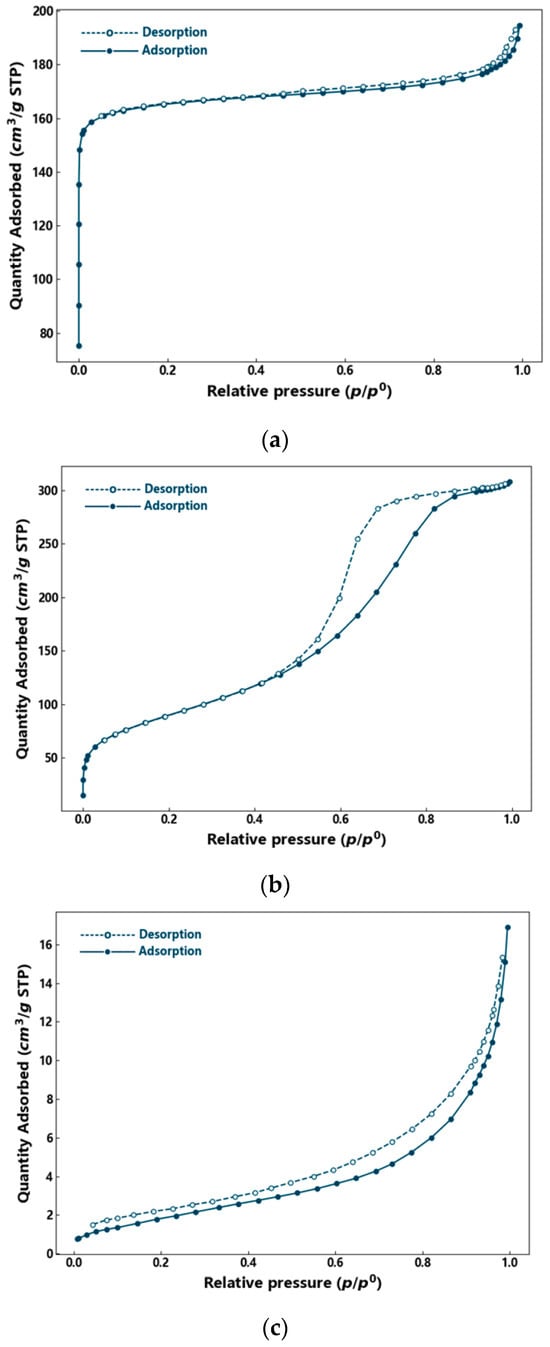
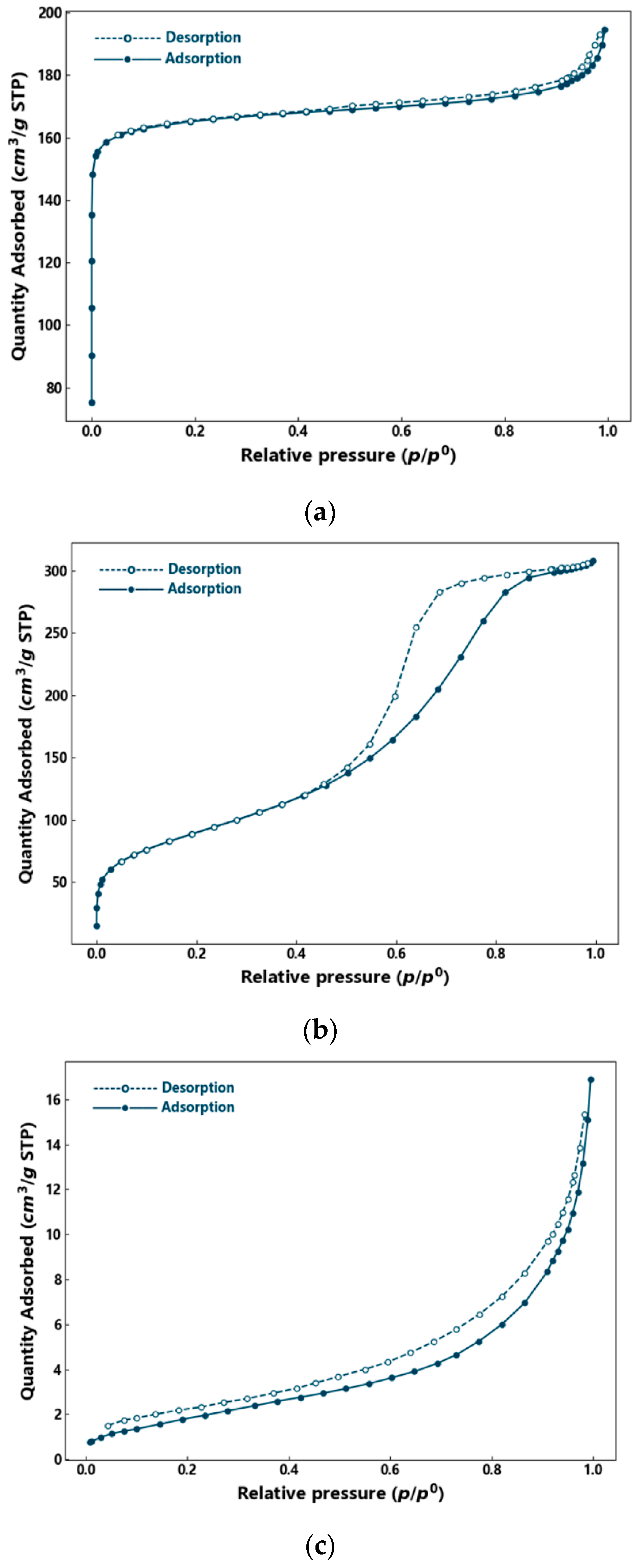
The specific surface area and porosity of the samples were determined using a Micromeritics ASAP 2460 analyzer (Micromeritics Instrument Corporation, Norcross, GA, USA). The adsorption–desorption isotherms of the catalysts are presented in Figure 1.
Figure 1.
Adsorption–desorption isotherms of the catalysts: (a) HY-zeolites, (b) NiFe/Y-zeolites, and (c) NiFe/microspheres.
The main textural characteristics of the catalysts are presented in Table 3.
Table 3.
Textural characteristics of catalysts.
The HY-zeolite is characterized by a Type I adsorption isotherm, corresponding to a predominantly microporous structure. Intense nitrogen uptake at low relative pressures (p/p0) is associated with micropore filling. The BET specific surface area obtained is 672.90 m2/g, of which 642.30 m2/g is attributable to the microporous surface, while the outer surface accounts for 30.61 m2/g. The t-plot micropore volume is 0.24 cm3/g, and the total pore volume calculated by DFT is 0.25 cm3/g. At (p/p0 > 0,4), a non-large discrepancy between the adsorption and desorption branches is observed, forming a weakly pronounced hysteresis loop, which indicates the presence of a small mesoporous component. The average pore diameter along the BJH desorption branch is 7.44 nm, which further confirms the presence of mesoporous pores along with the predominant microporous structure.
For NiFe/Y-zeolites, a type IV isotherm is observed with a pronounced hysteresis loop in the region of medium and high relative pressures, which is characteristic of the mesoporous component and capillary condensation in mesopores. The NiFe/Y micropore area is 18.04 m2/g, while the outer surface is significantly higher and reaches 304.57 m2/g. The BET specific surface area is 322.62 m2/g. The total DFT pore volume is 0.44 cm3/g, and the average BJH pore diameter is 5.25 nm.
NiFe/microspheres have a significantly lower adsorption capacity than zeolite-containing catalysts. The shape of the isotherm corresponds to type V, which is characterized by a weak adsorbent–adsorbate interaction in combination with the presence of a porous structure and hysteresis with an increase in relative pressure. The BET specific surface area is only 7.49 m2/g, the micropore area is 5.72 m2/g, and the outer surface is 1.77 m2/g. The total DFT pore volume is 0.024 cm3/g, which is significantly lower than the corresponding values for HY-zeolites and NiFe/Y-zeolites. The average BJH pore diameter is 11.22 nm. Thus, the total available porosity and NiFe/microsphere surface area is substantially lower than that of zeolite-containing catalysts.
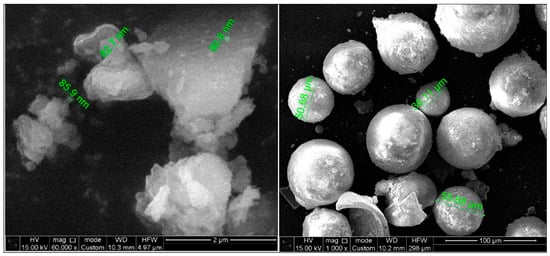
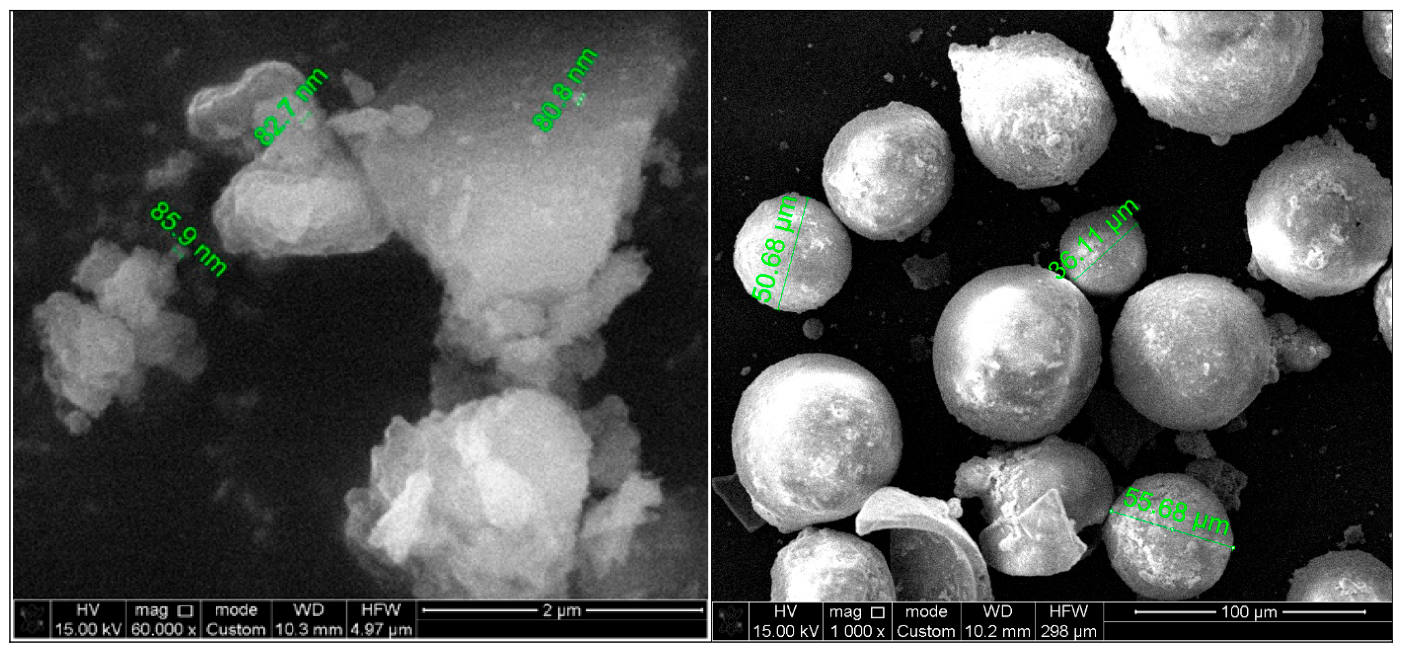
The surface morphology of the resulting NiFe/Y-zeolite and NiFe/microsphere catalysts was examined using a Quanta 3D 200i scanning electron microscope (FEI Company, Hillsboro, OR, USA) (Figure 2).
Figure 2.
Photomicrographs of NiFe/Y-zeolite and NiFe/microsphere catalysts.
The micrograph shows that the NiFe/Y-zeolite catalyst consists of agglomerates of irregularly shaped particles. The size of individual crystallites is about 80–90 μm. The NiFe/microsphere catalyst consists mainly of spherical particles with a diameter of 50–60 μm. After modification with nickel and iron compounds and subsequent heat treatment, the structural integrity of the support is maintained, while local irregularities associated with the distribution of the active phase are observed on the surface of the microspheres. Combined with the low specific surface area, these indicate limited availability of active sites and predominance of surface catalytic processes, which may be one of the reasons for the lower efficiency of this catalyst compared with zeolite-containing systems.
The acidic properties of the catalysts were investigated by temperature-programmed ammonia desorption (NH3-TPD). In the experiment, a catalyst sample with pre-adsorbed ammonia was heated at a rate of 10 °C/min in a helium stream up to 600 °C. The acid sites were evaluated by the amount of desorbed ammonia detected during heating (Table 4).
Table 4.
Acid properties of catalysts.
The results of the temperature-programmed ammonia desorption (NH3-TPD) showed that the HY-zeolite is characterized by two ammonia desorption maxima at 175 and 245 °C. The amount of desorbed ammonia at these temperatures were 523.4 and 1137.4 μmol/g, respectively. The total amount of desorbed ammonia was 1.661 mmol/g.
For NiFe/Y-zeolites, one ammonia desorption maximum was observed at 180 °C, corresponding to 429 μmol/g of desorbed ammonia. The total amount of desorbed ammonia for this catalyst was 429 μmol/g.
No ammonia desorption was detected for NiFe/microspheres.
According to the temperature-programmed ammonia desorption, the initial HY-zeolite is characterized by the presence of two types of acid sites, which is confirmed by the presence on the thermal-desorption spectrum of two ammonia desorption maximums: a low-temperature maximum at 175 °C and a high-temperature maximum at 245 °C. The low-temperature peak is typically associated with weak Lewis acid sites represented by coordinatively unsaturated aluminum atoms in the zeolite structure. The high-temperature peak corresponds to the stronger Brønsted acid sites, the role of which is played by proton-donating hydroxyl groups bonded to aluminum atoms of the crystal lattice [27].
Following the modification of the zeolite with nickel and iron salts, the NH3-TPD thermal-desorption spectrum shows only a single main ammonia desorption peak at approximately 180 °C, indicating a significant change in the distribution and strength of the acid sites compared with the initial HY zeolite. It is likely that, during the modification process and subsequent contact with aqueous solutions, partial deactivation or a change in the state of the proton-donating sites may have occurred, which could have led to a change in the acidic properties of the modified sample. The total acidity of the NiFe/Y zeolite is 429 µmol NH3/g. For the microsphere catalyst, there are practically no ammonia desorption peaks, which indicates an extremely low concentration of acid sites or their complete absence.
Cavitation experiments were conducted to evaluate the catalytic effect of ultrasonic treatment of high-viscosity oil in the presence of catalysts. The treatment was carried out on a TEFIC-1000D ultrasonic unit (TEFIC BIOTECH CO., LIMITED, Xi’an, China) at a frequency of 22 kHz and a power of 50 W. Briefly, 20.0 g of high-viscosity oil was used as raw material. The catalyst concentration was 1.0% by weight of the oil. Ultrasound exposure was carried out for 10 min at an initial temperature of 25 °C.
After the completion of ultrasonic treatment, the obtained samples were subjected to simple atmospheric distillation using a laboratory distillation flask equipped with a straight condenser. The distillate was collected according to the vapor temperature and separated into two fractions: the light fraction (≤200 °C) and the middle fraction (200–300 °C). The yield of the fractions was determined gravimetrically.
3. Results and Discussion
All experiments were performed in three parallel replicates. Results are presented as mean ± standard deviation (Table 5).
Table 5.
Fraction yields during ultrasonic treatment of high-viscosity oil.
Statistical analysis was carried out based on the initial values from three parallel measurements for each sample under investigation. To assess differences between groups, a one-way analysis of variance (ANOVA) was used, followed by Tukey HSD test for pairwise comparisons. Differences were considered statistically significant at p < 0.05. For the yield of the ≤200 °C fraction, ANOVA revealed statistically significant differences between the groups under investigation (F(4,10) = 220.86, p < 0.001). Statistically significant differences were also found for the 200–300 °C fraction (F(4,10) = 597.85, p < 0.001). The subsequent Tukey HSD test confirmed the statistical significance of all pairwise comparisons for both fractions under investigation (p < 0.05).
Ultrasonic treatment of high-viscosity oil without a catalyst leads to a significant change in the yields of both studied distillate fractions compared with that of the initial oil. The yield of the light fraction (≤200 °C) decreases from 6.84 to 5.81%, while the most pronounced change is observed for the middle fraction (200–300 °C), whose yield decreases from 20.36 to 5.52%. Thus, despite the absence of an increase in the yield of the desired distillate fractions, a significant change in their yields under the influence of ultrasound indicates a noticeable effect of the cavitation on the structure and composition of the high-viscosity oil dispersion.
To identify components, assess changes in hydrocarbon composition, and determine the effect of ultrasonic treatment in the presence of catalysts on the destruction of high-molecular-weight oil components, the group and individual hydrocarbon compositions of the obtained distillate fractions (Table 6 and Table 7) were studied using an Agilent Technologies 7890A (Agilent Technologies, Wilmington, DE, USA) gas chromatograph equipped with an Agilent 5975C (Agilent Technologies, Wilmington, DE, USA) mass selective detector. The analysis was carried out on a 30 m long Rtx-100DHA capillary column, with an internal diameter of 0.25 mm and a stationary phase thickness of 0.5 µm. The column temperature was programmed within the range of 60–300 °C at a heating rate of 8 °C/min. The evaporator temperature was 280 °C. Grade A helium was used as the carrier gas at a column pressure of 2 psi. The sample injection volume was 0.2 µL, and injection was carried out in split mode at a split ratio of 20:1. Mass spectra were recorded in scan mode using electron ionization (EI) at an energy of 70 eV. The ion source temperature was 230 °C, and the quadrupole temperature was 150 °C. The total analysis time was 32 min. Identification of individual compounds was carried out using mass spectra and the NIST 08 library. The relative content of the identified components was automatically calculated using GS-MSD Data Analysis software (version G1701EA E.02.02.1431, Agilent Technologies, Santa Clara, CA, USA) based on the normalized peak areas of the total ion chromatogram (TIC). Thus, the values presented in Table 6 and Table 7 characterize the relative component composition of the tested fractions and were determined by the peak area normalization method, without using individual calibration factors or response factors. The instrument error does not exceed 3%.
Table 6.
Group chemical composition of light fraction with boiling point up to 200 °C of initial high-viscosity oil and after ultrasonic treatment in the presence of catalysts.
Table 7.
Group chemical composition of the middle fraction with a boiling point of 200–300 °C of the initial high-viscosity oil and after ultrasonic treatment in the presence of catalysts.
It should be noted that the relatively high content of olefinic hydrocarbons in the initial light fraction (20.82%) is associated with the peculiarities of the accepted group classification of components. The group of olefinic structures included not only acyclic alkenes but also cycloalkenes containing one or two double bonds in the cyclic moiety. The proportion of such cyclic olefin compounds was about 10.51%, while the remainder of the olefin group was represented by compounds with double bonds in the side alkyl moieties.
The results of GC-MS analysis indicate a significant transformation of the group hydrocarbon composition of the light fraction under ultrasonic cavitation without a catalyst, which is expressed, in particular, in an increase in the relative content of paraffin hydrocarbons from 2.14 to 21.27%. According to the literature data [28,29], ultrasound exposure is not always accompanied by the destruction of paraffin hydrocarbons. In particular, there is an increase in the crystallization temperature of oil and an increase in the viscosity of paraffin oils. The authors [28,29] attribute this effect to radical processes initiated by ultrasonic cavitation. In the absence of stabilizing factors, such radicals can participate not only in the destruction reactions of high-molecular-weight oil components but also in secondary polycondensation processes, leading to the formation of heavier structures.
Suppression of free radical recombination reactions generated under ultrasonic cavitation can be achieved by introducing hydrogen, hydrogen donors, aromatic solvents or catalysts [30,31]. The presence of these components helps stabilize the intermediate radical particles and shifts the direction of transformations towards the destruction of high-molecular-weight compounds.
Also, during ultrasonic cavitation, a significant decrease in the content of condensed naphthenes (from 16.34 to 6.90%) and olefinic compounds (from 20.82 to 6.07%) in the light fraction of high-viscosity oil is observed.
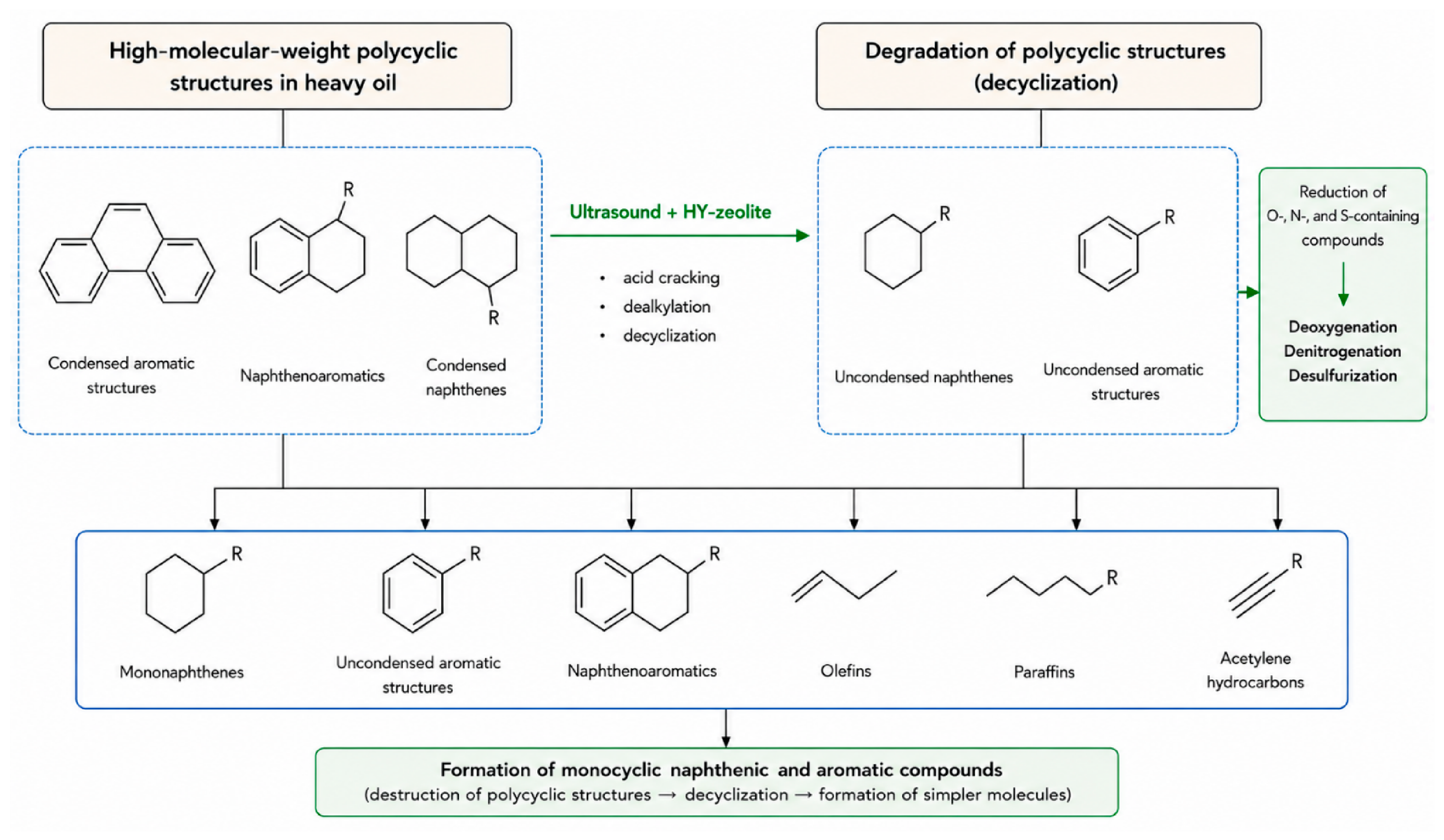
When the HY-zeolite was added after ultrasonic treatment, the light fraction yield slightly increased from 6.84 to 7.38%. The most significant changes observed include an increase in the content of non-condensed naphthenes to 48.8%, a decrease in the content of oxygen-containing compounds from 22.3% to 13.7%, and the disappearance of naphthenobenzenes, sulfur-containing compounds, and naphthalenes, while the content of paraffins remained low (1.1%). Such changes indicate the destruction of polycyclic structures and the occurrence of decyclization reactions, accompanied by the formation of single-ring naphthenic and aromatic compounds.
The fraction up to 200 °C after ultrasonic treatment in the presence of the NiFe/zeolite catalyst is characterized by a high content of non-condensed naphthenes (40.02%) and a nearly twofold decrease in the content of condensed naphthenes compared with the light fraction of the initial oil. However, after ultrasonic cavitation of high-viscosity oil in the presence of the NiFe/zeolite, the light fraction yield decreased to 4.45%.
The addition of microspheres to high-viscosity oil as a catalyst system under cavitation also resulted in a reduction in the light fraction content to 3.23%, which is lower than that obtained under non-catalytic treatment. In the light fraction after ultrasonic cavitation in the presence of the NiFe/microsphere, an increase in the content of benzene compounds and single-ring naphthenes was observed, while a relatively high content of condensed naphthenes (12.25%) was also preserved. The low specific surface area, large size of the microspheroidal particles, and the absence of developed acid sites in the NiFe/microsphere catalyst create less favorable conditions for the destruction of high-molecular-weight oil components, contributing to the formation of large associates and a decrease in the yield of the light distillate fraction.
The yield of the middle fraction (200–300 °C) from the initial oil is 20.36% (Table 5). A high content of oxygenates indicates an increased concentration of resinous components in this fraction.
The sharp decrease in the yield of the middle fraction to 5.52% following ultrasonic treatment without a catalyst (Table 5) indicates the predominance of secondary condensation and aggregation processes involving asphaltene-resinous components. Probably, in the absence of hydrogen-donor compounds, the radicals formed during cavitation do not participate in destruction but in recombination reactions. Cavitation of high-viscosity oil without a catalyst leads to a sharp increase in the paraffin content in the middle fraction from 5.59% to 14.51%, similar to the trend observed for the light distillate fraction. At the same time, there is a significant decrease in the content of non-condensed naphthenes to 1.25% and oxygen-containing compounds from 47.5% to 22.05%, which indicates a partial destruction of heteroatomic components. However, an increase in the proportion of nitrogen- and sulfur-containing compounds is recorded, which can be associated both with the redistribution of components between fractions and with the concentration of more-stable heteroatom-containing structures in the distillate.
Cavitation treatment of heavy oil in the presence of the HY-zeolite reduces the yield of the middle fraction to 18%. Following treatment in the presence of the NiFe/zeolites and NiFe/microspheres, the yields of the middle oil fraction are approximately 10% and 12%, respectively (Table 5), reflecting moderate catalytic activity with regard to the formation of distillate fractions.
The use of the HY-zeolites results in the most pronounced transformation of the hydrocarbon composition. An increase is observed in the content of single-ring naphthenes to 14% and benzene and naphthene-benzene structures (15% and 8%, respectively), as well as a nearly twofold increase in condensed aromatic compounds. At the same time, the proportion of oxygen- and sulfur-containing compounds decreases, indicating the high activity of the zeolite acid sites in cracking reactions and the redistribution of heteroatom-containing compounds.
In the case of the NiFe/zeolite catalyst, an increase in the proportion of non-condensed naphthenes to 27.5% is observed, with a practically unchanged content of condensed naphthenes (6.4%). There is also a slight increase in the content of naphthene-benzene compounds and polycyclic aromatic compounds, which indicates the progress of cyclization and aromatization of hydrocarbons under ultrasonic cavitation. Despite the NiFe/zeolite catalyst having a developed surface area (441.5 m2/g) and low-temperature acid sites, the yield of the light fraction under ultrasonic treatment was lower than that obtained in the absence of a catalyst. This indicates that, under conditions of cavitation exposure, Lewis acidity is not sufficient to effectively direct radical transformations towards the destruction of high-molecular-weight components. It is likely that, in order to stabilize radical intermediate species and suppress their recombination in this system, either stronger hydrogen donors or the presence of Brønsted acid sites—characteristic of more-acidic forms of zeolites—are required.
The group chemical composition of the middle fraction after ultrasonic treatment of high-viscosity oil in the presence of a NiFe/microsphere catalyst is characterized by an increase in the content of non-condensed naphthenes (20.18%), benzenes (14.15%), naphthene-benzenes (5.05%) and condensed aromatic compounds (23.13%), which indicates the intensification of the processes of cyclization and aromatization of hydrocarbons. At the same time, there is a decrease in the content of oxygen-, nitrogen- and sulfur-containing compounds to 14.02; 0.85 and 0.50%, respectively.
The results obtained confirm that the direction of hydrocarbon conversions under ultrasonic cavitation conditions depends significantly on the nature of the catalyst. In general, among the investigated catalytic systems, HY-zeolites demonstrated the highest efficiency in increasing the yields of both the light and middle fractions compared with ultrasonic treatment without a catalyst, increasing their yields from 5.81% to 7.38% and from 5.52% to 17.99%, respectively. This effect may be associated with the developed acidic properties of the HY-zeolite and its ability to promote the conversion of high-molecular-weight oil components.
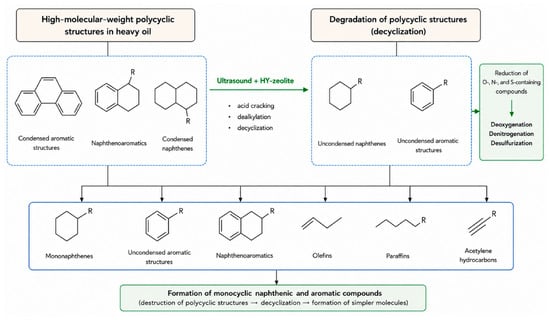
Figure 3 shows a diagram of the possible transformation pathway of oil components during ultrasonic cavitation in the presence of HY-zeolites, proposed based on the results of GC-MS analysis of light (≤200 °C) and middle (200–300 °C) fractions obtained after ultrasonic treatment of high-viscosity oil.
Figure 3.
The proposed mechanism of conversion of oil components during ultrasonic cavitation in the presence of HY-zeolites.
Among the catalytic systems investigated in the present study, HY-zeolites demonstrated the highest catalytic efficiency in the ultrasonic treatment of high-viscosity tarry-asphaltene oil compared with NiFe-containing systems. This may be attributed to their pronounced acidic properties, although this conclusion is limited by the specific composition and preparation conditions of the investigated catalysts. In contrast to conventional hydrotreatment processes under hydrogen pressure, where catalyst effectiveness is determined primarily by the availability of molecular hydrogen, under cavitation conditions, the reaction system has been found to be controlled by radical mechanisms, in which the acid sites of the catalyst simultaneously promote the cracking of high-molecular-weight structures and the stabilization of reactive intermediate species. It has been shown that catalysts effective in autoclave hydrogenation do not always retain high activity during ultrasonic cavitation, indicating a difference between hydrogen-donor and cavitation-induced radical conversion mechanisms. At the same time, despite the absence of a significant increase in the yield of light fractions, the HY-zeolite causes a change in the structure of condensed hydrocarbons towards less-condensed cyclic compounds, confirming its role as a cracking catalyst. These results emphasize the need to introduce a hydrogen-donor medium or hydrogen carriers to increase the efficiency of ultrasonic catalytic conversion of heavy oils.
The lack of hydrogen-donor sites in the catalysts leads to the opposite effect, which indicates their possible participation in the stabilization of the colloidal structure of high-viscosity oil, consisting of oils, resins, and asphaltenes. In the absence of a sufficient number of active hydrogen-donor sites, ultrasonic treatment promotes the aggregation of asphaltene particles rather than their degradation.
In this study, the main focus was on the yields of the light (≤200 °C) and middle (200–300 °C) fractions, as well as on changes in their group and individual component composition as determined by GC-MS. The heavy residue with a boiling point > 300 °C was not analyzed separately; therefore, its SARA composition, asphaltene content, average molecular weight, and possible formation of coke products were not quantified.
From a practical point of view, a key advantage of the catalytic process is the possibility of regenerating and reusing the catalyst. In this study, the reuse of the catalysts following ultrasonic treatment was not investigated experimentally; therefore, the retention of their catalytic activity during subsequent cycles cannot be quantified. With repeated use, partial deactivation of the catalysts is possible due to the accumulation of high-molecular-weight petroleum components on the surface and the blocking of active sites, as well as possible changes in the surface and structural characteristics of the active phase.
Furthermore, in this study, the yield and composition of the fractions obtained were determined immediately after ultrasonic treatment. Consequently, the temporal stability of the observed changes was not assessed. The study of sample aging by monitoring their viscosity, fractional composition, and component composition over a specific period represents an important area for further research and will enable the long-term stability of the effects of ultrasonic–catalytic treatment to be assessed.
4. Conclusions
The study investigated the effect of ultrasonic cavitation at a frequency of 22 kHz and a power of 50 W in combination with various catalytic systems (HY-zeolites, NiFe/Y-zeolites, and NiFe/microspheres) on the fractional composition of high-viscosity oil and the group chemical composition of fractions with boiling points up to 200 °C and in the range of 200–300 °C. It was found that ultrasonic treatment without a catalyst leads to a decrease in the yields of the target distillate fractions, which is associated with the occurrence of secondary radical processes and the possible aggregation of asphaltene and resinous components. It has been shown that the nature of the catalyst has a decisive influence on the direction of these transformations.
Of the systems studied, HY-zeolites demonstrated the highest efficiency, resulting in a 7.9% increase in the yield of the light fraction compared with the initial oil. In addition, under the action of HY-zeolites, a structural rearrangement of high-molecular-weight polycyclic components was observed, with the formation of less-condensed naphthenic and aromatic compounds, indicating the intensification of cracking and decyclization processes.
The NiFe/Y-zeolite and NiFe/microsphere catalysts contribute to the formation of naphthenic and aromatic structures in the light and middle fractions but do not provide an increase in the yield of distillate products. The results obtained indicate that the effectiveness of ultrasonic catalytic conversion of high-viscosity oil is determined not only by the presence of active metal sites but also by the ability of the catalyst to stabilize radical intermediate species. Thus, the use of acid zeolite catalysts is a promising approach for intensifying the ultrasonic processing of heavy oils and increasing the selectivity towards the formation of valuable distillate fractions.
Author Contributions
Conceptualization, D.A. and M.B. (Murzabek Baikenov); methodology, D.A. and M.B. (Murzabek Baikenov); software, Y.K. and A.M.; validation, D.A., M.B. (Murzabek Baikenov) and M.B. (Markhabbat Bakir); formal analysis, D.A., M.B. (Murzabek Baikenov), M.B. (Markhabbat Bakir), Y.K., A.M., A.A. and B.T.; investigation, D.A., M.B. (Murzabek Baikenov), M.B. (Markhabbat Bakir), Y.K., A.M., A.A. and B.T.; resources, D.A., M.B. (Murzabek Baikenov), Y.K., A.M. and B.T.; data curation, D.A. and M.B. (Markhabbat Bakir); writing—original draft preparation, D.A.; writing—review and editing, D.A.; visualization, Y.K. and A.M.; supervision, D.A. and M.B. (Murzabek Baikenov); project administration, D.A.; funding acquisition, D.A. All authors have read and agreed to the published version of the manuscript.
Funding
This research is funded by the Committee of Science of the Ministry of Science and Higher Education of the Republic of Kazakhstan (Grant No. AP22684288 Destruction of the Karazhanbas field high-viscosity oil by ultrasonic action in the presence of a catalyst).
Data Availability Statement
The original contributions presented in this study are included in the article. Further inquiries can be directed to the corresponding author(s).
Conflicts of Interest
The authors declare no conflicts of interest.
References
- Zolotukhin, V.A. New technology for refining of heavy crude and oil-refining residues. Chem. Pet. Eng. 2004, 40, 585–589. [Google Scholar] [CrossRef] [Scilit]
- Ilyushin, Y.; Martirosyan, A.V.; Asadulagi, M.A.; Kukharova, T. Modeling and optimization of an automatic temperature control system for the catalytic cracking process. Modelling 2026, 7, 68. [Google Scholar] [CrossRef] [Scilit]
- Al-Ameri, O.B.; Alzuhairi, M.; Shakor, Z.; Bailón-García, E.; Carrasco-Marín, F.; Amaro-Gahete, J. Kinetic and thermodynamic study of vacuum residue cracking over cerium-modified metakaolinite catalyst. Processes 2025, 13, 3126. [Google Scholar] [CrossRef] [Scilit]
- Miroshnichenko, D.; Chemerinskiy, M.; Bilushchak, H.; Pyshyev, S.; Rohovyi, Y.; Bogoyavlenska, O. Forecasting the characteristics of crude oil from the Druzhelyubivske oil and gas condensate field. Min. Miner. Depos. 2025, 19, 81–90. [Google Scholar] [CrossRef] [Scilit]
- Myltykbayeva, Z.; Mussabayeva, B.; Ongarbayev, Y.; Imanbayev, Y.; Muktaly, D. Ultrasonic technology for hydrocarbon raw recovery and processing. Processes 2024, 12, 2162. [Google Scholar] [CrossRef] [Scilit]
- Kairbekov, Z.K.; Maloletnev, A.S.; Dzheldybaeva, I.M. Application of ultrasonication to intensify the thermal cracking of fuel oil in a mixture with oil shale. Solid Fuel Chem. 2020, 54, 175–179. [Google Scholar] [CrossRef] [Scilit]
- Mullakaev, M.S.; Abramov, V.O.; Abramov, A.V. Development of ultrasonic equipment and technology for well stimulation and enhanced oil recovery. J. Pet. Sci. Eng. 2015, 125, 201–208. [Google Scholar] [CrossRef] [Scilit]
- Nadirova, Z.K.; Ivakhnenko, O.P.; Zhantasov, M.K.; Bimbetova, G.Z.; Nadirov, K.S. Ultrasound-assisted dewatering of crude oil from Kumkol oilfield. Chem. Bull. Kazakh Natl. Univ. 2021, 101, 4–10. [Google Scholar] [CrossRef] [Scilit]
- Ye, G.; Lu, X.; Han, P.; Peng, F.; Wang, Y.; Shen, X. Application of ultrasound on crude oil pretreatment. Chem. Eng. Process. Process Intensif. 2008, 47, 2346–2350. [Google Scholar] [CrossRef] [Scilit]
- Luo, X.; Gong, H.; He, Z.; Zhang, P.; He, L. Recent advances in applications of power ultrasound for petroleum industry. Ultrason. Sonochem. 2021, 70, 105337. [Google Scholar] [CrossRef] [Scilit]
- Huang, X.; Zhou, C.; Suo, Q.; Wang, S. Experimental study on viscosity reduction for residual oil by ultrasonic. Ultrason. Sonochem. 2018, 41, 661–669. [Google Scholar] [CrossRef] [Scilit]
- Kuimov, D.; Minkin, M.; Yurov, A.; Lukyanov, A. Current state of research on the mechanism of cavitation effects in the treatment of liquid petroleum products—Review and proposals for further research. Fluids 2023, 8, 172. [Google Scholar] [CrossRef] [Scilit]
- Zheng, L.; Jiao, J.; Yang, M. Relations between asphaltene content, viscosity reduction rate of heavy oil and ultrasonic parameters. Pet. Sci. Technol. 2019, 37, 1683–1690. [Google Scholar] [CrossRef] [Scilit]
- Qiao, J.; Zuo, K.; Sun, Y.; Song, W.; Zhang, X.; Dai, L.; Wang, W.; Jian, C. Experimental studies on the effect of ultrasonic treatment and hydrogen donors on residual oil characteristics. Ultrason. Sonochem. 2020, 69, 105266. [Google Scholar] [CrossRef] [Scilit]
- Maye, P.E.E.; Yang, J.; Yan, T.; Xu, X. The effects of ultrasonic treatment on the molecular structure of residual oil. China Pet. Process. Petrochem. Technol. 2017, 19, 82–88. [Google Scholar]
- Kaushik, P.; Kumar, A.; Bhaskar, T.; Sharma, Y.; Tandon, D.; Goyal, H. Ultrasound cavitation technique for up-gradation of vacuum residue. Fuel Process. Technol. 2012, 93, 73–77. [Google Scholar] [CrossRef] [Scilit]
- Pelayo, E.E.M.; Yang, J.Y.; Yan, T.Y.; Xu, X.R. Study on the modification of vacuum residue by ultrasonic radiation. China Pet. Process. Petrochem. Technol. 2017, 19, 114–122. [Google Scholar]
- Ordabaeva, A.T.; Muldakhmetov, Z.M.; Gazaliev, A.M.; Meiramov, M.G.; Zhivotova, T.S. Hydrocatalytic treatment of a broad coal tar fraction. Coke Chem. 2023, 66, 220–226. [Google Scholar] [CrossRef] [Scilit]
- Mansouri, H.; Mohammadidoust, A.; Mohammadi, F. An optimization study on quality promotion of heavy crude oil exposed ultrasonic waves and magnetic nanoparticles addition. Chem. Eng. Process. Process Intensif. 2021, 167, 108542. [Google Scholar] [CrossRef] [Scilit]
- Baimukhametov, G.F.; Dengaev, A.V.; Safiullina, E.U.; Kayumov, A.A.; Drozdov, I.M.; Shishulin, V.V.; Boushra, A.; Vakhin, A.V.; Sargin, B.V.; Sidibe, M.S. Relaxation process in crude oil after ultrasonic treatment. Int. J. Eng. Trans. B Appl. 2024, 37, 896–903. [Google Scholar] [CrossRef] [Scilit]
- Kadyirov, A.; Karaeva, J.; Barskaya, E.; Vachagina, E. Features of rheological behavior of crude oil after ultrasonic treatment. Braz. J. Chem. Eng. 2023, 40, 159–168. [Google Scholar] [CrossRef] [Scilit]
- Galimzyanova, A.R.; Gataullin, R.N.; Stepanova, Y.S.; Marfin, E.A.; Khelkhal, M.A.; Vakhin, A.V. Elucidating the impact of ultrasonic treatment on bituminous oil properties: A comprehensive study of viscosity modification. Geoenergy Sci. Eng. 2024, 233, 212487. [Google Scholar] [CrossRef] [Scilit]
- Aitbekova, D.; Baikenov, M.; Ainabayev, A.; Balpanova, N.; Tyanakh, S.; Absat, Z.; Rakhimzhanova, N.; Kochegina, Y. A study of the conversion kinetics of high-viscosity oil components during ultrasonic treatment in the presence of zeolite. Fuels 2026, 7, 12. [Google Scholar] [CrossRef] [Scilit]
- Yedrissov, A.T.; Aitbekova, D.E.; Tusipkhan, A.; Tateyeva, A.B.; Baikenova, G.G.; Baikenov, M.I.; Kaikenov, D.A. TGA-based thermokinetics of high-viscosity oil decomposition in the presence of nanocatalysts, catalytic additives, and polymers. Pet. Chem. 2021, 61, 431–437. [Google Scholar] [CrossRef] [Scilit]
- Aitbekova, D.E.; Yun, M.F.; Meiramov, M.G.; Baikenova, G.G.; Kumakov, F.E.; Tusipkhan, A.; Mukhametzhanova, S.K.; Baikenov, M.I. Catalytic hydrogenation of a model mixture of anthracene and phenanthrene. Solid Fuel Chem. 2019, 53, 230–238. [Google Scholar] [CrossRef] [Scilit]
- Ranjbar, N.; Kuenzel, C. Cenospheres: A review. Fuel 2017, 207, 1–12. [Google Scholar] [CrossRef] [Scilit]
- Vosmerikov, A.A.; Vosmerikova, L.N.; Vosmerikov, A.V. Acidic and catalytic properties of Mg-containing zeolite catalyst in the propane conversion to olefinic hydrocarbons. ChemChemTech 2023, 66, 42–49. [Google Scholar] [CrossRef] [Scilit]
- Anufriev, R.V.; Volkova, G.I.; Vasilyeva, A.A.; Petukhova, A.V.; Usheva, N.V. The integrated effect on properties and composition of high-paraffin oil sludge. Procedia Chem. 2015, 15, 2–7. [Google Scholar] [CrossRef] [Scilit][Green Version]
- Volkova, G.I.; Morozova, A.V. The influence of ultrasonic treatment on the properties of oil systems. J. Phys. Conf. Ser. 2020, 1611, 012018. [Google Scholar] [CrossRef] [Scilit]
- Anufriev, R.V.; Volkova, G.I. Changing the structural and mechanical properties of hydrocarbons after a high-frequency acoustic impact. Chem. Sustain. Dev. 2014, 22, 303–308. [Google Scholar]
- Khamees, L.A.; Alhaleem, A.A.; Abdul-Majeed, G.H. Ultrasonic-assisted fast upgrading of heavy crude oil using novel nanofluids. S. Afr. J. Chem. Eng. 2025, 53, 410–441. [Google Scholar] [CrossRef] [Scilit]

Disclaimer/Publisher’s Note: The statements, opinions and data contained in all publications are solely those of the individual author(s) and contributor(s) and not of MDPI and/or the editor(s). MDPI and/or the editor(s) disclaim responsibility for any injury to people or property resulting from any ideas, methods, instructions or products referred to in the content. |
© 2026 by the authors. Licensee MDPI, Basel, Switzerland. This article is an open access article distributed under the terms and conditions of the Creative Commons Attribution (CC BY) license.