


Abstract
Bioenergy production from agro-industrial waste has the potential to contribute to climate change mitigation. In Brazil, the pequi (Caryocar brasiliense Camb.) production chain makes an economic, environmental, and social contribution. However, the collection and processing of the fruit produce large amounts of waste, such as the peel, whose improper disposal leads to significant environmental impacts. This study evaluated how moisture and carbonization temperature influence the energy properties of charcoal briquettes made from pequi peel waste. Carbonization was performed at two final temperatures (360 °C/480 °C) with a heating rate of 1.5 °C min−1 and residence times of 4 h and 5 h 20 min, respectively. Carbonization yields were calculated based on dry mass. Briquettes were produced from pequi peel at moisture contents of 5%, 7.5%, and 10% (wet basis). After carbonization, the charcoal briquette samples were characterized by proximate analysis, higher heating value (HHV), bulk density, energy density, and mechanical durability. Carbonization temperature exerted a more pronounced effect on the properties of the carbonized briquettes than the initial moisture content. Carbonization at 480 °C increased the fixed carbon content (76.38%, 74.25%, and 75.10% for treatments 1, 2, and 3) and the HHV (25.10–25.31 MJ kg−1), while reducing the gravimetric yield (32.84–33.25%). The influence of moisture content was more evident in carbonizations carried out at 360 °C, indicating a temperature-dependent interaction. The use of pequi peel for solid biofuel production promotes the valorization of agro-industrial residues and supports strategies aimed at the circular bioeconomy and the decarbonization of the energy matrix.
1. Introduction
Energy transition requires concerted efforts to promote renewable energy sources in alignment with sustainable economic development [1,2]. In this context, extractive residues represent a promising alternative for bioenergy production, contributing to the mitigation of environmental impacts and the sustainable utilization of resources, thereby fostering a circular economy [3]. In addition to their traditional uses as fertilizers, forage, and industrial raw materials, biomass utilization as a biofuel is an effective strategy to mitigate climate change, enhance energy security, and stimulate regional economic development [4].
The pequi tree (Caryocar brasiliense Camb.) belongs to the family Caryocaraceae and is one of the symbols of the Brazilian Cerrado [5]. It plays an important role in the regional economy and in the livelihoods of many families, being mainly collected through extractivism [6]. The pequi fruit is commercialized in different forms, such as fresh fruit, pulp, oil, liqueurs, sweets, and cosmetics, serving both local markets and industry [7]. The processing and commercialization of the fruit prioritize its pulp, which leads to the disposal of the remaining parts and, consequently, to the generation of large volumes of solid waste. These residues are mainly composed of the outer peel, the stone (seed), and portions of the endocarp, which together may represent more than 75% of the total fruit mass [8,9]. Pequi production in 2024, as reported by IBGE, reached 54,165 tons, with the largest contribution coming from the state of Minas Gerais [10]. Based on this amount, the estimated production of residual peel biomass was approximately 40 thousand tons. These large quantities reinforce the need for technological alternatives for their valorization.
Several studies have already demonstrated the potential for utilizing this byproduct. In the food sector, flour obtained from pequi peel exhibits a high content of prebiotic compounds and significant antioxidant potential, which has encouraged its application as an ingredient in the formulation of functional foods and nutraceuticals [11,12]. Furthermore, research has demonstrated the feasibility of using this ingredient in the development of gluten-free products, such as cookies intended for individuals with celiac disease [13]. In the agricultural field, pequi peel biochar has shown good performance as a soil acidity amendment and as a source of potassium for plants [14]. In the medical field, extracts from pequi peel have shown promise as natural photosensitizers for antimicrobial photodynamic therapy, combining microbial control with preservation of the initial wound-healing process [15]. In veterinary medicine, a study developed eye drops based on pequi peel extracts, indicating promising use in the treatment of infectious or inflammatory ophthalmopathies in companion dogs [16].
Although these studies demonstrate the versatility and high-value applications of pequi peel, such uses may not be sufficient to absorb the large volumes generated annually. Therefore, alternative large-scale valorization strategies are necessary. In this context, the densification of pequi peels in the form of briquettes represents a promising utilization route that, in addition to improving energy density, facilitates logistical aspects such as handling, transportation, and storage [17]. In this context, integrating waste management with renewable energy production is essential to promote the circular economy and add value to the pequi production chain. This approach not only mitigates the impacts of improper disposal but also contributes to several Sustainable Development Goals (SDGs), including No Poverty (SDG 1), Zero Hunger (SDG 2), Affordable and Clean Energy (SDG 7), Decent Work and Economic Growth (SDG 8), Responsible Consumption and Production (SDG 12), and Climate Action (SDG 13) [3].
Despite the growing interest in biomass densification and carbonization processes, studies integrating the effects of initial moisture content and carbonization temperature on agro-extractive residues remain scarce, particularly for underexplored species such as Caryocar brasiliense. Most previous works focus either on raw biomass pyrolysis or on densified fuels separately, without addressing their combined influence on thermochemical behavior and fuel performance.
Carbonization can enhance the benefits of biomass densification, an effective method to improve the energy properties of pequi residues after compaction, such as increasing the fixed carbon content, higher heating value, and energy density [9,10,18]. In this way, the process complements the advantages of briquette production [19]. The carbonization temperature and heating rate directly influence the yield and quality of solid products as well as gaseous and liquid by-products [11,12,20], making it important to investigate how the carbonization of biofuels at different temperatures can affect their physical and chemical properties, thus determining their efficiency as solid biofuels [21].
In this context, this study provides a novel contribution by systematically evaluating the interaction between briquetting moisture and carbonization temperature on the thermal degradation, product distribution, and energy properties of pequi peel briquettes. Additionally, this work advances current knowledge by linking thermogravimetric behavior with practical fuel performance, offering insights for decentralized bioenergy systems in extractive communities.
The objective of this study was to analyze the influence of briquette production moisture and carbonization temperature on the chemical, thermal, and physical parameters of pequi peel biomass, also assessing the combined effects of these variables on gravimetric yield and by-product formation during the process. In response to growing environmental concerns and the need to meet the Sustainable Development Goals (SDGs), this research aims to develop alternatives for the reutilization of these residues, promoting the circular economy and integrating the pequi production chain by transforming environmental waste into economic assets.
2. Materials and Methods
2.1. Biological Material
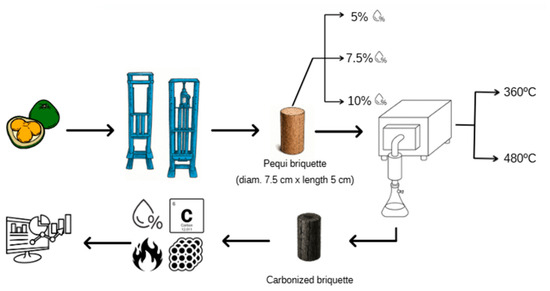
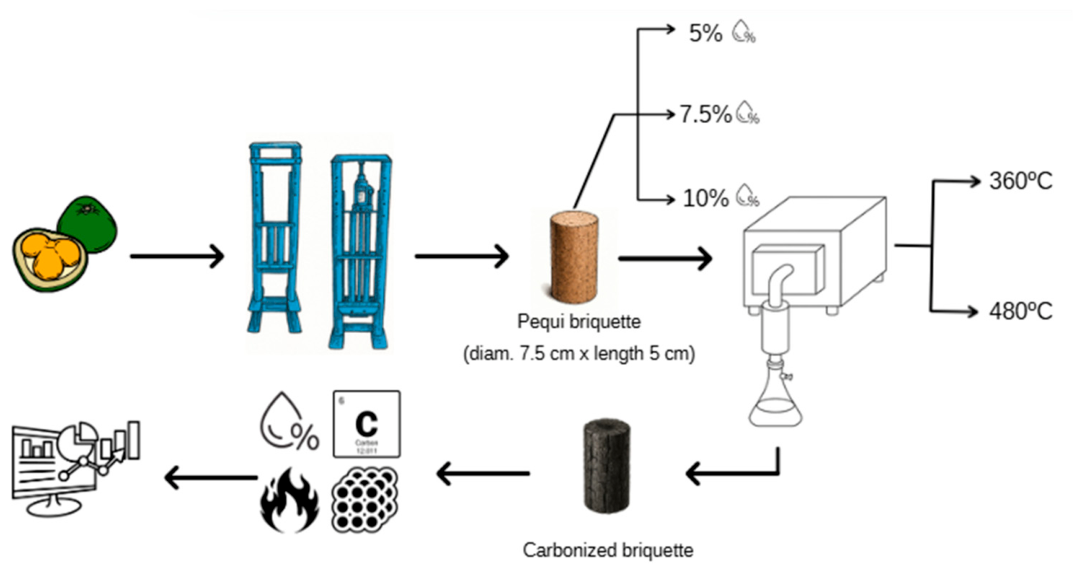
The pequi peels used in this study were directly collected from markets and selling points in the city of Montes Claros, Minas Gerais state, Brazil (16°42′56″ S; 43°51′58″ W; 624 m). To reduce variability associated with different suppliers, all material was obtained within the same week and pooled to form a single batch. After collection, the peels were transported to the laboratory, cleaned to remove foreign impurities, and air-dried under controlled laboratory conditions (≈25 °C, protected from direct sunlight) for 7 days. The dried biomass was milled and sieved to obtain a uniform particle size fraction of 0.5 cm. The sieved material was thoroughly mixed to ensure homogeneity prior to moisture adjustment and briquetting. The pequi briquettes intended for carbonization were produced using a manual press equipped with 7.5 cm diameter steel tubes and operated by a hydraulic jack, which provided the pressure required for particle densification (Figure 1). The applied pressure was neither monitored nor quantified to avoid differences between treatments, as the process was conducted manually. Although the applied load was manually controlled, all briquettes were produced by the same operator following a standardized procedure to minimize variability. The mass and dimensions of the briquettes were recorded, allowing the calculation of bulk density and reducing variability among replicates. The moisture content was adjusted gravimetrically prior to pressing and verified to ensure experimental consistency.
Figure 1.
Schematic representation of the applied methodology.
The pressing time was fixed at five minutes. The briquettes were produced under three distinct experimental conditions, differing exclusively in the moisture content of the biomass during compaction. Approximately 500 g of fresh pequi peel was used for each briquette unit. The biomass moisture was adjusted by adding specific volumes of water. In the first treatment (T1), 25 mL of water was added, resulting in a moisture content of 5% (wet basis); in the second (T2), 37.5 mL was added, increasing the moisture to 7.5%; and in the third (T3), 50 mL was added, reaching 10% moisture. These values refer to the biomass moisture immediately before the compaction process and do not represent the final moisture of the briquettes before the carbonization step. After pressing, the briquettes (diameter 7.5 cm; length 5.0 cm) were air-dried in a shaded and ventilated environment until reaching constant weight, which occurred approximately seven days after production. At the end of the drying process, the residual moisture content of the briquettes ranged from 8.0% to 8.7%.
2.2. Thermogravimetric Analysis of Biomass for Defining Carbonization Temperatures
Thermogravimetric analysis (TGA) was performed to investigate the thermal degradation behavior of the biomass and to support the selection of carbonization temperatures. The analyses were conducted using a DTG-60H thermal analyzer (Shimadzu Corporation, Kyoto, Japan) under an inert nitrogen atmosphere (50 mL min−1) to prevent oxidative reactions. Approximately 5 mg of sample was placed in alumina crucibles and heated from 28 to 900 °C at heating rates of 5, 10, 15, and 20 °C min−1. All analyses were performed in duplicate to ensure reproducibility. The use of multiple heating rates allowed the evaluation of the influence of thermal conditions on degradation behavior and provided qualitative insights into the kinetics of biomass decomposition, based on the displacement of DTG peaks. The derivative thermogravimetric (DTG) curves were obtained as the first derivative of mass loss with respect to temperature (dm/dT), enabling the identification of distinct thermal degradation stages associated with the main biomass components.
2.3. Briquettes Carbonization and Process Yields
Carbonization was carried out in triplicate, using two briquettes from each treatment, in a laboratory muffle furnace with electric heating, adapted to recover the pyroligneous liquor. Heating was performed at a rate of 1.5 °C min−1 until reaching final temperatures of 360 °C and 480 °C (Table 1). The final carbonization temperatures were defined based on the thermogravimetric behavior of the biomass. The temperature of 360 °C corresponds to the main devolatilization region, where hemicellulose and cellulose degradation predominate. This temperature range is consistent with the typical thermal decomposition intervals reported in the literature, in which hemicellulose degrades primarily between 200 and 350 °C and cellulose between 300 and 400 °C, while lignin decomposes gradually over a broader range (approximately 250–500 °C) [22,23]. In contrast, 480 °C was selected because it is close to the stabilization region observed in the TG curve, indicating advanced devolatilization and greater structural reorganization of the carbon matrix. Temperatures around 450–500 °C are widely reported as representative of conventional slow pyrolysis conditions for producing thermally stable char with increased fixed carbon content [22]. The heating rate of 1.5 °C min−1 was selected to ensure controlled thermal degradation, minimizing internal temperature gradients and allowing a more homogeneous devolatilization process. Slow heating rates are commonly adopted in laboratory-scale carbonization studies to favor structural stability of the char matrix and to improve reproducibility of thermochemical transformations.
Table 1.
Carbonization profile according to time and temperature for pequi peel briquettes.
The gravimetric yield was calculated as the ratio between the dry mass of the carbonized briquette and the dry mass of the briquette before carbonization (Equation (1)). For this purpose, the briquettes were previously dried in an oven until reaching constant weight before carbonization, in order to eliminate the influence of moisture on yield evaluation. Similarly, after carbonization, the raw material was also dried prior to weighing, ensuring that the yield calculation reflected only the mass loss related to the thermal degradation of organic components, and not water evaporation.
where
- RGY: gravimetric yield (%);
- DMCB: dry mass of carbonized briquette (g);
- DMB: dry mass of briquette (g).
Condensates were collected using a condensation system connected to the pyrolysis reactor. Every effort was made to minimize losses during collection, though minor losses due to adsorption and evaporation may occur. The bio-oil yield was determined by dividing the mass of the pyrolysis liquid by the dry mass of the briquette before carbonization (Equation (2)).
where
- RBO: bio-oil yield (%);
- MBO: mass of bio-oil (g);
- MB: dry mass of the briquette (g).
Two experimental points in bio-oil yield were considered outliers, as they deviated from the mean by more than 22 standard deviations, likely due to operational disturbances during pyrolysis. Excluding these outliers did not affect the overall conclusions.
The non-condensable gas yield was determined by difference, using Equation (3).
where
- RNCG: non-condensable gas yield (%);
- RGY: gravimetric yield (%);
- RBO: bio-oil yield (%).
2.4. Properties of Pequi Biomass and Carbonized Briquettes
The pequi briquettes’ bulk density, with a moisture content between 8.0 and 8.7%, was calculated based on the ratio between mass and volume, according to ISO 17828 [24]. The mass was determined using an analytical balance, while the volume was obtained from measurements of the briquette diameter and height taken with a digital caliper.
The breakage index of the carbonized briquettes was determined according to the ABNT NBR 7416 [25] standard (Equation (4)):
where
- BI: breakage index (%);
- Pf: mass of the fragments after the test (g);
- Pi: mass of the sample before the test (g).
The moisture content was determined according to ASTM D1762 [26]. The ash and volatile matter contents were also analyzed following this procedure, while the fixed carbon content was calculated by difference, as 100% minus the sum of the volatile matter and ash contents. The higher heating value (HHV) was measured using an adiabatic bomb calorimeter, following the specifications of NBR 8633 [27].
The energy density for each treatment was determined based on the product of the higher heating value (HHV) and the bulk density.
2.5. Statistical Analysis
The experimental design adopted was completely randomized, in a 3 × 2 factorial arrangement, considering two factors: the moisture content used in briquette production and the two carbonization heating programs applied. Before the statistical analysis, data normality was verified using the Shapiro–Wilk test. For the variables that did not violate normality (p > 0.05), parametric analyses were performed to compare the treatments. Among the analyzed variables, only the bio-oil yield did not show a normal distribution, even after applying statistical transformations. Therefore, two outlier values were removed, both belonging to the treatment with 7.5% moisture (Treatment 2), one corresponding to the carbonization at a final temperature of 360 °C and the other at 480 °C. For significant interactions between factors, Tukey’s test was applied at a 5% probability level to compare means and perform the necessary breakdowns, aiming to better understand the individual and combined effects of the treatments.
3. Results
3.1. Pequi Biomass Characterization
The proximate analysis of the pequi shell showed 74.41% volatile matter, 2.90% ash, and 22.69% fixed carbon. The HHV was 14.23 MJ kg−1. These values are consistent with lignocellulosic biomasses commonly used for bioenergy, indicating their potential as a feedstock for thermochemical conversion.
3.2. Thermogravimetric Analyses
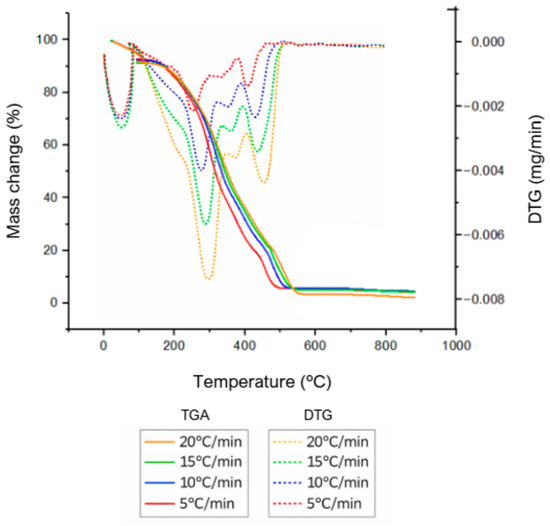
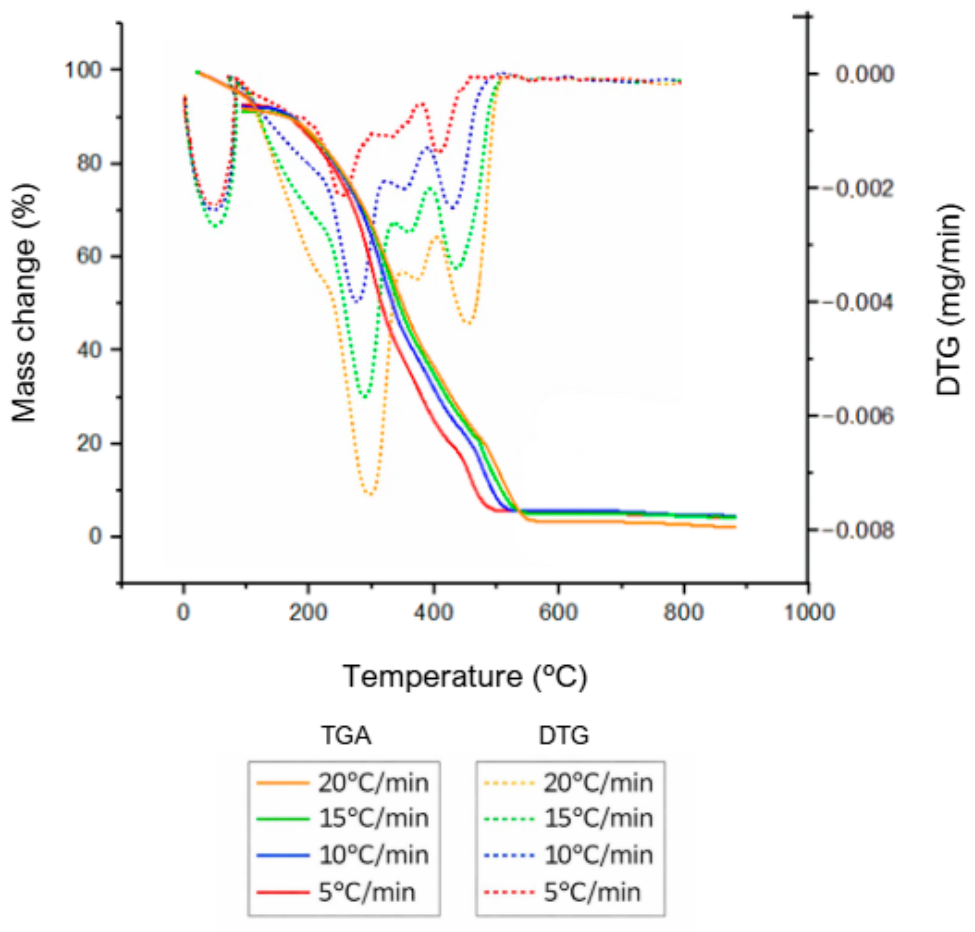
Thermogravimetric analysis (TGA) and derivative thermogravimetry (DTG) were performed to investigate the thermal degradation behavior of pequi peel and its implications for thermochemical conversion processes (Figure 2).
Figure 2.
TG and DTG curves of pequi peel obtained at different heating rates.
The TG curves showed an initial mass loss of approximately 10% up to 180 °C. The main degradation stage occurred between 180 °C and 450 °C, accounting for approximately 70% of the total mass loss. The DTG curves revealed distinct decomposition peaks associated with biomass components, and these peaks shifted toward higher temperatures with increasing heating rate.
3.3. Carbonization Yields of Pequi Peel Briquettes
The interaction between biomass moisture during briquette production and the pyrolysis temperature profile was not significant (p = 0.3846) for gravimetric yield (Table 2). This indicates that the effect of the pyrolysis temperature profile on gravimetric yield does not depend on the moisture level. The pyrolysis temperature profile was highly significant (p < 0.0001), demonstrating that the final carbonization temperature affected the charcoal yield. Moisture alone did not have a statistically significant effect (p = 0.7593), suggesting that its variation within the tested range does not influence the yield.
Table 2.
Mean values and standard deviation for gravimetric yield, bio-oil, and non-condensable gases after briquette carbonization.
The results of the factorial analysis indicate that the interaction between moisture content and pyrolysis temperature profile had a significant influence on the percentage of bio-oil. In the interaction breakdown, the effect of the pyrolysis temperature profile within each moisture level showed significant differences for all levels, with p = 0.0275, p = 0.0006, and p = 0.0144 for moisture levels 1, 2, and 3, respectively. When analyzing the effect of moisture within each pyrolysis temperature profile, a significant difference was observed only for temperature profile 1 (p = 0.0001), while for profile 2, the difference between moisture levels was not statistically significant (p = 0.3501).
The analysis of variance for the percentage of non-condensable gases did not reveal statistically significant effects of initial moisture content (p = 0.9415), indicating that variations in biomass moisture alone did not influence the amount of gas produced. The interaction between moisture and pyrolysis temperature profile was also not significant (p = 0.0760). In contrast, the pyrolysis temperature profile alone was statistically significant (p = 0.0002), demonstrating that different heating profiles markedly influenced the production of non-condensable gases.
3.4. Properties of Carbonized Briquettes
Carbonization of the briquettes at 480 °C increased the fixed carbon content and the higher heating value, reaching up to 76.38% fixed carbon and 25.31 MJ kg−1 HHV (Table 3), indicating greater energy efficiency compared to briquettes carbonized at 360 °C.
Table 3.
Properties of the carbonized briquettes.
The variance analysis for ash content in the briquettes did not reveal statistically significant effects of initial moisture, the pyrolysis temperature profile, or the interaction between these factors.
The results of the factorial analysis indicate that the interaction between moisture content and pyrolysis temperature profile had a significant effect on volatile matter content, but only for a pyrolysis temperature at 360 °C. Under this condition, a highly significant difference was observed between the moisture treatments (p < 0.0001), suggesting that the initial moisture of the material directly affects the release of volatile compounds during pyrolysis. In contrast, for profile 2, this effect was not significant (p = 0.8238), indicating that longer heat exposure may limit the influence of moisture on volatile matter.
Fixed carbon content was influenced by the pyrolysis temperature profile (p < 0.0001), whereas moisture content alone did not have a significant effect (p = 0.3117). However, a significant interaction between moisture and temperature profile was observed (p = 0.0439), indicating that the effect of the profile on fixed carbon depends on the moisture level. The interaction breakdown showed that for pyrolysis temperature at 360 °C, moisture levels significantly affected fixed carbon content (p = 0.0268), while for profile 2, this difference was not significant (p = 0.6658). Conversely, the effect of the profile within each moisture treatment was significant across all three conditions: moisture T1 (p < 0.0001), moisture T2 (p = 0.0165), and moisture T3 (p = 0.0003). These results demonstrate that the influence of the pyrolysis profile on fixed carbon varies according to moisture content, highlighting the importance of jointly analyzing these factors for process optimization.
The moisture content, pyrolysis temperature profile, and their interaction affected the briquette breakage index, indicating that these factors do not act independently. The significant interaction (p < 0.0001) demonstrates that the impact of moisture on the breakage index depends on the applied temperature profile, and vice versa. Factor breakdown reinforced this: within profile 1, different moisture levels significantly affected the breakage index (p < 0.0001), which was also observed within profile 2. The profile also had a significant effect within each moisture treatment, with p < 0.0001 for treatments 1 and 2, and p = 0.0026 for treatment 3. These results show that the variables are interdependent, highlighting the necessity of joint analysis to accurately understand their effects on the breakage index and determine the most suitable conditions.
The apparent density of the briquettes was significantly influenced by the pyrolysis temperature profile (p < 0.0001), whereas the moisture factor alone did not have a statistically significant effect (p = 0.4202). However, the interaction between moisture and temperature profile was significant (p = 0.0089), indicating that the effect of the profile on density varies according to the material’s moisture content. The analysis showed that the profile influenced density at all moisture levels tested (p < 0.05). On the other hand, when analyzing the effect of moisture within each profile, significance was observed only for profile 1 (p = 0.0211), while in profile 2, the effect of moisture was not significant (p = 0.1081).
The increase in pyrolysis temperature resulted in higher calorific value and energy density. According to the Tukey test results (p < 0.05), the carbonizations carried out at 480 °C formed statistically superior groups, highlighting the impact of carbonization temperature on the energy performance of the briquettes.
4. Discussion
4.1. Carbonization Yield and Thermogravimetric Analyses
Increasing the carbonization temperature reduced the gravimetric yield and increased the bio-oil yield, indicating that higher temperatures promote greater biomass conversion, resulting in a lower amount of carbonized briquette and higher production of liquid and gaseous co-products. This behavior is consistent with a study on the carbonization of Eucalyptus microcorys, which reported a 5% decrease in charcoal yield when the final carbonization temperature increased from 500 °C to 900 °C [28]. When the pyrolysis temperature of Atriplex nitens S. was varied from 400 °C to 600 °C, the carbonization yield decreased from 37.14% to 30.60%, corroborating our findings [29]. Similar results have shown that increasing the pyrolysis temperature reduces charcoal yield while increasing the yields of condensable and non-condensable gases [30,31,32].
During the carbonization process with a final temperature of 360 °C, the occurrence of bio-oil release, smoke formation, and flame appearance was observed at 241 °C, 323 °C, and 360 °C, respectively. For the carbonization conducted at a final temperature of 480 °C, these phenomena occurred at 240 °C, 333 °C, and 360 °C, respectively. A similar study using Eucalyptus spp. reported that the maximum peaks of gas and bio-oil emissions occurred within the temperature range of 300–450 °C [33] mainly due to the hemicellulose and cellulose conversion.
As shown by thermogravimetric analysis, pequi peel exhibited a mass loss of approximately 10% up to 180 °C, associated with moisture and low-molecular-weight volatiles [34]. The most significant degradation occurred between 180 °C and 450 °C, representing around 70% of total mass loss, corresponding to the thermal decomposition of hemicellulose and cellulose. The DTG curves showed two major decomposition events, whose temperatures shifted slightly with heating rate. This shift in DTG peaks with increasing heating rate indicates the presence of kinetic limitations, suggesting that higher heating rates delay thermal degradation and require higher temperatures to reach maximum decomposition rates. This behavior is consistent with typical biomass pyrolysis kinetics and reflects heat and mass transfer limitations during the process. The final decomposition stage (460–505 °C, depending on the heating rate) was related to lignin degradation and biomass carbonization [35].
Recent studies on pequi residues using multicomponent kinetic modeling and Py-GC/MS analysis have demonstrated that biomass thermal degradation occurs through overlapping reactions associated with its main constituents [8]. In these studies, hemicellulose decomposition is linked to the formation of oxygenated compounds such as acetic acid and furans, while cellulose degradation produces anhydrosugars, and lignin contributes mainly to phenolic compounds. These findings support the interpretation of the DTG curves observed in this study, in which distinct degradation stages can be associated with the progressive breakdown of these components. The broad decomposition range attributed to lignin is particularly consistent with its complex aromatic structure and its role in fixed carbon formation. Furthermore, kinetic analyses reported in the literature indicate that biomass degradation follows a multi-step mechanism with varying activation energies, reinforcing that the thermal behavior observed in this study is governed by overlapping reactions rather than a single-step process [8].
The identification of these three degradation stages (moisture removal, active devolatilization, and lignin decomposition) provides a clearer understanding of the thermal behavior of the biomass and supports the selection of the carbonization temperatures adopted in this study. In practical terms, this thermal behavior indicates that the temperature range between 360 and 480 °C represents a transition between intense devolatilization and structural carbon enrichment, which is critical for optimizing both yield and fuel quality.
The decomposition of the main biomass constituents is directly related to the products generated during carbonization, as each component degrades within a specific temperature range [34]. Hemicellulose, due to its less organized structure and lower polymerization degree, degraded at lower temperatures (190–320 °C), whereas cellulose, with a more crystalline structure, required higher energy and degraded primarily above 300 °C [36]. Lignin, in contrast, decomposes over a wider temperature range, contributing significantly to char formation and explaining the higher fixed carbon content observed at elevated temperatures.
This TGA evidence supports the observed increase in carbonized products at higher temperatures and explains the formation of bio-oil and gases. This difference in pyrolysis behavior explains the variation in product formation, since lignin tends to produce more charcoal, while cellulose and hemicellulose favor the generation of liquid and gaseous products [37]. In agreement with this, Shrivastava et al. [38] reported a higher liquid yield from woody biomass compared to non-woody biomass, due to the thermal decomposition of its high cellulose and hemicellulose contents.
Furthermore, the relative amounts of charcoal, gases, and liquids depend not only on the composition of the biomass but also on the process conditions, such as temperature, heating rate, and residence time [21,27]. From a process perspective, these results indicate that the selection of carbonization conditions must consider the balance between devolatilization intensity and carbon matrix stabilization, aiming to optimize both yield and fuel quality.
Low temperatures combined with long residence times favor the formation of solid products, high temperatures with extended durations increase gas release, and moderate temperatures with short residence times tend to generate more liquids [39]. The DTG curves provide important information on the thermal reactivity of the biomass, allowing the identification of distinct degradation stages associated with its main components. The displacement of DTG peaks toward higher temperatures with increasing heating rate indicates kinetic limitations and reduced heat transfer efficiency, which directly influence the decomposition behavior. This thermal response is particularly relevant for fuel applications, as it reflects the reactivity and stability of the material during thermochemical conversion processes such as pyrolysis and combustion.
An increase in temperature leads to a higher yield of non-condensable gases, as at elevated temperatures, the condensable gases are converted into bio-oil [38]. Palamanit et al. [40] studying both woody and non-woody biomass, reported that the yields of bio-oil, solid fraction, and pyrolysis gas ranged between 32.96 and 45.99%, 23.41–37.51%, and 25.23–37.58% by weight, respectively, values similar to those observed in the present study. Regarding bio-oil, Vilas-Boas et al. [41] showed that, at the same heating rate, increasing the temperature can result in an average increase of up to 15% in bio-oil yield. The values obtained in our study fall within this range. This increase can be explained by the greater extent of primary thermochemical decomposition reactions, which promote the formation of more pyrolysis vapors [41].
4.2. Properties of Pequi Biomass and Carbonized Briquettes
The elemental composition of pequi peel reported in the literature indicates characteristics typical of lignocellulosic biomass suitable for bioenergy applications. According to previous studies, pequi peel presents approximately 45.42 ± 0.01% carbon, 4.69 ± 0.09% hydrogen, 0.51 ± 0.04% nitrogen, and 2.01 ± 0.02% sulfur, with an oxygen content of 47.37 ± 0.01% [42]. The relatively high carbon content is associated with the energy potential of the biomass, as carbon is the main contributor to the calorific value of solid fuels. In contrast, the elevated oxygen content, reflected in the O/C atomic ratio of 0.78, is typical of raw lignocellulosic materials and tends to reduce the heating value compared with more carbonized fuels [42]. The H/C ratio of 1.23 suggests the presence of aliphatic structures commonly found in plant biomass and indicates that thermochemical processes such as pyrolysis or carbonization can significantly improve the fuel quality by increasing carbon concentration and reducing oxygenated compounds [43]. Additionally, the relatively low nitrogen content (0.51%) may contribute to lower NOx emissions during combustion, which is advantageous from an environmental perspective [42]. Overall, the elemental composition reported for pequi peel is consistent with values observed for other agricultural residues used in solid biofuel production, supporting its potential as a feedstock for thermochemical conversion.
The characterization of pequi shells showed results similar to those reported in the literature. In a study on the pyrolysis of pequi shell, values of 71.56% volatile matter, 2.38% ash, and 26.06% fixed carbon were found [8]. The values obtained in our study for both volatile matter and fixed carbon fall within the typical ranges observed in lignocellulosic materials commercially used as bioenergy feedstocks [44].
The increase in pyrolysis temperature decreased the volatile matter content, showing a trend similar to that of the yield, whereas an opposite trend was observed for the fixed carbon content. A study on the effect of temperature on the structural and physicochemical properties of carbonized apple tree branches reported similar findings [45], corroborating the present work. This behavior can be explained by the intensified thermal degradation of volatile compounds at higher temperatures, which promoted their conversion into liquids and gases rather than their retention in the carbonized material [46,47,48].
A briquette exhibiting high fixed carbon content and low levels of volatile matter and ash is preferable [32,33]. This is because such characteristics tend to promote a more gradual combustion, resulting in a longer residence time in the furnace until complete burnout, which improves its specific consumption [49]. Studies have reported that increasing the pyrolysis temperature leads to a higher ash content, due to the progressive concentration of residual minerals and the thermal degradation of lignocellulosic fractions, which are volatilized as the temperature rises [50], as observed for the 480 °C heating program in the present study. From a fuel application standpoint, higher fixed carbon content and lower volatile matter contribute to more stable combustion, reduced smoke formation, and longer burning time, which are key parameters for residential and small-scale energy systems.
A high ash content compromises the calorific value and requires additional precautions when used as a biofuel, such as more frequent removal of solid residues and increased maintenance of thermal equipment [51]. The values found in this study are slightly higher than expected. Although the factorial analysis did not indicate a significant influence of temperature on this parameter, the choice of the ideal carbonization temperature should consider the balance between energy properties, yield, and ash content, aiming for greater system efficiency, since a high ash content reduces the higher heating value of the fuel [52,53].
The pyrolysis temperature is directly related to the fixed carbon content, which is attributed to a higher degree of carbon polymerization [54]. The results of this study are in agreement with previous research reporting an increase in fixed carbon content with rising pyrolysis temperature, observed in various types of carbonized materials, such as residues from palm fibers, leaves, and petioles; tomato plant residues; cucumber plants; and Conocarpus plant residues [55].
Considering the pequi production chain and the application of carbonized briquettes for food preparation and residential heating, a temperature of 480 °C proved to be the most suitable, as it resulted in materials with higher calorific value and fixed carbon content. In residential contexts, these characteristics are more important than the gravimetric yield, as they provide more efficient combustion, which is desirable for domestic use.
As observed in previous studies, the hardness of plant-based materials decreases as the final carbonization temperature increases [56]. The breakage index is inversely related to strength. In our study, we found that increasing the heating rate led to greater degradation of the carbonized briquette structure, which reduced its physical strength and increased the breakage index. This decrease in strength may be associated with the higher release of volatile gases during carbonization, which compromises the structural integrity of the material [57]. A study with carbonization temperatures ranging from 300 to 700 °C showed that the strength of Eucalyptus wood charcoal decreases as the temperature rises. However, the thermal degradation of wood components does not fully explain the changes in the physical strength of charcoal; other factors, such as density and morphological structure, also play an important role [58].
The density results are not considered highly satisfactory or suitable for certain energy applications, particularly in the steel industry, which requires denser materials [49]. However, the compaction was performed using a manually operated press, intentionally chosen because it is an easily accessible and manageable piece of equipment, suitable for communities with large amounts of pequi residues that are currently discarded. This approach allows for practical utilization of these residues, aligning with the principles of the circular economy by transforming local by-products into resources. If the briquettes had been produced using industrial machinery, it is likely that the post-carbonization density values would have been higher.
The apparent density values indicate that increasing the temperature resulted in higher density. This behavior was also observed by Vaiškūnaitė, Mažeikienė e Mohammadi [59], who used final temperature ranges of 300 °C, 400 °C, 500 °C, and 600 °C. Similarly, Suresh Babu et al. [53] reported the same pattern when pyrolyzing residual biomass composed of mixed wood and coconut shell residues, with pyrolysis temperatures ranging from 400 to 800 °C. This occurs because higher temperatures promote greater compaction of the carbonized material particles by reducing moisture and concentrating the material into a smaller volume [59].
The higher heating value (HHV) is one of the main parameters in energy assessments and is defined as the amount of energy released per unit of mass or volume of the fuel after complete combustion [51]. The HHV of the pequi biomass was 14.23 MJ kg−1, which falls within the range reported for other lignocellulosic materials. This value is similar to that of wheat straw, which typically ranges from 14 to 15 MJ kg−1 [60]. In contrast, the HHV of pequi biomass is lower than that reported for conifer bark and sawdust, which range from 17 to 18 MJ kg−1 and are generally characterized by higher lignin content and lower moisture levels [60]. Therefore, although pequi biomass presents potential for energy use, its calorific performance is more comparable to that of lighter agricultural residues and remains below that of woody biomasses traditionally used as solid fuels. Another relevant aspect for energy applications is the energy density, which represents the amount of energy contained per unit of volume [61].
In our study, increasing the pyrolysis temperature resulted in a higher heating value, as also reported by Rambhatla et al. [62] for mixed wood sawdust residues, and consequently led to an increase in energy density. These authors observed that the heating value increased by 5.72% when the pyrolysis temperature was raised from 400 to 900 °C, due to the enhanced elemental composition of the biochar. This behavior highlights that the high heating value of briquettes carbonized at higher temperatures reinforces their potential use as a solid fuel in heating systems [53]. Values similar to, although slightly lower than, those obtained in the present study were reported by Ramírez-Ramírez et al. [63], who found calorific values ranging from 17.7 to 19.7 MJ kg−1 for briquettes produced with binder-free sawdust from primary wood processing. The value obtained in our research was higher, meeting and exceeding the minimum requirement for commercial briquettes, which must present a calorific value above 17.5 MJ kg−1 [63].
In our study, the pyrolysis process led to a significant increase in the heating value of the biomass, a result that is consistent with the findings reported by Mierzwa-Hersztek et al. [60]. These authors observed that the calorific value of the carbonized biomass was, on average, 36% higher than that of the raw materials used in the pyrolysis process, attributing this improvement to the reduction in volatile matter and the consequent increase in fixed carbon content [60]. Similarly, the carbonized briquettes produced in our work exhibited higher heating values than the original biomass, reinforcing that pyrolysis is an effective process for concentrating energy content and enhancing the quality of the resulting solid fuel. These parameters are fundamental for evaluating the practical applicability of the material as a fuel, as higher heating value and energy density directly influence energy efficiency, storage, and transport viability in real use conditions.
Acrocomia aculeata residues carbonized at 550 °C exhibited energy densities ranging from 3.64 to 10.45 GJ m−3, higher than those observed in our study, which can be attributed both to the elevated lignin content in Acrocomia aculeata biomass [64] and higher ash content in pequi. Similarly, briquettes made from coffee processing residues carbonized at 450 °C also showed higher values than the pequi peel briquettes in our study. The authors reported an energy density of 22.8 GJ m−3, associated with a high apparent density of 0.793 g cm−3 [61]. However, the lower apparent density and consequently lower energy density observed in our study are related to the compaction process used for the briquettes.
The results of our study indicate that pequi peel (Caryocar brasiliense Camb.) is viable for the production of carbonized briquettes, which represents an advantage for rural communities, extractivists, and small-scale producers by facilitating local utilization of the residue, adding value, and promoting the closure of the pequi production chain within the principles of the circular economy, in addition to improving the energy characteristics of the biofuel. Briquettes carbonized at 480 °C provided higher heating value and fixed carbon content, favoring their application in residential activities such as food preparation. TGA/DTG analysis demonstrated sequential decomposition of hemicellulose, cellulose, and lignin, supporting the observed increase in biochar content and energy density, which are critical for efficient combustion. From a carbon mitigation perspective, although direct emission measurements were not performed, the substitution of traditional fuels such as firewood or fossil-based fuels by carbonized briquettes may reduce net CO2 emissions, particularly when considering the renewable origin of the biomass and the potential for carbon retention in the solid phase. In this way, the valorization of pequi residues as solid biofuel may contribute to reducing greenhouse gas emissions by replacing fossil fuels and avoiding emissions associated with improper biomass disposal. Future studies should quantify these benefits through life cycle assessment (LCA) or direct emission measurements. The increase in fixed carbon content after carbonization also suggests greater carbon stability in the solid phase. However, this gain in energy quality is accompanied by higher ash content and lower gravimetric yield, which requires attention regarding cleaning frequency and process efficiency. Briquettes carbonized at 360 °C, although exhibiting lower heating value and fixed carbon content, showed better yield and may be advantageous in contexts where productivity is more relevant than thermal performance. Although the apparent density and energy density are lower than some other agro-residues, they remain sufficient for residential heating, illustrating the trade-off between feedstock accessibility, processing simplicity, and fuel efficiency. Although direct emission measurements were not performed, the combined results of TGA/DTG, proximate analysis, and HHV provide indirect evidence of improved fuel performance and potential environmental benefits. Thus, the results obtained in this study contribute to advancing knowledge on the energetic utilization of agro-industrial residues, particularly pequi peel, reinforcing its potential as a viable feedstock for solid biofuel production. Overall, these findings link physicochemical and thermal properties directly to practical fuel performance, addressing the key requirements for a solid biofuel in small-scale and community applications.
5. Conclusions
Pequi peel (Caryocar brasiliense Camb.) has potential for the production of carbonized briquettes, contributing significantly to the utilization of agro-industrial residues and to the strengthening of the circular bioeconomy. The carbonization temperature was identified as the most influential factor on the energy properties of the charcoal briquettes, with carbonization at 480 °C providing higher fixed carbon content, higher heating value (HHV), and greater energy density, characteristics desirable for residential and culinary applications. Conversely, carbonization at 360 °C resulted in higher gravimetric yield, which may be advantageous in contexts where productivity is a priority.
The initial moisture content of the pequi briquette feedstock had more pronounced effects at lower temperatures, indicating a pyrolysis temperature-dependent interaction. Although the apparent density values obtained are not ideal for industrial applications, they remain sufficient for residential heating and cooking, illustrating the trade-off between accessible processing and fuel efficiency. The use of simple and accessible equipment reinforces the feasibility of this technology for extractive communities and small-scale producers, promoting productive inclusion and sustainability.
The results obtained contribute to advancing knowledge both on the pequi densification and energetic use of pequi residues, highlighting that the selection of briquette production conditions should consider a balance between yield, energy quality, and applicability according to the intended use. Thus, this study reinforces the importance of valorizing agro-industrial residues as a strategy for decarbonizing the energy matrix and promoting sustainable development.
Author Contributions
Conceptualization, B.L.d.L. and F.C.; methodology, B.L.d.L., A.J.V.Z., F.C., T.B., E.E.P.B., M.D.C.A. and A.G.C.; validation, B.L.d.L. and F.G.d.S.; formal analysis, B.L.d.L., L.d.S.A.S. and E.F.; investigation, B.L.d.L.; data curation, B.L.d.L. and F.G.d.S.; writing—original draft preparation, B.L.d.L., A.J.V.Z. and S.G.W.; writing—review and editing, B.L.d.L., A.J.V.Z., F.C., T.B., E.E.P.B., M.D.C.A., A.N., A.G.C., L.d.S.A.S., E.F., S.G.W. and M.A.D.; supervision, F.C.; project administration, B.L.d.L. and F.C. All authors have read and agreed to the published version of the manuscript.
Funding
This research was funded by “Fundação de Amparo à Pesquisa do Estado de Minas Gerais” (FAPEMIG), grant number 14190.
Data Availability Statement
The datasets generated and analyzed during the current study are available from the corresponding author upon reasonable request.
Acknowledgments
We gratefully acknowledge the Fundação de Amparo à Pesquisa do Estado de Minas Gerais (FAPEMIG) for providing scholarships, the Financiadora de Estudos e Projetos (FINEP)—Project number 16296 sub. 1, Agreement 26280, and also the project “From extractivism to agroindustry in the quilombola community of Pontinha: a commitment to achieving the Sustainable Development Goals”.
Conflicts of Interest
The authors declare no conflicts of interest.
References
- Chou, C.-H.; Ngo, S.L.; Tran, P.P. Renewable Energy Integration for Sustainable Economic Growth: Insights and Challenges via Bibliometric Analysis. Sustainability 2023, 15, 15030. [Google Scholar] [CrossRef] [Scilit]
- Sahoo, K.; Alanya-Rosenbaum, S.; Bergman, R.; Abbas, D.; Bilek, E.M. Environmental and Economic Assessment of Portable Systems: Production of Wood-Briquettes and Torrefied-Briquettes to Generate Heat and Electricity. Fuels 2021, 2, 345–366. [Google Scholar] [CrossRef] [Scilit]
- Kumba, H.; Makepa, D.C.; Charamba, A.N.; Olanrewaju, O.A. Towards Circular Economy: Integrating Waste Management for Renewable Energy Optimization in Zimbabwe. Sustainability 2024, 16, 5014. [Google Scholar] [CrossRef] [Scilit]
- Azadbakht, M.; Safieddin Ardebili, S.M.; Rahmani, M. A Study on Biodiesel Production Using Agricultural Wastes and Animal Fats. Biomass Convers. Biorefinery 2023, 13, 4893–4899. [Google Scholar] [CrossRef] [Scilit]
- Geöcze, K.C.; Barbosa, L.C.A.; Lima, C.F.; Ferruzzi, M.G.; Fidêncio, P.H.; Sant’ana, H.M.P.; Silvério, F.O. Caryocar brasiliense Camb. Fruits from the Brazilian Cerrado as a Rich Source of Carotenoids with pro-Vitamin A Activity. J. Food Compos. Anal. 2021, 101, 103943. [Google Scholar] [CrossRef] [Scilit]
- Paula, D.; da Capela, A.; Martins, A.F.; Costa, N.; Lelis, C. Biological Activities of Pequi (Caryocar brasiliense Camb.) Pulp Oil. In Multiple Biological Activities of Unconventional Seed Oils; Elsevier: Amsterdam, The Netherlands, 2022; pp. 257–267. [Google Scholar]
- Silva, L.H.P.d.; Pinto, L.C.L.; Teixeira, S.A.d.M.; Drumond, M.A. Pequi Fruit (Caryocar brasiliense) in Minas Gerais: Commercialization and Public Policy. Floresta Ambiente 2020, 27, e20171129. [Google Scholar] [CrossRef] [Scilit]
- Mumbach, G.D.; da Silva, J.C.G.; Di Domenico, M.; Liborio, D.d.O.; Pacheco, J.G.A.; Alves, J.L.F. Unlocking the Potential of Pequi (Caryocar brasiliense) Residues for Bioenergy and Renewable Chemicals: Multicomponent Kinetic Modeling, Thermodynamic Parameter Estimation, and Characterization of Volatile Products through TGA and Py-GC/MS Experiments. Ind. Crops Prod. 2024, 209, 117928. [Google Scholar] [CrossRef] [Scilit]
- Brito Cangussu, L.; Leão, D.P.; Oliveira, L.S.; Franca, A.S. Profile of Bioactive Compounds in Pequi (Caryocar brasilense Camb.) Peel Flours. Food Chem. 2021, 350, 129221. [Google Scholar] [CrossRef] [Scilit]
- Instituto Brasileiro de Geografia e Estatística. Produção de Pequi. 2024. Available online: https://www.ibge.gov.br/explica/producao-agropecuaria/pequi/br (accessed on 16 January 2026).
- Alves-Santos, A.M.; Silva, M.M.d.A.; Rodrigues, C.A.P.; Albuquerque, T.M.R.d.; Souza, E.L.d.; Naves, M.M.V. Prebiotic Activity of Pequi (Caryocar brasiliense Camb.) Shell on Lactobacillus and Bifidobacterium Strains: A Medicinal Food Ingredient. J. Med. Food 2024, 27, 145–153. [Google Scholar] [CrossRef] [Scilit] [PubMed]
- Garcia, L.S.; Cunha, A.L.F.d.; Costa, B.A.; Oliveira, G.R.S.; Mendonça, H.; Reis, G.D.d.; Silva, V.D.M.; Correia, V.T.d.V.; Reina, L.D.C.B.; Melo, J.O.F. Pequi (Caryocar Brasiliense E Caryocar Coriaceum): Importância Socioeconômica, Principais Fitoquímicos E Propriedades Bioativas. In Árvores, Plantas e Frutos do Cerrado: Aplicações e Possibilidades; Editora Científica Digital: São João-del-Rei, Brazil, 2024; pp. 97–114. [Google Scholar]
- Romani, V.P.; de Oliveira, D.E.C.; Célia, J.A.; de Almeida, A.B.; Rocha, M.A.A.; e Silva, D.B.; Resende, O. Exploring Pequi (Caryocar brasiliense Camb.) Mesocarp Flour of Brazilian Cerrado Biome to Produce Gluten-free Antioxidant Biscuits. J. Food Sci. 2025, 90, e70070. [Google Scholar] [CrossRef] [Scilit] [PubMed]
- Silva, M.S.A.; Colen, F.; Sampaio, R.A.; Azevedo, A.M.; Basílio, J.J.N.; Cota, C.G.; Fernandes, L.A. Biochar from Caryocar Brasiliense as a Soil Conditioner for Common Bean Plants. Ciência Rural 2022, 52, e2000871. [Google Scholar] [CrossRef] [Scilit]
- Diniz, L.A.; Ferreira, L.d.A.Q.; Ribeiro, R.d.B.; de Jesus, S.L.G.; Anestino, T.A.; Caldeira, A.S.P.; Souto, G.R.; de Avelar, G.F.; Amaral, F.A.; Ferreira, M.V.L.; et al. Exploring the Association between a Standardized Extract of Pequi Peels (Caryocar brasiliense Cambess) and Blue Light as a Photodynamic Therapy for Treating Superficial Wounds. Photochem. Photobiol. 2024, 100, 712–724. [Google Scholar] [CrossRef] [Scilit] [PubMed]
- Carmo, J.M.C.d.; Oliveira, B.E.B.d.; Arcaten, N.; Silva, M.F.d.; Souto, C.N.; Machado, M.R.F.; Amaral, A.V.C.d. Ensaio HET-CAM Para Avaliação de Colírio a Base Da Casca e Polpa de Pequi (Caryocar brasiliense): Estudo Preliminar. Ciência Anim. Bras. 2025, 26, 79398E. [Google Scholar] [CrossRef] [Scilit]
- Marreiro, H.M.P.; Peruchi, R.S.; Lopes, R.M.B.P.; Andersen, S.L.F.; Eliziário, S.A.; Rotella Junior, P. Empirical Studies on Biomass Briquette Production: A Literature Review. Energies 2021, 14, 8320. [Google Scholar] [CrossRef] [Scilit]
- Papa, K.; Lavarias, J.; Denson, M.; Paragas, D.; Tanquilut, M.R.; Morico, A. Characterization, Kinetic Studies, and Thermodynamic Analysis of Pili (Canarium ovatum Engl.) Nutshell for Assessing Its Biofuel Potential and Bioenergy Applications. Fuels 2025, 7, 2. [Google Scholar] [CrossRef] [Scilit]
- Kipngetich, P.; Kiplimo, R.; Tanui, J.K.; Chisale, P. Effects of Carbonization on the Combustion of Rice Husks Briquettes in a Fixed Bed. Clean. Eng. Technol. 2023, 13, 100608. [Google Scholar] [CrossRef] [Scilit]
- Korkmaz, A.A. Determination of Energy Value and Ash-Sulfur Content of Clean Fuel Obtained from Lignite Carbonization at Different Heating Rates. Energy Sources Part A Recovery Util. Environ. Eff. 2022, 44, 44–56. [Google Scholar] [CrossRef] [Scilit]
- Wei, T.; Hong, H.; Zhang, H.; Wu, F. Comparative Carbonization Study of Pyrolyzed Biomass: New Insights Into the Structure and Composition Evolution of Biochar. BioEnergy Res. 2025, 18, 13. [Google Scholar] [CrossRef] [Scilit]
- Yang, H.; Yan, R.; Chen, H.; Lee, D.H.; Zheng, C. Characteristics of Hemicellulose, Cellulose and Lignin Pyrolysis. Fuel 2007, 86, 1781–1788. [Google Scholar] [CrossRef] [Scilit]
- Demirbas, A.; Arin, G. An Overview of Biomass Pyrolysis. Energy Sources 2002, 24, 471–482. [Google Scholar] [CrossRef] [Scilit]
- ISO 17828:2015; Solid Biofuels—Determination of Bulk Density. ISO: Geneva, Switzerland, 2015.
- NBR 7416; Carvão Vegetal—Determinação do Índice de Quebra. Associação Brasileira de Normas Técnicas: Rio de Janeiro, Brazil, 1984.
- ASTM D 1762-84; Standard Test Method for Chemical Analysis of Wood Charcoal. ASTM International: West Conshohocken, PA, USA, 2011; pp. 1–2.
- NBR 8633; Carvão Vegetal—Determinação do Poder Calorífico. Associação Brasileira de Normas Técnicas: Rio de Janeiro, Brazil, 1984.
- Vieira, R.d.S.; Lima, J.T.; Monteiro, T.C.; Selvatti, T.d.S.; Baraúna, E.E.P.; Napoli, A. Influência Da Temperatura No Rendimento Dos Produtos Da Carbonização de Eucalyptus Microcorys. Cerne 2013, 19, 59–64. [Google Scholar] [CrossRef] [Scilit]
- Altıkat, A.; Alma, M.H.; Altıkat, A.; Bilgili, M.E.; Altıkat, S. A Comprehensive Study of Biochar Yield and Quality Concerning Pyrolysis Conditions: A Multifaceted Approach. Sustainability 2024, 16, 937. [Google Scholar] [CrossRef] [Scilit]
- Costa, J.M.F.N.; Carneiro, A.d.C.O.; Carvalho, A.M.M.L.; Jacovine, L.A.G.; Vital, B.R.; Araujo, S.d.O.; Canal, W.D. Influência Da Temperatura de Pirólise Nas Emissões Gasosas, Rendimentos e Densidade Do Carvão Vegetal. Rev. Ciência Madeira—RCM 2020, 11, 53–62. [Google Scholar] [CrossRef] [Scilit]
- Maulinda, L.; Husin, H.; Arahman, N.; Rosnelly, C.M.; Syukri, M.; Nurhazanah; Nasution, F.; Ahmadi. The Influence of Pyrolysis Time and Temperature on the Composition and Properties of Bio-Oil Prepared from Tanjong Leaves (Mimusops elengi). Sustainability 2023, 15, 13851. [Google Scholar] [CrossRef] [Scilit]
- Jerzak, W.; Acha, E.; Li, B. Comprehensive Review of Biomass Pyrolysis: Conventional and Advanced Technologies, Reactor Designs, Product Compositions and Yields, and Techno-Economic Analysis. Energies 2024, 17, 5082. [Google Scholar] [CrossRef] [Scilit]
- Canal, W.D.; Carvalho, A.M.M.L.; Oliveira, A.C.; De Magalhães, M.A.; Cândido, W.L.; Fialho, L.D.F. Comportamento Térmico, Emissão de Gases Condensáveis e Não Condensáveis No Processo de Carbonização Da Madeira. Pesqui. Florest. Bras. 2016, 36, 261. [Google Scholar] [CrossRef] [Scilit]
- Chen, D.; Cen, K.; Zhuang, X.; Gan, Z.; Zhou, J.; Zhang, Y.; Zhang, H. Insight into Biomass Pyrolysis Mechanism Based on Cellulose, Hemicellulose, and Lignin: Evolution of Volatiles and Kinetics, Elucidation of Reaction Pathways, and Characterization of Gas, Biochar and Bio-oil. Combust. Flame 2022, 242, 112142. [Google Scholar] [CrossRef] [Scilit]
- Figueirêdo, M.B.; Hita, I.; Deuss, P.J.; Venderbosch, R.H.; Heeres, H.J. Pyrolytic Lignin: A Promising Biorefinery Feedstock for the Production of Fuels and Valuable Chemicals. Green Chem. 2022, 24, 4680–4702. [Google Scholar] [CrossRef] [Scilit]
- Igliński, B.; Kujawski, W.; Kiełkowska, U. Pyrolysis of Waste Biomass: Technical and Process Achievements, and Future Development—A Review. Energies 2023, 16, 1829. [Google Scholar] [CrossRef] [Scilit]
- Chandraratne, M.R.; Daful, A.G. Recent Advances in Thermochemical Conversion of Biomass. In Recent Perspectives in Pyrolysis Research; IntechOpen: Rijeka, Croatia, 2022. [Google Scholar]
- Shrivastava, P.; Kumar, A.; Tekasakul, P.; Lam, S.S.; Palamanit, A. Comparative Investigation of Yield and Quality of Bio-Oil and Biochar from Pyrolysis of Woody and Non-Woody Biomasses. Energies 2021, 14, 1092. [Google Scholar] [CrossRef] [Scilit]
- Aboelela, D.; Saleh, H.; Attia, A.M.; Elhenawy, Y.; Majozi, T.; Bassyouni, M. Recent Advances in Biomass Pyrolysis Processes for Bioenergy Production: Optimization of Operating Conditions. Sustainability 2023, 15, 11238. [Google Scholar] [CrossRef] [Scilit]
- Palamanit, A.; Khongphakdi, P.; Tirawanichakul, Y.; Phusunti, N. Investigation of Yields and Qualities of Pyrolysis Products Obtained from Oil Palm Biomass Using an Agitated Bed Pyrolysis Reactor. Biofuel Res. J. 2019, 6, 1065–1079. [Google Scholar] [CrossRef] [Scilit]
- Vilas-Boas, A.C.M.; Tarelho, L.A.C.; Oliveira, H.S.M.; Silva, F.G.C.S.; Pio, D.T.; Matos, M.A.A. Valorisation of Residual Biomass by Pyrolysis: Influence of Process Conditions on Products. Sustain. Energy Fuels 2024, 8, 379–396. [Google Scholar] [CrossRef] [Scilit]
- Dalmolin da Silva, M.; Araujo Martins, E.; Moreira, R.P.L.; Rosa, A.P.; Borges, A.C. Valorization of Caryocar Brasiliense Byproducts: Microwave-Assisted Extraction of Phenolics and Material Characterization for Environmental and Bioenergy Applications. ACS Omega 2025, 10, 59435–59446. [Google Scholar] [CrossRef] [Scilit]
- Aliyu, M.; Iwabuchi, K.; Itoh, T. Upgrading the Fuel Properties of Hydrochar by Co-Hydrothermal Carbonisation of Dairy Manure and Japanese Larch (Larix kaempferi): Product Characterisation, Thermal Behaviour, Kinetics and Thermodynamic Properties. Biomass Convers. Biorefin. 2023, 13, 11917–11932. [Google Scholar] [CrossRef] [Scilit]
- Gonçalves Martins, J.P.; Setter, C.; Ataíde, C.H.; Pires de Oliveira, T.J.; Magriotis, Z.M. Study of Pequi Peel Pyrolysis: Thermal Decomposition Analysis and Product Characterization. Biomass Bioenergy 2021, 149, 106095. [Google Scholar] [CrossRef] [Scilit]
- Zhao, S.-X.; Ta, N.; Wang, X.-D. Effect of Temperature on the Structural and Physicochemical Properties of Biochar with Apple Tree Branches as Feedstock Material. Energies 2017, 10, 1293. [Google Scholar] [CrossRef] [Scilit]
- Ronsse, F.; van Hecke, S.; Dickinson, D.; Prins, W. Production and Characterization of Slow Pyrolysis Biochar: Influence of Feedstock Type and Pyrolysis Conditions. GCB Bioenergy 2013, 5, 104–115. [Google Scholar] [CrossRef] [Scilit]
- Falemara, B.C.; Joshua, V.I.; Aina, O.O.; Nuhu, R.D. Performance Evaluation of the Physical and Combustion Properties of Briquettes Produced from Agro-Wastes and Wood Residues. Recycling 2018, 3, 37. [Google Scholar] [CrossRef] [Scilit]
- Wulandari, A.P.; Rossiana, N.; Zahdi, F.R.M.; Nuraulia, R.; Nur’anifah, R.; Kartika, C.I.; Rahmah, L.A.; Kusmoro, J.; Madihah. Yusnaidar Formulation and Characterization of Bio-Briquettes and Bio-Pellets from Ramie (Boehmeria nivea) Biomass as Renewable Fuel. Sustainability 2024, 16, 10930. [Google Scholar] [CrossRef] [Scilit]
- Loureiro, B.A.; Assis, M.R.; Melo, I.C.N.A.; Oliveira, A.F.C.F.; Trugilho, P.F. Rendimento Gravimétrico Da Carbonização e Caracterização Qualitativa Do Carvão Vegetal Em Clones de Híbridos de Corymbia spp. Para Uso Industrial. Ciência Florest. 2021, 31, 214–232. [Google Scholar] [CrossRef] [Scilit]
- Rafiq, M.K.; Bachmann, R.T.; Rafiq, M.T.; Shang, Z.; Joseph, S.; Long, R. Influence of Pyrolysis Temperature on Physico-Chemical Properties of Corn Stover (Zea mays L.) Biochar and Feasibility for Carbon Capture and Energy Balance. PLoS ONE 2016, 11, e0156894. [Google Scholar] [CrossRef] [Scilit]
- Yang, X.; Wang, H.; Strong, P.; Xu, S.; Liu, S.; Lu, K.; Sheng, K.; Guo, J.; Che, L.; He, L.; et al. Thermal Properties of Biochars Derived from Waste Biomass Generated by Agricultural and Forestry Sectors. Energies 2017, 10, 469. [Google Scholar] [CrossRef] [Scilit]
- Yao, X.; Hu, Y.; Ge, J.; Ma, X.; Mao, J.; Sun, L.; Xu, K.; Xu, K. A Comprehensive Study on Influence of Operating Parameters on Agglomeration of Ashes during Biomass Gasification in a Laboratory-Scale Gasification System. Fuel 2020, 276, 118083. [Google Scholar] [CrossRef] [Scilit]
- Suresh Babu, K.K.B.; Nataraj, M.; Tayappa, M.; Vyas, Y.; Mishra, R.K.; Acharya, B. Production of Biochar from Waste Biomass Using Slow Pyrolysis: Studies of the Effect of Pyrolysis Temperature and Holding Time on Biochar Yield and Properties. Mater. Sci. Energy Technol. 2024, 7, 318–334. [Google Scholar] [CrossRef] [Scilit]
- Domingues, R.R.; Trugilho, P.F.; Silva, C.A.; Melo, I.C.N.A.d.; Melo, L.C.A.; Magriotis, Z.M.; Sánchez-Monedero, M.A. Properties of Biochar Derived from Wood and High-Nutrient Biomasses with the Aim of Agronomic and Environmental Benefits. PLoS ONE 2017, 12, e0176884. [Google Scholar] [CrossRef] [Scilit] [PubMed]
- Almutairi, A.A.; Ahmad, M.; Rafique, M.I.; Al-Wabel, M.I. Variations in Composition and Stability of Biochars Derived from Different Feedstock Types at Varying Pyrolysis Temperature. J. Saudi Soc. Agric. Sci. 2023, 22, 25–34. [Google Scholar] [CrossRef] [Scilit]
- Abreu Neto, R.d.; Assis, A.A.d.; Ballarin, A.W.; Hein, P.R.G. Dynamic Hardness of Charcoal Varies According to the Final Temperature of Carbonization. Energy Fuels 2018, 32, 9659–9665. [Google Scholar] [CrossRef] [Scilit]
- Costa, L.J.; Trugilho, P.F.; Lima, J.T.; Simetti, R.; Bastos, T.A. Caracterização Mecânica do Carvão Vegetal de Clones Corymbia. Sci. For. 2017, 45, 629–639. [Google Scholar] [CrossRef] [Scilit]
- Siebeneichler, E.A.; Costa, L.M.d.; Figueredo, N.A.; Tronto, J.; Rocha, P.A. Influência de Temperatura e Taxas de Aquecimento Na Resistência Mecânica, Densidade e Rendimento Do Carvão Da Madeira de Eucalyptus Cloeziana. Rev. Ciência Da Madeira—RCM 2017, 8, 82–94. [Google Scholar] [CrossRef] [Scilit]
- Vaiškūnaitė, R.; Mažeikienė, A.; Mohammadi, K. Effects of Pyrolysis Temperature on Biochar Physicochemical and Microbial Properties for H2S Removal from Biogas. Sustainability 2024, 16, 5424. [Google Scholar] [CrossRef] [Scilit]
- Mierzwa-Hersztek, M.; Gondek, K.; Jewiarz, M.; Dziedzic, K. Assessment of Energy Parameters of Biomass and Biochars, Leachability of Heavy Metals and Phytotoxicity of Their Ashes. J. Mater. Cycles Waste Manag. 2019, 21, 786–800. [Google Scholar] [CrossRef] [Scilit]
- Protásio, T.d.P.; Bufalino, L.; Mendes, R.F.; Ribeiro, M.X.; Trugilho, P.F.; Leite, E.R.d.S. Torrefação e Carbonização de Briquetes de Resíduos do Processamento dos Grãos de Café. Rev. Bras. Eng. Agrícola Ambient. 2012, 16, 1252–1258. [Google Scholar] [CrossRef] [Scilit]
- Rambhatla, N.; Panicker, T.F.; Mishra, R.K.; Manjeshwar, S.K.; Sharma, A. Biomass Pyrolysis for Biochar Production: Study of Kinetics Parameters and Effect of Temperature on Biochar Yield and Its Physicochemical Properties. Results Eng. 2025, 25, 103679. [Google Scholar] [CrossRef] [Scilit]
- Ramírez-Ramírez, M.A.; Carrillo-Parra, A.; Ruíz-Aquino, F.; Hernández-Solís, J.J.; Pintor-Ibarra, L.F.; González-Ortega, N.; Orihuela-Equihua, R.; Carrillo-Ávila, N.; Rutiaga-Quiñones, J.G. Evaluation of Selected Physical and Thermal Properties of Briquette Hardwood Biomass Biofuel. BioEnergy Res. 2022, 15, 1407–1414. [Google Scholar] [CrossRef] [Scilit]
- Evaristo, A.B.; Martino, D.C.; Ferrarez, A.H.; Donato, D.B.; Carneiro, A.d.C.O.; Grossi, J.A.S. Potencial Energético Dos Resíduos Do Fruto Da Macaúba E Sua Utilização Na Produção De Carvão Vegetal. Ciência Florest. 2016, 26, 571–577. [Google Scholar] [CrossRef] [Scilit]

Disclaimer/Publisher’s Note: The statements, opinions and data contained in all publications are solely those of the individual author(s) and contributor(s) and not of MDPI and/or the editor(s). MDPI and/or the editor(s) disclaim responsibility for any injury to people or property resulting from any ideas, methods, instructions or products referred to in the content. |
© 2026 by the authors. Licensee MDPI, Basel, Switzerland. This article is an open access article distributed under the terms and conditions of the Creative Commons Attribution (CC BY) license.