


Abstract
Background and Objectives: Cross-country differences in chronic kidney disease (CKD) burden across Europe, as estimated by the Global Burden of Disease (GBD) study, are often interpreted as reflecting unequal diagnosis, yet this interpretation has rarely been examined against other data sources. This study examined associations between economic, social and environmental determinants and CKD prevalence and mortality across 29 European Union and European Economic Area countries, assessed convergence between 1990 and 2023, and compared GBD estimates with vital registration data. Materials and Methods: Age-standardized CKD prevalence, mortality and disability-adjusted life years were obtained from GBD 2023. Cross-sectional regression (2023; heteroskedasticity-consistent standard errors; n = 27), k-means cluster analysis, and sigma- and beta-convergence analyses were performed. GBD mortality was compared with Eurostat death rates for diseases of the kidney and ureter (ICD-10 N00–N29, 2011–2023). GBD input sources for CKD prevalence were reviewed for Estonia, Latvia, Lithuania and Austria. Results: No structural determinant was robustly associated with CKD prevalence or mortality, and outcomes did not differ significantly across the three-cluster typology (Kruskal–Wallis, p = 0.17–0.75). Mortality dispersion declined between the mid-1990s and the mid-2000s and stagnated thereafter. Prevalence dispersion increased marginally until the mid-2000s, with no significant trend from 2008 onward. Rank agreement between GBD and Eurostat mortality was moderate (ρ = 0.38 in 2023, down from 0.61 in 2017) and improved when diabetes deaths were added (ρ = 0.66). Estonia showed the largest discrepancy. Prevalence estimates for all four reviewed countries relied mainly on kidney replacement therapy registries, and no population-based source was identified for Latvia or Lithuania. Conclusions: The structural determinants examined did not explain cross-country differences in GBD-estimated CKD burden, and no consistent regional pattern emerged. Part of this variation is compatible with differences in cause-of-death coding and sparse local input data. GBD-derived estimates alone are therefore insufficient to infer diagnostic inequality between countries, and direct indicators of screening and detection are needed.
1. Introduction
Chronic kidney disease (CKD) is among the leading causes of disability and premature death worldwide. It affects an estimated 11% of the global population and is projected to become the fifth leading cause of years of life lost by 2040 [1] (Its burden extends beyond biomedical determinants and is shaped by economic and social conditions [2]. The World Health Organization defines social determinants of health as the conditions in which people are born, grow, live, work and age [3]. These determinants do not affect all regions uniformly, and variation in their intensity and timing across countries has been linked to differences in the epidemiology of kidney disease, including through urbanization, environmental exposure and lifestyle change [4].
A recurring observation in the literature is that cross-country differences in CKD burden are not fully explained by classical clinical risk factors such as diabetes and hypertension [5]. Following the human capital framework proposed by [6]), health expenditure can be understood as an investment in a depreciating stock of health rather than a simple administrative cost, which provides an economic rationale for treating national healthcare spending as a structural determinant of disease outcomes. Socioeconomic position has similarly been described as a fundamental cause of health inequalities, because it secures access to whichever resources are relevant for avoiding risk and disease at a given time, even as the specific mechanisms linking exposure to outcome change [7]. CKD has accordingly been described as an inequality-driven disease, more frequent among populations with constrained access to adequate living conditions [8], although the strength and consistency of this association in high-income European settings remain debated. Income-related gradients in kidney function have been documented even under near-universal health coverage [9], and such gradients have been comparatively under-investigated in Central and Eastern Europe [10].
Reported socioeconomic correlates of CKD include low income, unemployment, limited education and constrained access to screening and specialist care [11,12,13]. Proposed pathways include delayed presentation to nephrology services, self-medication with nephrotoxic drugs and financial barriers to co-payments and reimbursed medications [8], alongside occupational exposures associated with lower-income employment [14]. For kidney replacement therapy (KRT), a European study found lower use of home dialysis and early transplantation in countries with lower gross domestic product and healthcare spending [15]. Environmental stressors add a further dimension. Ambient air pollution has been associated with decline in renal function [16,17], and heat exposure has recently been identified as a substantial and likely underestimated cause of excess mortality in Europe, with tens of thousands of deaths attributed to the summers of 2022 to 2024 [18].
These questions have gained policy relevance. In May 2025, the World Health Assembly adopted its first resolution dedicated to kidney health, formally integrating CKD into the global noncommunicable disease agenda [19], and kidney health was subsequently included for the first time in a United Nations political declaration on noncommunicable diseases [20]. CKD mortality has been reported to be rising faster in Central and Eastern Europe than in Western Europe, a disparity attributed in part to differences in life expectancy, which affect the extent to which the long-term consequences of CKD appear in official mortality statistics [21,22] Diagnostic gaps persist even in Western European health systems: a Norwegian study found that most primary care patients with laboratory-confirmed stage 3–5 CKD were unknown to nephrology services [23], and a Danish study reported persistent gaps in cardio-renal treatment despite general practitioner awareness [7].
Most cross-country comparisons of CKD burden in Europe rely on modelled estimates from the GBD study [24], which are produced through standardized but distinct pipelines for fatal and non-fatal outcomes. For mortality, GBD starts from national vital registration data but first reassigns deaths coded to so-called garbage codes (ICD codes that are ill-defined, intermediate or implausible as underlying causes of death, such as heart failure, septicaemia or unspecified diabetes) to plausible underlying causes using statistical redistribution algorithms [25]. Cause-specific mortality is then modelled with the Cause of Death Ensemble model [26]. Because the proportion and type of garbage codes vary considerably between countries, including high-income Western European countries, GBD cause-specific mortality can depart substantially from official national statistics [27]. For prevalence, GBD uses the Bayesian meta-regression tool DisMod-MR, which combines population-based surveys, registries and clinical data and, where local data are sparse, borrows strength from regional patterns and country-level covariates [28,29]. Estimates for countries without population-based measurements of kidney function and albuminuria therefore depend to a considerable extent on modelling assumptions rather than on direct observation.
These features are particularly relevant for CKD. Kidney disease is inconsistently recorded as the underlying cause on death certificates, and agreement between death certificates and renal registries on cause of death has been shown to be poor [30,31]. CKD mortality derived from vital registration is therefore sensitive to national certification and coding practices. At the same time, population-based estimates of CKD prevalence are available for only part of Europe and vary in methodology [5]. GBD estimates are increasingly used to infer cross-country differences in CKD detection, yet the extent to which they are corroborated by national vital registration data and local prevalence studies has rarely been examined. Few studies have also jointly examined economic, social and environmental determinants of CKD prevalence and mortality within the European Union and European Economic Area, or assessed whether these outcomes have converged over time. A related global analysis examined the relative contribution of economic vulnerability and social inequality to CKD burden [32], but without a focus on longitudinal convergence or on the consistency of modelled estimates with registration data.
The aim of this study was threefold: to examine associations between economic, social and environmental determinants and GBD-estimated CKD prevalence and mortality across 29 European Union and European Economic Area countries, to assess whether these outcomes converged across countries between 1990 and 2023, and to compare GBD estimates with vital registration data and review their input sources for selected countries.
2. Materials and Methods
2.1. Study Design and Data Sources
This study combined a cross-sectional ecological analysis with a longitudinal convergence analysis. Age-standardized rates of CKD prevalence, mortality, and disability-adjusted life years (DALYs), together with prevalence rates for diabetes mellitus and hypertensive heart disease, were obtained from the Global Burden of Disease Study 2023 [24] for the years 2022 and 2023, and for the full series from 1990 to 2023 for the convergence analysis. All rates were age-standardized across all ages, using the GBD 2023 standard population.
Diabetes and hypertensive heart disease prevalence were retained as descriptive clinical covariates, reported alongside the structural determinants, rather than included in the regression models. Because these conditions are established causal antecedents of CKD, adjusting for them in a model examining structural determinants of CKD burden would risk controlling for variables on the causal pathway; they were instead used to verify that the clustering dimensions captured distinct structural, rather than clinical, variation.
2.2. Sample
The sample comprised the twenty-seven member states of the European Union together with Iceland and Norway, yielding twenty-nine countries in total. This composition corresponds to the European Union and the European Free Trade Association members participating in the European Economic Area with available GBD data; the United Kingdom, no longer an EU or EEA member, and Liechtenstein, for which country-level GBD and covariate data were not consistently available, were not included.
2.3. Structural Determinants and Covariates
Four structural determinants were retained for the cross-sectional analysis: healthcare expenditure per capita in purchasing power parity terms, from the World Health Organization Global Health Expenditure Database [33]; the at-risk-of-poverty-or-social-exclusion rate, from Eurostat; ambient fine particulate matter (PM2.5) exposure, from the World Health Organization ambient air quality database [34]; and heat-related mortality during the summers of 2022 and 2023, from [18]. Data for Iceland and Malta were unavailable for one or more of these determinants (at-risk-of-poverty-or-social-exclusion rate and heat-related mortality, respectively); these two countries were therefore excluded from analyses requiring complete data on all four determinants, as detailed below. As a secondary, exploratory check, the density of generalist medical practitioners per hundred thousand population was obtained from Eurostat (dataset hlth_rs_physcat); this indicator was unavailable for Slovakia, reducing the effective sample for this check to twenty-seven countries. All predictors were standardized to zero mean and unit variance prior to analysis.
For the 2023 cross-sectional analysis, healthcare expenditure, the at-risk-of-poverty-or-social-exclusion rate, PM2.5 exposure, and heat-related mortality all corresponded to the year 2023, matching the reference year of the outcome variables; the pooled 2022–2023 panel analysis similarly paired each country-year observation with covariates from the same calendar year.
2.4. Regression Diagnostics and Sensitivity Analyses
The primary regression analysis used 2023 as the reference year, to avoid the pseudoreplication that arises from treating repeated country-year observations as independent. Ordinary least squares regression was estimated separately for CKD prevalence and mortality, with the four structural determinants as predictors, using heteroskedasticity-consistent (HC3) standard errors. As a sensitivity analysis, the pooled 2022–2023 panel was also analyzed, with standard errors clustered by country and degrees of freedom set to the number of clusters minus one, to assess whether conclusions were sensitive to the inclusion of repeated observations. Variance inflation factors were computed to assess multicollinearity, and the Breusch–Pagan test was used to assess heteroskedasticity. Cook’s distance was computed to identify influential observations; as a robustness check, the regression was re-estimated after excluding countries with the highest influence. A further sensitivity analysis re-estimated the prevalence model excluding heat-related mortality, to assess whether associations were dependent on this determinant.
2.5. Country Clustering and CKD Burden Comparisons
A k-means cluster analysis was performed on the four standardized structural determinants for the 2023 cross-section, restricted to the twenty-seven countries with complete data on all four dimensions; Iceland and Malta were not assigned to a cluster and are reported separately, with their nearest cluster centroid identified for descriptive purposes only. The number of clusters was selected using the average silhouette width. Differences in CKD prevalence, mortality, and DALYs across the resulting typology were assessed using the Kruskal–Wallis test.
2.6. Convergence Modelling and Robustness Analyses
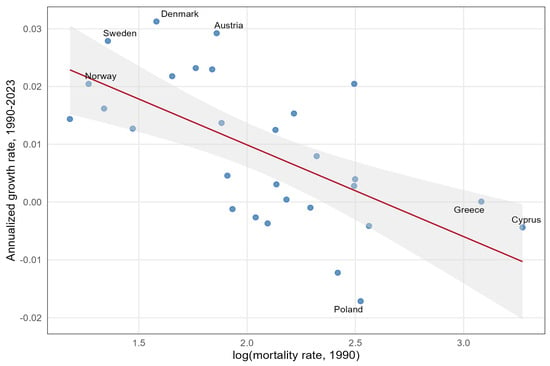
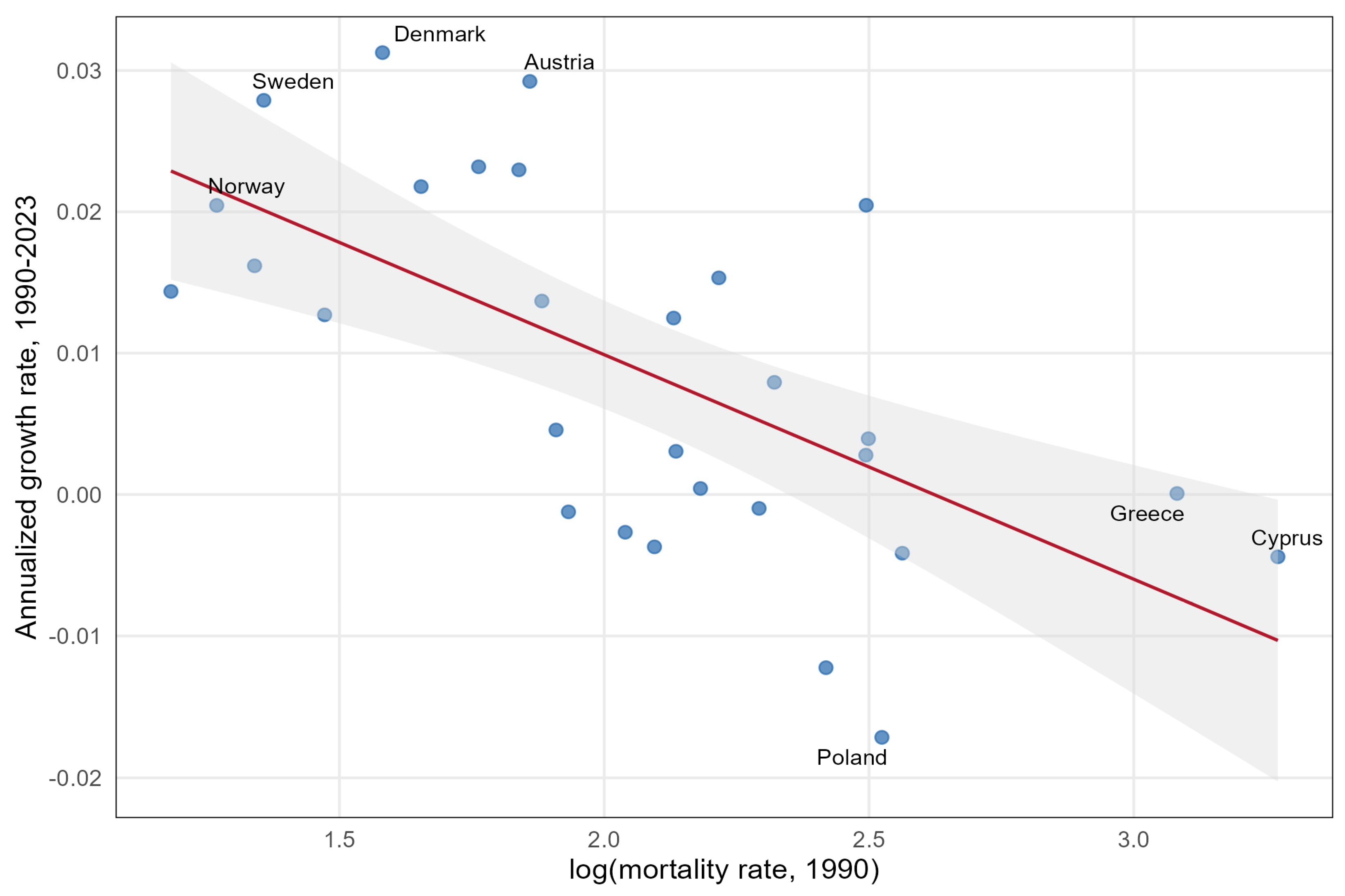
Sigma-convergence was assessed by computing the cross-country coefficient of variation of each outcome for every year from 1990 to 2023 and testing the linear trend of this coefficient over time, using Newey–West standard errors to account for serial autocorrelation. Given evidence of a non-monotonic trend, this analysis was repeated separately for the 1990–2005 and 2008–2023 subperiods. Beta-convergence was assessed by regressing the annualized logarithmic growth rate of mortality between 1990 and 2023 on its logarithmic level in 1990, with a negative and significant coefficient interpreted as evidence of convergence. This model was re-estimated excluding Cyprus, the country with the most extreme initial value, and after excluding small states, as robustness checks. A conditional convergence model was estimated including mean healthcare expenditure over 2000–2023, rather than expenditure in a single year, as the World Health Organization Global Health Expenditure Database does not extend before 2000; convergence over the 2000–2023 subperiod was also estimated for comparison with the full 1990–2023 series. As a robustness check on the choice of subperiods, a data-driven single-break search (grid search minimizing residual sum of squares across candidate break years) was used to assess whether the 1990–2005/2008–2023 split was well supported by the data.
2.7. Consistency Checks of GBD Estimates
To assess the internal consistency of GBD-based mortality estimates, GBD 2023 age-standardized CKD mortality rates were compared with Eurostat standardized death rates for diseases of the kidney and ureter (ICD-10 codes N00–N29; Eurostat dataset hlth_cd_asdr2), using Spearman rank correlations for each year from 2011 to 2023. National vital registration data, including those compiled by Eurostat, constitute one of the input sources used by GBD to model cause-specific mortality; this comparison should therefore be understood as a check on internal consistency (how closely the GBD synthesis reproduces the underlying registration data) rather than validation against a fully independent gold standard, since GBD reassigns deaths coded to ill-defined causes before modelling, so that GBD and official cause-specific mortality are expected to differ [27]. As the Eurostat category is broader than CKD, agreement was interpreted as indicative rather than as a direct validation. The association between generalist practitioner density and the magnitude of the discrepancy between GBD and Eurostat mortality rankings was examined as an exploratory secondary analysis. In addition, the GBD 2023 input sources for CKD prevalence and mortality were reviewed for Estonia, Latvia, and Lithuania, together with Austria as a reference country, using the GBD Sources Tool [24] to assess the extent to which modelled estimates for these countries were supported by population-based surveys as opposed to kidney replacement therapy registry data or covariate-based extrapolation. The GBD 2023 prevalence estimate for adults aged 20 years and older in Estonia was obtained from the GBD Results Tool, filtered to age group 20+ and location Estonia, for comparison with the [35] estimate, which used the same age restriction.
2.8. Missing Data Handling
Missing values occurred for Iceland (at-risk-of-poverty-or-social-exclusion rate and heat-related mortality), Malta (heat-related mortality), as noted above, and for Slovakia (generalist practitioner density, secondary analysis only). No imputation was performed; countries with missing values on a given analysis were excluded listwise from that specific analysis, and the resulting sample size is reported for each model.
All statistical analyses were conducted in R (version 4.5.2) and statistical significance was set at p < 0.05.
3. Results
3.1. Descriptive Statistics
The analytic panel covered 29 countries observed in 2022 and 2023, yielding 58 country-year observations (Table 1). Age-standardized CKD prevalence ranged from 4816 to 10,752 per 100,000 population, mortality from 5.1 to 23.8 per 100,000, and DALYs from 155.7 to 567.3 per 100,000. Healthcare expenditure per capita ranged from 2449 to 9797 international dollars, the at-risk-of-poverty-or-social-exclusion rate from 11.8% to 34.4%, PM2.5 exposure from 4.1 to 18.2 µg/m3, and heat-related mortality from 2 to 373 deaths per million.
Table 1.
Descriptive statistics of the cross-sectional panel (29 EU/EEA countries, 2022 and 2023).
The four structural determinants were substantially intercorrelated (Table 2): healthcare expenditure correlated −0.71 with PM2.5 exposure, −0.49 with heat-related mortality, and −0.44 with poverty; poverty and heat-related mortality correlated 0.65. Diabetes prevalence showed weak correlations with the four structural determinants (all |r| ≤ 0.26). Hypertensive heart disease prevalence showed a moderate negative correlation with healthcare expenditure (r = −0.48) and a moderate positive correlation with PM2.5 exposure (r = 0.39), but weak correlations with poverty and heat-related mortality (|r| < 0.3); the two clinical covariates were weakly correlated with one another (r = 0.24), supporting their use as a descriptive check on the clinical composition of the sample rather than as regression covariates.
Table 2.
Pearson correlation matrix of the four standardized structural determinants and two clinical covariates.
3.2. Cross-Sectional Regression
The primary regression, estimated on the 2023 cross-section (n = 27) with HC3 standard errors, explained a modest share of variance in prevalence (R2 = 0.33, adjusted R2 = 0.21) and a smaller share in mortality (R2 = 0.21, adjusted R2 = 0.06); no predictor reached conventional statistical significance in either model (Table 3a). Heat-related mortality showed the association closest to significance with CKD mortality (coefficient 2.8, 95% CI −0.4 to 6.0, p = 0.083); no predictor approached significance for prevalence.
Table 3.
(a) Cross-sectional regression coefficients for CKD prevalence and mortality (2023), with heteroskedasticity-consistent (HC3) standard errors and 95% confidence intervals. (b) Sensitivity analysis: pooled 2022–2023 panel regression for CKD prevalence, with country-clustered standard errors (degrees of freedom = G − 1).
As a sensitivity analysis, the pooled 2022–2023 panel was analyzed with country-clustered standard errors and degrees of freedom set to G − 1 (G = 27; Table 3b). In this specification, healthcare expenditure (coefficient −813.0, 95% CI −1596.8 to −29.2, p = 0.043) and PM2.5 exposure (coefficient −1024.6, 95% CI −1980.5 to −68.6, p = 0.037) reached nominal significance for prevalence, while no predictor was significant for mortality. This discrepancy between the single-year and pooled specifications, addressed further in Section 4, illustrates the sensitivity of ecological regression results to the treatment of repeated country-year observations.
3.3. Model Diagnostics and Robustness
The Breusch–Pagan test indicated significant heteroskedasticity in the prevalence model (BP = 13.99, df = 4, p = 0.007), supporting the use of heteroskedasticity-consistent standard errors. Variance inflation factors remained below 3.5 for all predictors (maximum 3.47 for PM2.5), indicating no formal multicollinearity problem; this does not, however, eliminate the interpretive difficulty posed by the substantial pairwise correlations reported in Table 2, particularly between healthcare expenditure and PM2.5 exposure (r = −0.71).
Cook’s distance identified Poland, Italy, Estonia, and Greece as the most influential observations in the prevalence model. When these four countries were excluded (n = 23), no predictor was significant, and the PM2.5 coefficient reversed sign (from −792 to +89, p = 0.91). Leave-one-out analysis showed that the association between PM2.5 and prevalence was particularly sensitive to Estonia, falling to roughly one-third of its magnitude in the full four-predictor model when Estonia alone was excluded (coefficient −236, p = 0.72), though the full-model association itself had not reached conventional significance (p = 0.351). When heat-related mortality was excluded from the prevalence model, the association between PM2.5 exposure and prevalence approached, but did not reach, conventional significance in isolation (coefficient −1228, p = 0.052, n = 28), and this association did not persist after excluding the influential countries identified above. No predictor combination yielded a robust, statistically significant, sign-stable association with either outcome.
For mortality, Cook’s distance identified Estonia, Cyprus, Finland, and Greece as the most influential observations; excluding them left heat-related mortality (the predictor closest to significance in the main model) weaker and still non-significant (coefficient 1.5, p = 0.20). In the pooled 2022–2023 panel with country-clustered standard errors, heat-related mortality was similarly non-significant for mortality (coefficient 1.8, p = 0.12).
3.4. Country Typology
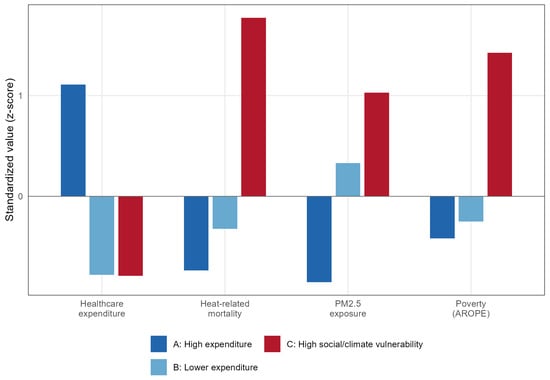
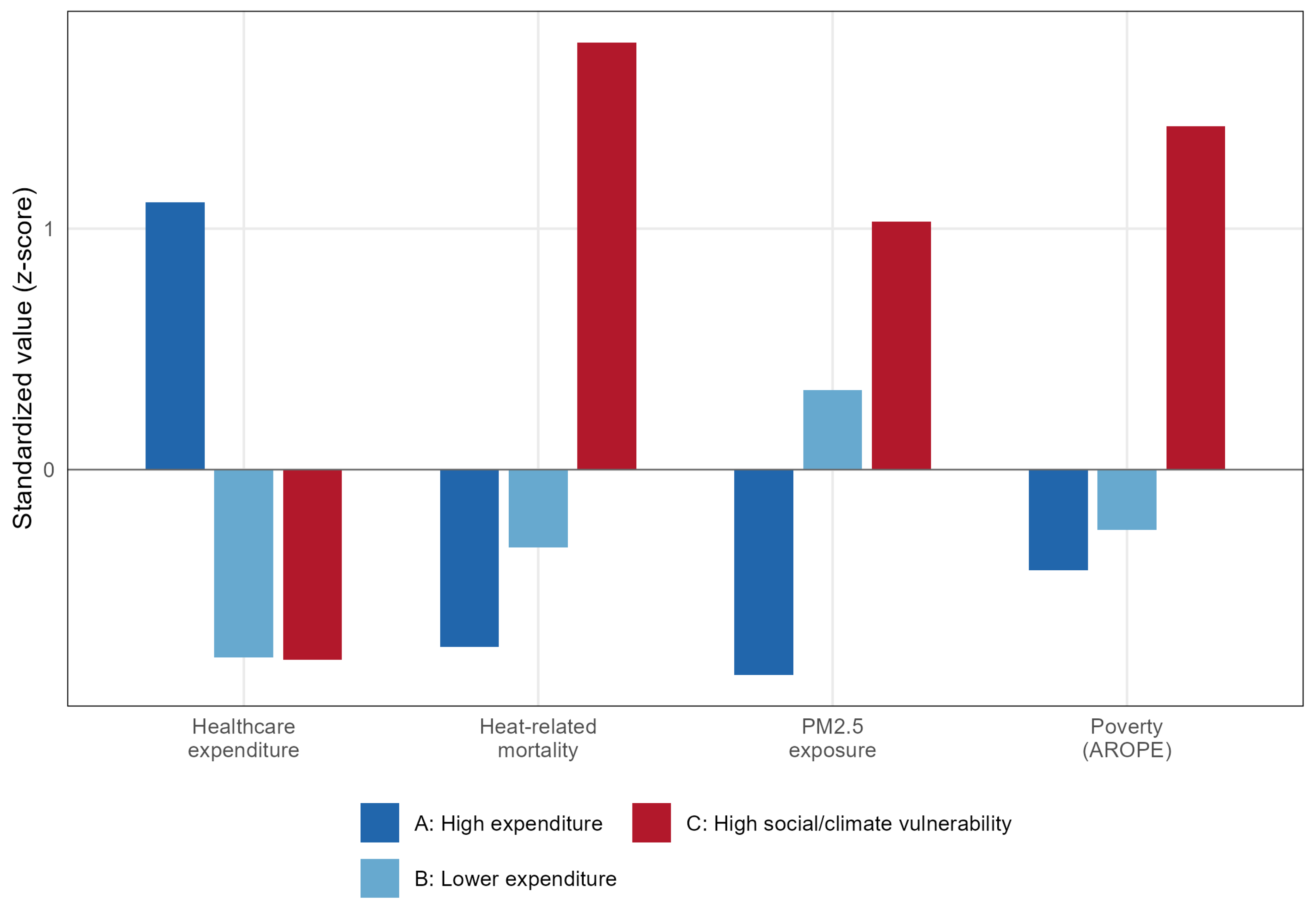
A k-means cluster analysis of the four standardized structural determinants, restricted to the 27 countries with complete data, identified three profiles at a silhouette width of 0.42 (Table 4 and Table 5, Figure 1). Clusters were labeled by their defining structural characteristics rather than by geography.
Table 4.
Median structural determinants and chronic kidney disease outcomes by country cluster (2023).
Table 5.
Country membership of the three-cluster typology (2023).
Figure 1.
Mean standardized structural determinants by country cluster (2023).
Cluster A (high expenditure, low structural vulnerability; n = 11: Austria, Belgium, Denmark, Finland, France, Germany, Ireland, Luxembourg, Netherlands, Norway, Sweden) had the highest median healthcare expenditure ($7727) and the lowest median values on all three remaining dimensions. Cluster B (lower expenditure, moderate vulnerability; n = 11: Croatia, Cyprus, Czechia, Estonia, Hungary, Latvia, Lithuania, Poland, Portugal, Slovakia, Slovenia) had substantially lower median expenditure ($3507) and intermediate poverty, PM2.5, and heat-related mortality. Cluster C (high social and climate vulnerability; n = 5: Bulgaria, Greece, Italy, Romania, Spain) had median expenditure similar to Cluster B ($3454) but the highest median poverty rate (26.5%) and markedly higher heat-related mortality (234 versus 56 and 31 deaths per million in Clusters B and A, respectively), which was the principal dimension distinguishing Cluster C from Cluster B (Figure 1).
Iceland and Malta were not assigned to a cluster because of missing data on one or more dimensions; Iceland’s available dimensions (high expenditure, low PM2.5) placed it closest to Cluster A, while Malta’s placed it closest to Cluster B; both assignments should be interpreted with caution given incomplete data.
Median CKD prevalence was 6359 per 100,000 in Cluster A, 5549 in Cluster B, and 5585 in Cluster C; median mortality was 9.8, 10.7, and 11.3 per 100,000, respectively (Table 4). Neither prevalence nor mortality differed significantly across clusters (Kruskal–Wallis, p = 0.42 and p = 0.75, respectively); DALYs showed a similar lack of significant difference (p = 0.17). Median mortality was numerically higher in Clusters B and C than in Cluster A, but these differences were not statistically significant.
3.5. Convergence Analysis
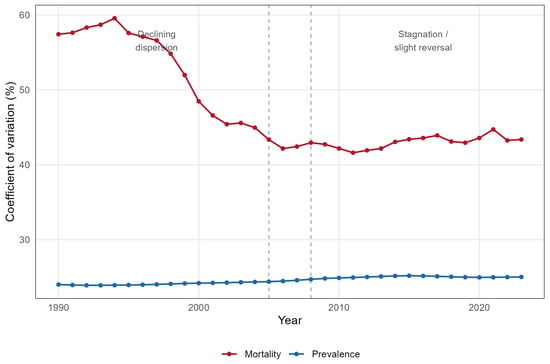
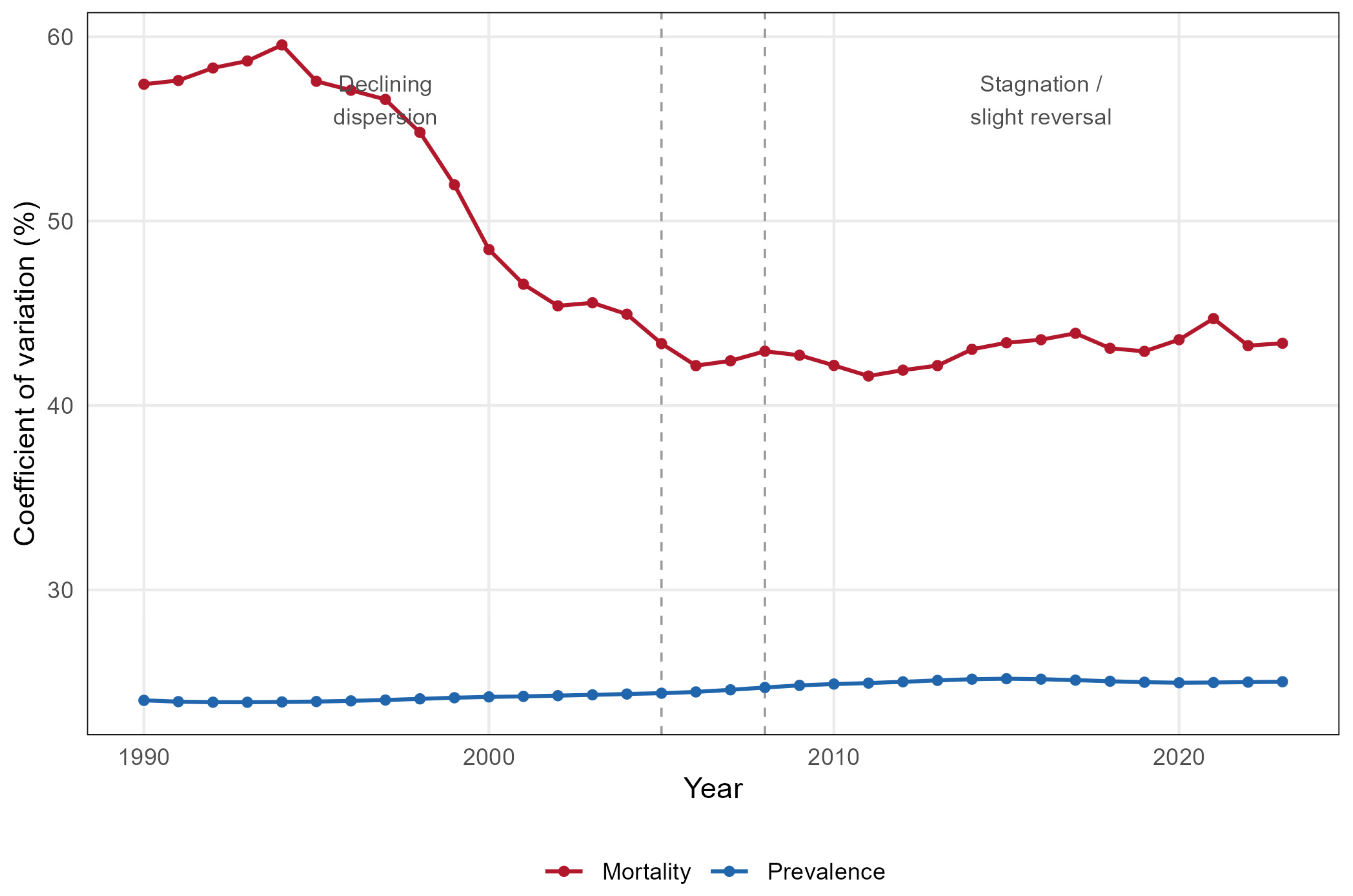
The coefficient of variation of mortality rose slightly from 57.4% in 1990 to a peak of 59.6% in 1994, before declining to a low of approximately 42–43% by the mid-2000s; this decline was not sustained (Figure 2, Table 6). Newey–West adjusted regression confirmed a significant negative trend for 1990–2005 (slope −1.16 per year, 95% CI −1.48 to −0.84, p < 0.001) and a significant positive trend for 2008–2023 (slope +0.11 per year, 95% CI 0.03 to 0.19, p = 0.010), indicating a slight reversal following the earlier convergence. The coefficient of variation of prevalence showed a significant increasing trend between 1990 and 2005 (slope +0.033 per year, 95% CI 0.019 to 0.047, p < 0.001) but no significant trend thereafter (2008–2023: slope +0.011, 95% CI −0.060 to 0.081, p = 0.744. The 1990–2005 and 2008–2023 subperiods were chosen as round, interpretable windows bracketing the approximate turning point in mortality dispersion; a data-driven single-break search placed the optimal break for mortality around 1999, with comparable fit throughout 1999–2007, indicating that the exact timing of the turning point is not sharply identified from these data. The break for prevalence was more precisely located, in 2008.
Figure 2.
Sigma-convergence of CKD mortality and prevalence, 1990–2023.
Table 6.
Sigma-convergence and beta-convergence test results for chronic kidney disease mortality and prevalence, 1990–2023.
Beta-convergence in mortality was confirmed for the full 1990–2023 period (β = −0.0159, SE = 0.0037, 95% CI −0.0235 to −0.0083, p < 0.001) and for the 2000–2023 subperiod (β = −0.0154, p = 0.006), with countries with higher initial mortality, including Cyprus, Poland, and Greece, showing slower growth or decline over the following decades, while several countries with low initial mortality, including Denmark, Austria, Sweden, and Norway, showed an increase (Figure 3). This result was not driven by a single country: excluding Cyprus, the country with the highest 1990 mortality rate, left the coefficient essentially unchanged (β = −0.0172, 95% CI −0.0258 to −0.0085, p < 0.001). The result was similarly unaffected by the exclusion of small states with distinctive profiles: removing Malta, Iceland, Luxembourg, and Cyprus left the coefficient essentially unchanged (β = −0.0182, SE = 0.0048, 95% CI −0.0281 to −0.0084, p < 0.001).
Figure 3.
Beta-convergence of CKD mortality across EU/EEA countries, 1990–2023.
Because the World Health Organization Global Health Expenditure Database does not extend before 2000, the conditional convergence model used mean healthcare expenditure over 2000–2023 rather than expenditure in a single year. This addition did not materially change the pace of convergence (β = −0.0151, p = 0.006), and mean expenditure itself was not a significant predictor of the mortality growth rate (coefficient −0.0024, p = 0.62), whether expressed as the 2000–2023 mean, the cumulative total, the initial 2000 level, or the 2000–2023 growth rate (all p > 0.6). Prevalence showed no equivalent convergence pattern (β close to zero, p = 0.73).
3.6. Comparison of GBD and Registry-Based Mortality
GBD 2023 age-standardized CKD mortality rates showed moderate agreement with Eurostat standardized death rates for diseases of the kidney and ureter (ICD-10 N00–N29) in 2023 (Spearman ρ = 0.38, p = 0.042, n = 29), improving to ρ = 0.47 when Estonia was excluded (Table 7). Agreement was markedly stronger in earlier years of the series, peaking at ρ = 0.61 in 2017, and declined steadily thereafter to ρ = 0.38 in 2022 and 2023, a pattern consistent across the full 2011–2023 series rather than confined to a single year (Table 7).
Table 7.
Comparison of GBD 2023 estimates: agreement with Eurostat cause-of-death statistics (2011–2023), association with generalist practitioner density, and review of GBD input sources for CKD prevalence in the Baltic states and Austria. (A) Agreement between GBD and Eurostat mortality rankings by year (2011–2023); (B) Summary of comparisons (2023); (C) GBD 2023 input sources for CKD prevalence: Baltic states and Austria.
Combining the Eurostat N00–N29 category with mortality from diabetes (ICD-10 E10–E14) improved agreement with GBD substantially (ρ = 0.66 for 2023), suggesting that part of the discrepancy reflects differences in cause-of-death classification rather than in the underlying burden of disease. Estonia showed the largest single discrepancy in the sample, ranking first among the 29 countries on GBD mortality but twenty-fifth on the Eurostat registry-based rate. This discrepancy was specific to Estonia rather than shared across the Baltic states: Latvia showed no rank difference between GBD and Eurostat mortality estimates (rank 14 in both), and Lithuania showed a difference of a single rank (27 versus 26).
As a secondary, exploratory check, the density of generalist medical practitioners was not associated with GBD prevalence (Spearman ρ = 0.15, p = 0.45) or mortality (ρ = −0.03, p = 0.87) directly, providing no support for a direct workforce-based explanation of GBD-estimated CKD burden (Table 7). However, generalist practitioner density was inversely associated with the magnitude of the discrepancy between GBD and Eurostat mortality rankings (ρ = −0.46, p = 0.016, n = 27), suggesting that weaker primary care infrastructure may be associated with greater divergence between modelled and registry-based mortality estimates, independent of the direction of that divergence.
3.7. Review of GBD Input Sources for the Baltic States
Given the magnitude of the Estonia discrepancy, the GBD 2023 input sources for CKD prevalence were reviewed for Estonia, Latvia, and Lithuania, using Austria as a reference country (Table 7).
For Estonia, 28 sources were identified, of which 24 were kidney replacement therapy registry records (1998–2020) and 3 were older reviews of end-stage renal disease; only one source, a national study using electronic health record data [35], provided a population-based estimate of CKD prevalence, at 7.4%, compared with a GBD 2023 estimate of approximately 22% among adults aged 20 years and older. This GBD estimate refers to adults aged 20 years and older and is therefore not directly comparable to the all-ages age-standardized rate reported in Table 1 (maximum 10,752 per 100,000, or 10.8%); it is reported here as the metric most comparable in scope to the [35] estimate.
For Latvia (20 sources) and Lithuania (10 sources), all identified sources were kidney replacement therapy registry records or older end-stage renal disease reviews; no population-based prevalence source was identified for either country.
By comparison, Austria had 32 input sources, 29 of which were registry-based, with one population-based source (Table 7). Mortality estimates for all four countries were supported by national vital registration data spanning multiple decades. Austria’s source profile was structurally similar to Estonia’s, with one population-based source alongside predominantly registry-based sources; the clearest distinction within this comparison was not between Estonia and the reference country, but between Estonia, which had at least one population-based estimate, and Latvia and Lithuania, for which no such source was identified at all.
4. Discussion
This study examined whether economic, social and environmental determinants were associated with cross-country variation in GBD-estimated chronic kidney disease prevalence and mortality across 29 European Union and European Economic Area countries, and whether these estimates were corroborated by vital registration data. Neither the cross-sectional regression nor the country typology provided robust support for a structural explanation of prevalence or mortality. In the primary 2023 model, no predictor reached statistical significance for either outcome, and none was significant for mortality in the pooled 2022–2023 specification. The three-cluster typology, which showed moderate structure on the dimensions used to construct it (average silhouette width 0.42), did not correspond to significant differences in prevalence, mortality or DALYs. This null result is informative. It indicates that the structural determinants most commonly invoked in the literature on socioeconomic gradients in chronic disease (healthcare expenditure, poverty, air pollution and heat exposure) do not on their own account for the marked cross-country dispersion in GBD-estimated CKD burden observed in this sample.
The pooled specification yielded nominally significant negative associations of healthcare expenditure and PM2.5 exposure with prevalence. These should not be interpreted as substantive effects. A negative association between air pollution and CKD prevalence is implausible on biological grounds. It is more likely to reflect the strong correlation between the two predictors (r = −0.71), the dependence of the estimates on a small number of influential countries, and the underestimation of uncertainty when repeated country-year observations with near-constant covariates are pooled. The instability of these associations across specifications illustrates the limited capacity of ecological regression with fewer than thirty units to separate the independent contributions of correlated structural determinants.
The longitudinal analysis told a more differentiated story than a single convergence coefficient can convey. Mortality dispersion declined sharply between the mid-1990s and the mid-2000s, a period of broad health system and economic transition in Central and Eastern Europe [36]. This decline was not sustained: from 2008 onward, dispersion stagnated and showed a small but statistically significant reversal. Beta-convergence in mortality was robust across specifications, including the exclusion of Cyprus and of small states and the adjustment for healthcare expenditure. It was, however, achieved partly through rising mortality in several countries with low initial rates, including Denmark, Austria, Sweden and Norway, rather than solely through declines in high-mortality countries. This pattern may reflect population ageing, longer survival with advanced CKD or changes in certification practices as much as a narrowing of underlying risk. Healthcare expenditure did not predict the pace of convergence in any specification tested, whether measured as a multi-year mean, a cumulative total, an initial level or a growth rate. Whatever drove the earlier narrowing of mortality differences, it does not appear to have been differential growth in health spending, at least not in the form captured by aggregate expenditure data. Prevalence, by contrast, showed no beta-convergence. Its dispersion increased marginally until the mid-2000s, with no significant trend from 2008 onward. Because GBD prevalence estimates are more heavily model-based than mortality estimates, particularly for countries with sparse local data, this near-stability may reflect the smoothing behaviour of the estimation process as much as any underlying epidemiological stability.
The cross-country heterogeneity in GBD-estimated CKD burden is compatible with several distinct explanations, examined in turn below, which the present data cannot definitively adjudicate. Underdiagnosis is the interpretation most commonly advanced in the literature for comparable cross-country patterns. However, direct evidence for it in this study was limited. Generalist practitioner density showed no association with GBD prevalence or mortality, and no country-level indicator of screening intensity was available to test the hypothesis directly. Independent evidence on CKD unawareness in older Europeans [37] also does not point toward Eastern or Baltic under-detection specifically: unawareness in that study was, if anything, higher in Sweden and Switzerland than in Estonia or the southern European countries in the present sample. This does not rule out underdiagnosis as a contributing factor, but it does not provide the corroboration needed to treat it as the primary explanation.
Two alternative explanations received more direct support. The first is differences in cause-of-death coding. Kidney disease is inconsistently recorded as the underlying cause on death certificates, and agreement between death certificates and renal registries on cause of death is poor [30,31]. In the present study, agreement between GBD mortality estimates and Eurostat vital registration data for diseases of the kidney and ureter was only moderate (ρ = 0.38 in 2023) and declined from a peak of ρ = 0.61 in 2017. It improved substantially when diabetes-related deaths were added to the comparison (ρ = 0.66). This is consistent with evidence that unspecified diabetes is among the most frequent garbage codes in Western European vital registration data and is partly reassigned by GBD to other underlying causes [27]. A meaningful share of kidney-attributable mortality may therefore be recorded under diabetes in some countries. However, the improved agreement may also partly reflect shared cardiometabolic covariates used in GBD modelling, rather than coding alone.
The second explanation concerns the input data underlying GBD prevalence estimates. Review of the GBD 2023 input sources showed that prevalence estimates for Estonia, Latvia and Lithuania relied almost entirely on kidney replacement therapy registry data, which cover only end-stage disease, together with older reviews. Latvia and Lithuania had no population-based prevalence source of any kind. This suggests that prevalence estimates for these two countries rely largely on DisMod-MR modelling, drawing on regional patterns and country-level covariates rather than on direct local observation. It does not, on its own, establish the direction of any resulting bias. Estonia was a partial exception. A single population-based source, using national electronic health record data, reported a CKD prevalence of 7.4% among adults, compared with a GBD 2023 estimate of approximately 22% for the same age group [35]. This comparison is not straightforward to interpret. Electronic health record prevalence captures diagnosed, coded cases, whereas the GBD estimate is intended to include earlier, undiagnosed stages of disease defined by reduced kidney function or albuminuria. The threefold difference is therefore compatible with at least two distinct explanations that this study cannot adjudicate between: substantial overestimation in the GBD model for a country with limited local input data, or substantial underascertainment of early-stage CKD in routine electronic health records. The latter would itself constitute evidence of the underdiagnosis this study set out to evaluate, and is consistent with findings from Hungary, where fewer than one-third of laboratory-confirmed CKD cases carried a corresponding diagnosis code [38]. Austria, used here as a reference country, had a similarly registry-dominated source profile with one population-based source. The clearer contrast is therefore between Estonia and Austria, which both had at least one local population-based estimate, and Latvia and Lithuania, which had none.
The mortality discrepancy observed for Estonia, which ranked first among the 29 countries on GBD mortality but twenty-fifth on the Eurostat registry-based rate, rests on a separate line of evidence and should not be attributed to the composition of prevalence inputs. Mortality estimates for all three Baltic countries and for Austria were supported by national vital registration data spanning several decades, and the discrepancy was not shared by Latvia or Lithuania. Its source, whether in national certification practices, in GBD redistribution of ill-defined causes, or in both, could not be identified with the data available and warrants country-specific investigation. In an exploratory analysis, lower generalist practitioner density was associated with a larger absolute discrepancy between GBD and Eurostat mortality rankings across countries (ρ = −0.46). This is compatible with weaker primary care infrastructure being associated with less complete or less specific cause-of-death recording, but it was not corrected for multiple comparisons and should be regarded as hypothesis-generating. Finally, competing mortality, whereby shorter life expectancy in parts of Central and Eastern Europe reduces the likelihood that CKD is observed as a terminal event, remains a plausible contributing mechanism for between-country differences in CKD mortality, though it was not directly testable with the indicators available.
These results indicate that cross-country heterogeneity in GBD-estimated CKD burden across the EU/EEA cannot be attributed to the structural determinants examined, and that part of it is compatible with measurement limitations arising from cause-of-death coding and sparse local input data. Whether residual differences also reflect unequal disease detection cannot be determined from the present data.
Limitations
Several limitations should be considered when interpreting these findings. The ecological design precludes any inference about individual-level mechanisms linking structural determinants to disease outcomes. The four structural determinants were substantially intercorrelated, which limits the precision with which their independent contributions can be separated, even though variance inflation factors did not indicate a formal multicollinearity problem. The cross-sectional regression was sensitive to a small number of influential countries, and results differed between the single-year and pooled panel specifications, underscoring the fragility of ecological regression estimates at this sample size. GBD estimates, particularly for prevalence, are model-based rather than directly observed. Their agreement with the vital registration data examined was only moderate and declined over the study period, so conclusions drawn from GBD data alone should be treated as provisional. The comparison with Eurostat is not fully independent, since national vital registration data are themselves an input to GBD mortality estimates, and the Eurostat category N00–N29 is broader than CKD. The proportion of garbage codes in national vital registration data was not examined directly, although it is known to vary substantially across European countries [27]. The review of GBD input sources was limited to four countries and to prevalence data; a systematic audit across the full sample was beyond the scope of this study. Heat-related mortality is itself a health outcome rather than a direct exposure measure, and its interpretation as a structural determinant should be treated with corresponding caution. Finally, the conditional convergence analysis relied on healthcare expenditure as the only available time-varying covariate, and expenditure data were not available before 2000. Other potentially relevant trends, such as changes in screening guidelines or in access to kidney replacement therapy, could not be examined.
5. Conclusions
This study provides a comparative assessment of chronic kidney disease (CKD) burden across 29 European Union and European Economic Area (EU/EEA) countries, integrating three complementary perspectives: the relationship between CKD burden and selected structural determinants, the long-term evolution of cross-country inequalities in CKD prevalence and mortality, and the agreement between Global Burden of Disease (GBD) mortality estimates and national vital registration data. Taken together, the findings highlight the complexity of interpreting international variation in CKD burden and the need for caution when differences between countries are inferred from modelled estimates alone.
No robust cross-country association was identified between healthcare expenditure, poverty, PM2.5 exposure or heat-related mortality and GBD-estimated CKD prevalence or mortality. Similarly, CKD outcomes did not differ significantly across the structural country typology identified in the analysis. These findings should not be interpreted as evidence that socioeconomic conditions, environmental exposures or health-system characteristics are unimportant determinants of CKD. Rather, they indicate that, at the country level and using the indicators examined here, these factors do not adequately explain the observed heterogeneity in GBD-estimated CKD burden across EU/EEA countries. Aggregate national indicators may obscure substantial within-country inequalities, while the relationship between structural determinants and CKD may operate through complex pathways involving diabetes, hypertension, obesity, ageing, occupational and environmental exposures, access to primary care, and the timing of CKD detection and treatment.
The longitudinal analysis further showed that the European CKD landscape cannot be described as a continuous process of convergence. CKD mortality converged across countries between the mid-1990s and the mid-2000s, suggesting that differences in mortality narrowed during this period. However, this process subsequently stalled, with no evidence of continued convergence in more recent years. For CKD prevalence, cross-country dispersion increased marginally until the mid-2000s, while no significant trend was observed from 2008 onward. These results suggest that progress towards greater equality in CKD outcomes across Europe has been limited and uneven. The absence of continued convergence is particularly relevant from a public health perspective because it suggests that broader improvements in healthcare systems and population health have not necessarily translated into progressively smaller international differences in CKD burden.
A central finding concerns the comparability of CKD mortality estimates. Agreement between GBD estimates and vital registration data was only moderate and declined over the last decade. Importantly, agreement improved when deaths coded to diabetes were incorporated into the comparison. This finding supports the interpretation that international variation in cause-of-death certification and coding practices contributes to discrepancies between modelled CKD mortality and mortality recorded in national vital statistics. CKD frequently coexists with diabetes and cardiovascular disease, and the condition selected as the underlying cause of death may therefore vary according to certification practices, coding rules and national data systems. Consequently, part of the apparent cross-country variation in CKD mortality may reflect differences in attribution rather than differences in the underlying epidemiological burden alone.
The review of GBD input sources reinforces concerns regarding the evidence base supporting some country-level estimates. In particular, prevalence estimates for Latvia and Lithuania were not supported by population-based prevalence data identified among the GBD input sources examined. In such settings, modelled estimates may necessarily depend more strongly on information borrowed from other populations, covariates or statistical assumptions. This does not imply that the estimates are incorrect, but it increases uncertainty regarding their interpretation and highlights the importance of distinguishing between directly observed and predominantly model-derived estimates when making cross-country comparisons.
The substantial discrepancy observed for Estonia between GBD-estimated CKD mortality and vital registration mortality could not be explained by the analyses conducted in this study. Neither the inclusion of diabetes-coded deaths nor the structural indicators examined provided a sufficient explanation. This finding warrants country-specific investigation of mortality certification, coding practices, changes in ICD implementation, data completeness, GBD input sources and modelling assumptions. More generally, large country-specific discrepancies should be treated as signals for further data-quality assessment rather than automatically interpreted as evidence of unusually high or low disease burden.
Overall, the findings do not support attributing cross-country heterogeneity in GBD-estimated CKD burden either to the structural determinants examined or specifically to differences in diagnostic performance. Several mechanisms remain plausible and are not mutually exclusive. Underdiagnosis may contribute to apparently low recorded prevalence in countries with limited screening or lower testing intensity. Conversely, more intensive detection may increase measured prevalence without necessarily indicating a genuinely higher underlying disease burden. Differences in population age structure, competing mortality, multimorbidity, cause-of-death attribution and the availability of epidemiological data may further influence international comparisons. Modelled CKD estimates should therefore be interpreted as the product of both underlying epidemiology and the information systems through which that epidemiology is observed.
Implications for public health policy.
The findings support the development of more harmonised CKD surveillance across EU/EEA countries. International comparisons would benefit from a common minimum surveillance framework based on standardised definitions of CKD, comparable laboratory measurements and consistent reporting by age, sex, disease stage and major comorbidities. Surveillance systems should incorporate estimated glomerular filtration rate (eGFR) and urinary albumin-to-creatinine ratio (UACR), together with appropriate confirmation of chronicity, to reduce variation arising from differences in case definition and testing practices.
Population-based CKD surveys should be prioritised in countries for which nationally representative empirical prevalence data are absent or outdated. The lack of population-based input data identified for Latvia and Lithuania illustrates a broader methodological vulnerability: where direct epidemiological evidence is limited, international estimates inevitably depend more heavily on statistical modelling. Periodic nationally representative surveys incorporating serum creatinine and albuminuria measurements would provide an empirical benchmark against which routine healthcare data and modelled estimates could be validated.
European CKD surveillance would also benefit from moving beyond prevalence and mortality to include indicators of diagnostic activity and access to care. Relevant measures could include the proportion of eligible adults receiving serum creatinine/eGFR and UACR testing, testing frequency among people with diabetes or hypertension, the proportion of newly diagnosed patients identified at different CKD stages, referral rates to nephrology services and the proportion of eligible patients receiving recommended kidney-protective therapies. Without such indicators, it remains difficult to distinguish countries with genuinely lower CKD prevalence from those in which CKD is less frequently detected.
Greater harmonisation of death certification and cause-of-death coding is also warranted. The improved agreement between GBD and vital registration data after inclusion of diabetes-coded deaths suggests that CKD mortality cannot be interpreted independently of coding practices for major comorbid conditions. European-level initiatives could support regular audits of death certification, training for physicians completing death certificates and comparative analyses of multiple-cause-of-death data. Where available, multiple-cause mortality data may provide a more informative picture of the contribution of CKD to mortality than analyses restricted to the underlying cause of death.
Transparency regarding the empirical basis of modelled estimates should also be strengthened. For each country and period, users of international burden estimates should ideally be able to distinguish estimates supported by recent nationally representative data from those relying predominantly on modelling, regional information or covariate prediction. Such information is particularly important when estimates are used for international benchmarking, health-system evaluation or resource allocation. Statistical uncertainty intervals may not fully capture the additional uncertainty arising from limited or absent direct population-level observations.
The observed stagnation in mortality convergence further suggests that reducing CKD inequalities across Europe may require targeted approaches rather than reliance solely on general improvements in health-system resources. Policies could prioritise early detection among populations at increased risk, equitable access to laboratory testing and primary care, integrated management of diabetes, hypertension and cardiovascular disease, timely nephrology referral and equitable access to evidence-based kidney-protective treatment. These interventions should be accompanied by monitoring systems capable of determining whether improvements in detection and treatment are distributed equitably both within and between countries.
At the European level, a coordinated CKD surveillance strategy could therefore combine harmonised epidemiological definitions, minimum reporting standards, comparable indicators of testing and diagnosis, population-based validation studies and improved interoperability between laboratory, primary care, hospital, mortality and renal registry data. Such an approach could reduce uncertainty in cross-country comparisons while providing policymakers with more actionable information on where gaps occur along the continuum from CKD detection to treatment and outcomes.
Directions for future research.
Future research should seek to disentangle true epidemiological variation from differences in detection and measurement. This will require country-level indicators of screening coverage and testing intensity, including eGFR and UACR testing rates, repeated testing for confirmation of chronicity, stage at first diagnosis and referral patterns. Linking these indicators with population-based prevalence estimates would allow researchers to examine directly whether countries with apparently low CKD prevalence have lower underlying disease occurrence or lower levels of detection.
A broader range of structural and health-system determinants should also be considered. Healthcare expenditure is a relatively crude measure of health-system capacity and may not capture resources specifically relevant to CKD prevention and management. More informative variables could include primary-care accessibility, density of general practitioners and nephrologists, laboratory availability, coverage of preventive health examinations, access to diabetes and hypertension management, reimbursement policies for kidney-related testing and medicines, and uptake of guideline-recommended therapies. Longitudinal analyses of these indicators could provide additional insight into whether changes in health-system characteristics precede changes in CKD detection, prevalence or mortality.
Greater attention should also be given to inequalities within countries. National averages may conceal substantial socioeconomic, geographic and demographic disparities. Individual- or regional-level studies could investigate CKD prevalence, detection and outcomes according to income, education, employment, urban–rural residence, migration background and access to healthcare. Multilevel designs would be particularly valuable for separating individual-level risk factors from contextual effects attributable to regions and national health systems.
Further investigation is needed to understand discrepancies between GBD estimates and national mortality statistics. Country-specific validation studies could compare underlying-cause and multiple-cause mortality records with clinical data, renal registries and hospital records. Estonia represents an especially relevant case for such investigation. Detailed assessment of temporal changes in certification practices, ICD coding, national mortality data and GBD modelling inputs could help determine whether the observed discrepancy reflects coding, data processing, modelling assumptions or genuine epidemiological characteristics.
The sensitivity of international CKD comparisons to alternative definitions of mortality also deserves investigation. Analyses based on CKD as the underlying cause of death could be compared with definitions incorporating CKD as any contributing cause, diabetes with renal complications and other closely related renal diagnoses. Such analyses could quantify the extent to which cross-country differences and temporal trends depend on cause-of-death definitions and identify comparisons that are particularly vulnerable to coding heterogeneity.
The convergence analysis could also be extended beyond measures of cross-country dispersion. Future studies could examine both sigma- and beta-convergence, investigate country-specific trajectories and assess whether groups of countries follow distinct patterns of convergence or divergence. Change-point approaches could additionally explore whether major changes in CKD definitions, laboratory reporting, clinical guidelines, health policies or therapeutic availability coincide with shifts in international prevalence or mortality trajectories.
Longitudinal research linking changes in detection practices with subsequent trends in prevalence and mortality would be particularly informative. Increased testing may initially raise measured prevalence through improved case ascertainment while contributing, over a longer period, to lower rates of advanced disease and mortality through earlier treatment. Analyses that explicitly account for these temporal relationships could help distinguish epidemiological deterioration from improvements in disease recognition.
Triangulation across multiple data sources should become a central principle of comparative CKD research. GBD estimates, national and international mortality databases, renal replacement therapy registries, electronic health records, administrative databases and population-based health examination surveys capture different dimensions of CKD burden and are subject to different sources of bias. Rather than treating any single source as a definitive reference, future studies should assess the consistency of findings across complementary sources. Such triangulation could identify countries and periods in which estimates are relatively robust, as well as those in which apparent differences are particularly sensitive to data availability, coding practices or modelling assumptions.
In conclusion, international differences in estimated CKD burden across the EU/EEA cannot be explained straightforwardly by the selected structural determinants and should not automatically be interpreted as differences in diagnostic performance. The stagnation of mortality convergence, moderate and recently declining agreement between GBD estimates and vital registration data, and uneven availability of population-based prevalence evidence point to an important methodological and public health challenge: improving the comparability of CKD measurement across Europe. Strengthening population-based surveillance, harmonising diagnostic and mortality reporting, documenting testing intensity and increasing transparency regarding the empirical basis of modelled estimates are essential steps towards determining how much of the observed European variation reflects genuine differences in disease burden and how much reflects differences in how CKD is detected, recorded and modelled. A stronger empirical evidence base would provide a more reliable foundation for identifying inequalities, evaluating health-system performance and developing policies aimed at reducing preventable CKD morbidity and mortality across Europe.
Author Contributions
Conceptualization, O.F., I.M., N.-R.G., C.R., S.T., O.M.; methodology, O.F., I.M., N.-R.G., C.R., S.T., O.M.; validation, O.F., I.M., N.-R.G., C.R., S.T., O.M.; formal analysis, O.F., I.M., N.-R.G., C.R., S.T., O.M.; investigation, N.-R.G., C.R., S.T.; resources, O.F., I.M., N.-R.G., C.R., S.T., O.M. writing—original draft preparation, O.F., I.M., N.-R.G., C.R., S.T., O.M.; writing—review and editing, O.F.,. I.M., N.-R.G., O.M.; visualization, O.F., I.M., N.-R.G., C.R., S.T., O.M.; supervision, O.F. and O.M.; project administration, O.M. All authors have read and agreed to the published version of the manuscript.
Funding
This research received no external funding.
Institutional Review Board Statement
Ethical review and approval were waived for this study due to the exclusive use of publicly available, aggregate-level data with no direct involvement of human participants.
Informed Consent Statement
This study was based exclusively on secondary, aggregate-level data and did not involve the recruitment or direct participation of individual human subjects. No individual-level or identifiable human data were accessed or analyzed at any stage. As such, the provision of informed consent was not required.
Data Availability Statement
Publicly available datasets were analyzed in this study, drawn from the Global Burden of Disease Study 2023 [24], (GBD 2023 Chronic Kidney Disease Collaborators, 2025), Eurostat, the World Health Organization, and [18] Janoš et al. (2025). The country-level panel constructed for this analysis is available from the corresponding author upon reasonable request.
Conflicts of Interest
The authors declare no conflicts of interest.
Abbreviations
The following abbreviations are used in this manuscript:
| AROPE | At-risk-of-poverty-or-social-exclusion rate |
| CI | Confidence interval |
| CKD | Chronic kidney disease |
| DALYs | Disability-adjusted life years |
| DisMod-MR | Disease Modelling–Meta-Regression (Bayesian meta-regression tool) |
| EEA | European Economic Area |
| ESRD | End-stage renal disease |
| EU | European Union |
| GBD | Global Burden of Disease |
| HC3 | Heteroskedasticity-consistent standard errors, type 3 |
| ICD-10 | International Classification of Diseases, 10th Revision |
| KRT | Kidney replacement therapy |
| PM2.5 | Fine particulate matter with an aerodynamic diameter ≤ 2.5 µm |
| SE | Standard error |
References
- Kovesdy, C.P. Epidemiology of chronic kidney disease: An update 2022. Kidney Int. Suppl. 2022, 12, 7–11. [Google Scholar] [CrossRef] [Scilit] [PubMed]
- Doccioli, C.; Sera, F.; Stoppa, G.; De Marchi, B.; Catelan, D.; Ficorilli, A.; Malavasi, G.; Biggeri, A. “Aria di Ricerca in Valle del Serchio”: A cross-sectional citizen science study to evaluate CKD prevalence and associations with environmental risk factors in the Serchio Valley (Lucca, Tuscany, Italy). Front. Public Health 2025, 13, 1536070. [Google Scholar] [CrossRef] [Scilit] [PubMed]
- World Health Organization. Social Determinants of Health. Available online: https://www.who.int/social_determinants/en/ (accessed on 10 May 2026).
- Zhang, L.; Santos, A.C.S., Jr.; Anandh, U.; Saran, R.; Zhao, M.-H. Effects of social determinants of health on the landscape of kidney disease. Nat. Rev. Nephrol. 2026, 22, 333–346. [Google Scholar] [CrossRef] [Scilit] [PubMed]
- Brück, K.; Stel, V.S.; Gambaro, G.; Hallan, S.; Völzke, H.; Ärnlöv, J.; Kastarinen, M.; Guessous, I.; Vinhas, J.; Stengel, B.; et al. CKD prevalence varies across the European general population. J. Am. Soc. Nephrol. 2016, 27, 2135–2147. [Google Scholar] [CrossRef] [Scilit] [PubMed]
- Grossman, M. On the concept of health capital and the demand for health. J. Political Econ. 1972, 80, 223–255. [Google Scholar] [CrossRef] [Scilit] [PubMed]
- Lindhardt, M.; Knudsen, S.T.; Saxild, T.; Charles, M.; Borg, R. Treating chronic kidney disease in Danish primary care: Results from the observational ATLAS study. BMC Prim. Care 2025, 26, 23. [Google Scholar] [CrossRef] [Scilit] [PubMed]
- Grant, C.H.; Salim, E.; Lees, J.S.; Stevens, K.I. Deprivation and chronic kidney disease—A review of the evidence. Clin. Kidney J. 2023, 16, 1081–1091. [Google Scholar] [CrossRef] [Scilit] [PubMed]
- Ishimura, N.; Inoue, K.; Maruyama, S.; Nakamura, S.; Kondo, N. Income level and impaired kidney function among working adults in Japan. JAMA Health Forum 2024, 5, e235445. [Google Scholar] [CrossRef] [Scilit] [PubMed]
- Sever, M.Ş.; Jager, K.J.; Vanholder, R.; Stengel, B.; Harambat, J.; Finne, P.; Tesař, V.; Barbullushi, M.; Bumblytė, I.A.; Zakharova, E.; et al. A roadmap for optimizing chronic kidney disease patient care and patient-oriented research in the Eastern European nephrology community. Clin. Kidney J. 2021, 14, 23–35. [Google Scholar] [CrossRef] [Scilit] [PubMed]
- Nicholas, S.B.; Kalantar-Zadeh, K.; Norris, K.C. Socioeconomic disparities in chronic kidney disease. Adv. Chronic Kidney Dis. 2015, 22, 6–15. [Google Scholar] [CrossRef] [Scilit] [PubMed]
- Norris, K.C.; Beech, B.M. Social determinants of kidney health: Focus on poverty. Clin. J. Am. Soc. Nephrol. 2021, 16, 809–811. [Google Scholar] [CrossRef] [Scilit] [PubMed]
- Morton, R.L.; Schlackow, I.; Staplin, N.; Gray, A.; Cass, A.; Haynes, R.; Emberson, J.; Herrington, W.; Landray, M.J.; Baigent, C.; et al. Impact of educational attainment on health outcomes in moderate to severe CKD. Am. J. Kidney Dis. 2016, 67, 31–39. [Google Scholar] [CrossRef] [Scilit] [PubMed]
- Anandh, U.; Meena, P.; Karam, S.; Luyckx, V. Social, political and legal determinants of kidney health: Perspectives from lower- and middle-income countries with a focus on India. Front. Nephrol. 2022, 2, 1024667. [Google Scholar] [CrossRef] [Scilit] [PubMed]
- Kampmann, J.D.; Stel, V.S.; Christensen, L.S.; Kramer, A.; Finne, P. Socioeconomic factors and access to home dialysis and early kidney transplantation across Europe. J. Nephrol. 2025, 38, 2469–2471. [Google Scholar] [CrossRef] [Scilit] [PubMed]
- Lao, X.Q.; Bo, Y.; Chen, D.; Zhang, K.; Szeto, C.-C. Environmental pollution to kidney disease: An updated review of current knowledge and future directions. Kidney Int. 2024, 106, 214–225. [Google Scholar] [CrossRef] [Scilit] [PubMed]
- Chogtu, B.; Magazine, R.; Prabhu, R.; Lakshmi, R.V. Air pollution and chronic kidney disease: An emerging challenge. Clin. Epidemiol. Glob. Health 2025, 36, 102204. [Google Scholar] [CrossRef] [Scilit]
- Janoš, T.; Quijal-Zamorano, M.; Shartova, N.; Gallo, E.; Méndez Turrubiates, R.F.; Beltrán Barrón, N.D.; Peyrusse, F.; Ballester, J. Heat-related mortality in Europe during 2024 and health emergency forecasting to reduce preventable deaths. Nat. Med. 2025, 31, 4065–4074, Correction in Nat. Med. 2025, 31, 4311. [Google Scholar] [CrossRef] [Scilit] [PubMed]
- World Health Organization. Resolution WHA78.6: Reducing the Burden of Noncommunicable Diseases Through Promotion of Kidney Health and Strengthening Prevention and Control of Kidney Disease (2025). Available online: https://apps.who.int/gb/ebwha/pdf_files/WHA78/A78_R6-en.pdf (accessed on 15 June 2026).
- International Society of Nephrology. The ISN Responds to the UN Political Declaration on Noncommunicable Diseases: Implications for Kidney Health (16 December 2025). Available online: https://www.theisn.org/?p=51484 (accessed on 20 June 2026).
- Ortiz, A.; Yanagita, M.; Yokoi, H.; Torra, R. Evolving strategies for early diagnosis, proactive prevention and treatment of CKD. Nephrol. Dial. Transplant. 2026, 41, 418–427. [Google Scholar] [CrossRef] [Scilit] [PubMed]
- European Renal Association Council; Torra, R.; Goumenos, D.S.; Arici, M.; Ortiz, A.; Adamczak, M.; Eller, K.; Ferreira, A.C.; Grandaliano, G.; Jager, K.; et al. ERA’s ABCDE framework for kidney disease prevention: Turning the WHO kidney health resolution into action. Nephrol. Dial. Transplant. 2026, 41, 793–801. [Google Scholar] [CrossRef] [Scilit] [PubMed]
- Abedini, S.; Lindberg, M.; Bjune, T.; Bøe, T.B.; Hartmann, A.; Jenssen, T.G. Chronic kidney disease in Norwegian primary care: Underdiagnosis and undertreatment—Findings from the VISTAKID (Vestfold Investigation of Stage 3–5 Kidney Disease) study. BMC Nephrol. 2026, 27, 170. [Google Scholar] [CrossRef] [Scilit] [PubMed]
- GBD 2023 Chronic Kidney Disease Collaborators. Global, regional, and national burden of chronic kidney disease in adults, 1990–2023, and its attributable risk factors: A systematic analysis for the Global Burden of Disease Study 2023. Lancet 2025, 406, 2461–2482. [Google Scholar] [CrossRef] [Scilit] [PubMed]
- Naghavi, M.; Makela, S.; Foreman, K.; O’Brien, J.; Pourmalek, F.; Lozano, R. Algorithms for enhancing public health utility of national causes-of-death data. Popul. Health Metr. 2010, 8, 9. [Google Scholar] [CrossRef] [Scilit] [PubMed]
- Foreman, K.J.; Lozano, R.; Lopez, A.D.; Murray, C.J.L. Modeling causes of death: An integrated approach using CODEm. Popul. Health Metr. 2012, 10, 1. [Google Scholar] [CrossRef] [Scilit] [PubMed]
- Monasta, L.; Alicandro, G.; Pasovic, M.; Cunningham, M.; Armocida, B.; Murray, C.J.L.; Ronfani, L.; Naghavi, M.; GBD 2019 Italy Causes of Death Collaborators. Redistribution of garbage codes to underlying causes of death: A systematic analysis on Italy and a comparison with most populous Western European countries based on the Global Burden of Disease Study 2019. Eur. J. Public Health 2022, 32, 456–462, Correction in Eur. J. Public Health 2022, 32, 331. [Google Scholar] [CrossRef] [Scilit] [PubMed]
- Flaxman, A.D.; Vos, T.; Murray, C.J.L. (Eds.) An Integrative Metaregression Framework for Descriptive Epidemiology; University of Washington Press: Seattle, WA, USA, 2015. [Google Scholar]
- GBD 2021 Diseases and Injuries Collaborators. Global incidence, prevalence, years lived with disability (YLDs), disability-adjusted life-years (DALYs), and healthy life expectancy (HALE) for 371 diseases and injuries in 204 countries and territories and 811 subnational locations, 1990–2021: A systematic analysis for the Global Burden of Disease Study 2021. Lancet 2024, 403, 2133–2161. [Google Scholar] [CrossRef] [Scilit] [PubMed]
- Perneger, T.V.; Klag, M.J.; Whelton, P.K. Cause of death in patients with end-stage renal disease: Death certificates vs. registry reports. Am. J. Public Health 1993, 83, 1735–1738. [Google Scholar] [CrossRef] [Scilit] [PubMed]
- Li, S.Q.; Cass, A.; Cunningham, J. Cause of death in patients with end-stage renal disease: Assessing concordance of death certificates with registry reports. Aust. N. Z. J. Public Health 2003, 27, 419–424. [Google Scholar] [CrossRef] [Scilit] [PubMed]
- Balci, M.A.; Teiusan, S.C.; Akguller, O.; Iuga, H. Economic vulnerability or social inequality? A global comparative analysis of their relative impact on chronic kidney disease burden. Front. Public Health 2026, 14, 1811282. [Google Scholar] [CrossRef] [Scilit] [PubMed]
- World Health Organization. Global Health Expenditure Database [Data Set] (2024a). Available online: https://apps.who.int/nha/database (accessed on 22 June 2026).
- World Health Organization. Ambient Air Quality Database [Data Set] (2024b). Available online: https://www.who.int/data/gho/data/themes/air-pollution (accessed on 24 June 2026).
- Rosenberg, M.; Thetloff, M.; Tamm, S.; Kuusk, K.; Reisberg, S.; Vilo, J. Kroonilise neeruhaiguse levimus Eesti e-tervise andmete alusel [Prevalence of chronic kidney disease based on Estonian e-health data]. Eest. Arst 2023, 102, 263–276. [Google Scholar]
- Mackenbach, J.P.; Karanikolos, M.; McKee, M. The unequal health of Europeans: Successes and failures of policies. Lancet 2013, 381, 1125–1134. [Google Scholar] [CrossRef] [Scilit] [PubMed]
- Horton, H.M.; Börsch-Supan, M. High unawareness of kidney dysfunction in European older adults and the importance of early detection through comorbidities. PLoS ONE 2025, 20, e0333578. [Google Scholar] [CrossRef] [Scilit] [PubMed]
- Zemplényi, A.; Sághy, E.; Kónyi, A.; Szabó, L.; Wittmann, I.; Laczy, B. Prevalence, cardiometabolic comorbidities and reporting of chronic kidney disease: A Hungarian cohort analysis. Int. J. Public Health 2023, 68, 1605635. [Google Scholar] [CrossRef] [Scilit] [PubMed]

Disclaimer/Publisher’s Note: The statements, opinions and data contained in all publications are solely those of the individual author(s) and contributor(s) and not of MDPI and/or the editor(s). MDPI and/or the editor(s) disclaim responsibility for any injury to people or property resulting from any ideas, methods, instructions or products referred to in the content. |
© 2026 by the authors. Licensee MDPI, Basel, Switzerland. This article is an open access article distributed under the terms and conditions of the Creative Commons Attribution (CC BY) license.