


Abstract
Two-dimensional (2D) group-IV materials are promising for spintronics due to their silicon compatibility and tunable properties. In this work, we investigate the structural, electronic, magnetic, and optical properties of semi-hydrogenated 2D SiGe random alloys—where hydrogen atoms saturate only one side of the atomic plane—using density functional theory and many-body perturbation theory (). Substitutional disorder is modeled via representative high-symmetry configurations introduced by Baldereschi and co-workers to enable quasiparticle and optical simulations in large supercells. We demonstrate that these semi-hydrogenated alloys possess an intrinsic magnetic semiconducting ground state, arising from the electronic structure of the system, with an integer magnetic moment of per primitive cell. The spin-resolved electronic structure features nearly flat frontier bands and a finite energy gap, which is significantly renormalized by quasiparticle corrections while maintaining robust spin polarization. These properties remain remarkably stable across different realizations of chemical disorder and over a wide range of alloy compositions considered in this work. Optical spectra calculated within the random phase approximation reveal a composition-dependent red-shift of the low-energy onset in the imaginary part of the dielectric function, consistent with the evolution of the quasiparticle electronic structure and the persistence of flat spin-polarized frontier bands. Our findings establish semi-hydrogenated 2D SiGe random alloys as a resilient model platform to explore interaction-driven magnetism in disordered two-dimensional systems, while simultaneously offering realistic prospects for spintronic and magneto-optoelectronic applications in the presence of chemical disorder.
1. Introduction
The discovery of graphene has triggered an extensive search for two-dimensional (2D) materials beyond carbon, motivated by the possibility of combining reduced dimensionality with novel electronic, optical, and magnetic functionalities [1,2,3,4]. Within this framework, group-IV monolayers represent a particularly appealing class of systems due to their intrinsic compatibility with silicon-based technologies. Early theoretical studies demonstrated that silicon and germanium can form stable low-buckled honeycomb structures, now known as silicene and germanene [5,6]. These materials exhibit distinctive electronic properties, including Dirac-like dispersions, a pronounced coupling between lattice buckling and electronic states, and a strong sensitivity to structural modifications and external perturbations.
First-principles investigations have played a central role in establishing the physical properties of 2D group-IV materials and in demonstrating their versatility as tunable electronic platforms. Reduced dimensionality, lateral confinement, and chemical functionalization have been shown to provide effective routes to engineer electronic and optical responses. Representative examples include the prediction of tunable electronic, magnetic, and optical properties in silicene nanoribbons [7,8] and the demonstration of band-structure engineering in lateral silicene and germanene heterostructures [9]. More recently, surface functionalization of extended two-dimensional group-IV layers, including hydrogen passivation, has been shown to significantly affect band alignment and electronic properties, providing an additional and conceptually simple degree of freedom for electronic-structure engineering [10].
Beyond pristine monoelemental layers, alloying offers a powerful strategy to further tailor the properties of two-dimensional systems. By analogy with bulk SiGe alloys, widely employed in microelectronics for strain management and band-gap engineering, two-dimensional alloys enable continuous tuning of lattice parameters and electronic structure through composition control. First-principles studies have demonstrated the structural stability of random SiGe honeycomb alloys and revealed a rich variety of electronic behaviors, ranging from semi-metallic to semiconducting regimes depending on composition and surface functionalization [11]. Hydrogenated 2D SiGe random alloys, in particular, exhibit enhanced thermodynamic stability and tunable band gaps, making them promising candidates for opto-electronic and flexible applications.
From a theoretical standpoint, the description of substitutional disorder in alloys remains a fundamental challenge, as true chemical randomness cannot be exactly represented within periodic boundary conditions. A physically transparent and computationally efficient framework is provided by the use of high-symmetry representative configurations introduced by Baldereschi and co-workers. The original formulation of this approach dates back to early studies on the representation of average properties in disordered systems [12], and was subsequently formalized as a general theoretical framework for modeling random alloys while preserving the underlying crystal symmetry [13]. Its robustness and wide applicability were later demonstrated through systematic applications to a variety of semiconductor alloy systems, establishing it as a reliable tool for first-principles investigations of disordered materials [14]. Within this framework, a limited number of carefully chosen configurations captures the essential effects of chemical disorder on structural and electronic properties, enabling accurate simulations even for large supercells and computationally demanding approaches.
Alternative methods, such as the special quasirandom structure (SQS) technique [15,16], explicitly aim at reproducing short-range correlation functions of perfectly random alloys. While highly accurate from a statistical standpoint, SQS configurations typically exhibit reduced symmetry and a large number of inequivalent atomic sites, leading to a substantial increase in computational cost. These limitations become particularly severe when large supercells and extensive Brillouin-zone sampling are required, and this balance becomes particularly critical when many-body approaches such as the approximation are required, motivating the use of representative-structure approaches in the present work.
Interaction-driven magnetism in low-dimensional systems has been widely studied in various contexts [17]. Magnetic phenomena in SiGe-based systems have also attracted considerable attention in the presence of substitutional disorder. Previous first-principles studies on Mn-doped SiGe alloys demonstrated that magnetism can be stabilized through extrinsic transition-metal impurities and is strongly governed by the local chemical environment [18,19]. These findings highlight the crucial role played by chemical disorder and local atomic configurations in determining magnetic properties, but also underscore the fundamentally extrinsic nature of the magnetic mechanism in impurity-doped systems. At the same time, these works provided early examples of how disorder-aware first-principles modeling strategies can be employed to investigate magnetic phenomena in structurally and chemically complex SiGe-based alloys.
Recent advances in two-dimensional magnetism have demonstrated the emergence of long-range spin order in atomically thin systems [20,21], stimulating interest in mechanisms beyond conventional exchange interactions.
A distinct and conceptually appealing route to magnetism in low-dimensional materials is provided by interaction-driven mechanisms associated with nearly flat electronic bands [17,22] and by chemisorption-induced spin polarization, as exemplified by ferromagnetism in semi-hydrogenated graphene [23]. Flat-band electronic structures are known to enhance interaction effects and promote correlated phases, including magnetism [24,25]. In this context, a central open question naturally emerges: can intrinsic magnetism and robust spin-polarized electronic states arise in two-dimensional SiGe systems without relying on extrinsic magnetic dopants, but instead as a consequence of reduced dimensionality, substitutional disorder, and surface functionalization?
In this work, we address this question by investigating the structural, electronic, magnetic, and optical properties of semi-hydrogenated two-dimensional SiGe random alloys using density functional theory and many-body perturbation theory. Substitutional disorder is treated within the framework of high-symmetry representative configurations introduced by Baldereschi and co-workers, enabling systematic quasiparticle and optical simulations in large supercells. We demonstrate that these systems host an intrinsic magnetic semiconducting ground state characterized by nearly flat, spin-polarized frontier bands and an integer magnetic moment per primitive cell, remarkably robust with respect to the different realizations of chemical disorder considered in this work and preserved at the quasiparticle level.
2. Computational Methods
2.1. Density Functional Theory Calculations
All first-principles calculations were performed within density functional theory (DFT) using the Quantum ESPRESSO package [26,27]. Exchange–correlation effects were treated within the generalized gradient approximation (GGA) using the Perdew–Burke–Ernzerhof (PBE) functional [28]. Norm-conserving pseudopotentials from the DOJO library were employed for Si, Ge, and H atoms [29,30].
The electronic wave functions were expanded in a plane-wave basis set with a kinetic energy cutoff of 75 Ry. Spin-polarized collinear calculations were carried out throughout the study by explicitly allowing for spin-symmetry breaking (). A cold smearing scheme was adopted with a smearing width of Ry in order to ensure numerical stability while preserving the insulating character of the systems. Spin–orbit coupling effects were not included.
Brillouin-zone integrations were performed using Monkhorst–Pack -point meshes [31] adapted to the system size. For primitive unit cells, an grid was employed for self-consistent calculations, while denser meshes up to were used for non-self-consistent calculations and band-structure analysis. For supercell calculations, including random alloy configurations, or samplings were adopted depending on the cell size. A sufficiently large vacuum spacing perpendicular to the atomic plane was included in all simulations to avoid spurious interactions between periodic images.
2.2. Structural Optimization
Structural relaxations were carried out using a variable-cell relaxation scheme. Atomic positions and in-plane lattice parameters were optimized simultaneously using the Broyden–Fletcher–Goldfarb–Shanno (BFGS) algorithm [32]. Cell relaxations were constrained to preserve the two-dimensional character of the systems by allowing variations only in the in-plane lattice vectors (). A convergence threshold of kbar was imposed on the residual stress tensor, while electronic self-consistency was achieved with a total energy convergence threshold of Ry.
2.3. Modeling of Random SiGe Alloys
Random SiGe alloys were modeled using large supercells containing up to 48 atoms, corresponding to a replication of the primitive unit cell. Different alloy compositions were generated by substituting Si and Ge atoms within the buckled honeycomb lattice while maintaining hydrogen passivation. This approach enables an explicit treatment of chemical disorder without relying on effective-medium approximations.
The description of substitutionally disordered SiGe alloys within periodic boundary conditions requires an explicit strategy to represent chemical randomness in finite supercells. In this work, random alloy configurations were generated following the approach originally developed by Baldereschi and co-workers for the treatment of substitutional disorder in semiconductor solid solutions [19,33]. Within this framework, representative atomic configurations are constructed by distributing the alloy constituents over the lattice sites so as to preserve point-group symmetries and reproduce, on average, the structural characteristics of a random alloy, while keeping the supercell size computationally affordable. This methodology has been successfully applied in earlier first-principles studies of both bulk and low-dimensional alloy systems, including SiGe-based materials [11].
An alternative and widely used approach for modeling random alloys is the special quasirandom structure (SQS) method introduced by Zunger and co-workers [15,16]. In the SQS approach, atomic configurations are explicitly optimized to reproduce the short-range correlation functions of an infinite, perfectly random alloy. While this technique provides a more systematic description of alloy statistics, it typically requires supercells with reduced symmetry and a larger number of inequivalent atomic sites, leading to a substantially higher computational cost.
Supercells of size and were constructed as representative configurations following the Baldereschi approach, with additional special quasirandom structure (SQS) configurations included for comparison.
For the two-dimensional SiGe alloys investigated here, SQS configurations at intermediate compositions (e.g., ) were found to exhibit a strongly reduced symmetry compared to the corresponding Baldereschi-type random cells. This reduction leads to a significant increase in the number of -points, electronic bands, and memory requirements required for converged quasiparticle and optical calculations, rendering the SQS approach computationally prohibitive within a and linear-response framework for large supercells.
For these reasons, the Baldereschi–Peressi approach was adopted as an optimal compromise between fidelity to random-alloy behavior and computational efficiency. The use of high-symmetry representative configurations allows the essential physics of chemical disorder to be captured while enabling the systematic investigation of electronic, magnetic, and optical properties using computationally demanding many-body techniques. The robustness of the magnetic state against alloy disorder further confirms the suitability of the structural sampling adopted in this work.
2.4. Magnetic Properties
All investigated systems converge to a magnetic ground state. The total magnetic moment obtained from spin-polarized self-consistent calculations amounts to per primitive cell for both 2D-@H and 2D-@H, within numerical accuracy. In random alloy supercells, the total magnetization scales linearly with system size, reaching for supercells containing 48 atoms. This scaling behavior indicates an intrinsic and homogeneous magnetic order extending over the entire two-dimensional lattice.
Spin–orbit coupling effects are expected to be small compared to the dominant exchange energy and are not expected to alter the main conclusions.
2.5. Quasiparticle Calculations
Many-body perturbation theory provides an accurate framework for quasiparticle corrections in low-dimensional systems [34]. Many-body quasiparticle corrections were computed using the Yambo code [35] within the approximation [36]. The screened Coulomb interaction was treated using the plasmon-pole approximation, and quasiparticle energies were obtained by solving the Dyson equation. To accelerate convergence with respect to the number of unoccupied states, the Bruneval–Gonze terminator was employed [37].
A large number of electronic bands was included in the evaluation of the polarization function and self-energy, with band manifolds extending up to 1600 states for supercell calculations. Response-function cutoffs and frequency grids were carefully converged. Quasiparticle corrections were explicitly resolved for both majority- and minority-spin channels.
2.6. Optical Properties
Optical properties of low-dimensional systems have been extensively investigated in the literature [38]. The present calculations are performed within the random phase approximation (RPA), which captures the main optical transitions but neglects excitonic effects that may become significant in low-dimensional systems [39].
Linear optical properties were calculated within the random phase approximation (RPA) using the Yambo code [35]. The macroscopic dielectric function was obtained from the solution of the Dyson equation for the polarizability using the Hartree kernel. Optical spectra were computed for in-plane light polarization, consistent with the intrinsic two-dimensional nature of the systems.
The energy range of the optical calculations extended up to 15 eV, with a uniform energy broadening of 0.1 eV. Transitions involving up to 400 electronic bands were included in the evaluation of dipole matrix elements and polarization functions. A sufficiently dense frequency grid was employed to ensure smooth and converged spectra across the investigated composition range.
2.7. AI Use
Generative artificial intelligence tools were used exclusively to check completeness, clarity, and internal consistency of the manuscript. No scientific content, data, results, or interpretations were generated by AI. The author reviewed and edited all text and takes full responsibility for the content of the manuscript.
3. Results
3.1. Structural Models and Alloy Stability
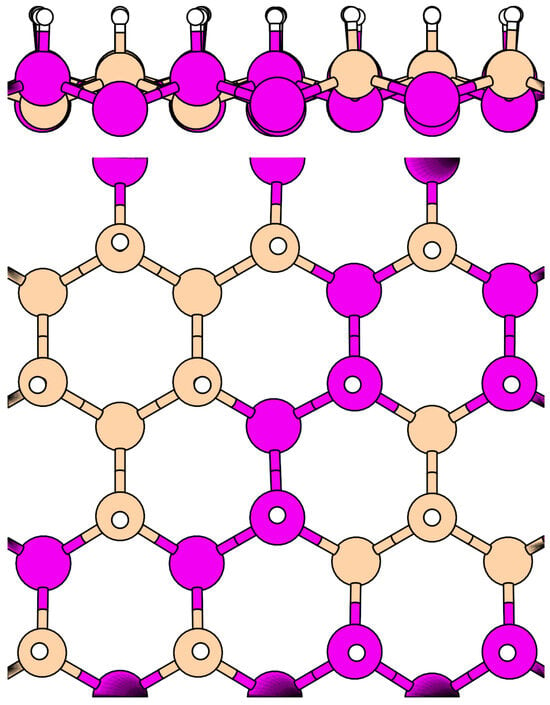
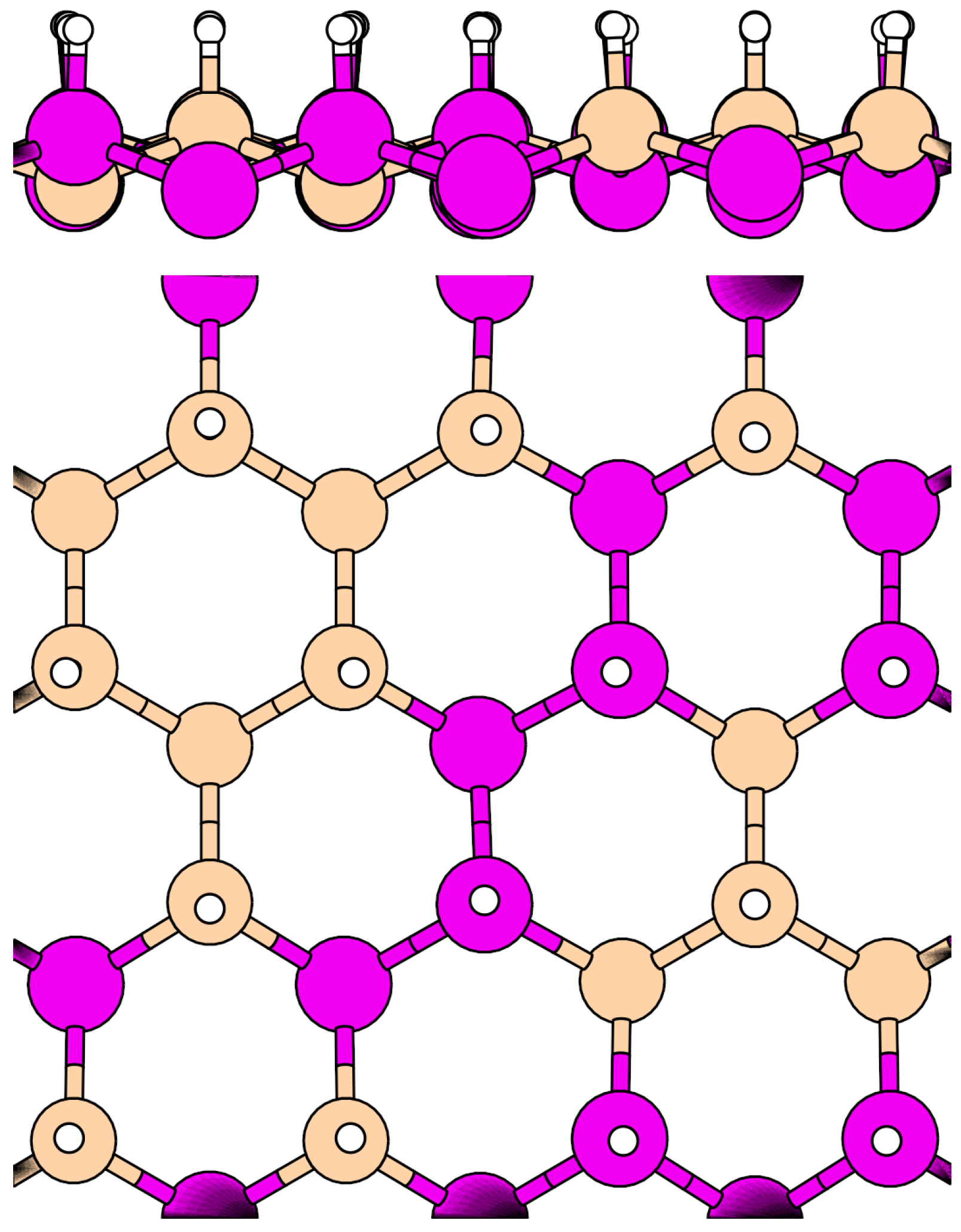
The structural model of the representative semi-hydrogenated two-dimensional SiGe random alloy investigated in this work is shown in Figure 1, where the coexistence of substitutional disorder within the SiGe honeycomb lattice and hydrogen passivation of one side of the monolayer highlights the key structural ingredients underlying the subsequent electronic and magnetic properties.
Figure 1.
Stick-and-balls model of 2D-@H random alloy crystal. Atoms are color-coded as follows: Hydrogen (white), Silicon (light orange), and Germanium (magenta). Top panel: side view. Bottom panel: top view.
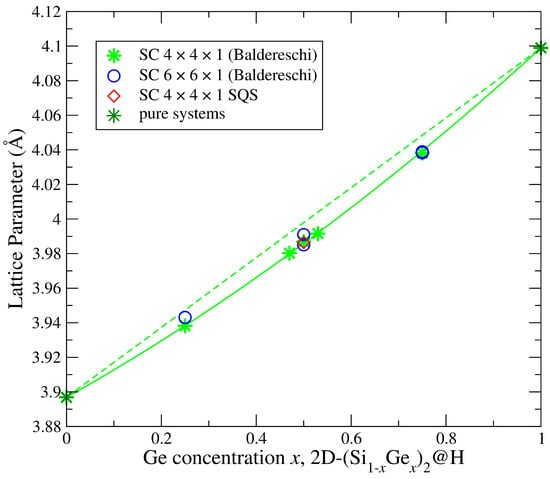
The composition dependence of the relaxed in-plane lattice parameter is reported in Figure 2, showing a smooth and nearly Vegard-like behavior with a small bowing, which confirms the structural stability of the two-dimensional SiGe random alloys across the entire composition range and provides a consistent structural framework for the analysis of their electronic and magnetic properties.
Figure 2.
Lattice parameter of the primitive unit cell as a function of random alloy composition. Symbols denote first-principles results obtained for representative configurations ( supercells), larger supercells (), SQS configurations, and pure systems at the boundaries of the concentration range. Solid line: bowing () interpolation. Dashed line: Vegard’s law (linear function).
The composition dependence of the lattice parameter, including results obtained for different supercell sizes and configurations, is shown in Figure 2.
The calculated values exhibit a smooth and nearly Vegard-like behavior across the entire composition range. Results obtained using representative configurations in 4 × 4 supercells (Baldereschi approach), larger 6 × 6 supercells constructed within the same representative-structure (Baldereschi) framework, and a SQS-like configuration are in excellent agreement.
At the composition limits ( and ), the system reduces to the pure 2D-@H and 2D-@H monolayers, respectively, which are not subject to configurational disorder and are therefore described by their primitive 1 × 1 unit cells. The overall consistency between different supercell sizes and configurations confirms the robustness of the structural properties against chemical disorder.
The very small dispersion of the lattice parameter across different configurations further supports the validity of the adopted structural sampling.
3.2. Spin-Polarized Electronic Structure and Flat Bands
All the investigated systems converge to a magnetic semiconducting ground state characterized by a robust and integer magnetic moment. For the primitive unit cell of hydrogenated two-dimensional group-IV layers, containing two Si or Ge atoms and one H atom, the spin-polarized self-consistent calculations yield a total magnetization of per cell within numerical accuracy. This magnetic moment scales linearly with the system size: in the supercells (48 atoms) employed to model the random SiGe alloys, the total magnetization converges to per supercell. This proportionality demonstrates that the magnetic order is intrinsic and homogeneously distributed over the two-dimensional lattice, rather than arising from localized states associated with defects or specific chemical environments.
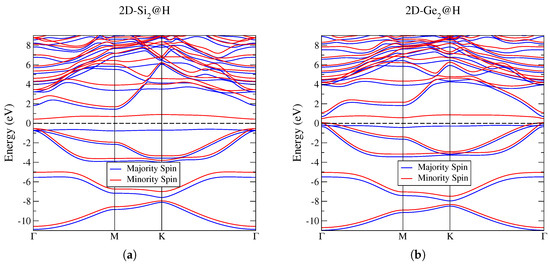
The integer magnetic moment per primitive cell is directly reflected in the spin-resolved Kohn–Sham electronic band structure. As shown in the left and right panel of Figure 3 for 2D-@H and 2D-@H, respectively, the electronic structure is characterized by a fully occupied majority-spin valence band and an empty minority-spin conduction band, separated by a finite energy gap. Notably, the highest occupied majority-spin band and the lowest unoccupied minority-spin band exhibit a remarkably weak dispersion along the high-symmetry directions of the Brillouin zone, resulting in nearly flat frontier bands close to the Fermi level. Such flat-band features are known to enhance interaction effects and play a central role in stabilizing magnetic order in low-dimensional systems.
Figure 3.
Spin-resolved electronic band structures of (a) 2D-@H and (b) 2D-@H calculated at the Kohn–Sham level. Majority- and minority-spin channels are shown separately, highlighting the magnetic semiconducting character and the presence of nearly flat frontier bands in the vicinity of the Fermi level (set to zero energy).
This flat-band character is preserved upon alloying. Despite the presence of chemical disorder in the random SiGe alloys, both the spin polarization of the band edges and the semiconducting character of the systems remain stable over the entire composition range. The persistence of flat frontier bands indicates that alloy disorder does not induce significant band broadening or spin mixing in the vicinity of the gap, highlighting the robustness of the underlying magnetic mechanism in the presence of chemical disorder.
A quantitative analysis of the composition dependence of the fundamental energy gap, at both the Kohn–Sham and quasiparticle levels, is provided in Appendix B (see also Figure A1). Due to its intrinsically k-resolved nature, the band gap is more sensitive to local electronic rearrangements in random alloys than Brillouin-zone-averaged structural and optical observables.
3.3. Robustness Against Chemical Disorder
Disorder effects in two-dimensional alloys are known to influence electronic properties; however, several studies have shown that key physical features may remain robust under configuration averaging [16,40].
To explicitly assess the robustness of the present results against chemical disorder, additional calculations were performed using both a SQS-like configuration in a 4 × 4 supercell and multiple independent random configurations in larger 6 × 6 supercells.
In all cases, the total magnetic moment scales linearly with system size (16 for 4 × 4 and 36 for 6 × 6 supercells), demonstrating that magnetism is an intrinsic and extensive property of the system, independent of the specific atomic arrangement.
The electronic band gap exhibits only minor variations (on the order of 0.03–0.05 eV) across different configurations. This behavior is reflected in the small dispersion of the data reported in Figure A1 and confirms that the main electronic trends are preserved despite different realizations of the alloy structure.
Overall, these results demonstrate that both the magnetic and electronic properties of semi-hydrogenated SiGe monolayers are remarkably robust with respect to the different realizations of chemical disorder considered in the present study, supporting the validity of the representative-structure approach adopted in this work. In particular, the absence of significant fluctuations in both magnetization and band gap indicates that the underlying physical mechanism is governed by global electronic structure features rather than local atomic arrangements.
3.4. Many-Body Electronic Structure and Optical Properties
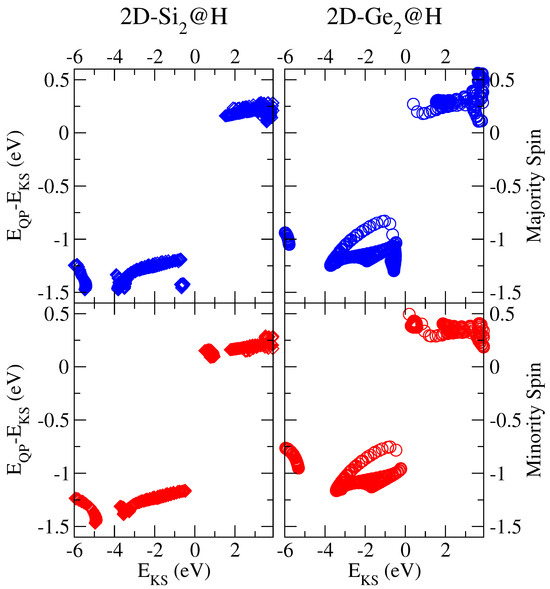
Many-body quasiparticle corrections obtained within the approximation further support the stability of this electronic structure. As shown in Figure 4 for both majority- and minority-spin channels, the quasiparticle corrections renormalize the band energies with respect to the Kohn–Sham values while preserving both the spin separation and the weak dispersion of the frontier states. The calculated shifts display a pronounced spin dependence; however, they do not modify the total magnetic moment, confirming that the magnetic semiconducting state remains stable beyond the mean-field description.
Figure 4.
Quasiparticle energy corrections () for majority-spin (top panels) and minority-spin (bottom panels) states of 2D-@H (left panels) and 2D-@H (right panels). The origin of the horizontal axis is set at the Fermi energy.
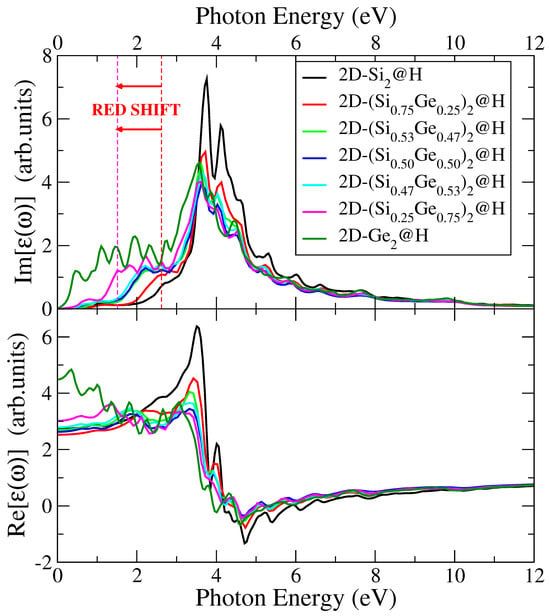
The optical response of the semi-hydrogenated SiGe alloys, computed within the random phase approximation and reported in Figure 5, exhibits systematic composition-dependent trends. In particular, the imaginary part of the macroscopic dielectric function, , shows a progressive red-shift of the low-energy spectral onset with alloy composition.
Figure 5.
Real and imaginary parts of the macroscopic dielectric function calculated within the random phase approximation for semi-hydrogenated 2D SiGe alloys at different compositions, for in-plane polarization. exhibits a composition-dependent red-shift of the low-energy onset with increasing Ge content. The red and magenta dashed vertical lines mark the positions of the low-energy onset of for 2D-@H and 2D-@H, respectively, highlighting the shift toward lower photon energies. shows a more complex compositional dependence.
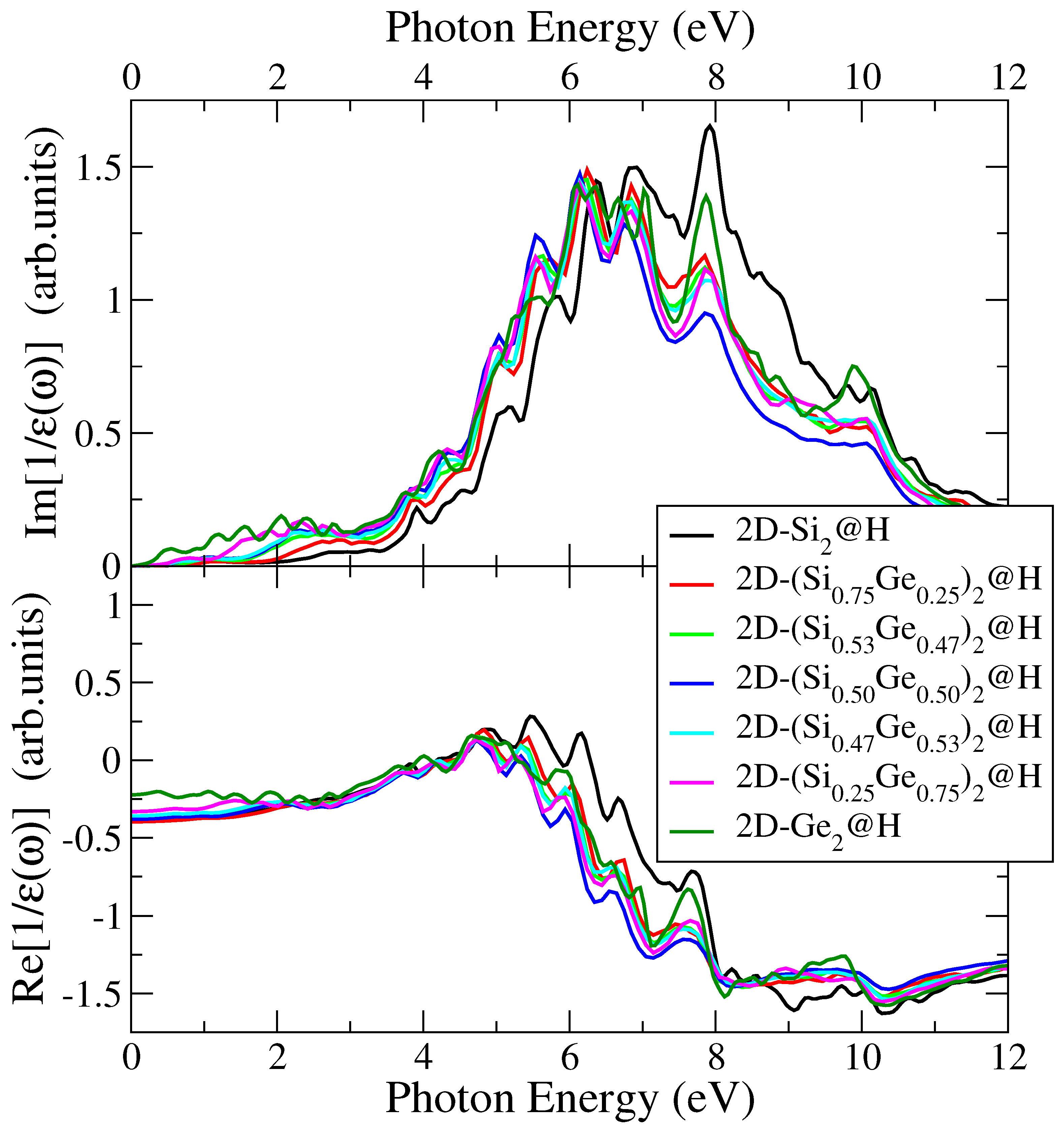
As a complementary characterization of collective electronic excitations, we report in Appendix C the energy-loss function , which provides direct access to longitudinal modes and can be directly compared with experimental electron energy-loss spectroscopy (EELS) measurements.
4. Discussion
The coexistence of an integer magnetic moment per primitive cell and nearly flat, spin-polarized electronic bands represents a distinctive feature of hydrogenated two-dimensional group-IV materials. The exact scaling of the total magnetization—from in the primitive cell to in the supercells—provides compelling evidence that magnetism in these systems is an intrinsic bulk property of the two-dimensional lattice, rather than a finite-size artifact or a consequence of specific local chemical environments.
The spin-resolved band structures shown in Figure 3 directly elucidate the microscopic origin of this behavior. The presence of an almost dispersionless majority-spin valence band and a similarly flat minority-spin conduction band indicates a strong localization of the electronic states responsible for magnetism, combined with long-range spin coherence across the lattice. Flat-band physics is well known to amplify interaction effects and to favor the emergence of magnetically ordered phases in low-dimensional systems. In the present case, hydrogen passivation plays a key role in stabilizing this electronic structure: by saturating dangling bonds and breaking sublattice symmetry, hydrogen eliminates non-magnetic surface states while enabling a spin imbalance that is delocalized over the buckled group-IV framework.
The robustness of flat, spin-polarized bands against chemical disorder, highlighted by the composition-dependent trends shown in Figure A1, is particularly significant. In many two-dimensional materials, alloying leads to band broadening, gap smearing, or suppression of magnetic order. In contrast, the SiGe random alloys investigated here retain both a finite energy gap and an integer magnetic moment per primitive cell over the entire composition range. This behavior indicates that magnetism is governed primarily by global electronic-structure features rather than by local Si/Ge substitutions.
In strictly two-dimensional systems, long-range magnetic order at finite temperature requires the presence of magnetic anisotropy, as stated by the Mermin–Wagner theorem. In the absence of anisotropy, thermal fluctuations would destroy long-range spin order. In the present system, the dominant energy scale is set by the exchange interaction associated with the nearly flat spin-polarized bands, which leads to a robust magnetic ground state at zero temperature.
Although spin–orbit coupling (SOC), not explicitly included in this study, is expected to introduce only a relatively small magnetic anisotropy in Si- and Ge-based systems, even weak anisotropy can be sufficient to stabilize magnetic ordering at finite temperature. Therefore, the results reported here establish the existence of a strong intrinsic magnetic instability, while the actual critical temperature will depend on the magnitude of anisotropy, which may be enhanced by substrate effects, strain, or external fields.
As a consequence, while a quantitative estimate of the Curie temperature is beyond the scope of the present work, the system identified here represents a promising platform for realizing two-dimensional magnetism in experimentally accessible conditions.
Quasiparticle effects, summarized in Figure 4, further support this interpretation. Although corrections substantially renormalize the band energies and introduce pronounced spin-dependent self-energy shifts, they do not alter the spin-resolved topology of the bands near the Fermi level. The preservation of flat frontier bands at the quasiparticle level demonstrates that these features are not artifacts of the Kohn–Sham approximation, but rather intrinsic properties of the interacting electronic system. As a result, the magnetic semiconducting state remains stable beyond the mean-field description.
The composition-dependent evolution of the optical response provides further insight into the electronic structure of semi-hydrogenated two-dimensional SiGe random alloys. In particular, the imaginary part of the macroscopic dielectric function, , shown in Figure 5, exhibits a progressive red-shift of the low-energy spectral onset with increasing Ge content. This behavior directly reflects the modification of the underlying interband transitions and is consistent with the evolution of the fundamental energy gap at the quasiparticle level.
From a microscopic perspective, the low-energy features of are dominated by vertical transitions involving the spin-polarized frontier states near the valence- and conduction-band edges. The preservation of nearly flat majority- and minority-spin bands across the entire composition range results in a high joint density of states close to the optical onset, enhancing the intensity of the pre-edge spectral features. As the alloy composition is varied, shifts in the relative energetic alignment of these frontier states translate into a systematic displacement of the optical onset, giving rise to the observed red-shift.
Importantly, the robustness of the red-shift trend against chemical disorder mirrors the stability of the magnetic semiconducting state and the persistence of flat frontier bands. This indicates that the optical response at low energies is governed by global electronic structure features rather than by local compositional fluctuations. In contrast, the real part of the dielectric function, , displays more complex variations with composition, reflecting its indirect dependence on the entire excitation spectrum through Kramers–Kronig relations rather than a rigid shift of specific spectral features.
From a broader perspective, the combination of flat bands, complete spin polarization at the band edges, and robustness against alloy disorder is highly desirable for two-dimensional spintronic applications. Flat bands enhance the density of states and magnify interaction-driven phenomena, while the fixed and scalable magnetic moment ensures well-defined and stable spin channels. In this context, semi-hydrogenated SiGe monolayers emerge as promising platforms for disorder-tolerant two-dimensional spintronic and magneto-optoelectronic devices, combining intrinsic magnetism with full compatibility with silicon-based technologies.
5. Conclusions
In this work, we have demonstrated that semi-hydrogenated two-dimensional SiGe random alloys host a robust magnetic semiconducting ground state that emerges intrinsically from the electronic structure of the hydrogenated group-IV lattice. By combining density functional theory, many-body perturbation theory within the approximation, and linear-response calculations, we have shown that these systems exhibit an integer magnetic moment per primitive cell together with nearly flat, spin-polarized frontier bands.
A key outcome of this study is the intrinsic and scalable nature of the magnetic order. The exact linear scaling of the total magnetic moment with system size, preserved across different alloy compositions, provides clear evidence that magnetism is a genuine bulk property of the two-dimensional lattice and not a finite-size or defect-related artifact. The flat-band character observed at the band edges plays a central role in this behavior by enhancing interaction effects and stabilizing spin polarization in a low-dimensional setting.
Importantly, the magnetic semiconducting state demonstrated here proves to be remarkably robust with respect to the different realizations of chemical disorder considered in this work. Despite the presence of substitutional randomness in the SiGe alloys, both the spin polarization and the finite energy gap are preserved over the entire composition range. Moreover, quasiparticle corrections within the framework confirm that the key features of the electronic structure—namely, spin separation and flat frontier bands—remain intact beyond the Kohn–Sham mean-field description, establishing the intrinsic character of the magnetic state at the many-body level.
The optical response provides a complementary perspective on this behavior: the progressive red-shift of the low-energy onset in the imaginary part of the dielectric function reflects the evolution of interband transitions involving flat, spin-polarized frontier states and remains robust against chemical disorder.
From an experimental perspective, although experimental realization is still evolving, several key ingredients required for the present system have already been demonstrated. Silicene and germanene monolayers have been successfully synthesized on metallic substrates such as Ag(111), Au(111), and Al(111), demonstrating the feasibility of stabilizing group-IV two-dimensional allotropes under epitaxial conditions [41,42,43]. In addition, their fully hydrogenated counterparts, silicane and germanane, have been experimentally realized and shown to exhibit semiconducting behavior, confirming the viability of chemical functionalization in these systems [44,45].
In the present case, the key requirement is the realization of asymmetric (single-sided) hydrogenation, which can in principle be achieved in supported geometries where one side of the monolayer is naturally protected by the substrate, while the exposed surface can be functionalized through controlled atomic hydrogen dosing in ultra-high vacuum. Although precise control of hydrogen coverage and uniformity remains challenging, similar strategies have been successfully employed in other two-dimensional materials, including graphene [46].
An additional practical aspect concerns the stability of the magnetic phase in the presence of a substrate. While substrate interactions may modify the electronic structure, the robustness of the flat-band-induced magnetism demonstrated in this work suggests that the underlying physical mechanism may persist under realistic conditions, particularly in weakly interacting or partially decoupled configurations. Moreover, the possibility of tuning the system via strain, electrostatic gating, or substrate engineering provides further routes to experimentally access and control the predicted magnetic semiconducting phase [3,47].
Overall, while experimental realization is non-trivial, the combination of established growth techniques, demonstrated hydrogenation strategies, and the intrinsic robustness of the predicted electronic properties suggests that the systems proposed in this work represent a physically plausible platform for the exploration of two-dimensional magnetism in group-IV materials.
From a more fundamental standpoint, the present results demonstrate that semi-hydrogenation provides an effective and conceptually simple route to stabilize interaction-driven magnetic phases in two-dimensional group-IV materials without relying on extrinsic dopants or engineered defects. The emergence of intrinsic magnetism, its resilience to chemical disorder, and its persistence at the quasiparticle level point to an electronic mechanism governed by global lattice symmetry and band topology rather than by local bonding details. Within this framework, semi-hydrogenated SiGe alloys can be viewed as a tunable model platform to explore flat-band magnetism in disordered low-dimensional systems. At the same time, the combination of intrinsic spin polarization, semiconducting behavior, and full compatibility with silicon-based materials suggests that these systems may offer realistic opportunities for the development of two-dimensional spintronic and magneto-optoelectronic functionalities under conditions where chemical disorder is present.
Funding
This research received no external funding.
Data Availability Statement
No new experimental data were created in this study. All computational parameters and data supporting the reported results are provided within the article.
Acknowledgments
The author acknowledges the Italian National Supercomputing Consortium (CINECA) for providing high-performance computing resources and technical support, and thanks Roberto Colnaghi for technical support on computer hardware. During the preparation of this manuscript, the author used Microsoft Copilot (M365 Copilot based on GPT-5 chat model) for assistance in revising and improving the clarity and organization of the text. The author reviewed and edited all content and takes full responsibility for the final manuscript.
Conflicts of Interest
The author declares no conflicts of interest.
Abbreviations
The following abbreviations are used in this manuscript:
| 2D | Two-dimensional |
| DFT | Density Functional Theory |
| GGA | Generalized Gradient Approximation |
| PBE | Perdew–Burke–Ernzerhof |
| One-shot approximation with self-consistency on the Green’s function only | |
| RPA | Random Phase Approximation |
| EELS | Electron Energy-Loss Spectroscopy |
| HPC | High-Performance Computing |
Appendix A. 2D-SiGe Random Alloy Crystal Structures
The representative random alloy configurations reported in Table A1 follow the same structural sampling strategy previously introduced in Ref. [11], here suitably extended to smaller supercells in order to enable converged quasiparticle and optical calculations. This approach provides a faithful representation of substitutional disorder while preserving a high degree of crystal symmetry, which is essential for the computationally demanding many-body simulations considered in this work.
For each alloy composition, the assignment of Si or Ge atoms to the different coordination shells was obtained by explicitly analyzing interatomic distances and symmetry-equivalent lattice sites within the relaxed structures. The same identification procedure adopted in Ref. [11] was employed, ensuring a consistent and reproducible definition of the local atomic environments across the entire composition range.
Table A1.
Local atomic environment of representative two-dimensional SiGe random alloys modeled using a supercell. For each Ge concentration x, the table reports the atomic species occupying the successive coordination shells around the central atom (defined as the atom located at the origin). Atoms belonging to the same coordination shell are at the same distance from the central atom and are symmetry-equivalent. Hydrogen atoms are not included. For completeness, the limiting cases and , obtained using a primitive cell, are also reported.
Appendix B. Quasiparticle Band Gap
The quasiparticle band gap reported in Figure A1 is defined as the energy difference between the minority-spin (spin-down) valence- and conduction-band edges at the point. For comparison, the corresponding Kohn–Sham (KS) gap is also shown.
The KS gap exhibits a moderate sensitivity to the specific atomic configuration; however, its variation remains limited to a few tens of meV. This behavior confirms the robustness of the main electronic trends against both chemical disorder and supercell size, as also reflected by the small dispersion of the data reported in Figure A1.
Figure A1.
Electronic band gap as a function of alloy composition, obtained from Kohn–Sham (KS) eigenvalues and quasiparticle-corrected (QP) energies. Symbols denote results for different structural models, including and supercells (Baldereschi representative configurations) and Special Quasi-random Structure (SQS, ) configurations, while data at the boundaries correspond to the pure systems. Solid lines are a guide for the eye. The dashed line represents the linear variation of the Kohn–Sham gap.
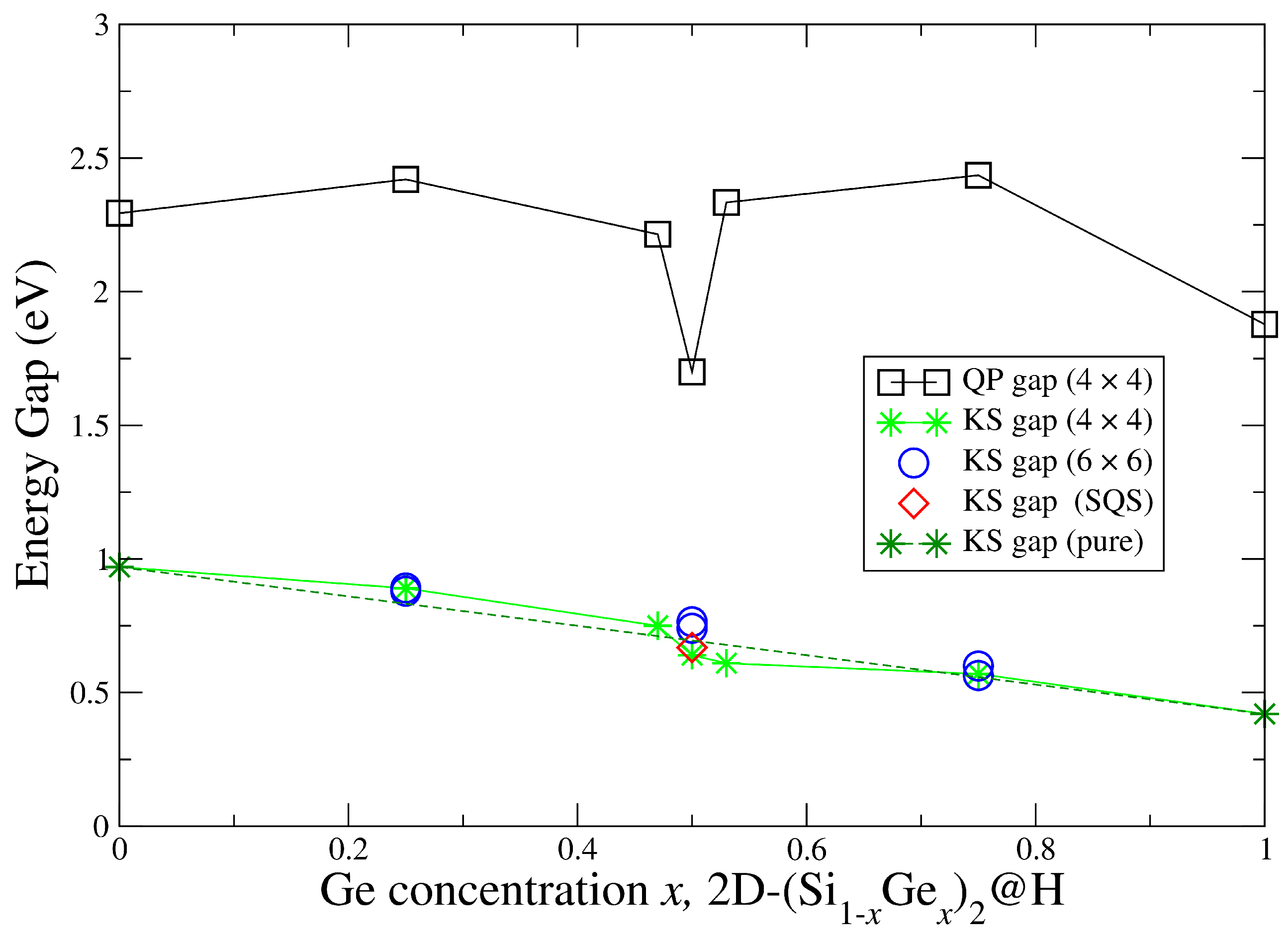
In contrast, the quasiparticle band gap displays a non-monotonic dependence on alloy composition. This behavior originates from the intrinsically k-resolved character of the band gap, which makes it more sensitive to local electronic rearrangements than Brillouin-zone-averaged quantities such as lattice parameters or optical spectra.
As a consequence, in substitutionally disordered systems, local variations in the electronic structure may be amplified at the quasiparticle level, leading to non-monotonic trends that do not affect the overall physical picture discussed in the main text. The small quantitative variations observed across different configurations further support the disorder-tolerant character of the electronic structure.
Appendix C. Energy-Loss Function
Since the investigated systems are intrinsically two-dimensional, the energy-loss function was computed exclusively for in-plane polarization. This choice is physically motivated, as in-plane fields probe collective charge-density excitations characteristic of two-dimensional systems (2D plasmons) and yield spectra that are directly comparable with electron energy-loss spectroscopy (EELS) measurements. In contrast, out-of-plane polarization is strongly affected by depolarization effects and vacuum contributions, which obscure the intrinsic electronic response of the monolayer.
Figure A2.
Energy-loss function computed within the random phase approximation for semi-hydrogenated two-dimensional SiGe random alloys at different compositions. The spectra are obtained from the macroscopic inverse dielectric function in the long-wavelength limit and provide direct insight into collective electronic excitations accessible by electron energy-loss spectroscopy (EELS).
References
- Novoselov, K.S.; Mishchenko, A.; Carvalho, A.; Castro Neto, A.H. 2D materials and van der Waals heterostructures. Science 2016, 353, aac9439. [Google Scholar] [CrossRef] [Scilit] [PubMed]
- Fiori, G.; Bonaccorso, F.; Iannaccone, G.; Palacios, T.; Neumaier, D.; Seabaugh, A.; Banerjee, S.K.; Colombo, L. Electronics based on two-dimensional materials. Nat. Nanotechnol. 2014, 9, 768–779. [Google Scholar] [CrossRef] [Scilit] [PubMed]
- Geim, A.K.; Grigorieva, I.V. Van der Waals heterostructures. Nature 2013, 499, 419–425. [Google Scholar] [CrossRef] [Scilit] [PubMed]
- Butler, S.Z.; Hollen, S.M.; Cao, L.; Cui, Y.; Gupta, J.A.; Gutiérrez, H.R.; Heinz, T.F.; Hong, S.S.; Huang, J.; Ismach, A.F.; et al. Progress, challenges, and opportunities in two-dimensional materials beyond graphene. ACS Nano 2013, 7, 2898–2926. [Google Scholar] [CrossRef] [Scilit] [PubMed]
- Takeda, K.; Shiraishi, K. Theoretical possibility of stage corrugation in Si and Ge analogs of graphite. Phys. Rev. B 1994, 50, 14916–14922. [Google Scholar] [CrossRef] [Scilit] [PubMed]
- Cahangirov, S.; Topsakal, M.; Aktürk, E.; Sahin, H.; Ciraci, S. Two- and One-Dimensional Honeycomb Structures of Silicon and Germanium. Phys. Rev. Lett. 2009, 102, 236804. [Google Scholar] [CrossRef] [Scilit] [PubMed]
- Ferri, M.; Fratesi, G.; Onida, G.; Debernardi, A. Optical properties of shortest-width zig-zag silicene nanoribbons: Effects of local fields. Micro Nano Eng. 2018, 1, 37–41. [Google Scholar] [CrossRef] [Scilit]
- Ferri, M.; Fratesi, G.; Onida, G.; Debernardi, A. Ab initio study of the structural, electronic, magnetic, and optical properties of silicene nanoribbons. Phys. Rev. B 2019, 99, 085414. [Google Scholar] [CrossRef] [Scilit]
- Debernardi, A.; Marchetti, L. Ab initio simulations of pseudomorphic silicene and germanene bidimensional heterostructures. Phys. Rev. B 2016, 93, 245426. [Google Scholar] [CrossRef] [Scilit]
- Douma, D.H.; Debernardi, A. Hydrogen passivation effects on band alignment in lateral 2D group-IV heterostructures: A first-principles study. 2D Mater. 2025, 12, 045028. [Google Scholar] [CrossRef] [Scilit]
- Debernardi, A. Tuning structural and electronic properties of two-dimensional Si and Ge based random alloys: An ab initio study. Eur. Phys. J. B 2020, 93, 117. [Google Scholar] [CrossRef] [Scilit]
- Bogusławski, P.; Baldereschi, A. Representative configurations and average properties of disordered semiconductors. In Proceedings of the 17th International Conference on the Physics of Semiconductors; Chadi, J.D., Harrison, W.A., Eds.; Springer: New York, NY, USA, 1990; pp. 939–942. [Google Scholar]
- Baldereschi, A.; Peressi, M. Atomic scale structure of ionic and semiconducting solid solutions. J. Phys. Condens. Matter 1993, 5, B37–B41. [Google Scholar] [CrossRef] [Scilit]
- Tinivella, U.; Peressi, M.; Baldereschi, A. Random pseudobinary ionic alloys: Lattice energy and structural properties. J. Phys. Condens. Matter 1997, 9, 11141–11154. [Google Scholar] [CrossRef] [Scilit]
- Zunger, A.; Wei, S.H.; Ferreira, L.G.; Bernard, J.E. Special quasirandom structures. Phys. Rev. Lett. 1990, 65, 353–356. [Google Scholar] [CrossRef] [Scilit] [PubMed]
- Wei, S.H.; Zunger, A. Electronic properties of random alloys: Special quasirandom structures. Phys. Rev. B 1990, 42, 9622–9649. [Google Scholar] [CrossRef] [Scilit] [PubMed]
- Mielke, A. Ferromagnetism in the Hubbard model on line graphs and further considerations. J. Phys. Math. Gen. 1991, 24, 3311–3321. [Google Scholar] [CrossRef] [Scilit]
- Picozzi, S.; Antoniella, F.; Continenza, A.; Mosca Conte, A.; Debernardi, A.; Peressi, M. Stabilization of half metallicity in Mn-doped silicon upon Ge alloying. Phys. Rev. B 2004, 70, 165205. [Google Scholar] [CrossRef] [Scilit]
- Peressi, M.; Debernardi, A.; Picozzi, S.; Antoniella, F.; Continenza, A. Half-metallic Mn-doped SixGe1-x alloys: A first-principles study. Comput. Mater. Sci. 2005, 33, 125–131. [Google Scholar] [CrossRef] [Scilit]
- Gong, C.; Li, L.; Li, Z.; Ji, H.; Stern, A.; Xia, Y.; Cao, T.; Bao, W.; Wang, C.; Wang, Y.; et al. Discovery of intrinsic ferromagnetism in two-dimensional van der Waals crystals. Nature 2017, 546, 265–269. [Google Scholar] [CrossRef] [Scilit] [PubMed]
- Huang, B.; Clark, G.; Navarro-Moratalla, E.; Klein, D.R.; Cheng, R.; Seyler, K.L.; Zhong, D.; Schmidgall, E.; McGuire, M.A.; Cobden, D.H.; et al. Layer-dependent ferromagnetism in a van der Waals crystal down to the monolayer limit. Nature 2017, 546, 270–273. [Google Scholar] [CrossRef] [Scilit] [PubMed]
- Taşcı, E.S.; Vatansever, E.; Avgin, I. Flat-band ferromagnetism in low-dimensional systems. Phys. Rev. B 2017, 95, 245122. [Google Scholar]
- Zhou, J.; Wang, Q.; Sun, Q.; Chen, X.S.; Kawazoe, Y.; Jena, P. Ferromagnetism in semihydrogenated graphene sheet. Nano Lett. 2009, 9, 3867–3870. [Google Scholar] [CrossRef] [Scilit] [PubMed]
- Leykam, D.; Flach, S. Perspective: Photonic flatbands. APL Photonics 2018, 3, 070901. [Google Scholar] [CrossRef] [Scilit]
- Tang, E.; Mei, J.W.; Wen, X.G. High-temperature fractional quantum Hall states. Phys. Rev. Lett. 2011, 106, 236802. [Google Scholar] [CrossRef] [Scilit] [PubMed]
- Giannozzi, P.; Baroni, S.; Bonini, N.; Calandra, M.; Car, R.; Cavazzoni, C.; Ceresoli, D.; Chiarotti, G.L.; Cococcioni, M.; Dabo, I.; et al. QUANTUM ESPRESSO: A modular and open-source software project for quantum simulations of materials. J. Phys. Condens. Matter 2009, 21, 395502. [Google Scholar] [CrossRef] [Scilit] [PubMed]
- Giannozzi, P.; Andreussi, O.; Brumme, T.; Bunau, O.; Buongiorno Nardelli, M.; Calandra, M.; Car, R.; Cavazzoni, C.; Ceresoli, D.; Cococcioni, M.; et al. Advanced capabilities for materials modelling with Quantum ESPRESSO. J. Phys. Condens. Matter 2017, 29, 465901. [Google Scholar] [CrossRef] [Scilit] [PubMed]
- Perdew, J.P.; Burke, K.; Ernzerhof, M. Generalized Gradient Approximation Made Simple. Phys. Rev. Lett. 1996, 77, 3865–3868. [Google Scholar] [CrossRef] [Scilit] [PubMed]
- Hamann, D.R. Optimized norm-conserving Vanderbilt pseudopotentials. Phys. Rev. B 2013, 88, 085117. [Google Scholar] [CrossRef] [Scilit]
- Van Setten, M.J.; Giantomassi, M.; Bousquet, E.; Verstraete, M.J.; Hamann, D.R.; Gonze, X.; Rignanese, G.M. The PseudoDojo: Training and grading a 85 element optimized norm-conserving pseudopotential table. Comput. Phys. Commun. 2018, 226, 39–54. [Google Scholar]
- Monkhorst, H.J.; Pack, J.D. Special points for Brillouin-zone integrations. Phys. Rev. B 1976, 13, 5188–5192. [Google Scholar] [CrossRef] [Scilit]
- Pfrommer, B.G.; Côté, M.; Louie, S.G.; Cohen, M.L. Relaxation of crystals with the quasi-Newton method. J. Comput. Phys. 1997, 131, 233–240. [Google Scholar] [CrossRef] [Scilit]
- Baldereschi, A. Mean-value point in the Brillouin zone. Phys. Rev. B 1973, 7, 5212–5215. [Google Scholar] [CrossRef] [Scilit]
- Hybertsen, M.S.; Louie, S.G. Electron correlation in semiconductors and insulators: Band gaps and quasiparticle energies. Phys. Rev. B 1986, 34, 5390. [Google Scholar] [CrossRef] [Scilit]
- Marini, A.; Hogan, C.; Grüning, M.; Varsano, D. Yambo: An ab initio tool for excited state calculations. Comput. Phys. Commun. 2009, 180, 1392–1403. [Google Scholar] [CrossRef] [Scilit]
- Hedin, L. New Method for Calculating the One-Particle Green’s Function. Phys. Rev. 1965, 139, A796–A823. [Google Scholar] [CrossRef] [Scilit]
- Bruneval, F.; Gonze, X. Accurate GW self-energies in a plane-wave basis. Phys. Rev. B 2008, 78, 085125. [Google Scholar] [CrossRef] [Scilit]
- Mak, K.F.; Lee, C.; Hone, J.; Shan, J.; Heinz, T.F. Atomically thin MoS2: A new direct-gap semiconductor. Phys. Rev. Lett. 2010, 105, 136805. [Google Scholar] [CrossRef] [Scilit] [PubMed]
- Onida, G.; Reining, L.; Rubio, A. Electronic excitations: Density-functional versus many-body Green’s-function approaches. Rev. Mod. Phys. 2002, 74, 601–659. [Google Scholar] [CrossRef] [Scilit]
- Bellaiche, L.; Vanderbilt, D. Virtual crystal approximation revisited: Application to dielectric and piezoelectric properties of perovskites. Phys. Rev. B 2000, 61, 7877. [Google Scholar] [CrossRef] [Scilit]
- Kara, A.; Enriquez, H.; Seitsonen, A.P.; Lew Yan Voon, L.C.; Vizzini, S.; Aufray, B.; Oughaddou, H. A review on silicene—New candidate for electronics. Surf. Sci. Rep. 2012, 67, 1–18. [Google Scholar] [CrossRef] [Scilit]
- Aufray, B.; Vizzini, S.; Oughaddou, H.; Léandri, C.; Ealet, B.; Le Lay, G. Graphene-like silicon nanoribbons on Ag(110): A possible formation of silicene. Appl. Phys. Lett. 2010, 96, 183102. [Google Scholar] [CrossRef] [Scilit]
- Derivaz, M.; Dentel, D.; Stephan, R.; Hanf, M.C.; Mehdaoui, A.; Sonnet, P.; Pirri, C. Continuous germanene layer on Al(111). Nano Lett. 2015, 15, 2510–2516. [Google Scholar] [CrossRef] [Scilit] [PubMed]
- Bianco, E.; Butler, S.; Jiang, S.; Restrepo, O.D.; Windl, W.; Goldberger, J.E. Stability and exfoliation of germanane: A germanium graphane analogue. ACS Nano 2013, 7, 4414–4421. [Google Scholar] [CrossRef] [Scilit] [PubMed]
- Trivedi, S.; Srivastava, A.; Kurchania, R. Silicene and germanene: A first principle study of electronic structure and effect of hydrogenation-passivation. J. Comput. Theor. Nanosci. 2014, 11, 781–788. [Google Scholar] [CrossRef] [Scilit]
- Elias, D.C.; Nair, R.R.; Mohiuddin, T.M.G.; Morozov, S.V.; Blake, P.; Halsall, M.P.; Ferrari, A.C.; Boukhvalov, D.W.; Katsnelson, M.I.; Geim, A.K.; et al. Control of graphene’s properties by reversible hydrogenation: Evidence for graphane. Science 2009, 323, 610–613. [Google Scholar] [CrossRef] [Scilit] [PubMed]
- Huang, C.; Wu, S.; Sanchez, A.M.; Peters, J.J.P.; Beanland, R.; Ross, J.S.; Rivera, P.; Yao, W.; Cobden, D.H.; Xu, X. Lateral heterojunctions within monolayer MoSe2–WSe2 semiconductors. Nat. Mater. 2014, 13, 1096–1101. [Google Scholar] [CrossRef] [Scilit] [PubMed]
Disclaimer/Publisher’s Note: The statements, opinions and data contained in all publications are solely those of the individual author(s) and contributor(s) and not of MDPI and/or the editor(s). MDPI and/or the editor(s) disclaim responsibility for any injury to people or property resulting from any ideas, methods, instructions or products referred to in the content. |
© 2026 by the author. Licensee MDPI, Basel, Switzerland. This article is an open access article distributed under the terms and conditions of the Creative Commons Attribution (CC BY) license.